Usage of Integers as Directed Numbers

Use of Integers as Directed Numbers | Solved Examples on How to Use Integers?

Directed numbers are integers that have a particular magnitude and direction. Integer can be any number that can’t be decimal or fraction. Check the definition of directed numbers, integers, and examples. All students can know how to use integers as directed numbers by following the example questions existing in our further sections.

Directed Numbers  – Definition

Directed numbers are the integers that represent a direction either positive or negative. Integers are the numbers that can be positive or negative or 0.

The examples of integers are -5, -4, -3, -2, -1, 0, 1, 2, 3, 4, 5, . . . . The set of integers can be represented by Z.

How to Use Integers?

Integers can be used to perform arithmetic operations like addition, subtraction, multiplication and division. The examples of types of integers are along the lines.

  • The profits in a business represent a positive integer, losses mean a negative integer.
  • The rise in price represents a positive integer, the fall in the price of a product is a negative integer.

Use of Integers as Directed Numbers

The simple steps to use the integers as directed numbers are mentioned here.

  • Draw two perpendicular lines representing east, west in opposite directions.
  • North on the top and south on the bottom.
  • East and North represent positive integers.
  • West, South represents negative integers.
  • Locate the number and mark it.

Example Questions on Integers as Directed NUmbers

Question 1:
What is the meaning of the following expressions?
(i) -15 km to the east
(ii) Profit of -$58
(iii) Ascending -15 feet

Solution:
(i) -15 km to the east = 15 km towards the West
(ii) Profit of -$58 = Loss of $58
(iii) Ascending -15 feet = 15 feet downward movement or descending 15 feet.

Question 2:
A person drives 15 miles due to south and then 10 miles due north. Find his position with respect to his starting point.

Solution:
Let 15 miles due South is represented by +15, then -10 miles represents 10 miles due North.
Use of Integers as Directed Numbers 1
On adding +15 and -10, we get;
(+15) + (-10) = 15 – 10
= 5
Therefore, the position of the person with respect to his starting point is 5 miles due north.

Question 3:
David has money of Rs 800 in the bank account. He withdraws Rs 500. How much money he had in the bank account?

Solution:
Given that,
David has the money in the bank account = Rs 800
Withdrawl amount = Rs 500
The money he has in the bank account = 800 – 500 = 300
Therefore, the money he has in the bank account = Rs 300

FAQ’s on Use of Integers as Directed Numbers

1. What is a directed number in maths?

The directed numbers are the numbers with both direction and size. One direction is positive and the other is negative.

2. What are the uses of integers in real life?

Integers are useful to compute the efficiency of positive or negative numbers in almost every field. It also helps to know the position.

3. What are directed numbers in integers?

Directed numbers are integers that have a particular magnitude/size and direction.

4. What are the integer rules?

Rules of integers can be defined as follows:

  • The Sum of two positive or negative integers is an integer
  • The product of two positive or negative integers is an integer.
  • The addition between any integer and its negative value results in zero.
Properties on Multiplication of Decimal Numbers

Properties of Multiplication of Decimal Numbers – Definition, Facts, Examples | Rules about Multiplying Decimals

In this article, you will learn in detail about the Properties of Multiplication of Decimal Numbers, Some examples, and so on. Students who want to multiply the decimal numbers either by decimal numbers or whole numbers must have to know the properties of the Multiplication of Decimal Numbers. The method of multiplying the decimal numbers is the same as the multiplication of whole numbers.

Also, Refer: Problems on Multiplication of Decimal Fractions

What is a Decimal?

In mathematics, a Decimal Numbers will be defined as one type of number, which has an integer part and a fractional part is separated by a dot. The dot in between a whole number and a fractional part is called a decimal point. The digits followed by the decimal point show a value is always smaller than one.

Types of Decimals:
There are two types of decimals, namely:
1. Recurring Decimal Numbers
2. Non- Recurring Decimal Numbers

Recurring Decimal Numbers – These Decimal Numbers are Repeating or Non-Terminating Decimals.
Examples of Non-Terminating Decimal Numbers are 2.123123 (Finite) and 4.252525252525… (Infinite).

Non-Recurring Decimal Numbers – These Decimal Numbers are Non Repeating or Terminating Decimals.
Examples of Non-Recurring Decimal Numbers are 5.14812 (Finite), 2.5428454845…. (Infinite).

What is Multiplication of Decimal Numbers?

Multiplication of decimal numbers is defined as first multiply as if there’s no decimal and then count the number of digits after the decimal in each factor. After that, put the same numbers of digits behind the decimal in the product.

Properties of Multiplication of Decimal Numbers

The below given are Properties of Multiplication of decimal numbers:

  • When we multiply the decimal number with zero then the product value is zero.
  • The product of a decimal number and a whole number multiplied in any order remains similar.
  • The product of two decimal numbers remains similar, even though the order is modified.
  • The product of decimal fractions and 1 is the decimal fraction itself.
  • When you perform multiplication in decimals, the numbers will be taken in any order and therefore the product will always remain the same.

Problems on Multiplication of Decimals

Problem 1: 
Find the final product value of 3.77 x 2.8

Solution:
As given in the question, the values are 3.77, and 2.8.
If the order of numbers is changed, then also the product of two decimal numbers remains the same.
Now, multiply the values and write the product value.
So, the product value is,
3.77 x 2.8 = 10.556
If the order is changed,
2.8 x 3.77 = 10.556
Both the values are the same.
Therefore, the final product value is 10.556.

Problem 2:
Find the following product values:
(i) 1 x 7.61
(ii) 8.32 x 1
(iii) 1x 5.98 x 1

Solution:
Given in the question,
(i) 1 x 7.61
The product of decimal fractions and 1 is the decimal fraction itself.
So, the product value of given numbers is,
1 x 7.61 = 7.61

(ii) 8.32 x 1
Now, we have to find the product value.
The product of decimal fractions and 1 is the decimal fraction itself.
So, the product value is
8.32 x 1= 8.32

(iii) 1 x 5.98 x 1
The product of decimal fractions and 1 is the decimal fraction itself.
Thus, the product value is
1 x 5.98 x 1 = 5.98

Problem 3:
If the cost of 1 book is Rs. 18.10. Find the cost of 4 books?

Solution:
Given,
The cost of 1 book is, Rs.18.10
Now, we have to find the cost of 4 books using the multiplication method.
So, the cost of 4 books is,
Rs.18.10 x 4 =Rs. 72.4
Therefore, the cost of 4 books is Rs. 72.4.

Problem 4:
What are the values of the following:
(i) 101.54 x 0
(ii) 654.3 x 0

Solution:
As given in the question, the values are
(i) 101.54 x 0
Now, we have to multiply and write the value.
The product of decimal fractions and zero is zero.
So, the values are,
101.54 x 0 = 0
Therefore, the given value product value is 0.

(ii) 654.3 x 0
Now, we need to find the product value using multiplication.
The product of decimal fractions and zero is zero.
Thus, the product value is,
654.3 x 0 = 0

Problem 5:
What is the multiplication value of a given number? The value is 3.5 x 1.7 x 75.3.

Solution:
As given in the question, the value is 3.5 x 1.7 x 75.3
Now, using the multiplication method we need to find the value.
So, the values are,
3.5 x 1.7 x 75.3 = 3.5 x (1.7 x 75.3) = 448.035
When you perform multiplication in decimals, the numbers will be taken in any order and therefore the product will always remain the same.
Therefore, the multiplication value of 3.5 x 1.7 x 75.3 is 448.035

FAQ’s on Properties of Multiplying Decimals

1. What is the Multiplication of decimal numbers?

Multiplication of decimal numbers is defined as first multiply as if there’s no decimal and then count the number of digits after the decimal in each factor. After that, put the same numbers of digits behind the decimal in the product.

2. What are the four rules of decimals?

Four basic rules (or) operations involving decimals are addition, subtraction, multiplication, and division.

3. If a decimal fraction is multiplied by a 1, what will be the product value?

When the decimal fraction is multiplied by 1, the product value is the decimal fraction itself.

Comparing and Ordering Integers

Comparing and Ordering Integers on the Number Line – Examples | Order Integers in Ascending or Descending Order

Ordering integers means arranging integers either in ascending order or descending order. The integer is the positive numbers, negative numbers, and zero. The integers are compared and ordered on a number line from the least to highest and highest to least. Students who are in 6th grade math can get useful details like definitions and solved examples on integers order in the following sections.

Do Refer:

Integers – Definition

Integers are the set of whole numbers and their opposite numbers. The three types of integers are positive integers, negative integers, and zero. Integers that are greater than zero are positive integers and these are arranged on the right side of 0 on the number line. Negative integers are the integers that are lesser than zero and these are placed on the left side of 0 on the number line. Zero is neither positive nor negative. Integers are denoted by Z= { . . -4, -3, -2, -1, 0, 1, 2, 3, 4, 5, . .}

Ordering Integers on the Number Line

We can find the order of integers using the number line. On a number line, the integers on the left side of 0 are negative integers and they are arranged in ascending order from left to right. The numbers on the right side of 0 are positive numbers and they are arranged in ascending order from left to right. So, integers are arranged in ascending order on the number line.

Number Line with Integers

In the above figure, the integers -5 to 6 are placed from lowest to the highest from left to right. So, the order of integers is -5 < -4 < -3 < -2< -1 < 0 < 1 < 2 < 3 < 4 < 5 < 6.

Comparison of Integers

We can compare two integers at a time. The symbols used to compare integers are >, <, and =. If the value of the first integer is more than the second integer, then > symbol is used. When two integers have the value, then = symbol is used, otherwise < symbol is used.

The facts about comparing the integers are given here:

  • The order of integers on the left side of the number line is smaller than 0 and on the right side of the number line, are greater than 0.
  • All positive integers are greater than all negative integers.
  • The more the integer is negative, the more its value is smaller
  • The more the integer is positive, the more its value is greater.

Solved Examples on Ordering of the Integers

Example 1:
Arrange the following integers in ascending order.
(i) -5, 0, 3, -8, 6, 4
(ii) 8, 2, 5, 15, -1, -3

Solution:
The number line for the integers is given here.
number line
(i) The ascending order of given integers is -8, -5, 0, 3, 4, 6
(ii) The ordering integers from least to greatest is -3, -1, 2, 5, 8, 15

Example 2:
Arrange the following integers in descending order.
(i) 3, -1, 0, -5, 7, 9, 8
(ii) 2, -2, 5, -8, 0, -6, 3

Solution:
(i) The order of given integers from lowest to the greatest is 9, 8, 7, 3, 0, -1, -5
(ii) The given integers order in descending order is 5, 3, 2, 0, -2, -6, -8.

Frequently Asked Question’s on Comparing Integers

1. How to compare and order integers?

Compare any two integers and place < or > or = symbol between them. Based on the comparison symbol between the integers, they can be placed either from lowest to greatest or greatest to the lowest sequence.

2. What are the rules for placing integers in order?

The rules of integers are positive integers have the highest value than negative integers, zero is not a positive or negative integer. The more negative integer has a smaller value. By considering these rules, one can arrange the integers in order.

3. What is the meaning of ordering integers?

Integers ordering is a sequence in which integers are arranged. It is the arrangement of integer numbers in descending or ascending order.

4. What are the 2 types of ordering integers?

The two types of ordering and comparing integers are ascending order and descending order.

Use of Integers

Everyday Use of Integers with Examples | Usage of Integers as Directed Numbers

An integer is a number that includes 0, positive numbers, and negative numbers. It can never be a fraction, decimal, or percent. Integers are mainly used in our day-to-day lives in mathematical terms. Get to know the definition, operations, and use of integers in the below-mentioned sections. Also, get the example questions with solutions for the convenience of grade 6 math students.

Also, Check: Use of Integers as Directed Numbers

What is an Integer?

Integers are a set of counting numbers (positive and negative) along with zero. Some of the examples of integers are -4, -3, -2, -1, 0, 1, 2, 3. The integers are represented by Z. The types of integers are positive integers, negative integers, and zero.

Integer Rules

The rules depend on the operations performed on integers given below:

  • Addition Rule:
    • If the sign of both integers is the same, then the sum will have the same sign.
    • If the sign of one integer is positive, the sign of another integer is negative, then the sign of the result is the sign of the larger number.
  • Subtraction Rule:
    • Convert the operation to addition by changing the sign of the subtrahend.
  • Multiplication Rule:
    • Multiply the sign of integers to get the result sign.
  • Division Rule:
    • Divide the signs of two operands and get the resultant sign.

Read More:

Real Life Examples of Integers

The examples on using integers are along the lines:

  • If profit is represented by positive integers, losses are by negative integers.
  • The rise in the price of a product is represented by positive integers and fill in price by negative integers.
  • If heights above the sea level are represented by positive integers, then depths below sea level by negative integers, and so on.

Integers as Directed Numbers

If a number represents direction, then the number is called a directed number. The below-given examples explain it in detail.

Example:
If +4 represents 4 m towards East, then -5 represents 5 m towards its opposite direction i.e towards west.
Use of Integers as Directed Numbers 1
If a positive integer shows a particular direction, then the negative integer shows the opposite direction.

Example Questions on Use of Integers

Question 1:
Write an integer to describe a situation
(i) Losing Rs 100
(ii) Owing Rs 1500
(iii) Depositing $500 in a bank

Solution:
(i) An integer representing a loss of Rs 100 is -100.
(ii) An integer representing an owing of Rs 1500 is -1500
(iii) An integer representing depositing $500 in a bank is +500

Question 2:
Write an appropriate integer for each of the following:
(i) earned Rs 800 interest
(ii) a decrease of 5 members
(iii) an increase of 3 inches

Solution:
(i) Earned Rs 800 interest is represented by +800
(ii) Decrease of 5 members is represented by -5
(iii) An increase of 3 inches is represented by +3

Frequently Asked Question’s on Using Integers

1. What are the applications of integers?

Integers are used to signify two contradicting situations. The positive and negative integers have different applications. Integers can compare and measure changes in temperature, credits, debits calculation by the bank.

2. What are the integer rules?

The integer rules are the sum of two integers is an integer, a difference of two integers is an integer. Multiplication of two or more integers is an integer. The division of integers may or may not be an integer.

3. What are the integer properties?

The main properties of integers are closure property, commutative property, associative property, identity property, and distributive property.

4. What are the 5 integer operations?

The operations with integers are addition, subtraction, multiplication, and division.

Worksheet on Simple Word Problems on Proportions

Worksheet on Simple Word Problems on Proportion | Proportion Word Problems Worksheet PDF

Practice the simple questions on Proportion in our Worksheet on Simple Word Problems on Proportion. Our Worksheet on Simple Word Problems on Proportion is meant for 6th Grade Math Students. Download the free Printable Proportion Word Problems Worksheet with Answers PDF and learn the problem-solving approach used.

Numbers are said to be in Proportion if the product of extremes = product of middle terms. All the Word Problems are given here and explain the basic concept of proportion in a better way. Use it during your homework or assignments and resolve your queries in no time.

Do refer:

Proportion Word Problems Worksheet with Answers PDF

I. If the cost of 12 apples is Rs 200. what is the cost of 18 apples?

Solution:

Given,
The cost of 12 apples=Rs 200
Let the Cost of 18 apples be x.
By the proportion, we get
200/12=x/18
18.200=12x
3600=12x
x=3600/12=300
Therefore, the cost of 18 apples is Rs 300.


II. The ratio of gold and copper, in an alloy is 5: 3. If the weight of gold, in the alloy is 2 kg; find the weight of the copper in the alloy?

Solution:

Given,
The ratio of gold and copper, in an alloy, is =5: 3
Weight of the gold=2 kg
Let the Weight of the copper=3x
weight of the gold=5x
2=5x
x=2/5=0.4
Weight of the copper in the alloy=3x
=3(0.4)=1.2 kg
Therefore, the ratio of copper in the alloy is 1.2 kg.


III. A worker working at the company earns Rs 1000 for every 9 hours of work. How much will the worker earn in 34 hours?

Solution:

Given,
No. of hours of work=9
He earns money for 9 hours=Rs 1000
Let the worker earn be x working for 34 hours.
By applying the proportion we get
1000/9=x/34
34000=9x
x=34000/9
=3777
Therefore, The worker will get Rs 3777 for working 34 hours.


IV. The first, second, and fourth terms of a proportion are 4, 5, and 10, respectively. Find its third term.

Solution:

Let the third term be x.
By applying the proportion we get
4:5=x:10
4.10=5. x
5x=40
x=40/5=8
Therefore, the third term is 8.


V. A map is given with a scale of 2 cm=400 km. What is the actual distance between the two places in km. If the distance in the map is 3.5 cm?

Solution:

Given that,
A scale of 2 cm=400 km
Let the scale of 3.5 cm be x.
By using the proportion we get
400:2=x:3.5
400.3.5=2x
x=400.3.5/2
=700 km
Therefore, the actual distance between the two places is 700 km.


VI. The ratio of the sale of Dresses on a Sunday to that of the whole week of the shop was 4: 9. If the total sale of dresses in the same week was Rs 5000, find the sale of dresses on Sunday?

Solution:

Given that,
The ratio of the sale of Dresses on a Sunday to that of the whole week of the shop was =4: 9
Let the sales of dresses on a Sunday=4x
Let the sales of dresses of the whole week=9x
The total sale of dresses in the same week was=Rs 5000
9x=5000
x=5000/9=555.55
Sales of dresses on the Sunday=4x=4(555.55)=2222
Hence, the Sales of dresses on a Sunday is Rs 2222.


VII. A picture measuring 5” high by 7” wide is to be enlarged so that the width is now 9. How tall will the picture be?

Solution:

Given that,
The height of the picture=5
The width of the picture=7
After enlarging the width is=9
Let the height of the picture=h
5/7=h/9
45=7h
h=45/7=6.42
Therefore, the height of the picture is 6.42.


VIII. In a mixture of 65 liters, the ratio of water to milk is 1:2. What is the amount of water to be added if the ratio has to be 2:1?

Solution:

Given that,
The ratio of water and milk=1:2
Number of litres of water = (1/(1+2)) *65 = 21 litres.
So, 65-21= 44 liters of milk is present in it.
Let the quantity of water to be added be x liters.
Setting up the proportion,
water /milk= (21+x)/44 = 2/1
21+x=88
x=67.
Therefore, 67 liters of water have to be added to bring it to the ratio of 2:1.


IX. A certain recipe calls for 2 kgs of sugar for every 4 kgs of flour. If 80kgs of this sweet has to be prepared, how much sugar is required?

Solution

:
Let the quantity of sugar required to be x kgs.
2 kgs of sugar added to 4 kgs of flour constitutes a total of 6 kgs of sweet.
2 kgs of sugar is present in 6 kgs of sweet. We need to find the quantity of sugar required for 80 kgs of sweet. So the proportion looks like this.
2/6 = x/80
160=6x
x=26.
Therefore, 26 kg of sugar is required for 60 kgs of sweet.


X. If 50 ml of water contains 14% of chlorine, how much water must be added in order to create an 8% chlorine solution?

Solution:

Let x ml of chlorine be present in water.
By applying the proportion we get,
Then, 14/100 = x/50
x = 7 ml
Therefore, 7 ml is present in 50 ml of water.
In order for this 7 ml to constitute 8% of the solution, we need to add extra water. Let this be y ml.
Then, 8/100 = 7/y → y =87.5 ml.
So in order to get an 8% chlorine solution, we need to add 87.5-50 = 37.5 ml of water.


XI. At a birthday party for 120 people, it was estimated that one bottle of cool drink would be sufficient for 5 people. How many bottles would be sufficient for 120 people?

Solution:

Given that,
Total no. of people at the birthday party=120
one bottle of cool drink will be sufficient for the people=5
Let x bottles be sufficient for 120 people.
By the proportion we get,
1:5=x:120
120=5x
x=120/5=24
Therefore, 24 bottles are sufficient for 120 people.


XII. Sameera used 6 packets of bread on an 8-day hiking trip. How many packets of bread she should pack for a 12-day hiking trip if she eats the same amount of bread each day?

Solution:

Given that,
6 packets of bread are sufficient for the 8-day hiking trip. 
Let b packets are sufficient for a 12-day hiking trip.
By using proportion,
b/12=6/8
b/12=3/4
b=3/4.12
=9
Therefore, Sameera should pack 9 packets of bread for the 12-day hiking trip.


Capacity

Capacity – Definition, Meaning, Units, Examples | Capacity Measurement Chart

We come across many objects that occupy the volume in our daily life. The volume is different for different containers. Capacity refers to the quantity that a container holds. In this article, we have provided what is meant by capacity, Units for Measurement of Capacity, some examples of measurement of capacity. Go through the problems and learn how to convert the measurements and enhance your skills.

The students of 5th grade are suggested to refer to our page to secure good marks in the exams. Also, this page helps you to know how to measure the capacity of the given quantity. Capacity is a word used in different situations for example “Jessie has a great capacity for work”

Read More: Multiplication and Division of Units of Measurement

Capacity – Definition

Capacity is defined as the amount of liquid a container can hold. Capacity is nothing but the volume or quantity of a container. Capacity is a liquid measurement. It is the ability of the hollow object for holding the substance. Capacity takes the shape of a particular container.

Difference between Volume and Capacity

Learn about the difference between volume and capacity from this page.

VolumeCapacity
1. Volume is the total space covered by the object.1. Capacity is defined as the amount of liquid a container can hold.
2. Volume is measured in cubic units.2. Capacity is measured in metric units like gallons, litres etc.
3. Solid and liquid both are measured in volume.3. Only hollow objects have the capacity.

Measurement of Capacity

Generally, capacity is used to measure to find how much an object can hold the substance. The capacity of an object is measured in solid, liquid, gas. Capacity is measured in metric units such as litres, millilitres, gallons etc. We can measure the capacity of the object with a spoon, jars, cups, glasses and so on.

Capacity Measurement Chart

U. S Standard System:

1 cup = 8 fluid ounces (fl oz)
1 pint (pt) = 2 cups
1 quart (qt) = 2 pints
1 gallon (gal) = 4 quarts

1 gallon = 4 quarts = 8 pints = 16 cups = 128 fluid ounces.

Metric Units:
Milliliters and liters are commonly used to measure capacity.

1 milliliter (ml) = 0.001 liter
1 centiliter (cl) = 0.01 liter
1 deciliter (dl) = 0.1 liter
1 liter (l) =  1000 milliliters
1 hectoliter (hl) = 100 liters
1 decaliter (dal) = 10 liters
1 kiloliter (kl) = 1000 liters

Examples of Measuring Capacity

Let us discuss measuring capacity with the help of the examples. Check out the problems and know how to convert from litres to millilitres and millilitres to litres.

Example 1.
A milkman sold 24 litres 300 millilitres of milk on 4 days of a month and 43 litres 130 millilitres of milk in the next 2 days. What quantity of milk did he sell in 5 days?
Solution:
Given,
A milkman sold milk on 4 days of a month = 24litres 300 millilitres
A milkman sold milk on next 2 days = 43 litres 130 millimetres
Quantity of milk did he sell in 5 days = 24litres 300millilitres + 43 litres 130 millilitres
= 67 litres 430 millilitres

Example 2.
Convert 24 litres into millilitres?
Solution:
Given,
1 litre = 1000 millilitres
24 litre = 24 × 1000 = 24000 millilitres
Therefore 24 litres = 24000 millilitres

Example 3.
Sowmya used 4000 millilitres of milk to make a sweet. The milk used in litres is?
Solution:
Given that,
Sowmya used 4000 millilitres of milk to make a sweet.
Convert from litres to millilitres.
We know that
1000 millilitres = 1 litre
4000 millilitres = 4 litres

Example 4.
Convert 3 litres 8 millilitres is equal to?
Solution:
Convert from litres to millilitres.
1 litre = 1000 millilitres
3 litre = 3000 millilitres
3000 millilitres + 8 millilitres = 3008 millilitres

Example 5.
A container has a capacity of 109000 millilitres the capacity in litres is?
Solution:
Given that,
A container has a capacity of 109000 millilitres.
We have to convert from millilitres to litres
1000 millilitres = 1 litre
109000 millilitres = 109 litres

FAQs on Measuring Capacity

1. What is the Measurement of the Volume and Capacity?

Volume is defined as the amount of total space covered by an object. Whereas capacity is defined as the measure of the quantity of an object. Volume is calculated as the product of the length, width and height of an object. Capacity is the measurement towards litres, millilitres.

2. What is the difference between volume and capacity?

1. Volume is measured in the cubic units such as cubic centimetres or cubic meters.
2. Capacity is measured in metric units like litres, millilitres
3. Volume is the space covered by an object.
4. Capacity is the amount of substance an object contained.

3. Is capacity and volume are same?

No, they are not the same. Capacity is measured in litres and volume is measured in cubic centimetres or cubic meters.

Multiplication and Division of Units of Measurement | How do you Multiply and Divide Measurements?

Students can learn how to multiply and divide the numbers with different units of measurement from here. The method of multiplication and division of units of measurement is similar to the multiplication and division of ordinary numbers and decimal numbers.

Students of 5th Grade can find the examples of problems of multiplication and division of units of measurement at the end of this page. Hence make use of this page and enhance your math skills and score good marks in the exams.

Multiplication and Division of Units of Length

Multiplication and division of different or equal units of length can be simplified using general numbers. It is similar to normal multiplication and division.

How to Multiply and Divide units of Length?

1. Determine the given numbers and units.
2. If the units are the same you can directly multiply the values.
3. If the units are different then you have to convert the units and then perform the multiplication and division operation.

Example:
Multiply 5 m 5 cm by 5.
Solution:
We can multiply lengths by a number like the multiplication of ordinary numbers
Multiplication of units of measurement img_1

Multiplication and Division of Units of Mass

The mass has the units like milligrams, grams, and kilograms. We can multiply and divide the units of mass similar to normal multiplication and division operations.

How to Multiply and Divide Units of Mass?

1. Identify the numbers and units.
2. If the units are the same you can multiply the values without any conversions.
3. If the units are not the same then you have to convert the units and then perform the multiplication and division operation.

Multiplication and Division of Units of Capacity

Capacity is nothing but the maximum amount a container can hold. The units of capacity are liters, milliliters. The operation of multiplication and division of capacity is the same as the ordinary multiplication and division.

How to Multiply and Divide units of Capacity?

1. Check the given numbers and units.
2. If the units are the same you can perform multiplication and division operations without any conversions.
3. If the units are unlike then you have to convert the units and then multiply and divide the numbers and write the result.

Units Conversion

  • 1 meter = 100 centimeters
  • 1 centimeter = 0.01 meter
  • 1 kilometer = 1000 meters
  • 1 meter = 0.001 kilometer
  • 1 liter = 1000 ml
  • 1 ml = 0.001 liter
  • 1 kilogram = 1000 grams
  • 1 gram = 0.001 kilogram

Multiplication and Division of Measurements with Different Units Examples

Example 1.
Multiply 13 kilometers 26 meters by 2?
Solution:
We can multiply lengths by a number like the multiplication of ordinary numbers
12 kilometres 26 meters = 13.026 meters
13.026 meters × 2 = 26.052 kilometres

Example 2.
Multiply 11 grams 12 milligrams by 5?
Solution:
12 milligrams = 12/1000 grams
11 grams 12 milligrams = 11.012 grams
11.012 grams × 5 = 55.060 grams

Example 3.
Divide 3 kilometers 140 meters units by 4.
Solution:
let us convert 3 kilometres 140 meters into meters = 3 kilometres 140 meters
= 3000 meters + 140 meters = 3140 meters
Now divide 3140 by 4 = 785 kilometres.

Example 4.
Divide 20 liters 340 milliliters by 2?
Solution:
When measurements are given as a combination of two units we first convert the bigger unit to a lower unit and then divide.
20 litres 340 millilitres = 20 litres + 340 millilitres
= 20000 milliliters + 340 millilitres
= 20340 millilitres
Now divide 20340 millilitres by 2 = 10170 millilitres
Therefore 10170 millilitres = 10000 millilitres + 170 millilitres = 10 liters 170 millilitres.

Example 5.
Divide 120 liters 34 dl by 8?
Solution:
34 dl = 3.4 litres
120 litres + 3.4 litres = 123.4 litres
123.4 litres divided by 8 = 15.425 = 15 liters 425 dl.

FAQs on Multiplying and Dividing Units of Measurement

1. Can you multiply two different units of measurement?

Multiplication and division of units don’t have any bases. Multiplication is repeated addition.

2. What are the units for multiplication and division?

When two different units are multiplied or divided the obtained result is a new unit which is a combination of the units.

3. How do you cross multiply with different units?

1. Write the conversion as a fraction.
2. Simply the numbers.
3. Cancel any units that are both top and bottom.

Metric Measures as Percentage

Metric Measures as Percentages – Definition, Facts, Rules, Examples | How to Calculate Metric Measures as Percentages?

Students who are interested to learn about metric measures as percentages can get detailed information from this page. Before directly going into the topic let us the basics like what is a metric system is and what is meant by a percentage. 5th grade students can know how to convert the cent as a percent of a dollar, the gram as a percentage of a kilogram, the centimeter as a percentage of a meter, etc. Also, you can see some example problems related to metric measures as percentages.

What is Metric System?

A Metric system is the decimal measuring system based on the meter, gram, liter as units of length, capacity, and weight or mass. It is a better system for measuring decimals. It is used in the home, education, industry but it is not suited for fractions.

What is meant by Percentage?

A percentage is a number or ratio expressed as a fraction of 100 it is denoted using the symbol % in abbreviations it is called pct. It is a dimensionless number; it has no units of measurement.

How to Measure Percentages?

  • First, Determine the total or whole amount given.
  • Divide the no. to be expressed as a percent by the total amount.
  • Divide the smaller number by the larger number to get the result.
  • Multiply the resulting value by 100.

Cent as a Percentage of a Dollar

Every dollar is made up of 1 hundred cents so each cent is equal to 1 percent of a dollar.
1 dollar = 100 cent
1 cent = 1/100 dollar = 1% of a dollar
10 cent = 10/100 dollar

Millilitre as a Percentage of a Liter

1 liter equals 1000 milliliters so each milliliter equals 0.001 percent of a liter.
1000 milliliter = 1 liter
1 ml = 1/1000 of a liter
1 ml = 0.1% of a liter

Centimeter as a Percentage of a Meter

1 meter equals 100 centimeters so each centimeter is equal to 0.01 percent of the meter.
100 centimeters = 1 meter
1 cm = 1/100 of a meter
1cm = 1% of a meter

Gram as a Percentage of a Kilogram

1 gram equals 1000 kilograms so each gram equals 0.001 percent of kilograms.
1000 grams = 1 kilogram
1 gram = 1/1000 of a kilogram
1 gram = 0.1% of a kg

Problems on Metric Measures as Percentages

It is very important to all to practice the problems along with the concept. Solving problems will help you to score the highest marks in the exams.

Example 1.
Convert 240 centimeters to meters?
Solution:
We know that,
100 centimetres = 1 meter
We know that 1 centimetre = 0.01 meter
Thus 240 centimetres = 240 × 0.01
240 centimetres = 2.40 meters
Therefore 240 centimetres is equivalent to 2.40 meters.

Example 2.
Convert 2000 grams to kilograms?
Solution:
We know that,
1000 grams = 1 kilogram
1 gram = 1/1000 kilograms = 0.001 kilograms
2000 grams = 2000 × 0.001 kilograms
2000 grams = 2 kilograms
Therefore 2000 grams is equivalent to 1 kilogram.

Example 3.
Convert 36 kiloliters to liters?
Solution:
We know that,
1 kiloliter = 1000 litres
36 kiloliters = 36 × 1000 litres
36 kiloliters = 36000 litres
Therefore 36 kiloliters are equivalent to 36000 liters.

Example 4.
Convert 82 grams to milligrams?
Solution:
We know that,
1 gram = 1000 milligrams
82 grams = 82 × 1000
82 grams = 82000 milligrams
Therefore 82 grams is equivalent to 82000 milligrams.

Example 5.
Find the value of 3 Percentage of dollar 70 is?
Solution:
We know that,
100 cent = 1 dollar
1 cent = 1/100 dollar
3 % of dollar 70 is
3/100 × 70 = $2.1
Therefore 3 percent of $ 70 is $ 2.1

FAQs on Metric Measures as Percentages

1. What are the units of percentage?

Percentages have no units of measurement.

2. What are the rules to follow when performing metric conversion?

General rules to follow in metric conversion is to move the decimal place to the right an equal number of places.

3. What do the metric measures indicate?

The metric system is a system of measurement that uses meter, liter, kilogram, grams, distance, volume, and so on.

Adding Integers

Adding Integers – Definition, Rules, Solved Examples | How to Add Positive, Negative Integers?

Integers are numbers that do not have fractions or decimals. One can perform fundamental arithmetic operations on two or more integers. Get to know about the step-by-step process of adding integers, rules to add two integers, and solved examples in the following sections. All the 6th grade students can learn the best way to find the addition of integers with the same sign and different signs.

Read Similar Articles:

Addition of Integers

In maths, addition is one of the primary arithmetic operations. Other fundamental operations are subtraction, multiplication, and division. Adding two integers means adding one integer to the other one. The result of the sum of two integers is always an integer.

It is possible to add two integers having the same sign or different sign. But we need to follow some rules for performing addition between the integers. Anyone can get the sum of two or more integers by finding it manually or using the number line.

What are the Rules for Adding Integers?

Integers are the group of numbers that is having positive, negative, zero, but not fractions or decimals. The rules for adding integers are along the lines. There are three possibilities of adding integers.

Addition Between Two Positive Integers:

  • If two positive integers are added, then the sign of the result will be positive.
  • For example, add +5 to +8, 5 + 8 = 13

Addition Between Two Negative Integers:

  • Whenever you add two negative numbers, then the result will be a negative number.
  • For example, add -5 to -8, -5 – 8 = -13.

Addition Between a Positive Integer and a Negative Integer:

  • The addition of a positive number and a negative number gives the result either a positive or negative number. The sign of the result is nothing but the sign of the greater number in the addition.
  • For example, add -5 to 8, -5 + 8 = 3

How to Add Integers?

The detailed step-by-step process to find the sum of two integers is given here.

  • Let us take any two integers.
  • Know the sign of those given numbers.
  • Based on the sign of the integer, decide the sign of the result.
  • Add the first integer to the next integer and write the result along with the sign.

Example Questions on Adding Integers

Question 1:
Evaluate the expression -13 + 25

Solution:
The given expression is -13 + 25
Subtract 13 from 25 and put the sign of the greatest number to the result.
Adding Integers 1
-13 + 25 = +12

Question 2:
Find the sum of following
(i) 15 + 13
(ii) 12 + (-14)
(iii) -23 – 32

Solution:
(i) Given expression is 15 + 13
Add two numbers and the sign of the result will be positive.

15 + 13 = +28
(ii) Given expression is 12 + (-14)
12 – 14 = ?
Subtract 12 from 14 and the sign of the result will be negative as the greatest number 14 have a negative sign.
So, 12 – 14 = -2
(iii) Given expression is -23 – 32
Add 23 to 32 and the sign of the result will be negative as two integers are negative.
Adding Integers 3
-23 – 32 = -55.

Frequently Asked Question’s on Addition of Integers

1. What are the rules for adding two integers?

The rules to add integers are:

  • The sum of two positive integers is a positive integer.
  • The sum of two negative integers is a negative integer.
  • The sum of a positive and negative integer is the highest number sign.

2. How do you add integers?

Add the first integer to the second integer and give the sign to the sum by checking the rules.

3. What does adding integers mean?

The addition of two integers means finding its sum. If the integers having the same sign, then the result will also have the same sign. If the integers are having different signs, then the result sign will be the sign of the highest number.

4. Give an example for the addition of integers?

The example of addition of integers is 4 + 5 = 9.

Intrepreting Bar Graph

Interpreting Bar Graph – Definition, Steps, Examples | How to Read and Interpret Bar Charts in Statistics?

Interpreting Bar Graph tells you how to collect the information from the bar chart. We have included different examples to explain the reading and interpretation of bar graphs. Also, every bar graph is explained with clear steps so that you can answer any kind of problem asked in your exams quite easily. Understand the construction of bar graphs and different types of bar graphs by referring to our other articles.

Also, Refer: Worksheet on Representing Data on Bar Graph

How to Interpret Bar Charts in Statistics? | Steps in Interpreting Bar Graphs

Follow the below steps to understand the data from a given Bar Graph.

1. Firstly, take the given bar graph you need to analyze.
2. Analyze the bar graph type.
3. Understand what data the bar graph represents.
4. Then, analyze different data and every rectangular graph available in a bar graph.
5. Finally, separate the information from the bar graph and answer all the related questions.

Features of a Bar Chart

Below are the some of the Features of a Bar Graph.

  • The Bar chart shows the large set of information in simple visual form.
  • It helps in estimating the key values at a glance.
  • It is better to represent the data than a table.
  • Each category of data can appear in the frequency distribution.

Interpreting Bar Graphs Examples

Example 1.
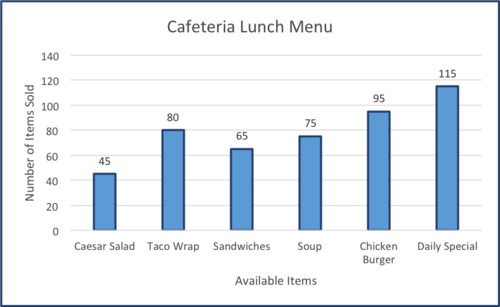
Evaluate the below bar graph and answer the following questions. The below bar graph compares the lunch options available in the college cafeteria to the number sold during one week.

Interpreting a bar graph

(i) How many sandwiches sold out from the Cafeteria lunch menu?
(ii) Which item sold high in between Chicken Burger and Taco Wrap?
(iii) Which item sold less in the Cafeteria lunch menu?

Solution:
Given Cafeteria lunch menu is
Caesar Salad – 45
Taco Wrap – 80
Sandwiches – 65
Soup – 75
Chicken Burger – 95
Daily Special – 115
(i) 65 sandwiches are sold out from the Cafeteria lunch menu.
(ii) Chicken Burger – 95 and Taco Wrap – 80
95 > 80.
Therefore, Chicken Burger is the most purchased from the Cafeteria lunch menu compared to Taco Wrap.
(iii) Caesar Salad items sold less in the Cafeteria lunch menu.

Example 2.
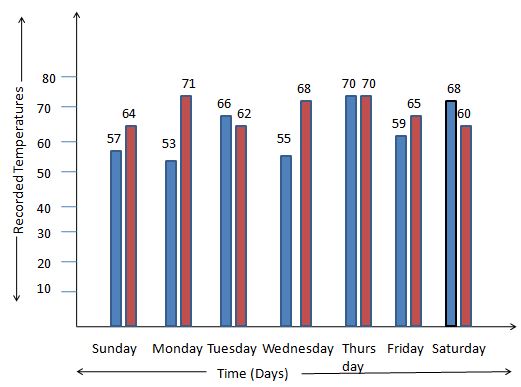
The Given bar graph is often drawn with two or more bars in each category. The following bar graph shows the temperature in degrees Fahrenheit for the third week of May for the years 2001 and 2016 respectively. Observe the bar graph to answer the questions presented below the graph.

Interpreting a bar graph example

(i) What was the highest recorded temperature in the year 2001?
(ii) What is the lowest temperature recorded for the year 2016?
(iii) What is the average daily temperature for the week displayed on the bar graph for each year?

Solution:
The temperature in degrees Fahrenheit for the third week of May from the years 2001 and 2016.
(i) The temperatures recorded in the 2001 year are 57, 53, 66, 55, 70, 59, 68.
70 is the highest temperature.
Therefore, the highest recorded temperature in the year 2001 is 70 degrees Fahrenheit.
(ii) The temperatures recorded in the 2016 year are 64, 71, 62, 68, 70, 65, 60.
60 is the lowest temperature.
Therefore, the lowest recorded temperature in the year 2016 is 60 degrees Fahrenheit.
(iii) The average daily temperature for the week displayed on the bar graph for each year is
The answer is 61.1 degrees Fahrenheit for the year 2001.
The answer is 65.7 degrees Fahrenheit for the year 2016.

Example 3.
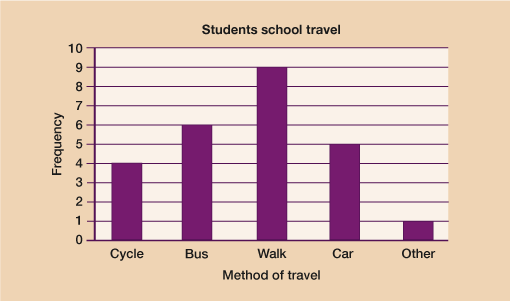
Sam asked some students how they traveled to school. She drew this bar chart to show the results.
Interpreting a bar graph examples

(i) Which method of travel was used most by the students?
(ii) How many students did Sam ask in total?
(iii) How many more students walked to a school than cycled to school?

Solution:
Given that some students traveled to school.
(i) The most used method of traveling to school is Walking.
(ii) To find out the total number of students, add the amount.
4 + 6 + 9 + 5 + 1 = 25 students in total.
(iii) Students who walked = 9.
Students who cycled = 4.
To find out how many more you do by subtracting the number of students who cycled from Students who walked.
9 – 4 = 5 more students walked than cycled.

FAQs on Interpreting Bar Graph

1. Mention the different types of bar graphs?

The different types of bar graphs are
(i) Stacked bar graph
(ii) Grouped bar graph
(iii) Vertical bar graph
(iv) Horizontal bar graph

2. What are the steps in interpreting bar graph?

The steps to interpret a bar graph are

1. Take the given bar graph you need to analyze.
2. Check out the bar graph type.
3. Understand what data the bar graph represents.
3. Analyze different data and every rectangular graph available in a bar graph.
4. Separate the information from the bar graph and answer all the related questions.

3. What is the use of a bar graph?

The use of a bar graph is to show the data in a visual form which changes over time. Bar graph helps to show a large amount of data into a visual representation.