Big Ideas Math Algebra 1 Answers Chapter 3 Graphing Linear Functions

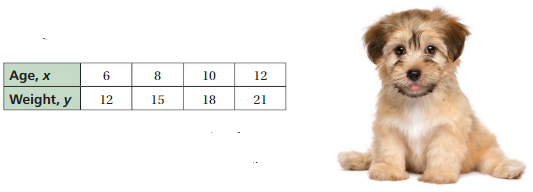
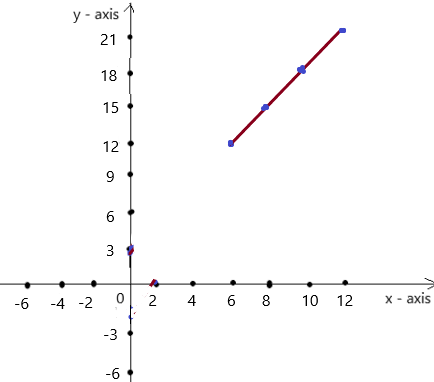
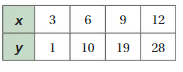
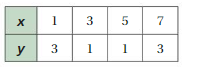
Searching for engaging ways and opportunities to learn the concepts of Big Ideas Math Algebra 1 Answers Ch 3 Graphing Linear Functions? Then make use of this guide for BIM Book Algebra 1 Chapter 3 Graphing Linear Functions Answers and understand various concepts behind them. Preparing from the Big Ideas Math Book Ch 3 Graphing Linear Functions help you to understand the concepts easily.

The Big Ideas Math Algebra 1 Answer Key Ch 3 Graphing Linear Functions includes Questions from Exercises 3.1 to 3.7, Chapter Tests, Practice Tests, Cumulative Assessment, Review Tests, etc. Practice using the BIM Algebra 1 Graphing Linear Functions Solution Key and learn all the fundamentals involved. Big Ideas Math Algebra 1 Ch 3 Graphing Linear Functions Answer Key is available free of cost and you can prepare using it anytime and anywhere.

Big Ideas Math Book Algebra 1 Answer Key Chapter 3 Graphing Linear Functions

Solving all the Big Ideas Math Book Algebra 1 Chapter 3 Graphing Linear Functions Textbook Questions you can improve your speed and accuracy in the exam. You can access all the Big Ideas Math Algebra 1 Answers Graphing Linear Functions Exercises and Lessons through quick links available below.  Just tap on them and seek the homework help you might need and enhance your math proficiency.

Graphing Linear Functions Maintaining Mathematical Proficiency

Plot the point in a coordinate plane. Describe the location of the point.

Question 1.
A(3, 2)
Answer:
The given point is: A (3,2)
Compare the given point with (x, y)
So,
x = 3 and y = 2
Hence,
The representation of the point in the coordinate plane is:

Question 2.
B(-5, 1)
Answer:
The given point is: B (-5,1)
Compare the given point with (x, y)
So,
x = -5 and y = 1
Hence,
The representation of the given point in the coordinate plane is:

Question 3.
C(0, 3)
Answer:
The given point is: c (0,3)
Compare the given point with (x,y)
So,
x = 0 and y = 3
Hence,
The representation of the given point in the coordinate plane is:

Question 4.
D(-1, -4)
Answer:
The given point is: D (-1,-4)
Compare the given point with (x,y)
So,
x = -1 and y = -4
Hence,
The representation of the given point in the coordinate plane is:

Question 5.
E(-3, 0)
Answer:
The given point is: E (-3,0)
Compare the given point with (x,y)
So,
x = -3 and y = 0
Hence,
The representation of the given point in the coordinate plane is:

Question 6.
F(2, -1)
Answer:
The given point is: F (2,-1)
Compare the given point with (x,y)
So,
x = 2 and y = -1
Hence,
The representation of the given point in the coordinate plane is:

Evaluate the expression for the given value of x.

Question 7.
3x – 4; x = 7
Answer:
The value of the expression for the given value of x is: 17

Explanation:
The given expression is:
3x – 4 with x = 7
Hence,
The value of the expression is:
3 (7) – 4 = 21 – 4 = 17
Hence, from the above,
We can conclude that the value of the expression for the given value of x is: 17

Question 8.
-5x + 8; x = 3
Answer:
The value of the expression for the given value of x is: -7

Explanation:
The given expression is:
-5x + 8 with x = 3
Hence,
The value of the expression is:
-5 (3) + 8 = -15 + 8 = -7
Hence, from the above,
We can conclude that the value of the expression for the given value of x is: -7

Question 9.
10x + 18; x = 5
Answer:
The value of the expression for the given value of x is: 68

Explanation:
The given expression is:
10x + 18 with x = 5
Hence,
The value of the expression is:
10 (5) + 18 = 50 + 18 = 68
Hence, from the above,
We can conclude that the value of the expression for the given value of x is: 68

Question 10.
-9x – 2; x = -4
Answer:
The value of the expression for the given value of x is: 34

Explanation:
The given expression is:
-9x – 2 with x = -4
Hence,
The value of the expression is:
-9 (-4) – 2 = 36 – 2 = 34
Hence, from the above,
We can conclude that the value of the expression for the given value of x is: 34

Question 11.
24 – 8x; x = -2
Answer:
The value of the expression for the given value of x is: 40

Explanation:
The given expression is:
24 – 8x with x = -2
Hence,
The value of the expression is:
24 – 8 (-2) = 24 + 16 = 40
Hence, from the above,
We can conclude that the value of the expression for the given value of x is: 40

Question 12.
15x + 9; x = -1
Answer:
The value of the expression for the given value of x is: -6

Explanation:
The given expression is:
15x + 9 with x = -1
Hence,
The value of the expression is:
15 (-1) + 9 = -15 + 9 = -6
Hence, from the above,
We can conclude that the value of the expression for the given value of x is: -6

Question 13.
ABSTRACT REASONING
Let a and b be positive real numbers. Describe how to plot (a, b), (-a, b), (a, -b), and (-a, -b).
Answer:
It is given that a and b are positive real numbers
The given points are (a, b), (-a, b), (a, -b) and (-a, -b)
Let the names of the points be:
A (a, b), B (-a, b), C (a, -b), and D (-a, -b)
We know that,
The coordinate plane is divided into 4 parts. These parts are called  “Quadrants”
So,
The representation of a and b in the 4 quadrants are:
1st Quadrant: (a, b)
2nd Quadrant: (-a, b)
3rd Quadrant: (-a, -b)
4th Quadrant: (a, -b)
Hence,
The representation of the given points in the coordinate plane is:

Graphing Linear Functions Mathematical Practices

Monitoring Progress

Determine whether the viewing window is square. Explain.

Question 1.
-8 ≤ x ≤ 7, -3 ≤ y ≤ 7

Question 2.
-6 ≤ x ≤ 6, -9 ≤ y ≤ 9

Question 3.
-18 ≤ x ≤ 18, -12 ≤ y ≤ 12

Use a graphing calculator to graph the equation. Use a square viewing window.

Question 4.
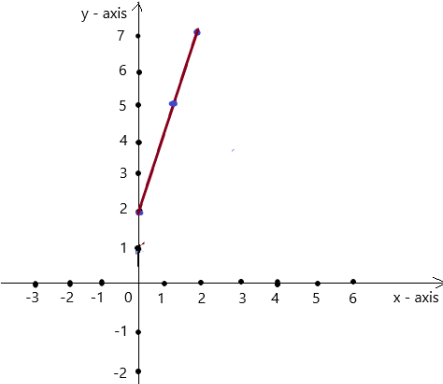
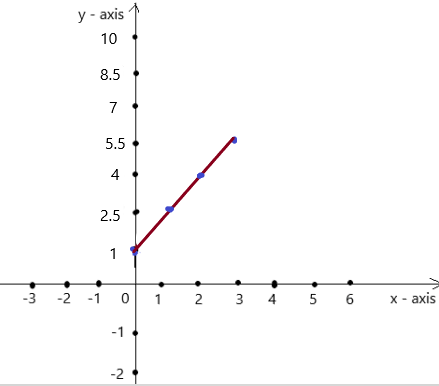
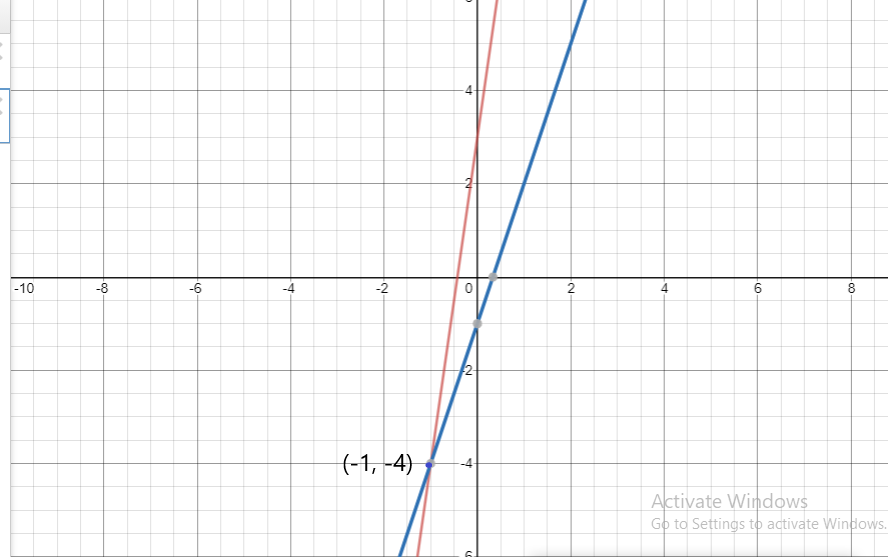
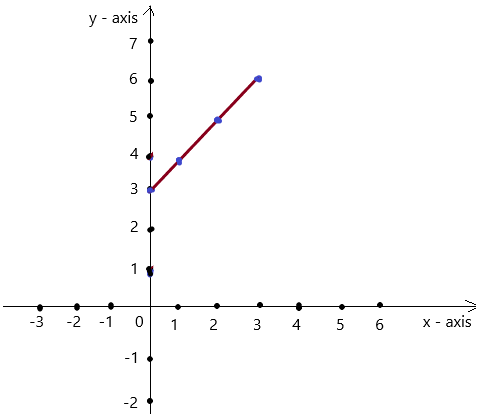
y = x + 3
Answer:
The given equation is:
y = x + 3
Now,
We can find the values of x and y by putting the values 0, 1, 2…..
Hence,
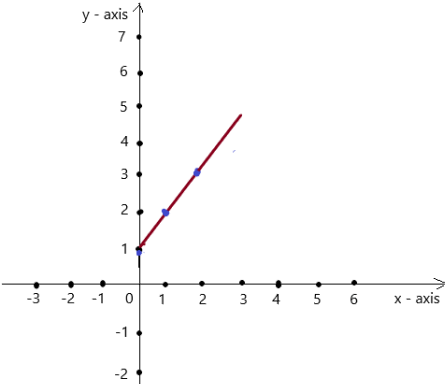
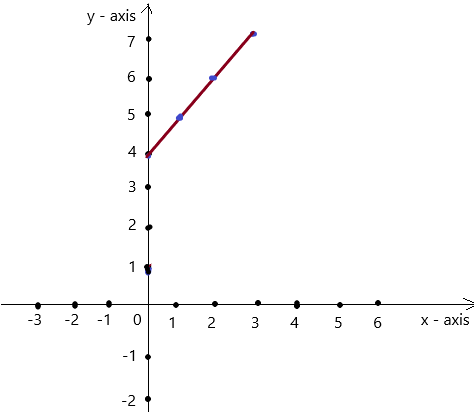
The representation of the given equation in the coordinate plane is:

Question 5.
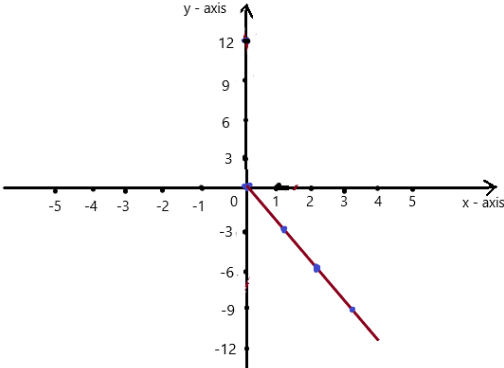
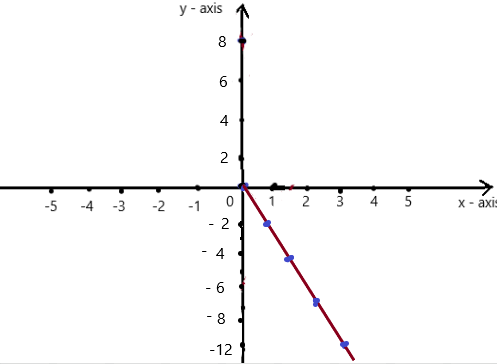
y = -x – 2
Answer:
The given equation is:
y = -x – 2
Now,
We can find the values of x and y by putting the values 0, 1, 2…..
Hence,
The representation of the given equation in the coordinate plane is:

Question 6.
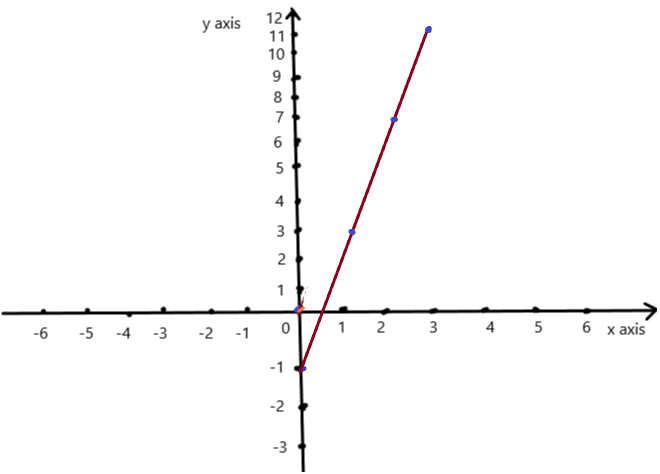
y = 2x – 1
Answer:
The given equation is:
y = 2x – 1
Now,
We can find the values of x and y by putting the values 0, 1, 2…..
Hence,
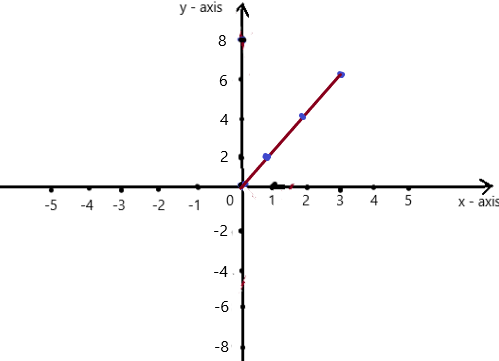
The representation of the given equation in the coordinate plane is:

Question 7.
y = -2x + 1
Answer:
The given equation is:
y = -2x + 1
Now,
We can find the values of x and y by putting the values 0, 1, 2…..
Hence,
The representation of the given equation in the coordinate plane is:

Question 8.
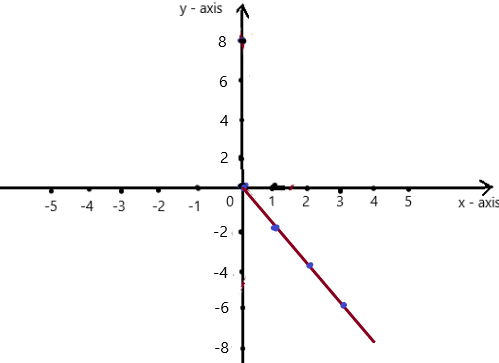
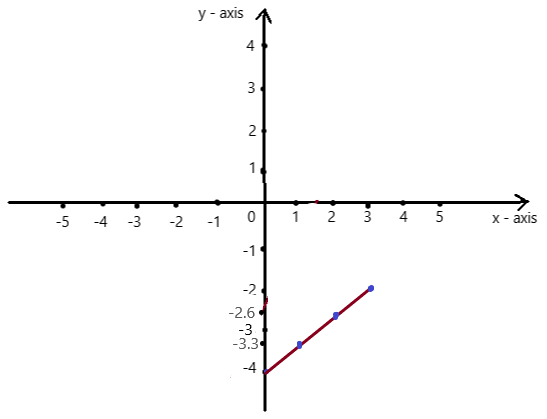
y = –\(\frac{1}{3}\)x – 4
Answer:
The given equation is:
y = –\(\frac{1}{3}\)x – 4
Now,
We can find the values of x and y by putting the values 0, 1, 2…..
Hence,
The representation of the given equation in the coordinate plane is:

Question 9.
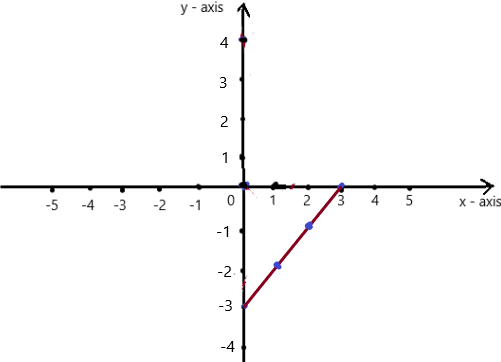
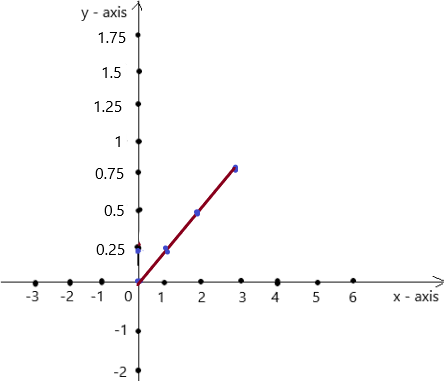
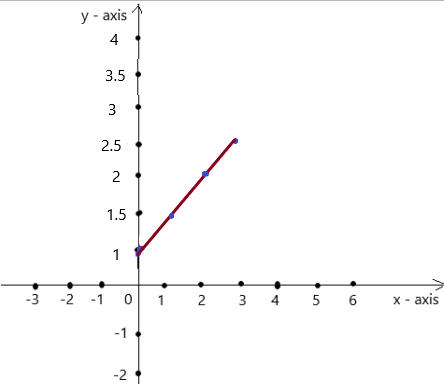
y = \(\frac{1}{3}\)x + 2
Answer:
The given equation is:
y = \(\frac{1}{3}\)x + 2
Now,
We can find the values of x and y by putting the values 0, 1, 2…..
Hence,
The representation of the given equation in the coordinate plane is:

Question 10.
How does the appearance of the slope of a line change between a standard viewing window and a square viewing window?
Answer:
A typical graphing calculator screen has a height to width ratio of 2 to 3. This means that when you use the standard viewing window of -10 to 10 ( on each axis ), the graph will not be in its true perspective.
To see a graph in its true perspective, you need to use a square viewing window, in which the tick marks on the x-axis are spaced the same as the tick marks on the y-axis.

Lesson 3.1 Functions

Essential Question

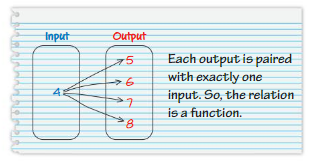
A relation pairs inputs with outputs. When a relation is given as ordered pairs, the x-coordinates are inputs and the y-coordinates are outputs. A relation that pairs each input with exactly one output is a function.

EXPLORATION 1
Describing a Function
Work with a partner.
Functions can be described in many ways.

  • by an equation
  • by an input-output table
  • using words
  • by a graph
  • as a set of ordered pairs

a. Explain why the graph is shown represents a function.
Answer:
The vertical line test can be used to determine whether a graph represents a function. If we can draw any vertical line that intersects a graph more than once, then the graph does not define a function because that x value has more than one output. A function has only one output value for each input value.

b. Describe the function in two other ways.
Answer:
The function can be described in 4 ways. They are:
a. A function can be represented verbally.
Example:
The circumference of a square is four times one of its sides.
b. A function can be represented algebraically.
Example:
3 x + 6 .
c. A function can be represented numerically.
d. A function can be represented graphically.

EXPLORATION 2

Identifying Functions
Work with a partner. Determine whether each relation represents a function. Explain your reasoning.

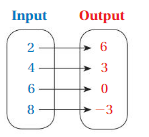
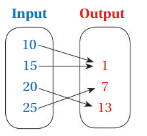
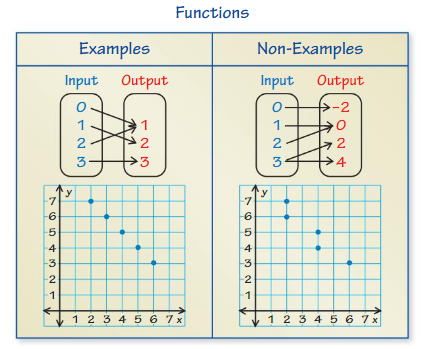
Big Ideas Math Algebra 1 Answers Chapter 3 Graphing Linear Functions 1
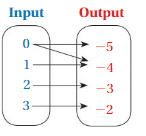
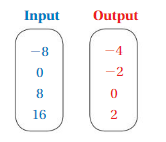
Big Ideas Math Algebra 1 Answers Chapter 3 Graphing Linear Functions 1.1
e. (-2, 5), (-1, 8), (0, 6), (1, 6), (2, 7)
f. (-2, 0), (-1, 0), (-1, 1), (0, 1), (1, 2), (2, 2)
g. Each radio frequency x in a listening area has exactly one radio station y.
h. The same television station x can be found on more than one channel y.
i. x = 2
j. y = 2x + 3
Answer:
We know that,
Functions can be described in different ways. They are:
a. By an equation
b. By an input-output table
c. Using words
d. By a graph
e. As a set of ordered pairs
We know that,
A function has only a single input for each or multiple outputs
Hence,
The given Exercises above i.e., a, e, g,  j are the relations that represent a function and the remaining relations are not functions

Communicate Your Answer

Question 3.
What is a function? Give examples of relations, other than those in Explorations 1 and 2, that (a) are functions and (b) are not functions.
Answer:
Definition of Function:
A relation from a set of inputs to a set of possible outputs where each input is related to exactly one output is known as ” Function”
Examples of relation that is a function:
a. y = x + 3
b. y = -x² + 1
Example of relation that is not a function:

We know that,
A relation is a set of inputs for specific outputs.
But from the above,
A single input has multiple outputs

3.1 Lesson

Monitoring Progress

Determine whether the relation is a function. Explain.

Question 1.
(-5, 0), (0, 0), (5, 0), (5, 10)
Answer:
The given relation is:
(-5, 0), (0, 0), (5, 0), (5, 10)
From the given relation,
We know that,
x represents the input
y represents the output
We know that,
For a function, each input should correspond with only one output
But,
When we observe the given relation, there are 2 outputs for a single input
Hence, from the above,
We can conclude that the given relation is not a function

Question 2.
(-4, 8), (-1, 2), (2, -4), (5, -10)
Answer:
The given relation is:
(-4, 8), (-1, 2), (2, -4), (5, -10)
From the given relation,
We know that,
x represents the input
y represents the output
We know that,
For a function, each input should correspond with only one output
Hence, from the above,
We can conclude that the given relation is a function

Question 3.
Big Ideas Math Algebra 1 Answers Chapter 3 Graphing Linear Functions 2
Answer:
The given table is:
Big Ideas Math Algebra 1 Answers Chapter 3 Graphing Linear Functions 2
The representation of the table in the form of relation is:
(2, 2.6), (4, 5.2), (6, 7.8)
From the given relation,
We know that,
x represents the input
y represents the output
We know that,
For a function, each input should correspond with only one output
Hence, from the above,
We can conclude that the given relation is a function

Question 4.
Big Ideas Math Answer Key Algebra 1 Chapter 3 Graphing Linear Functions 3
Answer:
The given figure is:
Big Ideas Math Answer Key Algebra 1 Chapter 3 Graphing Linear Functions 3
The representation of the given figure in the form of relation is:
(1, -2), (1, 0), (2, 4)
From the given relation,
We know that,
x represents the input
y represents the output
We know that,
For a function, each input should correspond with only one output
But,
When we observe the given relation, there are 2 outputs for a single input
Hence, from the above,
We can conclude that the given relation is not a function

Monitoring Progress

Determine whether the graph represents a function. Explain.

Question 5.
Big Ideas Math Answer Key Algebra 1 Chapter 3 Graphing Linear Functions 4
Answer:
The given graph is:
Big Ideas Math Answer Key Algebra 1 Chapter 3 Graphing Linear Functions 4
The representation of the points from the graph is:
(0, 3), (1, 3), (2, 3), (3, 3), (4, 3), (5, 3)
From the given relation,
We know that,
x represents the input
y represents the output
We know that,
For a function, each input should correspond with only one output
We have to remember that the inputs must be different but outputs may be the same or different
Hence, from the above,
We can conclude that the given graph is a function

Question 6.
Big Ideas Math Answer Key Algebra 1 Chapter 3 Graphing Linear Functions 5
Answer:
The given figure is:
Big Ideas Math Answer Key Algebra 1 Chapter 3 Graphing Linear Functions 5
From the graph,
The representation of the points are:
(2, 1), (1, 2), (1, 3), (1, 4), (0.5, 5), (0.5, 6), (3, 0), (4, 1), (4.2, 2), (4.8, 3), (5, 4), (5.1, 5), (5.1, 6)
From the points,
We can observe that the output is different for the same input
Hence, from the above,
We can conclude that the given graph is not a function

Question 7.
Big Ideas Math Answer Key Algebra 1 Chapter 3 Graphing Linear Functions 6
Answer:
The given figure is:
Big Ideas Math Answer Key Algebra 1 Chapter 3 Graphing Linear Functions 6
From the given graph,
We can observe that for the same value of x, there are different values of y
Where,
x represents the input
y represents the output
We know that,
For a function, each input must be matched with a single output
Hence, from the above,
We can conclude that the given graph is not a function

Question 8.
Big Ideas Math Answer Key Algebra 1 Chapter 3 Graphing Linear Functions 7
Answer:
The given figure is:
Big Ideas Math Answer Key Algebra 1 Chapter 3 Graphing Linear Functions 7
From the graph,
We can observe that there are multiple outputs for a single input
Hence, from the above,
We can conclude that the given graph is not a function

Monitoring Progress

Find the domain and range of the function represented by the graph.

Question 9.
Big Ideas Math Answer Key Algebra 1 Chapter 3 Graphing Linear Functions 8

Answer:
The given graph is:
Big Ideas Math Answer Key Algebra 1 Chapter 3 Graphing Linear Functions 8
We know that,
“Domain” is defined as the set of all values present in the x-axis
“Range” is defined as the set of all values present in the y-axis
Hence,
The domain of the given graph is: -2, -1, 0, 1, 2
The range of the given graph is: 1, 2, 3,  4

Question 10.
Big Ideas Math Answer Key Algebra 1 Chapter 3 Graphing Linear Functions 9
Answer:
The given graph is:
Big Ideas Math Answer Key Algebra 1 Chapter 3 Graphing Linear Functions 9
We know that,
“Domain” is defined as the set of all values present in the x-axis
“Range” is defined as the set of all values present in the y-axis
Hence,
The domain of the given graph is: 1, 2, 3, 4, 5
The range of the given graph is: 0, 1, 2, 3,  4

Monitoring Progress

Question 11.
The function a = -4b + 14 represents the number ‘a’ of avocados you have left after making b batches of guacamole.
a. Identify the independent and dependent variables.
Answer:
The “Independent variable” represents the input values of a function and can be any value in the domain.
The dependent variable represents the output values of the function and depends on the value of the independent variable
Hence, from the above,
The independent variable is: b (batches of guacamole)
The dependent variable is: a ( The number of avocados )

b. The domain is 0, 1, 2, and 3. What is the range?
Answer:
The given function is:
a = -4b + 14
In the given function,
Input: b
Output: a
We know that,
The “Domain” is defined as the set of all values present in the input or the x-axis
The given Domain is: 0, 1, 2, and 3
So,
To find the range, we have to find the values of b for each value present in the domain
So,
a = -4 (0) + 14 = 14
a = -4 (1) + 14 = 10
a = -4 (2) + 14 = 6
a = -4 (3) + 14 = 2
Hence, from the above,
We can conclude that the range for the given equation is: 2,  6, 10, and 14

Question 12.
The function t = 19m + 65 represents the temperature t (in degrees Fahrenheit) of an oven after preheating for m minutes.
a. Identify the independent and dependent variables.
Answer:
The “Independent variable” represents the input values of a function and can be any value in the domain.
The dependent variable represents the output values of the function and depends on the value of the independent variable
Hence, from the above,
The independent variable is: Minutes
The dependent variable is: Temperature

b. A recipe calls for an oven temperature of 350°F. Describe the domain and range of the function.
Answer:
The given function is:
t = 19m + 65
Compare the given function with
y = mx + c
It is given that a recipe calls for an oven temperature of 350°F
So,
350 = 19m + 65
19m = 350 – 65
19m = 285
m = 285 / 19
m = 15 minutes
So,
t = 19 (15) + 350
t = 285 + 65
t = 350°F
Hence, from the above,
We can conclude that
The domain of the given function is: 0 ≤ m ≤ 15 [ Since the minutes will not be -ve ]
The range of the given function is: 65 ≤ t ≤ 350 [ Since the  minimum temperature is the value of c ]

Functions 3.1 Exercises

Vocabulary and Core Concept Check

Question 1.
WRITING
How are independent variables and dependent variables different?
Answer:
Big Ideas Math Algebra 1 Answers Chapter 3 Graphing Linear Functions 3.1 Question 1

Question 2.
DIFFERENT WORDS, SAME QUESTION
Which is different? Find “both” answers.
Big Ideas Math Answer Key Algebra 1 Chapter 3 Graphing Linear Functions 9.1
Answer:
The given statements are:
a. Find the range of the function represented by the table?
b. Find the inputs of the function represented by the table?
c. Find the x values of the function represented by (-1, 7), (0, 5), and (1, -1)?
d. Find the domain of the function represented by (-1, 7), (0, 5), and (1, -1)?
Now,
From the given table,
The values of x are: -1, 0, 1
The values of y are: 7, 5, -1
We know that,
For a function,
The x values represent the input and the domain
The y values represent the output and the range
So,
a.
The range of the function represented by the table is: 7, 5, -1
b.
The inputs of the function represented by the table are: -1, 0, 1
c.
The x values of the function represented by the given points are: -1, 0, 1
d.
The domain of the function represented by the given points are: -1, 0, 1
Hence, from the above,
We can conclude that all the given four are the same

Monitoring Progress and Modeling with Mathematics

In Exercises 3–8, determine whether the relation is a function. Explain.

Question 3.
(1, -2), (2, 1), (3, 6), (4, 13), (5, 22)
Answer:
Big Ideas Math Algebra 1 Answers Chapter 3 Graphing Linear Functions 3.1 Question 3

Question 4.
(7, 4), (5, -1), (3, -8), (1, -5), (3, 6)
Answer:
The given points are:
(7, 4), (5, -1), (3, -8), (1, -5), (3, 6)
We know that,
For a function, each input has only a single output
But from the above,
We can observe that 3 has multiple outputs
Hence, from the above,
We can conclude that the given relation is not a function

Question 5.
Big Ideas Math Answer Key Algebra 1 Chapter 3 Graphing Linear Functions 10
Answer:
Big Ideas Math Algebra 1 Answers Chapter 3 Graphing Linear Functions 3.1 Question 5

Question 6.
Big Ideas Math Answer Key Algebra 1 Chapter 3 Graphing Linear Functions 11
Answer:
The given relation is:
Big Ideas Math Answer Key Algebra 1 Chapter 3 Graphing Linear Functions 11
We know that,
For a function, a single input has a single output
Hence, from the above,
We can say that each input has only 1 output
Hence, from the above,
We can conclude that the given relation is a function

Question 7.
Big Ideas Math Answer Key Algebra 1 Chapter 3 Graphing Linear Functions 12
Answer:
Big Ideas Math Algebra 1 Answers Chapter 3 Graphing Linear Functions 3.1 Question 7

Question 8.
Big Ideas Math Answer Key Algebra 1 Chapter 3 Graphing Linear Functions 13
Answer:
The given table is:
Big Ideas Math Answer Key Algebra 1 Chapter 3 Graphing Linear Functions 13
From the given table,
We can observe that each input has a single output
Hence, from the above,
We can conclude that the given relation is a function

In Exercises 9–12, determine whether the graph represents a function. Explain.

Question 9.
Big Ideas Math Answer Key Algebra 1 Chapter 3 Graphing Linear Functions 14
Answer:
Big Ideas Math Algebra 1 Answers Chapter 3 Graphing Linear Functions 3.1 Question 9

Question 10.
Big Ideas Math Answer Key Algebra 1 Chapter 3 Graphing Linear Functions 15
Answer:
The given graph is:
Big Ideas Math Answer Key Algebra 1 Chapter 3 Graphing Linear Functions 15
From the given graph,
We can observe that the vertical line can be drawn through more than one point on the graph i.e., input 2 has repeated 2 times i.e., (2, 1) and (2, 5)
Hence, from the above,
We can conclude that the given graph is not a function

Question 11.
Big Ideas Math Answer Key Algebra 1 Chapter 3 Graphing Linear Functions 16
Answer:
Big Ideas Math Algebra 1 Answers Chapter 3 Graphing Linear Functions 3.1 Question 11

Question 12.
Big Ideas Math Answer Key Algebra 1 Chapter 3 Graphing Linear Functions 17
Answer:
The given graph is:
Big Ideas Math Answer Key Algebra 1 Chapter 3 Graphing Linear Functions 17
From the given graph,
We can observe that each input corresponds to a single output
Hence, from the above,
We can conclude that the given graph is a function

In Exercises 13–16, find the domain and range of the function represented by the graph.

Question 13.
Big Ideas Math Answer Key Algebra 1 Chapter 3 Graphing Linear Functions 18
Answer:
Big Ideas Math Algebra 1 Answers Chapter 3 Graphing Linear Functions 3.1 Question 13

Question 14.
Big Ideas Math Answer Key Algebra 1 Chapter 3 Graphing Linear Functions 19
Answer:
The given graph is:
Big Ideas Math Answer Key Algebra 1 Chapter 3 Graphing Linear Functions 19
From the given graph,
The ordered pairs are: (0, 4), (-2, 4), (2, 4), (4, 4)
Hence,
The domain of the given graph is: 0, -2, 2, 4
The range of the given graph is: 4

Question 15.
Big Ideas Math Answer Key Algebra 1 Chapter 3 Graphing Linear Functions 20
Answer:
Big Ideas Math Algebra 1 Answers Chapter 3 Graphing Linear Functions 3.1 Question 15

Question 16.
Big Ideas Math Answer Key Algebra 1 Chapter 3 Graphing Linear Functions 21
Answer:
The given graph is:
Big Ideas Math Answer Key Algebra 1 Chapter 3 Graphing Linear Functions 21
From the given graph,
Identify the x and y values
So,
The values of x range from 2 to 7 excluding 2 and 7
The values of y range from 1 to 6 excluding 1 and 6
Hence, from the above,
We can conclude that
The domain of the given graph is: 2 < x < 7
The range of the given graph is: 1 < y < 6

Question 17.
MODELING WITH MATHEMATICS
The function y = 25x + 500 represents your monthly rent y (in dollars) when you pay x days late.
a. Identify the independent and dependent variables.
b. The domain is 0, 1, 2, 3, 4, and 5. What is the range?
Answer:
Big Ideas Math Algebra 1 Answers Chapter 3 Graphing Linear Functions 3.1 Question 17

Question 18.
MODELING WITH MATHEMATICS
The function y = 3.5x + 2.8 represents the cost y (in dollars) of a taxi ride of x miles.
Big Ideas Math Answer Key Algebra 1 Chapter 3 Graphing Linear Functions 22
a. Identify the independent and dependent variables.
Answer:
The given function is:
y = 3.5x + 2.8
From the above function,
The independent variable is: x which represents the number of miles
The dependent variable is: y which represents the cost in dollars

b. You have enough money to travel at most 20 miles in a taxi. Find the domain and range of the function.
Answer:
The given function is:
y = 3.5x + 2.8
It is given that you have enough money to travel at most 20 miles i.e., the value of x in a taxi i.e.,
x ≥ 0 and x ≤ 20
So,
The value of x ranges from 0 ≤ x ≤ 20
Now,
y = 3.5 (20) + 2.8
y = 7 + 2.8
y = $9.8
y = 3.5 (0) + 2.8
y = 0 + 2.8
y = $2.8
Hence, from the above,
We can conclude that
The domain of the given function is: 0 ≤ x ≤ 20 miles
The range of the given function is: $2.8 ≤ y ≤ $9.8

ERROR ANALYSIS
In Exercises 19 and 20, describe and correct the error in the statement about the relation shown in the table.

Big Ideas Math Answer Key Algebra 1 Chapter 3 Graphing Linear Functions 23

Question 19.
Big Ideas Math Answer Key Algebra 1 Chapter 3 Graphing Linear Functions 24
Answer:
Big Ideas Math Algebra 1 Answers Chapter 3 Graphing Linear Functions 3.1 Question 19

Question 20.
Big Ideas Math Answer Key Algebra 1 Chapter 3 Graphing Linear Functions 25
Answer:
It is given that the relation is a function and the range is 1, 2, 3, 4, and 5
We know that,
The relation is a function only when a single input pairs with an output
For the function, the domain, and the range exist
From the given table,
The domain is: 1, 2, 3, 4, 5
The range is: 6, 7, 8, 6, 9
Hence, from the above,
We can conclude that the given statement is not correct

ANALYZING RELATIONSHIPS
In Exercises 21 and 22, identify the independent and dependent variables.

Question 21.
The number of quarters you put into a parking meter affects the amount of time you have on the meter.
Answer:
Big Ideas Math Algebra 1 Answers Chapter 3 Graphing Linear Functions 3.1 Question 21

Question 22.
The battery power remaining on your MP3 player is based on the amount of time you listen to it.
Answer:
The given statement is:
The battery power remaining on your MP3 player is based on the amount of time you listen to it.
Hence, from the above,
We can conclude that
The Independent variable: Amount of time
The dependent variable: Battery power

Question 23.
MULTIPLE REPRESENTATIONS
The balance y (in dollars) of your savings account is a function of the month x.
Big Ideas Math Answer Key Algebra 1 Chapter 3 Graphing Linear Functions 26
a. Describe this situation in words.
b. Write the function as a set of ordered pairs.
c. Plot the ordered pairs in a coordinate plane.
Answer:
Big Ideas Math Algebra 1 Answers Chapter 3 Graphing Linear Functions 3.1 Question 23

Question 24.
MULTIPLE REPRESENTATIONS
The function 1.5x + 0.5y = 12 represents the number of hardcover books x and softcover books y you can buy at a used book sale.
a. Solve the equation for y.
Answer:
The given function is:
1.5x + 0.5y = 12
So,
0.5y = 12 – 1.5x
y = \(\frac{12 – 1.5x}{0.5}\)
y = \(\frac{12}{0.5}\) – \(\frac{1.5x}{0.5}\)
y = 24 – 3x
Hence, from the above,
We can conclude that the equation for y is:
y = 24 – 3x

b. Make an input-output table to find ordered pairs for the function.
Answer:
From part (a),
The equation for y is:
y = 24 – 3x
Now,
Put the values of 0, 1, 2, 3 in x
So,
y = 24 – 3(0) = 24
y = 24 – 3(1) = 21
y = 24 – 3(2) = 18
y = 24 – 3 (3) = 15
Hence,
The input-output table for the given equation of y is:

c. Plot the ordered pairs in a coordinate plane.
Answer:
From part (b),
The table is:

We know that,
The ordered pair is in the form of (x, y)
From the table,
The ordered pairs are:
(0, 24), (1, 21), (2, 18), (3, 15)
Hence,
The representation of the ordered pairs in the coordinate plane is:

Question 25.
ATTENDING TO PRECISION
The graph represents a function. Find the input value corresponding to an output of 2.
Big Ideas Math Answer Key Algebra 1 Chapter 3 Graphing Linear Functions 27
Answer:
Big Ideas Math Algebra 1 Answers Chapter 3 Graphing Linear Functions 3.1 Question 25

Question 26.
OPEN-ENDED
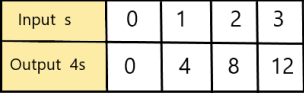
Fill in the table so that when t is the independent variable, the relation is a function, and when t is the dependent variable, the relation is not a function.
Big Ideas Math Answer Key Algebra 1 Chapter 3 Graphing Linear Functions 28
Answer:
Let the function in terms of t and v  such as t is the independent variable and v is the dependent variable is:
v = t + 4 ———–(1)
Let the function in terms of t and v  such as v is the independent variable and t is the dependent variable is:
t = 4v ———–(2)
Now,
place the values 0, 1, 2, 3 …….. in the independent variables of both functions
Now,
In equation (1),
v = 0 + 4 = 4
v = 1 + 4 = 5
v = 2 + 4 = 6
v = 3 + 4 = 7
In equation (2),
t = 4(0) = 0
t = 4(1) = 4
t = 4(2) = 8
t = 4(3) = 12
Hence,
     
Hence, from the above,
We can conclude that equation (1) is a function and equation (2) is not a function

Question 27.
ANALYZING RELATIONSHIPS
You select items in a vending machine by pressing one letter and then one number.
Big Ideas Math Answer Key Algebra 1 Chapter 3 Graphing Linear Functions 29
a. Explain why the relation that pairs letter-number combinations with food or drink items is a function.
b. Identify the independent and dependent variables.
c. Find the domain and range of the function
Answer:
Big Ideas Math Algebra 1 Answers Chapter 3 Graphing Linear Functions 3.1 Question 27

Question 28.
HOW DO YOU SEE IT?
The graph represents the height h of a projectile after t seconds.
Big Ideas Math Answer Key Algebra 1 Chapter 3 Graphing Linear Functions 30
a. Explain why h is a function of t.
b. Approximate the height of the projectile after 0.5 seconds and after 1.25 seconds.
c. Approximate the domain of the function.
d. Is t a function of h? Explain.
Answer:
a.
The given graph is:
Big Ideas Math Answer Key Algebra 1 Chapter 3 Graphing Linear Functions 30
From the graph,
We can observe that when we draw the vertical lines, each vertical line corresponds to only 1 value.
Hence, from the above,
We can conclude that h is a function of t by using the vertical line method

b.
From the given graph,
We can observe that the height of the projectile after 0.5 seconds increases and after some time, the height of the projectile decreases
We can observe that the height of the projectile after 1.25 seconds decreases steadily
Hence, from the above,
We can conclude that
The approximate maximum height after 0.5 seconds is: 30 feet
The approximate maximum height after 1.25 seconds is: 25 feet

c.
From the given graph,
The values of t in the x-axis vary from 0 to 2.5
Hence,
The domain of the given graph is: 0 ≤ t ≤ 2.5 seconds

d.
t is not a function of h
Reason:
When we observe the graph,
We can see that for a single value of t, there are multiple values of h.
We know that a relation can be considered as a function only when a single input pairs with a single output
hence, from the above,
We can conclude that that t is not a function of h

Question 29.
MAKING AN ARGUMENT
Your friend says that a line always represents a function. Is your friend correct? Explain.
Answer:
Big Ideas Math Algebra 1 Answers Chapter 3 Graphing Linear Functions 3.1 Question 29

Question 30.
THOUGHT-PROVOKING
Write a function in which the inputs and/or the outputs are not numbers. Identify the independent and dependent variables. Then find the domain and range of the function.
Answer:
It is given that the inputs and/or the outputs will not be numbers.
So,
The given function in which the inputs and/or the outputs are not numbers is:
°C = 32 + °F
From the given function,
The independent variable is: °F
The dependent variable is: °C
Now,
From the given function,
We can observe that the values of °F vary from -∞ to ∞
Now,
Place the values of -∞ to ∞ in the place of °F
So,
°C = 32 + 0 = 32°F
°C = 32 + 1 = 33°F
°C = 32 – 1 = 31°F
°C = 32 – 40 = -8°F
Hence, from the above values,
We can observe that the values of °C vary from -∞ to ∞
Hence, from the above,
We can conclude that
The domain of the function is: -∞ to ∞
The range of the function is: -∞ to ∞

ATTENDING TO PRECISION In Exercises 31–34, determine whether the statement uses the word function in a way that is mathematically correct. Explain your reasoning.

Question 31.
The selling price of an item is a function of the cost of making the item.
Answer:
Big Ideas Math Algebra 1 Answers Chapter 3 Graphing Linear Functions 3.1 Question 31

Question 32.
The sales tax on a purchased item in a given state is a function of the selling price.
Answer:
The given statement is:
The sales tax on a purchased item in a given state is a function of the selling price
We know that,
The sales tax is a percentage applied to the selling price
Hence, from the above,
We can conclude that the given statement uses the word function in a way that is mathematically correct.

Question 33.
A function pairs each student in your school with a homeroom teacher.
Answer:
Big Ideas Math Algebra 1 Answers Chapter 3 Graphing Linear Functions 3.1 Question 33

Question 34.
A function pairs each chaperone on a school trip with 10 students.
Answer:
The given statement is:
A function pairs each chaperone on a school trip with 10 students.
We know that,
Each chaperone on a school trip pairs with more than 1 student i.e., the number may be 2 or ∞ but not exactly 10
Hence, from the above,
We can conclude that the given statement does not use the word function in a way that is mathematically correct.

REASONING
In Exercises 35–38, tell whether the statement is true or false. If it is false, explain why.

Question 35.
Every function is a relation.
Answer:
Big Ideas Math Algebra 1 Answers Chapter 3 Graphing Linear Functions 3.1 Question 35

Question 36.
Every relation is a function.
Answer:
The given statement is false

Explanation:
We know that,
Every function is a relation that has only 1 output for a single input
But we can not say that every relation has a single output for a single input
Hence, from the above,
We can conclude that the given statement is false

Question 37.
When you switch the inputs and outputs of any function, the resulting relation is a function.
Answer:
Big Ideas Math Algebra 1 Answers Chapter 3 Graphing Linear Functions 3.1 Question 37

Question 38.
When the domain of a function has an infinite number of values, the range always has an infinite number of values.
Answer:
The given statement is false

Explanation:
We know that,
The domain is defined as the set of all the values of x
The range is defined as the set of all the values of y
Now, consider an example
Let the input be x
Let the output be a constant
Now,
The domain of the input can vary from -∞ to ∞
But the range of the output is only a constant even though we put any value of x
Hence, from the above,
We can conclude that the given statement is false

Question 39.
MATHEMATICAL CONNECTIONS
Consider the triangle shown.
Big Ideas Math Answer Key Algebra 1 Chapter 3 Graphing Linear Functions 31
a. Write a function that represents the perimeter of the triangle.
b. Identify the independent and dependent variables.
c. Describe the domain and range of the function. (Hint: The sum of the lengths of any two sides of a triangle is greater than the length of the remaining side.)
Answer:
Big Ideas Math Algebra 1 Answers Chapter 3 Graphing Linear Functions 3.1 Question 39

REASONING
In Exercises 40–43, find the domain and range of the function.

Question 40.
y = | x |
Answer:
The given function is:
y = | x |
We know that,
| x | = x for x > 0
| x | = -x for x < 0
So,
We can put the values of x from -∞ to ∞
So,
The values of x vary from 0 to ∞ since x can’t be negative
Hence, from the above,
We can conclude that
The domain of the given function is: -∞ to ∞
The range of the given function is: 0 to ∞

Question 41.
y = – | x |
Answer:
Big Ideas Math Algebra 1 Answers Chapter 3 Graphing Linear Functions 3.1 Question 41

Question 42.
y = | x | – 6
Answer:
The given function is:
y = | x | – 6
We know that,
| x | = x for x > 0
| x | = -x for x < 0
So,
We can vary the values of x from -∞ to ∞
The values of y vary from -6 to ∞
Hence, from the above,
We can conclude that
The domain of the given function is: -∞ to ∞
The range of the given function is: y ≥ -6

Question 43.
y = 4 – | x |
Answer:
Big Ideas Math Algebra 1 Answers Chapter 3 Graphing Linear Functions 3.1 Question 43

Maintaining Mathematical Proficiency

Write the sentence as an inequality. (Section 2.1)

Question 44.
A number y is less than 16.
Answer:
The given worded form is:
A number y is less than 16
Hence,
The representation of the given worded form in the form of inequality is:
y < 16

Question 45.
Three is no less than a number x.
Answer:
Big Ideas Math Algebra 1 Answers Chapter 3 Graphing Linear Functions 3.1 Question 45

Question 46.
Seven is at most the quotient of a number d and -5.
Answer:
The given worded form is:
Seven is at most the quotient of a number d and -5
Hence,
The representation of the given worded form in the form of inequality is:
7 ≤ d ÷ (-5)

Question 47.
The sum of a number w and 4 is more than -12.
Answer:
Big Ideas Math Algebra 1 Answers Chapter 3 Graphing Linear Functions 3.1 Question 47

Evaluate the expression.

Question 48.
112
Answer:
The product of 11² is:
11² = 11 × 11 = 121

Question 49.
(-3)4
Answer:
Big Ideas Math Algebra 1 Answers Chapter 3 Graphing Linear Functions 3.1 Question 49

Question 50.
-52
Answer:
The product of -5² is:
-5² = -5 × -5 = 25 [ We know that – × – = + ]

Question 51.
25
Answer:
Big Ideas Math Algebra 1 Answers Chapter 3 Graphing Linear Functions 3.1 Question 51

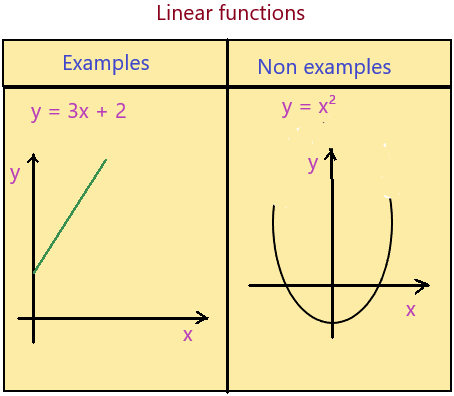
Lesson 3.2 Linear Functions

Essential Question

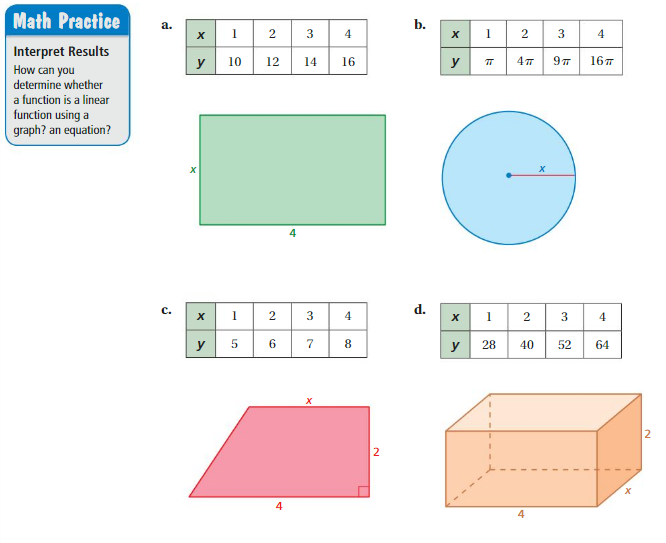
How can you determine whether a function is linear or non-linear?
Answer:
Simplify the equation as closely as possible to the form of y = mx + c.
Check to see if your equation has exponents.
If it has exponents, it is nonlinear. If your equation has no exponents, it is linear.

EXPLORATION 1
Finding Patterns for Similar Figures

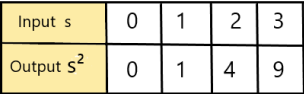
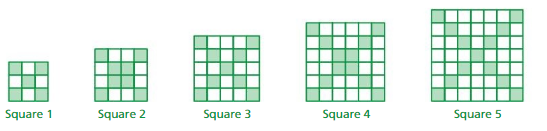
Work with a partner. Copy and complete each table for the sequence of similar figures. (In parts (a) and (b), use the rectangle shown.) Graph the data in each table. Decide whether each pattern is linear or nonlinear. Justify your conclusion.
a. perimeters of similar rectangles
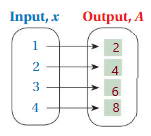
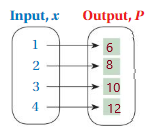
Big Ideas Math Answer Key Algebra 1 Chapter 3 Graphing Linear Functions 32
Answer:
We know that,
The perimeter of the rectangle (P) = 2 (Length + Width)
P = 2 (x + 2x)
P = 2 (3x)
P = 6x
Hence,
The completed table for the perimeters of similar rectangles is:

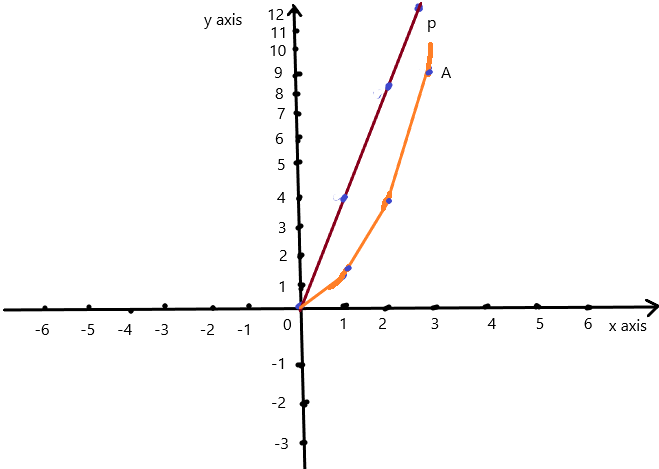
The representation of the perimeters of the similar rectangles in the coordinate plane is:

b. areas of similar rectangles
Big Ideas Math Answer Key Algebra 1 Chapter 3 Graphing Linear Functions 32
Answer:
We know that,
Area of the rectangle (A) = Length × Width
A = x × (2x)
A = 2x²
Hence,
The complete table for the area of the similar rectangles is:

The representation of the areas of the similar rectangles in the coordinate plane is:

c. circumferences of circles of radius r
Answer:
We know that,
The circumference of circle = 2πr
Take the value of π as 3
Hence,
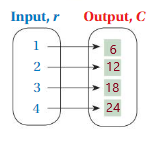
The complete table for the circumferences of circles of radius r is:

The representation of the circumferences of the circles in the coordinate plane is:

d. areas of circles of radius r
Answer:
We know that,
The area of the circle = πr²
Take the value of π as 3
Hence,
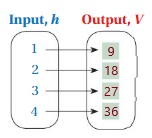
The complete table for the areas of the similar circles is:


The representation of the areas of the similar circles is:

Communicate Your Answer

Question 2.
How do you know that the patterns you found in Exploration 1 represent functions?
Answer:
In Exploration 1,
From the graphs,
We can observe that from the vertical test, only one point passes through each vertical line i.e., each input hs only 1 output
Our observation coincides with the definition of function
Hence, from the above,
We can conclude that the given patterns in Exploration 1 represent functions

Question 3.
How can you determine whether a function is linear or nonlinear?
Answer:
Simplify the equation as closely as possible to the form of y = mx + c.
Check to see if your equation has exponents.
If it has exponents, it is nonlinear. If your equation has no exponents, it is linear.

Question 4.
Describe two real-life patterns: one that is linear and one that is nonlinear. Use patterns that are different from those described in Exploration 1.
Answer:
The real-life pattern that is linear is:
The distance you travel when you go for a jog, you can graph the function and make some assumptions with only two points. The slope of a function is the same as the rate of change for the dependent variable (y), For instance, if you’re graphing distance Vs
The real-life pattern that is non-linear is:
Triangulation of GPS signals
Example:
A device like your cellphone receives signals from GPS satellites, which have known orbital positions around the Earth.

3.2 Lesson

Monitoring Progress

Does the graph or table represent a linear or nonlinear function? Explain.

Question 1.
Big Ideas Math Answer Key Algebra 1 Chapter 3 Graphing Linear Functions 36
Answer:
The given graph is:
Big Ideas Math Answer Key Algebra 1 Chapter 3 Graphing Linear Functions 36
The graph represents a straight line
We know that,
The straight line will be in the form of
y = mx + c or y = mx
Where,
m is the slope-intercept
c is the y-intercept that cuts through the y-axis
Hence, from the above,
We can conclude that the given graph is linear function

Question 2.

Big Ideas Math Answer Key Algebra 1 Chapter 3 Graphing Linear Functions 37
Answer:
The given graph is:
Big Ideas Math Answer Key Algebra 1 Chapter 3 Graphing Linear Functions 37
From the given graph,
We can observe that the graph is not a straight line i.e., it is not linear
Hence, from the above,
We can conclude that the given graph is a non-linear function

Question 3.
Big Ideas Math Answer Key Algebra 1 Chapter 3 Graphing Linear Functions 38
Answer:
The given table is:
Big Ideas Math Answer Key Algebra 1 Chapter 3 Graphing Linear Functions 38
From the given table,
We can observe that
There is a constant difference of 1 between the values of x and there is a constant difference of 2 between the values of y
The difference is constant for both the values of x and y
Hence, from the above,
We can conclude that the given table is a linear function

Question 4.
Big Ideas Math Answer Key Algebra 1 Chapter 3 Graphing Linear Functions 39
Answer:
The given table is:
Big Ideas Math Answer Key Algebra 1 Chapter 3 Graphing Linear Functions 39
From the given table,
We can observe that
There is a constant difference of 1 between the values of x and there is a constant ratio of 2 between the values of y.
Since the operations are different between the values of x and y,
We can conclude that the given table is a non-linear function

Does the equation represent a linear or nonlinear function? Explain.

Question 5.
y = x + 9
Answer:
The given equation represents the linear function

Explanation:
The given function is:
y = x + 9
We know that,
The standard representation of the linear function is:
y = mx + c
When we compare the given equation with the standard representation of linear function,
We can conclude that the given equation is a linear function

Question 6.
y = \(\frac{3 x}{5}\)
Answer:
The given equation represents a linear function

Explanation:
The given function is:
y = \(\frac{3 x}{5}\)
5y = 3x
3x – 5y = 0
y = \(\frac{3}{5}\)x + 0
We know that,
The standard representation of a linear function is:
y = mx + c
When we compare the above function with the standard representation of a linear function,
We can conclude that the given function is a linear function

Question 7.
y = 5 – 2x²
Answer:
The given equation represents a non-linear function

Explanation:
The given function is:
y = 5 – 2x²
We know that,
The standard representation of a linear function is:
y = mx + c
When we compare the given function with the standard representation of a linear function,
We can conclude that the given function is a non-linear function

Question 8.
The linear function m = 50 – 9d represents the amount m (in dollars) of money you have after buying d DVDs.
(a) Find the domain of the function. Is the domain discrete or continuous? Explain.
Answer:
The given linear function is:
m = 50 – 9d
Where,
m is the amount in dollars you have after buying d DVDs
m is the dependent variable
d is the independent variable
We know that,
The domain is defined for the independent variables
So,
Let
d = 0, 1, 2, 3, 4, 5……
Now,
m = 50 – 9 (0) = 50
m = 50 – 9 (1) = 41
m = 50 – 9 (2) = 32
m = 50 – 9 (3) = 23
m = 50 – 9 (4) = 14
m = 50 – 9 (5) = 5
m = 50 – 9 (6) = -4
Hence, from the above,
We can conclude that
The domain of the given linear function is: 0, 1, 2, 3, 4, and 5 [ Since from 6, -ve values are coming and the money will not be -ve ]
The domain is discrete [ Since a discrete graph is a series of unconnected points ]

(b) Graph the function using its domain.
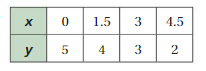
Answer:
From part (a),
The domain of the given function is: 0, 1, 2, 3, 4, and 5
Hence,
The representation of the domain in the coordinate plane is:

Question 9.
Is the domain discrete or continuous? Explain.
Big Ideas Math Answer Key Algebra 1 Chapter 3 Graphing Linear Functions 40
Answer:
The given table is:
Big Ideas Math Answer Key Algebra 1 Chapter 3 Graphing Linear Functions 40
From the given table,
The ordered pairs are:
(1, 12), (2, 24), (3, 36)
Hence,
The representation of the ordered pairs in the coordinate plane is:

From the above graph,
We can say that the points are scattered or discrete and they are unconnected
Hence, from the above,
We can conclude that the domain for the given table is discrete

Question 10.
A 20-gallon bathtub is draining at a rate of 2.5 gallons per minute. The number g of gallons remaining is a function of the number m of minutes.
a. Does this situation represent a linear function? Explain.
Answer:
It is given that a 20-gallon bathtub is draining at a rate of 2.5 gallons per minute.
Where,
The number g of gallons remaining is a function of the number m of minutes.
So,
From the above,
We can say that the bathtub is draining at the constant rate
We know that,
From the property of linear function, the change will be constantly increasing or decreasing
So,
The representation of the linear function for this situation is:
g = 20 – 2.5x
Hence, from the above,
We can conclude that the given situation is a linear function

b. Find the domain of the function. Is the domain discrete or continuous? Explain.
Answer:
From part (a),
We can conclude that the given situation is a linear function
So,
The domain of the function = \(\frac{Total volume of the bathtub}{The rate of draining}\)
= \(\frac{20}{2.5}\)
= \(\frac{200}{25}\)
= 8
Hence,
The domain of the function is: 0 ≤ x ≤ 8 [ Since the draining rate will not be -ve ]
From the representation of the domain,
We can conclude that the domain is continuous

c. Graph the function using its domain.
Answer:
From part (a),
The linear function is:
g = 20 – 2.5x
We know that,
The domain is: 0 ≤ x ≤ 8
So,
g = 20 – 2.5 (0) = 20
g = 20 – 2.5 (1) = 17.5
g = 20 – 2.5 (2) = 15
g = 20 – 2.5 (3) = 12.5
g = 20 – 2.5 (4) = 10
g = 20 – 2.5 (5) = 7.5
g = 20 – 2.5 (6) = 5
g = 20 – 2.5 (7) = 2.5
g = 20 – 2.5 (8) = 0
Hence,
The representation of the linear function using the domain in the coordinate plane is:

Write a real-life problem to fit the data shown in the graph. Is the domain of the function discrete or continuous? Explain.

Question 11.
Big Ideas Math Answer Key Algebra 1 Chapter 3 Graphing Linear Functions 41
Answer:
The given graph is:
Big Ideas Math Answer Key Algebra 1 Chapter 3 Graphing Linear Functions 41
The real-life problem that fits the given graph is:
An escalator moves upwards at a constant rate of 1step/minute.
So,
What is the rate escalator moves upwards after 8 minutes?
From the given graph,
We can say that the points are connected
Hence, from the above,
We can conclude that the domain of the function is continuous

Question 12.
Big Ideas Math Answer Key Algebra 1 Chapter 3 Graphing Linear Functions 42
Answer:
The given graph is:
Big Ideas Math Answer Key Algebra 1 Chapter 3 Graphing Linear Functions 42
The real-life problem that fits the given graph is:
If one company offers to pay you $450 per week and the other offers $10 per hour, and both ask you to work 40 hours per week, which company is offering the better rate of pay?
From the graph,
We can observe that the points are connected
Hence, from the above,
We can conclude that the domain is continuous

Linear Functions 3.2 Exercises

Vocabulary and Core Concept Check

Question 1.
COMPLETE THE SENTENCE
A linear equation in two variables is an equation that can be written in the form ________, where m and b are constants.
Answer:
Big Ideas Math Algebra 1 Answers Chapter 3 Graphing Linear Functions 3.2 Question 1

Question 2.
VOCABULARY
Compare linear functions and nonlinear functions.
Answer:
Linear Function:
A Linear function is a relation between two variables that produces a straight line when graphed.
Example:
y = 2x + 3
Non-Linear Function:
A non-linear function is a function that does not form a line when graphed.
Example:
y = 6x³

Question 3.
VOCABULARY
Compare discrete domains and continuous domains.
Answer:
Big Ideas Math Algebra 1 Answers Chapter 3 Graphing Linear Functions 3.2 Question 3

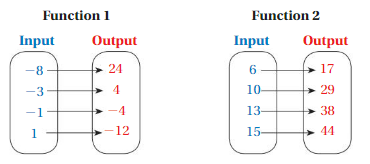
Question 4.
WRITING
How can you tell whether a graph shows a discrete domain or a continuous domain?
Answer:
A “Discrete domain” is a set of input values that consists of only certain numbers in an interval.
A “continuous domain” is a set of input values that consists of all numbers in an interval.
Sometimes, the set of points that represent the solutions of an equation are distinct, and other times the points are connected.

Monitoring Progress and Modeling with Mathematics

In Exercises 5–10, determine whether the graph represents a linear or nonlinear function. Explain.

Question 5.
Big Ideas Math Answer Key Algebra 1 Chapter 3 Graphing Linear Functions 43
Answer:
Big Ideas Math Algebra 1 Answers Chapter 3 Graphing Linear Functions 3.2 Question 5

Question 6.
Big Ideas Math Answer Key Algebra 1 Chapter 3 Graphing Linear Functions 44
Answer:
The given graph is:
Big Ideas Math Answer Key Algebra 1 Chapter 3 Graphing Linear Functions 44
From the above graph,
By using the vertical test, there is only one point going through each point and the given graph is a straight line
Hence, from the above,
We can conclude that the given graph is a linear function

Question 7.
Big Ideas Math Answer Key Algebra 1 Chapter 3 Graphing Linear Functions 45
Answer:
Big Ideas Math Algebra 1 Answers Chapter 3 Graphing Linear Functions 3.2 Question 7

Question 8.
Big Ideas Math Answer Key Algebra 1 Chapter 3 Graphing Linear Functions 46
Answer:
The given graph is:
Big Ideas Math Answer Key Algebra 1 Chapter 3 Graphing Linear Functions 46
From the above graph,
By using the vertical test, each line passes through only one point and the given graph is a straight line
Hence, from the above,
We can conclude that the given graph is a linear function

Question 9.
Big Ideas Math Answer Key Algebra 1 Chapter 3 Graphing Linear Functions 47
Answer:
Big Ideas Math Algebra 1 Answers Chapter 3 Graphing Linear Functions 3.2 Question 9

Question 10.
Big Ideas Math Answer Key Algebra 1 Chapter 3 Graphing Linear Functions 48
Answer:
The given graph is:
Big Ideas Math Answer Key Algebra 1 Chapter 3 Graphing Linear Functions 48
From the above graph,
By using the vertical test, each line passes through each point and the given graph is not a straight line
Hence, from the above,
We can conclude that the given graph is a non-linear function

In Exercises 11–14, determine whether the table represents a linear or nonlinear function. Explain.

Question 11.
Big Ideas Math Answer Key Algebra 1 Chapter 3 Graphing Linear Functions 49
Answer:
Big Ideas Math Algebra 1 Answers Chapter 3 Graphing Linear Functions 3.2 Question 11

Question 12.
Big Ideas Math Answer Key Algebra 1 Chapter 3 Graphing Linear Functions 50
Answer:
The given table is:
Big Ideas Math Answer Key Algebra 1 Chapter 3 Graphing Linear Functions 50
From the above table,
The difference between all the values of x is 2 which is a constant through all the values of x
The difference between all the values of y is not constant
Since the difference between all the values of y is not constant
The given table is a non-linear function

Question 13.
Big Ideas Math Answer Key Algebra 1 Chapter 3 Graphing Linear Functions 51
Answer:
Big Ideas Math Algebra 1 Answers Chapter 3 Graphing Linear Functions 3.2 Question 13

Question 14.
Big Ideas Math Answer Key Algebra 1 Chapter 3 Graphing Linear Functions 52
Answer:
The given table is:
Big Ideas Math Answer Key Algebra 1 Chapter 3 Graphing Linear Functions 52
From the above table,
The difference between all the values of x is +1 throughout all the values of x
The difference between all the values of y is -15 throughout all the values of y
Since the differences are constant for all the values of x and y,
The given table is a linear function

ERROR ANALYSIS
In Exercises 15 and 16, describe and correct the error in determining whether the table or graph represents a linear function.

Question 15.
Big Ideas Math Answer Key Algebra 1 Chapter 3 Graphing Linear Functions 53
Answer:
Big Ideas Math Algebra 1 Answers Chapter 3 Graphing Linear Functions 3.2 Question 15

Question 16.
Big Ideas Math Answer Key Algebra 1 Chapter 3 Graphing Linear Functions 54
Answer:
By using the vertical test in the graph,
We can say that each line passes through one point and the given graph is a straight line
Hence, from the above,
We can conclude that the given graph is a linear function

In Exercises 17–24, determine whether the equation represents a linear or nonlinear function. Explain.

Question 17.
y = x2 + 13
Answer:
Big Ideas Math Algebra 1 Answers Chapter 3 Graphing Linear Functions 3.2 Question 17

Question 18.
y = 7 – 3x
Answer:
The given equation is a linear function

Explanation:
The given equation is:
y = 7 – 3x
Compare the given equation with the standard representation of the given linear function
The standard representation of the linear function is:
y = mx + c
Hence, from the above,
We can conclude that the given equation is a linear function

Question 19.
Big Ideas Math Answer Key Algebra 1 Chapter 3 Graphing Linear Functions 55
Answer:
Big Ideas Math Algebra 1 Answers Chapter 3 Graphing Linear Functions 3.2 Question 19

Question 20.
y = 4x(8 – x)
Answer:
The given equation is not a linear function

Explanation:
The given equation is:
y = 4x (8 – x)
so,
y = 4x (8) – 4x (x)
y = 32x – 4x²
Compare the above equation with the standard representation of the linear function
The standard representation of the linear function is:
y = mx + c
Hence, from the above,
We can conclude that the given equation is not a linear function

Question 21.
2 + \(\frac{1}{6}\) y = 3x + 4
Answer:
Big Ideas Math Algebra 1 Answers Chapter 3 Graphing Linear Functions 3.2 Question 21

Question 22.
y – x = 2x – \(\frac{2}{3}\)y
Answer:
The given equation is a linear fraction

Explanation:
The given equation is:
y – x = 2x – \(\frac{2}{3}\)y
So,
y + \(\frac{2}{3}\)y = 2x + x
\(\frac{3y}{3}\) + \(\frac{2y}{3}\) = 3x
\(\frac{5}{3}\)y = 3x
y = 3x × \(\frac{3}{5}\)
y = \(\frac{9}{5}\)x + 0
Compare the above equation with the standard representation of the linear function
The standard representation of the linear function is:
y = mx + c
Hence, from the above,
We can conclude that the given equation is a linear function

Question 23.
18x – 2y = 26
Answer:
Big Ideas Math Algebra 1 Answers Chapter 3 Graphing Linear Functions 3.2 Question 23

Question 24.
2x + 3y = 9xy
Answer:
The given equation is not a linear fraction

Explanation:
The given equation is:
2x + 3y = 9xy
2x = 9xy – 3y
2x = y (9x – 3)
y = \(\frac{2}{9x – 3}\)x
Compare the above equation with the standard representation of the linear function
The standard representation of the linear function is:
y = mx + c
Hence, from the above,
We can conclude that the given equation is not a linear function

Question 25.
CLASSIFYING FUNCTIONS
Which of the following equations do not represent linear functions? Explain.
A. 12 = 2x2 + 4y2
B. y – x + 3 = x
C. x = 8
D. x = 9 – \(\frac{3}{4}\)y
E. y = \(\frac{5x}{11}\)
F = \(\sqrt{x}\) + 3
Answer:
Big Ideas Math Algebra 1 Answers Chapter 3 Graphing Linear Functions 3.2 Question 25

Question 26.
USING STRUCTURE
Fill in the table so it represents a linear function.
Big Ideas Math Algebra 1 Solutions Chapter 3 Graphing Linear Functions 56
Answer:
The given table is:
Big Ideas Math Algebra 1 Solutions Chapter 3 Graphing Linear Functions 56
From the above table,
we can observe that the difference between all the values of x is 5 which is a constant
Now,
To find the difference between all the values of y which is a constant, we have to use the trial and error method.
Now,
If we add +1 to -1 and continue adding +1 to all the values of y, then
-1 + 1 = 0
0 + 1 = 1
1 + 1 = 2
2 + 1 = 3
But the last value is: 11
Now,
If we add +2 to -1 and continue adding +2 to all the values of y, then
-1 + 2 = 1
1 + 2 = 3
3 + 2 = 5
5 + 2 = 7
But the last value is: 11
Now,
If we add +3 to -1 and continue adding +3 to all the values of y, then
-1 + 3 = 2
2 + 3 = 5
5 + 3 = 8
8 + 3 = 11
The last value is also: 11
Hnece, from the above,
We can conclude that we have to add +3 to make all the values of y constant so that the given table represents a linear function
The completed table is:

In Exercises 27 and 28, find the domain of the function represented by the graph. Determine whether the domain is discrete or continuous. Explain.

Question 27.
Big Ideas Math Answer Key Algebra 1 Chapter 3 Graphing Linear Functions 57
Answer:
Big Ideas Math Algebra 1 Answers Chapter 3 Graphing Linear Functions 3.2 Question 27

Question 28.
Big Ideas Math Answer Key Algebra 1 Chapter 3 Graphing Linear Functions 58
Answer:
The given graph is:
Big Ideas Math Answer Key Algebra 1 Chapter 3 Graphing Linear Functions 58
We know that,
The domain is defined as the range of all the values of x
So,
From the above graph,
The domain is: 0, 1, 2, 3, 4, 5, 6, and 7
Hence, from the above,
We can conclude that the domain of the given graph is: 0, 1, 2, 3, 4, 5, 6, and 7

In Exercises 29–32, determine whether the domain is discrete or continuous. Explain.

Question 29.
Big Ideas Math Answer Key Algebra 1 Chapter 3 Graphing Linear Functions 59
Answer:
Big Ideas Math Algebra 1 Answers Chapter 3 Graphing Linear Functions 3.2 Question 29

Question 30.
Big Ideas Math Answer Key Algebra 1 Chapter 3 Graphing Linear Functions 60
Answer:
The given table is:
Big Ideas Math Answer Key Algebra 1 Chapter 3 Graphing Linear Functions 60
From the given table,
The difference between the values of x is 1 which is constant throughout all of the values of x
The difference between the values of y is 3 which is constant throughout all of the values of y
Hence,
Since the difference is constant for both the values of x and y,
The domain of the given table is continuous

Question 31.

Big Ideas Math Answer Key Algebra 1 Chapter 3 Graphing Linear Functions 61
Answer:
Big Ideas Math Algebra 1 Answers Chapter 3 Graphing Linear Functions 3.2 Question 31

Question 32.
Big Ideas Math Answer Key Algebra 1 Chapter 3 Graphing Linear Functions 62
Answer:
The given table is:
Big Ideas Math Answer Key Algebra 1 Chapter 3 Graphing Linear Functions 62
From the above table,
The difference between all the values of x is 1 which is a constant
The difference between all the values of y is 4 which is a constant
Hence,
Since the difference between all the values of x and y is constant,
The given function is a linear function
The domain of the given function is continuous

ERROR ANALYSIS
In Exercises 33 and 34, describe and correct the error in the statement about the domain. 33. xy214324682.5 is in the domain.

Question 33.
Big Ideas Math Answer Key Algebra 1 Chapter 3 Graphing Linear Functions 63
Answer:
Big Ideas Math Algebra 1 Answers Chapter 3 Graphing Linear Functions 3.2 Question 33

Question 34.
Big Ideas Math Answer Key Algebra 1 Chapter 3 Graphing Linear Functions 64
Answer:
We know that,
The domain is the range of all the values of x
Now,
From the given graph,
The domain of the given function is: 0, 1, 2, 3, 4, 5, and 6
From the given graph,
We can observe that the domain of the given graph is continuous because there are not any unconnected points in the graph

Question 35.
MODELING WITH MATHEMATICS
The linear function m = 55 – 8.5b represents the amount m (in dollars) of money that you have after buying b books.
a. Find the domain of the function. Is the domain discrete or continuous? Explain.
b. Graph the function using its domain.
Big Ideas Math Answer Key Algebra 1 Chapter 3 Graphing Linear Functions 65
Answer:
Big Ideas Math Algebra 1 Answers Chapter 3 Graphing Linear Functions 3.2 Question 35.1
Big Ideas Math Algebra 1 Answers Chapter 3 Graphing Linear Functions 3.2 Question 35.2

Question 36.
MODELING WITH MATHEMATICS
The number y of calories burned after x hours of rock climbing is represented by the linear function y = 650x.
a. Find the domain of the function. Is the domain discrete or continuous? Explain.
b. Graph the function using its domain.
Big Ideas Math Answer Key Algebra 1 Chapter 3 Graphing Linear Functions 65.1
Answer:
a.
It is given that
The number y of calories burned after x hours of rock climbing is represented by the linear function
y = 650x.
It is given that x is the number of hours
Hence,
The domain of the given function is:
1 ≤ x ≤ 24
Since, the domain of the function is inequality,
The domain of the function is continuous

b.
The given function is:
y = 650x
From part (a),
The domain of the function is: 1 ≤ x ≤ 24
So,
y = 650 (1) = 650
y = 650 (2) = 1300
y = 650 (3) = 1950
.
.
.
.
y = 650 (12) = 7800
Hence,
The representation of the function with the domain in the coordinate plane is:

Question 37.
MODELING WITH MATHEMATICS
You are researching the speed of sound waves in dry air at 86°F. The table shows the distances d (in miles) sound waves travel in t seconds.
Big Ideas Math Answer Key Algebra 1 Chapter 3 Graphing Linear Functions 66
a. Does this situation represent a linear function? Explain.
b. Find the domain of the function. Is the domain discrete or continuous? Explain.
c. Graph the function using its domain.
Answer:
Big Ideas Math Algebra 1 Answers Chapter 3 Graphing Linear Functions 3.2 Question 37

Question 38.
MODELING WITH MATHEMATICS
The function y = 30 + 5x represents the cost y (in dollars) of having your dog groomed and buying x extra services.
Big Ideas Math Answer Key Algebra 1 Chapter 3 Graphing Linear Functions 67
a. Does this situation represent a linear function? Explain.
Answer:
The given function is:
y = 30 + 5x
We know that,
The standard representation of the linear function is:
y = mx + c
Compare the given function with the standard representation
Hence, from the above,
We can conclude that the given situation represents a linear function

b. Find the domain of the function. Is the domain discrete or continuous? Explain.
Answer:
The given function is:
y = 30 + 5x
Where,
y is the amount in dollars
x is the cost of extra grooming services
From the above,
The maximum number of given extra grooming services is: 5
So,
We can use extra grooming service or not
Hence, from the above,
We can conclude that
The domain of the given function is: 0 ≤ x ≤ 5
Hence,
The domain of the given function is continuous

c. Graph the function using its domain.
Answer:
The given function is:
y = 30 + 5x
We know that,
The domain of the function is: 0 ≤ x ≤ 5
So,
y = 30 + 5(0) = 30
y = 30 + 5 (1) = 35
y = 30 + 5(2) = 40
y = 30 + 5 (3) = 45
y = 30 + 5 (4) = 50
y = 30 + 5 (5) = 55
Hence,
The representation of the function using its domain in the coordinate plane is:

WRITING In Exercises 39–42, write a real-life problem to fit the data shown in the graph. Determine whether the domain of the function is discrete or continuous. Explain.

Question 39.
Big Ideas Math Answer Key Algebra 1 Chapter 3 Graphing Linear Functions 68
Answer:
Big Ideas Math Algebra 1 Answers Chapter 3 Graphing Linear Functions 3.2 Question 39

Question 40.
Big Ideas Math Answer Key Algebra 1 Chapter 3 Graphing Linear Functions 69
Answer:
The given graph is:
Big Ideas Math Answer Key Algebra 1 Chapter 3 Graphing Linear Functions 69
From the above graph,
The real-life situation is:
The temperature of a country in the winter season falls by 2°C
The domain of the graph is continuous as there are not any unconnected points

Question 41.
Big Ideas Math Answer Key Algebra 1 Chapter 3 Graphing Linear Functions 70
Answer:
Big Ideas Math Algebra 1 Answers Chapter 3 Graphing Linear Functions 3.2 Question 41

Question 42.
Big Ideas Math Answer Key Algebra 1 Chapter 3 Graphing Linear Functions 71
Answer:
The given graph is:
Big Ideas Math Answer Key Algebra 1 Chapter 3 Graphing Linear Functions 71
From the above graph,
The real-life situation is:
The number of ants in a colony increase by 2 times per day. So, the number of ants increases by how many times in 5 days?
The domain of the given graph is continuous since there is not any unconnected point in the graph

Question 43.
USING STRUCTURE
The table shows your earnings y (in dollars) for working x hours.
a. What is the missing y-value that makes the table represent a linear function?
b. What is your hourly pay rate?
Big Ideas Math Answer Key Algebra 1 Chapter 3 Graphing Linear Functions 72
Answer:
Big Ideas Math Algebra 1 Answers Chapter 3 Graphing Linear Functions 3.2 Question 43

Question 44.
MAKING AN ARGUMENT
The linear function d = 50t represents the distance d (in miles) Car A is from a car rental store after t hours. The table shows the distances Car B is from the rental store.
Big Ideas Math Answer Key Algebra 1 Chapter 3 Graphing Linear Functions 73
a. Does the table represent a linear or nonlinear function? Explain.
Answer:
The given table is:
Big Ideas Math Answer Key Algebra 1 Chapter 3 Graphing Linear Functions 73
From the above table,
The values of x increases at a constant rate of 2 but the value of y increases by 120 1st time and by 130 2nd time
Hence,
We can observe that for the constant difference of the values of x, there is no constant difference of the values of y
Hence, from the above,
We can conclude that the given table is a linear function

b. Your friend claims Car B is moving at a faster rate. Is your friend correct? Explain.
Answer:
It is given that
The function represented by car A is:
d = 50t
The function represented by car B is:
Big Ideas Math Answer Key Algebra 1 Chapter 3 Graphing Linear Functions 73
From the above functions,
We can say that the distance traveled by car A increases at a constant rate whereas the distance traveled by car B increases at a random rate
Hence, from the above
We can conclude that the car B is moving at a faster rate when we observe the above table

MATHEMATICAL CONNECTIONS
In Exercises 45–48, tell whether the volume of the solid is a linear or nonlinear function of the missing dimension(s). Explain.

Question 45.
Big Ideas Math Answer Key Algebra 1 Chapter 3 Graphing Linear Functions 74
Answer:
Big Ideas Math Algebra 1 Answers Chapter 3 Graphing Linear Functions 3.2 Question 45

Question 46.
Big Ideas Math Answer Key Algebra 1 Chapter 3 Graphing Linear Functions 74.1
Answer:
The given figure is:
Big Ideas Math Answer Key Algebra 1 Chapter 3 Graphing Linear Functions 74.1
From the above figure,
We can observe that the given figure is a prism
We know that,
The volume of a prism = Area × height
= Length × Width × Height
So,
The volume of a prism (V) =3 × b × 4
V = 12b
Compare the above volume with y = mx + c
So,
V = 12b + 0
Hence, from the above,
We can conclude that the equation represents a Linear function

Question 47.
Big Ideas Math Answer Key Algebra 1 Chapter 3 Graphing Linear Functions 74.2
Answer:
Big Ideas Math Algebra 1 Answers Chapter 3 Graphing Linear Functions 3.2 Question 47

Question 48.
Big Ideas Math Answer Key Algebra 1 Chapter 3 Graphing Linear Functions 74.3
Answer:
The given figure is:
Big Ideas Math Answer Key Algebra 1 Chapter 3 Graphing Linear Functions 74.3
From the above figure,
We can observe that the given figure is a cone
We know that,
The volume of a cone = \(\frac{1}{3}\) πr²h
So,
The volume of a cone (V) = \(\frac{1}{3}\) × \(\frac{22}{7}\) × r² × 15
V = 770r²
Compare the above equation with
y = mx + c
But, the given equation is not in the form of y = mx + c
Hence, from the above,
We can conclude that the equation represents a non-linear function

Question 49.
REASONING
A water company fills two different-sized jugs. The first jug can hold x gallons of water. The second jug can hold y gallons of water. The company fills A jugs of the first size and B jugs of the second size. What does each expression represent? Does each expression represent a set of discrete or continuous values?
a. x + y
b. A + B
c. Ax
d. Ax + By
Big Ideas Math Answer Key Algebra 1 Chapter 3 Graphing Linear Functions 75
Answer:
Big Ideas Math Algebra 1 Answers Chapter 3 Graphing Linear Functions 3.2 Question 49

Question 50.
THOUGHT-PROVOKING
You go to a farmer’s market to buy tomatoes. Graph a function that represents the cost of buying tomatoes. Explain your reasoning.
Answer:
It is given that you go to a farmer’s market to buy tomatoes.
So,
To draw the graph that represents the cost of buying tomatoes,
The required relation is:
Cost of tomatoes ∝ Quantity or weight of tomatoes
We know that,
∝ represents the direct relation. In a graph, this relation can be represented in a straight line
Hence,
The representation of the relation of cost of buying tomatoes and weight of tomatoes is:

Question 51.
CLASSIFYING A FUNCTION
Is the function represented by the ordered pairs linear or nonlinear? Explain your reasoning.
(0, 2), (3, 14), (5, 22), (9, 38), (11, 46)
Answer:
Big Ideas Math Algebra 1 Answers Chapter 3 Graphing Linear Functions 3.2 Question 51

Question 52.
HOW DO YOU SEE IT?
You and your friend go running. The graph shows the distances you and your friend run.
Big Ideas Math Answer Key Algebra 1 Chapter 3 Graphing Linear Functions 76
a. Describe your run and your friend’s run. Who runs at a constant rate? How do you know? Why might a person not run at a constant rate?
Answer:
The given graph is:
Big Ideas Math Answer Key Algebra 1 Chapter 3 Graphing Linear Functions 76
From the graph,
The running represented by you is a straight line
The running represented by your friend is not a straight line
We know that,
A straight line has a constant rate
Hence, from the above,
We can conclude that you run at a constant rate and your friend does not run at a constant rate

b. Find the domain of each function. Describe the domains using the context of the problem.
Answer:
From part (a),
The given graph is:
Big Ideas Math Answer Key Algebra 1 Chapter 3 Graphing Linear Functions 76
We know that,
The domain is defined as the range of the values of x
Hence, from the above,
We can conclude that
The domain of the function related to you is: 0 ≤ x ≤ 50
The domain of the function related to your friend is: 0 ≤ x ≤ 50

WRITING
In Exercises 53 and 54, describe a real-life situation for the constraints.

Question 53.
The function has at least one negative number in the domain. The domain is continuous.
Answer:
Big Ideas Math Algebra 1 Answers Chapter 3 Graphing Linear Functions 3.2 Question 53

Question 54.
The function gives at least one negative number as an output. The domain is discrete.
Answer:
When you go on a world tour and for some days, you stayed in Antarctica,
The temperatures in Antarctica is at a negative temperature around the year and only for some months in the year, the temperature will be positive

Maintaining Mathematical Proficiency

Tell whether x and y show direct variation. Explain your reasoning.

Question 55.
Big Ideas Math Answer Key Algebra 1 Chapter 3 Graphing Linear Functions 77
Answer:
Big Ideas Math Algebra 1 Answers Chapter 3 Graphing Linear Functions 3.2 Question 55

Question 56.
Big Ideas Math Answer Key Algebra 1 Chapter 3 Graphing Linear Functions 78
Answer:
The given graph is:
Big Ideas Math Answer Key Algebra 1 Chapter 3 Graphing Linear Functions 78
From the graph,
We can observe that it is a straight line and passes through the origin
Hence, from the above,
We can conclude that x and y shows direct variation

Question 57.
Big Ideas Math Answer Key Algebra 1 Chapter 3 Graphing Linear Functions 79
Answer:
Big Ideas Math Algebra 1 Answers Chapter 3 Graphing Linear Functions 3.2 Question 57

Evaluate the expression when x = 2.

Question 58.
6x + 8
Answer:
The given expression is: 6x + 8
When x = 2,
6x + 8 = 6 (2) + 8
= 12 + 8 = 20
Hence,
The value of the expression when x = 2 is: 20

Question 59.
10 – 2x + 8
Answer:
Big Ideas Math Algebra 1 Answers Chapter 3 Graphing Linear Functions 3.2 Question 59

Question 60.
4(x + 2 – 5x)
Answer:
The given expression is: 4 (x + 2 – 5x)
When x = 2,
4 (x + 2 – 5x) = 4 (2 + 2 – 5 (2) )
= 4 (4 – 10 )
= 4 (-6) = -24
Hence,
The value of the expression when x = 2 is: -24

Question 61.
\(\frac{x}{2}\) + 5x – 7
Answer:
Big Ideas Math Algebra 1 Answers Chapter 3 Graphing Linear Functions 3.2 Question 61

Lesson 3.3 Function Notation

Essential Question

How can you use function notation to represent a function?
The notation f(x), called function notation, is another name for y. This notation is read as “the value of f at x” or “f of x.” The parentheses do not imply multiplication. You can use letters other than f to name a function. The letters g, h, j, and k are often used to name functions.

EXPLORATION 1
Matching Functions with Their Graphs
Work with a partner.
Match each function with its graph.
a. f (x) = 2x – 3
b. g(x) = -x + 2
c. h(x) = x2 – 1
d. j(x) = 2x2 – 3
Big Ideas Math Answer Key Algebra 1 Chapter 3 Graphing Linear Functions 80
Big Ideas Math Answer Key Algebra 1 Chapter 3 Graphing Linear Functions 81
Answer:
The given equations are:
a. f (x) = 2x – 3
b. g(x) = -x + 2
c. h(x) = x2 – 1
d. j(x) = 2x2 – 3
Now,
a.
The given equation is:
f(x) = 2x – 3
So,
The representation of the given equation in the coordinate plane is:

Hence, from the above,
We can conclude that graph B) matches this equation
b.
The given equation is:
f(x) = 2x – 3
So,
The representation of the given equation in the coordinate plane is:

Hence, from the above,
We can conclude that graph D) matches this equation
c.
The given equation is:
h(x) = x² – 1
So,
The representation of the given equation in the coordinate plane is:

Hence, from the above,
We can conclude that graph A) matches this equation
d.
The given equation is:
j(x) = 2x² – 3
So,
The representation of the given equation in the coordinate plane is:

Hence, from the above,
We can conclude that graph C) matches this equation

EXPLORATION 2
Evaluating a Function
Work with a partner.
Consider the function
f(x) = -x + 3.
Locate the points (x, f(x)) on the graph. Explain how you found each point.
Big Ideas Math Answer Key Algebra 1 Chapter 3 Graphing Linear Functions 82
a. (-1, f(-1))
b. (0, f(0))
c. (1, f(1))
d. (2, f(2))
Answer:
The given function is:
f(x) = -x + 3
The graph for the given function is:
Big Ideas Math Answer Key Algebra 1 Chapter 3 Graphing Linear Functions 82
Now,
The simplified points are:
a.
(-1, f(-1)) = (-1, [-(-1) + 3]) = (-1, 4)
b.
(0, f(0)) = (0, [0 + 3]) = (0, 3)
c.
(1, f(1)) = (1, [-1 + 3]) = (1, 2)
d.
(2, f(2)) = (2, [-2 + 3]) = (2, 1)
So,
The simplified points are:
(-1, 4), (0, 3), (1, 2), (2, 1)
Hence,
The representation of the above points in the graph is:

Communicate Your Answer

Question 3.
How can you use function notation to represent a function? How are standard notation and function notation similar? How are they different?
Big Ideas Math Answer Key Algebra 1 Chapter 3 Graphing Linear Functions 82.1
Answer:
“Function notation” is a simpler method of describing a function without a lengthy written explanation. The most frequently used function notation is f(x) which is read as “f” of “x”.
The standard notation and function notation are similar in the way of simplification
Difference betwwen Function notataion and standard notation:
The representation of function notation largely depends on the number of variables present in the function
Ex:
f(x,y) = 2xy + 3
f(x) = x + 3
The representation of the standard notation does not depend on the number of variables present in the equation.

3.3 Lesson

Monitoring Progress

Evaluate the function when x = −4, 0, and 3.

Question 1.
f(x) = 2x – 5
Answer:
The given function is:
f(x) = 2x – 5
Now,
When x = -4,
f(-4) = 2 (-4) – 5 = -8 – 5 = -13
When x = 0,
f(0) = 2 (0) – 5 = 0 – 5 = -5
When x = 3,
f(3) = 2 (3) – 5 = 6 – 5 = 1
Hence, from the above,
We can conclude that the values of f(x) when x = -4, 0, 3 are: -13, -5, and 1

Question 2.
g(x) = -x – 1
Answer:
The given function is:
g(x) = -x – 1
Now,
When x = -4,
g(-4) = -[-4] – 1 = 4 – 1 = 3
When x = 0,
g(0) = 0 – 1 = -1
When x = 3,
g(3) = -3 – 1 = -4
Hence, from the above,
We can conclude that the values of g(x) when x = -4, 0, 3 are: 3, -1, and -4

Question 3.
WHAT IF? In Example 2, let f(t) be the outside temperature (°F) t hours after 9 A.M. Explain the meaning of each statement.
a. f(4) = 75
b. f(m) = 70
c. f(2) = f(9)
d. f(6) > f(0)

Monitoring Progress

Find the value of x so that the function has the given value.

Question 4.
f(x) = 6x + 9; f(x) = 21
Answer:
The value of x is: 2

Explanation:
The give function is:
f(x) = 6x + 9 with f(x) = 21
So,
21 = 6x + 9
6x = 21 – 9
6x = 12
x = 12 / 6
x = 2
Hence, from the above,
We can conclude that the value of x in the given function is: 2

Question 5.
g(x) = \(-\frac{1}{2}\)x + 3; g(x) = -1
Answer:
The value of x is: 8

Explanation:
The given function is:
g(x) = \(-\frac{1}{2}\)x + 3 with g(x) = -1
So,
-1 = \(-\frac{1}{2}\)x + 3
\(-\frac{1}{2}\)x = -1 – 3
\(-\frac{1}{2}\)x = -4
–\(\frac{1}{2}\)x = -4
\(\frac{1}{2}\)x = 4
x = 2(4)
x = 8
Hence, from the above,
We can conclude that the value of x in the given function is: 8

Graph the linear function.

Question 6.
f(x) = 3x – 2
Answer:
The given function is:
f(x) = 3x – 2
Now,
put the values -2, -1, 0, 1, 2 in the place of x and find the values of f(x) toplot a graph [ Remember you can take any value and any number of values]
So,
f(-2) = 3 (-2) – 2 = -6 – 2 = -8
f(-1) = 3(-1) – 2 = -3 – 2 = -5
So,
The completed table for the given function is:

Hence,
The representation of the given function in the coordinate plane is:

Question 7.
g(x) = -x + 4
Answer:
The given function is:
g(x) = -x + 4
Now,
put the values -2, -1, 0, 1, 2 in the place of x and find the values of f(x) toplot a graph [ Remember you can take any value and any number of values]
So,
g(-2) = -[-2] + 4 = 2 + 4 = 6
g(-1) = -[-1] + 4 = 4 + 1 = 5
So,
The completed table for the given function is:

Hence,
The representation of the given function in the coordinate plane is:

Question 8.
h(x) = \(-\frac{3}{4}\)x – 1
Answer:
The given function is:
h(x) = \(-\frac{3}{4}\)x – 1
Now,
put the values -2, -1, 0, 1, 2 in the place of x and find the values of f(x) toplot a graph [ Remember you can take any value and any number of values]
So,
h(-2) = \(-\frac{3}{4}\) (-2) – 1
= \(\frac{3}{2}\) – 1
= \(\frac{1}{2}\)
h(-1) = \(-\frac{3}{4}\) (-1) – 1
= \(\frac{3}{4}\) – 1
= \(-\frac{1}{4}\)
So,
The completed table for the given function is:

Hence,
The representation of the given function in the coordinate plane is:

Question 9.
WHAT IF?
Let f(x) = 250 – 75x represent the second flight, where f(x) is the number of miles the helicopter is from its destination after x hours. Which flight takes less time? Explain.

Function Notation 3.3 Exercises

Vocabulary and Core Concept Check

Question 1.
COMPLETE THE SENTENCE
When you write the function y = 2x + 10 as f(x) = 2x + 10, you are using ______________.
Answer:
Big Ideas Math Algebra 1 Answers Chapter 3 Graphing Linear Functions 3.3 Question 1

Question 2.
REASONING
Your height can be represented by a function h, where the input is your age. What does h(14) represent?
Answer:
It is given that your height can be represented by a function h, where the input is your age
So,
h (14) means you are 14 years old

Monitoring Progress and Modeling with Mathematics

In Exercises 3–10, evaluate the function when x = –2, 0, and 5.

Question 3.
f(x) = x + 6
Answer:
Big Ideas Math Algebra 1 Answers Chapter 3 Graphing Linear Functions 3.3 Question 3

Question 4.
g(x) = 3x
Answer:
The given function is:
g (x) = 3x
When x = -2,
g (-2) = 3 (-2) = -6
When x = 0,
g (0) = 3 (0) = 0
When x = 5,
g (5) = 3 (5) = 15
Hence, from the above,
We can conclude that the values of g (x) when x = -2, 0, 5 is: -6, 0, and 15

Question 5.
h(x) = -2x + 9
Answer:
Big Ideas Math Algebra 1 Answers Chapter 3 Graphing Linear Functions 3.3 Question 5

Question 6.
r(x) = -x – 7
Answer:
The given function is:
r (x) = -x – 7
When x = -2,
r (-2) = -[-2] – 7
= 2 – 7 = -5
When x = 0,
r (0) = 0 – 7 = -7
When x = 5,
r (5) = -5 – 7 = -12
Hence, from the above,
We can conclude taht the values of r (x) when x = 0, -2, 5 is: -5, -7, and -12

Question 7.
p(x) = -3 + 4x
Answer:
Big Ideas Math Algebra 1 Answers Chapter 3 Graphing Linear Functions 3.3 Question 7

Question 8.
b(x) = 18 – 0.5x
Answer:
The given function is:
b (x) = 18 – 0.5x
When x = -2,
b (-2) = 18 – 0.5 (-2)
= 18 + 1 = 19
When x = 0,
b (0) = 18 – 0.5 (0) = 18
When x = 5,
b (5) = 18 – 0.5 (5)
18 – 2.5 = 15.5
Hence, from the above,
We can conclude that the values of b (x) when x = 0, -2, 5 is: 19, 18, and 15.5

Question 9.
v(x) = 12 – 2x – 5
Answer:
Big Ideas Math Algebra 1 Answers Chapter 3 Graphing Linear Functions 3.3 Question 9

Question 10.
n(x) = -1 – x + 4
Answer:
The given function is:
n (x) = -1 – x + 4
When x = -2,
n (-2) = -1 – [-2] + 4
= -1 + 2 + 4
= 6 – 1
= 5
When x = 0,
n (0) = -1 – 0 + 4
= -1 + 4 = 3
When x = 2,
n (2) = -1 – 2 + 4
= 4 – 3
= 1
Hence, from the above,
We can conclude that the values of n (x) when x = -2, 0, 5 is: 5, 3, and 1

Question 11.
INTERPRETING FUNCTION NOTATION
Let c(t) be the number of customers in a restaurant t hours after 8 A.M. Explain the meaning of each statement.
a. c(0) = 0
b. c(3) = c(8)
c. c(n) = 29
d. c(13) < c(12)
Answer:
Big Ideas Math Algebra 1 Answers Chapter 3 Graphing Linear Functions 3.3 Question 11

Question 12.
INTERPRETING FUNCTION NOTATION
Let H(x) be the percent of U.S. households with Internet use x years after 1980. Explain the meaning of each statement.
a. H(23) = 55
b. H(4) = k
c. H(27) ≥ 61
d. H(17) + H(21) ≈ H(29)
Answer:
It is given that H (x) is the percent of U.S households with internet use x years after 1980
Now,
a.
The given function is:
H (23) = 55
The meaning of the above function is:
23 years after 1980, 55% of U.S households will be using the internet

b.
The given function is:
H(4) = k
The meaning of the above function is:
4 years after 1980, k% of U.S households will be using the internet

c.
The given function is:
H(27) ≥ 61
The meaning of the above function is:
27 years after 1980, more than 61% of U.S households will be using the internet

d.
The given function is:
H(17) + H(21) ≈ H(29)
The meaning of the above function is:
The percentage of U.S households using the internet after 29 years is equal to the sum of percentage of household using the internet after 17 years and 21 years

In Exercises 13–18, find the value of x so that the function has the given value.  

Question 13.
h(x) = -7x; h(x) = 63
Answer:
Big Ideas Math Algebra 1 Answers Chapter 3 Graphing Linear Functions 3.3 Question 13

Question 14.
t(x) = 3x; t(x) = 24
Answer:
The given function is:
t (x) = 3x with t (x) = 24
So,
24 = 3x
x = 24 / 3
x = 8
Hence, from the above,
We can conclude that the value of the given function is: 8

Question 15.
m(x) = 4x + 15; m(x) = 7
Answer:
Big Ideas Math Algebra 1 Answers Chapter 3 Graphing Linear Functions 3.3 Question 15

Question 16.
k(x) = 6x – 12; k(x) = 18
Answer:
The given function is:
k (x) = 6x – 12 with k (x) = 18
So,
6x – 12 = 18
6x = 12 + 18
6x = 30
x = 30 / 6
x = 5
Hence, from the above,
We can conclude that the value of the given function is: 5

Question 17.
q(x) = \(\frac{1}{2}\)x – 3; q(x) = -4
Answer:
Big Ideas Math Algebra 1 Answers Chapter 3 Graphing Linear Functions 3.3 Question 17

Question 18.
j(x) = –\(\frac{4}{5}\)x + 7; j(x) = -5
Answer:
The given function is:
j (x) = —\(\frac{4}{5}\)x + 7 with j (x) = -5
So,
-5 = –\(\frac{4}{5}\)x + 7
-5 – 7 = –\(\frac{4}{5}\)x
–\(\frac{4}{5}\)x = -12
\(\frac{4}{5}\)x = 12
x = 12 × –\(\frac{5}{4}\)
x = 15
Hence, from the above,
We can conclude that the value of the given function is: 15

In Exercises 19 and 20, find the value of x so that f(x) = 7. 

Question 19.
Big Ideas Math Answer Key Algebra 1 Chapter 3 Graphing Linear Functions 83
Answer:
Big Ideas Math Algebra 1 Answers Chapter 3 Graphing Linear Functions 3.3 Question 19

Question 20.
Big Ideas Math Answer Key Algebra 1 Chapter 3 Graphing Linear Functions 84
Answer:
The given function is:
f (x) = 7
So,
We know that,
y = f (x)
So,
From the above,
We can say that the value of y is: 7
Now,
To find the value of x, observe the location corresponding to the value of y
So,
The value of x is: -2
Hence,
The point of the graph where f (x) = 7 is: (-2, 7)

Question 21.
MODELING WITH MATHEMATICS
The function C(x) = 17.5x – 10 represents the cost (in dollars) of buying x tickets to the orchestra with a $10 coupon.
a. How much does it cost to buy five tickets?
b. How many tickets can you buy for $130?
Answer:
Big Ideas Math Algebra 1 Answers Chapter 3 Graphing Linear Functions 3.3 Question 21

Question 22.
MODELING WITH MATHEMATICS
The function d(t) = 300,000t represents the distance (in kilometers) that light travels in t seconds.
a. How far does light travel in 15 seconds?
b. How long does it take light to travel 12 million kilometers?
Big Ideas Math Answer Key Algebra 1 Chapter 3 Graphing Linear Functions 85
Answer:
The given function is:
d (t) = 300,000t
represents the distance in kilometers that travels in t seconds
a.
The distance traveled by light in 15 seconds is:
d (15) = 300,000 (15)
= 4,500,000 kilometers
Hence, from the above,
We can conclude that the distance traveled by light in 15 seconds is: 4,500,000 kilometers

b.
It is given that the total distance traveled by light is 12 million kilometers
So,
d (t) = 12 million kilometers
So,
12,000,000 = 300,000 (t)
t = 12,000,000 / 300,000
t = 40 seconds
Hence, from the above,
We can conclude that the time taken by light to travel 12 million kilometers is: 40 seconds

In Exercises 23–28, graph the linear function. 

Question 23.
p(x) = 4x
Answer:
Big Ideas Math Algebra 1 Answers Chapter 3 Graphing Linear Functions 3.3 Question 23

Question 24.
h(x) = -5
Answer:
The given function is:
h (x) = -5
Now,
put the values -2, -1, 0, 1, 2 in the place of x and find the values of f(x) to plot a graph [ Remember you can take any value and any number of values]
So,
The completed table for the given function is:

Hence,
The representation of the given function in the coordinate plane is:

Question 25.
d(x) = \(-\frac{1}{2} x\) – 3
Answer:
Big Ideas Math Algebra 1 Answers Chapter 3 Graphing Linear Functions 3.3 Question 25

Question 26.
w(x) = \(\frac{3}{5} x\) + 2
Answer:
The given function is:
w (x) = \(\frac{3}{5} x\) + 2
So,
w (x) = \(\frac{3}{5}\) x + 2
Now,
put the values -2, -1, 0, 1, 2 in the place of x and find the values of f(x) to plot a graph [ Remember you can take any value and any number of values]
So,
The completed table for the given function is:

Hence,
The representation of the given function in the coordinate plane is:

Question 27.
g(x) = -4 + 7x
Answer:
Big Ideas Math Algebra 1 Answers Chapter 3 Graphing Linear Functions 3.3 Question 27

Question 28.
f(x) = 3 – 6x
Answer:
The given function is:
f (x) = 3 – 6x
Now,
put the values -2, -1, 0, 1, 2 in the place of x and find the values of f(x) to plot a graph [ Remember you can take any value and any number of values]
So,
The completed table for the given function is:

Hence,
The representation of the given function in the coordinate plane is:

Question 29.
PROBLEM-SOLVING
The graph shows the percent p(in decimal form) of battery power remaining in a laptop computer after t hours of use. A tablet computer initially has 75% of its battery power remaining and loses 12.5% per hour. Which computer’s battery will last longer? Explain.
Big Ideas Math Answer Key Algebra 1 Chapter 3 Graphing Linear Functions 86
Answer:
Big Ideas Math Algebra 1 Answers Chapter 3 Graphing Linear Functions 3.3 Question 29.1
Big Ideas Math Algebra 1 Answers Chapter 3 Graphing Linear Functions 3.3 Question 29.2

Question 30.
PROBLEM-SOLVING
The function C(x) = 25x + 50 represents the labor cost (in dollars) for Certified Remodeling to build a deck, where x is the number of hours of labor. The table shows sample labor costs from its main competitor, Master Remodeling. The deck is estimated to take 8 hours of labor. Which company would you hire? Explain.
Big Ideas Math Answer Key Algebra 1 Chapter 3 Graphing Linear Functions 87
Answer:
It is given that the given function
C(x) = 25x + 50
represents the labor cost (in dollars) for certified Remodeling to build a deck
Where,
x is the number of hours of labor.
The given table is:
Big Ideas Math Answer Key Algebra 1 Chapter 3 Graphing Linear Functions 87
The given table shows the sample labor costs from its main competitor, Master Remodeling.
It is also given that the deck is estimated to take 8 hours of labor.
Now,
From the given table,
We can observe that the competitor ‘Master Remodeling’ completes the deck in 6 hours whereas for certified Remodeling, it will take 8 hours of labor to complete a deck thereby increases the cost. i.e., the avlue of C(x) also increases when compared to the Master Remodeling
Hence, from the above,
We can conclude that we choose “Master Remodeling” company

Question 31.
MAKING AN ARGUMENT
Let P(x) be the number of people in the U.S. who own a cell phone x years after 1990. Your friend says that P(x + 1) > P(x) for any x because x + 1 is always greater than x. Is your friend correct? Explain.
Answer:
Big Ideas Math Algebra 1 Answers Chapter 3 Graphing Linear Functions 3.3 Question 31

Question 32.
THOUGHT-PROVOKING
Let B(t) be your bank account balance after t days. Describe a situation in which B(0) < B(4) < B(2).
Answer:
The given relation is:
B (0) < B (4) < B (2)
Let us consider
Sunday – Day 0
Monday -Day 1
Tuesday -Day 2
Wednesday – Day 3
Thursday – Day 4
Friday – Day 5
Saturday – Day 6
Now,
By using the above relation,
The situation we can assume is:
A man named A works at a company where he receives his salary every Tuesday (Day 2) of a normal week. He then spends some of his salary paying bills on Thursday (Day 4). On Sunday, he decides to spend all of his remaining salary on food, groceries, and transportation allowance for the following week

Question 33.
MATHEMATICAL CONNECTIONS
Rewrite each geometry formula using function notation. Evaluate each function when r = 5 feet. Then explain the meaning of the result.
a. Diameter, d = 2r
b. Area, A = πr2
c. Circumference, C = 2πr
Big Ideas Math Answer Key Algebra 1 Chapter 3 Graphing Linear Functions 88
Answer:
Big Ideas Math Algebra 1 Answers Chapter 3 Graphing Linear Functions 3.3 Question 33

Question 34.
HOW DO YOU SEE IT?
The function y = A(x) represents the attendance at a high school x weeks after a flu outbreak. The graph of the function is shown.
Big Ideas Math Answer Key Algebra 1 Chapter 3 Graphing Linear Functions 89
a. What happens to the school’s attendance after the flu outbreak?
Answer:
The given graph is:
Big Ideas Math Answer Key Algebra 1 Chapter 3 Graphing Linear Functions 89
From the above graph,
We can observe that after the flu outbreak, the school’s attendance first decreased and then again steadily increased

b. Estimate A(13) and explain its meaning.
Answer:
The given graph is:
Big Ideas Math Answer Key Algebra 1 Chapter 3 Graphing Linear Functions 89
Now,
We know that
The function notation and the standard notations are similar
So,
y = A (x)
So,
y = A (13)
So,
The value of x is: 13
To find the value of y or the given function, observe the graph for the value of y corresponding to the value of x i.e., 13
So,
From the graph,
y = 430 [Approximately]
Hence, from the above,
We can conclude that
The estimation of A(13) is:
A (13) = 430 {Approximately]

c. Use the graph to estimate the solution(s) of the equation A(x) = 400. Explain the meaning of the solution(s).
Answer:
The given graph is:
Big Ideas Math Answer Key Algebra 1 Chapter 3 Graphing Linear Functions 89
The given equation is:
A (x) = 400
From the above graph,
For the solution of the given equation i.e., the value of x,
Observe the location of 400 in the graph and its corresponding x-value
Hence,
From the graph,
We can observe that the value of x is: 1
Hence, from the above,
We can conclude that the solution of the given equation is: 1

d. What was the least attendance? When did that occur?
Answer:
The given graph is:
Big Ideas Math Answer Key Algebra 1 Chapter 3 Graphing Linear Functions 89
From the above graph,
We can observe that there is deep depreciation in the attendance i.e., least attendance of the students in a week
So,
By observing the graph,
We can say that
The least attendance of the students occurs in the 4th week
The least attendance of the students is: 350
Hence, from the above,
We can conclude that
The week that has the least attendance is: 4th week
The number of students of the least attendance is: 350students

e. How many students do you think are enrolled at this high school? Explain your reasoning.
Answer:
The given graph is:
Big Ideas Math Answer Key Algebra 1 Chapter 3 Graphing Linear Functions 89
From the given graph,
We can observe that the y-axis represents the number of students enrolled in the high school
So,
The highest number on the y-axis represents the total number of students enrolled in the high school
Hence, from the above,
We can conclude that the total number of students in the high school is: 450 students

Question 35.
INTERPRETING FUNCTION NOTATION
Let f be a function. Use each statement to find the coordinates of a point on the graph of f.
a. f(5) is equal to 9.
b. A solution of the equation f(n) = -3 is 5.
Answer:
Big Ideas Math Algebra 1 Answers Chapter 3 Graphing Linear Functions 3.3 Question 35

Question 36.
REASONING
Given a function f, tell whether the statement f(a + b) = f(a) + f(b) is true or false for all inputs a and b. If it is false, explain why.
Answer:
Let the given function is:
f or f(x) = mx + c
Now,
Let the values of a and b be integers
So,
Let,
a = 0 and b = 1
So,
f( a + b ) = f (1)
So,
f(1) = m + c
Now,
f(a) = f (0) = c
f (b) = f(1) = m + c
Hence, from the above,
We can conclude that
f (a + b) is not equal to f (a) + f(b)

Maintaining Mathematical Proficiency

Solve the inequality. Graph the solution. (Section 2.5)

Question 37.
-2 ≤ x – 11 ≤ 6
Answer:
Big Ideas Math Algebra 1 Answers Chapter 3 Graphing Linear Functions 3.3 Question 37

Question 38.
5a < -35 or a – 14 > 1
Answer:
The given inequality is:
5a < -35 or a – 14 > 1
So,
a < -35 / 5 or a > 1 + 14
a < -7 or a > 15
Hence,
The solutions of the given inequality are:
a < -7 or a > 15
The representation of the solution of the given inequality in the graph is:

Question 39.
-16 < 6k + 2 < 0
Answer:
Big Ideas Math Algebra 1 Answers Chapter 3 Graphing Linear Functions 3.3 Question 39

Question 40.
2d + 7 < -9 or 4d – 1 > -3
Answer:
The given inequality is:
2d + 7 < -9 or 4d – 1 > -3
2d < -9 – 7 or 4d > -3 + 1
2d < -16 or 4d > -2
d < -16 / 2 or d > -2 / 4
d < -8 or d > -1 /  2
Hence,
The solutions of the given inequality are:
d < -8 or d > -1 / 2
The representation of the solutions of the given inequality in the graph is:

Question 41.
5 ≤ 3y + 8 < 17
Answer:
Big Ideas Math Algebra 1 Answers Chapter 3 Graphing Linear Functions 3.3 Question 41

Question 42.
4v + 9 ≤ 5 or -3v ≥ -6
Answer:
The given inequality is:
4v + 9 ≤5 or -3v ≥ -6
So,
4v ≤ 5 – 9 or 3v ≥ 6
4v ≤ -4 or v ≥ 6 / 3
v ≤ -4 / 4 or v ≥ 2
v ≤ -1 or v ≥ 2
Hence,
The solutions of the given inequality are:
v ≤ -1 or v ≥ 2
The representation of the solutions of the given inequality is:

Graphing Linear Functions Study Skills: Staying Focused During Class

Core Vocabulary
Big Ideas Math Answer Key Algebra 1 Chapter 3 Graphing Linear Functions 90

Core Concepts
Section 3.1
Big Ideas Math Answer Key Algebra 1 Chapter 3 Graphing Linear Functions 91

Section 3.2
Big Ideas Math Answer Key Algebra 1 Chapter 3 Graphing Linear Functions 92

Section 3.3
Using FunctionNotation, p. 122

Mathematical Practices

Question 1.
How can you use technology to confirm your answers in Exercises 40–43 on page 110?
Answer:
We know that,
| x | = x for x > 0
| x | = -x for x < 0
So,
By using the above properties,
We can find the domain and the range of the given Exercises
Hence,
We can confirm the answers in Exercises 40 – 43 on page 110

Question 2.
How can you use patterns to solve Exercise 43 on page 119?
Answer:
In Exercise 43 on page 119,
We can observe from the table that the difference between the values of x and y is constant
So,
By using the above property, we can find the constant difference between the values of x and y to complete the pattern

Question 3.
How can you make sense of the quantities in the function in Exercise 21 on page 125?
Answer:
In Exercise 21 on page 125,
Compare the given function with the standard representation of the linear function y = mx + c
So,
In the above function,
We know that,
m is the cost of x tickets in dollars
c is the constant
f (x) or y is the function notation of Cost function

Study Skills

Staying Focused during Class

As soon as class starts, quickly review your notes from the previous class and start thinking about math.
Repeat what you are writing in your head.
When a particular topic is difficult, ask for another example.
Big Ideas Math Answer Key Algebra 1 Chapter 3 Graphing Linear Functions 94

Graphing Linear Functions 3.1 – 3.3 Quiz

Determine whether the relation is a function. Explain. (Section 3.1)

Question 1.
Big Ideas Math Answer Key Algebra 1 Chapter 3 Graphing Linear Functions 95
Answer:
The given table is:
Big Ideas Math Answer Key Algebra 1 Chapter 3 Graphing Linear Functions 95
We know that for a relationship to be a function,
Each input value has to match with each output value
Hence,
From the above table,
We can conclude that the given table is a function since each input value matches with each output value

Question 2.
(-10, 2), (-8, 3), (-6, 5), (-8, 8), (-10, 6)
Answer:
The given ordered pairs are:
(-10, 2), (-8, 3), (-6, 5), (-8, 8), (-10, 6)
We know that,
A relation is said to be a function if each input matches with only 1 output
So,
By observing the above-ordered pairs,
We can say that the input -8 comes 2 times
Hence, from the above,
We can conclude that the given ordered pairs do not represent a function

Find the domain and range of the function represented by the graph. (Section 3.1)

Question 3.
Big Ideas Math Answer Key Algebra 1 Chapter 3 Graphing Linear Functions 96
Answer:
The given graph is:
Big Ideas Math Answer Key Algebra 1 Chapter 3 Graphing Linear Functions 96
We know that,
The domain is the set of all x-values
The range is the set of all y-values
So,
The domain of the given graph is: {0, 1, 2, 3, 4}
The range of the given graph is: {1, -1, -3}

Question 4.
Big Ideas Math Answer Key Algebra 1 Chapter 3 Graphing Linear Functions 97
Answer:
The given graph is:
Big Ideas Math Answer Key Algebra 1 Chapter 3 Graphing Linear Functions 97

We know that,
The domain is the set of all x-values
The range is the set of all y-values
So,
The domain of the given graph is: {-1, -2, 1, 2}
The range of the given graph is: {-2, -1, 0, 1, 2}

Question 5.
Big Ideas Math Answer Key Algebra 1 Chapter 3 Graphing Linear Functions 98
Answer:
The given graph is:
Big Ideas Math Answer Key Algebra 1 Chapter 3 Graphing Linear Functions 98
We know that,
The domain is the set of all x-values
The range is the set of all y-values
So,
The domain of the given graph is: {-3, -2, -1, 1, 2, 3}
The range of the given graph is: {-1, 0, 1, 2, 3}

Determine whether the graph, table, or equation represents a linear or nonlinear function. Explain. (Section 3.2)

Question 6.
Big Ideas Math Answer Key Algebra 1 Chapter 3 Graphing Linear Functions 99
Answer:
The given graph is:
Big Ideas Math Answer Key Algebra 1 Chapter 3 Graphing Linear Functions 99
We know that,
A linear function must always represent a straight line irrespective of the straight line passes through the origin or passes through any other point
Hence, from the above,
We can conclude that the given graph is a linear function

Question 7.
Big Ideas Math Answer Key Algebra 1 Chapter 3 Graphing Linear Functions 100
Answer:
The given table is:
Big Ideas Math Answer Key Algebra 1 Chapter 3 Graphing Linear Functions 100
The representation of the values of x and y in the table in the form of ordered pairs is:
(-5, 3), (0, 7), and (5, 10)
Represent the ordered pairs in the coordinate plane
The representation of the ordered pairs in the coordinate plane is:

From the above points, we can say it forms a straight line
A linear function must always represent a straight line irrespective of the straight line passes through the origin or passes through any other point
Hence, from the above,
We can conclude that the given table represents a linear function

Question 8.
y = x(2 – x)
Answer:
The given function is:
y = x (2 – x)
So,
y = 2 (x) – x (x)
y = 2x – x²
Compare the above function with the standard representation of the linear function
The standard representation of the linear function is:
y = mx + c
Hence, from the above comparison,
We can conclude that the given function is a non-linear function

Determine whether the domain is discrete or continuous. Explain. (Section 3.2)

Question 9.
Big Ideas Math Answer Key Algebra 1 Chapter 3 Graphing Linear Functions 101
Answer:
The given table is:
Big Ideas Math Answer Key Algebra 1 Chapter 3 Graphing Linear Functions 101
From the above table,
The values of x have specific values of y
We know that,
The domain is defined as the set of all the values of x
Hence, from the above,
We can conclude that the domain of the given table is discrete

Question 10.
Big Ideas Math Answer Key Algebra 1 Chapter 3 Graphing Linear Functions 102
Answer:
The given table is:
Big Ideas Math Answer Key Algebra 1 Chapter 3 Graphing Linear Functions 102
From the above table
We can observe that the values of x have specific values of y
We know that,
The domain is defined as the set of all the values of x
Hence, from the above,
We can conclude that the domain of the given table is discrete

Question 11.
For w(x) = -2x + 7, find the value of x for which w(x) = -3. (Section 3.3)
Answer:
The given function is:
w (x) = -2x + 7 with w (x)  = -3
So,
-3 = -2x + 7
-2x = -3 – 7
-2x = -10
2x = 10
x = 10 / 5
x = 2
Hence, from the above,
We can conclude that the value of the given function is: 2

Graph the linear function. ( Section 3.3)

Question 12.
g(x) = x + 3
Answer:
The given function is:
g (x) = x + 3
Now,
put the values -2, -1, 0, 1, 2 in the place of x and find the values of f(x) toplot a graph [ Remember you can take any value and any number of values]
So,
The completed table for the given function is:

Hence,
The representation of the given function in the coordinate plane is:

Question 13.
p(x) = -3x – 1
Answer:
The given function is:
p (x) = -3x – 1
Now,
put the values -2, -1, 0, 1, 2 in the place of x and find the values of f(x) toplot a graph [ Remember you can take any value and any number of values]
So,
The completed table for the given function is:

Hence,
The representation of the given function in the coordinate plane is:

Question 14.
m(x) = \(\frac{2}{3}\)x
Answer:
The given function is:
m (x) = \(\frac{2}{3}\)x
Now,
put the values -2, -1, 0, 1, 2 in the place of x and find the values of f(x) to plot a graph [ Remember you can take any value and any number of values]
So,
The completed table for the given function is:

Hence,
The representation of the given function in the coordinate plane is:

Question 15.
The function m = 30 – 3r represents the amount m (in dollars) of money you have after renting r video games. (Section 3.1 and Section 3.2)
a. Identify the independent and dependent variables.
Answer:
The given function is:
m = 30 – 3r
We know that,
The independent variables are the values of x
The dependent variables are the values of y
Now,
Compare the given function with
y = mx + c
Hence,
The independent variable of the given function is: r
The dependent variable of the given function is: m

b. Find the domain and range of the function. Is the domain discrete or continuous? Explain.
Answer:
The given function is:
m = 30 – 3r
Now,
put the values -2, -1, 0, 1, 2 in the place of x and find the values of f(x) to plot a graph [ Remember you can take any value and any number of values]
So,
The completed table of the given function is:

We know that,
The domain is defined as the set of all the values of x
the range is defined as the set of all the values of y
Hence,
The domain of the given function is: {-2, -1, 0, 1, 2}
The range of the given function is: {36, 33, 30, 27, 24, 21}

c. Graph the function using its domain.
Answer:
The completed table for the given function from part (b) is:

Hence,
The representation of the given function using its domain in the coordinate plane is:

Question 16.
The function d(x) = 1375 – 110x represents the distance (in miles) a high-speed train is from its destination after x hours. (Section 3.3)
a. How far is the train from its destination after 8 hours?
Answer:
The given function is:
d (x) = 1375 – 110x
Where,
d (x) represents the distance (in miles)
x represents the time
Now,
It is given that we have to find the distance traveled by train after 8 hours i.e., the value of x is given
So,
d (x) = 1375 – 110 (8)
= 1375 – 880
= 495 miles
Hence, from the above,
We can conclude that the distance traveled by train after 8 hours is: 495 miles

b. How long does the train travel before reaching its destination?
Answer:
The given function is:
d (x) = 1375 – 110x
From part (a),
We find the value of d (x) as: 495 miles
So,
495 = 1375 – 110x
110x = 1375 – 495
110x = 880
x = 880 /110
x = 8 hours
Hence, from the above,
We can conclude that train travel for 8 hours before reaching its destination

Lesson 3.4 Graphing Linear Equations in Standard Form

Essential Question
How can you describe the graph of the equation Ax + By = C?
Answer:
When A and B are not both zero,
The graph of Ax + By = C is always a line.
Now,
Divide both sides by B
Because the form Ax + By = C can describe any line,
It is called the standard form of an equation for a line.

EXPLORATION 1
Using a Table to Plot Points
Work with a partner.
You sold a total of $16 worth of tickets to a fundraiser. You lost track of how many of each type of ticket you sold. Adult tickets are $4 each. Child tickets are $2 each.
Big Ideas Math Answer Key Algebra 1 Chapter 3 Graphing Linear Functions 102.1
a. Let x represent the number of adult tickets. Let y represent the number of child tickets. Use the verbal model to write an equation that relates to x and y.
Answer:
It is given that you sold a total of $16 worth of tickets to a fundraiser. You lost track of how many of each type of ticket you sold. Adult tickets are $4 each. Child tickets are $2 each.
It is also given that
Let x be the number of adult tickets
Let y be the number of child tickets
So,
The total cost of tickets = (The cost of the child tickets + The cost of the adult tickets)
The total cost of tickets = (The number of children) × ( The cost of each child ticket ) + ( The numebr of adults ) × ( The cost of each adult ticket )
So,
16 = 2x + 4y
2 (x + 2y) = 16
x + 2y = 16 / 2
So,
x + 2y = 8
Hence, from the above,
We can conclude that the equation that relates x and y is:
x + 2y = 8

b. Copy and complete the table to show the different combinations of tickets you might have sold.
Answer:
The equation that represents the number of different tickets sold is:
x + 2y = 8
2y = 8 – x
y = \(\frac{8 – x}{2}\)
So,
The completed table that shows the different combinations of tickets you might have sold is:

c. Plot the points from the table. Describe the pattern formed by the points.
Answer:
The completed table that shows the different combinations of tickets you might have sold is from part (b) is:

The representation of the ordered pairs from the above table is:
(1, 4), (2, 3), (3, 3), (4, 2), (5, 2)
Hence,
The representation of the points from the table in the coordinate plane is:

Hence, from the graph,
We can observe that the pattern drawn by the points is a straight line

d. If you remember how many adult tickets you sold, can you determine how many child tickets you sold? Explain your reasoning.
Big Ideas Math Answer Key Algebra 1 Chapter 3 Graphing Linear Functions 104
Answer:
The given function from part (a) is in the form of
y = mx + c
Where,
y is the number of adult tickets
x is the number of child tickets
So,
If we know the number of adult tickets you sold, i.e., the value of y, then we can find the number of child tickets, i.e., the value of x by putting the value of y in the equation
y = mx + c
Hence, from the above,
We can conclude that if we know the number of adult tickets you sold, then we can find the number of child tickets you sold

EXPLORATION 2
Rewriting and Graphing an Equation
Work with a partner.
You sold a total of $48 worth of cheese. You forgot how many pounds of each type of cheese you sold. Swiss cheese costs $8 per pound. Cheddar cheese costs $6 per pound.
Big Ideas Math Answer Key Algebra 1 Chapter 3 Graphing Linear Functions 105
a. Let x represent the number of pounds of Swiss cheese. Let y represent the number of pounds of cheddar cheese. Use the verbal model to write an equation that relates to x and y.
Answer:
it is given that you sold a total of $48 worth of cheese. You forgot how many pounds of each type of cheese you sold. Swiss cheese costs $8 per pound. Cheddar cheese costs $6 per pound.
It is also given that,
x represents the number of pounds of Swiss cheese
y represents the number of pounds of Cheddar cheese
Now,
The total cost = ( The cost of Swiss Cheese ) + ( The cost of Cheddar Cheese )
The total cost = ( The number of pounds of Swiss cheese ) × ( The cost of Swiss cheese ) + ( The number of pounds of Cheddar cheese ) × ( The cost of Cheddar cheese )
48 = 8x + 6y
8x + 6y = 48
2 (4x + 3y) = 48
4x + 3y = 48 / 4
4x + 3y = 12
Hence, from the above,
We can conclude that the equation that relates both x and y is:
4x + 3y = 12

b. Solve the equation for y. Then use a graphing calculator to graph the equation. Given the real-life context of the problem, find the domain and range of the function.
Answer:
The equation that relates to x and y from part (a) is:
4x + 3y = 12
3y = 12 – 4x
y = \(\frac{12 – 4x}{3}\)
So,
The representation of the equation in the coordinate plane is:

We know that,
The domain is the set of all the values of x in the graph
The range is the set of all the values of y in the graph
Now,
From the graph,
The domain of the equation is: { -4, -3, -2, -1, 0, 1, 2, 3 }
The range of the given equation is: {-1, -2, -3, -4, -5, -6, -7, -8, -9, 5, 6, 7, 8, 9, 10}

c. The x-intercept of a graph is the x-coordinate of a point where the graph crosses the x-axis. The y-intercept of a graph is the y-coordinate of a point where the graph crosses the y-axis. Use the graph to determine the x- and y-intercepts.
Answer:
The given equation is:
y = \(\frac{12 – 4x}{3}\)
It is given that the x-intercept of a graph is the x-coordinate of a point where the graph crosses the x-axis. The y-intercept of a graph is the y-coordinate of a point where the graph crosses the y-axis.
Now,
The graph from part (b) is:

Hence,
By observing the graph,
We can conclude that
The x-intercept is: 3
The y-intercept is: 4

d. How could you use the equation you found in part (a) to determine the x- and y-intercepts? Explain your reasoning.
Answer:
The given equation is:
y = \(\frac{12 – 4x}{3}\)
We know that,
We can obtain the x-intercept by making y term zero
We can obtain the y-intercept making x term zero
So,
The x-intercept is:
0 = \(\frac{12 – 4x}{3}\)
12 – 4x = 0
4x = 12
x = 12 / 4
x = 3
Hence,
The x-intercept is: 3
The y-intercept is:
y = \(\frac{12 – 4(0)}{3}\)
y = 12 / 3
y = 4
Hence,
The y-intercept is: 4

e. Explain the meaning of the intercepts in the context of the problem.
Answer:
An intercept of any function is a point where the graph of the function crosses, or intercepts, the x-axis or y-axis.  When the linear function is used to represent a real-world situation, the intercepts have significant meaning in the context of the problem.

Communicate Your Answer

Question 3.
How can you describe the graph of the equation Ax + By = C?
Answer:
When A and B are not both zero,
The graph of Ax + By = C is always a line.
Now,
Divide both sides by B
Because the form Ax + By = C can describe any line,
It is called the standard form of an equation for a line.

Question 4.
Write a real-life problem that is similar to those shown in Explorations 1 and 2.
Answer:
The real-life problem that is similar to those in Explorations  1 and 2 is:
The age of A is twice the age of B and the sum of the twice the age of A and the age of B is 24

3.4 Lesson

Monitoring Progress

Question 1.
y = -2.5
Answer:
The given equation is:
y = -2.5
Hence,
The representation of the given equation in the coordinate plane is:

Question 2.
x = 5
Answer:
The given equation is:
x = 5
Hence,
The representation of the given equation in the coordinate plane is:

Use intercepts to graph the linear equation. Label the points corresponding to the intercepts.

Question 3.
2x – y = 4
Answer:
The given equation is:
2x – y = 4
Rewrite the given equation in the standard form
We know that,
The standard form of the linear equation is:
y = mx + c
So,
y = 2x – 4
To find the value of x-intercept, put y = 0
2x – 4 = 0
2x = 4
x = 4 / 2
x = 2
To find the value of y-intercept, put x = 0
y = 2(0) – 4
y = -4
Hence,
The representation of the given equation corresponding to the intercepts in the coordinate plane is:

Question 4.
x + 3y = -9
Answer:
The given equation is:
x + 3y = -9
Rewrite the given equation in the standard form
We know that,
The standard form of the linear equation is:
y = mx + c
So,
3y = -9 – x
y = (-9 -x ) / 3
Now,
To find the value of x-intercept, put y = 0
-9 – x = 0
x = -9
To find the value of y-intercept, put x = 0
y = (-9 – 0) / 3
t = -9 / 3
y = -3
Hence,
The representation of the given equation corresponding to the intercepts in the coordinate plane is:

Question 5.
WHAT IF? You decide to rent tables from a different company. The situation can be modeled by the equation 4x + 6y = 180, where x is the number of small tables and y is the number of large tables. Graph the equation and interpret the intercepts.
Answer:
It is given that you decide to rent tables from a different company.
The given equation corresponding to the above situation is given as:
4x + 6y = 180
Where,
x is the number of small tables
y is the number of large tables
Now,
Rewrite the given equation in the standard form of the linear equation
We know that,
The standard form of the linear equation is:
y = mx + c
So,
6y = 180 – 4x
y = (180 – 4x) / 6
Now,
To find the value of the x-intercept, put y = 0
180 – 4x = 0
4x = 180
x = 180 / 4
x = 45
To find the value of the y-intercept, put x = 0
y = (180 – 4(0) ) / 6
y = 180 / 6
y = 30
Hence,
The representation of the given equation corresponding to the intercepts in the coordinate plane is:

Graphing Linear Equations in Standard Form 3.4 Exercises

Vocabulary and Core Concept Check

Question 1.
WRITING
How are x-intercepts and y-intercepts alike? How are they different?
Answer:
Big Ideas Math Algebra 1 Answers Chapter 3 Graphing Linear Functions 3.4 Question 1

Question 2.
WHICH ONE did DOESN’T BELONG?
Which point does not belong with the other three? Explain your reasoning.
Big Ideas Math Answer Key Algebra 1 Chapter 3 Graphing Linear Functions 105.1
Answer:
The given points are:
a. (0, -3)
b. (0, 0)
c. (4, -3)
d. (4, 0)
From the above points,
We can observe that
(0, -3) belongs to the y-axis
(0, 0) belongs to the origin
(4, -3) does not belong either to the x-axis or y-axis
(4, 0) belongs to the x-axis
Hence, from the above,
We can conclude that (4, -3) does not belong with the other three

Monitoring Progress and Modeling with Mathematics

In Exercises 3–6, graph the linear equation.

Question 3.
x = 4
Answer:
Big Ideas Math Algebra 1 Answers Chapter 3 Graphing Linear Functions 3.4 Question 3

Question 4.
y = 2
Answer:
The given equation is:
y = 2
Hence,
The representation of the given equation in the coordinate plane is:

Question 5.
y = -3
Answer:
Big Ideas Math Algebra 1 Answers Chapter 3 Graphing Linear Functions 3.4 Question 5

Question 6.
x = -1
Answer:
The given equation is:
x = -1
Hence,
The representation of the given equation in the coordinate plane is:

In Exercises 7–12, find the x- and y-intercepts of the graph of the linear equation.

Question 7.
2x + 3y = 12
Answer:
Big Ideas Math Algebra 1 Answers Chapter 3 Graphing Linear Functions 3.4 Question 7

Question 8.
3x + 6y = 24
Answer:
The given equation is:
3x + 6y = 24
Now,
To find the value of the x-intercept, put y = 0
So,
3x + 0 = 24
3x = 24
x = 24 / 3
x = 8
To find the value of the y-intercept, put x = 0
So,
0 + 6y = 24
6y = 24
y = 24 / 6
y = 4
Hence, from the above,
We can conclude that
The value of the x-intercept is: 8
The value of the y-intercept is: 4

Question 9.
-4x + 8y = -16
Answer:
Big Ideas Math Algebra 1 Answers Chapter 3 Graphing Linear Functions 3.4 Question 9

Question 10.
-6x + 9y = -18
Answer:
The given equation is:
-6x + 9y = -18
Now,
To find the x-intercept, put y = 0
So,
-6x + 0 = -18
-6x = -18
6x = 18
x = 18 / 6
x = 3
To find the y-intercept, put x = 0
So,
0 + 9y = -18
9y = -18
y = -18 / 9
y = -2
Hence, from the above,
We can conclude that
The value of the x-intercept is: 3
The value of the y-intercept is: -2

Question 11.
3x – 6y = 2
Answer:
Big Ideas Math Algebra 1 Answers Chapter 3 Graphing Linear Functions 3.4 Question 11

Question 12.
-x + 8y = 4
Answer:
The given equation is:
-x + 8y = 4
Now,
To find the x-intercept, put y = 0
So,
-x + 0 = 4
-x = 4
x = -4
To find the y-intercept, put x = 0
So,
0 + 8y = 4
8y = 4
y = 4 / 8
y = 1 / 2
Hence, from the above,
We can conclude that
The value of the x-intercept is: -4
The value of the y-intercept is: 1/2

In Exercises 13–22, use intercepts to graph the linear equation. Label the points corresponding to the intercepts.

Question 13.
5x + 3y = 30
Answer:
Big Ideas Math Algebra 1 Answers Chapter 3 Graphing Linear Functions 3.4 Question 13

Question 14.
4x + 6y = 12
Answer:
The given equation is:
4x + 6y = 12
Now,
To find the x-intercept, put y = 0
So,
4x + 0 = 12
4x = 12
x = 12 / 4
x = 3
To find the y-intercept, put x = 0
0 + 6y = 12
6y = 12
y = 12 / 6
y = 2
Hence,
The representation of the given equation along with the intercepts in the coordinate plane is:

Question 15.
-12x + 3y = 24
Answer:
Big Ideas Math Algebra 1 Answers Chapter 3 Graphing Linear Functions 3.4 Question 15

Question 16.
-2x + 6y = 18
Answer:
The given equation is:
-2x + 6y = 18
Now,
To find the x-intercept, put y = 0
So,
-2x + 0 = 18
-2x = 18
x = -18 / 2
x = -9
To find the y-intercept, put x = 0
So,
0 + 6y = 18
6y = 18
y = 18 / 6
y = 3
Hence,
The representation of the given equation along with the intercepts in the coordinate plane is:

Question 17.
-4x + 3y = -30
Answer:
Big Ideas Math Algebra 1 Answers Chapter 3 Graphing Linear Functions 3.4 Question 17

Question 18.
-2x + 7y = -21
Answer:
The given equation is:
-2x + 7y = -21
Now,
To find the value of the x-intercept, put y = 0
-2x + 0 = -21
-2x = -21
2x = 21
x = 21/2
To find the value of the y-intercept, put x = 0
So,
0 + 7y = -21
7y = -21
y = -21 / 7
y = -3
Hence,
The representation of the given equation along with the intercepts in the coordinate plane is:

Question 19.
-x + 2y = 7
Answer:
Big Ideas Math Algebra 1 Answers Chapter 3 Graphing Linear Functions 3.4 Question 19

Question 20.
3x – y = -5
Answer:
The given equation is:
3x – y = -5
Now,
To find the x-intercept, put y = 0
So,
3x – 0 = -5
3x =  -5
x = -5/3
To find the y-intercept, put x = 0
So,
0 – y = -5
-y = -5
y = 5
Hence,
The representation of the given equation along with the intercepts in the coordinate plane is:

Question 21.
–\(\frac{5}{2}\)x + y = 10
Answer:
Big Ideas Math Algebra 1 Answers Chapter 3 Graphing Linear Functions 3.4 Question 21.1
Big Ideas Math Algebra 1 Answers Chapter 3 Graphing Linear Functions 3.4 Question 21.2

Question 22.
–\(\frac{1}{2}\)x + y = -4
Answer:
The given equation is:
–\(\frac{1}{2}\)x + y = -4
Now,
To find the x-intercept, put y =0
So,
–\(\frac{1}{2}\)x + 0 = -4
–\(\frac{1}{2}\)x = -4
-x = -4(2)
-x = -8
x = 8
To find the y-intercept, put x = 0
So,
0 + y = -4
y = -4
Hence,
The representation of the given equation along with the intercepts in the coordinate plane is:

Question 23.
MODELING WITH MATHEMATICS
A football team has an away game, and the bus breaks down. The coaches decide to drive the players to the game in cars and vans. Four players can ride in each car. Six players can ride in each van. There are 48 players on the team. The equation 4x + 6y = 48 models this situation, where x is the number of cars and y is the number of vans.
a. Graph the equation. Interpret the intercepts.
b. Find four possible solutions in the context of the problem.
Answer:
Big Ideas Math Algebra 1 Answers Chapter 3 Graphing Linear Functions 3.4 Question 23.1
Big Ideas Math Algebra 1 Answers Chapter 3 Graphing Linear Functions 3.4 Question 23.2
Big Ideas Math Algebra 1 Answers Chapter 3 Graphing Linear Functions 3.4 Question 23.3

Question 24.
MODELING WITH MATHEMATICS
You are ordering shirts for the math club at your school. Short-sleeved shirts cost $10 each. Long-sleeved shirts cost $12 each. You have a budget of $300 for the shirts. The equation 10x + 12y = 300 models the total cost, where x is the number of short-sleeved shirts and y is the number of long-sleeved shirts.
a. Graph the equation. Interpret the intercepts.
Answer:
It is given that you are ordering shirts for the math club at your school. Short-sleeved shirts cost $10 each. Long-sleeved shirts cost $12 each. You have a budget of $300 for the shirts.
The above situation is represented by the equation
10x + 12y = 300
where,
x is the number of short-sleeved shirts
y is the number of long-sleeved shirts.
Now,
The given equation is:
10x + 12y = 300
To find the x-intercept, put y =0
So,
10x + 12 (0) = 300
10x = 300
x = 300 / 10
x = 30
To find the y-intercept, put x = 0
So,
10 (0) + 12y = 300
12y = 300
y = 300 / 12
y = 25
Hence,
The representation of the given equation along with the intercepts in the coordinate plane is:

b. Twelve students decide they want short-sleeved shirts. How many long-sleeved shirts can you order?
Answer:
The given equation is:
10x + 12y = 300
where,
x is the number of short-sleeved shirts
y is the number of long-sleeved shirts.
It is given that 12 students decided they want short-sleeved shirts
So,
The number of short-sleeved shirts = 12
So,
10 (12) + 12y = 300
120 + 12y = 300
12y = 300 – 120
12y = 180
y = 180 / 12
y = 15
Hence, from the above,
We can conclude that the number of long-sleeved shirts is: 15

ERROR ANALYSIS
In Exercises 25 and 26, describe and correct the error in finding the intercepts of the graph of the equation.

Question 25.
Big Ideas Math Answer Key Algebra 1 Chapter 3 Graphing Linear Functions 106
Answer:
Big Ideas Math Algebra 1 Answers Chapter 3 Graphing Linear Functions 3.4 Question 25

Question 26.
Big Ideas Math Answer Key Algebra 1 Chapter 3 Graphing Linear Functions 107
Answer:
The given equation is:
4x + 10y = 20
Now,
To find the value of the x-intercept, put y = 0
So,
4x + 10 (0) = 20
4x = 20
x = 20 / 4
x = 5
To find the value of the y-intercept, put x = 0
So,
4 (0) + 10y = 20
10y = 20
y = 20 / 10
y = 2
Hence, from the above,
We can conclude that
The x-intercept is: (5, 0)
The y-intercept is: (0, 2)

Question 27.
MAKING AN ARGUMENT
You overhear your friend explaining how to find intercepts to a classmate. Your friend says, “When you want to find the x-intercept, just substitute 0 for x and continue to solve the equation.” Is your friend’s explanation correct? Explain.
Answer:
Big Ideas Math Algebra 1 Answers Chapter 3 Graphing Linear Functions 3.4 Question 27

Question 28.
ANALYZING RELATIONSHIPS
You lose track of how many 2-point baskets and 3-point baskets a team makes in a basketball game. The team misses all the 1-point baskets and still scores 54 points. The equation 2x + 3y = 54 models the total points scored, where x is the number of 2-point baskets made and y is the number of 3-point baskets made.
a. Find and interpret the intercepts.
Answer:
It is given that you lose track of how many 2-point baskets and 3-point baskets a team makes in a basketball game.
It is also given that the team misses all the 1-point baskets and still scores 54 points.
The above situation can be described by the equation:
2x + 3y = 54
where,
x is the number of 2-point baskets made
y is the number of 3-point baskets made.
So,
To find the value of the x-intercept, put y = 0
So,
2x = 54
x = 54 / 2
x = 27
To find the value of the y-intercept, put x = 0
3y = 54
y = 54 / 3
y = 18
Hence, from the above,
We can conclude that
The value of the x-intercept is: 27
The value of the y-intercept is: 18

b. Can the number of 3-point baskets made be odd? Explain your reasoning.
Answer:
From part (a),
The number of 3-point baskets can be represented as: y
So,
To make the 3-point baskets odd, the multiples of 3 must be odd
But, in this scenario, it is not possible
Hence, from the above,
We can conclude that the number of 3-point baskets made not be odd

c. Graph the equation. Find two more possible solutions in the context of the problem.
Answer:

The given equation is:
2x + 3y = 54
From the graph,
We can observe that there are many solutions like (3, 16), (6, 14), (10, 11) and so on
Now,
To satisfy the above equation, substitute the points we obtained from the graph
Hence, from the above,
We can conclude that the solutions to the given equation are: (3, 16) and (6, 14)

MULTIPLE REPRESENTATIONS
In Exercises 29–32, match the equation with its graph.

Big Ideas Math Answer Key Algebra 1 Chapter 3 Graphing Linear Functions 108

Question 29.
5x + 3y = 30
Answer:
Big Ideas Math Algebra 1 Answers Chapter 3 Graphing Linear Functions 3.4 Question 29

Question 30.
5x + 3y = -30
Answer:
The given equation is:
5x + 3y = -30
Now,
To find the value of the x-intercept, put y = 0
So,
5x = -30
x = -30 / 5
x = -6
To find the value of the y-intercept, put x = 0
So,
3y = -30
y = -30 / 3
y = -10
Hence, from the above,
We can conclude that the graph C) matches the given equation

Question 31.
5x – 3y = 30
Answer:
Big Ideas Math Algebra 1 Answers Chapter 3 Graphing Linear Functions 3.4 Question 31

Question 32.
5x – 3y = -30
Answer:
The given equation is:
5x – 3y = -30
Now,
To find the value of the x-intercept, put y = 0
So,
5x = -30
x = -30 / 5
x = -6
To find the value of the y-intercept, put x = 0
So,
-3y = -30
3y = 30
y = 30 / 3
y = 10
Hence, from the above,
We can conclude that the graph B) matches the given equation

Question 33.
MATHEMATICAL CONNECTIONS
Graph the equations x = 5, x = 2, y = -2, and y = 1. What enclosed shape do the lines form? Explain your reasoning.
Answer:
Big Ideas Math Algebra 1 Answers Chapter 3 Graphing Linear Functions 3.4 Question 33

Question 34.
HOW DO YOU SEE IT? You are organizing a class trip to an amusement park. The cost to enter the park is $30. The cost to enter with a meal plan is $45. You have a budget of $2700 for the trip. The equation 30x + 45y = 2700 models the total cost for the class to go on the trip, where x is the number of students who do not choose the meal plan and y is the number of students who do choose the meal plan.
Big Ideas Math Answer Key Algebra 1 Chapter 3 Graphing Linear Functions 109
a. Interpret the intercepts of the graph.
Answer:
The given graph is:
Big Ideas Math Answer Key Algebra 1 Chapter 3 Graphing Linear Functions 109
We know that,
The x-intercept is the point that cuts the x-axis and y must be 0
The y-intercept is the point that cuts the y-axis and x must be 0
Hence,
From the graph,
We can conclude that
The x-intercept is: (90, 0)
The y-intercept is: (0, 60)

b. Describe the domain and range in the context of the problem.
Answer:
The given graph is:
Big Ideas Math Answer Key Algebra 1 Chapter 3 Graphing Linear Functions 109
We know that,
The domain is defined as the set of all the values of x
The range is defined as the set of all the values of y
Hence,
The domain of the given function is: {0, 10, 20, 30, 40, 50, 60, 70, 80, 90}
The range of the given function is: {0, 10, 20, 30, 40, 50, 60}

Question 35.
REASONING
Use the values to fill in the equation Big Ideas Math Answer Key Algebra 1 Chapter 3 Graphing Linear Functions 110 so that the x-intercept of the graph is -10 and the y-intercept of the graph is 5.
Big Ideas Math Answer Key Algebra 1 Chapter 3 Graphing Linear Functions 110.1
Answer:
Big Ideas Math Algebra 1 Answers Chapter 3 Graphing Linear Functions 3.4 Question 35

Question 36.
THOUGHT-PROVOKING
Write an equation in the standard form of a line whose intercepts are integers. Explain how you know the intercepts are integers.
Answer:
We know that,
The equation in the standard form is:
y = mx + c
Now,
To find the value of the x-intercept, put y = 0
So,
mx = -c
x = –\(\frac{c}{m}\)
To find the value of the y-intercept, put x = 0
So,
y = 0 + c
y = c
Now, from the above
We can observe that to make the x and y-intercepts integers, the values of the intercepts must be the multiples of the variable c

Question 37.
WRITING
Are the equations of horizontal and vertical lines written in standard form? Explain your reasoning.
Answer:
Big Ideas Math Algebra 1 Answers Chapter 3 Graphing Linear Functions 3.4 Question 37

Question 38.
ABSTRACT REASONING
The x- and y-intercepts of the graph of the equation 3x + 5y = k are integers. Describe the values of k. Explain your reasoning.
Answer:
The given equation is:
3x + 5y = k
To find the value of the x-intercept, put y = 0
So,
3x = k
So,
The values of k so that k become integer is 0, 1, 2, and so on
To find the value of the y-intercept, put x = 0
So,
5y = k
So,
The values of k so that k becomes integer is 0, 1, 2, and so on
Hence, from the above,
We can conclude that the values of k so that the x and y-intercepts become integers are: 0, 1, 2, and so on

Maintaining Mathematical Proficiency

Simplify the expression.

Question 39.
Big Ideas Math Answer Key Algebra 1 Chapter 3 Graphing Linear Functions 111
Answer:
Big Ideas Math Algebra 1 Answers Chapter 3 Graphing Linear Functions 3.4 Question 39

Question 40.
Big Ideas Math Answer Key Algebra 1 Chapter 3 Graphing Linear Functions 112
Answer:
The given expression is:
\(\frac{14 -18}{0 – 2}\)
= \(\frac{-4}{-2}\)
= \(\frac{4}{2}\)
= 2
Hence, from the above,
We can conclude that the value of the given expression is: 2

Question 41.
Big Ideas Math Answer Key Algebra 1 Chapter 3 Graphing Linear Functions 113
Answer:
Big Ideas Math Algebra 1 Answers Chapter 3 Graphing Linear Functions 3.4 Question 41

Question 42.
Big Ideas Math Answer Key Algebra 1 Chapter 3 Graphing Linear Functions 114
Answer:
The given expression is:
\(\frac{12 – 17}{-5 – (-2)}\)
= \(\frac{12 – 17}{-5 + 2}\)
= \(\frac{-5}{-3}\)
= \(\frac{5}{3}\)
Hence, from the above,
We can conclude that the value of the given expression is: \(\frac{5}{3}\)

Lesson 3.5 Graphing Linear Equations in Slope-Intercept Form

EXPLORATION 1
Finding Slopes and y-Intercepts
Work with a partner.
Find the slope and y-intercept of each line.
Big Ideas Math Answer Key Algebra 1 Chapter 3 Graphing Linear Functions 115
Answer:
Big Ideas Math Answer Key Algebra 1 Chapter 3 Graphing Linear Functions 115
We know that,
The standard form of a linear equation is:
y = mx + c
Where,
m is the slope
c is the y-intercept
Now,
a.
The given equation is:
y = \(\frac{2}{3}\)x + 2
Now,
Compare the given equation with the standard form of the linear equation
By comparison,
We get,
m = \(\frac{2}{3}\) and c = 2

b.
The given equation is:
y = -2x – 1
Now,
Compare the given equation with the standard form of the linear equation
By comparison,
We get,
m = -2 and c = -1

EXPLORATION 2
Writing a Conjecture
Work with a partner.
Graph each equation. Then copy and complete the table. Use the completed table to write a conjecture about the relationship between the graph of y = mx + b and the values of m and b.
Big Ideas Math Answer Key Algebra 1 Chapter 3 Graphing Linear Functions 116
Big Ideas Math Answer Key Algebra 1 Chapter 3 Graphing Linear Functions 117
Answer:
The given table is:
Big Ideas Math Answer Key Algebra 1 Chapter 3 Graphing Linear Functions 117
Now,
The representation of the given equations in the coordinate plane is as follows:
Now,
a.
The given equation is:
y = –\(\frac{2}{3}\)x + 3
Hence,
The representation of the given equation in the coordinate plane is:

b.
The given equation is:
y = 2x – 2
Hence,
The representation of the given equation in the coordinate plane is:

c.
The given equation is:
y = -x + 1
Hence,
The representation of the given equation in the coordinate plane is:

d.
The given equation is:
y = x – 4
Hence,
The representation of the given equation in the coordinate plane is:

Now,
We know that,
The standard form of a linear equation is:
y = mx + b
Where,
m is the slope
b is the y-intercept
Hence,
The completed table for the above equations’ slopes and y-intercepts is:

Communicate Your Answer

Question 3.
How can you describe the graph of the equation y = mx + b?
a. How does the value of m affect the graph of the equation?
b. How does the value of b affect the graph of the equation?
c. Check your answers to parts (a) and (b) by choosing one equation from Exploration 2 and (1) varying only m and (2) varying only b.
Answer:
The graph of the equation
y = mx + b
is a straight line
Now,
a.
The value of m affects the steepness of the line. It also describes the direction (positive or negative). The value of m defines the constant rate of change of variables

b.
The value of b affects the line to where it should have the point of intersection with the y-axis

c.
The examples of how m and b varies are as follows:
y =-3x – 3
y = 2x + 8
y = -3x + 6
Hence,
The slopes and y-intercepts of the above equations are:
m = -3 and b = -3
m = 2 and b = 8
m = -3 and b = 6

3.5 Lesson

Monitoring Progress

Describe the slope of the line. Then find the slope.

Question 1.
Big Ideas Math Answer Key Algebra 1 Chapter 3 Graphing Linear Functions 118
Answer:
The given graph is:
Big Ideas Math Answer Key Algebra 1 Chapter 3 Graphing Linear Functions 118
From the graph,
The given points are:
(-4, 3), (1, 1)
We know that,
The slope of the line when the two points are given is:
m = \(\frac{y2 – y1}{x2 – x1}\)
So,
The points are represented as (x, y)
So,
The first point is represented as (x1, y1)
The second point is represented as (x2, y2)
So,
(x1, y1) = (-4, 3) and (x2, y2) = (1, 1)
Hence,
m = \(\frac{1 – 3}{1 – [-4]}\)
m = \(\frac{-2}{1 + 4}\)
m = \(\frac{-2}{5}\)
Hence, from the above,
We can conclude that the slope of the given graph is: \(\frac{-2}{5}\)

Question 2.
Big Ideas Math Answer Key Algebra 1 Chapter 3 Graphing Linear Functions 119
Answer:
The given graph is:
Big Ideas Math Answer Key Algebra 1 Chapter 3 Graphing Linear Functions 119
From the graph,
The given points are:
(3, 3), (-3, 1)
We know that,
The slope of the line when the two points are given is:
m = \(\frac{y2 – y1}{x2 – x1}\)
So,
The points are represented as (x, y)
So,
The first point is represented as (x1, y1)
The second point is represented as (x2, y2)
So,
(x1, y1) = (3, 3) and (x2, y2) = (-3, 1)
Hence,
m = \(\frac{1 – 3}{-3 – 3}\)
m = \(\frac{-2}{6}\)
m = \(\frac{-1}{3}\)
Hence, from the above,
We can conclude that the slope of the given graph is: \(\frac{-1}{3}\)

Question 3.
Big Ideas Math Answer Key Algebra 1 Chapter 3 Graphing Linear Functions 120
Answer:
The given graph is:
Big Ideas Math Answer Key Algebra 1 Chapter 3 Graphing Linear Functions 120
From the graph,
The given points are:
(5, 4), (2, -3)
We know that,
The slope of the line when the two points are given is:
m = \(\frac{y2 – y1}{x2 – x1}\)
So,
The points are represented as (x, y)
So,
The first point is represented as (x1, y1)
The second point is represented as (x2, y2)
So,
(x1, y1) = (5, 4) and (x2, y2) = (2, -3)
Hence,
m = \(\frac{-3 – 4}{2 – 5}\)
m = \(\frac{-7}{-3}\)
m = \(\frac{7}{3}\)
Hence, from the above,
We can conclude that the slope of the given graph is: \(\frac{7}{3}\)

Monitoring Progress

The points represented by the table lie on a line. How can you find the slope of the line from the table? What is the slope of the line?

Question 4.
Big Ideas Math Answer Key Algebra 1 Chapter 3 Graphing Linear Functions 121
Answer:
The given table is:
Big Ideas Math Answer Key Algebra 1 Chapter 3 Graphing Linear Functions 121
From the above table,
The representations of the values of x and y in the form of ordered pairs are:
(2, 10), (4, 15), (6, 20), (8, 25)
Now,
To find the slope of a line,
Take any 2 ordered pairs and find the slope
Now,
Let,
(x1, y1) = (2, 10) and (x2, y2) = (4, 15)
We know that,
The slope of the line when the two points are given is:
m = \(\frac{y2 – y1}{x2 – x1}\)
Hence,
m = \(\frac{15 – 10}{4 – 2}\)
m = \(\frac{5}{2}\)
Hence, from the above,
We can conclude that the slope of the given graph is: \(\frac{5}{2}\)

Question 5.
Big Ideas Math Answer Key Algebra 1 Chapter 3 Graphing Linear Functions 122
Answer:
The given table is:
Big Ideas Math Answer Key Algebra 1 Chapter 3 Graphing Linear Functions 122
From the above table,
The representations of the values of x and y in the form of ordered pairs are:
(5, -12), (5, -9), (5, -6), (5, -3)
Now,
To find the slope of a line,
Take any 2 ordered pairs and find the slope
Now,
Let,
(x1, y1) = (5, -12) and (x2, y2) = (5, -9)
We know that,
The slope of the line when the two points are given is:
m = \(\frac{y2 – y1}{x2 – x1}\)
Hence,
m = \(\frac{-9 – [-12]}{5 – 5}\)
m = \(\frac{3}{0}\)
Hence, from the above,
We can conclude that the slope of the given graph is: undefined

Find the slope and the y-intercept of the graph of the linear equation.

Question 6.
y = -6x + 1
Answer:
The given equation is:
y = -6x + 1
We know that,
The standard representation of a linear equation is:
y  mx + c
Where,
m is the slope
c is the y-intercept
Now,
Compare the given equation with the standard representation of the linear equation
Hence,
The values of m and c are: -6 and 1

Question 7.
y = 8
Answer:
The given equation is:
y = 8
Rewrite the given equation as:
y = 0x + 8
We know that,
The standard representation of a linear equation is:
y  mx + c
Where,
m is the slope
c is the y-intercept
Now,
Compare the given equation with the standard representation of the linear equation
Hence,
The values of m and c are: 0 and 8

Question 8.
x + 4y = -10
Answer:
The given equation is:
x + 4y = -10
Rewrite the given equation as:
4y = -10 – x
y = \(\frac{-10 – x}{4}\)
y = \(\frac{-x}{4}\) – \(\frac{10}{4}\)
We know that,
The standard representation of a linear equation is:
y  mx + c
Where,
m is the slope
c is the y-intercept
Now,
Compare the given equation with the standard representation of the linear equation
Hence,
The values of m and ‘c’ are: –\(\frac{1}{4}\) and –\(\frac{10}{4}\)

Graph the linear equation. Identify the x-intercept.

Question 9.
y = 4x – 4
Answer:
The given equation is:
y = 4x – 4
Now,
To find the x-intercept, put y = 0
So,
0 = 4x – 4
4x = 4
x = 4 / 4
x = 1
Hence,
The representation of the given equation along with the x-intercept in the coordinate plane is:

Question 10.
3x + y = -3
Answer:
The given equation is:
3x + y = -3
Now,
To find the x-intercept, put y = 0
So,
3x + 0 = -3
3x = -3
x = -3 / 3
x = -1
Hence,
The representation of the given equation along with the x-intercept in the coordinate plane is:

Question 11.
x + 2y = 6
Answer:
The given equation is:
x + 2y = 6
Now,
To find the x-intercept, put y = 0
So,
x + 0 = 6
x = 6
Hence,
The representation of the given equation along with the x-intercept in the coordinate plane is:

Question 12.
A linear function h models a relationship in which the dependent variable decreases 2 units for every 5 units the independent variable increases. Graph h when h(0) = 4. Identify the slope, y-intercept, and x-intercept of the graph.
Answer:
It is given that a linear function h models a relationship in which the dependent variable decreases 2 units for every 5 units the independent variable increases.
We know that,
The independent variable is: x
the dependent variable is: y
So,
So,
x = -2 and y = +5
So,
We can say that the slope is represented as:
m = \(\frac{-2}{5}\)
It is also given that
h (0) = 2
So,
y = 2 at x = 0
Hence,
The y-intercept is: (0, 2)
Hence,
The representation of the equation in the standard form is:
y = mx + c
y = –\(\frac{2}{5}\)x + 2
Now,
The value of the x-intercept can be obtained by putting y = 0
So,
0 = –\(\frac{2}{5}\)x + 2
–\(\frac{2}{5}\)x = -2
\(\frac{2}{5}\)x = 2
x = \(\frac{5 × 2}{2}\)
x = 5
Hence, from the above,
We can conclude that
The slope is: –\(\frac{2}{5}\)
The x-intercept is: (5, 0)
The y-intercept is: (0, 2)

Question 13.
WHAT IF? The elevation of the submersible is modeled by h(t) = 500t – 10,000.
(a) Graph the function and identify its domain and range.
Answer:
The given function is:
h(t) = 500t – 10,000
So,
The representation of the given function in the coordinate plane is:

From the above graph,
We can say that the given equation is parallel to the y-axis
Hence,
There are no values for the domain since there are no values of x
The range of the given function is: -20,000 ≤ t ≤ 20,000

(b) Interpret the slope and the intercepts of the graph.
Answer:
The given function is:
h (t) = 500t – 10,000
Compare the given equation with the standard linear equation y = mx + c
So,
m = 500
c = -10,000
Now,
To find the x-intercept, put y = 0 or h (t) = 0
So,
500t – 10,000 = 0
500t = 10,000
t = 10,000 / 500
t = 20 or x = 20
To find the y-intercept, put x = 0 or t = 0
So,
h (t) = 500 (0) – 10,000
h (t) = -10,000
Hence, from the above,
We can conclude that
The slope is: 500
The x-intercept is: 20
The y-intercept is: -10,000

Graphing Linear Equations in Slope-Intercept Form 3.5 Exercises

Vocabulary and Core Concept

Question 1.
COMPLETE THE SENTENCE
The ________ of a nonvertical line passing through two points is the ratio of the rise to the run.
Answer:
Big Ideas Math Algebra 1 Answers Chapter 3 Graphing Linear Functions 3.5 Question 1

Question 2.
VOCABULARY
What is a constant function? What is the slope of a constant function?
Answer:
A “Constant function” is a function where the output (y) is the same for every input (x) value.
The slope for a constant function will be 0

Question 3.
WRITING
What is the slope-intercept form of a linear equation? Explain why this form is called the slope-intercept form.
Answer:
Big Ideas Math Algebra 1 Answers Chapter 3 Graphing Linear Functions 3.5 Question 3

Question 4.
WHICH ONE did DOESN’T BELONG? Which equation does not belong with the other three? Explain your reasoning.
Big Ideas Math Answer Key Algebra 1 Chapter 3 Graphing Linear Functions 122.1
Answer:
The given equations are:
a. y = -5x – 1
b. 2x – y = 8
c. y = x + 4
d. y = -3x + 13
Now,
Rewrite all the above equations in the form of
y = mx + c
So,
Now,
a.
The given equation is:
y = -5x – 1
Compare the above equation with
y = mx + c
So,
We will get,
m = -5 and c = -1

b.
The given equation is:
2x – y = 8
y = 2x – 8
Compare the above equation with
y = mx + c
So,
We will get
m = 8 and c = -8

c.
The given equation is:
y = x + 4
Compare the above equation with
y = mx + c
So,
We will get
m = 1 and c = 4

d.
The given equation is:
y = -3x + 13
Compare the above equation with
y = mx + c
So,
We will get
m = -3 and c = 3
Hence, from the above,
We can conclude that equation (b) does not belong with the other three since the slope of equation (b) is even whereas all the other slops are odd

Monitoring Progress and Modeling with Mathematics

In Exercises 5–8, describe the slope of the line. Then find the slope.

Question 5.
Big Ideas Math Answer Key Algebra 1 Chapter 3 Graphing Linear Functions 123
Answer:
Big Ideas Math Algebra 1 Answers Chapter 3 Graphing Linear Functions 3.5 Question 5

Question 6.
Big Ideas Math Answer Key Algebra 1 Chapter 3 Graphing Linear Functions 124
Answer:
The given graph is:
Big Ideas Math Answer Key Algebra 1 Chapter 3 Graphing Linear Functions 124
From the graph,
We can observe that the slope falls from right to left
So,
The slope is positive
Now,
We have to represent the first pair as (x1, y1) and the second pair as (x2, y2)
Now,
The representation of the values of x and y in the form of ordered pairs to find a slope is:
(4, 3), (1, -1)
We know that,
m = \(\frac{y2 – y1}{x2 – x1}\)
m = \(\frac{-1 – 3}{1 – 4}\)
m = \(\frac{-4}{-3}\)
m = \(\frac{4}{3}\)
Hence, from the above,
We can conclude that the slope of the line is: \(\frac{4}{3}\)

Question 7.
Big Ideas Math Answer Key Algebra 1 Chapter 3 Graphing Linear Functions 125
Answer:
Big Ideas Math Algebra 1 Answers Chapter 3 Graphing Linear Functions 3.5 Question 7

Question 8.
Big Ideas Math Answer Key Algebra 1 Chapter 3 Graphing Linear Functions 126
Answer:
The given graph is:
Big Ideas Math Answer Key Algebra 1 Chapter 3 Graphing Linear Functions 126
From the graph,
We can observe that the slope falls from left to right
So,
The slope is negative
Now,
We have to represent the first pair as (x1, y1) and the second pair as (x2, y2)
Now,
The representation of the values of x and y in the form of ordered pairs to find a slope is:
(0, 3), (5, -1)
We know that,
m = \(\frac{y2 – y1}{x2 – x1}\)
m = \(\frac{-1 – 3}{5 – 0}\)
m = \(\frac{-4}{5}\)
m = –\(\frac{4}{5}\)
Hence, from the above,
We can conclude that the slope of the line is: –\(\frac{4}{5}\)

In Exercises 9–12, the points represented by the table lie on a line. Find the slope of the line.

Question 9.
Big Ideas Math Answer Key Algebra 1 Chapter 3 Graphing Linear Functions 127
Answer:
Big Ideas Math Algebra 1 Answers Chapter 3 Graphing Linear Functions 3.5 Question 9

Question 10.
Big Ideas Math Answer Key Algebra 1 Chapter 3 Graphing Linear Functions 128
Answer:
The given table is:
Big Ideas Math Answer Key Algebra 1 Chapter 3 Graphing Linear Functions 128
We know that,
To find the slope from a given table, we can take any x and y pair from the table
We have to represent the first pair as (x1, y1) and the second pair as (x2, y2)
Now,
The representation of the values of x and y in the form of ordered pairs to find a slope is:
(-1, -6), (2, -6)
We know that,
m = \(\frac{y2 – y1}{x2 – x1}\)
m = \(\frac{-6 + 6}{2 + 1}\)
m = \(\frac{0}{3}\)
m = 0
Hence, from the above,
We can conclude that the slope of the line is: 0

Question 11.
Big Ideas Math Answer Key Algebra 1 Chapter 3 Graphing Linear Functions 129
Answer:
Big Ideas Math Algebra 1 Answers Chapter 3 Graphing Linear Functions 3.5 Question 11

Question 12.
Big Ideas Math Answer Key Algebra 1 Chapter 3 Graphing Linear Functions 130
Answer:
The given table is:
Big Ideas Math Answer Key Algebra 1 Chapter 3 Graphing Linear Functions 130
We know that,
To find the slope from a given table, we can take any x and y pair from the table
We have to represent the first pair as (x1, y1) and the second pair as (x2, y2)
Now,
The representation of the values of x and y in the form of ordered pairs to find a slope is:
(-4, 2), (-3, -5)
We know that,
m = \(\frac{y2 – y1}{x2 – x1}\)
m = \(\frac{-5 – 2}{-3 – [-4]}\)
m = \(\frac{-7}{1}\)
m = -7
Hence, from the above,
We can conclude that the slope of the line is: -7

Question 13.
ANALYZING A GRAPH
The graph shows the distance y(in miles) that a bus travels in x hours. Find and interpret the slope of the line.
Big Ideas Math Answer Key Algebra 1 Chapter 3 Graphing Linear Functions 131
Answer:
Big Ideas Math Algebra 1 Answers Chapter 3 Graphing Linear Functions 3.5 Question 13

Question 14.
ANALYZING A TABLE
The table shows the amount x(in hours) of time you spend at a theme park and the admission fee y (in dollars) to the park. The points represented by the table lie on a line. Find and interpret the slope of the line.
Big Ideas Math Answer Key Algebra 1 Chapter 3 Graphing Linear Functions 132
Answer:
The given table is:
Big Ideas Math Answer Key Algebra 1 Chapter 3 Graphing Linear Functions 132
It is given that the table shows the amount x(in hours) of time you spend at a theme park and the admission fee y (in dollars) to the park and the points represented by the table lie on a line.
Now,
The representations of the x and y values in the form of ordered pairs i.e., (x, y)
So,
Let (6, 54.99) and (7, 54.99) be the 2 ordered pairs
We know that,
m = \(\frac{y2 – y1}{x2 – x1}\)
m = \(\frac{54.99 – 54.99}{7 – 6}\)
m = \(\frac{0}{1}\)
m = 0
Hence, from the above,
We can conclude that the slope of the line is: 0

In Exercises 15–22, find the slope and the y-intercept of the graph of the linear equation.

Question 15.
y = -3x + 2
Answer:
Big Ideas Math Algebra 1 Answers Chapter 3 Graphing Linear Functions 3.5 Question 15

Question 16.
y = 4x – 7
Answer:
The given equation is:
y = 4x – 7
Compare the given equation with the standard form of the linear equation
y = mx + c
By comparing, we will get
m = 4 and c = -7
Hence, from the above,
We can conclude that
The slope of the given equation (m) is: 4
The y-intercept of the given equation is: -7

Question 17.
y = 6x
Answer:
Big Ideas Math Algebra 1 Answers Chapter 3 Graphing Linear Functions 3.5 Question 17

Question 18.
y = -1
Answer:
The given equation is:
y = -1
Rewrite the given equation in the form of
y = mx + c
So,
y = 0x – 1
Compare the given equation with the standard form of the linear equation
y = mx + c
By comparing, we will get
m = 0 and c = -1
Hence, from the above,
We can conclude that
The slope of the given equation (m) is: 0
The y-intercept of the given equation is: -1

Question 19.
-2x + y = 4
Answer:
Big Ideas Math Algebra 1 Answers Chapter 3 Graphing Linear Functions 3.5 Question 19

Question 20.
x + y = -6
Answer:
The given equation is:
x + y = -6
Rewrite the given equation in the form of the linear equation
y = mx + c
So,
y = -x – 6
Compare the given equation with the standard form of the linear equation
y = mx + c
By comparing, we will get
m = -1 and c = -6
Hence, from the above,
We can conclude that
The slope of the given equation (m) is: -1
The y-intercept of the given equation is: -6

Question 21.
-5x = 8 – y
Answer:
Big Ideas Math Algebra 1 Answers Chapter 3 Graphing Linear Functions 3.5 Question 21

Question 22.
0 = 1 – 2y + 14x
Answer:
The given equation is:
0 =1 – 2y + 14x
Rewrite the give equation in the form of
y = mx + c
So,
2y = 14x + 1
Divide by 2 into both sides
y = (14 / 2)x + (1 / 2)
y = 7x + \(\frac{1}{2}\)
Compare the given equation with the standard form of the linear equation
y = mx + c
By comparing, we will get
m = 7 and c = \(\frac{1}{2}\)
Hence, from the above,
We can conclude that
The slope of the given equation (m) is: 7
The y-intercept of the given equation is:\(\frac{1}{2}\)

ERROR ANALYSIS
In Exercises 23 and 24, describe and correct the error in finding the slope and the y-intercept of the graph of the equation.

Question 23.
Big Ideas Math Answer Key Algebra 1 Chapter 3 Graphing Linear Functions 133
Answer:
Big Ideas Math Algebra 1 Answers Chapter 3 Graphing Linear Functions 3.5 Question 23

Question 24.
Big Ideas Math Answer Key Algebra 1 Chapter 3 Graphing Linear Functions 134
Answer:
The given equation is:
y = 3x – 6
Compare the above equation with the standard form of the linear equation
y = mx + c
So,
We will get
m = 3 and c = -6
Hence, from the above,
We can conclude that
The slope of the given equation (m) is: 3
The y-intercept of the given equation is: -6

In Exercises 25–32, graph the linear equation. Identify the x-intercept.

Question 25.
y = -x + 7
Answer:
Big Ideas Math Algebra 1 Answers Chapter 3 Graphing Linear Functions 3.5 Question 25

Question 26.
y = \(\frac{1}{2}\)x + 3
Answer:
The given linear equation is:
y = \(\frac{1}{2}\)x + 3
To find the x-intercepy, put y = 0
0 = \(\frac{1}{2}\)x + 3
–\(\frac{1}{2}\)x = 3
x = 3 (-2)
x = -6
Hence,
The representation of the given linear equation in the coordinate plane is:

Question 27.
y = 2x
Answer:
Big Ideas Math Algebra 1 Answers Chapter 3 Graphing Linear Functions 3.5 Question 27

Question 28.
y = -x
Answer:
The given linear equation is:
y = -x
Rewrite the given equation in the form of y = mx + c
So,
y = -x + 0
To find the x-intercept, put y = 0
So,
0 = -x + 0
x = 0
Hence,
The representation of the given linear equation along with the x-intercept in the coordinate plane is:

Question 29.
3x + y = -1
Answer:
Big Ideas Math Algebra 1 Answers Chapter 3 Graphing Linear Functions 3.5 Question 29

Question 30.
x + 4y = 8
Answer:
The given linear equation is:
x + 4y = 8
4y = -x + 8
Divide by 4 into both sides
y = –\(\frac{1}{4}\)x + (8 / 4)
y = –\(\frac{1}{4}\)x + 2
To find the x-intercept, put y = 0
0 = –\(\frac{1}{4}\)x + 2
\(\frac{1}{4}\)x = 2
x = 2(4)
x = 8
Hence,
The representation of the given linear equation along with the x-intercept in the coordinate plane is:

Question 31.
-y + 5x = 0
Answer:
Big Ideas Math Algebra 1 Answers Chapter 3 Graphing Linear Functions 3.5 Question 31

Question 32.
2x – y + 6 = 0
Answer:
The given linear equation is:
2x – y + 6 = 0
So,
y = 2x + 6
To find the x-intercept, put y = 0
So,
0 = 2x + 6
-2x = 6
x = -6 / 2
x = -3
Hence,
The representation of the given linear equation along with the x-intercept in the coordinate plane is:

In Exercises 33 and 34, graph the function with the given description. Identify the slope, y-intercept, and x-intercept of the graph.

Question 33.
A linear function f models a relationship in which the dependent variable decreases 4 units for every 2 units the independent variable increases. The value of the function at 0 is -2.
Answer:
Big Ideas Math Algebra 1 Answers Chapter 3 Graphing Linear Functions 3.5 Question 33

Question 34.
A linear function h models a relationship in which the dependent variable increases 1 unit for every 5 units the independent variable decreases. The value of the function at 0 is 3.
Answer:
It is given that a linear function h models a relationship in which the dependent variable increases 1 unit for every 5 units the independent variable decreases.
We know that,
The independent variable is: x
The dependent variable is: y
So,
Slope (m) = y / x
m = 1 / (-5)
m = –\(\frac{1}{5}\)
It is given that the value of the function at 0 is 3
So,
The value of y at x = 0 is: 3
Hence,
The y-intercept of the given function is: 3
Hence,
The representation of the slope and the y-intercept in the standard form of the linear function s:
y = mx + c
So,
y = –\(\frac{1}{5}\)x + 3
To find the x-intercept, put y = 0
So,
0 = –\(\frac{1}{5}\)x + 3
\(\frac{1}{5}\)x = 3
x = 3(5)
x = 15
To find the y-intercept, put x = 0
So,
y = 3
Hence, from the above,
We can conclude that
The slope of the given function is: –\(\frac{1}{5}\)
The x-intercept is: 15
The y-intercept is: 3
The representation of the given function in the coordinate plane is:

Question 35.
GRAPHING FROM A VERBAL DESCRIPTION
A linear function r models the growth of your right index fingernail. The length of the fingernail increases 0.7 millimeters every week. Graph r when r(0) = 12. Identify the slope and interpret the y-intercept of the graph.
Answer:
Big Ideas Math Algebra 1 Answers Chapter 3 Graphing Linear Functions 3.5 Question 35

Question 36.
GRAPHING FROM A VERBAL DESCRIPTION
A linear function m models the amount of milk sold by a farm per month. The amount decreases 500 gallons for every $1 increase in price. Graph m when m(0) = 3000. Identify the slope and interpret the x- and y-intercepts of the graph.
Answer:
It is given that the amount of milk decreases 500 gallons for every $1 increase
From the above,
We can say that,
The price is the independent variable
So,
x represents the price
The amount of milk is the dependent variable
So,
y represents the amount of milk
So,
Slope = y / x
Slope = -500 / 1
So,
Slope (m) = -500
It is given that,
m (0) = 3000
We know that,
m (0) is the functional representation of y
So,
y = 3000 when x = 0
Hence,
The y-intercept is: 3000
Now,
The representation of the slope and the y-intercept in the standard form of the linear equation is:
y = ,x + c
y = -500x + 3000
Now,
To find the x-intercept, put y = 0
So,
0 = -500x + 3000
500x = 3000
x = 3000 / 500
x = 6
To find the y-intercept, put x = 0
So,
y = -500 (0) + 3000
y = 3000
Hence, from the above,
We can conclude that
The slope of the given equation is: -500
The c-intercept or y-intercept of the given equation is: 3000
The x-intercept of the given equation is: 6

Question 37.
MODELING WITH MATHEMATICS
The function shown models the depth d (in inches) of snow on the ground during the first 9 hours of a snowstorm, where t is the time (in hours) after the snowstorm begins.
Big Ideas Math Answer Key Algebra 1 Chapter 3 Graphing Linear Functions 135
a. Graph the function and identify its domain and range.
b. Interpret the slope and the d-intercept of the graph.
Answer:
Big Ideas Math Algebra 1 Answers Chapter 3 Graphing Linear Functions 3.5 Question 37

Question 38.
MODELING WITH MATHEMATICS
The function c(x) = 0.5x + 70 represents the cost c (in dollars) of renting a truck from a moving company, where x is the number of miles you drive the truck.
a. Graph the function and identify its domain and range.
Answer:
The given function is:
c (x) = 0.5x + 70
Where,
represents the cost c (in dollars) of renting a truck from a moving company,
x is the number of miles you drive the truck.
Hence,
The representation of the given function in the coordinate plane is:

We know that,
The domain is the set of all the values of x that holds the given equation true
The range is defined as the set of all the values of y that holds the given equation true
Hence,
The domain of the given function is: -100 ≤ x ≤ 60
The range of the given function is: 20 ≤y ≤ 70

b. Interpret the slope and the c-intercept of the graph.
Answer:
The given function is:
c (x) = 0.5x + 70
Compare the above equation with the standard form of the linear function
y = mx + c
SO,
By comparing, we get
m = 0.5 and c = 70
Hence, from the above,
We can conclude that
The slope of the given function is: 0.5
The c-intercept is: 70

Question 39.
COMPARING FUNCTIONS
A linear function models the cost of renting a truck from a moving company. The table shows the cost y (in dollars) when you drive the truck x miles. Graph the function and compare the slope and the y-intercept of the graph with the slope and the c-intercept of the graph in Exercise 38.
Big Ideas Math Answer Key Algebra 1 Chapter 3 Graphing Linear Functions 136
Answer:
Big Ideas Math Algebra 1 Answers Chapter 3 Graphing Linear Functions 3.5 Question 39

ERROR ANALYSIS
In Exercises 40 and 41, describe and correct the error in graphing the function.

Question 40.
Big Ideas Math Answer Key Algebra 1 Chapter 3 Graphing Linear Functions 137
Answer:
The given equation is:
y + 1 = 3x
Rewrite the above equation in the form of
y = mx + c
So,
The given equation can be rewritten as:
y = 3x – 1
Now,
Compare the above equation with the standard form of the linear equation
y = mx + c
So,
By comparison,
We get
m = 3 and c = -1
Hence,
The representation of the given equation in the coordinate plane is:

Question 41.
Big Ideas Math Answer Key Algebra 1 Chapter 3 Graphing Linear Functions 138
Answer:
Big Ideas Math Algebra 1 Answers Chapter 3 Graphing Linear Functions 3.5 Question 41

Question 42.
MATHEMATICAL CONNECTIONS
Graph the four equations in the same coordinate plane.
3y = -x – 3
2y – 14 = 4x
4x – 3 – y = 0
x – 12 = -3y
a. What enclosed shape do you think the lines form? Explain.
Answer:
The given equations are:
a. 3y = -x – 3
b. 2y – 14 = 4x
c. 4x – 3 – y = 0
d. x – 12 = -3y
Now,
Rewrite the given equations in the form of
y = mx + c
So,
a.
The given equation is:
3y = -x – 3
Divide by 3 into both sides
y = –\(\frac{x}{3}\) – (3 / 3)
y = –\(\frac{1}{3}\)x – 1

b.
The given equation is:
2y – 14 = 4x
Divide by 2 into both sides
y – (14 / 2) = 2x
y – 7 = 2x
y = 2x + 7

c.
The given equation is:
4x – 3 – y = 0
y = 4x – 3

d.
The given equation is:
x – 12 = -3y
Divide by -3 into both sides
y = –\(\frac{x}[3]\) + (12 / 3)
y = –\(\frac{1}{3}\)x + 4
Hence,
The representations of the given four equations in the coordinate plane is:

Hence,
By observing the graph,
We can conclude that the enclosed lines in the graph form a rectangle

b. Write a conjecture about the equations of parallel lines.
Answer:
We can determine from their equations whether two lines are parallel by comparing their slopes.
If the slopes are the same and the y-intercepts are different, the lines are parallel.
If the slopes are different, the lines are not parallel.
Unlike parallel lines, perpendicular lines do intersect.

Question 43.
MATHEMATICAL CONNECTIONS The graph shows the relationship between the width y and the length x of a rectangle in inches. The perimeter of a second rectangle is 10 inches less than the perimeter of the first rectangle.
a. Graph the relationship between the width and length of the second rectangle.
Big Ideas Math Answer Key Algebra 1 Chapter 3 Graphing Linear Functions 139
b. How does the graph in part (a) compare to the graph shown?
Answer:
Big Ideas Math Algebra 1 Answers Chapter 3 Graphing Linear Functions 3.5 Question 43.1
Big Ideas Math Algebra 1 Answers Chapter 3 Graphing Linear Functions 3.5 Question 43.2

Question 44.
MATHEMATICAL CONNECTIONS
The graph shows the relationship between the base length x and the side length (of the two equal sides) y of an isosceles triangle in meters. The perimeter of a second isosceles triangle is 8 meters more than the perimeter of the first triangle.
Big Ideas Math Answer Key Algebra 1 Chapter 3 Graphing Linear Functions 140
a. Graph the relationship between the base length and the side length of the second triangle.
The given graph is:
Big Ideas Math Answer Key Algebra 1 Chapter 3 Graphing Linear Functions 140
It is given that the graph shows the relationship between the base length x and the side length (of the two equal sides) y of an isosceles triangle in meters. The perimeter of a second isosceles triangle is 8 meters more than the perimeter of the first triangle.
Now,
From the graph,
The equation for the first Isosceles triangle is:
y = 6 – \(\frac{1}{2}\)x
Multiply by 2 into both sides
2y = 6 (2) – x
2y = 12 – x
2y + x = 12
The above equation represents the perimeter of the first Isosceles triangle
Where,
x is the base length
y is the side of the equal length like the third side
It is also given that the perimeter of a second isosceles triangle is 8 meters more than the perimeter of the first triangle.
So,
2y + x = 12 + 8
2y + x = 20
The above equation represents the perimeter of the second Isosceles triangle
Hence,
The representation of the perimeter of the second isosceles triangle in the coordinate plane is:

b. How does the graph in part (a) compare to the graph shown?
Answer:
The equation of the perimeter of the first isosceles triangle is:
y = 6 – \(\frac{1}{2}\)x
The equation of the perimeter of the second isosceles triangle is:
y = 10 – \(\frac{1}{2}\)x
Hence,
From comparing the above 2 equations with the standard form of the linear equation
y = mx + c
We can observe that the slopes are equal and only the y-intercepts are different
Hence, from the above,
We can conclude that the graphs of the perimeters of the first isosceles triangle and the second isosceles triangle are parallel

Question 45.
ANALYZING EQUATIONS
Determine which of the equations could be represented by each graph.
Big Ideas Math Answer Key Algebra 1 Chapter 3 Graphing Linear Functions 141
Answer:
Big Ideas Math Algebra 1 Answers Chapter 3 Graphing Linear Functions 3.5 Question 45

Question 46.
MAKING AN ARGUMENT
Your friend says that you can write the equation of any line in slope-intercept form. Is your friend correct? Explain your reasoning.
Answer:
No, your friend is not correct

Explanation:
We can write the equation in slope-intercept form only when hat equation is in the linear form i.e., only x and y terms.
If there are exponential terms in an equation, then we can not write that equation in slope-intercept form
Hence, from the above,
We can conclude that your friend is not correct

Question 47.
WRITING
Write the definition of the slope of a line in two different ways.
Answer:
Big Ideas Math Algebra 1 Answers Chapter 3 Graphing Linear Functions 3.5 Question 47

Question 48.
THOUGHT-PROVOKING
Your family goes on vacation to a beach 300 miles from your house. You reach your destination 6 hours after departing. Draw a graph that describes your trip. Explain what each part of your graph represents.
Answer:

Question 49.
ANALYZING A GRAPH
The graphs of the functions g(x) = 6x + a and h(x) = 2x + b, where a and b are constants, are shown. They intersect at the point (p, q).
Big Ideas Math Answer Key Algebra 1 Chapter 3 Graphing Linear Functions 142
a. Label the graphs of g and h.
b. What do a and b represent?
c. Starting at the point (p, q), trace the graph of g until you get to the point with the x-coordinate p + 2. Mark this point C. Do the same with the graph of h. Mark this point D. How much greater is the y-coordinate of point C than the y-coordinate of point D?
Answer:
Big Ideas Math Algebra 1 Answers Chapter 3 Graphing Linear Functions 3.5 Question 49.1
Big Ideas Math Algebra 1 Answers Chapter 3 Graphing Linear Functions 3.5 Question 49.2

Question 50.
HOW DO YOU SEE IT? Your commute to school by walking and by riding a bus. The graph represents your commute.
Big Ideas Math Answer Key Algebra 1 Chapter 3 Graphing Linear Functions 143
a. Describe your commute in words.
Answer:
The given graph is:
Big Ideas Math Answer Key Algebra 1 Chapter 3 Graphing Linear Functions 143
From the graph,
We can observe that your commute to school is different at different time intervals
Now,
From 0 to 10 seconds,
The distance you commuted gradually increases
From 10 to 14 seconds,
The distance you commuted is constant
From 14 to 18 seconds,
The distance you commuted abruptly increased

b. Calculate and interpret the slopes of the different parts of the graph.
Answer:
The given graph is:
Big Ideas Math Answer Key Algebra 1 Chapter 3 Graphing Linear Functions 143
From the graph,
We can observe that there are different commutes at different time intervals,
Now,
The x-axis represents the time
The y-axis represents the distance in miles
Now,
From 0 to 10 seconds,
The ordered pairs from the coordinate plane are:
(0, 0), (10, 0.5)
We know that,
The slope when 2 ordered pairs are given is represented as:
m = \(\frac{y2 – y1}{x2 – x1}\)
So,
From 0 to 10 seconds,
m = \(\frac{0.5 – 0}{10 – 0}\)
m = \(\frac{0.5}{10}\)
m = \(\frac{5}{100}\)
m = 0.05
From 10 to 14 seconds,
The ordered pairs from the coordinate plane are:
(10, 0.5), (14, 0.5)
We know that,
The slope when 2 ordered pairs are given is represented as:
m = \(\frac{y2 – y1}{x2 – x1}\)
So,
From 10 to 14 seconds,
m = \(\frac{0.5 – 0.5}{14 – 10}\)
m = \(\frac{0}{4}\)
m = 0
From 14 to 18 seconds,
The ordered pairs from the coordinate plane are:
(14, 0.5), (18, 2.5)
We know that,
The slope when 2 ordered pairs are given is represented as:
m = \(\frac{y2 – y1}{x2 – x1}\)
So,
From 14 to 18 seconds,
m = \(\frac{2.5 – 0.5}{18 – 14}\)
m = \(\frac{2}{4}\)
m = \(\frac{1}{2}\)
m = 0.5
Hence, fromthe above,
We can conclude that
The slope from 0 to 10 seconds is: 0.05
The slope from 10 to 14 seconds is: 0
The slope from 14 to 18 seconds is: 0.5

PROBLEM-SOLVING
In Exercises 51 and 52, find the value of k so that the graph of the equation has the given slope or y-intercept.

Question 51.
y = 4kx – 5; m = \(\frac{1}{2}\)
Answer:
Big Ideas Math Algebra 1 Answers Chapter 3 Graphing Linear Functions 3.5 Question 51

Question 52.
Big Ideas Math Answer Key Algebra 1 Chapter 3 Graphing Linear Functions 144
Answer:
The given equation is:
y = –\(\frac{1}{3}\)x + \(\frac{5}{6}\)k
Compare the above equation with the standard representation of the linear equation.
We know that,
The standard representation of the linear equation is:
y = mx + b
On comparison,
We get,
m = –\(\frac{1}{3}\) and b = \(\frac{5}{6}\)k
It is given that
The value of b is: -10
So,
\(\frac{5}{6}\)k = -10
5k = -10 × 6
k = \(\frac{-10 × 6}{5}\)
k = -12
Hence, from the above,
We can conclude that the value of k is: -12

Question 53.
ABSTRACT REASONING
To show that the slope of a line is constant, let (x1, y1) and (x2, y2) be any two points on the line y = mx + b. Use the equation of the line to express y1 in terms of x1 and y2 in terms of x2. Then use the slope formula to show that the slope between the points is m.
Answer:
Big Ideas Math Algebra 1 Answers Chapter 3 Graphing Linear Functions 3.5 Question 53

Maintaining Mathematical Proficiency

Find the coordinates of the figure after the transformation.

Question 54.
Translate the rectangle with 4 units left.
Big Ideas Math Answer Key Algebra 1 Chapter 3 Graphing Linear Functions 145
Answer:
The given graph is:
Big Ideas Math Answer Key Algebra 1 Chapter 3 Graphing Linear Functions 145
From the given graph,
The rectangle is covered up to 1 to 3 units at the x-axis and 0 to -4 units at the y-axis
So,
When we move the rectangle 4 units left, i.e., move the 1 and 3 units left for 4 units and move the 0 and -4 units left for 4 units
So,
The new rectangle in the graph is formed at:
At the x-axis:
1 – 4 = -3
3 – 4 = -1
At the y-axis:
0 – 4 = -4
-4 – 4 = -8
Hence,
The new rectangle is formed at (-1, -3) at the x-axis and at (-4, -8) at the y-axis
Hence,
The representation of the rectangle after the transformation in the coordinate plane is:

Question 55.
Dilate the triangle with respect to the origin using a scale factor of 2.
Big Ideas Math Answer Key Algebra 1 Chapter 3 Graphing Linear Functions 146
Answer:
Big Ideas Math Algebra 1 Answers Chapter 3 Graphing Linear Functions 3.5 Question 55

Question 56.
Reflect the trapezoid in the y-axis.
Big Ideas Math Answer Key Algebra 1 Chapter 3 Graphing Linear Functions 147
Answer:
Determine whether the equation represents a linear or nonlinear function. Explain.

Question 57.
y – 9 = \(\frac{2}{x}\)
Answer:
Big Ideas Math Algebra 1 Answers Chapter 3 Graphing Linear Functions 3.5 Question 57

Question 58.
x = 3 + 15y
Answer:
The given function is:
x = 3 + 15y
Rewrite the above given function in the form of
y = mx + c
So,
15y = 3 – x
y = \(\frac{3 – x}{15}\)
y = \(\frac{3}{15}\) – \(\frac{1}{15}\)x
Hence,
The above function is in the form of
y = mx + c
Hence, from the above,
We can conclude that the given function is linear

Question 59.
\(\frac{x}{4}\) + \(\frac{y}{12}\) = 1
Answer:
Big Ideas Math Algebra 1 Answers Chapter 3 Graphing Linear Functions 3.5 Question 59

Question 60.
y = 3x4 – 6
Answer:
The given function is:
y = 3x4 – 6
Rewrite the above given function in the form of
y = mx + c
But,
The above function is not in the form of
y = mx + c
Hence, from the above,
We can conclude that the given function is non-linear

Lesson 3.6 Transformations of Graphs of Linear Functions

Essential Question
How does the graph of the linear function f(x) = x compare to the graphs of g(x) = f(x) + c and h(x) = f(cx)? Comparing Graphs of Functions
Answer:
The given linear function is:
f (x) = x
The graph corresponding to the above function will be the vertical line
Now,
The given functions are:
g (x) = f (x) + c and h (x) = f (cx)
Now,
The graph of g (x) will be the vertical line translated i.e., addition or subtraction by c units
The graph of h (x) will be the graph of the function f(x) stretched or compressed by 1/c units

EXPLORATION 1
Comparing Graphs of Functions
Work with a partner.
The graph of f(x) = x is shown. Sketch the graph of each function, along with f, on the same set of coordinate axes. Use a graphing calculator to check your results. What can you conclude?
a. g(x) = x + 4
b. g(x) = x + 2
c. g(x) = x – 2
d. g(x) = x – 4
Big Ideas Math Answer Key Algebra 1 Chapter 3 Graphing Linear Functions 148
Big Ideas Math Answer Key Algebra 1 Chapter 3 Graphing Linear Functions 149
Answer:
The given functions are:
a. g(x) = x + 4
b. g(x) = x + 2
c. g(x) = x – 2
d. g(x) = x – 4
The other given function is:
f (x) = x
Now,
a.
The given function is:
g (x) = x + 4
Hence,
The representations of f(x) and g (x) in the same coordinate plane are:

Hence, from the above,
We can conclude that g (x) translated 4 units away from f(x) to the left side i.e., towards the positive y-axis

b.
The given function is:
g (x) = x + 2
Hence,
The representations of f(x) and g (x) in the same coordinate plane are:

Hence, from the above,
We can conclude that g (x) translated 2 units away from f(x) to the left side i.e., towards the positive y-axis

c.
The given function is:
g (x) = x – 2
Hence,
The representations of f(x) and g (x) in the same coordinate plane are:

Hence, from the above,
We can conclude that g (x) translated 2 units away from f(x) to the right side i.e., towards the negative y-axis

d,
The given function is:
g (x) = x – 4
Hence,
The representations of f(x) and g (x) in the same coordinate plane are:

Hence, from the above,
We can conclude that g (x) translated 4 units away from f(x) to the right side i.e., towards the negative y-axis

EXPLORATION 2
Comparing Graphs of Functions
Work with a partner.
Sketch the graph of each function, along with f(x) = x, on the same set of coordinate axes. Use a graphing calculator to check your results. What can you conclude?
a. h(x) = \(\frac{1}{2}\)x
b. h(x) = 2x
c. h(x) = –\(\frac{1}{2}\)x
d. h(x) = -2x
Answer:
The given functions are:
a. h(x) = \(\frac{1}{2}\)x
b. h(x) = 2x
c. h(x) = –\(\frac{1}{2}\)x
d. h(x) = -2x
The other given function is:
f (x) = x
Now,
a.
The given function is:
h(x) = \(\frac{1}{2}\)x
Hence,
The representations of f (x) and h (x) in the same coordinate plane are:

Hence, from the above,
We can conclude that h (x) and f (x) passes through the origin and h (x) is steeper than f (x)

b.
The given function is:
h(x) = 2x
Hence,
The representation of f (x) and h(x) in the same coordinate plane is:

Hence, from the above,
We can conclude that h(x) and f(x) passes through the origin and f (x) is steeper than h (x)

c.
The given function is:
h(x) = –\(\frac{1}{2}\)x
Hence,
The representation of f (x) and h (x) in the same coordinate plane is:

Hence, from the above,
We can conclude that h (x) and f (x) are on the opposite axes

d.
The given function is:
h(x) = -2x
Hence,
The representation of f (x) and h (x) in the same coordinate plane is:

Hence, from the above,
We can conclude that f (x) and h (x) are in the opposite axes

EXPLORATION 3
Matching Functions with Their Graphs
Work with a partner.
Match each function with its graph. Use a graphing calculator to check your results. Then use the results of Explorations 1 and 2 to compare the graph of k to the graph of f(x) = x.
a. k(x) = 2x – 4
b. k(x) = -2x + 2
c. k(x) = –\(\frac{1}{2}\)x + 4
d. k(x) = –\(\frac{1}{2}\)x — 2
Big Ideas Math Answer Key Algebra 1 Chapter 3 Graphing Linear Functions 150
Answer:
The given functions are:
a. k(x) = 2x – 4
b. k(x) = -2x + 2
c. k(x) = –\(\frac{1}{2}\)x + 4
d. k(x) = –\(\frac{1}{2}\)x — 2
The other given function is:
f (x) = x
Now,
a.
The given equation is:
k(x) = 2x – 4
Hence,
The representation of k (x) and f (x) in the coordinate plane is:

Hence, from the above,
We can conclude that graph C) matches k (x)
By comparing f (x) and k (x),
We can say that k (x) translates 2 units from f (x) towards the positive x-axis

b.
The given function is:
k(x) = -2x + 2
Hence,
The representation of k (x) and f (x) in the coordinate plane is:

Hence, from the above,
We can conclude that graph A) matches k (x)
By comparing f (x) and k (x),
We can say that k (x) and f (x) are on the opposite axes

c.
The given function is:
k(x) = –\(\frac{1}{2}\)x + 4
Hence,
The representation of k (x) and f (x) in the coordinate plane is:

Hence, from the above,
We can conclude that graph D) matches k (x)
By comparing f (x) and k (x),
We can say that k (x) and f (x) are on opposite axes and k (x) only translates through only the positive and negative x-axes

d.
The given function is:
k(x) = –\(\frac{1}{2}\)x — 2
Hence,
The representation of k (x) and f (x) in the coordinate plane is:

Hence, from the above,
We can conclude that graph B) matches k (x)
By comparing f (x) and k (x),
We can say that k (x) and f(x) are on the opposite axes and k (x) translates through only the negative x-axis and the negative y-axis

Communicate Your Answer

Question 4.
How does the graph of the linear function f(x) = x compare to the graphs of g(x) = f(x) + c and h(x) = f(cx)?
Answer:
The given linear function is:
f (x) = x
The graph corresponding to the above function will be the vertical line
Now,
The given functions are:
g (x) = f (x) + c and h (x) = f (cx)
Now,
The graph of g (x) will be the vertical line translated i.e., addition or subtraction by c units
The graph of h (x) will be the graph of the function f(x) stretched or compressed by 1/c units

3.6 Lesson

Monitoring Progress
Using f, graph (a) g and (b) h. Describe the transformations from the graph of f to the graphs of g and h.

Question 1.
f(x) = 3x + 1; g(x) = f(x) – 2; h(x) = f(x – 2)
Answer:
The given functions are:
f (x) = 3x + 1; g (x) = f (x) – 2 and h (x) = f (x – 2)
Now,
It is given that,
g (x) = f (x) – 2
So,
g (x) = 3x + 1 – 2
g (x) = 3x – 1
It is given that,
h (x) = f (x – 2)
h (x) = 3 (x – 2) + 1
h (x) = 3 (x) + 3 (2) + 1
h (x) = 3x + 6 + 1
h (x) = 3x + 7
Hence,
The representations of f (x), g (x), and h (x) in a coordinate plane is:

Hence, from the above,
We can conclude that
g (x) is translated 2 units away from f (x) toward the positive x-axis and h (x) is translated 5 units away from f (x) toward the positive y-axis

Question 2.
f(x) = -4x – 2; g(x) = -f(x); h(x) = f(-x)
Answer:
The given functions are:
f (x) = -4x – 2; g (x) = -f (x) and h (x) = f (-x)
Now,
It is given that,
g (x) = -f (x)
So,
g (x) = – (-4x – 2)
g (x) = 4x + 2
It is given that,
h (x) = f (-x)
h (x) = -4 (-x) – 2
h (x) = 4x – 2
Hence,
The representations of f (x), g (x), and h (x) in a coordinate plane is:

Hence, from the above,
We can conclude that
g (x) is translated 2.5 units away from f (x) toward the positive y-axis and h (x) is translated 1 unit away from f (x) toward the positive x-axis

Using f, graph (a) g and (b) h. Describe the transformations from the graph of f to the graphs of g and h.

Question 3.
f(x) = 4x – 2; g(x) = f (\(\frac{1}{2}\)x ); h(x) = 2f(x)
Answer:
The given functions are:
f (x) = 4x – 2; g (x) = f (\(\frac{1}{2}\)x ) and h (x) = 2f (x)
Now,
It is given that,
g (x) = f (\(\frac{1}{2}\)x )
So,
g (x) = 4 ( f (\(\frac{1}{2}\)x ) – 2
g (x) = 2x – 2
It is given that,
h (x) = 2f (x)
h (x) = 2 (4x – 2)
h (x) = 2 (4x) – 2(2)
h (x) = 8x – 4
Hence,
The representations of f (x), g (x), and h (x) in a coordinate plane is:

Hence, from the above,
We can conclude that
g (x) is translated 0.5 units away from f (x) toward the positive x-axis and h (x) is translated 0 units away from f (x) toward the origin

Question 4.
f(x) = -3x + 4; g(x) = f(2x); h(x) = \(\frac{1}{2}\)f(x)
Answer:
The given functions are:
f (x) = -3x + 4; g (x) = f (2x) and h (x) = \(\frac{1}{2}\)f(x)
Now,
It is given that,
g (x) = f (2x)
So,
g (x) = -3 (2x) + 4
g (x) = -6x + 4
It is given that,
h (x) = \(\frac{1}{2}\)f(x)
h (x) = \(\frac{1}{2}\) (3x + 4)
h (x) = \(\frac{3}{2}\)x + \(\frac{4}{2}\)
h (x) = \(\frac{3}{2}\)x + 2
Hence,
The representations of f (x), g (x), and h (x) in a coordinate plane is:

Hence, from the above,
We can conclude that
g (x) and f (x) are on the same axis and h (x) and f (x) are on the opposite axis

Question 5.
Graph f(x) = x and h(x) = \(\frac{1}{2}\)x – 2. Describe the transformations from the graph of f to the graph of h.
Answer:
The given functions are:
f (x) = x and h (x) = \(\frac{1}{2}\)x – 2
Hence,
The representation of f (x) and h (x) in the same coordinate plane is:

Hence, from the above,
We can conclude that h (x) translated 4 units away from f (x) towards the positive x-axis

Transformations of Graphs of Linear Functions 3.6 Exercises

Vocabulary and Core Concept Check

Question 1.
WRITING
Describe the relationship between f(x) = x and all other nonconstant linear functions.
Answer:
Big Ideas Math Algebra 1 Answers Chapter 3 Graphing Linear Functions 3.6 Question 1

Question 2.
VOCABULARY
Name four types of transformations. Give an example of each and describe how it affects the graph of a function.
Answer:
The four types of transformations that affect the graph of a function are:
a. Translation
Ex:
f (x) = x and g (x) = 2 f(x)
b. Rotation
Ex:
f (x) = 3x + 2 and g (x) = 3x – 2
c. Reflection
Ex:
f (x) =x and g (x) =-f (x)
d. Dilation
Ex:
f (x) = 3x + 6 and g (x) = f (2x)

Question 3.
WRITING
How does the value of a in the equation y = f(ax) affect the graph of y = f(x)? How does the value of a in the equation y = af(x) affect the graph of y = f(x)?
Big Ideas Math Answer Key Algebra 1 Chapter 3 Graphing Linear Functions 151
Answer:
Big Ideas Math Algebra 1 Answers Chapter 3 Graphing Linear Functions 3.6 Question 3

Question 4.
REASONING
The functions f and g are linear functions. The graph of g is a vertical shrink of the graph of f. What can you say about the x-intercepts of the graphs of f and g? Is this always true? Explain.
Answer:
It is given that the functions f and g are linear functions
We know that,
f can be written as f (x)
g can be written as g (x)
It is also given that the graph of g is a vertical shrink of the graph of f.
So,
Since the graph of g shrinks, then the x-intercept of g will also shrink if we observe the functions of f and g
Hence, from the above,
We can conclude that the x-intercept of g will shrink and this is always true

In Exercises 5–10, use the graphs of f and g to describe the transformation from the graph of f to the graph of g.

Question 5.
Big Ideas Math Answer Key Algebra 1 Chapter 3 Graphing Linear Functions 152
Answer:
Big Ideas Math Algebra 1 Answers Chapter 3 Graphing Linear Functions 3.6 Question 5

Question 6.
Big Ideas Math Answer Key Algebra 1 Chapter 3 Graphing Linear Functions 153
Answer:
The given graph is:
Big Ideas Math Answer Key Algebra 1 Chapter 3 Graphing Linear Functions 153
From the above graph,
The given functions are:
f (x) = x – 3
g (x) = f (x + 4)
So,
g (x) = (x + 4) – 3
g (x) = x + 1
Hence,
When we observe f (x) and g (x), we can say that
g (x) shrinks by 2 units of f (x)

Question 7.
f(x) = \(\frac{1}{3}\)x + 3; g(x) = f(x) = -3
Answer:
Big Ideas Math Algebra 1 Answers Chapter 3 Graphing Linear Functions 3.6 Question 7

Question 8.
f(x) = -3x + 4; g(x) = f(x) + 1
Answer:
The given functions are:
f (x) = -3x + 4
g (x) = f (x) + 1
So,
g (x) = -3x + 4 + 1
g (x) = -3x + 5
Hence,
The representation of f and g in the same coordinate plane is:

Hence, from the above,
We can conclude that g (x) translates 1 unit away from f (x)

Question 9.
f(x) = -x – 2; g(x) = f(x + 5)
Answer:
Big Ideas Math Algebra 1 Answers Chapter 3 Graphing Linear Functions 3.6 Question 9

Question 10.
f(x) = \(\frac{1}{2}\)x – 5; g(x) = f(x – 3)
Answer:
The given functions are:
f (x) = \(\frac{1}{2}\)x – 5
g (x) = f (x – 3)
So,
g (x) = \(\frac{1}{2}\) ( x – 3 ) – 5
Hence,
The representation of f (x) and g (x) in the same coordinate plane is:

Hence, from the above,
We can conclude that g (x) is dilated from f (x)

Question 11.
MODELING WITH MATHEMATICS
You and a friend start biking from the same location. Your distance d (in miles) after t minutes is given by the function d(t) = \(\frac{1}{5}\)t. Your friend starts biking 5 minutes after you. Your friend’s distance f is given by the function f(t) = d(t – 5). Describe the transformation from the graph of d to the graph of f.
Big Ideas Math Answer Key Algebra 1 Chapter 3 Graphing Linear Functions 154
Answer:
Big Ideas Math Algebra 1 Answers Chapter 3 Graphing Linear Functions 3.6 Question 11

Question 12.
MODELING WITH MATHEMATICS
The total cost C (in dollars) to cater an event with p people is given by the function C(p) = 18p + 50. The set-up fee increases by $25. The new total cost T is given by the function T(p) = C(p) + 25. Describe the transformation from the graph of C to the graph of T.
Big Ideas Math Answer Key Algebra 1 Chapter 3 Graphing Linear Functions 155
Answer:
It is given that the total cost C (in dollars) to cater an event with p people is given by the function
C(p) = 18p + 50
It is also given that the set-up fee increases by $25.
So,
The new total cost T is given by the function
T(p) = C(p) + 25
So,
T (p) = 18p + 50 + 25
T (p) = 18p + 75
Hence,
The representation of T (p) and C (p) in the same coordinate plane is:

Hence, from the above,
We can conclude that T (p) translated 25 units away from C (p)

In Exercises 13–16, use the graphs of f and h to describe the transformation from the graph of f to the graph of h.

Question 13.
Big Ideas Math Answer Key Algebra 1 Chapter 3 Graphing Linear Functions 156
Answer:
Big Ideas Math Algebra 1 Answers Chapter 3 Graphing Linear Functions 3.6 Question 13

Question 14.
Big Ideas Math Answer Key Algebra 1 Chapter 3 Graphing Linear Functions 157
Answer:
The given graph is:
Big Ideas Math Answer Key Algebra 1 Chapter 3 Graphing Linear Functions 157
From the above graph,
The given functions are:
f (x) = -3x + 1
h (x) = f (-x)
So,
h (x) = -3 (-x) + 1
h (x) = 3x + 1
Hence,
The representations of f (x) and h (x) in the same coordinate plane is:

Hence, from the above,
We can conclude that f (x) and h (x) are perpendicular lines

Question 15.
f(x) = -5 – x; h(x) = f(-x)
Answer:
Big Ideas Math Algebra 1 Answers Chapter 3 Graphing Linear Functions 3.6 Question 15

Question 16.
f(x) = \(\frac{1}{4}\)x – 2; h(x) = -f(x)
Answer:
The given functions are:
f (x) = \(\frac{1}{4}\)x – 2
h (x) = – f(x)
So,
h (x) = – (\(\frac{1}{4}\)x – 2)
Hence,
The representation of f (x) and h (x) in the same coordinate plane is:

Hence, from the above,
We can conclude that h (x) is a reflection of f (x) on the y-axis

In Exercises 17–22, use the graphs of f and r to describe the transformation from the graph of f to the graph of r.

Question 17.
Big Ideas Math Answer Key Algebra 1 Chapter 3 Graphing Linear Functions 158
Answer:
Big Ideas Math Algebra 1 Answers Chapter 3 Graphing Linear Functions 3.6 Question 17

Question 18.
Big Ideas Math Answer Key Algebra 1 Chapter 3 Graphing Linear Functions 159
Answer:
The given graph is:
Big Ideas Math Answer Key Algebra 1 Chapter 3 Graphing Linear Functions 159
From the above graph,
The given functions are:
f (x) = -x
r (x) = f (\(\frac{1}{4}\) x)
So,
r (x) = –\(\frac{1}{4}\)x
Hence,
The representation of f (x) and r (x) in the same coordinate plane is:

Hence, from the above,
We can conclude that r (x) shrinks by \(\frac{1}{4}\) of f (x)

Question 19.
f(x) = -2x – 4; r(x) = f(\(\frac{1}{2}\)x )
Answer:
Big Ideas Math Algebra 1 Answers Chapter 3 Graphing Linear Functions 3.6 Question 19

Question 20.
f(x) = 3x + 5; r(x) = f (\(\frac{1}{3}\)x)
Answer:
The given functions are:
f (x) = 3x + 5
r (x) = f (\(\frac{1}{3}\)x)
So,
r (x) = 3 ( \(\frac{1}{3}\) x ) + 5
r (x) = x + 5
Hence,
The representation of f (x) and r (x) in the same coordinate plane is:

Hence, from the above,
We can conclude that r (x) shrinks by 1 unit of f (x)

Question 21.
f(x) = \(\frac{2}{3}\)x + 1; r(x) = 3f(x)
Answer:
Big Ideas Math Algebra 1 Answers Chapter 3 Graphing Linear Functions 3.6 Question 21

Question 22.
f(x) = –\(\frac{1}{4}\)x – 2; r(x) = 4f(x)
Answer:
The given functions are:
f (x) = –\(\frac{1}{4}\)x – 2
r (x) = 4 f (x)
So,
r (x) = 4 [-\(\frac{1}{4}\)x – 2]
r (x) = -x – 8
Hence,
The representation of f (x) and r (x) in the same coordinate plane is:

Hence, from the above,
We can conclude that r (x) translates 4 units away from  f (x)

In Exercises 23–28, use the graphs of f and h to describe the transformation from the graph of f to the graph of h.

Question 23.
Big Ideas Math Answer Key Algebra 1 Chapter 3 Graphing Linear Functions 160
Answer:
Big Ideas Math Algebra 1 Answers Chapter 3 Graphing Linear Functions 3.6 Question 23

Question 24.
Big Ideas Math Answer Key Algebra 1 Chapter 3 Graphing Linear Functions 161
Answer:
The given graph is:
Big Ideas Math Answer Key Algebra 1 Chapter 3 Graphing Linear Functions 161
From the above grah,
The given functions are:
f (x) = -2x – 6
h (x) = \(\frac{1}{3}\) f(x)
So,
h (x) = –\(\frac{1}{3}\) (2x + 6)
Hence,
The representation of f (x) and h (x) in the same coordinate plane is:

Hence, from the above,
We can conclude that h (x) stretches by \(\frac{1}{3}\) of f (x)

Question 25.
f(x) = 3x – 12; h(x) = \(\frac{1}{6}\)f(x)
Answer:
Big Ideas Math Algebra 1 Answers Chapter 3 Graphing Linear Functions 3.6 Question 25

Question 26.
f(x) = -x + 1; h(x) = f(2x)
Answer:
The given functions are:
f (x) = -x + 1
h (x) = f (2x)
So,
h (x) = -(2x) + 1
h (x) = -2x + 1
Hence,
The representation of f (x) and h (x) in the same coordinate plane is:

Hence, from the above,
We can conclude that h (x) stretches by 1 unit from f (x)

Question 27.
f(x) = -2x – 2; h(x) = f(5x)
Answer:
Big Ideas Math Algebra 1 Answers Chapter 3 Graphing Linear Functions 3.6 Question 27

Question 28.
f(x) = 4x + 8; h(x) = \(\frac{3}{4}\)f(x)
Answer:
The given functions are:
f (x) = 4x + 8
h (x) = \(\frac{3}{4}\) f (x)
So,
h (x) = \(\frac{3}{4}\) (4x + 8)
h (x) = \(\frac{3}{4}\) (4x) + \(\frac{3}{4}\) (8)
h (x) = 3x + 6
Hence,
The representation of f (x) and h (x) in the same coordinate plane is:

Hence, from the above,
We can conclude that h (x) shrinks by 2 units from f (x)

In Exercises 29–34, use the graphs of f and g to describe the transformation from the graph of f to the graph of g.

Question 29.
f(x) = x – 2; g(x) = \(\frac{1}{4}\)f(x)
Answer:
Big Ideas Math Algebra 1 Answers Chapter 3 Graphing Linear Functions 3.6 Question 29

Question 30.
f(x) = -4x + 8; g(x) = -f(x)
Answer:
The given functions are:
f (x) = -4x + 8
g (x) = -f (x)
So,
g (x) = -4 (-x) + 8
g (x) = 4x + 8
Hence,
The representation of f (x) and g (x) in the same coordinate plane is:

Hence, from the above graph,
We can conclude that g (x) is a reflection of f (x)

Question 31.
f(x) = -2x – 7; g(x) = f(x – 2)
Answer:
Big Ideas Math Algebra 1 Answers Chapter 3 Graphing Linear Functions 3.6 Question 31

Question 32.
f(x) = 3x + 8; g(x) = f(\(\frac{2}{3}\)x)
Answer:
The given functions are:
f (x) = 3x + 8
g (x) = f (\(\frac{2}{3}\)x)
So,
g (x) = 3 ( \(\frac{2}{3}\) ) x + 8
g (x) = 2x + 8
Hence,
The representation of f (x) and g (x) in the same coordinate plane is:

Hence, from the above,
We can conclude that g (x) shrink by 1 unit of the graph of f (x)

Question 33.
f(x) = x – 6; g(x) = 6f(x)
Answer:
Big Ideas Math Algebra 1 Answers Chapter 3 Graphing Linear Functions 3.6 Question 33

Question 34.
f(x) = -x; g(x) = f(x) -3
Answer:
The given functions are:
f (x) = -x
g (x) = f (x) – 3
So,
g (x) = -x – 3
Hence,
The representation of f (x) and g (x) in the same coordinate plane is:

Hence, from the above,
We can conclude that g (x) is translated by 3 units away from f (x)

In Exercises 35–38, write a function g in terms of f so that the statement is true.

Question 35.
The graph of g is a horizontal translation 2 units right of the graph of f.
Answer:
Big Ideas Math Algebra 1 Answers Chapter 3 Graphing Linear Functions 3.6 Question 35

Question 36.
The graph of g is a reflection in the y-axis of the graph of f.
Answer:
We know that,
f can be writen as f (x)
g can be written as g (x)
Now,
The given statement is:
The graph of g is a reflection of f(x) in the y-axis of the graph of f (x)
So,
Reflection in the y-axis means if f (x) is +ve, then the reflection of f (x) will be -ve and vice-versa
Hence,
The representation of the given statement in terms of f(x) is:
g (x) = f (-x)

Question 37.
The graph of g is a vertical stretch by a factor of 4 of the graph of f.
Answer:
Big Ideas Math Algebra 1 Answers Chapter 3 Graphing Linear Functions 3.6 Question 37

Question 38.
The graph of g is a horizontal shrink by a factor of \(\frac{1}{5}\) of the graph of f.
Answer:
We know that,
f can be writen as f (x)
g can be written as g (x)
Now,
The given statement is:
The graph of g is a horizontal shrink by a factor of \(\frac{1}{5}\) of the graph
We know that,
“Shrink” is represented by ‘-‘
“Stretch” is represented by ‘+’
Hence,
The representation of the given statement in terms of f (x) is:
g (x) = – \(\frac{1}{5}\) f (x)

ERROR ANALYSIS In Exercises 39 and 40, describe and correct the error in graphing g.

Question 39.
Big Ideas Math Answer Key Algebra 1 Chapter 3 Graphing Linear Functions 162
Answer:
Big Ideas Math Algebra 1 Answers Chapter 3 Graphing Linear Functions 3.6 Question 39

Question 40.
Big Ideas Math Answer Key Algebra 1 Chapter 3 Graphing Linear Functions 163
Answer:
The given functions are:
f (x) = -x + 3 and g (x) = f (-x)
So,
g (x) = -[-x] + 3
g (x) = x + 3
Hence,
The representations of f (x) and g (x) in the same coordinate plane is:

Hence, from the above,
We can conclude that f (x) and g (x) are perpendicular lines from the graph

In Exercises 41–46, graph f and h. Describe the transformations from the graph of f to the graph of h.

Question 41.
f(x) = x; h(x) = \(\frac{1}{3}\)x + 1
Answer:
Big Ideas Math Algebra 1 Answers Chapter 3 Graphing Linear Functions 3.6 Question 41

Question 42.
f(x) = x; h(x) = 4x – 2
Answer:
The given functions are:
f (x) = x and h (x) = 4x – 2
Hence,
The representation of f (x) and h (x) in the same coordinate plane is:

Hence, from the above,
We can conclude that the transformations are a vertical stretch by a factor of 4 followed by a vertical translation of 2 units down

Question 43.
f(x) = x; h(x) = -3x – 4
Answer:
Big Ideas Math Algebra 1 Answers Chapter 3 Graphing Linear Functions 3.6 Question 43

Question 44.
f(x) = x; h(x) = –\(\frac{1}{2}\)x + 3
Answer:
The given functions are:
f (x) = x and h (x) = –\(\frac{1}{2}\)x + 3
Hence,
The representation of f (x) and h (x) in the same coordinate plane is:

Hence, from the above,
We can conclude that the transformations are a vertical shrink by a factor of \(\frac{1}{2}\) followed by a vertical translation of 3 units up

Question 45.
f(x) = 2x; h(x) = 6x – 5
Answer:
Big Ideas Math Algebra 1 Answers Chapter 3 Graphing Linear Functions 3.6 Question 45

Question 46.
f(x) = 3x; h(x) = -3x – 7
Answer:
The given functions are:
f (x) = 3x and h (x) = -3x – 7
Hence,
The representation of f (x) and h (x) in the same coordinate plane is:

Hence, from the above,
We can conclude that the transformations are a vertical shrink by a factor of 3 followed by a vertical translation of 7 units down

Question 47.
MODELING WITH MATHEMATICS
The function t(x) = -4x +72 represents the temperature from 5 P.M. to 11 P.M., where x is the number of hours after 5 P.M. The function d(x) = 4x + 72 represents the temperature from 10 A.M. to 4 P.M., where x is the number of hours after 10 A.M. Describe the transformation from the graph of t to the graph of d.
Big Ideas Math Answer Key Algebra 1 Chapter 3 Graphing Linear Functions 164
Answer:
Big Ideas Math Algebra 1 Answers Chapter 3 Graphing Linear Functions 3.6 Question 47

Question 48.
MODELING WITH MATHEMATICS
A school sells T-shirts to promote school spirit. The school’s profit is given by the function P(x) = 8x – 150, where x is the number of T-shirts sold. During the playoffs, the school increases the price of the T-shirts. The school’s profit during the play-offs is given by the function Q(x) = 16x – 200, where x is the number of T-shirts sold. Describe the transformations from the graph of P to the graph of Q.
Big Ideas Math Answer Key Algebra 1 Chapter 3 Graphing Linear Functions 164.1
Answer:
It is given that a school sells T-shirts to promote school spirit. The school’s profit is given by the function
P(x) =8x- 150
where,
x is the number of T-shirts sold
It is also given that during the playoffs, the school increases the price of the T-shirts. The school’s profit during the play-offs is given by the function
Q(x) = 16x – 200
where,
x is the number of T-shirts sold.
Hence,
The representation of P (x) and Q(x) in the same coordinate plane is:

Hence, from the above graph,
We can conclude that
The x-axis shrink by a factor of 2
The y-axis shrink by 50

Question 49.
USING STRUCTURE
The graph of g(x) = a • f(x – b) + c is a transformation of the graph of the linear function f. Select the word or value that makes each statement true.
Big Ideas Math Answer Key Algebra 1 Chapter 3 Graphing Linear Functions 165
a. The graph of g is a vertical ______ of the graph of f when a = 4, b = 0, and c = 0.
b. The graph of g is a horizontal translation ______ of the graph of f when a = 1, b = 2, and c = 0.
c. The graph of g is a vertical translation 1 unit up of the graph of f when a = 1, b = 0, and c = ____.
Answer:
Big Ideas Math Algebra 1 Answers Chapter 3 Graphing Linear Functions 3.6 Question 49

Question 50.
USING STRUCTURE
The graph of h(x) = a • f(bx – c) + d is a transformation of the graph of the linear function f. Select the word or value that makes each statement true.
Big Ideas Math Answer Key Algebra 1 Chapter 3 Graphing Linear Functions 166
a. The graph of h is a ______ shrink of the graph of f when a = \(\frac{1}{3}\), b = 1, c = 0, and d = 0.
b. The graph of h is a reflection in the ______ of the graph of f when a = 1, b = -1, c = 0, and d = 0.
c. The graph of h is a horizontal stretch of the graph of f by a factor of 5 when a = 1, b = _____, c = 0, and d = 0.
Answer:
The given original function is:
f (x) = x
The given choice of words to make the given statements true is:
Big Ideas Math Answer Key Algebra 1 Chapter 3 Graphing Linear Functions 166
The transformation of the function of f (x) is given as:
h (x) = a f (bx – c) + d
Where,
a, b, c, and d are constants
Now,
a.
The given values of constants are:
a = \(\frac{1}{3}\),
b = 1
c = 0
d = 0
So,
h (x) = \(\frac{1}{3}\)f (1 (x) – 0) + 0
h (x) = \(\frac{1}{3}\) f (x)
So,
h (x) = \(\frac{1}{3}\)x
Hence,
The representations of f (x) and h (x) in the coordinate plane is:

Hence, from the above,
We can conclude that the graph of h is a vertical shrink of the graph of f when a = \(\frac{1}{3}\), b = 1, c = 0, and d = 0.

b.
The given values of constants are:
a = 1
b = -1
c = 0
d = 0
So,
h (x) = 1f (-1 (x) – 0) + 0
h (x) =  f (-x)
So,
h (x) = -x
Hence,
The representations of f (x) and h (x) in the coordinate plane is:

Hence, from the above,
We can conclude that the graph of h is a reflection in the y-axis of the graph of f when a = 1, b = -1, c = 0, and d = 0

c.
The given values of constants are:
a = 1
b = p
c = 0
d = 0
So,
h (x) = 1f (p (x) – 0) + 0
h (x) =  f (px)
So,
h (x) = px
Hence,
The representations of f (x) and h (x) in the coordinate plane is:

Hence, from the above,
We can conclude that the graph of h is a horizontal stretch of the graph of f by a factor of 5 when a = 1, b = \(\frac{1}{5}\), c = 0, and d = 0

Question 51.
ANALYZING GRAPHS
Which of the graphs are related by only a translation? Explain.
Big Ideas Math Answer Key Algebra 1 Chapter 3 Graphing Linear Functions 167
Answer:
Big Ideas Math Algebra 1 Answers Chapter 3 Graphing Linear Functions 3.6 Question 51

Question 52.
ANALYZING RELATIONSHIPS
A swimming pool is filled with water by a hose at a rate of 1020 gallons per hour. The amount v (in gallons) of water in the pool after t hours is given by the function v(t) = 1020t. How does the graph of v change in each situation?
a. A larger hose is found. Then the pool is filled at a rate of 1360 gallons per hour.
Answer:
It is given that a swimming pool is filled with water by a hose at a rate of 1020 gallons per hour. The amount v (in gallons) of water in the pool after t hours is given by the function
v(t) = 1020t
Now,
It is also given that a pool is filled at a rate of 1360 gallons per hour
So,
The overall rate change = 1340 / 1020
= 440 / 330
= 4 / 3
So,
The new rate of change is representad by the function
f (t) = (4 / 3) v (t)
Hence,
The representation of the graph of v using the functions v (t) = 1020t and v (t) = 1360t is:

b. Before filling up the pool with a hose, a water truck adds 2000 gallons of water to the pool.
Answer:
We know that,
From part (a),
The function for filling up the pool with a hose is given as:
v (t) = 1020t
It is given that before filling up the pool with a hose, a water truck adds 2000 gallons of water to the pool
So,
v (t) = 1020t + 2000
Hence,
The representations of the functions before filling the hose and  a water truck adds 2000 gallons of water are:

Question 53.
ANALYZING RELATIONSHIPS
You have $50 to spend on fabric for a blanket. The amount m (in dollars) of money you have after buying y yards of fabric is given by the function m(y) = -9.98y + 50. How does the graph of m change in each situation?
Big Ideas Math Answer Key Algebra 1 Chapter 3 Graphing Linear Functions 168
a. You receive an additional $10 to spend on the fabric.
b. The fabric goes on sale, and each yard now costs $4.99.
Answer:
Big Ideas Math Algebra 1 Answers Chapter 3 Graphing Linear Functions 3.6 Question 53

Question 54.
THOUGHT-PROVOKING
Write a function g whose graph passes through the point (4, 2) and is a transformation of the graph of f(x) = x.
Answer:
It is given that a function g whose graph passes through the point (4, 2) and is a transformation of the graph of f(x) = x
We know that,
The equation that passes through (h, k) and it is a transformation of another function is:
y = fx – h) + k
So,
From (4, 2)
As the translation between the values of x and y in the given point is 2,
We can make the value of ‘h’ as -2
We can make the value of k as -4
Hence,
The equation that passes through (4, 2) is:
y = (x + 2 ) – 4
y = x – 2
Hence, from the above,
We can conclude that the function that passes through (4, 2) is:
g (x) = x – 2

In Exercises 55–60, graph f and g. Write g in terms of f. Describe the transformation from the graph of f to the graph of g.

Question 55.
f(x) = 2x – 5; g(x) = 2x – 8
Answer:
Big Ideas Math Algebra 1 Answers Chapter 3 Graphing Linear Functions 3.6 Question 55

Question 56.
f(x) = 4x + 1; g(x) = -4x – 1
Answer:
The given equations are:
f (x) = 4x + 1
g (x) = -4x – 1
So,
g (x) = – (4x + 1)
g (x) = -f (x)
Hence,
The representations of f (x) and g (x) in the coordinate plane is:

Hence, from the above,
We can conclude that f (x) and g (x) are on the opposite quadrants

Question 57.
f(x) = 3x + 9; g(x) = 3x + 15
Answer:
Big Ideas Math Algebra 1 Answers Chapter 3 Graphing Linear Functions 3.6 Question 57

Question 58.
f(x) = -x – 4 ; g(x) = x – 4
Answer:
The given equations are:
f (x) = -x – 4
g (x) = x – 4
Hence,
The representations of f (x) and g (x) in the coordinate plane are:

Hence, from the above,
We can conclude that f (x) and g (x) are perpendicular lines since only the slopes vary and the y-intercepts are the same

Question 59.
f(x) = x + 2; g(x) = \(\frac{2}{3}\)x + 2
Answer:
Big Ideas Math Algebra 1 Answers Chapter 3 Graphing Linear Functions 3.6 Question 59

Question 60.
f(x) = x – 1; g(x) = 3x – 3
Answer:
The given equations are:
f (x) = x – 1
g (x) = 3x – 3
So,
g (x) = 3 (x – 1)
g (x) = 3 f (x)
Hence,
The representations of f (x) and g (x) in the coordinate plane are:

Hence, from the above,
We can conclude that g (x) translates 3 units away from f (x)

Question 61.
REASONING
The graph of f(x) = x + 5 is a vertical translation 5 units up of the graph of f(x) = x. How can you obtain the graph of f(x) = x + 5 from the graph of f(x) = x using a horizontal translation?
Answer:
Big Ideas Math Algebra 1 Answers Chapter 3 Graphing Linear Functions 3.6 Question 61

Question 62.
HOW DO YOU SEE IT? Match each function with its graph. Explain your reasoning.
Big Ideas Math Answer Key Algebra 1 Chapter 3 Graphing Linear Functions 169
a. a(x) = f(-x)
b. g(x) = f(x) – 4
c. h(x) = f(x) + 2
d. k(x) = f(3x)
Answer:

REASONING
In Exercises 63–66, find the value of r.

Question 63.
Big Ideas Math Answer Key Algebra 1 Chapter 3 Graphing Linear Functions 170
Answer:
Big Ideas Math Algebra 1 Answers Chapter 3 Graphing Linear Functions 3.6 Question 63

Question 64.
Big Ideas Math Answer Key Algebra 1 Chapter 3 Graphing Linear Functions 171
Answer:
The given equations are:
f (x) = -3x + 5
g (x) = f (rx)
So,
g (x) = -3 (rx) + 5
Where,
r is the transformational factor
From the graph,
The x-intercept of g(x) is: 5
Now,
To find he x-intercept, put y = 0
So,
0 = -3 (rx) + 5
3 (rx) = 5
3r (5) = 5
3r = 5 / 5
3r = 1
r = \(\frac{1}{3}\)
Hence, from the above,
WE can conclude that the value of r is: \(\frac{1}{3}\)

Question 65.
Big Ideas Math Answer Key Algebra 1 Chapter 3 Graphing Linear Functions 172
Answer:
Big Ideas Math Algebra 1 Answers Chapter 3 Graphing Linear Functions 3.6 Question 65

Question 66.
Big Ideas Math Answer Key Algebra 1 Chapter 3 Graphing Linear Functions 173
Answer:
The given equations are:
f (x) = \(\frac{1}{2}\)x + 8
g (x) = f (x) + r
So,
g (x) = \(\frac{1}{2}\)x + 8 + r
From the graph,
We can observe that f (x) and g (x) are both the parallel lines
So,
The slopes of f (x) and g (x) are the same and only the y-intercepts differ in f (x) and g (x)
From the graph,
We can observe that the y-intercept of g (x) is: 0
So,
g (x) = \(\frac{1}{2}\)x + 8 + 0
Hence, from the above,
We can conclude that the value of r is: 0

Question 67.
CRITICAL THINKING
When is the graph of y = f(x) + w the same as the graph of y = f(x + w) for linear functions? Explain your reasoning.
Answer:
Big Ideas Math Algebra 1 Answers Chapter 3 Graphing Linear Functions 3.6 Question 67

Maintaining Mathematical Proficiency

Solve the formula for the indicated variable.(Section 1.5)

Question 68.
Solve for h.
Big Ideas Math Answers Algebra 1 Chapter 3 Graphing Linear Functions 174
Answer:
The given formula from the given figure is:
V = πr²h
Divide by πr² into both sides
So,
\(\frac{V}{πr²}\) = h
Hence, from the above,
We can conclude that the formula for ‘h’ is:
h = \(\frac{V}{πr²}\)

Question 69.
Solve for w.
Big Ideas Math Answers Algebra 1 Chapter 3 Graphing Linear Functions 175
Answer:
Big Ideas Math Algebra 1 Answers Chapter 3 Graphing Linear Functions 3.6 Question 69

Solve the inequality. Graph the solution, if possible. (Section 2.6)

Question 70.
| x – 3 | ≤ 14
Answer:
The given absolute value inequality is:
| x + 3 | ≤ 14
We know that,
| x | = x for x > 0
| x | = -x for x < 0
So,
x + 3 ≤ 14 and x + 3 ≥ -14
x ≤ 14 – 3 and x ≥ -14 – 3
x ≤ 11 and x ≥ -17
Hence, from the above,
We can conclude that the solutions to the given absolute value inequality are:
x ≤11 and x ≥ -17
The representation of the solutions of the given inequality in the graph is:

Question 71.
| 2x + 4 | > 16
Answer:
Big Ideas Math Algebra 1 Answers Chapter 3 Graphing Linear Functions 3.6 Question 71

Question 72.
5 | x + 7 | < 25
Answer:
The given absolute value inequality is:
5 | x + 7 | < 25
So,
| x + 7 | < 25 / 5
| x + 7 | < 5
We know that,
| x | = x for x > 0
| x | = -x for x < 0
So,
x + 7 < 5 and x + 7 > -5
x < 5 – 7 and x > -5 – 7
x < -2 and x > -12
Hence, from the above,
We can conclude that the solutions of the given absolute value inequality are:
x < -2 and x > -12
The representations of the solutions of the given absolute value inequality in the graph is:

Question 73.
-2 | x + 1 | ≥ 18
Answer:
Big Ideas Math Algebra 1 Answers Chapter 3 Graphing Linear Functions 3.6 Question 73

Lesson 3.7 Graphing Absolute Value Functions

Essential Question
How do the values of a, h, and k affect the graph of the absolute value function g(x) = a | x – h | + k? The parent absolute value function is f(x) = | x | Parent absolute value function
The graph of f is V-shaped.
Answer:
The given absolute value function is:
g (x) = a | x – h | + k
The parent function for the given absolute value function is:
f (x) = | x |
It is also given that the graph of f is v-shaped
Now,
The given absolute value function has the constants a, x, h, and k
Now,
“x – h” represents the translation of the x-axis where h is the translation value
Ex:
x – h =x – 3
Where,
x is the original function and h is the translation factor of x
Now,
“k” represents the y-intercept of the given absolute value function
The value of k affects the graph of the given absolute value function to translate on the y-axis up and down or shrink and stretch

EXPLORATION 1
Identifying Graphs of Absolute Value Functions
Work with a partner.
Match each absolute value function with its graph. Then use a graphing calculator to verify your answers.
a. g(x) = | x – 2 |
b. g(x) = | x – 2 | + 2
c. g(x) = | x + 2 | + 2
d. g(x) = – | x + 2 | + 2
e. g(x) = 2 | x – 2 |
f. g(x) = – | x + 2 | + 2
Big Ideas Math Answer Key Algebra 1 Chapter 3 Graphing Linear Functions 176
Answer:
The given absolute value functions are:
a. g(x) = | x – 2 |
b. g(x) = | x – 2 | + 2
c. g(x) = | x + 2 | + 2
d. g(x) = – | x + 2 | + 2
e. g(x) = 2 | x – 2 |
f. g(x) = – | x + 2 | + 2
We know that,
| x | =x for x > 0
| x | = -x for x < 0
Now,
a.
The given absolute value function is:
g(x) = | x – 2 |
So,
g (x) = x – 2 or g (x) = – (x – 2)
g (x) = x – 2 or g (x) = 2 – x
Hence,
The representation of the given absolute value function in the coordinate plane is:

Hence, fro the above,
We can conclude that graph F) matches the given absolute value function
b.
The given absolute value function is:
g(x) = | x – 2 | + 2
So,
g (x) = x – 2 + 2 or g (x) = – (x – 2) + 2
g (x) = x or g (x) = 2 – x + 2
g (x) = x or g (x) = 4 – x
Hence,
The representation of the given absolute value function in the coordinate plane is:

Hence, from the above,
We can conclude that graph C) matches the given absolute value function
c.
The given absolute value function is:
g(x) = | x + 2 | + 2
So,
g (x) = x + 2 + 2 or g (x) = – (x + 2 ) + 2
g (x) = x + 4 or  g (x) = -x – 2 + 2
g (x) = x + 4 or g (x) = -x
Hence,
The representation of the given absolute value function in the coordinate plane is:

Hence, from the above,
We can conclude that graph C) matches the given absolute value function
d.
The given absolute value function is:
g(x) = – | x + 2 | + 2
So,
g (x) = – (x + 2 )  + 2 or g (x) = – [- (x + 2 ) ] + 2
g (x) = -x – 2 + 2 or g (x) = x + 2 + 2
g (x) = x or g (x) =x + 4
Hence,
The representation of the given absolute value function in the coordinate plane is:

Hence, from the above,
We can conclude that graph B) matches the given absolute value function
e.
The given absolute value function is:
g(x) = 2 | x – 2 |
So,
g (x) = 2 (x – 2) or g (x) = 2 ( – (x – 2) )
g (x) = 2x – 4 or g (x) = 2 (-x + 2 )
g (x)= 2x – 4 or g (x) = -2x + 4
Hence,
The representation of the given absolue value functions in the coordinate plane is:

Hence, from the above,
We can conclude that the graph A) matches the given absolute value function
f.
The given absolute value function is:
g(x) = – | x + 2 | + 2
So,
g (x) = – (x + 2) + 2 or g (x) = – [- (x – 2} ] + 7
g (x) = x + 4 or g (x) = 2 – x + 7
g (x) = x + 4 or g (x) = -x + 9
Hence,
The representation of the given absolute value function in the coordinate plane is:

Hence, from the above,
We can conclude that graph E) matches the given absolute value function

Communicate Your Answer

Question 2.
How do the values of a, h, and k affect the graph of the absolute value function g(x) = a | x – h | + k?
Big Ideas Math Answer Key Algebra 1 Chapter 3 Graphing Linear Functions 176.1
Answer:
The given absolute value function is:
g (x) = a | x – h | + k
From the above absolute value function,
We can say that
a, h and k are constants
Now,
“a” represents the constant to multiply g (x)
“h” represents the translation factor on the x-axis
“k” represents the y-intercept of the given function
The value of “h” and “k” affect the graph in such a way that the graph can move anywhere in the graph

Question 3.
Write the equation of the absolute value function whose graph is shown. Use a graphing calculator to verify your equation.
Big Ideas Math Answer Key Algebra 1 Chapter 3 Graphing Linear Functions 177
Answer:
The given graphing calculator is:
Big Ideas Math Answer Key Algebra 1 Chapter 3 Graphing Linear Functions 177
From the above graph,
We can observe that the plot is in downwqrd direction i.e., the absolute value fuction is negative and the plot passes through 2 in the x-axis
Hence,
The absolute value function representing the given graph is:
f (x) = -| x + 1 | + 2

3.7 Lesson

Monitoring Progress

Graph the function. Compare the graph to the graph of f(x) = | x |. Describe the domain and range.

Question 1.
h(x) = | x | – 1
Answer:
The given functions are:
f (x) = | x |
h (x) = | x | – 1
Hence,
The representation of f (x) and h (x) in  the same coordinate plane is:

Hence, from the above graph,
h (x) is translated vertically away from f (x) on the y-axis by 1unit
Now,
The domain of the given functions are: -10 ≤ x ≤ 10
The range of the given functions are: -1 ≤ y ≤ 10

Question 2.
n(x) = | x + 4 |
Answer:
The given functions are:
f (x) = | x |
h (x) = | x + 4 |
Hence,
The representation of f (x) and h (x) in the same coordinate plane is:

Hence, from the above graph,
h (x) is translated from f (x) 4 units away on the x-axis
Now,
The domain of f (x) is: -10 ≤ x ≤ 10
The domain of h (x) is: -10 ≤ x ≤6
The range of f (x) is: 0 ≤ y ≤ 10
The range of h (x) is: 0 ≤y ≤ 6

Graph the function. Compare the graph to the graph of f(x) = | x |. Describe the domain and range.

Question 3.
t(x) = -3| x |
Answer:
The given functions are:
f (x) = | x |
t (x) = -3 | x |
Hence,
The representation of f (x) and t (x) in the same coordinate plane is:

Hence, from the above graph,
t (x) is shrunk by 3units and rotated by 90° on the y-axis
Now,
The domain of f (x) is: -10 ≤ x ≤ 10
The domain of t (x) is: -3 ≤x ≤ 3
The range of f (x) is: 0 ≤ y ≤ 10
The range of t (x) is: -10 ≤ y ≤ 0

Question 4.
v(x) = \(\frac{1}{4}\)| x |
Answer:
The given functions are:
f (x) = | x |
v (x) = \(\frac{1}{4}\)| | x |
Hence,
The representation of f (x) and v (x) in the same coordinate plane is:

Hence, from the above graph,
t (x) translates \(\frac{1}{4}\)| units of f (x) on the y-axis
Now,
The domain of the given functions are: -10 ≤ x ≤ 10
The range of f (x) is: 0 ≤ y ≤ 10
The range of t (x) is: 0 ≤ y ≤ 2.5

Question 5.
Graph f(x) = | x – 1 | and g(x) = | \(\frac{1}{2}\)x – 1 |.
Compare the graph of g to the graph of f.
Answer:
The given functions are:
f (x) = | x – 1 |
g (x) = | \(\frac{1}{2}\)x – 1 |
Hence,
The representation of f (x) and g (x) in the same coordinate plane is:

Hence, from the above graph,
g (x) translates 1 unit away from f (x) on the x-axis
Now,
The domain of f (x) is: -8 ≤ x ≤  10
The domain of g (x) is: -10 ≤  x ≤  10
The range of f (x) is: 0 ≤  y ≤ 10
The range of g (x) is: 0 ≤  y ≤  6

Question 6.
Graph f(x) = | x + 2 | + 2 and g(x) = | -4x + 2 | + 2.
Compare the graph of g to the graph of f.
Answer:
The given functions are:
f (x) = | x + 2 | + 2
g (x) = | -4x + 2 | + 2
Hence,
The representation of f (x) and g(x) in the same coordinate plane is:

Hence, from the above graph,
g (x) translates \(\frac{3}{2}\) units away from f (x) on the x-axis
Now,
The domain of f (x) is: -10 ≤ x ≤ 6
The domain of g (x) is:-1.5 ≤ x ≤ 2.5
The range of f (x) is: 0 ≤ y ≤ 10
The range of g (x) is: 2 ≤y ≤ 10

Question 7.
Let g(x) = | –\(\frac{1}{2}\)x + 2 | + 1.
(a) Describe the transformations from the graph of f(x) = | x | to the graph of g.
(b) Graph g.
Answer:
a.
The given functions are:
f (x) = | x |
g (x) = | –\(\frac{1}{2}\)x + 2 | + 1
Hence,
The representation of f (x) and g (x) in the same coordinate plane is:

Hence, from the above graph,
We can observe that
g (x) translates 4 units away from f (x) on the positive x-axis
g (x) translates 2 units away from f (x) on the negative x-axis

b.
The function of g (x) is:
| –\(\frac{1}{2}\)x + 2 | + 1
We know that,
g can be written as g (x)
Hence,
The representation of g (x) in the coordinate plane is:

Graphing Absolute Value Functions 3.7 Exercises

Vocabulary and Core Concept Check

Question 1.
COMPLETE THE SENTENCE
The point (1, -4) is the _______ of the graph of f(x) = -3 | x – 1 | – 4.
Answer:
Big Ideas Math Algebra 1 Answers Chapter 3 Graphing Linear Functions 3.7 Question 1

Question 2.
USING STRUCTURE
How do you know whether the graph of f(x) = a | x – h | + k is a vertical stretch or a vertical shrink of the graph of f(x) = | x | ?
Answer:
The given function is:
f (x) = a | x – h | + k
Where,
a is the vertical stretch or vertical shrink
h is the horizontal translation
k is the vertical shift
Now,
‘a’ will be the vertical stretch if the value of a is an integer
‘a’ will be the vertical shrink if the value of ‘a’ is a fraction
Hence, from the above,
We can conclude that the given function is a vertical stretch

Question 3.
WRITING
Describe three different types of transformations of the graph of an absolute value function.
Answer:
Big Ideas Math Algebra 1 Answers Chapter 3 Graphing Linear Functions 3.7 Question 3

Question 4.
REASONING
The graph of which function has the same y-intercept as the graph of f(x) = | x – 2 | + 5? Explain.
Big Ideas Math Answer Key Algebra 1 Chapter 3 Graphing Linear Functions 178
Answer:
The given absolute value functions are:
a. f (x) = | x – 2 | + 5
b. g (x) = | 3x – 2 | + 5
c. h (x) = 3 | x – 2 | + 5
We know that,
| x | = x for x > 0
| x | = -x for x < 0
Now,
a.
The given absolute value function is:
f (x) = | x – 2 | + 5
So,
f (x) = x – 2 + 5 or f (x) = -(x – 2) + 5
f (x) = x + 3 or f (x) = -x + 2 + 5
f (x) = x + 3 or f (x) = -x + 7

b.
The given absolute value function is:
g (x) = | 3x – 2 | + 5
So,
g (x) = 3x – 2 + 5 or g (x) = – (3x – 2 ) + 5
g (x) = 3x + 3 or g (x) = -3x + 2 + 5
g (x) = 3x + 3 or g (x) = -3x + 7

c.
The given absolute value function is:
h (x) = 3 | x – 2 | + 5
So,
h (x) = 3 (x – 2) + 5 or h (x) = -3 (x – 2) + 5
h (x) = 3x – 6 + 5 or h (x) = -3x + 6 + 5
h (x) = 3x – 1 or h (x) = -3x + 11
Compare the solutions of the given absolute value functions with
f (x) = mx + c
Where,
m is the slope
c is the y-intercept
Hence, from the above,
We can conclude that a) and b ) have the same y-intercepts

Monitoring Progress and Modeling with Mathematics

In Exercises 5–12, graph the function. Compare the graph to the graph of f(x) = | x |. Describe the domain and range.

Question 5.
d(x) = | x | – 4
Answer:
Big Ideas Math Algebra 1 Answers Chapter 3 Graphing Linear Functions 3.7 Question 5

Question 6.
r(x) = | x | + 5
Answer:
The given functions are:
f (x) = | x |
r (x) = | x | + 5
Hence,
The representation of f (x) and r (x) in the coordinate plane is:

Hence, from the above,
We can conclude that r (x) is 5 units away from f (x)
Now,
The domain of the given absolute value function is: -5 ≤ x ≤ 5
The range of the given absolute value function is: 5 ≤y ≤10

Question 7.
m(x) = | x + 1 |
Answer:
Big Ideas Math Algebra 1 Answers Chapter 3 Graphing Linear Functions 3.7 Question 7

Question 8.
v(x) = | x – 3 |
Answer:
The given absolute value functions are:
f (x) = | x |
v (x) = | x – 3 |
Hence,
The representation of f(x) and v (x) in the coordinate plane is:

Hence, from the above,
We can conclude that v (x) translates 3 units away from f (x)
Now,
The domain of the given absolute value function is: -6 ≤ x ≤ 10
The range of the given absolute value function is: 6 ≤ y ≤ 10

Question 9.
p(x) = \(\frac{1}{3}\) | x |
Answer:
Big Ideas Math Algebra 1 Answers Chapter 3 Graphing Linear Functions 3.7 Question 9

Question 10.
j(x) = 3 | x |
Answer:
The given absolute value functions are:
f (x) = | x |
j (x) = 3 | x |
Hence,
The representation of f (x) and j (x) in the same coordinate plane is:

Hence, from the above,
We can conclude that j (x) vertically stretches 3 units away from f (x)
Now,
The domain of the given absolute value function is: -3.5 ≤ x ≤ 3.5
The range of the given absolute value function is: 0 ≤ y ≤ 10

Question 11.
a(x) = -5 | x |
Answer:
Big Ideas Math Algebra 1 Answers Chapter 3 Graphing Linear Functions 3.7 Question 11

Question 12.
q(x) = – \(\frac{3}{2}\) | x |
Answer:
The given absolute value functions are:
f (x) = | x |
q (x) = –\(\frac{3}{2}\) | x |
Hence,
The representation of f (x) and q (x) in the same coordinate plane is:

Hence, from the above,
We can conclude that q (x) shrinks by \(\frac{3}{2}\) units from f (x)
Now,
The domain of the given absolute value function is: -6.5 ≤ x ≤ 6.5
The range of the given absolute value function is: -10 ≤ y ≤ 0

In Exercises 13–16, graph the function. Compare the graph to the graph of f(x) = | x − 6 |.

Question 13.
h(x) = | x – 6 | + 2
Answer:
Big Ideas Math Algebra 1 Answers Chapter 3 Graphing Linear Functions 3.7 Question 13

Question 14.
n(x) = \(\frac{1}{2}\) | x – 6 |
Answer:
The given functions are:
f (x) = | x – 6 |
n (x) = \(\frac{1}{2}\) | x – 6 |
Hence,
The representation of f (x) and n (x) in the coordinate plane is:

Hence, from the above,
We can conclude that n (x) vertically stretches \(\frac{1}{2}\) units of f (x)

Question 15.
k(x) = -3 | x – 6 |
Answer:
Big Ideas Math Algebra 1 Answers Chapter 3 Graphing Linear Functions 3.7 Question 15

Question 16.
g(x) = | x – 1 |
Answer:
The given functions are:
f (x) = | x – 6 |
g (x) = | x – 1 |
Hence,
The representation of f (x) and g (x) in the coordinate plane is:

Hence, from the above,
We can conclude that g (x) translates 4 units away from f (x) on the positive x-axis

In Exercises 17 and 18, graph the function. Compare the graph to the graph of f(x) = | x + 3 | − 2.

Question 17.
y(x) = | x + 4 | – 2
Answer:
Big Ideas Math Algebra 1 Answers Chapter 3 Graphing Linear Functions 3.7 Question 17

Question 18.
b(x) = | x + 3 | + 3
Answer:
The given absolute value functions are:
f (x) = | x + 3 | – 2
b (x) = | x + 3 | + 3
Hence,
The representation of f (x) and b (x) in the coordinate plane is:

Hence, from the above,
We can conclude that f (x) and b (x) are parallel lines since the slopes are constant and there are different values of the y-intercepts

In Exercises 19–22, compare the graphs. Find the value of h, k, or a.

Question 19.
Big Ideas Math Answer Key Algebra 1 Chapter 3 Graphing Linear Functions 179
Answer:
Big Ideas Math Algebra 1 Answers Chapter 3 Graphing Linear Functions 3.7 Question 19

Question 20.
Big Ideas Math Answer Key Algebra 1 Chapter 3 Graphing Linear Functions 180
Answer:
The given graph is:
Big Ideas Math Answer Key Algebra 1 Chapter 3 Graphing Linear Functions 180
From the above graph,
The given functions are:
f (x) = | x |
t (x) = | x – h |
Where,
h is the horizontal translation
From the graph,
We can observe that the translation occurs at (1, 0) of f (x)
Hence, from the above,
We can conclude that the value of ‘h’ is: 1

Question 21.
Big Ideas Math Answer Key Algebra 1 Chapter 3 Graphing Linear Functions 181
Answer:
Big Ideas Math Algebra 1 Answers Chapter 3 Graphing Linear Functions 3.7 Question 21

Question 22.
Big Ideas Math Answers Algebra 1 Chapter 3 Graphing Linear Functions 182
Answer:
The given graph is:
Big Ideas Math Answers Algebra 1 Chapter 3 Graphing Linear Functions 182
From the given graph,
The given graphs are:
f (x) = | x |
w (x) = a | x |
Where,
‘a’ is the vertical stretch
From the graph,
We can observe that the vertical stretch occurs at (0, 2)
Hence, from the above,
We can conclude that the value of a is: 2

In Exercises 23–26, write an equation that represents the given transformation(s) of the graph of g(x) = | x |.

Question 23.
vertical translation 7 units down
Answer:
Big Ideas Math Algebra 1 Answers Chapter 3 Graphing Linear Functions 3.7 Question 23

Question 24.
horizontal translation 10 units left
Answer:
The given statement is:
Horizontal translation 10 units left
Let the absolute value function be y = | x |
So,
“Horizontal translation” means the moving of value on the x-axis either to the left side or the right side i.e., either on the negative or positive x-axis
So,
The given statement in the absolute value function form is:
y = | x | + 10

Question 25.
vertical shrink by a factor of \(\frac{1}{4}\)
Answer:
Big Ideas Math Algebra 1 Answers Chapter 3 Graphing Linear Functions 3.7 Question 25

Question 26.
vertical stretch by a factor of 3 and a reflection in the x-axis
Answer:
The given statement is:
Vertical stretch by a factor of 3 and a reflection in the x-axis
We know that,
The representation of the vertical stretch ‘a’ of the function is:
y = a.f (x)
The representation of the reflection of the function is:
y= f (-x)
Now,
Let the absolute value function be
y = x
Hence,
The representation of the given statement in the absolute value function form is:
Vertical stretch:
y = 3x
Reflection:
y = -3x

In Exercises 27–32, graph and compare the two functions.

Question 27.
f(x) = | x – 4 |; g(x) = | 3x – 4 |
Answer:
Big Ideas Math Algebra 1 Answers Chapter 3 Graphing Linear Functions 3.7 Question 27

Question 28.
h(x) = | x + 5 |; t(x) = | 2x + 5 |
Answer:
The given functions are:
h (x) = | x + 5 |
t (x) = | 2x + 5 |
Hence,
The representation of h (x) and t (x) in the same coordinate plane is:

Hence, from the above,
We can conclude that t (x) translates 6 units away from h (x) in the negative y-axis

Question 29.
p(x) = | x + 1 | – 2; q(x) = | \(\frac{1}{4}\)x + 1 | – 2
Answer:
Big Ideas Math Algebra 1 Answers Chapter 3 Graphing Linear Functions 3.7 Question 29

Question 30.
w(x) = | x – 3 | + 4; y(x) = | 5x – 3 | + 4
Answer:
The given absolute value functions are:
w (x) = | x – 3 | + 4
y (x) = | 5x – 3 | + 4
Hence,
The representation of w (x) and y (x) in the coordinate plane is:

Hence, from the above,
We can conclude that w (x) is 7 units away from y (x) in the positive y-axis

Question 31.
a(x) = | x + 2 | + 3; b(x) = | -4x + 2 | + 3
Answer:
Big Ideas Math Algebra 1 Answers Chapter 3 Graphing Linear Functions 3.7 Question 31

Question 32.
u(x) = | x – 1 | + 2; v(x) = | –\(\frac{1}{2}\)x – 1 | + 2
Answer:
The given absolute value functions are:
u (x) = | x – 1 | + 2
v (x) = | –\(\frac{1}{2}\)x – 1 | + 2
Hence,
The representation of u (x) and v (x) in the coordinate plane is:

Hence, from the above,
We can conclude that u (x) is 1 unit away from v (x) in the positive y-axis

In Exercises 33–40, describe the transformations from the graph of f(x) = | x | to the graph of the given function. Then graph the given function.

Question 33.
r(x) = | x + 2 | – 6
Answer:
Big Ideas Math Algebra 1 Answers Chapter 3 Graphing Linear Functions 3.7 Question 33

Question 34.
c(x) = | x + 4 | + 4
Answer:
The given absolute value function is:
c (x) = | x + 4 | + 4
Hence,
The representation of c (x) in the coordinate plane is:

Hence, from the above,
We can conclude that c (x) translates 4 units away in the positive x-axis and 4 units vertically in the y-axis

Question 35.
d(x) = – | x – 3 | + 5
Answer:
Big Ideas Math Algebra 1 Answers Chapter 3 Graphing Linear Functions 3.7 Question 35

Question 36.
v(x) = -3| x + 1 | + 4
Answer:
The given absolute value function is:
v (x) = -3 | x + 1 | + 4
Hence,
The representation of v (x) in the coordinate plane is:

Hence, from the above,
We can conclude that v (x) translates 4 units vertically above and 2 units to the right side of the positive x-axis

Question 37.
m(x) = \(\frac{1}{2}\) | x + 4 | – 1
Answer:
Big Ideas Math Algebra 1 Answers Chapter 3 Graphing Linear Functions 3.7 Question 37

Question 38.
s(x) = | 2x – 2 | – 3
Answer:
The given absolute value function is:
s (x) = | 2x – 2 | – 3
Hence,
The representation of s (x) in the coordinate plane is:

Hence, from the above,
We can conclude that s (x) translates 4 units away to the right side of the positive x-axis

Question 39.
j(x) = | -x + 1 | – 5
Answer:
Big Ideas Math Algebra 1 Answers Chapter 3 Graphing Linear Functions 3.7 Question 39

Question 40.
n(x) = | –\(\frac{1}{3}\)x + 1 | + 2
Answer:
The given absolute value function is:
n (x) = | –\(\frac{1}{3}\)x + 1 | + 2
Hence,
The representation of n (x) in the coordinate plane is:

Hence, from the above,
We can conclude that n (x) translates 4 units away from the origin

Question 41.
MODELING WITH MATHEMATICS
The number of pairs of shoes sold s (in thousands) increases and then decreases as described by the function s(t) = -2 | t – 15 | + 50, where t is the time (in weeks).
Big Ideas Math Answers Algebra 1 Chapter 3 Graphing Linear Functions 183
a. Graph the function.
b. What is the greatest number of pairs of shoes sold in 1 week?
Answer:
Big Ideas Math Algebra 1 Answers Chapter 3 Graphing Linear Functions 3.7 Question 41

Question 42.
MODELING WITH MATHEMATICS
On the pool table shown, you bank the five ball off the side represented by the x-axis. The path of the ball is described by the function p(x) = \(\frac{4}{3}\) | x – \(\frac{5}{4}\) |.
Big Ideas Math Answers Algebra 1 Chapter 3 Graphing Linear Functions 184
a. At what point does the five-ball bank off the side?
Answer:
It is given that on the pool table shown, you bank the five ball off the side represented by the x-axis. The path of the ball is described by the function
p(x) = \(\frac{4}{3}\) | x – \(\frac{5}{4}\) |
Now,
To find the point where the five-ball bank off the side, draw the plot of the given absolute value function
So,
The representation of the given absolute value function in the coordinate plane is:

Hence, from the above,
The point where the five-ball offside is: (1, 0)

b. Do you make the shot? Explain your reasoning.
Answer:
The given graph is:
Big Ideas Math Answers Algebra 1 Chapter 3 Graphing Linear Functions 184
From the graph,
We can observe that the point is accurately going through the hole i.e., at (5, 5)
Hence, from the above,
We can conclude that you make the shot

Question 43.
USING TRANSFORMATIONS
The points A (-\(\frac{1}{2}\), 3) , B(1, 0), and C(-4, -2) lie on the graph of the absolute value function f. Find the coordinates of the points corresponding to A, B, and C on the graph of each function.
a. g(x) = f(x) – 5
b. h(x) = f(x – 3)
c. j(x) = -f(x)
d. k(x) = 4f(x)
Answer:
Big Ideas Math Algebra 1 Answers Chapter 3 Graphing Linear Functions 3.7 Question 43.1
Big Ideas Math Algebra 1 Answers Chapter 3 Graphing Linear Functions 3.7 Question 43.2
Big Ideas Math Algebra 1 Answers Chapter 3 Graphing Linear Functions 3.7 Question 43.3

Question 44.
USING STRUCTURE
Explain how the graph of each function compares to the graph of y = | x | for positive and negative values of k, h, and a.
a.y = | x | + k
b. y = | x – h |
c. y = a| x |
d. y = | ax |
Answer:
The given absolute value functions are:
a.y = | x | + k
b. y = | x – h |
c. y = a| x |
d. y = | ax |
We know that,
| x | = x for x > 0
| x | = -x for x < 0
It is given that
The parent function is:
y = | x |
Now,
a.
The given absolute value function is:
y = | x | + k
Hence,
The given absolute value function translates from the parent function k units away in the positive y-axis vertically
b.
The given absolute value function is:
y = | x – h |
Hence,
The given absolute value function translates from the parent function h units away in the positive x-axis horizontally
c.
The given absolute value function is:
y = a| x |
Hence,
The given absolute value function reflects from the parent function ‘a’ units away
d.
The given absolute value function is:
y = | ax |
Hence,
The given absolute value function dilates from the parent function with the value of ‘a’ units

ERROR ANALYSIS
In Exercises 45 and 46, describe and correct the error in graphing the function.

Question 45.
Big Ideas Math Answers Algebra 1 Chapter 3 Graphing Linear Functions 185
Answer:
Big Ideas Math Algebra 1 Answers Chapter 3 Graphing Linear Functions 3.7 Question 45

Question 46.
Big Ideas Math Answers Algebra 1 Chapter 3 Graphing Linear Functions 186
Answer:
The given absolute value function is:
y = -3 | x|
We know that,
| x | = x for x > 0
| x | = -x for x < 0
So,
y = -3 (x) or y = -3 (-x)
So,
y = -3x or y = 3x
Hence,
The representation of the given absolute value function in the coordinate plane is:

Hence, from the above,
We can conclude that the given absolute value function in downward direction

MATHEMATICAL CONNECTIONS
In Exercises 47 and 48, write an absolute value function whose graph forms a square with the given graph.

Question 47.
Big Ideas Math Answers Algebra 1 Chapter 3 Graphing Linear Functions 187
Answer:
Big Ideas Math Algebra 1 Answers Chapter 3 Graphing Linear Functions 3.7 Question 47

Question 48.
Big Ideas Math Answers Algebra 1 Chapter 3 Graphing Linear Functions 188
Answer:
The given graph is:
Big Ideas Math Answers Algebra 1 Chapter 3 Graphing Linear Functions 188
From the graph,
The given absolute value function is:
y = | x – 3 | + 1
From the given absolute value function,
We can say that the x-axis translates 3 units away in the positive x-axis and the y-axis is a vertical stretch with the value of k as 1

Question 49.
WRITING
Compare the graphs of p(x) = | x – 6 | and q(x) = | x | – 6.
Answer:
Big Ideas Math Algebra 1 Answers Chapter 3 Graphing Linear Functions 3.7 Question 49

Question 50.
HOW DO YOU SEE IT? The object of a computer game is to break bricks by deflecting a ball toward them using a paddle. The graph shows the current path of the ball and the location of the last brick.
Big Ideas Math Answers Algebra 1 Chapter 3 Graphing Linear Functions 189
a. You can move the paddle up, down, left, and right. At what coordinates should you place the paddle to break the last brick? Assume the ball deflects at a right angle.
Answer:
The given graph is:
Big Ideas Math Answers Algebra 1 Chapter 3 Graphing Linear Functions 189
It is given that the paddle moves at the right angle using a ball
So,
From the graph,
The coordinates that are at a right angle to break the brick using a paddle is:
(3, 8) and (14, 8)

b. You move the paddle to the coordinates in part (a), and the ball is deflected. How can you write an absolute value function that describes the path of the ball?
Answer:
From part (a),
The coordinates that are used to break the brick using a paddle is:
(3, 8) and (14, 8)
We know that,
For absolute value function,
The parent function will always be:
f (x) = | x |
From part (a),
The y-axis is constant and the x-axis is translating 3 units away and 14 units away
We know that,
The value of the absolute value function with the translation of x-value and  y-value as k-value
So,
f (x) = | x – h | + k
Hence,
The absolute value function that describes the path of the ball is:
f (x) = | x – 3 | + 8
f (x) = | x – 14 | + 8

In Exercises 51–54, graph the function. Then rewrite the absolute value function as two linear functions, one that has the domain x < 0 and one that has the domain x ≥ 0.

Question 51.
y = | x |
Answer:
Big Ideas Math Algebra 1 Answers Chapter 3 Graphing Linear Functions 3.7 Question 51

Question 52.
y = | x | – 3
Answer:
The given absolute value function is:
We know that,
| x | = x for x > 0
| x | = -x for x < 0
So,
y = x – 3 or y = -x – 3
Hence,
The representation of the given absolute value function in the coordinate plane is:

Question 53.
y = – | x | + 9
Answer:
Big Ideas Math Algebra 1 Answers Chapter 3 Graphing Linear Functions 3.7 Question 53

Question 54.
y = – 4 | x |
Answer:
The given absolute value function is:
y = -4 | x |
We know that,
| x | = x for x > 0
| x | = -x for x < 0
So,
y = -4 (x) or y = -4 (-x)
y = -4x or y = 4x
Hence,
The representation of the given absolute value function in the coordinate plane is:

In Exercises 55–58, graph and compare the two functions.

Question 55.
f(x) = | x – 1 | + 2; g(x) = 4 | x – 1 | + 8
Answer:
Big Ideas Math Algebra 1 Answers Chapter 3 Graphing Linear Functions 3.7 Question 55

Question 56.
s(x) = | 2x – 5 | – 6; t(x) = \(\frac{1}{2}\) | 2x – 5 | – 3
Answer:
The given functions are:
s (x) = | 2x – 5 | – 6
t (x) = \(\frac{1}{2}\) | 2x – 5 | – 3
Hence,
The representation of s (x) and t (x) in the coordinate plane is:

Hence, from the above,
We can conclude that s (x) translates 60 units away from t (x)

Question 57.
v(x) = -2 | 3x + 1 | + 4; w(x) = 3 | 3x + 1 | – 6
Answer:
Big Ideas Math Algebra 1 Answers Chapter 3 Graphing Linear Functions 3.7 Question 57

Question 58.
c(x) = 4 | x + 3 | – 1; d(x) = –\(\frac{4}{3}\) | x + 3 | + \(\frac{1}{3}\)
Answer:
The given functions are:
c (x) = 4 | x + 3 | – 1
d (x) =-\(\frac{4}{3}\) | x + 3 | + \(\frac{1}{3}\)
Hence,
The representation of c (x) and d (x) in the same coordinate plane is:

Hence, from the above,
We can conclude that d(x) and c (x) are opposite to each other

Question 59.
REASONING
Describe the transformations from the graph of g(x) = -2 | x + 1 | + 4 to the graph of h(x) =| x |. Explain your reasoning.
Answer:
Big Ideas Math Algebra 1 Answers Chapter 3 Graphing Linear Functions 3.7 Question 59

Question 60.
THOUGHT-PROVOKING
Graph an absolute value function f that represents the route a wide receiver runs in a football game. Let the x-axis represent the distance (in yards) across the field horizontally. Let the y-axis represent the distance (in yards) down the field. Be sure to limit the domain so the route is realistic.
Answer:
It is given that
Let the x-axis represent the distance (in yards) across the field horizontally
Let the y-axis represent the distance (in yards) down the field.
Let,
The distance across the field horizontally is: 50 yards
The distance down the field is: 25 yards
Remember we can take any value in the x-axis and the y-axis
So,
(x, y) = (50, 25)
So,
The absolute value function f that represents the route a wide receiver runs in a football game is:
f (x) = | x – 50 | + 25
Hence,
The representation of the above absolute value function in the coordinate plane is:

Hence, from the above,
The domain of the given absolute value function is: x ≥ 0
The range of the given absolute value function is: y > 0

Question 61.
SOLVING BY GRAPHING
Graph y = 2 | x + 2 | – 6 and y = -2 in the same coordinate plane. Use the graph to solve the equation 2 | x + 2 | – 6 = -2. Check your solutions.
Answer:
Big Ideas Math Algebra 1 Answers Chapter 3 Graphing Linear Functions 3.7 Question 61

Question 62.
MAKING AN ARGUMENT
Let p be a positive constant. Your friend says that because the graph of y =| x | + p is a positive vertical translation of the graph of y = | x |, the graph of y = | x + p | is a positive horizontal translation of the graph of y = | x |. Is your friend correct? Explain.
Answer:
It is given that your friend says that because the graph of y =| x | + p is a positive vertical translation of the graph of y = | x |, the graph of y = | x + p | is a positive horizontal translation of the graph of y = | x |.
Now,
The graph of
y = | x | + p is a positive vertical translation because the y-intercept in the given equation is positive
Now,
The graph of
y = | x + p | will be a horizontal translation with negative translation value
But, according to your friend,
y = | x + p | is a positive horizontal translation
Hence, from the above,
We can conclude that your friend is not correct

Question 63.
ABSTRACT REASONING
Write the vertex of the absolute value function f(x) = | ax – h | + k in terms of a, h, and k.
Answer:
Big Ideas Math Algebra 1 Answers Chapter 3 Graphing Linear Functions 3.7 Question 63

Maintaining Mathematical Proficiency

Solve the inequality. (Section 2.4)

Question 64.
8a – 7 ≤ 2(3a – 1)
Answer:
The given inequality is:
8a – 7 ≤ 2 (3a – 1)
So,
8a – 7 ≤ 2 (3a) – 2 (1)
8a – 7 ≤ 6a – 2
8a – 6a ≤ -2 + 7
2a ≤ 5
a ≤ \(\frac{5}{2}\)
Hence, from the above,
We can conclude that the solution to the given inequality is:
a ≤ \(\frac{5}{2}\)

Question 65.
-3(2p + 4) > -6p – 5
Answer:
Big Ideas Math Algebra 1 Answers Chapter 3 Graphing Linear Functions 3.7 Question 65

Question 66.
4(3h + 1.5) ≥ 6(2h – 2)
Answer:
The given inequality is:
4 (3h + 1.5) ≥ 6 (2h – 2)
So,
4 (3h) + 4 (1.5) ≥ 6 (2h) – 6 (2)
12h + 6 ≥ 12h – 12
12h – 12h + 6 ≥ -12
6 ≥ -12
Since the above inequality is true,
The given inequality has infinite solutions

Question 67.
-4(x + 6) < 2(2x – 9)
Answer:
Big Ideas Math Algebra 1 Answers Chapter 3 Graphing Linear Functions 3.7 Question 67

Find the slope of the line. (Section 3.5)

Question 68.
Big Ideas Math Answers Algebra 1 Chapter 3 Graphing Linear Functions 190
Answer:
The given graph is:
Big Ideas Math Answers Algebra 1 Chapter 3 Graphing Linear Functions 190
From the above graph,
The points are: (0, 3), (-2, -2)
We know that,
The slope of the give line when (x1, y1), (x2, y2) are given is:
m= \(\frac{y2 – y1}{x2 – x1}\)
So,
(x1, y1) = (0, 3) and (x2, y2) = (-2, -2)
So,
m = \(\frac{-2 – 3}{-2 – 0}\)
m = \(\frac{-5}{-2}\)
m = \(\frac{5}{2}\)
Hence, from the above,
We can conclude that the slope of the given line is: \(\frac{5}{2}\)

Question 69
Big Ideas Math Answers Algebra 1 Chapter 3 Graphing Linear Functions 191
Answer:
Big Ideas Math Algebra 1 Answers Chapter 3 Graphing Linear Functions 3.7 Question 69

Question 70.
Big Ideas Math Answers Algebra 1 Chapter 3 Graphing Linear Functions 192
Answer:
The given graph is:
Big Ideas Math Answers Algebra 1 Chapter 3 Graphing Linear Functions 192
From the above graph,
The given points are: (-3, 1), (1, -4)
We know that,
The slope of the give line when (x1, y1), (x2, y2) are given is:
m= \(\frac{y2 – y1}{x2 – x1}\)
So,
(x1, y1) = (-3, 1) and (x2, y2) = (1, -4)
So,
m = \(\frac{-4 – 1}{1 – [-3]}\)
m = \(\frac{-5}{1 + 3}\)
m = \(\frac{-5}{4}\)
Hence, from the above,
We can conclude that the slope of the given line is: –\(\frac{5}{4}\)

Graphing Linear Functions Performance Task: The Cost of a T-Shirt

3.4–3.7 What Did You Learn?

Core Vocabulary
Big Ideas Math Answers Algebra 1 Chapter 3 Graphing Linear Functions 193

Core Concepts
Section 3.4
Big Ideas Math Answers Algebra 1 Chapter 3 Graphing Linear Functions 194

Section 3.5
Big Ideas Math Answers Algebra 1 Chapter 3 Graphing Linear Functions 195

Section 3.6
Big Ideas Math Answers Algebra 1 Chapter 3 Graphing Linear Functions 196

Section 3.7
Big Ideas Math Answers Algebra 1 Chapter 3 Graphing Linear Functions 197

Mathematical Practices

Question 1.
Explain how you determined what units of measure to use for the horizontal and vertical axes in Exercise 37 on page 142.
Answer:
In Exercise 37 on page 142,
The given function is:
d (t)= (1/2)t + 6
We know that,
The horizontal axis represents the independent variable
The vertical axis represents the dependent variable
So,
The horizontal axis represents the time
The vertical axis represents the depth

Question 2.
Explain your plan for solving Exercise 48 on page 153.
Answer:
In Exercise 48 on page 153,
The profits of a school obtained by a school before playoffs and during the playoffs
So,
First, plot the 2 equations in a coordinate plane and compare the functions in the coordinate plane

Performance Task 

The Cost of a T-Shirt

You receive bids for making T-shirts for your class fundraiser from four companies. To present the pricing information, one company uses a table, one company uses a written description, one company uses an equation, and one company uses a graph. How will you compare the different representations and make the final choice? To explore the answers to this question and more, go to Big Ideas Math Answers Algebra 1 Chapter 3 Graphing Linear Functions 198
Big Ideas Math Answers Algebra 1 Chapter 3 Graphing Linear Functions 199

Graphing Linear Functions Chapter Review

3.1 Functions (pp. 103 – 110)

Determine whether the relation is a function. Explain.
Big Ideas Math Answers Algebra 1 Chapter 3 Graphing Linear Functions 200
Answer:
The given table is:
Big Ideas Math Answers Algebra 1 Chapter 3 Graphing Linear Functions 200
We know that,
Every input has exactly one output.
x represents the input
y represents the output
Hence, from the table,
We can conclude that the given table is a function

Determine whether the relation is a function. Explain. 

Question 1.
(0, 1), (5, 6), (7, 9)
Answer:
The given ordered pairs are:
(0, 1), (5, 6), (7, 9)
We know that,
Every input has exactly one output
x represents the input
y represents the output
Hence, from the above,
We can conclude that the given relation is a function

Question 2.
Big Ideas Math Answers Algebra 1 Chapter 3 Graphing Linear Functions 201
Answer:
The given graph is:
Big Ideas Math Answers Algebra 1 Chapter 3 Graphing Linear Functions 201
We know that,
Every input has exactly one output
x represents the input
y represents the output
Now,
From the graph,
The input ‘2’ has 2 outputs i.e., (2, 0), and (2, 2)
Hence, from the above,
We can conclude that the given graph is not a function

Question 3.
Big Ideas Math Answers Algebra 1 Chapter 3 Graphing Linear Functions 202
Answer:
The given relation is:
Big Ideas Math Answers Algebra 1 Chapter 3 Graphing Linear Functions 202
We know that,
Every input has exactly one output
x represents the input
y represents the output
Hence, from the above,
We can conclude that the given relation is a function

Question 4.
The function y = 10x + 100 represents the amount y (in dollars) of money in your bank account after you babysit for x hours.
a. Identify the independent and dependent variables.
Answer:
The given function is:
y = 10x + 100
Where,
y represents the amount in dollars
x represents the number of hours
Now,
From the given function,
WE can say that
The independent variable of the given function is: x
The dependent variable of the given function is: y

b. You babysit for 4 hours. Find the domain and range of the function.
Answer:
The given function is:
y = 10x + 100
Where,
y represents the amount in dollars
x represents the number of hours
It is given that you babysit for 4 hours
So,
The given value of x is: 4
So,
The maximum value of y is:
y = 10 (4) + 100
y = 40 + 100
y = $140
We know that,
The amount and the time must not be the negative values
Hence,
The domain of the given function is: 0 ≤ x ≤ 4
The range of the give function is: 0 ≤ y ≤ 140

3.2 Linear Functions (pp. 111–120)

Does the table or equation represent a linear or nonlinear function? Explain.
Big Ideas Math Answers Algebra 1 Chapter 3 Graphing Linear Functions 203
Answer:
As x increases by 4, y increases by different amounts. The rate of change is not constant.
So,
The function is nonlinear.

b. y = 3x – 4
Answer:
The equation is in the form y = mx + b.
So,
The equation represents a linear function.

Does the table or graph represent a linear or nonlinear function? Explain. 

Question 5.
Big Ideas Math Answers Algebra 1 Chapter 3 Graphing Linear Functions 204
Answer:
The given table is:
Big Ideas Math Answers Algebra 1 Chapter 3 Graphing Linear Functions 204
From the given table,
The difference between all the values of x is: 5
The difference between all the values of y is: -3
Since there is a constant difference present between the values of x and the values of y,
The given table is a linear function

Question 6.
Big Ideas Math Answers Algebra 1 Chapter 3 Graphing Linear Functions 205
Answer:
The given graph is:
Big Ideas Math Answers Algebra 1 Chapter 3 Graphing Linear Functions 205
We know that,
The representation of a linear function in the graph is a “Straight line”
But,
We can say that the given graph is not a straight line from the graph
Hence, from the above,
We can conclude that the given graph is a non-linear function

Question 7.
The function y = 60 – 8x represents the amount y (in dollars) of money you have after buying x movie tickets.
(a) Find the domain of the function. Is the domain discrete or continuous? Explain.
Answer:
The given function is:
y = 60 – 8x
Where,
y represents the amount in dollars
x represents the number of movie tickets
We know that,
The domain is the set of all the values of x so that the given function will be satisfied
Since x represents the number of movie tickets, the value of x can’t be negative and the number of tickets will be infinity
Hence,
The domain of the given function is: 0 ≤ x ≤ ∞
Hence, from the above domain,
We can conclude that the domain is continuous

(b) Graph the function using its domain. Evaluate the function when x = -3, 0 and 5.
Answer:
The given function is:
y = 60 – 8x
Now,
The value of the given function when x = -3 is:
y = 60 – 8 (-3)
y = 60 + 24
y = 84
The value of the given function when x = 0 is:
y = 60 – 8 (0)
y = 60
The value of the given function when x = 5 is:
y = 60 – 8(5)
y = 60 – 40
y = 20
Now,
The representation of the given function along with its domain is:

Question 8.
f(x) = x + 8
Answer:
The given equation is:
f (x) = x + 8
We know that,
The standard representation of the function f (x) is: y
The standard representation of the linear equation is:
y = mx + c
Now,
y = x + 8
By comparing the given equation and the standard representation of the linear equation,
We can conclude that the given equation is a linear equation

Find the value of x, so that the function has the given value.

Question 9.
g(x) = 4 – 3x

Question 10.
k(x) = 7x; k(x) = 49
Answer:
The given function is:
k (x) = 7x with k (x) = 49
So,
49 = 7x
x = 49 / 7
x = 7
Hence, from the above,
We can conclude that the value of the given function is: 7

Question 11.
r(x) = -5x – 1; r(x) = 19
Answer:
The given function is:
r (x) = 5x – 1 with r (x) = 19
So,
19 = 5x – 1
5x = 19 + 1
5x = 20
x = 20 / 5
x = 4
Hence, from the above,
We can conclude that the value of the given function is: 4

Graph the linear function.

Question 12.
g(x) = -2x – 3
Answer:
The given function is:
g (x) = -2x – 3
Hence,
The representation of g (x) in the coordinate plane is:

Question 13.
h(x) = \(\frac{2}{3}\)x + 4
Answer:
The given function is:
h (x) = \(\frac{2}{3}\)x + 4
Hence,
The representation of h (x) in the coordinate plane is:

Question 14.
8x – 4y = 16
Answer:
The given function is:
8x – 4y = 16
4y = 8x – 16
y = \(\frac{8x  16}{4}\)
y = \(\frac{8x}{4}\) – \(\frac{16}{4}\)
y =2x – 4
Hence,
The representation of the given function in the coordinate plane is:

Question 15.
-12x – 3y = 36
Answer:
The given function is:
-12x – 3y = 36
Hence,
The representation of the given function in the coordinate plane is:

Question 16.
y = -5
Answer:
The given function is:
y = -5
Hence,
The representation of the given function in the coordinate plane is:

Question 17.
x = 6
Answer:
The given function is:
x = 6
Hence,
The representation of the given function in the coordinate plane is:

The points represented by the table lie on a line. Find the slope of the line. 

Question 18.
Big Ideas Math Answers Algebra 1 Chapter 3 Graphing Linear Functions 206
Answer:
The given table is:
Big Ideas Math Answers Algebra 1 Chapter 3 Graphing Linear Functions 206
We know that,
If the input and output values are given in the form of the table,
We can take any 2 pairs of the input and output values to find the slope
So,
The representation of ordered pairs to find the slope is:
(x1, y1) = (6, 9),
(x2, y2) = (11, 15)
Now,
We know that,
The slope of the line = \(\frac{y2 – y1}{x2 – x1}\)
= \(\frac{15 – 9}{11 – 6}\)
= \(\frac{6}{5}\)
Hence, from the above,
We can conclude that the slope of the given line is: \(\frac{6}{5}\)

Question 19.
Big Ideas Math Answers Algebra 1 Chapter 3 Graphing Linear Functions 207
Answer:

The given table is:
Big Ideas Math Answers Algebra 1 Chapter 3 Graphing Linear Functions 207
We know that,
If the input and output values are given in the form of the table,
We can take any 2 pairs of the input and output values to find the slope
So,
The representation of ordered pairs to find the slope is:
(x1, y1) = (3, -5),
(x2, y2) = (3, -2)
Now,
We know that,
The slope of the line = \(\frac{y2 – y1}{x2 – x1}\)
= \(\frac{-2 – [-5]}{3 – 3}\)
= \(\frac{5 – 2}{0}\)
= Undefined or ∞
Hence, from the above,
We can conclude that the slope of the given line is: Undefined or ∞

Question 20.
Big Ideas Math Answers Algebra 1 Chapter 3 Graphing Linear Functions 208
Answer:
The given table is:
Big Ideas Math Answers Algebra 1 Chapter 3 Graphing Linear Functions 208
We know that,
If the input and output values are given in the form of the table,
We can take any 2 pairs of the input and output values to find the slope
So,
The representation of ordered pairs to find the slope is:
(x1, y1) = (-4, -1),
(x2, y2) = (-3, -1)
Now,
We know that,
The slope of the line = \(\frac{y2 – y1}{x2 – x1}\)
= \(\frac{-1 – [-1]}{-3 – [-4]}\)
= \(\frac{-1 + 1}{-3 + 4}\)
= 0
Hence, from the above,
We can conclude that the slope of the given line is: 0

Graph the linear equation. Identify the x-intercept. 

Question 21.
y = 2x + 4
Answer:
The given linear equation is:
y = 2x + 4
To find the x-intercept, put y = 0
So,
2x + 4 = 0
2x = -4
x = -4 / 2
x = -2
Hence,
The representation of the given linear equation in the coordinate plane is:

Question 22.
-5x + y = -10
Answer:
The given linear equation is:
-5x + y = -10
To find the x-intercept, put y = 0
-5x + 0 = -10
-5x = -10
5x = 10
x = 10 / 5
x = 2
Hence,
The representation of the given linear equation in the coordinate plane is:

Question 23.
x + 3y = 9
Answer:
The given linear equation is:
x + 3y = 9
To find the x-intercept, put y = 0
So,
x + 0 = 9
x = 9
Hence,
The representation of the given linear equation in the coordinate plane is:

Question 24.
A linear function h models a relationship in which the dependent variable decreases 2 units for every 3 units the independent variable increases. Graph h when h(0) = 2. Identify the slope, y-intercept, and x-intercept of the graph. Let f(x) = 3x + 4. Graph f and h. Describe the transformation from the graph of f to the graph of h.
Answer:
It is given that a linear function h models a relationship in which the dependent variable decreases 2 units for every 3 units the independent variable increases.
We know that,
x represents the independent variable
y represents the dependent variable
So,
The given x value is: 3
The given y value is: -2
So,
The rate of change (or) slope (m) = \(\frac{y}{x}\)
= \(\frac{-2}{3}\)
= –\(\frac{2}{3}\)
It is also given that h (0) = 2
That means the y-intercept of h (x) is 2 when x is 0
We know that,
The representation of the standad form of the linear equation is:
y = mx + c
So,
h (x) =-\(\frac{2}{3}\)x + 2
The other given function is:
f (x) = 3x + 4
Hence,
The representation of f (x0 and h (x) in the same coordinate plane is:

Hence, from the above,
We can conclude that h (x) is 1.5 units away from f (x) on the x-axis

Let f(x) = 3x + 4.Graph f and h. Describe the transformation from the graph of f to the graph of h.

Question 25.
h(x) = f(x + 3)
ANswer:
The given functions are:
f (x) = 3x + 4
h (x) = f (x + 3)
So,
h (x) = 3 (x + 3) + 4
h (x) = 3 (x) + 3 (3) + 4
h (x) = 3x + 9 + 4
h (x) = 3x + 13
Hence,
The representation of f (x) and h (x) in the same coordinate plane is:

Hence, from the above,
We can conclude that f (x) and h (x) are parallel lines

Question 26.
h(x) = f(x) + 1
Answer:
The given functions are:
f (x) = 3x + 4
h (x) = f (x) + 1
So,
h (x) = 3x + 4 + 1
h (x) = 3x + 5
Hence,
The representation of f (x) and h (x) in the same coordinate plane is:

Hence, from the above,
We can conclude that f (x) and h (x) are the paralel lines

Question 27.
h(x) = f(-x)
Answer:
The given functions are:
f (x) = 3x + 4
h (x) = f (-x)
So,
h (x) = 3 (-x) + 4
h (x) = -3x + 4
Hence,
The representation of f (x) and h (x) in the same coordinate plane is:

Hence, from the above,
We can conclude that h (x) and f (x) are inversions of each other

Question 28.
h(x) = -f(x)
Answer:
The given functions are:
f (x) = 3x + 4
h (x) = -f (x)
So,
h (x) = – (3x + 4)
h (x) = -3x – 4
Hence,
The representation of f (x) and h (x) in the same coordinate plane is:

Hence, from the above,
We can conclude that h (x) and f (x) are reflections to each other

Question 29.
h(x) = 3f(x)
Answer:
The given function srae:
f (x) = 3x + 4
h (x) = 3 f (x)
So,
h (x) = 3 (3x + 4)
Hence,
The representation of f (x) and  h (x) in the same coordinate plane is:

Hence, from the above,
We can conclude that h (x) is a vertical stretch of f (x)

Question 30.
h(x) = f(6x)
Answer:
The given functions are:
f (x) = 3x + 4
h (x) = f (6x)
So,
h (x) = 3 (6x) + 4
h (x) = 18x + 4
Hence,
The representation of f (x) and h (x) in the same coordinate plane is:

Hence, from the above,
We can conclude that h (x) translates 2 units away from f (x) on the x-axis

Question 31.
Graph f(x) = x and g(x) = 5x + 1. Describe the transformations from the graph of f to the graph of g.
Answer:
The given functions are:
f (x) = x
g (x) = 5x + 1
Hence,
The representation of f (x) and g (x) in the same coordinate plane is:

Hence, from the above,
We can conclude that g (x) translates away 8 units away from f (x)  on the x-axis

Graph the function. Compare the graph to the graph of f(x) = | x |. Describe the domain and range.

Question 32.
m(x) = | x | + 6
Answer:
The given absolute value functions are:
f (x) = | x |
m (x) = | x | + 6
Hence,
The representation of f (x) and m (x) in the same coordinate plane is:

Hene, from the above,
We can conclude that m (x) translates 6 units up from the positive x-axis
Hence,
The domain of f (x) is: -10 ≤ x ≤ 10
The domain of m (x) is: -4 ≤ x ≤ 4
The range of m (x) is: 0 ≤y ≤ 10
The range of f (x) is: 0 ≤ y ≤10
The range of m (x) is: 6 ≤y ≤10

Question 33.
p(x) = | x – 4 |
Answer:
The given absolute value functions are:
f (x) = | x |
p (x) = | x – 4 |
Hence,
The representation of f (x) and p (x) in the same coordinate plane is:

Hene, from the above,
We can conclude that p (x) translates 1 unit up from the positive x-axis
Hence,
The domain of f (x) is: -10 ≤ x ≤ 10
The domain of p (x) is: -6 ≤ x ≤ 10
The range of f (x) is: 0 ≤ y ≤10
The range of p (x) is: 6 ≤y ≤10

Question 34.
q(x) = 4 | x |
Answer:
The given absolute value functions are:
f (x) = | x |
q (x) = 4 | x |
Hence,
The representation of f (x) and q (x) in the same coordinate plane is:

Hene, from the above,
We can conclude that q (x) translates 7 units up from the positive x-axis
Hence,
The domain of f (x) is: -10 ≤ x ≤ 10
The domain of q (x) is: -2.5 ≤ x ≤ 2.5
The range of q (x) is: 0 ≤y ≤ 10
The range of f (x) is: 0 ≤ y ≤10

Question 35.
r(x) = –\(-\frac{1}{4}\)| x |
Answer:
The given absolute value functions are:
f (x) = | x |
r (x) = –\(-\frac{1}{4}\) | x |
So,
r (x) = \(\frac{1}{4}\) | x |
Hence,
The representation of f (x) and r (x) in the same coordinate plane is:

Hene, from the above,
We can conclude that r (x) translates  units up from the positive x-axis
Hence,
The domain of f (x) is: -10 ≤ x ≤ 10
The domain of r (x) is: -10 ≤ x ≤ 10
The range of r (x) is: 0 ≤y ≤ 2
The range of f (x) is: 0 ≤ y ≤10

Question 36.
Graph f(x) = | x – 2 | + 4 and g(x) = | 3x – 2 | + 4. Compare the graph of g to the graph of f.
Answer:
The given functions are:
f (x) = | x – 2 | + 4
g (x) = | 3x – 2 | + 4
Hence,
The representation of f (x) and g (x) in the same coordinate plane is:

Hence, from the above,
We can conclude that g (x) translates 5 units away from f (x) on the x-axis

Question 37.
Let g(x) = \(\frac{1}{3}\) | x – 1 | – 2.
(a) Describe the transformations from the graph of f(x) = | x | to the graph of g.
Answer:
The given functions are:
f (x) = | x |
g (x) = \(\frac{1}{3}\) | x – 1 | – 2
Hence,
The representation of f (x) and g (x) in the coordinate plane is:

Hence, from the above,
We can conclude that g (x) translates 2 units away from f (x) on the y-axis
(b) Graph g.
Answer:
It is given that
g (x) = \(\frac{1}{3}\) | x – 1 | – 2
Hence,
The representation of g (x) in the coordinate plane is:

Graphing Linear Functions Chapter Test

Determine whether the relation is a function. If the relation is a function, determine whether the function is linear or nonlinear. Explain. 

Question 1.
Big Ideas Math Answers Algebra 1 Chapter 3 Graphing Linear Functions 209
Answer:
The given table is:
Big Ideas Math Answers Algebra 1 Chapter 3 Graphing Linear Functions 209
We know that,
Every input has exactly one output
So,
The given table is a function
Now,
The constant between all the values of x is: 1
There is no constant difference between all the values of y
Since there is no constant rate of change,
We can conclude that the obtained function is a non-linear function

Question 2.
y = -2x + 3
Answer:
The given equation is:
y = -2x + 3
We know that,
The standard form of the linear equation is:
y = mx + c
For a relation o be a function, every input has exactly only one output
Hence, from the above,
We can conclude that the given equation is a function and it is a linear function

Question 3.
x = -2
Answer:
The given equation is:
x = -2
We know that,
A relation is said to be a function if every input has exactly one output
So,
For x = -2
The input is: 2
The output is: 0
So,
The given equation is a function
For a given function to be a linear function, it will be in the form
y = mx + c
Hence, from the above,
We can conclude that the given function is a non-linear function

Graph the equation and identify the intercept(s). If the equation is linear, find the slope of the line. 

Question 4.
2x – 3y = 6
Answer:
The given equation is:
2x – 3y = 6
3y = 2x – 6
y = \(\frac{2x – 6}{3}\)
y = \(\frac{2x}{3}\) – \(\frac{6}{3}\)
y = \(\frac{2}{3}\)x – 2
Hence,
The above equation is in the form of
y = mx + c
So,
The given equation is a linear equation
So,
m = \(\frac{2}{3}\)
The y-intercept is: -2
To find the x-intercept, put y = 0
\(\frac{2}{3}\)x – 2 = 0
x = 3
Hence, from the above,
We can conclude that
Slope (m) = \(\frac{2}{3}\)
The x-intercept is: 3
The y-intercept is: -2

Question 5.
y = 4.5
Answer:
The given equation is:
y = 4.5
The given equation is not in the form of
y = mx + c
Hence,
The given equation is non-linear

Question 6.
y = | x – 1 | – 2
Answer:
The given equation is:
y = | x – 1 | – 2
We know that,
| x | = x for x > 0
| x | = -x for x < 0
So,
y = x – 1 – 2 or y = -(x – 1) – 2
y = x – 3 or y = -x + 1 – 2
y = x – 3 or y = -x – 1
The above 2 equations are in the form of
y = mx + c
Hence,
The slope is: 1 or -1
The y-intercept is: -3 or -1
To find the x-intercept, put y =0
So,
0 = x – 3 or 0 = -x – 1
x = 3 or x = -1
Hence, from the above,
We can conclude that
The slope is: 1 or -1
The x-intercept is: 3 or -1
The y-intercept is: -3 or -1

Find the domain and range of the function represented by the graph. Determine whether the domain is discrete or continuous. Explain. 

Question 7.
Big Ideas Math Answers Algebra 1 Chapter 3 Graphing Linear Functions 210
Answer:
The given graph is:
Big Ideas Math Answers Algebra 1 Chapter 3 Graphing Linear Functions 210
From the graph,
We can observe that the graph is not a straight line
So,
We can say that the given graph is a non-linear function
Hence, from the above,
We can conclude that the domain is continuous by observing the graph

Question 8.
Big Ideas Math Answers Algebra 1 Chapter 3 Graphing Linear Functions 211
Answer:
The given graph is:
Big Ideas Math Answers Algebra 1 Chapter 3 Graphing Linear Functions 211
From the graph,
We can observe that the points form a straight line
So,
We can say that the given graph is a linear function
Hence, from the above,
We can conclude that the domain is continuous since all the points are connected

Graph f and g. Describe the transformations from the graph of f to the graph of g. 

Question 9.
f(x) = x; g(x) = -x + 3
Answer:
The given functions are:
f (x) = x
g (x) = -x + 3
Hence,
The representation of f (x) and g (x) in the coordinate plane is:

Hence, from the above,
We can conclude that f (x) and g (x) are perpendicular lines with a slope of -1

Question 10.
f(x) = | x | ; g(x) = | 2x + 4 |
Answer:
The given functions are:
f (x) = | x |
g (x) = | 2x + 4 |
Hence,
The representation of f (x) and g (x) in the coordinate plane is:

Hence, from the above,
We can conclude that g (x) is 2 units away from f (x) on the x-axis

Question 11.
Function A represents the amount of money in a jar based on the number of quarters in the jar. Function B represents your distance from home over time. Compare the domains.
Answer:
It is given that
Function A represents the amount of money in a jar based on the number of quarters in the jar
Function B represents your distance from home over time
We know that,
The distance should be greater than or equal to 0
The amount is greater than or equal to a quarter of the amount of the money
Hence,
The domain of function A is: \(\frac{1}{4}\) ≤ x ≤ ∞
The domain of function B is: 0 ≤ x ≤ ∞

Question 12.
A mountain climber is scaling a 500-foot cliff. The graph shows the elevation of the climber over time.
a. Find and interpret the slope and the y-intercept of the graph.
b. Explain two ways to find f(3). Then find f(3) and interpret its meaning.
c. How long does it take the climber to reach the top of the cliff? Justify your answer.
Big Ideas Math Answers Algebra 1 Chapter 3 Graphing Linear Functions 212
Answer:
a.
It is given that a mountain-climber is scaling a 500-foot cliff
The given graph is:
Big Ideas Math Answers Algebra 1 Chapter 3 Graphing Linear Functions 212
From the graph,
The equation that shows the elevation of the climber over tie is:
f (x) = 125x + 50
We know that,
The standard representation of the output for the function output is: y
So,
y = 125x + 50
Compare the above equation with
y = mx + c
So,
m = 125 and the y-intercept is: 50
Hence, from the above,
We can conclude that
The slope of the given equation is: 125
The y-intercept of the given equation is: 50

b.
From part (a),
The given equation is:
f (x) = 125x + 50
So,
f (3) = 125 (3) + 50
f (3) = 375 + 50
f (3) = 425
Hence, from the above,
We can conclude that for 3 hours, the climber climbs 425 feet

c.
The given graph is:
Big Ideas Math Answers Algebra 1 Chapter 3 Graphing Linear Functions 212
From the given graph,
The top of the hill is the maximum height i.e., the highest value on the y-axis
Hence, from the above,
We can conclude that it takes 4 hours to reach the top of the cliff

Question 13.
Without graphing, compare the slopes and the intercepts of the graphs of the functions f(x) = x + 1 and g(x) = f(2x).
Answer:
The given functons are:
f (x) = x + 1
g (x) = f (2x)
So,
g (x) = 2x + 1
Now,
Compare f (x) and g (x) with the standard linear equation
y = mx + c
So,
For f (x),
m = 1 and c = 1
Where,
c is the y-intercept
For g (x),
m = 2 and c = 1
Where,
c is the y-intercept

Question 14.
A rock band releases a new single. Weekly sales s (in thousands of dollars) increase and then decrease as described by the function s(t) = -2 | t – 20 | + 40, where t is the time (in weeks).
a. Identify the independent and dependent variables.
b. Graph s. Describe the transformations from the graph of f(x) = | x | to the graph of s.
Answer:
a.
It is given that a rock band releases a new single and weekly sales s (in thousands of dollars) increase and then decrease as described by the function
s(t) = -2 | t – 20 | + 40
where,
t is the time (in weeks)
Now,
The independent variable of the given function  is: t
The dependent variable of the given function is: s (t)

b.
The given absolute value functions are:
f (x) = | x |
s (t) = -2 | t – 20 | + 40
Hence,
The representation of f (x) and s (t) in the coordinate plane is:

Hence, from the above,
We can conclude that s (t) translates 5 units away from f (x) on the y-axis

Graphing Linear Functions Cumulative Assessment

Question 1.
You claim you can create a table of values that represents a linear function. Your friend claims he can create a table of values that represents a nonlinear function. Using the given numbers, what values can you use for x (the input) and y (the output) to support your claim? What values can your friend use?
Big Ideas Math Answers Algebra 1 Chapter 3 Graphing Linear Functions 213
Answer:
It is given that you claim you can create a table of values that represents a linear function. Your friend claims he can create a table of values that represents a nonlinear function.
Hence,
The values you and your friend use are:

Question 2.
A car rental company charges an initial fee of $42 and a daily fee of $12.
a. Use the numbers and symbols to write a function that represents this situation.
Big Ideas Math Answers Algebra 1 Chapter 3 Graphing Linear Functions 214
b. The bill is $138. How many days did you rent the car?
Answer:
a.
It is given that a car rental company charges an initial fee of $42 and a daily fee of $12
So,
The function that represents the situation is:
f (x) = (42 + 12) × x
f (x) = 52x
Where,
x is the number of days that you rent the car

b.
It is given that the bill is: $138
So,
138 = 52x
x = 138 ÷ 52
x = 3
Hence, from the above,
We can conclude that you can rent the car for 3 days

Question 3.
Fill in values for a and b so that each statement is true for the inequality ax − b> 0.
a. When a = _____ and b = _____, x > \(\frac{b}{a}\).
b. When a = _____ and b = _____, x < \(\frac{b}{a}\).
Answer:
a.
The given inequality is:
ax – b > 0
ax > b
x > b / a
So,
The value of a is less than b and the value of b is greater than a
b.
The value of a is greater than b and the value of b is less than a

Question 4.
Fill in the inequality with <, ≤, >, or ≥ so that the solution of the inequality is represented by the graph.
Big Ideas Math Answers Algebra 1 Chapter 3 Graphing Linear Functions 215
Answer:
The given number line is:
Big Ideas Math Answers Algebra 1 Chapter 3 Graphing Linear Functions 215
From the given number line,
The given inequality is:
-3 (x + 7) _____ -24
-3 (x) – 3 (7) _____ -24
-3x – 21 _____ -24
-3x ____ -24 + 21
-3x ____-3
3x ____ 3
x ____ 3 / 3
x ____ 1
From the number line
The marked line represented from 1 including 1 and continued till the right end of the number line
Hence,
x ≥ 1
Hence, from the above,
We can conclude that the symbol used for the given inequality is: ≥

Question 5.
Use the numbers to fill in the coefficients of ax + by = 40 so that when you graph the function, the x-intercept is -10 and the y-intercept is 8.
Big Ideas Math Answers Algebra 1 Chapter 3 Graphing Linear Functions 216
Answer:
The given function is:
ax + by = 40
It is given that the x-intercept and the y-intercept is: -10 and 8
Now,
To find the x-intercept, put y = 0
So,
ax = 40
a (-10) = 40
a = -40 / 10
a = -4
To find the y-intercept, put x = 0
So,
by = 40
b (8) = 40
b = 40 / 8
b = 5
Hence, from the above,
We can conclude that the values of a and b are: -4 and 5

Question 6.
Solve each equation. Then classify each equation based on the solution. Explain your reasoning.
a. 2x – 9 = 5x – 33
Answer:
The given expression is:
2x – 9 = 5x – 33
2x – 5x = -33 + 9
-3x = -24
x = 24 / 3
x = 8
Hence, from the above,
We can conclude that the given expression has 1 solution

b. 5x – 6 = 10x + 10
Answer:
The given expression is:
5x – 6 = 10x + 10
5x – 10x = 10 + 6
-5x = 16
x = -16 / 5
Hence, from the above,
We can conclude that the given expression has only 1 solution

c. 2(8x – 3) = 4(4x + 7)
Answer:
The given expression is:
2 (8x – 3 ) = 4 (4x + 7)
2 (8x) – 2 (3) = 4 (4x) + 4(7)
16x – 6 = 16x + 28
Hence, from the above,
We can conclude that the given expression has no solution

d. -7x + 5 = 2(x – 10.1)
Answer:
The given expression is:
-7x + 5 = 2 (x – 10.1)
-7x + 5 = 2x – 20.2
-7x – 2x = -20.2 – 5
-9x = -25.2
x = 25.9 / 9
Hence, from the above,
We can conclude that the given expression has only 1 solution

e. 6(2x + 4) = 4(4x + 10)
Answer:
The given expression is:
6 (2x + 4) = 4 (4x + 10)
12x + 24 = 16x + 40
12x – 16x = 40 – 24
-4x = 16
x = -16 / 4
x = -4
Hence, from the above,
We can conclude that the given expression has only 1 solution

f. 8(3x + 4) = 2(12x + 16)
Answer:
The given expression is:
8 (3x + 4) = 2 (12x + 16)
24x + 32 = 24x + 32
Hence, from the above,
We can conclude that the given expression has no solution

Question 7.
The table shows the cost of bologna at a deli. Plot the points represented by the table in a coordinate plane. Decide whether you should connect the points with a line. Explain your reasoning.
Big Ideas Math Answers Algebra 1 Chapter 3 Graphing Linear Functions 217
Answer:
The given table is:
Big Ideas Math Answers Algebra 1 Chapter 3 Graphing Linear Functions 217
Hence,
The representation of the points in the coordinate plane is:

Hence, from the above,
We can say that we can connect the points in the graph

Question 8.
The graph of g is a horizontal translation right, then a vertical stretch, then a vertical translation down of the graph of f(x) = x. Use the numbers and symbols to create g.
Big Ideas Math Answers Algebra 1 Chapter 3 Graphing Linear Functions 218
Answer:
The given function is:
f (x) = x
We know that,
f (x) can be re-written as f
g (x) can b ere-written as g
Now,
Let the operations performed on f (x) can be expressed in terms of g (x)
So,
Horizontal translation right:
g (x) = f (x) – 3 or g (x) = f (x) – 1 or g (x)  f (x) – (1/2)
Vertical stretch:
g (x) = 3 f (x)
Vertical translation down:
g (x) = f (x – 1)

Question 9.
What is the sum of the integer solutions of the compound inequality 2 | x – 5 | < 16?
A. 72
B. 75
C. 85
D. 88
Answer:
The given compound inequality is:
2 | x – 5 | < 16
So,
2 (x – 5) < 16 an d 2 (x – 5 ) > -16
2x – 10 < 16 and 2x – 10 > -16
2x < 26 and 2x >-6
x < 13 and x > -3
Hence,
The solution of the given compoud inequality is: -3 < x < 13
Now,
The sum of all the integers = -2 – 1 + 0 + 1 + 2 + 3 + 4 + 5+ 6 + 7 + 8 +9 + 10 + 11 + 12
= 75
Hence, from the above,
We can conclude that the sum of all the integers is: 75

Question 10.
Your bank offers a text alert service that notifies you when your checking account balance drops below a specific amount. You set it up so you are notified when your balance drops below $700. The balance is currently $3000. You only use your account for paying your rent (no other deposits or deductions occur). Your rent each month is $625.
a. Write an inequality that represents the number of months m you can pay your rent without receiving a text alert.
Answer:
It is given that your bank offers a text alert service that notifies you when your checking account balance drops below a specific amount. You set it up so you are notified when your balance drops below $700. The balance is currently $3000. You only use your account for paying your rent (no other deposits or deductions occur). Your rent each month is $625
Let m be the number of months
Hence,
The inequality that represents the number of months you can pay rent without receiving a text is:
3000 – 625x > 700

b. What is the maximum number of months you can pay your rent without receiving a text alert?
Answer:
From part (a),
The inequality that represents the number of months m without receiving a text alert is:
3000 – 625x > 700
3000 – 700 > 625x
2300 > 625x
2300 / 625 > x
3.68 > x
x < 4 months [ Since the number of months will not be in decimals]
Hence, from the above,
We can conclude that the maximum number of months you can pay your rent without receiving a text alert is: 4 months

c. Suppose you start paying rent in June. Select all the months you can pay your rent without making a deposit.
Big Ideas Math Answers Algebra 1 Chapter 3 Graphing Linear Functions 219
Answer:
From part (b),
The maximum number of months is:
x < 4 months
It is given that you start paying rent in June
So,
All the months you can pay your rent without making a deposit is:
June, July, August

Big Ideas Math Algebra 1 Answers Chapter 2 Solving Linear Inequalities

Wondering how to clear your doubts regarding the BIM Algebra 1 Chapter 2 Solving Linear Inequalities? Then you have come the right way and we will help you by providing the Big Ideas Math Algebra 1 Answer Key Chapter 2 Solving Linear Inequalities given by subject experts. Avail them during your preparation and understand the concepts of Big Ideas Math Algebra 1 Answers easily.

You will find solutions to all the Big Ideas Math Chapter 2 Solving Linear Inequalities Exercises 2.1 to 2.6, along with Chapter Test, Review Tests, Cumulative Practice, Quiz, etc. Make the most out of this preparation material and stand out from the crowd and score better grades in your exams.

Big Ideas Math Book Algebra 1 Answer Key Chapter 2 Solving Linear Inequalities

Practicing using the Big Ideas Math Algebra 1 Answer Key Ch 2 Solving Linear Inequalities and learn how to solve various questions easily. BIM Book Algebra 1 Chapter 2 Solving Linear Inequalities Solution Key will aid in your preparation and enhances your conceptual knowledge. All the Solutions prepared are given by subject experts keeping in mind the latest syllabus guidelines.

You can refer to Big Ideas Math Answers for Grades K-8 to learn all the chapters and concepts in it effectively. For the sake of your convenience, we have curated the quick links for all the Lessons and Exercises in the Big Ideas Math Book Algebra 1 Answer Key Solving Linear Inequalities. You just need to tap on them to learn about the particular concept in no time.

Solving Linear Inequalities Maintaining Mathematical Proficiency

Graph the number.

Question 1.
6
Answer:
The number line representing 6 is:

Question 2.
| 2 |
Answer:
We know that,
| x | = x for x > 0
| x | = -x for x < 0
So,
The number line representing | 2 | is:

Question 3.
| -1 |
Answer:
We know that,
| -x | = x for x > 0
| -x | = -x for x < 0
So,
The number line representing | -1 | is:

Question 4.
2 + | -2 |
Answer:
The given absolute value expression is:
2 + | -2 |
We know that,
| -x | =x for x > 0
| -x | = -x for x < 0
So,
2 + | -2 | = 2 + 2                                                 2 + | – 2 | = 2 – 2
= 4                                                                       = 0
Hence,
The number line representing the values of 2 + | – 2 | is:

Question 5.
1 – | -4 |
Answer:
The given absolute value expression is:
1 – | – 4 |
We know that,
| -x | = x for x > 0
| – x | = -x for x < 0
So,
1 – | – 4 | = 1 – 4                                      1 – | – 4 | = 1 – ( -4 )
= -3                                                          = 5
Hence,
The number line representing the values of 1 – | – 4 | is:

Question 6.
-5 + | 3 |
Answer:
The given absolute value expression is:
-5 + | 3 |
We know that,
| x | = x for x > 0
| x | = -x for x < 0
So,
-5 + | 3 | = -5 + 3                                 -5 + | 3 | = -5 -3
= -2                                                        = -8
Hence,
The number line representing the values of -5 + | 3 | is:

Complete the statement with <, >, or =.

Question 7.
Big Ideas Math Algebra 1 Answers Chapter 2 Solving Linear Inequalities 1
Answer:
We know that,
The order of the numbers in the ascending order is:
-9, -8, -7, -6, -5, -4 ,-3, -2, -1, 0, 1, 2, 3, 4, 5, 6, 7, 8, 9
Hence, from the above,
We can conclude that
2 < 9

Question 8.
Big Ideas Math Algebra 1 Answers Chapter 2 Solving Linear Inequalities 2
Answer:
The order of the numbers in the ascending order is:
-9, -8, -7, -6, -5, -4 ,-3, -2, -1, 0, 1, 2, 3, 4, 5, 6, 7, 8, 9
Hence, from the above,
We can conclude that
-6 < 5

Question 9.
Big Ideas Math Algebra 1 Answers Chapter 2 Solving Linear Inequalities 3
Answer:
The order of the numbers in the ascending order is:
-9, -8, -7, -6, -5, -4 ,-3, -2, -1, 0, 1, 2, 3, 4, 5, 6, 7, 8, 9
We know that,
The greater number in the positive integers is the lesser number in the negative integers
Hence, from the above,
We can conclude that
-12 < -4

Question 10.
Big Ideas Math Algebra 1 Answers Chapter 2 Solving Linear Inequalities 4
Answer:
The order of the numbers in the ascending order is:
-9, -8, -7, -6, -5, -4 ,-3, -2, -1, 0, 1, 2, 3, 4, 5, 6, 7, 8, 9
We know that,
The greater number in the positive integers is the lesser number in the negative integers
Hence, from the above,
We can conclude that
-7 > -13

Question 11.
Big Ideas Math Algebra 1 Answers Chapter 2 Solving Linear Inequalities 5
Answer:
We know that,
| -x | = x for x > 0
| -x | = -x for x < 0
The order of the numbers in the ascending order is:
-9, -8, -7, -6, -5, -4 ,-3, -2, -1, 0, 1, 2, 3, 4, 5, 6, 7, 8, 9
We know that,
The greater number in the positive integers is the lesser number in the negative integers
Hence, from the above,
We can conclude that
8 = 8 ( or ) -8 = -8

Question 12.
Big Ideas Math Algebra 1 Answers Chapter 2 Solving Linear Inequalities 6
Answer:
We know that,
| -x | = x for x > 0
| -x | = -x for x < 0
The order of the numbers in the ascending order is:
-9, -8, -7, -6, -5, -4 ,-3, -2, -1, 0, 1, 2, 3, 4, 5, 6, 7, 8, 9
We know that,
The greater number in the positive integers is the lesser number in the negative integers
Hence, from the above,
We can conclude that
-10 < 18    ( or ) -10 > -18

Question 13.
ABSTRACT REASONING
A number a is to the left of a number b on the number line. How do the numbers -a and -b compare?
Answer:
It is given that a number a is to the left of a number b on the number line.
So,
The representation of a and b on the number line is:

Hence, from the above number line
We can conclude that
-a > -b

Solving Linear Inequalities Mathematical Practices

Monitoring Progress

Use a graphing calculator to solve the inequality.

Question 1.
2x + 3 < x – 1
Answer:
The given inequality is:
2x + 3 < x – 1
We know that,
When we convert the mathematical symbols from LHS to RHS, the sign of that mathematical symbol change. i.e.,
+ will be converted into – and vice – versa
× will be converted into ÷ and vice-versa
So,
2x – x < -1 – 3
x < – 4
Hence,
The representation of the solved inequality in the number line is:

Question 2.
-x – 1 > -2x + 2
Answer:
The given inequality is:
-x – 1 > -2x + 2
We know that,
When we convert the mathematical symbols from LHS to RHS, the sign of that mathematical symbol change. i.e.,
+ will be converted into – and vice – versa
× will be converted into ÷ and vice-versa
So,
-x + 2x > 2 + 1
x > 3
Hence,
The representation of the solved inequality in the number line is:

Question 3.
\(\frac{1}{2}\)x + 1 > \(\frac{3}{2}\)x + 3
Answer:
The given inequality is:
\(\frac{1}{2}\)x + 1 > \(\frac{3}{2}\)x + 3
We know that,
When we convert the mathematical symbols from LHS to RHS, the sign of that mathematical symbol change. i.e.,
+ will be converted into – and vice – versa
× will be converted into ÷ and vice-versa
So,
\(\frac{1}{2}\)x – \(\frac{3}{2}\)x > 3 – 1
\(\frac{1 – 3}{2}\)x > 2
\(\frac{-2}{2}\)x > 2
\(\frac{-1}{1}\)x > 2
-x > 2
Multiply with –  both sides
So,
x > -2
Hence,
The representation of the solved inequality in the number line is:

Lesson 2.1 Writing and Graphing Inequalities

Essential Question

How can you use an inequality to describe a real-life statement?
Answer:
Inequality is just a relationship between two amounts, in which the amounts are not the same.
Example:
She completed her work before anyone else. i.e., her finish time was less than everyone else

EXPLORATION 1
Writing and Graphing Inequalities

Work with a partner. Write an inequality for each statement. Then sketch the graph of the numbers that make each inequality true.
a. Statement The temperature t in Sweden is at least -10°C.
Inequality Big Ideas Math Algebra 1 Answers Chapter 2 Solving Linear Inequalities 7
Graph Big Ideas Math Algebra 1 Answers Chapter 2 Solving Linear Inequalities 8
Answer:
The given graph is:
Big Ideas Math Algebra 1 Answers Chapter 2 Solving Linear Inequalities 8
It s given that the temperature t in Sweden is at least -10°C
The meaning of the above statement is that the temperature of Sweden is -10°C or greater than -10°C
Hence,
The representation of the temperature of Sweden in the graph is:

b. Statement The elevation e of Alabama is at most 2407 feet.
Inequality Big Ideas Math Algebra 1 Answers Chapter 2 Solving Linear Inequalities 9
Graph Big Ideas Math Algebra 1 Answers Chapter 2 Solving Linear Inequalities 10
Answer:
The given graph is:
Big Ideas Math Algebra 1 Answers Chapter 2 Solving Linear Inequalities 10
It is given that the elevation ‘ e ‘ of Alabama is at most 2,407 feet
From the given graph,
We can say that the gap between each elevation is 1,000 feet
So,
The elevation of Alabama will come between 2000 and 3000 in the number line
Hence,
The representation of the elevation of Alabama in the given graph is:

Big Ideas Math Algebra 1 Answers Chapter 2 Solving Linear Inequalities 11
Answer:
EXPLORATION 2
Writing Inequalities
Work with a partner. Write an inequality for each graph. Then, in other words, describe all the values of x that make each inequality true.
Big Ideas Math Algebra 1 Answers Chapter 2 Solving Linear Inequalities 12
Answer:
The given number lines are:
Big Ideas Math Algebra 1 Answers Chapter 2 Solving Linear Inequalities 12
a)
From the given number line,
The value of x marked from 1 to 4
Hence,
The inequality representing the given number line is:
x ≥ 1
b)
From the given number line,
The value of x marked after 1 till the end of the number line
Hence,
The inequality representing the given number line is:
x > 1
c)
From the given number line,
The value of x marked from 1 till the end of the left side of the number line.
Hence,
The inequality representing the given number line is:
x ≤ 1
d)
From the given number line,
The value of x marked before 1 till the end of the left side of the number line
Hence,
The inequality representing the given number lie is:
x < 1

Communicate Your Answer

Question 3.
How can you use an inequality to describe a real-life statement?
Answer:
Inequality is just a relationship between two amounts, in which the amounts are not the same.
Example:
A ball in the net is worth two in the bush. i.e., the value of a single ball in the net is greater than the value of a single ball in the bush.

Question 4.
Write a real-life statement that involves each inequality.
a. x < 3.5
b. x ≤ 6
c. x > -2
d. x ≥ 10
Answer:
a)
The given inequality is:
x < 3.5
The real-life situation that involves the given inequality is:
The number of birds that are less than the height of 3.5 inches
b)
The given inequality is:
x ≤ 6
The real- life situation that involves the given inequality is:
The number of people that are buying the mobiles from a mobile store
c)
The given inequality is:
x > -2
The real-life situation that involves the given inequality is:
The number of integers that are greater than -2
d)
The given inequality is:
x ≥ 10
The real-life situation that involves the given inequality is:
The number of chocolates that are distributed greater than or equal to 10 children

2.1 Lesson

Monitoring Progress

Write the sentence as an inequality.

Question 1.
A number b is fewer than 30.4.
Answer:
The given sentence is:
A number b is fewer than 30.4
Hence,
The representation of the given sentence in the form of inequality is:
b < 30.4

Question 2.
–\(\frac{7}{10}\) is at least twice a number k minus 4.
Answer:
The given sentence is:
–\(\frac{7}{10}\) is at least twice a number k minus 4.
Hence,
The representation of the given sentence in the form of inequality is:
–\(\frac{7}{10}\) = 2k – 4

Tell whether −6 is a solution to the inequality.

Question 3.
c + 4 < -1
Answer:
-6 is not a solution to the given inequality

Explanation:
The given equation is:
c + 4 = -1
So,
c = -4 – 1
c = -5
Hence, from the above,
We can conclude that -6 is not a solution to the given inequality

Question 4.
10 ≤ 3 – m
Answer:
-6 is not a solution to the given inequality

Explanation:
The given inequality is:
10 ≤ 3 – m
So,
-m ≤ 10 – 3
-m ≤ 7
Multiply by – on both sides
m ≤ -7
Hence, from the above,
We can conclude that -6 is not a solution to the given inequality

Question 5.
21 ÷ x ≥ -3.5
Answer:
-6 is a solution to the given inequality

Explanation:
The given inequality is:
21 ÷ x ≥ -3.5
So,
-21 ÷ 3.5 ≥ x
-210 ÷ 35 ≥ x
-6 ≥ x
x ≤ -6
Hence, from the above,
We can conclude that -6 is a solution to the given inequality

Question 6.
4x – 25 > -2
Answer:
-6 is not a solution to the given inequality

Explanation:
The given inequality is:
4x – 25 > -2
So,
4x > -2 + 25
4x > 23
x > 23 ÷ 4
x > 5.75
Hence, from the above,
We can conclude that -6 is not a solution to the given inequality

Graph the inequality.

Question 7.
b > -8
Answer:
The given inequality is:
b > -8
Hence,
The representation of the given inequality in the number line is:

Question 8.
1.4 ≥ g
Answer:
The given inequality is:
1.4 ≥ g
So,
g ≤ 1.4
Hence,
The representation of the given inequality in the number line is:

Question 9.
r < \(\frac{1}{2}\)
Answer:
The given inequality is:
r < \(\frac{1}{2}\)
So,
r < 0.5
Hence,
The representation of the given inequality in the number line is:

Question 10.
v ≥ \(\sqrt{36}\)
Answer:
The given inequality is:
v > \(\sqrt{36}\)
So,
v > 6
Hence,
The representation of the given inequality in the number line is:

Question 11.
Write an inequality that represents the graph.
Big Ideas Math Algebra 1 Answers Chapter 2 Solving Linear Inequalities 13
Answer:
The given graph is:
Big Ideas Math Algebra 1 Answers Chapter 2 Solving Linear Inequalities 13
From the given graph,
We can say that the marked line is from -6 and continued after -6 till the last number on the right side of the number line.
Hence,
The representation of the given number line in the form of inequality is:
x ≥ -6

Writing and Graphing Inequalities 2.1 Exercises

Vocabulary and Core Concept Check

Question 1.
COMPLETE THE SENTENCE
A mathematical sentence using the symbols <, >, ≤, or ≥ is called a(n)_______.
Answer:
Big Ideas Math Algebra 1 Answer Key Chapter 2 Solving Linear Inequalities 2.1 Question 1

Question 2.
VOCABULARY
Is 5 in the solution set of x + 3 > 8? Explain.
Answer:
5 is not in the solution of the given inequality
x + 3 > 8

Explanation:
The given inequality is:
x + 3 > 8
So,
x > 8 – 3
x > 5
Hence, from the above,
We can conclude that 5 is not in the solution of the given inequality

Question 3.
ATTENDING TO PRECISION
Describe how to graph an inequality.
Answer:
Big Ideas Math Algebra 1 Answer Key Chapter 2 Solving Linear Inequalities 2.1 Question 3

Question 4.
DIFFERENT WORDS, SAME QUESTION
Which is different? Write “both” inequalities.
Big Ideas Math Algebra 1 Answers Chapter 2 Solving Linear Inequalities 14
Answer:
The given inequalities in the worded form are:
a) w is greater than or equal to -7
b) w is not less than -7
c) w is no more than -7
d) w is at least -7
Now,
a)
The given worded form in the form of inequality is:
w ≥ -7
b)
The given worded form in the form of inequality is:
w > -7
c)
The given worded form in the form of inequality is:
w ≥ -7
d)
The given worded form in the form of inequality is:
w ≥ -7

Monitoring Progress and Modeling with Mathematics

In Exercises 5–12, write the sentence as an inequality.

Question 5.
A number x is greater than 3.
Answer:
Big Ideas Math Algebra 1 Answer Key Chapter 2 Solving Linear Inequalities 2.1 Question 5

Question 6.
A number n plus 7 is less than or equal to 9.
Answer:
The given worded form is:
A number n plus 7 is less than or equal to 9
Hence,
The representation of the given worded form in the form of inequality is:
n + 7 ≤ 9

Question 7.
Fifteen is no more than a number t divided by 5.
Answer:
Big Ideas Math Algebra 1 Answer Key Chapter 2 Solving Linear Inequalities 2.1 Question 7

Question 8.
Three times a number w is less than 18.
Answer:
The given worded form is:
Three times a number w is less than 18
Hence,
The representation of the given worded form in the form of inequality is:
3w < 18

Question 9.
One-half of a number y is more than 22.
Answer:
Big Ideas Math Algebra 1 Answer Key Chapter 2 Solving Linear Inequalities 2.1 Question 9

Question 10.
Three is less than the sum of a number s and 4.
Answer:
The given worded form is:
Three is less than the sum of a number s and 4
Hence,
The representation of the given worded form in the form of inequality is:
3 < s + 4

Question 11.
Thirteen is at least the difference between a number v and 1.
Answer:
Big Ideas Math Algebra 1 Answer Key Chapter 2 Solving Linear Inequalities 2.1 Question 11

Question 12.
Four is no less than the quotient of a number x and 2.
Answer:
The given worded form is:
Four is no less than the quotient of a number x and 2
Hence,
The representation of the given worded form in the form of inequality is:
4 > x ÷ 2

Question 13.
MODELING WITH MATHEMATICS
On a fishing trip, you catch two fish. The weight of the first fish is shown. The second fish weighs at least 0.5 pound more than the first fish. Write an inequality that represents the possible weights of the second fish.
Big Ideas Math Algebra 1 Answers Chapter 2 Solving Linear Inequalities 15
Answer:
Big Ideas Math Algebra 1 Answer Key Chapter 2 Solving Linear Inequalities 2.1 Question 13

Question 14.
MODELING WITH MATHEMATICS
There are 430 people in a wave pool. Write an inequality that represents how many more people can enter the pool.
Big Ideas Math Algebra 1 Answers Chapter 2 Solving Linear Inequalities 16
Answer:
The inequality that represents the number of more people that can enter the pool is:
430 + x = 600
Where,
x is the number of more people that can enter the pool

Explanation:
It is given that there are 430 people in a wave pool
It is also given that the maximum capacity in a pool is: 600
Let,
x be the number of more people that can enter the pool
Hence,
The inequality that represents the number of more people that can enter the pool is:
430 + x = 600

In Exercises 15–24, tell whether the value is a solution to the inequality.

Question 15.
r + 4 > 8; r = 2
Answer:
Big Ideas Math Algebra 1 Answer Key Chapter 2 Solving Linear Inequalities 2.1 Question 15

Question 16.
5 – x < 8; x = -3
Answer:
-3 is not a solution of the given inequality

Explanation:
The given inequality is:
5 – x < 8
It is given that x = -3
So,
5 – ( -3 ) < 8
5 + 3 < 8
8 < 8
Hence, from the above,
We can conclude that x = -3 is not a solution to the given inequality

Question 17.
3s ≤ 19; s = -6
Answer:
Big Ideas Math Algebra 1 Answer Key Chapter 2 Solving Linear Inequalities 2.1 Question 17

Question 18.
17 ≥ 2y ; y = 7
Answer:
y = 7 is a solution of the given inequality

Explanation:
The given inequality is:
17 ≥ 2y
It is given that y = 7
So,
17 ≥ 2 ( 7 )
17 ≥ 14
Hence, from the above,
We can conclude that y = 7 is a solution of the given inequality

Question 19.
-1 > –\(\frac{x}{2}\); x = 3
Answer:
Big Ideas Math Algebra 1 Answer Key Chapter 2 Solving Linear Inequalities 2.1 Question 19

Question 20.
–\(\frac{4}{z}\) ≥ 3; z = 2
Answer:
z = 2 is not a solution of the given inequality

Explanation;
The given inequality is:
–\(\frac{4}{z}\) ≥ 3
It is given that z = 2
So,
–\(\frac{4}{2}\) ≥ 3
-2 ≥ 3
Hence, from the above,
We can conclude that z = 2 is not a solution of the given inequality

Question 21.
14 ≥ -2n + 4; n = -5
Answer:
Big Ideas Math Algebra 1 Answer Key Chapter 2 Solving Linear Inequalities 2.1 Question 21

Question 22.
-5 ÷ (2s) < -1; s = 10
Answer:
s = 10 is a solution of the given inequality

Explaantion:
The given inequality is:
-5 ÷ ( 2s ) < -1
It is given that s = 10
So,
-5 ÷ 2 ( 10 ) < -1
-5 ÷ 20 < -1
–\(\frac{1}{4}\) < -1
\(\frac{1}{4}\) < 1
1 < 4
Hence, from the above,
We can conclude that s = 10 is a solution of the given inequality

Question 23.
20 ≤ \(\frac{10}{2z}\) + 20; z = 5
Answer:
Big Ideas Math Algebra 1 Answer Key Chapter 2 Solving Linear Inequalities 2.1 Question 23

Question 24.
\(\frac{3m}{6}\) – 2 > 3; m = 8
Answer:
m = 8 is not a solution of the given inequality

Explanation:
The given inequality is:
\(\frac{3m}{6}\) – 2 > 3
It is given that m = 8
So,
\(\frac{3 × 8}{6}\) > 3 + 2
4  3 + 2
4 > 5
Hence, from the above,
We can conclude that m = 8 is not a solution of the given inequality

Question 25.
MODELING WITH MATHEMATICS
The tallest person who ever lived was approximately 8 feet 11 inches tall.
a. Write an inequality that represents the heights of every other person who has ever lived.
b. Is 9 feet a solution of the inequality? Explain.
Big Ideas Math Algebra 1 Answer Key Chapter 2 Solving Linear Inequalities 2.1 Question 25

Question 26.
DRAWING CONCLUSIONS
The winner of a weight-lifting competition bench-pressed 400 pounds. The other competitors all bench-pressed at least 23 pounds less.
a. Write an inequality that represents the weights that the other competitors bench-pressed.
Answer:
It is given that the winner of a weight-lifting competition bench pressed 400 pounds whereas the other competitors all bench-pressed at least 23 pounds less.
Let,
x be the number of pounds that all the other competitors’ bench-pressed
So,
The inequality that represents the weights that the other competitors bench-pressed is:
x  + 23 ≤ 400

b. Was one of the other competitors able to bench-press 379 pounds? Explain.
Answer:
No, one of the other competitors won’t be able to bench-press 379 pounds

Explanation:
From part (a),
The inequality that represents the weights that the other competitors bench-pressed is:
x + 23 ≤ 400
x ≤ 400 – 23
x ≤ 377 pounds
Hence, from the above,
We can conclude that one of the other competitors won’t be able to bench-press 379 pounds

ERROR ANALYSIS
In Exercises 27 and 28, describe and correct the error in determining whether 8 is in the solution set of the inequality.

Question 27.
Big Ideas Math Algebra 1 Answers Chapter 2 Solving Linear Inequalities 17
Answer:
Big Ideas Math Algebra 1 Answer Key Chapter 2 Solving Linear Inequalities 2.1 Question 27

Question 28.
Big Ideas Math Algebra 1 Answers Chapter 2 Solving Linear Inequalities 18
Answer:
8 is a solution set of the given inequality

Explanation:
The given inequality is:
\(\frac{1}{2}\)x + 2 ≤ 6
It is given that x = 8
So,
\(\frac{1}{2}\) × 8 ≤ 6 – 2
\(\frac{8}{2}\) ≤ 4
4 ≤ 4
Hence, from the above,
We can conclude that 8 is a solution set of the given inequality

In Exercises 29–36, graph the inequality.

Question 29.
x ≥ 2
Answer:
Big Ideas Math Algebra 1 Answer Key Chapter 2 Solving Linear Inequalities 2.1 Question 29

Question 30.
z ≤ 5
Answer:
The given inequality is:
z ≤ 5
Hence,
The representation of the given inequality in the number line is:

Question 31.
-1 > t
Answer:
Big Ideas Math Algebra 1 Answer Key Chapter 2 Solving Linear Inequalities 2.1 Question 31

Question 32.
-2 < w
Answer:
The given inequality is:
-2 < w
So,
w > -2
Hence,
The representation of the given inequality in the number line is:

Question 33.
v ≤ -4
Answer:
Big Ideas Math Algebra 1 Answer Key Chapter 2 Solving Linear Inequalities 2.1 Question 33

Question 34.
s < 1
Answer:
The given inequality is:
s < 1
Hence,
The representation of the given inequality in the number line is:

Question 35.
\(\frac{1}{4}\) < p
Answer:
Big Ideas Math Algebra 1 Answer Key Chapter 2 Solving Linear Inequalities 2.1 Question 35

Question 36.
r ≥ -| 5 |
Answer:
The given inequality is:
r ≥ – | 5 |
We know that,
| x | = x for x > 0
| x | = -x for x < 0
So,
r ≥ -5   ( or ) r ≥ 5
Hence,
The representation of the given inequalities in the number line is:

In Exercises 37–40, write and graph an inequality for the given solution set.

Question 37.
{x | x < 7}
Answer:
Big Ideas Math Algebra 1 Answer Key Chapter 2 Solving Linear Inequalities 2.1 Question 37

Question 38.
{n | n ≥ -2}
Answer:
The given inequality is:
{n | n ≥ -2}
The given inequality can be rewritten as:
n ≥ -2
Hence,
The representation of the given inequality in the number line is:

Question 39.
{z | 1.3 ≤ z}
Answer:
Big Ideas Math Algebra 1 Answer Key Chapter 2 Solving Linear Inequalities 2.1 Question 39

Question 40.
{w | 5.2 > w}
Answer:
The given inequality is:
{w | 5.2 > w}
The given inequality can be rewritten as:
5.2 > w
So,
w < 5.2
From the above value,
We can say that 5.2 lies between 5 and 6
Hence,
The representation of the given inequality in the number line is:

In Exercises 41–44, write an inequality that represents the graph.

Question 41.
Big Ideas Math Algebra 1 Answers Chapter 2 Solving Linear Inequalities 19
Answer:
Big Ideas Math Algebra 1 Answer Key Chapter 2 Solving Linear Inequalities 2.1 Question 41

Question 42.
Big Ideas Math Algebra 1 Answers Chapter 2 Solving Linear Inequalities 21
Answer:
The given number line is:
Big Ideas Math Algebra 1 Answers Chapter 2 Solving Linear Inequalities 21
From the above number line,
We can say that the marked line started from -2 and ended at the last value on the right side of the number line.
Hence,
The representation of the inequality for the given number line is:
x ≥ -2

Question 43.
Big Ideas Math Algebra 1 Answers Chapter 2 Solving Linear Inequalities 22
Answer:
Big Ideas Math Algebra 1 Answer Key Chapter 2 Solving Linear Inequalities 2.1 Question 43

Question 44.
Big Ideas Math Algebra 1 Answers Chapter 2 Solving Linear Inequalities 23
Answer:
The given number line is:
Big Ideas Math Algebra 1 Answers Chapter 2 Solving Linear Inequalities 23
From the above number line,
We can say that the marked line started from -1 excluding – and continued till the end of the number line in the left side of the number line
Hence,
The representation of the inequality for the given number line is:
x < -1

Question 45.
ANALYZING RELATIONSHIPS
The water temperature of a swimming pool must be no less than 76°F. The temperature is currently 74°F. Which graph correctly shows how much the temperature needs to increase? Explain your reasoning.
Big Ideas Math Algebra 1 Answers Chapter 2 Solving Linear Inequalities 24
Answer:
Big Ideas Math Algebra 1 Answer Key Chapter 2 Solving Linear Inequalities 2.1 Question 45

Question 46.
MODELING WITH MATHEMATICS
According to state law for vehicles traveling on state roads, the maximum total weight of a vehicle and its contents depends on the number of axles on the vehicle. For each type of vehicle, write and graph an inequality that represents the possible total weights w (in pounds) of the vehicle and its contents.
Big Ideas Math Algebra 1 Answers Chapter 2 Solving Linear Inequalities 25
Answer:
It is given that the maximum total weight of a vehicle and its contents depends on the number of axles on the vehicle.
Now,
Let,
w be the total weight of the vehicle and its contents
For the 2 axles vehicle, if the maximum weight is 40,000 lb and w is the possible total weight of the vehicle and its contents, then
w < 40,000
The representation of the given inequality in the number line is:

For the 3 axles vehicle, if the maximum weight is 60,000 lb and w is the possible total weight of the vehicle and its contents, then
w < 60,000
The representation of the given inequality in the number line is:

For the 4 axles vehicle, if the maximum weight is 80,000 lb and w is the possible total weight of the vehicle and its contents, then
w < 80,000
The representation of the given inequality in the number line is:

Question 47.
PROBLEM-SOLVING
The Xianren Bridge is located in Guangxi Province, China. This arch is the world’s longest natural arch, with a length of 400 feet. Write and graph an inequality that represents the lengths ℓ (in inches) of all other natural arches.
Big Ideas Math Algebra 1 Answers Chapter 2 Solving Linear Inequalities 26
Answer:
Big Ideas Math Algebra 1 Answer Key Chapter 2 Solving Linear Inequalities 2.1 Question 47

Question 48.
THOUGHT-PROVOKING
A student works no more than 25 hours each week at a part-time job. Write an inequality that represents how many hours the student can work each day.
Answer:
It is given that a student works no more than 25 hours each week at a part-time job
Let the number of days that students work each week be x
So,
The inequality that represents the number of hours the students work each week is:
x < 25
We know that,
1 week = 7 days
So,
7x < 25
Hence,
The inequality that represents the number of hours the students work each day is:
x < \(\frac{25}{7}\)
x < 3.5
Hence,
The representation of the inequality in the number line is:

Question 49.
WRITING
Describe a real-life situation modeled by the inequality 23 + x ≤ 31.
Answer:
Big Ideas Math Algebra 1 Answer Key Chapter 2 Solving Linear Inequalities 2.1 Question 49

Question 50.
HOW DO YOU SEE IT?
The graph represents the known melting points of all metallic elements (in degrees Celsius). Big Ideas Math Algebra 1 Answers Chapter 2 Solving Linear Inequalities 27
a. Write an inequality represented by the graph.
Answer:
The given graph is:
Big Ideas Math Algebra 1 Answers Chapter 2 Solving Linear Inequalities 27
From the above graph,
We can say that the marked line started from -38.87 and continued till the end of the right line of the number line
Hence,
The inequality that represents the given number line is:
x ≥ -38.87

b. Is it possible for a metallic element to have a melting point of -38.87°C? Explain.
Answer:
Yes, it is possible for a metallic element to have a melting point of -38.87°C.

Explanation:
The given graph is:
Big Ideas Math Algebra 1 Answers Chapter 2 Solving Linear Inequalities 27
From the above graph,
The starting point is -38.87
Hence, from the above,
We can conclude that it is possible for a metallic element to have a melting point of -38.87°C

Question 51.
DRAWING CONCLUSIONS
A one-way ride on a subway costs $0.90. A monthly pass costs $24. Write an inequality that represents how many one-way rides you can buy before it is cheaper to buy the monthly pass. Is it cheaper to pay the one-way fare for 25 rides? Explain.
Big Ideas Math Algebra 1 Answers Chapter 2 Solving Linear Inequalities 27.1
Answer:
Big Ideas Math Algebra 1 Answer Key Chapter 2 Solving Linear Inequalities 2.1 Question 51

Question 52.
MAKING AN ARGUMENT
The inequality x ≤ 1324 represents the weights (in pounds) of all mako sharks ever caught using a rod and reel. Your friend says this means no one using a rod and reel has ever caught a mako shark that weighs 1324 pounds. Your cousin says this means someone using a rod and reel has caught a mako shark that weighs 1324 pounds. Who is correct? Explain your reasoning.
Answer:
Your cousin is correct

Explanation:
It is given that the inequality x ≤ 1324 represents the weights (in pounds) of all mako sharks ever caught using a rod and reel. Your friend says this means no one using a rod and reel has ever caught a mako shark that weighs 1324 pounds. Your cousin says this means someone using a rod and reel has caught a mako shark that weighs 1324 pounds.
Now,
The given inequality is:
x ≤ 1324
The meaning of inequality is the value of x is less than or equal to 1324 pounds
Now,
Your friend says this means no one using a rod and reel has ever caught a mako shark that weighs 1324 pounds
But, from the given inequality,
The statement of your friend is wrong
Your cousin says this means someone using a rod and reel has caught a mako shark that weighs 1324 pounds
But from the given inequality,
The statement of your cousin is correct.
Hence, from the above,
We can conclude that your cousin is correct

Question 53.
CRITICAL THINKING
Describe a real-life situation that can be modeled by more than one inequality.
Answer:
Big Ideas Math Algebra 1 Answer Key Chapter 2 Solving Linear Inequalities 2.1 Question 53

Question 54.
MODELING WITH MATHEMATICS
In 1997, Superman’s cape from the 1978 movie Superman was sold at an auction. The winning bid was $17,000. Write and graph an inequality that represents the amounts all the losing bids.
Answer:
It is given that in 1997, Superman’s cape from the 1978 movie Superman was sold at an auction. The winning bid was $17,000.
So,
The bid must not be less than $17,000, otherwise, the bid will lose
Hence,
The inequality that represents the amounts of all losing bids is:
x < 17,000
The representation of the inequality in the number line is:

MATHEMATICAL CONNECTIONS
In Exercises 55–58, write an inequality that represents the missing dimension x.

Question 55.
The area is less than 42 square meters.
Big Ideas Math Algebra 1 Answers Chapter 2 Solving Linear Inequalities 28
Answer:
Big Ideas Math Algebra 1 Answer Key Chapter 2 Solving Linear Inequalities 2.1 Question 55

Question 56.
The area is greater than or equal to 8 square feet.
Big Ideas Math Algebra 1 Answers Chapter 2 Solving Linear Inequalities 29
Answer:
The inequality that represents the value of x is:
x ≥ \(\frac{8}{5}\)

Explanation:
The given figure is:
Big Ideas Math Algebra 1 Answers Chapter 2 Solving Linear Inequalities 29
From the above figure,
We can say that the given figure is a Right-angled triangle
We know that,
The area of the triangle = \(\frac{1}{2}\) × Base × Height
= \(\frac{1}{2}\) × x × 10
= 5x
It is given that the area of the triangle is greater than or equal to 8 square feet
So,
5x ≥ 8 square feet
x ≥ \(\frac{8}{5}\)
Hence, from the above,
We can conclude that the inequality that represents x is:
x ≥ \(\frac{8}{5}\)

Question 57.
The area is less than 18 square centimeters.
Big Ideas Math Algebra 1 Answers Chapter 2 Solving Linear Inequalities 30
Answer:
Big Ideas Math Algebra 1 Answer Key Chapter 2 Solving Linear Inequalities 2.1 Question 57

Question 58.
The area is greater than 12 square inches.
Big Ideas Math Algebra 1 Answers Chapter 2 Solving Linear Inequalities 31
Answer:
The inequality that represents the value of x is:
x > 6

Explanation:
The given figure is:
Big Ideas Math Algebra 1 Answers Chapter 2 Solving Linear Inequalities 31
From the above figure,
We can say that the given figure is the rectangle.
We know that,
The area of the rectangle = Length × Width
= 2 × x
It is given that the area of the rectangle is greater than 12 square inches
So,
2x > 12
x > 12 / 2
x > 6
Hence, from the above,
We can conclude that the inequality that represents the value of x is:
x > 6

Question 59.
WRITING
A runner finishes a 200-meter dash in 35 seconds. Let r represent any speed (in meters per second) faster than the runner’s speed.
a. Write an inequality that represents r. Then graph the inequality.
b. Every point on the graph represents a speed faster than the runner’s speed. Do you think every point could represent the speed of a runner? Explain.
Answer:
Big Ideas Math Algebra 1 Answer Key Chapter 2 Solving Linear Inequalities 2.1 Question 59

Maintaining Mathematical Proficiency

Solve the equation. Check your solution.(Section 1.1)

Question 60.
x + 2 = 3
Answer:
The value of x is: 1

Explanation:
The given equation is:
x + 2 = 3
So,
x = 3 – 2
x = 1
Hence, from the above
We can conclude that the value of x is: 1

Question 61.
y – 9 = 5
Answer:
Big Ideas Math Algebra 1 Answer Key Chapter 2 Solving Linear Inequalities 2.1 Question 61

Question 62.
6 = 4 + y
Answer:
The value of y is: 2

Explanation:
The given equation is:
6 = 4 + y
So,
6 – 4 = y
2 = y
y = 2
Hence, from the above,
We can conclude that the value of y is: 2

Question 63.
-12 = y – 11
Answer:
Big Ideas Math Algebra 1 Answer Key Chapter 2 Solving Linear Inequalities 2.1 Question 63

Solve the literal equation for x.(Section 1.5)

Question 64.
v = x • y • z
Answer:
The value of x is: \(\frac{v}{yz}\)

Explanation:
The given equation is:
v = x ⋅ y ⋅ z
x = \(\frac{v}{yz}\)
Hence, from the above,
We can conclude that the value of x is: \(\frac{v}{yz}\)

Question 65.
s = 2r + 3x
Answer:
Big Ideas Math Algebra 1 Answer Key Chapter 2 Solving Linear Inequalities 2.1 Question 65

Question 66.
w = 5 + 3(x – 1)
Answer:
The value of x is: \(\frac{w – 2}{3}\)

Explanation:
The given equation is:
w = 5 + 3 ( x – 1 )
So,
w = 5 + 3 ( x ) – 3 ( 1 )
w = 5 + 3x – 3
w = 3x + 2
3x = w – 2
x = \(\frac{w – 2}{3}\)
Hence, from the above,
We can conclude that the value of x is: \(\frac{w – 2}{3}\)

Question 67.
n = \(\frac{2x + 1}{2}\)
Answer:
Big Ideas Math Algebra 1 Answer Key Chapter 2 Solving Linear Inequalities 2.1 Question 67

Lesson 2.2 Solving Inequalities Using Addition or Subtraction

Essential Question
How can you use addition or subtraction to solve an inequality?
EXPLORATION 1
Quarterback Passing Efficiency
Work with a partner.
The National Collegiate Athletic Association (NCAA) uses the following formula to rank the passing efficiencies P of quarterbacks.
Big Ideas Math Algebra 1 Answers Chapter 2 Solving Linear Inequalities 32
Answer:
The formula used to rank the passing efficiencies P of the quarterbacks is:

By comparing the coefficients, we get
Y = 8.4
C = 100
T = 330
N = 200
A = 1
Now,
a) T < C
= 330 < 100
Hence, from the above,
We can conclude that the given inequality is not true
b) C + N ≤ A
= ( 100 + 200 ) ≤ 1
= 300 ≤ 1
Hence, from the above,
We can conclude that the given inequality is not true
c) N < A
= 200 < 1
Hence, from the above,
We can conclude that the given inequality is not true
d) A – C ≥ M
We know that,
M = C – N
So,
A-C ≥ C – N
( 1 – 100 ) ≥ ( 100 – 200 )
= -99 ≥ -100
= 99 ≥ 100
Hence, from the above,
We can conclude that the given inequality is not true

EXPLORATION 2
Finding Solutions of Inequalities
Work with a partner.
Use the passing efficiency formula to create a passing record that makes each inequality true. Record your results in the table. Then describe the values of P that make each inequality true.
Big Ideas Math Algebra 1 Answers Chapter 2 Solving Linear Inequalities 33
a. P < 0
b. P + 100 ≥ 250
c. P – 250 > -80
Answer:
Using the data from Exploration 1,
The completed table is:

Now,
The formula for passing efficiency is:

a) P < 0
To make P < 0,
The value of A or any of the values of the numerator must be less than 0
b) P + 100 ≥ 250
P ≥ 250 – 100
P ≥ 150
Hence, from the above,
We can conclude that the value of P must be greater than or equal to 150
c ) P – 250 > -80
P > -80 + 250
P > 170
Hence, from the above,
We can conclude that the value of P must be greater than 170

Communicate Your Answer

Question 3.
How can you use addition or subtraction to solve an inequality?
Answer:
If you want to add or subtract from one side of the equation, you must perform the same operation to the other side of the equation. When solving inequalities by adding or subtracting, our goal is to have the variable on its own

Question 4.
Solve each inequality.
a. x + 3 < 4 b. x – 3 ≥ 5 c. 4 > x – 2
d. -2 ≤ x + 1
Answer:
The given inequalities are:
a) x + 3 < 4
b) x – 3 ≥ 5
c) 4 > x – 2
d) -2 ≤ x + 1
Now,
a)
The given inequality is:
x + 3 < 4
So,
x < 4 – 3
x < 1
Hence, from the above,
We can conclude that x < 1
b)
The given inequality is:
x – 3 ≥ 5
x ≥ 5 + 3
x ≥ 8
Hence, from the above,
We can conclude that x ≥ 8
c)
The given inequality is:
4 > x – 2
So,
4 + 2 > x
6 > x
x < 6
Hence, from the above,
We can conclude that x < 6
d)
The given inequality is:
-2 ≤ x + 1
So,
-2 – 1 ≤ x
-3 ≤ x
x ≥ -3
Hence, from the above,
We can conclude that x ≥ -3

2.2 Lesson

Monitoring Progress

Solve the inequality. Graph the solution.

Question 1.
b – 2 > -9
Answer:
The given inequality is:
b – 2 > -9
So,
b > -9 + 2
b > -7
Hence, from the above,
We can conclude that the value of b is greater than -7
The representation of the inequality in the number line is:

Question 2.
m – 3 ≤ 5
Answer:
The given inequality is:
m – 3 ≤ 5
So,
m ≤ 5 + 3
m ≤ 8
Hence, from the above,
We can conclude that the value of m is less than or equal to 8
The representation of the inequality in the number line is:

Question 3.
\(\frac{1}{4}\) > y – \(\frac{1}{4}\)
Answer:
The given inequality is:
\(\frac{1}{4}\) > y – \(\frac{1}{4}\)
So,
\(\frac{1}{4}\) + \(\frac{1}{4}\) > y
\(\frac{1 + 1}{4}\) > y
\(\frac{2}{4}\) > y
\(\frac{1}{2}\) > y
y < \(\frac{1}{2}\)
Hence, from the above,
We can conclude that the value of y is less than \(\frac{1}{2}\)
The representation of the inequality in the number line is:

Solve the inequality. Graph the solution.

Question 4.
k + 5 ≤ -3
Answer:
The given inequality is:
k + 5 ≤ -3
So,
k ≤ -3 – 5
k ≤ -8
Hence, from the above,
We can conclude that the value of k is less than or equal to -8
The representation of the inequality in the number line is:

Question 5.
\(\frac{5}{6}\) ≤ z + \(\frac{1}{6}\)
Answer:
The given inequality is:
\(\frac{5}{6}\) ≤ z + \(\frac{1}{6}\)
So,
\(\frac{5}{6}\) – \(\frac{1}{6}\) ≤ z
\(\frac{5 – 1}{6}\) ≤ z
\(\frac{4}{6}\) ≤ z
\(\frac{2}{3}\) ≤ z
z ≥ \(\frac{2}{3}\)
z ≥ 0.6
z ≥ 1 ( Approx. )
Hence, from the above,
We can conclude that the value of z is approximately greater than or equal to 1
The representation of the inequality in the number line is:

Question 6.
p + 0.7 > -2.3
Answer:
The given inequality is:
p + 0.7 > -2.3
So,
p > -2.3 – 0.7
p > -3
Hence, from the above,
We can conclude that the value of p is greater than -3
The representation of the inequality in the number line is:

Monitoring Progress

Question 7.
The microwave oven uses only 1000 watts of electricity. Does this allow you to have both the microwave oven and the toaster plugged into the circuit at the same time? Explain your reasoning.
Answer:
Yes, this allows you to have both the microwave oven and the toaster plugged into the circuit at the same time

Explanation:
It is given that the microwave oven uses only 1000 watts of electricity.
We know that,
The toaster consumes less electricity than the microwave oven
Hence, from the above,
We can conclude that 1000 watts of electricity allow you to have both the microwave oven and the toaster plugged into the circuit at the same time

Solving Inequalities Using Addition or Subtraction 2.2 Exercises

In Exercises 3−6, tell which number you would add to or subtract from each side of the inequality to solve it.

Question 1.
VOCABULARY
why is the inequality x ≤ 6 equivalent to the inequality x – 5 ≤ 6 – 5 ?
Answer:
Big Ideas Math Algebra 1 Answer Key Chapter 2 Solving Linear Inequalities 2.2 Question 1

Question 2.
WRITING
Compare solving equations using addition with solving inequalities using addition.
Answer:
Solving equations and inequalities using addition is very similar. You have to add the same quantity on every side and the sign between the two sides does not change.
It remains the equal sign  “=”  in the case of equations and the inequality sign in the case of inequalities

Question 3.
k + 11 < -3
Answer:
Big Ideas Math Algebra 1 Answer Key Chapter 2 Solving Linear Inequalities 2.2 Question 3

Question 4.
v – 2 > 14
Answer:
The value of v is: 16

Explanation:
The given equation is:
v – 2 > 14
So,
v  – 2 + 2 > 14 + 2
v > 16
Hence, from the above,
We can conclude that we have to add 2 on both sides

Question 5.
-1 ≥ b – 9
Answer:
Big Ideas Math Algebra 1 Answer Key Chapter 2 Solving Linear Inequalities 2.2 Question 5

Question 6.
-6 ≤ 17 + p
Answer:
The value of p is: p ≥ -23

Explanation:
The given inequality is:
-6 ≤ 17 + p
So,
-6 + 6 ≤ 17 + 6 + p
0 ≤ 23 + p
-23 ≤ p
p ≥ -23
Hence, from the above,
We can conclude that we have to add 6 on both sides

In Exercises 7−20, solve the inequality. Graph the solution.

Question 7.
x – 4 < -5
Answer:
Big Ideas Math Algebra 1 Answer Key Chapter 2 Solving Linear Inequalities 2.2 Question 7

Question 8.
1 ≤ s – 8
Answer:
The given inequality is:
1 ≤ s – 8
1 + 8 ≤ s – 8 + 8
9 ≤ s
s ≥ 9
Hence,
The solution to the given inequality is:
s ≥ 9
The representation of the inequality in the number line is:

Question 9.
6 ≥ m – 1
Answer:
Big Ideas Math Algebra 1 Answer Key Chapter 2 Solving Linear Inequalities 2.2 Question 9

Question 10.
c – 12 > -4
Answer:
The given inequality is:
c – 12 > -4
So,
c – 12 + 4 > -4 + 4
c – 8 > 0
c > 0 + 8
c > 8
Hence, from the above,
We can conclude that the solution to the given inequality is:
c > 8
The representation of the inequality in the number line is:

Question 11.
r + 4 < 5
Answer:
Big Ideas Math Algebra 1 Answer Key Chapter 2 Solving Linear Inequalities 2.2 Question 11

Question 12.
-8 ≤ 8 + y
Answer:
The given inequality is:
-8 ≤ 8 + y
So,
-8 + 8 ≤ 8 + 8 + y
0 ≤ 16 + y
-16 ≤ y
y ≥ -16
Hence, from the above,
We can conclude that the solution to the given inequality is:
y ≥ -16
The representation of the inequality in the number line is:

Question 13.
9 + w > 7
Answer:
Big Ideas Math Algebra 1 Answer Key Chapter 2 Solving Linear Inequalities 2.2 Question 13

Question 14.
15 ≥ q + 3
Answer:
The given inequality is:
15 ≥ q + 3
So,
15 – 15 ≥ q + 3 – 15
0 ≥ q – 12
12 ≥ q
q ≤ 12
Hence, from the above,
We can conclude that the solution to the given inequality is:
q ≤ 12
The representation of the inequality in the number line is:

Question 15.
h – (-2) ≥ 10
Answer:
Big Ideas Math Algebra 1 Answer Key Chapter 2 Solving Linear Inequalities 2.2 Question 15

Question 16.
-6 > t – (-13)
Answer:
The given inequality is:
-6 > t – ( -13 )
So,
-6 + 6 > t + 13 + 6
0 > t + 19
-19 > t
t < -19
Hence, from the above,
We can conclude that the solution to the given inequality is:
t < -19
The representation of the inequality in the number line is:

Question 17.
j + 9 – 3 < 8
Answer:
Big Ideas Math Algebra 1 Answer Key Chapter 2 Solving Linear Inequalities 2.2 Question 17

Question 18.
1 – 12 + y ≥ -5
Answer:
The given inequality is:
1 – 12 + y ≥ -5
So,
-11 + y ≥ -5
-11 + 5 + y ≥ -5 + 5
6 + y ≥ 0
y ≥ -6
Hence, from the above,
We can conclude that the solution to the given inequality is:
y ≥ -6
The representation of the inequality in the number line is:

Question 19.
10 ≥ 3p – 2p – 7
Answer:
Big Ideas Math Algebra 1 Answer Key Chapter 2 Solving Linear Inequalities 2.2 Question 19

Question 20.
18 – 5z + 6z > 3 + 6
Answer:
The given inequality is:
18 – 5z + 6z > 3 + 6
So,
18 + z > 9
18 – 9 + z > 9 – 9
z + 9 > 0
z > -9
Hence, from the above,
We can conclude that the solution to the given inequality is:
z > -9
The representation of the inequality in the number line is:

In Exercises 21−24, write the sentence as an inequality. Then solve the inequality.

Question 21.
A number plus 8 is greater than 11.
Answer:
Big Ideas Math Algebra 1 Answer Key Chapter 2 Solving Linear Inequalities 2.2 Question 21

Question 22.
A number minus 3 is at least -5.
Answer:
The given worded form is:
A number minus 3 is at least -5
Let the number be x
So,
The representation of the given worded form in the form of inequality is:
x – 3 ≥ -5
So,
x – 3 + 5 ≥ -5 + 5
x + 2 ≥ 0
x ≥ -2
Hence, the solution to the given worded form inequality is:
x ≥ -2

Question 23.
The difference of a number and 9 is fewer than 4.
Answer:
Big Ideas Math Algebra 1 Answer Key Chapter 2 Solving Linear Inequalities 2.2 Question 23

Question 24.
Six is less than or equal to the sum of a number and 15.
Answer:
The given worded form is:
Six is less than or equal to the sum of a number and 15
Let the number be x
So,
The representation of the given worded form in the form of inequality is:
6 ≤ x + 15
6 – 6 ≤ x + 15 – 6
0 ≤ x + 9
-9 ≤ x
x ≥ -9
Hence, from the above,
We can conclude that the solution to the given worded form of the inequality is:
x ≥ -9

Question 25.
MODELING WITH MATHEMATICS
You are riding a train. Your carry-on bag can weigh no more than 50 pounds. Your bag weighs 38 pounds.
a. Write and solve an inequality that represents how much weight you can add to your bag.
b. Can you add both a 9-pound laptop and a 5-pound pair of boots to your bag without going over the weight limit? Explain.
Answer:
Big Ideas Math Algebra 1 Answer Key Chapter 2 Solving Linear Inequalities 2.2 Question 25

Question 26.
MODELING WITH MATHEMATICS
You order the hardcover book shown from a website that offers free shipping on orders of $25 or more. Write and solve an inequality that represents how much more you must spend to get free shipping.
Big Ideas Math Algebra 1 Answers Chapter 2 Solving Linear Inequalities 34
Answer:
The inequality that represents the more money you must spend to get free shipping is:

Explanation:
It is given that you order the hardcover book shown from a website that offers free shipping on orders of $25 or more.
From the figure,
The cost of a hardcover book is: $19.76
Let
The amount more money you must spend to get free shipping to be x
So,
x + 19.76 ≥ 25
x + 19.76 – 25 ≥ 25 – 25
x – 5.24 ≥ 0
x ≥ $5.24
Hence, from the above,
We can conclude that the amount more money you must spend to get free shipping is: $5.24
ERROR ANALYSIS
In Exercises 27 and 28, describe and correct the error in solving the inequality or graphing the solution.

Question 27.
Big Ideas Math Algebra 1 Answers Chapter 2 Solving Linear Inequalities 35
Answer:
Big Ideas Math Algebra 1 Answer Key Chapter 2 Solving Linear Inequalities 2.2 Question 27

Question 28.
Big Ideas Math Algebra 1 Answers Chapter 2 Solving Linear Inequalities 36
Answer:
The given inequality is:
-10 + x ≥ -9
-10 + 9 + x ≥ -9 + 9
-1 + x ≥ 0
x ≥ 1
Hence, from the above,
We can conclude that the solution to the given inequality is:
x ≥ 1
The representation of the inequality in the number line is:

Question 29.
PROBLEM-SOLVING
An NHL hockey player has 59 goals so far in a season. What are the possible numbers of additional goals the player can score to match or break the NHL record of 92 goals in a season?
Answer:
Big Ideas Math Algebra 1 Answer Key Chapter 2 Solving Linear Inequalities 2.2 Question 29

Question 30.
MAKING AN ARGUMENT
In an aerial ski competition, you perform two acrobatic ski jumps. The scores on the two jumps are then added together.
Big Ideas Math Algebra 1 Answers Chapter 2 Solving Linear Inequalities 37

a. Describe the score that you must earn on your second jump to beat your competitor.
Answer:
The given table is:
Big Ideas Math Algebra 1 Answers Chapter 2 Solving Linear Inequalities 37
Let the score of your second acrobatic ski jump be x
Now,
From the above table,
We can say that your score must be greater than your competitor’s score to beat your competitor
Hence,
The inequality that represents the score you must earn on your second jump to beat your competitor is:
x > 119.8

b. Your coach says that you will beat your competitor if you score 118.4 points. A teammate says that you only need 117.5 points. Who is correct? Explain.
Answer:
Your coach and your teammate both are correct

Explanation:
The given table is:
Big Ideas Math Algebra 1 Answers Chapter 2 Solving Linear Inequalities 37
From the above table,
In the 1st acrobatic ski jump,
Your competitor’s score is: 117.1
Your score is: 119.5
If you want to beat your competitor, then you have to score more than 117.1
So,
x > 117.1
It is given that your coach says that you will beat your competitor if you score 118.4 points. A teammate says that you only need 117.5 points
So,
According to your coach,
You have to score 118.4 points to beat your competitor
So,
118.4 > 117.1
According to a teammate,
You have to score 117.5 points to beat your competitor
So,
117.5 > 117.1
Hence, from the above,
We can conclude that your coach and your teammate both are correct

Question 31.
REASONING
Which of the following inequalities are equivalent to the inequality x – b < 3, where b is a constant? Justify your answer.
Big Ideas Math Algebra 1 Answers Chapter 2 Solving Linear Inequalities 38
Answer:
Big Ideas Math Algebra 1 Answer Key Chapter 2 Solving Linear Inequalities 2.2 Question 31

MATHEMATICAL CONNECTIONS
In Exercises 32 and 33, write and solve an inequality to find the possible values of x.

Question 32.
Perimeter < 51.3 inches
Big Ideas Math Algebra 1 Answers Chapter 2 Solving Linear Inequalities 39
Answer:
The value of x is greater than 21.6 inches

Explanation:
The given figure is:
Big Ideas Math Algebra 1 Answers Chapter 2 Solving Linear Inequalities 39
From the above figure,
We can say that the figure is the triangle
We know that,
The perimeter is the sum of all of the sides
So,
The perimeter of the triangle = 15.5 + 14.2 + x
It is given that
Perimeter < 51.3 inches
So,
51.3 < 29.7 + x
51.3 – 29.7 < x
21.6 < x
x > 21.6
Hence, from the above,
We can conclude that the value of x is greater than 21.6 inches

Question 33.
Perimeter ≤ 18.7 feet
Big Ideas Math Algebra 1 Answers Chapter 2 Solving Linear Inequalities 39.1
Answer:
Big Ideas Math Algebra 1 Answer Key Chapter 2 Solving Linear Inequalities 2.2 Question 33

Question 34.
THOUGHT-PROVOKING
Write an inequality that has the solution shown in the graph. Describe a real-life situation that can be modeled by inequality.
Big Ideas Math Algebra 1 Answers Chapter 2 Solving Linear Inequalities 40
Answer:
The given number line is:
Big Ideas Math Algebra 1 Answers Chapter 2 Solving Linear Inequalities 40
From the above number line,
We can observe that the marked line is starting from 16 and continued till the left end of the number line
So,
The inequality that represents the given number line is:
x ≤ 16
The real-life situation that can be modeled by inequality is:
A lift carrying no more than 16 people

Question 35.
WRITING
Is it possible to check all the numbers in the solution set of an inequality? When you solve the inequality x – 11 ≥ -3, which numbers can you check to verify your solution? Explain your reasoning.
Answer:
Big Ideas Math Algebra 1 Answer Key Chapter 2 Solving Linear Inequalities 2.2 Question 35

Question 36.
HOW DO YOU SEE IT?
The diagram represents the numbers of students in a school with brown eyes, brown hair, or both.
Big Ideas Math Algebra 1 Answers Chapter 2 Solving Linear Inequalities 41
Determine whether each inequality must be true. Explain your reasoning.
a. H ≥ E
b. H + 10 ≥ E
c. H ≥ X
d. H + 10 ≥ X
e. H > X
f. H + 10 > X
Answer:
The given diagram is:
Big Ideas Math Algebra 1 Answers Chapter 2 Solving Linear Inequalities 41
From the above diagram,
We can observe that,
The spaces occupied by H and E are equal
The spaces occupied by H and E are greater than X
So,
We can say that
H = E; H > X; E > X
Now,
a. H ≥ E
From the above diagram,
The given inequality is not true
b. H + 10 ≥ E
From the above diagram,
The given inequality is not true
c. H ≥ X
From the above diagram,
The given inequality is not true
d. H + 10 ≥ X
From the above diagram,
The given inequality is not true
e. H > X
From the above diagram,
The given inequality is true
f. H + 10 > X
From the above diagram,
The given inequality is true

Question 37.
REASONING
Write and graph an inequality that represents the numbers that are not solutions to each inequality.
a. x + 8 < 14
b. x – 12 ≥ 5.7
Answer:
Big Ideas Math Algebra 1 Answer Key Chapter 2 Solving Linear Inequalities 2.2 Question 37

Question 38.
PROBLEM-SOLVING
Use the inequalities c – 3 ≥ d, b + 4 < a + 1, and a – 2 ≤ d – 7 to order a, b, c, and d from least to greatest.
Answer:
The order of a, b, c, and d from least to greatest is:
b, a, c, and d

Explanation:
The given inequalities are:
A) c – 3 ≥ d
B) b + 4 < a + 1
C) a – 2 ≤ d – 7
Now,
A)
The given inequality is:
c – 3 ≥ d
c ≥ d + 3
B)
The given inequality is:
b + 4 < a + 1
b < a + 1 – 4
b < a – 3
b + 3 < a
a > b + 3
C)
The given inequality is:
a – 2 ≤ d – 7
a ≤ d – 7 + 2
a ≤ d – 5
a + 5 ≤ d
d ≥ a + 5
Hence, from the above,
We can conclude that the order of a, b, c, d from least to greatest is:
b, a, c, and d

Maintaining Mathematical Proficiency

Find the product or quotient.

Question 39.
7 • (-9)
Answer:
Big Ideas Math Algebra 1 Answer Key Chapter 2 Solving Linear Inequalities 2.2 Question 39

Question 40.
-11 • (-12)
Answer:
The given expression is:
-11 ⋅ ( -12 )
= 11 ⋅ 12 [ Since we know that – × – = + ]
= 132
Hence, from the above,
We can conclude that the product of the given expression is: 132

Question 41.
-27 ÷ (-3)
Answer:
Big Ideas Math Algebra 1 Answer Key Chapter 2 Solving Linear Inequalities 2.2 Question 41

Question 42.
20 ÷ (-5)
Answer:
The given expression is:
20 ÷ ( -5 )
= -20 ÷ 5 [ Since we know that + ÷ – = – ]
= -4
Hence, from the above,
We can conclude that the product of the given expression is: -4

Solve the equation. Check your solution.(Section 1.1)

Question 43.
6x = 24
Answer:
Big Ideas Math Algebra 1 Answer Key Chapter 2 Solving Linear Inequalities 2.2 Question 43

Question 44.
-3y = -18
Answer:
The given equation is:
-3y = -18
y = -18 ÷ ( -3 )
y = 6 [ Sice we know that – ÷ – = + ]
Hence, fro the above,
We can conclude that the value of y in the given equation is: 6

Question 45.
\(\frac{s}{-8}\) = 13
Answer:
Big Ideas Math Algebra 1 Answer Key Chapter 2 Solving Linear Inequalities 2.2 Question 45

Question 46.
\(\frac{n}{4}\) = -7.3
Answer:
The given equation is:
\(\frac{n}{4}\) = -7.3
n = -7.3 × 4
n = -29.2
Hence, from the above,
We can conclude that the value of n in the given equation is: -29.2

Lesson 2.3 Solving Inequalities Using Multiplication or Division

Essential Question

How can you use division to solve inequality?

EXPLORATION 1
Writing a Rule
Work with a partner.
a. Copy and complete the table. Decide which graph represents the solution of the inequality 6 < 3x. Write the solution to the inequality.
Big Ideas Math Algebra 1 Answers Chapter 2 Solving Linear Inequalities 42
Answer:
a)
The completed table is:

The given number lines are:

From the above two number lines,
We can say that the expression 6 < 3x will be true if the value of x is greater than 2
From the 2nd number line,
We can observe that the value of x is greater than 2
b)
Rule:
Division Property of Inequality:
If you divide one side of an inequality by a number, you can divide the other side of the inequality by the same number.The given inequality is:
6 < 3x
3x > 6
x > 6 ÷ 3
x > 2
So,
From the table,
x > 2 means x = 3, 4, 5
So,
The value of x is: 3, 4, 5
Now,
i. 2x < 4
Answer:
The given inequality is:
2x < 4
x < 4 / 2
x < 2
Now,
From the above table,
We can observe that x < 2 will be held true if the value of x is -1, 0, 1

ii. 3 ≥ 3x
Answer:
The given inequality is:
3 ≥ 3x
1 ≥ x
x ≤ 1
Now,
From the above table,
We can observe that x ≤ 1 will be held true if the value of the x is -1, 0, 1

iii. 2x < 8
Answer:
The given inequality is:
2x < 8
x < 8 / 2
x < 4
Now,
From the above table,
We can observe that x < 4 will be held true if the value of x is -1, 0, 1, 2, 3

iv. 6 ≥ 3x
Answer:
The given inequality is:
6 ≥ 3x
So,
6 / 3 ≥ x
2 ≥ x
x ≤ 2
Now,
from the above table,
We can observe that x ≤ 2 will be held true if the value of x is -1, 0, 1, 2

EXPLORATION 2
Writing a Rule
Work with a partner.
a. Copy and complete the table. Decide which graph represents the solution of the inequality 6 < -3x. Write the solution of the inequality.
Big Ideas Math Algebra 1 Answers Chapter 2 Solving Linear Inequalities 43
Answer:
The complete table is:

From the given number lines,
The first graph indicates the inequality
x < -2
The second graph indicates the inequality
x > -2
Hence, from the table and the number line,
The inequality that represents the table is:
x < -2

b. Use a table to solve each inequality. Then write a rule that describes how to use division to solve the inequalities.
Rule:
Division Property of Inequality:
If you divide one side of an inequality by a number, you can divide the other side of the inequality by the same number.
i. -2x < 4
Answer:
The given inequality is:
-2x < 4
-x < 4 / 2
-x < 2
x < -2
Hence,
From the above table,
We can observe that the values of x for the inequality x < -2 is -5, -4, -3

ii. 3 ≥ -3x
Answer:
The given inequality is:
3 ≥ -3x
1 ≥ -x
-1 ≥ x
x ≤ -1
Hence,
From the above table,
We can observe that the values of x for the inequality x ≤ -1 is -5, -4, -3, -2, -1

iii. -2x < 8
Answer:
The given inequality is:
-2x < 8
x < -8 /2
x < -4
Hence,
From the above table,
We can observe that the values of x for the inequality x < -4 is  -5

iv.6 ≥ -3x
Answer:
The given inequality is:
6 ≥ -3x
6 / ( -3 ) ≥ x
-2 ≥ x
x ≤ -2
Hence,
From the above table,
We can observe that the values of x for the inequality x ≤ -2 is -5, -4, -3, -2

Communicate Your Answer

Question 3.
How can you use division to solve inequality?
Answer:
You can use division to solve the inequality by using the Division Property of Inequality
Division Property of Inequality:
If you divide one side of an inequality by a number, you can divide the other side of the inequality by the same number.

Question 4.
Use the rules you wrote in Explorations 1(b) and 2(b) to solve each inequality.
a. 7x < -21
b. 12 ≤ 4x
c. 10 < -5x d. -3x ≤ 0
Answer:
Rule:
Division Property of Inequality:
If you divide one side of an inequality by a number, you can divide the other side of the inequality by the same number.
By using the above rule, solve the given inequalities
Now,
a. 7x < -21
Answer:
The given inequality is:
7x < -21
x < -21 /
x < -3
Hence, from the above,
We can conclude that the solution to the given inequality is x < -3

b. 12 ≤ 4x
Answer:
The given inequality is:
12 ≤ 4x
12 / 4 ≤ x
3 ≤ x
x ≥ 3
Hence, from the above,
We can conclude that the solution to the given inequality is x ≥ 3

c. 10 < -5x
Answer:
The given inequality is:
10 < -5x
10 / -5 < x
2 < x
x > 2
Hence, from the above,
We can conclude that the solution to the given inequality is x > 2

d. -3x ≤ 0
Answer:
The given inequality is:
-3x ≤ 0
x ≤ 0 / -3
x ≤ 0
Hence, from the above,
We can conclude that the solution to the given inequality is x ≤ 0

2.3 Lesson 

Monitoring Progress Solve the inequality. Graph the solution. 

Question 1.
\(\frac{n}{7}\) ≥ -1
Answer:
The given inequality is:
\(\frac{n}{7}\) ≥ -1
n ≥ -1 ( 7 )
n ≥ -7
Hence, from the above,
We can conclude that the solution o the inequality is n ≥ -7
The representation of the inequality in the number line is:

Question 2.
-6.4 ≥ \(\frac{1}{5}\)w
Answer:
The given inequality is:
-6.4 ≥ \(\frac{1}{5}\)w
-6.4 ( 5 ) ≥ w
-32 ≥ w
w ≤ -32
Hence, from the above,
We can conclude that the solution to the given inequality is w ≤ -32
The representation of the inequality in the number line is:

Question 3.
4b ≥ 36
Answer:
The given inequality is:
4b ≥ 36
b ≥ 36 / 4
b ≥ 9
Hence, from the above,
We can conclude that the solution to the given inequality is b ≥ 9
The representation of the inequality in the number line is:

Question 4.
-18 > 1.5q
Answer:
The given inequality is:
-18 > 1.5q
-18 / 1.5 > q
-180 / 15 > q
-12 > q
q < -12
Hence, from the above,
We can conclude that the solution to the given inequality is q < -12
The representation of the inequality in the number line is:

Monitoring Progress

Solve the inequality. Graph the solution.

Question 5.
\(\frac{p}{-4}\) < 7
Answer:
The given inequality is:
\(\frac{p}{-4}\) < 7
–\(\frac{p}{4}\) < 7
-p < 7 ( 4 )
-p < 28
p < -28
Hence, from the above,
We can conclude that the solution to the given inequality is p < -28
The representation of the inequality in the number line is:

Question 6.
\(\frac{x}{-5}\) ≤ -5
Answer:
The given inequality is:
\(\frac{x}{-5}\) ≤ -5
–\(\frac{x}{5}\) ≤ -5
\(\frac{x}{5}\) ≤ 5
x ≤ 5 ( 5 )
x ≤ 25
Hence, from the above,
We can conclude that the solution to the given inequality is x ≤ 25
The representation of the inequality in the number line is:

Question 7.
-1 ≥ –\(\frac{1}{10}\)z
Answer:
The given inequality is:
-1 ≥ –\(\frac{1}{10}\)z
1 ≥ \(\frac{1}{10}\)z
1 ( 10 ) ≥ z
10 ≥ z
z ≤ 10
Hence, from the above,
We can conclude that the solution to the given inequality is z ≤ 10
The representation of the inequality in the number line is:

Question 8.
-9m > 63
Answer:
The given inequality is:
-9m > 63
m > -63 / 9
m > -7
Hence, from the above
We can conclude that the solution to the given inequality is m > -7
The representation of the inequality in the number line is:

Question 9.
-2r ≥ -22
Answer:
The given inequality is:
-2r ≥ -22
2r ≥ 22
r ≥ 22 / 2
r ≥ 11
Hence, from the above
We can conclude that the solution to the given inequality is r ≥ 11
The representation of the inequality in the number line is:

Question 10.
-0.4y ≥ -12
Answer:
The given inequality is:
-0.4y ≥ -12
0.4y ≥ 12
y ≥ 12 / 0.4
y ≥ 120 / 4
y ≥ 30
Hence, from the above
We can conclude that the solution to the given inequality is y ≥ 30
The representation of the inequality in the number line is:

Question 11.
You have at most $3.65 to make copies. Each copy costs $0.25. Write and solve an inequality that represents the number of copies you can make.
Answer:
The inequality that represents the number of copies you can make is:
x + 0.25 ≤ 3.65

Explanation:
It is given that you have at most $3.65 i.e., you have a maximum of only $3.65 to make copies and it is also given that each copy costs $0.25.
Let,
The additional cost to make the copies be $x
So,
The total cost = x + 0.25
But,
The total cost won’t be greater than 3.65
Hence,
The inequality that represents the number of copies you can make is:
x + 0.25 ≤ 3.65

Question 12.
The maximum speed limit for a school bus is 55 miles per hour. Write and solve an inequality that represents the number of hours it takes to travel 165 miles in a school bus.
Answer:
The inequality that represents the number of hours it takes to travel 165 miles in a school bus is:
x ≥ 3

Explanation:
It is given that the maximum speed limit for a school bus is 55 miles per hour.
Let,
x be the number of hours
So,
The inequality that represents the number of hours it takes to travel 165 miles in a school bus is:
55x ≥ 165
x ≥ 165 / 55
x ≥ 3
Hence, from the above,
We can conclude that the inequality that represents the number of hours it takes to travel 165 miles in a school bus is:
x ≥ 3

Solving Inequalities Using Multiplication or Division 2.3 Exercises

In Exercises 3–10, solve the inequality. Graph the solution.

Vocabulary and Core Concept Check

Question 1.
WRITING
Explain how solving 2x < -8 is different from solving -2x < 8
Answer:
Big Ideas Math Algebra 1 Answer Key Chapter 2 Solving Linear Inequalities 2.3 Question 1

Question 2.
OPEN-ENDED
Write an inequality that is solved using the Division property of Inequality where the inequality symbol needs to be reversed.
Answer:
The required inequality is:
-6 < 3x
Using the Division Property of Inequality,
-6 / 3 < ( 3 / 3 )x
-2 < x
x > -2
Hence, from the above,
We can conclude that the inequality is solved using the Division Property of Inequality wheer the inequality symbol needs to be reversed

Question 3.
4x < 8
Answer:
Big Ideas Math Algebra 1 Answer Key Chapter 2 Solving Linear Inequalities 2.3 Question 3

Question 4.
3y ≤ -95.
Answer:
The given inequality is:
3y ≤ -95
y ≤ -95 / 3
y ≤ -31.6
y ≤ -32 [ Approximate value ]
Hence, from the above,
We can conclude that the solution to the given inequality is y ≤ -32
The representation of the inequality in the number line is:

Question 5.
-20 ≤ 10n
Answer:
Big Ideas Math Algebra 1 Answer Key Chapter 2 Solving Linear Inequalities 2.3 Question 5

Question 6.
35 < 7t
Answer:
The given inequality is:
35 < 7t
35 / 7 < t
5 < t
t > 5
Hence, from the above,
We can conclude that the solution to the given inequality is t > 5
The representation of the inequality in the number line is:

Question 7.
\(\frac{x}{2}\) > -2
Answer:
Big Ideas Math Algebra 1 Answer Key Chapter 2 Solving Linear Inequalities 2.3 Question 7

Question 8.
\(\frac{a}{4}\) < 10.2
Answer:
The given inequality is:
\(\frac{a}{4}\) < 10.2
a < 10.2 ( 4 )
a < 40.8
a < 40 [ Approximate value ]
Hence, from the above,
We can conclude that the solution to the given inequality is a < 40
The representation of the inequality in the number line is:

Question 9.
20 ≥ \(\frac{4}{5}\)w
Answer:
Big Ideas Math Algebra 1 Answer Key Chapter 2 Solving Linear Inequalities 2.3 Question 9

Question 10.
-16 ≤ \(\frac{8}{3}\)t
Answer:
The given inequality is:
-16 ≤ \(\frac{8}{3}\)t
-16 ( 3) ≤ 8t
-48 ≤ 8t
-48 / 8 ≤ t
-6 ≤ t
t ≥ -6
Hence, from the above,
We can conclude that the solution to the given inequality is t ≥ -6
The representation of the inequality in the number line is:

In Exercises 11–18, solve the inequality. Graph the solution.

Question 11.
-6t < 12
Answer:
Big Ideas Math Algebra 1 Answer Key Chapter 2 Solving Linear Inequalities 2.3 Question 11

Question 12.
-9y > 9
Answer:
The given inequality is:
-9y > 9
y > -9 / 9
y > -1
Hence, from the above,
We can conclude that the solution to the given inequality is y > -1
The representation of the inequality in the number line is:

Question 13.
-10 ≥ -2z
Answer:
Big Ideas Math Algebra 1 Answer Key Chapter 2 Solving Linear Inequalities 2.3 Question 13

Question 14.
-15 ≤ -3c
Answer:
The given inequality is:
-15 ≤ -3c
15 ≤ 3c
15 / 3 ≤ c
5 ≤ c
c ≥ 5
Hence, from the above,
We can conclude that the solution to the given inequality is c ≥ 5
The representation of the inequality in the number line is:

Question 15.
\(\frac{n}{-3}\) ≥ 1
Answer:
Big Ideas Math Algebra 1 Answer Key Chapter 2 Solving Linear Inequalities 2.3 Question 15

Question 16.
\(\frac{w}{-5}\) ≤ 16
Answer:
The given inequality is:
\(\frac{w}{-5}\) ≤ 16
w ≤ -16 ( 5 )
w ≤ -80
Hence, from the above,
We can conclude that the solution to the given inequality is w ≤ -80
The representation of the inequality in the number line is:

Question 17.
-8 < –\(\frac{1}{4}\)m
Answer:
Big Ideas Math Algebra 1 Answer Key Chapter 2 Solving Linear Inequalities 2.3 Question 17

Question 18.
-6y > –\(\frac{2}{3}\)
Answer:
The given inequality is:
-6 > –\(\frac{2}{3}\)y
6  > \(\frac{2}{3}\)y
6 ( 3 ) > 2y
18 > 2y
18 / 2 > y
9 > y
y < 9
Hence, from the above,
We can conclude that the solution to the given inequality is y < 9
The representation of the inequality in the number line is:

Question 19.
MODELING WITH MATHEMATICS
You have $12 to buy five goldfish for your new fish tank. Write and solve an inequality that represents the prices you can pay per fish.
Answer:
Big Ideas Math Algebra 1 Answer Key Chapter 2 Solving Linear Inequalities 2.3 Question 19

Question 20.
MODELING WITH MATHEMATICS
A weather forecaster predicts that the temperature in Antarctica will decrease by 8°F each hour for the next 6 hours. Write and solve an inequality to determine how many hours it will take for the temperature to drop at least 36°F.
Answer:
The inequality to determine the number of hours it will take for the temperature to drop at least 36° F is:
x ≥ 4.5

Explanation:
It is given that a weather forecaster predicts that the temperature in Antarctica will decrease by 8°F each hour for the next 6 hours.
Now,
Let the number of hours that will take to drop the temperature be x
So,
8x ≥ 36
x ≥ 36 / 8
x ≥ 4.5
Hence, from the above,
We can conclude that the inequality to determine the number of hours it will take for the temperature to drop at least 36° F is:
x ≥ 4.5 hours

USING TOOLS
In Exercises 21–26, solve the inequality. Use a graphing calculator to verify your answer.

Question 21.
36 < 3y
Answer:
Big Ideas Math Algebra 1 Answer Key Chapter 2 Solving Linear Inequalities 2.3 Question 21

Question 22.
17v ≥ 51
Answer:
The given inequality is:
17v ≥ 51
v ≥ 51 / 17
v ≥ 3
Hence, from the above,
We can conclude that the solution to the given inequality is v ≥ 3
The representation of the inequality in the number line is:

Question 23.
2 ≤ –\(\frac{2}{9}\)x
Answer:
Big Ideas Math Algebra 1 Answer Key Chapter 2 Solving Linear Inequalities 2.3 Question 23

Question 24.
4 > \(\frac{n}{-4}\)
Answer:
The given inequality is:
4 > \(\frac{n}{-4}\)
4 ( -4 ) > n
-16 > n
n < -16
Hence, from the above,
We can conclude that the solution to the given inequality is n < -16
The representation of the inequality in the number line is:

Question 25.
2x > \(\frac{3}{4}\)
Answer:
Big Ideas Math Algebra 1 Answer Key Chapter 2 Solving Linear Inequalities 2.3 Question 25

Question 26.
1.1y < 4.4
Answer:
The given inequality is:
1.1y < 4.4
\(\frac{11}{10}\)y > \(\frac{44}{10}\)
y > \(\frac{10 × 44}{11 × 10}\)
y > 4
Hence, from the above,
We can conclude that the solution to the given inequality is y > 4
The representation of the inequality in the number line is:

ERROR ANALYSIS
In Exercises 27 and 28, describe and correct the error in solving the inequality.

Question 27.
Big Ideas Math Algebra 1 Answers Chapter 2 Solving Linear Inequalities 45
Answer:
Big Ideas Math Algebra 1 Answer Key Chapter 2 Solving Linear Inequalities 2.3 Question 27

Question 28.
Big Ideas Math Algebra 1 Answers Chapter 2 Solving Linear Inequalities 46
Answer:
The given inequality is:
-4y ≤ -32
4y ≤ 32
y ≤ 32 /4
y ≤ 8
Hence, from the above,
We can conclude that the solution to the given inequality is:
y ≤ 8

Question 29.
ATTENDING TO PRECISION
You have $700 to buy a new carpet for your bedroom. Write and solve an inequality that represents the costs per square foot that you can pay for the new carpet. Specify the units of measure in each step.
Big Ideas Math Algebra 1 Answers Chapter 2 Solving Linear Inequalities 47
Answer:
Big Ideas Math Algebra 1 Answer Key Chapter 2 Solving Linear Inequalities 2.3 Question 29

Question 30.
HOW DO YOU SEE IT?
Let m > 0. Match each inequality with its graph. Explain your reasoning.
Big Ideas Math Algebra 1 Answers Chapter 2 Solving Linear Inequalities 48
Answer:
The given inequalities are:
a. \(\frac{x}{m}\) < -1
b. \(\frac{x}{m}\) > 1
c. \(\frac{x}{m}\) < 1
d. –\(\frac{x}{m}\) < 1
It is given that m > 0 i.e., m is a positive number
Let,
The value of x is: 1
Now,
a.
The given inequality is:
\(\frac{x}{m}\) < -1
\(\frac{1}{m}\) < -1
1 < -m
-1 < m
m > -1
Hence,,
From the number lines, D) represents the required number line  for this inequality
b.
The given inequality is:
\(\frac{x}{m}\) > 1
x > m
1 > m
m < 1
Hence,
From the number lines, B) represents the required number line for this inequality
c.
The given inequality is:
\(\frac{x}{m}\) < 1
x < m
1 < m
m > 1
Hence,
From the number lines, A) represents the required number line for this inequality
d.
The given inequality is:
–\(\frac{x}{m}\) < 1
-x < -m
x < m
1 < m
m > 1
Hence,
From the number lines, A) represents the required number line for this inequality

Question 31.
MAKING AN ARGUMENT
You run for 2 hours at a speed no faster than 6.3 miles per hour.
a. Write and solve an inequality that represents the possible numbers of miles you run.
b. A marathon is approximately 26.2 miles. Your friend says that if you continue to run at this speed, you will not be able to complete a marathon in less than 4 hours. Is your friend correct? Explain.
Answer:
Big Ideas Math Algebra 1 Answer Key Chapter 2 Solving Linear Inequalities 2.3 Question 31

Question 32.
THOUGHT-PROVOKING
The inequality
\(\frac{x}{4}\) ≤ 5 has a solution of x = p. Write a second inequality that also has a solution of x = p.
Answer:
The second inequality that also has a solution x = p is:
x ≤ 20

Explanation:
The given inequality is:
\(\frac{x}{4}\) ≤ 5
It is given that the given inequality has a solution of x = p
So,
The second inequality that also has a second solution of x = p is:
\(\frac{x}{4}\) ≤ 5
x ≤ 5 ( 4 )
x ≤ 20
Hence, from the above,
We can conclude that the second inequality that also has a solution of x = p is:
x ≤ 20

Question 33.
PROBLEM-SOLVING
The U.S. Mint pays $0.02 to produce every penny. How many pennies are produced when the U.S. Mint pays more than $6 million in production costs?
Answer:
Big Ideas Math Algebra 1 Answer Key Chapter 2 Solving Linear Inequalities 2.3 Question 33

Question 34.
REASONING
Are x ≤ \(\frac{2}{3}\) and -3x ≤ -2 equivalent? Explain your reasoning.
Answer:
Yes,
x ≤ \(\frac{2}{3}\) and -3x ≤ -2 are equivalent

Explanation:
The given inequalities are -3x ≤ -2 and x ≤ \(\frac{2}{3}\)
Now,
x ≤ \(\frac{2}{3}\)
3x ≤ 2
Now,
-3x ≤ -2
Multiply with ‘-‘ on both sides
We know that,
– × – = +
So,
3x ≤ 2
Hence, from the above,
We can conclude that the given two inequalities are equivalent

Question 35.
ANALYZING RELATIONSHIPS
Consider the number line shown.
Big Ideas Math Algebra 1 Answers Chapter 2 Solving Linear Inequalities 49
a. Write an inequality relating A and B.
b. Write an inequality relating -A and -B.
c. Use the results from parts (a) and (b) to explain why the direction of the inequality symbol must be reversed when multiplying or dividing each side of an inequality by the same negative number.
Answer:
Big Ideas Math Algebra 1 Answer Key Chapter 2 Solving Linear Inequalities 2.3 Question 35

Question 36.
REASONING
Why might solving the inequality \(\frac{4}{x}\) ≥ 2 by multiplying each side by x lead to an error? (Hint: Consider x > 0 and x < 0.)
Answer:
The given inequality is:
\(\frac{4}{x}\) ≥ 2
4 ≥ 2x
4 / 2 ≥ x
2 ≥ x
x ≤ 2
It is given that to consider x > 0 and x < 0 i.e., x as a positive number and a negative number
Now,
Multiply the given inequality by x on both sides and consider x as positive
4x ≥ 2x²
4x / 2 ≥ x²
2x / x ≥ x
2 ≥ x
x ≤ 2
Now,
Multiply the given inequality by x on both sides and consider x as negative
-4x ≥ -2x²
4x / 2 ≥ x²
2x ≥ x²
2x / x ≥ x
2 ≥ x
x ≤ 2
Hence, from the above,
We can conclude that there will be no error even when we multiply the given inequality with x on both sides

Question 37.
MATHEMATICAL CONNECTIONS
The radius of a circle is represented by the formula r = \(\frac{C}{2π}\). Write and solve an inequality that represents the possible circumferences C of the circle.
Big Ideas Math Algebra 1 Answers Chapter 2 Solving Linear Inequalities 50
Answer:
Big Ideas Math Algebra 1 Answer Key Chapter 2 Solving Linear Inequalities 2.3 Question 37

Question 38.
CRITICAL THINKING
A water-skiing instructor recommends that a boat pulling a beginning skier has a speed less than 18 miles per hour. Write and solve an inequality that represents the possible distances d (in miles) that a beginner can travel in 45 minutes of practice time.
Answer:
The inequality that represents the possible distances that a beginner can travel in 45 minutes of practice time is:
d < 13.5 miles

Explanation:
It is given that a water-skiing instructor recommends that a boat pulling a beginning skier has a speed less than 18 miles per hour
The given speed is in terms of miles per hour
So,
The time should also be in hours
But the given time is in minutes
So,
We know that,
60 minutes = 1 hour
So,
45 minutes = \(\frac{45}{60}\) hours
= \(\frac{3}{4}\) hours
It is also given that the distance is d
We know that,
Speed = \(\frac{Distance}{Time}\)
So,
Distance = Speed × Time
Hence,
The inequality that represents the possible distances that a beginner can travel in 45 minutes of practice time is:
d < 18 ( \(\frac{3}{4}\) )
d < \(\frac{18 × 3}{4}\)
d < \(\frac{54}{4}\)
d < \(\frac{27}{2}\)
d < 13.5 miles
Hence, from the above,
We can conclude that the inequality that represents the possible distances that a beginner can travel in 45 minutes of practice time is:
d < 13.5 miles

Question 39.
CRITICAL THINKING
A local zoo employs 36 people to take care of the animals each day. At most, 24 of the employees work full time. Write and solve an inequality that represents the fraction of employees who work part-time. Graph the solution. Maintaining Mathematical Proficiency Solve the equation. Check your solution. (Section 1.2 and Section 1.3)
Answer:
Big Ideas Math Algebra 1 Answer Key Chapter 2 Solving Linear Inequalities 2.3 Question 39

Question 40.
5x + 3 = 13
Answer:
The given equaltion is:
5x + 3 = 13
5x = 13 – 3
5x = 10
x = 10 / 2
x = 5
Hence, from the above,
We can conclude that the solution to the given equaltion is x = 5

Question 41.
\(\frac{1}{2}\)y – 8 = -10
Answer:
Big Ideas Math Algebra 1 Answer Key Chapter 2 Solving Linear Inequalities 2.3 Question 41

Question 42.
-3n + 2 = 2n – 3
Answer:
The given equation is:
-3n + 2 = 2n – 3
-3n – 2n = -3 – 2
-5n = -5
5n = 5
n = 5 / 5
n = 1
Hence, from the above,
We can conclud ethat the solution to the given equation is n = 1

Question 43.
\(\frac{1}{2}\)z + 4 = \(\frac{5}{2}\)z – 8 Tell which number is greater.
Answer:
Big Ideas Math Algebra 1 Answer Key Chapter 2 Solving Linear Inequalities 2.3 Question 43

Question 44.
0.8, 85%
Answer:
The relation between the given numbers are:
0.8 < 85%

Explanation:
The given numbers are: 0.8 and 85%
We know that,
x% = \(\frac{x}{100}\)
We can rewrite 0.8 as 0.80 since both 0.8 and 0.80 are the same
So,
85% = \(\frac{85}{100}\)
0.8 = \(\frac{80}{100}\)
By comparison, we can get
0.8 is less than 85%
Hence, from the above,
We can conclude that
0.8 < 85%

Question 45.
\(\frac{16}{30}\), 50%
Answer:
Big Ideas Math Algebra 1 Answer Key Chapter 2 Solving Linear Inequalities 2.3 Question 45

Question 46.
120%, 0.12
Answer:
The relation between the given numbers are:
120% > 0.12

Explanation:
The given numbers are: 120% and 0.12
We know that,
x% = \(\frac{x}{100}\)
Now,
120% = \(\frac{120}{100}\)
0.12 = \(\frac{12}{100}\)
By comparison, we can get
120% is greater than 0.12
Hence, from the above,
We can conclude that
120% > 0.12

Question 47.
60%, \(\frac{2}{3}\)
Answer:
Big Ideas Math Algebra 1 Answer Key Chapter 2 Solving Linear Inequalities 2.3 Question 47

Lesson 2.4 Solving Multi-step Inequalities

Essential Question
How can you solve a multi-step inequality?

EXPLORATION 1
Solving a Multi-Step Inequality
Work with a partner.

• Use what you already know about solving equations and inequalities to solve each multi-step inequality. Justify each step.
• Match each inequality with its graph. Use a graphing calculator to check your answer.
a. 2x + 3 ≤ x + 5
b. -2x + 3 > x + 9
c. 27 ≥ 5x + 4x
d. -8x + 2x – 16 < -5x + 7x
e. 3(x – 3) – 5x > -3x – 6
f. -5x – 6x ≤ 8 – 8x – x
Big Ideas Math Algebra 1 Answers Chapter 2 Solving Linear Inequalities 51
Big Ideas Math Algebra 1 Answers Chapter 2 Solving Linear Inequalities 51.1
Answer:
The given inequalities are:
a. 2x + 3 ≤ x + 5
b. -2x + 3 > x + 9
c. 27 ≥ 5x + 4x
d. -8x + 2x – 16 < -5x + 7x
e. 3(x – 3) – 5x > -3x – 6
f. -5x – 6x ≤ 8 – 8x – x
The given graphing calculators are:
Big Ideas Math Algebra 1 Answers Chapter 2 Solving Linear Inequalities 51.1
Now,
From the graphing calculators, we can observe that the graph is divided into 4 parts.
The first part indicates +x
The second part indicates -x
Now,
a.
The given inequality is:
2x + 3 ≤ x + 5
So,
2x – x ≤ 5 – 3
x ≤ 2
Hence, from the above,
We can conclude that the solution to the given inequality is x ≤ 2
The graph B) matches the solution of the given inequality

b.
The given inequality is:
-2x + 3 > x + 9
So,
-2x – x > 9  -3
-3x > 6
x > -6 / 3
x > -2
Hence, from the above,
We can conclude that the solution to the given inequality is x > -2
The graph C) matches the solution of the given inequality

c.
The given inequality is:
27 ≥ 5x + 4x
So,
27 ≥ 9x
27 / 9 ≥ x
3 ≥ x
x ≤ 3
Hence, from the above,
We can conclude that the solution to the given inequality is x ≤ 3
The graph E) matches the solution of the given inequality

d.
The given inequality is:
-8x + 2x – 16 < -5x + 7x
So,
-6x – 16 < 2x
-6x – 2x < 16
-8x < 16
x < -16 / 8
x < -2
Hence, from the above,
We can conclude that the solution to the given inequality is x < -2
Graph A) matches the solution of the given inequality

e.
The given inequality is:
3(x – 3) – 5x > -3x – 6
So,
3 ( x ) – 3 ( 3 ) – 5x > -3x – 6
3x – 9 – 5x > -3x – 6
-2x – 9 > -3x – 6
-2x + 3x > -6 + 9
x > 3
Hence, from the above,
We can conclude that the solution to the given inequality is x > 3
The graph D) matches the solution of the given inequality

f.
The given inequality is:
-5x – 6x ≥ 8 – 8x – x
So,
-11x ≥ 8 – 9x
-11x + 9x ≥ 8
-2x ≥ 8
x ≥ -8 / 2
x ≥ -4
Hence, from the above,
We can conclude that the solution to the given inequality is x ≥ -4
The graph F) matches the solution of the given inequality

Question 2.
How can you solve a multi-step inequality?
Answer:
The general procedure for solving multi-step inequality is as follows:
a) Clear parenthesis i.e., Brackets on both sides of the inequality and collect like terms
b) Addor subtract terms so the variable is on one side and the constant is on another side of the inequality sign

Question 3.
Write two different multi-step inequalities whose solutions are represented by the graph.
Big Ideas Math Algebra 1 Answers Chapter 2 Solving Linear Inequalities 52
Answer:
The given graph is:
Big Ideas Math Algebra 1 Answers Chapter 2 Solving Linear Inequalities 52
From the given graph,
We can observe that the marking started from -1 but by excluding -1 and continued till the left end of the graph
So,
The inequality represented by the graph is given as:
x < -1

2.4 Lesson

Monitoring Progress
Solve the inequality. Graph the solution.

Question 1.
4b – 1 < 7
Answer:
The given inequality is:
4b – 1 < 7
So,
4b < 7 + 1
4b < 8
b < 8 / 4
b < 2
Hence, from the above,
We can conclude that the solution to the given inequality is b < 2
The representation of the inequality in the number line is:

Question 2.
8 – 9c ≥ -28
Answer:
The given inequality is:
8 – 9c ≥ -28
-9c ≥ -28 – 8
-9c ≥ -36
9c ≥ 36
c ≥ 36 / 9
c ≥ 4
Hence, from the above,
We can conclude that the solution to the given inequality is c ≥ 4
The representation of the inequality in the number line is:

Question 3.
\(\frac{n}{-2}\) + 11 > 12
Answer:
The given inequality is:
\(\frac{n}{-2}\) + 11 > 12
\(\frac{n}{-2}\) > 12 – 11
\(\frac{n}{-2}\) > 1
n > 1 (-2)
n > -2
Hence, from the above,
We can conclude that the solution to the given inequality is n > -2
The representation of the inequality in the number line is:

Question 4.
6 ≥ 5 – \(\frac{v}{3}\)
Answer:
The given inequality is:
6 ≥ 5 – \(\frac{v}{3}\)
6 – 5 ≥ – \(\frac{v}{3}\)
-1 ≥ \(\frac{v}{3}\)
-3 ≥ v
v ≤ -3
Hence, from the above,
We can conclude that the solution to the given inequality is v ≤ -3
The representation of the inequality in the number line is:

Solve the inequality.

Question 5.
5x – 12 ≤ 3x – 4
Answer:
The given inequality is:
5x – 12 ≤ 3x – 4
5x – 3x ≤ 12 – 4
2x ≤ 8
x ≤ 8 / 2
x ≤ 4
Hence, from the above,
We can conclude that the solution to the given inequality is x ≤ 4

Question 6.
2(k – 5) < 2k + 5
Answer:
The given inequality is:
2 ( k – 5 ) < 2k + 5
So,
2 ( k ) – 2 ( 5 ) < 2k + 5
2k – 10 < 2k + 5
2k – 2k < 5 + 10
-10 < 5
Hence, from the above,
We can conclude that there is no solution for the given inequality

Question 7.
-4(3n – 1) > -12n + 5.2
Answer:
The given inequality is:
-4 ( 3n – 1 ) > -12n + 5.2
So,
-4 ( 3n ) – 4 ( -1 ) > -12n + 5.2
-12n + 4 > -12n + 5.2
-12n + 12n + 4 > 5.2
4 > 5.2
Hence, from the above,
We can conclude that there is no solution for the given inequality

Question 8.
3(2a – 1) ≥ 10a – 11
Answer:
The given inequality is:
3 ( 2a – 1 ) ≥ 10a – 11
So,
3 ( 2a ) – 3 ( 1 ) ≥ 10a – 11
6a – 3 ≥ 10a – 11
6a – 10a ≥ -11 + 3
-4a ≥ -8
4a ≥ 8
a ≥ 8 / 4
a ≥ 2
Hence, from the above,
We can conclude that the solution to the given inequality is a ≥ 2

Question 9.
WHAT IF?
You need a mean score of at least 85 points to advance to the next round. What scores in the fifth game will allow you to advance?
Answer:

Solving Multi-step Inequalities 2.4 Exercises

Vocabulary and Core Concept Check

Question 1.
WRITING
Compare solving multi-step inequalities and solving multi-step equations.
Answer:
Big Ideas Math Algebra 1 Answer Key Chapter 2 Solving Linear Inequalities 2.4 Question 1

Question 2.
WRITING
Without solving, how can you tell that the inequality 4x + 8 ≤ 4x – 3 has no solution?
Answer:
The given inequality is:
4x + 8  ≤ 4x – 3
Rearrange the variables ad constant terms
So,
4x – 4x ≤ -3 – 8
0 + 8 ≤ -3
8 ≤ -3
Hence, from the above,
We can observe that there is no variable x
Hence,
We can conclude that there is no solution for the given inequality

In Exercises 3–6, match the inequality with its graph.

Question 3.
7b – 4 ≤ 10
Answer:
Big Ideas Math Algebra 1 Answer Key Chapter 2 Solving Linear Inequalities 2.4 Question 3

Question 4.
4p + 4 ≥ 12
Answer:
The given inequality is:
4p + 4 ≥ 12
So,
4p ≥ 12 – 4
4p ≥ 8
p ≥ 8 / 4
p ≥ 2
Hence, from the above,
We can conclude that the solution to the given inequality is p ≥ 2
The graph represented for the solution is A) [ Se the graphs from Exercise 6 ]

Question 5.
-6g + 2 ≥ 20
Answer:
Big Ideas Math Algebra 1 Answer Key Chapter 2 Solving Linear Inequalities 2.4 Question 5

Question 6.
3(2 – f) ≤ 15

Big Ideas Math Algebra 1 Answers Chapter 2 Solving Linear Inequalities 53
Answer:
The given inequality is:
3 (2 – f) ≤  15
So,
3 (2) – 3 (f) ≤  15
6 – 3f ≤  15
-3f ≤  15 – 6
-3f ≤  9
f ≤  -9 / 3
f ≤  -3
Hence, from the above,
We can conclude that the solution to the given inequality is f ≤  -3
The graph C) represents the solution of the given inequality

In Exercises 7–16, solve the inequality. Graph the solution.

Question 7.
2x – 3 > 7
Answer:
Big Ideas Math Algebra 1 Answer Key Chapter 2 Solving Linear Inequalities 2.4 Question 7

Question 8.
5y + 9 ≤ 4
Answer:
The given inequality is:
5y + 9 ≤ 4
So,
5y ≤  4  -9
5y ≤  -5
y ≤  -5 / 5
y ≤  -1
Hence, from the above,
We can conclude that the solution to the given inequality is y ≤  -1
The representation of the solution in the graph is:

Question 9.
-9 ≤ 7 – 8v
Answer:
Big Ideas Math Algebra 1 Answer Key Chapter 2 Solving Linear Inequalities 2.4 Question 9

Question 10.
2 > -3t – 10
Answer:
The given inequality is:
2 > -3t – 10
So,
2 + 10 > -3t
12 > -3t
-12 / 3 > t
-4 > t
t < -4
Hence, from the above,
We can conclude that the solution to the given inequality is t < -4
The representation of the solution of the inequality in the graph is:

Question 11.
\(\frac{w}{2}\) + 4 > 5
Answer:
Big Ideas Math Algebra 1 Answer Key Chapter 2 Solving Linear Inequalities 2.4 Question 11

Question 12.
1 + \(\frac{m}{3}\) ≤ 6
Answer:
The given inequality is:
1 + \(\frac{m}{3}\) ≤ 6
So,
\(\frac{m}{3}\) ≤ 6 – 1
\(\frac{m}{3}\) ≤ 5
m ≤ 5 (3)
m ≤ 15
Hence, from the above,
We can conclude that the solution to the given inequality is m ≤ 15
The representation of the solution of the inequality in the graph is:

Question 13.
\(\frac{p}{-8}\) + 9 > 13
Answer:
Big Ideas Math Algebra 1 Answer Key Chapter 2 Solving Linear Inequalities 2.4 Question 13

Question 14.
3 + \(\frac{r}{-4}\) ≤ 6
Answer:
The given inequality is:
3 + \(\frac{r}{-4}\) ≤ 6
\(\frac{r}{-4}\) ≤ 6 – 3
\(\frac{r}{-4}\) ≤ 3
r ≤ 3 (-4)
r ≤ -12
Hence, from the above,
We can conclude that the solution to the given inequality is r ≤ -12
The representation of the solution of the given inequality in the graph is:

Question 15.
6 ≥ -6(a + 2)
Answer:
Big Ideas Math Algebra 1 Answer Key Chapter 2 Solving Linear Inequalities 2.4 Question 15

Question 16.
18 ≤ 3(b – 4)
Answer:
The given inequality is:
18 ≤ 3 (b – 4)
So,
18 ≤ 3 (b) – 3 (4)
18 ≤ 3b – 12
18 + 12 ≤ 3b
30 ≤ 3b
30 / 3 ≤ b
10 ≤ b
b ≥ 10
Hence, from the above,
We can conclude that the solution to the given inequality is b ≥ 10
The representation of the solution of the given inequality in the graph is:

In Exercises 17–28, solve the inequality.

Question 17.
4 – 2m > 7 – 3m
Answer:
Big Ideas Math Algebra 1 Answer Key Chapter 2 Solving Linear Inequalities 2.4 Question 17

Question 18.
8n+ 2 ≤ 8n – 9
Answer:
The given nequality is:
8n + 2 ≤ 8n – 9
So,
8n – 8n + 2 ≤ -9
2 ≤ 9
Hence, from the above,
We can conclude that there is no solution for the given inequality

Question 19.
-2d – 2 < 3d + 8
Answer:
Big Ideas Math Algebra 1 Answer Key Chapter 2 Solving Linear Inequalities 2.4 Question 19

Question 20.
8 + 10f > 14 – 2f
Answer:
The given inequality is:
8 + 10f > 14 – 2f
10f + 2f > 14 – 8
12f > 6
f > 6 / 12
f > \(\frac{1}{2}\)
Hence, from the above,
We can conclude that the solution to the given inequality is f > \(\frac{1}{2}\)

Question 21.
8g – 5g – 4 ≤ -3 + 3g
Answer:
Big Ideas Math Algebra 1 Answer Key Chapter 2 Solving Linear Inequalities 2.4 Question 21

Question 22.
3w – 5 > 2w + w – 7
Answer:
The given inequality is:
3w – 5 > 2w + w – 7
So,
3w – 5 > 3w – 7
3w – 5 – 3w > -7
-5 > -7
5 > 7
Hence, from the above,
We can conclude that there is no solution for the given inequality

Question 23.
6(ℓ + 3) < 3(2ℓ + 6)
Answer:
Big Ideas Math Algebra 1 Answer Key Chapter 2 Solving Linear Inequalities 2.4 Question 23

Question 24.
2(5c – 7) ≥ 10(c – 3)
Answer:
The given inequality is:
2 (5c – 7) ≥ 10 (c – 3)
So,
2 (5c) – 2 (7) ≥ 10 (c) – 10 (3)
10c – 14 ≥ 10c – 30
10c – 10c – 14 ≥ -30
-14 ≥ -30
14 ≥ 30
Hence, from the above,
We can conclude that there is no solution for the given inequality

Question 25.
4 (\(\frac{1}{2}\)t – 2 )> 2(t – 3)
Answer:
Big Ideas Math Algebra 1 Answer Key Chapter 2 Solving Linear Inequalities 2.4 Question 25

Question 26.
15 (\(\frac{1}{3}\)b + 3 ) ≤ 6(b + 9)
Answer:
The given inequality is:
15 ( (\(\frac{1}{3}\)b + 3 ) ) ≤ 6 (b + 9)
So,
15 ( (\(\frac{1}{3}\)b ) ) + 15 (3) ≤ 6 (b) + 6 (9)
5b + 45 ≤ 6b + 54
5b – 6b ≤ 54 – 45
-b ≤ 9
b ≤ -9
Hence, from the above,
We can conclude that the solution to the given inequality is b ≤ -9

Question 27.
9j – 6 + 6j ≥ 3(5j – 2)
Answer:
Big Ideas Math Algebra 1 Answer Key Chapter 2 Solving Linear Inequalities 2.4 Question 27

Question 28.
6h – 6 + 2h < 2(4h – 3)
Answer:
The given inequality is:
6h – 6 + 2h < 2 (4h – 3)
So,
8h – 6 < 2 (4h) – 2 (3)
8h – 6 < 8h – 6
8h – 8h < -6 + 6
0 < 0
Hence, from the above,
We can conclude that there is no solution for the given inequality

ERROR ANALYSIS
In Exercises 29 and 30, describe and correct the error in solving the inequality.

Question 29.
Big Ideas Math Algebra 1 Answers Chapter 2 Solving Linear Inequalities 54
Answer:
Big Ideas Math Algebra 1 Answer Key Chapter 2 Solving Linear Inequalities 2.4 Question 29

Question 30.
Big Ideas Math Algebra 1 Answers Chapter 2 Solving Linear Inequalities 55
Answer:
The given inequality is:
-2 (1 – x) ≤ 2x – 7
-2 (1) + 2 (x) ≤ 2x – 7
-2 + 2x ≤ 2x – 7
-2 + 2x – 2x ≤ -7
-2 ≤ -7
2 ≤  7
Hence, from the above,
We can conclude that the given inequality has no solution

Question 31.
MODELING WITH MATHEMATICS
Write and solve an inequality that represents how many $20 bills you can withdraw from the account without going below the minimum balance.
Big Ideas Math Algebra 1 Answers Chapter 2 Solving Linear Inequalities 56
Answer:
Big Ideas Math Algebra 1 Answer Key Chapter 2 Solving Linear Inequalities 2.4 Question 31

Question 32.
MODELING WITH MATHEMATICS
A woodworker wants to earn at least $25 an hour making and selling cabinets. He pays $125 for materials. Write and solve an inequality that represents how many hours the woodworker can spend building the cabinet.
Big Ideas Math Algebra 1 Answers Chapter 2 Solving Linear Inequalities 57
Answer:
The inequality that represents the number of hours the woodworker can spend build the cabinet is:
x ≥ 5

Explanation:
It is given that a woodworker wants to earn at least $25 an hour making and selling cabinets. He pays $125 for materials.
Let x be the number of hours taken by the woodworker to build the cabinet
So,
The inequality that represents the number of hours the woodworker can spend build the cabinet is:
25 (x) ≥ 125
x ≥ 125 / 25
x ≥ 5
Hence, from the above,
We can conclude that the inequality that represents the number of hours the woodworker can spnd build the cabinet is x ≥ 5

Question 33.
MATHEMATICAL CONNECTIONS
The area of the rectangle is greater than 60 square feet. Write and solve an inequality to find the possible values of x.
Big Ideas Math Algebra 1 Answers Chapter 2 Solving Linear Inequalities 58
Answer:
Big Ideas Math Algebra 1 Answer Key Chapter 2 Solving Linear Inequalities 2.4 Question 33

Question 34.
MAKING AN ARGUMENT
Forest Park Campgrounds charges a $100 membership fee plus $35 per night. Woodland Campgrounds charges a $20 membership fee plus $55 per night. Your friend says that if you plan to camp for four or more nights, then you should choose Woodland Campgrounds. Is your friend correct? Explain.
Answer:
Yes, your friend is correct

Explanation:
It is given that the Forest Park Campgrounds charges a $100 membership fee plus $35 per night and the Woodland Campgrounds charges a $20 membership fee plus $55 per night.
It is also given that your friend says that if you plan to camp for four or more nights, then you should choose Woodland Campgrounds.
So,
Let x be the number of nights you spend
Now,
The charge of the Forest Park Campgrounds for x nights = 100 + 35x
The charge of the Woodland Campgrounds = 20 + 55x
Now,
It is given that for four or more nights i.e., x ≥ 4, you will choose Woodland Campgrounds
So,
We have to verify the above statement
So,
20 + 55x ≥ 100 + 35x
55x – 35x ≥ 100 – 20
20x ≥ 80
x ≥ 80 / 20
x ≥ 4
Hence, from the above,
We can conclude that your friend is correct.

Question 35.
PROBLEM-SOLVING
The height of one story of a building is about 10 feet. The bottom of the ladder on the truck must be at least 24 feet away from the building. How many stories can the ladder reach? Justify your answer.
Big Ideas Math Algebra 1 Answers Chapter 2 Solving Linear Inequalities 59
Answer:
Big Ideas Math Algebra 1 Answer Key Chapter 2 Solving Linear Inequalities 2.4 Question 35.1
Big Ideas Math Algebra 1 Answer Key Chapter 2 Solving Linear Inequalities 2.4 Question 35.2

Question 36.
HOW DO YOU SEE IT?
The graph shows your budget and the total cost of x gallons of gasoline and a car wash. You want to determine the possible amounts (in gallons) of gasoline you can buy within your budget.
a. What is your budget?
Big Ideas Math Algebra 1 Answers Chapter 2 Solving Linear Inequalities 60
Answer:
Your budget is: $40

Explanation:
The given graph is:
Big Ideas Math Algebra 1 Answers Chapter 2 Solving Linear Inequalities 60
From the graph,
We can observe that x-axis represents the amount of gasoline ( gallons ) and the y-axis represents the budget
From the graph,
The line is represented parallel to the x-axis i.e., Budget
So,
From the graph,
The given equation is:
y = 40
Hence, from the above,
We can conclude that the budget is: $40

b. How much does a gallon of gasoline cost? How much does a car wash cost?
Answer:
The cost of a gallon of gasoline is: $3.55
The cost of a car wash is: $8

Explanation:
It is given that the graph shows your budget and the total cost of x gallons of gasoline and a car wash.
From the graph,
We know that,
The x-axis represents the amount of gasoline ( gallons )
So,
The equation represented by the x-axis is:
y = 3.55x + 8
So,
From the equation,
We know that,
The coefficient of x represents the cost of x gallons of gasoline and the constant term represents the cost of a car wash
Hence, from the above,
We can conclude that
The cost of a gallon of gasoline is: $3.55
The cost of a car wash is: $8

c. Write an inequality that represents the possible amounts of gasoline you can buy.
Answer:
The inequality that represents the possible amounts of gasoline you can buy is:
x ≤ 9 gallons

Explanation:
From the graph,
We know that,
The x-axis represents the amounts of gasoline you can buy
We know that,
y = 3.55x + 8
We know that,
The budget will be less than or equal to $40
So,
3.55x + 8 ≤ 40
3.55x ≤ 40 – 8
3.55x ≤ 32
x ≤ 32 / 3.55
x ≤ 9 [ Approx. ]
Hence, from the above,
We can conclude that the inequality that represents the possible amounts of gasoline you can buy is:
x ≤ 9

d. Use the graph to estimate the solution of your inequality in part (c).
Answer:
From part (c),
The required inequality is:
3.55x + 8 ≤ 40
From the graph,
We can observe the x-axis and y-axis intersected at one particular point.
The particular point is the estimated solution of the inequality
So,
The particular point = (x , y ) = ( 9 , 40 )
Hence, from the above,
We can conclude that the estimated solution of your inequality in part (c) is ( 9, 40 )

Question 37.
PROBLEM-SOLVING
For what r values of r will the area of the shaded region be greater than or equal to 9(π – 2)?
Answer:
Big Ideas Math Algebra 1 Answer Key Chapter 2 Solving Linear Inequalities 2.4 Question 37

Question 38.
THOUGHT-PROVOKING
A runner’s times (in minutes) in the four races he has completed are 25.5, 24.3, 24.8, and 23.5. The runner plans to run at least one more race and wants to have an average time of less than 24 minutes. Write and solve an inequality to show how the runner can achieve his goal.
Answer:
The inequality that shows the runner can achieve his goal is:
x < 21.9 minutes

Explanation:
It is given that a runner’s times (in minutes) in the four races he has completed are 25.5, 24.3, 24.8, and 23.5.
It is also given that the runner plans to run at least one more race and wants to have an average time of less than 24 minutes.
Now,
Let x be the time in the fifth race [ Since it is given that the runner plans to run at least one more race ]
We know that,
Average = \(\frac{The sum of all the items}{The number of items}\)
Now,
Average = \(\frac{25.5 + 24.3 + 24.8 + 23.5 + x}{5}\)
Average = \(\frac{98.1 + x}{5}\)
It is given that the average time will be less than 24 minutes
So,
\(\frac{98.1 + x}{5}\) < 24
98.1 + x < 24 (5)
98.1 + x < 120
x < 120 – 98.1
x < 21.9 minutes
Hence, from the above,
We can conclude that the inequality that shows the runner can achieve his goal is x < 21.9 minutes

REASONING
In Exercises 39 and 40, find the value of a for which the solution of the inequality is all real numbers.

Question 39.
a(x + 3) < 5x + 15 – x
Answer:
Big Ideas Math Algebra 1 Answer Key Chapter 2 Solving Linear Inequalities 2.4 Question 39

Question 40.
3x + 8 + 2ax ≥ 3ax – 4a
Answer:
The value of a is: 3

Explanation:
The given inequality is:
3x + 8 + 2ax ≥ 3ax – 4a
So,
3x + 2ax – 3ax ≥ -4a – 8
3x – ax ≥ -4a – 8
It is given that the solution of the given inequality is all real numbers
So,
x = 0
So,
To make x = 0,
We can observe from the inequality that ‘a’ must be equal to 3
Hence, from the above,
We can conclude that the value of a is: 3

Maintaining Mathematical Proficiency
Write the sentence as an inequality. (Section 2.1)

Question 41.
Six times a number y is less than or equal to 10.
Answer:
Big Ideas Math Algebra 1 Answer Key Chapter 2 Solving Linear Inequalities 2.4 Question 41

Question 42.
A number p plus 7 is greater than 24.
Answer:
The given worded form is:
A number p plus 7 is greater than 24
Hence,
The representation of the worded form in the form of inequality is:
p + 7 > 24

Question 43.
The quotient of a number r and 7 is no more than 18.
Answer:
Big Ideas Math Algebra 1 Answer Key Chapter 2 Solving Linear Inequalities 2.4 Question 43

Solving Linear Inequalities Study Skills: Analyzing Your Errors

2.1–2.4 What Did You Learn?

Core Vocabulary
Big Ideas Math Algebra 1 Answers Chapter 2 Solving Linear Inequalities 61

Core Concepts
Section 2.1
Representing Linear Inequalities, p. 57

Section 2.2
Big Ideas Math Algebra 1 Answers Chapter 2 Solving Linear Inequalities 62

Section 2.3
Multiplication and Division Properties of Inequality (c > 0), p. 68
Multiplication and Division Properties of Inequality (c < 0), p. 69

Section 2.4
Solving Multi-Step Inequalities, p. 74
Special Solutions of Linear Inequalities, p. 75

Mathematical Practices

Question 1.
Explain the meaning of the inequality symbol in your answer to Exercise 47 on page 59. How did you know which symbol to use?
Answer:
In Exercise 47 on page 59,
The inequality symbol we used is: ≤
The meaning of ≤ is ” Less than or equal to ”
In Exercise 47,
It is given that the Xianren bridge arch is the longest natural arch with a length of 400 feet i.e., there is no arch longer than the Xianren bridge arch and the remaining natural arches are shorter than the Xianren arch
Hence,
The lengths of all the arches including the Xianren arch will be represented by the inequality symbol “≤”

Question 2.
In Exercise 30 on page 66, why is it important to check the reasonableness of your answer in part (a) before answering part (b)?
Answer:
In part (a), it is given that you have to beat your competitor with your score.
So,
Your score must be greater than your competitor
Then only you can solve part (b).

Question 3.
Explain how considering the units involved in Exercise 29 on page 71 helped you answer the question.
Answer:
In Exercise 29 on page 71,
The mat that is given is in the form of the square since its length and width both are the same
So,
We know that,
Area of the square = Side²
Let the cost per square foot be x
So,
The inequality formed will be like:
( Area of the square ) ⋅ x ≤ $700

Study Skills

Analyzing Your Errors

Application Errors
What Happens: You can do numerical problems, but you struggle with problems that have context.
How to Avoid This Error: Do not just mimic the steps of solving an application problem. Explain out loud what the question is asking and why you are doing each step. After solving the problem, ask yourself, “Does my solution make sense?”
Big Ideas Math Algebra 1 Answers Chapter 2 Solving Linear Inequalities 63

Solving Linear Inequalities Maintaining 2.1 – 2.4 Quiz

Write the sentence as an inequality. (Section 2.1)

Question 1.
A number z minus 6 is greater than or equal to 11.
Answer:
The given worded form is:
A number z minus 6 is greater than or equal to 11
Hence,
The representation of the worded form in the form of inequality is:
z – 6 ≥ 11

Question 2.
Twelve is no more than the sum of -1.5 times a number w and 4.
Answer:
The given worded form is:
Twelve is no more than the sum of -1.5 times a number w and 4
Hence,
The representation of the worded form in the form of inequality is:
12 ≤ -1.5w + 4

Write an inequality that represents the graph.(Section 2.1)

Question 3.
Big Ideas Math Algebra 1 Answers Chapter 2 Solving Linear Inequalities 64
Answer:
The inequality that represents the given graph is:
x < 0

Explanation:
The given graph is:
Big Ideas Math Algebra 1 Answers Chapter 2 Solving Linear Inequalities 64
From the above number line,
We can observe that the marked line started from 0 that excludes 0 and continued till the left end of the number line
Hence,
The inequality that represents the given graph is:
x < 0

Question 4.
Big Ideas Math Algebra 1 Answers Chapter 2 Solving Linear Inequalities 65
Answer:
The inequality that represents the given graph is:
x ≥ 8

Explanation:
The given graph is:
Big Ideas Math Algebra 1 Answers Chapter 2 Solving Linear Inequalities 65
From the above graph,
The marked line started from 8 that includes 8 and continued till the right end of the number line.
Hence,
The inequality that represents the given graph is:
x ≥ 8

Solve the inequality. Graph the solution. (Section 2.2 and Section 2.3)

Question 5.
9 + q ≤ 15
Answer:
The solution to the given inequality is:
q ≤ 6

Explanation:
The given inequality is:
9 + q ≤ 15
So,
q ≤ 15 – 9
q ≤ 6
Hence, from the above,
We can conclude that the solution to the given inequality is q ≤ 6
The representation of the solution of the inequality in the graph is:

Question 6.
z – (-7) < 5
Answer:
The solution to the given inequality is:
z < -2

Explanation:
The given inequality is:
z – (-7) < 5
So,
z + 7  < 5
z < 5 – 7
z < -2
Hence, from the above,
We can conclude that the solution to the given inequality is z < -2
The representation of the solution of the inequality in the graph is:

Question 7.
-3 < y – 4
Answer:
The solution to the given inequality is:
y > 1

Explanation:
The given inequality is:
-3 < y – 4
So,
-3 + 4 < y
1 < y
y > 1
Hence, from the above,
We can conclude that the solution to the given inequality is y > 1
The representation of the solution of inequality in the graph is:

Question 8.
3p ≥ 18
Answer:
The solution to the given inequality is:
p ≥ 6

Explanation:
The given inequality is:
3p ≥ 18
p ≥ 18 / 3
p ≥ 6
Hence, from the above,
We can conclude that the solution to the given inequality is p ≥ 6
The representation of the solution of the inequality in the graph is:

Question 9.
6 > \(\frac{w}{-2}\)
Answer:
The solution to the given inequality is:
w < -12

Explanation:
The given inequality is:
6 > \(\frac{w}{-2}\)
So,
6 (-2) > w
-12 > w
w < -12
Hence, from the above,
We can conclude that the solution to the given inequality is w < -12
The representation of the solution of the inequality in the graph is:

Question 10.
-20x > 5
Answer:
The solution to the given inequality is:
x > – \(\frac{1}{4}\)
So,
x > -0.25

Explanation:
The given inequality is:
-20x > 5
So,
x > -5 / 20
x > – \(\frac{1}{4}\)
Hence, from the above,
We can conclude that the solution to the given inequality is x > –\(\frac{1}{4}\)
The representation of the solution of the inequality in the graph is:

Solve the inequality. (Section 2.4)

Question 11.
3y – 7 ≥ 17
Answer:
The solution to the given inequality is:
y ≥ 8

Explanation:
The given inequality is:
3y – 7 ≥ 17
So,
3y ≥ 17 + 7
3y ≥ 24
y ≥ 24 / 3
y ≥ 8
Hence, from the above,
We can conclude that the solution to the given inequality is y ≥ 8

Question 12.
8(3g – 2) ≤ 12(2g + 1)
Answer:
There is no soution for the given inequality

Explanation:
The given inequality is:
8 (3g – 2) ≤ 12 (2g + 1)
So,
8 (3g) – 8 (2) ≤ 12 (2g) + 12 (1)
24g – 16 ≤ 24g + 12
24g – 24g – 16 ≤ 12
-16 ≤ 12
Hence, from the above,
We can conclude that there is no solution for the given inequality

Question 13.
6(2x – 1) ≥ 3(4x + 1)
Answer:
There is no solution for the given inequality

Explanation:
The given inequality is:
6 (2x – 1)≥ 3 (4x + 1)
So,
6 (2x) – 6 (1) ≥ 3 (4x) + 3 (1)
12x – 6 ≤ 12x + 3
12x – 6 – 12x ≤ 3
-6 ≤ 3
Hence, from the above,
We can conclude that there is no solution for the given inequality

Question 14.
Three requirements for a lifeguard training course are shown. (Section 2.1)
a. Write and graph three inequalities that represent the requirements.
b. You can swim 250 feet, tread water for 6 minutes, and swim 35 feet underwater without taking a breath. Do you satisfy the requirements of the course? Explain.
Big Ideas Math Algebra 1 Answers Chapter 2 Solving Linear Inequalities 66
Answer:
a.
The given requirements are:
1. Swim at least 100 yards
2. Tread water for at least 5 minutes
3. Swim 10 yards or more underwater without taking a breath
Now,
1.
The inequality that represents the first requirement is:
x ≥ 100 yards
2.
The inequality that represents the second requirement is:
x ≥ 5 minutes
3.
The inequality that represents the third requirement is:
x ≥ 10 yards

b.
It is given that you can swim 250 feet, tread water for 6 minutes, and swim 35 feet underwater without taking a breath.
From part (a),
The inequalities for the three requirements are:
x ≥ 100 yards
x ≥ 5 minutes
x ≥ 10 yards
Hence, from the above,
We can conclude that you satisfied the requirements of the course

Question 15.
The maximum volume of an American white pelican’s bill is about 700 cubic inches. A pelican scoops up 100 cubic inches of water. Write and solve an inequality that represents the additional volumes the pelican’s bill can contain. (Section 2.2)
Answer:
The inequality that represents the additional volumes of the pelican’s bill can contain is:
x  ≤ 600

Explanation:
It is given that the maximum volume of an American white pelican’s bill is about700 cubic inches. A pelican scoops up 100 cubic inches of water.
Let x be the additional volumes the pelican’s bill can contain
It is also given that the maximum volume is 700 cubic inches and a pelican’s bill scoops up 100 cubic inches of water
Hence,
The inequality that represents the additional volumes of the pelican’s bill can contain is:
x + 100 ≤ 700
x ≤ 700 – 100
x ≤ 600

Question 16.
You save $15 per week to purchase one of the bikes shown. (Section 2.3and Section 2.4)
a. Write and solve an inequality to find the numbers of weeks you need to save to purchase a bike.
b. Your parents give you $65 to help you buy the new bike. How does this affect your answer in part (a)? Use an inequality to justify your answer.
Big Ideas Math Algebra 1 Answers Chapter 2 Solving Linear Inequalities 67
Answer:
a.
It is given that you save $15 per week to purchase one of the bikes
From the fig,
It is given that the starting price of the bike is $120
Now,
Let x be the number of weeks
Hence,
The inequality that representing the number of weeks you need to save to purchase a bike is:
15 ⋅ x ≥ 120
15x ≥ 120
x ≥ 120 / 15
x ≥ 8
Hence, from the above,
We can conclude that the number of weeks you need to save to purchase a bike is 8 weeks

b.
It is given that your parents give you $65 to help you buy the new bike.
We know that,
The starting price of the bike is: $120
So,
The remaining amount that needs to purchase a bike = 120 – 65
= $55

Lesson 2.5 Solving Compound Inequalities

Essential Question
How can you use inequalities to describe intervals on the real number line?
EXPLORATION 1
Describing Intervals on the Real Number
Work with a partner.
In parts (a)–(d), use two inequalities to describe the interval.
Big Ideas Math Algebra 1 Answers Chapter 2 Solving Linear Inequalities 68
e. Do you use “and” or “or” to connect the two inequalities in parts (a)–(d)? Explain.
Answer:
(a) – (d):
The given graphs are:
Big Ideas Math Algebra 1 Answers Chapter 2 Solving Linear Inequalities 68
From the given graphs,
We can observe that the marked lines are from a certain number to a certain number
Now,
a.
In the given graph,
The marked line starting from -3 excluding -3 and continued till -6 including -6
So,
The inequality that represents the given interval is:
x ≥ -6 and x < -3
Hence,
The compound inequality that represents the given interval is:
-6 ≤ x < -3

b.
In the given graph,
The marked line starting from -5 excluding -5 and continued till 4 including 4
So,
The inequality that represents the given interval is:
x > -5 and x < 4
Hence,
The compound inequality that represents the given interval is:
-5 < x < 4

c.
In the given graph,
The marked line starting from -4 including -4 and continued till 5 including 5
So,
The inequality that represents the given interval is:
x ≥ -4 and x ≤ 5
Hence,
The compound inequality that represents the given interval is:
-4 ≤ x ≤ 5

d.
In the given graph,
The marked line starting from -3 excluding -3 and continued till 6 including 6
So,
The inequality that represents the given interval is:
x > -3 and x < 6
Hence,
The compound inequality that represents the given interval is:
-3 < x < 6

e.
We use “and” to connect the two inequalities in parts (a) – (d)
Now,
From (a) – (d),
We can observe that,
For Half-open interval,
We use ≥ and <
For closed interval,
We use ≥ and ≤
For open interval,
We use > and <

EXPLORATION 2
Describing Two Infinite Intervals
Work with a partner. In parts (a)–(d), use two inequalities to describe the interval.
Big Ideas Math Algebra 1 Answers Chapter 2 Solving Linear Inequalities 69
e. Do you use “and” or “or” to connect the two inequalities in parts (a)–(d)? Explain.
Answer:
The given graphs are:
Big Ideas Math Algebra 1 Answers Chapter 2 Solving Linear Inequalities 69
(a) – (d):
a.
In the given graph,
The first marked line starting from -6 including -6 and continued till the end of the left side of the graph
The second marked line starting from 3 excluding 3 and continued till the end of the right side of the graph
So,
The inequality that represents the given intervals are:
x ≤ -6 and x > 3
Hence,
The compound inequality that represents the given interval is:
-6 ≤ x > 3

b.
In the given graph,
The first marked line starting from -5 excluding -5 and continued till the end of the left side of the graph
The second marked line starting from 4 including 4 and continued till the end of the right side of the graph
So,
The inequality that represents the given intervals are:
x < -5 and x ≥ 4
Hence,
The compound inequality that represents the given interval is:
-5 < x ≥ 4

c.
In the given graph,
The first marked line starting from -4 including -4 and continued till the end of the left side of the graph
The second marked line starting from 5 including 5 and continued till the end of the right side of the graph
So,
The inequality that represents the given intervals are:
x ≤ -4 and x ≥ 5
Hence,
The compound inequality that represents the given interval is:
-4 ≤ x ≥ 5

d.
In the given graph,
The first marked line starting from -3 excluding -3 and continued till the end of the left side of the graph
The second marked line starting from 6 excluding 6 and continued till the end of the right side of the graph
So,
The inequality that represents the given intervals are:
x < -3 and x > 6
Hence,
The compound inequality that represents the given interval is:
-3 < x > 6

e.
We use “and” to connect the two inequalities in parts (a) – (d)
Now,
From (a) – (d),
We can observe that,
For Half-open interval,
We use ≥ and <
For closed interval,
We use ≥ and ≤
For open interval,
We use > and <

Communicate Your Answer

Question 3.
How can you use inequalities to describe intervals on the real number line?
Answer:
An inequality that includes the boundary point indicated by the “or equal” part of the symbols ≤ and ≥ with a closed dot on the number line. The symbol (∞) indicates the interval is unbounded to the right. Express ordering relationships using the symbol < for “less than” and > for “greater than.”

2.5 Lesson

Monitoring Progress

Write the sentence as an inequality. Graph the inequality.

Question 1.
A number d is more than 0 and less than 10.
Answer:
The given worded form is:
A number d is more than 0 and less than 10
Hence,
The representation of the given worded form in the form of inequality is:
d > 0 and d < 10
The representation of the inequalities in the form of compound inequality is:
0 < d < 10
The representation of the compound inequality in the graph is:

Question 2.
A number a is fewer than -6 or no less than -3.
Answer:
The given worded form is:
A number a is fewer than -6 or no less than -3
Hence,
The representation of the given worded form in the form of inequality is:
a < -6 or a > -3
The representation of the inequalities in the graph is:

Solve the inequality. Graph the solution.

Question 3.
5 ≤ m + 4 < 10
Answer:
The given inequality is:
5 ≤ m + 4 < 10
Subtract by 4 on both sides
5 – 4 ≤ m + 4 – 4 < 10 – 4
1 ≤ m < 6
Hence, from the above,
We can conclude that the compound inequality for the given inequality is: 1 ≤ m < 6
The representation of the compound inequality in the graph is:

Question 4.
-3 < 2k – 5 < 7
Answer:
The given inequality is:
-3 < 2k – 5 < 7
Add 5 on both sides
-3 + 5 < 2k – 5 + 5 < 7 + 5
2 < 2k < 12
Divide by 2 on both sides
1 < k < 6
Hence, from the avove,
We can conclude that the compound inequality for the given inequality is: 1 < k < 6
The representation of the compound inequality in the graph is:

Question 5.
4c + 3 ≤ -5 or c – 8 > -1
Answer:
The given inequality is:
4c + 3 ≤ -5 or c – 8 > -1
So,
4c ≤ -5 – 3 or c > -1 + 8
4c ≤ -8 or c > 7
c ≤ -8 / 4 or c > 7
c ≤ -2 or c > 7
Hence, from the above,
We can conclude that the solutions to the given inequality are: c ≤ -2 or c > 7
The representations of the solutions in the graph are:

Question 6.
2p + 1 < -7 or 3 – 2p ≤ -1
Answer:
The given inequality is:
2p + 1 < -7 or 3 – 2p ≤ -1
So,
2p < -7 – 1 or -2p ≤ -1 – 3
2p < -8 or -2p ≤ -4
p < -8 / 2 or p ≤ -4 / (-2)
p < -4 or p ≤ 2
Hence, from the above,
We can conclude that the solutions to the given inequality are: p < -4 or p ≤ 2
The representations of the solutions in the graph are:

Question 7.
Write and solve a compound inequality that represents the temperature rating (in degrees Fahrenheit) of the winter boots.
Big Ideas Math Algebra 1 Answers Chapter 2 Solving Linear Inequalities 70
Answer:
The range of the temperature rating ( In °C ) of the winter boots is: -40°C to 15°C
We know that,
°F = ( °C × \(\frac{9}{5}\) ) + 32
Now,
To convert -40°C into °F,
°F = ( -40°C × \(\frac{9}{5}\) ) + 32
°F = -72 + 32
°F = – 40°F
Now,
To convert 15°C into °F,
°F = ( 15 × \(\frac{9}{5}\) ) + 32
°F = 27 + 32
°F = 59°F
Let t be the temperature in °F
So,
The representation of the temperature ranges in the form of inequalities is:
t > -40°F and t < 59°F
Hence,
The representation of the temperature ranges in the form of compound inequality is:
-40°F < t < 59°F

Solving Compound Inequalities 2.5 Exercises

Vocabulary and Core Concept Check

Question 1.
WRITING
Compare the graph of -6 ≤ x ≤ -4 with the graph of x ≤ -6 or x ≥ -4.
Answer:
Big Ideas Math Algebra 1 Answer Key Chapter 2 Solving Linear Inequalities 2.5 Question 1

Question 2.
WHICH ONE do DOESN’T BELONG?
Which compound inequality does not belong with the other three? Explain your reasoning.
Big Ideas Math Algebra 1 Answers Chapter 2 Solving Linear Inequalities 70.1
Answer:
The given inequalities are:
a. a > 4 or a < -3
b. a< -2 or a > 8
c. a > 7 or a < -5
d. a < 6 or a > -9
Now,
Represent all the inequalities in the graph
So,
a.
The given inequality is:
a > 4 or a < -3
The representation of the inequalities in the graph is:

b.
The given inequality is:
a < -2 or a > 8
The representation of the inequalities in the graph is:

c.
The given inequality is:
a > 7 or a < -5
The representation of the inequalities in the graph is:

d.
The given inequality is:
a < 6  or a > -9
The representation of the inequalities in the graph is:

From the above,
We can conclude that inequality c) does not belong with the other three inequalities

In Exercises 3–6, write a compound inequality that is represented by the graph.

Question 3.
Big Ideas Math Algebra 1 Answers Chapter 2 Solving Linear Inequalities 71
Answer:
Big Ideas Math Algebra 1 Answer Key Chapter 2 Solving Linear Inequalities 2.5 Question 3

Question 4.
Big Ideas Math Algebra 1 Answers Chapter 2 Solving Linear Inequalities 72
Answer:
The given graph is:
Big Ideas Math Algebra 1 Answers Chapter 2 Solving Linear Inequalities 72
From the above graph,
We can observe that the marked line started from 7 excluding 7 and continued till 14 excluding 14
Hence,
The representation of the inequalities from the given graph is:
x > 7 and x < 14
The representation of the inequalities in the form of compound inequality is:
7 < x < 14

Question 5.
Big Ideas Math Algebra 1 Answers Chapter 2 Solving Linear Inequalities 73
Answer:
Big Ideas Math Algebra 1 Answer Key Chapter 2 Solving Linear Inequalities 2.5 Question 5

Question 6.
Big Ideas Math Algebra 1 Answers Chapter 2 Solving Linear Inequalities 74
Answer:
The given graph is:
Big Ideas Math Algebra 1 Answers Chapter 2 Solving Linear Inequalities 74
From the above graph,
We can observe that
The first marked line started from 4 including 4 and continued till the end of the left end of the graph
The second marked line started from 6 excluding 6 and continued till the end of the right end of the graph
Hence,
The representation of the given graph in the form of inequality is:
x ≤ 4 or x > 6

In Exercises 7–10, write the sentence as an inequality. Graph the inequality.

Question 7.
A number p is less than 6 and greater than 2.
Answer:
Big Ideas Math Algebra 1 Answer Key Chapter 2 Solving Linear Inequalities 2.5 Question 7

Question 8.
A number n is less than or equal to -7 or greater than 12.
Answer:
The given worded form is:
A number n is less than or equal to -7 or greater than 12
Hence,
The representation of the given worded form in the form of inequality is:
n ≤ -7 or n > 12
The representation of the inequalities in the graph is:

Question 9.
A number m is more than -7\(\frac{2}{3}\) or at most -10.
Answer:
Big Ideas Math Algebra 1 Answer Key Chapter 2 Solving Linear Inequalities 2.5 Question 9

Question 10.
A number r is no less than -1.5 and fewer than 9.5.
Answer:
The given worded form is:
A number r is no less than -1.5 and fewer than 9.5
Hence,
The representation of the given worded form in the form of inequality is:
r > -1.5 and r < 9.5
Hence,
The representation of the given worded form in the form of compound inequality is:
-1.5 < r < 9.5
The representation of the compound inequality in the graph is:

Question 11.
MODELING WITH MATHEMATICS
Slitsnails are large mollusks that live in deep waters. They have been found in the range of elevations shown. Write and graph a compound inequality that represents this range.
Big Ideas Math Algebra 1 Answers Chapter 2 Solving Linear Inequalities 75
Answer:
Big Ideas Math Algebra 1 Answer Key Chapter 2 Solving Linear Inequalities 2.5 Question 11

Question 12.
MODELING WITH MATHEMATICS
The life zones on Mount Rainier, a mountain in Washington, can be approximately classified by elevation, as follows.
Low-elevation forest: above 1700 feet to 2500 feet mid-elevation forest: above 2500 feet to 4000 feet Subalpine: above 4000 feet to 6500 feet
Alpine: above 6500 feet to the summit
Big Ideas Math Algebra 1 Answers Chapter 2 Solving Linear Inequalities 76
Write a compound inequality that represents the elevation range for each type of plant life.
a. trees in the low-elevation forest zone
b. flowers in the subalpine and alpine zones
Answer:
It is given that the elevations of the life zones on Mount Rainier are as follows:
Low-elevation forest: above 1700 feet to 2500 feet
Mid-elevation forest: above 2500 feet to 4000 feet
Subalpine: above 4000 feet to 6500 feet
Alpine: above 6500 feet to the summit
Let the elevation range for each type of plant life be x
So,
a.
The inequality that represents the elevation range of trees in the low-elevation forest zone is:
x > 1700 feet and x < 2500 feet
Hence,
The representation of the elevation range of trees in the low-elevation forest zone in the form of compound inequality is:
1700 feet < x < 2500 feet
b.
The inequalities that represent the elevation range of trees in the subalpine and alpine zones is:
Subalpine zone: x > 4000 feet and x < 6500 feet
Alpine zone: x > 6500 feet
Hence,
The representation of the elevation range of trees in the Subalpine zone and Alpine zone in the form of compound inequality is:
Subalpine zone: 4000 feet < x < 6500 feet
Alpine zone: x > 6500 feet

In Exercises 13–20, solve the inequality. Graph the solution.

Question 13.
6 < x + 5 ≤ 11
Answer:
Big Ideas Math Algebra 1 Answer Key Chapter 2 Solving Linear Inequalities 2.5 Question 13

Question 14.
24 > -3r ≥ -9
Answer:
The given inequality is:
24 > -3r ≥ -9
Divide by 3 on both sides
( 24 / 3 ) > ( -3r / 3 ) ≥ ( -9 / 3 )
8 > -r ≥ -3
Multiply with ‘-‘ on both sides
-8 < r ≤ 3 [ Because when we multiply with ‘-‘, we have to change the inequality signs also ]
Hence,
The representation of the solution of the given inequality in the graph is:

Question 15.
v + 8 < 3 or -8v < -40
Answer:
Big Ideas Math Algebra 1 Answer Key Chapter 2 Solving Linear Inequalities 2.5 Question 15

Question 16.
-14 > w + 3 or 3w ≥ -27
Answer:
The given inequality is:
-14 > w + 3 or 3w ≥ -27
So,
-14 – 3 > w or w ≥ -27 / 3
-17 > w or w ≥ -9
w < -17 or w ≥ -9
Hence,
The representation of the solutions of the given inequality in the graph is:

Question 17.
2r + 3 < 7 or -r + 9 ≤ 2
Answer:
Big Ideas Math Algebra 1 Answer Key Chapter 2 Solving Linear Inequalities 2.5 Question 17

Question 18.
-6 < 3n + 9 < 21
Answer:
The given inequality is:
-6 < 3n + 9 < 21
Subtract with 9 on both sides
-6 – 9 < 3n + 9 – 9 < 21 – 9
-15 < 3n < 12
Divide by 3 on both sides
( -15 / 3 ) < ( 3n / 3 ) < ( 12 / 3 )
-5 < n < 4
Hence,
The representation of the solution of the inequality in the graph is:

Question 19.
-12 < \(\frac{1}{2}\)(4x + 16) < 18
Answer:
Big Ideas Math Algebra 1 Answer Key Chapter 2 Solving Linear Inequalities 2.5 Question 19

Question 20.
35 < 7(2 – b) or \(\frac{1}{3}\)(15b – 12) ≥ 21
Answer:
The given inequality is:
35 < 7 (2 – b) or \(\frac{1}{3}\) ( 15b – 12 ) ≥ 21
So,
35 < 7 (2) – 7 (b) or 15b – 12 ≥ 21 (3)
35 < 14 – 7b or 15b – 12 ≥ 63
7b < 14 – 35 or 15b ≥ 63 + 12
7b < -21 or 15b ≥ 75
b < -21 / 7 or b ≥ 75 / 15
b < -3 or b ≥ 5
Hence,
The representation of the solutions of the given inequality in the graph is:

ERROR ANALYSIS
In Exercises 21 and 22, describe and correct the error in solving the inequality or graphing the solution.

Question 21.
Big Ideas Math Algebra 1 Answers Chapter 2 Solving Linear Inequalities 77
Answer:
Big Ideas Math Algebra 1 Answer Key Chapter 2 Solving Linear Inequalities 2.5 Question 21

Question 22.
Big Ideas Math Algebra 1 Answers Chapter 2 Solving Linear Inequalities 78
Answer:
The given inequality is:
x – 2 > 3 or x + 8 < -2
So,
x > 3 + 2 or x < -2 – 8
x > 5 or x < -10
Hence,
The representation of the solutions of the inequality in the graph is:

Question 23.
MODELING WITH MATHEMATICS
Write and solve a compound inequality that represents the possible temperatures (in degrees Fahrenheit) of the interior of the iceberg.
Big Ideas Math Algebra 1 Answers Chapter 2 Solving Linear Inequalities 79
Answer:
Big Ideas Math Algebra 1 Answer Key Chapter 2 Solving Linear Inequalities 2.5 Question 23

Question 24.
PROBLEM-SOLVING
A ski shop sells skis with lengths ranging from 150 centimeters to 220 centimeters. The shop says the length of the skis should be about 1.16 times a skier’s height (in centimeters). Write and solve a compound inequality that represents the heights of skiers the shop does not provide skis for.
Answer:
The compound inequality that represents the heights of skiers the shop does not provide skis for is:
129.3 centimeters > h > 189.7 centimeters

Explanation:
It is given that a ski shop sells skis with lengths ranging from 150 centimeters to 220 centimeters.
It is also given that the shop says the length of the skis should be about 1.16 times a skier’s height (in centimeters).
Now,
Let x be the possible length of the skis
Let h be the possible height of the skiers for whom the shop does not provide skis for
So,
The inequality that represents the lengths of the skis is:
x < 150 centimeters or x > 220 centimeters
So,
The compound inequality that represents the length of the skis is:
150 centimeters > x > 220 centimeters
But,
x = 1.16h
So,
150 centimeters > 1.16h > 220 centimeters
(150 / 1.16) centimeters > h > (220 / 1.16) centimeters
129.3 centimeters > h > 189.7 centimeters
Hence, from the above,
We can conclude that the compound inequality that represents the heights of skiers the shop does not provide skis for is:
129.3 centimeters > h > 189.7 centimeters

In Exercises 25–30, solve the inequality. Graph the solution, if possible.

Question 25.
22 < -3c + 4 < 14
Answer:
Big Ideas Math Algebra 1 Answer Key Chapter 2 Solving Linear Inequalities 2.5 Question 25

Question 26.
2m – 1 ≥ 5 or 5m > -25
Answer:
The given inequality is:
2m – 1≥ 5 or 5m > -25
So,
2m ≥ 5 + 1 or m > -25 / 5
2m ≥ 6 or m > -5
m ≥ 6 / 2 or m > -5
m ≥ 3 or m > -5
Hence, from the above
We can conclude that the solutions to the given inequality are:
m ≥ 3 or m > -5
The compound inequality of the solutions of the given inequality is:
m > -5
The representation of the solutions of the given inequality in the graph is:

Question 27.
-y + 3 ≤ 8 and y + 2 > 9
Answer:
Big Ideas Math Algebra 1 Answer Key Chapter 2 Solving Linear Inequalities 2.5 Question 27

Question 28.
x – 8 ≤ 4 or 2x + 3 > 9
Answer:
The given inequality is:
x – 8 ≤ 4 or 2x + 3 > 9
So,
x ≤ 4 + 8 or 2x >  9 – 3
x ≤ 12 or 2x > 6
x ≤ 12 or x > 6 / 2
x ≤ 12 or x > 3
Hence, from the above,
We can conclude that the solutions to the given inequality are:
x ≤ 12 or x > 3
The compound inequality of the solutions of the given inequality is:
3 < x ≤ 12
The representation of the solutions of the inequalities in the graph is:

Question 29.
2n + 19 ≤ 10 + n or -3n + 3 < -2n + 33
Answer:
Big Ideas Math Algebra 1 Answer Key Chapter 2 Solving Linear Inequalities 2.5 Question 29

Question 30.
3x – 18 < 4x – 23 and x – 16 < -22
Answer:
The given inequality is:
3x – 18 < 4x – 23 and x – 16 < -22
So,
3x – 4x < -23 + 18 and x < -22 + 16
-x < -5 and x < – 6
x < 5 and x < -6
Hence, from the above,
We can conclude that the solutions to the given inequality are:
x < 5 and x < -6
The compound inequality that represents the solutions of the given inequality is:
x < 5
The representation of the solutions of the given inequality in the graph is:

Question 31.
REASONING
Fill in the compound inequality Big Ideas Math Answer Key Algebra 1 Chapter 2 Solving Linear Inequalities 110 and 5(x + 2) ≥ 2(x + 8) with <, ≤, >, or ≥ so that the solution is only one value.
Answer:
Big Ideas Math Algebra 1 Answer Key Chapter 2 Solving Linear Inequalities 2.5 Question 31

Question 32.
THOUGHT-PROVOKING
Write a real-life story that can be modeled by the graph.
Answer:
The real-life situation that can be modeled by the graph is:
Suppose we have 100 children in a school. Out of the 100 children, there are 60 boys and the rest are girls.
The attendance of all the boys in a particular month is 50% and all of the girls is 70%. Mark the percentage attendance that is between the attendance of all the boys and girls?
The graph representing the above real-life situation is:

Question 33.
MAKING AN ARGUMENT
The sum of the lengths of any two sides of a triangle is greater than the length of the third side. Use the triangle shown to write and solve three inequalities. Your friend claims the value of x can be 1. Is your friend correct? Explain.
Big Ideas Math Answer Key Algebra 1 Chapter 2 Solving Linear Inequalities 111
Answer:
Big Ideas Math Algebra 1 Answer Key Chapter 2 Solving Linear Inequalities 2.5 Question 33

Question 34.
HOW DO YOU SEE IT?
The graph shows the annual profits of a company from 2006 to 2013.
Big Ideas Math Algebra 1 Answers Chapter 2 Solving Linear Inequalities 80
a. Write a compound inequality that represents the annual profits from 2006 to 2013.
Answer:
The given graph is:
Big Ideas Math Algebra 1 Answers Chapter 2 Solving Linear Inequalities 80
From the graph,
We can observe that the annual profits from 2006 to 2013
So,
The minimum value in the graph is: $65 million
The highest value in the graph is: $100 million
Let x be the annual profit
Hence,
The inequalities that represent the annual profits from 2006 to 2013 are:
x ≥ $65 million and x ≤ $100 million
So,
The compound inequality that represents the annual profits from 2006 to 2013 is:
$65 million ≤ x ≤ $100 million

b. You can use the formula P = R – C to find the profit P, where R is the revenue and C is the cost. From 2006 to 2013, the company’s annual cost was about $125 million. Is it possible the company had annual revenue of $160 million from 2006 to 2013? Explain.
Answer:
Yes, it is possible that the company had annual revenue of $160 million from 2006 to 2013

Explanation:
From part (a),
The total profit from 2006 to 2013 is:
P = 65 + 70 + 85 + 50 + 65 + 70 + 90
= $575 million
It is given that you can use the formula P = R – C to find the profit P, where R is the revenue and C is the cost.
It is also given that from 2006 to 2013, the company’s annual cost was about $125 million.
So,
P = R – C
R = P + C
R = 575 + 125
= $700 million
Hence, from the above,
We can conclude that it is possible that the company had annual revenue of $160 million from 2006 to 2013

Maintaining Mathematical Proficiency

Solve the equation. Graph the solutions, if possible.

Question 35.
| \(\frac{d}{9}\) | = 6
Answer:
Big Ideas Math Algebra 1 Answer Key Chapter 2 Solving Linear Inequalities 2.5 Question 35

Question 36.
7 | 5p – 7 | = -21
Answer:
The given absolute value equation is:
7 | 5p – 7 | = 21
So,
| 5p – 7 | = -21 / 7
| 5p – 7 | = -3
We know that,
| x | = x for x > 0
| x | = -x for x < 0
So,
5p – 7 = -3 or 5p – 7 = – (-3)
5p = -3 + 7 or 5p = 3 + 7
5p = 4 or 5p = 10
p = \(\frac{4}{5}\) or p = 2
p = 0.8 or p = 2
p = 1 [Approx. value] or p = 2
Hence, from the above,
We can conclude that the solutions to the given absolute value equation are:
p = 1 or p = 2
The representation of the solutions of the given absolute value equation in the graph is:

Question 37.
| r + 2 | = | 3r – 4 |
Answer:
Big Ideas Math Algebra 1 Answer Key Chapter 2 Solving Linear Inequalities 2.5 Question 37.1
Big Ideas Math Algebra 1 Answer Key Chapter 2 Solving Linear Inequalities 2.5 Question 37.2

Question 38.
Big Ideas Math Algebra 1 Answers Chapter 2 Solving Linear Inequalities 81
Answer:
The given absolute value equation is:
| \(\frac{1}{2}\)w – 6 | = | w + 7 |
So,
\(\frac{1}{2}\)w – 6 = w + 7
\(\frac{1}{2}\)w – w = 7 + 6
–\(\frac{1}{2}\)w = 13
w = 13 (-2)
w = -26
Hence, from the above,
We can conclude that the solution to the given absolute value equation is:
w = -26
The representation of the solution of the given absolute value equation in the graph is:

Find and interpret the mean absolute deviation of the data.

Question 39.
1, 1, 2, 5, 6, 8, 10, 12, 12, 13
Answer:
Big Ideas Math Algebra 1 Answer Key Chapter 2 Solving Linear Inequalities 2.5 Question 39

Question 40.
24, 26, 28, 28, 30, 30, 32, 32, 34, 36
Answer:
The given numbers are:
24, 26, 28, 28, 30, 30, 32, 32, 34, 36
We know that,
Mean = \(\frac{The sum of the given numbers}{The total number of numbers}\)
= \(\frac{24 + 26+ 28 + 28 + 30 + 30 + 32 + 32 + 34 + 36}{10}\)
= \(\frac{300}{10}\)
= 30
Now,
We know that,
Absolute deviation = ( The mean ) – ( Given number )
So,
Absolute deviations are:
30 – 24, 30 – 26, 30 – 28, 30 – 28, 30 – 30, 30 – 30, 30 – 32, 30 – 32, 30 – 34, 30 – 36
= 6, 4, 2, 2, 0, 0, -2, -2, -6, -4
So,
Absolute Mean deviation = \(\frac{Sum of Absolute deviations}{The numebr of absolute deviations}\)
= \(\frac{6 + 4 + 2 + 2 + 0 + 0 – 2 – 2 – 6 – 4}{10}\)
= \(\frac{0}{10}\)
= 0
Hence, from the above,
We can conclude that there is no deviation

Lesson 2.6 Solving Absolute Value Inequalities

Essential Question
How can you solve an absolute value inequality? Solving an Absolute Value Inequality Algebraically
EXPLORATION 1
Solving an Absolute Value Inequality Algebraically
Work with a partner.

Consider the absolute value inequality | x + 2 | ≤ 3.
a. Describe the values of x + 2 that make the inequality true. Use your description to write two linear inequalities that represent the solutions of the absolute value inequality.
b. Use the linear inequalities you wrote in part (a) to find the solutions of the absolute value inequality.
Big Ideas Math Algebra 1 Answer Key Chapter 2 Solving Linear Inequalities 82
c. How can you use linear inequalities to solve an absolute value inequality?
Answer:
The given absolute value equation is:
| x + 2 | ≤ 3
a.
We know that,
| x | = x for x > 0
| x | = -x for x < 0
So,
x + 2 ≤ 3 or x + 2 ≤ -3
x ≤ 3 – 2 or x ≤ -3 – 2
x ≤ 1 or x ≤ -5
Hence, from the above,
We can conclude that the solutions to the given absolute value equation is:
x ≤ 1 or x ≤ -5

b.
The given absolute value equation is:
| x + 2 | ≤ 3
From part (a),
The solutions of the given absolute value equation are:
x ≤ 1 or x ≤ -5
We know that,
| x | = x for x > 0
| x | = -x for x < 0
Now,
For x = 1,
| 1 + 2 | ≤ 3
| 3 | ≤ 3
3 ≤ 3
For x = -5,
| -5 + 2 | ≤ 3
| -3 | ≤ 3
3 ≤ 3

c.
The following are the steps to solve the absolute value inequality:
A) Isolate the absolute value expression on the left side of the inequality
B) If the number on the other side of the inequality sign is negative, then your equation either has no solution or all real numbers as solutions
C) Remove the absolute value bars by setting up a compound inequality
D) Solve the inequalities

EXPLORATION 2
Solving an Absolute Value Inequality Graphically
Work with a partner.
Consider the absolute value inequality
| x + 2 | ≤ 3.
a. On a real number line, locate the point for which | x + 2 | ≤ 3
Big Ideas Math Algebra 1 Answer Key Chapter 2 Solving Linear Inequalities 83
Answer:
The given absolute value inequality is:
| x + 2 | ≤ 3
From Exploration 1,
The solutions of the absolute value inequality | x + 2 | ≤ 3 are:
x ≤ 1 and x ≤ -5
The compound inequality of the solution of the given absolute value inequality is:
x ≤ 1 ( Since the absolute value inequality can never be negative )
Now,
The given graph is:
Big Ideas Math Algebra 1 Answer Key Chapter 2 Solving Linear Inequalities 83
Hence,
The representation of the solutions of the absolute value inequality is:

b. Locate the points that are within 3 units from the point you found in part (a). What do you notice about these points?
Answer:
From part (a),
The compound inequality that represents the solution of the given absolute value inequality is:
x ≤ 1
The points that are within 3 units from the point x ≤ 1, i.e., the given point + 3
So,
1 + 3 = 4
Hence,
The point we have to locate in the graph is:
x ≤ 4
Hence,
The representation of the compound inequality of the given absolute value inequality in the graph is:

c. How can you use a number line to solve an absolute value inequality?
Answer:
You begin the marking of the points on the number line by making it into separate equations and then solving them separately. An absolute value equation has no solution if the absolute value expression equals a negative number since an absolute value can never be negative. You can write an absolute value inequality as a compound value inequality

EXPLORATION 3
Solving an Absolute Value Inequality Numerically
Work with a partner.

Solving an Absolute Value Inequality Numerically
Work with a partner. Consider the absolute value inequality | x + 2 | ≤ 3.
a. Use a spreadsheet, as shown, to solve the absolute value inequality.
b. Compare the solutions you found using the spreadsheet with those you found in Explorations 1 and 2. What do you notice?
c. How can you use a spreadsheet to solve an absolute value inequality?
Answer:

Communicate Your Answer

Question 4.
How can you solve an absolute value inequality?
Answer:
Isolate the absolute value expression on the left side of the inequality. If the number on the other side of the inequality sign is negative, your equation either has no solution or all real numbers as solutions. Use the sign of each side of your inequality to decide which of these cases holds.

Question 5.
What do you like or dislike about the algebraic, graphical, and numerical methods for solving an absolute value inequality? Give reasons for your answers.
Answer:
We have to use algebraic, graphical, and numerical methods for solving an absolute value inequality depending on the situation
The algebraic and graphical methods for solving an absolute value inequality are useful when the size of the inequality is small i.e., have only 1 variable

2.6 Lesson

Monitoring Progress

Solve the inequality. Graph the solution, if possible

Question 1.
| x | ≤ 3.5
Answer:
The given absolute value inequality is:
| x | ≤ 3.5
We know that,
| x | =x for x > 0
| x | = -x for x < 0
So,
x ≤ 3.5
x ≤ 4 [Approximate value}
Hence, from the above,
We can conclude that the solution of the given absolute value inequality is:
x ≤ 4 [Approximate value]
The representation of the solution of the given absolute value inequality in the graph is:

Question 2.
| k – 3 | < -1
Answer:
The given absolute value inequality is:
| k – 3 | < -1
We know that,
If the number on the other side of the absolute value expression is negative, then the given absolute value equation has no solution or has real numbers as a solution
Hence, from the above,
We can conclude that the given absolute value inequality has no solution

Question 3.
| 2w – 1 | < 11
Answer:
The given absolute value inequality is:
| 2w – 1 | < 11
We know that,
| x | =x for x > 0
| x | = -x for x < 0
So,
2w – 1 < 11
2w < 11 + 1
2w < 12
w < 12 /  2
w < 6
Hence, from the above,
We can conclude that the solution of the given absolute value inequality is:
w < 6
The representation of the solution of the given absolute value inequality in the graph is:

Question 4.
| x + 3 | > 8
Answer:
The given absolute value inquality is:
| x + 3 | > 8
We know that,
| x | = xfor x > 0
| x | = -x for x < 0
So,
x + 3 > 8
x > 8 – 3
x > 5
Hence, from the above,
We can conclude that the solution of the given absolute value inequality is:
x > 5
The representation of the solution of the given absolute value inequality in the graph is:

Question 5.
| n + 2 | – 3 ≥ -6
Answer:
The given absolute value inequality is:
| n + 2 | – 3 ≥ -6
So,
| n + 2 | ≥ -6 + 3
| n + 2 | ≥ -3
We know that,
If the number on the other side of the absolute value expression is negative, then the given absolute value equation has no solution or has real numbers as a solution
Hence, from the above,
We can conclude that the given absolute value inequality has no solution

Question 6.
3 | d + 1 | – 7 ≥ -1
Answer:
The given absolute value inequality is:
3 | d + 1 | – 7 ≥ -1
So,
3 | d + 1 | ≥ -1 + 7
3 | d + 1 | ≥ 6
| d + 1 | ≥ 6 / 3
| d + 1 | ≥ 2
We know that,
| x | = x for x > 0
| x | = -x for x < 0
Hence,
d + 1 ≥ 2
d ≥ 2 – 1
d ≥ 1
Hence, from the above,
We can conclude that the solution of the given absolute value inequality is:
d ≥ 1
The representation of the solution of the given inequality in the graph is:

Question 7.
WHAT IF?
You are willing to pay the mean price with an absolute deviation of at most $75. How many of the computer prices meet your condition?
Answer:

Solving Absolute Value Inequalities 2.6 Exercises

Question 1.
REASONING
Can you determine the solution of | 4x – 2 | ≥ -6 without solving it? Explain
Answer:
Big Ideas Math Algebra 1 Answer Key Chapter 2 Solving Linear Inequalities 2.6 Question 1

Question 2.
WRITING
Describe how solving | w – 9 | ≤ 2 is different from solving | w – 9 | ≥ 2.
Answer:
The given absolute value inequalities are:
| w – 9 | ≤ 2 and | w – 9 | ≥ 2
Now,
We know that,
| x | = x for x > 0
| x | = -x for x < 0
So,
w – 9 ≤ 2 and w – 9 ≥ 2
w ≤ 2 + 9 and w ≥ 2 + 9
w ≤ 11 and w ≥ 11
w – 9 ≤ -2 and w – 9 ≥ -2
w ≤ -2 + 9 and w ≥ -2 + 9
w ≤ 7 and w ≥ 7
Hence, from the above,
We can conclude that the given absolute value inequalities are different by observing the above values for the 2 absolute value inequalities

Monitoring Progress and Modeling with Mathematics 

In Exercises 3–18, solve the inequality. Graph the solution, if possible.

Question 3.
| x | < 3
Answer:
Big Ideas Math Algebra 1 Answer Key Chapter 2 Solving Linear Inequalities 2.6 Question 3

Question 4.
| y | ≥ 4.
Answer:
The given absolute value inequality is:
| y | ≥ 4
We know that,
| x | = x for x > 0
| x | = -x for x < 0
Hence,
The solutions for the given absolute value inequality is:
y ≥ 4 or y ≤ -4
The representation of the compound inequality solution of the given absolute value inequality is:

Question 5.
| d + 9 | > 3
Answer:
Big Ideas Math Algebra 1 Answer Key Chapter 2 Solving Linear Inequalities 2.6 Question 5

Question 6.
| h – 5 | ≤ 10
Answer:
The given absolute value inequality is:
| h – 5 | ≤ 10
We know that,
| x | = x for x > 0
| x | = -x for x < 0
So,
h – 5 ≤ 10
h ≤ 10 + 5 and h ≥ -10 + 5
h ≤ 15 and h ≥ -5
Hence,
The compound inequality of the solutions of the given absolute value inequality are:
-5 ≤  h ≤  15
The representation of the compound inequality in the graph is:

Question 7.
| 2s – 7 | ≥ -1
Answer:
Big Ideas Math Algebra 1 Answer Key Chapter 2 Solving Linear Inequalities 2.6 Question 7

Question 8.
| 4c + 5 | > 7
Answer:
The given absolute value inequality is:
| 4c + 5 | > 7
We know that,
| x | = x for x > 0
| x | = -x for x < 0
So,
4c + 5 > 7 or 4c + 5 < -7
4c > 7 – 5 or 4c < -7 – 5
4c > 2 or 4c < -12
c > \(\frac{2}{4}\) or c < –\(\frac{4}{12}\)
c > \(\frac{1}{2}\) or c < –\(\frac{1}{3}\)
Hence,
The solutions of the given absolute value equation are:
c > \(\frac{1}{2}\) or c < –\(\frac{1}{3}\)
c > 1 or c < 0 [ Approximate values of the inequality ]
The representation of the solutions of the given absolute value inequality in the graph is:

Question 9.
| 5p + 2 | < -4
Answer:
Big Ideas Math Algebra 1 Answer Key Chapter 2 Solving Linear Inequalities 2.6 Question 9

Question 10.
| 9 – 4n | < 5
Answer:
The given absolute value inequality is:
| 9 – 4n | < 5
We know that,
| x | = x for x > 0
| x | = -x for x < 0
So,
9 – 4n < 5 and 9 – 4n > -5
9 – 5 < 4n and 9 + 5 > 4n
4 < 4n and 14 > 4n
4n > 4 and 4n < 14
n > 4/ 4 and n < 14 / 4
n > 1 and n < 7 / 2
n > 1 and n < 3.5
Hence,
The solutions of the given absolute value inequality are:
n > 1 and n < 3.5
The compound solution of the solutions of the given absolute value inequality is:
1 < n < 3.5
The representation of the compound inequality of the solutions of the given inequality in the graph is:

Question 11.
| 6t – 7 | – 8 ≥ 3
Answer:
Big Ideas Math Algebra 1 Answer Key Chapter 2 Solving Linear Inequalities 2.6 Question 11

Question 12.
| 3j – 1 | + 6 > 0
Answer:
The given absolute value inequality is:
| 3j – 1 | + 6 > 0
So,
| 3j – 1 | > 0 – 6
| 3j – 1 | > -6
We know that,
By definition of absolute values, the absolute value of an expression must be greater than or equal to 0
So,
The expression | 3j – 1 |  will always be greater than -6
Hence,
For the given absolute value inequality, all the real numbers are solutions

Question 13.
3 | 14 – m | > 18
Answer:
Big Ideas Math Algebra 1 Answer Key Chapter 2 Solving Linear Inequalities 2.6 Question 13

Question 14.
-4 | 6b – 8 | ≤ 12
Answer:
The given absolute value inequality is:
-4 | 6b – 8 | ≤ 12
So,
| 6b – 8 | ≤ -3
We know that,
By definition of absolute values, the absolute value of an expression must be greater than or equal to 0.
So,
The expression | 6b – 8 | must not be less than -3
Hence,
For the given absolute value inequality, there is no solution

Question 15.
2 | 3w + 8 | ≥ 13
Answer:
Big Ideas Math Algebra 1 Answer Key Chapter 2 Solving Linear Inequalities 2.6 Question 15

Question 16.
3 | 2 – 4u | + 5 < -13
Answer:
The given absolute value inequality is:
3 | 2 – 4u | + 5 < -13
So,
3 | 2 – 4u | < -13 – 5
3 | 2 – 4u | < -18
| 2 – 4u | < -6
We know that,
By definition of absolute values, the absolute value of an expression must be greater than or equal to 0.
So,
The expression | 2 – 4u | must not be less than -6
Hence,
For the given absolute value inequality, there is no solution

Question 17.
6 | -f + 3 | + 7 > 7
Answer:
Big Ideas Math Algebra 1 Answer Key Chapter 2 Solving Linear Inequalities 2.6 Question 17

Question 18.
\(\frac{2}{3}\) |4v + 6 | – 2 ≤ 10
Answer:
The given absolute value inequality is:
\(\frac{2}{3}\) | 4v + 6 | – 2 ≤ 10
\(\frac{2}{3}\) | 4v + 6 | ≤ 10 + 2
\(\frac{2}{3}\) | 4v + 6 | ≤ 12
| 4v + 6 | ≤ 12 × \(\frac{3}{2}\)
| 4v + 6 | ≤ 18
We know that,
| x | = x for x > 0
| x | = -x for x < 0
So,
4v + 6 ≤ 18 and 4v + 6 ≥ -18
4v ≤ 18 – 6 and 4v ≥ -18 – 6
4v ≤ 12 and 4v ≥ -24
v ≤ 12 / 4 and v ≥ -24 / 4
v ≤ 3 and v ≥ -6
Hence, from the above,
We can conclude that the solutions of the given absolute value inequality are:
v ≤ 3 and v ≥ -6
The representation of the compound inequality of the solutions of the given absolute value inequality is:
-6 ≤ v ≤ 3
The representation of the compound inequality in the graph is:

Question 19.
MODELING WITH MATHEMATICS
The rules for an essay contest say that entries can have 500 words with an absolute deviation of at most 30 words. Write and solve an absolute value inequality that represents the acceptable numbers of words.
Answer:
Big Ideas Math Algebra 1 Answer Key Chapter 2 Solving Linear Inequalities 2.6 Question 19

Question 20.
MODELING WITH MATHEMATICS
The normal body temperature of a camel is 37°C. This temperature varies by up to 3°C throughout the day. Write and solve an absolute value inequality that represents the range of normal body temperatures (in degrees Celsius) of a camel throughout the day.
Big Ideas Math Algebra 1 Answers Chapter 2 Solving Linear Inequalities 84
Answer:
The absolute value inequality that represents the range of normal body temperatures of a camel throughout the day is:
34°C ≤ t ≤ 40°C

Explanation:
It is given that the normal body temperature of a camel is 37°C and this temperature varies by up to 3°C throughout the day.
Let t be the temperature in °C
So,
The absolute value inequality that represents the range of normal body temperatures of a camel throughout the day is:
37 – 3 ≤ t ≤ 37 + 3
34°C ≤ t ≤ 40°C

ERROR ANALYSIS
In Exercises 21 and 22, describe and correct the error in solving the absolute value inequality.

Question 21.
Big Ideas Math Algebra 1 Answers Chapter 2 Solving Linear Inequalities 85
Answer:
Big Ideas Math Algebra 1 Answer Key Chapter 2 Solving Linear Inequalities 2.6 Question 21

Question 22.
Big Ideas Math Algebra 1 Answers Chapter 2 Solving Linear Inequalities 86
Answer:
The given absolute value inequality is:
| x + 4 | > 13
We know that,
| x | = x for x > 0
| x | = -x for x < 0
So,
x + 4 > 13 or x + 4 < -13
x > 13 – 4 or x < -13 – 4
x > 9 or x < -17
Hence, from the above,
We can conclude that the solutions of the given absolute value inequality are:
x > 9 or x < -17

In Exercises 23–26, write the sentence as an absolute value inequality. Then solve the inequality.

Question 23.
A number is less than 6 units from 0.
Answer:
Big Ideas Math Algebra 1 Answer Key Chapter 2 Solving Linear Inequalities 2.6 Question 23

Question 24.
A number is more than 9 units from 3.
Answer:
The given worded form is:
A number is more than 9 units from 3
Let n be the number
Hence,
The representation of the given worded form in the form of absolute value inequality is:
| n – 3 | > 9
We know that,
| x | = x for x > 0
| x | = -x for x < 0
So,
n – 3 > 9 or n – 3 < -9
n > 9 + 3 or n < -9 + 3
n > 12 or n < -6
Hence, from the above,
We can conclude that the solutions o the given absolute value inequality is:
n > 12 or n < -6

Question 25.
Half of a number is at most 5 units from 14.
Answer:
Big Ideas Math Algebra 1 Answer Key Chapter 2 Solving Linear Inequalities 2.6 Question 25

Question 26.
Twice a number is no less than 10 units from -1.
Answer:
The given worded form is:
Twice a number is no less than 10 units from -1
Let x be the number
So,
The representation of the given worded form in the form of absolute value inequality is:
| 2x – (-1) | > 10
So,
| 2x + 1 | > 10
We know that,
| x | = x for x > 0
| x | = -x for x < 0
Hence,
2x + 1 > 10 or 2x + 1 < -10
2x > 10 – 1 or 2x < -10 – 1
2x > 9 or 2x < -11
x > \(\frac{9}{2}\) or x < –\(\frac{11}{2}\)
Hence, from the above,
We can conclude that the solutions of the given absolute value inequality is:
x > \(\frac{9}{2}\) or x < –\(\frac{11}{2}\)

Question 27.
PROBLEM SOLVING
An auto parts manufacturer throws out gaskets with weights that are not within 0.06 pound of the mean weight of the batch. The weights (in pounds) of the gaskets in a batch are 0.58, 0.63, 0.65, 0.53, and 0.61. Which gasket(s) should be thrown out?
Answer:
Big Ideas Math Algebra 1 Answer Key Chapter 2 Solving Linear Inequalities 2.6 Question 27

Question 28.
PROBLEM-SOLVING
Six students measure the acceleration (in meters per second ) of an object in free fall. The measured values are shown. The students want to state that the absolute deviation of each measured value x from the mean is at most d. Find the value of d.
10.56, 9.52, 9.73, 9.80, 9.78, 10.91
Answer:
The value of d is: 0.86

Explanation:
The given numbers are:
10.56, 9.52, 9.73, 9.80, 9.78, 10.91
We know that,
Mean = \(\frac{Sum of the given observations}{Number of observations}\)
= \(\frac{10.56 + 9.52 + 9.73 + 9.80 + 9.78 + 10.91}{6}\)
= \(\frac{60.3}{6}\)
= 10.05
Now,
We know that,
Absolute deviation = Mean – ( Given observation)
It is given that that the measured value is x
Hence,
The representation of the absolute deviation in the form of absolute value inequality is:
| x – 10.05 | ≤ d
So,
| 10.56 – 10.05 | ≤ d
| 9.52 – 10.05 | ≤ d
| 9.73 – 10.05 | ≤ d
| 9.80 – 10.05 | ≤ d
| 9.78 – 10.05 | ≤ d
| 10.91 – 10.05 | ≤ d
So,
d ≥ 0.51
d ≥ 0.53
d ≥ 0.32
d ≥ 0.25
d ≥ 0.27
d ≥ 0.86
Hence, from the above,
We can conclude that the value of d will be the highest deviation from the mean value
The value of d is: 0.86

MATHEMATICAL CONNECTIONS
In Exercises 29 and 30, write an absolute value inequality that represents the situation. Then solve the inequality.

Question 29.
The difference between the areas of the figures is less than 2.
Big Ideas Math Algebra 1 Answers Chapter 2 Solving Linear Inequalities 86.1
Answer:
Big Ideas Math Algebra 1 Answer Key Chapter 2 Solving Linear Inequalities 2.6 Question 29

Question 30.
The difference between the perimeters of the figures is less than or equal to 3.
Big Ideas Math Algebra 1 Answers Chapter 2 Solving Linear Inequalities 87
Answer:
The given figures are:
Big Ideas Math Algebra 1 Answers Chapter 2 Solving Linear Inequalities 87
From the above,
The given figures are: Rectangle and square
We know that,
The perimeter of a rectangle = 2 ( Length + Width )
The perimeter of a square = 4 ( Side )
So,
The perimeter of a rectangle = 2 ( 3 + x + 1 ) = 2 ( x + 4 )
The perimeter of a square = 4 (x) = 4x
It is given that the difference of the perimeters of the given figures is less than or equal to 3
So,
| 2 ( x + 4 ) – 4x | ≤ 3
We know that,
| x | = x for x > 0
| x | = -x for x < 0
So,
2 (x + 4) – 4x ≤3 and 2 ( x + 4 ) – 4x ≥ -3
2x + 8 – 4x ≤ 3 and 2x + 8 – 4x ≥ -3
8 – 2x ≤ 3 and 8- 2x ≥ -3
-2x ≤ 3 – 8 and -2x ≥ -3 – 8
-2x ≤ -5 and -2x ≥ -11
2x ≤ 5 and 2x ≥ 11
x ≤ \(\frac{5}{2}\) and x ≥ \(\frac{11}{2}\)
Hence, from the above,
We can conclude that the compound inequality for the solutions of the given absolute value inequality is:
\(\frac{11}{2}\) ≤ x ≤ \(\frac{5}{2}\)

REASONING
In Exercises 31–34, tell whether the statement is true or false. If it is false, explain why.

question 31.
If a is a solution of | x + 3 | ≤ 8, then a is also a solution of x + 3 ≥ -8.
Answer:
Big Ideas Math Algebra 1 Answer Key Chapter 2 Solving Linear Inequalities 2.6 Question 31

Question 32.
If a is a solution of | x + 3 | > 8, then a is also a solution of x + 3 > 8.
Answer:
The given statement is true

Explanation:
The given statement is:
If a is a solution of | x + 3 | > 8, then a is also a solution of x + 3 > 8
Now,
The given inequality is:
| x + 3 | > 8
We know that,
| x | = x for x > 0
| x | = -x for x < 0
So,
x + 3 > 8 or x + 3 < -8
We know that,
The value of the absolute value expression must be greater than or equal to 0
So,
x + 3 < -8 has no solution
So,
a is a solution of x + 3 > 8
Hence, from the above,
We can conclude that the given statement is true

Question 33.
If a is a solution of | x + 3 | ≥ 8, then a is also a solution of x + 3 ≥ -8.
Answer:
Big Ideas Math Algebra 1 Answer Key Chapter 2 Solving Linear Inequalities 2.6 Question 33

Question 34.
If a is a solution of x + 3 ≤  -8, then a is also a solution of | x + 3 | ≥ 8.
Answer:
The given statement is true

Explanation:
The given statement is:
If a is a solution of x + 3 ≤ -8, then a is a solution of | x + 3 | ≥ 8
Now,
The given absolute value inequality is:
| x + 3 | ≥ 8
We know that,
| x | = x for x > 0
| x | = -x for x < 0
So,
x + 3 ≥ 8 or x + 3 ≤ -8
If a is a solution of x + 3  ≥ 8, then a is also a solution of x + 3 ≤ -8
Hence, from the above,
We can conclude that the given statement is true

Question 35.
MAKING AN ARGUMENT
One of your classmates claims that the solution of | n | > 0 is all real numbers. Is your classmate correct? Explain your reasoning.
Answer:
Big Ideas Math Algebra 1 Answer Key Chapter 2 Solving Linear Inequalities 2.6 Question 35

Question 36.
THOUGHT-PROVOKING
Draw and label a geometric figure so that the perimeter P of the figure is a solution to the inequality | P – 60 | ≤ 12.
Answer:
The given absolute value inequality is:
| p – 60 | ≤ 12
We know that,
| x | = x for x > 0
| x | = -x for x < 0
So,
p – 60 ≤ 12 and p – 60 ≥ -12
p ≤ 12 + 60 and p ≥ -12 + 60
p ≤ 72 and p ≥ 48
Hence,
The representation of the compound inequality of the perimeter of the figure is:
48 ≤ p ≤ 72
Now, find the value of 4p i.e., the perimeter of the square
So,
192 ≤ 4p ≤ 288
Hence, from the above,
We can conclude that the perimeter is represented for the perimeter of the square

Question 37.
REASONING
What is the solution of the inequality | ax + b | < c, where c < 0? What is the solution of the inequality | ax + b | > c, where c < 0? Explain.
Answer:
Big Ideas Math Algebra 1 Answer Key Chapter 2 Solving Linear Inequalities 2.6 Question 37

Question 38.
HOW DO YOU SEE IT?
Write an absolute value inequality for each graph.
Big Ideas Math Algebra 1 Answers Chapter 2 Solving Linear Inequalities 88
How did you decide which inequality symbol to use for each inequality?
Answer:
The given graphs are:
Big Ideas Math Algebra 1 Answers Chapter 2 Solving Linear Inequalities 88
a.
From the given graph,
The 1st marked line starts from -1 including -1 and continued till the left end of the number line
The 2nd marked line starts from 5 including from 5 and continued till the right end of the number line
Hence,
The representation of the marked lines in the form of absolute value inequality is:
| x + 1 | ≤ 3 and | x – 5 | ≥ 1

b.
From the given graph,
The marked line starts from -1 excluding -1 and continued till 5 on the right end of the number line
Hence,
The representation of the marked line in the form of absolute value inequality is:
| x + 1 | > 6
c.
From the given graph,
The marked line starts from -1 including -1 and continued till 5 on the right end of the number line
Hence,
The representation of the marked line in the form of absolute value inequality is:
| x + 1 | ≥ 6
d.
Fro the given graph,
The 1st marked line starts from -1 excluding -1 and continued till the left end of the number line
The 2nd marked line starts from 5 excluding 5 and continued till the right end of the number line
Hence,
The representation of the marked lines in the form of absolute value inequality is:
| x + 1 | < 3 and | x – 5 | > 1
If the marked point is indicated on the number line and if that marked line continued till the right end of the number line, then we will use ≥
If the marked point is not indicated on the number line and if that marked line continued till the right end of the number line, then we will use >
If the marked point is indicated on the number line and if that marked line continued till the left end of the number line, then we will use ≤
If the marked point is not indicated on the number line and if that marked line continued till the left end of the number line, then we will use <

Question 39.
WRITING
Explain why the solution set of the inequality | x | < 5 is the intersection of two sets, while the solution set of the inequality | x | > 5 is the union of two sets.
Answer:
Big Ideas Math Algebra 1 Answer Key Chapter 2 Solving Linear Inequalities 2.6 Question 39

Question 40.
PROBLEM-SOLVING
Solve the compound inequality below. Describe your steps.
| x – 3 | < 4 and | x + 2 | > 8
Answer:
The given inequalities are:
| x + 3 | < 4 and | x + 2  | > 8
We know that,
| x | = x for x > 0
| x | = -x for x < 0
So,
x + 3 < 4 or x + 3 > -4 and x + 2 > 8 or x + 2 < -8
x < 4 – 3 or x > -4 – 3 and x > 8 – 2 or x < -8 – 2
x < 1 or x > -7 and x > 6 or x < -10
Hence,
The compound inequality of the solutions of the given absolute value inequalities are:
-7 < x < 1 and -10 > x > 6

Maintaining Mathematical Proficiency

Plot the ordered pair in a coordinate plane. Describe the location of the point.

Question 41.
A(1, 3)
Answer:
Big Ideas Math Algebra 1 Answer Key Chapter 2 Solving Linear Inequalities 2.6 Question 41

Question 42.
B(0, -3)
Answer:
In the graph,
X-axis:
The right side of the x-axis will be: +ve
The left side of the x-axis will be: -ve
Y-axis:
The top side of the y-axis will be: +ve
The downside of the y-axis will be: -ve
We know that,
The graph is divided into 4 quadrants. They are:
1st Quadrant: x: +ve and y: -ve
2nd Quadrant: x: -ve and y: +ve
3rd Quadrant: x: -ve and y: -ve
4th Quadrant: x: +ve and y: -ve
Hence,
B(0, -3) will be in the 4th Quadrant
The representation of point B in the graph is:

Question 43.
C(-4, -2)
Answer:
Big Ideas Math Algebra 1 Answer Key Chapter 2 Solving Linear Inequalities 2.6 Question 43

Question 44.
D(-1, 2)
Answer:
In the graph,
X-axis:
The right side of the x-axis will be: +ve
The left side of the x-axis will be: -ve
Y-axis:
The top side of the y-axis will be: +ve
The downside of the y-axis will be: -ve
We know that,
The graph is divided into 4 quadrants. They are:
1st Quadrant: x: +ve and y: -ve
2nd Quadrant: x: -ve and y: +ve
3rd Quadrant: x: -ve and y: -ve
4th Quadrant: x: +ve and y: -ve
Hence,
D(-1, 2) will be in the 2nd Quadrant
The representation of point D in the graph is:

Copy and complete the table.

Question 45.
Big Ideas Math Algebra 1 Answers Chapter 2 Solving Linear Inequalities 89
Answer:
Big Ideas Math Algebra 1 Answer Key Chapter 2 Solving Linear Inequalities 2.6 Question 45

Question 46.
Big Ideas Math Algebra 1 Answers Chapter 2 Solving Linear Inequalities 90
Answer:
The completed table is:

Solving Linear Inequalities Performance Task: Grading Calculations

2.5–2.6 What Did You Learn?

Core Vocabulary
compound inequality, p. 82
absolute value inequality, p. 88
absolute deviation, p. 90

Core Concepts
Section 2.5
Writing and Graphing Compound Inequalities, p. 82
Solving Compound Inequalities, p. 83

Section 2.6
Solving Absolute Value Inequalities, p. 88

Mathematical Practices

Question 1.
How can you use a diagram to help you solve Exercise 12 on page 85?
Answer:
In Exercise 12 on page 85,
The given diagram represents the maximum elevation of Mount Rainier
In the diagram,
The given maximum elevation of Mount Rainier is: 14,410 ft
So,
This 14,410 ft is divided into different types of elevation in Exercise 12

Question 2.
In Exercises 13 and 14 on page 85, how can you use structure to break down the compound inequality into two inequalities?
Answer:
In Exercises 13 and 14 on page 85,
First, perform the necessary mathematical operations so that only the variable must be present
So,
After performing the necessary mathematical operations, the structure of the compound inequality will be like
a < x < b or a > x > b
The breakdown of the compound inequality a < x < b will be like x >a and x < b
The breakdown of the compound inequality a > x > b will be like x < a and x > b
We can put the different types of inequality symbols in the breakdown of inequalities

Question 3.
Describe the given information and the overall goal of Exercise 27 on page 91.
Answer:
The given information is:
An auto parts manufacturer throws out gaskets with weights that are not within 0.06 pounds of the mean weight of the batch. The weights (in pounds) of the gaskets in a batch are 0.58, 0.63, 0.65, 0.53, and 0.61
The overall goal of Exercise 27:
Find the mean of the given weights and find the absolute deviation of the gaskets
The absolute deviation of the gaskets that are less than 0.0 pounds of the man weight should be thrown out

Question 4.
For false statements in Exercises 31–34 on page 92, use examples to show the statements are false.
Answer:
In Exercises 31 – 34 on page 92,
Exercises 33 and 34 are false
The Exercise 33 is: | x + 3 | ≥ 8
The Exercise 34 is: | x + 3 | ≥ 8
So,
In Exercise 33,
a is a solution for x + 3 ≥ 8 and x + 3 ≤ -8
In Exercise 34,
a is a solution of x + 3 ≥ 8 and x + 3 ≤ -8

Performance Task

Grading Calculations

You are not doing as well as you had hoped in one of your classes. So, you want to figure out the minimum grade you need on the final exam to receive the semester grade that you want. Is it still possible to get an A? How would you explain your calculations to a classmate?
To explore the answers to this question and more, go to Big Ideas Math Algebra 1 Answers Chapter 2 Solving Linear Inequalities 91
Big Ideas Math Algebra 1 Answers Chapter 2 Solving Linear Inequalities 91.1

Solving Linear Inequalities Chapter Review

2.1 Writing and Graphing Inequalities (pp. 53–60)
a. A number x plus 36 is no more than 40. Write this sentence as an inequality.
Big Ideas Math Algebra 1 Answers Chapter 2 Solving Linear Inequalities 91.2
b. Graph w > −3.
Big Ideas Math Algebra 1 Answers Chapter 2 Solving Linear Inequalities 92

Write the sentence as an inequality.

Question 1.
A number d minus 2 is less than -1.
Answer:
The given worded form is:
A number d minus 2 is less than -1
Hence,
The representation of the given worded form in the form of inequality is:
d – 2 < -1

Question 2.
Ten is at least the product of a number h and 5.
Answer:
The given worded form is:
Ten is at least the product of a number h and 5
Hence,
The representation of the given worded form in the form of inequality is:
10 ≥ h(5)
10 ≥ 5h
10 / 5 ≥ h
2 ≥ h
h ≤ 2
Hence, from the above,
We can conclude that the representation of the given worded form in the form of inequality is:
h ≤ 2

Graph the inequality.

Question 3.
x > 4
Answer:
The given inequality is:
x > 4
Hence,
The representation of the given inequality in the graph is:

Question 4.
y ≤ 2
Answer:
The given inequality is:
y ≤ 2
Hence,
The representation of the given inequality in the graph is:

Question 5.
-1 ≥ z
Answer:
The given inequality is:
-1 ≥ z
z ≤ -1
Hence,
The representation of the given inequality in the graph is:

2.2 Solving Inequalities Using Addition or Subtraction (pp. 61–66)

Solve x + 2.5 ≤ −6. Graph the solution.
Big Ideas Math Algebra 1 Answers Chapter 2 Solving Linear Inequalities 93

Solve the inequality. Graph the solution.

Question 6.
p + 4 < 10
Answer:
The given inequality is:
p + 4 < 10
So,
p < 10 – 4
p < 6
Hence, from the above,
We can conclude that the solution to the given inequality is p < 6
The representation of the solution of the given inequality in the graph is:

Question 7.
r – 4 < -6
Answer:
The given inequality is:
r – 4 < -6
So,
r < -6 + 4
r < -2
Hence, from the above,
We can conclude that the solution to the given inequality is r < -2
The representation of the solution of the given inequality in the graph is:

Question 8.
2.1 ≥ m – 6.7
Answer:
The given inequality is:
2.1 ≥ m – 6.7
So,
2.1 + 6.7 ≥ m
8.8 ≥ m
9 ≥ m [Approximate value]
m ≤ 9
Hence, from the above,
We can conclude that the solution to the given inequality is m ≤ 9
The representation of the solution of the given inequality in the graph is:

2.3 Solving Inequalities. Using Multiplication or Division

Solve \(\frac{n}{-10}\) > 5. Graph the solution.
Big Ideas Math Algebra 1 Answers Chapter 2 Solving Linear Inequalities 94

Solve the inequality. Graph the solution.

Question 9.
3x > -21
Answer:
The given inequality is:
3x > -21
So,
x > -21 / 3
x > -7
Hence, from the above,
We can conclude that the solution to the given inequality is x > -7
The representation of the solution of the given inequality in the graph is:

Question 10.
-4 ≤ \(\frac{g}{5}\)
Answer:
The given inequality is:
-4 ≤ \(\frac{g}{5}\)
-4 (5) ≤ g
-20 ≤ g
g ≥ -20
Hence, from the above,
We can conclude that the solution to the given inequality is g ≥ -20
The representation of the solution of the given inequality in the graph is:

Question 11.
–\(\frac{3}{4}\)n ≤ 3
Answer:
The given inequality is:
–\(\frac{3}{4}\)n ≤ 3
n ≤ 3 × –\(\frac{4}{3}\)
n ≤ —\(\frac{3 × 4}{3}\)
n ≤ -4
Hence, from the above,
We can conclude that the solution to the given inequality is n ≤ -4
The representation of the solution of the given inequality in the graph is:

Question 12.
\(\frac{s}{-8}\) ≥ 11
Answer:
The given inequality is:
\(\frac{s}{-8}\) ≥ 11
s ≥ 11 (-8)
s ≥ -88
Hence, from the above,
We can conclude that the solution to the given inequality is s ≥ -88
The representation of the solution of the given inequality in the graph is:

Question 13.
36 < 2q
Answer:
The given inequality is:
36 < 2q
So,
36 / 2 < q
18 < q
q > 18
Hence, from the above,
We can conclude that the solution to the given inequality is q > 18
The representation of the solution of the given inequality in the graph is:

Question 14.
-1.2k > 6
Answer:
The given inequality is:
-1.2k > 6
So,
k > 6 / -1.2
k > -60 / 12
k > -5
Hence, from the above,
We can conclude that the solution to the given inequality is k > -5
The representation of the solution of the given inequality in the graph is:

2.4 Solving Multi-step Inequalities

Solve 22 + 3y ≥ 4. Graph the solution.
Big Ideas Math Algebra 1 Answers Chapter 2 Solving Linear Inequalities 95

Solve the inequality. Graph the solution, if possible.

Question 15.
3x – 4 > 11
Answer:
The given inequality is:
3x – 4 > 11
So,
3x > 11 + 4
3x > 15
x > 15 / 3
x > 5
Hence, from the above,
We can conclude that the solution to the given inequality is x > 5
The representation of the solution of the given inequality in the graph is:

Question 16.
-4 < \(\frac{b}{2}\) + 9
Answer:
The given inequality is:
-4 < \(\frac{b}{2}\) + 9
-4 – 9 < \(\frac{b}{2}\)
-13 < \(\frac{b}{2}\)
-13 (2) < b
-26 < b
b > -26
Hence, from the above,
We can conclude that the solution of the given inequality is b > -26
The representation of the solution of the given inequality in the graph is:

Question 17.
7 – 3n ≤ n + 3
Answer:
The given inequality is:
7 – 3n ≤ n + 3
-3n – n ≤ 3 – 7
-4n ≤ -4
4n ≤ 4
n ≤ 4 / 4
n ≤ 1
Hence, from the above,
We can conclude that the solution to the given inequality is n ≤ 1
The representation of the solution of the given inequality in the graph is:

Question 18.
2(-4s + 2) ≥ -5s – 10
Answer:
The given inequality is:
2 (-4s +2) ≥ -5s – 10
So,
2 (-4s) + 2 (2) ≥ -5s – 10
-8s + 4 ≥ -5s – 10
-8s + 5s ≥ -10 –  4
-3s ≥ -14
3s ≥ 14
s ≥ 14 / 3
s ≥ 5 [ Approximate value }
Hence, from the above,
We can conclude that the solution of the given inequality is s ≥ 5
The representation of the solution of the given inequality in the graph is:

Question 19.
6(2t + 9) ≤ 12t – 1
Answer:
The given inequality is:
6(2t + 9) ≤ 12t – 1
So,
6 (2t) + 6 (9) ≤ 12t – 1
12t + 54 ≤ 12t – 1
1t – 12t + 54 ≤ -1
54 ≤ -1
Hence, from the above,
We can conclude that there is no solution for the given inequality

Question 20.
3r – 8 > 3(r – 6)
Answer:
The given inequality is:
3r – 8 > 3 ( r – 6 )
So,
3r – 8 > 3 (r) – 3 (6)
3r – 8 > 3r – 18
3r – 8 – 3r > -18
-8 > -18
8 > 18
Hence, from the above,
We can conclude that there is no solution to the given inequality

2.5 Solving Compound Inequalities

Solve −1 ≤ −2d + 7 ≤ 9. Graph the solution.
Big Ideas Math Algebra 1 Solutions Chapter 2 Solving Linear Inequalities 96

Question 21.
A number x is more than -6 and at most 8. Write this sentence as an inequality. Graph the inequality.
Answer:
The given worded form is:
A number x is more than -6 and at most 8
The representation of the given worded form in the form of inequality is:
x > -6 and x ≤ 8
Hence,
The representation of the solutions of the given worded form in the form of compound inequality is:
-6 < x ≤ 8
The representation of the compound inequality in the graph is:

Solve the inequality. Graph the solution.

Question 22.
19 ≥ 3z + 1 ≥ -5
Answer:
The given inequality is:
19 ≥ 3z + 1 ≥ -5
Subtract with -1 on both sides
So,
19 – 1 ≥ 3z + 1 – 1 ≥ -5 – 1
18 ≥ 3z ≥ -6
Divide by 3 on both sides
So,
(18 / 3) ≥ (3z / 3) ≥ (-6 / 3)
6 ≥ z ≥ -2
-2 ≤ z ≤ 6
Hence, from the above,
We can conclude that the compound inequality solution to the given inequality is:
-2 ≤ z ≤ 6
The representation of the compound inequality in the graph is:

Question 23.
\(\frac{r}{4}\) < -5 or -2r – 7 ≤ 3
Big Ideas Math Algebra 1 Solutions Chapter 2 Solving Linear Inequalities 97
Answer:
The given inequality is:
\(\frac{r}{4}\) < -5 or -2r – 7 ≤ 3
r < -5 (4) or -2r ≤ 3 + 7
r < -20 or -2r ≤ 10
r < -20 or r ≤ -5
Hence, from the above,
We can conclude that the solutions to the given inequality are:
r < -20 or r ≤ -5
The representations of the solutions of the given inequality in the graph is:

2.6 Solving Absolute Value Inequalities

Solve the inequality. Graph the solution, if possible.

Question 24.
| m | ≥ 10
Answer:
The given absolute value inequality is:
| m | ≥ 10
We know that,
| x | = x for x > 0
| x | = -x for x < 0
So,
m ≥ 10 or m ≤ -10
We know that,
The value of absolute value expression must be greater than or equal to 0
So,
m ≥ 10
Hence, from the above,
We can conclude that the solution of the given absolute value inequality is m ≥ 10
The representation of the solution of the given absolute value inequality in the graph is:

Question 25.
| k – 9 | < -4
Answer:
The given absolute value inequality is:
| k – 9 | < 4
We know that,
| x | = x for x > 0
| x | = -x for x < 0
So,
k – 9 < 4 and k – 9 > -4
k < 4 + 9 and k > -4 + 9
k < 13 and k > 5
Hence, from the above,
We can conclude that the solutions of the given absolute value inequality are:
k < 13 and k > 5
The representation of the compound inequality of the solutions of the given absolute inequality is:
5 < k < 13
The representation of the compound inequality in the graph is:

Question 26.
4 | f – 6 | ≤ 12
Answer:
The given absolute value inequality is:
4 | f – 6 | ≤ 12
| f – 6 | ≤ 3
We know that,
| x | = x for x > 0
| X | = -x for x < 0
So,
f – 6 ≤ 3 and f – 6 ≥ -3
f ≤ 3 + 6 and f ≥ -3 + 6
f ≤ 9 and f ≥ 3
Hence, from the above,
We can conclude that the solutions of the given absolute value inequality are:
f ≤ 9 and f ≥ 3
The representation of the compound inequality of the solutions of the given absolute value inequality is:
3 ≤ f ≤ 9
The representation of the compound inequality in the graph is:

Question 27.
5 | b + 8 | – 7 > 13
Answer:
The given absolute value inequality is:
5 | b + 8 | – 7 > 13
5 | b + 8 | > 13 + 7
5 | b + 8 | > 20
| b + 8 | > 4
We know that,
| x | = x for x > 0
| x | = -x for x < 0
So,
b + 8  > 4 or b + 8 < -4
b > 4 + 8 or b < -4 – 8
b > 12 or b < -12
We know that,
The value of absolute value expression must be greater than or equal to 0
So,
b > 12
Hence, from the above,
We can conclude that the solution to the given absolute value inequality is b > 12
The representation of the solution of the given absolute value inequality in the graph is:

Question 28.
| -3g – 2 | + 1 < 6
Answer:
The given absolute value inequality is:
| -3g – 2 | + 1 < 6
– | 3g + 2 | < 6 – 1
– | 3g + 2 | < 5
| 3g + 2 | < -5
We know that,
The value of absolute value expression must be greater than or equal to 0
Hence, from the above,
We can conclude that there is no solution to the given absolute value inequality

Question 29.
| 9 – 2j | + 10 ≥ 2
Answer:
The given absolute value inequality is:
| 9 – 2j | + 10 ≥  2
| 9 – 2j | ≥ 2 – 10
| 9 – 2j | ≥  -8
We know that,
The value of absolute value expression must be greater than or equal to 0
Hence, from the above,
We can conclude that there is no solution to the given absolute value inequality

Question 30.
A safety regulation states that the height of a guardrail should be 106 centimeters with an absolute deviation of no more than 7 centimeters. Write and solve an absolute value inequality that represents the acceptable heights of a guardrail.
Answer:
The absolute value inequality that represents the acceptable heights of a guardrail is:
| x – 106 | ≤ 7 centimeters

Explanation:
It is given that a safety regulation states that the height of a guardrail should be 106 centimeters with an absolute deviation of no more than 7 centimeters.
Now,
We know that,
Absolute deviation = ( Mean ) – ( The given observation )
Let the Mean be x
So,
Absolute deviation = x – 106
Hence,
The absolute value inequality that represents the acceptable heights of a guardrail is:
| x – 106 | ≤ 7
We know that,
| x | = x for x > 0
| x | = -x for x < 0
So,
x – 106 ≤ 7 and x – 106 ≥ -7
x ≤ 7 + 106 and x ≥ -7 + 106
x ≤ 113 and x ≥ 99
Hence, from the above,
We can conclude that the absolute value inequality that represents the acceptable heights of a guardrail is:
| x – 106 | ≤ 7

Solving Linear Inequalities Chapter Test

Write the sentence as an inequality.

Question 1.
The sum of a number y and 9 is at least -1.
Answer:
The given worded form is:
The sum of a number y and 9 is at least -1
Hence,
The representation of the given worded form in the form of inequality is:
y + 9 ≥ -1

Question 2.
A number r is more than 0 or less than or equal to -8.
Answer:
The given worded form is:
A number r is more than 0 or less than or equal to -8
Hence,
The representation of the given worded form in the form of inequality is:
r > 0 or r ≤ -8

Question 3.
A number k is less than 3 units from 10.
Answer:
The given worded form is:
A number k is less than 3 units from 10
Hence,
The representation of the given worded form in the form of inequality is:
k – 10 < 3

Solve the inequality. Graph the solution, if possible.

Question 4.
\(\frac{x}{2}\) – 5 ≥ -9
Answer:
The given inequality is:
\(\frac{x}{2}\) – 5 ≥ -9
\(\frac{x}{2}\) ≥ -9 + 5
\(\frac{x}{2}\) ≥ -4
x ≥ -4 (2)
x ≥ -8
Hence, from the above,
We can conclude that the solution to the given inequality is x ≥ -8
The representation of the solution of the given inequality in the graph is:

Question 5.
-4s < 6s + 1
Answer:
The given inequality is:
-4s < 6s + 1
So,
-4s – 6s < 1
-10s < 1
10s < -1
s < –\(\frac{1}{10}\)
s < -0.1
Hence, from the above,
We can conclude that the solution to the given inequality is s < -0.1
The representation of the solution of the given inequality in the graph is:

Question 6.
4p + 3 ≥ 2(2p + 1)
Answer:
The given inequality is:
4p + 3 ≥ 2 (2p + 1)
So,
4p + 3 ≥ 2 (2p) + 2 (1)
4p + 3 ≥ 4p + 2
4p – 4p + 3 ≥ 2
3 ≥ 2
Hence, from the above,
We can conclude that there is no solution for the given inequality

Question 7.
-7 < 2c – 1 < 10
Answer:
The given inequality is:
-7 < 2c – 1 < 10
Add 1 on both sides
So,
-7 + 1 < 2c – 1 + 1 < 10 + 1
-6 < 2c < 11
Divide by 3 on both sides
(-6 / 2) < (2c / 2) < (11 / 2)
-3 < c < 5.5
-3 < c < 6 [Approximate inequality]
Hence, from the above,
We can conclude that the solution to the given inequality is -3 < c < 6
The representation of the solution of the given inequality in the graph is:

Question 8.
-2 ≤ 4 – 3a ≤ 13
Answer:
The given inequality is:
-2 ≤ 4 – 3a ≤ 13
Subtract 4 on both sides
-2 – 4 ≤ 4 – 4 – 3a ≤ 13 – 4
-6 ≤ -3a ≤ 9
Divide by – on both sides
6 ≥ 3a ≥ -9
Divide by 3 on both sides
(6 / 3) ≥ (3a / 3) ≥ (-9 / 3)
2 ≥ a ≥ -3
-3 ≤ a ≤ 2
Hence, from the above,
We can conclude that the solution to the given inequality is -3 ≤ a ≤ 2
The representation of the solution of the inequality in the graph is:

Question 9.
-5 < 2 – h or 6h + 5 > 71
Answer:
The given inequality is:
-5 < 2 – h or 6h + 5 > 71
-5 – 2 < h or 6h > 71 – 5
-7 < -h or 6h > 66
7 < h or h > 66 / 6
h > 7 or h > 11
Hence, from the above,
We can conclude that the solution to the given inequality is h > 7 [Since h > 11 is before  h > 7]
The representation of the solution of the given inequality in the graph is:

Question 10.
| 2q + 8 | > 4
Answer:
The given absolute value inequality is:
| 2q + 8 | > 4
We know that,
| x | = x for x > 0
| x | = -x for x < 0
So,
2q + 8 > 4 or 2q + 8 < -4
2q > 4 – 8 or 2q < -4 – 8
2q > -4 or 2q < -12
We know that,
The value of the absolute value expression must be greater than or equal to 0
Hence, from the above,
We can conclude that the given absolute value inequality has no solution

Question 11.
-2 | y – 3 | – 5 ≥ -4
Answer:
The given absolute value inequality is:
-2 | y – 3 | – 5 ≥ -4
So,
-2 | y – 3 | ≥ -4 + 5
-2 | y – 3 | ≥1
| y – 3 | ≥ –\(\frac{1}{2}\)
We know that,
The value of the absolute value expression must be greater than or equal to 0
Hence, from the above,
We can conclude that the given absolute inequality has no solution

Question 12.
4 | -3b + 5 | – 9 < 7
Answer:
The given absolute value inequality is:
4 | -3b + 5 | – 9 < 7
So,
4 | -3b + 5 | < 7 + 9
4 | -3b + 5 | < 16
| -3b + 5 | < 16 / 4
| -3b + 5 | < 4
We know that,
| x | = x for x > 0
| x | = -x for x < 0
So,
-3b + 5 < 4 and -3b + 5 > -4
-3b < 4 – 5 and -3b > -4 – 5
-3b < -1 and -3b > -9
3b < 1 and b > 3
b < \(\frac{1}{3}\) and b > 3
b < 0 and b > 3 [ Approximate value of inequality ]
Hence, from the above,
We can conclude that the solutions of the given inequality are b < 0 and b > 3
The representation of the solutions of the given inequality in the graph is:

Question 13.
You start a small baking business, and you want to earn a profit of at least $250 in the first month. The expenses in the first month are $155. What are the possible revenues that you need to earn to meet the profit goal?
Answer:
The possible revenues that you need to earn to meet the profit goal is:
R ≥ $405

Explanation:
It is given that you start a small baking business, and you want to earn a profit of at least $250 in the first month. The expenses in the first month are $155.
Now,
Let
P is the profit
R is the Revenue
E is the expenses
We know that,
P = R – E
It is given that P ≥ $250
So,
R – E ≥250
R – 155 ≥ 250
R ≥ 250 + 155
R ≥ 405
Hence, from the above,
We can conclude that the possible revenues that you need to earn to meet the profit goal is:
R ≥ $405

Question 14.
A manufacturer of bicycle parts requires that a bicycle chain have a width of 0.3 inches with an absolute deviation of at most 0.0003 inches. Write and solve an absolute value inequality that represents the acceptable widths.
Big Ideas Math Algebra 1 Solutions Chapter 2 Solving Linear Inequalities 96.1
Answer:
The absolute value inequality that represents the acceptable widths is:
0.2997 inches ≤ w ≤0.3003 inches

Explanation:
It is given that a manufacturer of bicycle parts requires that a bicycle chain have a width of 0.3 inches with an absolute deviation of at most 0.0003 inches.
We know that,
Absolute deviation = Mean – Observation
Let the Mean be x
So,
x – 0.3 ≤ 0.0003
Hence,
The absolute value inequality that represents the acceptable widths is:
| x – 0.3 | ≤ 0.0003
-0.0003 ≤ x – 0.3 ≤ 0.0003
Add with 0.3 on both sides
-0.0003 + 0.3 ≤ x – 0.3 + 0.3 ≤ 0.0003 + 0.3
0.2997 ≤ x ≤ 0.3003
Hence, from the above,
We can conclude that the absolute value inequality that represents the acceptable widths is:
0.2997 inches ≤ w ≤0.3003 inches

Question 15.
Let a, b, c, and d be constants. Describe the possible solution sets of the inequality ax + b < cx + d.
Answer:

Write and graph a compound inequality that represents the numbers that are not solutions to the inequality represented by the graph shown. Explain your reasoning.

Question 16.
Big Ideas Math Algebra 1 Solutions Chapter 2 Solving Linear Inequalities 97.1
Answer:
The given graph is:
Big Ideas Math Algebra 1 Solutions Chapter 2 Solving Linear Inequalities 97.1
From the graph,
The 1st marked line starts from -3 including -3 and continued till the left end of the number line
The 2nd marked line starts from 2 excluding 2 and continued till the right end of the number line
Hence,
The representation of the inequalities from the graph is:
x ≤ -3 and x > 2

Question 17.
Big Ideas Math Algebra 1 Solutions Chapter 2 Solving Linear Inequalities 98
Answer:
The given graph is:
Big Ideas Math Algebra 1 Solutions Chapter 2 Solving Linear Inequalities 98
From the graph,
The marked line starts from -4 including -4 and continued till -1 including -1 to the right end of the number line
Hence,
The representation of the inequality from the graph is:
x ≥ -4 and x ≤ -1
Hence,
The representation of the inequalities in the form of compound inequality is:
–4 ≤ x ≤ -1

Question 18.
A state imposes a sales tax on items of clothing that cost more than $175. The tax applies only to the difference in the price of the item and $175.
a. Use the receipt shown to find the tax rate (as a percent).
b. A shopper has $430 to spend on a winter coat. Write and solve an inequality to find the prices p of coats that the shopper can afford. Assume that p ≥ 175.
c. Another state imposes a 5% sales tax on the entire price of an item of clothing. For which prices would paying the 5% tax to be cheaper than paying the tax described above? Write and solve an inequality to find your answer and list three prices that are solutions.
Big Ideas Math Algebra 1 Solutions Chapter 2 Solving Linear Inequalities 99
Answer:
a.
From the given receipt,
The price is: $295
The total price is: $302.50
It is given that
Tax = Product price – $175
Now,
Let R be the tax rate
So,
R (product price – 175) = 7.5
R ( 295 – 175 ) = 7.5
R ( 120 ) = 7.5
%R = \(\frac{7.5}{120}\) × 100
%R = \(\frac{75}{1200}\) × 100
%R = 0.0625 × 100
%R = 6.25%
Hence, from the above,
We can conclude that the tax rate using the receipt is: 6.25%

b.
It is given that a shopper has $430 to spend on a winter coat
Let p be the number of coats
It is also given that to assume p ≥ 175
We know that,
The total price = The given price + Tax
So,
The representation of the inequality that represents the price of coats is:
p + R ( p – 175 ) ≤ 430
p + 0.0625 (p – 175)  ≤ 430
1.0625p – 10.9375 ≤ 430
1.0625p ≤ 430 + 10.9375
1.0625p ≤ 440.9375
p ≤ 440.9375 / 1.0625
p ≤ 415
Hence, from the above,
We can conclude that the prices of the coats that the shopper can afford are:
p ≤ $415

c.
It is given that another state imposes a 5% sales tax on the entire price of an item of clothing.
Now,
Let t be the tax rate that another state-imposed
Let x be the price
So,
(1+0.05) × t ≤ t + 0.0625 (t – 175)
1.05t ≤ 1.0625t – 10.9375
10.9375 ≤ 1.0625t – 1.05t
10.9375 ≤ 0.0125t
10.9375 / 0.0125 ≤ t
875 ≤ t
t ≥ 875
hence, from the above,
We can conclude that $875 is cheaper

Solving Linear Inequalities Maintaining Cumulative Assessment

Question 1.
The expected attendance at a school event is 65 people. The actual attendance can vary by up to 30 people. Which equation can you use to find the minimum and maximum attendances?
A. | x – 65 | = 30
B. | x + 65 | = 30
C. | x – 30 | = 65
D. | x + 30 | = 65
Answer:
It is given that the expected attendance at a school event is 65 people. The actual attendance can vary by up to 30 people.
So,
The absolute value equation that represents the maximum and minimum attendances are:
| x – Expected maximum attendance | ≤ 30
Hence,
| x – 65 | ≤ 30
| x – 65 | = 30
Hence, from the above,
We can conclude that option A represents the minimum and maximum attendances at a school event

Question 2.
Fill in values for a and b so that each statement is true for the inequality ax + 4 ≤ 3x + b.
a. When a = 5 and b = _____, x ≤ -3.
b. When a = _____ and b = _____, the solution of the inequality is all real numbers.
c. When a = _____ and b = _____, the inequality has no solution.
Answer:
The given inequality is:
ax + 4  ≤ 3x + b
a.
When a = 5,
5x + 4 ≤ 3x + b
5x – 3x + 4 ≤ b
2x + 4 ≤ b
2x ≤ b – 4
x ≤ ( b – 4 ) / 2
So,
The solution x ≤ -3 will be possible only if b = -2

b.
The given inequality is:
ax + 4 ≤ 3x + b
Compare the like coefficients
Hence,
The values of a and b so that the solution of an inequality is all real numbers are:
a = 3, b ≥ 4

c.
The given inequality is:
ax + 4 ≤ 3x + b
Hence,
The values of a and b so that the inequality has no solution are:
a = 3 and b < 4

Question 3.
Place each inequality into one of the two categories.
Big Ideas Math Algebra 1 Solutions Chapter 2 Solving Linear Inequalities 101
Answer:
The inequalities that have at least one integer solution must have x variable
The inequalities that have no integer solution must not have x variable
So,
The given inequalities are:
a. 5x – 6 + x ≥ 2x – 8
b. x – 8 + 4x ≤ 3 (x – 3) + 2x
c. 2 (3x + 8) > 3 (2x + 6)
d. 9x – 3 < 12 or 6x + 2 > -10
e. 17 < 4x + 5 < 21
f. 5 (x – 1) ≤ 5x – 3
Hence, from the above,
We can conclude that
The inequalities that have at least one integer solution are: a, d, e
The inequalities that have no integer solution are: b, c, f

Question 4.
Admission to a play costs $25. A season pass costs $180.
a. Write an inequality that represents the number x of plays you must attend for the season pass to be a better deal.
b. Select the number of plays for which the season pass is not a better deal.
Big Ideas Math Answer Key Algebra 1 Chapter 2 Solving Linear Inequalities 104
Answer:
a.
It is given that admission to a play costs $25 and a season pass costs $180
Let the number of plays be x
So,
The total number of pays = 25x
Hence,
The inequality that represents the number x of plays you must attend for the season pass to be a  better deal is:
25x > 180
x > 180 / 25
x > 7.2
Hence, from the above,
We can conclude that the inequality that represents the number x of plays you must attend for the season pass to be a better deal is:
x > 7.2

b.
From part (a),
The inequality that represents the season pas to be a better deal is:
x > 7.2
So,
The inequality that represents the season pass not to be a better deal is:
x < 7.2
Hence, from the given numbers,
The number of plays that the season pass is not a better deal is: 0, 1, 2, 3, 4, 5, 6, and 7

Question 5.
Select the values of a that make the solution of the equation 3(2x – 4) = 4(ax – 2) positive.
Big Ideas Math Answer Key Algebra 1 Chapter 2 Solving Linear Inequalities 105
Answer:
The given equation is:
3 (2x – 4) = 4 (ax – 2)
So,
3 (2x) – 3 (4) = 4 (ax) – 4 (2)
6x – 12 = 4ax – 8
6x – 12 + 8 = 4ax
6x – 4 = 4ax
6x – 4ax = 4
x (6 – 4a) = 4
Now,
The given numbers are: -2, -1, 0, 1, 2, 3, 4, 5
So,
x (6 – 4(-2) ) = 4
x ( 6 – 4 ( -1) ) = 4
x ( 6 – 4(0) ) = 4
x ( 6 – 4(1) ) = 4
x ( 6 – 4 (2) ) = 4
x ( 6 – 4 (3) ) = 4
x ( 6 – 4 (4) ) = 4
x ( 6 – 4 (5) ) = 4
Hence, from the above,
We can conclude that the values of a so that the solution is positive are: -2, -1, 0, 1

Question 6.
Fill in the compound inequality with <, ≤, , ≥, or > so the solution is shown in the graph.
Big Ideas Math Answer Key Algebra 1 Chapter 2 Solving Linear Inequalities 107
Answer:
From the graph,
The representation of the inequality is:
-2 ≤ x < 3
Now,
The given inequality is:
4x – 18 ____ -x – 3 and -3x – 9 _____ -3
4x + x ____ -3 + 18 and -3x ___ -3 + 9
5x ____ 15 and -3x ___ 6
x ____ 15 / 5 and x ____ -3 / 6
x ____ 3 and x ____ -2
Hence,
The blanks that can fill the inequality are:
x < 3 and x ≥ -2

Question 7.
You have a $250 gift card to use at a sporting goods store.
Big Ideas Math Answer Key Algebra 1 Chapter 2 Solving Linear Inequalities 108
a. Write an inequality that represents the possible numbers x of pairs of socks you can buy when you buy 2 pairs of sneakers. Can you buy 8 pairs of socks? Explain.
b. Describe what the inequality 60 + 80x ≤ 250 represents in this context.
Answer:
a.
It is given that
The cost of a pair of sneakers is: $80
The cost of a pair of socks is: $12
It is given that there are 2 pairs of sneakers and x pairs of socks
Hence,
The inequality that represents the possible number of x pairs of socks you can buy when you buy 2 pairs of sneakers is:
2 (80) + 12x ≤ 250
160 + 12x ≤ 250
12x ≤ 250 – 160
12x ≤ 90
x ≤ 90 / 12
x ≤ 7.5
Hence, from the above,
We can conclude that you can buy only 7 pairs of socks

b.
The given inequality is:
60 + 8x ≤ 250
12 (5) + 8x ≤ 250
Hence, from the above,
We can conclude that you can buy 5 pairs of sneakers in this context

Question 8.
Consider the equation shown, where a, b, c, and d are integers.
ax + b = cx + d
Student A claims the equation will always have one solution. Student B claims the equation will always have no solution. Use the numbers shown to answer parts (a)–(c).
Big Ideas Math Answer Key Algebra 1 Chapter 2 Solving Linear Inequalities 109
a. Select values for a, b, c, and d to create an equation that supports Student A’s claim.
Answer:
The given equation is:
ax + b = cx + d
Student A claims the equation will have always one solution
Hence,
From the given numbers,
The values of a, b, c, and d are:
a = -1, b = 2, c = -1, d = 4
So,
The value of x is:
-x + 2 = x + 4
-x – x = 4 – 2
-2x = 2
x = -2 /2
x = -1
Hence, from the above,
We can conclude that according to Student A’s claim,
The values of a, b, c, and d are:
a = -1, b = 2, c = 1, d = 4

b. Select values for a, b, c, and d to create an equation that supports Student B’s claim.
Answer:
The given equation is:
ax + b = cx + d
Student B claims that the equation will have no solution
So,
The value of x must be equal to 0
So,
a must be equal to c
Hence,
The values of a, b, c, and d are: a = c and the values of b and d will be any number from the given numbers

c. Select values for a, b, c, and d to create an equation that shows both Student A and Student B are incorrect.
Answer:
The given equation is:
ax + b = cx + d
For the claims of both Student A and Student B to be false,
The given equation must have the real numbers as a solution
So,
To have the real numbers as a solution, the values of a and b will be arbitrary from the given numbers

Big Ideas Math Algebra 1 Answers Chapter 1 Solving Linear Equations

Big Ideas Math Book Algebra 1 Answer Key Chapter 1 Solving Linear Equations

Solving Linear Equations Maintaining Mathematical Proficiency

Add or subtract.

Question 1.
-5 + (-2)
Answer:
-5 + (-2 ) = -7

Explanation:
We know that,
A) – × – = +
B) + × – = –
C) + × + = +
D) – × + = –
We know that,
The result of any mathematical operation follows the sign of the big number and if the two numbers have the same sign, then the result of that also operation also follows the same sign and if there is no sign before the number, then we can take that number as positive number i.e., +a
So,
-5 + ( -2 ) = -5 – 2
= – ( 5 + 2 )
= -7
Hence, from the above,
We can conclude that,
-5 + ( -2 ) = -7

Question 2.
0 + (-13)
Answer:
0 + -13 = -13

Explanation:
We know that,
A) – × – = +
B) + × – = –
C) + × + = +
D) – × + = –
We know that,
The result of any mathematical operation follows the sign of the big number and if the two numbers have the same sign, then the result of that also operation also follows the same sign and if there is no sign before the number, then we can take that number as positive number i.e., +a
So,
0 + ( -13 ) = 0 – 13
= -13
Hence, from the above,
We can conclude that,
0 + ( -13 ) = -13

Question 3.
-6 + 14
Answer:
-6 + 14 = 8

Explanation:
We know that,
A) – × – = +
B) + × – = –
C) + × + = +
D) – × + = –
We know that,
The result of any mathematical operation follows the sign of the big number and if the two numbers have the same sign, then the result of that also operation also follows the same sign and if there is no sign before the number, then we can take that number as positive number i.e., +a
So,
-6 + 14 = +14 – 6
= +8
= 8
Hence, from the above,
We can conclude that
-6 +14 = 8

Question 4.
19 – (-13)
Answer:
19 – ( -13 ) = 32

Explanation:
We know that,
A) – × – = +
B) + × – = –
C) + × + = +
D) – × + = –
We know that,
The result of any mathematical operation follows the sign of the big number and if the two numbers have the same sign, then the result of that also operation also follows the same sign and if there is no sign before the number, then we can take that number as positive number i.e., +a
So,
19 – ( -13 ) = 10 + 9 + 10 + 3
= 20 + 12
= 32
Hence, from the above,
We can conclude that,
19 – (-13 ) = 32

Question 5.
-1 – 6
Answer:
-1 -6 = -7

Explanation:
We know that,
A) – × – = +
B) + × – = –
C) + × + = +
D) – × + = –
We know that,
The result of any mathematical operation follows the sign of the big number and if the two numbers have the same sign, then the result of that also operation also follows the same sign and if there is no sign before the number, then we can take that number as positive number i.e., +a
So,
-1 – 6 = – ( 1 + 6 )
= -7
Hence, from the above,
We can conclude that
-1 -6 = -7

Question 6.
– 5 – (-7)
Answer:
-5 – ( -7 ) = 2

Explanation:
We know that,
A) – × – = +
B) + × – = –
C) + × + = +
D) – × + = –
We know that,
The result of any mathematical operation follows the sign of the big number and if the two numbers have the same sign, then the result of that also operation also follows the same sign and if there is no sign before the number, then we can take that number as positive number i.e., +a
So,
-5 – ( -7 ) = -5 + 7
= 7 – 5
= 2
Hence, from the above,
We can conclude that
-5 – ( -7 ) = 2

Question 7.
17 + 5
Answer:
17 + 5 = 22

Explanation:
We know that,
A) – × – = +
B) + × – = –
C) + × + = +
D) – × + = –
We know that,
The result of any mathematical operation follows the sign of the big number and if the two numbers have the same sign, then the result of that also operation also follows the same sign and if there is no sign before the number, then we can take that number as positive number i.e., +a
So,
17 + 5 = 15 + 2 + 5
= 22
Hence, from the above,
We can conclude that
17 + 5 = 22

Question 8.
8 + (-3)
Answer:
8 + ( -3 ) = 5

Explanation:
We know that,
A) – × – = +
B) + × – = –
C) + × + = +
D) – × + = –
We know that,
The result of any mathematical operation follows the sign of the big number and if the two numbers have the same sign, then the result of that also operation also follows the same sign and if there is no sign before the number, then we can take that number as positive number i.e., +a
So,
8 + ( -3 ) = 8 – 3
= 5
Hence, from the above,
We can conclude that
8  + ( -3 ) = 5

Question 9.
11 – 15
Answer:
11 – 15 = -4

Explanation:
We know that,
A) – × – = +
B) + × – = –
C) + × + = +
D) – × + = –
We know that,
The result of any mathematical operation follows the sign of the big number and if the two numbers have the same sign, then the result of that also operation also follows the same sign and if there is no sign before the number, then we can take that number as positive number i.e., +a
So,
11 – 15 = -15 + 11
= – ( 15 – 11 )
= -4
Hence, from the above,
We can conclude that,
11 – 15 = -4

Multiply or divide.

Question 10.
-3(8)
Answer:
-3(8) = -3 × 8
= -24

Explanation:
We know that,
A) – × – = +
B) + × – = –
C) + × + = +
D) – × + = –
We know that,
The result of any mathematical operation follows the sign of the big number and if the two numbers have the same sign, then the result of that also operation also follows the same sign and if there is no sign before the number, then we can take that number as positive number i.e., +a
So,
-3(8) = -3 × +8
= -24
Hence, from the above,
We can conclude that
-3 ( 8 ) = -24

Question 11.
-7 • (-9)
Answer:
-7 . ( -9 ) = -7 × +9
= -63

Explanation:
We know that,
A) – × – = +
B) + × – = –
C) + × + = +
D) – × + = –
We know that,
The result of any mathematical operation follows the sign of the big number and if the two numbers have the same sign, then the result of that also operation also follows the same sign and if there is no sign before the number, then we can take that number as positive number i.e., +a
So,
-7 . ( 9 ) = -7 × +9
= -63
Hence, from the above,
We can conclude that
-7 . ( 9 ) = -63

Question 12.
4 • (-7)
Answer:
4 . ( -7 ) = 4 × ( -7 )
= -28

Explanation:
We know that,
A) – × – = +
B) + × – = –
C) + × + = +
D) – × + = –
We know that,
The result of any mathematical operation follows the sign of the big number and if the two numbers have the same sign, then the result of that also operation also follows the same sign and if there is no sign before the number, then we can take that number as positive number i.e., +a
So,
4. (-7 ) = +4 × -7
= -28
Hence, from the above,
We can conclude that
4 . ( -7 ) = -28

Question 13.
-24 ÷ (-6)
Answer:
-24 ÷ ( -6 ) = 4

Explanation:
We know that,
A) – ÷ – = +
B) + ÷ – = –
C) + ÷ + = +
D) – ÷ + = –
We know that,
The result of any mathematical operation follows the sign of the big number and if the two numbers have the same sign, then the result of that also operation also follows the same sign and if there is no sign before the number, then we can take that number as positive number i.e., +a
So,
-24 ÷ ( -6 ) = + ( 24 ÷ 6 )
= 4
Hence, from the above,
We can conclude that
-24 ÷ ( -6 ) = 4

Question 14.
-16 ÷ 2
Answer:
-16 ÷ 2 = -8

Explanation:
We know that,
A) – ÷ – = +
B) + ÷ – = –
C) + ÷ + = +
D) – ÷ + = –
We know that,
The result of any mathematical operation follows the sign of the big number and if the two numbers have the same sign, then the result of that also operation also follows the same sign and if there is no sign before the number, then we can take that number as positive number i.e., +a
So,
-16 ÷ 2 = -8
Hence, from the above,
We can conclude that
-16 ÷ 2 = -8

Question 15.
12 ÷ (-3)
Answer:
12 ÷ ( -3 ) = -4

Explanation:
We know that,
A) – ÷ – = +
B) + ÷ – = –
C) + ÷ + = +
D) – ÷ + = –
We know that,
The result of any mathematical operation follows the sign of the big number and if the two numbers have the same sign, then the result of that also operation also follows the same sign and if there is no sign before the number, then we can take that number as positive number i.e., +a
So,
12 ÷ ( -3 )
= 12 ÷ -3
= -4
Hence, from the above,
We can conclude that
12 ÷ ( -3 ) = -4

Question 16.
6 • 8
Answer:
6 . 8 = 6 × 8
= 48

Explanation:
We know that,
A) – × – = +
B) + × – = –
C) + × + = +
D) – × + = –
We know that,
The result of any mathematical operation follows the sign of the big number and if the two numbers have the same sign, then the result of that also operation also follows the same sign and if there is no sign before the number, then we can take that number as positive number i.e., +a
So,
6 . 8 = 6 × 8
= 48
Hence, from the above,
We can conclude that
6 . 8 = 48

Question 17.
36 ÷ 6
Answer:
36 ÷ 6 = 6

Explanation:
We know that,
A) – ÷ – = +
B) + ÷ – = –
C) + ÷ + = +
D) – ÷ + = –
We know that,
The result of any mathematical operation follows the sign of the big number and if the two numbers have the same sign, then the result of that also operation also follows the same sign and if there is no sign before the number, then we can take that number as positive number i.e., +a
So,
36 ÷ 6 = ( 30 + 6 ) ÷ 6
= ( 30 ÷ 6 ) + ( 6 ÷ 6 )
= 5 + 1
= 6
Hence, from the above,
We can conclude that
36 ÷ 6 = 6

Question 18.
-3(-4)
Answer:
-3 ( -4 ) = -3 × -4
= -12

Explanation:
We know that,
A) – × – = +
B) + × – = –
C) + × + = +
D) – × + = –
We know that,
The result of any mathematical operation follows the sign of the big number and if the two numbers have the same sign, then the result of that also operation also follows the same sign and if there is no sign before the number, then we can take that number as positive number i.e., +a
So,
-3 ( -4 ) = -3 × -4
= +12
Hence, from the above,
We can conclude that
-3 ( – 4 ) = 12

Question 19.
ABSTRACT REASONING
Summarize the rules for
(a) adding integers,
(b) subtracting integers,
(c) multiplying integers, and
(d) dividing integers.
Give an example of each.
Answer:
a) Adding integers:
We know that,
The result of any mathematical operation i.e., Addition or subtraction follows the sign of the big number and if the two numbers have the same sign, then the result of that also operation also follows the same sign and if there is no sign before the number, then we can take that number as positive number i.e., +a
Example:
Let take the two numbers -2 and 3
So,
The addition of -2 and 3 is:
-2 + 3 = +1
= 1 ( Since the big number has a positive sign )

b) Subtracting integers:
We know that,
The result of any mathematical operation i.e., Addition or subtraction follows the sign of the big number and if the two numbers have the same sign, then the result of that also operation also follows the same sign and if there is no sign before the number, then we can take that number as positive number i.e., +a
Example:
Let take the two numbers -3 and +8
So,
The subtraction of -3 and +8 is:
-3 – ( +8 ) = -3 – 8
= – ( 3 + 8 )
= -11 ( Since both the numbers have a negative sign )

c) Multiplying integers:
We know that,
A) – × – = +
B) + × – = –
C) + × + = +
D) – × + = –
Example:
Let take the two numbers +8 and -3
So,
The multiplication of +8 and -3 is:
+8 ( -3 ) = 8 × -3
= -24 ( Since + × – = – )

d) Dividing integers:
We know that,
A) – ÷ – = +
B) + ÷ – = –
C) + ÷ + = +
D) – ÷ + = –
Example:
Let take the two numbers -12 and -2
So,
The division of -12 and -2 is:
-12 ÷ ( -2 ) = -12 ÷ -2
= ( -10 + -2 ) ÷ -2
= ( -10 ÷ -2 ) + ( -2 ÷ -2 )
= 5 + 1
= 6
Hence, from the above,
We can conclude all the rules for the four basic mathematical operations.

Solving Linear Equations Monitoring Progress

Solve the problem and specify the units of measure.

Question 1.
The population of the United States was about 280 million in 2000 and about 310 million in 2010. What was the annual rate of change in population from 2000 to 2010?
Answer:
The annual rate of change in population from 2000 to 2010 is: 30 million

Explanation:
It is given that the population of the United States was about 280 million in 2000 and about 310 million in 2010.
So,
The annual rate of change in population from 2000 to 2010 = ( The population of United States in 2010 ) – ( The population of United States in 2000 )
= 310 – 280
= 30 million
Hence, from the above,
We can conclude that the annual rate of change in population from 2000 to 2010 is: 30 million

Question 2.
You drive 240 miles and use 8 gallons of gasoline. What was your car’s gas mileage (in miles per gallon)?
Answer:
Your car’s gas mileage ( in miles per gallon ) is: 30

Explanation:
It is given that you drive 240 miles and use 8 gallons of gasoline.
So,
The mileage of your car = ( The total number of miles driven by your car ) ÷ ( The number of gallons of gasoline used by your car )
= 240 ÷ 8
= ( 160 + 80 ) ÷ 8
= ( 160 ÷ 8 ) + ( 80 ÷ 8 )
= 20 + 10
= 30 miles
Hence, from the above,
We can conclude that the mileage of your car is: 30 miles per gallon

Question 3.
A bathtub is in the shape of a rectangular prism. Its dimensions are 5 feet by 3 feet by 18 inches. The bathtub is three-fourths full of water and drains at a rate of 1 cubic foot per minute. About how long does it take for all the water to drain?
Answer:
The total time taken for the water to drain is: 2,430 minutes

Explanation:
It is given that a bathtub is in the shape of a rectangular prism. Its dimensions are 5 feet by 3 feet by 18 inches. The bathtub is three-fourths full of water and drains at a rate of 1 cubic foot per minute.
So,
The volume of the rectangular prism = The dimensions of the rectangular prism
= 5 × 3 × 18 × 12
= 3,240 cubic feet
Now,
The volume of the bathtub which is three-fourths full of water = \(\) {3}{4}[\latex] × 3240
= 2,430 cubic feet
It is also given that that the bathtub drains at a rate of 1 cubic foot per minute.
So,
The time taken to drain 2,430 cubic feet of water in minutes = 2,430 × 1
= 2,430 minutes
Hence, from the above,
We can conclude that the time taken for the water to drain from the bathtub at a rate of 1 cubic foot per minute is: 2,430 minutes

Lesson 1.1 Solving Simple Equations

Essential Question
How can you use simple equations to solve real-life problems?

Exploration 1
Measuring Angles

Work with a partner. Use a protractor to measure the angles of each quadrilateral. Copy and complete the table to organize your results. (The notation m∠A denotes the measure of angle A.) How precise are your measurements?

Big Ideas Math Algebra 1 Answers Chapter 1 Solving Linear Equations 2

EXPLORATION 2
Making a Conjecture

Work with a partner. Use the completed table in Exploration 1 to write a conjecture about the sum of the angle measures of a quadrilateral. Draw three quadrilaterals that are different from those in Exploration 1 and use them to justify your conjecture.
Answer:
The completed table is:

From the above table,
We can say that the sum of all the angle in any quadrilateral is: 360 degrees
So,
From the above table,
The angles in Quadrilateral a is: 60 degrees, 125 degrees, 120 degrees, and 55 degrees
We know that,
The quadrilateral will have n angles based on the shape.
The shape which has more than 3 sides is called a Quadrilateral.
Ex: Rectangle, Square, Pentagon, Hexagon, etc.

From the above quadrilaterals,
We can say that all the sides in each quadrilateral are equal.
So,
The angles in each quadrilateral are also equal.
So,
In a rectangle, there are 4 sides
So,
By measuring, we can observe that each angle of a rectangle is: 90 degrees
Hence,
The sum of all angles in a rectangle = 90 + 90 + 90 + 90 = 360 degrees
In a pentagon, there are 5 sides
By measuring, we can observe that each rectangle of a pentagon
Hence,
The sum of all the angles in a pentagon = = 72+ 72 + 72 + 72 + 72 = 360 degrees
In a Hexagon, there are 6 sides
So,
By measuring, we can observe that each angle of a hexagon is: 60 degrees
Hence,
The sum of all angle is a Hexagon = 60 + 60 + 60 + 60 + 60 + 60 = 360 degrees
Hence, from the above-drawn quadrilaterals,
We can conclude that our conjecture is proven.

EXPLORATION 3
Applying Your Conjecture

Work with a partner. Use the conjecture you wrote in Exploration 2 to write an equation for each quadrilateral. Then solve the equation to find the value of x. Use a protractor to check the reasonableness of your answer.
Big Ideas Math Algebra 1 Answers Chapter 1 Solving Linear Equations 3
Answer:
The given figure is:
Big Ideas Math Algebra 1 Answers Chapter 1 Solving Linear Equations 3
From Exploration 2, the proven conjecture is:
The sum of all angles in a quadrilateral is: 360 degrees
Now,
In Quadrilateral a.,
By using the above-proven conjecture,
85 + 80 + 100 + x = 360 degrees
265 + x = 360 degrees
x = 360 – 265
= 95 degrees
So,
The angle x is: 95 degrees
In Quadrilateral b.,
By using the above-proven conjecture,
72 + 78 + 60 + x = 360 degrees
210 + x = 360 degrees
x = 360 – 210
= 150 degrees
So,
The angle of x is: 150 degrees
In Quadrilateral c.,
By using the above-proven conjecture,
90 + 90  +30 + x = 360 degrees
210 + x = 360 degrees
x = 360 – 210
= 150 degrees
So,
The angle of x is: 150 degrees

Communicate Your Answer

Question 4.
How can you use simple equations to solve real-life problems?

Question 5.
Draw your own quadrilateral and cut it out. Tear off the four corners of the quadrilateral and rearrange them to affirm the conjecture you wrote in Exploration 2. Explain how this affirms the conjecture.
Answer:
Your Quadrilateral is:

From the above Quadrilateral,
We can observe that the tear-off corners of the quadrilateral are joined and it becomes the triangle.
So,
In the above Quadrilateral, there are two quadrilaterals.
We know that,
The sum of all angles in a triangle is: 180 degrees
So,
The sum of all angles in the two triangles = 180 + 180 = 360 degrees
These two triangles form a quadrilateral.
So,
The sum of all angles in a quadrilateral is: 360 degrees
Hence, from the above,
We can conclude that we can prove Exploration 2’s conjecture by your own example.

1.1 Lesson

Monitoring Progress

Solve the equation. Justify each step. Check your solution.

Question 1.
n + 3 = -7
Answer:
The value of n is: -10

Explanation:
The given equation is:
n + 3 = -7
When we convert any sign from LHS, then the sign will be converted into the opposite sign in RHS,
So,
+ in LHS is converted into – in RHS and vice-versa
× in LHS is converted into ÷ in RHS and vice-versa
So,
n + 3 = -7
n = -7 – (+3 )
n = -7 – 3
= -10
Hence from the above,
We can conclude that the value of n is: -10

Question 2.
g – \(\frac{1}{3}\) = –\(\frac{2}{3}\)
Answer:
The value of g is: –\(\frac{1}{3}\)

Explanation:
The given equation is:
g – \(\frac{1}{3}\) = –\(\frac{2}{3}\)
When we convert any sign from LHS, then the sign will be converted into the opposite sign in RHS,
So,
+ in LHS is converted into – in RHS and vice-versa
× in LHS is converted into ÷ in RHS and vice-versa
So,
g – \(\frac{1}{3}\) = –\(\frac{2}{3}\)
g = –\(\frac{2}{3}\) + \(\frac{1}{3}\)
g = \(\frac{-2 + 1}{3}\)
g = \(\frac{-1}{3}\)
g = –\(\frac{1}{3}\)
Hence, fromthe above,
We can conclude that the value of g is: –\(\frac{1}{3}\)

Question 3.
-6.5 = p + 3.9
Answer:
The value of p is: -10.4

Explanation:
The given equation is:
-6.5 = p + 3.9
When we convert any sign from LHS, then the sign will be converted into the opposite sign in RHS,
So,
+ in LHS is converted into – in RHS and vice-versa
× in LHS is converted into ÷ in RHS and vice-versa
So,
-6.5 = p + 3.9
p = -6.5 – 3.9
= – ( 6.5 + 3.9 )
= – 10.4
Hence, from the above,
We can conclude that the value of p is: -10.4

Monitoring Progress

Solve the equation. Justify each step. Check your solution.

Question 4.
\(\frac{y}{3}\) = -6
Answer:
The value of y is: -18

Explanation:
The given equation is:
\(\frac{y}{3}\) = -6
When we convert any sign from LHS, then the sign will be converted into the opposite sign in RHS,
So,
+ in LHS is converted into – in RHS and vice-versa
× in LHS is converted into ÷ in RHS and vice-versa
So,
\(\frac{y}{3}\) = -6
\(\frac{y}{1}\) × \(\frac{1}{3}\) = -6
\(\frac{y}{1}\) = -6 ÷ \(\frac{1}{3}\)
y = -6 × -3
y = -18
Hence, from the above,
We can conclude that the value of y is: -18

Question 5.
9π = πx
Answer:
The value of x is: 9

Explanation:
The given equation is:
9π = πx
When we convert any sign from LHS, then the sign will be converted into the opposite sign in RHS,
So,
+ in LHS is converted into – in RHS and vice-versa
× in LHS is converted into ÷ in RHS and vice-versa
So,
9π = πx
9 × π = π × x
x = ( 9 × π ) ÷ π
x = 9
Hence, from the above,
We can conclude that the value of x is: 9

Question 6.
0.05w = 1.4
Answer:
The value of w is: 28

Explanation:
The given equation is:
0.05w = 1.4
When we convert any sign from LHS, then the sign will be converted into the opposite sign in RHS,
So,
+ in LHS is converted into – in RHS and vice-versa
× in LHS is converted into ÷ in RHS and vice-versa
So,
0.05w = 1.4
0.05 × w = 1.4
\(\frac{5}{100}\) × w = \(\frac{14}{10}\)
w = \(\frac{14}{10}\) ÷ \(\frac{5}{100}\)
w = \(\frac{14}{10}\) × \(\frac{100}{5}\)
w = \(\frac{14 × 100}{10 × 5}\)
w = \(\frac{28}{1}\)
w = 28
Hence, from the above,
We can conclude that the value of w is: 28

Monitoring Progress

Question 7.
Suppose Usain Bolt ran 400 meters at the same average speed that he ran the 200 meters. How long would it take him to run 400 meters? Round your answer to the nearest hundredth of a second.
Answer:
The time it took for him to run 400 meters is: 0.50 seconds

Explanation:
It is given that Usain Bolt ran 400 meters at the same average speed that he ran the 200 meters.
We know that,
Speed = Distance ÷ Time
But, it is given that the average speed is the same.
Hence,
Speed = Constant
So,
Since speed is constant, distance is directly proportional to time.
So,
The time taken by Usain Bolt to run 400 meters = 200 ÷ 400
= ( 2 × 100 ) ÷ ( 4 × 100 )
= 10 ÷ 20
= 0.50 seconds ( 0.5 and 0.50 are the same values Only for the representation purpose, we will add ‘0’ after 5 )
Hence from the above,
We can conclude that the time is taken by Usain Bolt to run 400 meters when rounded-off to the nearest hundredth is: 0.50 seconds

Monitoring Progress

Question 8.
You thought the balance in your checking account was $68. When your bank statement arrives, you realize that you forgot to record a check. The bank statement lists your balance as $26. Write and solve an equation to find the amount of the check that you forgot to record.
Answer:
The amount of the check that you forgot to record is: $42

Explanation:
It is given that you thought the balance in your checking account was $68 and when your bank statement arrives, you realize that you forgot to record a check and the bank statement lists your balance as $26.
Now,
Let the amount you forgot to record be: x
So,
The total balance in your checking account = ( The listed balance ) + ( The amount that you forgot to record a check )
68 = 26 + x
When we convert any sign from LHS, then the sign will be converted into the opposite sign in RHS,
So,
+ in LHS is converted into – in RHS and vice-versa
× in LHS is converted into ÷ in RHS and vice-versa
So,
68 = 26 + x
x = 68 – 26
x = $42
Hence, from the above,
We can conclude that the amount that forgot to record is: $42

Solving Simple Equations 1.1 Exercises

Monitoring Progress and Modeling with Mathematics

In Exercises 5–14, solve the equation. Justify each step. Check your solution.

Question 1.
VOCABULARY Which of the operations +, -, ×, and ÷ are inverses of each other?
Answer:
When we convert any sign from LHS, then the sign will be converted into the opposite sign in RHS,
So,
+ in LHS is converted into – in RHS and vice-versa
× in LHS is converted into ÷ in RHS and vice-versa
Hence, from the above,
We can conclude that,
+ is inverse of –  and vice-versa
× is inverse of ÷ and vice-versa

Question 2.
VOCABULARY Are the equations -2x = 10 and -5x = 25 equivalent? Explain.
Answer:
The equations -2x = 10 and -5x = 25 are equivalent

Explanation:
The given equations are:
-2x = 10 and -5x = 25
When we convert any sign from LHS, then the sign will be converted into the opposite sign in RHS,
So,
+ in LHS is converted into – in RHS and vice-versa
× in LHS is converted into ÷ in RHS and vice-versa
We know that,
A) – ÷ – = +
B) + ÷ – = –
C) + ÷ + = +
D) – ÷ + = –
So,
From -2x = 10,
x = 10 ÷ ( -2 )
x = -10 ÷ 2
x = -5
From -5x = 25,
x = 25 ÷ ( -5 )
x = -25 ÷ 5
x = -5
Hence, from the above,
We can conclude that the equations -2x = 10 and -5x = 25 are equivalent

Question 3.
WRITING Which property of equality would you use to solve the equation 14x = 56? Explain.
Answer:
The given equation is:
14x = 56
So,
It can be re-written as
14 × x = 56
When we convert any sign from LHS, then the sign will be converted into the opposite sign in RHS,
So,
+ in LHS is converted into – in RHS and vice-versa
× in LHS is converted into ÷ in RHS and vice-versa
So,
x = 56 ÷ 14
x = 4
Hence, from the above,
We can conclude that the value of x is: 4

Question 4.
WHICH ONE DOESN’T BELONG? Which expression does not belong with the other three? Explain your reasoning.
Big Ideas Math Answers Algebra 1 Chapter 1 Solving Linear Equations 501
Answer:
The equation C) does not belong to the other three

Explanation:
Let the given equations be named as A), B), C), and D)
So,
The given equations are:
A) 8 = x ÷ 2
B) 3 = x ÷ 4
C) x – 6 = 5
D) x ÷ 3 = 9
So,
From the above equations,
The equations A, B), and D) are dividing the numbers whereas equation C) subtracting the numbers
Hence, from the above,
We can conclude that,
The equation C) does not belong to the other three.

Question 5.
x + 5 = 8

Answer:
Big-Ideas-Math-Algebra-1-Answers-Chapter-1-Solving-Linear-Equations-Lesson-1.1-Q5

Question 6.
m + 9 = 2
Answer:
The value of m is: -5

Explanation:

Question 7.
y – 4 = 3

Answer:
Big-Ideas-Math-Algebra-1-Answers-Chapter-1-Solving-Linear-Equations-Lesson-1.1-Q7

Question 8.
s – 2 = 1
Answer:
The value of s is: 3

Explanation;

Question 9.
w + 3 = -4

Answer:
Big-Ideas-Math-Algebra-1-Answers-Chapter-1-Solving-Linear-Equations-Lesson-1.1-Q9

Question 10.
n – 6 = -7
Answer:
The value of n is: -1

Explanation:

Question 11.
-14 = p – 11

Answer:
Big-Ideas-Math-Algebra-1-Answers-Chapter-1-Solving-Linear-Equations-Lesson-1.1-Q11

Question 12.
0 = 4 + q
Answer:
The value of q is: -4

Explanation;

Question 13.
r + (-8) = 10

Answer:
Big-Ideas-Math-Algebra-1-Answers-Chapter-1-Solving-Linear-Equations-Lesson-1.1-Q13

Question 14.
t – (-5) = 9
Answer:
The value of t is: 4

Explanation;

Question 15.
MODELING WITH MATHEMATICS
A discounted amusement park ticket costs $12.95 less than the original price p. Write and solve an equation to find the original price.
Big Ideas Math Algebra 1 Answers Chapter 1 Solving Linear Equations 4

Answer:
The equation for the original price is:
p = x + $12.95

Explanation:
It is given that a discounted amusement park ticket costs $12.95 less than the original price p.
So,
Let the discounted amusement park ticket be: x
The given original price is: p
So,
The discounted amusement park ticket cost = p – $12.95
x = p – 12.95
When we convert any sign from LHS, then the sign will be converted into the opposite sign in RHS,
So,
+ in LHS is converted into – in RHS and vice-versa
× in LHS is converted into ÷ in RHS and vice-versa
So,
p = x + $12.95
Hence, from the above,
We can conclude that the equation for the original price is:
p = x + $12.95

Question 16.
MODELING WITH MATHEMATICS
You and a friend are playing a board game. Your final score x is 12 points less than your friend’s final score. Write and solve an equation to find your final score.
Big Ideas Math Algebra 1 Answers Chapter 1 Solving Linear Equations 5

Answer:
Your final score is:
x = ( The score of your friend ) – 12

Explanation:
It is given that you and a friend are playing a board game. Your final score x is 12 points less than your friend’s final score.
So,
The scores table is shown below:
Big Ideas Math Algebra 1 Answers Chapter 1 Solving Linear Equations 5
From the above table,
The final score of your friend is: 195
Let the final score of yours is: x
So,
x = ( The final score of your friend ) – 12
= 195 – 12
= 183 points
Hence, from the above,
We can conclude that the final score of yours is: 183 points

USING TOOLS
The sum of the angle measures of a quadrilateral is 360°. In Exercises 17–20, write and solve an equation to find the value of x. Use a protractor to check the reasonableness of your answer.

Question 17.
Big Ideas Math Algebra 1 Answers Chapter 1 Solving Linear Equations 6

Answer:
Big-Ideas-Math-Algebra-1-Answers-Chapter-1-Solving-Linear-Equations-Lesson-1.1-Q17

Question 18.
Big Ideas Math Algebra 1 Answers Chapter 1 Solving Linear Equations 7

Answer:
The value of x is: 85 degrees

Explanation:
We know that,
The sum of angles in a quadrilateral is: 360 degrees
So,
150 + 48 + 77 + x = 360
275 + x = 360
x = 360 – 275
x = 85 degrees
Hence, from the above,
We can conclude that the value of x is: 85 degrees

Question 19.
Big Ideas Math Algebra 1 Answers Chapter 1 Solving Linear Equations 8

Answer:
Big-Ideas-Math-Algebra-1-Answers-Chapter-1-Solving-Linear-Equations-Lesson-1.1-Q19

Question 20.
Big Ideas Math Algebra 1 Answers Chapter 1 Solving Linear Equations 9

Answer:
The value of x is: 100 degrees

Explanation:
We know that,
The sum of all angles in a quadrilateral is: 360 degrees
So,
115 + 85 + 60 + x = 360
260 + x = 360
x = 360 – 260
x = 100 degrees
Hence, from the above,
We can conclude that the value of x is: 100 degrees

In Exercises 21–30, solve the equation. Justify each step. Check your solution.

Question 21.
5g = 20

Answer:
Big-Ideas-Math-Algebra-1-Answers-Chapter-1-Solving-Linear-Equations-Lesson-1.1-Q21

Question 22.
4q = 52
Answer:
The value of g is: 13

Explanation:
The given equation is:
4g = 52
4 × g = 52
When we convert any sign from LHS, then the sign will be converted into the opposite sign in RHS,
So,
+ in LHS is converted into – in RHS and vice-versa
× in LHS is converted into ÷ in RHS and vice-versa
So,
g = 52 ÷ 4
= ( 44 + 8 ) ÷ 4
= ( 44 ÷ 4 ) + ( 8 ÷ 4 )
= 11 + 2
= 13
Hence, from the above,
We can conclude that the value of g is: 13

Question 23.
p ÷ 5 = 3

Answer:
Big-Ideas-Math-Algebra-1-Answers-Chapter-1-Solving-Linear-Equations-Lesson-1.1-Q23

Question 24.
y ÷ 7 = 1
Answer:
The value of y is: 7

Explanation:
The given equation is:
y ÷ 7 = 1
When we convert any sign from LHS, then the sign will be converted into the opposite sign in RHS,
So,
+ in LHS is converted into – in RHS and vice-versa
× in LHS is converted into ÷ in RHS and vice-versa
So,
y = 1 × 7
y = 7
Hence, from the above,
We can conclude that the value of y is: 7

Question 25.
-8r = 64

Answer:
Big-Ideas-Math-Algebra-1-Answers-Chapter-1-Solving-Linear-Equations-Lesson-1.1-Q25

Question 26.
x ÷(-2) = 8
Answer:
The value of x is: -16

Explanation:
The given equation is:
x ÷ ( -2 ) = 8
We know that,
A) – ÷ – = +
B) + ÷ – = –
C) + ÷ + = +
D) – ÷ + = –
When we convert any sign from LHS, then the sign will be converted into the opposite sign in RHS,
So,
+ in LHS is converted into – in RHS and vice-versa
× in LHS is converted into ÷ in RHS and vice-versa
So,
x ÷ ( -2 ) = 8
x = 8 × ( -2 )
x = -16
Hence, from the above,
We can conclude that the value of x is: -16

Question 27.
\(\frac{x}{6}\) = 8

Answer:
Big-Ideas-Math-Algebra-1-Answers-Chapter-1-Solving-Linear-Equations-Lesson-1.1-Q27

Question 28.
\(\frac{w}{-3}\) = 6
Answer:
The value of w is: -18

Explanation:
The given equation is:
\(\frac{w}{-3}\) = 6
We know that,
A) – ÷ – = +
B) + ÷ – = –
C) + ÷ + = +
D) – ÷ + = –
When we convert any sign from LHS, then the sign will be converted into the opposite sign in RHS,
So,
+ in LHS is converted into – in RHS and vice-versa
× in LHS is converted into ÷ in RHS and vice-versa
So,
\(\frac{w}{-3}\) = 6
w = 6 × ( -3 )
w = -18
Hence, from the above,
We can conclude that the value of w is: -18

Question 29.
-54 = 9s

Answer:
Big-Ideas-Math-Algebra-1-Answers-Chapter-1-Solving-Linear-Equations-Lesson-1.1-Q29

Question 30.
-7 = \(\frac{t}{7}\)
Answer:
The value of t is: -49

Explanation:
The given equation is:
-7 = \(\frac{t}{7}\)
We know that,
A) – ÷ – = +
B) + ÷ – = –
C) + ÷ + = +
D) – ÷ + = –
When we convert any sign from LHS, then the sign will be converted into the opposite sign in RHS,
So,
+ in LHS is converted into – in RHS and vice-versa
× in LHS is converted into ÷ in RHS and vice-versa
So,
-7 = \(\frac{t}{7}\)
t = -7 × 7
t = -49
Hence, from the above
We can conclude that the value of t is: -49

In Exercises 31– 38, solve the equation. Check your solution.

Question 31.
\(\frac{3}{2}\) + t = \(\frac{1}{2}\)

Answer:
Big-Ideas-Math-Algebra-1-Answers-Chapter-1-Solving-Linear-Equations-Lesson-1.1-Q31

Question 32.
b – \(\frac{3}{16}\) = \(\frac{5}{16}\)
Answer:
The value of b is: \(\frac{1}{2}\)

Explanation:
The given equation is:
b – \(\frac{3}{16}\) = \(\frac{5}{16}\)
When we convert any sign from LHS, then the sign will be converted into the opposite sign in RHS,
So,
+ in LHS is converted into – in RHS and vice-versa
× in LHS is converted into ÷ in RHS and vice-versa
So,
b = \(\frac{5}{16}\) + \(\frac{3}{16}\)
Since the denominators of both the numerators are equal, add the numerators making the denominator common
So,
b = \(\frac{5 + 3}{16}\)
b = \(\frac{8}{16}\)
b = \(\frac{1}{2}\)
Hence, from the above,
We can conclude that the value of b is: \(\frac{1}{2}\)

Question 33.
\(\frac{3}{7}\)m = 6

Answer:
Big-Ideas-Math-Algebra-1-Answers-Chapter-1-Solving-Linear-Equations-Lesson-1.1-Q33

Question 34.
–\(\frac{2}{5}\)y = 4
Answer:
The value of y is: 10

Explanation:
The given equation is:
–\(\frac{2}{5}\)y = 4
We know that,
A) – ÷ – = +
B) + ÷ – = –
C) + ÷ + = +
D) – ÷ + = –
When we convert any sign from LHS, then the sign will be converted into the opposite sign in RHS,
So,
+ in LHS is converted into – in RHS and vice-versa
× in LHS is converted into ÷ in RHS and vice-versa
So,
–\(\frac{2}{5}\)y = 4
–\(\frac{2}{5}\) × y = 4
y = 4 ÷ –\(\frac{2}{5}\)
y = 4 × –\(\frac{5}{2}\)
y = -4 × –\(\frac{5}{2}\)
y = –\(\frac{4}{1}\) × –\(\frac{5}{2}\)
y = –\(\frac{4 × 5}{1 × 2}\)
y = 10
Hence, from the above,
We can conclude that the value of y is: 10

Question 35.
5.2 = a – 0.4

Answer:
Big-Ideas-Math-Algebra-1-Answers-Chapter-1-Solving-Linear-Equations-Lesson-1.1-Q35

Question 36.
f + 3π = 7π
Answer:
The value of f is: 4π

Explanation:
The given equation is:
f + 3π = 7π
When we convert any sign from LHS, then the sign will be converted into the opposite sign in RHS,
So,
+ in LHS is converted into – in RHS and vice-versa
× in LHS is converted into ÷ in RHS and vice-versa
So,
f + 3π = 7π
f = 7π – 3π
f = π ( 7 – 3 )
f = π ( 4 )
f = 4π
Hence, from the above,
We can conclude that the value of f is: 4π

Question 37.
– 108π = 6πj

Answer:
Big-Ideas-Math-Algebra-1-Answers-Chapter-1-Solving-Linear-Equations-Lesson-1.1-Q37

Question 38.
x ÷ (-2) = 1.4
Answer:
The value of x is: –\(\frac{14}{5}\)

Explanation:
The given equation is:
x ÷ ( -2 ) = 1.4
We know that,
A) – ÷ – = +
B) + ÷ – = –
C) + ÷ + = +
D) – ÷ + = –
When we convert any sign from LHS, then the sign will be converted into the opposite sign in RHS,
So,
+ in LHS is converted into – in RHS and vice-versa
× in LHS is converted into ÷ in RHS and vice-versa
So,
x ÷ ( -2 ) = 1.4
x ÷ ( -2 ) = \(\frac{14}{10}\)
x ÷ ( -2 ) = \(\frac{7}{5}\)
x = \(\frac{7}{5}\) × ( -2 )
x = – \(\frac{7}{5}\) × \(\frac{2}{1}\)
x = –\(\frac{14}{5}\)
Hence, from the above,
We can conclude that the value of x is: –\(\frac{14}{5}\)

ERROR ANALYSIS
In Exercises 39 and 40, describe and correct the error in solving the equation.

Question 39.
Big Ideas Math Algebra 1 Answers Chapter 1 Solving Linear Equations 10

Answer:
Big-Ideas-Math-Algebra-1-Answers-Chapter-1-Solving-Linear-Equations-Lesson-1.1-Q39

Question 40.
Big Ideas Math Algebra 1 Answers Chapter 1 Solving Linear Equations 11

Answer:
A negative 3 should have been multiplied to each side.
We know that,
A) – × – = +
B) + × – = –
C) + × + = +
D) – × + = –
So,
-(\(\frac{m}{3}\) ) =-4
-3  ( \(\frac{m}{3}\) ) = -4 ( -3 )
3 ( \(\frac{m}{3}\) ) = -4 ( -3 )
3 ( \(\frac{m}{3}\) ) = 12
\(\frac{m}{3}\)  × \(\frac{3}{1}\) = 12
m = 12
Hence, from the above,
We can conclude that the value of m is: 12

Question 41.
ANALYZING RELATIONSHIPS
A baker orders 162 eggs. Each carton contains 18 eggs. Which equation can you use to find the number x of cartons? Explain your reasoning and solve the equation.
Big Ideas Math Algebra 1 Answers Chapter 1 Solving Linear Equations 12

Answer:
Big-Ideas-Math-Algebra-1-Answers-Chapter-1-Solving-Linear-Equations-Lesson-1.1-Q41

MODELING WITH MATHEMATICS
In Exercises 42– 44, write and solve an equation to answer the question.

Question 42.
The temperature at 5 P.M. is 20°F. The temperature at 10 P.M. is -5°F. How many degrees did the temperature fall?
Answer:
The fall in temperature is: 25 degrees Fahrenheit

Explanation:
It is given that the temperature at 5 P.M. is 20°F and the temperature at 10 P.M. is -5°F.
So,
The fall in temperature = ( The temperature at 5 P.M ) – ( The temperature at 10 P.M )
We know that,
A) – × – = +
B) + × – = –
C) + × + = +
D) – × + = –
So,
The fall in temperature = 20 – ( -5 )
= 20 + 5
= 25 degrees Fahrenheit
Hence, from the above,
We can conclude that the fall in temperature is: 25 degrees Fahrenheit

Question 43.
The length of an American flag is 1.9 times its width. What is the width of the flag?
Big Ideas Math Algebra 1 Answers Chapter 1 Solving Linear Equations 13

Answer:
Big-Ideas-Math-Algebra-1-Answers-Chapter-1-Solving-Linear-Equations-Lesson-1.1-Q43

Question 44.
The balance of an investment account is $308 more than the balance 4 years ago. The current balance of the account is $4708. What was the balance 4 years ago?
Answer:
The balance 4 years ago is: $4,400

Explanation:
It is given that the balance of an investment account is $308 more than the balance 4 years ago. The current balance of the account is $4708.
So,
The current balance of the account = ( The balance of an investment account 4 years ago ) + $308
Let the balance of an investment account four years ago be x.
When we convert any sign from LHS, then the sign will be converted into the opposite sign in RHS,
So,
+ in LHS is converted into – in RHS and vice-versa
× in LHS is converted into ÷ in RHS and vice-versa
So,
$4,708 = x + $308
x = 4,708 – 308
x = $4,400
Hence, from the above,
We can conclude that the balance of an investment account four years ago is: $4,400

Question 45.
REASONING
Identify the property of equality that makes Equation 1 and Equation 2 equivalent.
Big Ideas Math Algebra 1 Answers Chapter 1 Solving Linear Equations 14

Answer:
Big-Ideas-Math-Algebra-1-Answers-Chapter-1-Solving-Linear-Equations-Lesson-1.1-Q45

PROBLEM-SOLVING
Question 46.

Tatami mats are used as a floor covering in Japan. One possible layout uses four identical rectangular mats and one square mat, as shown. The area of the square mat is half the area of one of the rectangular mats.
Big Ideas Math Algebra 1 Answers Chapter 1 Solving Linear Equations 15
a. Write and solve an equation to find the area of one rectangular mat.
Answer:
The area of one rectangular mat is: 18 ft²

Explanation:
It is given that the tatami mats are used as a floor covering in Japan and for that, one layout of tatami mats requires the four identical rectangular mats and the one square mat
So,
The total area of the tatami mats = ( The area of the four rectangular mats ) + ( The area of the one square mat )
The give tatami mat layout is:
Big Ideas Math Algebra 1 Answers Chapter 1 Solving Linear Equations 15
From the layout,
We can observe that
The total area of the layout is: 81 ft²
So,
The total area of tatami mats = 81 ft²
( The area of the four rectangular mats ) + ( The area of the one square mat ) = 81 ft²
It is also given that
The area of a square mat is half of one of the rectangular mats
So,
Area of the square mat = ( Area of the rectangular mat ) ÷ 2
So,
( The area of the four rectangular mats ) + \(\frac{Area of the rectangular mat}{2}\)  = 81 ft²
4 ( The area of the rectangular mat ) + \(\frac{Area of the rectangular mat}{2}\)  = 81 ft²
\(\frac{8}{2}\) ( The area of the rectangular mat ) + \(\frac{1}{2}\) ( The area of the rectangular mat ) = 81 ft²
( The area of the rectangular mat ) [ \(\frac{8}{2}\) + \(\frac{1}{2}\) ] = 81 ft²
\(\frac{9}{2}\) ( The area of the rectangular mat ) = 81 ft²
When we convert any sign from LHS, then the sign will be converted into the opposite sign in RHS,
So,
+ in LHS is converted into – in RHS and vice-versa
× in LHS is converted into ÷ in RHS and vice-versa
So,
The area of the rectangular mat = 81 ÷ \(\frac{9}{2}\)
= 81 × \(\frac{2}{9}\)
= \(\frac{81}{1}\) × \(\frac{2}{9}\)
= \(\frac{81 × 2}{9 × 1}\)
= 18 ft²
Hence, from the above,
We can conclude that the area of one rectangular mat is: 18 ft²

b. The length of a rectangular mat is twice the width. Use Guess, Check, and Revise to find the dimensions of one rectangular mat.
Answer:
The dimensions of the rectangular mat are:
Length: 6 ft
Width: 3 ft

Explanation:
From the above problem,
The area of the rectangular mat = 18 ft²
It is given that the length of a rectangular mat is twice the width.
We know that the area of the rectangle = ( Length ) × ( Width )
When we convert any sign from LHS, then the sign will be converted into the opposite sign in RHS,
So,
+ in LHS is converted into – in RHS and vice-versa
× in LHS is converted into ÷ in RHS and vice-versa
It is also given that the length of a rectangular mat is twice the width
So,
Length of a rectangular mat = 2 × Width
Now,
The area of the rectangular mat = Length × Width
18 = 2 × Width × Width
Width × Width = 18 ÷ 2
Width × Width = 9
From guessing,
We can say that
Width of the rectangular mat = 3 ft
Now,
The length of the rectangular mat = 2 × 3
= 6 ft
Hence, from the above,
We can conclude that the dimensions of the rectangular mat are:
Length: 6 ft
Width: 3 ft

Question 47.
PROBLEM-SOLVING
You spend $30.40 on 4 CDs. Each CD costs the same amount and is on sale for 80% of the original price.
a. Write and solve an equation to find how much you spend on each CD.
b. The next day, the CDs are no longer on sale. You have $25. Will you be able to buy 3 more CDs? Explain your reasoning.
Big Ideas Math Algebra 1 Answers Chapter 1 Solving Linear Equations 15.1

Answer:
Big-Ideas-Math-Algebra-1-Answers-Chapter-1-Solving-Linear-Equations-Lesson-1.1-Q47

Question 48.
ANALYZING RELATIONSHIPS
As c increases, does the value of x increase, decrease, or stay the same for each equation? Assume c is positive.
Big Ideas Math Algebra 1 Answers Chapter 1 Solving Linear Equations 16

Answer:
Let assume the values of c be: 0,1,2,3
So,
The completed table by taking the values of c is:

By taking the values of c positive i.e., 0, 1, 2, 3
We can observe that as the value of c increases, the values of x sometimes increasing and sometimes stays the same but not decreasing.

Question 49.
USING STRUCTURE
Use the values -2, 5, 9, and 10 to complete each statement about the equation ax = b – 5.
a. When a = ___ and b = ___, x is a positive integer.
b. When a = ___ and b = ___, x is a negative integer.

Answer:
Big-Ideas-Math-Algebra-1-Answers-Chapter-1-Solving-Linear-Equations-Lesson-1.1-Q51

Question 50.
HOW DO YOU SEE IT?
The circle graph shows the percents of different animals sold at a local pet store in 1 year.
Big Ideas Math Algebra 1 Answers Chapter 1 Solving Linear Equations 17
a. What percent is represented by the entire circle?
Answer:
The percent represented by the entire circle is = 69 % + x %

Explanation:
It is given that the circle represents the percent of different animals sold at a local store for 1 year
Now,
The given circle is:
Big Ideas Math Algebra 1 Answers Chapter 1 Solving Linear Equations 17
We know that,
In terms of percentages, any circle represents 100%
So,
The equation representing the circle is:
The percentage of different animals in the circle = 48 + 5 + 9 + 7 +x
The percentage of different animals in the circle= 69% + x%

b. How does the equation 7 + 9 + 5 + 48 + x = 100 relate to the circle graph? How can you use this equation to find the percent of cats sold?
Answer:
The percent of cats sold is: 31%

Explanation:
We know that,
In terms of percentages, any circle represents 100%
So,
The total percent of animals = The percent of animals that are represented by the circle
100% = 69% + x%
When we convert any sign from LHS, then the sign will be converted into the opposite sign in RHS,
So,
+ in LHS is converted into – in RHS and vice-versa
× in LHS is converted into ÷ in RHS and vice-versa
So,
x% = 100% – 69%
x% = 31%
Hence, from the above,
We can conclude that the percent of cats is: 31%

Question 51.
REASONING
One-sixth of the girls and two-sevenths of the boys in a school marching band are in the percussion section. The percussion section has 6 girls and 10 boys. How many students are in the marching band? Explain.

Answer:
Big-Ideas-Math-Algebra-1-Answers-Chapter-1-Solving-Linear-Equations-Lesson-1.1-Q51

Question 52.
THOUGHT-PROVOKING
Write a real-life problem that can be modeled by an equation equivalent to the equation 5x = 30. Then solve the equation and write the answer in the context of your real-life problem.

Answer:
Let suppose there is some number of boys. The number of girls is five times of the boys and the total number of girls is 30. Find the number of boys?
Ans:
Let,
The number of boys is x.
It is given that the number of girls is five times of boys.
So,
The number of girls = 5x
It is also given that
The number of girls = 30
So,
5x = 30
When we convert any sign from LHS, then the sign will be converted into the opposite sign in RHS,
So,
+ in LHS is converted into – in RHS and vice-versa
× in LHS is converted into ÷ in RHS and vice-versa
So,
5 × x = 30
x = 30 ÷ 5
x = 6
Hence, from the above,
We can conclude that the number of boys is: 6

MATHEMATICAL CONNECTIONS
In Exercises 53–56, find the height h or the area of the base B of the solid.

Question 53.
Big Ideas Math Algebra 1 Answers Chapter 1 Solving Linear Equations 18

Answer:
Big-Ideas-Math-Algebra-1-Answers-Chapter-1-Solving-Linear-Equations-Lesson-1.1-Q53

Question 54.
Big Ideas Math Algebra 1 Answers Chapter 1 Solving Linear Equations 19

Answer:
The height of the cuboid is: 9 cm

Explanation:
The given figure is:
Big Ideas Math Algebra 1 Answers Chapter 1 Solving Linear Equations 19
We know that,
The volume of a cuboid = L × B × H
We know that,
The cuboid is made from a rectangle
We know that,
The area of a rectangle = L × H
So,
The volume of a cuboid = A × B
From the above figure,
The given volume is: 1323 cm³
The given Area is: 147 cm²
So,
1323 = 147 × H
When we convert any sign from LHS, then the sign will be converted into the opposite sign in RHS,
So,
+ in LHS is converted into – in RHS and vice-versa
× in LHS is converted into ÷ in RHS and vice-versa
So,
H = 1323 ÷ 147
H = 9
Hence, from the above,
We can conclude that the height of the cuboid is: 9 cm

Question 55.
Big Ideas Math Algebra 1 Answers Chapter 1 Solving Linear Equations 20

Answer:

Question 56.
Big Ideas Math Algebra 1 Answers Chapter 1 Solving Linear Equations 21

Answer:
The height of the prism is: \(\frac{5}{6}\) ft

Explanation:
The given figure is:
Big Ideas Math Algebra 1 Answers Chapter 1 Solving Linear Equations 21
We know that,
The volume of the prism =  Area × Height
From the above figure,
The volume of the prism = 35 ft³
The area of the prism = 30 ft²
When we convert any sign from LHS, then the sign will be converted into the opposite sign in RHS,
So,
+ in LHS is converted into – in RHS and vice-versa
× in LHS is converted into ÷ in RHS and vice-versa
So,
35 = 30 × H
H = 35 ÷ 30
H = \(\frac{5}{6}\) ft
Hence, from the above,
We can conclude that the height of the prism is: \(\frac{5}{6}\) ft

Question 57.
MAKING AN ARGUMENT
In baseball, a player’s batting average is calculated by dividing the number of hits by the number of at-bats. The table shows Player A’s batting average and the number of at-bats for three regular seasons.
Big Ideas Math Algebra 1 Answers Chapter 1 Solving Linear Equations 22
a. How many hits did Player A have in the 2011 regular season? Round your answer to the nearest whole number.
b. Player B had 33 fewer hits in the 2011 season than Player A but had a greater batting average. Your friend concludes that Player B had more at-bats in the 2011 season than Player A. Is your friend correct? Explain. Maintaining

Answer:
Big-Ideas-Math-Algebra-1-Answers-Chapter-1-Solving-Linear-Equations-Lesson-1.1-Q57

Maintaining Mathematical Proficiency

Use the Distributive Property to simplify the expression.

Question 58.
8(y + 3)
Answer:
8 ( y + 3 ) = 8y + 24

Explanation:
The given expression is: 8 ( y + 3 )
We know that,
By using the Distributive Property,
a ( b + c ) = ( a × b ) + ( a × c )
So,
By using the above Property,
8 ( y + 3 ) = ( 8 × y ) + ( 8 × 3 )
= 8y + 24
Hence, from the above,
We can conclude that
8 ( y + 3 ) = 8y + 24

Question 59.
Big Ideas Math Algebra 1 Answers Chapter 1 Solving Linear Equations 23

Answer:
Big-Ideas-Math-Algebra-1-Answers-Chapter-1-Solving-Linear-Equations-Lesson-1.1-Q59

Question 60.
5(m + 3 + n)
Answer:
5 ( m + 3 + n ) = 5m + 5n + 15

Explanation:
The given expression is: 5 ( m + 3 + n )
By using the Distributive Property,
a ( b + c ) = ( a × b ) + ( a × c )
So,
By using the above Property,
5 ( m + 3 + n ) = ( 5 × m ) + ( 5 × 3 ) + ( 5 × n )
= 5m + 15 + 5n
Hence, from the above,
We can conclude that,
5 ( m + 3 + n ) = 5m + 15 + 5n

Question 61.
4(2p + 4q + 6)

Answer:
Big-Ideas-Math-Algebra-1-Answers-Chapter-1-Solving-Linear-Equations-Lesson-1.1-Q61

Copy and complete the statement. Round to the nearest hundredth, if necessary.

Question 62.
Big Ideas Math Algebra 1 Answers Chapter 1 Solving Linear Equations 24

Answer:
The missing number is: \(\frac{1}{12}\)

Explanation:
Let the missing number be: x
So,
The given equation is:
\(\frac{5L}{min}\) = \(\frac{x L}{h}\)
We know that,
1 hour = 60 minutes
So,
1 min = \(\frac{1}{60}\) hour
So,
\(\frac{5 L}{min}\) = \(\frac{5 L × 1}{60h}\)
\(\frac{5 L}{min}\) = \(\frac{1 L }{12h}\)
So,
x = \(\frac{1}{12}\)
Hence, from the above,
We can conclude that,
The missing number is: \(\frac{1}{12}\)

Question 63.
Big Ideas Math Algebra 1 Answers Chapter 1 Solving Linear Equations 25

Answer:
Big-Ideas-Math-Algebra-1-Answers-Chapter-1-Solving-Linear-Equations-Lesson-1.1-Q63

Question 64.
Big Ideas Math Algebra 1 Answers Chapter 1 Solving Linear Equations 26

Answer:
The missing number is: \(\frac{1}{12}\)

Explanation:
Let the missing number be: x
So,
The given equation is:
\(\frac{7 gal}{min}\) = \(\frac{x qin}{sec}\)
We know that,
1 min = 60 seconds
1 quintal = 100 kg
1 gallon = 3.78 kg = 4 kg
So,
1 gallon = 0.04 quintal
1 sec = \(\frac{1}{60}\) min
So,
\(\frac{7 gal}{min}\) = \(\frac{x qin × 1}{60min}\)
\(\frac{7 gal}{min}\) = \(\frac{1 L }{12h}\)
So,
x = \(\frac{1}{12}\)
Hence, from the above,
We can conclude that,
The missing number is: \(\frac{1}{12}\)

Question 65.
Big Ideas Math Algebra 1 Answers Chapter 1 Solving Linear Equations 27

Answer:
Big-Ideas-Math-Algebra-1-Answers-Chapter-1-Solving-Linear-Equations-Lesson-1.1-Q65

Lesson 1.2 Solving Multi-step Equations

Essential Question

How can you use multi-step equations to solve real-life problems?

EXPLORATION 1
Solving for the Angle Measures of a Polygon

Work with a partner. The sum S of the angle measures of a polygon with n sides can be found using the formula S = 180(n – 2). Write and solve an equation to find each value of x. Justify the steps in your solution. Then find the angle measures of each polygon. How can you check the reasonableness of your answers?
Big Ideas Math Algebra 1 Answers Chapter 1 Solving Linear Equations 27.1
Answer:
The given polygons are:

It is given that,
The sum S of the angle measures of a polygon with n sides can be found using the formula S = 180(n – 2).
a)
The number of sides (n ) = 3
So,
The sum of angles ( S ) = 180 ( n – 2 )
= 180 ( 3 – 2 )
= 180 ( 1 )
= 180
Now,
The given sides of a polygon are: 30, 9x, (30 + x )
So,
30 + 9x + 30 + x = 180
60 + 10x = 180
When we convert any sign from LHS, then the sign will be converted into the opposite sign in RHS,
So,
+ in LHS is converted into – in RHS and vice-versa
× in LHS is converted into ÷ in RHS and vice-versa
So,
10x = 180 – 60
10x = 120
x = 120 ÷ 10
x = 12
Hence, from the above,
The angle measures of the given polygon are:
30, 9 × 12, 30 + 12
= 30, 108, 45 degrees
b)
The number of sides (n ) = 3
So,
The sum of angles ( S ) = 180 ( n – 2 )
= 180 ( 3 – 2 )
= 180 ( 1 )
= 180
Now,
The given sides of a polygon are: 30, 9x, (30 + x )
So,
50 + x + 10 + 20 + x = 180
80 + 2x = 180
When we convert any sign from LHS, then the sign will be converted into the opposite sign in RHS,
So,
+ in LHS is converted into – in RHS and vice-versa
× in LHS is converted into ÷ in RHS and vice-versa
So,
2x = 180 – 80
2x = 100
x = 100 ÷ 2
x = 50
Hence, from the above,
The angle measures of the given polygon are:
50, 50 + 10, 50 + 20
= 50, 60, 70 degrees
c)
The number of sides (n ) = 4
So,
The sum of angles ( S ) = 180 ( n – 2 )
= 180 ( 4 – 2 )
= 180 ( 2 )
= 360
Now,
The given sides of a polygon are: 50, x, ( 2x + 20), ( 2x + 30 )
So,
50 + x + 2x + 20 + 2x + 30 = 360
100 + 5x = 360
When we convert any sign from LHS, then the sign will be converted into the opposite sign in RHS,
So,
+ in LHS is converted into – in RHS and vice-versa
× in LHS is converted into ÷ in RHS and vice-versa
So,
5x = 360 – 100
5x = 260
x = 260 ÷ 5
x = 52
Hence, from the above,
The angle measures of the given polygon are:
50,52, 2 (52) + 20, 2(52) + 30
= 50, 52, 124, 134 degrees
d)
The number of sides (n ) = 4
So,
The sum of angles ( S ) = 180 ( n – 2 )
= 180 ( 4 – 2 )
= 180 ( 2 )
= 360
Now,
The given sides of a polygon are: x, x + 42, x + 35, x – 17
So,
x + x + 42 + x + 35 + x – 17 = 360
60 + 4x = 360
When we convert any sign from LHS, then the sign will be converted into the opposite sign in RHS,
So,
+ in LHS is converted into – in RHS and vice-versa
× in LHS is converted into ÷ in RHS and vice-versa
So,
4x = 360 – 60
4x = 300
x = 300 ÷ 4
x = 75
Hence, from the above,
The angle measures of the given polygon are:
75,  75 + 42,  75 + 35 , 75 – 17
= 75, 117, 110, 58 degrees
e)
The number of sides (n ) = 5
So,
The sum of angles ( S ) = 180 ( n – 2 )
= 180 ( 5 – 2 )
= 180 ( 3 )
= 540
Now,
The given sides of a polygon are: (4x + 15), (5x + 10), (8x + 8), (3x + 5), (5x + 2)
So,
(4x + 15)+ (5x + 10)+ (8x + 8)+ (3x + 5)+ (5x + 2) = 540
40 + 25x = 540
When we convert any sign from LHS, then the sign will be converted into the opposite sign in RHS,
So,
+ in LHS is converted into – in RHS and vice-versa
× in LHS is converted into ÷ in RHS and vice-versa
So,
25x = 540 – 40
25x = 500
x = 500 ÷ 25
x = 20
Hence, from the above,
The angle measures of the given polygon are:
(4. 20 + 15)+ (5. 20 + 10)+ (8.20 + 8)+ (3. 20 + 5)+ (5. 20 + 2)
= 95, 110, 168, 65, 102 degrees
f)
The number of sides (n ) = 5
So,
The sum of angles ( S ) = 180 ( n – 2 )
= 180 ( 5 – 2 )
= 180 ( 3 )
= 540
Now,
The given sides of a polygon are: (2x + 25), (3x + 16), (2x + 8), (4x – 18), (3x – 7)
So,
(2x + 25) + (3x + 16) + (2x + 8) + (4x – 18) + (3x – 7) = 540
24 + 14x = 540
When we convert any sign from LHS, then the sign will be converted into the opposite sign in RHS,
So,
+ in LHS is converted into – in RHS and vice-versa
× in LHS is converted into ÷ in RHS and vice-versa
So,
14x = 540 – 24
14x = 516
x = 540 ÷ 14
x = 38.5
x = 39
Hence, from the above,
The angle measures of the given polygon are:
(2. 39 + 25), (3.39 + 16), (2.39 + 8), (4.39 – 18), (3.39 – 7)
= 103, 133, 86, 138, 110 degrees

EXPLORATION 2
Work with a partner.

a. Draw an irregular polygon.
Answer:

b. Measure the angles of the polygon. Record the measurements on a separate sheet of paper.
Answer:

c. Choose a value for x. Then, using this value, work backward to assign a variable expression to each angle measure, as in Exploration 1.
d. Trade polygons with your partner.
e. Solve an equation to find the angle measures of the polygon your partner drew. Do your answers seem reasonable? Explain.

Communicate Your Answer

Question 3.
How can you use multi-step equations to solve real-life problems?

Question 4.
In Exploration 1, you were given the formula for the sum S of the angle measures of a polygon with n sides. Explain why this formula works.
Answer:
We know that,
The sum of the angles in a triangle is: 180 degrees
The triangle is also a quadrilateral
So,
A quadrilateral can be formed by the minimum of the three lines
So,
The minimum sum of all the angles in a quadrilateral is: 180 degrees
Now,
Let suppose we form a quadrilateral with 4 sides.
So,
The sum of all the angles in a quadrilateral = 360 degrees = 180 degrees × 2
= 180 degrees ( 4 sides -2 )
Let suppose we form a quadrilateral with 5 sides
So,
The sum of all the angles in a quadrilateral = 540 degrees = 180 degrees × 3
= 180 degrees ( 5 -2 )
Hence, in general,
We can conclude that the sum of all the angles with n sides in a quadrilateral = 180 degrees ( n-2 )

Question 5.
The sum of the angle measures of a polygon is 1080º. How many sides does the polygon have? Explain how you found your answer.
Answer:
The number of sides the polygon with 1080° have: 6

Explanation:
It is given that the sum of all angle measures of a polygon is: 1080°
We know that,
The sum of angle measures with n sides in a polygon = 180° ( n – 2 )
When we convert any sign from LHS, then the sign will be converted into the opposite sign in RHS,
So,
+ in LHS is converted into – in RHS and vice-versa
× in LHS is converted into ÷ in RHS and vice-versa
So,
1080° =180° ( n – 2 )
n – 2 = 1080 ÷ 180
n – 2 = 6
n = 6 + 2
n = 8
Hence, from the above,
We can conclude that the number of sides of the polygon with sum of the angles 1080° is: 6

1.2 Lesson

Monitoring Progress

Solve the equation. Check your solution.

Question 1.
-2n + 3 = 9
Answer:
The value of n is: -3

Explanation:
The given equation is:
-2n + 3 = 9
When we convert any sign from LHS, then the sign will be converted into the opposite sign in RHS,
So,
+ in LHS is converted into – in RHS and vice-versa
× in LHS is converted into ÷ in RHS and vice-versa
So,
-2n + 3 = 9
-2n = 9 – (+3 )
n = 6 ÷ ( -2 )
= -3
Hence from the above,
We can conclude that the value of n is: -3

Question 2.
-21 = \(\frac{1}{2}\) – 11

Question 3.
-2x – 10x + 12 = 18
Answer:
The value of x is: –\(\frac{1}{2}\)

Explanation:
The given equation is:
-2x – 10x + 12 = 18
When we convert any sign from LHS, then the sign will be converted into the opposite sign in RHS,
So,
+ in LHS is converted into – in RHS and vice-versa
× in LHS is converted into ÷ in RHS and vice-versa
So,
-( 2x + 10x ) = 18 – 12
-12x = 6
x = 6 ÷ ( -12 )
x = –\(\frac{1}{2}\)
Hence, from the above,
We can conclude that the value of x is: –\(\frac{1}{2}\)

Monitoring Progress

Solve the equation. Check your solution.

Question 4.
3(x + 1) + 6 = -9
Answer:
The value of x is: -6

Explanation:
The given equation is:
3 ( x + 1 ) + 6 = -9
When we convert any sign from LHS, then the sign will be converted into the opposite sign in RHS,
So,
+ in LHS is converted into – in RHS and vice-versa
× in LHS is converted into ÷ in RHS and vice-versa
So,
3 ( x + 1 ) = -9 – (+6 )
By using the Distributive property,
3 ( x + 1 ) = 3x + 3
So,
3x + 3 = -15
3x = -15 – ( +3 )
3x = -18
x = -18 ÷ 3
x = -6
Hence, from the above,
We can conclude that the value of x is: -6

Question 5.
15 = 5 + 4(2d – 3)
Answer:
The value of d is:\(\frac{11}{4}\)

Explanation:
The given equation is:
15 = 5 + 4 ( 2d – 3 )
When we convert any sign from LHS, then the sign will be converted into the opposite sign in RHS,
So,
+ in LHS is converted into – in RHS and vice-versa
× in LHS is converted into ÷ in RHS and vice-versa
4 ( 2d – 3 ) = 15 -5
4 ( 2d – 3 ) = 10
By using the Distributive property,
4 ( 2d – 3 ) = 4 (2d ) -4 (3 )
= 8d – 12
So,
8d – 12 = 10
8d = 10 + 12
8d = 22
d = 22 ÷ 8
d = \(\frac{11}{4}\)
Hence, from the above,
We can conclude that the value of d is: \(\frac{11}{4}\)

Question 6.
13 = -2(y – 4) + 3y
Answer:
The value of y is: 5

Explanation:
The given equation is:
13 = -2 ( y – 4 ) + 3y
When we convert any sign from LHS, then the sign will be converted into the opposite sign in RHS,
So,
+ in LHS is converted into – in RHS and vice-versa
× in LHS is converted into ÷ in RHS and vice-versa
By using the Distributive Property,
-2 ( y – 4 ) = -2y + 8
So,
13 = -2y + 8 + 3y
13 = y + 8
y = 13 – 8
y = 5
Hence, from the above,
We can conclude that the value of y is: 5

Question 7.
2x(5 – 3) – 3x = 5
Answer:
The value of x is: 5

Explanation:
The given equation is:
2x ( 5 – 3 ) – 3x = 5
When we convert any sign from LHS, then the sign will be converted into the opposite sign in RHS,
So,
+ in LHS is converted into – in RHS and vice-versa
× in LHS is converted into ÷ in RHS and vice-versa
So,
2x ( 2 ) – 3x = 5
4x – 3x = 5
x = 5
Hence, from the above,
We can conclude that the value of y is: 5

Question 8.
-4(2m + 5) – 3m = 35
Answer:
The value of m is: -5

Explanation:
The given equation is:
-4 ( 2m + 5 ) – 3m = 35
When we convert any sign from LHS, then the sign will be converted into the opposite sign in RHS,
So,
+ in LHS is converted into – in RHS and vice-versa
× in LHS is converted into ÷ in RHS and vice-versa
Now,
By using the Distributive Property,
-4 ( 2m + 5 ) = -4 (2m ) + 5 ( -4 )
= -8m -20
So,
-8m -20 -3m = 35
-11m – 20 = 35
-11m = 35 + 20
-11m = 55
m = 55 ÷ ( -11 )
m = -5
Hence, from the above,
We can conclude that the value of m is: -5

Question 9.
5(3 – x) + 2(3 – x) = 14
Answer:
The value of x is: 1

Explanation:
The given equation is:
5 ( 3 – x ) + 2 ( 3 – x ) = 14
When we convert any sign from LHS, then the sign will be converted into the opposite sign in RHS,
So,
+ in LHS is converted into – in RHS and vice-versa
× in LHS is converted into ÷ in RHS and vice-versa
Now,
By using the Distributive property,
5 ( 3 – x ) = 5 (3 ) -5 (x)
= 15 – 5x
2 ( 3 – x ) = 2 (3) – 2 ( x)
= 6 – 2x
So,
15 – 5x + 6 – 2x = 14
21 – 7x = 14
7x = 21 – 14
7x = 7
x = 7 ÷ 7
x = 1
Hence, from the above,
We can conclude that the value of x is: 1

Monitoring Progress

Question 10.
The formula d = \(\frac{1}{2}\)n + 26 relates the nozzle pressure n (in pounds per square inch) of a fire hose and the maximum horizontal distance the water reaches d (in feet). How much pressure is needed to reach a fire 50 feet away?
Big Ideas Math Algebra 1 Answers Chapter 1 Solving Linear Equations 28
Answer:
The pressure needed to reach a fire 50 feet away (n ) is: 48 pounds per square inch

Explanation:
It is given that the formula
d = \(\frac{1}{2}\)n + 26
relates the nozzle pressure n (in pounds per square inch) of a fire hose and the maximum horizontal distance the water reaches d (in feet).
So,
The given equation is:
d = \(\frac{1}{2}\)n + 26
Where,
d is the maximum horizontal distance
n is the pressure
It is also given that the maximum horizontal distance is: 50 feet
So,
50 = \(\frac{1}{2}\)n + 26
\(\frac{1}{2}\)n = 50 – 26
\(\frac{1}{2}\)n = 24
\(\frac{1}{2}\) × n = 24
n = 24 × 2
n = 48 pounds per square inch
Hence, from the above
We can conclude that the pressure needed to reach 50 feet away is: 48 pounds per square inch

Question 11.
Monitoring Progress
You have 96 feet of fencing to enclose a rectangular pen for your dog. To provide sufficient running space for your dog to exercise, the pen should be three times as long as it is wide. Find the dimensions of the pen.
Big Ideas Math Answers Algebra 1 Chapter 1 Solving Linear Equations 29
Answer:
The dimensions of the pen are:
length of the pen: 12 feet
Width of the pen: 36 feet

Explanation;
It is given that you  have 96 feet of fencing to enclose a rectangular pen for your dog. To provide sufficient running space for your dog to exercise, the pen should be three times as long as it is wide.
So,
The perimeter of the rectangular pen is: 96 feet
We know that,
The perimeter of the rectangle = 2 (Length + Width )
It is also given that the pen is three times as long as it is wide
So,
Width = 3 × Length
So,
The perimeter of the rectangular pen =2 (  Length + ( 3 × Length ) )
96 = 2 ( 4 × Length )
4 × Length = 96 ÷ 2
4 × Length = 48
Length = 48 ÷ 4
Length = 12 feet
So,
Width = 3 × Length
= 3 × 12 = 36 feet
hence, from the above,
We can conclude that
The dimensions of the rectangular pen are:
Length of the pen is: 12 feet
Width of the pen is: 36 feet

Solving Multi-step Equations 1.2 Exercises

Monitoring Progress and Modeling with Mathematics

In Exercises 3−14, solve the equation. Check your solution.

Vocabulary and Core ConceptCheck

Question 1.
COMPLETE THE SENTENCE To solve the equation 2x + 3x = 20, first combine 2x and 3x because they are _________.
Answer:
The given equation is:
2x + 3x = 20
As 2x and 3x are combined by the symbol “+”, add 2x and 3x
So,
2x + 3x = 5x
So,
5x = 20
x = 20 ÷ 4
x = 5

Question 2.
WRITING Describe two ways to solve the equation 2(4x – 11) = 10.
Answer:
The given equation is:
2 (4x – 11) = 10
Way-1:
2 × (4x – 11) = 10
When we convert any sign from LHS, then the sign will be converted into the opposite sign in RHS,
So,
+ in LHS is converted into – in RHS and vice-versa
× in LHS is converted into ÷ in RHS and vice-versa
So,
4x – 11 = 10 ÷ 2
4x – 11 = 5
4x = 5 + 11
4x = 16
x = 16 ÷ 4
x = 4
Hence,
The value of x is: 4

Way-2:
By using the Distributive Property,
2 (4x – 11) = 2 (4x) – 2 (11)
= 8x – 22
So,
8x – 22 = 10
When we convert any sign from LHS, then the sign will be converted into the opposite sign in RHS,
So,
+ in LHS is converted into – in RHS and vice-versa
× in LHS is converted into ÷ in RHS and vice-versa
So,
8x = 10 + 22
8x = 32
x = 32 ÷ 8
x = 4
Hence,
The value of x is: 4

Question 3.
3w + 7 = 19

Answer:
Big-Ideas-Math-Algebra-1-Answers-Chapter-1-Solving-Linear-Equations-Lesson-1.2-Q3

Question 4.
2g – 13 = 3
Answer:
The value of g is: 8

Explanation:
The given equation is:
2g – 13 = 3
When we convert any sign from LHS, then the sign will be converted into the opposite sign in RHS,
So,
+ in LHS is converted into – in RHS and vice-versa
× in LHS is converted into ÷ in RHS and vice-versa
So,
2g = 3 + 13
2g = 16
2 × g = 16
g = 16 ÷ 2
g = 8
Hence, from the above,
We can conclude that the value of g is: 8

Question 5.
11 = 12 – q

Answer:
Big-Ideas-Math-Algebra-1-Answers-Chapter-1-Solving-Linear-Equations-Lesson-1.2-Q5

Question 6.
10 = 7 – m
Answer:
The value of m is: -3

Explanation:
The given equation is:
10 = 7 – m
When we convert any sign from LHS, then the sign will be converted into the opposite sign in RHS,
So,
+ in LHS is converted into – in RHS and vice-versa
× in LHS is converted into ÷ in RHS and vice-versa
So,
-m = 10 – 7
-m = 3
Multiply with “-” on both sides
– (-m ) = -3
m = -3
Hence, from the above,
We can conclude that the value of m is: -3

Question 7.
5 = \(\frac{z}{-4}\) – 3

Answer:
Big-Ideas-Math-Algebra-1-Answers-Chapter-1-Solving-Linear-Equations-Lesson-1.2-Q7

Question 8.
\(\frac{a}{3}\) + 4 = 6
Answer:
The value of a is: 6

Explanation:
The given equation is:
\(\frac{a}{3}\) + 4 = 6
When we convert any sign from LHS, then the sign will be converted into the opposite sign in RHS,
So,
+ in LHS is converted into – in RHS and vice-versa
× in LHS is converted into ÷ in RHS and vice-versa
So,
\(\frac{a}{3}\) = 6 – 4
\(\frac{a}{3}\) = 2
a = 2 × 3
a = 6
Hence, from the above,
We can conclude that the value of a is: 6

Question 9.
\(\frac{h + 6}{5}\) = 2

Answer:
Big-Ideas-Math-Algebra-1-Answers-Chapter-1-Solving-Linear-Equations-Lesson-1.2-Q9

Question 10.
\(\frac{d – 8}{-2}\) = 12
Answer:
The value of d is: -16

Explanation:
The given equation is:
\(\frac{d – 8}{-2}\) = 12
When we convert any sign from LHS, then the sign will be converted into the opposite sign in RHS,
So,
+ in LHS is converted into – in RHS and vice-versa
× in LHS is converted into ÷ in RHS and vice-versa
So,
d – 8 = 12 × (-2)
d – 8 = -24
d = -24 + 8
d = -16
Hence, from the above,
We can conclude that the value of d is: -16

Question 11.
8y + 3y = 44

Answer:
Big-Ideas-Math-Algebra-1-Answers-Chapter-1-Solving-Linear-Equations-Lesson-1.2-Q11

Question 12.
36 = 13n – 4n
Answer:
The value of n is: 4

Explanation:
The given equation is:
36 = 13n – 4n
When we convert any sign from LHS, then the sign will be converted into the opposite sign in RHS,
So,
+ in LHS is converted into – in RHS and vice-versa
× in LHS is converted into ÷ in RHS and vice-versa
So,
36 = 9n
9n = 36
n = 36 ÷ 9
n = 4
Hence, from the above,
We can conclude that the value of n is: 4

Question 13.
12v + 10v + 14 = 80

Answer:
Big-Ideas-Math-Algebra-1-Answers-Chapter-1-Solving-Linear-Equations-Lesson-1.2-Q13

Question 14.
6c – 8 – 2c = -16
Answer:
The value of c is: -2

Explanation:
The given equation is:
6c – 8 – 2c = -16
When we convert any sign from LHS, then the sign will be converted into the opposite sign in RHS,
So,
+ in LHS is converted into – in RHS and vice-versa
× in LHS is converted into ÷ in RHS and vice-versa
So,
4c – 8 = -16
4c = -16 + 8
4 × c = -8
c = -8 ÷ 4
c = -2
Hence, from the above,
We can conclude that the value of c is: -2

Question 15.
MODELING WITH MATHEMATICS
The altitude a (in feet) of a plane in minutes after liftoff is given by a = 3400t + 600. How many minutes after liftoff is the plane at an altitude of 21,000 feet?
Big Ideas Math Algebra 1 Answers Chapter 1 Solving Linear Equations 30

Answer:
Big-Ideas-Math-Algebra-1-Answers-Chapter-1-Solving-Linear-Equations-Lesson-1.2-Q15

Question 16.
MODELING WITH MATHEMATICS
A repair bill for your car is $553. The parts cost $265. The labor cost is $48 per hour. Write and solve an equation to find the number of hours of labor spent repairing the car.
Answer:
The number of hours of labor spent repairing the car is: 6 hours

Explanation:
It is given that a repair bill for your car is $553. The parts cost $265. The labor cost is $48 per hour.
Let the number of hours of labor spent repairing the car be: x
So,
The total bill to repair your car = ( The labor cost per hour ) × ( The number of hours of labor spent repairing the car ) +  (The cost of the parts )
553 = 48x + 265
When we convert any sign from LHS, then the sign will be converted into the opposite sign in RHS,
So,
+ in LHS is converted into – in RHS and vice-versa
× in LHS is converted into ÷ in RHS and vice-versa
So,
48x = 553 – 265
48x = 288
48 × x = 288
x = 288 ÷ 48
x = 6
Hence, from the above,
We can conclude that the number of hours of labor spent repairing the car is: 6 hours

In Exercises 17−24, solve the equation. Check your solution.

Question 17.
4(z + 5) = 32

Answer:
Big-Ideas-Math-Algebra-1-Answers-Chapter-1-Solving-Linear-Equations-Lesson-1.2-Q17

Question 18.
-2(4g – 3) = 3018.
Answer:
The value of g is: 378

Explanation:
The given equation is:
-2 (4g – 3) = 3018
When we convert any sign from LHS, then the sign will be converted into the opposite sign in RHS,
So,
+ in LHS is converted into – in RHS and vice-versa
× in LHS is converted into ÷ in RHS and vice-versa
So,
-2 × ( 4g – 3 ) = 3018
4g – 3 = 3018 ÷ 2
4g – 3 = 1,509
4g = 1,509 +3
4 × g = 1,512
g = 1,512 ÷ 4
g = 378
Hence, from the above,
We can conclude that the value of g is: 378

Question 19.
6 + 5(m + 1) = 26

Answer:
Big-Ideas-Math-Algebra-1-Answers-Chapter-1-Solving-Linear-Equations-Lesson-1.2-Q19

Question 20.
5h+ 2(11 – h) = -5
Answer:
The value of h is: -9

Explanation:
The given equation is:
5h + 2 ( 11-h ) = -5
When we convert any sign from LHS, then the sign will be converted into the opposite sign in RHS,
So,
+ in LHS is converted into – in RHS and vice-versa
× in LHS is converted into ÷ in RHS and vice-versa
By using the Distributive Property of Multiplication,
2 ( 11 – h ) = 2 (11 ) – 2 ( h )
= 22 – 2h
So,
5h + 22 – 2h = -5
3h + 22 = -5
3h = -5 – (+22)
3h = -5 -22
3h = -27
h = -27 ÷ 3
h = -9
Hence, from the above,
We can conclude that the value of h is: -9

Question 21.
27 = 3c – 3(6 – 2c)

Answer:
Big-Ideas-Math-Algebra-1-Answers-Chapter-1-Solving-Linear-Equations-Lesson-1.2-Q21

Question 22.
-3 = 12y – 5(2y – 7)
Answer:
The value of y is: -19

Explanation:
The given equation is:
-3 = 12y – 5 (2y – 7)
When we convert any sign from LHS, then the sign will be converted into the opposite sign in RHS,
So,
+ in LHS is converted into – in RHS and vice-versa
× in LHS is converted into ÷ in RHS and vice-versa
So,
12y – 5 (2y – 7) = -3
By using the Distributive Property of Multiplication,
5 ( 2y – 7 ) = 5 (2y ) – 5 (7 )
= 10y – 35
So,
12y – ( 10y – 35 ) = -3
12y – 10y + 35 = -3
2y + 35 = -3
2y = -3 – (+35 )
2y = -3 – 35
2y = -38
y = -38 ÷ 2
y = -19
Hence, from the above,
We can conclude that the value of y is: -19

Question 23.
-3(3 + x) + 4(x – 6) = -4

Answer:
Big-Ideas-Math-Algebra-1-Answers-Chapter-1-Solving-Linear-Equations-Lesson-1.2-Q23

Question 24.
5(r + 9) – 2(1 – r) = 1
Answer:
The value of r is: -6

Explanation:
The given equation is:
5 ( r + 9 ) – 2 ( 1 – r ) = 1
When we convert any sign from LHS, then the sign will be converted into the opposite sign in RHS,
So,
+ in LHS is converted into – in RHS and vice-versa
× in LHS is converted into ÷ in RHS and vice-versa
Now,
By using the Distributive Property of Multiplication,
5 ( r + 9 ) = 5 ( r ) + 5 ( 9 )
= 5r + 45
2 ( 1 – r ) = 2 ( 1 ) – 2 ( r )
= 2 – 2r
So,
5r + 45 – ( 2 – 2r ) = 1
5r + 45 – 2 + 2r = 1
7r + 43 = 1
7r = 1 – 43
7r = -42
r = -42 ÷ 7
r = -6
Hence, from the above,
We can conclude that the value of r is: -6

USING TOOLS
In Exercises 25−28, find the value of the variable. Then find the angle measures of the polygon. Use a protractor to check the reasonableness of your answer.

Question 25.
Big Ideas Math Algebra 1 Answers Chapter 1 Solving Linear Equations 31

Answer:
Big-Ideas-Math-Algebra-1-Answers-Chapter-1-Solving-Linear-Equations-Lesson-1.2-Q25

Question 26.
Big Ideas Math Answers Algebra 1 Chapter 1 Solving Linear Equations 32
Answer:
The angle measures of the rhombus are:
60°, 60°, 120°, 120°

Explanation:
The given figure is:
Big Ideas Math Answers Algebra 1 Chapter 1 Solving Linear Equations 32
From the above figure,
The angle measures of the rhombus are: a°, 2a°, a°, 2a°
It is also given that the sum of all the angle measures is: 360°
So,
a° + 2a° + a° + 2a° = 360°
6a° = 360°
a = 360° ÷ 6
a = 60°
Hence, from the above,
We can conclude that the angle measures of the rhombus are:
a°, 2a°, a°, 2a° = 60°, 2 ( 60° ), 60°, 2 ( 60° )
= 60°, 60°, 120°, 120°

Question 27.
Big Ideas Math Answers Algebra 1 Chapter 1 Solving Linear Equations 33

Answer:
Big-Ideas-Math-Algebra-1-Answers-Chapter-1-Solving-Linear-Equations-Lesson-1.2-Q27

Question 28.
Big Ideas Math Answers Algebra 1 Chapter 1 Solving Linear Equations 34
Answer:
The angle measures of the hexagon are:
120°, 120°, 100°, 120°, 250°, 260°

Explanation:
The given figure is:
Big Ideas Math Answers Algebra 1 Chapter 1 Solving Linear Equations 34
From the given figure,
The angle measures of the hexagon are:
120°, 120°, 100°, 120°, x°, (x + 10)°
It is also given that the sum of the angle measures of the hexagon is: 720°
So,
120° + 120° + 100° + 120° + x° + (x + 10)° = 720°
470° + x = 720°
x = 720° – 470°
x = 250°
Hence, from the above,
We can conclude that the angle measures of the hexagon are:
120°, 120°, 100°, 120°, x°, (x + 10)° = 120°, 120°, 100°, 120°, 250°, (250 + 10)°
= 120°, 120°, 100°, 120°, 250°, 260°

In Exercises 29−34, write and solve an equation to find the number.

Question 29.
The sum of twice a number and 13 is 75.

Answer:
Big-Ideas-Math-Algebra-1-Answers-Chapter-1-Solving-Linear-Equations-Lesson-1.2-Q29

Question 30.
The difference of three times a number and 4 is -19.
Answer:
The number is: -5

Explanation:
It is given that the difference of three times of a number and 4 is -19
Now,
Let the number be x
So,
The three times of a number = 3 (x) = 3x
So,
3x – 4 = -19
When we convert any sign from LHS, then the sign will be converted into the opposite sign in RHS,
So,
+ in LHS is converted into – in RHS and vice-versa
× in LHS is converted into ÷ in RHS and vice-versa
So,
3x = -19 + 4
3x = -15
x = -15 ÷ 3
x = -5
Hence, from the above,
We can conclude that the number is: -5

Question 31.
Eight plus the quotient of a number and 3 is -2.

Answer:
Big-Ideas-Math-Algebra-1-Answers-Chapter-1-Solving-Linear-Equations-Lesson-1.2-Q31

Question 32.
The sum of twice a number and half the number is 10.
Answer:
The number is: 4

Explanation:
It is given that the sum of twice of a number and half the number is 10.
Let the number be x.
So,
The twice of a number = 2 (x ) = 2x
Half of the number = x ÷ 2 = \(\frac{x}{2}\)
So,
2x + \(\frac{x}{2}\) = 10
2x can be rewritten as: \(\frac{4x}{2}\)
So,
\(\frac{4x}{2}\) + \(\frac{x}{2}\) = 10
\(\frac{4x + x}{2}\) = 10
\(\frac{5x}{2}\) = 10
5x = 10 × 2
5x = 20
x = 20 ÷ 5
x = 4
Hence, from the above,
We can conclude that the numebr is: 4

Question 33.
Six times the sum of a number and 15 is -42.

Answer:
Big-Ideas-Math-Algebra-1-Answers-Chapter-1-Solving-Linear-Equations-Lesson-1.2-Q33

Question 34.
Four times the difference of a number and 7 is 12.
Answer:
The number is: 4

Explanation:
It is given that the four times the difference of a number and 7 is 12
Let the number be x
So,
Four times of the number = 4 ( x ) = 4x
So,
4x – x = 12
3x = 12
x = 12 ÷ 3
x = 4
Hence, from the above,
We can conclude that the number is: 4

USING EQUATIONS
In Exercises 35−37, write and solve an equation to answer the question. Check that the units on each side of the equation balance.

Question 35.
During the summer, you work 30 hours per week at a gas station and earn $8.75 per hour. You also work as a landscaper for $11 per hour and can work as many hours as you want. You want to earn a total of $400 per week. How many hours must you work as a landscaper?

Answer:
Big-Ideas-Math-Algebra-1-Answers-Chapter-1-Solving-Linear-Equations-Lesson-1.2-Q35

Question 36.
The area of the surface of the swimming pool is 210 square feet. What is the length d of the deep end (in feet)?
Big Ideas Math Answers Algebra 1 Chapter 1 Solving Linear Equations 35

Answer:
The length d of the deep end is: 12 feet

Explanation:
The given figure is:
Big Ideas Math Answers Algebra 1 Chapter 1 Solving Linear Equations 35
It is given that the area of the surface of the swimming pool is 210 square feet
From the above figure,
We can observe that the shape of the swimming pool is a rectangle.
So,
Length of the swimming pool = 10 ft
Width of the swimming pool = d + 9 ft
So,
The area of the swimming pool = Length × Width
= 10 × ( d + 9 )
Now,
210 = 10 × ( d + 9 )
d + 9 = 210 ÷ 10
d + 9 = 21
d = 21 – 9
d = 12 feet
Hence, from the above,
We can conclude that the length d of the deep end is: 12 feet

Question 37.
You order two tacos and a salad. The salad costs $2.50. You pay 8% sales tax and leave a $3 tip. You pay a total of $13.80. How much does one taco cost?

Answer:
Big-Ideas-Math-Algebra-1-Answers-Chapter-1-Solving-Linear-Equations-Lesson-1.2-Q37

JUSTIFYING STEPS
In Exercises 38 and 39, justify each step of the solution.

Question 38.
Big Ideas Math Answers Algebra 1 Chapter 1 Solving Linear Equations 36

Answer:
–\(\frac{1}{2}\) ( 5x – 8 ) – 1 = 6                          Write the equation
–\(\frac{1}{2}\) ( 5x – 8 ) = 6 + 1                         Arrange the similar terms
–\(\frac{1}{2}\) ( 5x – 8 ) = 7                                  Simplify
– ( 5x – 8 ) = 7 × 2                                                              Divide by 2 on both sides
– ( 5x – 8 ) = 14                                                                    Simplify
5x – 8 = -14                                                                       Multiply with “-” on both sides
5x = -14 + 8                                                                         Arrange the similar terms
5x = -6                                                                               Divide by 6 on both sides
x = –\(\frac{6}{5}\)                                              The result
Hence,
The solution is: x = –\(\frac{6}{5}\)

Question 39.
Big Ideas Math Answers Algebra 1 Chapter 1 Solving Linear Equations 37

Answer:
Big-Ideas-Math-Algebra-1-Answers-Chapter-1-Solving-Linear-Equations-Lesson-1.2-Q39

ERROR ANALYSIS
In Exercises 40 and 41, describe and correct the error in solving the equation.

Question 40.
Big Ideas Math Answers Algebra 1 Chapter 1 Solving Linear Equations 38

Answer:
The given equation is:
-2 ( 7 – y ) + 4 = -4
When we convert any sign from LHS, then the sign will be converted into the opposite sign in RHS,
So,
+ in LHS is converted into – in RHS and vice-versa
× in LHS is converted into ÷ in RHS and vice-versa
So,
-2 ( 7 – y ) = -4 –  (+4 )
-2 ( 7 – y ) = -4 – 4
-2 ( 7 – y ) = -8
Now,
By using the Distributive Property of Multiplication,
2 ( 7 – y ) = 2 ( 7 ) – 2 ( y )
= 14 – 2y
So,
– ( 14 – 2y ) = -8
2y – 14 = -8
2y = -8 + 14
2y = 6
y = 6 ÷ 2
y = 3
Hence,
The value of y is: 3

Question 41.
Big Ideas Math Answers Algebra 1 Chapter 1 Solving Linear Equations 39

Answer:
Big-Ideas-Math-Algebra-1-Answers-Chapter-1-Solving-Linear-Equations-Lesson-1.2-Q41

MATHEMATICAL CONNECTIONS
In Exercises 42−44, write and solve an equation to answer the question.

Question 42.
The perimeter of the tennis court is 228 feet. What are the dimensions of the court?
Big Ideas Math Answers Algebra 1 Chapter 1 Solving Linear Equations 40

Answer:
The dimensions of the court are:
The Length of the court is: 36 feet
The width of the court is: 78 feet

Explanation:
The given figure is:
Big Ideas Math Answers Algebra 1 Chapter 1 Solving Linear Equations 40
It is given that the perimeter of the tennis court is: 228 feet
From the above figure,
We can observe that the shape of the tennis court is the rectangle
So,
The length of the tennis court = w feet
The width of the tennis court =  (2w + 6 ) feet
We know that,
The perimeter of the rectangle = 2 ( Length + Width )
So,
The perimeter of the tennis court = 2 ( Length + Width )
228 = 2 ( w + 2w + 6 )
By using the Distributive Property of Multiplication,
2 ( w + 2w + 6 ) = 2 ( 3w + 6 )
= 2 ( 3w ) + 2 ( 6 )
= 6w + 12
So,
228 = 6w + 12
6w = 228 – 12
6w = 216
w = 216 ÷ 6
w = 36
Hence, from the above,
We can conclude that
The length of the tennis court is: 36 feet
The width of the tennis court is: 2w + 6  = 2 ( 36 ) + 6 = 78 feet

Question 43.
The perimeter of the Norwegian flag is 190 inches. What are the dimensions of the flag?
Big Ideas Math Answers Algebra 1 Chapter 1 Solving Linear Equations 41

Answer:
Big-Ideas-Math-Algebra-1-Answers-Chapter-1-Solving-Linear-Equations-Lesson-1.2-Q43

Question 44.
The perimeter of the school crossing sign is 102 inches. What is the length of each side?
Big Ideas Math Answers Algebra 1 Chapter 1 Solving Linear Equations 42

Answer:
The length of each side is: 15 inches

Explanation:
The given figure is:
Big Ideas Math Answers Algebra 1 Chapter 1 Solving Linear Equations 42
It is given that the perimeter of the crossing sign is 102 inches
We know that,
The perimeter of any polygon is the sum of all the sides of that polygon
So,
The perimeter of the crossing sign = s + ( s + 6 ) + ( s + 6 ) + s + 2s
102 = 6s + 12
102 – 12 = 6s
6s = 90
s = 90 ÷ 6
s = 15 inches
Hence, from the above,
We can conclude that the length of each side is: 15 inches

Question 45.
COMPARING METHODS
Solve the equation 2(4 – 8x) + 6 = -1 using (a) Method 1 from Example 3 and (b) Method 2 from Example 3. Which method do you prefer? Explain.

Answer:
Big-Ideas-Math-Algebra-1-Answers-Chapter-1-Solving-Linear-Equations-Lesson-1.2-Q45
Big-Ideas-Math-Algebra-1-Answers-Chapter-1-Solving-Linear-Equations-Lesson-1.2-Q45-i

Question 46.
PROBLEM – SOLVING
An online ticket agency charges the amounts shown for basketball tickets. The total cost for an order is $220.70. How many tickets are purchased?
Big Ideas Math Answers Algebra 1 Chapter 1 Solving Linear Equations 43

Answer:

Question 47.
MAKING AN ARGUMENT
You have quarters and dimes that total $2.80. Your friend says it is possible that the number of quarters is 8 more than the number of dimes. Is your friend correct? Explain.

Answer:
Big-Ideas-Math-Algebra-1-Answers-Chapter-1-Solving-Linear-Equations-Lesson-1.2-Q47

Question 48.
THOUGHT-PROVOKING
You teach a math class and assign a weight to each component of the class. You determine final grades by totaling the products of the weights and the component scores. Choose values for the remaining weights and find the necessary score on the final exam for a student to earn an A (90%) in the class, if possible. Explain your reasoning.
Big Ideas Math Answers Algebra 1 Chapter 1 Solving Linear Equations 44

Answer:
The completed table is:

From the above table,
The weights can be calculated by the difference between the total participation and the class participation and divide the total value by 100.
So,
The weight of homework = [ ( 100 – 95 ) ÷ 100]
= 5 ÷ 100
= 0.50
The weight of midterm exam = ( 100 – 88 ) ÷ 100
= 12 ÷ 100
= 0.12
So,
The necessary score of the final exam = ( 92 + 95 + 88 ) % ÷ 3
= 275 % ÷ 3
= 91.6 %

Question 49.
REASONING
An even integer can be represented by the expression 2n, where n is an integer. Find three consecutive even integers that have a sum of 54. Explain your reasoning.

Answer:
Big-Ideas-Math-Algebra-1-Answers-Chapter-1-Solving-Linear-Equations-Lesson-1.2-Q49

Question 50.
HOW DO YOU SEE IT?
The scatter plot shows the attendance for each meeting of a gaming club.
Big Ideas Math Answers Algebra 1 Chapter 1 Solving Linear Equations 45
a. The mean attendance for the first four meetings is 20. Is the number of students who attended the fourth meeting greater than or less than 20? Explain.
Answer:
The number of students who attended the fourth meeting is greater than 20

Explanation:
The given graph is:
Big Ideas Math Answers Algebra 1 Chapter 1 Solving Linear Equations 45
We know that
The mean = ( Sum of the given numbers ) ÷ (The total number of the numbers)
From the above graph,
The attendance of the 1st meeting = 18
The attendance of the 2nd meeting = 21
The attendance of the 3rd meeting = 17
Let the attendance of the 4th meeting be: x
So,
The mean attendance  of the first four meetings = ( The attendance of the 4 meetings ) ÷  ( The total number of meetings )
= ( 18 + 21 + 17 + x ) ÷ 4
It is given that the mean attendance of the first four meetings is: 20
So,
20 =  ( 18 + 21 + 17 + x ) ÷ 4
( 56 + x ) ÷ 4 = 20
56 + x = 20 × 4
56 + x = 80
x = 80 – 56
x = 24
Hence, from the above,
We can conclude that the attendance of the 4th meeting is greater than 20

b. Estimate the number of students who attended the fourth meeting.
Answer:
The number of students who attended the fourth meeting is: 24

Explanation:
The mean attendance  of the first four meetings = ( The attendance of the 4 meetings ) ÷  ( The total number of meetings )
= ( 18 + 21 + 17 + x ) ÷ 4
It is given that the mean attendance of the first four meetings is: 20
So,
20 =  ( 18 + 21 + 17 + x ) ÷ 4
( 56 + x ) ÷ 4 = 20
56 + x = 20 × 4
56 + x = 80
x = 80 – 56
x = 24
Hence, from the above,
We can conclude that the number of students who attended the 4th meeting is: 24

c. Describe a way you can check your estimate in part (b).
Answer:
The estimate in part (b) can be checked by using the property of the mean
So,
The mean attendance of the four meetings = ( The attendance of the four meetings ) ÷ ( The total number of meetings )
= ( 18 + 21 + 17 + 24 ) ÷ 4
= 80 ÷ 4
= 20
Hence, from the above,
We can conclude that the mean attendance of the four meetings is the same as given above.

REASONING
In Exercises 51−56, the letters a, b, and c represent nonzero constants. Solve the equation for x.

Question 51.
bx = -7

Answer:
Big-Ideas-Math-Algebra-1-Answers-Chapter-1-Solving-Linear-Equations-Lesson-1.2-Q51

Question 52.
x + a = \(\frac{3}{4}\)
Answer:
The value of x is: \(\frac{3}{4}\) – a

Explanation:
The given equation is:
x + a = \(\frac{3}{4}\)
When we convert any sign from LHS, then the sign will be converted into the opposite sign in RHS,
So,
+ in LHS is converted into – in RHS and vice-versa
× in LHS is converted into ÷ in RHS and vice-versa
So,
x =  \(\frac{3}{4}\) – a
Hence, from the above,
We can conclude that the value of a is: \(\frac{3}{4}\) – a

Question 53.
ax – b = 12.5

Answer:
Big-Ideas-Math-Algebra-1-Answers-Chapter-1-Solving-Linear-Equations-Lesson-1.2-Q53

Question 54.
ax + b = c
Answer:
The value of x is: \(\frac{c – b}{a}\)

Explanation:
The given equation is:
ax + b = c
When we convert any sign from LHS, then the sign will be converted into the opposite sign in RHS,
So,
+ in LHS is converted into – in RHS and vice-versa
× in LHS is converted into ÷ in RHS and vice-versa
So,
ax = c – b
x = \(\frac{c – b}{a}\)
Hence, from the above,
We can conclude that the value of x is: \(\frac{c – b}{a}\)

Question 55.
2bx – bx = -8

Answer:
Big-Ideas-Math-Algebra-1-Answers-Chapter-1-Solving-Linear-Equations-Lesson-1.2-Q55

Question 56.
cx – 4b = 5b
Answer
The value of x is: \(\frac{9b}{c}\)

Explanation:
The given equation is:
cx – 4b = 5b
When we convert any sign from LHS, then the sign will be converted into the opposite sign in RHS,
So,
+ in LHS is converted into – in RHS and vice-versa
× in LHS is converted into ÷ in RHS and vice-versa
So,
cx = 5b + 4b
cx = 9b
x = \(\frac{9b}{c}\)
Hence, from the above,
We can conclude that the value of x is: \(\frac{9b}{c}\)

Maintaining Mathematical Proficiency

Simplify the expression.

Question 57.
4m + 5 – 3m

Answer:
Big-Ideas-Math-Algebra-1-Answers-Chapter-1-Solving-Linear-Equations-Lesson-1.2-Q57

Question 58.
9 – 8b + 6b
Answer:
9 – 8b + 6b
= 9 – (8b – 6b )
= 9 – 2b

Question 59.
6t + 3(1 – 2t) – 5

Answer:

Determine whether (a) x = −1 or (b) x = 2 is a solution of the equation.

Question 60.
x – 8 = -9
Answer:
x = -1 is a solution to the given equation

Explanation:
The given equation is:
x – 8 = -9
a) Let x = -1
So,
-1 – 8 = -9
-9 = -9
As LHS is equal to RHS
x = -1 is a solution of the given equation
b) Let x = 2
So,
2 – 8 = -9
-6 = -9
As LHS is not equal to RHS,
x = 2 is not a solution of the given equation

Question 61.
x + 1.5 = 3.5

Answer:

Question 62.
2x – 1 = 3
Answer:
x = 2 is a solution to the given equation

Explanation:
The given equation is:
2x – 1 = 3
a) Let x = -1
So,
2 ( -1 ) – 1 = 3
-2 – 1 = 3
-3 = 3
As LHS is not equal to RHS
x = -1 is not a solution to the given equation
b) Let x = 2
So,
2 ( 2 ) -1 = 3
4 – 1 = 3
3 = 3
As LHS is equal to RHS,
x = 2  is a solution to the given equation

Question 63.
3x + 4 = 1

Answer:

Question 64.
x + 4 = 3x
Answer:
x = 2 is a solution to the given equation

Explanation:
The given equation is:
x + 4 = 3x
a) Let x = -1
So,
-1 + 4 = 3 ( -1 )
= 3 = -3
As LHS is not equal to RHS,
x = -1 is not a solution to the given equation
b) Let x = 2
So,
2 + 4 = 3 ( 2 )
6 = 6
As LHS is equal to RHS,
x = 2 is a solution to the given equation.

Question 65.
-2(x – 1) = 1 – 3x

Answer:
Big-Ideas-Math-Algebra-1-Answers-Chapter-1-Solving-Linear-Equations-Lesson-1.2-Q65

Lesson 1.3 Solving Equations with Variables on Both Sides

EXPLORATION 1
Perimeter

Work with a partner. The two polygons have the same perimeter. Use this information to write and solve an equation involving x. Explain the process you used to find the solution. Then find the perimeter of each polygon.
Big Ideas Math Answers Algebra 1 Chapter 1 Solving Linear Equations 46
Answer:
The perimeter of the hexagon is: 6
The perimeter of the square is: 6

Explanation:
The given figures are:
Big Ideas Math Answers Algebra 1 Chapter 1 Solving Linear Equations 46
Based on the number of sides (n) in the polygon,
We can say the name of that polygon
So,
In the first figure,
The number of sides is: 6
So,
It is Hexagon
In the second figure,
The number of sides is: 4
So,
It is square ( As all the angles are 90° )
It is given that the two polygons have the same perimeter
We know that,
“Perimeter” of a polygon is defined as the sum of all the sides in the polygon
So,
The sum of all sides in the hexagon = 5 + 2 + 5 + 2 + x + x
= 14 + 2x
The sum of all sides in the square = \(\frac{3x}{2}\) + 3 + 4 + 5
= \(\frac{3x}{2}\) + 12
It is given that the perimeter of both the polygons are equal
So,
14 + 2x = \(\frac{3x}{2}\) + 12
14 – 12 = \(\frac{3x}{2}\) – 2x
\(\frac{3x}{2}\) – 2x = 2
We can write 2x as \(\frac{4x}{2}\)
So,
\(\frac{3x}{2}\) – \(\frac{4x}{2}\) = 2
\(\frac{3x – 4x}{2}\) = 2
\(\frac{-x}{2}\) = 2
– \(\frac{x}{2}\) = 2
-x = 2 × 2
-x = 4
x = -4
Hence,
The perimeter of the Hexagon = 14 + 2x = 14 + 2 ( -4 )
= 14 – 8 = 6
The perimeter of the square = \(\frac{3x}{2}\) + 12
\(\frac{3 × -4}{2}\) + 12
= \(\frac{-12}{2}\) + 12
= \(\frac{-12}{2}\) + \(\frac{24}{2}\)
= \(\frac{24 – 12}{2}\)
= \(\frac{12}{2}\)
= 6
Hence, from the above,
We can conclude that
The perimeter of the Hexagon is: 6
The perimeter of the square is: 6

EXPLORATION 2
Perimeter and Area

Work with a partner.

  • Each figure has the unusual property that the value of its perimeter (in feet) is equal to the value of its area (in square feet). Use this information to write an equation for each figure.
  • Solve each equation for x. Explain the process you used to find the solution.
  • Find the perimeter and area of each figure.

Big Ideas Math Answers Algebra 1 Chapter 1 Solving Linear Equations 47

Question 3.
How can you solve an equation that has variables on both sides?
Answer:
If the variable is the same on both sides in an equation, then rearrange the like terms
So,
Separate the variables and the numbers and simplify the variables and the numbers
In this way,
We can solve an equation with a single variable

Question 4.
Write three equations that have the variable x on both sides. The equations should be different from those you wrote in Explorations 1 and 2. Have your partner solve the equations.
Answer:
Let the three equations that have variable x on both sides and different from Explorations 1 and 2 are:
a) 6x + 2 = 5x-6
b) 16x = 18x – 2
c) 12x = 15x + 63
Now,
a)
The given equation is:
6x + 2 = 5x – 6
When we convert any sign from LHS, then the sign will be converted into the opposite sign in RHS,
So,
+ in LHS is converted into – in RHS and vice-versa
× in LHS is converted into ÷ in RHS and vice-versa
So,
6x – 5x = -6 – 2
x = -8
Hence,
The value of x is: -8
b) The given equation is:
9x = 18x – 2
When we convert any sign from LHS, then the sign will be converted into the opposite sign in RHS,
So,
+ in LHS is converted into – in RHS and vice-versa
× in LHS is converted into ÷ in RHS and vice-versa
So,
18x – 16x = 2
2x = 2
x = 2 ÷ 2
x = 1
Hence,
The value of x is: 1
c) The given equation is:
12x = 15x + 63
When we convert any sign from LHS, then the sign will be converted into the opposite sign in RHS,
So,
+ in LHS is converted into – in RHS and vice-versa
× in LHS is converted into ÷ in RHS and vice-versa
So,
12x -15x = 63
-3x = 63
x = 63 ÷ ( -3 )
x = -63 ÷ 3
x = -21
Hence,
The value of x is: -21

1.3 Lesson

Monitoring Progress

Solve the equation. Check your solution.

Question 1.
-2x = 3x + 10
Answer:
The value of x is: -2

Explanation:
The given equation is:
-2x = 3x + 10
When we convert any sign from LHS, then the sign will be converted into the opposite sign in RHS,
So,
+ in LHS is converted into – in RHS and vice-versa
× in LHS is converted into ÷ in RHS and vice-versa
So,
-2x – 3x = 10
-5x = 10
x = 10 ÷ (-5)
x = -10 ÷ 5
x = -2
Hence, from the above,
We can conclude that the value of x is: -2

Question 2.
\(\frac{1}{2}\)(6h – 4) = -5h + 1
Answer:
The value of h is: \(\frac{3}{8}\)

Explanation:
The given equation is:
\(\frac{1}{2}\) ( 6h – 4 ) = -5h + 1
When we convert any sign from LHS, then the sign will be converted into the opposite sign in RHS,
So,
+ in LHS is converted into – in RHS and vice-versa
× in LHS is converted into ÷ in RHS and vice-versa
So,
6h – 4 = 2 ( -5h + 1 )
6h – 4 = 2 ( -5h ) + 2 ( 1 ) [ By using the Distributive Property of Multiplication )
6h – 4 = -10h + 2
6h + 10h = 2 + 4
16h = 6
h = \(\frac{6}{16}\)
h= \(\frac{3}{8}\)
Hence, from the above,
We can conclude that the value of h is: \(\frac{3}{8}\)

Question 3.
–\(\frac{3}{4}\)(8n + 12) = 3(n – 3)
Answer:
The value of n is: 0

Explanation:
The given equation is:
–\(\frac{3}{4}\) ( 8n + 12 ) = 3 ( n – 3 )
When we convert any sign from LHS, then the sign will be converted into the opposite sign in RHS,
So,
+ in LHS is converted into – in RHS and vice-versa
× in LHS is converted into ÷ in RHS and vice-versa
So,
8n + 12 = –\(\frac{4}{3}\) × 3 ( n – 3 )
8n + 12 = –\(\frac{4}{3}\) \(\frac{3}{1}\) ( n – 3 )
8n + 12 = –\(\frac{3 × 4}{3 × 1}\) ( n – 3 )
8n + 12 = -4 ( n – 3 )
8n + 12 = -4n – 4 ( -3 )
8n + 12 = -4n + 12
8n + 4n =12 – 12
12n = 0
n = 0
Hence, from the above,
We can conclude that the value of n is: 0

Monitoring Progress

Solve the equation.

Question 4.
4(1 – p) = 4p – 4
Answer:
The value of p is: 1

Explanation:
The given equation is:
4 ( 1 -p ) = 4p – 4
When we convert any sign from LHS, then the sign will be converted into the opposite sign in RHS,
So,
+ in LHS is converted into – in RHS and vice-versa
× in LHS is converted into ÷ in RHS and vice-versa
So,
4 ( 1 ) – 4 ( p ) = 4p – 4
4 – 4p = 4p – 4
4p + 4p = 4 + 4
8p = 8
p = 8 ÷ 8
p = 1
Hence, from the above,
We can conclude that the value of p is: 1

Question 5.
6m – m = –\(\frac{5}{6}\)(6m – 10)
Answer:
The value of m is: \(\frac{5}{6}\)

Explanation:
The given equation is:
6m – m = –\(\frac{5}{6}\) ( 6m – 10 )
When we convert any sign from LHS, then the sign will be converted into the opposite sign in RHS,
So,
+ in LHS is converted into – in RHS and vice-versa
× in LHS is converted into ÷ in RHS and vice-versa
So,
5m = –\(\frac{5}{6}\) ( 6m – 10 )
5m = –\(\frac{5}{6}\) ( 6m ) – ( –\(\frac{5}{6}\) ( 10 ) )
5m = –\(\frac{5}{6}\) × \(\frac{6m}{1}\) + \(\frac{5}{6}\) \(\frac{10}{1}\)
5m = –\(\frac{5 × 6m}{6 × 1}\) + \(\frac{5 × 10}{6 × 1}\)
5m = -5m + \(\frac{25}{3}\)
5m + 5m = \(\frac{25}{3}\)
10m = \(\frac{25}{3}\)
m = \(\frac{25}{3}\) ÷ \(\frac{10}{1}\)
m = \(\frac{25}{3}\) × \(\frac{1}{10}\)
m = \(\frac{25}{30}\)
m = \(\frac{5}{6}\)
Hence, from the above,
We can conclude that the value of m is: \(\frac{5}{6}\)

Question 6.
10k + 7 = -3 – 10k
Answer:
The value of k is: –\(\frac{1}{2}\)

Explanation:
The given equation is:
10k + 7 = -3 – 10k
When we convert any sign from LHS, then the sign will be converted into the opposite sign in RHS,
So,
+ in LHS is converted into – in RHS and vice-versa
× in LHS is converted into ÷ in RHS and vice-versa
So,
10k + 10k = -3 – ( +7 )
20k = -3 –
20k = -10
k = -10 ÷ 20
k = –\(\frac{1}{2}\)
Hence, from the above,
We can conclude that the value of k is: –\(\frac{1}{2}\)

Question 7.
3(2a – 2) = -2(3a – 3)
Answer:
The value of a is: 1

Explanation:
The given equation is:
3 ( 2a – 2 ) = -2 ( 3a – 3 )
When we convert any sign from LHS, then the sign will be converted into the opposite sign in RHS,
So,
+ in LHS is converted into – in RHS and vice-versa
× in LHS is converted into ÷ in RHS and vice-versa
So,
By using the Distributive Property of Multiplication,
3 ( 2a ) – 3 ( 2 ) = -2 ( 3a ) + 2 ( 3 )
6a – 6 = -6a + 6
6a + 6a = 6 + 6
12a = 12
a = 12 ÷ 12
a = 1
Hence, from the above,
We can conclude that the value of a is: 1

Concept Summary

Steps for Solving Linear Equations
Here are several steps you can use to solve a linear equation. Depending on the equation, you may not need to use some steps.
Big Ideas Math Answers Algebra 1 Chapter 1 Solving Linear Equations 48
Step 1
Use the Distributive Property to remove any grouping symbols.
Step 2
Simplify the expression on each side of the equation.
Step 3
Collect the variable terms on one side of the equation and the constant terms on the other side.
Step 4
Isolate the variable.
Step 5
Check your solution.

Monitoring Progress

Question 8.
A boat travels upstream on the Mississippi River for 3.5 hours. The return trip only takes 2.5 hours because the boat travels 2 miles per hour faster downstream due to the current. How far does the boat travel upstream? Answer:
The distance the boat travel upstream is: 17.5 miles

Explanation:
It is given that a boat travels upstream on the Mississippi River for 3.5 hours. The return trip only takes 2.5 hours because the boat travels 2 miles per hour faster downstream due to the current.
Now,
Let x be the speed of the boat traveled upstream
We know that,
Speed = Distance ÷ Time
Distance = Speed × Time
It is given that the time taken by the boat traveled upstream is: 3.5 hours
So,
Distance traveled upstream = 3.5 × x = 3.5x
Now,
It is also given that the speed of the boat is 2 miles per hour faster downstream
So,
Distance traveled downstream by boat = 2.5 ( x + 2 )
SO,
As both the distances are the same,
3.5x = 2.5 ( x + 2 )
By using the Distributive Property of Multiplication,
3.5x = 2.5 ( x) + 2.5 ( 2 )
3.5x = 2.5x + 5
3.5x – 2.5x = 5
x = 5
So,
The distance traveled upstream by boat = 3.5x = 3.5 ( 5 )
= 17.5 miles per hour
Hence, from the above,
We can conclude that the distance traveled upstream by boat is: 17.5 miles per hour

Solving Equations with Variables on Both Sides 1.3 Exercises

Monitoring Progress and Modeling with Mathematics

In Exercises 3–16, solve the equation. Check your solution.

Question 1.
VOCABULARY Is the equation -2(4 – x) = 2x + 8 an identity? Explain your reasoning.
Answer:
-2 ( 4 – x ) = 2x + 8 is not an identity

Explanation:
The given equation is:
-2 ( 4 – x ) = 2x + 8
By using the Distributive Property of Multiplication,
-2 ( 4 ) + 2 ( x ) = 2x + 8
-8 + 2x = 2x + 8
2x – 8 = 2x + 8
As
LHS ≠ RHS
-2 ( 4 – x ) = 2x + 8  is not an identity

Question 2.
WRITING Describe the steps in solving the linear equation 3(3x – 8) = 4x + 6
Answer:
The value of x is: 6

Explanation:
The given equation is:
3 ( 3x – 8 ) = 4x + 6
When we convert any sign from LHS, then the sign will be converted into the opposite sign in RHS,
So,
+ in LHS is converted into – in RHS and vice-versa
× in LHS is converted into ÷ in RHS and vice-versa
So,
Now,
By using the Distributive Property of Multiplication,
3 ( 3x ) – 3 ( 8 ) = 4x + 6
9x – 24 = 4x + 6
9x – 4x = 6 + 24
5x = 30
x = 30 ÷ 5
x = 6
Hence, from the above,
We can conclude that the value of x is: 6

Question 3.
15 – 2x = 3x

Answer:
Big-Ideas-Math-Algebra-1-Answers-Chapter-1-Solving-Linear-Equations-Lesson-1.3-Q3

Question 4.
26 – 4s = 9s
Answer:
The value of s is: 2

Explanation:
The given equation is:
26 – 4s = 9s
When we convert any sign from LHS, then the sign will be converted into the opposite sign in RHS,
So,
+ in LHS is converted into – in RHS and vice-versa
× in LHS is converted into ÷ in RHS and vice-versa
So,
26 = 9s + 4s
13s = 26
s = 26 ÷ 13
s = 2
Hence, from the above,
We can conclude that the value of s is: 2

Question 5.
5p – 9 = 2p + 12

Answer:
Big-Ideas-Math-Algebra-1-Answers-Chapter-1-Solving-Linear-Equations-Lesson-1.3-Q5

Question 6.
8g + 10 = 35 + 3g
Answer:
The value of g is: 5

Explanation:
The given equation is:
8g + 10 = 35 + 3g
When we convert any sign from LHS, then the sign will be converted into the opposite sign in RHS,
So,
+ in LHS is converted into – in RHS and vice-versa
× in LHS is converted into ÷ in RHS and vice-versa
So,
8g – 3g = 35 – 10
5g = 25
g = 25 ÷ 5
g = 5
Hence, from the above,
We can conclude that the value of g is: 5

Question 7.
5t + 16 = 6 – 5t

Answer:
Big-Ideas-Math-Algebra-1-Answers-Chapter-1-Solving-Linear-Equations-Lesson-1.3-Q7

Question 8.
-3r + 10 = 15r – 8
Answer:
The value of r is: 1

Explanation:
The given equation is:
-3r + 10 = 15r – 8
When we convert any sign from LHS, then the sign will be converted into the opposite sign in RHS,
So,
+ in LHS is converted into – in RHS and vice-versa
× in LHS is converted into ÷ in RHS and vice-versa
So,
-3r – 15r = -10 – 8
-18r = -18
r = -18 ÷ ( -18 )
r = 1 [ since – ÷ – = + ]
Hence, from the above,
We can conclude that the value of r is: 1

Question 9.
7 + 3x – 12x = 3x + 1

Answer:
Big-Ideas-Math-Algebra-1-Answers-Chapter-1-Solving-Linear-Equations-Lesson-1.3-Q9

Question 10.
w – 2 + 2w = 6 + 5w
Answer:
The value of w is: -4

Explanation:
The given equation is:
w – 2 + 2w = 6 + 5w
When we convert any sign from LHS, then the sign will be converted into the opposite sign in RHS,
So,
+ in LHS is converted into – in RHS and vice-versa
× in LHS is converted into ÷ in RHS and vice-versa
So,
w + 2w -5w =6 + 2
-2w = 8
w = -8 ÷ 2
w = -4
Hence, from the above,
We can conclude that the value of w is: -4

Question 11.
10(g + 5) = 2(g + 9)

Answer:
Big-Ideas-Math-Algebra-1-Answers-Chapter-1-Solving-Linear-Equations-Lesson-1.3-Q11

Question 12.
-9(t – 2) = 4(t – 15)
Answer:
The value of t is: 6

Explanation:
The given equation is:
-9 ( t – 2 ) = 4 ( t – 15 )
When we convert any sign from LHS, then the sign will be converted into the opposite sign in RHS,
So,
+ in LHS is converted into – in RHS and vice-versa
× in LHS is converted into ÷ in RHS and vice-versa
So,
Now,
By using the Distributive Property of Multiplication,
-9 ( t ) +  9 ( 2 ) = 4 ( t ) – 4 ( 15 )
-9t + 18 = 4t – 60
-9t – 4t = -60 – 18
-13t = -78
t = -78 ÷ ( -13 )
t = 6 [ Since  -÷ – = + ]
Hence, from the above,
We can conclude that the value of t is: 6

Question 13.
\(\frac{2}{3}\)(3x + 9) = -2(2x + 6)

Answer:
Big-Ideas-Math-Algebra-1-Answers-Chapter-1-Solving-Linear-Equations-Lesson-1.3-Q13

Question 14.
2(2t + 4) = \(\frac{3}{4}\)(24 – 8t)
Answer:
The value of t is: 1

Explanation:
The given equation is:
2 ( 2t + 4 ) = \(\frac{3}{4}\) ( 24 – 8t )
When we convert any sign from LHS, then the sign will be converted into the opposite sign in RHS,
So,
+ in LHS is converted into – in RHS and vice-versa
× in LHS is converted into ÷ in RHS and vice-versa
So,
By using the Distributive Property of Multiplication,
2 ( 2t ) + 2 ( 4 ) = \(\frac{3}{4}\) ( 24 ) – 8t  (\(\frac{3}{4}\) )
4t + 8 = \(\frac{3}{4}\) × \(\frac{24}{1}\) – \(\frac{8t}{1}\) × \(\frac{3}{4}\)
4t + 8 = \(\frac{3 × 24}{4 × 1}\) – \(\frac{3 × 8t}{4 × 1}\)
4t + 8 = \(\frac{18}{1}\) – \(\frac{6t}{1}\)
4t + 8 = 18 – 6t
4t + 6t = 18 – 8
10t = 10
t = 10 ÷ 10
t = 1
Hence, from the above,
We can conclude that the value of t is: 1

Question 15.
10(2y + 2) – y = 2(8y – 8)

Answer:
Big-Ideas-Math-Algebra-1-Answers-Chapter-1-Solving-Linear-Equations-Lesson-1.3-Q15

Question 16.
2(4x + 2) = 4x – 12(x – 1)
Answer:
The value of x is: \(\frac{1}{2}\)

Explanation:
The given equation is:
2 ( 4x + 2 ) = 4x – 12 ( x – 1 )
When we convert any sign from LHS, then the sign will be converted into the opposite sign in RHS,
So,
+ in LHS is converted into – in RHS and vice-versa
× in LHS is converted into ÷ in RHS and vice-versa
Now,
By using the Distributive Property of Multiplication,
2 ( 4x ) + 2 ( 2 ) = 4x – 12 ( x ) + 12 ( 1 ) [ Since – × – = + ]
8x + 4 = 4x – 12x + 12
8x + 4 =12 – 8x
8x + 8x = 12 – 4
16x = 8
x = 8 ÷ 16
x = \(\frac{1}{2}\)
Hence, from the above,
We can conclude that the value of x is: \(\frac{1}{2}\)

Question 17.
MODELING WITH MATHEMATICS
You and your friend drive toward each other. The equation 50h = 190 – 45h represents the number h of hours until you and your friend meet. When will you meet?

Answer:
Big-Ideas-Math-Algebra-1-Answers-Chapter-1-Solving-Linear-Equations-Lesson-1.3-Q17

Question 18.
MODELING WITH MATHEMATICS
The equation 1.5r + 15 = 2.25r represents the number r of movies you must rent to spend the same amount at each movie store. How many movies must you rent to spend the same amount at each movie store?
Big Ideas Math Answers Algebra 1 Chapter 1 Solving Linear Equations 49

Answer:
The number of movies you rent to spend the same amount at each movie store is: 20

Explanation:
It is given that
The equation 1.5r + 15 = 2.25r represents the number r of movies you must rent to spend the same amount at each movie store.
Now,
We have to find the value of r to find the number f movies you must rent to spend the same amount at each movie store
So,
The given equation is:
1.5r + 15 = 2.25r
When we convert any sign from LHS, then the sign will be converted into the opposite sign in RHS,
So,
+ in LHS is converted into – in RHS and vice-versa
× in LHS is converted into ÷ in RHS and vice-versa
So,
2.25r – 1.5r = 15
0.75r = 15
\(\frac{75}{100}\)r = 15
r = 15 × \(\frac{100}{75}\)
r = \(\frac{15}{1}\) × \(\frac{100}{75}\)
r = \(\frac{15 × 100}{1 × 75}\)
r = 20
Hence, from the above,
We can conclude that the number of movies you rent to spend the same amount at each movie store is: 20

In Exercises 19–24, solve the equation. Determine whether the equation has one solution, no solution, or infinitely many solutions.

Question 19.
3t + 4 = 12 + 3t

Answer:
Big-Ideas-Math-Algebra-1-Answers-Chapter-1-Solving-Linear-Equations-Lesson-1.3-Q19

Question 20.
6d + 8 = 14 + 3d
Answer:
The value of d is: 2

Explanation:
The given equation is:
6d + 8 = 14 + 3d
When we convert any sign from LHS, then the sign will be converted into the opposite sign in RHS,
So,
+ in LHS is converted into – in RHS and vice-versa
× in LHS is converted into ÷ in RHS and vice-versa
So,
6d – 3d = 14 – 8
3d = 6
d = 6 ÷ 3
d = 2
Hence, from the above,
We can conclude that the value of d is: 2

Question 21.
2(h + 1) = 5h – 7

Answer:
Big-Ideas-Math-Algebra-1-Answers-Chapter-1-Solving-Linear-Equations-Lesson-1.3-Q21

Question 22.
12y + 6 = -6(2y + 1)
Answer:
The value of y is: –\(\frac{1}{2}\)

Explanation:
The given equation is:
12y + 6 = -6 ( 2y + 1 )
When we convert any sign from LHS, then the sign will be converted into the opposite sign in RHS,
So,
+ in LHS is converted into – in RHS and vice-versa
× in LHS is converted into ÷ in RHS and vice-versa
So,
By using the Distributive Property of Multiplication,
12y + 6 = -6 ( 2y ) – 6 ( 1 )
12y + 6 = -12y – 6
12y + 12y = -6 – ( +6 )
24y = -6 – 6
24y = -12
y = -12 ÷ 24
y = –\(\frac{1}{2}\)
Hence, from the above,
We can conclude that the value of y is: –\(\frac{1}{2}\)

Question 23.
3(4g + 6) = 2(6g + 9)

Answer:
Big-Ideas-Math-Algebra-1-Answers-Chapter-1-Solving-Linear-Equations-Lesson-1.3-Q23

Question 24.
5(1 + 2m) = \(\frac{1}{2}\)(8 + 20m)
Answer:
m has indefinite solutions

Explanation:
The given equation is:
When we convert any sign from LHS, then the sign will be converted into the opposite sign in RHS,
So,
+ in LHS is converted into – in RHS and vice-versa
× in LHS is converted into ÷ in RHS and vice-versa
So,
By using the Distributive Property of Multiplication,
5 ( 1 ) + 5 ( 2m ) = \(\frac{1}{2}\) ( 8 ) + \(\frac{1}{2}\) ( 20m )
2 ( 5 + 10m ) = 8 + 20m
2 ( 5 ) + 2 ( 10m ) = 8 + 20m
10 + 20m = 8 + 20m
20m – 20m = 8 – 10
20m – 20m = -2
As  m has the same coefficients and have the opposite signs, m has indefinite solutions
Hence, from the above,
We can conclude that the equation has the indefinite solutions

ERROR ANALYSIS
In Exercises 25 and 26, describe and correct the error in solving the equation.

Question 25.
Big Ideas Math Answers Algebra 1 Chapter 1 Solving Linear Equations 50

Answer:
Big-Ideas-Math-Algebra-1-Answers-Chapter-1-Solving-Linear-Equations-Lesson-1.3-Q25

Question 26.
Big Ideas Math Answers Algebra 1 Chapter 1 Solving Linear Equations 51

Answer:
The given equation is:
6 ( 2y + 6 ) = 4 ( 9 + 3y )
When we convert any sign from LHS, then the sign will be converted into the opposite sign in RHS,
So,
+ in LHS is converted into – in RHS and vice-versa
× in LHS is converted into ÷ in RHS and vice-versa
Now,
By using the Distributive Property of Multiplication,
6 ( 2y ) + 6 ( 6 ) = 4 ( 9 ) + 4 ( 3y )
12y + 36 = 36 + 12y
12y – 12y = 36 – 36
0 = 0
As the coefficients of y are zero, the equation has no solution
Hence, from the above,
We can conclude that there is no error in the analysis of the equation.

Question 27.
MODELING WITH MATHEMATICS
Write and solve an equation to find the month when you would pay the same total amount for each Internet service.
Big Ideas Math Answers Algebra 1 Chapter 1 Solving Linear Equations 52

Answer:
Big-Ideas-Math-Algebra-1-Answers-Chapter-1-Solving-Linear-Equations-Lesson-1.3-Q27

Question 28.
PROBLEM-SOLVING
One serving of granola provides 4% of the protein you need daily. You must get the remaining 48 grams of protein from other sources. How many grams of protein do you need daily?
Answer:
The number of grams of protein you need daily is: 50 grams

Explanation:
It is given that one serving of granola provides 4% of the protein you need daily. You must get the remaining 48 grams of protein from other sources.
So,
Let the number of grams of protein you need daily be: x
So,
The number of grams of protein you need daily = 4 % of x + 48
We know that,
100%  = 1
So,
4 % = 0.04
So,
The number of grams of protein you need daily = 0.04x + 48
x = 0.04x + 48
When we convert any sign from LHS, then the sign will be converted into the opposite sign in RHS,
So,
+ in LHS is converted into – in RHS and vice-versa
× in LHS is converted into ÷ in RHS and vice-versa
So,
x – 0.04x = 48
0.96x = 48
\(\frac{96}{100}\)x = 48
x = 48 × \(\frac{100}{96}\)
x = \(\frac{48}{1}\) × \(\frac{100}{96}\)
x = \(\frac{48 × 100}{1 × 96}\)
x = \(\frac{50}{1}\)
x = 50 grams
Hence, from the above,
We can conclude that the number of proteins you need daily is: 50 grams

USING STRUCTURE
In Exercises 29 and 30, find the value of r.

Question 29.
8(x + 6) – 10 + r = 3(x + 12) + 5x

Answer:
Big-Ideas-Math-Algebra-1-Answers-Chapter-1-Solving-Linear-Equations-Lesson-1.3-Q29

Question 30.
4(x – 3) – r + 2x = 5(3x – 7) – 9x
Answer:
The value of r is: 23

Explanation:
The given equation is:
4 ( x – 3 ) – r + 2x = 5 ( 3x – 7 ) – 9x
When we convert any sign from LHS, then the sign will be converted into the opposite sign in RHS,
So,
+ in LHS is converted into – in RHS and vice-versa
× in LHS is converted into ÷ in RHS and vice-versa
So,
By using the Distributive Property of Multiplication,
4x – 4 ( 3 ) – r + 2x = 5 ( 3x ) – 5 ( 7 ) – 9x
4x – 12 – r + 2x = 15x – 35 – 9x
6x – 12 – r = 6x – 35
r = 6x – 6x – 12 + 35
r = 23
Hence, from the above,
We can conclude that the value of r is: 23

MATHEMATICAL CONNECTIONS
In Exercises 31 and 32, the value of the surface area of the cylinder is equal to the value of the volume of the cylinder. Find the value of x. Then find the surface area and volume of the cylinder.

Question 31.
Big Ideas Math Answers Algebra 1 Chapter 1 Solving Linear Equations 53

Answer:
Big-Ideas-Math-Algebra-1-Answers-Chapter-1-Solving-Linear-Equations-Lesson-1.3-Q31

Question 32.
Big Ideas Math Answers Algebra 1 Chapter 1 Solving Linear Equations 54
Answer:
The Surface Area of the cylinder is: 461.49 cm²
The volume of the cylinder is: 488.58 cm³

Explanation:
The given figure is:
Big Ideas Math Answers Algebra 1 Chapter 1 Solving Linear Equations 54
From the above figure,
The radius of the cylinder is: 7\(\frac{1}{5}\) feet
The height of the cylinder is: x feet
It is given that the Total Surface Area of the cylinder and the volume of the cylinder are equal.
We know that,
The Surface Area of the cylinder = 2πr² + 2πrh
The volume of the cylinder = πr²h
The value of π is: 3.1416
Now,
The representation of 7\(\frac{1}{5}\) in the improper fraction form is: \(\frac{36}{5}\)
So,
2πr² + 2πrh = πr²h
[ 2 × 3.1416 × \(\frac{36}{5}\) × \(\frac{36}{5}\) ] + [ 2 × 3.1416 × \(\frac{36}{5}\) × x ] = [3.1416 × latex]\frac{36}{5}[/latex] × \(\frac{36}{5}\) × x ]
325.72 + 45.23x = 162.86x
162.86x – 45.23x = 325.72
117.63x = 325.72
x = 2.76
x = 3
So,
The Surface Area of the cylinder = 2πr² + 2πrh
= [ 2 × 3.1416 × \(\frac{36}{5}\) × \(\frac{36}{5}\) ] + [ 2 × 3.1416 × \(\frac{36}{5}\) × x ]
= 325.72 + 45.23x
= 325.72 + 45.23 ( 3 )
= 461.49 cm²
The volume of the cylinder = πr²h
= [3.1416 × latex]\frac{36}{5}[/latex] × \(\frac{36}{5}\) × x ]
= 162.86x
= 162.86 ( 3 )
= 488.58 cm³
Hence, from the above,
We can conclude that
The Surface Area of the cylinder is: 461.49 cm²
The volume of the cylinder is: 488.58 cm³

Question 33.
MODELING WITH MATHEMATICS
A cheetah that is running 90 feet per second is 120 feet behind an antelope that is running 60 feet per second. How long will it take the cheetah to catch up to the antelope?

Answer:
Big-Ideas-Math-Algebra-1-Answers-Chapter-1-Solving-Linear-Equations-Lesson-1.3-Q33

Question 34.
MAKING AN ARGUMENT
A cheetah can run at top speed for only about 20 seconds. If an antelope is too far away for a cheetah to catch it in 20 seconds, the antelope is probably safe. Your friend claims the antelope in Exercise 33 will not be safe if the cheetah starts running 650 feet behind it. Is your friend correct? Explain.
Answer:
Your friend is not correct

Explanation:
It is given that a cheetah can run at top speed for only about 20 seconds. If an antelope is too far away for a cheetah to catch it in 20 seconds, the antelope is probably safe. Your friend claims the antelope in Exercise 33 will not be safe if the cheetah starts running 650 feet behind it.
Let the distance of running antelope be x.
Let ‘t’ be the time taken
So,
The distance of running Antelope is:
x = 650 + 60t
The cheetah must arrive at the same position to catch the antelope
So,
x = 90t
Now,
90t = 650 + 60t
90t – 60t = 650
30t = 650
t = 650 ÷ 30
t = 21.7 seconds
But it is given that the cheetah has to reach the same position as the antelope in 20 seconds
But according to the calculation, it takes 21.7 seconds
So,
According to your friend, the antelope is not safe if the cheetah is running 650 meters behind it.
Hence, from the above,
We can conclude that your friend is not correct.

REASONING
In Exercises 35 and 36, for what value of a is the equation an identity? Explain your reasoning.

Question 35.
a(2x + 3) = 9x + 15 + x

Answer:
Big-Ideas-Math-Algebra-1-Answers-Chapter-1-Solving-Linear-Equations-Lesson-1.3-Q35

Question 36.
8x – 8 + 3ax = 5ax – 2a
Answer:
The given equation becomes an identity at a = 4

Explanation:
The given equation is:
8x – 8 + 3ax = 5ax – 2a
When we convert any sign from LHS, then the sign will be converted into the opposite sign in RHS,
So,
+ in LHS is converted into – in RHS and vice-versa
× in LHS is converted into ÷ in RHS and vice-versa
So,
5ax – 3ax = 8x – 8 – 2a
2ax = 8 ( x – 1 ) – 2a
2ax + 2a = 8x – 8
Equate the like coefficients of x and the like constants in both LHS and RHS
So,
2ax = 8x                                   2a = -8
a = 8x ÷ 2x                               a = -8 ÷ 2
a = 4                                         a = -4
Now,
At a = 4,
The equation becomes
8x – 8 + 3ax = 5ax – 2a
8x – 8 + 3x ( 4 ) = 5x ( 4 ) -2 ( 4 )
8x – 8 + 12x = 20x – 8
20x – 8 = 20x – 8
Hence,
At a =4,
The given equation is an Identity
At a = -4,
The equation becomes
8x – 8 + 3ax = 5ax – 2a
8x – 8 + 3x ( -4 ) = 5x ( -4 ) -2 ( -4 )
8x – 8 – 12x = -20x + 8
-4x – 8 = -20x + 8
Hence,
At a = -4, the given equation is not an Identity
Hence, from the above,
We can conclude that the given equation is an Identity at a = 4

Question 37.
REASONING
Two times the greater of two consecutive integers is 9 less than three times the lesser integer. What are the integers?

Answer:
Big-Ideas-Math-Algebra-1-Answers-Chapter-1-Solving-Linear-Equations-Lesson-1.3-Q37

Question 38.
HOW DO YOU SEE IT?
The table and the graph show information about students enrolled in Spanish and French classes at a high school.
Big Ideas Math Answers Algebra 1 Chapter 1 Solving Linear Equations 55
a. Use the graph to determine after how many years there will be equal enrollment in Spanish and French classes.
Answer:
The year where there will be equal enrollment in Spanish and French classes is: 6

Explanation:
The given table and the graph of the students for the Spanish and French classes are:
Big Ideas Math Answers Algebra 1 Chapter 1 Solving Linear Equations 55
So,
From the above table,
To find the year where there is equal enrollment in both Spanish and French, we have to find the point in the graph that the two points of Spanish and French intersect
So,
From the above graph,
The point that is intersecting is at 6th year
Hence, from the above,
We can conclude that there is an equal enrollment of students in the 6th year in both Spanish and French classes

b. How does the equation 355 – 9x = 229 + 12x relate to the table and the graph? How can you use this equation to determine whether your answer in part (a) is reasonable?
Answer:
The given equation
355 – 9x = 229 + 12x
represents the total number of students enrolled in the different years in both Spanish and French classes
Now,
In part (a),
We observed that there is an equal enrollment of the students at 6th year in both Spanish and French classes
So,
Here,
x is: The number of years
So,
In part (a),
x = 6
Now,
Substitute x = 6 in the given equation.
Now,
355 – 9x = 229 + 12x
355 – 9 ( 6 ) = 229 + 12 ( 6 )
355 – 54 = 229 + 72
301 = 301
As
LHS = RHS
We can say that the answer is reasonable in part (a)

Question 39.
WRITING EQUATIONS
Give an example of a linear equation that has (a) no solution and (b) infinitely many solutions. Justify your answers.

Answer:
Big-Ideas-Math-Algebra-1-Answers-Chapter-1-Solving-Linear-Equations-Lesson-1.3-Q39

Question 40.
THOUGHT-PROVOKING
Draw a different figure that has the same perimeter as the triangle shown. Explain why your figure has the same perimeter.
Big Ideas Math Answers Algebra 1 Chapter 1 Solving Linear Equations 56

Answer:

Maintaining Mathematical Proficiency

Order the values from least to greatest.

Question 41.
9, | -4|, -4, 5, | 2 |

Answer:
Big-Ideas-Math-Algebra-1-Answers-Chapter-1-Solving-Linear-Equations-Lesson-1.3-Q41

Question 42.
| -32 |, 22, -16, -| 21 |, | -10 |
Answer:
We know that,
| -x | = x
| x | = x
So,
| -32 | = 32
| 21 | = 21
| -10 | = 10
Hence,
The order of the values from the least to the greatest is:
-21, -16, 10, 22, 32

Question 43.
-18, | -24 |, -19, | -18 |, | 22 |

Answer:
Big-Ideas-Math-Algebra-1-Answers-Chapter-1-Solving-Linear-Equations-Lesson-1.3-Q43

Question 44.
-| – 3 |, | 0 |, -1, | 2 |, -2
Answer:
We know that,
| -x | = x
| x | = x
So,
| -3 | = 3
| 0 | = 0
| 2 | = 2
Hence,
The order of the numbers from the least to the greatest is:
-3, -2, -1, 0, 2

Solving Linear Equations Study Skills: Completing

1.1-1.3 What Did You Learn

Core Vocabulary

Big Ideas Math Answers Algebra 1 Chapter 1 Solving Linear Equations 57

Core Concepts

Section 1.1
Big Ideas Math Answers Algebra 1 Chapter 1 Solving Linear Equations 58

Section 1.2

Big Ideas Math Answers Algebra 1 Chapter 1 Solving Linear Equations 59

Section 1.3

Big Ideas Math Answers Algebra 1 Chapter 1 Solving Linear Equations 60

Mathematical Practices

Question 1.
How did you make sense of the relationships between the quantities in Exercise 46 on page 9?
Answer:
In Exercise 46 on page 9,
There is a layout of the tatami mat which comprises the four identical rectangular mats and the one square mat.
it is also given that the area of the square mat is half of one of the rectangular mats
Now,
We know that,
The area of the square mat = Area² [ Since all the sides of the square are equal ]
The area of the rectangular mat = Length × Width
So,
According to the given condition,
The relation between the area of the square mat and one of the rectangular mat is:
Area of the square mat = \(\frac{1}{2}\) Area of one of the rectangular mat
Side² = \(\frac{1}{2}\) ( Length × Width )

Question 2.
What is the limitation of the tool you used in Exercises 25–28 on page 16?
Answer:
The limitations of the tool you used in Exercises 25 – 28 on page 16 are:
A) The calculated values and the values measured using the tool will be different
B) We won’t get the exact values of the angle measures using the tool

Question 3.
What definition did you use in your reasoning in Exercises 35 and 36 on page 24?
Answer:
The definition you used in your reasoning in Exercises 35 and 36 on page 24 is:
Make the like coefficients of the same variable in both LHS and RHS equal so that we get the value of the variable.

Study Skills

Completing Homework Efficiently

Before doing homework, review the Core Concepts and examples. Use the tutorials at BigIdeasMath.com for additional help.

Complete homework as though you are also preparing for a quiz. Memorize different types of problems, vocabulary, rules, and so on.
Big Ideas Math Answers Algebra 1 Chapter 1 Solving Linear Equations 61

Solving Linear Equations 1.1-1.3 Quiz

Solve the equation. Justify each step. Check your solution. (Section 1.1)

Question 1.
x + 9 = 7
Answer:
The value of x is -2

Explanation:
The given equation is:
x + 9 = 7
When we convert any sign from LHS, then the sign will be converted into the opposite sign in RHS,
So,
+ in LHS is converted into – in RHS and vice-versa
× in LHS is converted into ÷ in RHS and vice-versa
So,
x = 7 –  ( +9 )
x = 7 – 9
x = -2
Hence, from the above,
We can conclude that the value of x is: -2

Question 2.
8.6 = z – 3.8
Answer:
The value of z is: 12.4

Explanation:
The given equation is:
8.6 = z – 3.8
When we convert any sign from LHS, then the sign will be converted into the opposite sign in RHS,
So,
+ in LHS is converted into – in RHS and vice-versa
× in LHS is converted into ÷ in RHS and vice-versa
So,
z = 8.6 + 3.8
z = 12.4
Hence, from the above,
We can conclude that the value of z is: 12.4

Question 3.
60 = -12r
Answer:
The value of r is:  -5

Explanation:
The given equation is:
60 = -12r
When we convert any sign from LHS, then the sign will be converted into the opposite sign in RHS,
So,
+ in LHS is converted into – in RHS and vice-versa
× in LHS is converted into ÷ in RHS and vice-versa
r = 60 ÷ ( -12 )
r = -60 ÷ 12
r = -5
Hence, from the above,
We can conclude that the value of r is: -5

Question 4.
\(\frac{3}{4}\)p = 18
Answer:
The value of p is: 24

Explanation:
The given equation is:
\(\frac{3}{4}\)p = 18
When we convert any sign from LHS, then the sign will be converted into the opposite sign in RHS,
So,
+ in LHS is converted into – in RHS and vice-versa
× in LHS is converted into ÷ in RHS and vice-versa
So,
p = 18 × \(\frac{4}{3}\)
p = \(\frac{18}{1}\) × \(\frac{4}{3}\)
p = \(\frac{18 × 4}{1 × 3}\)
p = \(\frac{24}{1}\)
p = 24
Hence, from the above,
We can conclude that the value of p is: 24

Solve the equation. Check your solution. (Section 1.2)

Question 5.
2m – 3 = 13
Answer:
The value of m is: 8

Explanation:
The given equation is:
2m – 3 = 13
When we convert any sign from LHS, then the sign will be converted into the opposite sign in RHS,
So,
+ in LHS is converted into – in RHS and vice-versa
× in LHS is converted into ÷ in RHS and vice-versa
So,
2m = 13 + 3
2m = 16
m = 16 ÷ 2
m = 8
Hence, from the above,
We can conclude that the value of m is: 8

Question 6.
5 = 10 – v
Answer:
The value of v is: 5

Explanation:
The given equation is:
5 = 10 – v
When we convert any sign from LHS, then the sign will be converted into the opposite sign in RHS,
So,
+ in LHS is converted into – in RHS and vice-versa
× in LHS is converted into ÷ in RHS and vice-versa
So,
v= 10 – 5
v = 5
Hence, from the above,
We can conclude that the value of v is: 5

Question 7.
5 = 7w + 8w + 2
Answer:
The value of w is: \(\frac{1}{5}\)

Explanation:
The given equation is:
5 = 7w + 8w + 2
When we convert any sign from LHS, then the sign will be converted into the opposite sign in RHS,
So,
+ in LHS is converted into – in RHS and vice-versa
× in LHS is converted into ÷ in RHS and vice-versa
So,
5 – 2 = 7w + 8w
15w = 3
w = 3 ÷ 15
w = \(\frac{1}{5}\)
Hence, from the above,
We can conclude that the value of w is: \(\frac{1}{5}\)

Question 8.
-21a + 28a – 6 = -10.2
Answer:
The value of a is: –\(\frac{3}{5}\)

Explanation:
The given equation is:
-21a + 28a  – 6 = -10.2
When we convert any sign from LHS, then the sign will be converted into the opposite sign in RHS,
So,
+ in LHS is converted into – in RHS and vice-versa
× in LHS is converted into ÷ in RHS and vice-versa
So,
-21a + 28a = -10.2 + 6
7a = -4.2
a = -4.2 ÷ 7
a= –\(\frac{42}{10}\) ÷ 7
a = –\(\frac{42}{10}\) × \(\frac{1}{7}\)
a = –\(\frac{42 × 1}{10 × 7}\)
a = – \(\frac{6}{10}\)
a = –\(\frac{3}{5}\)
Hence, from the above,
We can conclude that the value of a is: –\(\frac{3}{5}\)

Question 9.
2k – 3(2k – 3) = 45
Answer:
The value of k is: -9

Explanation:
The given equation is:
2k – 3 ( 2k – 3 ) = 45
When we convert any sign from LHS, then the sign will be converted into the opposite sign in RHS,
So,
+ in LHS is converted into – in RHS and vice-versa
× in LHS is converted into ÷ in RHS and vice-versa
SO,
2k – 3 ( 2k ) + 3 ( 3 ) = 45
2k – 6k + 9 = 45
2k – 6k = 45 – 9
-4k = 36
k = 36 ÷ -4
k = -9
Hence, from the above,
We can conclude that the value of k is: -9

Question 10.
68 = \(\frac{1}{5}\)(20x + 50) + 2
Answer:
The value of x is: 14

Explanation:
The given equation is:
68 = \(\frac{1}{5}\) [ 20x + 50 ] + 2
When we convert any sign from LHS, then the sign will be converted into the opposite sign in RHS,
So,
+ in LHS is converted into – in RHS and vice-versa
× in LHS is converted into ÷ in RHS and vice-versa
So,
68 – 2 = \(\frac{1}{5}\) [ 20x + 50 ]
66 = \(\frac{1}{5}\) [ 20x + 50 ]
66 × 5 = 20x + 50
330 = 20x + 50
20x = 330 – 50
20x = 280
x = 280 ÷ 20
x = 14
Hence, from the above,
We can conclude that the value of x is: 14

Solve the equation. (Section 1.3)

Question 11.
3c + 1 = c + 1
Answer:
The value of c is: 0

Explanation:
The given equation is:
3c + 1 = c + 1
When we convert any sign from LHS, then the sign will be converted into the opposite sign in RHS,
So,
+ in LHS is converted into – in RHS and vice-versa
× in LHS is converted into ÷ in RHS and vice-versa
3c – c = 1 – 1
2c = 0
c = 0
Hence, from the above,
We can conclude that the value of c is: 0

Question 12.
-8 – 5n = 64 + 3n
Answer:
The value of n is: -9

Explanation:
The given equation is:
-8 – 5n = 64 + 3n
When we convert any sign from LHS, then the sign will be converted into the opposite sign in RHS,
So,
+ in LHS is converted into – in RHS and vice-versa
× in LHS is converted into ÷ in RHS and vice-versa
So,
-8 – 64 = 3n + 5n
-72 = 8n
n = -72 ÷ 8
n = -9
Hence, from the above,
We can conclude that the value of n is: -9

Question 13.
2(8q – 5) = 4q
Answer:
The value of q is: \(\frac{5}{6}\)

Explanation:
Te given equation is:
2 ( 8q – 5 ) = 4q
When we convert any sign from LHS, then the sign will be converted into the opposite sign in RHS,
So,
+ in LHS is converted into – in RHS and vice-versa
× in LHS is converted into ÷ in RHS and vice-versa
So,
2 ( 8q ) – 2 ( 5 ) = 4q
16q – 10 = 4q
16q – 4q = 10
12q = 10
q = 10 ÷ 12
q = \(\frac{5}{6}\)
Hence, from the above,
We can conclude that the value of q is: \(\frac{5}{6}\)

Question 14.
9(y – 4) – 7y = 5(3y – 2)
Answer:
The value of y is: -2

Explanation:
The given equation is:
9 ( y – 4 ) – 7y = 5 ( 3y – 2 )
When we convert any sign from LHS, then the sign will be converted into the opposite sign in RHS,
So,
+ in LHS is converted into – in RHS and vice-versa
× in LHS is converted into ÷ in RHS and vice-versa
So,
9 ( y ) – 9 ( 4 ) – 7y = 5 ( 3y ) – 5 ( 2 )
9y – 36 – 7y = 15y – 10
2y – 36 = 15y – 10
15y – 2y = 10 – 36
13y = -26
y = -26 ÷ 13
y = -2
Hence, from the above,
We can conclude that the value of y is: -2

Question 15.
4(g + 8) = 7 + 4g
Answer:
The given equation has no solution

Explanation:
The given equation is:
4 ( g + 8 ) = 7 + 4g
When we convert any sign from LHS, then the sign will be converted into the opposite sign in RHS,
So,the given equation has no solution
+ in LHS is converted into – in RHS and vice-versa
× in LHS is converted into ÷ in RHS and vice-versa
So,
4 ( g ) + 4 ( 8 ) = 7 + 4g
4g + 32 = 7 + 4g
4g – 4g + 7 = 32
7 = 32
Hence, from the above,
We can conclude that the given equation has no solution.

Question 16.
-4(-5h – 4) = 2(10h + 8)
Answer:
The value of h is: 0

Explanation:
The given equation is:
-4 ( 5h – 4 ) = 2 ( 10h + 8 )
When we convert any sign from LHS, then the sign will be converted into the opposite sign in RHS,
So,
+ in LHS is converted into – in RHS and vice-versa
× in LHS is converted into ÷ in RHS and vice-versa
So,
-4 ( 5h ) + 4 ( 4 ) = 2 ( 10h ) + 2 ( 8 )
-20h + 16 = 20h + 16
-20h – 20h = 1 – 16
-40h =0
h = 0
Hence, from the above,
We can conclude that the value of h is: 0

Question 17.
To estimate how many miles you are from a thunderstorm, count the seconds between when you see lightning and when you hear thunder. Then divide by 5. Write and solve an equation to determine how many seconds you would count for a thunderstorm that is 2 miles away. (Section 1.1)
Answer:

Question 18.
You want to hang three equally-sized travel posters on a wall so that the posters on the ends are each 3 feet from the end of the wall. You want the spacing between posters to be equal. Write and solve an equation to determine how much space you should leave between the posters. (Section 1.2)
Big Ideas Math Answers Algebra 1 Chapter 1 Solving Linear Equations 62

Answer:
The space you should leave between the posters is: \(\frac{3}{2}\) ft

Explanation:
The given figure is:
Big Ideas Math Answers Algebra 1 Chapter 1 Solving Linear Equations 62
It is given that you want to hang three equally-sized travel posters on a wall so that the posters on the ends are each 3 feet from the end of the wall. You want the spacing between posters to be equal.
So,
From the figure,
The total space = 15 ft
The total spacing covered at the ends = 3 + 3 = 6 ft
Let the space between the equally spaced posters be x
So,
The total spacing between the travel posters = 2x + 2x + 2x = 6x ft
SO,
The total space = ( The total spacing covered at the ends ) + ( The total spacing between the travel posters )
15 = 6 + 6x
6x = 15 – 6
6x = 9
x = 9 ÷ 6
x = \(\frac{3}{2}\) ft
Hence, from the above,
We can conclude that the spacing between the travel posters is: \(\frac{3}{2}\) ft

Question 19.
You want to paint a piece of pottery at an art studio. The total cost is the cost of the piece plus an hourly studio fee. There are two studios to choose from. (Section 1.3)
a. After how many hours of the painting are the total costs the same at both studios? Justify your answer.
b. Studio B increases the hourly studio fee by $2. How does this affect your answer in part (a)? Explain.
Big Ideas Math Algebra 1 Answer Key Chapter 1 Solving Linear Equations 63

Answer:
a)
It is given that,
The total cost = Cost of the vase + The hourly studio fee
Let the number of hours be x
So,
The total cost for studio A = 10 + 8x
The total cost of studio B = 16 + 6x
It is given that the total costs are the same
So,
10 + 8x = 16 + 6x
8x – 6x = 16 – 10
2x = 6
x = 6 ÷ 2
x = 3
Hence, from the above,
We can conclude that the total cost will be the same after 3 hours for both the studios

b)
It is given that the studio B increases the hourly studio fee by $2
So,
The total hourly studio fee for studio B = 6 + 2 = $8
So,
Now,
As in part (a), the same process will be repeated but in the studio B’s hourly fee of $6, we have to put $8
So,
10 + 8x = 16 + 8x
8x – 8x = 6 – 10
10 = 16
Hence, from the above,
We can conclude that the value of x has no solutions

Lesson 1.4 Solving Absolute Value Equations

Essential Question

How can you solve an absolute value equation?
EXPLORATION 1
Solving an Absolute Value Equation Algebraically
Work with a partner. Consider the absolute value equation
| x + 2 | = 3.
Big Ideas Math Algebra 1 Answer Key Chapter 1 Solving Linear Equations 64
a. Describe the values of x + 2 that make the equation true. Use your description to write two linear equations that represent the solutions of the absolute value equation.
Answer:
We know that,
| x | = x
-| x | = -x
So,
| x + 2 | = 3
x + 2 = 3
x = 3 – 2
x = 1
Now,
-| x + 2 | = 3
| x + 2  | = -3
-x – 2 = -3
-x = -3 + 2
-x = -1
x = 1
So,
The values of x + 2 that make the equation true is: 3 and 3
The value of x is: 1 and 1

b. Use the linear equations you wrote in part (a) to find the solutions of the absolute value equation.
Answer:
We know that,
| x | = x
-| x | = -x
So,
| x + 2 | = 3
x + 2 = 3
x = 3 – 2
x = 1
Now,
-| x + 2 | = 3
-| x + 2  | = -3
-x – 2 = -3
-x = -3 + 2
-x = -1
x = 1
So,
The solutions of | x + 2 | are: 1 and 1

c. How can you use linear equations to solve an absolute value equation?
Answer:
We use linear equations to solve an absolute value equation by using the following properties. They are:
A) | x | = x
B) -| x | = -x

EXPLORATION 2
Solving an Absolute Value Equation Graphically
Work with a partner.
Consider the absolute value equation
| x + 2 | = 3.
a. On a real number line, locate the point for which x + 2 = 0.
Big Ideas Math Algebra 1 Answer Key Chapter 1 Solving Linear Equations 64.1
Answer:
The given equation is:
x + 2 = 0
x = 0 – 2
x = -2
So,
On a real number line, we have to locate the point x = -2
Hence,
The point we have to locate on the real number line is:

b. Locate the points that are 3 units from the point you found in part (a). What do you notice about these points?
Answer:
From part (a).
We found that x = -2
Now,
To locate the points that are 3 units away or 3 units behind from the point you found in part (a), i.e., x = -2
We know that,
3 units away imply ” Add 3 ”
3 units behind imply ” Subtract 3 ”
Now,
We have to add 3 and subtract 3 to the point we obtained in part (a)
So,
When we add 3 to x = -2,
x = -2 + 3
x =1
When we subtract 3 from x = -2,
x = -2 – 3
x = -5
Hence,
The points we have to locate in the real number line are: 1 and -5
So,
The real number line with the located points is:

c. How can you use a number line to solve an absolute value equation?
Answer:
The given absolute value equation is:
| x + 2 | = 3
We know that,
| x | = x
-| x | = -x
So,
| x + 2 | = 3
x + 2 = 3
x = 3 – 2
x = 1
– | x + 2 | = -3
-x – 2 = -3
-x = -3 + 2
-x = -1
x = 1
So,
The values we have to locate in the number line is:

EXPLORATION 3
Solving an Absolute Value Equation Numerically

Work with a partner. Consider the absolute value equation
| x + 2 | = 3.
a. Use a spreadsheet, as shown, to solve the absolute value equation.
b. Compare the solutions you found using the spreadsheet with those you found in Explorations 1 and 2. What do you notice?
c. How can you use a spreadsheet to solve an absolute value equation?
Big Ideas Math Algebra 1 Answer Key Chapter 1 Solving Linear Equations 65

Communicate Your Answer

Question 4.
How can you solve an absolute value equation?
Answer:
We can solve the absolute equation by using the following properties. They are:
A) | x| = x
B) – | x | = -x

Question 5.
What do you like or dislike about the algebraic, graphical, and numerical methods for solving an absolute value equation? Give reasons for your answers.
Answer:
The algebraic, numerical, and graphical methods have their own advantages in their own perspective.
The algebraic methods used to solve the linear equations whereas the graphical method used to indicate the linear equations.
The numerical method is applicable for mathematical operations

1.4 Lesson

Monitoring Progress

Solve the equation. Graph the solutions, if possible.

Question 1.
| x | = 10
Answer:
The value of x is: 10

Explanation:
The given absolute value equation is:
| x | = 10
We know that,
| x | = x
So,
x = 10
Hence, from the above,
We can conclude that the value of x is: 10

Question 2.
| x – 1 | = 4
Answer:
The value of x is: 5

Explanation:
The given absolute value equation is:
| x – 1 | = 4
We know that,
| x | = x
So,
x – 1 = 4
x = 4 + 1
x = 5
Hence, from the above,
We can conclude that the value of x is: 5

Question 3.
| 3 + x | = -3
Answer:
The value of x is: -6

Explanation:
The given absolute value equation is:
| 3 + x | = -3
We know that,
| x | = x
So,
x + 3 = -3
x = -3 – 3
x = -6
Hence, from the above,
We can conclude that the value of x is: -6

Solve the equation. Check your solutions.

Question 4.
| x – 2 | + 5 = 9
Answer:
The value of x is: 6

Explanation:
The given absolute value equation is:
| x – 2 | + 5 = 9
| x – 2 | = 9 – 5
| x – 2 | = 4
We know that,
| x | = x
So,
x – 2 = 4
x = 4 + 2
x = 6
Hence, from the above,
We can conclude that the value of x is: 6

Question 5.
4 | 2x + 7 | = 16
Answer:
The value of x is: –\(\frac{3}{2}\)

Explanation:
The given absolute value equation is:
4 | 2x + 7 | = 16
| 2x + 7 | = 16 ÷ 4
| 2x + 7| = 4
We know that,
| x | = x
So,
2x + 7 = 4
2x = 4 – 7
2x = -3
x = –\(\frac{3}{2}\)
Hence, from the above,
We can conclude that the value of x is: –\(\frac{3}{2}\)

Question 6.
-2 | 5x – 1 | – 3 = -11
Answer:
The value of x is: 1

Explanation:
The given absolute value equation is:
-2 | 5x – 1 | – 3 = -11
-2 | 5x – 1 | = -11 + 3
-2 | 5x – 1 | = -8
| 5x – 1 | = -8 ÷ ( -2 )
| 5x – 1 | = 4
We know that,
| x | = x
So,
5x – 1 = 4
5x = 4 + 1
5x = 5
x = 5 ÷ 5
x = 1
Hence, from the above,
We can conclude that the value of x is: 1

Question 7.
For a poetry contest, the minimum length of a poem is 16 lines. The maximum length is 32 lines. Write an absolute value equation that represents the minimum and maximum lengths.
Answer:
The minimum value length is: 16
The maximum length is: 32

Explanation:
It is given that for a poetry contest, the minimum length of a poem is 16 lines. The maximum length is 32 lines.
So,
The absolute value equation that represents the minimum length of a poem = | The minimum length of a poem |
= | 16 |
= 16
The absolute value equation that represents the maximum length of a poem = | The maximum length of a poem |
= | 32 |
= 32
Hence, from the above,
We can conclude that
The minimum value length is: 16
The maximum length is: 32

Solve the equation. Check your solutions.

Question 8.
| x + 8 | = | 2x + 1 |
Answer:
The value of x is: 7

Explanation:
The given absolute value equation is:
| x + 8 | = | 2x + 1 |
We know that,
| x | = x
So,
x + 8 = 2x + 1
2x – x = 8 – 1
x = 7
Hence from the above,
We can conclude that the value of x is: 7

Question 9.
3 | x – 4 | = | 2x + 5 |
Answer:
The value of x is: 17

Explanation:
The given absolute equation is:
3 | x – 4 | = | 2x + 5 |
We know that,
| x |  = x
So,
3 ( x – 4 ) = 2x + 5
3 ( x ) – 3 ( 4 ) = 2x + 5
3x – 12 = 2x + 5
3x – 2x = 5 + 12
x = 17
Hence, from the above,
We can conclude that the value of x is: 17

Solve the equation. Check your solutions.

Question 10.
| x + 6 | = 2x
Answer:
The value of x is: 6

Explanation:
The absolute value equation is:
| x + 6 | = 2x
We know that,
| x | = x
So,
x + 6 = 2x
2x – x = 6
x = 6
Hence, from the above,
We can conclude that the value of x is: 6

Question 11.
| 3x – 2 | = x
Answer:
The value of x is: 1

Explanation:
The given absolute value equation is:
| 3x – 2 | = x
We know that,
| x | = x
So,
3x – 2 = x
Soo,
3x – x = 2
2x = 2
x = 2 ÷ 2
x = 1
Hence, from the above,
We can conclude that the value of x is: 1

Question 12.
| 2 + x | = | x – 8 |
Answer:
The given absolute value equation has no solution

Explanation:
The given absolute value equation is:
| 2 + x | = | x – 8 |
We know that,
| x | = x
So,
2 + x = x – 8
2 = x – x – 8
2 = -8
Hence, from the above,
We can conclude that the given absolute value equation has no solution

Question 13.
| 5x – 2 | = | 5x + 4 |
Answer:
The given absolute value equation has no solution

Explanation:
The given absolute value equation is:
| 5x – 2 | = | 5x + 4 |
We know that,
| x | = x
So,
5x – 2 = 5x + 4
5x – 5x – 2 = 4
-2 = 4
Hence, from the above,
We can conclude that the given absolute value equation has no solution

Solving Absolute Value Equations 1.4 Exercises

Vocabulary and Core Concept Check

Question 1.
VOCABULARY
What is an extraneous solution?
Answer:
Extraneous solutions are values that we get when solving equations that are not really solutions to the equation.
Example for extraneous solution:
| 5x – 2 | = | 5x + 4 |

Question 2.
WRITING
Without calculating, how do you know that the equation | 4x – 7 | = -1 has no solution?
Answer:
The given absolute value equation is:
| 4x – 7 | = -1
We know that,
An absolute value can never equal a negative number.
So,
By the above,
We can say that
| 4x – 7 | must not equal to a negative number.
Hence, from the above,
We can conclude that | 4x – 7 | = -1 has no solution without calculating its solution

Monitoring Progress and Modeling with Mathematics

In Exercises 3−10, simplify the expression.

Question 3.
| -9 |

Answer:
Big-Ideas-Math-Algebra-1-Answers-Chapter-1-Solving-Linear-Equations-Lesson-1.4-Q3

Question 4.
– | 15 |
Answer:
The value of -| 15 | is: -15

Explanation:
The given absolute value is: -| 15 |
We know that,
| x | = x
| -x | = x
-| x | = -x
So,
-| 15 | = -15
Hence, from the above,
We can conclude that the value of -| 15 | is: -15

Question 5.
| 14 | – | -14 |

Answer:
Big-Ideas-Math-Algebra-1-Answers-Chapter-1-Solving-Linear-Equations-Lesson-1.4-Q5

Question 6.
| -3 | + | 3 |
Answer:

The value of | -3 | + | 3 | is: 6

Explanation:
The given absolute value expression is:
| -3 | + | 3 |
We know that,
| x | = x
| -x | = x
-| x | = -x
So,
| -3 | + | 3 |
= 3 + 3
= 6
Hence, from the above,
We can conclude that the value of | -3 | + | 3 | is: 6

Question 7.
– | -5 • (-7) |

Answer:
Big-Ideas-Math-Algebra-1-Answers-Chapter-1-Solving-Linear-Equations-Lesson-1.4-Q7

Question 8.
| -0.8 • 10 |
Answer:
The value of | -0.8 ⋅ 10 | is: 8

Explanation:
The given absolute value expression is:
| -0.8 ⋅ 10 |
We know that,
| x | = x
| -x | = x
-| x | = -x
So,
| -0.8 ⋅ 10 |
= | – ( 8 ⁄ 10 ) ⋅ ( 10 ⁄ 1 ) |
= | – ( 8 × 10 ) ⁄ ( 10 × 1 ) |
= | -8 |
= 8
hence, from the above,
We can conclude that the value of | -0.8 ⋅ 10 | is: 8

Question 9.
Big Ideas Math Algebra 1 Answer Key Chapter 1 Solving Linear Equations 66

Answer:
Big-Ideas-Math-Algebra-1-Answers-Chapter-1-Solving-Linear-Equations-Lesson-1.4-Q9

Question 10.
Big Ideas Math Algebra 1 Answer Key Chapter 1 Solving Linear Equations 67
Answer:
The value of | -12 ⁄ 4 | is: 3

Explanation:
The given absolute value expression is: | -12 ⁄ 4 |
We know that,
| x | = x
| -x | = x
– | x | = -x
So,
| -12 ⁄ 4 | = | -3 |
= 3
Hence, from the above,
We can conclude that the value of | -12 ⁄ 4 | is: 3

In Exercises 11−24, solve the equation. Graph the solution(s), if possible.

Question 11.
| w | = 6

Answer:
Big-Ideas-Math-Algebra-1-Answers-Chapter-1-Solving-Linear-Equations-Lesson-1.4-Q11

Question 12.
| r | = -2
Answer:
The absolute value of a number must be greater than or equal to 0 and can not be equal to -2.
Hence,
The given absolute eqution has no solution

Question 13.
| y | = -18

Answer:
Big-Ideas-Math-Algebra-1-Answers-Chapter-1-Solving-Linear-Equations-Lesson-1.4-Q13

Question 14.
| x | = 13
Answer:
The value of x is: 13 or -13

Explanation:
The given absolute value equation is:
| x | = 13
We know that,
|x | = x
– | x | = -x
So,
| x | = 13 or – 13
Hence, from the above,
We can conclude that the value of x is: 13 or -13

Question 15.
| m + 3 | = 7

Answer:
Big-Ideas-Math-Algebra-1-Answers-Chapter-1-Solving-Linear-Equations-Lesson-1.4-Q15

Question 16.
| q – 8 | = 14
Answer:
The value of q is: 22 or -6

Explanation:
The given absolute value equation is:
| q – 8 | = 14
We know that,
| x | = x for x > 0
| x | = -x for x < 0
So,
q – 8 = 14                                                      q – 8 = -14
q = 14 + 8                                                     q = -14 + 8
q = 22                                                             q = -6
Hence, from the above,
We can conclude that the value of q is: 22 or -6

Question 17.
| -3d | = 15

Answer:
Big-Ideas-Math-Algebra-1-Answers-Chapter-1-Solving-Linear-Equations-Lesson-1.4-Q17

Question 18.
Big Ideas Math Algebra 1 Answer Key Chapter 1 Solving Linear Equations 68
Answer:
The value of t is: 12 or -12

Explanation:
The given absolute value equation is:
| t / 2 | = 12
We know that,
| x | = x  for x > 0
| x | = -x for x < 0
So,
t / 2 = 6                                       t / 2 = -6
t = 6 × 2                                      t = 6 × -2
t = 12                                           t = -12
Hence, from the above,
We can conclude that the value of t is: 12 or -12

Question 19.
| 4b – 5 | = 19

Answer:
Big-Ideas-Math-Algebra-1-Answers-Chapter-1-Solving-Linear-Equations-Lesson-1.4-Q19

Question 20.
| x – 1 | + 5 = 2
Answer:
The given absolute value equation has no solution

Explanation:
The given absolute value equation is:
| x – 1 | + 5 = 2
| x – 1 | = 2 – 5
| x – 1  | = -3
We know that,
The absolute value of an equation must be greater than or equal to zero
So,
| x – 1 | = -3 has no solution
Hence, from the above,
We can conclude that the given absolute value equation has no solution

Question 21.
-4 | 8 – 5n | = 13

Answer:
Big-Ideas-Math-Algebra-1-Answers-Chapter-1-Solving-Linear-Equations-Lesson-1.4-Q21

Question 22.
Big Ideas Math Algebra 1 Answer Key Chapter 1 Solving Linear Equations 69
Answer:
The value of y is: -3 or 6

Explanation:
The given absolute value equation is:
-3 | 1 – ( 2 / 3 ) y | = -9
| 1 – (2 / 3  ) y | = -9 ÷ ( -3 )
| 1 – ( 2 / 3 ) y | = 3
We know that,
| x | = x for x > 0
| x | = -x for x < 0
So,
1 – ( 2 / 3 ) y = 3                                    1 – ( 2 /3 ) y = -3
2/3 y = 1 – 3                                           2/3 y = 1 + 3
2 / 3 y = -2                                              2 / 3 y = 4
2y = -2 × 3                                               2y = 4 × 3
2y = -6                                                      2y = 12
y = -6 ÷ 2                                                  y = 12 ÷ 2
y = -3                                                         y = 6
Hence, from the above,
We can conclude that the value of y is: -3 or 6

Question 23.
Big Ideas Math Algebra 1 Answer Key Chapter 1 Solving Linear Equations 70

Answer:
Big-Ideas-Math-Algebra-1-Answers-Chapter-1-Solving-Linear-Equations-Lesson-1.4-Q23

Question 24.
9 | 4p + 2 | + 8 = 35
Answer:
The value of p is: 1 / 4 or -5 / 4

Explanation:
The given absolute value equation is:
9 | 4p + 2 | + 8 = 35
9 | 4p + 2 | = 35 – 8
9 | 4p + 2 | = 27
| 4p + 2 | = 27 ÷ 9
| 4p + 2 | = 3
We know that,
| x | = x for x > 0
| x | = -x for x < 0
So,
4p + 2 = 3                    4p + 2 = -3
4p = 3 – 2                     4p = -3 – 2
4p = 1                           4p = -5
p = 1 / 4                         p = -5 / 4
Hence, from the above,
We can conclude that the value of p is: 1 / 4 or -5 / 4

Question 25.
WRITING EQUATIONS
The minimum distance from Earth to the Sun is 91.4 million miles. The maximum distance is 94.5 million miles.
a. Represent these two distances on a number line.
b. Write an absolute value equation that represents the minimum and maximum distances.

Answer:
Big-Ideas-Math-Algebra-1-Answers-Chapter-1-Solving-Linear-Equations-Lesson-1.4-Q25

Question 26.
WRITING EQUATIONS
The shoulder heights of the shortest and tallest miniature poodles are shown.
Big Ideas Math Algebra 1 Answer Key Chapter 1 Solving Linear Equations 71
a. Represent these two heights on a number line.
b. Write an absolute value equation that represents these heights.

Answer:
a)
The number line that represents the two heights on a number line is:

b)
The minimum shoulder height = ( 15 – 10 ) / 2
= 5 / 2
= 2.5 inches
The maximum shoulder height = 10 + 2.5
= 12.5 inches
Now,
Let the heights between poodles be x.
Hence,
The absolute value equation is:
| x – 12.5 | = 2.5

USING STRUCTURE In Exercises 27−30, match the absolute value equation with its graph without solving the equation.

Question 27.
| x + 2 | = 4

Answer:
Big-Ideas-Math-Algebra-1-Answers-Chapter-1-Solving-Linear-Equations-Lesson-1.4-Q27

Question 28.
| x + 4 | = 2
Answer:
The given absolute value equation is:
| x + 4 | = 2
To find the halfway point, made the absolute value equation equal to 0.
So,
| x + 4  | = 0
So,
x = -4
From the given absolute value equation,
We can say that the distance from the halfway point to the minimum and maximum points is: 2

Question 29.
| x – 2 | = 4

Answer:
Big-Ideas-Math-Algebra-1-Answers-Chapter-1-Solving-Linear-Equations-Lesson-1.4-Q29

Question 30.
| x + 4 | = 2
Big Ideas Math Algebra 1 Answer Key Chapter 1 Solving Linear Equations 72

Answer:

In Exercises 31−34, write an absolute value equation that has the given solutions.

Question 31.
x = 8 and x = 18

Answer:
Big-Ideas-Math-Algebra-1-Answers-Chapter-1-Solving-Linear-Equations-Lesson-1.4-Q31

Question 32.
x = -6 and x = 10
Answer:
The given absolute value equation is:
| x – 2 | = 8

Explanation:
The given values of x are:
x = -6 and x = 10
Now,
The halfway point between 10 and -6 = [ 10 – ( -6 ) ] / 2
= [ 10 + 6 ] / 2
= 16 / 2
= 8
The minimum distance from the halfway point = 8 – 6 = 2
Hence,
The absolute value equation is:
| x – 2 | = 5

Question 33.
x = 2 and x = 9

Answer:
Big-Ideas-Math-Algebra-1-Answers-Chapter-1-Solving-Linear-Equations-Lesson-1.4-Q33

Question 34.
x = -10 and x = -5

Answer:
The given values of x are:
x = -10 and x = -5
Now,
The halfway point between -10 and -5 = [ 10 – ( 5 ) ] / 2
= [ 10 – 5 ] / 2
= 5 / 2
= 2.5
So,
The minimum value from the half-point = 2.5 + ( -10 )
= 2.5 – 10
= -7.5
Hence,
The absolute value equation is:
| x – ( -7.5 ) | = 2.5
| x + 7.5 | = 2.5

In Exercises 35−44, solve the equation. Check your solutions. 

Question 35.
| 4n – 15 | = | n |

Answer:
Big-Ideas-Math-Algebra-1-Answers-Chapter-1-Solving-Linear-Equations-Lesson-1.4-Q35

Question 36.
| 2c + 8 | = | 10c |
Answer:
The values of c are: 1 and 2 / 3

Explanation:
The given absolute value equation is:
| 2c + 8 | = | 10c |
We know that,
| x | = x for x > 0
| x | = -x for x < 0
Now,
2c + 8 = 10c                                      2c + 8 = -10c
10c – 2c = 8                                       2c + 10c = 8
8c = 8                                                12c = 8
c = 8 / 8                                              c = 8 / 12
c = 1                                                    c = 2 /3
Hence, from the above,
We can conclude that the values of c are: 1 and 2 / 3

Question 37.
| 2b – 9 | = | b – 6 |

Answer:
Big-Ideas-Math-Algebra-1-Answers-Chapter-1-Solving-Linear-Equations-Lesson-1.4-Q37

Question 38.
| 3k – 2 | = 2 | k + 2 |
Answer:
The values of k are: 6 and -2 / 5

Explanation:
The given absolute equation is:
| 3k – 2 | = 2 | k + 2 |
We know that,
| x | = x for x > 0
| x | = -x for x < 0
So,
2 ( k + 2 ) = 3k – 2                                            2 ( k + 2 ) = – ( 3k – 2 )
2k + 4 = 3k – 2                                                 2k + 4 = -3k + 2
3k – 2k = 4 + 2                                                 2k + 3k = 2 – 4
k = 6                                                                 5k = -2
k = 6                                                                 k = -2 / 5
Hence, from the above,
We can conclude that the values of k are: 6 and -2 / 5

Question 39.
4 | p – 3 | = | 2p + 8 |

Answer:
Big-Ideas-Math-Algebra-1-Answers-Chapter-1-Solving-Linear-Equations-Lesson-1.4-Q39

Question 40.
2 | 4w – 1 | = 3 | 4w + 2 |
Answer:
The value of w is: -2

Explanation:
The given absolute value equation is:
2 | 4w – 1 | = 3 | 4w+ 2 |
We know that,
| x | = x for x > 0
| x | = -x for x < 0
So,
2 ( 4w – 1 ) = 3 ( 4w + 2 )                        -2 ( 4w – 1 ) = -3 ( 4w + 2 )
8w – 2 = 12w + 6                                      -8w + 2 = -12w -6
12w – 8w = -6 – 2                                      -12w + 8w = 6 + 2
4w = -8                                                       -4w = 8
w = -8 / 4                                                      w = 8 / -4
w = -2                                                            w = -2
Hence, from the above,
We can conclude that the value of w is: -2

Question 41.
| 3h + 1 | = 7h

Answer:
Big-Ideas-Math-Algebra-1-Answers-Chapter-1-Solving-Linear-Equations-Lesson-1.4-Q41

Question 42.
| 6a – 5 | = 4a
Answer:
The value of a is: 5 / 2 and 1 / 2

Explanation:
The given absolute value equation is:
| 6a – 5 | = 4a
We know that,
| x | = x for x > 0
| x | = -x for x < 0
So,
6a – 5 = 4a                                                6a – 5 = -4a
6a – 4a = 5                                                 6a + 4a = 5
2a = 5                                                         10a = 5
a = 5 / 2                                                       a = 5 / 10
a = 5 / 2                                                       a = 1 / 2
Hence, from the above,
We can conclude that the values of a are: 5 / 2 and 1 / 2

Question 43.
| f – 6 | = | f + 8 |

Answer:
Big-Ideas-Math-Algebra-1-Answers-Chapter-1-Solving-Linear-Equations-Lesson-1.4-Q43

Question 44.
| 3x – 4 | = | 3x – 5 |
Answer:
The given absolute value equation has no solution

Explanation:
The given absolute value equation is:
| 3x – 4 | = | 3x – 5 |
We know that,
| x | = x for x > 0
| x | = -x for x < 0
So,
3x – 4 = 3x – 5                                – ( 3x – 4 ) = – ( 3x – 5 )
4 = 5                                                 4 = 5
Hence, from the above,
We can conclude that the given absolute value equation has no solution

Question 45.
MODELING WITH MATHEMATICS
Starting from 300 feet away, a car drives toward you. It then passes by you at a speed of 48 feet per second. The distance d (in feet) of the car from you after t seconds is given by the equation d = | 300 – 48t |. At what times is the car 60 feet from you?

Answer:
Big-Ideas-Math-Algebra-1-Answers-Chapter-1-Solving-Linear-Equations-Lesson-1.4-Q45

Question 46.
MAKING AN ARGUMENT
Your friend says that the absolute value equation | 3x + 8 | – 9 = -5 has no solution because the constant on the right side of the equation is negative. Is your friend correct? Explain.
Answer:
Yes, your friend is correct

Explanation:
The given absolute value equation is:
| 3x + 8 | – 9 = -5
We know that,
The absolute value equation value must have greater than or equal to 0
But here
The value of the absolute value equation is less than 0
Hence,
The given absolute value equation has no solution.
Hence, from the above,
We can conclude that your friend is correct.

Question 47.
MODELING WITH MATHEMATICS
You randomly survey students about year-round school. The results are shown in the graph.
Big Ideas Math Algebra 1 Answer Key Chapter 1 Solving Linear Equations 73
The error given in the graph means that the actual percentage could be 5% more or 5% less than the percent reported by the survey.
a. Write and solve an absolute value equation to find the least and greatest percents of students who could be in favor of the year-round school.
b. A classmate claims that \(\frac{1}{3}\) of the student body is actually in favor of the year-round school. Does this conflict with the survey data? Explain.

Answer:
Big-Ideas-Math-Algebra-1-Answers-Chapter-1-Solving-Linear-Equations-Lesson-1.4-Q47

Question 48.
MODELING WITH MATHEMATICS
The recommended weight of a soccer ball is 430 grams. The actual weight is allowed to vary by up to 20 grams.
a. Write and solve an absolute value equation to find the minimum and maximum acceptable soccer ball weights.
Answer:
It is given that the recommended weight of a soccer ball is 430 grams and the actual weight is allowed to vary up to 20 grams
Hence,
The absolute value equation that represents the minimum and maximum acceptable soccer ball weights is:
| x – 430 | = 20
We know that,
| x | = x for x > 0
| x | = -x for x < 0
So,
x – 430 = 20                               x – 430 = -20
x = 20 + 430                              x = -20 + 430
x = 460 grams                            x = 410 grams
Hence, from the above,
We can conclude that the maximum and minimum acceptable soccer weights respectively are: 460 grams and 410 grams

b. A soccer ball weighs 423 grams. Due to wear and tear, the weight of the ball decreases by 16 grams. Is the weight acceptable? Explain.
Answer:
The weight that caused due to wear and tear is not acceptable

Explanation:
From the above problem,
We get the maximum weight of the soccer ball to be 460 grams with 20 grams increase or decreased to the weight of the ball
Now,
It is given that the weight of the ball is decreased by 16 grams due to wear and tear
So,
The weight of the ball now = 460 – 16 = 444 grams
But it is given that the weight of the ball becomes 423 grams due to wear and tear.
Hence, from the above,
We can conclude that the weight is not acceptable

ERROR ANALYSIS
In Exercises 49 and 50, describe and correct the error in solving the equation.

Question 49.
Big Ideas Math Algebra 1 Answer Key Chapter 1 Solving Linear Equations 74

Answer:
Big-Ideas-Math-Algebra-1-Answers-Chapter-1-Solving-Linear-Equations-Lesson-1.4-Q49

Question 50.
Big Ideas Math Algebra 1 Answer Key Chapter 1 Solving Linear Equations 75

Answer:
The values of x are: -2 and -4 / 3

Explanation:
The given absolute value equation is:
| 5x + 8 | = x
We know that,
| x | = x for x > 0
| x | = – x for x < 0
So,
5x + 8 = x                                                      5x + 8 = -x
5x – x = -8                                                      5x + x = -8
4x = -8                                                            6x = -8
x = -8 / 4                                                         x = -8 / 6
x = -2                                                               x = -4 / 3
Hence, from the above,
We can conclude that the values of x are: -2 and -4 / 3

Question 51.
ANALYZING EQUATIONS
Without solving completely, place each equation into one of the three categories.
Big Ideas Math Algebra 1 Answer Key Chapter 1 Solving Linear Equations 76

Answer:
Big-Ideas-Math-Algebra-1-Answers-Chapter-1-Solving-Linear-Equations-Lesson-1.4-Q51

Question 52.
USING STRUCTURE
Fill in the equation Big Ideas Math Algebra 1 Answer Key Chapter 1 Solving Linear Equations 77 with a, b, c, or d so that the equation is graphed correctly.
Big Ideas Math Algebra 1 Answer Key Chapter 1 Solving Linear Equations 77.1

Answer:

ABSTRACT REASONING
In Exercises 53−56, complete the statement with always, sometimes, or never. Explain your reasoning.

Question 53.
If x2 = a2, then | x | is ________ equal to | a |.

Answer:
Big-Ideas-Math-Algebra-1-Answers-Chapter-1-Solving-Linear-Equations-Lesson-1.4-Q53

Question 54.
If a and b are real numbers, then | a – b | is _________ equal to | b – a |.
Answer:
If a and b are real numbers, then
| a – b | is equal to | b – a |

Explanation:
Let,
| a | = 5 and | b | = 9
We know that,
| x | =x for  x > 0
| x | = -x for x < 0
So,
| a – b | = | 5 – 9 |
= | -4 | = 4
| b – a | = | 9 – 5 |
=  | 4 |
= 4
Hence, from the above,
We can conclude that value of
| a – b | is equal to | b – a | if a and b are real numbers

Question 55.
For any real number p, the equation | x – 4 | = p will ________ have two solutions.

Answer:
Big-Ideas-Math-Algebra-1-Answers-Chapter-1-Solving-Linear-Equations-Lesson-1.4-Q55

Question 56.
For any real number p, the equation | x – p | = 4 will ________ have two solutions.
Answer:
For any real number,
| x – p | = 4 will have two solutions

Explanation:
The given absolute value equation is:
| x – p | = 4
Let the value of p be 1
We know that,
| x | = x for x > 0
| x | = – x for x < 0
So,
| x – 1 | = 4
| x – 1 | = 4                                        | x – 1 | = -4
x = 4 + 1                                           x = -4 + 1
x = 5                                                  x = -3
Hence, from the above,
We can conclude that
| x – p | = 4 will have two solutions for any real number p

Question 57.
WRITING
Explain why absolute value equations can have no solution, one solution, or two solutions. Give an example of each case.

Answer:
Big-Ideas-Math-Algebra-1-Answers-Chapter-1-Solving-Linear-Equations-Lesson-1.4-Q55

Question 58.
THOUGHT-PROVOKING
Describe a real-life situation that can be modeled by an absolute value equation with the solutions x = 62 and x = 72.
Answer:
Suppose in a school, an exam is conducted. In that examination, 67% of the students are passed. If the error of the pass percentage is 5 %, then what are the minimum and the maximum number of students passed in the examination?
Now,
The absolute value equation for the given real-life situation is:
| x – 67 | = 5
We know that,
| x | = x for x> 0
| x | =-x for x < 0
So,
x – 67 = 5                                         x – 67 = -5
x = 5 + 67                                        x = -5 + 67
x = 72                                               x = 62
Hence, from the above,
We can conclude that the minimum and maximum number of students passed in the examination  respectively are: 72 and 67

Question 59.
CRITICAL THINKING
Solve the equation shown. Explain how you found your solution(s).
8 | x + 2 | – 6 = 5 | x + 2 | + 3

Answer:
Big-Ideas-Math-Algebra-1-Answers-Chapter-1-Solving-Linear-Equations-Lesson-1.4-Q59
Big-Ideas-Math-Algebra-1-Answers-Chapter-1-Solving-Linear-Equations-Lesson-1.4-Q59-i

Question 60.
HOW DO YOU SEE IT?
The circle graph shows the results of a survey of registered voters on the day of an election.
Big Ideas Math Algebra 1 Answer Key Chapter 1 Solving Linear Equations 78
The error given in the graph means that the actual percentage could be 2% more or 2% less than the percent reported by the survey.
a. What are the minimum and maximum percents of voters who could vote Republican?
Answer:
The minimum percentage of voters for Republicans is: 40%
The maximum percentage of voters for Republicans is: 44 %

Explanation:
The given graph is:
Big Ideas Math Algebra 1 Answer Key Chapter 1 Solving Linear Equations 78
From the graph,
The vote percentage for Republicans is: 42 %
The error percentage is: ±2%
So,
The absolute value equation for the maximum and the minimum number of voters is:
| x – 42 | = 2
We know that,
| x | = x for x > 0
| x | = -x for x < 0
So,
x – 42 = 2                                                                 x – 42 = -2
x = 2 + 42                                                                x = -2 + 42
x = 44                                                                       x = 40
Hence, from the above,
We can conclude that
The minimum percentage of voters for Republicans is: 40%
The maximum percentage of voters for Republicans is: 44 %

b. How can you use absolute value equations to represent your answers in part (a)?
Answer:
From the property of absolute values,
We know that,
| x | = x for x > 0
| x | = -x for x < 0
From the part ( a ),
The absolute value equation is:
| x – 42 | = 2
So,
x – 42 = 2                                                                 x – 42 = -2
x = 2 + 42                                                                x = -2 + 42
x = 44                                                                       x = 40
Hence, from the above,
We can conclude that we can use absolute values in the above way to represent the answers

c. One candidate receives 44% of the vote. Which party does the candidate belong to? Explain.
Answer:
The candidate of the Republican party receives 44 % of the vote.

Explanation:
The given graph is:
Big Ideas Math Algebra 1 Answer Key Chapter 1 Solving Linear Equations 78
From the above graph,
We can say that,
The percentage of the vote received by the candidate of the Republican party = 42 %
The error percentage = ± 2 %
So,
Now,
The percentage of the vote received by the Republicans = 42 + 2  ( or ) 42 – 2
= 44 ( or ) 40
Hence, from the above,
We can conclude that the candidate of the Republican party received the 44 % of the vote

Question 61.
ABSTRACT REASONING
How many solutions does the equation a | x + b | + c = d have when a > 0 and c = d? when a < 0 and c > d? Explain your reasoning.

Answer:
Big-Ideas-Math-Algebra-1-Answers-Chapter-1-Solving-Linear-Equations-Lesson-1.4-Q61

Maintaining Mathematical Proficiency

Identify the property of equality that makes Equation 1 and Equation 2 equivalent. (Section 1.1)

Question 62.
Big Ideas Math Algebra 1 Answer Key Chapter 1 Solving Linear Equations 79

Answer:
The given equations are:
Equation 1: 3x + 8 = x – 1
Equation 2: 3x + 9= x
From Equation 1,
3x + 8 = x – 1
3x + 8 + 1 = x
3x + 9 = x
Hence, from the above,
We can conclude that we can get Equation2 by rearranging the Equation 1

Question 63.
Big Ideas Math Algebra 1 Answer Key Chapter 1 Solving Linear Equations 80

Answer:
Big-Ideas-Math-Algebra-1-Answers-Chapter-1-Solving-Linear-Equations-Lesson-1.4-Q63

Use a geometric formula to solve the problem.

Question 64.
A square has an area of 81 square meters. Find the side length.
Answer:
The side length of the square is: 9 meters

Explanation:
The given area of the square is: 81 square meters
We know that,
Area of the square = Side × Side
81 = Side × Side
Side² = 81
Apply square root on both sides
√Side² = √81
Side = 9 meters
Hence, from the above,
We can conclude that the side of the square is: 9 meters

Question 65.
A circle has an area of 36π square inches. Find the radius.

Answer:
Big-Ideas-Math-Algebra-1-Answers-Chapter-1-Solving-Linear-Equations-Lesson-1.4-Q65

Question 66.
A triangle has a height of 8 feet and an area of 48 square feet. Find the base.
Answer:
The base of the triangle is: 12 feet

Explanation:
It is given that a triangle has a height of 8 feet and an area of 48 square feet
We know that,
The area of the triangle = ( 1 /  2 ) × Base × Height
48 = ( 1 / 2 ) × Base × 8
Base × 8 = 48 × 2
Base = ( 48 × 2 ) ÷ 8
Base = 96 ÷ 8
Base = 12 feet
Hence, from the above,
We can conclude that the base of the triangle is: 12 feet

Question 67.
A rectangle has a width of 4 centimeters and a perimeter of 26 centimeters. Find the length.

Answer:
Big-Ideas-Math-Algebra-1-Answers-Chapter-1-Solving-Linear-Equations-Lesson-1.4-Q67

Lesson 1.5 Rewriting Equations and Formulas

Essential Question
How can you use a formula for one measurement to write a formula for a different measurement?
Answer:
Write the formula for one measurement and then solve the formula for the different measurement you want to find and use this new formula to find that measurement
Hence, in the above way,
We can use a formula for one measurement to write a formula for a different measurement

EXPLORATION 1
Using an Area Formula
Work with a partner.

a. Write a formula for the area A of a parallelogram.
Answer:
We know that,
The area of the parallelogram ( A) = Base × Height

b. Substitute the given values into the formula. Then solve the equation for b. Justify each step.
Big Ideas Math Algebra 1 Answer Key Chapter 1 Solving Linear Equations 81
Answer:
The value of b is: 6 in

Explanation:
The given figure is:
Big Ideas Math Algebra 1 Answer Key Chapter 1 Solving Linear Equations 81
From the given figure,
Area ( A) = 30 in²
Height ( h ) = 5 in
Base = b
From part ( a),
Area of the parallelogram = Base × Height
30 = 5 × b
b = 30 ÷ 5
b = 6 in
Hence, from the above,
We can conclude that the value of b is: 6 in

c. Solve the formula in part (a) for b without first substituting values into the formula. Justify each step.
Answer:
From part ( a ),
Area of the parallelogram = Base × Height
Base = ( Area of the parallelogram ) ÷ Height of the parallelogram
From the given figure,
Base = b
So,
b = ( Area of the parallelogram ) ÷ Height of the parallelogram

d. Compare how you solved the equations in parts (b) and (c). How are the processes similar? How are they different?
Big Ideas Math Algebra 1 Answer Key Chapter 1 Solving Linear Equations 82
Answer:
We know that,
The area of the parallelogram = Base × Height
Using the above formula,
We solved parts (b ) and ( c )

EXPLORATION 2
Using Area, Circumference, and Volume Formulas
Work with a partner. Write the indicated formula for each figure. Then write a new formula by solving for the variable whose value is not given. Use the new formula to find the value of the variable.
Big Ideas Math Algebra 1 Answer Key Chapter 1 Solving Linear Equations 83
Answer:
The given geometrical figures are:
Big Ideas Math Algebra 1 Answer Key Chapter 1 Solving Linear Equations 83
Now,
a)
The given figure is:

We know that,
Area of the trapezoid = h ( a + b ) / 2
Where,
h is the height between the two sides
a + b is the sum of the parallel sides [ Here, b1 and b2 ]
From the given figure,
Area of the trapezoid = 63 cm²
1st parallel side ( b1 ) = 8 cm
2nd parallel side ( b2 ) = 10 cm
So,
Area of the trapezoid = h ( 8 + 10 ) / 2
63 = h ( 18 ) / 2
63 × 2 = h × 18
h = ( 63 × 2 ) ÷ ( 18 × 1 )
h = 7 cm
Hence, from the above,
We can conclude that the value of h is: 7 cm
b)
The given figure is:

We know that,
Circumference of a circle = 2πr
Where
r is the radius of the circle
From the above figure,
Circumference of the circle ( C ) = 24π ft
So,
24π = 2πr
r = ( 24π ) ÷ ( 2π )
r = 12 ft
Hence, from the above,
We can conclude that the value of r is: 12 ft
c)
The given figure is:

We know that,
The volume of the rectangular prism ( V ) = Length × Width × Height
The area of the rectangle ( B) = Length × Width
So,
The volume of the rectangular prism (V ) = B × Height
From the above figure,
The volume of the rectangular prism ( V ) = 75 yd³
The area of the rectangle ( B ) = 15 yd²
So,
75 = 15 × Height
Height = 75 ÷ 15
Height = 15 yd
Hence, from the above,
We can conclude that the value of h is: 15 yd
d)
The given figure is:

We know that,
The volume of cone ( V ) = πr²h / 3
The area of the circle ( B ) = πr²
Where,
r is the radius of the circle
h is the height of the cone
So,
The volume of the cone ( V ) = Bh / 3
From the above figure,
V = 24π m³
B = 12π m³
So,
24π = 12π × h / 3
h / 3 = 24π ÷ 12π
h / 3 = 2
h = 2 × 3
h = 6 m
Hence, from the above,
We can conclude that the height of the cone is: 6 m

Communicate Your Answer

Question 3.
How can you use a formula for one measurement to write a formula for a different measurement? Give an example that is different from those given in Explorations 1 and 2.
Answer:
Write the formula for one measurement and then solve the formula for the different measurement you want to find and use this new formula to find that measurement
Example:
The given figure is:

We know that,
The area of the rectangle ( A ) = Length × Width
From the above figure,
A = 20 cm²
L = 10 cm
Let,
W be the width of the rectangle
So,
20 = 10 × W
W = 20 ÷ 10
W = 2 cm
Hence, from the above,
We can conclude that the value of W is: 2 cm

1.5 Lesson

Monitoring Progress

Solve the literal equation for y.

Question 1.
3y – x = 9
Answer:
The value of y is: ( x + 9 ) / 3

Explanation:
The given equation is:
3y – x = 9
When we convert any sign from LHS, then the sign will be converted into the opposite sign in RHS,
So,
+ in LHS is converted into – in RHS and vice-versa
× in LHS is converted into ÷ in RHS and vice-versa
So,
3y = 9 + x
y = ( x + 9 ) / 3
Hence, from the above,
We can conclude that the value of y is: ( x + 9 ) / 3

Question 2.
2x – 2y = 5
Answer:
The value of y is: ( 2x – 5 ) / 2

Explanation:
The given equation is:
2x – 2y = 5
When we convert any sign from LHS, then the sign will be converted into the opposite sign in RHS,
So,
+ in LHS is converted into – in RHS and vice-versa
× in LHS is converted into ÷ in RHS and vice-versa
So,
2y = 2x – 5
y = ( 2x – 5 ) / 2
Hence, from the above,
We can conclude that the value of y is: ( 2x – 5 ) / 2

Question 3.
20 = 8x + 4y
Answer:
The value of y is: 5 – 2x

Explanation:
The given equation is:
20 = 8x + 4y
When we convert any sign from LHS, then the sign will be converted into the opposite sign in RHS,
So,
+ in LHS is converted into – in RHS and vice-versa
× in LHS is converted into ÷ in RHS and vice-versa
So,
4y = 20 – 8x
y = ( 20 – 8x ) / 4
y = ( 20 ÷ 4 ) – ( 8x ÷ 4 )
y = 5 – 2x
Hence, from the above,
We can conclude that the value of y is: 5 – 2x

Solve the literal equation for x.

Question 4.
y = 5x – 4x
Answer:
The value of x is: y

Explanation:
The given equation is:
y = 5x – 4x
When we convert any sign from LHS, then the sign will be converted into the opposite sign in RHS,
So,
+ in LHS is converted into – in RHS and vice-versa
× in LHS is converted into ÷ in RHS and vice-versa
So,
x = y
Hence, from the above,
We can conclude that the value of x is: y

Question 5.
2x + kx = m
Answer:
The value of x is: m / ( k + 2  )

Explanation:
The given equation is:
2x + kx = m
When we convert any sign from LHS, then the sign will be converted into the opposite sign in RHS,
So,
+ in LHS is converted into – in RHS and vice-versa
× in LHS is converted into ÷ in RHS and vice-versa
So,
x ( k + 2 ) = m
x = m / ( k + 2 )
Hence, from the above,
We can conclude that the value of x is: m / ( k + 2 )

Question 6.
3 + 5x – kx = y
Answer:
The value of x is: ( y – 3 ) / ( 5 – k )

Explanation:
The given equation is:
3 + 5x – kx = y
When we convert any sign from LHS, then the sign will be converted into the opposite sign in RHS,
So,
+ in LHS is converted into – in RHS and vice-versa
× in LHS is converted into ÷ in RHS and vice-versa
So,
5x – kx = y – 3
x ( 5 – k ) = y – 3
x = ( y – 3 ) / ( 5 – k )
Hence, from the above,
We can conclude that the value of x is: ( y – 3 ) / ( 5 – k )

Solve the formula for the indicated variable. 

Question 7.
Area of a triangle: A = \(\frac{1}{2}\)bh; Solve for h.
Answer:
The value of h is: \(\frac{2A}{b}\)

Explanation:
The given area of a triangle is:
A = \(\frac{1}{2}\) bh
bh = 2A
h = \(\frac{2A}{b}\)
Hence, from the above,
We can onclude that the value of h is: \(\frac{2A}{b}\)

Question 8.
The surface area of a cone: S = πr2 + πrℓ; Solve for ℓ.
Answer:
The value of l is: \(\frac{S}{πr}\) – r

Explanation:
The given surface area of a cone is:
S = πr² + πrl
S= πr ( r + l )
r + l = \(\frac{S}{πr}\)
l = \(\frac{S}{πr}\) – r
Hence, from the above,
We can conclude that the value of l is: \(\frac{S}{πr}\) – r

Monitoring Progress

Question 9.
A fever is generally considered to be a body temperature greater than 100°F. Your friend has a temperature of 37°C. Does your friend have a fever?
Answer:
Your friend does not have a fever

Explanation:
It is given that a fever is generally considered to be a body temperature greater than 100°F.
We know that,
To convert Fahrenheit into Celsius,
°C = ( °F – 32 ) × \(\frac{5}{9}\)
°C = ( 100 – 32 ) × \(\frac{5}{9}\)
°C = 68 × \(\frac{5}{9}\)
°C = 37.7°
But it is given that your friend has a temperature of 37°C
So, for fever, the temperature has to be 37.7°C
Hence, from the above,
We can conclude that your friend does not have a fever

Question 10.
How much money must you deposit in a simple interest account to earn $500 in interest in 5 years at 4% annual interest?
Answer:
The money you deposit in simple interest is: $2,500

Explanation:
It is given that you earned $500 in a simple interest to earn in 5 years at 4% annual interest
Let,
The money you deposited be: $x
We know that,
Simple interest = ( Principle × Time × Rate ) / 100
The principle is the money you deposited
So,
500 = ( x × 5 × 4 ) / 100
( x × 5 × 4 ) = 500 × 100
x × 20 = 500 × 100
x = ( 500 × 100 ) ÷ 20
x = $2,500
Hence, from the above,
We can conclude that the money you deposited is: $2,500

Question 11.
A truck driver averages 60 miles per hour while delivering freight and 45 miles per hour on the return trip. The total driving time is 7 hours. How long does each trip take?
Answer:
The time taken for each trip is: 3 hours and 4 hours respectively

Explanation:
It is given that a truck driver averages 60 miles per hour while delivering freight and 45 miles per hour on the return trip. The total driving time is 7 hours.
We know that,
Speed = \(\frac{Distance}{Time}\)
Time = \(\frac{Distance}{Speed}\)
Let the distance be D
It is given that the total driving time is: 7 hours
So,
7 = \(\frac{D}{60}\) + \(\frac{D}{45}\)
7 / D = \(\frac{60 + 45}{60 × 45}\)
7 / D = \(\frac{105}{2,700}\)
D = 7 / \(\frac{105}{2,700}\)
D = 7 × \(\frac{2,700}{105}\)
D = \(\frac{7}{1}\) × \(\frac{2,700}{105}\)
D = \(\frac{7 × 2,700}{1 × 10⁵}\)
D = 180 miles
So,
The time taken to deliver = \(\frac{180}{60}\) = 3 hours
The time taken to return = \(\frac{180}{45}\) = 4 hours
Hence, from the above,
We can conclude that the time taken for each trip is: 3 hours and 4 hours respectively

Rewriting Equations and Formulas 1.5 Exercices

Vocabulary and Core Concept Check

Question 1.
VOCABULARY
Is Big Ideas Math Algebra 1 Answer Key Chapter 1 Solving Linear Equations 84 a literal equation? Explain.
Answer:
The ” Literal equation” is an equation that contains only letters
Now,
The given equation is:
9r + 16 = π / 5
From the above definition,
We can say that the given equation is a ” Literal equation ”

Question 2.
DIFFERENT WORDS, SAME QUESTION?
Which is different? Find “both” answers.
Big Ideas Math Algebra 1 Answer Key Chapter 1 Solving Linear Equations 85
Answer:
The given problems are:
a) Solve 3x + 6y = 24 for x
b) Solve 24 – 3x = 6y for x
c) Solve 6y = 24 – 3x in terms of x
d) Solve 24 – 6y = 3x for x in terms of y
So,
From the above-given problems,
We can observe that d) is different as we have to find x in terms of y whereas in the remaining three problems, we have to find x

Monitoring Progress and Modeling with Mathematics

In Exercises 3–12, solve the literal equation for y.

Question 3.
y – 3x = 13

Answer:
Big-Ideas-Math-Algebra-1-Answers-Chapter-1-Solving-Linear-Equations-Lesson-1.5-Q3

Question 4.
2x + y = 7
Answer:
The value of y is: 7 – 2x

Explanation:
The given literal equation is:
2x + y = 7
Now,
y = 7 – 2x
Hence, from the above,
We can conclude that the value of y is: 7 – 2x

Question 5.
2y – 18x = -26

Answer:
Big-Ideas-Math-Algebra-1-Answers-Chapter-1-Solving-Linear-Equations-Lesson-1.5-Q5

Question 6.
20x + 5y = 15
Answer:
The value of y is: 3 – 4x

Explanation:
The given literal equation is:
20x + 5y = 15
Now,
5y = 15 – 20x
y = ( 15 – 20x ) / 5
y = ( 15  / 5 ) – ( 20x / 5 )
y = 3 – 4x
Hence, from the above,
We can conclude that the value of y is: 3 – 4x

Question 7.
9x – y = 45

Answer:
Big-Ideas-Math-Algebra-1-Answers-Chapter-1-Solving-Linear-Equations-Lesson-1.5-Q7

Question 8.
6 – 3y = -6
Answer:
The value of y is: 4

Explanation:
The given literal equation is:
6 – 3y = -6
-3y = -6 – ( +6 )
-3y = -6 -6
-3y = -12
y = -12 ÷ ( -3 )
y = 12 ÷ 3
y = 4
Hence, from the above,
We can conclude that the value of y is: 4

Question 9.
4x – 5 = 7 + 4y

Answer:
Big-Ideas-Math-Algebra-1-Answers-Chapter-1-Solving-Linear-Equations-Lesson-1.5-Q9

Question 10.
16x + 9 = 9y – 2x
Answer:
The value of y is: 18x + 9

Explanation:
The given literal equation is:
16x + 9 = y – 2x
So,
16x + 2x + 9 = y
18x + 9 = y
y = 18x + 9
Hence, from the above,
We can conclude that the value of y is: 18x + 9

Question 11.
2 +\(\frac{1}{6}\)y = 3x + 4

Answer:
Big-Ideas-Math-Algebra-1-Answers-Chapter-1-Solving-Linear-Equations-Lesson-1.5-Q11

Question 12.
11 – \(\frac{1}{2}\)y = 3 + 6x
Answer:
The value of y is: 16 – 12x

Explanation:
The given literal equation is:
11 – \(\frac{1}{2}\)y = 3 + 6x
So,
–\(\frac{1}{2}\)y = 3 + 6x – 11
-y = 2 ( 3 + 6x – 11 )
y = -2 ( 3 + 6x – 11 )
y = -2 ( 3 ) -2 ( 6x ) + 2 ( 11 )
y = -6 – 12x + 22
y = 16 – 12x
Hence, from the above,
We can conclude that the value of y is: 16 – 12x

In Exercises 13–22, solve the literal equation for x.

Question 13.
y = 4x + 8x

Answer:
Big-Ideas-Math-Algebra-1-Answers-Chapter-1-Solving-Linear-Equations-Lesson-1.5-Q13

Question 14.
m = 10x – x
Answer:
The value of x is: m / 9

Explanation:
The given literal equation is:
m = 10x – x
m = 9x
x = m / 9
Hence, from the above,
We can conclude that the value of x is: m / 9

Question 15.
a = 2x + 6xz

Answer:
Big-Ideas-Math-Algebra-1-Answers-Chapter-1-Solving-Linear-Equations-Lesson-1.5-Q15

Question 16.
y = 3bx – 7x
Answer:
The value of x is: y / ( 3b – 7 )

Explanation:
The given literal equation is:
y = 3bx – 7x
So,
y = x ( 3b – 7 )
x = y / ( 3b – 7 )
Hence, from the above,
We can conclude that the value of x is: y / ( 3b – 7 )

Question 17.
y = 4x + rx + 6

Answer:
Big-Ideas-Math-Algebra-1-Answers-Chapter-1-Solving-Linear-Equations-Lesson-1.5-Q17

Question 18.
z = 8 + 6x – px
Answer:
The value of x is: ( z – 8 ) / ( 6 – p )

Explanation:
The given literal equation is:
z = 8 + 6x – px
So,
z – 8 = 6x – px
z – 8 = x ( 6 – p )
x = ( z – 8 ) / ( 6 – p )
Hence, from the above,
We can conclude that the value of x is: ( z – 8 ) / ( 6 – p )

Question 19.
sx + tx = r

Answer:
Big-Ideas-Math-Algebra-1-Answers-Chapter-1-Solving-Linear-Equations-Lesson-1.5-Q19

Question 20.
a = bx + cx + d
Answer:
The value of x is: ( a – d ) / ( b + c )

Explanation:
The given literal equation is:
a = bx + cx + d
a – d = bx + cx
a – d = x ( b + c )
x = ( a – d ) / ( b + c )
Hence, from the above,
We can conclude that the value of x is: ( a – d ) / ( b + c )

Question 21.
12 – 5x – 4kx = y

Answer:
Big-Ideas-Math-Algebra-1-Answers-Chapter-1-Solving-Linear-Equations-Lesson-1.5-Q21

Question 22.
x – 9 + 2wx = y
Answer:
The value of x is: ( y – 9 ) / ( 1 – 2w )

Explanation:
The given literal equation is:
x – 9 + 2wx = y
x – 2wx = y + 9
x ( 1 – 2w ) = y + 9
x = ( y – 9 ) / ( 1 – 2w )
Hence, from the above,
We can conclude that the value of x is: ( y – 9 ) / ( 1 – 2w )

Question 23.
MODELING WITH MATHEMATICS
The total cost C (in dollars) to participate in a ski club is given by the literal equation C = 85x + 60, where x is the number of ski trips you take.
a. Solve the equation for x.
b. How many ski trips do you take if you spend a total of $315? $485?
Big Ideas Math Algebra 1 Answer Key Chapter 1 Solving Linear Equations 86

Answer:
Big-Ideas-Math-Algebra-1-Answers-Chapter-1-Solving-Linear-Equations-Lesson-1.5-Q23

Question 24.
MODELING WITH MATHEMATICS
The penny size of a nail indicates the length of the nail. The penny size d is given by the literal equation d = 4n – 2, where n is the length (in inches) of the nail.
a. Solve the equation for n.
b. Use the equation from part (a) to find the lengths of nails with the following penny sizes: 3, 6, and 10.
Answer:
a)
The given literal equation is:
d = 4n – 2
Where,
n is the length ( in inches ) of the nail
So,
4n = d + 2
n = ( d + 2 ) / 4
b)
It is given that,
The penny sizes ( d ) are: 3, 6, and 10
From part ( a ),
The literal equation is:
n = ( d + 2  ) / 4
Put, d= 3, 6 and 10
So,
n = ( 3 + 2 ) /4 = 5 / 4 inches
n = ( 6 + 2 ) / 4 = 2 inches
n = ( 10 + 2 ) / 4 = 3 inches

ERROR ANALYSIS
In Exercises 25 and 26, describe and correct the error in solving the equation for x.

Question 25.
Big Ideas Math Algebra 1 Answer Key Chapter 1 Solving Linear Equations 87

Answer:
Big-Ideas-Math-Algebra-1-Answers-Chapter-1-Solving-Linear-Equations-Lesson-1.5-Q25

Question 26.
Big Ideas Math Algebra 1 Answer Key Chapter 1 Solving Linear Equations 72.1

Answer:
The given literal equation is:
10 = ax – 3b
So,
ax = 10 + 3b
x = ( 10 + 3b ) / a

In Exercises 27–30, solve the formula for the indicated variable.

Question 27.
Profit: P = R – C; Solve for C.

Answer:
Big-Ideas-Math-Algebra-1-Answers-Chapter-1-Solving-Linear-Equations-Lesson-1.5-Q27

Question 28.
Surface area of a cylinder: S = 2πr2 + 2πrh; Solve for h.
Answer:
The given Surface area of a cylinder is:
S = 2πr² + 2πrh
So,
S = 2πr ( r + h )
S / 2πr = r + h
h = S / 2πr – r
Hence, from the above,
We can conclude that the value of h is: S / ( 2π

Question 29.
Area of a trapezoid: A = \(\frac{1}{2}\)h(b1 + b2); Solve for b2.

Answer:
Big-Ideas-Math-Algebra-1-Answers-Chapter-1-Solving-Linear-Equations-Lesson-1.5-Q29

Question 30.
The average acceleration of an object: Big Ideas Math Algebra 1 Answer Key Chapter 1 Solving Linear Equations 88; Solve for v1.
Answer:
The given average acceleration of an object is:
a = ( v1 – v0 ) / t
So,
at = v1 – v0
v1 = at + v0
Hence, from the above,
We can conclude that the value of v1 is: at + v0

Question 31.
REWRITING A FORMULA
A common statistic used in professional football is the quarterback rating. This rating is made up of four major factors. One factor is the completion rating given by the formula
Big Ideas Math Algebra 1 Answer Key Chapter 1 Solving Linear Equations 88.1
where C is the number of completed passes and A is the number of attempted passes. Solve the formula for C.

Answer:
Big-Ideas-Math-Algebra-1-Answers-Chapter-1-Solving-Linear-Equations-Lesson-1.5-Q31

Question 32.
REWRITING A FORMULA
Newton’s law of gravitation is given by the formula
Big Ideas Math Algebra 1 Answer Key Chapter 1 Solving Linear Equations 89
where F is the force between two objects of masses m1 and m2, G is the gravitational constant, and d is the distance between the two objects. Solve the formula for m1.
Answer:
The value of m1 is: Fd² / Gm2

Explanation:
The given Newton’s law of gravitation is given by:
Big Ideas Math Algebra 1 Answer Key Chapter 1 Solving Linear Equations 89
where
F is the force between two objects of masses m1 and m2
G is the gravitational constant
d is the distance between the two objects.
Now,
( m1m2 ) = Fd² / G
m1 = Fd² / Gm2
Hence, from the above,
We can conclude that the value of m1 is: Fd² / Gm2

Question 33.
MODELING WITH MATHEMATICS
The sale price S (in dollars) of an item is given by the formula S = L – rL, where L is the list price (in dollars) and r is the discount rate (in decimal form).
a. Solve the formula for r.
Big Ideas Math Algebra 1 Answer Key Chapter 1 Solving Linear Equations 90
b. The list price of the shirt is $30. What is the discount rate?

Answer:
Big-Ideas-Math-Algebra-1-Answers-Chapter-1-Solving-Linear-Equations-Lesson-1.5-Q33

Question 34.
MODELING WITH MATHEMATICS
The density d of a substance is given by the formula d = \(\frac{m}{V}\), where m is its mass and V is its volume.
Big Ideas Math Algebra 1 Answer Key Chapter 1 Solving Linear Equations 91
a. Solve the formula for m?
Answer:
The given density d of a substance is given by:
d = \(\frac{m}{V}\)
So,
d × V = m
Hence, from the above,
We can conclude that the value of m is: d × V

b. Find the mass of the pyrite sample.
Answer:
The mass of the pyrite sample is: 6.012 gm

Explanation:
The given figure is:
Big Ideas Math Algebra 1 Answer Key Chapter 1 Solving Linear Equations 91
From the above figure,
The density of Pyrite = 5.01 g/cm³
The volume of Pyrite = 1.2 cm³
From part (a),
The mass of Pyrite = Density × Volume
So,
The mass of Pyrite ( m ) = 5.01 × 1.2
= 6.012 gm
Hence, from the above,
We can conclude that the mass of Pyrite is: 6.012 gm

Question 35.
PROBLEM-SOLVING
You deposit $2000 in an account that earns simple interest at an annual rate of 4%. How long must you leave the money in the account to earn $500 in interest?

Answer:
Big-Ideas-Math-Algebra-1-Answers-Chapter-1-Solving-Linear-Equations-Lesson-1.5-Q35

Question 36.
PROBLEM-SOLVING
A flight averages 460 miles per hour. The return flight averages 500 miles per hour due to a tailwind. The total flying time is 4.8 hours. How long is each flight? Explain.
Big Ideas Math Algebra 1 Answer Key Chapter 1 Solving Linear Equations 91.1

Answer:
The time taken for flight is: 2.5 hours
The time taken for return is: 2.3 hours

Explanation:
It is given that a flight averages 460 miles per hour. The return flight averages 500 miles per hour due to a tailwind. The total flying time is 4.8 hours.
We know that,
Speed = Distance / Time
Time = Distance / Speed
It is also given that the total flying time is 4.8 hours
Let the distance be D
So,
\(\frac{D}{460}\) + \(\frac{D}{500}\) = 4.8
\(\frac{460 + 500}{230,000}\) = 4.8 / D
\(\frac{960}{230,000}\) = 4.8 / D
D = 4.8 × \(\frac{230,000}{960}\)
D = 1,150 miles
Hence,
The time taken for flight = 1,150 ÷ 460 = 2.5 hpurs
The time taken for return = 1,150 ÷ 500 = 2.3 hours

Question 37.
USING STRUCTURE
An athletic facility is building an indoor track. The track is composed of a rectangle and two semicircles, as shown.
Big Ideas Math Algebra 1 Solutions Chapter 1 Solving Linear Equations 92
a. Write a formula for the perimeter of the indoor track.
b. Solve the formula for x.
c. The perimeter of the track is 660 feet, and r is 50 feet. Find x. Round your answer to the nearest foot.

Answer:
Big-Ideas-Math-Algebra-1-Answers-Chapter-1-Solving-Linear-Equations-Lesson-1.5-Q37

Question 38.
MODELING WITH MATHEMATICS
The distance d (in miles) you travel in a car is given by the two equations shown, where t is the time (in hours) and g is the number of gallons of gasoline the car uses.
Big Ideas Math Algebra 1 Solutions Chapter 1 Solving Linear Equations 93
a. Write an equation that relates g and t.
Answer:
The given equations are:
d = 55t ——————— (1)
d = 20g ——————— (2)
By the law of Equality,
55t = 20g [ As the LHS for both the equations are equal, make the RHS equal ]
t / g = 20 / 55
t / g = 4 / 11

b. Solve the equation for g.
Answer:
From the given figure,
d = 20g
d = 55t
From part (a),
t / g = 4 / 11
11t = 4g
g = 11t / 4
Hence, from the above,
We can conclude that the value of g is: 11t / 4

c. You travel for 6 hours. How many gallons of gasoline does the car use? How far do you travel? Explain.
Answer:
From part (b),
g = 11t / 4
Where,
g is the number of gallons of gasoline
It is given that you travel for 6 hours
So,
t = 6 hours
Now,
g = ( 11 × 6 ) / 4
g = 66/4 gallons
Hence, from the above,
We can conclude that the number of gallons of gasoline is: 66 / 4 gallons

Question 39.
MODELING WITH MATHEMATICS
One type of stone formation found in Carlsbad Caverns in New Mexico is called a column. This cylindrical stone formation connects to the ceiling and the floor of a cave.
Big Ideas Math Algebra 1 Solutions Chapter 1 Solving Linear Equations 94
a. Rewrite the formula for the circumference of a circle, so that you can easily calculate the radius of a column given its circumference.
b. What is the radius (to the nearest tenth of a foot) of a column that has a circumference of 7 feet? 8 feet? 9 feet?
c. Explain how you can find the area of a cross-section of a column when you know its circumference.

Answer:
Big-Ideas-Math-Algebra-1-Answers-Chapter-1-Solving-Linear-Equations-Lesson-1.5-Q39

Question 40.
HOW DO YOU SEE IT?
The rectangular prism shown has bases’ with equal side lengths.
Big Ideas Math Algebra 1 Solutions Chapter 1 Solving Linear Equations 95
a. Use the figure to write a formula for the surface area S of the rectangular prism.
Answer:
The given figure is:
Big Ideas Math Algebra 1 Solutions Chapter 1 Solving Linear Equations 95
From the above figure,
The surface area of the rectangular prism ( S) = 2 ( lb + bh + lh )
Where,
l is the length of the rectangular prism
b is the Width of the rectangular prism
h is the height of the rectangular prism

b. Your teacher asks you to rewrite the formula by solving for one of the side lengths, b or ℓ. Which side length would you choose? Explain your reasoning.
Answer:
From part (a),
The surface area of the rectangular prism ( S ) = 2 ( lb + bh + lh )
S / 2 = lb + bh + lh
S / 2 = b ( l + h ) + bh
S / 2 = b ( l + b + h )
b = S / 2 ( l + b + h )
Hence, from the above,
We can conclude that the value of b is: S / 2 ( l + b + h )

Question 41.
MAKING AN ARGUMENT
Your friend claims that Thermometer A displays a greater temperature than Thermometer B. Is your friend correct? Explain your reasoning.
Big Ideas Math Algebra 1 Solutions Chapter 1 Solving Linear Equations 96

Answer:
Big-Ideas-Math-Algebra-1-Answers-Chapter-1-Solving-Linear-Equations-Lesson-1.5-Q41

Question 42.
THOUGHT-PROVOKING
Give a possible value for h. Justify your answer. Draw and label the figure using your chosen value of h.
Big Ideas Math Algebra 1 Solutions Chapter 1 Solving Linear Equations 97

Answer:
The completed figure is:

The value of h is: 5 cm

Explanation:
The given figure is:
Big Ideas Math Algebra 1 Solutions Chapter 1 Solving Linear Equations 97
From the given figure,
We can say that the geometrical figure is the parallelogram
We know that,
Area of the parallelogram = Base × Height
From the given figure,
Area of the parallelogram = 40 cm²
The base of the parallelogram = 8 cm
So,
40 = 8 × Height
Height = 40 ÷ 8
Height = 5 cm
Hence, from the above,
We can conclude that
The completed figure is:

The value of h is: 5 cm

MATHEMATICAL CONNECTIONS
In Exercises 43 and 44, write a formula for the area of the regular polygon. Solve the formula for the height h.

Question 43.
Big Ideas Math Algebra 1 Solutions Chapter 1 Solving Linear Equations 98

Answer:
Big-Ideas-Math-Algebra-1-Answers-Chapter-1-Solving-Linear-Equations-Lesson-1.5-Q43

Question 44.
Big Ideas Math Algebra 1 Solutions Chapter 1 Solving Linear Equations 99

Answer:
The value of h is: A / 3b

Explanation:
The given figure is:
Big Ideas Math Algebra 1 Solutions Chapter 1 Solving Linear Equations 99
From the above figure,
We can say that the figure is Hexagon
Now,
The Hexagon with the six triangles is:

So,
From the figure,
There are 6 triangles
We know that,
The area of a triangle = \(\frac{1}{2}\) × Base × Height
So,
The area of the Hexagon = The area of the 6 triangles
= 6 ( \(\frac{1}{2}\) ) × Base × Height
Let,
The area of the Hexagon be A
The height of the hexagon be h
The Base of the hexagon be b
So,
A = 6 ( \(\frac{1}{2}\) ) × Base × Height
A = 3 × Base × Height
Base × Height = A / 3
Height = A / ( 3 × Base )
So,
h = A / 3b
Hence, from the above,
We can conclude that the value of h is: A / 3b

REASONING
In Exercises 45 and 46, solve the literal equation for a.

Question 45.
Big Ideas Math Algebra 1 Solutions Chapter 1 Solving Linear Equations 100

Answer:
Big-Ideas-Math-Algebra-1-Answers-Chapter-1-Solving-Linear-Equations-Lesson-1.5-Q45

Question 46.
Big Ideas Math Answer Key Algebra 1 Chapter 1 Solving Linear Equations 101
Answer:
The value of a is: \(\frac{by}{y – bx}\)

Explanation:
The given literal equation is:
y = x [ \(\frac{ab}{a – b}\)
\(\frac{ab}{a – b}\) = y / x
x ( ab ) = y ( a – b )
abx = ay – by
by = ay – abx
by = a ( y – bx )
a = \(\frac{by}{y – bx}\)
Hence, from the above,
We can conclude that the value of a is: \(\frac{by}{y – bx}\)

Maintaining Mathematical Proficiency

Evaluate the expression.

Question 47.
15 – 5 + 52

Answer:
Big-Ideas-Math-Algebra-1-Answers-Chapter-1-Solving-Linear-Equations-Lesson-1.5-Q47

Question 48.
18 • 2 – 42 ÷ 8
Answer:
The given expression is:
18 ⋅ 2 – 4² ÷ 8
We have to remember that,
When there is an expression to solve with multiple mathematical symbols, we have to follow the BODMAS rule
BODMAS indicates the hierarchy we have to follow when we will solve mathematical symbols
In BODMAS,
B – Brackets
O – Of
D – Division
M – Multiplication
A – Addition
S – Subtraction
So,
18 ⋅ 2 – 4² ÷ 8 = 18 ⋅ 2 – ( 4 × 4 ) ÷ 8
= 18 ⋅ 2 – 2
= 36 – 2
= 34

Question 49.
33 + 12 ÷ 3 • 5

Answer:
Big-Ideas-Math-Algebra-1-Answers-Chapter-1-Solving-Linear-Equations-Lesson-1.5-Q49

Question 50.
25(5 – 6) + 9 ÷ 3
Answer:
The given expression is:
25(5 – 6) + 9 ÷ 3
We have to remember that,
When there is an expression to solve with multiple mathematical symbols, we have to follow the BODMAS rule
BODMAS indicates the hierarchy we have to follow when we will solve mathematical symbols
In BODMAS,
B – Brackets
O – Of
D – Division
M – Multiplication
A – Addition
S – Subtraction
So,
25(5 – 6) + 9 ÷ 3 = ( 2 × 2 × 2 × 2 × 2 ) ( 5 – 6 ) + ( 9 ÷ 3 )
= ( 2 × 2 × 2 × 2 × 2 ) ( 5 – 6 ) + 3
= ( 2 × 2 × 2 × 2 × 2 ) ( -1 ) + 3
= -( 2 × 2 × 2 × 2 × 2 )  + 3
= -32 + 3
= -29

Solve the equation. Graph the solutions, if possible. (Section 1.4)

Question 51.
| x – 3 | + 4 = 9

Answer:
Big-Ideas-Math-Algebra-1-Answers-Chapter-1-Solving-Linear-Equations-Lesson-1.5-Q51

Question 52.
| 3y – 12 | – 7 = 2
Answer:
The values of y are: 7 and 1

Explanation:
The given absolute value equation is:
| 3y – 12 | – 7 = 2
| 3y – 12 | = 2 + 7
| 3y – 12 | = 9
We know that,
| x | = x for x > 0
| x | = -x for x < 0
So,
3y – 12 = 9                      3y – 12 = -9
3y = 9 + 12                     3y = -9 + 12
3y = 21                            3y = 3
y = 21 / 3                         y = 3 / 3
y = 7                                y = 1
Hence, from the above,
We can conclude that the values of y are: 7 and 1

Question 53.
2 | 2r + 4 | = -16

Answer:
Big-Ideas-Math-Algebra-1-Answers-Chapter-1-Solving-Linear-Equations-Lesson-1.5-Q53

Question 54.
-4 | s + 9 | = -24
Answer:
The value of s is: -3 and -15

Explanation:
The given absolute value equation is:
-4 | s + 9 | = -24
| s + 9 | = -24 ÷ ( -4 )
| s + 9 | = 6 [ Since – ÷ – = + ]
We know that,
| x | = x for x > 0
| x | = -x for x < 0
So,
s + 9 = 6                                       s + 9 = -6
s = 6 – 9                                         s = -6 – 9
s = -3                                             s = -15
Hence, from the above,
We can conclude that the values of s are: -3 and -15

Solving Linear Equations Performance Task: Magic of Mathematics

1.4–1.5 What Did You Learn?

Core Vocabulary
Big Ideas Math Answer Key Algebra 1 Chapter 1 Solving Linear Equations 102

Core Concepts
Section 1.4
Big Ideas Math Answer Key Algebra 1 Chapter 1 Solving Linear Equations 103
Section 1.5
Big Ideas Math Answer Key Algebra 1 Chapter 1 Solving Linear Equations 104

Mathematical Practices

Question 1.
How did you decide whether your friend’s argument in Exercise 46 on page 33 made sense?
Answer:
On page 33 in Exercise 46,
The given absolute equation is:
| 3x + 8 | – 9 = -5
| 3x + 8 | = -5 + 9
| 3x + 8 | = 4
So, from the absolute equation,
We can say that the given absolute value equation has a solution
But, according to your friend,
The argument is that the absolute value equation has no solution

Question 2.
How did you use the structure of the equation in Exercise 59 on page 34 to rewrite the equation?
Answer:
The given absolute value equation in Exercise 59 on page 34 is:
8 | x + 2 | – 6 = 5 | x + 2 | + 3
The above equation can be re-written as:
8 | x + 2  | – 5  | x + 2 | = 3 + 6
3 | x + 2  | = 9
Hence, from the above,
We can conclude that the re-written form of the given absolute value equation is:
3 | x + 2 | = 9

Question 3.
What entry points did you use to answer Exercises 43 and 44 on page 42?
Answer:
In Exercises 43 and 44 on page 42,
We used the triangles as an entry point
In Exercise 43,
The given figure is a pentagon
Using the above entry point,
We divided the pentagon into 5 triangles
In Exercise 44,
The given figure is a Hexagon
Using the above entry point,
We divided the hexagon into 6 triangles.

Performance Task

Magic of Mathematics

Have you ever watched a magician perform a number trick? You can use algebra to explain how these types of tricks work.
Big Ideas Math Answer Key Algebra 1 Chapter 1 Solving Linear Equations 105
To explore the answers to these questions and more, go to Big Ideas Math Answer Key Algebra 1 Chapter 1 Solving Linear Equations 106

Solving Linear Equations Chapter Review

1.1 Solving Simple Equations (pp. 3–10)

a. Solve x − 5 = −9. Justify each step.
Big Ideas Math Answer Key Algebra 1 Chapter 1 Solving Linear Equations 106.1

b. Solve 4x = 12. Justify each step.
Big Ideas Math Answer Key Algebra 1 Chapter 1 Solving Linear Equations 107

Solve the equation. Justify each step. Check your solution.

Question 1.
z + 3 = -6
Answer:
The value of z is: -9

Explanation:
The given equation is:
z + 3 = -6
When we convert any sign from LHS, then the sign will be converted into the opposite sign in RHS,
So,
+ in LHS is converted into – in RHS and vice-versa
× in LHS is converted into ÷ in RHS and vice-versa
So,
z = -6 – ( +3 )
z = -6 – 3
z = -9
Hence, from the above,
We can conclude that the value of z is: -9

Question 2.
2.6 = -0.2t
Answer:
The value of t is: -13

Explanation:
The given equation is:
2.6 = -0.2t
\(\frac{26}{10}\) = –\(\frac{2}{10}\)t
t = \(\frac{26}{10}\) ÷ ( –\(\frac{2}{10}\) )
t = – \(\frac{26}{10}\) × \(\frac{10}{2}\)
t = -13
Hence, from the above,
We can conclude that the value of t is: -13

Question 3.
– \(\frac{n}{5}\) = -2
Answer:
The value of n is: 10

Explanation:
The given equation is:
–\(\frac{n}{5}\) = -2
When we convert any sign from LHS, then the sign will be converted into the opposite sign in RHS,
So,
+ in LHS is converted into – in RHS and vice-versa
× in LHS is converted into ÷ in RHS and vice-versa
So,
-n = -2 × 5
-n = -10
n = 10
Hence, from the above,
We can conclude that the value of n is: 10

1.2 Solving Multi-Step Equations (pp. 11–18)

Solve −6x + 23 + 2x = 15.
Big Ideas Math Answer Key Algebra 1 Chapter 1 Solving Linear Equations 108

Solve the equation. Check your Solution.

Question 4.
3y + 11 = -16
Answer:
The value of y is: -9

Explanation:
The given equation is:
3y + 11 = -16
When we convert any sign from LHS, then the sign will be converted into the opposite sign in RHS,
So,
+ in LHS is converted into – in RHS and vice-versa
× in LHS is converted into ÷ in RHS and vice-versa
So,
3y = -16 – 11
3y = -27
y = -27 ÷ 3
y = -9
Hence, from the above,
We can conclude that the value of y is: -9

Question 5.
6 = 1 – b
Answer:
The value of b is: -5

Explanation:
The given equation is:
6 = 1 – b
When we convert any sign from LHS, then the sign will be converted into the opposite sign in RHS,
So,
+ in LHS is converted into – in RHS and vice-versa
× in LHS is converted into ÷ in RHS and vice-versa
So,
b = 1 – 6
b = -5
Hence, from the above,
We can conclude that the value of b is: -5

Question 6.
n + 5n + 7 = 43
Answer:
The value of n is: 6

Explanation:
The given equation is:
n + 5n + 7 = 43
When we convert any sign from LHS, then the sign will be converted into the opposite sign in RHS,
So,
+ in LHS is converted into – in RHS and vice-versa
× in LHS is converted into ÷ in RHS and vice-versa
So,
6n + 7 = 43
6n = 43 – 7
6n = 36
n = 36 ÷ 6
n = 6
Hence, from the above,
We can conclude that the value of n is: 6

Question 7.
-4(2z + 6) – 12 = 4
Answer:
The value of z is: -5

Explanation:
The given equation is:
-4 ( 2z + 6 ) – 12 = 4
When we convert any sign from LHS, then the sign will be converted into the opposite sign in RHS,
So,
+ in LHS is converted into – in RHS and vice-versa
× in LHS is converted into ÷ in RHS and vice-versa
So,
-4 ( 2z + 6 ) = 4 + 12
-4 ( 2z + 6 ) = 16
-4 ( 2z ) – 4 ( 6 ) = 16
-8z – 24 = 16
-8z = 16 + 24
-8z = 40
z = 40 ÷ ( -8 )
z = -5
Hence, from the above,
We can conclude that the value of z is: -5

Question 8.
\(\frac{3}{2}\)(x – 2) – 5 = 19
Answer:
The value of x is: 18

Explanation:
The given equation is:
\(\frac{3}{2}\) ( x – 2 ) – 5 = 19
When we convert any sign from LHS, then the sign will be converted into the opposite sign in RHS,
So,
+ in LHS is converted into – in RHS and vice-versa
× in LHS is converted into ÷ in RHS and vice-versa
So,
\(\frac{3}{2}\) ( x – 2 ) = 19 + 5
\(\frac{3}{2}\) ( x – 2 ) = 24
x – 2 = 24 × \(\frac{2}{3}\)
x – 2 = \(\frac{24}{1}\) × \(\frac{2}{3}\)
x – 2 = 16
x = 16 + 2
x = 18
Hence, from the above,
We can conclude that the value of x is: 18

Question 9.
6 = \(\frac{1}{5}\)w + \(\frac{7}{5}\)w – 4
Answer:
The value of w is: \(\frac{25}{4}\)

Explanation:
The given equation is:
6 = \(\frac{1}{5}\)w + \(\frac{7}{5}\)w – 4
When we convert any sign from LHS, then the sign will be converted into the opposite sign in RHS,
So,
+ in LHS is converted into – in RHS and vice-versa
× in LHS is converted into ÷ in RHS and vice-versa
So,
6 + 4 = \(\frac{1}{5}\)w + \(\frac{7}{5}\)w
10 = w [ \(\frac{1 + 7}{5}\) ]
10 = \(\frac{8}{5}\)w
w = 10 × \(\frac{5}{8}\)
w = \(\frac{10}{1}\) × \(\frac{5}{8}\)
w = \(\frac{25}{4}\)
Hence, from the above,
We can conclude that the value of w is: \(\frac{25}{4}\)

Find the value of x. Then find the angle measures of the polygon.

Question 10.
Big Ideas Math Answer Key Algebra 1 Chapter 1 Solving Linear Equations 109

Answer:
The angle measures of the given polygon are: 110°, 50°, 20°

Explanation:
The given figure is:
Big Ideas Math Answer Key Algebra 1 Chapter 1 Solving Linear Equations 109
From the above figure,
The angle measures are: 110°, 5x°, 2x°
It is also given that
The sum of the angle measures = 180°
So,
110 + 5x + 2x = 180°
7x = 180 – 110
7x = 70°
x = 70 / 7
x = 10°
Hence, from the above,
We can conclude that the angle measures of the given polygon are: 110°, 50°, 20°

Question 11.
Big Ideas Math Answer Key Algebra 1 Chapter 1 Solving Linear Equations 110

Answer:
The angle measures of the given polygon are: 126°, 126°, 96°, 96°, 96°

Explanation:
The given figure is:
Big Ideas Math Answer Key Algebra 1 Chapter 1 Solving Linear Equations 110
From the above figure,
The angle measures of the given polygon are: ( x – 30 )°, x°, x°, ( x – 30 )°, ( x – 30 )°
It is also given that,
The sum of the angle measures of the given polygon = 540°
So,
( x – 30 )° + x° + x° + ( x – 30 )° + ( x – 30 )° = 540°
5x – 90° = 540°
5x = 540° + 90°
5x = 630°
x = 630 / 5
x = 126°
Hence,f rom the above,
We can conclude that the angle measures of the given polygon are: 126°, 126°, 96°, 96°, 96°

1.3 Solving Equations with Variables on Both Sides (pp. 19–24)

Solve 2( y − 4) = −4( y + 8).
Big Ideas Math Answer Key Algebra 1 Chapter 1 Solving Linear Equations 111

Solve the equation.

Question 12.
3n – 3 = 4n + 1
Answer:
The value of n is: -4

Explanation:
The given equation is:
3n – 3 = 4n + 1
When we convert any sign from LHS, then the sign will be converted into the opposite sign in RHS,
So,
+ in LHS is converted into – in RHS and vice-versa
× in LHS is converted into ÷ in RHS and vice-versa
So,
4n – 3n = -1 – 3
n = -4
Hence, from the above,
We can conclude that the value of n is: -4

Question 13.
5(1 + x) = 5x + 5
Answer:
The given equation has no solution

Explanation:
The given equation is:
5 ( 1 + x ) = 5x + 5
When we convert any sign from LHS, then the sign will be converted into the opposite sign in RHS,
So,
+ in LHS is converted into – in RHS and vice-versa
× in LHS is converted into ÷ in RHS and vice-versa
So,
5 ( 1 ) + 5 ( x ) = 5x + 5
5 + 5x = 5x + 5
5 = 5x – 5x + 5
5 = 5
Hence, from the above,
We can conclude that the given equation has no solution

Question 14.
3(n + 4) = \(\frac{1}{2}\)(6n + 4)
Answer:
The given equation has no solution

Explanation:
The given equation is:
3 ( n + 4 ) = \(\frac{1}{2}\) ( 6n + 4 )
When we convert any sign from LHS, then the sign will be converted into the opposite sign in RHS,
So,
+ in LHS is converted into – in RHS and vice-versa
× in LHS is converted into ÷ in RHS and vice-versa
So,
3 ( n ) + 3 ( 4 ) = \(\frac{1}{2}\) ( 6n + 4 )
3n + 12 = \(\frac{1}{2}\) ( 6n + 4 )
2 ( 3n + 12 ) = 6n + 4
2 ( 3n ) + 2 ( 12 ) = 6n + 4
6n + 24 = 6n + 4
24 = 6n – 6n + 4
24 = 4
Hence, from the above,
We can conclude that the given equation has no solution

1.4 Solving Absolute Value Equations (pp. 27–34)

a. Solve | x − 5 | = 3.
Big Ideas Math Answer Key Algebra 1 Chapter 1 Solving Linear Equations 112

b. Solve | 2x + 6 | = 4x. Check your solutions.
Big Ideas Math Answer Key Algebra 1 Chapter 1 Solving Linear Equations 113

Big Ideas Math Answer Key Algebra 1 Chapter 1 Solving Linear Equations 114

Check the apparent solutions to see if either is extraneous.
The solution is x = 3. Reject x = -1 because it is extraneous.

Solve the equation. Check your solutions.

Question 15.
| y + 3 | = 17
Answer:
The value of y is: 14 or -20

Explaantion:
The given absolute value equation is:
| y + 3 | = 17
We know that,
| x | = x for x  0
| x | = -x for x < 0
So,
y + 3 = 17                               y + 3 = -17
y = 17 – 3                                y = -17 – 3
y = 14                                      y = -20
Hence, from the above,
We can conclude that the value of y is: 14 or -20

Question 16.
-2 | 5w – 7 | + 9 = -7
Answer:
The value of w is: 3 or –\(\frac{1}{5}\)

Explanation:
The given absolute value equation is:
-2 | 5w – 7 | + 9 = -7
-2 | 5w – 7 | = -7 – 9
-2 | 5w – 7 | = -16
| 5w – 7 | = -16 / ( -2 )
| 5w – 7 | = 8
We know that,
| x | = x for x > 0
| x | = -x for x < 0
So,
5w – 7 = 8                                     5w – 7 = -8
5w = 8 + 7                                    5w = -8 + 7
5w = 15                                         5w = -1
w = 15 ÷ 5                                     w = –\(\frac{1}{5}\)
w = 3                                              w =-\(\frac{1}{5}\)
Hence, from the above,
We can conclude that the value of w is: 3 or –\(\frac{1}{5}\)

Question 17.
| x – 2 | = | 4 + x |
Answer:
The given absolute equation has no solution

Explanation:
The given absolute value equation is:
| x – 2 | = | 4 + x |
We know that,
| x | = x for x > 0
| x | = -x for x < 0
So,
x – 2 = 4 + x                                                   – ( x – 2 ) = – ( 4 + x )
-2 = 4                                                                2 = -4
Hence, from the above,
We can conclude that the given absolute equation has no solution

Question 18.
The minimum sustained wind speed of a Category 1 hurricane is 74 miles per hour. The maximum sustained wind speed is 95 miles per hour. Write an absolute value equation that represents the minimum and maximum speeds.
Answer:
The absolute value equation that represents the minimum and maximum speeds is:
| x – 84.5 | = 9.5

Explanation:
It is given that the minimum sustained wind speed of a Category 1 hurricane is 74 miles per hour. The maximum sustained wind speed is 95 miles per hour.
So,
The average wind speed sustained = ( 74 + 95 ) /2
= 169 / 2
= 84.5 miles per hour
Now,
The minimum wind speed from the average speed point = 84.5 – 74
= 9.5 miles per hour
So,
The absolute value equation that represents the minimum and maximum wind speed is:
| x – 84.5 | = 9.5

1.5 Rewriting Equations and Formulas (pp. 35–42)
a. The slope-intercept form of a linear equation is y = mx + b. Solve the equation for m.
Big Ideas Math Answer Key Algebra 1 Chapter 1 Solving Linear Equations 115

b. The formula for the surface area S of a cylinder is S = 2πr2 + 2πrh. Solve the formula for the height h.
Big Ideas Math Answer Key Algebra 1 Chapter 1 Solving Linear Equations 116

Solve the literal equation for y.

Question 19.
2x – 4y = 20
Answer:
The value of y is: ( x / 2 ) – 5

Explanation:
The given literal equation is:
2x – 4y = 20
When we convert any sign from LHS, then the sign will be converted into the opposite sign in RHS,
So,
+ in LHS is converted into – in RHS and vice-versa
× in LHS is converted into ÷ in RHS and vice-versa
So,
4y = 2x – 20
y = ( 2x – 20 ) / 4
y = ( 2x / 4 ) – ( 20 / 4 )
y = ( x / 2 ) – 5
Hence, from the above,
We can conclude that the value of y is: ( x / 2 ) – 5

Question 20.
8x – 3 = 5 + 4y
Answer:
The value of y is: 2x – 2

Explanation:
The given literal equation is:
8x – 3 = 5 + 4y
When we convert any sign from LHS, then the sign will be converted into the opposite sign in RHS,
So,
+ in LHS is converted into – in RHS and vice-versa
× in LHS is converted into ÷ in RHS and vice-versa
So,
4y = 8x – 3 – 5
4y = 8x – 8
y = ( 8x – 8 ) / 4
y = ( 8x / 4 ) – ( 8 – 4 )
y = 2x – 2
Hence, from the above,
We can conclude that the value of y is: 2x – 2

Question 21.
a a = 9y + 3yx
Answer:
The value of y is: a² / ( 3x + 9 )

Explanation:
The given literal equation is:
a² = 9y + 3yx
When we convert any sign from LHS, then the sign will be converted into the opposite sign in RHS,
So,
+ in LHS is converted into – in RHS and vice-versa
× in LHS is converted into ÷ in RHS and vice-versa
So,
a² = y ( 3x + 9 )
y = a² / ( 3x + 9 )
Hence, from the above,
We can conclude that the value of y is: a² / ( 3x + 9 )

Question 22.
The volume V of a pyramid is given by the formula V = \(\frac{1}{3}\)Bh, where B is the area of the base and h is the height.
a. Solve the formula for h.
b. Find the height h of the pyramid.
Big Ideas Math Answer Key Algebra 1 Chapter 1 Solving Linear Equations 117

Answer:
a)
The value of h is: \(\frac{3V}{B}\)

Explanation:
The given formula is:
V = \(\frac{1}{3}\)Bh
Where,
B is the area of the base
h is the height
Now,
3V = Bh
h = \(\frac{3V}{B}\)
Hence, from the above,
We can conclude that the value of h is: \(\frac{3V}{B}\)

b)
The value of h is: 18 cm

Explanation:
From the given figure,
Area of the base ( B ) = 36 cm²
Volume of the base ( V ) = 216 cm³
From part (a),
h = \(\frac{3V}{B}\)
h = \(\frac{3 × 216}{36}\)
h = \(\frac{3 × 216}{36 × 1}\)
h = 18 cm
Hence, from the above,
We can conclud ethat the value of h is: 18 cm

Question 23.
The formula F = \(\frac{9}{5}\)(K – 273.15) + 32 converts a temperature from kelvin K to degrees Fahrenheit F.
a. Solve the formula for K.
b. Convert 180°F to kelvin K. Round your answer to the nearest hundredth.
Answer:
a)
The formula for K is:
K = \(\frac{5}{9}\) ( F – 32 ) + 273.15

Explanation:
The given formula for F is:
F = \(\frac{9}{5}\) ( K – 273.15 ) + 32
Now,
F – 32 = \(\frac{9}{5}\) ( K – 273.15 )
\(\frac{5}{9}\) ( F – 32 ) = K – 273.15
K = \(\frac{5}{9}\) ( F – 32 ) + 273.15
Hence, from the above,
We can conclude that the value of K is: \(\frac{5}{9}\) ( F – 32 ) + 273.15

Solving Linear Equations Chapter Test

Solve the equation. Justify each step. Check your solution.

Question 1.
x – 7 = 15
Answer:
The value of x is: 22

Explanation:
The given equation is:
x – 7 = 15
Now,
x = 15 + 7
x = 22
Hence, from the above,
We can conclude that the value of x is: 22

Question 2.
\(\frac{2}{3}\)x = 5
Answer:
The value of x is: \(\frac{15}{2}\)

Explanation:
The given equation is:
\(\frac{2}{3}\) x = 5
Now,
x = 5 × \(\frac{3}{2}\)
x = \(\frac{5}{1}\) × \(\frac{3}{2}\)
x = \(\frac{15}{2}\)
Hence, from the above,
We can conclude that the value of x is: \(\frac{15}{2}\)

Question 3
11x + 1 = -1 + x
Answer:
The value of x is: –\(\frac{1}{5}\)

Explanation:
The given equation is:
11x + 1 = -1 + x
Now,
11x – x = -1 – 1
10x = -2
x = –\(\frac{2}{10}\)
x = –\(\frac{1}{5}\)
Hence, from the above,
We can conclude that the value of x is: –\(\frac{1}{2}\)

Solve the equation.

Question 4.
2 | x – 3 | – 5 = 7
Answer:
The value of x is: 9 or -3

Explanation:
The given absolute value equation is:
2 | x – 3 | – 5 = 7
2 | x – 3 | = 7 + 5
2 | x – 3 | = 12
| x – 3 | = \(\frac{12}{2}\)
| x – 3 | = 6
We know that,
| x | = x for x > 0
| x | = -x for x < 0
So,
x – 3 = 6                             x – 3 = -6
x = 6 + 3                            x = -6 + 3
x = 9                                   x = -3
Hence, from the above,
We can conclude that the value of x is: 9 or -3

Question 5.
| 2x – 19 | = 4x + 1
Answer:
The value of x is: -10 or 3

Explanation:
The given absolute value equation is:
| 2x – 19 | = 4x + 1
We know that,
| x | = x for x > 0
| x | = -x for x < 0
4x + 1 = 2x – 19                         4x + 1 = – ( 2x – 19 )
4x – 2x = -19 – 1                         4x + 2x = 19 – 1
2x = -20                                      6x = 18
x = \(\frac{-20}{2}\)      x = \(\frac{18}{6}\)
x = -10                                         x = 3
Hence, from the above,
We can conclude that the value of x is: -10 or 3

Question 6.
-2 + 5x – 7 = 3x – 9 + 2x
Answer:
The given absolute equation has no solution

Explanation:
The given equation is:
-2 + 5x – 7 = 3x – 9 + 2x
5x – 9 = 5x – 9
Hence, from the above,
We can conclude that the given absolute value equation has no solution

Question 7.
3(x + 4) – 1 = -7
Answer:
The value of x is: -6

Explanation:
The given equation is:
3 ( x + 4 ) – 1 = -7
So,
3 ( x ) + 3 ( 4 ) = -7 + 1
3x + 12 = -6
3x = -6 – 12
3x = -18
x = –\(\frac{18}{3}\)
x = -6
Hence, from the above,
We can conclude that the value of x is: -6

Question 8.
| 20 + 2x | = | 4x + 4 |
Answer:
The value of x is: 8

Explanation:
The given absolute value equation is:
| 20 + 2x | = | 4x + 4 |
We know that,
| x | = x for x > 0
| x | = -x for x < 0
So,
20 + 2x = 4x + 4
4x – 2x = 20 – 4
2x = 16
x = \(\frac{16}{2}\)
x = 8
Hence, from the above,
We can conclude that the value of x is: 8

Question 9.
\(\frac{1}{3}\)(6x + 12) – 2(x – 7) = 19
Answer:
The given equation has no solution

Explanation:
The given equation is:
\(\frac{1}{3}\) ( 6x + 12 ) – 2 ( x – 7 ) = 19
Now,
\(\frac{1}{3}\) ( 6x – 12 ) = 19 + 2 ( x – 7 )
\(\frac{1}{3}\) ( 6x – 12 ) = 19 + 2x – 14
\(\frac{1}{3}\) ( 6x – 12 ) = 2x + 5
1 ( 6x – 12 ) = 3 ( 2x + 5 )
6x – 12 = 6x + 15
6x – 6x = 15 + 12
15 = -12
Hence, from the above,
We can conclude that the given equation has no solution

Describe the values of c for which the equation has no solution. Explain your reasoning.

Question 10.
3x – 5 = 3x – c
Answer:
The value of c is: 5

Explanation:
The given equation is:
3x – 5 = 3x – c
It is given that the equation has no solution
So,
3x – 3x – 5 =-c
-c = -5
c = 5
Hence, from the above,
We can conclude that the value of c is: 5

Question 11.
| x – 7 | = c
Answer:
The value of c is: -7

Explanation:
The given absolute value equation is:
| x – 7 | = c
It is given that the equation has no solution i.e., x = 0
So,
0 – 7 = c
c = -7
Hence, from the above,
We can conclude that the value of c is: -7

Question 12.
A safety regulation states that the minimum height of a handrail is 30 inches. The maximum height is 38 inches. Write an absolute value equation that represents the minimum and maximum heights.
Answer:
The absolute value expression that represents the minimum and maximum heights is:
| x – 64 | = 34

Explanation:
It is given that a safety regulation states that the minimum height of a handrail is 30 inches. The maximum height is 38 inches.
So,
The average height of a handrail = ( 30 + 38 ) / 2
= 68 / 2
= 34 inches
Now,
The minimum height from the average height of a handrail = 34 + 30
= 64 inches
Hence,
The absolute value equation that represents the minimum and maximum height of a handrail is:
| x – 64 | = 34

Question 13.
The perimeter P (in yards) of a soccer field is represented by the formula P = 2ℓ + 2w, where ℓ is the length (in yards) and w is the width (in yards).
a. Solve the formula for w.
Answer:
The given formula is:
P = 2l + 2w
Where,
P is perimeter ( in yards )
l is the length ( in yards )
w is the width ( in yards )
So,
2w = P – 2l
w = ( P – 2l ) / 2
Hence, from the above,
We can conclude that the formula for w is:
w = ( P – 2l ) / 2

b. Find the width of the field.
Answer:
The given figure is:
Big Ideas Math Answer Key Algebra 1 Chapter 1 Solving Linear Equations 117.1
From the above figure,
Perimeter ( P ) = 330 yd
Length ( l) = 100 yd
From part (a),
w = ( P – 2l ) /2
w = ( 330 – 100 ) / 2
w = 230 / 2
w = 115 yd
Hence, from the above,
We can conclude that the width of the field is: 115 yd

c. About what percent of the field is inside the circle?
Big Ideas Math Answer Key Algebra 1 Chapter 1 Solving Linear Equations 117.1
Answer:

Question 14.
Your car needs new brakes. You call a dealership and a local mechanic for prices.
Big Ideas Math Answer Key Algebra 1 Chapter 1 Solving Linear Equations 118
a. After how many hours are the total costs the same at both places? Justify your answer.
Answer:
From the given table,
Let the total labor hours be x
So,
The total cost at the Dealership = ( Cost of parts ) + ( Labor cost per hour ) × ( Total labor hours )
= 24 + 99x
The total cost at the local mechanic = ( Cost of parts ) + ( Labor cost per hour ) × ( Total labor hours )
= 45 + 89x
It is given that the total cost is the same in both places
So,
24 + 99x = 45 + 89x
99x – 89x = 45 – 24
10x = 21
x = 21 / 10
x = 2.1 hours
Hence, from the above,
We can conclude that after 2.1 hours, the total cost will be the same in both places

b. When do the repairs cost less at the dealership? at the local mechanic? Explain.
Answer:
The given table is:
Big Ideas Math Answer Key Algebra 1 Chapter 1 Solving Linear Equations 118
From the above table,
Compare the labor cost per hour
By comparison,
We can say that the labor cost per hour is less at the local mechanic
Hence, from the above,
We can conclude that the repair cost less at the local mechanic

Question 15.
Consider the equation | 4x + 20 | = 6x. Without calculating, how do you know that x = -2 is an extraneous solution?
Answer:
We know that,
The absolute value equations only accept the values greater than or equal to 0
Hence,
For the given absolute value equation,
| 4x + 20 | = 6x
x = -2 is an extraneous solution

Question 16.
Your friend was solving the equation shown and was confused by the result “-8 = -8.” Explain what this result means.
4(y – 2) – 2y = 6y – 8 – 4y
4y – 8 – 2y = 6y – 8 – 4y
2y – 8 = 2y – 8
-8 = -8
Answer:
The result ” -8 = -8 ” means that the solved equation has no solution

Solving Linear Equations Cumulative Assessment

Question 1.
A mountain biking park has 48 trails, 37.5% of which are beginner trails. The rest are divided evenly between intermediate and expert trials. How many of each kind of trail are there?
A. 12 beginner, 18 intermediate, 18 expert
B. 18 beginner, 15 intermediate, 15 expert
C. 18 beginner, 12 intermediate, 18 expert
D. 30 beginner, 9 intermediate, 9 expert

Answer:
The correct option is: B
The number of beginner trials is: 18
The number of intermediate trials is: 15
The number of expert trials is: 15

Explanation:
It is given that a mountain biking park has 48 trails, 37.5% of which are beginner trails. The rest are divided evenly between intermediate and expert trials.
So,
The number of beginner trials is 3.5 % of the total number of trials
It is given that the total number of trials is: 48
We know that,
The value of 37.5 % is: \(\frac{3}{8}\) [ 37.5 % = 50 % – 12.5 % ]
So,
The number of beginner trials = \(\frac{3}{8}\) × 48
= \(\frac{3}{8}\) × \(\frac{48}{1}\)
= \(\frac{3 × 48}{8 × 1}\)
= 18
So,
The number  of intermediate and expert trials = ( The total number of trials ) – ( The number of beginner trials )
= 48 – 18
= 30 trials
It is also given that the intermediate trials and expert trails are divided evenly
So,
30 ÷ 2 = 15 trials each
Hence, from the above,
We can conclude that
The number of beginner trials is: 18
The number of intermediate trials is: 15
The number of expert trials is: 15

Question 2.
Which of the equations are equivalent to cx – a = b?
Big Ideas Math Answer Key Algebra 1 Chapter 1 Solving Linear Equations 119

Answer:
The given equations are:
a) cx – a + b = 2b
b) 0 = cx – a + b
c) 2cx – 2a = b / 2
d) x – a = b / 2
e) x = ( a + b ) / c
f) b + a = cx
Now,
We have to find the equations from above that is equivalent to the given equation cx – a = b
Now,
a)
The given equation is:
cx – a + b = 2b
So,
cx – a = b – b
cx – a = b
b)
The given equation is:
0 = cx – a + b
So,
cx – a = -b
c)
The given equation is:
2cx – 2a = b / 2
So,
cx – a = b / 4
d )
The given equation is:
cx – a = b / 2
So,
2 ( cx – a ) = b
e)
The given equation is:
x = ( a + b ) / c
So,
cx = a + b
cx – a = b
f)
The given equation is:
b + a = cx
So,
cx – a = b
Hence, from the above,
We can conclude that the equations that are equivalent to cx – a = b is: a, e, f

Question 3.
Let N represent the number of solutions of the equation 3(x – a) = 3x – 6. Complete each statement with the symbol <, >, or =.
a. When a = 3, N ____ 1.
b. When a = -3, N ____ 1.
c. When a = 2, N ____ 1.
d. When a = -2, N ____ 1.
e. When a = x, N ____ 1.
f. When a = -x, N ____ 1.

Answer:
The given equation is:
3 ( x – a ) = 3x – 6
So,
3x – 3a = 3x – 6
Now,
a) When a = 3,
3x – 3 ( 3 ) = 3x – 6
3x – 9 = 3x – 6
9 = 6
Hence,
When a = 3 there is no solution
Hence,
N < 1
b) When a = -3
3x + 3 ( 3 ) =3 x – 6
9 = -6
Hence,
When a = -3, there is no solution
Hence,
N < 1
c) When a = 2
3x – 3 ( 2 ) = 3x – 6
3x – 6 =3x –
6 = 6
Hence,
When a= 2, there is no solution
Hence,
N < 1
d) When a = -2
3x + 3 ( 2 ) = 3x – 6
3x + 6 = 3x – 6
6 = -6
Hence,
When a = -2, thereis no solution
Hence,
N < 1
e) When a = x
3x – 3 ( x ) = 3x – 6
3x = 6
x = 6 / 3
x = 2
Hence,
When a  x, theer is 1 solution
Hence,
N = 1
f) When a = -x
3x + 3 ( x ) = 3x – 6
6x – 3x = -6
3x = -6
x = -6 / 3
x = -2
Hence,
When a = -x, there is 1 solution
Hence,
N = 1

Question 4.
You are painting your dining room white and your living room blue. You spend $132 on 5 cans of paint. The white paint costs $24 per can, and the blue paint costs $28 per can.
a. Use the numbers and symbols to write an equation that represents how many cans of each color you bought.
Big Ideas Math Answer Key Algebra 1 Chapter 1 Solving Linear Equations 120
Answer:
The number of cans of white paint is: 2
The number of cans of blue paint is: 3

Explanation:
It is given that you spend $132 on 5 cans of paint
It is also given that the white paint costs $24 per can and the blue paint costs $28 per can
Now,
Let
The number of white cans is: x
The number of blue cans be: 5 – x
So,
The total cost of paint = ( The number of white cans ) × ( The cost of white paint per can ) + ( The number of blue cans ) × ( The cost of blue paint per can )
132 = 24x + 28 ( 5 – x )
24x + 28 ( 5 ) – 28x = 132
140 – 4x = 132
4x = 140 – 132
4x = 8
x = 8 ÷ 4
x = 2
Hence, from the above,
We can conclude that
The number of cans of white paint is: 2
The number of cans of blue paint is: 3

b. How much would you have saved by switching the colors of the dining room and living room? Explain.
Answer:
The money you have saved by switching the colors of the dining room and living room is: $0

Explanation:
From part (a),
The number of white cans is: 2
The number of blue cans is: 3
It is given that white color is used in the dining room and the blue color is used in the living room
So,
The cost of white paint after interchanging the color in the living room = 24 × 2
= $48
The cost of blue paint after interchanging the color in the dining room = 28 × 3
= $84
So,
The total cost of paint after interchanging the colors = 48 + 84
= $132
Hence,
The amount of money saved = ( The money you paid for the paint before interchanging ) – ( The money you paid for the paint after interchanging )
= 132 – 132
=$0

Question 5.
Which of the equations are equivalent?
Big Ideas Math Answer Key Algebra 1 Chapter 1 Solving Linear Equations 121

Answer:
The given equations are:
a ) 6x + 6 = -14
b ) 8x + 6 = -2x – 14
c ) 5x + 3 = -7
d ) 7x + 3 = 2x – 13
Now,
To find the equivalent equations, find the value of x
So,
a)
The given equation is:
6x + 6 = -14
6x = -14 – 6
6x = -20
x = -20 / 6
x = -10 / 3
b)
The given equation is:
8x + 6 = -2x – 14
8x + 2x = -14 – 6
10x = -20
x = -20 / 10
x = -2
c)
The given equation is:
5x + 3 = -7
5x = -7 -3
5x = -10
x= -10 / 5
x = -2
d)
The given equation is:
7x + 3 = 2x – 13
7x – 2x = -13 – 3
5x = -16
x = -16 / 5
Hence, from the above,
We can conclude that the equations c) and d) are equivalent

Question 6.
The perimeter of the triangle is 13 inches. What is the length of the shortest side?
Big Ideas Math Answer Key Algebra 1 Chapter 1 Solving Linear Equations 122
Answer:
The length of the shortest side is: 3 inches

Explanation:
We know that,
The perimeter is the sum of all the sides of the given figure
It is given that the perimeter of the triangle is: 13 inches
So,
The perimeter of the triangle = ( x – 5 ) + ( x / 2 ) + 6
13 = x + 1 + ( x / 2 )
13 = ( 2x / 2 ) + ( x / 2 ) + 1
3x / 2 = 13 – 1
3x / 2 = 12
3x = 12 × 2
3x = 24
x = 24 / 3
x = 8
So,
The lengths of all sides are: ( 8 – 5 ), 6, ( 8 / 2 ) = 3 inches, 6 inches, 4 inches
Hence, from the above,
We can conclude that the length of the shortest side is: 3 inches

Question 7.
You pay $45 per month for cable TV. Your friend buys a satellite TV receiver for $99 and pays $36 per month for satellite TV. Your friend claims that the expenses for a year of satellite TV are less than the expenses for a year of cable.
a. Write and solve an equation to determine when you and your friend will have paid the same amount for TV services.
Answer:
It is given that you pay $45 per month for cable TV. Your friend buys a satellite TV receiver for $99 and pays $36 per month for satellite TV
So,
Let the number of months be x
Now,
The time they paid the same amount for TV services is:
45x = 99 + 36x
45x – 36x = 99
9x= 99
x = 99 / 9
x = 11
Hence, from the above,
We can conclude that after 11 months, you and your friend will pay the same amount for TV services

b. Is your friend correct? Explain.
Answer:
Your friend is correct

Explanation:
We know that,
1 year = 12 months
So,
The expenses paid by you for TV services = 45x = 45 × 12 = $540
The expenses paid by your friend for TV services = 99 + 36x
= 99 + 36 ( 12 )
= 99 + 432
= $531
By comparing the expenses of you and your friend,
We can conclude that your friend is correct

Question 8.
Place each equation into one of the four categories.
Big Ideas Math Answer Key Algebra 1 Chapter 1 Solving Linear Equations 123

Question 9.
A car travels 1000 feet in 12.5 seconds. Which of the expressions do not represent the average speed of the car?
Big Ideas Math Answer Key Algebra 1 Chapter 1 Solving Linear Equations 124

Answer:
We know that,
Average speed = ( Distance ) ÷ ( Time )
It is given that a car travels 1000 feet in 12.5 seconds
So,
Average speed = 1000 / 12.5
= 80\(\frac{feet}{second}\)
Now,
The given options are:
A) 80\(\frac{second}{feet}\) B) 80\(\frac{feet}{second}\) C) \(\frac{80 feet}{second}\)
D) \(\frac{second}{ 80 feet}\)
Hence, from the above,
We can conclude that option B) represents the average speed

Big Ideas Math Answers Grade 6 Chapter 10 Data Displays

Big Ideas Math Answers Grade 6 Chapter 10 Data Displays: Free step by step solutions to Big Ideas Math Answers Grade 6 Chapter 10 Data Displays are available here. You can learn the concepts of Stem and leaf plot, histogram, shapes of distribution, Box and Whisker plots in an easy manner. Hence Download Answer Key of Big Ideas Math 6th Grade Chapter 10 Data Displays for free of cost. Start practicing the Big Ideas Math Answers Grade 6 Data Displays problems and score good marks in the exams.

Big Ideas Math Book 6th Grade Answer Key Chapter 10 Data Displays

Solve the problems on Data Displays listed below and become a master in maths. I know it is difficult for parents to explain the homework problems. So, in order to help them, we are providing the solutions for BIM Math 6th Grade Answer Key Chapter 10 Data Displays. Make use of the Big Ideas Math Grade 6 Solution Key and make your child completer their homework in time.

Performance Task

Lesson 1 – Stem-and-Leaf Plots

Lesson 2 – Histograms

Lesson 3 – Shapes of Distributions

Lesson 4 – Choosing Appropriate Measures

Lesson 5 – Box-and-Whisker Plots

Data Displays

Data Displays STEAM Video/Performance Task

STEAM Video
Choosing a Dog
Different animals grow at different rates. Given a group of puppies, describe an experiment that you can perform to compare their growth rates. Describe a real-life situation where knowing an animal’s growth rate can be useful.

Watch the STEAM Video “Choosing a Dog.” Then answer the following questions.
1. Using Alex and Tony’s stem-and-leaf plots below, describe the weights of most dogs at 3 months of age and 6 months of age.
Big Ideas Math Answer Key Grade 6 Chapter 10 Data Displays 1

Answer:
Weight of dogs at 3 months:
29, 34, 40, 40, 41, 42, 44, 46, 47, 48, 48, 53
Weight of dogs at 6 months:
57, 58, 61, 61, 63, 64, 65, 65, 65, 66, 67, 73
2. Make predictions about how the stem-and-leaf plot will look after 9 months and after 1 year.
Weight of dogs at 9 months
77, 78, 81, 81, 83, 84, 85, 85, 85, 86, 87, 91
Weight of dogs at 1 year
87, 88, 89, 93, 94, 95, 95, 95, 95, 96, 97, 99

Performance Task
Classifying Dog Breeds by Size
Big Ideas Math Answer Key Grade 6 Chapter 10 Data Displays 2
After completing this chapter, you will be able to use the concepts you learned to answer the questions in the STEAM Video Performance Task. You will be given names, breeds, and weights of full-grown dogs at a shelter.
Big Ideas Math Answer Key Grade 6 Chapter 10 Data Displays 3
You will use a data display to make conclusions about the sizes of dogs at the shelter. Why might someone be interested in knowing the sizes of dogs at a shelter?

Answer:
Because they need time to adjust.
You can buy the dog shelter based on the height and weight of the dogs.

Data Displays Getting Ready for Chapter 10

Chapter Exploration
Work with a partner. A famous data set was collected in Scotland in the mid-1800s. It contains the chest sizes(in inches) of 5738 men in the Scottish Militia.
Big Ideas Math Answer Key Grade 6 Chapter 10 Data Displays 4
1. Describe the shape of the bar graph shown above.

Answer: The shape of the above graph is Histogram.

2. Which of the following data sets have a bar graph that is similar in shape to the bar graph shown above? Assume the sample is selected randomly from the population. Explain your reasoning.
a. the heights of 500 women
b. the ages of 500 dogs
c. the last digit of 500 phone numbers
d. the weights of 500 newborn babies

Answer: The last digit of 500 phone numbers is similar in shape to the bar graph shown above.

3. Describe two other real-life data sets, one that is similar in shape to the bar graph shown above and one that is not.

Answer: The height of 500 students in the school and age of students in the classroom.

Vocabulary
The following vocabulary terms are defined in this chapter. Think about what each term might mean and record your thoughts.
stem-and-leaf plot
box-and-whisker plot
frequency table
five-number summary

Answer:
i. stem-and-leaf plot: A stem-and-leaf display or stem-and-leaf plot is a device for presenting quantitative data in a graphical format, similar to a histogram, to assist in visualizing the shape of a distribution.
ii. A box and whisker plot—also called a box plot—displays the five-number summary of a set of data. The five-number summary is the minimum, first quartile, median, third quartile, and maximum. In a box plot, we draw a box from the first quartile to the third quartile. A vertical line goes through the box at the median.
iii. In statistics, a frequency distribution is a list, table, or graph that displays the frequency of various outcomes in a sample. Each entry in the table contains the frequency or count of the occurrences of values within a particular group or interval.
iv. The five-number summary is a set of descriptive statistics that provides information about a dataset.

Lesson 10.1 Stem-and-Leaf Plots

EXPLORATION 1

Making a Data Display
Workwith a partner. The list below gives the ages of women when they became first ladies of the United States.
Big Ideas Math Answer Key Grade 6 Chapter 10 Data Displays 10.1 1
a. The incomplete data display shows the ages of the first ladies in the left column of the list above. What do the numbers on the left represent? What do the numbers on the right represent?
b. This data display is called a stem-and-leaf plot. What numbers do you think represent the stems? leaves? Explain your reasoning.
c. Complete the stem-and-leaf plot using the remaining ages.

Answer:
Big-Ideas-Math-Answer-Key-Grade-6-Chapter-10-Data-Displays-10.1-1
The tens place represents the stem and the ones place represents the leaf.
d. REASONING
Write a question about the ages of first ladies that is easier to answer using a stem-and-leaf plot than a dot plot.
Answer: Make the stem and leaf plot to find the ages of the first ladies.
By using the above data you can make the stem and leaf plot easily.

Big Ideas Math Answer Key Grade 6 Chapter 10 Data Displays 10.1 2

Key Idea
Stem-and-Leaf Plots
A stem-and-leaf plot uses the digits of data values to organize a data set. Each data value is broken into a stem(digit or digits on the left) and a leaf(digit or digits on the right).
A stem-and-leaf plot shows how data are distributed.
Big Ideas Math Answer Key Grade 6 Chapter 10 Data Displays 10.1 4

EXAMPLE 1

Making a Stem-and-Leaf Plot
Big Ideas Math Answer Key Grade 6 Chapter 10 Data Displays 10.1 5
Make a stem-and-leaf plot of the lengths of the 12 phone calls.
Step 1: Order the data.
2, 3, 5, 6, 10, 14, 18, 23, 23, 30, 36, 55
Step 2: Choose the stems and the leaves. Because the data values range from 2 to 55, use the tens digits for the stems and the ones digits for the leaves. Be sure to include the key.
Step 3: Write the stems to the left of the vertical line.
Step 4: Write the leaves for each stem to the right of the vertical line.
Big Ideas Math Answer Key Grade 6 Chapter 10 Data Displays 10.1 6

Try It
Question 1.
Make a stem-and-leaf plot of the hair lengths.
Big Ideas Math Answer Key Grade 6 Chapter 10 Data Displays 10.1 7
Answer:
Step 1: Order the data.
1, 1, 1, 2, 2, 4, 5, 5, 7, 12, 20, 23, 27, 30, 32, 33, 38, 40, 44, 47
Step 2: Choose the stems and the leaves. Because the data values range from 1 to 47, use the tens digits for the stems and the ones digits for the leaves. Be sure to include the key.
Step 3: Write the stems to the left of the vertical line.
Step 4: Write the leaves for each stem to the right of the vertical line.
Big Ideas Math Answers Grade 6 Chapter 12 Data Displays img_5

EXAMPLE 2
Big Ideas Math Answer Key Grade 6 Chapter 10 Data Displays 10.1 8
The stem-and-leaf plot shows student quiz scores. (a) How many students scored less than 8 points? (b) How many students scored at least 9 points? (c) How are the data distributed?
a. There are five scores less than 8 points:
6.6, 7.0, 7.5, 7.7, and 7.8.
Five students scored less than 8 points.10
b. There are four scores of at least 9 points:
9.0, 9.2, 9.9, and 10.0.
Four students scored at least 9 points.
c. There are few low quiz scores and few high quiz scores. So, most of the scores are in the middle, from 8.1 to 8.9 points.

Try It
Question 2.
Use the grading scale at the right.
Big Ideas Math Answer Key Grade 6 Chapter 10 Data Displays 10.1 9
a. How many students received a B on the quiz?
Answer: There are 9 students who received a B on the quiz.
b. How many students received a C on the quiz?
Answer: There are 4 students who received a C on the quiz.

Self – Assessment for Concepts & Skills

Solve each exercise. Then rate your understanding of the success criteria in your journal.
Question 3.
MAKING A STEM-AND-LEAF PLOT
Make a stem-and-leaf plot of the data values 14, 22, 9, 13, 30, 8, 25, and 29.
Answer:
The ones represent the leaf and the tens place represent the stem.
Big Ideas Math Grade 6 Chapter 10 Data Displays img_6

Question 4.
WRITING
How does a stem-and-leaf plot show the distribution of a data set?
Big Ideas Math Answer Key Grade 6 Chapter 10 Data Displays 10.1 10
Answer:
02, 03, 1, 21, 26, 30, 34, 36, 44, 45, 48, 48, 49

Explanation:
A stem-and-leaf display or stem-and-leaf plot is a device for presenting quantitative data in a graphical format, similar to a histogram, to assist in visualizing the shape of a distribution.

Question 5.
REASONING
Consider the stem-and-leaf plot shown.
a. How many data values are at most 10?
Answer: By seeing the above stem and leaf plot we can find the data values of at most 10.
The data values less than or equal to 10 are 3.
b. How many data values are at least 30?
Answer: By seeing the above stem and leaf plot we can find the data values of at least 30.
The data values of less than 30 are 5.
c. How are the data distributed?
Answer: The data is distributed according to the stem and leaf plot. The tens place is given to the stem and the ones place is given to the leaf.

Question 6.
CRITICAL THINKING
How can you display data whose values range from 82 through 129 in a stem-and-leaf plot?
Answer:
Given data range from 82 to 129
Considering 9 random values between 82 and 129.
From the data 86, 91, 93, 100, 107, 109, 113, 122, 124, stem and leaf are calculated for each number.
86 is split into 8 (stem) and 6 (leaf)
91 is split into 9 (stem) and 1 (leaf)
93 is split into 9 (stem) and 3 (leaf)
100 is split into 10 (stem) and 0 (leaf)
107 is split into 10 (stem) and 7 (leaf)
109 is split into 10 (stem) and 9 (leaf)
113 is split into 11 (stem) and 3 (leaf)
122 is split into 12 (stem) and 2 (leaf)
124 is split into 12 (stem) and 4 (leaf)

Big Ideas Math Grade 6 Chapter 10 Data Displays img_7

EXAMPLE 3
Modeling Real Life
The stem-and-leaf plot shows the heights of several houseplants. Use the data to answer the question, “What is a typical height of a houseplant?
Big Ideas Math Answer Key Grade 6 Chapter 10 Data Displays 10.1 11
Find the mean, median, and mode of the data. Use the measure that best represents the data to answer the statistical question.
Mean: \(\frac{162}{15}\) = 10.8
Median: 11
Mode: 11
The mean is slightly less than the median and mode, but all three measures can be used to represent the data.
So, the typical height of a houseplant is about 11 inches.

Self-Assessment for Problem Solving

Solve each exercise. Then rate your understanding of the success criteria in your journal.
Big Ideas Math Answer Key Grade 6 Chapter 10 Data Displays 10.1 12
Question 7.
DIG DEEPER!
Work with a partner. Use two number cubes to conduct the following experiment. Then use a stem-and-leaf plot to organize your results and describe the distribution of the data.
• Toss the cubes and find the product of the resulting numbers. Record your results.
• Repeat this process 30 times.
Answer:
From the data 15,4,6,30,6,8,36,12,12,6,6,4,15,10,4,2,20,3,15,6,4,6,3,10,3,20,4,12,4,20.
Stem and leaf are calculated for each number.
15 is split into 1 (stem) and 5 (leaf)
04 is split into 0 (stem) and 4 (leaf)
06 is split into 0 (stem) and 6 (leaf)
30 is split into 3 (stem) and 0 (leaf)
06 is split into 0 (stem) and 6 (leaf)
08 is split into 0 (stem) and 8 (leaf)
36 is split into 3 (stem) and 6 (leaf)
12 is split into 1 (stem) and 2 (leaf)
06 is split into 0 (stem) and 6 (leaf)
04 is split into 0 (stem) and 4 (leaf)
15 is split into 1 (stem) and 5 (leaf)
10 is split into 1 (stem) and 0 (leaf)
04 is split into 0 (stem) and 4 (leaf)
02 is split into 0 (stem) and 2 (leaf)
20 is split into 2 (stem) and 0 (leaf)
03 is split into 0 (stem) and 3 (leaf)
15 is split into 1 (stem) and 5 (leaf)
06 is split into 0 (stem) and 6 (leaf)
04 is split into 0 (stem) and 4 (leaf)
06 is split into 0 (stem) and 6 (leaf)
03 is split into 0 (stem) and 3 (leaf)
20 is split into 2 (stem) and 0 (leaf)
04 is split into 0 (stem) and 4 (leaf)
12 is split into 1 (stem) and 2 (leaf)
04 is split into 0 (stem) and 4 (leaf)
20 is split into 2 (stem) and 0 (leaf)
Big ideas Math Grade 6 Chapter 10 Data Displays img_8

Question 8.
The stem-and-leaf plot shows the weights (in pounds) of several puppies at a pet store. Use the data to answer the question, “How much does a puppy at the pet store weigh?
Answer:
We can use the mean of the data. To find the mean, add the data then divide the sum of the number of data
(8+12+15+17+18+24+24+31)/8 = 149/8 = 18.625
To the nearest pound, a puppy weighs about 19 pounds

Stem-and-Leaf Plots Homework & Practice 10.1

Review & Refresh

Find and interpret the mean absolute deviation of the data.
Question 1.
8, 6, 8, 5, 3, 10, 11, 5, 7
Answer:
First, arrange the given values in the ascending order.
3, 5, 5, 6, 7, 8, 8, 10, 11
We find the mean of the data
mean = (3 + 5 + 5 + 6 + 7 + 8 + 8 + 10 + 11)/9
mean = 7

Question 2.
55, 46, 39, 62, 55, 51, 48, 60, 39, 45
Answer:
First, arrange the given values in the ascending order.
39, 39, 45, 46, 48, 51, 55, 55, 60, 62
We find the mean of the data
mean = (39 + 39 + 45 + 46 + 48 + 51 + 55 + 55 + 60 + 62)/10
mean = 50

Question 3.
37, 54, 41, 18, 28, 32
Answer:
First, arrange the given values in the ascending order.
18, 28, 32, 37, 41, 54
We find the mean of the data
mean = (18+28+32+37+41+54)/6
mean = 35

Question 4.
12, 25, 8, 22, 6, 1, 10, 4
Answer:
First, arrange the given values in ascending order.
1, 4, 6, 8, 10,12, 22, 25
mean = (1+ 4 + 6 + 8 + 10 + 12 + 22 + 25)/8
mean = 11

Use the Distributive Property to simplify the expression.
Question 5.
5(n + 8)
Answer: 5n + 40

Explanation:
5(n + 8) = 5 × n + 5 × 8
5n + 40

Question 6.
7(y – 6)
Answer: 7y – 42

Explanation:
7(y – 6) = 7 × y – 7 × 6
7y – 42

Question 8.
14(2b + 3)
Answer: 28b + 42

Explanation:
14(2b + 3) = 14 × 2b + 14 × 3
28b + 42

Question 9.
11(9 + s)
Answer: 99 + 11s

Explanation:
11(9 + s) = 11 × 9 + 11 × s
99 + 11s

Solve the equation.
Question 9.
\(\frac{p}{2}\) = 8
Answer: 16

Explanation:
\(\frac{p}{2}\) = 8
p = 8 × 2
p = 16

Question 10.
28 = 6g
Answer: 4.66

Explanation:
28 = 6g
g = 28/6 = 4.66
Thus g = 4.66

Question 11.
3d ÷ 4 = 9
Answer: 12

Explanation:
3d ÷ 4 = 9
3d = 9 × 4
3d = 36
d = 36/3
d = 12
Thus d = 12

Question 12.
10 = \(\frac{2z}{3}\)
Answer:

Explanation:
10 = \(\frac{2z}{3}\)
10 × 3 = 2z
2z = 30
z = 30/2
z = 15
So, z = 15

Concepts, Skills, & Problem Solving

REASONING
Write a question that is easier to answer using the stem-and-leaf plot than a dot plot. (See Exploration 1, p. 457.)
Question 13.
Big Ideas Math Answer Key Grade 6 Chapter 10 Data Displays 10.1 13
Answer:
Make a stem leaf plot to find the number of customers who visit your shop.
12, 13, 16, 17, 20, 21, 21, 23, 23, 28, 28, 32, 33, 34, 34, 35, 35, 36, 39, 39, 40, 41, 41, 42, 44, 46, 47, 48, 49, 49

Question 14.
Big Ideas Math Answer Key Grade 6 Chapter 10 Data Displays 10.1 14
Answer:
Make the stem leaf plot to find the number of text messages you received per hour.
40, 40, 42, 46, 46, 49, 51, 51, 53, 53, 57, 57, 57, 59, 59, 59, 61, 62, 62, 65, 65, 66, 67, 68, 68, 70, 72, 72, 73, 74.

MAKING A STEM-AND-LEAF PLOT Make a stem-and-leaf plot of the data.
Question 15.
Big Ideas Math Answer Key Grade 6 Chapter 10 Data Displays 10.1 15
Answer:
We have to write the stem and leaf plot for the above table.
Big Ideas Math Grade 6 Chapter 10 Data Displays img_9

Question 16.
Big Ideas Math Answer Key Grade 6 Chapter 10 Data Displays 10.1 16
Answer:
We have to write the stem and leaf plot for the above table.
Big Ideas Math Grade 6 Chapter 10 Data Displays img_10

Question 17.
Big Ideas Math Answer Key Grade 6 Chapter 10 Data Displays 10.1 17
Answer:
We have to write the stem and leaf plot for the above table.
Big Ideas Math Grade 6 Chapter 10 Data Displays img_10

Question 18.
Big Ideas Math Answer Key Grade 6 Chapter 10 Data Displays 10.1 18
Answer:
We have to write the stem and leaf plot for the above table.
Big Ideas Math Grade 6 Chapter 10 Data Displays img_12

Question 19.
Big Ideas Math Answer Key Grade 6 Chapter 10 Data Displays 10.1 19
Answer:
We have to write the stem and leaf plot for the above table.
Big Ideas Math Grade 6 Chapter 10 Data Displays img_13

Question 20.
Big Ideas Math Answer Key Grade 6 Chapter 10 Data Displays 10.1 20
Answer:
We have to write the stem and leaf plot for the above table.
Big Ideas Math Grade 6 Chapter 10 Data Displays img_14

Question 21.
YOU BE THE TEACHER
Your friend makes a stem-and-leaf plot of the data. Is your friend correct? Explain your reasoning.
Big Ideas Math Answer Key Grade 6 Chapter 10 Data Displays 10.1 21
51, 25, 47, 42, 55, 26, 50, 44, 55
Answer: your friend is correct

Explanation:
In stem and leaf plot the tens place represent stem and the ones place represent the leaf.

MODELING REAL LIFE
The stem-and-leaf plot shows the numbers of confirmed cases of a virus in 15 countries.
Question 22.
How many of the countries have more than 60 confirmed cases?
Answer: 6 countries

Explanation:
By seeing the above stem and leaf plot we can find the number of cases more than 60.
The number of leaf represents the number of countries.
62, 63, 63, 67, 75, 97.
Thus there are 6 countries that have more than 60 confirmed cases.

Question 23.
Find the mean, median, mode, range, and interquartile range of the data.
Answer:
41, 41, 43, 43, 45, 50, 52, 53, 54, 62, 63, 63, 67, 75, 97
In its simplest mathematical definition regarding data sets, the mean used is the arithmetic mean, also referred to as mathematical expectation, or average.
Mean:
mean = (41+41+43+43+45+50+52+53+54+62+63+63+67+75+97)/15
mean = 56.6
Median:
In the odd cases where there are only two data samples or there is an even number of samples where all the values are the same, the mean and median will be the same.
41, 41, 43, 43, 45, 50, 52, 53, 54, 62, 63, 63, 67, 75, 97
So, the median of the given data is 53.
Mode:
The mode is the value in a data set that has the highest number of recurrences.
41, 41, 43, 43, 45, 50, 52, 53, 54, 62, 63, 63, 67, 75, 97
mode = 41, 43, 63 (Repeated 2 times)

Question 24.
How are the data distributed?
Answer:
The distribution of a data set is the shape of the graph when all possible values are plotted on a frequency graph. Usually, we are not able to collect all the data for our variable of interest.

Question 25.
Which data value is an outlier? Describe how the outlier affects the mean.
Answer:
Outliers affect the mean value of the data but have little effect on the median or mode of a given set of data.
Example: A student receives a zero on a quiz and subsequently. has the following scores: 0, 70, 70, 80, 85, 90, 90, 90, 95, 100. Outlier: 0.

Question 26.
REASONING
Each stem-and-leaf plot below has a mean of 39. Without calculating, determine which stem-and-leaf plot has the lesser mean absolute deviation. Explain your reasoning.
Big Ideas Math Answer Key Grade 6 Chapter 10 Data Displays 10.1 23
Answer:
i. 23, 27, 30, 32, 36, 39, 41, 42, 45, 48, 51, 54
Mean = (23+27+30+32+36+39+41+42+45+48+51+54)/12
Mean = 39
The mean absolute deviation is 7.833
ii. 22, 24, 25, 28, 29, 33, 38, 45, 53, 56, 57, 58
Mean = (22+24+25+28+29+33+38+45+53+56+57+58)/12
Mean = 39
The mean absolute deviation is 12.333
Thus the first stem and leaf plot has the lesser mean absolute deviation.

Question 27.
DIG DEEPER!
The stem-and-leaf plot shows the daily high temperatures (in degrees Fahrenheit) for the first 15 days of June.
Big Ideas Math Answer Key Grade 6 Chapter 10 Data Displays 10.1 24
a. When you include the daily high temperatures for the rest of the month, the mean absolute deviation increases. Draw a stem-and-leaf plot that could represent all of the daily high temperatures for the month.

Answer:
Big Ideas Math Answers Grade 6 Chapter 12 Data Displays img_6
b. Use your stem-and-leaf plot from part(a) to answer the question, “What is a typical daily high temperature in June?”
Answer: 89°F is the high temperature in the month of June.

Question 28.
CRITICAL THINKING
The back-to-back stem-and-leaf plot shows the 9-hole golf scores for two golfers. Only one of the golfers can compete in a tournament as your teammate. Use measures of center and measures of variation to support choosing either golfer.
Big Ideas Math Answer Key Grade 6 Chapter 10 Data Displays 10.1 25
Answer:
The scores of Rich are
35, 37, 41, 42, 43, 44, 45, 48
The scores of Will are
42, 43, 44, 44, 46, 47, 47, 48, 49
Will can compete in the tournament.

Lesson 10.2 Histograms

EXPLORATION 1

Performing an Experiment
Work with a partner.
a. Make the airplane shown from a single sheet of 8\(\frac{1}{2}\) by-11-inch paper. Then design and make your own paper airplane.
Big Ideas Math Answers 6th Grade Chapter 10 Data Displays 10.2 1
b. PRECISION
Fly each airplane 20 times. Keep track of the distance flown each time. Specify Units. What units will you use to measure the distance flown? Will the units you use affect the results in your frequency table? Explain.
c. A frequency table groups data values into intervals. The frequency is the number of values in an interval. Use a frequency table to organize the results for each airplane.
d. MODELING Represent the data in the frequency tables graphically. Which airplane flies farther? Explain your reasoning.
Answer:

Big Ideas Math Answers 6th Grade Chapter 10 Data Displays 10.2 3

Key Idea
Histograms
p. 463 frequency, A histogram is a bar graph that shows the frequencies of data values in intervals of the same size.
Big Ideas Math Answers 6th Grade Chapter 10 Data Displays 10.2 4
The height of a bar represents the frequency of the values in the interval.

EXAMPLE 1
Making a Histogram
The frequency table shows the numbers of laps that people in a swimming class completed today. Display the data in a histogram.
Big Ideas Math Answers 6th Grade Chapter 10 Data Displays 10.2 5
Step 1: Draw and label the axes.
Step 2: Draw a bar to represent the frequency of each interval.
Big Ideas Math Answers 6th Grade Chapter 10 Data Displays 10.2 6

Try It
Question 1.
The frequency table shows the ages of people riding a roller coaster. Display the data in a histogram.
Big Ideas Math Answers 6th Grade Chapter 10 Data Displays 10.2 7
Answer:
BIM Grade 6 Answers Chapter 10 Data Displays img_21

EXAMPLE 2
Using a Histogram
The histogram shows winning speeds at the Daytona 500.
(a) Which interval contains the most data values?
(b) How many of the winning speeds are less than 140 miles per hour?
(c) How many of the winning speeds are at least 160 miles per hour?
Big Ideas Math Answers 6th Grade Chapter 10 Data Displays 10.2 8.1
a. The interval with the tallest bar contains the most data values.
So, the 150−159 miles per hour interval contains the most data values.
b. One winning speed is in the 120−129 miles per hour interval, and eight winning speeds are in the 130−139 miles per hour interval.
So, 1 + 8 = 9 winning speeds are less than 140 miles per hour.
c. Eight winning speeds are in the 160−169 miles per hour interval, and five winning speeds are in the 170−179 miles per hour interval.
So, 8 + 5 =13 winning speeds are at least 160 miles per hour.

Try It
Question 2.
The histogram shows the numbers of hours that students in a class slept last night.
a. How many students slept at least 8 hours?
b. How many students slept less than 12 hours?
Big Ideas Math Answers 6th Grade Chapter 10 Data Displays 10.2 8

Answer:

A. Number of students who slept for 8 to 11 hours is 8.
Number of students who slept for 12 to 15 hours is 3.
The total number of students who slept for atleast 8 hours is 8.

B. Number of students who slept for 8 to 11 hours is 8.
Number of students who slept for 4 to 7 hours is 8.
Number of students who slept for 0 to 3 hours is 2.
Thus the number of students who slept for less than 12 hours is 8 + 8 + 2 = 18 students

EXAMPLE 3
Comparing Data Displays
The data displays show how many push-ups students in a class completed for a physical fitness test. Which data display can you use to find how many students are in the class? Explain.
Big Ideas Math Answers 6th Grade Chapter 10 Data Displays 10.2 9
You can use the histogram because it shows the number of students in each interval. The sum of these values represents the number of students in the class. You cannot use the circle graph because it does not show the number of students in each interval.

Try It
Question 3.
Which data display should you use to describe the portion of the entire class that completed 30−39 push-ups? Explain.
Answer: You should use the percentage of the number of students in the interval of 30-39 to find the completed push-ups.
The portion of the entire class that completed 30−39 push-ups is 24%

Self-Assessment for Concepts & Skills

Solve each exercise. Then rate your understanding of the success criteria in your journal
Question 4.
MAKING A HISTOGRAM
The table shows the numbers of siblings of students in a class.
Big Ideas Math Answers 6th Grade Chapter 10 Data Displays 10.2 10
a. Display the data in a histogram.b. Explain how you chose reasonable intervals for your histogram in part
Answer:

Question 5.
NUMBER SENSE
Can you find the range and the interquartile range of the data in the histogram? If so, find them. If you cannot find them, explain why not.
Big Ideas Math Answers 6th Grade Chapter 10 Data Displays 10.2 11
Answer:

EXAMPLE 4
Modeling Real Life made using the data displays in Example 3?
A. Twelve percent of the class completed 9 push-ups.
B. Five students completed at least 10 and at most 19 push-ups.
C. At least one student completed more than 39 push-ups.
D. Less than \(\frac{1}{4}\) of the class completed 30 or more push-ups.
The circle graph shows that12% completed 0−9 push-ups, but you cannot determine how many completed exactly 9. So, Statement A cannot be made.
Big Ideas Math Answers 6th Grade Chapter 10 Data Displays 10.2 12
In the histogram, the bar height for the 10−19 interval is 5, and the bar height for the 40−49 interval is 1. So, Statements B and C can be made.
The circle graph shows that24% completed 30−39 push-ups, and 4% completed 40−49 push-ups. So, 24% + 4% =28% completed 30 or more push-ups. Because \(\frac{1}{4}\) = 25% and 28% > 25%, Statement D cannot be made.
The correct answers are A and D.

Self-Assessment for Problem Solving
Solve each exercise. Then rate your understanding of the success criteria in your journal.
Big Ideas Math Answers 6th Grade Chapter 10 Data Displays 10.2 13
Question 6.
The histogram shows the numbers of rebounds per game for a middle school basketball player in a season.
a. Which interval contains the most data values?
b. 54 How many games did the player play during the season?
c. In what percent of the games did the player have 4 or more rebounds?
Answer:

Question 7.
Determine whether you can make each statement by using the histogram in the previous exercise.Explain.Rebounds
a. The basketball player had 2 rebounds in 6 different games.
b. The basketball player had more than 1 rebound in 9 different games
Answer:

Histograms Homework & Practice 10.2

Review & Refresh

Make a stem-and-leaf plot of the data.
Question 1.
Big Ideas Math Answers 6th Grade Chapter 10 Data Displays 10.2 14
Answer:
Big Ideas Math Answers Grade 6 Chapter 10 Data Displays img_11

Question 2.
Big Ideas Math Answers 6th Grade Chapter 10 Data Displays 10.2 15
Answer:
Big Ideas Math Answers Grade 6 Chapter 10 Data Displays img_12

Find the percent of the number.
Question 3.
25% of 180
Answer: 45

Explanation:
25% = 25/100
25/100 × 180
We get 45
So, 25% of 180 is 45.

Question 4.
30% of 90
Answer: 27

Explanation:
30% = 30/100
30/100 × 90 = 27
So, 30% of 90 is 27

Question 5.
16% of 140
Answer: 22.4

Explanation:
16% = 16/100
16/100 × 140 = 22.4
So, 16% of 140 is 22.4

Question 6.
64% of 807.
Answer: 516.48

Explanation:
64% = 64/100
64/100 × 807 = 516.48
So, 64% of 807 is 516.48

Question 7.
What is the least common multiple of 7 and 12?
A. 28
B. 42
C. 84
D. 168
Answer: 84

Explanation:
Find and list multiples of each number until the first common multiple is found. This is the lowest common multiple.
Multiples of 7:
7, 14, 21, 28, 35, 42, 49, 56, 63, 70, 77, 84, 91, 98
Multiples of 12:
12, 24, 36, 48, 60, 72, 84, 96, 108
Therefore,
LCM(7, 12) = 84
Thus the correct answer is option c.

Concepts, Skills, & Problem Solving
MAKING A FREQUENCY TABLE Organize the data using a frequency table. (See Exploration 1, p. 463.)
Question 8.
Big Ideas Math Answers 6th Grade Chapter 10 Data Displays 10.2 16
Answer:

BIM Grade 6 Answer Key Chapter 10 Data Displays img_13

Question 9.
Big Ideas Math Answers 6th Grade Chapter 10 Data Displays 10.2 17
Answer:
BIM Grade 6 Answer Key Chapter 10 Data Displays img_14

MAKING A HISTOGRAM Display the data in a histogram.
Question 10.
Big Ideas Math Answers 6th Grade Chapter 10 Data Displays 10.2 18
Answer:
BIM Grade 6 Answer Key Chapter 10 Data Displays img_15

Question 11.
Big Ideas Math Answers 6th Grade Chapter 10 Data Displays 10.2 19
Answer:
BIM Grade 6 Answer Key Chapter 10 Data Displays img_16

Question 12.
Big Ideas Math Answers 6th Grade Chapter 10 Data Displays 10.2 20
Answer:
BIM Grade 6 Answer Key Chapter 10 Data Displays img_17

Question 13.
Big Ideas Math Answers 6th Grade Chapter 10 Data Displays 10.2 21
Answer:
BIM Grade 6 Answer Key Chapter 10 Data Displays img_18

Question 14.
Big Ideas Math Answers 6th Grade Chapter 10 Data Displays 10.2 22
Answer:
BIM Grade 6 Answer Key Chapter 10 Data Displays img_19

Question 15.
Big Ideas Math Answers 6th Grade Chapter 10 Data Displays 10.2 23
Answer:
BIM Grade 6 Answer Key Chapter 10 Data Displays img_20

Question 16.
YOU BE THE TEACHER
Your friend displays the data in a histogram. Is your friend correct? Explain your reasoning.
Big Ideas Math Answers 6th Grade Chapter 10 Data Displays 10.2 24
Answer: yes your friend is correct.
The frequency table matches the histogram.

Question 17.
MODELING REAL LIFE
The histogram shows the numbers of magazines read last month by the students in a class.
Big Ideas Math Answers 6th Grade Chapter 10 Data Displays 10.2 25
a. Which interval contains the fewest data values?
Answer: The interval 4-5 has the fewest data values.
b. How many students are in the class?
Answer:
0-1 = 2
2-3 = 15
4-5 = 0
6-7 = 3
2 + 15 + 3 = 20
c. What percent of the students read fewer than six magazines?
Answer: By seeing the above histogram we can say that 25% of the students read fewer than six magazines.

Question 18.
YOU BE THE TEACHER
Your friend interprets the histogram. Is your friend correct? Explain your reasoning.
Big Ideas Math Answers 6th Grade Chapter 10 Data Displays 10.2 26
Answer:
Compare your friend with the above histogram.
By seeing the above histogram we can say that it took 12 seconds to download songs.
So, your friend is correct.

Question 19.
REASONING
The histogram shows the percent of the voting-age population in each state who voted in a presidential election. Explain whether the graph supports each statement.
Big Ideas Math Answers 6th Grade Chapter 10 Data Displays 10.2 27
a. Only 40% of one state voted.
b. In most states, between 50% and 64.9% voted.
c. The mode of the data is between 55% and 59.9%
Answer:

Question 20.
PROBLEM SOLVING
The histograms show the areas of counties in Pennsylvania and Indiana. Which state do you think has the greater area? Explain.
Big Ideas Math Answers 6th Grade Chapter 10 Data Displays 10.2 28
Answer:

Question 21.
MODELING REAL LIFE
The data displays show how many pounds of garbage apartment residents produced in 1 week. Which data display can you use to find how many residents produced more than 25 pounds of garbage? Explain.
Big Ideas Math Answers 6th Grade Chapter 10 Data Displays 10.2 29
Answer:

Question 22.
REASONING
Determine whether you can make each statement by using the data displays in Exercise 21. Explain your reasoning.
a. One resident produced 10 pounds of garbage.
b. Twelve residents produced between 20 and 29 pounds of garbage.
Answer:

Question 23.
DIG DEEPER!
The table shows the lengths of some whales in a marine sanctuary.
Big Ideas Math Answers 6th Grade Chapter 10 Data Displays 10.2 30
a. Make a histogram of the data starting with the interval 51−55.
b. Make another histogram of the data using a different-sized interval.
c. Compare and contrast the two histograms.
Answer:

Question 24.
LOGIC
Can you find the mean or the median of the data in Exercise 17? Explain.
Answer:

Lesson 10.3 Shapes of Distributions

Big Ideas Math Answers Grade 6 Chapter 10 Data Displays 10.3 1

EXPLORATION
Describing Shapes of Distributions
Work with a partner. The lists show the first three digits and last four digits of several phone numbers in the contact list of a cell phone.
Big Ideas Math Answers Grade 6 Chapter 10 Data Displays 10.3 2
a. Compare and contrast the distribution of the last digit of each phone number to the distribution of the first digit of each phone number. Describe the shapes of the distributions.
b. Describe the shape of the distribution of the data in the table below. Compare it to the distributions in part(a).
Answer:

You can use dot plots and histograms to identify shapes of distributions.

Key Ideas
Symmetric and Skewed Distributions
Big Ideas Math Answers Grade 6 Chapter 10 Data Displays 10.3 3

EXAMPLE 1
Describing Shapes of Distributions

Describe the shape of each distribution.
Big Ideas Math Answers Grade 6 Chapter 10 Data Displays 10.3 4

Try It
Question 1.
Describe the shape of the distribution.
Big Ideas Math Answers Grade 6 Chapter 10 Data Displays 10.3 5
Answer:
BIM 6th Grade Chapter 10 Data Displays Answer Key img_4
A symmetric distribution has a graph in which the left side is a mirror image of the right side.
A skewed distribution has a graph in which a “tail” extends to the left and most data are on the right OR a “tail” extends to the right and most data are on the left.

EXAMPLE 2
Describing the Shape of a Distribution
The frequency table shows the ages of people watching a comedy in a theater. Display the data in a histogram. Then describe the shape of the distribution.
Big Ideas Math Answers Grade 6 Chapter 10 Data Displays 10.3 6
Draw and label the axes. Then draw a bar to represent the frequency of each interval.
Most of the data are on the right, and the tail extends to the left.
So, the distribution is skewed left.
Answer:
For a distribution that is skewed right, the tail extends to the right and most of the data are on the left side of the graph.

Try It
Question 2.
The frequency table shows the ages of people watching a historical movie in a theater. Display the data in a histogram. Describe the shape of the distribution.
Big Ideas Math Answers Grade 6 Chapter 10 Data Displays 10.3 7
Answer:

Self-Assessment for Concepts & Skills

Solve each exercise. Then rate your understanding of the success criteria in your journal.
Question 3.
WRITING
Explain in your own words what it means for a distribution to be (a) skewed left, (b) symmetric, and (c) skewed right.
Answer:

Question 4.
DESCRIBING A DISTRIBUTION
Display the data shown in a histogram. Describe the shape of the distribution.
Big Ideas Math Answers Grade 6 Chapter 10 Data Displays 10.3 8
Answer:

Question 5.
WHICH ONE DOESN’T BELONG?
Which histogram does not belong with the other three? Explain your reasoning.
Big Ideas Math Answers Grade 6 Chapter 10 Data Displays 10.3 9
Answer:

EXAMPLE 3
Modeling Real Life
The histogram shows the ages of people watching an animated movie in the same theater as in Example 2. Which movie has an older audience?
Big Ideas Math Answers Grade 6 Chapter 10 Data Displays 10.3 10
Understand the problem
You are given histograms that display the ages of people watching two movies. You are asked to determine which movie has an older audience.

Make a plan
Use the intervals and distributions of the data to determine which movie has an older audience.

Solve and check
The intervals in the histograms are the same. Most of the data for the animated movie are on the left, while most of the data for the comedy are on the right. This means that the people watching the comedy are generally older than the people watching the animated movie.

So, the comedy has an older audience.
Big Ideas Math Answers Grade 6 Chapter 10 Data Displays 10.3 11
Check Reasonableness
The movies have similar attendance. However,only4 people watching the comedy are 17 or under. A total of 35 people watching the animated movie are 17 or under. So, it is reasonable to conclude that the comedy has an older audience.

Self-Assessment for Problem Solving
Solve each exercise. Then rate your understanding of the success criteria in your journal.
Question 6.
The frequency table shows the numbers of visitors each day to parks in Aurora and Grover in one month. Which park generally has more daily visitors? Justify your answer.
Big Ideas Math Answers Grade 6 Chapter 10 Data Displays 10.3 12
Answer:

Question 7.
DIG DEEPER!
The frequency tables below show the ages of guests on two cruises. Can you make accurate comparisons of the ages of the guests? Explain your reasoning.
Big Ideas Math Answers Grade 6 Chapter 10 Data Displays 10.3 13
Answer:

Shapes of Distributions Homework & Practice 10.1

Review & Refresh

Display the data in a histogram.
Question 1.
Big Ideas Math Answers Grade 6 Chapter 10 Data Displays 10.3 14
Answer:
Big Ideas Math Answers Grade 6 Chapter 12 Data Displays img_1
On the vertical axis, place frequencies. Label this axis “Frequency”.
On the horizontal axis, place the lower value of each interval.
Draw a bar extending from the lower value of each interval to the lower value of the next interval.

Question 2.
Big Ideas Math Answers Grade 6 Chapter 10 Data Displays 10.3 15
Answer:
BIM Grade 6 Answer Key Chapter 10 Data Displays img_2

On the vertical axis, place frequencies. Label this axis “Frequency”.
On the horizontal axis, place the lower value of each interval.
Draw a bar extending from the lower value of each interval to the lower value of the next interval.

Question 3.
Big Ideas Math Answers Grade 6 Chapter 10 Data Displays 10.3 16
Answer:
Big Ideas Math Answers Grade 6 Chapter 12 Data Displays img_3

On the vertical axis, place frequencies. Label this axis “Frequency”.
On the horizontal axis, place the lower value of each interval.
Draw a bar extending from the lower value of each interval to the lower value of the next interval.

Write a unit rate for the situation.
Question 4.
$200 per 8 days
Answer:
200/8 = 25
Thus $25 per day.

Question 5.
60 kilometers for every 1.5 hours
Answer:
Your average speed is 60 km per 1.5 hours.
60/1.5 = 40 km/hr

Concepts, Skills, &Problem Solving

DESCRIBING SHAPES OF DISTRIBUTIONS Describe the shape of the distribution of the data in the table. (See Exploration 1, p. 471.)
Question 6.
Big Ideas Math Answers Grade 6 Chapter 10 Data Displays 10.3 17
Answer:
Step 1:
Order the data
0, 0, 1, 1, 1, 1, 2, 2, 2, 2, 2, 2, 3, 3, 3, 3, 4, 4, 4, 5, 5, 6

Question 7.
Big Ideas Math Answers Grade 6 Chapter 10 Data Displays 10.3 18
Answer:
Step 1:
Order the data
12, 12, 12, 13, 13, 13, 14, 14, 14, 15, 15, 15, 16, 16, 16.

DESCRIBING SHAPES OF DISTRIBUTIONS

Describe the shape of the distribution.
Question 8.
Big Ideas Math Answers Grade 6 Chapter 10 Data Displays 10.3 19
Answer: 25, 26, 27, 27, 28, 28, 28, 28, 29, 29, 29, 29, 29, 30, 30, 30

Question 9.
Big Ideas Math Answers Grade 6 Chapter 10 Data Displays 10.3 20
Answer:

15, 16, 16, 17, 17, 17, 18, 18, 18, 18, 18, 19, 19, 19, 20, 20, 21

Question 10.
Big Ideas Math Answers Grade 6 Chapter 10 Data Displays 10.3 21
Answer:

Question 11.
Big Ideas Math Answers Grade 6 Chapter 10 Data Displays 10.3 22
Answer:

Question 12.
MODELING REAL LIFE
The frequency table shows the years of experience for the medical states in Jones County and Pine County. Display the data for each county in a histogram. Which county’s medical state has less experience? Explain.
Big Ideas Math Answers Grade 6 Chapter 10 Data Displays 10.3 23
Answer:

Question 13.
REASONING
What is the shape of the distribution of the restaurant waiting times? Explain your reasoning.
Big Ideas Math Answers Grade 6 Chapter 10 Data Displays 10.3 24
Answer:

Question 14.
LOGIC
Are all distributions either approximately symmetric or skewed? Explain. If not, give an example.
Answer:

Question 15.
REASONING
Can you use a stem-and-leaf plot to describe the shape of a distribution? Explain your reasoning.
Answer:

Question 16.
DIG DEEPER!
The table shows the donation amounts received by a charity in one day.
Big Ideas Math Answers Grade 6 Chapter 10 Data Displays 10.3 25
a. Make a histogram of the data starting with the interval 0–14. Describe the shape of the distribution.
b. A company adds $5 to each donation. Make another histogram starting with the same interval as in part(a). Compare the shape of this distribution with the distribution in part(a). Explain any differences in the distributions.
Answer:

Question 17.
CRITICAL THINKING
Describe the shape of the distribution of each bar graph. Match the letters A, B, and C with the mean, the median, and the mode of each data set. Explain your reasoning.
Big Ideas Math Answers Grade 6 Chapter 10 Data Displays 10.3 26
Answer:

Lesson 10.4 Choosing Appropriate Measures

EXPLORATION 1
Using Shapes of Distributions
Work with a partner.
In Section 10.3 Exploration 1(a), you described the distribution of the first digits of the numbers at the right. In Exploration 1(b), you described the distribution of the data set below.
Big Ideas Math Solutions Grade 6 Chapter 10 Data Displays 10.4 1
What do you notice about the measures of center, measures of variation, and the shapes of the distributions? Explain.
b. Which measure of center best describes each data set? Explain your reasoning.
Big Ideas Math Solutions Grade 6 Chapter 10 Data Displays 10.4 2
c. which measures best describe the data. Which measure of variation best describes each data set? Explain your reasoning.
Answer:

You can use a measure of center and a measure of variation to describe the distribution of a data set.e shape of the distribution can help you choose which measures are the most appropriate to use.

Key Idea

Choosing Appropriate Measures
The mean absolute deviation (MAD) uses the mean in its calculation. So, when a data distribution is symmetric,
• use the mean to describe the center and
• use the MAD to describe the variation.

The interquartile range (IQR) uses quartiles in its calculation. So, when a data distribution is skewed,
• use the median to describe the center and
• use the IQR to describe the variation.

EXAMPLE 1
Choosing Appropriate Measures
The frequency table shows the number of states that border each state in the United States. What are the most appropriate measures to describe the center and the variation?
Big Ideas Math Solutions Grade 6 Chapter 10 Data Displays 10.4 3
To see the distribution of the data, display the data in a histogram.
The left side of the graph is approximately a mirror image of the right side of the graph. The distribution is symmetric.
So, the mean and the mean absolute deviation are the most appropriate measures to describe the center and the variation.

Try It
Question 1.
The frequency table shows the gas mileages of several motorcycles made by a company. What are the most appropriate measures to describe the center and the variation?
Big Ideas Math Solutions Grade 6 Chapter 10 Data Displays 10.4 4
Answer:
To see the distribution of the data, display the data in a histogram.
Big Ideas Math Grade 6 Chapter 10 Data Displays img_15

EXAMPLE 2
Describing a Data Set
The dot plot shows the average numbers of hours students in a class sleep each night. Describe the center and the variation of the data set.
Big Ideas Math Solutions Grade 6 Chapter 10 Data Displays 10.4 5
Most of the data values are on the right, clustered around 9, and the tail extends to the left. The distribution is skewed left, so the median and the interquartile range are the most appropriate measures to describe the center and the variation.
The median is 8.5 hours. The first quartile is 7.5, and the third quartile is 9. So, the interquartile range is 9 − 7.5 = 1.5 hours.
The data are centered around 8.5 hours. The middle half of the data varies by no more than 1.5 hours.

Try It
Question 2.
The dot plot shows the numbers of hours people spent at the gym last week. Describe the center and the variation of the data set.
Big Ideas Math Solutions Grade 6 Chapter 10 Data Displays 10.4 6
Answer:
Most of the data values are on the right, clustered around 6, and the tail extends to the left. The distribution is skewed left, so the median and the interquartile range are the most appropriate measures to describe the center and the variation.
The median is 5 hours. The first quartile is 2, and the third quartile is 4.
So, the interquartile range is 4 – 2 = 2 hours
The data are centered around 5 hours. The middle half of the data varies by no more than 2 hours.

Self-Assessment for Concepts & Skills

Solve each exercise. Then rate your understanding of the success criteria in your journal.
Question 3.
OPEN-ENDED
Construct a dot plot for which the mean is the most appropriate measure to describe the center of the distribution.
Answer:

CHOOSING APPROPRIATE MEASURES
Choose the most appropriate measures to describe the center and the variation. Explain your reasoning. Then find the measures you chose.
Question 4.
Big Ideas Math Solutions Grade 6 Chapter 10 Data Displays 10.4 7
Answer:
20, 28, 32, 32, 36, 36, 40, 40, 40, 40, 44, 44, 44, 48
Order your data set from lowest to highest values
Find the median. This is the second quartile Q2.
At Q2 split the ordered data set into two halves.
The lower quartile Q1 is the median of the lower half of the data.
Q1 = 32
The upper quartile Q3 is the median of the upper half of the data.
Q3 = 44
Median is the average of the data values.
So, the median, Q2 is 40.
Interquartile Range = Q3 – Q1
IQR = 44 – 32
IQR = 12

Question 5.
Big Ideas Math Solutions Grade 6 Chapter 10 Data Displays 10.4 8
Answer:
8, 10, 10, 12, 12, 12, 14, 14, 14, 14, 16, 16, 16, 18, 18, 20
8, 10, 12, 14, 16, 18, 20
Order your data set from lowest to highest values
Find the median. This is the second quartile Q2.
At Q2 split the ordered data set into two halves.
The lower quartile Q1 is the median of the lower half of the data.
Q1 = 12
The upper quartile Q3 is the median of the upper half of the data.
Q3 = 16
Median is the average of the data values.
So, the median, Q2 is 14
Interquartile Range = Q3 – Q1
IQR = 16 – 12
IQR = 4

Question 6.
WRITING
Explain why the most appropriate measures to describe the center and the variation of a data set are determined by the shape of the distribution.
Answer:
You can use a measure of center and a measure of variation to describe the distribution of a data set. The shape of the distribution can help you choose which measures are the most appropriate to use. The dot plot shows the average number of hours students in a class sleep each night.

EXAMPLE 3
Modeling Real Life
Two baskets each have16 envelopes with money inside, as shown in the tables. How much does a typical envelope in each basket contain? Why might a person want to pick from Basket B instead of Basket A?
Big Ideas Math Solutions Grade 6 Chapter 10 Data Displays 10.4 9
In each graph, the left side is a mirror image of the right side. Because both distributions are symmetric, the mean and the mean absolute deviation are the most appropriate measures to describe the center and the variation.
The mean of each data set is \(\frac{800}{16}\) = $50. The MAD of Basket A is \(\frac{320}{16}\) = $20, and the MAD of Basket B is \(\frac{120}{16}\) = $7.50. So, Basket A has more variability.

A typical envelope in each basket contains about $50. A person may choose from Basket B instead of Basket A because there is less variability. This means it is more likely to get an amount near $50 by choosing an envelope from Basket B than by choosing an envelope from Basket A.
Answer:

Self-Assessment for Problem Solving

Solve each exercise. Then rate your understanding of the success criteria in your journal.
Question 7.
Why might a person want to pick from Basket A instead of Basket B in Example 3? Explain your reasoning.
Answer:

Question 8.
In a video game, two rooms each have 12 treasure chests containing gold coins. The tables show the numbers of coins in each chest. You pick one chest and are rewarded with the coins inside. From which room would you choose? Explain your reasoning.
Big Ideas Math Solutions Grade 6 Chapter 10 Data Displays 10.4 10
Answer:

Question 9.
Create a dot plot of the numbers of pets that students in your class own. Describe the center and the variation of the data set.
Answer:

Choosing Appropriate Measures Homework & Practice 10.4

Review & Refresh

Describe the shape of the distribution.
Question 1.
Big Ideas Math Solutions Grade 6 Chapter 10 Data Displays 10.4 11
Answer:
Order the data
5, 6, 7, 7, 8, 8, 8, 9, 9, 9, 9, 9, 10, 10, 10, 10
The shape of the distribution for the above dot plot is
Big-Ideas-Math-Solutions-Grade-6-Chapter-10-Data-Displays-10.4-11

Question 2.
Big Ideas Math Solutions Grade 6 Chapter 10 Data Displays 10.4 12
Answer:

Find the median, first quartile, third quartile, and interquartile range of the data.
Question 3.
68, 74, 67, 72, 63, 70, 78, 64, 76
Answer:
Order the data
63, 64, 67, 68, 70, 72, 74, 76, 78
The median is nothing but the average value of the data.
70 is the average of the data values.
Order your data set from lowest to highest values
Find the median. This is the second quartile Q2.
Thus the second quartile Q2 is 70.
At Q2 split the ordered data set into two halves.
The lower quartile Q1 is the median of the lower half of the data.
Thus Q1 is 65.5
The upper quartile Q3 is the median of the upper half of the data.
Q3 is 75
Interquartile Range IQR = 9.5
If the size of the data set is odd, do not include the median when finding the first and third quartiles.
If the size of the data set is even, the median is the average of the middle 2 values in the data set. Add those 2 values, and then divide by 2. The median splits the data set into lower and upper halves and is the value of the second quartile Q2.

Question 4.
39, 48, 33, 24, 30, 44, 36, 41, 28, 53
Answer:
Order the data
24, 28, 30, 33, 36, 39, 41, 44, 48, 53
If the size of the data set is even, the median is the average of the middle 2 values in the data set. Add those 2 values, and then divide by 2. The median splits the data set into lower and upper halves and is the value of the second quartile Q2.
Median is (36+39)/2 = 37.5
Order your data set from lowest to highest values
Find the median. This is the second quartile Q2.
Thus the second quartile Q2 is 37.5
At Q2 split the ordered data set into two halves.
The lower quartile Q1 is the median of the lower half of the data.
Thus Q1 is 30
The upper quartile Q3 is the median of the upper half of the data.
Q3 is 44
Interquartile Range IQR = 14
If the size of the data set is odd, do not include the median when finding the first and third quartiles.

Divide. Write the answer in simplest form.
Question 5.
4\(\frac{2}{5}\) ÷ 2
Answer: 2 \(\frac{1}{5}\)

Explanation:
Convert any mixed numbers to fractions.
4\(\frac{2}{5}\) = \(\frac{22}{5}\)
\(\frac{22}{5}\) × \(\frac{1}{2}\) = \(\frac{22}{10}\)
Now convert from improper fraction to the mixed fraction.
\(\frac{22}{10}\) = 2 \(\frac{1}{5}\)

Question 6.
5\(\frac{1}{8}\) ÷ \(\frac{7}{8}\)
Answer: 5 \(\frac{6}{7}\)

Explanation:
Convert any mixed numbers to fractions.
5\(\frac{1}{8}\) = \(\frac{41}{8}\)
\(\frac{41}{8}\) ÷ \(\frac{7}{8}\)
\(\frac{41}{8}\) × \(\frac{8}{7}\) = \(\frac{328}{56}\)
Now convert from improper fraction to the mixed fraction.
\(\frac{328}{56}\) = 5 \(\frac{6}{7}\)

Question 7.
2\(\frac{3}{7}\) ÷ 1\(\frac{1}{7}\)
Answer: 2 \(\frac{1}{8}\)

Explanation:
Convert any mixed numbers to fractions.
2\(\frac{3}{7}\) = \(\frac{17}{7}\)
1\(\frac{1}{7}\) = \(\frac{8}{7}\)
\(\frac{17}{7}\) ÷ \(\frac{8}{7}\) = \(\frac{119}{56}\)
Simplify the fraction
\(\frac{119}{56}\) = 2 \(\frac{1}{8}\)

Question 8.
\(\frac{4}{5}\) ÷ 7\(\frac{1}{2}\)
Answer: \(\frac{8}{75}\)

Explanation:
Convert any mixed numbers to fractions.
7\(\frac{1}{2}\) = \(\frac{15}{2}\)
\(\frac{4}{5}\) ÷ \(\frac{15}{2}\) = \(\frac{8}{75}\)

Concepts, Skills, & Problem Solving

USING SHAPES OF DISTRIBUTIONS
Find the mean and the median of the data set. Which measure of center best describes the data set? Explain your reasoning. (See Exploration 1, p. 477.)
Question 9.
9, 3, 7, 7, 9, 2, 8, 9, 6, 7, 8, 9
Answer:

Question 10.
24, 25, 27, 27, 23, 29, 26, 26, 26, 25, 28
Answer:

CHOOSING APPROPRIATE MEASURES
Choose the most appropriate measures to describe the center and the variation.
Question 11.
Big Ideas Math Solutions Grade 6 Chapter 10 Data Displays 10.4 13
Answer:

Question 12.
Big Ideas Math Solutions Grade 6 Chapter 10 Data Displays 10.4 14
Answer:

Question 13.
Big Ideas Math Solutions Grade 6 Chapter 10 Data Displays 10.4 15
Answer:

Question 14.
Big Ideas Math Solutions Grade 6 Chapter 10 Data Displays 10.4 16
Answer:

Question 15.
DESCRIBING DATA SETS
Describe the centers and the variations of the data sets in Exercises 11 and 12.
Answer:

Question 16.
MODELING REAL LIFE
The frequency table shows the numbers of eggs laid by several octopi. What are the most appropriate measures to describe the center and the variation? Explain your reasoning.
Big Ideas Math Solutions Grade 6 Chapter 10 Data Displays 10.4 17
Answer:

Question 17.
MODELING REAL LIFE
The dot plot shows the vertical jump heights (in inches) of several professional athletes. Describe the center and the variation of the data set.
Big Ideas Math Solutions Grade 6 Chapter 10 Data Displays 10.4 18
Answer:

Question 18.
OPEN-ENDED
Describe a real-life situation where the median and the interquartile range are likely the best measures of center and variation to describe the data. Explain your reasoning.
Answer:

Question 19.
PROBLEM SOLVING
You play a board game in which you draw from one of two piles of cards. Each card has a number that says how many spaces you will move your piece forward on the game board. The tables show the numbers on the cards in each pile. From which pile would you choose? Explain your reasoning.
Big Ideas Math Solutions Grade 6 Chapter 10 Data Displays 10.4 19
Answer:

Question 20.
DIG DEEPER!
The frequency table shows the numbers of words that several students can form in 1 minute using the letters P, S, E, D, A. What are the most appropriate measures to describe the center and variation? Can you find the exact values of the measures of center and variation for the data? Explain.
Big Ideas Math Solutions Grade 6 Chapter 10 Data Displays 10.4 20
Answer:

Question 21.
REASONING
A bag contains 20 vouchers that can be redeemed for different numbers of tokens at an arcade, as shown in the table.
Big Ideas Math Solutions Grade 6 Chapter 10 Data Displays 10.4 21
a. Find the most appropriate measure to describe the center of the data set.
b. You randomly select a voucher from the bag. How many tokens are you most likely to receive? Explain.
c. Are your answers in parts (a) and (b) the same? Explain why or why not.
Answer:

Lesson 10.5 Box-and-Whisker Plots

EXPLORATION 1
Drawing a Box-and-Whisker Plot
Work with a partner. Each student in a sixth-grade class is asked to choose a number from 1 to 20. The results are shown below.
Big Ideas Math Answer Key Grade 6 Chapter 10 Data Displays 10.5 1
a. The box-and-whisker plot below represents the data set. Which part represents the box? the whiskers? Explain.
Big Ideas Math Answer Key Grade 6 Chapter 10 Data Displays 10.5 2
b. What does each of the five plotted points represent?
c. In your own words, describe what a box-and-whisker plot is and what it tells you about a data set.
d. Conduct a survey in your class. Have each student write a number from 1 to 20 on a piece of paper. Collect all of the data and draw a box-and-whisker plot that represents the data. Compare the data with the box-and-whisker plot in part(a).
Answer:

Big Ideas Math Answer Key Grade 6 Chapter 10 Data Displays 10.5 3.1

Key Idea
Box-and-Whisker Plot
A box-and-whisker plot represents a data set along a number line by using the least value, the greatest value, and the quartiles of the data. A box-and-whisker plot shows the variability of a data set.
Big Ideas Math Answer Key Grade 6 Chapter 10 Data Displays 10.5 3
The five numbers that make up the box-and-whisker plot are called the five-number summary of the data set.

EXAMPLE 1
Making a Box-and-Whisker Plot
Make a box-and-whisker plot for the ages(in years) of the spider monkeys at a zoo.
15, 20, 14, 38, 30, 36, 30, 30, 27, 26, 33, 35
Step 1: Order the data. Find the quartiles.
Big Ideas Math Answer Key Grade 6 Chapter 10 Data Displays 10.5 4
Step 2: Draw a number line that includes the least and greatest values. Graph points above the number line that represent the five-number summary.
Step 3: Draw a box using the quartiles. Draw a line through the median. Draw whiskers from the box to the least and the greatest values.
Big Ideas Math Answer Key Grade 6 Chapter 10 Data Displays 10.5 5
Answer:

Try It
Question 1.
A group of friends spent 1, 0, 2, 3, 4, 3, 6, 1, 0, 1, 2, and 2 hours online last night.Make a box-and-whisker plot for the data.
Answer:

The figure shows how data are distributed in a box-and-whisker plot.
Big Ideas Math Answer Key Grade 6 Chapter 10 Data Displays 10.5 6

EXAMPLE 2
Analyzing a Box-and-Whisker Plot
The box-and-whisker plot shows the body mass index (BMI) of a sixth-grade class.
Big Ideas Math Answer Key Grade 6 Chapter 10 Data Displays 10.5 7
a. What fraction of the students have a BMI of at least 22?
The right whisker represents students who have a BMI of at least 22.
So, about \(\frac{1}{4}\) of the students have a BMI of at least 22.
b. Are the data more spread out below the first quartile or above the third quartile? Explain.
The right whisker is longer than the left whisker.
So, the data are more spread out above the third quartile than below the first quartile.
c. Find and interpret the interquartile range of the data.
interquartile range = third quartile − first quartile
= 22 – 19 = 3
So, the middle half of the students’ BMIsvaries by no more than 3.

Try It
Question 2.
The box-and-whisker plot shows the heights of the roller coasters at an amusement park.
(a) What fraction of the roller coasters are between 120 feet tall and 220 feet tall?
(b) Are the data more spread out below or above the median? Explain.
(c) Find and interpret the interquartile range of the data.
Big Ideas Math Answer Key Grade 6 Chapter 10 Data Displays 10.5 8
Answer:

A box-and-whisker plot also shows the shape of a distribution.
Big Ideas Math Answer Key Grade 6 Chapter 10 Data Displays 10.5 9

EXAMPLE 3
Identifying Shapes of Distributions
The double box-and-whisker plot represents the life spans of crocodiles and alligators at a zoo. Identify the shape of the distribution of the lifespans of alligators.
Big Ideas Math Answer Key Grade 6 Chapter 10 Data Displays 10.5 10
For alligator life spans, the whisker lengths are equal. The median is in the middle of the box. The left side of the box-and-whisker plot is a mirror image of the right side of the box-and-whisker plot.
So, the distribution is symmetric.
Answer:

Try It
Question 3.
Identify the shape of the distribution of the life spans of crocodiles.
Answer:

Self-Assessment for Concepts & Skills

Solve each exercise. Then rate your understanding of the success criteria in your journal.
Question 4.
VOCABULARY
Explain how to find the five-number summary of a data set.
Answer:

MAKING A BOX-AND-WHISKER PLOT
Make a box-and-whisker plot for the data. Identify the shape of the distribution.
Question 5.
Ticket prices (dollars): 39, 42, 40, 47, 38, 39, 44, 55, 44, 58, 45
Answer:

Question 6.
Number of sit-ups: 20, 20, 23, 25, 25, 26, 27, 29, 30, 30, 32, 34, 37, 38
Answer:

Question 7.
NUMBER SENSE
In a box-and-whisker plot, what fraction of the data is greater than the first quartile?
Answer:

EXAMPLE 4
Modeling Real Life
The double box-and-whisker plot represents the prices of snowboards at two stores.
Big Ideas Math Answer Key Grade 6 Chapter 10 Data Displays 10.5 11
a. Which store’s prices are more spread out? Explain. Both boxes appear to be the same length. So, the interquartile range of each data set is equal. The range of the prices in Store B, however, is greater than the range of the prices in Store A.
So, the prices in Store B are more spread out.
b. Which store’s prices are generally higher? Explain.
For Store A,the distribution is symmetric with about one-half of the prices above $300.
For Store B, the distribution is skewed right with about three-fourths of the prices above $300.
So, the prices in Store B are generally higher.
Answer:

Self-Assessment for Problem Solving

Solve each exercise. Then rate your understanding of the success criteria in your journal.
Question 8.
The tables at the left show the test scores of two sixth-grade achievement tests. The same group of students took both tests. The students took one test in the fall and the other in the spring.
a. Analyze each distribution. Then compare and contrast the test results.
b. Which table likely represents the results of which test? Explain your reasoning.
Big Ideas Math Answer Key Grade 6 Chapter 10 Data Displays 10.5 12
Answer:

Question 9.
Make a box-and-whisker plot that represents the heights of the boys in your class. Then make a box-and-whisker plot that represents the heights of the girls in your class. Compare and contrast the distributions.
Answer:

Box-and-Whisker Plots Homework & Practice 10.5

Review & Refresh

Choose the most appropriate measures to describe the center and the variation.
Question 1.
Big Ideas Math Answer Key Grade 6 Chapter 10 Data Displays 10.5 13
Answer:

Question 2.
Big Ideas Math Answer Key Grade 6 Chapter 10 Data Displays 10.5 14
Answer:

Copy and complete the statement using < or >.
Question 3.
Big Ideas Math Answer Key Grade 6 Chapter 10 Data Displays 10.5 15
Answer: –\(\frac{2}{3}\) > –\(\frac{3}{4}\)

Explanation:
Compare fractions to find which fraction is larger and which is smaller.
The least common denominator (LCD) is 12
Rewriting as equivalent fractions with the LCD:
\(\frac{2}{3}\) = \(\frac{8}{12}\)
\(\frac{3}{4}\) = \(\frac{9}{12}\)
Now compare the fractions
–\(\frac{8}{12}\) >-\(\frac{9}{12}\)
Thus we can say that –\(\frac{2}{3}\) > –\(\frac{3}{4}\)

Question 4.
Big Ideas Math Answer Key Grade 6 Chapter 10 Data Displays 10.5 16
Answer: -2 \(\frac{1}{5}\) < -2 \(\frac{1}{6}\)

Explanation:
Compare fractions to find which fraction is larger and which is smaller.
Rewriting these inputs as fractions:
2 \(\frac{1}{5}\) = \(\frac{11}{5}\)
2 \(\frac{1}{6}\) = \(\frac{13}{6}\)
The LCM is 30
Rewriting as equivalent fractions with the LCD
\(\frac{11}{5}\) = \(\frac{66}{30}\)
\(\frac{13}{6}\) = \(\frac{65}{30}\)
– \(\frac{66}{30}\) < – \(\frac{65}{30}\)
-2 \(\frac{1}{5}\) < -2 \(\frac{1}{6}\)

Question 5.
Big Ideas Math Answer Key Grade 6 Chapter 10 Data Displays 10.5 17
Answer: -5.3 > -5.5

Explanation:
Compare fractions to find which fraction is larger and which is smaller.
The smallest number with the negative sign will be the greater number
Thus -5.3 > -5.5

Factor the expression using the GCF.
Question 6.
42 + 14
Answer

Question 7.
12x – 18
Answer:

Question 8.
28n + 20
Answer:

Question 9.
60g – 25h
Answer:

Concepts, Skills, & Problem Solving

COMPARING DATA Compare the data in the box-and-whisker plots. (See Exploration 1, p. 483.)
Question 10.
Big Ideas Math Answer Key Grade 6 Chapter 10 Data Displays 10.5 18
Answer:

Question 11.
Big Ideas Math Answer Key Grade 6 Chapter 10 Data Displays 10.5 19
Answer:

MAKING A BOX-AND-WHISKER PLOT
Make a box-and-whisker plot for the data.
Question 12.
Ages of teachers (in years): 30, 62, 26, 35, 45, 22, 49, 32, 28, 50, 42, 35
Answer:

Question 13.
Quiz scores: 8, 12, 9, 10, 12, 8, 5, 9, 7, 10, 8, 9, 11
Answer:

Question 14.
Donations (in dollars): 10, 30, 5, 15, 50, 25, 5, 20, 15, 35, 10, 30, 20
Answer:

Question 15.
Science test scores: 85, 76, 99, 84, 92, 95, 68, 100, 93, 88, 87, 85
Answer:

Question 16.
Shoe sizes: 12, 8.5, 9, 10, 9, 11, 11.5, 9, 9, 10, 10, 10.5, 8
Answer:

Question 17.
Ski lengths (in centimeters): 180, 175, 205, 160, 210, 175, 190, 205, 190, 160, 165, 195
Answer:

Question 18.
YOU BE THE TEACHER
Your friend makes a box-and-whisker plot for the data shown. Is your friend correct? Explain your reasoning.
Big Ideas Math Answer Key Grade 6 Chapter 10 Data Displays 10.5 20
2, 6, 4, 3, 7, 4, 6, 9, 6, 8, 5, 7
Answer:

Question 19.
MODELING REAL LIFE
The numbers of days 12 friends went camping during the summer are 6, 2, 0, 10, 3, 6, 6, 4, 12, 0, 6, and 2. Make a box-and-whisker plot for the data. What is the range of the data?
Answer:

Question 20.
ANALYZING A BOX-AND-WHISKER PLOT
The box-and-whisker plot represents the numbers of gallons of water needed to fill different types of dunk tanks offered by a company.
Big Ideas Math Answer Key Grade 6 Chapter 10 Data Displays 10.5 21
a. What fraction of the dunk tanks requires at least 500 gallons of water?
b. Are the data more spread out below the first quartile or above the third quartile? Explain.
c. Find and interpret the interquartile range of the data.
Answer:

Question 21.
MODELING REAL LIFE
The box-and-whisker plot represents the heights (in meters) of the tallest buildings in Chicago.
Big Ideas Math Answer Key Grade 6 Chapter 10 Data Displays 10.5 22
a. What percent of the buildings are no taller than 345 meters?
b. Is there more variability in the heights above 345 meters or below 260.5 meters? Explain.
c. Find and interpret the interquartile range of the data.
Answer:

Question 22.
CRITICAL THINKING
The numbers of spots on several frogs in a jungle are shown in the dot plot.
Big Ideas Math Answer Key Grade 6 Chapter 10 Data Displays 10.5 23
a. Make a box-and-whisker plot for the data.
b. Compare the dot plot and the box-and-whisker plot. Describe the advantages and disadvantages of each data display.
Answer:

SHAPES OF BOX-AND-WHISKER PLOTS
Identify the shape of the distribution. Explain.
Question 23.
Big Ideas Math Answer Key Grade 6 Chapter 10 Data Displays 10.5 24
Answer:

Question 24.
Big Ideas Math Answer Key Grade 6 Chapter 10 Data Displays 10.5 25
Answer:

Question 25.
Big Ideas Math Answer Key Grade 6 Chapter 10 Data Displays 10.5 26
Answer:

Question 26.
Big Ideas Math Answer Key Grade 6 Chapter 10 Data Displays 10.5 27
Answer:

Question 27.
MODELING REAL LIFE
The double box-and-whisker plot represents the start times of recess for classes at two schools.
Big Ideas Math Answer Key Grade 6 Chapter 10 Data Displays 10.5 28
a. Identify the shape of each distribution.
b. Which school’s start times for recess are more spread out? Explain.
c. You randomly pick one class from each school. Which class is more likely to have recess before lunch? Explain.
Answer:

MAKING A BOX-AND-WHISKER PLOT
Make a box-and-whisker plot for the data.
Question 28.
Temperatures (in °C): 15, 11, 14, 10, 19, 10, 2, 15, 12, 14, 9, 20, 17, 5
Answer:

Question 29.
Checking account balances (in dollars): 30, 0, 50, 20, 90, −15, 40, 100, 45, −20, 70, 0
Answer:

Question 30.
REASONING
The data set in Exercise 28 has an outlier. Describe how removing the outlier affects the box-and-whisker plot.
Answer:

Question 31.
OPEN-ENDED
Write a data set with 12 values that has a symmetric box-and-whisker plot.
Answer:

Question 32.
CRITICAL THINKING
When does a box-and-whisker plot not have one or both whiskers?
Answer: A simpler formulation is this: no whisker will be visible if the lower quartile is equal to the minimum, or if the upper quartile is equal to the maximum.

Question 33.
STRUCTURE Draw a histogram that could represent the distribution shown in Exercise 25.
Answer:

Question 34
DIG DEEPER!
The double box-and-whisker plot represents the goals scored per game by two lacrosse teams during a 16-game season.
Big Ideas Math Answer Key Grade 6 Chapter 10 Data Displays 10.5 29
a. Which team is more consistent? Explain.
b. Team 1 played Team 2 once during the season. Which team do you think won? Explain.
c. Can you determine the number of games in which Team 2 scored 10 goals or less? Explain your reasoning.
Answer:

Question 35.
CHOOSE TOOLS
A market research company wants to summarize the variability of the SAT scores of graduating seniors in the United States. Should the company use a stem-and-leaf plot, a histogram, or a box-and-whisker plot? Explain.
Answer:

Data Displays Connecting Concepts

Using the Problem-Solving Plan
1. The locations of pitches in an at-bat are shown in the coordinate plane, where the coordinates are measured in inches. Describe the location of a typical pitch in the at-bat.
Understand the problem
You know the locations of the pitches. You are asked to find the location of a typical pitch in the at-bat.

Make a plan
First, use the coordinates of the pitches to create two data sets, one for the x-coordinates of the pitches and one for the y-coordinates of the pitches. Next, make a box-and-whisker plot for each data set. Then use the most appropriate measure of center for each data set to find the location of a typical pitch.

Solve and check
Use the plan to solve the problem. Then check your solution.
Big Ideas Math Answers 6th Grade Chapter 10 Data Displays cc 1

2. A set of 20 data values is described below. Sketch a histogram that could represent the data set. Explain.
Big Ideas Math Answers 6th Grade Chapter 10 Data Displays cc 2
• least value: 10
• first quartile: 25
• mean: 29
• third quartile: 34
• greatest value: 48
• MAD: 7

3. The chart shows the dimensions (in inches) of several flat-rate shipping boxes. Each box is in the shape of a rectangular prism. Describe the distribution of the volumes of the boxes. Then find the most appropriate measures to describe the center and the variation of the volumes.

Performance Task
Classifying Dog Breeds by Size
At the beginning of this chapter, you watched a STEAM Video called “Choosing a Dog.” You are now ready to complete the performance task related to this video, available at BigIdeasMath.com. Be sure to use the problem-solving plan as you work through the performance task.
Big Ideas Math Answers 6th Grade Chapter 10 Data Displays cc 3

Data Displays Chapter Review

Review Vocabulary
Write the definition and give an example of each vocabulary term.
Big Ideas Math Answers 6th Grade Chapter 10 Data Displays cr 1

Graphic Organizers
You can use an Information Frame to help you organize and remember concepts. Here is an example of an Information Frame for the vocabulary term histogram.
Big Ideas Math Answers 6th Grade Chapter 10 Data Displays cr 2
Choose and complete a graphic organizer to help you study the concept.
1. stem-and-leaf plot
2. frequency table
3. shapes of distributions
4. box-and-whisker plot
Answer:

Chapter Self-Assessment
As you complete the exercises, use the scale below to rate your understanding of the success criteria in your journal.
Big Ideas Math Answers 6th Grade Chapter 10 Data Displays cr 3

10.1 Stem-and-Leaf Plots
Learning Target: Display and interpret data in stem-and-leaf plots.

Make a stem-and-leaf plot of the data.
Question 1.
Big Ideas Math Answers 6th Grade Chapter 10 Data Displays crr 1
Answer:
Big Ideas Math Answers Grade 6 Chapter 10 Data Displays img_16

Question 2.
Big Ideas Math Answers 6th Grade Chapter 10 Data Displays crr 2
Answer:
Big Ideas Math Answer Key Grade 6 Chapter 10 Data Displays img_17

Question 3.
The stem-and-leaf plot shows the weights (in pounds) of yellowfin tuna caught during a fishing contest.
Big Ideas Math Answers 6th Grade Chapter 10 Data Displays crr 3
a. How many tuna weigh less than 90 pounds?
b. Find the mean, median, mode, range, and interquartile range of the data.
c. How are the data distributed?
Answer:

Question 4.
The stem-and-leaf plot shows the body mass index (BMI) for adults at a recreation center. Use the data to answer the question, “What is the typical BMI for an adult at the recreation center?” Explain.
Big Ideas Math Answers 6th Grade Chapter 10 Data Displays crr 4
Answer:

Question 5.
Write a statistical question that can be answered using the stem-and-leaf plot.
Big Ideas Math Answers 6th Grade Chapter 10 Data Displays crr 5
Answer:

10.2 Histograms (pp. 463-470)
Learning Target: Display and interpret data in histograms.

Display the data in a histogram.
Question 6.
Big Ideas Math Answers 6th Grade Chapter 10 Data Displays crr 6
Answer:

Question 7.
Big Ideas Math Answers 6th Grade Chapter 10 Data Displays crr 7
Answer:
Big Ideas Math Answer Key Grade 6 Chapter 10 Data Displays img_19

Question 8.
The histogram shows the number of crafts each member of a craft club made for a fundraiser.
Big Ideas Math Answers 6th Grade Chapter 10 Data Displays crr 8
a. Which interval contains the most data values?
b. Frequency How many members made at least 6 crafts?
c. Can you use the histogram to determine the total number of crafts made? Explain.
Answer:

10.3 Shapes of Distributions (pp. 471–476)
Learning Target: Describe and compare shapes of distributions.

Question 9.
Describe the shape of the distribution.
Answer: The shape of a distribution is described by its number of peaks and by its possession of symmetry, its tendency to skew, or its uniformity.

Question 10.
The frequency table shows the math test scores for the same class of students as Exercise 9. Display the data in a histogram. Which test has higher scores?
Big Ideas Math Answers 6th Grade Chapter 10 Data Displays crr 10
Answer:

Question 11.
The table shows the numbers of neutrons for several elements in the nonmetal group of the periodic table. Make a histogram of the data starting with the interval 0–9. Describe the shape of the distribution.
Big Ideas Math Answers 6th Grade Chapter 10 Data Displays crr 11
Answer:

10.4 Choosing Appropriate Measures (pp. 477–482)
Learning Target: Use the shape of the distribution of a data set to determine which measures of center and variation best describe the data.

Choose the most appropriate measures to describe the center and the variation. Students’ Heights
Question 12.
Big Ideas Math Answers 6th Grade Chapter 10 Data Displays crr 12
Answer:

Question 13.
Big Ideas Math Answers 6th Grade Chapter 10 Data Displays crr 13
Answer:

Question 14.
Describe the center and the variation of the data set in Exercise 13.
Answer:

10.5 Box-and-Whisker Plots (pp. 483–490)
Learning Target: Display and interpret data in box-and-whisker plots.

Make a box-and-whisker plot for the data.
Question 15.
Ages of volunteers at a hospital:
14, 17, 20, 16, 17, 14, 21, 18
Answer:

Question 16.
Masses (in kilograms) of lions:
120, 200, 180, 150, 200, 200, 230, 160
Answer:

Question 17.
The box-and-whisker plot represents the lengths (in minutes) of movies being shown at a theater.
Big Ideas Math Answers 6th Grade Chapter 10 Data Displays crr 17
a. What percent of the movies are no longer than 120 minutes?
b. Is there more variability in the movie lengths longer than 130 minutes or shorter than 110 minutes? Explain.
c. Find and interpret the interquartile range of the data.
Answer:

Question 18.
The double box-and-whisker plot represents the heights of students in two math classes.
Big Ideas Math Answers 6th Grade Chapter 10 Data Displays crr 18
a. Identify the shape of each distribution.Height(cm)
b.Which class has heights that are more spread out? Explain.
c.You randomly pick one student from each class. Which student is more likely to be taller than 170 centimeters? Explain.
Answer:

Data Displays Practice Test

Make a stem-and-leaf plot of the data.
Question 1.
Big Ideas Math Answers Grade 6 Chapter 10 Data Displays pt 1
Answer:
Big Ideas Math Answers Grade 6 Chapter 10 Data Displays img_8

Question 2.
Big Ideas Math Answers Grade 6 Chapter 10 Data Displays pt 2
Answer:

Big Ideas Math Answers Grade 6 Chapter 10 Data Displays img_9

Question 3.
Find the mean, median, mode, range, and interquartile range of the data.
Big Ideas Math Answers Grade 6 Chapter 10 Data Displays pt 3
Answer:
Given data 35, 38, 40, 41, 48, 50, 54, 54, 54, 55, 59, 60
Mean:
The mean refers to an intermediate value between a discrete set of numbers, namely, the sum of all values in the data set, divided by the total number of values.
x̄ = (35+38+40+41+48+50+54+54+54+55+59+60)/12
x̄ = 49
Thus mean of the given data is 49.
Median:
Given data 35, 38, 40, 41, 48, 50, 54, 54, 54, 55, 59, 60
In the case where the total number of values in a data sample is odd, the median is simply the number in the middle of the list of all values. When the data sample contains an even number of values, the median is the mean of the two middle values.
Median = (50+54)/2 = 104/2 = 52
Thus the median of the given data is 52.
Mode:
The mode is the value in a data set that has the highest number of recurrences.
35, 38, 40, 41, 48, 50, 54, 54, 54, 55, 59, 60
Mode = 54 (repeated 3 times)

Question 4.
Display the data in a histogram. How many people watched less than 20 hours of television per week?
Big Ideas Math Answers Grade 6 Chapter 10 Data Displays pt 4
Answer:
BIM Grade 6 Chapter 10 Data Displays Answer Key img_10
By seeing the above histogram we can find the number of people who watched less than 20 hours of television per week.
14 + 16 = 30
Therefore 30 people watched less than 20 hours per week.

Question 5.
The dot plot shows the numbers of glasses of water Water Consumed that the students in a class drink in one day.
Big Ideas Math Answers Grade 6 Chapter 10 Data Displays pt 5
a. Describe the shape of the distribution.
b. Choose the most appropriate measures to describe the center and the variation. Find the measures you chose.
Answer:

Question 6.
Make a box-and-whisker plot for the lengths (in inches) of fish in a pond: 12, 13, 7, 8, 14, 6, 13, 10.
Answer:

Question 7.
The double box-and-whisker plot compares the battery lives (in hours) of two brands of cell phones.
Big Ideas Math Answers Grade 6 Chapter 10 Data Displays pt 7
a. What is the range of the upper 75% of battery life for each brand of cell phone?
b. Which brand of cell phone typically has a longer battery life? Explain.
c. In the box-and-whisker plot, there are 190 cell phones of Brand A that have at most 10.5 hours of battery life. About how many cell phones are represented in the box-and-whisker plot for Brand A?
Answer:

Data Displays Cumulative Practice

Question 1.
Research scientists are measuring the numbers of days lettuce seeds take to germinate. In a study, 500 seeds were planted. Of these,473 seeds germinated. The box-and-whisker plot summarizes the numbers of days it took the seeds to germinate. What can you conclude from the box-and-whisker plot?
Big Ideas Math Solutions Grade 6 Chapter 10 Data Displays cp 1
A. The median number of days for the seeds to germinate is 12.
B. 50% of the seeds took more than 8 days to germinate.
C. 50% of the seeds took less than 5 days to germinate.
D. The median number of days for the seeds to germinate was 6.
Answer:

Question 2.
Find the interquartile range of the data.
15 7 5 8 9 20 12 7 11 7 15
F. 8
G. 11
H. 12
I. 20
Answer: 8

Question 3.
There are seven different integers in a set. When they are listed from least to greatest, the middle integer is −1. Which statement below must be true?
A. There are three negative integers in the set.
B. There are three positive integers in the set.
C. There are four negative integers in the set.
D. The integer in the set after −1 is positive.
Answer:

Question 4.
What is the mean number of seats?
Big Ideas Math Solutions Grade 6 Chapter 10 Data Displays cp 4
F. 2.4 seats
G. 5 seats
H. 6.5 seats
I. 7 seats5.
Answer:

Question 5.
On Wednesday, a town received 17 millimeters of rain. This was x millimeters more rain than the town received on Tuesday. Which expression represents the amount of rain, in millimeters, the town received on Tuesday?
A. 17x
B. 17 – x-c
C. x + 17
D. x – 17
Answer:

Question 6.
One of the leaves is missing in the stem-and-leaf plot.
Big Ideas Math Solutions Grade 6 Chapter 10 Data Displays cp 6
The median of the data set represented by the stem-and-leaf plot is 38. What is the value of the missing leaf?
Answer:

Question 7.
Which property is demonstrated by the equation?
723 + (y + 277) = 723 + (277 + y)
F. Associative Property of Addition
G. Commutative Property of Addition
H. Distributive Property
I. Addition Property of Zero
Answer: Associative Property of Addition

Explanation:
Associative property of addition: Changing the grouping of addends does not change the sum
Thus the correct answer is option F.

Question 8.
A student took five tests and had a mean score of 92. Her scores on the first 4 tests were 90, 96, 86, and 92. What was her score on the fifth test?
A. 92
B. 93
C. 96
D. 98
Answer: 86

Explanation:
Given that,
A student took five tests and had a mean score of 92.
Her scores on the first 4 tests were 90, 96, 86, and 92.
(90+96+86+92+s)/5=90
(364+s)/5=90
364+s=450
s=86
So she scored an 86 on the fifth test.

Question 9.
At the end of the school year, your teacher counted the number of absences for each student. The results are shown in the histogram. How many students had fewer than 10 absences?
Big Ideas Math Solutions Grade 6 Chapter 10 Data Displays cp 9
Answer:

Question 10.
The ages of the 16 members of a camera club are listed below.
40, 22, 24, 58, 30, 31, 37, 25, 62, 40, 39, 37, 28, 28, 51, 44
Big Ideas Math Solutions Grade 6 Chapter 10 Data Displays cp 10.1
Big Ideas Math Solutions Grade 6 Chapter 10 Data Displays cp 10
Part A Order the ages from youngest to oldest.
Part B Find the median of the ages.
Part C Make a box-and-whisker plot for the ages.
Answer:

Conclusion:

I wish the information prevailed in Big Ideas Math Answer Key Grade 6 Chapter 10 Data Displays is beneficial for all. Tap the links and kickstart your preparation. Share the Big Ideas Math Answers Grade 6 Chapter 10 Data Displays pdf to your friends and help them to overcome their difficulties. Stay tuned to our site to get the solutions of all Big Ideas Math Answers Grade 6 Chapters.

Big Ideas Math Answers Grade 8 Chapter 4 Graphing and Writing Linear Equations

Hello Students!!! Are you looking for the Big Ideas Math Book 8th Grade Solution Key Chapter 4 Graphing and Writing Linear Equations on various websites? Stop your search now, because you are on the right page. Here the students can get the best study material to practice math in a correct way. You can learn the simple tricks to solve the problems with the help of Big Ideas Math Answers Grade 8 Chapter 4 Graphing and Writing Linear Equations.

Big Ideas Math Book 8th Grade Answer Key Chapter 4 Graphing and Writing Linear Equations

Practice makes your preparation perfect. You can score the maximum marks with reference to Big Ideas Math Answers Grade 8 Chapter 4 Graphing and Writing Linear Equations. We make you understand the concept of drawing the graphs with linear equations. Download Big Ideas Math Book 8th Grade Answer Key Chapter 4 Graphing and Writing Linear Equations for free.

Performance Task

Lesson: 1 Graphing Linear Equations

Lesson: 2 Slope of a Line

Lesson: 3 Graphing Proportional Relationships

Lesson: 4 Graphing Linear Equations in Slope-Intercept Form

Lesson: 5 Graphing Linear Equations in Standard Form

Lesson: 6 Writing Equations in Slope-Intercept Form

Lesson: 7 Writing Equations in Point-Slope Form

Chapter: 4 – Graphing and Writing Linear Equations

Graphing and Writing Linear Equations STEAM Video/Performance Task

STEAM Video

“Hurricane
A hurricane is a storm with violent winds. How can you prepare your home for a hurricane?
Watch the STEAM Video “Hurricane!” Then answer the following questions.
Big Ideas Math Answer Key Grade 8 Chapter 4 Graphing and Writing Linear Equations 1
1. Robert says that the closer you are to the eye of a hurricane, the stronger the winds become. The wind speed on an island is 50 miles per hour when the eye of a hurricane is 140 miles away.
a. Describe the wind speed on the island when the eye of the hurricane is 100 miles away.
b. Describe the distance of the island from the eye of the hurricane when the wind speed on the island is 25 miles per hour.
c. Sketch a line that could represent the wind speed y (in miles per hour) on the island when the eye of x the hurricane is miles away from the island. Wind speed
2. A storm dissipates as it travels over land. What does this mean?

Performance Task

Anatomy of a Hurricane
After completing this chapter, you will be able to use the concepts you learned to answer the questions in the STEAM Video Performance Task. You will be given information about the atmospheric pressure inside a hurricane.
Big Ideas Math Answer Key Grade 8 Chapter 4 Graphing and Writing Linear Equations 2
You will be asked to use a model to find the strength of a hurricane after x hours of monitoring. Why is it helpful to predict how strong the winds of a hurricane will become?

Graphing and Writing Linear Equations Getting Ready for Chapter 4

Chapter Exploration
1. Work with a partner.
a. Use the equation y = \(\frac{1}{2}\)x + 1 to complete the table. (Choose any two x-values and find the y-values.)
b. Write the two ordered pairs given by the table. These are called solutions of the equation.
Big Ideas Math Answer Key Grade 8 Chapter 4 Graphing and Writing Linear Equations 3.1
c. PRECISION Plot the two solutions. Draw a line exactly through the points.
d. Find a different point on the line. Check that this point is a solution of the equation y = \(\frac{1}{2}\)x + 1.
e. LOGIC Do you think it is true that any point on the line is a solution of the equation y = \(\frac{1}{2}\)x + 1? Explain.
f. Choose five additional x-values for the table below. (Choose both positive and negative x-values.) Plot the five corresponding solutions. Does each point lie on the line?
Big Ideas Math Answer Key Grade 8 Chapter 4 Graphing and Writing Linear Equations 3
g. LOGIC Do you think it is true that any solution of the equation y = \(\frac{1}{2}\)x + 1 is a point on the line? Explain.
h. Why do you think y = ax + b is called a linear equation?

Vocabulary
The following vocabulary terms are defined in this chapter. Think about what each term might mean and record your thoughts.
linear equation
slope
y-intercept
solution of a linear equation
x-intercept

Lesson 4.1 Graphing Linear Equations

EXPLORATION 1

Creating Graphs
Work with a partner. It starts snowing at midnight in Town A and Town B. The snow falls at a rate of 1.5 inche sper hour.
a. In Town A, there is no snow on the ground at midnight. How deep is the snow at each hour between midnight and 6 A.M.? Make a graph that represents this situation.
Big Ideas Math Answer Key Grade 8 Chapter 4 Graphing and Writing Linear Equations 4.1 1
b. Repeat part(a) for TownB, which has 4 inches of snow on the ground at midnight.
c. The equations below represent the depth y(in inches) of snow x hours after midnight in Town C and Town D. Graph each equation.
Town C y = 2x + 3
Town D y = 8
Big Ideas Math Answer Key Grade 8 Chapter 4 Graphing and Writing Linear Equations 4.1 2
d. Use your graphs to compare the snowfall in each town.
Answer:

Big Ideas Math Answer Key Grade 8 Chapter 4 Graphing and Writing Linear Equations 4.1 3

Try It

Graph the linear equation.
Question 1.
y = 3x
Answer:
Make to table of values
Replace x with a number and find the value of y
Big ideas math answers grade 8 chapter 4 img_1
Plot the values of x and y obtained above, on the graph
Big ideas math answers grade 8 chapter 4 img_1.1

Draw the line through the points

Big ideas math answers grade 8 chapter 4 img_1.2

Question 2.
y = – 2x – 1
Answer:
Big ideas math answers grade 8 chapter 4 img_2.1
Plot the values of x and y
Big ideas math answers grade 8 chapter 4 img_2.2
Now the line through the points
Big ideas math answers grade 8 chapter 4 img_2.3

Question 3.
y = –\(\frac{1}{2}\)x + 2
Answer:
Big ideas math answers grade 8 chapter 4 img_3.1
Plot the ordered pairs
Big ideas math answers grade 8 chapter 4 img_3.2

Graph the linear equation.
Question 4.
y = 3
Answer:
The graph of y = 3 is a horizontal like passing through (0, 3)
Draw a horizontal line through this point.
Big ideas math answer key grade 8 chapter 4 img_4

Question 5.
y = – 1.5
Answer:
The graph of y = -1.5 is a horizontal line passing through (0, -1.5)
Draw a horizontal line through this point.
Big ideas math answer key grade 8 chapter 4 img_5

Question 6.
x = – 4
Answer:
The graph of x = – 4 is a vertical line passing through (-4, 0)
Draw a vertical line through this point.
BIM Grade 8 Answers Chapter 4 img_6

Question 7.
x = \(\frac{1}{2}\)
Answer:
The graph of x = \(\frac{1}{2}\) is a vertical line passing through (\(\frac{1}{2}\), 0)
Draw a vertical line through this point.
Big Ideas Math 8th Grade Solution Key Chapter 4 img_7

Self-Assessment for Concepts & Skills
Solve each exercise. Then rate your understanding of the success criteria in your journal.

GRAPHING A LINEAR EQUATION Graph the linear equation.
Question 8.
y = – x + 1
Answer:
Make of a table of values
Replace x with a number and find the value of y
Big Ideas Math 8th Grade Solution Key Chapter 4 img_8.1
Plot the values of x and y obtained, on the graph,
Big Ideas Math 8th Grade Solution Key Chapter 4 img_8.2

Question 9.
y = 0.8x – 2
Answer:
Replace x with a number and find the value of y
Big Ideas Math 8th Grade Solution Key Chapter 4 img_9.1
Big Ideas Math 8th Grade Solution Key Chapter 4 img_9.2

Question 10.
x = 2.5
Answer:
The graph of x = 2.5 is a vertical line passing through (2.5, 0)
Draw a vertical line through this point.
Big Ideas Math Answers Grade 8 Chapter 4 img_10.1

Question 11.
y = \(\frac{2}{3}\)
Answer:
The graph of y = \(\frac{2}{3}\) is a horizontal line passing through (0, \(\frac{2}{3}\))
Draw a horizontal line through this point.
BIM Grade 8 Answer Key Chapter 4 img_11

Question 12.
WHICH ONE DOESN’T BELONG?
Which equation does not belong with the other three? Explain your reasoning.
Big Ideas Math Answer Key Grade 8 Chapter 4 Graphing and Writing Linear Equations 4.1 4
Answer:
y = x – 2
4x + 3 = y
y = x² + 6
x + 5 = y

Self-Assessment for Problem Solving
Solve each exercise. The rate your understanding of the success criteria in your journal.

Question 13.
A game show contestant earns y dollars for completing a puzzle in x minutes. This situation is represented by the equation y = – 250x + 5000. How long did a contestant who earned $500 take to complete the puzzle? Justify your answer.
Answer:
Given,
A game show contestant earns y dollars for completing a puzzle in x minutes.
This situation is represented by the equation y = – 250x + 5000.
y = -250x + 5000
500 = -250x + 5000
500 – 5000 = -250x + 5000 – 5000
-4500 = -250x
x = 18

Question 14.
The total cost y (in dollars) to join a cheerleading team and attend x competitions is represented by the equation y = 10x + 50.
Big Ideas Math Answer Key Grade 8 Chapter 4 Graphing and Writing Linear Equations 4.1 5
a. Graph the linear equation.

Answer:
Big Ideas Math Answers 8th Grade Chapter 4 img_14

b. You have $75 to spend. How many competitions can you attend?
Answer:
75 ≤ 10x + 50
75 – 50 ≤ 10x
25 ≤ 10x
2.5 ≥ x
By this I can say that I can attend 2 competitions if I have $75 to spend.

Question 15.
The seating capacity for a banquet hall is represented by y = 8x + 56, where x is the number of extra tables you need. How many extra tables do you need to double the original seating capacity?
Answer:
Given,
The seating capacity for a banquet hall is represented by y = 8x + 56, where x is the number of extra tables you need.
y = 8x + 56
2 × 56 = 8x + 56
112 = 8x + 56
8x = 112 – 56
8x = 56
x = 7 tables

Graphing Linear Equations Homework & Practice 4.1

Review & Refresh

Tell whether the triangles are similar. Explain.
Question 1.
Big Ideas Math Answer Key Grade 8 Chapter 4 Graphing and Writing Linear Equations 4.1 6
Answer:
x° + 46° + 95° = 180°
x° + 141° = 180°
x° = 180° – 141°
x° = 39°
Thus the angles of the triangle are 39°, 46°, 95°
y° + 39° + 46° = 180°
y° + 75° = 180°
y° = 180° – 75°
y° = 95°
Three angles of the triangle are 39°, 46°, 95°
The triangles have two pairs of congruent angles.

Question 2.
Big Ideas Math Answer Key Grade 8 Chapter 4 Graphing and Writing Linear Equations 4.1 7
Answer:
x° + 40° + 51° = 180°
x° + 91° = 180°
x° = 180° – 91°
x° = 89°
Three angles of the triangle are 40°, 51°, 89°
y° + 40° + 79° = 180°
y° + 119° = 180°
y° = 180° – 119°
y° = 61°

Describe the translation of the point to its image.
Question 3.
(1, – 4) → (3, 0)
Answer:
A(1, -4) = A'(1 + 2, -4) = (3, -4)
A'(3, 4) = B(3, -4 + 4) = (3, 0)
Translate 2 units right and 4 units up.

Question 4.
(6, 4) → (- 4, – 6)
Answer:
We are given the points
(6, 4) → (- 4, – 6)
A(6, 4) = A'(6 – 10, 4) = (-4, 4)
A'(-4, -4) = B(-4, 4 – 10) = (-4, -6)

Question 5.
(4, – 2) → (- 9, 3)
Answer:
We are given the points
A(4, -2)
B(-9, 3)
A(4, -2) = A'(4 – 13, -2) = (-9, -2)
A'(-9, -2) = B(-9, -2 + 4) = (-9, 3)

Concepts, Skills, & Problem Solving

CREATING GRAPHS Make a graph of the situation. (See Exploration 1, p. 141.)
Question 6.
The equation y = – 2x + 8 represents the amount (in fluid ounces) of dish detergent in a bottle after x days of use.
Answer:
Bigideas math answers grade 8 chapter 4 img_15

Question 7.
The equation y = 15x + 20 represents the cost (in dollars) of a gym membership after x months.
Answer:
Bigideas math answers grade 8 chapter 4 img_16

PRECISION Copy and complete the table with two solutions. Plot the ordered pairs and draw the graph of the linear equation. Use the graph to find a third solution of the equation.
Question 8.
Big Ideas Math Answer Key Grade 8 Chapter 4 Graphing and Writing Linear Equations 4.1 8
Answer:
Bigideas math answers grade 8 chapter 4 img_17
(x, y) = (2, 5)
Bigideas math answers grade 8 chapter 4 img_18

Question 9.
Big Ideas Math Answer Key Grade 8 Chapter 4 Graphing and Writing Linear Equations 4.1 9
Answer:
Bigideas math answers grade 8 chapter 4 img_19
(x, y) = (3, 3)
Bigideas math answers grade 8 chapter 4 img_20

GRAPHING A LINEAR EQUATION Graph the linear equation.
Question 10.
y = – 5x
Answer:
Bigideas math answers grade 8 chapter 4 img_21

Question 11.
y = 9x
Answer:
Bigideas math answers grade 8 chapter 4 img_22

Question 12.
y = 5
Answer:
The graph of y = 5 is a horizontal line passing through (0, 5)
Draw a horizontal line through this point.
Bigideas math answers grade 8 chapter 4 img_23

Question 13.
x = – 6
Answer:
Bigideas math answers grade 8 chapter 4 img_24

Question 14.
y = x – 3
Answer:
Bigideas math answers grade 8 chapter 4 img_25

Question 15.
y = – 7x – 1
Answer:
Bigideas math answers grade 8 chapter 4 img_26

Question 16.
y = – \(\frac{x}{8}\) + 4
Answer:
Bigideas math answers grade 8 chapter 4 img_27

Question 17.
y = 0.75x – 0.5
Answer:
Bigideas math answers grade 8 chapter 4 img_28

Question 18.
y = – \(\frac{2}{3}\)
Answer:
Bigideas math answers grade 8 chapter 4 img_29

Question 19.
y = 6.75
Answer:
Bigideas math answers grade 8 chapter 4 img_30

Question 20.
x = – 0.5
Answer:
The graph of x = -0.5 is a vertical line passing through (-0.5, 0)
Draw a vertical line through this point.
Big Ideas Math Answers Grade 8 Ch 4 img_26

Question 21.
x = \(\frac{1}{4}\)
Answer:
The graph of x = \(\frac{1}{4}\) is a vertical line passing through (\(\frac{1}{4}\), 0)
Draw a vertical line through this point.
Big Ideas Math Answers Grade 8 Ch 4 img_27

Question 22.
YOU BE THE TEACHER
Your friend graphs the equation y = 4. Is your friend correct? Explain your reasoning.
Answer:
Big Ideas Math Answers Grade 8 Ch 4 img_28
No my friend is not correct because the graph for the equation y = 4 is a  horizontal line not a vertical line, and it passes through the point (0, 4) not (4, 0)

Question 23.
MODELING REAL LIFE
The equation y = 20 represents the cost y (in dollars) for sending x text messages in a month. Graph the linear equation. What does the graph tell you about your texting plan?
Big Ideas Math Answer Key Grade 8 Chapter 4 Graphing and Writing Linear Equations 4.1 10
Answer:
Big Ideas Math Answers Grade 8 Ch 4 img_29

Question 24.
MODELING REAL LIFE
The equation y = 2x + 3 represents the cost y (in dollars) of mailing a package that weighs x pounds.
Big Ideas Math Answer Key Grade 8 Chapter 4 Graphing and Writing Linear Equations 4.1 11
a. Use a graph to estimate how much it costs to mail the package.
b. Use the equation to find exactly how much it costs to mail the package.
Answer:
Given the equation y = 2x + 3
The ordered pairs will be (0, 3), (2,7), (4, 11)
Now plot the ordered pairs
Big Ideas Math Answers Grade 8 Ch 4 img_30
y = 2(1.126) + 3
= 5.252 ≈ 5.25

SOLVING A LINEAR EQUATION Solve for y. Then graph the linear equation.
Question 25.
y – 3x = 1
Answer:
y – 3x = 1
y = 3x + 1
Big Ideas Math Answers Grade 8 Ch 4 img_31
Draw a line through the points
Big Ideas Math Answers Grade 8 Ch 4 img_32

Question 26.
5x + 2y = 4
Answer:
5x + 2y = 4
2y = 4 – 5x
y = – \(\frac{5}{2}\)x + 2
BIM 8th Grade Solution Key Chapter 4 img_33

Question 27.
– \(\frac{1}{3}\)y + 4x = 3
Answer:
– \(\frac{1}{3}\)y + 4x = 3
– \(\frac{1}{3}\)y = 3 – 4x
y = 12x – 9
BIM 8th Grade Solution Key Chapter 4 img_34

Question 28.
x + 0.5y = 1.5
Answer:
x + 0.5y = 1.5
0.5y = -x + 1.5
y = -2x + 3
Big Ideas Math Grade 8 Answers Chapter 4 img_35

Question 29.
MODELING REAL LIFE
The depth y (in inches) of a lake after x years is represented by the equation y = 0.2x + 42. How much does the depth of the lake increase in four years? Use a graph to justify your answer.
Big Ideas Math Answer Key Grade 8 Chapter 4 Graphing and Writing Linear Equations 4.1 12
Answer:
y = 0.2x + 42
Depth of the lake now: y = 0.2(0) + 42 = 42
Depth of the lake after 4 years: y = 0.2(4) + 42 = 42.8
Big Ideas Math Grade 8 Answers Chapter 4 img_36
42.8 – 42 = 0.8 inches

Question 30.
MODELING REAL LIFE
The amount y (in dollars) of money in your savings account after x months is represented by the equation y = 12.5x + 100.
a. Graph the linear equation.

Answer:
Big Ideas Math Grade 8 Answers Chapter 4 img_37
b. How many months will it take you to save a total of $237.50?
Answer:
y = 12.5x + 100
237.5 = x + 100
237.5 – 100 = 12.5x + 100 – 100
12.5x = 137.5
x = 11

Question 31.
PROBLEM SOLVING
The radius y (in millimeters) of a chemical spill after x days is represented by the equation y = 6x + 50.
Big Ideas Math Answer Key Grade 8 Chapter 4 Graphing and Writing Linear Equations 4.1 13
a. Graph the linear equation.

Answer:
Big Ideas Math Grade 8 Answers Chapter 4 img_38
b. The leak is noticed after two weeks. What is the area of the leak when it is noticed? Justify your answer.
Answer:
y = 6(14) + 50
y = 84 + 50
y = 134 mm
2πr = 2π = 841.95 sq. mm

Question 32.
GEOMETRY
The sum S of the interior angle measures of a polygon with n sides is S = (n – 2) • 180°.
a. Plot four points (n, S) that satisfy the equation. Is the equation a linear equation? Explain your reasoning.

Answer:
Big Ideas Math 8th Grade Answer Key for Chapter 4 img_39
b. Does the value n = 3.5 make sense in the context of the problem? Explain your reasoning.
Answer:
The value n = 3.5 does not make sense because the number of angles cannot be other than integer greater or equal to 2.

Question 33.
DIG DEEPER!
One second of video on your cell phone uses the same amount of memory as two pictures. Your cell phone can store 2500 pictures.
a. Create a graph that represents the number y of pictures your cell phone can store when you take x seconds of video.

Answer:
Big Ideas Math 8th Grade Answer Key for Chapter 4 img_40
b. How many pictures can your cell phone store in addition to a video that is one minute and thirty seconds long?
Answer:
Determine the number of pictures you can store in addition to a video of 1 min 30 seconds.
1 min 30 seconds = (60 + 90) 3 seconds = 90 seconds
2500 – (2 . 90)
2500 – 180 = 2320 pictures

Lesson 4.2 Slope of a Line

EXPLORATION 1

Measuring the Steepness of a Line
Work with a partner. Draw any nonvertical line in a coordinate plane.
a. Develop a way to measure the steepness of the line. Compare your method with other pairs.
b. Draw a line that is parallel to your line. What can you determine about the steepness of each line? Explain your reasoning.
Answer:

EXPLORATION 2

Using Right Triangles
Work with a partner. Use the figure shown.
Big Ideas Math Answers 8th Grade Chapter 4 Graphing and Writing Linear Equations 4.2 1
a. △ABC is a right triangle formed by drawing a horizontal line segment from point A and a vertical line segment from point B. Use this method to draw another right triangle, △DEF, with its longest side on the line
b. What can you conclude about the two triangles in part(a)? Justify your conclusion. Compare your results with other pairs.
c. Based on your conclusions in part(b), what is true about \(\frac{BC}{AC}\) and the corresponding measure in △DEF? Explain your reasoning. What do these values tell you about the line?
Answer:

Big Ideas Math Answers 8th Grade Chapter 4 Graphing and Writing Linear Equations 4.2 2

Try It

Find the slope of the line.
Question 1.
Big Ideas Math Answers 8th Grade Chapter 4 Graphing and Writing Linear Equations 4.2 3
Answer:
(x1, y1) = (-2, 3)
(x2, y2) = (3, 2)
m = (y2 – y1)/(x2 – x1)
m = (2 -3)/(3 – (-2))
m = -1/5
Thus slope = -1/5

Question 2.
Big Ideas Math Answers 8th Grade Chapter 4 Graphing and Writing Linear Equations 4.2 4
Answer:
(x1, y1) = (-4, -1)
(x2, y2) = (2, 1)
m = (y2 – y1)/(x2 – x1)
m = (1 – (-1))/(2 – (-4))
m = 2/6
Thus slope = 1/3

Find the slope of the line through the given points.
Question 3.
(1, -2), (7, -2)
Answer:
(x1, y1) = (1, -2)
(x2, y2) = (7, -2)
m = (y2 – y1)/(x2 – x1)
m = (-2 – (-2))/(7 – 1)
m = 0/6
Thus slope = 0

Question 4.
(-3, -3), (-3, -5)
Answer:
(x1, y1) = (-3, -3)
(x2, y2) = (-3, -5)
m = (y2 – y1)/(x2 – x1)
m = (-5 + 3)/(-3 + 3)
m = -2/0
Thus slope = undefined

Question 5.
WHAT IF
The blue line passes through (-4, -3) and (-3, 2). Are any of the lines parallel? Explain.
Answer:
(x1, y1) = (-4, -3)
(x2, y2) = (-3, 2)
m = (y2 – y1)/(x2 – x1)
m = (2 + 3)/(-3 + 4)
m = 5/1
m = 5
The slpe of the blue line is 5 and the slope of the red line is also 5.
The blue lines and red lines have same slopes so they are parallel.

Self-Assessment for Concepts & Skills
Solve each exercise. Then rate your understanding of the success criteria in your journal.

Question 6.
VOCABULARY
What does it mean for a line to have a slope of 4?
Answer:
If a line have a slope of 4 it means that the line rises 4 units for every 1 units it runs.

FINDING THE SLOPE OF A LINE Find the slope of the line through the given points.
Question 7.
(1, -1), (6, 2)
Answer:
(x1, y1) = (1, -1)
(x2, y2) = (6, 2)
m = (y2 – y1)/(x2 – x1)
m = (2 – (-1))/(6 – 1)
m = 3/5

Question 8.
(2, -3), (5, -3)
Answer:
(x1, y1) = (2, -3)
(x2, y2) = (5, -3)
m = (y2 – y1)/(x2 – x1)
m = (5 – 2)/(-3 + 3)
m = 3/0
m = undefined

Question 9.
FINDING SLOPE
Are the lines parallel? Explain your reasoning.
Big Ideas Math Answers 8th Grade Chapter 4 Graphing and Writing Linear Equations 4.2 5
Answer:
Red line:
(x1, y1) = (-1, 0)
(x2, y2) = (1, -2)
m = (y2 – y1)/(x2 – x1)
m = (-2 – 0)/1 – (-1))
m = -2/2
m = -1
Blue Line:
(x1, y1) = (-1, 3)
(x2, y2) = (1, -1)
m = (y2 – y1)/(x2 – x1)
m = (-1 – 3)/(1 – (-1))
m = -4/2
m = -2
The slope of the blue line and red line are not the same. So they are not parallel.

Self-Assessment for Problem Solving
Solve each exercise. Then rate your understanding of the success criteria in your journal.

Question 10.
The table shows the lengths (in inches) of your hair months after your last haircut. The points in the table lie on a line. Find and interpret the slope of the line. After how many months is your hair 4 inches long?
Big Ideas Math Answers 8th Grade Chapter 4 Graphing and Writing Linear Equations 4.2 6
Answer:
Determine the slope of the line using two points from the table:
(2, 1), (4, 2)
m = (2 – 1)/4 – 2
m = 1/2
m = 0.5
This means that each month the hair grows 0.5 inches
As the hair grows 0.5 inches/ month, it will be 4 inches long after 4/0.5 = 8 months.

Question 11.
A customer pays an initial fee and a daily fee to rent a snowmobile. The total payment for 3 days is 92 dollars. The total payment for 5 days is 120 dollars. What is the daily fee? Justify your answer.
Answer:
Given,
A customer pays an initial fee and a daily fee to rent a snowmobile.
The total payment for 3 days is 92 dollars. The total payment for 5 days is 120 dollars.
m = (120 – 92)/5 – 3
m = 28/2
m = 14

Question 12.
You in-line skate from an elevation of 720 feet to an elevation of 750 feet in 30 minutes. Your friend in-line skates from an elevation of 600 feet to an elevation of 690 feet in one hour. Compare your rates of change in elevation.
Big Ideas Math Answers 8th Grade Chapter 4 Graphing and Writing Linear Equations 4.2 7
Answer:
Given,
You in-line skate from an elevation of 720 feet to an elevation of 750 feet in 30 minutes.
Your friend in-line skates from an elevation of 600 feet to an elevation of 690 feet in one hour.
(750 – 720)/30 = 30/30 = 1 ft/min
(690 – 600)/60 = 90/60 = 1.5 ft/min

Slope of a Line Homework & Practice 4.2

Review & Refresh

Graph the linear equation.
Question 1.
y = 4x – 3
Answer:
Big Ideas Math Grade 8 Chapter 4 Solution Key img_41

Question 2.
x = -3
Answer:
Big Ideas Math Grade 8 Chapter 4 Solution Key img_42

Question 3.
y = 2
Answer:
Big Ideas Math Grade 8 Chapter 4 Solution Key img_43

Question 4.
y = \(\frac{3}{2}\)x – \(\frac{1}{2}\)
Answer:
Big Ideas Math Grade 8 Chapter 4 Solution Key img_44

Find the missing values in the ratio table.
Question 5.
Big Ideas Math Answers 8th Grade Chapter 4 Graphing and Writing Linear Equations 4.2 8
Answer:
Big-Ideas-Math-Answers-8th-Grade-Chapter-4-Graphing-and-Writing-Linear-Equations-4.2-8
x/10 = 1/3
x = 10/3
x = 3.33
1/3 = 5/y
y = 5 × 3
y = 15
1/3 = 7/z
z = 3 × 7
z = 21

Question 6.
Big Ideas Math Answers 8th Grade Chapter 4 Graphing and Writing Linear Equations 4.2 9
Answer:
Big-Ideas-Math-Answers-8th-Grade-Chapter-4-Graphing-and-Writing-Linear-Equations-4.2-9

Concepts, Skills, &Problem Solving

USING RIGHT TRIANGLES Use the figure shown (See Exploration 2, p. 147.)
Big Ideas Math Answers 8th Grade Chapter 4 Graphing and Writing Linear Equations 4.2 10
Question 7.
Find the slope of the line.
Answer:
(x1, y1) = B(-4, 2)
(x2, y2) = A(-2, 1)
m = (y2 – y1)/(x2 – x1)
m = (1 – 2)/(-2 – (-4))
m = -1/2
Thus the slope m = -1/2

Question 8.
Let point D be at (-4, 1). Use the sides of △BDA to find the slope of the line.
Answer:
Big Ideas Math Grade 8 Chapter 4 Answers img_45
m = -BD/DA = -1/2

FINDING THE SLOPE OF A LINE Find the slope of the line.
Question 9.
Big Ideas Math Answers 8th Grade Chapter 4 Graphing and Writing Linear Equations 4.2 11
Answer:
(x1, y1) = (-2, 0)
(x2, y2) = (2, 3)
m = (y2 – y1)/(x2 – x1)
m = (3 – 0)/(2 – (-2))
m = 3/4

Question 10.
Big Ideas Math Answers 8th Grade Chapter 4 Graphing and Writing Linear Equations 4.2 11
Answer:
(x1, y1) = (-2, 5)
(x2, y2) = (2, 0)
m = (y2 – y1)/(x2 – x1)
m = (0 – 5)/(2 – (-2))
m = -5/4

Question 11.
Big Ideas Math Answers 8th Grade Chapter 4 Graphing and Writing Linear Equations 4.2 13
Answer:
(x1, y1) = (-4, 1)
(x2, y2) = (1, -2)
m = (y2 – y1)/(x2 – x1)
m = (-2 – 1)/(1 + 2)
m = -3/5

Question 12.
Big Ideas Math Answers 8th Grade Chapter 4 Graphing and Writing Linear Equations 4.2 14
Answer:
(x1, y1) = (-5, -4)
(x2, y2) = (1, -3)
m = (y2 – y1)/(x2 – x1)
m = (-3 – (-4))/(1 – (-5))
m = 1/6

Question 13.
Big Ideas Math Answers 8th Grade Chapter 4 Graphing and Writing Linear Equations 4.2 15
Answer:
(x1, y1) = (-1, 3)
(x2, y2) = (3, 3)
m = (y2 – y1)/(x2 – x1)
m = (3 – 3)/(3 – (-1))
m = 0/4
m = 0

Question 14.
Big Ideas Math Answers 8th Grade Chapter 4 Graphing and Writing Linear Equations 4.2 16
Answer:
(x1, y1) = (1, 3)
(x2, y2) = (1, -2)
m = (y2 – y1)/(x2 – x1)
m = (-2 – 3)/(1 – 1)
m = -5/0
m = undefined

FINDING THE SLOPE OF A LINE Find the slope of the line through the given points.
Question 15.
(4, -1), (-2, -1)
Answer:
(x1, y1) = (4, -1)
(x2, y2) = (-2, -1)
m = (y2 – y1)/(x2 – x1)
m = (-1 – (-1))/(-2 – 4)
m = 0/-6
m = 0

Question 16.
(5, -3), (5, 8)
Answer:
(x1, y1) = (5, -3)
(x2, y2) = (5, 8)
m = (y2 – y1)/(x2 – x1)
m = (8 – 3)/(5 – 5)
m = 5/0
m = undefined

Question 17.
(-7, 0), (-7, -6)
Answer:
(x1, y1) = (-7, 0)
(x2, y2) = (-7, -6)
m = (y2 – y1)/(x2 – x1)
m = (-6 – 0)/(-7 – (-7))
m = -6/0
m = undefined

Question 18.
(-3, 1), (-1, 5)
Answer:
(x1, y1) = (-3, 1)
(x2, y2) = (-1, 5)
m = (y2 – y1)/(x2 – x1)
m = (5 – 1)/(-1 + 3)
m = 4/2
m = 2

Question 19.
(10, 4), (4, 15)
Answer:
(x1, y1) = (10, 4)
(x2, y2) = (4, 15)
m = (y2 – y1)/(x2 – x1)
m = (15 – 4)/(4 – 10)
m = 11/-6
m = -11/6

Question 20.
(-3, 6), (2, 6)
Answer:
(x1, y1) = (-3, 6)
(x2, y2) = (2, 6)
m = (y2 – y1)/(x2 – x1)
m = (6 – 6)/(2 – (-3))
m = 0/5
m = 0

Question 21.
REASONING
Draw a line through each point using slope of m = \(\frac{1}{4}\). Do the lines intersect? Explain.
Big Ideas Math Answers 8th Grade Chapter 4 Graphing and Writing Linear Equations 4.2 17
Answer:
Big Ideas math Grade 8 Answer Key Chapter 4 img_46
The 2 lines are parallel because they have the same slope and they do not intersect.

Question 22.
YOU BE THE TEACHER
Your friend finds the slope of the line shown. Is your friend correct? Explain your reasoning.
Big Ideas Math Answers 8th Grade Chapter 4 Graphing and Writing Linear Equations 4.2 18
Answer:
Big Ideas math Grade 8 Answer Key Chapter 4 img_47
No my friend is not correct because the denominator should be 2 – 4
(x1, y1) = (2, 3)
(x2, y2) = (4, 1)
m = (y2 – y1)/(x2 – x1)
m = (1 – 3)/(4 – 2)
m = -2/2
m = -1

IDENTIFYING PARALLEL LINES Which lines are parallel? How do you know?
Question 23.
Big Ideas Math Answers 8th Grade Chapter 4 Graphing and Writing Linear Equations 4.2 19
Answer:
Blue line:
(x1, y1) = (-5, 2)
(x2, y2) = (-4, -1)
m = (y2 – y1)/(x2 – x1)
m = (-1 – 2)/(-4 – (-5))
m = -3/1
m = -3
Red line:
(x1, y1) = (-2, 1)
(x2, y2) = (-1, -2)
m = (y2 – y1)/(x2 – x1)
m = (-2 – 1)/(-1 – (-2))
m = -3/1
m = -3
Green Line:
(x1, y1) = (1, 3)
(x2, y2) = (2, -1)
m = (y2 – y1)/(x2 – x1)
m = (-1 – 3)/(2 – 1)
m = -4/1
m = -4
Blue line and red line have slope of -3, so they are parallel.

Question 24.
Big Ideas Math Answers 8th Grade Chapter 4 Graphing and Writing Linear Equations 4.2 20
Answer:
Blue line:
(x1, y1) = (-2, 3)
(x2, y2) = (-5, -2)
m = (y2 – y1)/(x2 – x1)
m = (-2 – 3)/(-5 – (-2))
m = -5/-3
m = 5/3
Red line:
(x1, y1) = (1, 2)
(x2, y2) = (-2, -2)
m = (y2 – y1)/(x2 – x1)
m = (-2 – 2)/(-2 – 1)
m = -4/-3
m = 4/3
Green Line:
(x1, y1) = (4, 1)
(x2, y2) = (1, -3)
m = (y2 – y1)/(x2 – x1)
m = (-3 – 1)/(1 – 4)
m = -4/-3
m = 4/3
Red line and green line have slope of 4/3 by this we can say that they are parallel.

IDENTIFYING PARALLEL LINES Are the given lines parallel? Explain your reasoning.
Question 25.
y = -5, y = 3
Answer:
8th Grade Big Ideas Math Answers Chapter 4 img_47
Both lines are horizontal and have slope = 0

Question 26.
y = 0, x = 0
Answer:
8th Grade Big Ideas Math Answers Chapter 4 img_48
The line y = 0 have slope = 0 and are horizontal lines.
The line x = 0 have slope = undefined and are vertical lines.
So, they are not parallel.

Question 27.
x = -4, x = 1
Answer:
8th Grade Big Ideas Math Answers Chapter 4 img_49
Both lines are vertical and have an undefined slope.

FINDING SLOPE The points in the table lie on a line. Find the slope of the line.
Question 28.
Big Ideas Math Answers 8th Grade Chapter 4 Graphing and Writing Linear Equations 4.2 21
Answer:
m = (y2 – y1)/(x2 – x1)
m = (10 – 2)/(3 – 1) = (18 – 10)/(5 – 3) = (26 – 18)/(7 – 5)
m = 8/2 = 8/2 = 8/2
m = 4 = 4 = 4
Slope = 4

Question 9.
Big Ideas Math Answers 8th Grade Chapter 4 Graphing and Writing Linear Equations 4.2 22
Answer:
m = (y2 – y1)/(x2 – x1)
m = (2 – 0)/(2 – (-3)) = (4 – 2)/(7 – 2) = (6 – 4)/(12 – 7)
m = 2/5 = 2/5 = 2/5
m = 2/5

Question 30.
MODELING REAL LIFE
Carpenters refer to the slope of a roof as the pitch of the roof. Find the pitch of the roof.
Big Ideas Math Answers 8th Grade Chapter 4 Graphing and Writing Linear Equations 4.2 23
Answer:
Pitch of the roof = rise/run
= 4/12 = 1/3

Question 31.
PROJECT
The guidelines for a wheelchair ramp suggest that the ratio of the rise to the run be no greater than 1 : 12.
Big Ideas Math Answers 8th Grade Chapter 4 Graphing and Writing Linear Equations 4.2 24
a. CHOOSE TOOLS Find a wheelchair ramp in your school or neighborhood. Measure its slope. Does the ramp follow the guidelines?

Answer:
rise/run < 1/12
m = 0.06
1/12 = 0.0833
0.06 < 0.0833
As m < 1/12 the wheelchair ramp follows the guides.

b. Design a wheelchair ramp that provides access to a building with a front door that is 2.5 feet above the sidewalk. Illustrate your design.
Answer:
AC/AB = 1/12
2.5/AB = 1/12
AB = 2.5 × 12
AB = 30
So the end of the ramp should be placed at least 30 feet from the front door.

USING AN EQUATION Use an equation to find the value of k so that the line that passes through the given points has the given slope.
Question 32.
(1, 3), (5, k); m = 2
Answer:
A(1, 3)
B(5, k)
m = 2
2 = (k – 3)/(5 – 1)
2 × 4 = k – 3
8 = k – 3
k = 8 + 3
k = 11

Question 33.
(-2, k), (2, 0); m = -1
Answer:
Given,
A(-2, k)
B(2, 0)
m = -1
-1 = (0 – k)/2 – (-2)
-1 = -k/4
-4 = -k
k = 4

Question 34.
(-4, k), (6, -7); m = –\(\frac{1}{5}\)
Answer:
Given,
A(-4, k)
B(6, -7)
m = –\(\frac{1}{5}\)
–\(\frac{1}{5}\) = (-7 – k)/6 – (-4)
-2 = -7 – k
-2 + 7 = -k
5 = -k
k = -5

Question 35.
(4, -4), (k, -1); m = \(\frac{3}{4}\)
Answer:
\(\frac{3}{4}\) = (-1 – (-4))/(k – 4)
4 = k – 4
k = 4 + 4
k = 8

Question 36.
MODELING REAL LIFE
The graph shows the numbers of prescriptions filled over time by a pharmacy.
Big Ideas Math Answers 8th Grade Chapter 4 Graphing and Writing Linear Equations 4.2 25
a. Find the slope of the line.
Answer:
(0, 0), (20, 5)
m = (5 – 0)/(20 – 0)
m = 5/20
m = 1/4
b. Explain the meaning of the slope as a rate of change.
Answer:
This means that every 4 minutes a prescription is filled.

Question 37.
CRITICAL THINKING
Which is steeper: the boatramp, or a road with a 12% grade? Note: Explain. (Road grade is the vertical increase divided by the horizontal distance.)
Big Ideas Math Answers 8th Grade Chapter 4 Graphing and Writing Linear Equations 4.2 26
Answer:
Mramp = rise/run = 6/36 = 1/6
Mroad = 12% = 12/100 = 0.12
0.16 = 0.166… > 0.12
Mramp > Mroad
Therefore the slope of the ramp is steeper than the slope of the road.

Question 38.
REASONING
Do the points A(-2, -1), B(1, 5), and C(4, 11) lie on the same line? Without using a graph, how do you know?
Answer:
Given,
A(-2, -1), B(1, 5), and C(4, 11)
mAB = (5 – (-1))/(1 – (-2)) = 6/3 = 2
mBC = (11 – 5)/(4 – 1) = 6/3 = 2
By seeing the slopes we can say that the points A, B, C lie on the same line.

Question 39.
PROBLEM SOLVING
A small business earns a profit of $6500 in January and $17,500 in May. What is the rate of change in profit for this time period? Justify your answer.
Answer:
Pjan = 6500
Pmay = 17,500
Pmay – Pjan/5 – 1
= (17,500 – 6500)/4
= 11,000/4 = 2750

Question 40.
STRUCTURE
Choose two points in the coordinate plane. Use the slope formula to find the slope of the line that passes through the two points. Then find the slope using the formula \(\frac{y_{1}-y_{2}}{x_{1}-x_{2}}\). Compare your results.
Answer:
P1(2, 5)
P2(3, 10)
m1 = (10 – 5)/(3 – 2) = 5/1 = 5
m2 = (5 – 10)/(1 – 3) = -5/-1 = 5
m1 = m2

Question 41.
DIG DEEPER!
The top and the bottom of the slide are level with the ground, which has a slope of 0.
Big Ideas Math Answers 8th Grade Chapter 4 Graphing and Writing Linear Equations 4.2 27
a. What is the slope of the main portion of the slide?
b. Describe the change in the slope when the bottom of the slide is only 12 inches above the ground. Explain your reasoning.
Answer:
18 inches = 1.5 feet
mMC = rise/run = (8 – 1.5)/(12 – 1 – 1) = 6.5/10 = 0.65
AD = 1
mMC = CR/MR
= (8 – 1)/(12 – 1 – 1) = 7/10 = 0.7
The slope increases from 0.65 to 0.70 because the rise increasses, while the run stays the same.

Lesson 4.3 Graphing Proportional Relationships

EXPLORATION 1

Using a Ratio Table to Find Slope
Work with a partner. The graph shows amounts of vinegar and water that can be used to make a cleaning product.
a. Use the graph to make a ratio table relating the quantities. Explain how the slope of the line is represented in the table.
Big Ideas Math Answers Grade 8 Chapter 4 Graphing and Writing Linear Equations 4.3 1
b. Make a ratio table that represents a different ratio of vinegar to water. Use the table to describe the slope of the graph of the new relationship.
Answer:

EXPLORATION 2

Deriving an Equation
Work with a partner. Let (x, y) represent any point on the graph of a proportional relationship.
Big Ideas Math Answers Grade 8 Chapter 4 Graphing and Writing Linear Equations 4.3 2
a. Describe the relationship between the corresponding side lengths of the triangles shown in the graph. Explain your reasoning.
b. Use the relationship in part(a) to write an equation relating y, m, and x. Then solve the equation for y. How can you find the side lengths of the triangles in the graph?
c. What does your equation in part(b) describe? What does represent? Explain your reasoning.
Answer:

Try It

Question 1.
WHAT IF
The cost of frozen yogurt is represented by y = 0.75x. Graph the equation and interpret the slope.
Answer:
The equation shows that the slope m is 0.75. So the graph passes through the points (0, 0) and (1, 0.75).
Plot the ordered pairs and draw the graph.
Big Ideas Math Grade 8 Answer Key Chapter 4 img_48
The slope indicates that the unit cost is $0.75 per ounce.

Question 2.
How much would a spacecraft that weighs 3500 kilograms on Earth weigh on Titan?
Answer:
y = 1/7 x
y = 1/7 × 3500
y = 500 kg
So a spacecraft would weigh 500 kg on Titan.

Self-Assessment for Concepts & Skills
Solve each exercise. Then rate your understanding of the success criteria in your journal.

GRAPHING A PROPORTIONAL RELATIONSHIP Graph the equation.
Question 3.
y = 4x
Answer:
Big Ideas Math Grade 8 Answer Key Chapter 4 img_49

Question 4.
y = -3x
Answer:
Big Ideas Math Grade 8 Answer Key Chapter 4 img_50

Question 5.
y = 8x
Answer:
Big Ideas Math Grade 8 Answer Key Chapter 4 img_51

Question 6.
WRITING AND USING AN EQUATION
The number of objects a x machine produces is proportional to the time (in minutes) that the machine runs. The machine produces five objects in four minutes.
a. Write an equation that represents the situation.

Answer:
As 5 objects are produced in 4 minutes, the slope of the line is m = 5/4.
The equation that represents the situation is
y = 5/4 x
y = 1.25 x

b. Graph the equation in part (a) and interpret the slope.

Answer:
Use the slope. The equation shows that the slope m is 1.25. So the graph passes through the points (0, 0) and (1, 1.25)

c. How many objects does the machine produce in one hour?
Answer:
Big Ideas Math Grade 8 Answer Key Chapter 4 img_52

Self-Assessment for Problem Solving
Solve each exercise. Then rate your understanding of the success criteria in your journal.

Question 7.
The amount y (in liters) of water that flows over a natural waterfall in x seconds is represented by the equation y = 500x. The graph shows the number of liters of water that flow over an artificial waterfall. Which waterfall has a greater flow? Justify your answer.
Big Ideas Math Answers Grade 8 Chapter 4 Graphing and Writing Linear Equations 4.3 3
Answer:
Given the equation y = 500x
15000 – 3000 = 12000
12000/4 = 3000
Mnatural = 500
3000 > 500
Therefore the artificial waterfall has greater flow.

Question 8.
The speed of sound in air is 343 meters per second. You see lightning and hear thunder 12 seconds later.
a. Is there a proportional relationship between the amount of time that passes and your distance from a lightning strike? Explain.

Answer:
y = kx
where k is the speed of sound, x the time and y the distance.
Yes, there is a proportional relationship between the amount of time that passes and your distance from the lightning strike as the further you are, the more time will pass until the sound reaches you.

b. Estimate your distance from the lightning strike.
Answer:
y = 343 × 12
= 4116 meters

Graphing Proportional Relationships Homework & Practice 4.3

Review & Refresh

Find the slope of the line.
Question 1.
Big Ideas Math Answers Grade 8 Chapter 4 Graphing and Writing Linear Equations 4.3 4
Answer:
(x1, y1) = (0, -3)
(x2, y2) = (3, 0)
m = (y2 – y1)/(x2 – x1)
m = (0 – (-3))/(3 – 0)
m = (0 + 3)/(3 – 0)
m = 3/3
m = 1

Question 2.
Big Ideas Math Answers Grade 8 Chapter 4 Graphing and Writing Linear Equations 4.3 5
Answer:
(x1, y1) = (0, 1)
(x2, y2) = (3, -5)
m = (y2 – y1)/(x2 – x1)
m = (-5 – 1)/(3 – 0)
m = -6/3
m = -2

Question 3.
Big Ideas Math Answers Grade 8 Chapter 4 Graphing and Writing Linear Equations 4.3 6
Answer:
(x1, y1) = (0, 0)
(x2, y2) = (2, 8)
m = (y2 – y1)/(x2 – x1)
m = (8 – 0)/(2 – 0)
m = 8/2
m = 4

Solve the equation. Check your solution.
Question 4.
2x + 3x = 10
Answer:
Given the equation
2x + 3x = 10
5x = 10
x = 10/5
x = 2

Question 5.
x + \(\frac{1}{6}\) = 4 – 2x
Answer:
Given the equation
x + \(\frac{1}{6}\) = 4 – 2x
x + 2x = 4 – \(\frac{1}{6}\)
3x = 4 – \(\frac{1}{6}\)
3x = \(\frac{23}{6}\)
x = \(\frac{23}{18}\)

Question 6.
2(1 – x) = 11
Answer:
2(1 – x) = 11
2 – 2x = 11
2 – 11 = 2x
2x = -9
x = -9/2

Concepts, Skills, & Problem Solving

USING EQUIVALENT RATIOS The graph shows amounts of water and flour that can be used to make dough. (See Exploration 1, p. 155.)
Big Ideas Math Answers Grade 8 Chapter 4 Graphing and Writing Linear Equations 4.3 7
Question 7.
Use the graph to make a ratio table relating the quantities. Explain how the slope of the line is represented in the table.
Answer:
BIM Grade 8 Solution Key Chapter 4 img_53
m = rise/run
= (10 – 5)/(6 – 3)
= 5/3
That means to every 5 cups of flour there is an increase of 3 cups of water.
The slope m is 5/3.

Question 8.
Make a ratio table that represents a different ratio of flour to water. Use the table to describe the slope of the graph of the new relationship.
Answer:
BIM Grade 8 Solution Key Chapter 4 img_54
From the table we find that for every increase of 7 cups of flour there is an increase of 4 cups of water.
The slope is 7/4.

Question 9.
GRAPHING AN EQUATION
The amount y(in dollars) that you raise by selling fundraiser tickets is represented by the equation y = 5x. Graph the equation and interpret the slope.
Answer:
BIM Grade 8 Solution Key Chapter 4 img_55
The slope indicates that the unit cost is $5 per ticket.

IDENTIFYING PROPORTIONAL RELATIONSHIPS Tell whether and are in a proportional relationship. Explain your reasoning. If so, write an equation that represents the relationship.
Question 10.
Big Ideas Math Answers Grade 8 Chapter 4 Graphing and Writing Linear Equations 4.3 8
Answer:
The graph doesn’t represent a proportional relationship because it doesn’t pass through the point (0, 0).

Question 11.
Big Ideas Math Answers Grade 8 Chapter 4 Graphing and Writing Linear Equations 4.3 9
Answer:
The graph represents a proportional relationship because it is linear and passes through the point (0, 0)
(0, 0), (2, 8)
m = (8 – 0)/(2 – 0)
m = 8/2
m = 4
The equation is y = 4x

Question 12.
Big Ideas Math Answers Grade 8 Chapter 4 Graphing and Writing Linear Equations 4.3 10
Answer:
(2 – 1)/(6 – 3) = 1/3
(3 – 2)/(9 – 6) = 1/3
(4 – 3)/(12 – 9) = 1/3
As the rate of change is constant, it means that the graph is a line.
(1 – y)/(3 – 0) = 1/3
(1 – y)/3 = 1/3
1 – y = 1
y = 1 – 1
y = 0
Therefore the point (0, 0) belomgs to the graph.
So the table represents a proportional relationship
y = 1/3 x

Question 13.
Big Ideas Math Answers Grade 8 Chapter 4 Graphing and Writing Linear Equations 4.3 11
Answer:
(8 – 4)/(5 – 2) = 4/3
(13 – 8)/(8 – 5) = 5/3
(23 – 13)/10 – 8 = 10/2 = 5

Question 14.
MODELING REAL LIFE
The cost y (in dollars) to rent a kayak is proportional to the number x of hours that you rent the kayak. It costs $27 to rent the kayak for 3 hours.
Big Ideas Math Answers Grade 8 Chapter 4 Graphing and Writing Linear Equations 4.3 12
a. Write an equation that represents the situation.
b. Interpret the slope of the graph of the equation.
c. How much does it cost to rent the kayak for 5 hours? Justify your answer.
Answer:
y = kx
27 = k × 3
k = 27/3
k = 9
The equation is k = 9x
b. The slope k = 3 shows that the cost of renting the kayak per hour is $9.
c. y = 9 × 5
y = 45

Question 15.
MODELING REAL LIFE
The distance y (in miles) that a truck travels on x gallons of gasoline is represented by the equation y = 18x. The graph shows the distance that a car travels.
Big Ideas Math Answers Grade 8 Chapter 4 Graphing and Writing Linear Equations 4.3 13
a. Which vehicle gets better gas mileage? Explain how you found your answer.

Answer:
y = 18x
(0, 0), (2, 50)
m = (50 – 0)/(2 – 0)
m = 50/2
m = 25
25 > 18
Therefore the car has better mileage.

b. How much farther can the vehicle you chose in part(a) travel on 8 gallons of gasoline?
Answer:
y = 25 × 8 – 18 × 8
= 200 – 144
= 56 miles

Question 16.
PROBLEM SOLVING
Toenails grow about 13 millimeters per year. The table shows fingernail growth.
Big Ideas Math Answers Grade 8 Chapter 4 Graphing and Writing Linear Equations 4.3 14
a. Do fingernails or toenails grow faster? Explain.

Answer:
y = 0.25x
m = (1.4 – 0.7)/(2 – 1)
m = 0.7
y = 0.7x
Because 0.7 > 0.25, the fingernails grow faster.

b. In the same coordinate plane, graph equations that represent the growth rates of toenails and fingernails. Compare and interpret the steepness of each graph.
Answer:
BIM Answer Key Grade 8 Chapter 4 img_57

Question 17.
REASONING
The quantities and are in a proportional relationship. What do you know about the ratio of y to x for any point (x, y) on the graph of x and y?
Answer:
y = kx
where k is constant
y/x = k
This means the ratio of y to x is constant.

Question 18.
DIG DEEPER!
The graph relates the temperature change y (in degrees Fahrenheit) to the altitude change x (in thousands of feet).
Big Ideas Math Answers Grade 8 Chapter 4 Graphing and Writing Linear Equations 4.3 15
a. Is the relationship proportional? Explain.

Answer: The relationship is proportional because the graph is linear and passes through the origin.

b. Write an equation of the line. Interpret the slope.

Answer:
(0,0), (10, -35)
m = (-35 – 0)/(10 – 0)
= -35/10
= -3.5
y = -3.5x

c. You are at the bottom of a mountain where the temperature is 74°F. The top of the mountain is 5500 feet above you. What is the temperature at the top of the mountain? Justify your answer.
Answer:
x = 5.5 – 0 = 5.5 thousand feet
y = -3.5x = -3.5(5.5) = -19.25
74 – 19.25 = 54.75°F

Question 19.
CRITICAL THINKING
Consider the distance equation d = rt, where d is the distance (in feet), r is the rate (in feet per second), and t is the time (in seconds). You run for 50 seconds. Are the distance you run and the rate you run at proportional? Use a graph to justify your answer.
Answer:
d = rt
d = 50r
Having the form y = kx the equation represents a proportional relationship.
BIM Answer Key Grade 8 Chapter 4 img_58

Lesson 4.4 Graphing Linear Equations in Slope-Intercept Form

EXPLORATION 1

Deriving an Equation
Work with a partner. In the previous section, you learned that the graph of a proportional relationship can be represented by the equation y = mx, where m is the constant of proportionality.
Big Ideas Math Solutions Grade 8 Chapter 4 Exponents and Scientific Notation 4.4 1
a. You translate the graph of a proportional relationship 3 units up as shown below. Let (x, y) represent any point on the graph. Make a conjecture about the equation of the line. Explain your reasoning.
Big Ideas Math Solutions Grade 8 Chapter 4 Exponents and Scientific Notation 4.4 2
b. Describe the relationship between the corresponding side lengths of the triangles. Explain your reasoning.
c. Use the relationship in part(b) to write an equation relating y, m, and x. Does your equation support your conjecture in part(a)? Explain.
d. You translate the graph of a proportional relationship b units up. Write an equation relating y, m, x, and b. Justify your answer.
Answer:

Big Ideas Math Solutions Grade 8 Chapter 4 Exponents and Scientific Notation 4.4 3

Try It

Find the slope and the y-intercept of the graph of the linear equation.
Question 1.
y = 3x – 7
Answer:
Given the equation
y = 3x – 7
Write the equation in slope – intercept form: y = mx + b
The slope of the line is m and the y – intercept of the line is b.
y = 3x – 7
Slope = 3 and y – intercept = -7

Question 2.
y – 1 = –\(\frac{2}{3}\)x
Answer:
Write the equation in slope – intercept form: y = mx + b
The slope of the line is m and the y – intercept of the line is b.
y – 1 = –\(\frac{2}{3}\)x
y = –\(\frac{2}{3}\)x + 1
Slope = –\(\frac{2}{3}\) and y – intercept = 1

Graph the linear equation. Identify the x-intercept.
Question 3.
y = x – 4
Answer:
y = x – 4
Comparing the above equation with slope – intercept equation.
slope = 1, y-intercept = -4
Ploy y – intercept and slope
slope = rise/run = 1/1
Plot the point that is 1 unit right and 1 unit up from (0, -4) = (1, -3)
Grade 8 BIM Answers Chapter 4 img_59
Thus the intercept is 4.

Question 4.
y = –\(\frac{1}{2}\)x + 1
Answer:
y = –\(\frac{1}{2}\)x + 1
Comparing the above equation with slope – intercept equation.
Slope = –\(\frac{1}{2}\), y-intercept = 1
y-intercept = 1. So plot (0, 1)
Slope = rise/run = -1/2
Plot the point that is 2 units right and 1 unit down from (0, -4) = (2, 0)
Grade 8 BIM Answers Chapter 4 img_60
So, the x-intercept is 2.

Self-Assessment for Concepts & Skills
Solve each exercise. Then rate your understanding of the success criteria in your journal.

Question 5.
IN YOUR OWN WORDS
Consider the graph of the equation y = mx + b.
a. How does changing the value of m affect the graph of the equation?

Answer:
The value of m is the slope of the graph. If the value of m changes it means the slope of the graph is changing, whether it will rise or fall from left or right is dependent on the value of m.

b. How does changing the value of b affect the graph of the equation?
Answer:
The value of b is the y-intercept of the graph. If the value of b changes it means it affects where the graph crosses the y – axis.

IDENTIFYING SLOPE AND y-INTERCEPT Find the slope and the y-intercept of the graph of the linear equation.
Question 6.
y = -x + 0.25
Answer:
y = mx + c
slope = -1 and y – intercept = 0.25

Question 7.
y – 2 = –\(\frac{3}{4}\)x
Answer:
Given the equation
y – 2 = –\(\frac{3}{4}\)x
y = –\(\frac{3}{4}\)x + 2
slope = –\(\frac{3}{4}\) and y – intercept = 2

GRAPHING A LINEAR EQUATION Graph the linear equation. Identify the x-intercept.
Question 8.
y = x – 7
Answer:
Grade 8 BIM Answers Chapter 4 img_61
The line crosses the x-axis at (7, 0)
So, the x – intercept is 7.

Question 9.
y = 2x + 8
Answer:
Grade 8 BIM Answers Chapter 4 img_62
The line crosses the x – axis at (-4, 0)
So, the x – intercept is -4.

Self-Assessment for Problem Solving
Solve each exercise. Then rate your understanding of the success criteria in your journal.

Question 10.
The height y (in feet) of a movable bridge after rising for seconds is represented by the equation y = 3x + 6. Graph the equation. Interpret the y-intercept and slope. How many seconds does it take the bridge to reach a height of 76 feet? Justify your answer.
Big Ideas Math Solutions Grade 8 Chapter 4 Exponents and Scientific Notation 4.4 4
Answer:
Given,
y = 3x + 6.
slope = 3, y – intercept = 16
Grade 8 BIM Answers Chapter 4 img_63
The y – intercept is 16. So, the initial height of the bridge is 16 feet.
The slope is 3. So, the bridge rises 3 feet per second.
The bridge will reach a height of 76 feet in 20 seconds.

Question 11.
The number of perfume bottles in storage after x months is represented by the equation y = -20x + 460. Graph the equation. Interpret the y-intercept and the slope. In how many months will there be no perfume bottles left in storage? Justify your answer.
Big Ideas Math Solutions Grade 8 Chapter 4 Exponents and Scientific Notation 4.4 5.1
Answer:
Given the equation
y = -20x + 460
Slope = -20, y-intercept = 460
Grade 8 BIM Answers Chapter 4 img_64
The y-intercept is 460. So, the initial number of perfume in the storage is 460.
The slope is -20. So, the number of perfume bottle decrease with 20 bottles per months.
There will be no perfume bottle left in the storage in 23 months.

Graphing Linear Equations in Slope-Intercept Form Homework & Practice 4.4

Review & Refresh

Tell whether x and y are in a proportional relationship. Explain your reasoning. If so, write an equation that represents the relationship.
Question 1.
Big Ideas Math Solutions Grade 8 Chapter 4 Exponents and Scientific Notation 4.4 5
Answer:
(8 – 6)/(2 – 1) = 2/1 = 2
(10 – 8)/(3 – 2) = 2/1 = 2
(12 – 10)/(4 – 3) = 2/1 = 2
The rate of change in the table is constant.
(6 – y)/(1 – 0) = 2
6 – y = 2
y = 6 – 2
y = 4
Therefore the graph does not pass through the origin.
So x and y are not proportional.

Question 2.
Big Ideas Math Solutions Grade 8 Chapter 4 Exponents and Scientific Notation 4.4 6
Answer:
(4 – 0)/(-8 – 0) = 4/-8 = -1/2 = -0.5
(2 – 4)/(-4 – (-8)) = -2/4 = -1/2 = -0.5
(-2 – 2)/(4 – (-4)) = -4/8 = -1/2 = -0.5
(-4 – (-2))/(8 – 4) = -2/4 = -1/2 = -0.5
As the rate of change is constant, x and y are in a proportional relationship.
y = -0.5x

Solve the equation for y.
Question 3.
x = 4y – 2
Answer:
Given the equation
x = 4y – 2
x – 2 = 4y
y = x/4 + 1/2

Question 4.
3y = -6x + 1
Answer:
Given the equation
3y = -6x + 1
y = -2x + 1/3

Question 5.
1 + y = –\(\frac{4}{5}\)x – 2
Answer:
Given the equation
1 + y = –\(\frac{4}{5}\)x – 2
y = –\(\frac{4}{5}\)x – 3

Question 6.
2.5y = 5x – 5
Answer:
Given the equation
2.5y = 5x – 5
y = 2x – 2

Question 7.
1.3y + 5.2 = -3.9x
Answer:
Given the equation
1.3y + 5.2 = -3.9x
1.3y = -3.9x – 5.2
y = -3x – 4

Question 8.
y – \(\frac{2}{3}\)x = -6
Answer:
Given the equation
y – \(\frac{2}{3}\)x = -6
y = \(\frac{2}{3}\)x -6

Concepts, Skills, &Problem Solving

GRAPHING A LINEAR EQUATION Graph the equation. (See Exploration 1, p. 161.)
Question 9.
The graph of y = 3.5x is translated up 2 units.
Answer:
Given the equation
y = 3.5x
The line obtained by translating the graph of the line y = 3.5x up 2 units has the same slope (3.5) and y – intercept 2 units greater, which means b = 0 + 2 = 2
Big Ideas Math Grade 8 Answer Key Chapter 4 img_60

Question 10.
The graph of y = -5x is translated down 3 units.
Answer:
y = -5x
The line obtained by translating the graph of the line y = -5x down 3 units has the same slope and the y – intercept 3 units smaller, which means b = 0 – 3 = -3
Big Ideas Math 8th Grade Answer Key for Chapter 4 img_61

MATCHING EQUATIONS AND GRAPHS Match the equation with its graph. Identify the slope and the y-intercept.
Question 11.
y = 2x + 1
Answer:
Given the eqation
y = 2x + 1
slope = 2 and y – intercept = 1
Big Ideas Math 8th Grade Answer Key for Chapter 4 img_62

Question 12.
y = \(\frac{1}{3}\)x – 2
Answer:
slope = 1/3 and y – intercept = -2
Big Ideas Math 8th Grade Answer Key for Chapter 4 img_63

Question 13.
y = –\(\frac{2}{3}\)x + 1
Answer:

Big Ideas Math Solutions Grade 8 Chapter 4 Exponents and Scientific Notation 4.4 7

Answer:
Slope = -2/3 and y – intercept = 1
The graph which passes through the point (0, 1) and has a negative slope is the matching graph of the given equation.

IDENTIFYING SLOPES AND y-INTERCEPTS Find the slope and the y-intercept of the graph of the linear equation.
Question 14.
y = 4x – 5
Answer:
y = mx + b
slope = 4 and y — intercept = -5

Question 15.
y = -7x + 12
Answer:
y = -7x + 12
y = mx + b
slpoe = -7 and y – intercept = 12

Question 16.
y = –\(\frac{4}{5}\)x – 2
Answer:
y = mx + b
slope = -4/5
y – intercept = -2

Question 17.
y = 2.25x + 3
Answer:
y = mx + b
slope = 2.25 and y – intercept = 3

Question 18.
y + 1 = \(\frac{4}{3}\)x
Answer:
y = mx + b
y + 1 = \(\frac{4}{3}\)x
y = \(\frac{4}{3}\)x – 1
slope = \(\frac{4}{3}\), y – intercept = -1

Question 19.
y – 6 = \(\frac{3}{5}\)x
Answer:
y = mx + b
y – 6 = \(\frac{3}{5}\)x
y = \(\frac{3}{5}\)x + 6
slope = 3/8 and y – intercept = 6

Question 20.
y – 3.5 = -2x
Answer:
y = mx + b
y – 3.5 = -2x
y = -2x + 3.5
slope = -2 and y – intercept = 3.5

Question 21.
y = -5 – \(\frac{1}{2}\)x
Answer:
y = mx + b
y = -5 – \(\frac{1}{2}\)x
y =- \(\frac{1}{2}\)x – 5
slope = – \(\frac{1}{2}\) and y – intercept = -5

Question 22.
y = 11 + 1.5x
Answer:
y = mx + b
y = 1.5x + 11
slope = 1.5 and y – intercept = 11

Question 23.
YOU BE THE TEACHER
Your friend finds the slope and y-intercept of the graph of the equation y = 4x – 3. Is your friend correct? Explain your reasoning.
Big Ideas Math Solutions Grade 8 Chapter 4 Exponents and Scientific Notation 4.4 8
Answer:
y = 4x – 3
No my friend is not correct because the y – intercept is -3.

Question 24.
MODELING REAL LIFE
The number y of seasonal allergy shots available at a facility x days after receiving a shipment is represented by y = -15x + 375.
a. Graph the linear equation.
b. Interpret the slope and the y-intercept.
Answer:
y = -15x + 375
x = 0
y = -15(0) + 375 = 375
y = 0
0 = -15x + 375
15x = 375
x = 375/15
x = 25
BIM Grade 8 Solution Key Chapter 4 img_64
The slope shows that the number of seasonal allergy shots decrease by 15 shots each day.
The y – intercept shows that the number of shots immediately after receiving a shipment is 375.

GRAPHING AN EQUATION Graph the linear equation. Identify the x-intercept.
Question 25.
y = x + 3
Answer:
Given the equation
y = x + 3
slope = 1 and y – intercept = 3
Slope = rise/run = 1/1
Plot the point that is 1 unit right and 1 unit up from (0, 3) = (1, 4)
BIM Grade 8 Solution Key Chapter 4 img_65
So, the x – intercept is -3.

Question 26.
y = 4x – 8
Answer:
y = 4x – 8
Comparing the above equation with slope – intercept equation.
slope = 4 and y – intercept = -8
Slope = rise/run = 4/1 = 4
Plot the point that is 1 unit right and 4 unit up from (0, -8) = (1, -4)
BIM Grade 8 Solution Key Chapter 4 img_66

Question 27.
y = -3x + 9
Answer:
y = -3x + 9
slope = -3 and y – intercept = 9
slope rise/run = -3/1 = -3
BIM Grade 8 Solution Key Chapter 4 img_67

So, the intercept is 3.

Question 28.
y = -5x – 5
Answer:
y = -5x – 5
slope = -5 and y – intercept = -5
slope = rise/run = -5/1
Plot the point that is 1 unit right and 5 unit up from (0, -5) = (1, -10)
BIM Grade 8 Solution Key Chapter 4 img_68
So, the x – intercept is -1.

Question 29.
y + 14 = -7x
Answer:
y + 14 = -7x
y = -7x – 14
slope = -7 and y – intercept = -14
Slope = rise/run = -7/1
Plot the point that is 1 unit right and 7 unit down from (0, -14) = (1, -21)
BIM Grade 8 Solution Key Chapter 4 img_69
So, the x – intercept is -2.

Question 30.
y = 8 – 2x
Answer:
Given the equation
y = 8 – 2x
y = -2x + 8
slope = -2 and y – intercept = 8
slope = rise/run = -2/1
Plot the point 1 unit right and 2 units down from (0, 8) = (1, 6)
BIM Grade 8 Solution Key Chapter 4 img_70
So, the x – intercept is 4.

Question 31.
PRECISION
You go to a harvest festival and pick apples.
a. Which equation represents the cost (in dollars) of going to the festival and picking x pounds of apples? Explain.
Big Ideas Math Solutions Grade 8 Chapter 4 Exponents and Scientific Notation 4.4 9
b. Graph the equation you chose in part(a).
Answer:
Picking a pound of apples costs $0.75, therefore x pounds cost 0.75 × x = 0.75x
y = 0.75x + 5
BIM Grade 8 Solution Key Chapter 4 img_71

Question 32.
REASONING
Without graphing, identify the equations of the lines that are parallel. Explain your reasoning.
Big Ideas Math Solutions Grade 8 Chapter 4 Exponents and Scientific Notation 4.4 10
Answer:
The lines which area parallel are those having the same slope.
y = 2x + 4
y = 2x – 3
y = 2x + 1
y = 1/2x + 1
y = 1/2x + 2

Question 33.
PROBLEM SOLVING
A skydiver parachutes to the ground. The height y (in feet) of the skydiver after x seconds is y = -10x + 3000.
Big Ideas Math Solutions Grade 8 Chapter 4 Exponents and Scientific Notation 4.4 11
a. Graph the linear equation.
b. Interpret the slope, y-intercept, and x-intercept.
Answer:
y = -10x + 3000
x = 0
y = -10(0) + 3000 = 3000
y = 0
0 = -10 + 3000
10x = 3000
x = 3000/10 = 300
BIM Grade 8 Solution Key Chapter 4 img_72
b. The slope shows that each second the skydiver descends 10 feet.
The y – intercept shows that the skydiver begins its dive from 3000 feet.
The x – intercept shows that he reaches the ground after 300 seconds.

Question 34.
DIG DEEPER!
Six friends create a website. The website earns money by selling banner ads. It costs $120 a month to operate the website.
a. A banner ad earns $0.005 per click. Write a linear equation that represents the monthly profit after paying operating costs.
b. Graph the equation in part(a). On the graph, label the number of clicks needed for the friends to start making a profit. Explain.
Answer:
y = 0.005x – 120
x = 0
y = 0.005(0) – 120
y = -120
y = 0
0 = 0.005x – 120
0.005x = 120
x = 24000
BIM Grade 8 Solution Key Chapter 4 img_73
x > 24,000

Lesson 4.5 Graphing Linear Equations in Standard Form

EXPLORATION 1

Using Intercepts
Work with a partner. You spend $150 on fruit trays and vegetable trays for a party.
Big Ideas Math Answer Key Grade 8 Chapter 4 Graphing and Writing Linear Equations 4.5 1
a. You buy x fruit trays and y vegetable trays. Complete the verbal model. Then use the verbal model to write an equation that relates x and y.
Big Ideas Math Answer Key Grade 8 Chapter 4 Graphing and Writing Linear Equations 4.5 2
b. What is the greatest number of fruit trays that you can buy? vegetable trays? Can you use these numbers to graph your equation from part (a) in the coordinate plane? Explain.
Big Ideas Math Answer Key Grade 8 Chapter 4 Graphing and Writing Linear Equations 4.5 3
c.Use a graph to determine the different combinations of fruit trays and vegetable trays that you can buy. Justify your answers algebraically.
d. You are given an extra $50 to spend. How does this affect the intercepts of your graph in part(c)? Explain your reasoning.
Answer:

Big Ideas Math Answer Key Grade 8 Chapter 4 Graphing and Writing Linear Equations 4.5 4

Try It

Graph the linear equation.
Question 1.
x + y = -2
Answer:
Given the equation
y = mx + b
x + y = -2
y = -x – 2
Comparing the value of b and m from y = mx + b
m = -1 and b = -2
Plot y – intercept = (0, b) = (0, -2)
Slope = -1
run/rise = -1/1
Plot the point 1 unit down and 1 unit to the right = (1, -3)
Now plot the points and draw the graph
BIM Grade 8 Solution Key Chapter 4 img_74

Question 2.
–\(\frac{1}{2}\)x + 2y = 6
Answer:
–\(\frac{1}{2}\)x + 2y = 6
2y = 6 + \(\frac{1}{2}\)x
y = 0.25x + 3
Comparing the value of b and m from y = mx + b
m = 0.25 and b = 3
Plot y – intercept = (0, b) = (0, 3)
Slope = 0.25
run/rise = 0.25/1
Plot the point 0.25 unit up and 1 unit to the right = (1, 3.25)
Now plot the points and draw the graph

BIM Grade 8 Solution Key Chapter 4 img_75

Question 3.
–\(\frac{2}{3}\)x + y = 0
Answer:
–\(\frac{2}{3}\)x + y = 0
y = \(\frac{2}{3}\)x
Comparing the value of b and m from y = mx + b
m = \(\frac{2}{3}\) and b = 0
Plot y – intercept = (0, b) = (0, 0)
Slope =\(\frac{2}{3}\)
run/rise = \(\frac{2}{3}\)
Plot the point 0.25 unit up and 1 unit to the right = (3, 2)
Now plot the points and draw the graph
BIM Grade 8 Solution Key Chapter 4 img_76

Question 4.
2x + y = 5
Answer:
2x + y = 5
y = -2x + 5
Comparing the value of b and m from y = mx + b
m = -2 and b = 5
Plot y – intercept = (0, b) = (0, 5)
Slope = -2
run/rise = \(\frac{-2}{1}\)
Plot the point 0.25 unit up and 1 unit to the right = (1, 3)
Now plot the points and draw the graph
BIM Grade 8 Solution Key Chapter 4 img_77

Graph the linear equation using intercepts.
Question 5.
2x – y = 8
Answer:
y = 0
2x – y = 8
2x – 0 = 8
2x = 8
x = 4
The x – intercept is (4, 0)
Y – intercept :
x = 0
2x – y = 8
2(0) – y = 8
y = -8
BIM Grade 8 Solution Key Chapter 4 img_78

Question 6.
x + 3y = 6
Answer:
X-intercept:
y = 0
x + 3y = 6
x + 3(0) = 6
x + 0 = 6
x = 6
The x – intercept is (6, 0)
Y – intercept:
x = 0
x + 3y = 6
0 + 3y = 6
y = 2
The y – intercept is (0, 2)
BIM Grade 8 Solution Key Chapter 4 img_79

Self-Assessment for Concepts & Skills
Solve each exercise. Then rate your understanding of the success criteria in your journal.

STRUCTURE Determine whether the equation is in standard form. If not, rewrite the equation in standard form.
Question 7.
y = x – 6
Answer:
y = x – 6
The standard form of equation is: Ax + By = C
The given equation is not in the standard form.
y = x – 6
x – y = 6

Question 8.
y – \(\frac{1}{6}\)x + 5 = 0
Answer:
The standard form of equation is: Ax + By = C
The given equation is not in the standard form.
y – \(\frac{1}{6}\)x + 5 = 0
\(\frac{1}{6}\)x – y = 5

Question 9.
4x + y = 5
Answer:
The standard form of equation is: Ax + By = C
The given equation is in the form of the standard form.

Question 10.
WRITING
Describe two ways to graph the equation 4x + 2y = 6.
Answer:
The two ways to graph the equation:
1. Graph the equation using standard form
2. Graph the equation using intercept.

GRAPHING A LINEAR EQUATION Graph the linear equation.
Question 11.
4x + y = 5
Answer:
Given the equation
4x + y = 5
y = -4x + 5
Comparing the value of b and m from y = mx + b
m = -4 and b = 5
Plot y – intercept = (0, b) = (0, 5)
Slope = -4
run/rise = \(\frac{-4}{1}\)
Plot the point 4 unit down and 1 unit to the right = (1, 1)
Now plot the points and draw the graph
BIM Grade 8 Solution Key Chapter 4 img_81

Question 12.
\(\frac{1}{3}\)x + 2y = 8
Answer:
X – intercept:
y = 0
\(\frac{1}{3}\)x + 2y = 8
\(\frac{1}{3}\)x + 2(0) = 8
\(\frac{1}{3}\)x = 8
x = 24
The x – intercept is (24, 0)
Y – intercept:
x = 0
\(\frac{1}{3}\)x + 2y = 8
\(\frac{1}{3}\)(0) + 2y = 8
2y = 8
y = 4
The y – intercept is (0, 4)
BIM Grade 8 Solution Key Chapter 4 img_82

Question 13.
5x – y = 10
Answer:
X – intercept:
y = 0
5x – 0 = 10
5x = 10
x = 2
The x-intercept is (2, 0)
Y – intercept:
x = 0
5x – y = 10
5(0) – y = 10
-y = 10
y = -10
The y – intercept is (0, -10)
BIM Grade 8 Solution Key Chapter 4 img_83

Question 14.
x – 3y = 9
Answer:
X – intercept:
y = 0
x – 3(0) = 9
x = 9
The x – intercept is (9, 0)
Y – intercept:
x = 0
0 – 3y = 9
-3y = 9
y = -3
The y – intercept is (0, -3)
BIM Grade 8 Solution Key Chapter 4 img_84

Self-Assessment for Problem Solving
Solve each exercise. Then rate your understanding of the success criteria in your journal.

Question 15.
You have $30 to spend on paint and clay. The equation 2x + 6y = 30 represents this situation, where x is the number of paint bottles and y is the number of tubs of clay. Graph the equation. Interpret the intercepts. How many bottles of paint can you buy if you buy 3 tubs of clay? Justify your answer.
Answer:
Given,
You have $30 to spend on paint and clay.
The equation 2x + 6y = 30 represents this situation,
where x is the number of paint bottles and y is the number of tubs of clay.
X – intercept:
y = 0
2x + 6y = 30
2x + 6(0) = 30
2x = 30
x = 15
The x – intercept is (15, 0)
Y – intercept:
x = 0
2x + 6y = 30
2(0) + 6y = 30
6y = 30
y = 5
The y – intercept is (0, 5)
BIM Grade 8 Solution Key Chapter 4 img_85
From the graph, I can buy 6 bottles of point if I buy 3 tubs of clay.
BIM Grade 8 Solution Key Chapter 4 img_86

Question 16.
You complete two projects for a class in 60 minutes. The equation x + y = 60 represents this situation, where x is the time (in minutes) you spend assembling a birdhouse and y is the time (in minutes) you spend writing a paper.
Big Ideas Math Answer Key Grade 8 Chapter 4 Graphing and Writing Linear Equations 4.5 5
a. Graph the equation. Interpret the intercepts.

Answer:
x + y = 60
y = -x + 60
BIM Grade 8 Solution Key Chapter 4 img_87

b. You spend twice as much time assembling the birdhouse as you do writing the paper. How much time do you spend writing the paper? Justify your answer.
Answer:
We are given,
y = 2x
2x = -x + 60
2x + x = 60
3x = 60
x = 20
y = 2 (20)
y = 40

Graphing Linear Equations in Standard Form Homework & Practice 4.5

Review & Refresh

Find the slope and the y-intercept of the graph of the linear equation.
Question 1.
y = x – 1
Answer:
y = mx + b
Slope = -1 and y – intercept = -1

Question 2.
y = -2x + 1
Answer:
y = -2x + 1
y = mx + b
Slope = -2 and y – intercept = 1

Question 3.
y = \(\frac{8}{9}\)x – 8
Answer:
y = \(\frac{8}{9}\)x – 8
y = mx + b
Slope = \(\frac{8}{9}\) and y – intercept = -8

Tell whether the blue figure is a reflection of the red figure.
Question 4.
Big Ideas Math Answer Key Grade 8 Chapter 4 Graphing and Writing Linear Equations 4.5 6
Answer:
The blue figure is not a reflection of the red figure because, for example the reflection of the upper leg of the upper leg of the red triangle across the y-axis is the top vertex of the blue triangle, not a point.

Question 5.
Big Ideas Math Answer Key Grade 8 Chapter 4 Graphing and Writing Linear Equations 4.5 7
Answer:
The blue figure is a reflection of the red figure because to each point in the red figure corresponds a symmetrical point in the blue figure.

Question 6.
Big Ideas Math Answer Key Grade 8 Chapter 4 Graphing and Writing Linear Equations 4.5 8
Answer:
The blue figure is a reflection of the red figure because to each point in the red figure corresponds a symmetrical point in the blue figure.

Concepts, Skills, &Problem Solving

USING INTERCEPTS Define two variables for the verbal model. Write an equation in slope-intercept form that relates the variables. Graph the equation using intercepts. (See Exploration 1, p. 167.)
Question 7.
Big Ideas Math Answer Key Grade 8 Chapter 4 Graphing and Writing Linear Equations 4.5 9
Answer:
x = amount of peaches (in pounds)
y = the amount of apples (in pounds)
2x + 1.5y = 15
y = 0 = 2x + 1.5(0) = 15
2x = 15
x = 7.5
x = 0
2(0) + 1.5y = 15
1.5y =15
y = 10
BIM Grade 8 Solution key Chapter 4 img_88

Question 8.
Big Ideas Math Answer Key Grade 8 Chapter 4 Graphing and Writing Linear Equations 4.5 10
Answer:
x = the biked distance (in miles)
y = the walked distance (in miles)
y = 0
16x + 2(0) = 32
16x = 32
x = 2
x = 0
16(0) + 2y = 32
2y = 32
y = 16
BIM Grade 8 Solution key Chapter 4 img_89

REWRITING AN EQUATION Write the linear equation in slope-intercept form.
Question 9.
2x + y = 17
Answer:
Given the equation
2x + y = 17
y = 17 – 2x
y = -2x + 17

Question 10.
5x – y = \(\frac{1}{4}\)
Answer:
Given the equation
5x – y = \(\frac{1}{4}\)
-y = \(\frac{1}{4}\) – 5x
y = 5x – \(\frac{1}{4}\)

Question 11.
–\(\frac{1}{2}\)x + y = 10
Answer:
Given the equation
–\(\frac{1}{2}\)x + y = 10
y = \(\frac{1}{2}\)x + 10

GRAPHING AN EQUATION Graph the linear equation.
Question 12.
-18x + 9y = 72
Answer:
Given the equation
-18x + 9y = 72
X – intercept:
y = 0
-18x + 9(0) = 72
-18x = 72
x = -4
The x – intercept is (-4, 0)
Y – intercept:
x = 0
-18x + 9y = 72
-18(0) + 9y = 72
9y = 72
y = 8
BIM Grade 8 Answers Chapter 4 img_90

Question 13.
16x – 4y = 2
Answer:
Given the equation
16x – 4y = 2
X – intercept:
y = 0
16x – 4y = 2
16x – 4(0) = 2
16x = 2
x = 0.125
The X – intercept is (0.125, 0)
Y – intercept:
x = 0
16(0) – 4y = 2
-4y = 2
y = -2
BIM Grade 8 Answers Chapter 4 img_91

Question 14.
\(\frac{1}{4}\)x + \(\frac{3}{4}\)y = 1
Answer:
Given the equation
\(\frac{1}{4}\)x + \(\frac{3}{4}\)y = 1
x + 3y = 4
y = 0
x + 3(0) = 4
x = 4
x = 0
0 + 3y = 4
3y = 4
y = 4/3
BIM Grade 8 Answers Chapter 4 img_93

MATCHING Match the equation with its graph.
Question 15.
15x – 12y = 60
Answer:
y = 0
15x – 12(0) = 60
15x = 60
x = 60/15
x = 4
x = 0
15(0) – 12y = 60
-12y = 60
y = -5
The graph having the x – intercept 4 and y – intercept -5

Question 16.
5x + 4y = 20
Answer:
Given the linear equation
5x + 4y = 20
y = 0
5x + 4(0) = 20
5x = 20
x = 4
x = 0
5(0) + 4y = 20
4y = 20
y = 5

Question 17.
10x + 8y = -40
Answer:

Big Ideas Math Answer Key Grade 8 Chapter 4 Graphing and Writing Linear Equations 4.5 11
10x + 8y = -40
y = 0
10x + 8(0) = -40
10x = -40
x = -4
x = 0
10(0) + 8y = -40
8y = -40
y = -5

Question 18
YOU BE THE TEACHER
Your friend finds the x-intercept of -2x + 3y = 12. Is your friend correct? Explain your reasoning.
Big Ideas Math Answer Key Grade 8 Chapter 4 Graphing and Writing Linear Equations 4.5 12
Answer:
-2x + 3y = 12
y = 0
-2x + 3(0) = 12
-2x = 12
x = -6
Your friend is not correct because the x – intercept is the value of x corresponding to y = 0.
Your friend computed the y – intercept.

Question 19.
MODELING REAL LIFE
A charm bracelet costs $65, plus $25 for each charm. The equation -25x + y = 65 represents the cost y (in dollars) of the bracelet, where x is the number of charms.
a. Graph the equation.
b. How much does a bracelet with three charms cost?
Answer:
BIM Grade 8 Answers Chapter 4 img_94
y = 25x + 65
Substitute the value of x in the equation
y = 25(3) + 65
y = 75 + 65
y = 140

USING INTERCEPTS TO GRAPH Graph the linear equation using intercepts.
Question 20.
3x – 4y = -12
Answer:
Given the equation
3x – 4y = -12
3x – 4(0) = -12
3x = -12
x = -4
The x – intercept is (-4, 0)
Y – intercept:
x = 0
3(0) – 4y = -12
-4y = -12
y = 3
The y – intercept is (0, 3)
BIM Grade 8 Answers Chapter 4 img_95

Question 21.
2x + y = 8
Answer:
X – intercept:
y = 0
2x + y = 8
2x + 0 = 8
2x = 8
x = 4
The x – intercept is (4, 0)
Y – intercept:
x = 0
2x + y = 8
2(0) + y = 8
y = 8
The y – intercept is (0, 8)
BIM Grade 8 Answers Chapter 4 img_96

Question 22.
\(\frac{1}{3}\)x – \(\frac{1}{6}\)y = –\(\frac{2}{3}\)
Answer:
X – intercept:
y = 0
\(\frac{1}{3}\)x – \(\frac{1}{6}\)(0) = –\(\frac{2}{3}\)
\(\frac{1}{3}\)x = –\(\frac{2}{3}\)
x = -2
The x – intercept is (-2, 0)
Y – intercept:
x = 0
\(\frac{1}{3}\)(0) – \(\frac{1}{6}\)y = –\(\frac{2}{3}\)
y = 4
The y – intercept is (0, 4)
BIM Grade 8 Answers Chapter 4 img_97

Question 23.
MODELING REAL LIFE
Your cousin has $90 to spend on video games and movies. The equation 30x + 15y = 90 represents this situation, where x is the number of video games purchased and y is the number of movies purchased. Graph the equation. Interpret the intercepts.
Answer:
30x + 15y = 90
x = 0
30(0) + 15y = 90
15y = 90
y = 6
y = 0
30x + 15(0) = 90
30x = 90
x = 3
BIM Grade 8 Answers Chapter 4 img_98
The x – intercept shows that 3 video games are purchased when no movies are purchased.
The y – intercept shows that 6 movies are purchased when no video games are purchased.

Question 24.
PROBLEM SOLVING
A group of friends go scuba diving. They rent a boat for x days and scuba gear for y people, represented by the equation 250x + 50y = 1000.
Big Ideas Math Answer Key Grade 8 Chapter 4 Graphing and Writing Linear Equations 4.5 13
a. Graph the equation and interpret the intercepts.
b. How many friends can go scuba diving if they rent the boat for 1 day? 2 days?
c. How much money is spent in total?
Answer:
250x + 50y = 1000
x = 0
250(0) + 50y = 1000
50y = 1000
y = 20
when y = 0
250x + 50(0) = 1000
250x = 1000
x = 4
BIM Grade 8 Answers Chapter 4 img_99
b.
250(1) + 50y = 1000
250 + 50y = 1000
50y = 1000 – 250
50y = 750
y = 15
when x = 2
250(2) + 50y = 1000
500 + 50y = 1000
50y = 1000 – 500
50y = 500
y = 500/50
y = 10

Question 25.
DIG DEEPER!
You work at a restaurant as a host and a server. You earn $9.45 for each hour you work as a host and $3.78 for each hour you work as a server.
Big Ideas Math Answer Key Grade 8 Chapter 4 Graphing and Writing Linear Equations 4.5 14
a. Write an equation in standard form that models your earnings.
b. Graph the equation.
Answer:
You earn $9.45 for each hour you work as a host and $3.78 for each hour you work as a server.
Number of hours worked as host + $3.78.
Number of hours worked as server = $113.40
9.45x + 3.78y = 113.40
x = 0
9.45(0) + 3.78y = 113.40
3.78y = 113.40
y = 30
when y = 0
9.45x + 3.78(0) = 113.40
9.45x = 113.40
x = 12
BIM Grade 8 Answers Chapter 4 img_100

Question 26.
LOGIC
Does the graph of every linear equation have an x-intercept? Justify your reasoning.
Answer:
y = mx + b
y = 0
0 = mx + b
mx = -b
x = -b/m for m ≠ 0
If m = 0 the equation has no solution. Therefore the equation y = b has no x – intercept.

Question 27.
CRITICAL THINKING
For a house call, a veterinarian charges $70, plus $40 per hour.
Big Ideas Math Answer Key Grade 8 Chapter 4 Graphing and Writing Linear Equations 4.5 15
a. Write an equation that represents the total fee y (in dollars) the veterinarian charges for a visit lasting x hours.

b. Find the x-intercept. Does this value make sense in this context? Explain your reasoning.
c. Graph the equation.
Answer:
Total fee = fixed charge + number of hours . cost per hour
y = 70 + 40x
y = 0
0 = 70 + 40x
-70 = 40x
x = -1.75
x = 0
y = 70 + 40(0)
y = 70
BIM Grade 8 Solutions Chapter 4 img_101

Lesson 4.6 Writing Equations in Slope-Intercept Form

EXPLORATION 1

Writing Equations of Lines
Work with a partner.For each part, answer the following questions.

  • What are the slopes and the y-intercepts of the lines?
  • What are equations that represent the lines?
  • What do the lines have in common?

Big Ideas Math Answers 8th Grade Chapter 4 Graphing and Writing Linear Equations 4.6 1
Answer:

EXPLORATION 2

Interpreting the Slope and the y-Intercept
Work with a partner. The graph represents the distance y (in miles) of a car from Phoenix after t hours of a trip.
Big Ideas Math Answers 8th Grade Chapter 4 Graphing and Writing Linear Equations 4.6 2
a. Find the slope and the y-intercept of the line. What do they represent in this situation?
b. Write an equation that represents the graph.
c. How can you determine the distance of the car from Phoenix after 11 hours?
Answer:

Try It

Write an equation in slope-intercept form of the line that passes through the given points.
Question 1.
Big Ideas Math Answers 8th Grade Chapter 4 Graphing and Writing Linear Equations 4.6 3
Answer:
m = (y2 – y1)/(x2 – x1)
= (4 – 2)/(1 – 0)
= 2/1
= 2
Because the line crosses the y – axis at (0, 2)
y = mx + b
y = 2x + 2

Question 2.
Big Ideas Math Answers 8th Grade Chapter 4 Graphing and Writing Linear Equations 4.6 4
Answer:
m = (y2 – y1)/(x2 – x1)
= (-1 – 3)/(0 – (-3))
= -4/3
Because y = -1 when x = 0, the y – intercept is -1
y = mx + b
y = -4/3 x – 1

Write an equation of the line that passes through the given points.
Question 3.
Big Ideas Math Answers 8th Grade Chapter 4 Graphing and Writing Linear Equations 4.6 5
Answer:
m = (y2 – y1)/(x2 – x1)
= (5 – 5)/(0 – (-4))
= 0/4
Because y = 5 when x = 0, the y – intercept is 5
y = mx + b
y = (0)x + 5
y = 5

Question 4.
Big Ideas Math Answers 8th Grade Chapter 4 Graphing and Writing Linear Equations 4.6 6
Answer:
m = (y2 – y1)/(x2 – x1)
= (1 – 1)/(3 – 0)
= 0/3
= 0
Because the line crosses the y – axis at (0, 1) the y – intercept is 1
y = mx + b
y = (0)x + 1
y = 1

Self-Assessment for Concepts & Skills
Solve each exercise. Then rate your understanding of the success criteria in your journal.

WRITING EQUATIONS IN SLOPE-INTERCEPT FORM Write an equation in slope-intercept form of the line that passes through the given points.
Question 5.
Big Ideas Math Answers 8th Grade Chapter 4 Graphing and Writing Linear Equations 4.6 7
Answer:
m = (y2 – y1)/(x2 – x1)
= (5 – 2)/(1 – 0)
= 3/1
= 3
Because y = 2 when x = 0, the y – intercept is 2
y = mx + b
y = (3)x + 2
y = 3x + 2

Question 6.
Big Ideas Math Answers 8th Grade Chapter 4 Graphing and Writing Linear Equations 4.6 8
Answer:
m = (y2 – y1)/(x2 – x1)
= (-1 – 5)/(1 – (-1))
= -6/2
= -3
Because the line crosses the y – axis at (0, 2) the y – intercept is 2
y = mx + b
y = -3x + 2

Question 7.
WRITING AN EQUATION
Write an equation of the line that passes through (0, -5) and (2, -5).
Answer:
m = (y2 – y1)/(x2 – x1)
= (-5 – (-5))/(2 – 0)
= 0/2
= 0
Because y = -5 when x = 0, the y – intercept is -5
y = mx + b
y = (0)x + -5
y = -5

Self-Assessment for Problem Solving
Solve each exercise. Then rate your understanding of the success criteria in your journal.

Question 8.
You load boxes onto an empty truck at a constant rate. After 3 hours, there are 100 boxes on the truck. How much longer do you work if you load a total of 120 boxes? Justify your answer.
Answer:
Let x be the number of hours you work if you load a total of 120 boxes.
100/3 = 120/x
100x = 3 × 120
x = 360/100
x = 3.6 hours
3.6 – 3 = 0.6 hours

Question 9.
The table shows the amounts (in tons) of waste left in a landfill after x months of waste relocation. Interpret the slope and the y-intercept of the line that passes through the given points. How many months does it take to empty the landfill? Justify your answer.
Big Ideas Math Answers 8th Grade Chapter 4 Graphing and Writing Linear Equations 4.6 9
Answer:
m = (12 – 15)/ (6 – 0)
m = -3/6
m = -0.5
b = 15
The y – intercept shows that there are 150 tons of waste in the beginning.
y = -0.5x + 15
y = 0
0 = -0.5x + 15
x = 30
So the ladfill will be emptied after 30 months.

Question 10.
DIG DEEPER!
A lifetime subscription to a website costs $250. A monthly subscription to the website costs $10 to join and $15 per month. Write equations to represent the costs of each plan. If you want to be a member for one year, which plan is less expensive? Explain.
Answer:
Given,
A lifetime subscription to a website costs $250. A monthly subscription to the website costs $10 to join and $15 per month.
Total cost for plan 1 = the lifetime subscription
y = 250
Total cost for Plan 2 = Fixed tax + Number of months . monthly cost
y = 10 + 15x
Plan 1: y = 250
Plan 2: y = 10 + 15(12) = 190
As 190 < 250, plan 1 is less expensive.

Writing Equations in Slope-Intercept Form Homework & Practice 4.6

Review & Refresh

Write the linear equation in slope-intercept form.
Question 1.
4x + y = 1
Answer:
Given the equation
4x + y = 1
y = -4x + 1

Question 2.
x – y = \(\frac{1}{5}\)
Answer:
Given the equation
x – y = \(\frac{1}{5}\)
x – \(\frac{1}{5}\) = y

Question 3.
–\(\frac{2}{3}\)x + 2y = -7
Answer:
Given the equation
–\(\frac{2}{3}\)x + 2y = -7
2y = -7 + \(\frac{2}{3}\)x
y = \(\frac{1}{3}\)x – \(\frac{7}{2}\)

Plot the ordered pair in a coordinate plane.
Question 4.
(1, 4)
Answer:
8th Grade BIM Answers Chapter 4 img_102

Question 5.
(-1, -2)
Answer:
8th Grade BIM Answers Chapter 4 img_103

Question 6.
(0, 1)
Answer:
8th Grade BIM Answers Chapter 4 img_104

Question 7.
(2, 7)
Answer:
8th Grade BIM Answers Chapter 4 img_105

Concepts, Skills, & Problem Solving

INTERPRETING THE SLOPE AND THE y-INTERCEPT The graph y represents the cost (in dollars) to open an online gaming account and buy x games. (See Exploration 2, p. 173.)
Big Ideas Math Answers 8th Grade Chapter 4 Graphing and Writing Linear Equations 4.6 10
Question 8.
Find the slope and the y-intercept of the line. What do they represent in this situation?
Answer:
(0, 15), (3, 45)
m = (45 – 15)/(3 – 0)
m = 30/3 10
Thus the slope of the line is m – 3.
b = 15
The slope represents the cost of one game, while the y – intercept is the cost of opening the gaming account.

Question 9.
Write an equation that represents the graph.
Answer:
m = 10
b = 15
y = mx + b
y = 10x + 15

Question 10.
How can you determine the total cost of opening an account and buying 6 games?
Answer:
y = 10x + 15
y = 10(6) + 15
y = 60 + 15
y = 75

WRITING EQUATIONS IN SLOPE-INTERCEPT FORM Write an equation in slope-intercept form of the line that passes through the given points.
Question 11.
Big Ideas Math Answers 8th Grade Chapter 4 Graphing and Writing Linear Equations 4.6 11
Answer:
m = (y2 – y1)/(x2 – x1)
= (4 – 3)/(0 – (-1))
= 1/1
= 1
Because the line crosses the y – axis at (0, 4) the y – intercept is 4
y = mx + b
y = (1)x + 4
y = x + 4

Question 12.
Big Ideas Math Answers 8th Grade Chapter 4 Graphing and Writing Linear Equations 4.6 12
Answer:
m = (y2 – y1)/(x2 – x1)
= (6 – 0)/(-3 – 0)
= 6/-3
= -2
Because the line crosses the y – axis at (0, 2) the y – intercept is 2
y = mx + b
y = -2x + 0
y = -2x

Question 13.
Big Ideas Math Answers 8th Grade Chapter 4 Graphing and Writing Linear Equations 4.6 13
Answer:
m = (y2 – y1)/(x2 – x1)
= (2 – 1)/(4 – 0)
= 1/4
Because the line crosses the y – axis at (0, 1) the y – intercept is 1
y = mx + b
y = 1/4 x + 1

Question 14.
Big Ideas Math Answers 8th Grade Chapter 4 Graphing and Writing Linear Equations 4.6 14
Answer:
m = (y2 – y1)/(x2 – x1)
= (1 – 2)/(0 – (-2))
= -1/2
Because y = 1 when x = 0, the y – intercept is 1
y = mx + b
y = -1/2 x + 2

Question 15.
Big Ideas Math Answers 8th Grade Chapter 4 Graphing and Writing Linear Equations 4.6 15
Answer:
m = (y2 – y1)/(x2 – x1)
= (-3 – (-4))/(0 – (-3))
= 1/3
Because y = -3 when x = 0, the y – intercept is -3
y = mx + b
y = 1/3 x – 3

Question 16.
Big Ideas Math Answers 8th Grade Chapter 4 Graphing and Writing Linear Equations 4.6 16
Answer:
m = (y2 – y1)/(x2 – x1)
= (-1 -4)/(0 – (-2))
= -5/2
Because y = -1 when x = 0, the y – intercept is -1
y = mx + b
y = -5/2 x – 1

WRITING EQUATIONS Write an equation of the line that passes through the given points.
Question 17.
(-1, 4), (0, 2)
Answer:
m = (y2 – y1)/(x2 – x1)
= (2 – 4)/(0 – (-1))
= -2/1
= -2
Because y = 2 when x = 0, the y – intercept is 2
y = mx + b
y = -2x + 2

Question 18.
(-1, 0), (0, 0)
Answer:
m = (y2 – y1)/(x2 – x1)
= (0 – 0)/(0 – (-1))
= 0/1
= 0
Because y = 0 when x = 0, the y – intercept is 0
y = mx + b
y = 0

Question 19.
(0, 4), (0, -3)
Answer:
Both points belong to the y-axis. Therefore the equation of the line passing through them is
x = 0

Question 20.
YOU BE THE TEACHER
Your friend writes an equation of the line shown. Is your friend correct? Explain your reasoning.
Big Ideas Math Answers 8th Grade Chapter 4 Graphing and Writing Linear Equations 4.6 17
Answer:
Because in the given graph, y = -2 when x = 0, so the y – intercept is -2. The equation of the line should be: y = 1/2 x – 2
No my friend is NOT correct.

Question 21.
MODELING REAL LIFE
A boa constrictor is 18 inches long at birth and grows 8 inches per year. Write an equation in slope y-intercept form that represents the length (in feet) of a boa constrictor that is x years old.
Big Ideas Math Answers 8th Grade Chapter 4 Graphing and Writing Linear Equations 4.6 18
Answer:
Given,
A boa constrictor is 18 inches long at birth and grows 8 inches per year.
Length after x years = birth length + number of years . Growth per year
y = 18 + 8x
y = 8x + 18
Convert it into feet
y = 2/3 x + 3/2

Question 22.
MODELING REAL LIFE
The table shows the speeds y (in miles per hour) of a car after x seconds of braking. Write an equation of the line that passes through the points in the table. Interpret the slope and the y-intercept of the line.
Big Ideas Math Answers 8th Grade Chapter 4 Graphing and Writing Linear Equations 4.6 19
Answer:
m = (y2 – y1)/(x2 – x1)
= (60 – 70)/(1 – 0)
= -10/1
= -10
Because y = 70 when x = 0, the y – intercept is 70
y = mx + b
y = -10x + 70
Slope = -10 represents the decrease in the speed of the car each seconds after breaking.
The y – intercept of 70 represents the initial speed of the car.

Question 23.
MODELING REAL LIFE
A dentist charges a flat fee for an office visit, plus an additional fee for every tooth removed. The graph shows the total cost y (in dollars) for a patient when the dentist removes x teeth. Interpret the slope and the y-intercept.
Big Ideas Math Answers 8th Grade Chapter 4 Graphing and Writing Linear Equations 4.6 20
Answer:
(2, 500), (4, 900)
m = (900 – 500)/(4 – 2)
m = 400/2
m = 200
y = mx + b
500 = 200(2) + b
500 = 400 + b
b = 500 – 400
b = 100
The slope shows that the amount charged for each removed tooth is $200.
The y – intercept shows that the flat fee for an office visit is $100.

Question 24.
MODELING REAL LIFE
One of your friends gives you $10 for a charity walkathon. Another friend gives you an amount per mile. After 5 miles, you have raised $13.50 total. Write an equation that represents the amount y of money you have raised after x miles.
Answer:
Given,
One of your friends gives you $10 for a charity walkathon.
Another friend gives you an amount per mile. After 5 miles, you have raised $13.50 total.
y = mx + b
b = 10
13.50 = 5m + 10
13.50 – 10 = 5m
3.50 = 5m
m = 3.50/5
m = 0.7
y = 0.7x + 10

Question 25.
PROBLEM SOLVING
You have 500 sheets of notebook paper. After 1 week, you have 72% of the sheets left. You use the same number of sheets each week. Write an equation that represents the number y of sheets remaining after x weeks.
Answer:
y = mx + b
500 – 0.72 × 500 = 500 – 360 = 140 sheets
m = -140
b = 500
y = -140x + 500

Question 26.
DIG DEEPER!
The palm tree on the left is 10 years old. The palm tree on the right is 8 years old. The trees grow at the same rate.
Big Ideas Math Answers 8th Grade Chapter 4 Graphing and Writing Linear Equations 4.6 21
a. Estimate the height y (in feet) of each tree.
b. Plot the two points (x, y), where x is the age of each tree and y is the height of each tree.
c. What is the rate of growth of the trees?
d. Write an equation that represents the height of a palm tree in terms of its age.
Answer:
a. estimate
left: 18
right: 12
plot y = 1.8x

Lesson 4.7 Writing Equations in Point-Slope Form

EXPLORATION 1

Deriving an Equation
Work with a partner. Let (x1, y1) represent a specific point on a line. Let (x, y) represent any other point on the line.
Big Ideas Math Answers Grade 8 Chapter 4 Graphing and Writing Linear Equations 4.7 1
a. Write an equation that represents the slope m of the line. Explain your reasoning.
b. Multiply each side of your equation in part(a) by the expression in the denominator. What does the resulting equation represent? Explain your reasoning.
Answer:

EXPLORATION 2

Writing an Equation
Work with a partner.
For 4 months, you saved $25 a month. You now have $175 in your savings account.
Big Ideas Math Answers Grade 8 Chapter 4 Graphing and Writing Linear Equations 4.7 2
a. Draw a graph that shows the balance in your account after t months.
b.Use your result from Exploration 1 to write an equation that represents the balance A after t months.
Answer:

Big Ideas Math Answers Grade 8 Chapter 4 Graphing and Writing Linear Equations 4.7 3

Try It
Write an equation in point -slope form of the line that passes through the given point and has the given slope.
Question 1.
(1, 2); m = -4
Answer:
y – y1 = m(x – x1)
y – 2 = -4(x – (1))
y – 2 = -4(x – 1)

Question 2.
(7, 0); m = 1
Answer:
y – y1 = m(x – x1)
y – 0 = 1(x – (7))
y – 0 = 1(x – 7)

Question 3.
(-8, -5); m = –\(\frac{3}{4}\)
Answer:
y – y1 = m(x – x1)
y – (-5) = –\(\frac{3}{4}\)(x – (-8))
y + 5 = –\(\frac{3}{4}\)(x + 8)

Write an equation in slope-intercept form of the line that passes through the given points.
Question 4.
(-2, 1), (3, -4)
Answer:
Slope(m) = (-4 – 1)/(3 – (-2))
= -5/5
m = -1
y – y1 = m(x – x1)
y – 1 = -1(x – (-2))
y – 1 = -1(x + 2)
y – 1 = -x – 2
y = -x – 1

Question 5.
Big Ideas Math Answers Grade 8 Chapter 4 Graphing and Writing Linear Equations 4.7 4
Answer:
Slope(m) = (3 – 5)/(-3 – (-5))
= -2/2
m = -1
y – y1 = m(x – x1)
y – 1 = -1(x – (-1))
y – 1 = -1(x + 1)
y – 1 = -x – 1
y = -x – 1 + 1
y = -x

Self-Assessment for Concepts & Skills
Solve each exercise. Then rate your understanding of the success criteria in your journal.

WRITING AN EQUATION Write an equation in point-slope form of the line that passes through the given point and has the given slope.
Question 6.
(2, 0); m = 1
Answer:
y – y1 = m(x – x1)
y – 0 = 1(x – (2))
y – 0 = 1(x – 2)

Question 7.
(-3, -1); m = –\(\frac{1}{3}\)
Answer:
y – y1 = m(x – x1)
y – (-1) = –\(\frac{1}{3}\)(x – (-3))
y + 1 = –\(\frac{1}{3}\)(x + 3)

Question 8.
(5, 4); m = 3
Answer:
y – y1 = m(x – x1)
y – 4 = 3(x – (5))
y – 4 = 3(x – 5)

Question 9.
WRITING AN EQUATION
Write an equation of the line that passes through the points given in the table.
Big Ideas Math Answers Grade 8 Chapter 4 Graphing and Writing Linear Equations 4.7 5
Answer:
Slope(m) = (-2 – 1)/(5 – 3)
= -3/2
m = -1
y – y1 = m(x – x1)
y – (-5) = -3/2(x – 7)
y + 5 = -3/2(x – 7)
y + 5 = -3/2 x + 21/2
y = -3/2 x + 11/2

Question 10.
DIFFERENT WORDS, SAME QUESTION
Which is different? Sketch “both” graphs.
Big Ideas Math Answers Grade 8 Chapter 4 Graphing and Writing Linear Equations 4.7 6
Answer:
y – 7 = 4x – 4
y = 4x + -4 + 7
y = 4x + 3
Graph line passes through the points (4, 5) and (5, 9)

Self-Assessment for Problem Solving
Solve each exercise. Then rate your understanding of the success criteria in your journal.

Question 11.
A writer finishes a project that a coworker started at a rate of 3 pages per hour. After 3 hours,25% of the project is complete.
a. The project is 200 pages long. Write and graph an equation for the total number y of pages that have been finished after the writer works for x hours.
b. The writer has a total of 45 hours to finish the project. Will the writer meet the deadline? Explain your reasoning.
Answer:
m = 3
y = 3x + b
b + 9 = 25%(200)
b + 9 = 0.25(200)
b + 9 = 50
b = 50 – 9
b = 41
y = 3x + 41
BIM 8th Grade Solution Key Ch 4 img_106
y = 3x + 41
y = 3(45) + 41 = 176 pages
As 176 < 200, the writer will not meet the deadline.

Question 12.
DIG DEEPER!
You and your friend begin to run along a path at different constant speeds.After 1 minute,your friend is 45 meters ahead of you. After 3 minutes, your friend is 105 meters ahead of you.
a. Write and graph an equation for the distance y (in meters) your friend is ahead of you after x minutes. Justify your answer.

Answer:
y = mx + b
45 = m + b
105 = 3m + b
105 – 45 = (3m + b) – (m + b)
60 = 2m
m = 30
45 = 30 + b
b = 45 – 30
b = 15
y = 30x + 15
BIM 8th Grade Solution Key Ch 4 img_107

b. Did you and your friend start running from the same spot? Explain your reasoning.
Answer:
The distance between you and your friend in the initial moment is b = 15 meters. So you are ahead your friend by 15 meters at the starting point.

Writing Equations in Point-Slope Form Homework & Practice 4.7

Review & Refresh

Write an equation in slope-intercept form of the line that passes through the given points.
Question 1.
Big Ideas Math Answers Grade 8 Chapter 4 Graphing and Writing Linear Equations 4.7 7
Answer:
Slope(m) = (5 – 4)/(0 – (-2))
= 1/2
m = 1/2
Because y = 5 when x = 0, the y – intercept is 5.
y = mx + b
y = 1/2 x + 5

Question 2.
Big Ideas Math Answers Grade 8 Chapter 4 Graphing and Writing Linear Equations 4.7 8
Answer:
Slope(m) = (5 – (-1))/(2 – (-2))
= (5 + 1)/(2 + 2)
m = 6/4
m = 3/2
From the graph, the line crosses the y – axis at (0, 2)
y = mx + b
y = 3/2 x + 2

Solve the equation. Check your solution, if possible.
Question 3.
2x + 3 = 2x
Answer:
Given the equation
2x + 3 = 2x
3 = 2x – 2x
3 ≠ 0

Question 4.
6x – 7 = 1 – 3x
Answer:
Given the equation
6x – 7 = 1 – 3x
6x + 3x = 1 + 7
9x = 8
x = 8/3

Question 5.
0.1x – 1 = 1.2x – 5.4
Answer:
Given the equation
0.1x – 1 = 1.2x – 5.4
0.1x – 1.2x = 1 – 5.4
-1.1x = -4.4
x = 4

Concepts, Skills, &Problem Solving

WRITING AN EQUATION The value of a new car decreases $4000 each year. After 3 years, the car is worth $18,000. (See Exploration 2, p. 179.)
Question 6.
Draw a graph that shows the value of the car after t years.
Answer:
BIM 8th Grade Solution Key Chapter 4 img_111

Question 7.
Write an equation that represents the value V of the car after t years.
Answer:
y = -4000t + b
where b is the original price
18,000 = -4000(3) + b
18,000 + 12,000 = b
b = 30,000
y = -4000t + 30,000

WRITING AN EQUATION Write an equation in point-slope form of the line that passes through the given point and has the given slope.
Question 8.
(3, 0); m = –\(\frac{2}{3}\)
Answer:
y – y1 = m(x – x1)
y – (0) = -2/3(x – 3)
y – 0 = -2/3(x – 3)

Question 9.
(4, 8); m = \(\frac{3}{4}\)
Answer:
y – y1 = m(x – x1)
y – (8) = 3/4(x – 4)
y – 8 = 3/4(x – 4)

Question 10.
(1, -3); m = 4
Answer:
y – y1 = m(x – x1)
y – (-3) = 4(x – 1)
y + 3 = 4(x – 1)

Question 11.
(7, -5); m = –\(\frac{1}{7}\)
Answer:
y – y1 = m(x – x1)
y – (-5) = –\(\frac{1}{7}\)(x – 7)
y + 5 = –\(\frac{1}{7}\)(x – 7)

Question 12.
(3, 3); m = \(\frac{5}{3}\)
Answer:
y – y1 = m(x – x1)
y – (3) = \(\frac{5}{3}\)(x – 3)
y – 3 = \(\frac{5}{3}\)(x – 3)

Question 13.
(-1, -4); m = -2
Answer:
y – y1 = m(x – x1)
y – (-4) = -2(x – (-1))
y + 4 = -2(x + 1)

WRITING AN EQUATION Write an equation in slope-intercept form of the line that passes through the given points.
Question 14.
(-1, -1), (1, 5)
Answer:
Slope(m) = (5 – (-1))/(2 – (-1))
= (5 + 1)/(1 + 1)
m = 6/2
m = 3
y – y1 = m(x – x1)
y – (5) = 3(x – (1))
y – 5 = 3x – 3
y = 3x + 2

Question 15.
(2, 4), (3, 6)
Answer:
Slope(m) = (6 – 4)/(3 – 2)
m = 2/1
m = 2
y – y1 = m(x – x1)
y – (4) = 2(x – (2))
y – 4 = 2x – 4
y = 2x

Question 16.
(-2, 3), (2, 7)
Answer:
Slope(m) = (7 – (3))/(2 – (-2))
= (7 – 3)/(2 + 2)
m = 4/4
m = 1
y – y1 = m(x – x1)
y – (3) = 1(x – (-2))
y – 3 = x + 2
y = x + 5

Question 17.
(4, 1), (8, 2)
Answer:
Slope(m) = (2 – (1))/(8 – (4))
= (2 – 1)/(8 – 4)
m = 1/4
y – y1 = m(x – x1)
y – (1) = 1/4(x – (4))
y – 1 = 1/4 x – 1
y = 1/4 x

Question 18.
(-9, 5), (-3, 3)
Answer:
Slope(m) = (3 – (5))/(-3 – (-9))
= (3 – 5)/(-3 + 9)
m = -2/6
m = -1/3
y – y1 = m(x – x1)
y – (3) = -1/3(x + 3)
y – 3 = -1/3 x – 1
y = -1/3 x + 2

Question 19.
(1, 2), (-2, -1)
Answer:
Slope(m) = (2 – (1))/(8 – (4))
= (-1 – 2)/(-2 – 1)
m = -3/-3
m = 1
y – y1 = m(x – x1)
y – (2) = 1(x – (1))
y – 2 = x – 1
y = x + 1

Question 20.
MODELING REAL LIFE
At 0° C, the volume of a gas is 22 liters. For each degree the temperature T (in degrees Celsius) increases, the volume V (in liters) of the gas increases by \(\frac{2}{25}\). Write an equation that represents the volume of the gas in terms of the temperature.
Answer:
The equation modeling the situation has the form:
V = mT + b
m = 2/25
22 = 2/25(0) + b
b = 22
V = 2/25 T + 22

WRITING AN EQUATION Write an equation of the line that passes through the given points in any form. Explain your choice of form.
Question 21.
Big Ideas Math Answers Grade 8 Chapter 4 Graphing and Writing Linear Equations 4.7 9
Answer:
m = (y2 – y1)/(x2 – x1)
= (2.5 – 1.5)/(0 – (-1))
= 1/1
= 1
Because the line crosses the y – axis at (0, 2.5), the y – intercept is 2.5
y = mx + b
y = (1)x + 2.5
y = x + 2.5

Question 22.
Big Ideas Math Answers Grade 8 Chapter 4 Graphing and Writing Linear Equations 4.7 10
Answer:
m = (y2 – y1)/(x2 – x1)
= (3.5 – 1.5)/(2 – (1))
= 2/1
= 2
y – y1 = m(x – x1)
y – (1.5) = 2(x – (1))
y – 1.5 = 2x – 2
y = 2x – 0.5

Question 23.
Big Ideas Math Answers Grade 8 Chapter 4 Graphing and Writing Linear Equations 4.7 11
Answer:
m = (y2 – y1)/(x2 – x1)
= (-1.5 – 4.5)/(1 – (-1))
= -6/2
= -3
y – y1 = m(x – x1)
y – (-1.5) = -3(x – (1))
y + 1.5 = -3x + 3
y = -3x + 1.5

Question 24.
Big Ideas Math Answers Grade 8 Chapter 4 Graphing and Writing Linear Equations 4.7 12
Answer:
m = (y2 – y1)/(x2 – x1)
= (-0.5 – 3.5)/(1 – (-1))
= -4/2
= -2
y – y1 = m(x – x1)
y – (-0.5) = -2(x – (1))
y + 0.5 = -2x – 2
y = -2x – 2.5

Question 25.
Big Ideas Math Answers Grade 8 Chapter 4 Graphing and Writing Linear Equations 4.7 13
Answer:
m = (y2 – y1)/(x2 – x1)
= (1 – (-1))/(0 – (-3))
= (1 + 1)/(0 + 3)
= 2/3
Because y = 1 when x = 0, the y – intercept is 1.
y = mx + b
y = 2/3 x + 1

Question 26.
Big Ideas Math Answers Grade 8 Chapter 4 Graphing and Writing Linear Equations 4.7 14
Answer:
m = (y2 – y1)/(x2 – x1)
= (4 – 6)/(-3 – (-7))
= -2/4
= -1/2
y – y1 = m(x – x1)
y – (2) = -1/2(x – (1))
y – 2 = -1/2x + 1/2
y = -1/2 x + 5/2

Question 27.
REASONING
Write an equation of the line that passes through the point (8, 2) and is parallel to the graph of the equation y = 4x – 3.
Answer:
y = 4x – 3
Comparing the given equation with y = mx + b, we get
m = 4
y – y1 = m(x – x1)
y – 2 = 4(x – 8)
y – 2 = 4x – 32
y = 4x – 32 + 2
y = 4x – 30

Question 28.
MODELING REAL LIFE
The table shows the amount y (in fluid ounces) of carpet cleaner in a tank after x minutes of cleaning.
Big Ideas Math Answers Grade 8 Chapter 4 Graphing and Writing Linear Equations 4.7 15
a. Write an equation that represents the amount of cleaner x in the tank after minutes.
b. How much cleaner is in the tank when the cleaning begins?
c. After how many minutes is the tank empty? Justify your answer.
Answer:

Question 29.
DIG DEEPER!
According to Dolbear’s law, you can predict the temperature T (in degrees Fahrenheit) by counting the number x of chirps made by a snowy tree cricket in 1 minute.When the temperature is 50°F, a cricket chirps 40 times in 1 minute. For each rise in temperature of 0.25°F, the cricket makes an additional chirp each minute.
a. You count 100 chirps in 1 minute. What is the temperature?
b. The temperature is 96°F.How many chirps do you expect the cricket to make? Justify your answer.
Answer:

Question 30.
PROBLEM SOLVING
The Leaning Tower of Pisa in Italy was built between 1173 and 1350.
a. Write an equation that represents the yellow line.
b. The tower is 56 meters tall. How far from the center is the top of the tower? Justify your answer.
Big Ideas Math Answers Grade 8 Chapter 4 Graphing and Writing Linear Equations 4.7 16
Answer:

Graphing and Writing Linear Equations Connecting Concepts

Using the Problem-Solving Plan
Question 1.
Every item in a retail store is on sale for 40% off. Write and graph an equation that represents the sale price of an item that has an original price of x dollars.
Big Ideas Math Answers Grade 8 Chapter 4 Graphing and Writing Linear Equations 4.7 cc 1
Understand the problem.
You know the percent discount of items in a retail store.You are asked to write and graph an equation that represents the sale price of an item that has an original price of x dollars.
Make a plan.
Selling an item for 40% off is the same as selling an item for 60% of its original price. Use this information to write and graph an equation that represents the situation.
Solve and check.
Use the plan to solve the problem. Then check your solution.
Answer:
40% = 0.40 and to find a percent of a number you multiply the number by the percent in decimal form.
So, the equation is d = 0.4p
BIM 8th Grade Answers img_111

Question 2.
Two supplementary angles have angle measures of x° and y°. Write and graph an equation that represents the relationship between the measures of the angles.
Answer:

Question 3.
A mechanic charges a diagnostic fee plus an hourly rate. The table shows the numbers of hours worked and the total costs for three customers.A fourth customer pays $285. Find the number of hours that the mechanic worked for the fourth customer.
Big Ideas Math Answers Grade 8 Chapter 4 Graphing and Writing Linear Equations 4.7 cc 2
Answer:

Performance Task

Anatomy of a Hurricane
At the beginning of this chapter, you watched a STEAM Video called “Hurricane!” You are now ready to complete the performance task related to this video, available at BigIdeasMath.com. Be sure to use the problem-solving plan as you work through the performance task.
Big Ideas Math Answers Grade 8 Chapter 4 Graphing and Writing Linear Equations 4.7 cc 3

Graphing and Writing Linear Equations Chapter Review

Review Vocabulary
Write the definition and give an example of each vocabulary term.
Big Ideas Math Answers Grade 8 Chapter 4 Graphing and Writing Linear Equations cr 1

Graphic Organizers
You can use a Definition and Example Chart to organize information about a concept. Here is an example of a Definition and Example Chart for the vocabulary term linear equation.
Big Ideas Math Answers Grade 8 Chapter 4 Graphing and Writing Linear Equations cr 2

Choose and complete a graphic organizer to help you study the concept.
Big Ideas Math Answers Grade 8 Chapter 4 Graphing and Writing Linear Equations cr 3
1. slope
2. slope of parallel lines
3. proportional relationship
4. slope-intercept form
5. standard form
6. point-slope form

Chapter Self-Assessment

As you complete the exercises, use the scale below to rate your understanding of the success criteria in your journal.
Big Ideas Math Answers Grade 8 Chapter 4 Graphing and Writing Linear Equations 4.7 cr 1

4.1 Graphing Linear Equations (pp. 141–146)
Learning Target: Graph linear equations.Graph the linear equation.

Question 1.
y = \(\frac{3}{5}\)x
Answer:
Bigideas Math Answers 8th Grade chapter 4 img_112

Question 2.
y = -2
Answer:
Bigideas Math Answers 8th Grade chapter 4 img_113

Question 3.
y = 9 – x
Answer:
Bigideas Math Answers 8th Grade chapter 4 img_114

Question 4.
y = -0.25x + 4
Answer:
Bigideas Math Answers 8th Grade chapter 4 img_115

Question 5.
y = \(\frac{2}{3}\)x + 2
Answer:
Bigideas Math Answers 8th Grade chapter 4 img_116

Question 6.
x = -5
Answer:
Bigideas Math Answers 8th Grade chapter 4 img_117

Question 7.
The equation y = 0.53x + 3 represents the cost y (in dollars) of riding in a taxi x miles.
Big Ideas Math Answers Grade 8 Chapter 4 Graphing and Writing Linear Equations 4.7 cr 2
a. Use a graph to estimate how much it costs to ride 5.25 miles in a taxi.
b. Use the equation to find exactly how much it costs to ride 5.25 miles in a taxi.
Answer:
Bigideas Math Answers 8th Grade chapter 4 img_118
y = 0.5x + 3
y = 0.5(5.25) + 3
y ≈ 5.6

Question 8.
The equation y = 9.5x represents the earnings y (in dollars) of an aquarium gift shop employee that works x hours.
Big Ideas Math Answers Grade 8 Chapter 4 Graphing and Writing Linear Equations 4.7 cr 8
a. Graph the linear equation.
b. How much does the employee earn for working 40 hours?
Answer:
Bigideas Math Answers 8th Grade chapter 4 img_119
Determine y for x = 40:
y = 9.5x
y = 9.5(40) = 380

Question 9.
Is y = x2 a linear equation? Explain your reasoning.
Answer:
y = x2
The graph of the given equation passes through the origin, but is not linear, therefore it is not a linear equation.
So, the answer is no.

Question 10.
The sum S of the exterior angle measures of a polygon with n sides is S = 360°.
a. Plot four points (n, S) that satisfy the equation. Is the equation a linear equation? Explain your reasoning.
b. Does the value n = 2 make sense in the context of the problem? Explain your reasoning.
Answer:
8th Grade Big Ideas Math Answer Key Chapter 4 img_120
The value n = 2 does not make sense in the context of the problem because a polygon has at least 3 sides.

4.2 Slope of a Line (pp. 147–154)
Learning Target: Find and interpret the slope of a line.

Describe the slope of the line. Then find the slope of the line.
Question 11.
Big Ideas Math Answers Grade 8 Chapter 4 Graphing and Writing Linear Equations 4.7 cr 11
Answer:
(x1, y1) = (3, 1)
(x2, y2) = (-3, -3)
m = (y2 – y1)/(x2 – x1)
m = (-3 – 1)/(-3 – 3)
m = -4/-6
m = 2/3

Question 12.
Big Ideas Math Answers Grade 8 Chapter 4 Graphing and Writing Linear Equations 4.7 cr 12
Answer:
(x1, y1) = (0, 4)
(x2, y2) = (2, -2)
m = (y2 – y1)/(x2 – x1)
m = (-2 – 4)/(2 – 0)
m = -6/2
m = -3
The slope is negative

Find the slope of the line through the given points.
Question 13.
(-5, 4), (8, 4)
Answer:
(x1, y1) = (-5, 4)
(x2, y2) = (8, 4)
m = (y2 – y1)/(x2 – x1)
m = (4 – 4)/(8 – (-5))
m = 0/13
m = 0

Question 14.
(-3, 5), (-3, 1)
Answer:
(x1, y1) = (-3, 5)
(x2, y2) = (-3, 1)
m = (y2 – y1)/(x2 – x1)
m = (1 – 5)/(-3 + 3)
m = -4/0
m = undefined

The points in the table lie on a line. Find the slope of the line.
Question 15.
Big Ideas Math Answers Grade 8 Chapter 4 Graphing and Writing Linear Equations 4.7 cr 15
Answer:
(x1, y1) = (0, -1)
(x2, y2) = (1, 0)
m = (y2 – y1)/(x2 – x1)
m = (0 – (-1))/(1 – 0)
m = 1/1
m = 1

Question 16.
Big Ideas Math Answers Grade 8 Chapter 4 Graphing and Writing Linear Equations 4.7 cr 16
Answer:
(x1, y1) = (-2, 3)
(x2, y2) = (0, 4)
m = (y2 – y1)/(x2 – x1)
m = (4 – 3)/(0 – (-2))
m = 1/2

Question 17.
How do you know when two lines are parallel? Use an example to justify your answer.
Answer:
Two lines are parallel when their slopes are the same. In order for the two lines not to coincide, we must add the condition that their y – intercepts.
Example 1:
d1: y = 3x – 6
d2: 3x – y = 6
The lines d1 and d2 have the same slope and the same y – intercept, therefore they coincide.

Question 18.
Draw a line through the point (-1, 2) that is parallel to the graph of the line in Exercise 11.
Answer:
y = 2/3 x – 1
A (-1, 2)
y = 2/3 x + b
y = 2/3 (-1) + b
b = 8/3
The equation of d1 is:
y = 2/3 x + 8/3
Determine the x intercept of d1:
0 = 2/3 x + 8/3
0 = 2x + 8
2x = -8
x = -8/2
x = -4
Bigideas math answers grade 8 ch 4 img_121

4.3 Graphing Proportional Relationships (pp. 155–160)
Learning Target: Graph proportional relationships.

Tell whether x and y are in a proportional relationship. Explain your reasoning. If so, write an equation that represents the relationship.
Question 19.
Big Ideas Math Answers Grade 8 Chapter 4 Graphing and Writing Linear Equations 4.7 cr 19
Answer:
x and y are not in a proportional relationship because the line does not pass through the origin.

Question 20.
Big Ideas Math Answers Grade 8 Chapter 4 Graphing and Writing Linear Equations 4.7 cr 20
Answer:
x and y are in a proportional relationship because the line does passes through the origin.
Determine the slope k using two points from the graph
k = (10 – 0)/(2 – 0)
k = 10/2
k = 5x

Question 21.
The cost y (in dollars) to provide food for guests at a dinner party is proportional to the number x of guests attending the party. It costs $30 to provide food for 4 guests.
a. Write an equation that represents the situation.
b. Interpret the slope of the graph of the equation.
c. How much does it cost to provide food for 10 guests? Justify your answer.
Answer:
y = kx
30 = 4k
k = 30/4
k = 7.5
y = 7.5x
b. The slope 7.5 represents the unit cost for a guest.
y = 7.5 × 10
y = 75
c. Determine y for x = 10
So it costs $75 to provide food for 10 guests.

Question 22.
The distance y (in miles) you run after weeks is represented by the equation y =8x. Graph the equation and interpret the slope.
Answer:
y = 8x
Big Ideas Math 8th Grade Answer Key for Chapter 4 img_122

Question 23.
You research that hair grows 15 centimeters per year on average. The table shows your friend’s hair growth.
Big Ideas Math Answers Grade 8 Chapter 4 Graphing and Writing Linear Equations 4.7 cr 23
a. Does your friend’s hair grow faster than average? Explain.

Answer:
The rate of growth on average is
15/12 = 1.25 cm/month
The slope/rate of growth for your friend is
(6 – 3)/(4 – 2) = 3/2 = 1.5 cm/month
As 1.5 > 1.25, your friends hair grows faster than average.

b. In the same coordinate plane, graph the average hair growth and the hair growth of your friend. Compare and interpret the steepness of each of the graphs.
Answer:
The equation for the average growth is
y = 1.25x
The equation for the friends growth is
y = 1.5 x
Big Ideas Math 8th Grade Answer Key for Chapter 4 img_123

4.4 Graphing Linear Equations in Slope-Intercept Form (pp. 161–166)
Learning Target: Graph linear equations in slope-intercept form.

Find the slope and the -intercept of the graph of the linear equation.
Question 24.
y = -4x + 1
Answer:
y = mx + b
slope = -4 and y – intercept = 1

Question 25.
y = \(\frac{2}{3}\)x – 12
Answer:
y = mx + b
slope = \(\frac{2}{3}\) and y – intercept = -12

Question 26.
y – 7 = 0.5x
Answer:
Given the equation
y – 7 = 0.5x
y = 0.5x + 7
slope = 0.5 and y – intercept = 7

Graph the linear equation. Identify the -intercept.
Question 27.
y = 2x – 6
Answer:
Given the equation
y = 2x – 6
Comparing the above equation with slope – intercept equation
slope = 2, y – intercept = -6
Slope = rise/run = 2/1
Plot the point that is 1 unit right and 2 units up from (0, -6) = (1, -4)
BIM Grade 8 Answers Chapter 4 img_124
The line crosses the x – axis at (3, 0)
So, the x – intercept is 3.
BIM Grade 8 Answers Chapter 4 img_125

Question 28.
y = -4x + 8
Answer:
y = -4x + 8
slope = -4 and y – intercept = 8
So plot (0, 8)
Slope = rise/run = -4/1
plot the point that is 1 unit right and 4 units down from (0, 8) = (1, 4)
BIM Grade 8 Answers Chapter 4 img_126
The line crosses the x- axis at (2, 0)
So the x – intercept is 2.
BIM Grade 8 Answers Chapter 4 img_127

Question 29.
y = -x – 8
Answer:
Given the equation
y = -x – 8
comparing the above equation with sloope – intercept equation.
Slope = -1 and y – intercept = -8
Slope = rise/run = -1/1
Plot the point that is 1 unit right and 1 unit down from (0, -8) = (1, -9)
BIM Grade 8 Answers Chapter 4 img_128
The line crosses the x-axis at (-8, 0)
So, the intercept is -8.
BIM Grade 8 Answers Chapter 4 img_129BIM Grade 8 Answers Chapter 4 img_129

Question 30.
The cost y (in dollars) of one person buying admission to a fair and going on x rides is y = x + 12.
Big Ideas Math Answers Grade 8 Chapter 4 Graphing and Writing Linear Equations 4.7 cr 30
a. Graph the equation.
b. Interpret the y-intercept and the slope.
Answer:
y = x + 12
Comparing the above equation with slope – intercept equation.
Slope = 1 and y – intercept = 12
So plot (0, 20)
Slope = rise/run = 1/1
Plot the point that is 1 unit right and 1 unit up from (0, 12) = (1, 13)
BIM Grade 8 Answers Chapter 4 img_130
The y – intercept is 12 so the initial cost of admission is $12.
The slope is 1 so for each ride the cost of the person increases $1 per ride.

Question 31.
Graph the linear equation with slope -5 and y-intercept 0.
Answer:
y – intercept = 0. So plot (0, 0)
Plot the point that is 1 unit right and 5 unit down from (0, 0) = (1, -5)
BIM Grade 8 Answers Chapter 4 img_131

4.5 Graphing Linear Equations in Standard Form (pp. 167–172)
Learning Target: Graph linear equations in standard form.

Write the linear equation in slope-intercept form.
Question 32.
4x + 2y = -12
Answer:
4x + 2y = -12
2y = -12 – 4x
y = -6 – 2x
y = -2x – 6

Question 33.
x – y = \(\frac{1}{4}\)
Answer:
Given the equation
x – y = \(\frac{1}{4}\)
y = x – \(\frac{1}{4}\)

Graph the linear equation.
Question 34.
\(\frac{1}{4}\)x + y = 3
Answer:
\(\frac{1}{4}\)x + y = 3
y = 3 – \(\frac{1}{4}\)x
y = –\(\frac{1}{4}\)x + 3
Slope = –\(\frac{1}{4}\) and y – intercept = 3
So plot (0, 3)
Slope = rise/run = –\(\frac{1}{4}\)
Plot the point that is 4 units right and 1 unit down from (0, 3) = (4, 2)
Big Ideas Math Answers 8th Grade Chapter 4 img_132

Question 35.
-4x + 2y = 8
Answer:
-4x + 2y = 8
2y = 8 + 4x
y = 2x + 4
Slope = 2 and y – intercept = 4
So plot (0, 4)
Slope = rise/run = 2/1
Plot the point that is 1 unit right and 2 units up from (0, 4) = (1, 6)
Big Ideas Math Answers 8th Grade Chapter 4 img_133

Question 36.
x + 5y = 10
Answer:
x + 5y = 10
5y = -x + 10
y = -1/5 x + 2
Slope = -1/5 and y – intercept = 2
So, plot (0, 2)
Slope = rise/run = -1/5
Plot the point that is 5 unit right and 1 unit down from (0, 2) = (5, 1)
Big Ideas Math Answers 8th Grade Chapter 4 img_134

Question 37.
–\(\frac{1}{2}\)x + \(\frac{1}{8}\)y = \(\frac{3}{4}\)
Answer:
–\(\frac{1}{2}\)x + \(\frac{1}{8}\)y = \(\frac{3}{4}\)
\(\frac{1}{8}\)y = \(\frac{3}{4}\)  + \(\frac{1}{2}\)x
y = 4x + 6
Slope = 4 and y – intercept = 6
So plot (0, 6)
Slope = rise/run = 4/1
Plot the point that is 1 unit right and 4 units up from (0, 6) = (1, 10)
Big Ideas Math Answers 8th Grade Chapter 4 img_135

Question 38.
A dog kennel charges $30 per night to board your dog and $6 for each hour of playtime. The amount of money you spend is given by 30x + 6y = 180, where x is the number of nights and y is the number of hours of playtime. Graph the equation and interpret the intercepts.
Answer:
Given,
A dog kennel charges $30 per night to board your dog and $6 for each hour of playtime.
The amount of money you spend is given by 30x + 6y = 180,
where x is the number of nights and y is the number of hours of playtime.
30x + 6y = 180
6y = -30x + 180
y = -5x + 30
BIM Answers Grade 8 Chapter 4 img_136
The x – intercept is 6, which means that the dog can stay for 6 nights when there is no playtime.
The y – intercept is 30, which means the dog can play for 30 hours when he does not spend any night at the kennel.

4.6 Writing Equations in Slope-Intercept Form (pp. 173–178)
Learning Target: Write equations of lines in slope-intercept form.

Write an equation in slope-intercept form of the line that passes through the given points.
Question 39.
Big Ideas Math Answers Grade 8 Chapter 4 Graphing and Writing Linear Equations 4.7 cr 39
Answer:
m = (y2 – y1)/(x2 – x1)
m = (1 – (-2))/(3 – 0)
m = (1 + 2)/(3 – 0)
m = 3/3
m = 1
We have to find the y – intercept because the line crosses the y – axis at (0, -2)
y = mx + b
y = x – 2

Question 40.
Big Ideas Math Answers Grade 8 Chapter 4 Graphing and Writing Linear Equations 4.7 cr 40
Answer:
m = (y2 – y1)/(x2 – x1)
m = (4 – 2)/(0 – 4)
m = 2/-4
m = -1/2
We have to find the y – intercept because the line crosses the y – axis at (0, 4)
y = mx + b
y =-1/2 x + 4

Question 41.
Big Ideas Math Answers Grade 8 Chapter 4 Graphing and Writing Linear Equations 4.7 cr 41
Answer:
m = (y2 – y1)/(x2 – x1)
m = (-2 – 1)/(2 – 0)
m = -3/2
We have to find the y – intercept because y = 1 when x = 0, the y – intercept is 1.
y = mx + b
y = -3/2 x + 1

Question 42.
Big Ideas Math Answers Grade 8 Chapter 4 Graphing and Writing Linear Equations 4.7 cr 42
Answer:
m = (y2 – y1)/(x2 – x1)
m = (-1 – (-3))/(1 – 0)
m = 2/1
m = 2
We have to find the y – intercept because y = -3 when x = 0, the y – intercept is -3.
y = mx + b
y = 2x + (-3)
y = 2x – 3

Question 43.
Write an equation of the line that passes through (0, 8) and (6, 8).
Answer:
m = (y2 – y1)/(x2 – x1)
m = (8 – 8)/(6 – 0)
m = 0/6
m = 0
We have to find the y – intercept because y = 8 when x = 0, the y – intercept is 8.
y = mx + b
y = (0) x + 8
y = 8

Question 44.
Write an equation of the line that passes through (0, -5) and (-5, -5).
Answer:
m = (y2 – y1)/(x2 – x1)
m = (-5 – (-5))/(-5 – 0)
m = 0/-5
m = 0
We have to find the y – intercept because y = -5 when x = 0, the y – intercept is -5
y = mx + b
y = (0) x + (-5)
y = -5

Question 45.
A construction crew is extending a highway sound barrier that is 13 miles long. The crew builds \(\frac{1}{2}\) of a mile per week. Write an equation in slope -intercept form that represents the length y (in miles) of the barrier after x weeks.
Answer:
Given,
A construction crew is extending a highway sound barrier that is 13 miles long.
The crew builds \(\frac{1}{2}\) of a mile per week.
y = mx + b
m = \(\frac{1}{2}\)
b = 13
y = \(\frac{1}{2}\)x + 13

4.7 Writing Equations in Point-Slope Form (pp. 179–184)
Learning Target: Write equations of lines in point-slope form.

Write an equation in point-slope form of the line that passes through the given point and has the given slope.
Question 46.
(4, 4); m = 3
Answer:
y – y1 = m(x – x1)
Substitute m value, x and y value in the equation
y – (4) = 3(x – 4)
y – 4 = 3(x – 4)

Question 47.
(2, -8); m = –\(\frac{2}{3}\)
Answer:
y – y1 = m(x – x1)
Substitute m value, x and y value in the equation
y – (-8) = –\(\frac{2}{3}\)(x – 2)
y + 8 = –\(\frac{2}{3}\)(x – 2)

Write an equation in slope-intercept form of the line that passes through the given points.
Question 48.
(-4, 2), (6, -3)
Answer:
m = (y2 – y1)/(x2 – x1)
m = (-3 – 2)/(6 – (-4))
m = -5/10
m = -1/2
y – y1 = m(x – x1)
Substitute m value, x and y value in the equation
y – 2 = –\(\frac{1}{2}\)(x – (-4))
y – 2 = –\(\frac{1}{2}\)(x + 4)
y = –\(\frac{1}{2}\)x

Question 49.
Big Ideas Math Answers Grade 8 Chapter 4 Graphing and Writing Linear Equations 4.7 cr 49
Answer:
m = (y2 – y1)/(x2 – x1)
m = (5 – 1)/(3 – 2)
m = 4/1
m = 4
y – y1 = m(x – x1)
Substitute m value, x and y value in the equation
y – (-3) = 4(x – 1)
y + 3 = 4x – 4
y = 4x – 7

Question 50.
The table shows your elevation y (in feet) on a ski slope after x minutes.
Big Ideas Math Answers Grade 8 Chapter 4 Graphing and Writing Linear Equations 4.7 cr 50
a. Write an equation that represents your elevation after x minutes.

Answer:
m = (600 – 800)/(2 – 1)
m = -200
800 = -200(1) + b
800 = -200 + b
800 + 200 = b
b = 1000 feet

b. What is your starting elevation?

Answer:
The starting elevation is the y – intercept
b = 1000 feet

c. After how many minutes do you reach the bottom of the ski slope? Justify your answer.
Answer:
0 = -200x + 1000
0 – 1000 = -200x
-1000 = -200x
200x = 1000
x = 5 minutes

Question 51.
A company offers cable television at$29.95 per month plus a one-time installation fee. The total cost for the first six months of service is $214.70. a. Write an equation in point-slope form that represents the total cost you pay for cable television after x months.
b. How much is the installation fee? Justify your answer.
Answer:
y – y1 = m(x – x1)
m = 29.95
y – 214.70 = 29.95(x – 6)
y – 214.70 + 214.70 = 29.95x – 179.97 + 2147.70
y = 29.95x + 35
b = 35

Question 52.
When might it be better to represent an equation in point-slope form rather than slope-intercept form? Use an example to justify your answer.
Answer:
When we are given the slope and a point that is the y – intercept, then the easiest way is to use the slope – intercept form y = mx + b
Example:
m = 2
(0, 5)
y = 2x + 5
m = 2
(1, 3)
y – 3 = 2(x – 1)
Easier when given the slope and a point that is not the y – intercept.

Graphing and Writing Linear Equations Practice Test

Find the slope and the -intercept of the graph of the linear equation.
Question 1.
y = 6x – 5
Answer:
y = 6x – 5
Slope = 6 and y – intercept = -5

Question 2.
y – 1 = 3x + 8.4
Answer:
Given the equation
y – 1 = 3x + 8.4
y = 3x + 8.4 + 1
y = 3x + 9.4
Slope = 3 and y – intercept = 9.4

Question 3.
–\(\frac{1}{2}\)x + 2y = 7
Answer:
Given the equation
–\(\frac{1}{2}\)x + 2y = 7
y = \(\frac{1}{4}\)x + \(\frac{7}{2}\)
Slope = \(\frac{1}{4}\) and y – intercept = \(\frac{7}{2}\)

Graph the linear equation.
Question 4.
y = –\(\frac{1}{2}\)x – 5
Answer:
Given the equation
y = –\(\frac{1}{2}\)x – 5
Slope = –\(\frac{1}{2}\) and y – intercept = -5
So plot (0, -5)
Plot the point that is 2 units right and 1 unit down from (0, -5) = (2, -6)
Draw a line through the two points.
BIM Grade 8 Answers Chapter 4 img_108

Question 5.
-3x + 6y = 12
Answer:
Given the equation
-3x + 6y = 12
6y = 3x + 12
y = \(\frac{1}{2}\)x + 2
Slope = \(\frac{1}{2}\), y – intercept = 2
Slope = rise/run = \(\frac{1}{2}\)
Plot the point that is 2 units right and 1 unit up from (0, 2) = (2, 3)
BIM Grade 8 Answers Chapter 4 img_109

Question 6.
y = \(\frac{2}{3}\)x
Answer:
Given the equation
y = \(\frac{2}{3}\)x
Slope = \(\frac{2}{3}\), y – intercept = 0
Slope = rise/run = \(\frac{2}{3}\)
Plot the point that is 3 units right and 2 unit up from (0, 0) = (3, 2)
Big Ideas Math Answers Grade 8 Ch 4 img_109

Question 7.
Which lines are parallel? Explain.
Big Ideas Math Solutions Grade 8 Chapter 4 Exponents and Scientific Notation pt 7
Answer:
Red line:
(x1, y1) = (-4, 1)
(x2, y2) = (2, 4)
m = (y2 – y1)/(x2 – x1)
m = (4 – 1)/(2 – (-4))
m = 3/6
m = 1/2
Blue line:
(x1, y1) = (-4, -1)
(x2, y2) = (2, 0.5)
m = (y2 – y1)/(x2 – x1)
m = (0.5 – (-1))/(2 – (-4))
m = 1.5/6
m = 1/4
Green Line:
(x1, y1) = (-2, -4)
(x2, y2) = (2, -2)
m = (y2 – y1)/(x2 – x1)
m = (-2 – (-4))/(2 – (-2))
m = 2/4
m = 1/2
Red lines and Green lines are parallel because both have same slope = 1/2

Question 8.
The points in the table lie on a line. Find the slope of the line.
Big Ideas Math Solutions Grade 8 Chapter 4 Exponents and Scientific Notation pt 8
Answer:
(x1, y1) = (-1, -4)
(x2, y2) = (0, -1)
m = (y2 – y1)/(x2 – x1)
m = (-1 – (-4))/(0 – (-1))
m = 3/1
m = 3

Write an equation in slope-intercept form of the line that passes through the given points.
Question 9.
Big Ideas Math Solutions Grade 8 Chapter 4 Exponents and Scientific Notation pt 9
Answer:
(x1, y1) = (-4, 1)
(x2, y2) = (2, 4)
m = (y2 – y1)/(x2 – x1)
m = (-5 – (-1))/(3 – 0)
m = -4/3
Because the line crosses the y – axis at (0, -1), the y – intercept is -1.
y = mx + b
y = -4/3x – 1

Question 10.
Big Ideas Math Solutions Grade 8 Chapter 4 Exponents and Scientific Notation pt 10
Answer:
m = (y2 – y1)/(x2 – x1)
m = (2 – 2)/(0 – (-2))
m = 0/2
m = 0
Because y = 2 when x =0, the y – intercept is 2.
y = mx + b
y = 2

Question 11.
Write an equation in point-slope form of the line that passes through (-4, 1) and (4, 3).
Answer:
m = (y2 – y1)/(x2 – x1)
m = (3 – 1)/(4 – (-4))
m = 2/8
m = 1/4
y – y1 = m(x – x1)
y – 1 = 1/4(x – (-4))
y – 1 = 1/4(x + 4)

Question 12.
The number y of new vocabulary words that you learn after x weeks is represented by the equation y = 15x.
a. Graph the equation and interpret the slope.
b. How many new vocabulary words do you learn after 5 weeks?
c. How many more vocabulary words do you learn after 6 weeks than after 4 weeks?
Answer:
a. 8th Grade Big Ideas Math Answer Key Chapter 4 img_109
b. y = 15 . 5
y = 75 words
c. 15 . 6 – 15 . 4 = 90 – 60 = 30 words

Question 13.
You used $90 worth of paint for a school float. The amount of money you spend is given by 18x + 15y = 90, where x is the number of gallons of blue paint and y is the number of gallons of white paint. Graph the equation and interpret the intercepts.
Answer:
Given,
18x + 15y = 90
15y = -18x + 90
y = -6/5 x + 6
8th Grade Big Ideas Math Answer Key Chapter 4 img_110
The x – intercept is 5 and shows that 5 gallons of blue paint might be bought when no gallon of the white pants is bought.
The y – intercept is 6 and shows that 6 gallons of white paint might be bought when no gallon of blue is bought.

Graphing and Writing Linear Equations Cumulative Practice

Big Ideas Math Solutions Grade 8 Chapter 4 Exponents and Scientific Notation cp 1
Question 1.
Which equation matches the line shown in the graph?
Big Ideas Math Solutions Grade 8 Chapter 4 Exponents and Scientific Notation cp 2
A. y =2x – 2
B. y = 2x + 1
C. y = x – 2
D. y = x + 1
Answer:
m = (-2 – 0)/(0 – 1)
m = 2
y = 2x – 2
Thus the correct answer is option A.

Question 2.
Which point lies on the graph of 6x – 5y = 14?
F. (-4, -1)
G. (-2, 4)
H. (-1, -4)
I. (4, -2)
Answer:
6x – 5y = 14
F. 6(-4) – 5(-1) = 14
-24 + 5 = 14
-19 ≠ 14
G. 6(-2) – 5(4) = 14
-12 – 20 = 14
-32 ≠ 14
H. 6(-1) – 5(-4) = 14
-6 + 20 = 14
14 = 14
Thus the correct answer is option H.

Question 3.
You reflect the triangle in the x-axis. What are the coordinates of the image?
Big Ideas Math Solutions Grade 8 Chapter 4 Exponents and Scientific Notation cp 3
A. X'(4, 1), Y'(2, 3), Z'(-2, 1)
B. X'(4, -1), Y'(2, -3), Z'(-2, -1)
C. X'(-4, -1), Y(-2, -3), Z'(2, -1)
D. X'(1, 4), Y'(3, 2), Z'(1, -2)
Answer:
BIM 8th Grade Solution Key ch 4 img_108
Thus the correct answer is option C.

Question 4.
Which of the following is the equation of a line parallel to the line shown in the graph?
Big Ideas Math Solutions Grade 8 Chapter 4 Exponents and Scientific Notation cp 4
Answer:
m = (-4 – 2)/(6 – 4)
m = -6/2
m = -3
Two lines parallel if they have the same slope.
From the given equations, the one having the slope -3 is y = -3x + 5
Thus the correct answer is option H.

Question 5.
What is the value of x?
Big Ideas Math Solutions Grade 8 Chapter 4 Exponents and Scientific Notation cp 5
Answer:
122 = 47 + x
47 + x = 122
x = 122 – 47
x = 75

Question 6.
An emergency plumber charges $49.00 plus $70.00 per hour of the repair. A bill to repair your sink is $241.50. This can be modeled by 70.00 h + 49.00 = 241.50, where h represents the number of hours for the repair. How many hours did it take to repair your sink?
A. 2.75 hours
B. 3.45 hours
C. 4.15 hours
D. 13,475 hours
Answer:
70.00 h + 49.00 = 241.50
70h = 241.50 – 49
70h = 192.5
h = 2.75 hours
Thus the correct answer is option A.

Question 7.
It costs $40 to rent a car for one day. In addition, the rental agency charges you for each mile driven, as shown in the graph.
Big Ideas Math Solutions Grade 8 Chapter 4 Exponents and Scientific Notation cp 7
Part A Determine the slope of the line joining the points on the graph.
Part B Explain what the slope represents.
Answer:
m = (50 – 40)/(100 – 0)
m = 10/100
m = 0.1

Question 8.
What value of makes the equation true?
Big Ideas Math Solutions Grade 8 Chapter 4 Exponents and Scientific Notation cp 8
7 + 2x = 4x – 5
Answer:
7 + 2x = 4x – 5
2x – 4x = -5 – 7
-2x = -12
x = 6

Question 9.
Trapezoid KLMN is graphed in the coordinate plane shown.
Big Ideas Math Solutions Grade 8 Chapter 4 Exponents and Scientific Notation cp 9
Rotate Trapezoid KLMN 90° clockwise about the origin. What are the coordinates of point M’, the image of point M after the rotation?
F. (-3, -2)
G. (-2, -3)
H. (-2, 3)
I. (3, 2)
Answer: M'(-3, -2)
Thus the correct answer is option F.

Question 10.
Solve the formula K = 3M – 7.
A. M = K + 7
B. M = \(\frac{K+7}{3}\)
C. M = \(\frac{K}{3}\) + 7
D. M = \(\frac{K-7}{3}\)
Answer:
K = 3M – 7
K + 7 = 3M
M = \(\frac{K+7}{3}\)
Thus the correct answer is option B.

Question 11.
What is the distance across the canyon?
Big Ideas Math Solutions Grade 8 Chapter 4 Exponents and Scientific Notation cp 11
F. 3.6 ft
G. 12 ft
H. 40 ft
I. 250 ft
Answer:
100/30 = d/12
3d = 12 × 10
3d = 120
d = 40 feet
Thus the correct answer is option H.

Conclusion:

All the solutions in the above article are beneficial for all the students of middle school students. All the solutions are prepared by the math professionals. The solutions are given clearly with step by step explanations. If you have any doubts regarding the chapter we are always ready to clarify your doubts. All you have to do is to post the comments in the below comment box.

Big Ideas Math Answers Grade 8 Chapter 2 Transformations

Hello students!!! Are you looking for the Big Ideas Math Grade 8 Answer Key on various sites? If yes, then finally you are on the right page. The students of 8th Grade can get the easy and detailed solutions for Big Ideas Math Answers 8th Std Chapter 2 transformations. Download Big Ideas Math Answers Grade 8 Chapter 2 Transformations pdf for free and start your preparation to secure the highest marks in the exams.

Big Ideas Math Book 8th Grade Answer Key Chapter 2 Transformations

Our main aim is to provide the step by step explanations for all the students of Grade 8. The solutions of Middle School Big Ideas Math Grade 8 key Chapter 2 Transformations are prepared by the math experts. Just tap the links given below and practice the problems and improve your skills.

Performance

Lesson: 1 Translations

Lesson: 2 Reflections

Lesson: 3 Rotations

Lesson: 4 Congruent Figures

Lesson: 5 Dilations

Lesson: 6 Similar Figures

Lesson: 7 Perimeters and Areas of Similar Figures

Chapter 2: Transformations 

Transformations STEAM Video/Performance

STEAM Video

Shadow Puppets

Some puppets are controlled using strings or wires. How else can a puppet be controlled?
Big Ideas Math Answers Grade 8 Chapter 2 Transformations 1.1

Watch the STEAM Video “Shadow Puppets.” Then answer the following questions.

Question 1.
Tory and Robert are using a light source to display puppets on a screen. Tory wants to show the pig jumping from the floor to the window. Should she use a translation, reflection, rotation, or dilation? Explain.
Big Ideas Math Answer Key Grade 8 Chapter 2 Transformations 1.2

Answer:
In the situation given, if we translate first, we move the pre-image closer to the center of dilation than if we translate second. That will result in a different image.

Question 2.
How can Tory show the pig getting smaller as it jumps out the window?

Performance Task

Master Puppeteer

After completing this chapter, you will be able to use the concepts you learned to answer the questions in the STEAM Video Performance Task. You will be given the coordinates of a kite being used bya puppeteer.
Big Ideas Math Answer Key Grade 8 Chapter 2 Transformations 1.3
Big Ideas Math Answer Key Grade 8 Chapter 2 Transformations 1.4
You will be asked to identify transformations for given movements of the kite. When might a puppeteer want to use a reflection?

Transformations Getting Ready for Chapter 2

Getting Ready for Chapter 2

Chapter Exploration
Big Ideas Math Answers Grade 8 Chapter 2 Transformations 2

Question 1.
Work with a partner. Form each triangle on a geoboard.

  • Which of the triangles are congruent to the triangle at the right?
  • Measure the sides of each triangle with a ruler. Record your results in a table.
  • Write a conclusion about the side lengths of triangles that are congruent.

Big Ideas Math Answers Grade 8 Chapter 2 Transformations 3
Big Ideas Math Answers Grade 8 Chapter 2 Transformations 4

Answer: option d

When two triangles are congruent they will have exactly the same three sides and exactly the same three angles. The equal sides and angles may not be in the same position

Vocabulary

The following vocabulary terms are defined in this chapter. Think about what the terms might mean and record your thoughts.
Big Ideas Math Answers Grade 8 Chapter 2 Transformations 5

Lesson 2.1 Translations

EXPLORATION 1
Work with a partner.
a. For each figure below, draw the figurein a coordinate plane. Then copy the figureonto a piece of transparent paper and slide the copy to a new location in the coordinate plane. Describe the location of the copy compared to the location of the original.

  • point
  • triangle
  • line segment
  • rectangle
  • line

Big Ideas Math Answers Grade 8 Chapter 2 Transformations 6
Big Ideas Math Answers Grade 8 Chapter 2 Transformations 6.1
b. When you slide figures, what do you notice about sides, angles, and parallel lines?
c. Describe the location of each point below compared to the point A(x, y).
B(x + 1, y + 2)
C(x – 3, y + 4)
D(x – 2, y + 3)
E(x + 4, y – 1)
d. You copy a point with coordinates (x, y) and slide it horizontally a units and vertically b units. What are the coordinates of the copy?

2.1 Lesson

Try It

Tell whether the blue figure is a translation of the red figure.

Question 1.
Big Ideas Math Answers Grade 8 Chapter 2 Transformations 7

Answer:
Here in the given figure, we can see that the shape of both red and blue figures is the same but the size is different. The red figure slide to form a blue figure but it is not the same size. So blue figure is not the translation of red figure.

Question 2.
Big Ideas Math Answers Grade 8 Chapter 2 Transformations 8

Answer:
Here in the given figure, we can see that the shape of both red and blue figures is the same and also the size is the same. The red figure slide to form exactly blue figure. So blue figure is the translation of red figure.

Try It

Question 3.
WHAT IF?
The red triangle is translated 4 units left and 2 units up. What are the coordinates of the image?

Answer:
Big Ideas Math Grade 8 Chapter 2 Answer Key img_6
We know that to translate a figure ‘a’ units horizontally and ‘b’ units vertically in coordinate plane, ‘a’ is added to x-coordinate and ‘b’ is added to y-coordinate of the vertices.
A(x,y) = A'(x+a, y+b)
The value a and b will be positive if shift is Right and Vertical Up and the value of a and b will be negative if shift is left and vertical Down.
Given: A(-2,1) B(2,5), C(1,2) and a = -4, b = 2
A'(-2+a, -2+b) = A'(-2-4, 1+2) = A'(-6,3)
B'(2+a, 5+b) = B'(2-4, 5+2) = B'(-2,7)
A'(1+a, 2+b) = C'(1-4, 2+2) = C'(-3,4)
Hence the coordinate of image are A'(-6,3), B'(-2,7), C'(-3,4).

Self-Assessment for Concepts & Skills

Solve each exercise. Then rate your understanding of the success criteria in your journal.

IDENTIFYING A TRANSLATION
Tell whether the blue figure is a translation of the red figure.

Question 4.
Big Ideas Math Answers Grade 8 Chapter 2 Transformations 9

Answer:
Here in the given figure, we can see that the shape of both red and blue figures is the same but the size is different. The red figure slide to form a blue figure but it is not the same size. So blue figure is not the translation of red figure.

Question 5.
Big Ideas Math Answers Grade 8 Chapter 2 Transformations 10

Answer:
Here in the given figure, we can see that the shape of both red and blue figures is the same, and also the size is the same. The red figure slide to form the exactly blue figure. So blue figure is the translation of red figure.

Question 6.
The vertices of a triangle are A(2, 2), B (0, 2), and C (3, 0). Translate the triangle 1 unit left and 2 units up. What are the coordinates of the image?

Answer:
Bigideas Math Answers Grade 8 Chapter 2 img_7
We know that to translate a figure ‘a’ units horizontally and ‘b’ units vertically in coordinate plane, ‘a’ is added to x-coordinate and ‘b’ is added to y-coordinate of the vertices.
A(x,y) = A'(x+a, y+b)
The value a and b will be positive if shift is Right and Vertical Up and the value of a and b will be negative if shift is left and vertical Down.
Given: A(2,2) B(0,2), C(3,0) and a = -1, b = 2
A'(2+a, 2+b) = A'(2-1, 2+2) = A'(1,4)
B'(0+a, 2+b) = B'(0-1, 2+2) = B'(-1,4)
A'(3+a, 0+b) = C'(3-1, 0+2) = C'(2,2)
Hence the coordinate of image are A'(1,4), B'(-1,4), C'(2,2).

Self-Assessment for Problem Solving

Solve each exercise. Then rate your understanding of the success criteria in your journal.

Question 7.
A neighborhood planner uses a coordinate plane to design a new neighborhood. The coordinates A(1, -1), B(1, -2), and C (2, -1) represent House A, House B, and House C. The planner decides to place a playground centered at the origin, and moves the houses to make space. House A is now located at A'(3, -4). What are the new coordinates of House B and House C when each house is moved using the same translation? Justify your answer.

Answer:
Big Ideas Math Answers 8th Grade Chapter 2 img_8
We know that to translate a figure ‘a’ units horizontally and ‘b’ units vertically in the coordinate plane, ‘a’ is added to x-coordinate and ‘b’ is added to y-coordinate of the vertices.
A(x,y) = A'(x+a, y+b)
The value a and b will be positive if shift is Right and Vertical Up and the value of a and b will be negative if shift is left and vertical Down.
Given: A(1,-1) B(1,-2), C(2,1) and A'(3,-4)
A'(1+a, -1+b) = A'(3,-4) So, a = 2, b = -3
New coordinates of the houses are
B'(1+a, -2+b) = B'(1+2, -2-3) = B'(3,-5)
C'(2+a, -1+b) = C'(2+2, -1-3) = C'(4,-4)
Hence the coordinate of image are B'(3,-5),C'(4,-4)

Question 8.
The locations of a quarterback and a wide receiver on a football field are represented in a coordinate plane. The quarterback throws the football to the point (6, -2). Use a translation to describe a path the wide receiver can take to catch the pass.
Big Ideas Math Answers Grade 8 Chapter 2 Transformations 11

Answer:
Coordinate of Receiver: (1,3) and football point:(-6,-2)
Horizontal shift: a = x2-x1 = 6 – 1 = 5
Verrical shift: b = y2 – y1 = -2 – 3 = -5
Hence the path which receiver will take 5 unit right and 5 unit down.

Translations Homework & Practice 2.1

Review & Refresh

Solve the equation for y.

Question 1.
6x + y = 12

Answer:
Given
6x + y = 12
Subtract 6x from both sides
y = 12 – 6x
Now arranging the terms
y = -6x + 12
y = 6 (-x + 2)
Thus y = 6(-x + 2)

Question 2.
9 = x + 3y

Answer:
Given,
9 = x + 3y
3y = 9 – x
Dividing by 3 on both sides
y = (9 – x)/3
y =  \(\frac{9}{3}\) – \(\frac{x}{3}\)
Now arranging the terms
y = – \(\frac{x}{3}\) + 3
Thus y = – \(\frac{x}{3}\) + 3

Question 3.
\(\frac{1}{3}\)x + 2y = 8

Answer:
Given,
\(\frac{1}{3}\)x + 2y = 8
Subtracting x/3 from both sides
2y = 8 – \(\frac{x}{3}\)
Now arranging the terms
2y = – \(\frac{x}{3}\) + 8
y = – \(\frac{x}{6}\) + 4

Question 4.
You put $550 in an account that earns 4.4% simple interest per year. How much interest do you earn in 6 months?
A. $1.21
B. $12.10
C. $121.00
D. $145.20

Answer: $12.10

Explanation:
Given:
You put $550 in an account that earns 4.4% simple interest per year.
Principal amount: P = $550
Rate of Interest: r = 4.4%
Time: t = 6 months = 0.5 year
We know that formula for Simple Interest is SI = prt/100
SI = (550 × 4.4 × 0.5)/100
SI = 1210/100
SI = 12.10
Hence the simple interest is $12.10
Thus the correct answer is option B.

Concepts, Skills, & Problem Solving

DESCRIBING RELATIONSHIPS
For each figure, describe the location of the blue figurerelative to the location of the red figure. (See Exploration 1, p. 43.)

Question 5.
Big Ideas Math Answers Grade 8 Chapter 2 Transformations 12

Answer: The path which the receiver will take is 6 units right and 3 units down.

Explanation:
Coordinate of Point A: (-3,2) and Point A’: (3,-5)
Horizontal shift: a = x2 – x1 = 3 – (-3) = 3 + 3 = 6
Vertical shift: b = y2 – y1 = -5 – (-2) = -5 + 2 = -3
Hence, The path which the receiver will take is 6 units right and 3 units down.

Question 6.
Big Ideas Math Answers Grade 8 Chapter 2 Transformations 13

Answer: The path which receive will take is 5 units left and 2 units down.

Explanation:
Coordinate of point A: (3,-2) and point A’: (-2,-4)
Horizontal shift: a = x2 – x1 = -2 – (3) = -2 – 3 = -5
Vertical shift: b = y2 – y1 = -4 – (-2) = -4 + 2 = -2
Hence, The path which receive will take is 5 unit left and 2 unit down.

IDENTIFYING A TRANSLATION
Tell whether the blue figure is a translation of the red figure.

Question 7.
Big Ideas Math Answers Grade 8 Chapter 2 Transformations 14

Answer:
Blue figure is the translation of red figure.

Explanation:
Here in the given figure, we can see that the shape of both blue and red figures are the same, and also the size of both the figure are the same. Also, the orientation of the blue figure is the same as the red figure. This means that the red figure sides to form the blue figure. So, the blue figure slides to form the red figure.

Question 8.
Big Ideas Math Answers Grade 8 Chapter 2 Transformations 15

Answer:
Blue figure is not the translation of the red figure.

Explanation:
Here in the given figure, we can see that the shape of both blue and red figures are the same, and also the size of both the figure are the same. But the orientation of the blue figure is different from the red figure. This means that the blue figure is not the translation of the red figure.

Question 9.
Big Ideas Math Answers Grade 8 Chapter 2 Transformations 16

Answer:
Blue figure is not the translation of the red figure.

Explanation:
Here in the given figure, we can see that the shape of both blue and red figures are the same, and also the size of both the figure are the same. But the orientation of the blue figure is different from the red figure. This means that the blue figure is not the translation of the red figure. The blue figure is the mirror image of the red figure.

Question 10.
Big Ideas Math Answers Grade 8 Chapter 2 Transformations 17

Answer:
Blue figure is the translation of red-figure.

Here in the given figure, we can see that the shape of both blue and red-figure are the same, and also the size of both the figure are the same. Also, the orientation of the blue figure is the same as the red figure. This means that the red figure slides to form the blue figure. so the figure slides to form the red figure.

Question 11.
Big Ideas Math Answers Grade 8 Chapter 2 Transformations 18

Answer:
Blue figure is the translation of red-figure.

Explanation:
Here in the given figure, we can see that the shape of both blue and red figures are the same, and also the size of both the figures are the same. Also, the orientation of the both figure is the same as the red figure. This means that the red figure slides to form the blue figure. So blue figure slides to form the red figure.

Question 12.
Big Ideas Math Answers Grade 8 Chapter 2 Transformations 19

Answer: Blue figure is not the translation of the red-figure.

Explanation:
Here in the given figure we can see that the shape of both blue and red figure are same and the size of both the figure are not same. The red figure are smaller as compared to the blue figure. This means that blue figure is not the translation of red figure.

TRANSLATE A FIGURE
The vertices of a triangle are L(0, 1), M(1, -2), and N(-2, 1). Draw the figure and its image after the translation.

Question 13.
1 unit left and 6 units up

Answer:
Big Ideas Math Answers Grade 8 Chapter 2 Transformations img_1

explanation:
We know that to translate a figure ‘a’ units horizontally and ‘b’ units vertically in the coordinate plane, ‘a’ is added to the x-coordinate and ‘b’ is added to the y-coordinates of the vertices.
A(x,y) – A'(x+a, y+b)
The value ‘a’ and ‘b’ will be positive if the shift is Right and Vertical up and the value of ‘a’ and ‘b’ will be negative if the shift is left and vertical down.
Given:L(0,1),M(1,-2),N(-2,1)anda=-1,b=6
L'(0+a,1+b)=l'(0-1,1+6)=L'(-1,7)
M'(1+a,-2+b)=M'(1-1,1+6)=M'(0,4)
N'(-2+a,1+b)=N'(-3-1,1+6)=N'(-4,7)
Hence,the coordinate of image are L'(-1,7),M'(0,4),N'(-4,7)

Question 14.
5 units right

Answer:
We know that to translate a figure ‘a’ units horizontal and ‘b’ units vertically in the coordinate plane, ‘a’ is added to X-coordinate and ‘b’ is added to Y-coordinate of the vertices.
a(x,y),=A'(x+a,y+b)
the value ‘a’ and ‘b’ will be positive if the shift is right and vertical up and the value of ‘a’ and ‘b’ will be negative if shift is left and vertical down.
Given:L(0,1),M(1,-2),N(-2,1)and a=5,b=0
L(0+a,1+b)=L'(0+5,1+0)=L'(5,1)
M'(1+a,-2=b)=M'(1+5,-2+0)=M'(6,-2)
N'(-2+a,1+b)=N'(-2+5,1+0)=N'(3,1)
Hence the coordinate of image are L'(5,1),M'(6,-2),N'(3,1).

Question 15.
(x + 2, y + 3)

Answer:
We know that to translate a figure ‘a’ units horizontally and ‘b’ units vertically in the coordinate plane, ‘a’ is added to x-coordinate and ‘b’ is added to y-coordinate of the vertices.
A(x,y) = A'(x+a, y+b)
the value of a and b will be positive if the shift is Right and vertical Up and the value of a and b will be negative if the shift is left and vertical down.
Given: L(0,1), M(1,-2), N(-2,1) and (x+2,y+3)
So the value of: a = 2 and b = 3
L'(o + a, 1 + b) = L'(0 + 2,1 + 3) = L'(2,4)
M'(1+a, -2 + b) = M'(1 + 2, -2 + 3) = M'(3, 1)
N'(-2 + a, 1 + b) = N'(-2 + 2, 1 + 3) = N'(0, 4)
Hence the coordinate of the image is L'(2,4), M'(3,1), N'(0,4)

Question 16.
(x – 3, y – 4)

Answer:
We know that to translate a figure ‘a’ units horizontally and ‘b’ units vertically in the coordinate plane, ‘a’ is added to x-coordinate and ‘b’ is added to y-coordinate of the vertices.
A(x,y) = A'(x+a, y+b)
the value of a and b will be positive if the shift is Right and vertical Up and the value of a and b will be negative if the shift is left and vertical down.
Given: L(0,1), M(1,-2), N(-2,1) and (x-3, y-4)
So the value of a = -3 and b = -4
L'(0 + a, 1 + b) = L'(0-3,1-4) = L'(-3,-3)
M'(1 + a, -2 + b) = M'(1 – 3, -2-4) = M'(-2,-6)
N'(-2 + a, 1 + b) = N'(-2 – 3, 1 – 4) = N'(-5, -3)
Hence the coordinate of the image are L'(-3,-3), M'(-2,-6), N'(-5, -3)

Question 17.
YOU BE THE TEACHER
Your friend translates point A 2 units down and 1 unit right. Is your friend correct? Explain your reasoning.
Big Ideas Math Answers Grade 8 Chapter 2 Transformations 20

Answer:
We know that to translate a figure ‘a’ units horizontally and ‘b’ units vertically in the coordinate plane, ‘a’ is added to x-coordinate and ‘b’ is added to the y-coordinate of the vertices.
A(x,y) = A'(x+a, y+b)
the value of a and b will be positive if the shift is Right and vertical Up and the value of a and b will be negative if the shift is left and vertical down.
Given points,
A(3, 1) and a = 1, b = -2
A'(3+a, 1+b) = A'(3+1, 1-2) = A'(4, -1)
So, the point A’ translated by my friend is wrong. He has reversed the x and y coordinate for translation.
Hence the correct translate point is A'(4,-1)

Question 18.
TRANSLATING A FIGURE
Translate the triangle 4 units right and 3 units down. What are the coordinates of the image?
Big Ideas Math Answers Grade 8 Chapter 2 Transformations 21

Answer:
Big Ideas Math Answer Key Grade 8 Chapter 2 Transformations img_3
We know that to translate a figure ‘a’ units horizontally and ‘b’ units vertically in the coordinate plane, ‘a’ is added to x-coordinate and ‘b’ is added to y-coordinate of the vertices.
A(x,y) = A'(x+a, y+b)
the value of a and b will be positive if the shift is Right and vertical Up and the value of a and b will be negative if the shift is left and vertical down.
Given points from graph: J(-1,3), K(-1,1), L(-4,1)
and a = 4, b = -3
J'(-1 + a, 3 + b) = J'(-1+4,3-3) = J'(3,0)
K'(-1 + a, 1 + b) = K'(-1 + 4, 1 – 3) = K'(3,-2)
L'(-4 + a, 1 + b) = L'(-4 + 4, 1 – 3) = L'(0,-2)
Hence the coordinate of image is J'(3,0), K'(3,-2), L'(0,-2)

Question 19.
TRANSLATING A FIGURE
Translate the figure 2 units left and 4 units down. What are the coordinates of the image?
Big Ideas Math Answers Grade 8 Chapter 2 Transformations 22

Answer:
Big Ideas Math Answer Key Grade 8 Chapter 2 Transformations img_4
We know that to translate a figure ‘a’ units horizontally and ‘b’ units vertically in the coordinate plane, ‘a’ is added to x-coordinate and ‘b’ is added to y-coordinate of the vertices.
A(x,y) = A'(x+a, y+b)
the value of a and b will be positive if the shift is Right and vertical Up and the value of a and b will be negative if the shift is left and vertical down.
Given: A(-1,4), B(2,3), C(3,0), D(-1,-1)
and a = -2, b = -4
A'(-1+a, 4+b) = A'(-1-2, 4-4) = A'(-3,0)
B'(2+a, 3+b) = B'(2-2, 3-4) = B'(0,-1)
C'(3+a, 0+b) = C'(3-2, 0-4) = C'(1,-4)
D'(-1+a, -1+b) = D'(-1-2, -1-4) = D'(-3,-5)
The coordinate of image are A'(-3,0), B'(0,-1), C'(1,-4), D'(-3,-5)

DESCRIBING A TRANSLATION
Describe the translation of the point to its image.

Question 20.
(3, 2) → (1,0)

Answer:
We know that to translate a figure ‘a’ units horizontally and ‘b’ units vertically in the coordinate plane, ‘a’ is added to x-coordinate and ‘b’ is added to y-coordinate of the vertices.
A(x,y) = A'(x+a, y+b)
the value of a and b will be positive if the shift is Right and vertical Up and the value of a and b will be negative if the shift is left and vertical down.
Coordinate of the point A:(3,-2) and the image point A’:(1,0)
Horizontal shift: a = x2 – x1 = 1 – 3 = -2
Vertical shift: b = y2 – y1 = 0 – (-2) = 0 + 2 = 2
Hence the translation path will be 2 units left and 2 units up.

Question 21.
(-8, -4) → (-3, 5)

Answer:
We know that to translate a figure ‘a’ units horizontally and ‘b’ units vertically in the coordinate plane, ‘a’ is added to x-coordinate and ‘b’ is added to y-coordinate of the vertices.
A(x,y) = A'(x+a, y+b)
the value of a and b will be positive if the shift is Right and vertical Up and the value of a and b will be negative if the shift is left and vertical down.
Coordinate of the point A:(-8,-4) and the image point A’:(-3,5)
Horizontal shift: a = x2 – x1 = -3 – (-8) = 5
Vertical shift: b = y2 – y1 = 5 – (-4) = 9
Hence the translation path will be 5 units left and 9 units up.

Question 22.
REASONING
You can click and drag an icon on a computer’s desktop. Is this an example of a translation? Explain.

Answer:
Yes, the dragging of an icon on a computer’s desktop is an example of translation.
Because when dragging an icon on desktop the icon directly slides and is stored in its new position. While dragging the icon there is no change in shape and size of the icon, thus fulfilling the criteria of translation.

Question 23.
MODELING REAL LIFE
The proposed location for a new oil platform is represented in a coordinate plane by a rectangle with vertices A(1, 3), B(1, 4), C(4, 4), and D(4, -3). An inspector recommends moving the oil platform 4 units right and 2 units down. Find the coordinates of the image. Then draw the original figureand the image in the coordinate plane.

Answer:
BIM 8th Grade Answers Chapter 2 Transformations img_5
We know that to translate a figure ‘a’ units horizontally and ‘b’ units vertically in the coordinate plane, ‘a’ is added to x-coordinate and ‘b’ is added to the y-coordinate of the vertices.
A(x,y) = A'(x+a, y+b)
the value of a and b will be positive if the shift is Right and vertical Up and the value of a and b will be negative if the shift is left and vertical down.
Given: A(1,-3), B(1,4), C(4,4), D(4,-3) and a = 4, b = -2
A'(1+a, -3+b) = A'(1+4, -3-2) = A'(5,-5)
B'(1+a, 4+b) = B'(1+4, 4-2) = B'(5,2)
C'(4+a, 4+b) = C'(4+4, 4-2) = C'(8,2)
D'(4+a, -3+b) = D'(4+4, -3-2) = D'(8,-5)
Hence the coordinate of image are A'(5,-5), B'(5,2), C'(8,2), D'(8,-5)

Question 24.
PROBLEM SOLVING
A school of fish translates from point F to point D.
a. Describe the translation of the school of fish.
b. Can the fishing boat make the same translation? Explain.
c. Describe a translation the fishing boat could make to get to point D.
Big Ideas Math Answers Grade 8 Chapter 2 Transformations 22.1

Answer:
a. Coordinate of the point F: (-3,2) and the point D: (2,3)
Horizontal shift: a = x2 – x1 = 2 – (-3) = 2 + 5 = 7
Vertical shift: b = y2 – y1 = 3 – 2 = 1
Hence the path of translation is 5 unit Right and 1 unit Up.
b. No, the fishing boat (point B) cannot make the same translation as by fish (point F). Because in path between from point B to point D the is an island which will interrupt the translation of fishing boat.
c. Coordinate of the point B:(-2,-1) and the point D: (2,3)
Horizontal shift: a = x2 – x1 = 2 – (-2) = 2 + 2 = 4
Verical shift: b = y2 – y1 = 3 -(-1) = 3 + 1 = 4
Hence the path of translation is 4 unit Right and 4 unit Up.

Question 25.
REASONING
The vertices of a triangle are A(0, -3), B(2, -1), and C(3, -3). You translate the triangle 5 units right and 2 units down. Then you translate the image 3 units left and 8 units down. Is the original triangle identical to the final image? Explain your reasoning.

Answer:
We know that to translate a figure ‘a’ units horizontally and ‘b’ units vertically in the coordinate plane, ‘a’ is added to x-coordinate and ‘b’ is added to y-coordinate of the vertices.
A(x,y) = A'(x+a, y+b)
the value of a and b will be positive if the shift is Right and vertical Up and the value of a and b will be negative if the shift is left and vertical down.
Given: A(0,-3), B(2,-1), C(3,-3) and a1 = 5, b1 = -2
A'(0+a, -3+b) = A'(0+5, -3-2) = A'(5,-5)
B'(2+a, -1+b) = B'(2+5, -1-2) = B'(7,-3)
C'(3+a, -3+b) = C'(3+5,-3-2) = C'(8,-5)
Hence the coordinate of the first image are A'(5,-5), B'(7,-3), C'(8,-5)
Given: A'(5,-5), B'(7,-3), C'(8,-5) and a2 = -3, b2 = -8
A”(5+a, -5+b) = A”(5-3, -5-8) = A”(2,-13)
B”(7+a, -3+b) = B”(7-3, -3-8) = B”(4,-11)
C”(8+a, -5+b) = C”(8-3,-5-8) = C”(5,-13)
Hence the coordinate of the first image are A”(2,-13), B”(4,-11), C”(5,-13)
a = a1+a2 = 5 – 3 = 2, and b = b1 + b2 = -2 – 8 = -10
A'(0+a, -3+b) = A'(0+2, -3-10) = A'(2,-13)
B'(2+a, -1+b) = B'(2+2, -1-10) = B'(4,-11)
C'(3+a, -3+b) = C'(3+2,-3-10) = C'(5,-13)
Hence the original triangle is identical to the final image. This is because we can use both the translation by finding the resultant translation.
For final translation we can use:(x+2, y-10)

Question 26.
DIG DEEPER!
In chess, a knight can move only in an L-shaped pattern:

  • two vertical squares, then one horizontal square;
  • two horizontal squares, then one vertical square;
  • one vertical square, then two horizontal squares; or
  • one horizontal square, then two vertical squares.

Write a series of translations to move the knight from g8 to g5.
Big Ideas Math Answers Grade 8 Chapter 2 Transformations 23

Answer:
The series of translation to move knight from g8 to g5
1. Move 1 units Right to h8 and then 2 units Down to h6
2. Move 2 units Left to f6 and then 1 unit Up to f7
3. Move 2 units Down to f5 and then 1 unit Right to g5

Lesson 2.2 Reflections

Reflecting Figures

Work with a partner.
a. For each figure below, draw the figure in the coordinate plane. Then copy the axes and the figure onto a piece of transparent paper. Flip the transparent paper and align the origin and the axes with the coordinate plane. For each pair of figures, describe the line of symmetry.

  • point
  • triangle
  • line segment
  • rectangle
  • line

Big Ideas Math Answers Grade 8 Chapter 2 Transformations 24
b. When you reflect figures, what do you notice about sides, angles, and parallel lines?
c. Describe the relationship between each point below and the point A(4, 7) in terms of reflections.
d. A point with coordinates (x, y) is reflected in the x-axis. What are the coordinates of the image?
e. Repeat part(d) when the point is reflected in the y-axis

2.2 Lesson

Try It

Tell whether the blue figure is a reflection of the red figure.

Question 1.
Big Ideas Math Answers Grade 8 Chapter 2 Transformations 25

Answer: Blue figure is not the reflection of the red figure

Explanation:
By seeing the above figure we can say that the blue figure is not the mirror image of the red figure. Thus Blue figure is not the reflection of the red figure.

Question 2.
Big Ideas Math Answers Grade 8 Chapter 2 Transformations 26

Answer: Blue figure is the reflection of the red figure

Explanation:
By seeing the above figure we can say that the blue figure is the mirror image of the red figure. If the red figure is flipped it would form the shape of the blue figure. Thus Blue figure is the reflection of the red figure

Try It

Question 3.
The vertices of a rectangle are A(-4, -3), B(-4, -1), C(-1, -1), and D(-1, -3). Draw the figure and its reflection in (a) the x-axis and (b) the y-axis.

Answer:
Given,
The vertices of a rectangle are A(-4, -3), B(-4, -1), C(-1, -1), and D(-1, -3).
Reflection about the x-axis:
A(x,y) = A'(x,-y)
A(-4, -3) = A'(-4,3)
B(-4, -1) = B'(-4,1)
C(-1, -1) = C'(-1,1)
D(-1, -3) = D'(-1,3)
Reflection through x-axis:
Big Ideas Math Answer Key Grade 8 Chapter 2 Transformations img_9(i)
Reflection through y-axis:
A(x,y) = A'(-x,y)
A(-4, -3) = A'(4,-3)
B(-4, -1) = B'(4,-1)
C(-1, -1) = C'(1,-1)
D(-1, -3) = D'(1,-3)
Big Ideas Math Answer Key Grade 8 Chapter 2 Transformations img_9(ii)

Self-Assessment for Concepts & Skills

Solve each exercise. Then rate your understanding of the success criteria in your journal.

Question 4.
REFLECTING A FIGURE
The vertices of a triangle are J(-3, -5), K(-2, 2), and L(1, -4). Draw the figure and its reflection in
(a) the x-axis and
(b) the y-axis.

Answer:
When a point is reflected about the x-axis then the y coordinate becomes the opposite.
A(x,y) = A'(x,-y)
The vertices of a triangle are J(-3, -5), K(-2, 2), and L(1, -4).
Reflection about the x-axis:
J(-3, -5) = J'(-3,5)
K(-2, 2) = K'(-2,-2)
L(1, -4) = L'(1,4)
Big Ideas Math Answers Grade 8 Chapter 2 Transformations img_10(i)
when a point is reflected about the y-axis then the x coordinate becomes the opposite.
A(x,y) = A'(-x,y)
Reflection about the y-axis:
J(-3, -5) = J'(3,-5)
K(-2, 2) = K'(2,2)
L(1, -4) = L'(-1,-4)
BIM Grade 8 Answers Chapter 2 Transformations img_10(ii)

Question 5.
WHICH ONE DOESN’T BELONG?
Which transformation does not belong with the other three? Explain your reasoning.
Big Ideas Math Answers Grade 8 Chapter 2 Transformations 27

Answer: 3rd figure is different from other figures. Because all the other three pictures are reflections of each other except the third one. The third picture is pointed in the same direction but all the other three figures are in opposite direction.

Self-Assessment for Problem Solving

Solve each exercise. Then rate your understanding of the success criteria in your journal.

Question 6.
You design a logo using the figure shown at the left. You want both the x-axis and the y-axis to be lines of reflection. Describe how to use reflections to complete the design. Then draw the logo in the coordinate plane.
Big Ideas Math Answers Grade 8 Chapter 2 Transformations 28

Answer:
When a point is reflected about the x-axis then the y coordinate becomes the opposite.
A(x,y) = A'(x,-y)
A(-4,2), B(-2,2), C(0,0), D(-2,0)
Reflection about the x-axis:
A(-4,2) = A'(-4,-2)
B(-2,2) = B'(-2,-2)
C(0,0) = C'(0,0)
D(-2,0) = D'(-2,0)
when a point is reflected about the y-axis then the x coordinate becomes the opposite.
A(x,y) = A'(-x,y)
Reflection about the y-axis:
A(-4,2) = A”(4,2)
B(-2,2) = B”(2,2)
C(0,0) = C”(0,0)
D(-2,0) = D”(2,0)
Now to complete the Logo again we have to take a reflection of the image figure about the y-axis. In this way, the logo will be symmetric about both axis.
A”(4,2) = A”‘(4,-2)
B”(2,2) = B”‘(2,-2)
C”(0,0) = C”‘(0,0)
D”(2,0) = D”‘(-2,0)
Bigideas Math Answer Key Grade 8 Chapter 2 img_11

Question 7.
DIG DEEPER!
You hit the golf ball along the path shown, so that its final location is a reflection in the y-axis of its starting location.
a. Does the golf ball land in the hole? Explain.
b. Your friend tries the shot from the same starting location. He bounces the ball of the wall at the point (-0.5, 7) so that its path is a reflection. Does the golf ball land in the hole?
Big Ideas Math Answers Grade 8 Chapter 2 Transformations 29

Answer:
a. Coordinates of the location of golf ball = (2,4)
Coordinates of location of hole = (-3,4)
Location of ball after reflection through y-axis = (2,4) = (-2,4)
But the location of the hole is (-3,4)
So the ball will not go into a hole and it will miss the hole by 1 unit.
Hence the ball will not go into the hole.
b. Yes, when the ball bounces at the point (-0.5,7) then it will land in the hole.

Reflections Homework & Practice 2.2

Review & Refresh

The vertices of a quadrilateral are P(-1, -1), Q(0, 4), R(3, 1), and S(1, -2). Draw the figure and its image after the translation.

Question 1.
7 units down

Answer:
Big Ideas Math 8th Grade Answer Key for Chapter 2 img_12
We know that to translate a figure ‘a’ units horizontally and ‘b’ units vertically in coordinate plane, ‘a’ is added to x-coordinate and ‘b’ is added to y-coordinates of the vertices.
A(x,y) = A'(x+a,y+b)
the value ‘a’ and ‘b’ will be positive if shift is right and vertical up and the value of ‘a’ and ‘b’ will be negative if shift is left and vertical down.
Given,
P(-1,-1)
Q(0,4)
R(3,1)
S(1,-2) and a = 0, b = -7
P'(-1+a,-1+b) = P'(-1+0,-1-7) = P'(-1,-8)
Q'(0+a,4+b) = Q'(0+4,4-7) = Q'(4,-3)
R'(3+a, 1+b) = R'(3+0,1-7) = R'(3,-6)
S'(1+a,-2+b) = S'(1+0,-2-7) = S'(1,-9)
Thus the coordinate of the image is P'(-1,-8), Q'(4,-3), R'(3,-6), and S'(1,-9)

Question 2.
3 units left and 2 units up

Answer:
We know that to translate a figure ‘a’ units horizontally and ‘b’ units vertically in coordinate plane, ‘a’ is added to x-coordinate and ‘b’ is added to y-coordinates of the vertices.
A(x,y) = A'(x+a,y+b)
the value ‘a’ and ‘b’ will be positive if shift is right and vertical up and the value of ‘a’ and ‘b’ will be negative if shift is left and vertical down.
Given,
P(-1,-1)
Q(0,4)
R(3,1)
S(1,-2) and a = -3, b = 2
P'(-1+a,-1+b) = P'(-1-3,-1+2) = P'(-4,1)
Q'(0+a,4+b) = Q'(0-3,4+2) = Q'(-3,6)
R'(3+a, 1+b) = R'(3-2,1+2) = R'(0,3)
S'(1+a,-2+b) = S'(1-3,-2+2) = S'(-2,0)
Thus the coordinate of the image are P'(-4,1), Q'(-3,6), R'(0,3) and S'(-2,0)
Big Ideas Math Answers Grade 8 Ch 2 Transformations img_11

Question 3.
(x + 4, y – 1)

Answer:
We know that to translate a figure ‘a’ units horizontally and ‘b’ units vertically in coordinate plane, ‘a’ is added to x-coordinate and ‘b’ is added to y-coordinates of the vertices.
A(x,y) = A'(x+a,y+b)
the value ‘a’ and ‘b’ will be positive if shift is right and vertical up and the value of ‘a’ and ‘b’ will be negative if shift is left and vertical down.
Given,
P(-1,-1)
Q(0,4)
R(3,1)
S(1,-2) and a = 4, b = -1
P'(-1+a,-1+b) = P'(-1+4,-1-1) = P'(3,-2)
Q'(0+a,4+b) = Q'(0+4,4-1) = Q'(4,3)
R'(3+a, 1+b) = R'(3+4,1-1) = R'(7,0)
S'(1+a,-2+b) = S'(1+4,-2-1) = S'(5,-3)
Thus the coordinate of the image are P'(3,-2), Q'(4,3), R'(7,0) and S'(5,-3)
Big ideas math answers grade 8 chapter 2 transformations img_12

Question 4.
(x – 5, y – 6)

Answer:
We know that to translate a figure ‘a’ units horizontally and ‘b’ units vertically in coordinate plane, ‘a’ is added to x-coordinate and ‘b’ is added to y-coordinates of the vertices.
A(x,y) = A'(x+a,y+b)
the value ‘a’ and ‘b’ will be positive if shift is right and vertical up and the value of ‘a’ and ‘b’ will be negative if shift is left and vertical down.
Given,
P(-1,-1)
Q(0,4)
R(3,1)
S(1,-2) and a = -5, b = -6
P'(-1+a,-1+b) = P'(-1-5,-1-6) = P'(-6,-7)
Q'(0+a,4+b) = Q'(0-5,4-6) = Q'(-5,-2)
R'(3+a, 1+b) = R'(3-5,1-6) = R'(-2,-5)
S'(1+a,-2+b) = S'(1-5,-2-6) = S'(-4,-8)
Thus the coordinate of the image are P'(-6,-7), Q'(-5,-2), R'(-2,-5) and S'(-4,-8)
BIM 8th Grade Answer Key Chapter 2 Transformations img_13

Tell whether the angles are complementary, supplementary or neither.

Question 5.
Big Ideas Math Answers Grade 8 Chapter 2 Transformations 30

Answer:
108° + 82° = 190°
Thus the angle is neither supplementary nor complementary.

Question 6.
Big Ideas Math Answers Grade 8 Chapter 2 Transformations 31

Answer: Complementary

Explanation:
43° + 47° = 90°
Two angles are called complementary when their measures add to 90 degrees.

Question 7.
Big Ideas Math Answers Grade 8 Chapter 2 Transformations 32

Answer:
38° + 62° = 100°
Hence the given angle is neither supplementary nor complementary.

Question 8.
36 is 75% of what number?
A. 27
B. 48
C. 54
D. 63

Answer: B. 48

Explanation:
Let x be the unknown value.
75% of x = 36
75% × x = 36
75/100 × x = 36
3/4x × x = 36
3x = 36 × 4
3x = 144
x = 144/3
x = 48
Thus the correct answer is option B.

Concepts, Skills, &Problem Solving
DESCRIBING RELATIONSHIPS
Describe the relationship between the given point and the point A(5, 3) in terms of reflections. (See Exploration 1, p. 49.)

Answer:
We know that when a point is reflected about x-axis then y-coordinate becomes the opposite.
P(x,y) = P'(x,-y)
We know that when a point is reflected about y-axis then x-coordinate becomes opposite.
P(x,y) = P'(-x,y)
Given: A(5,3), B(5,-3)
Hence the point A is reflected about the x-axis to get point B.

IDENTIFYING A REFLECTION
Tell whether the blue figure is a reflection of the red figure.

Question 12.
Big Ideas Math Answers Grade 8 Chapter 2 Transformations 33

Answer: No

Explanation:
The blue figure is not the mirror image of the red figure. If the red figure were flipped then the right of the blue and red figure should be facing each other. So, the blue figure is not a reflection of red figure.

Question 13.
Big Ideas Math Answers Grade 8 Chapter 2 Transformations 34

Answer: Yes

Explanation:
The blue figure is the mirror image of the red figure. If the red figure were flipped it will result in the blue figure. So, the blue figure is a reflection of red figure.

Question 14.
Big Ideas Math Answers Grade 8 Chapter 2 Transformations 35

Answer: Yes

Explanation:
The blue figure is the mirror image of the red figure. If the red figure were flipped it will result in the blue figure. So, the blue figure is a reflection of red figure.

Question 15.
Big Ideas Math Answers Grade 8 Chapter 2 Transformations 36

Answer: No

Explanation:
The blue figure is not the mirror image of the red figure. If the red figure were flipped then the right of the blue and red figure should be facing each other. So, the blue figure is not a reflection of red figure.

Question 16.
Big Ideas Math Answers Grade 8 Chapter 2 Transformations 37

Answer: Yes

Explanation:
The blue figure is the mirror image of the red figure. If the red figure were flipped it will result in the blue figure. So, the blue figure is a reflection of red figure.

Question 17.
Big Ideas Math Answers Grade 8 Chapter 2 Transformations 38

Answer: No

Explanation:
The blue figure is not the mirror image of the red figure. If the red figure were flipped then the right of the blue and red figure should be facing each other. So, the blue figure is not a reflection of red figure.

REFLECTING FIGURES
Draw the figure and its reflection in the x-axis. Identify the coordinates of the image.

Question 18.
A(3, 2), B(4, 4), C(1, 3)

Answer:
We know that when a point is reflected about the x-axis then y-coordinate becomes the opposite.
A(x,y) = A'(x,-y)
We know that when a point is reflected about the y-axis then the x-coordinate becomes the opposite.
A(x,y) = A'(-x,y)
Given,
A(3, 2), B(4, 4), C(1, 3)
Reflection about the x-axis:
A(3, 2) = A'(3,-2)
B(4, 4) = B'(4,-4)
C(1, 3) = C'(1,-3)
Thus the coordinate of the image are A'(3,-2), B'(4,-4), C'(1,-3)
Bigideas Math Answers Grade 8 Chapter 2 img_14

Question 19.
M(-2, 1), N(0, 3), P(2, 2)

Answer:
We know that when a point is reflected about the x-axis then y-coordinate becomes the opposite.
A(x,y) = A'(x,-y)
We know that when a point is reflected about the y-axis then the x-coordinate becomes the opposite.
A(x,y) = A'(-x,y)
Given,
M(-2, 1), N(0, 3), P(2, 2)
Reflection about the x-axis:
M(-2, 1) = M'(-2,-1)
N(0, 3) = N'(0,-3)
P(2, 2) = P'(2,-2)
Thus the coordinate of the image are M'(-2,-1), N'(0,-3), P'(2,-2)
Big Ideas Math Grade 8 Ch 2 Answer Key img_15

Question 20.
H(2, -2), J(4, -1), K(6, -3), L(5, -4)

Answer:
We know that when a point is reflected about the x-axis then y-coordinate becomes the opposite.
A(x,y) = A'(x,-y)
We know that when a point is reflected about the y-axis then the x-coordinate becomes the opposite.
A(x,y) = A'(-x,y)
Given,
H(2, -2), J(4, -1), K(6, -3), L(5, -4)
Reflection about the x-axis:
H(2, -2) = H'(-2,-1)
J(4, -1) = J'(4,1)
K(6, -3) = K'(6,3)
L(5, -4) = L'(5,4)
Thus the coordinate of the image are H'(-2,-1), J'(4,1), K'(6,3) and L'(5,4)
Big Ideas Math Answers Grade 8 Chapter 2 Transformations img_16

Question 21.
D(-2, -5), E(0, -1), F(2, -1), G(0, -5)

Answer:
We know that when a point is reflected about the x-axis then y-coordinate becomes the opposite.
A(x,y) = A'(x,-y)
We know that when a point is reflected about the y-axis then the x-coordinate becomes the opposite.
A(x,y) = A'(-x,y)
Given,
D(-2, -5), E(0, -1), F(2, -1), G(0, -5)
Reflection about the x-axis:
D(-2, -5) = D'(-2,5)
E(0, -1) = E'(0,1)
F(2, -1) = F'(2,1)
G(0, -5) = G'(0,5)
Thus the coordinate of the image are D'(-2,5), E'(0,1), F'(2,1), G'(0,5)
Big ideas Math Answers Grade 8 Chapter 2 Transformations img_17

REFLECTING FIGURES
Draw the figure and its reflection in the y-axis. Identify the coordinates of the image.

Question 22.
Q(-4, 2), R(-2, 4), S(-1, 1)

Answer:
We know that when a point is reflected about the y-axis then the x-coordinate becomes the opposite.
A(x,y) = A'(-x,y)
Given,
Q(-4, 2), R(-2, 4), S(-1, 1)
Reflection about the x-axis:
Q(-4, 2) = Q'(4,2)
R(-2, 4) = R'(2,4)
S(-1, 1)= S'(1,1)
Thus the coordinate of the image is Q'(4,2), R'(2,4), S'(1,1)
Big Ideas Math Grade 8 Chapter 2 solution Key img_18

Question 23.
T(4, -2), U(4, 2), V(6, -2)

Answer:
We know that when a point is reflected about the y-axis then the x-coordinate becomes the opposite.
A(x,y) = A'(-x,y)
Given,
T(4, -2), U(4, 2), V(6, -2)
Reflection about the y-axis
T(4,-2) = T'(-4,-2)
Y(4,2) = U'(-4,2)
V(6,-2) = V'(-6,-2)
Thus the coordinates of the figure are T'(-4,-2), U'(-4,2), V'(-6,-2)
Big Ideas Math Grade 8 Chapter 2 transformations answer key img_19

Question 24.
W(2, -1), X(5, -2), Y(5, -5), Z(2, -4)

Answer:
We know that when a point is reflected about the y-axis then the x-coordinate becomes the opposite.
A(x,y) = A'(-x,y)
Given,
W(2, -1), X(5, -2), Y(5, -5), Z(2, -4)
Reflection about the y-axis:
W(2,-1) = W'(-2,-1)
X(5,-2) = X'(-5,-2)
Y(5,-5) = Y'(-5,-5)
Z(2,-4) = Z'(-2,-4)
Thus the coordinates of the figure are W'(-2,-1), X'(-5,-2), Y'(-5,-5), Z'(-2,-4)
Big Ideas Math Grade 8 2nd Chapter Answer Key for Transformations img_20

Question 25.
J(2, 2), K(7, 4), L(9, -2), M(3, -1)

Answer:
We know that when a point is reflected about the y-axis then the x-coordinate becomes the opposite.
A(x,y) = A'(-x,y)
Given,
J(2, 2), K(7, 4), L(9, -2), M(3, -1)
Reflection about the y-axis
J(2, 2) = J(-2,2)
K(7, 4) = K'(-7,4)
L(9, -2) = L'(-9,-2)
M(3, -1) = M'(-3,-1)
Thus the coordinates of the figure are J(-2,2), K'(-7,4), L'(-9,-2), M'(-3,-1)
BIM Grade 8 Solution Key Chapter 2 Transformations img_21

Question 26.
REASONING
Which letters look the same when reflected in the line?
Big Ideas Math Answers Grade 8 Chapter 2 Transformations 39

Answer:
The letters which will look the same after being reflected through horizontal line are
B, C, D, E, H, I, K, O, X

STRUCTURE
The coordinates of a point and its image after a reflection are given. Identify the line of reflection.

Question 27.
(2, -2) → (2, 2)

Answer:
When a point is reflected about the x-axis then the y coordinate becomes the opposite.
A(x,y) = A'(x,-y)
when a point is reflected about the y-axis then the x coordinate becomes the opposite.
A(x,y) = A'(-x,y)
Given A(2, -2) → A'(2, 2)
Here we can see that x-coordinate of both A & A’ is the same but the y-coordinate of A’ is just the opposite of A. This means that A’ is the reflection of A about the x-axis.
Hence the point A is reflected about the x-axis to get point A’.

Question 28.
(-4, 1) → (4, 1)

Answer:
When a point is reflected about the x-axis then the y coordinate becomes the opposite.
A(x,y) = A'(x,-y)
when a point is reflected about the y-axis then the x coordinate becomes the opposite.
A(x,y) = A'(-x,y)
Given A(-4, 1) → A'(4, 1)
Here we can see that y-coordinate of both A & A’ is the same but the x-coordinate of A’ is just the opposite of A. This means that A’ is the reflection of A about y-axis.
Hence the point A is reflected about the y-axis to get point A’.

Question 29.
(-2, -5) → (4, -5)

Answer:
Given,
A(-2, -5) → A'(4, -5)
We observe that y-coordinate of both A and A’ is same but the x-coordinate of A’ is not opposite of A. This means that A’ is the reflection of A about a line x = a.
a = (x2+x1)/2 = (4-2)/2 = 2/2 = 1
Hence the point (-2,-5) is reflected about the line x = 1 to get point (4,-5)

Question 30.
(-3, -4) → (-3, 0)

Answer:
Given,
B(-3, -4) → B'(-3, 0)
We observe that x-coordinate of both B and B’ is the same but the y-coordinate of B’ is not the opposite of B. This means that A’ is the reflection of A about a line x = a.
b = (y2+y1)/2 = (0-4)/2 = -4/2 = -2
Hence the point (-3,-4) is reflected about the line y = -2 to get point (-3,0)

TRANSFORMING FIGURES
Find the coordinates of the figure after the transformations.

Question 31.
Translate the triangle 1 unit right and 5 units down. Then reflect the image in the y-axis.
Big Ideas Math Answers Grade 8 Chapter 2 Transformations 40

Answer:
We know that to translate a figure ‘a’ units horizontally and ‘b’ units vertically in the coordinate plane, ‘a’ is added to x-coordinate and ‘b’ is added to y-coordinate of the vertices.
A(x,y) = A'(x+a, y+b)
The value a and b will be positive if the shift is Right and Vertical Up and the value of a and b will be negative if the shift is left and vertical Down.
Given:
R(-4,1)
S(-4,4)
T(-2,1)
a = 1 and b = -5
R(-4,1) = R'(-4+a, 1+b) = R'(-4+1, 1-5) = R'(-3, -4)
S(-4,4) = S'(-4+a, 4+b) = S'(-4+1, 4-5) = S'(-3, -1)
T(-2,1) = T'(-2+a, 1+b) = T'(-2+1, 1-5) = T'(-1, -4)
Thus the coordinates of the image are R'(-3, -4), S'(-3, -1), T'(-1, -4)

Question 32.
Reflect the trapezoid in the x-axis. Then translate the image 2 units left and 3 units up.
Big Ideas Math Answers Grade 8 Chapter 2 Transformations 41

Answer:
When a point is reflected about the x-axis then the y coordinate becomes the opposite.
A(x,y) = A'(x,-y)
Given, W(-2,-2), X(-2,1), Y(2,1), and Z(4,-2)
Now reflection about the x-axis:
W(-2,-2) = W'(-2,2)
X(-2,1) = X'(-2,-1)
Y(2,1) = Y'(2,-1)
Z(4,-2) = Z'(4,2)
Thus the coordinates of the image: W'(-2,2), X'(-2,-1), Y'(2,-1), Z'(4,2)
Now translating the above image point:
We know that to translate a figure ‘a’ units horizontally and ‘b’ units vertically in the coordinate plane, ‘a’ is added to x-coordinate and ‘b’ is added to the y-coordinate of the vertices.
A(x,y) = A'(x+a, y+b)
The value a and b will be positive if the shift is Right and Vertical Up and the value of a and b will be negative if the shift is left and vertical Down.
Given:
W(-2,-2), X(-2,1), Y(2,1), and Z(4,-2)
a = -2 and b = 3
W(-2,2) = W”(-2+a, 2+b) = W”(-2-2, 2+3) = W”(-4, 5)
X(-2,-1) = X”(-2+a, -1+b) = X”(-2-2, -1+3) = X”(-4, 2)
Y(2,-1) = Y”(2+a, -1+b) = Y”(2-2, -1+3) = Y”(0, 2)
Z(4,2) = Z”(4+a, 2+b) = Z”(4-2, 2+3) = Z”(2, 5)
Thus the coordinates of the image: W”(-4, 5), X”(-4, 2), Y”(0, 2), Z”(2, 5)

Question 33.
REASONING
In Exercises 31 and 32, is the original figure identical to the final image? Explain.

Answer: Yes, in exercises 31 and 32 the original figure is identical to the final image. Because the type of transformation used is reflection and translation. The shape and size of the image figure do not change when there is reflection or translation. The only position of the image changes in both cases when compared to the position of the original figure.

Question 34.
CRITICAL THINKING
Hold a mirror to the left side of the photo of the vehicle.
a. What word do you see in the mirror?

Answer: The word which we will see in the mirror will be AMBULANCE. Because the word is written in mirror image form on the vehicle.

b. Why do you think it is written that way on the front of the vehicle?
Big Ideas Math Answers Grade 8 Chapter 2 Transformations 42

Answer: Ambulance

Explanation:
It is written in that way because the ambulance will be behind any vehicle then the word “AMBULANCE” will correctly appear in the Rear-view mirror of the front vehicle.

Question 35.
DIG DEEPER!
Reflect the triangle in the line y = x. How are the x- and y-coordinates of the image related to the x- and y-coordinates of the original triangle?
Big Ideas Math Answers Grade 8 Chapter 2 Transformations 43

Answer:
When a point is reflected about the line y = x then both x and y-coordinate become opposite.
A(x, y) = A'(-x, -y)
Given,
D(-1,-3)
E(-1,1)
F(-3,1)
Reflection about the line y = x
D(-1,-3) = D'(1,-3)
E(-1,1) = E'(1,-1)
F(-3,1) = F'(3,-1)
Hence the coordinates of the image: D'(1,-3), E'(1,-1), F'(3,-1)
Big Ideas Math Grade 8 Chapter 2 Solution Key img_21

Lesson 2.3 Rotations

EXPLORATION 1
Work with a partner.
a. For each figurebelow, draw the figure in the coordinate plane. Then copy the axes and the figure onto a piece of transparent paper. Turn the transparent paper and align the origin and the axes with the coordinate plane. For each pair of figures, describe the angle of rotation.
Big Ideas Math Answers Grade 8 Chapter 2 Transformations 44

  • point
  • triangle
  • line segment
  • rectangle

Big Ideas Math Answers Grade 8 Chapter 2 Transformations 45
b. When you rotate figures, what do you notice about sides, angles, and parallel lines?
c. Describe the relationship between each point below and the point A(3, 6) in terms of rotations.
d. What are the coordinates of a point P(x, y) after a rotation 90° counterclockwise about the origin? 180°? 270°?

2.3 Lesson

Try It
Tell whether the blue figure is a rotation of the red figure about the origin. If so, give the angle and direction of rotation.

Question 1.
Big Ideas Math Answers Grade 8 Chapter 2 Transformations 46

Answer: Yes blue figure is the rotation of red figure about the origin.

Explanation:
When we rotate the red figure 180 degrees clockwise or anti-clockwise about the origin we will get the same figure as the blue figure.

Question 2.
Big Ideas Math Answers Grade 8 Chapter 2 Transformations 47

Answer: Blue figure is not the rotation of the red figure.

Explanation:
When the red figure is rotated about the origin in any direction the distance of the center point of both the red figure and the blue figure will be the same from the origin point (0,0). The distance between the center of the object and the center of rotation always remains the same.
Thus Blue figure is not the rotation of the red figure.

Try It

The vertices of a figure are given. Rotate the figure as described. Find the coordinates of the image.

Question 3.
J(-4, -4), K(-4, 2), L(-1, 0), M(-2, -3); 180° about the origin

Answer:
When a point is rotated 180 degrees about the origin then both x and y-coordinates become opposite.
A(x, y) = A'(-x, -y)
Given, J(-4, -4), K(-4, 2), L(-1, 0), M(-2, -3)
Rotation about the origin
J(-4, -4) = J'(4,4)
K(-4, 2) = K'(4,-2)
L(-1, 0) = L'(1,0)
M(-2, -3) = M'(2,3)
Hence the coordinate of the image are J'(4,4), K'(4,-2), L'(1,0), M'(2,3)

Question 4.
P(-3, 2), Q(6, 1), R(-1, -5); 90° counterclockwise about the origin

Answer:
When a point is rotated 90 degrees about the origin then both x and y-coordinates become opposite.
A(x, y) = A'(-y, x)
Given,
P(-3, 2), Q(6, 1), R(-1, -5)
Rotation about the origin
P(-3, 2) = P'(-2,-3)
Q(6, 1) = Q'(-1,6)
R(-1, -5) = R'(5,-1)
Hence the coordinate of the image is P'(-2,-3), Q'(-1,6), R'(5,-1)

Question 5.
A(5, 3), B(4, -1), C(1, -1); 90° clockwise about the origin

Answer:
When a point is rotated 270 degrees counterclockwise about the origin then both x and y-coordinates gets interchanged and the x-coordinate becomes the opposite.
A(x, y) = A'(y, -x)
Given,
A(5, 3), B(4, -1), C(1, -1)
Rotation about the origin
A(5, 3) = A'(3,-5)
B(4, -1) = B'(-1,-4)
C(1, -1) = C'(-1,-1)
Hence the coordinate of the image are A'(3,-5), B'(-1,-4), C'(-1,-1)

Try It

Question 6.
The vertices of a triangle are P(-1, 2), Q(-1, 0), and R(2, 0). Rotate the triangle 180° about the origin, and then reflect it in the x-axis. What are the coordinates of the image?

Answer:
When a point is rotated 180 degrees about the origin then both x and y-coordinates become opposite.
A(x, y) = A'(-x, -y)
Given,
P(-1, 2), Q(-1, 0), and R(2, 0)
Rotation about the origin
P(-1, 2) = P'(1,-2)
Q(-1, 0) = Q'(1,0)
R(2, 0) = R'(-2,0)
Hence the coordinate of the image is P'(1,-2), Q'(1,0), R'(-2,0)
Now reflecting above image point about x-axis:
When a point is reflected about the x-axis then the y-coordinate becomes opposite.
A(x, y) = A'(x, -y)
Given,
P'(1,-2), Q'(1,0), R'(-2,0)
Rotation about the origin
P'(1,-2) = P”(1,2)
Q'(1,0) = Q”(1,0)
R'(-2,0) = R”(-2,0)
Hence the coordinate of the image are P'(1,2), Q'(1,0), R'(-2,0)

Self-Assessment for Concepts & Skills

Solve each exercise. Then rate your understanding of the success criteria in your journal.

Question 7.
IDENTIFYING A ROTATION
Tell whether the blue figure is a rotation of the red figure about point P. If so, give the angle and direction of rotation.
Big Ideas Math Answers Grade 8 Chapter 2 Transformations 48

Answer:
Yes, the blue figure is the rotation of the red figure about the origin.

Explanation:
Because when we will rotate the red figure 90 degrees anti-clockwise about the origin we will get the same figure as the blue figure.
By this, we can say that the blue figure is the result of the rotation of red figure by 90 degrees in the clock or anti-clockwise direction.

Question 8.
DIFFERENT WORDS, SAME QUESTION
Which is different? Find “both” answers.
Big Ideas Math Answers Grade 8 Chapter 2 Transformations 49
Big Ideas Math Answers Grade 8 Chapter 2 Transformations 50

Answer:
The statement which different from all other 3 statement is:
What are the coordinates of the image after a 270 degrees clockwise rotation about the origin?
Now coordinate of both the image are:
The rotation of an object 90 degrees clockwise is equal to the rotation of 270 degrees counterclockwise.
we know that when a point is rotated 270 degrees counterclockwise about origin then both coordinate gets interchanges and x-coordinate becomes opposite.
A(x, y) = A'(y, -x)
Given,
A(2, 4)
B(4, 4)
C(4, 1)
Rotating 90 degrees clockwise about the origin
A(2,4) = A'(4,-2)
B(4, 4) = B'(4,-4)
C(4, 1) = C'(1,-4)
Hence the coordinate of the image are: A'(4,-2), B'(4,-4), C'(1,-4)
Image of statement which different from all 3 statement
The rotation of an object 270 degrees clockwise is equal to the rotation of 90 degrees counterclockwise.
we know that when a point is rotated 90 degrees counterclockwise about origin then both coordinate gets interchanges and x-coordinate becomes opposite
P(x, y) = P'(-y, x)
Given,
A(2, 4)
B(4, 4)
C(4, 1)
Rotating 90 degrees clockwise about the origin
A(2, 4) = A'(-4, 2)
B(4, 4) = B'(-4, 4)
C(4, 1) = C'(-1, 4)
Hence the coordinate of the image are: A'(4,-2), B'(-4,4), C'(-1,4)
Third statement “what are the coordinates of the image after a 270 degrees clockwise rotation about origin?” is different.

Self-Assessment for Problem Solving

Solve each exercise. Then rate your understanding of the success criteria in your journal.

Question 9.
You move the red game piece to the indicated location using a rotation about the origin, followed by a translation. What are the coordinates of the vertices of the game piece after the rotation? Justify your answer.
Big Ideas Math Answers Grade 8 Chapter 2 Transformations 51

Answer:
To move the red game piece in the indicated location the game piee should be rotated 90 degrees in clockwise direction. The rotation of red game piece 90 degrees clockwise is same as the rotation of 270 degrees counterclockwise.
we know that when a point is rotated 270 degrees counterclockwise about origin then both coordinate gets interchanges and x-coordinate becomes opposite.
A(x,y) = A'(y, -x)
Conner point of red game piece:
A(0,-1), B(0,0), C(1,0), D(1,1), E(-2,1), F(-2,0), G(-1,0), H(-1,-1)
Rotating 90 degrees clockwise about the origin:
A(0,-1) = A'(-1,0)
B(0,0) = B'(0,0)
C(1,0) = C'(0,-1)
D(1,1) = D'(1,-1)
E(-2,1) = E'(1,2)
F(-2,0) = F'(0,2)
G(-1,0) = G'(0,1)
H(-1,-1) = H'(-1,1)
Hence the coordinate of corner of red game piece are A'(-1,0), B'(0,0), C'(0,-1), D'(1,-1), E'(1,2), F'(0,2), G'(0,1), H'(-1,1)

Question 10.
DIG DEEPER!
Skytypingis a technique that airplanes use to write messages in the sky. The coordinate plane shows a message typed in the sky over a city, where the positive y-axis represents north. What does the message say? How can you transform the message so that it is read from north to south?
Big Ideas Math Solutions Grade 8 Chapter 2 Transformations 52

Answer: HELLO

Explanation:
The message above on the coordinate plane can be transformed from north to south by rotating the image 90 degrees anticlockwise.

Rotations Homework & Practice 2.3

Review & Refresh

Tell whether the blue figure is a reflection of the red figure.

Question 1.
Big Ideas Math Solutions Grade 8 Chapter 2 Transformations 53

Answer: Yes, the blue figure is the reflection of red figure.

Explanation:
Because the blue figure is the exact mirror image of the red figure. If the red figure will be flipped it will result in the blue figure. So, the blue figure is the reflection of red figure.

Question 2.
Big Ideas Math Solutions Grade 8 Chapter 2 Transformations 54

Answer: No, the blue figure is not the reflection of red figure.

Explanation:
Because the blue figure is not the mirror image of the red figure. If the red figure will be flipped it will not result in the blue figure. So blue figure is not reflection of red figure.

Find the circumference of the object. Use 3.14 or \(\frac{22}{7}\) for π.

Question 3.
Big Ideas Math Solutions Grade 8 Chapter 2 Transformations 55

Answer:
Given diameter of disk D = 28 cm
Circumference of the circular disk is π × D
C = π × 28
C = 22/7 × 28
C = 22 × 4
C = 88 cm
Thus the circumference is 88 cm.

Question 4.
Big Ideas Math Solutions Grade 8 Chapter 2 Transformations 56

Answer:
Given the diameter of disk D = 11.4 in
Circumference of the circular disk is π × D
C = π × 11.4
C = 22/7 × 11.4
C = 3.14 × 11.4
C = 35.796 in
Thus the circumference is 35.796 in

Question 5.
Big Ideas Math Solutions Grade 8 Chapter 2 Transformations 57

Answer:
Given diameter of disk r = 0.5 ft
Circumference of the circular disk is 2π × r
C = 2π × 0.5
C = 6.28 × 0.5
C = 3.14 ft
Thus the circumference is 3.14 ft

Concepts, Skills, &Problem Solving

DESCRIBING RELATIONSHIPS
Describe the relationship between the given point and the point (2, 7) in terms of rotations. (See Exploration 1, p. 55.)

Question 6.
B(7, -2)

Answer:
Given,
A(7, 2) = B(7, -2)
Here we can see that after rotation x and y coordinate are interchanged and the y-coordinate is opposite. And we know that when a point is rotated 270 degrees counterclockwise about origin then both coordinates get interchanged and the x-coordinate becomes opposite.
P(x, y) = P'(y, -x)
Hence the above rotation is 270 degrees counterclockwise about the origin.

Question 7.
C(-7, 2)

Answer:
Given,
A(7, 2) = C(-7, 2)
Here we can see that after rotation x and y coordinate are interchanged and the y-coordinate is opposite. And we know that when a point is rotated 270 degrees counterclockwise about origin then both coordinate gets interchanged and x-coordinate becomes opposite.
P(x, y) = P'(-y, x)
Hence the above rotation is 90 degrees counterclockwise about the origin.

Question 8.
D(-2, -7)

Answer:
Given,
A(2, 7) = C(-2, -7)
Here we can see that after rotation x and y coordinate are interchanged and the y-coordinate is opposite. And we know that when a point is rotated 270 degrees counterclockwise about origin then both coordinate gets interchanged and x-coordinate becomes opposite.
P(x, y) = P'(-x, -y)
Hence the above rotation is 180 degrees counterclockwise about the origin.

IDENTIFYING A ROTATION
Tell whether the blue figure is a rotation of the red figure about the origin. If so, give the angle and direction of rotation.

Question 9.
Big Ideas Math Solutions Grade 8 Chapter 2 Transformations 58

Answer: No the blue figure is not the rotation of the red figure.

Explanation:
Because if the blue triangle were the result of the rotation of the red triangle then the hypotenuse of the blue triangle should have been parallel to the x-axis. so, it is not the case of rotation.

Question 10.
Big Ideas Math Solutions Grade 8 Chapter 2 Transformations 59

Answer: Yes, the blue figure is the result of the rotation of the red figure.

Explanation:
Because if the red figure is rotated 90 degrees in a counterclockwise direction it will result in a blue figure.

Question 11.
Big Ideas Math Solutions Grade 8 Chapter 2 Transformations 60

Answer: Yes, the blue figure is the result of the rotation of the red figure.

Explanation:
If the red figure is rotated 180 degrees in counterclockwise or clockwise direction it will result in blue figure.

Question 12.
Big Ideas Math Solutions Grade 8 Chapter 2 Transformations 61

Answer: Yes, the blue figure is the result of the rotation of the red figure.

Explanation:
If the red figure is rotated 90 degrees in a clockwise direction it will result in blue figure.

ROTATING A FIGURE
The vertices of a figure are given. Rotate the figure as described. Find the coordinates of the image.

Question 13.
A(2, -2), B(4, -1), C(4, -3), D(2, -4)
90° counterclockwise about the origin

Answer:
We know that when a point is rotated 90 degrees counterclockwise about the origin then both coordinates gets interchanged and y-coordinate becomes opposite.
P(x, y) = P'(-y, x)
Given,
A(2, -2), B(4, -1), C(4, -3), D(2, -4)
Rotating 90 degrees counterclockwise about the origin
A(2, -2) = A'(2,2)
B(4, -1) = B'(1,4)
C(4, -3) = C'(3,4)
D(2, -4) = D'(4,2)
Hence the coordinates of the image are A'(2,2), B'(1,4), C'(3,4), D'(4,2)

Question 14.
F(1, 2), G(3, 5), H(3, 2) 180° about the origin

Answer:
We know that when a point is rotated 180 degrees counterclockwise or clockwise direction about the origin then both coordinates gets interchanged and y-coordinate becomes opposite.
P(x, y) = P'(-x, -y)
Given,
F(1, 2), G(3, 5), H(3, 2)
Rotating 180 degrees about the origin
F(1, 2) = F'(-1,-2)
G(3, 5) = G'(-3,-5)
H(3, 2) = H'(-3,-2)
Hence the coordinates of the image are F'(-1,-2), G'(-3,-5), H'(-3,-2)

Question 15.
J(-4, 1), K(-2, 1), L(-4, -3)
90° clockwise about the origin

Answer:
The rotation of an object 90 degrees clockwise is equal to the rotation of 270 degrees counterclockwise.
We know that when a point is rotated 270 degrees counterclockwise about the origin then both coordinates gets interchanged and y-coordinate becomes opposite.
P(x, y) = P'(y, -x)
Given,
J(-4, 1), K(-2, 1), L(-4, -3)
Rotating 90 degrees clockwise about the origin
J(-4, 1) = J'(1,4)
K(-2, 1) = K'(1,2)
L(-4, -3) = L'(-3,4)
Hence the coordinates of the image are J'(1,4), K'(1,2), L'(-3,4)

Question 16.
P(-3, 4), Q(-1, 4), R(-2, 1), S(-4, 1)
270° clockwise about the origin

Answer:
The rotation of an object 270 degrees clockwise is equal to the rotation of 90 degrees counterclockwise.
We know that when a point is rotated 90 degrees counterclockwise about the origin then both coordinates gets interchanged and y-coordinate becomes opposite.
P(x, y) = P'(-y, x)
Given,
P(-3, 4), Q(-1, 4), R(-2, 1), S(-4, 1)
Rotating 90 degrees clockwise about the origin
P(-3, 4) = P'(-4,-3)
Q(-1, 4) = Q'(-4,-1)
R(-2, 1) = R'(-1,-2)
S(-4, 1) = S'(-1,-4)
Hence the coordinates of the image are P'(-4,-3), Q'(-4,-1), R'(-1,-2), S'(-1,-4)

Question 17.
W(-6, -2), X(-2, -2), Y(-2, -6), Z(-5, -6)
270° counterclockwise about the origin

Answer:
We know that when a point is rotated 270 degrees counterclockwise about the origin then both coordinates gets interchanged and y-coordinate becomes opposite.
P(x, y) = P'(y, -x)
Given,
W(-6, -2), X(-2, -2), Y(-2, -6), Z(-5, -6)
Rotating 90 degrees clockwise about the origin
W(-6, -2) = W'(-2,6)
X(-2, -2) = X'(-2,2)
Y(-2, -6) = Y'(-6,2)
Z(-5, -6) = Z'(-6,5)
Hence the coordinates of the image are W'(-2,6), X'(-2,2), Y'(-6,2), Z'(-6,5)

Question 18.
A(1, -1), B(5, -6), C(1, -6)
90° counterclockwise about the origin

Answer:
We know that when a point is rotated 90 degrees counterclockwise about the origin then both coordinates gets interchanged and y-coordinate becomes opposite.
P(x, y) = P'(-y, x)
Given,
A(1, -1), B(5, -6), C(1, -6)
Rotating 90 degrees clockwise about the origin
A(1, -1) = A'(1,1)
B(5, -6) = B'(6,5)
C(1, -6) = C'(6,1)
Hence the coordinates of the image are A'(1,1), B'(6,5), C'(6,1)

Question 19.
YOU BE THE TEACHER
The vertices of a triangle are A(4, 4), B(1, -2), and C(-3, 0). Your friend finds the coordinates of the image after a rotation 90° clockwise about the origin. Is your friend correct? Explain your reasoning.
Big Ideas Math Solutions Grade 8 Chapter 2 Transformations 62

Answer:
We know that when a point is rotated 270 degrees counterclockwise about the origin then both coordinates gets interchanged and y-coordinate becomes opposite.
P(x, y) = P'(y, -x)
Given,
A(4, 4), B(1, -2), and C(-3, 0).
Rotating 90 degrees clockwise about the origin
A(4, 4) = A'(4,-4)
B(1, -2) = B'(-2,-1)
C(-3,0) = C'(0,3)
Hence the coordinates of the image are A'(4,-4), B'(-2,-1), C'(0,3)
By this I can say that my friend is not correct.

Question 20.
PROBLEM SOLVING
A game show contestant spins the prize wheel shown. The arrow remains in a fixed position while the wheel rotates. The wheel stops spinning, resulting in an image that is a rotation 270° clockwise about the center of the wheel. What is the result?
Big Ideas Math Solutions Grade 8 Chapter 2 Transformations 62.1

Answer: Free spin

Explanation:
The arrow is located at 90 degrees in the counterclockwise direction of free spin. So when the wheel is rotated 270 degrees in a clockwise direction the arrow will be on the free spin column.

PATTERN
A figure has rotational symmetry if a rotation of 180° or less produces an image that fits exactly on the original figure. Determine whether the figure has rotational symmetry. Explain your reasoning.

Question 21.
Big Ideas Math Solutions Grade 8 Chapter 2 Transformations 63

Answer: Yes the given figure has rotational symmetry.

Explanation:
The given figure in the problem is rotated 120 degrees in any direction clockwise or counterclockwise then it will produce the same identical image. Since 120 degrees is less than 180 degrees so it will have rotational symmetry.

Question 22.
Big Ideas Math Solutions Grade 8 Chapter 2 Transformations 64

Answer: No the given figure does not have rotational symmetry.

Explanation:
The given figure in the problem will produce the same identical image only when it is rotated 360 degrees. Since 360 degrees is greater than 180 degrees so it will not have rotational symmetry.

Question 23.
Big Ideas Math Solutions Grade 8 Chapter 2 Transformations 65

Answer: Yes the given figure has rotational symmetry.

Explanation:
The given figure in the problem will produce the same identical image only when it is rotated 180 degrees. Since the maximum angle for rotational symmetry is 180 degrees so it will have rotational symmetry.

USING MORE THAN ONE TRANSFORMATION
The vertices of a figure are given. Find the coordinates of the image after the transformations given.

Question 24.
R(-7, -5), S(-1, -2), T(-1, -5)
Rotate 90° counterclockwise about the origin. Then translate 3 units left and 8 units up.

Answer:
We know that when a point is rotated 90 degrees counterclockwise about origin then both coordinates gets interchanges and y-coordinate becomes opposite.
P(x,y) = P'(-y,x)
Given, R(-7, -5), S(-1, -2), T(-1, -5)
Rotating 90 degrees counterclockwise about the origin
R(-7,-5) = R'(5,-7)
S(-1, -2) = S'(2,-1)
T(-1, -5) = T'(5,-1)
The coordinate of the image are R'(5,-7), S'(2,-1), T'(5,-1)
We know that to translate a figure ‘a’ units horizontally and ‘b’ units vertically in coordinate plane, ‘a’ is added to x-coordinate and ‘b’ is added to y-coordinate of the vertices.
A(x,y) = A'(x+a, y+b)
The value a and b will be positive if shift is Right and Vertical Up and the value of a and b will be negative if shift is left and vertical Down.
Given, R'(5,-7), S'(2,-1), T'(5,-1) and a = -3, b = 8
R'(5+a, -7+b) = R”(5-3, -7+8) = R”(2,1)
S'(2+a, -1+b) = R”(2-3, -1+8) = S”(-1,7)
R'(5+a, -1+b) = R”(5-3, -1+8) = T”(2,7)
The coordinate of the image are R”(2,1), S”(-1,7), T”(2,7)

Question 25.
J(-4, 4), K(-3, 4), L(-1, 1), M(-4, 1) Reflect in the x-axis, and then rotate 180° about the origin.

Answer:
We know that when a point is reflected about x-axis then y-coordinate becomes opposite.
A(x, y) = A'(x, -y)
Given J(-4, 4), K(-3, 4), L(-1, 1), M(-4, 1)
Reflection about the x-axis:
J(-4, 4) = J'(-4,-4)
K(-3, 4) = K'(-3,-4)
L(-1, 1) = L'(-1,-1)
M(-4, 1) = M'(-4,-1)
The coordinate of the image are J'(-4,-4), K'(-3,-4), L'(-1,-1), M'(-4,-1)
Now rotating the above image 180 degrees about the origin.
We know that when a point is reflected about x-axis then y-coordinate becomes opposite.
A(x, y) = A'(-x, -y)
J'(-4,-4), K'(-3,-4), L'(-1,-1), M'(-4,-1)
Rotating 180 degrees about the origin:
J'(-4,-4) = J”(4,4)
K'(-3,-4) = K”(3,4)
L'(-1,-1) = L”(1,1)
M'(-4,-1) = M”(4,1)
The coordinate of the image are J”(4,4), K”(3,4), L”(1,1), M”(4,1)

CRITICAL THINKING
Describe two different sequences of transformations in which the blue figure is the image of the red figure.

Question 26.
Big Ideas Math Solutions Grade 8 Chapter 2 Transformations 66

Answer:
Two different ways of translating a red figure in to blue figure:
1. First rotate the red figure 90 degrees in the counterclockwise direction and then translate that image 5 units towards the left to get the blue figure.
2. First rotate the red figure 90 degrees in a clockwise direction and then translate that image 1 unit towards the Right and 5 units Up to get the blue figure.

Question 27.
Big Ideas Math Solutions Grade 8 Chapter 2 Transformations 67

Answer:
Two different ways of translating a red figure in to blue figure:
1. First rotate the red figure 90 degrees in the counterclockwise direction and then translate that image 1 unit towards the left and 1 Down to get the blue figure.
2. First rotate the image in the x-axis and then translate that image 4 units towards the left and 2 units Up to get the blue figure.

Question 28.
REASONING
A trapezoid has vertices A(-6, -2), B(-3, -2), C(-1, -4), and D(-6, -4).
a. Rotate the trapezoid 180° about the origin. What are the coordinates of the image?

Answer:
A(x, y) = A'(-x, -y)
Given,
A(-6, -2), B(-3, -2), C(-1, -4), and D(-6, -4).
Rotating 180 degrees about the origin:
A(-6, -2) = A'(6,2)
B(-3, -2) = B'(3,2)
C(-1, -4) = C'(1,4)
D(-6, -4) = D'(6,4)
The coordinates of the image of trapezoid vertices are A'(6,2), B'(3,2), C'(1,4), D'(6,4)

b. Describe a way to obtain the same image without using rotations.

Answer:
In the above question, we can see that the coordinates of all the vertices of the trapezoid are negative and all the coordinates of the image vertices are positive. So there is another way to get the vertices of the image.
First, reflect the trapezoid in the x-axis and then in the y-axis or first reflect the trapezoid in the y-axis and then in the x-axis.

ROTATING A FIGURE
The vertices of a figure are given. Rotate the figure as described. Find the coordinates of the image.

Question 29.
D(2, 1), E(2, -2), F(-1, 4)
90° counterclockwise about vertex D

Answer:
P(x, y) = P'(-(y – b) + a, (x -a) + b)
Given,
D(2, 1), E(2, -2), F(-1, 4)
(a, b) = (2, 1)
Rotation about the point D(2,1)
D(2, 1) = D'(2,1)
E(2, -2) = E'(-(-2-1) + 2, (2 – 2) + 1) = E'(5, 1)
F(-1, 4) = F'(-(4 – 1) + 2, (-1 – 2) + 1) = F'(-1, -2)
Hence the coordinate of the image: D'(2,1), E'(5, 1), F'(-1, -2)

Question 30.
L(-4, -3), M(-1, -1), N(2, -2)
180° about vertex M

Answer:
When a point is rotated 180 degrees counterclockwise about a given point (a, b) then its both x and y coordinate becomes opposite and ‘b’ and ‘a’ are subtracted from x and y coordinate respectively.
P(x, y) = P'(-(x – a) + b, -(y – b) + a)
Given,
L(-4, -3), M(-1, -1), N(2, -2)
Rotation about the point M(-1, -1):
L(-4, -3) = L'(-(-4 + 1) – 1, -(-3 + 1) – 1) = L'(2, 1)
M(-1, -1) = M'(-1, -1)
N(2, -2) = N'(-(2 + 1) – 1, -(-2 + 1) – 1) = N'(-4, 0)
Hence the coordinate of the image are L'(2, 1), M'(-1, -1), N'(-4, 0)

Question 31.
W(-5, 0), X(-1, 4), Y(3, -1), Z(0, -4)
270° counterclockwise about vertex W

Answer:
When a point is rotated 270 degrees counterclockwise about a given point (a, b) then its both x and y coordinate becomes opposite and ‘b’ and ‘a’ are subtracted from x and y coordinate respectively.
P(x, y) = P'(-(x – a) + b, -(y – b) + a)
Given,
W(-5, 0), X(-1, 4), Y(3, -1), Z(0, -4)
Rotation about the point W(-5, 0):
W(-5, 0) = W'(-5, 0)
X(-1, 4) = X'((4 – 0) – 5, -(-1 + 5) + 0) = X'(-1, -4)
Y(3, -1) = Y'((-1 – 0) – 5, -(3 + 5) + 0) = Y'(-6, -8)
Z(0, -4) = Z'((-4 – 0) – 5, -(0 + 5) + 0) = Z'(-9, -5)
Hence the coordinate of the image are W'(-5, 0), X'(-1, -4), Y'(-6, -8), Z'(-9, -5)

Question 32.
D(-3, -4), E(-5, 2), F(1, -1), G(3, -7)
270° clockwise about vertex E.

Answer:
When a point is rotated 90 degrees counterclockwise about a given point (a, b) then its both x and y coordinate becomes opposite and ‘b’ and ‘a’ are subtracted from x and y coordinate respectively.
P(x, y) = P'(-(x – a) + b, -(y – b) + a)
Given,
D(-3, -4), E(-5, 2), F(1, -1), G(3, -7)
Rotation about the point E(-5, 2):
D(-3, -4) = D'(-(-4 – 2) – 5, -(-3 + 5) + 2) = D'(1, 4)
E(-5, 2) = E'(-5, 2)
F(1, -1) = F'(-(-1 – 2) – 5, (1 + 5) + 2) = F'(-2, 8)
G(3, -7) = G'(-(-7 – 2) – 5, (3 + 5) + 2) = G'(4, 10)
Hence the coordinate of the image are D'(1, 4), E'(-5, 2), F'(-2, 8), G'(4, 10)

Question 33.
LOGIC
You want to find the treasure located on the map at Big Ideas Math Solutions Grade 8 Chapter 2 Transformations 68. You are located at Big Ideas Math Solutions Grade 8 Chapter 2 Transformations 69. The following transformations will lead you to the treasure, but they are not in the correct order. Find the correct order. Use each transformation exactly once.

  • Rotate 180° about the origin.
  • Reflect in the y-axis.
  • Rotate 90° counterclockwise about the origin.
  • Translate 1 unit right and 1 unit up.

Big Ideas Math Solutions Grade 8 Chapter 2 Transformations 68.1

Answer:
The correct order of transformation to get the treasure are:

  • Rotate 180° about the origin.
  • Rotate 90° counterclockwise about the origin.
  • Reflect in the y-axis.
  • Translate 1 unit right and 1 unit up.

Question 34.
DIG DEEPER!
You rotate a triangle 90° counterclockwise about the origin. Then you translate its image 1 unit left and 2 units down. The vertices of the final image are (-5, 0), (-2, 2), and (-2, -1). What are the vertices of the original triangle?

Answer:
When a point is rotated 90 degrees counterclockwise about a given point (a, b) then its both x and y coordinate becomes opposite.
Let the three vertices of the triangle be: (x1, y1), (x2, y2), (x3, y3)
P(x, y) = P'(-y, x)
Rotating 90 degrees counterclockwise about the origin:
A(x1, y1) = A'(-y1, x1)
B(x2, y2) = B'(-y2, x2)
C(x3, y3) = C'(-y3, x3)
Now translating the image of the vertex for the final image
We know that to translate a figure ‘a’ units horizontally and ‘b’ units vertically in the coordinate plane, ‘a’ is added to x-coordinate and ‘b’ is added to the y-coordinate of the vertices.
A(x, y) = A'(x + a, y + b)
Given,
A'(-y1, x1), B'(-y2, x2), C'(-y3, x3) and a = -1, b = -2
A'(-y1 + a, x1 + b) = A”(-y1 – 1, x1 – 2)
B'(-y2 + a, x2 + b) = B”(-y2 – 1, x2 – 2)
C'(-y3 + a, x3 + b) = C”(-y3 – 1, x3 – 2)
The given coordinate of vertex point of final image are: (-5, 0), (-2, 2) and (-2, -1)
Now comparing the coordinate of the final image
(-y1 – 1, x1 – 2) = (-5, 0) so y1 = 4 and x1 = 2
(-y2 – 1, x2 – 2) = (-2, 2) so y2 = 1 and x2 = 4
(-y3 – 1, x3 – 2) = (-2, 1) so y3 = 1 and x3 = 1
Hence the vertices of original triangle are (2, 4), (4, 1) and (1, 1)

Lesson 2.4 Congruent Figures

EXPLORATION 1

Work with a partner.
a. For each pair of figures whose vertices are given below, draw the figures in a coordinate plane. Then copy one of the figures onto a piece of transparent paper. Use transformations to try to obtain one of the figures from the other figure.

  • A(-5, 1), B(-5, -4), C(-2, -4) and D(1, 4), E(1, -1), F(-2, -1)
  • G(1, 2), H(2, -6), J(5, 0) and L(-1, -2), M(-2, 6), N(-5, 0)
  • P(0, 0), Q(2, 2), R(4, -2) and X(0, 0), Y(3, 3), Z(6, -3)
  • A(0, 4), B(3, 8), C(6, 4), D(3, 0) and
    F(-4, -3), G(-8, 0), H(-4, 3), J(0, 0)
  • P(-2, 1), Q(-1, -2), R(1, -2), S(1, 1) and
    W(7, 1), X(5, -2), Y(3, -2), Z(3, 1)

Big Ideas Math Solutions Grade 8 Chapter 2 Transformations 69.1
Big Ideas Math Solutions Grade 8 Chapter 2 Transformations 69.2
b. Which pairs of figures in part(a) are identical? Explain your reasoning.
c. FigureA and FigureB are identical. Do you think there must be a sequence of transformations that obtains Figure A from Figure B? Explain your reasoning.

2.4 Lesson

Try It

Question 1.
A triangle has vertices X(0, 4), Y(4, 4), and Z(4, 2). Is △XYZ congruent to any of the triangles in Example 1? Explain.

Answer:
Big Ideas Math Grade 8 Chapter 2 transformation key img_22
After plotting the triangle XYZ on the coordinate plane we can say that the triangle XYZ is congruent to triangle PQR among all the given triangle in the figure. In fact, if triangle PQR is rotated 90 degrees clockwise of 270 degrees counterclockwise it will result in the triangle XYZ.

Try It

Question 2.
Describing a different Sequence of rigid motions between the figures.

Answer:
Different sequence of rigid motion to get the blue figure from the red figure are:
1. First rotate the red figure 90 degrees clockwise and the origin.
2. Then translate the image 4 units Right and 1 unit Up.

Self-Assessment for Concepts & Skills

Solve each exercise. Then rate your understanding of the success criteria in your journal.

Question 3.
IDENTIFYING CONGRUENT FIGURES
Use the coordinate plane shown.
Big Ideas Math Solutions Grade 8 Chapter 2 Transformations 70
a. Identify any congruent figures.

Answer: a. After seeing the figure we can say that triangle ABCD is congruent to triangle JKLM.

b. A rectangle has vertices W(4, 1), X(4, 2), Y(1, 2), and Z(-1, -1). Is Rectangle WXYZ congruent to any of the rectangles in the coordinate plane? Explain.

Answer:
Big ideas math Grade 8 ch 2 solution key img_23
Rectangle WXYZ is not congruent to any of the rectangles in the given figure because rectangle WXYZ is square of 3 units sides and the other rectangle in the figure does not have all the sides of 3 units.

RIGID MOTIONS
The red figure is congruent to the blue figure. Describe a sequence of rigid motions between the figures.

Question 4.
Big Ideas Math Solutions Grade 8 Chapter 2 Transformations 71

Answer:
The sequence of the rigid motions from the red-figure to the blue figure:
1. First we will rotate the red figure 180 degrees clockwise or anticlockwise about the origin because the given red figure in the 4th quadrant and the blue figure is in the 2nd quadrant.
2. Then we will translate the image 1 unit left because one vertex (-1,-4) of red figure is on the negative side of the x-axis.

Question 5.
Big Ideas Math Solutions Grade 8 Chapter 2 Transformations 72

Answer:
The sequence of the rigid motions from red figure to blue figure:
1. First we will rotate the red figure 90 degrees clockwise about the origin because the given red figure in the 1st quadrant.
2. Then we will translate the image 3 units right and 1 unit down.

Self-Assessment for Problem Solving

Solve each exercise. Then rate your understanding of the success criteria in your journal.

Question 6.
In the coordinate plane at the left, each grid line represents 50 feet. Each figure represents a pasture.
Big Ideas Math Solutions Grade 8 Chapter 2 Transformations 73
a. Are the figures congruent? Use rigid motions to justify your answer.

Answer: No the blue figure and red figure are not congruent.

Explanation:
By reflecting the red figure about the y-axis and translating the image 4 units Up we will not the same blue figure. So both figure are not congruent to each other.

b. How many feet of fencing do you need to enclose each pasture?

Answer:
Given the length of each grid line = 50 feet
Total feet of fencing = 50 × total number of grid line along the boundary
For red figure fencing: 50 × 12 = 600 feet
For blue figure fencing: 50 × 12 = 600 feet

Question 7.
A home decorator uses a computer to design a floor tile. How can the decorator transform the tile as shown?
Big Ideas Math Solutions Grade 8 Chapter 2 Transformations 74

Answer:
First, rotate the given tiles about 90 degrees in the clockwise direction and then take the mirror image about the vertical axis.

Congruent Figures Homework & Practice 2.4

Review & Refresh

The vertices of a figure are given. Rotate the figure as described. Find the coordinates of the image.

Question 1.
A(1, 3), B(2, 5), C(3, 5), D(2, 3)
90° counterclockwise about the origin

Answer:
When a point is rotated 90 degrees about the origin then both x and y-coordinates become opposite.
A(x, y) = A'(-y, x)
Given,
A(1, 3), B(2, 5), C(3, 5), D(2, 3)
Rotating 90 degrees counterclockwise about the origin:
A(1, 3) = A'(-3, 1)
B(2, 5) = B'(-5, 2)
C(3, 5) = C'(-5, 3)
D(2, 3) = D'(-3, 2)
Hence the coordinate of the image are A'(-3, 1), B'(-5, 2), C'(-5, 3), D'(-3, 2)

Question 2.
F(-2, 1), G(-1, 3), H(3, 1)
180° about the origin

Answer:
When a point is rotated 180 degrees about the origin then both x and y-coordinates become opposite.
A(x, y) = A'(-x, -y)
Given,
F(-2, 1), G(-1, 3), H(3, 1)
Rotating 90 degrees counterclockwise about the origin:
F(-2, 1) = F'(2,-1)
G(-1, 3) = G'(1,-3)
H(3, 1) = H'(-3,-1)
Hence the coordinate of the image are F'(2,-1), G'(1,-3), H'(-3,-1)

Factor the expression using the greatest common factor.

Question 3.
4n – 32

Answer:
4n – 32
Take 4 as a common factor.
4(n – 8)
Thus the greatest common factor is 4(n – 8)

Question 4.
3w + 66

Answer:
3w + 66
Take 3 as a common factor.
3(w + 22)
Thus the greatest common factor is 3(w + 22)

Question 5.
2y – 18

Answer:
2y – 18
Take 2 as a common factor.
2(y – 9)
Thus the greatest common factor is 2(y – 9).

Concepts, Skills, & Problem Solving
TRANSFORMING FIGURES
The vertices of a pair of figures are given. Determine whether the figures are identical. (See Exploration 1, p. 63.)

Question 6.
G(0, 0), H(3, 2), J(1, -2) and L(-1, 0), M(2, 2), N(0, -3)

Answer:
Big Ideas Math 8th Grade Solution Key Chapter 2 img_24
After plotting the triangles GHJ and LMN we can say that the triangle LMN are bigger compared to the other triangle. Thus both the triangles are not identical.

Question 7.
A(-2, -1), B(-2, 2), C(-1, 1), D(-1, -2) and F(-2, 0), G(-1, 1), H(2, 1), J(1, 0)

Answer:
Answer Key for BIM Grade 8 Chapter 2 tranformations img_25
By seeing both the quadrilaterals ABCD and FGHJ we can say that they are identical.

IDENTIFYING CONGRUENT FIGURES
Identify any congruent figures in the coordinate plane.

Question 8.
Big Ideas Math Solutions Grade 8 Chapter 2 Transformations 75

Answer:
On observing the diagram in the given figure we can see that the shape and size of pentagon ABCDE and pentagon FKJHG are the same. The length of each side of both the pentagon is the same. Thus they are congruent.

Question 9.
Big Ideas Math Solutions Grade 8 Chapter 2 Transformations 76

Answer:
By seeing the above figure we can say that the shape and size of parallelogram EFGH and parallelogram BCDA are the same. The length of each side of both the parallelogram are same. Parallelogram BCDA can be obtained by rotating parallelogram EFGH 90 degrees clockwise and translating its image. Hence the parallelogram, EFGH is congruent to BCDA.

DESCRIBING A SEQUENCE OF RIGID MOTIONS
The red figure is congruent to the blue figure. Describe a sequence of rigid motions between the figures.

Question 10.
Big Ideas Math Solutions Grade 8 Chapter 2 Transformations 77

Answer:
The sequence of rigid motions between the red and blue figures are:
1. First we will rotate the red figure 90 degrees clockwise about the origin because the given red figure is in the 2nd quadrant and the blue figure is in the 1st quadrant.
2. Then we will translate the image 1 unit left and 1 unit Down because one vertex of the red figure is at (-1, 1)

Question 11.
Big Ideas Math Solutions Grade 8 Chapter 2 Transformations 78

Answer:
The sequence of rigid motions between the red and blue figures are:
1. First we will rotate the red figure 180 degrees clockwise or anticlockwise about the origin because the given red figure is in 4th quadrant and the blue figure is in the 2nd quadrant.
2. Then we will translate the image 1 unit Right and 1 unit Down because one vertex of red figure is at (2, -2)

Question 12.
YOU BE THE TEACHER
Your friend describes a sequence of rigid motions between the figures. Is your friend correct? Explain your reasoning.
Big Ideas Math Solutions Grade 8 Chapter 2 Transformations 79

Answer:
When a point is reflected about x-axis then the y-coordinate becomes opposite.
A(x, y) = A'(x, -y)
Coordinates of red figure are A(1, -1), B(3, -1), C(4, -3), D(2, -3)
Reflection about the x-axis:
A(1, -1) = A'(1, 1)
B(3, -1) = B'(3, 1)
C(4, -3) = C'(4, 3)
D(2, -3) = D'(2, 3)
Now translating the above image point 5 unit left.
Coordinate of the vertex of blue figure are: A”(-4, 1), B”(3,1), C”(-1, 3), D”(-3,3)
We know that to translate a figure ‘a’ units horizontally and ‘b’ units vertically in coordinate plane, ‘a’ is added to x-coordinate and ‘b’ is added to y-coordinate of the vertices.
A(x,y) = A'(x+a, y+b)
The value a and b will be positive if the shift is Right and Vertical Up and the value of a and b will be negative if the shift is left and vertical Down.
Given:
A(1, 1), B(3, 1), C(4, 3), D(2, 3) and a = -5, b = 0
A”(1+a, 1+b) = A”(1-5, 1+0) = A”(-4, 1)
B”(3+a, 1+b) = B”(3-5, 1+0) = B”(-2,1)
C”(4+a,3+b) = C”(4-5, 3+0) = C”(-1, 3)
D”(2+a,3+b) = D”(2-5, 3+0) = D”(-3,3)
Hence the coordinate of image are A”(-4, 1), B”(-2,1), C”(-1, 3), D”(-3,3)
Since the coordinate of the vertex of the blue is the same in both ways.
We can say that the blue figure is obtained by the rigid motion of the red figure.

NAMING CORRESPONDING PARTS
The figures are congruent. Name the corresponding angles and the corresponding sides.

Question 13.
Big Ideas Math Solutions Grade 8 Chapter 2 Transformations 80

Answer:
Corresponding sides of the congruent figure are
AD = EH
AB = EF
BC = FG
CD = GH
Corresponding angles of the congruent figure are
∠A = ∠E
∠B = ∠F
∠C = ∠G
∠D = ∠H

Question 14.
Big Ideas Math Solutions Grade 8 Chapter 2 Transformations 81

Answer:
Corresponding sides of the congruent figure are
PQ = WV
QR = VZ
RS = ZY
ST = YX
TP = XW
Corresponding angles of the congruent figure are
∠P = ∠W
∠Q = ∠V
∠R = ∠Z
∠S = ∠Y
∠T = ∠X

Question 15.
MODELING REAL LIFE
You use a computer program to transform an emoji. How can you transform the emoji as shown?
Big Ideas Math Solutions Grade 8 Chapter 2 Transformations 82

Answer:
First, take the reflection of that emoji about vertical line and then rotate that image 90 degrees clockwise to get that given emoji.

Question 16.
CRITICAL THINKING
Two figures are congruent. Are the areas of the two figures the same? the perimeters? Explain your reasoning.

Answer:

  • The size of both figures should be the same.
  • The shape of both the figures should be the same.
  • All the corresponding angles should be the same.
  • Both the area and perimeter of two congruent figures are the same.

Question 17.
DIG DEEPER!
The houses are identical.
a. What is the length of side LM?

Answer:
Length of LM = length of CD
length of CD = 32 feet
So, the length of LM is 32 feet

b.Which angle of JKLMN corresponds to ∠D?
Answer:
∠D = ∠M
Thus ∠M corresponds to ∠D

c. Side AB is congruent to side AE. What is the length of side AB? What is the perimeter of ABCDE?
Big Ideas Math Solutions Grade 8 Chapter 2 Transformations 83.

Answer:
AE = JN
The length of JN is 20 ft
So, the length of AE = 20 ft
Perimeter of ABCDE = AB + BC + CD + DE + EA
Perimeter of ABCDE = 20 + 12 + 32 + 12 + 20 = 96 feet
Thus the Perimeter of ABCDE  is 96 feet

Question 18.
REASONING
Two constellations are represented by the figures in the coordinate plane shown. Are the figures congruent? Justify your answer.
Big Ideas Math Solutions Grade 8 Chapter 2 Transformations 84

Answer:
The above figure can be tranformed into below figure by rotating the figure 180 degrees clockwise or counterclockwise about the origin and translating the image 8 units Right and 8 units Up to get the above figure.

Lesson 2.5 Dilations

Big Ideas Math Solutions Grade 8 Chapter 2 Transformations 85

EXPLORATION 1

Work with a partner. Use geometry software.
a. Draw a polygon in the coordinate plane. Then dilate the polygon with respect to the origin. Describe the scale factor of the image.
Big Ideas Math Solutions Grade 8 Chapter 2 Transformations 86
Big Ideas Math Solutions Grade 8 Chapter 2 Transformations 86.1
b. Compare the image and the original polygon in part(a). What do you notice about the sides? the angles?
c. Describe the relationship between each point below and the point A(x, y) in terms of dilations.
Big Ideas Math Solutions Grade 8 Chapter 2 Transformations 87
d. What are the coordinates of a point P(x, y) after a dilation with respect to the origin by a scale factor of k?

2.5 Lesson

Try It

Tell whether the blue figure is a dilation of the red figure.

Question 1.
Big Ideas Math Solutions Grade 8 Chapter 2 Transformations 88

Answer:
No the blue figure is not the dilation of the red figure.

Explanation:
Blue and red figure has same size and same shape but the blue figure is reflection about vertical axis. So, the lines corresponding vertices of both figure does not meet at a point. This means that the blue figure is not the dilation of the red figure.

Question 2.
Big Ideas Math Solutions Grade 8 Chapter 2 Transformations 89

Answer: Yes, the blue figure is a dilation of the red figure.

Explanation:
We observe that all the angles of red figure are congruent to the angles of red figure. Also their will be lines connecting the corresponding verrtices meeting at a point. This means that blue figure is dilation of the red figure.

Try It

Question 3.
WHAT IF?
Triangle ABC is dilated by a scale factor of 2. What are the coordinates of the image?

Answer:
When the points of given figure are dilated we simply multiply each x and y coordinate by the given scale factor.
P(x, y) = P'(x . a, y . a)
Given points of the triangle: A (1, 3), B (2, 3), C (2, 1) and scale factor = 2
Dilating the figure by scale factor of 2
A (1, 3) = A'(1 . 2, 3 . 2) = A'(2, 6)
B (2, 3) = B'(2 . 2, 3 . 2) = B'(4, 6)
C (2, 1) = C'(2 . 2, 1 . 2) =  C'(4, 2)
Hence the coordinates of the image are A'(2, 6), B'(4, 6),  C'(4, 2)

Try It

Question 4.
WHAT IF?
Rectangle WXYZ is dilated by a scale factor of \(\frac{1}{4}\). What are the coordinates of the image?

Answer:
When the points of given figure are dilated we simply multiply each x and y coordinate by the given scale factor.
P(x, y) = P'(x . a, y . a)
Given points of the rectangle: W(-4, -6), X(-4, 8), Y(4, 8), Z(4, -6)
scale factor = 0.25
W(-4, -6) = W'(-4 × 0.25, -6 × 0.25) = W'(-1, -1.5)
X(-4, 8) = X'(-4 × 0.25, 8 × 0.25) = X'(-1, 2)
Y(4, 8) = Y'(4 × 0.25, 8 × 0.25) = Y'(1, 2)
Z(4, -6) = Z'(4 × 0.25, -6 × 0.25) = Z'(1, -1.5)
Hence the coordinates of the image are W'(-1, -1.5), X'(-1, 2), Y'(1, 2), Z'(1, -1.5)

Try It

Question 5.
WHAT IF?
Trapezoid ABCDis dilated using a scale factor of 3, and then rotated 180° about the origin. What are the coordinates of the image?

Answer:
When the points of given figure are dilated we simply multiply each x and y coordinate by the given scale factor.
P(x, y) = P'(x . a, y . a)
a is the scaling factor
Given points of trapezoid: A(-2, -1), B(-1,1), C(0,1), D(0,-1) scale factor = 3
Dilating the figure by scale factor of 3
A(-2, 1) = A'(-2 . 3, -1 . 3) = A'(-6, -3)
B(-1, 1) = B'(-1 . 3, 1 . 3) = B'(-3, 3)
C(0, 1) = C'(0 . 3, 1 . 3) = C'(0, 3)
D(0, -1) = D'(0 . 3, -1 . 3) = D'(0, -3)
Thus the coodrinate of the image are A'(-6, -3), B'(-3, 3), C'(0, 3), D'(0, -3)
when a point is rotated 180 degrees about the origin then both x and y coordinate becomes opposite.
P(x, y) = P'(-x, -y)
Image points: A'(-6, -3), B'(-3, 3), C'(0, 3), D'(0, -3)
Rotating 180 degrees about the origin:
A'(-6, -3) = A”(6, 3)
B'(-3, 3) = B”(3, -3)
C'(0, 3) = C”(0, -3)
D'(0, -3) = D”(0, 3)
Thus the coodrinate of the image are A”(6, 3), B”(3, -3), C”(0, -3), D”(0, 3)

Self-Assessment for Concepts & Skills
Solve each exercise. Then rate your understanding of the success criteria in your journal.

IDENTIFYING A DILATION
Tell whether the blue figure is a dilation of the red figure.

Question 6.
Big Ideas Math Solutions Grade 8 Chapter 2 Transformations 90

Answer: Yes, the blue figure is a dilation of the red figure.

Explanation:
We observe that all the angles of red figure are congruent to the angles of red figure. Also their will be lines connecting the corresponding vertices meeting at a point. This means that blue figure is dilation of the red figure.

Question 7.
Big Ideas Math Solutions Grade 8 Chapter 2 Transformations 91

Answer: No the blue figure is not the dilation of the red figure.

Explanation:
Blue and red figure has same size and same shape but the blue figure is reflection about vertical axis. So, the lines corresponding vertices of both figure does not meet at a point. This means that the blue figure is not the dilation of the red figure.

Question 8.
DILATING A FIGURE
The vertices of a rectangle are J(4, 8), K(12, 8), L(12, 4), and M(4, 4). Draw the image after a dilation with a scale factor of \(\frac{1}{4}\). Identify the type of dilation.

Answer:
When the points of given figure are dilated we simply multiply each x and y coordinate by the given scale factor.
P(x, y) = P'(x . a, y . a)
a is scale factor
Given, vertices of a rectangle are J(4, 8), K(12, 8), L(12, 4), and M(4, 4), scale factor = 0.25
J(4, 8) = J'(4 × 0.25, 8 × 0.25) = J'(1, 2)
K(12, 8) = K'(12 × 0.25, 8 × 0.25) = K'(3, 2)
L(12, 4) = L'(12 × 0.25, 4 × 0.25) = L'(3, 1)
M(4, 4) = M'(4 × 0.25, 4 × 0.25) = M'(1, 1)
Hence the coordinates of the image are J'(1, 2), K'(3, 2), L'(3, 1), M'(1, 1)
Big Ideas Math Answers Grade 8 Chapter 2 Transformations img_26

Question 9.
VOCABULARY
How is a dilation different from other transformations?

Answer:
The difference between dilation and other transformations are

  • In the case of dilate the size of the figure after the dilation either decrease or increase but the shape of the figure before and after dilation remains same. Also after the dilation the corresponding angles will be congruent.
  • In case of other transformations such as Rotation, translation, reflection the shape and size of figure before and after transformation remains the same.

Self-Assessment for Problem Solving

Solve each exercise. Then rate your understanding of the success criteria in your journal.

Question 10.
A photograph is dilated to fit in a frame, so that its area after the dilation is 9 times greater than the area of the original photograph. What is the scale factor of the dilation? Explain.

Answer: The scale factor of length and breadth will be 3.

Explanation:
Given,
The area after the dilation is 9 times greater than the area of the original photograph.
Area = length × breadth
p = 3 × 3
Hence the scale factor of length and breadth will be 3.

Question 11.
DIG DEEPER!
The location of a water treatment plant is mapped using a coordinate plane, where each unit represents 1 foot. The plant has vertices (0, 0), (0, 180), (240, 180), and (240, 0). You dilate the figure with a scale factor of \(\frac{1}{3}\). What are the coordinates of the image? What do you need to change so that the image accurately represents the location of the plant? Explain your reasoning.
Big Ideas Math Solutions Grade 8 Chapter 2 Transformations 92

Answer:
When the points of given figure are dilated we simply multiply each x and y coordinate by the given scale factor.
P(x, y) = P'(x . a, y . a)
a is the scaling factor
Location of water treatment plant: A(0, 0), B(0, 180), C(240, 180), D(240, 0)
scale factor = \(\frac{1}{3}\)
Dilating the figure by scale factor of \(\frac{1}{3}\)
A(0, 0) = A'(0 × \(\frac{1}{3}\), 0 × \(\frac{1}{3}\)) = A'(0, 0)
B(0, 180) = B'(0 × \(\frac{1}{3}\), 180 × \(\frac{1}{3}\)) = B'(0, 60)
C(240, 180) = C'(240 × \(\frac{1}{3}\), 180 × \(\frac{1}{3}\)) = C'(80, 60)
D(240, 0) = D'(240 × \(\frac{1}{3}\), 0 × \(\frac{1}{3}\)) = D'(80, 0)
Hence the coordinates of the image are A'(0, 0), B'(0, 60), C'(80, 60), D'(80, 0)

Dilations Homework & Practice 2.5

Review & Refresh

The red figure is congruent to the blue figure. Describe a sequence of rigid motions between the figures.

Question 1.
Big Ideas Math Solutions Grade 8 Chapter 2 Transformations 93

Answer:
Sequence of rigid motion between the red and blue figure are
1. First rotate the blue figure 90 degrees in counterclockwise direction about the orgin because blue figure in 1st quadrant and red figure is in 3rd quadrant.
2. Then translate the image 1 unit left and 4 units down.

Question 2.
Big Ideas Math Solutions Grade 8 Chapter 2 Transformations 94

Answer:
Sequence of rigid motion between the red and blue figure are
1. First reflect the blue fiure about x-axis. The image after the reflection will lies in the 3rd quadrant with same orientation.
2. Then translate the image 5 units Right.

Tell whether the ratios form a proportion.

Question 3.
3 : 5 and 15 : 20

Answer:
When two ratios are equal then it is called as proportion.
Given,
Given 3 : 5 and 15 : 20
3/5 and 15/20
3/5 and 3/4
Since the above two ratio are not equal hence they are not proportion

Question 4.
2 to 3 and 12 to 18

Answer:
When two ratios are equal then it is called as proportion.
Given,
2 to 3 and 12 to 18
2/3 and 12/18
2/3 and 2/3
Since the above two ratio are equal hence they are proportion.

Question 5.
7 : 28 and 12 : 48

Answer:
When two ratios are equal then it is called as proportion.
Given,
7 : 28 and 12 : 48
7/28 and 12/48
1/4 and 1/4
Since the above two ratio are equal hence they are proportion.

Concepts, Skills, &Problem Solving

DESCRIBING RELATIONSHIPS
Describe the relationship between the given point and the point A(8, 12) in terms of dilations. (See Exploration 1, p. 69.)

Question 6.
B(16, 24)

Answer:
Given a point and its image: A(8,12), B(16, 24)
Here we can see that both x-coordinate and y-coordinate of image point have increased to double.
This means that in this case, the image figure has become larger by the scale factor of 2 with respect to the origin.
Hence the dilation scale factor is 2.

Question 7.
C(2, 3)

Answer:
Given a point and its image: A(8,12), C(2, 3)
Here we can see that both x-coordinate and y-coordinate of image point has decreased to one-fourth.
This means that in this case, the image figure has become smaller by the scale factor of 0.25 with respect to the origin.
Thus the dilation scale factor is 1/4.

Question 8.
D(6, 9)

Answer:
Given a point and its image: A(8,12), D(6, 9)
Here we can see that both x-coordinate and y-coordinate of image point has decreased to three-fourth.
This means that in this case the image figure has become smaller by the scale factor of 0.75 with respect to the origin.
Thus the dilation scale factor is 3/4.

IDENTIFYING A DILATION
Tell whether the blue figure is a dilation of the red figure.

Question 9.
Big Ideas Math Solutions Grade 8 Chapter 2 Transformations 95

Answer: Yes, the blue figure is a dilation of the red figure.

Explanation:
We observe that all the angles of the red figure are congruent to the angles of the red figure. Also there will be lines connecting the corresponding vertices meeting at a point. This means that blue figure is a dilation of the red figure.

Question 10.
Big Ideas Math Solutions Grade 8 Chapter 2 Transformations 96

Answer: Yes, the blue figure is a dilation of the red figure.

Explanation:
We observe that all the angles of the red figure are congruent to the angles of the red figure. Also there will be lines connecting the corresponding vertices meeting at a point. This means that blue figure is a dilation of the red figure.

Question 11.
Big Ideas Math Solutions Grade 8 Chapter 2 Transformations 97

Answer: No the blue figure is not the dilation of the red figure.

Explanation:
The Blue and red figure has same size and same shape but the blue figure is a reflection of vertical axis. So, the lines corresponding vertices of both figure does not meet at a point. This means that the blue figure is not the dilation of the red figure.

Question 12.
Big Ideas Math Solutions Grade 8 Chapter 2 Transformations 98

Answer: Yes, the blue figure is a dilation of the red figure.

Explanation:
We observe that all the angles of red figure are congruent to the angles of red figure. Also their will be lines connecting the corresponding vertices meeting at a point. This means that blue figure is dilation of the red figure.

Question 13.
Big Ideas Math Solutions Grade 8 Chapter 2 Transformations 99

Answer: Yes, the blue figure is a dilation of the red figure.

Explanation:
We observe that all the angles of red figure are congruent to the angles of red figure. Also their will be lines connecting the corresponding vertices meeting at a point. This means that blue figure is dilation of the red figure.

Question 14.
Big Ideas Math Solutions Grade 8 Chapter 2 Transformations 100

Answer: No the blue figure is not the dilation of the red figure.

Explanation:
Blue and red figure has same size and same shape but the blue figure is reflection about vertical axis. So, the lines corresponding vertices of both figure does not meet at a point. This means that the blue figure is not the dilation of the red figure.

DILATING A FIGURE
The vertices of a figure are given. Draw the figure and its image after a dilation with the given scale factor. Identify the type of dilation.

Question 15.
A(1, 1), B(1, 4), C(3, 1); k = 4

Answer:
When the points of given figure are dilated we simply multiply each x and y coordinate by the given scale factor.
P(x, y) = P'(x . a, y . a)
Given points of the triangle: A(1, 1), B(1, 4), C(3, 1) and scale factor = 4
Dilating the figure by scale factor by 4
A(1, 1) = A'(1 × 4, 1 × 4) = A'(4, 4)
B(1, 4) = B'(1 × 4, 4 × 4) = B'(4, 16)
C(3, 1) = C'(3 × 4, 1 × 4) = C'(12, 4)
Hence the coordinate of the image are A'(4, 4), B'(4, 16), C'(12, 4)
Big Ideas Math 8th Grade Solution Key Chapter 2 Transformations img_27

Question 16.
D(0, 2), E(6, 2), F(6, 4); k = 0.5

Answer:
When the points of given figure are dilated we simply multiply each x and y coordinate by the given scale factor.
P(x, y) = P'(x . a, y . a)
Given points of the triangle: D(0, 2), E(6, 2), F(6, 4) and scale factor = 0.5
Dilating the figure by scale factor by 0.5
D(0, 2) = D'(0 × 0.25, 2 × 0.25) = D'(0, 1)
E(6, 2) = E'(6 × 0.25, 2 × 0.25) = E'(3, 1)
F(6, 4) = F'(6 × 0.25, 4 × 0.25) = F'(3, 2)
Hence the coordinate of the image are D'(0, 1), E'(3, 1), F'(3, 2)
BIM 8th grade solution key for chapter 2 transformations img_28

Question 17.
G(-2, -2), H(-2, 6), J(2, 6); k = 0.25

Answer:
When the points of given figure are dilated we simply multiply each x and y coordinate by the given scale factor.
P(x, y) = P'(x . a, y . a)
Given points of the triangle: G(-2, -2), H(-2, 6), J(2, 6) and scale factor = 0.25
G(-2, -2) = G'(-2 × 0.25, -2 × 0.25) = G'(-0.5, -0.5)
H(-2, 6) = H'(-2 × 0.25,6 × 0.25) = H'(-0.5, 1.5)
J(2, 6) = G'(2 × 0.25, 6 × 0.25) = J'(0.5, 1.5)
Hence the coordinate of the image are G'(-0.5, -0.5), H'(-0.5, 1.5), J'(0.5, 1.5)
Big Ideas Math Book Answers Grade 8 Chapter 2 Transformations img_29

Question 18.
M(2, 3), N(5, 3), P(5, 1); k = 3

Answer:
When the points of given figure are dilated we simply multiply each x and y coordinate by the given scale factor.
P(x, y) = P'(x . a, y . a)
Given points of the triangle: M(2, 3), N(5, 3), P(5, 1) and scale factor = 3
M(2, 3) = M'(2 × 3, 3 × 3) = M'(6, 9)
N(5, 3) = N'(5 × 3, 3 × 3) = N'(15, 9)
P(5, 1) = P'(5 × 3, 1 × 3) = P'(15, 3)
Hence the coordinate of the image are M'(6, 9), N'(15, 9), P'(15, 3)
Big Ideas Math Grade 8 Chapter 2 Solution Key img_30

Question 19.
Q(-3, 0), R(-3, 6), T(4, 6), U(4, 0); k = \(\frac{1}{3}\)

Answer:
When the points of given figure are dilated we simply multiply each x and y coordinate by the given scale factor.
P(x, y) = P'(x . a, y . a)
Given,
Q(-3, 0), R(-3, 6), T(4, 6), U(4, 0) and scale factor = \(\frac{1}{3}\)
Q(-3, 0) = Q'(-3 × \(\frac{1}{3}\), 0 × \(\frac{1}{3}\)) = Q'(-1, 0)
R(-3, 6) = R'(-3 × \(\frac{1}{3}\), 6 × \(\frac{1}{3}\)) = R'(-1, 2)
T(4, 6) = T'(4 × \(\frac{1}{3}\), 6 × \(\frac{1}{3}\)) = T'(4/3, 2)
U(4, 0) = U'(4 × \(\frac{1}{3}\), 0 × \(\frac{1}{3}\)) = U'(4/3, 0)
Hence the coordinate of the image are Q'(-1, 0), R'(-1, 2), T'(4/3, 2), U'(4/3, 0)
Big Ideas Math Grade 8 ch 2 transformations answer key img_31

Question 20.
V(-2, -2), W(-2, 3), X(5, 3), Y(5, -2); k = 5

Answer:
When the points of given figure are dilated we simply multiply each x and y coordinate by the given scale factor.
P(x, y) = P'(x . a, y . a)
Given,
V(-2, -2), W(-2, 3), X(5, 3), Y(5, -2), scaling factor = 5
Dilating the figure by scale factor of 5
V(-2, -2) = V'(-2 × 5, -2 × 5) = V'(-10, -10)
W(-2, 3) = W'(-2 × 5, 3 × 5) = W'(-10, 15)
X(5, 3) = X'(5 × 5, 3 × 5) = X'(25, 15)
Y(5, -2) = Y'(5 × 5, -2 × 5) = Y'(25, -10)
Hence the coordinate of the image are V'(-10, -10),W'(-10, 15), X'(25, 15), Y'(25, -10)
Big Ideas Math Grade 8 ch 2 answer key img_32

Question 21.
YOU BE THE TEACHER
Your friend finds the coordinates of the image of △ABC after a dilation with a scale factor of 2. Is your friend correct? Explain your reasoning.
Big Ideas Math Solutions Grade 8 Chapter 2 Transformations 101

Answer:
When the points of given figure are dilated we simply multiply each x and y coordinate by the given scale factor.
P(x, y) = P'(x . a, y . a)
Given,
The points of triangle: A(2, 5), B(2, 0), C(4, 0)
scale factor = 2
Dilating the figure by scale factor of 2
A(2, 5) = A'(2 × 2, 5 × 2) = A'(4, 10)
B(2, 0) = B'(2 × 2, 0 × 2) = B'(4, 0)
C(4, 0) = C'(4 × 2, 0 × 2) = C'(8, 0)
Hence the coordinate of the image are A'(4, 10), B'(4, 0), C'(8, 0)
By this, we can say that my friend is correct.

FINDING A SCALE FACTOR
The blue figure is a dilation of the red figure. Identify the type of dilation and find the scale factor.

Question 22.
Big Ideas Math Solutions Grade 8 Chapter 2 Transformations 102

Answer:
Scale factor = side length of image/side length of original figure
Scale factor = A’B’/AB = 6/3 = 2
Scale factor = 2
Hence, type of dilation is enlargement with scale factor of 2.

Question 23.
Big Ideas Math Solutions Grade 8 Chapter 2 Transformations 103

Answer:
Scale factor = side length of image/side length of original figure
Scale factor = X’Y’/XY= 2/8 = 1/4
Scale factor = 1/4
Hence, the type of dilation is reduction with the scale factor of 1/4

Question 24.
Big Ideas Math Solutions Grade 8 Chapter 2 Transformations 104

Answer:
Scale factor = side length of image/side length of the original figure
Scale factor = J’K’/JK = 15/10 = 3/2
Scale factor = 3/2
Hence, the type of dilation is reduction with the scale factor of 3/2

Question 25.
Big Ideas Math Solutions Grade 8 Chapter 2 Transformations 105

Answer:
Scale factor = side length of image/side length of original figure
Scale factor = Q’R’/QR = 4/8 = 1/2
Scale factor = 1/2
Hence, type of dilation is reduction with scale factor of 1/2

USING MORE THAN ONE TRANSFORMATION
The vertices of a figure are given. Find the coordinates of the image after the transformations given.

Question 26.
A(-5, 3), B(-2, 3), C(-2, 1), D(-5, 1)
Reflect in the y-axis. Then dilate using a scale factor of 2.

Answer:
We know that when a point is reflected about y-axis then is x-coordinate becomes opposite.
A(-5, 3), B(-2, 3), C(-2, 1), D(-5, 1)
A(x, y) = A'(-x, y)
A(-5, 3) = A'(5, 3)
B(-2, 3) = B'(2, 3)
C(-2, 1) = C'(2, 1)
D(-5, 1) = D'(5, 1)
Coordinate of the image are A'(5, 3), B'(2, 3), C'(2, 1), D'(5, 1)
A(-5, 3), B(-2, 3), C(-2, 1), D(-5, 1)
Reflect in the y-axis. Then dilate using a scale factor of 2
A'(5, 3) = A”(5 × 2, 3 × 2) = A”(10, 6)
B'(2, 3) = B”(2 × 2, 3 × 2) = B”(4, 6)
C'(2, 1) = C”(2 × 2, 1 × 2) = C”(4, 2)
D'(5, 1) = D”(5 × 2, 1 × 2) = D”(10, 2)
Coordinate of the image are A”(10, 6), B”(4, 6), C”(4, 2), D”(10, 2)
Big ideas math grade 8 chapter 2 solution key img_33

Question 27.
F(-9, -9), G(-3, -6), H(-3, -9).
Dilate using a scale factor of \(\frac{2}{3}\). Then translate 6 units up.

Answer:
When the points of given figure are dilated we simply multiply each x and y coordinate by the given scale factor.
P(x, y) = P'(x . a, y . a)
Given,
F(-9, -9), G(-3, -6), H(-3, -9) and scale factor of \(\frac{2}{3}\)
Dilating the figure by scale factor of \(\frac{2}{3}\)
F(-9, -9) = F'(-9 × 2/3, -9 × 2/3) = F'(-6, -6)
G(-3, -6) = G'(-3 × 2/3, -6 × 2/3) = G'(-2, -4)
H(-3, -9) = H'(-3 × 2/3, -9 × 2/3) = H'(-2, -6)
Coordinate of the image are F'(-6, -6), G'(-2, -4), H'(-2, -6)
Now translating above image 6 units up
F'(-6, -6), G'(-2, -4), H'(-2, -6) and a = 0, b = 6
F”(-6 + a, -6 + b) = F”(-6 + 0, -6 + 6) = F”(-6, 0)
G”(-2 + a, -4 + b) = G”(-2 + 0, -4 + 6) = G”(-2, 2)
H”(-2 + a, -6 + b) = H”(-2 + 0, -6 + 6) = H”(-2, 0)
Coordinate of the image are F”(-6, 0), G”(-2, 2), H”(-2, 0)
BIM Grade 8 Answers Chapter 2 img_34

Question 28.
J(1, 1), K(3, 4), L(5, 1)
Rotate 90° clockwise about the origin. Then dilate using a scale factor of 3.

Answer:
The rotation of an object 90 degrees clockwise is equal to the rotation of 270 degrees counterclockwise.
When a point is rotated 270 degrees counterclockwise about the origin then both x and y-coordinates gets interchanged and the x-coordinate becomes the opposite.
A(x, y) = A'(y, -x)
J(1, 1), K(3, 4), L(5, 1)
Rotate 90° clockwise about the origin.
J(1, 1) = J'(1, -1)
K(3, 4) = K'(4, -3)
L(5, 1) = L'(1, -5)
Coordinate of the image are J'(1, -1), K'(4, -3), L'(1, -5)
Now dilate using a scale factor of 3.
When the points of given figure are dilated we simply multiply each x and y coordinate by the given scale factor.
P(x, y) = P'(x . a, y . a)
J'(1, -1) = J”(1 . 3, -1 . 3) = J”(3, -3)
K'(4, -3) = K”(4 . 3, -3 . 3) = K”(12, -9)
L'(1, -5) = L”(1 . 3, -5 . 3) = L”(3, -15)
Coordinate of the image are J”(3, -3), K”(12, -9), L”(3, -15)
BIM 8th Grade Answers Ch 2 transformations img_35

Question 29.
LOGIC
You can use a flashlight and a shadow puppet (your hands) to project shadows on the wall.
a. Identify the type of dilation.p

Answer: The type of dilation is an enlargement

b. What does the flashlight represent?

Answer: Flashlight represents center of dilation because all the line connecting shadow and hand meet at the flashlight.
c. The length of the ears on the shadow puppet is 3 inches. The length of the ears on the shadow is 4 inches. What is the scale factor?

Answer: Scale factor = length of ears on shadow/length of ears on puppet
Scale factor = 4/3
d. Describe what happens as the shadow puppet moves closer to the flashlight. How does this affect the scale factor?
Big Ideas Math Solutions Grade 8 Chapter 2 Transformations 106

Answer:
As the flashlight will move closer the shadow will become larger. Also, the scale factor will increase.

Question 30.
REASONING
A triangle is dilated using a scale factor of 3. The image is then dilated using a scale factor of \(\frac{1}{2}\). What scale factor can you use to dilate the original triangle to obtain the final image? Explain.

Answer:
Given the first scale factor of triangle S1 = 3
Given second scale factor of triangle S2 = 1/2
We know that the final scale factor S = S1 × S2
Final Scale factor S = 3 × 1/2 = 3/2
Hence, the scale factor of the final image will be the multiplication of the first and second dilation scale factor and the final scale factor will be 3/2.

CRITICAL THINKING
The coordinate notation shows how the coordinates of a figure are related to the coordinates of its image after transformations. What are the transformations? Are the figure and its image congruent? Explain.

Question 31.
(x, y) → (2x + 4, 2y – 3)

Answer:
Given, (x, y) → (2x + 4, 2y – 3)
We can see that both x-coordinate and y-coordinate has been multiplied by 2 this means that the point has been dilated by the scale factor of 2.
Also, 4 has been added to x-coordinate while 3 is added to y-coordinate which means that obtained after the dilation has been translated 4 unit Right and 3 units Down.
The final image will not be congruent because after the dilation the size of the image either increases or decreases that depend on the type of dilation.

Question 32.
(x, y) → (-x – 1, y – 2)

Answer:
Given, (x, y) → (-x – 1, y – 2)
We can see that 1 has been subtracted from x-coordinate while 2 is subtracted from y-coordinate which means that will image has translated 1 unit left and 2 units down. And also x-coordinate is opposite which means the image has been reflected about the y-axis.
Hence, transforms translation of 1 unit left and 2 units down followed by reflection about y-axis.

Question 33.
Big Ideas Math Answers 8th Grade Chapter 2 Transformations 107

Answer:
Given, (x, y) → (1/3x, -1/3y)
We can see that both x-coordinate and y-coordinate has been multiplied by 2 this means that the point has been dilated by the scale factor of 1/3. Also, y-coordinate is opposite which means that image obtained after the dilation has been reflected about the x-axis.
Thus transforms are dilation with the scale factor of 1/3 followed by reflection about the x-axis.

STRUCTURE
The blue figure is a transformation of the red figure. Use coordinate notation to describe the transformation. Explain your reasoning.

Question 34.
Big Ideas Math Solutions Grade 8 Chapter 2 Transformations 108

Answer:
Coordinates of original figure A(1, 1) B(1, 2), C(2, 1)
Coordinates of red figure A'(2, 3) B'(2, 6), C'(4, 3)
Scale factor of x-coordinate = x-coordinate of image/x-coordinate of image = 2/1 = 2
Scale factor of y-coordinate = y-coordinate of image/y-coordinate of image = 3/1 = 3
Thus to transfer the red-figure into the blue figure x-coordinate of all the points has been multiplied by 2 and the y-coordinate of all the points has been multiplied by 3.

Question 35.
Big Ideas Math Answers 8th Grade Chapter 2 Transformations 109

Answer:
Coordinates of original figure A(4, 4) B(4, 8), C(8, 8), D(8, 4)
Coordinates of red figure A'(1, 2) B'(1, 4), C'(2, 4), D'(2. 2)
Scale factor of x-coordinate = x-coordinate of image/x-coordinate of image = 1/4 = 0.25
Scale factor of y-coordinate = y-coordinate of image/y-coordinate of image = 2/4 = 1/2 = 0.5
Thus to transfer the red figure into the blue figure x-coordinate of all the points has been multiplied by 0.25 and the y-coordinate of all the points has been multiplied by 0.50

Question 36.
NUMBER SENSE
You dilate a figure using a scale factor of 2, and then translate it 3 units right. Your friend translates the same figure 3 units right and then dilates it using a scale factor of 2. Are the images congruent? Explain.

Answer:
Blue the final image in both the case will be of the same shape and size.
Yes, the image in both cases will be the same.

Question 37.
PROBLEM SOLVING
The vertices of a trapezoid are A(-2, 3), B(2, 3), C(5, -2), and D(-2, -2). Dilate the trapezoid with respect to vertex A using a scale factor of 2. What are the coordinates of the image? Explain the method you used.

Answer:
When the points of a given figure are dilated about a point we simply multiply the distance of each side by the given scale factor. The coordinate of one point remains the same about which dilation occurs.
The vertices of a trapezoid are A(-2, 3), B(2, 3), C(5, -2), and D(-2, -2).
Scale factor = 2
So, here the coordinate of point A(-2, 3) will remains the same but all the other coordinates of points B’, C’, D’ will change according to the distance between each side of the trapezoid.
Big Ideas Math Key Grade 8 Chapter 2 transformations img_36
Image of the figure after dilating by a scale factor of 2
A(-2, 3) = A'(-2, 3)
B(2, 3) = B'(6, 3)
C(5, -2) = C'(12, -7)
D(-2, -2) = D'(-2, -7)
Thus the coordinate of the image are A'(-2, 3), B'(6, 3), C'(12, -7), D'(-2, -7)

Question 38.
DIG DEEPER!
A figure is dilated using a scale factor of -1. How can you obtain the image without using a dilation? Explain your reasoning.

Answer:
When a figure is dilated using a scale factor of -1 then both the x and y-coordinate of the image will become opposite.
Example:
A'(x . -1, y . -1) = A'(-x, -y)
But there are two ways to get the same image:
1. By rotating the figure 180 degrees clockwise or anticlockwise
A(x, y) rotating 180 degrees about the origin = A'(-x, -y)
2. By rotating the figure about the x-axis and y axis
A(x, y) reflecting about the origin = A'(-x, -y)

Lesson 2.6 Similar Figures

EXPLORATION 1

Work with a partner. Use geometry software.
a. For each pair of figures whose vertices are given below, draw the figures in a coordinate plane. Use dilations and rigid motions to try to obtain one of the figures from the other figure.

  • A(-3, 6), B(0, -3), C(3, 6) and G(-1, 2), H(0, 1), J(1, 2)
  • D(0, 0), E(3, 0), F(3, 3) and L(0, 0), M(0, 6), N(-6, 6)
  • P(1, 0), Q(4, 2), R(7, 0) and X(-1, 0), Y(-4, 6), Z(-7, 0)
  • A(-3, 2), B(-1, 2), C(-1, -1), D(-3, -1) and F(6, 4), G(2, 4), H(2, -2), J(6, -2)
  • P(-2, 2), Q(-1, -1), R(1, -1), S(2, 2) and W(2, 8), X(3, 3), Y(7, 3), Z(8, 8)

Big Ideas Math Answers 8th Grade Chapter 2 Transformations 110
Big Ideas Math Answers 8th Grade Chapter 2 Transformations 111
b. Is a scale drawing represented by any of the pairs of figures in part(a)? Explain your reasoning.
c. Figure A is a scale drawing of Figure B. Do you think there must be a sequence of transformations that obtains Figure A from Figure B? Explain your reasoning.

2.6 Lesson

Try It

Question 1.
A triangle has vertices D(0, 4), E(5, 4), and F(5, 0). Is △DEF similar to △ABC and △JKL in Example 1? Explain.

Answer:
Given coordinate of the triangle ABC: A(0, 3), B(3, 3), C(3, 0)
Given coordinate of the triangle DEF: D(0, 4), E(5, 4), F(5, 0)
Given coordinate of the triangle JKL: J(0, 6), K(6, 6), L(6, 0)
Here we can see that there is no fixed relation between the coordinate between triangle ABC and DEF or triangle ABC and JKL. So no triangle is dilation with the triangle ABC.
Hence, triangle ABC is not similar △DEF and △JKL.

Try It

Question 2.
Can you reflect the red figure first, and then perform the dilation to obtain the blue figure? Explain.

Answer:
Because the final image will not depend on the order of transformation. When we will first reflect red figure then the image will be of the same size and after the dilation of the image obtained after reflection we will get the same image so we can use any two method but the final image will be the same

Self-Assessment for Concepts & Skills

Solve each exercise. Then rate your understanding of the success criteria in your journal.

Question 3.
IDENTIFYING SIMILAR FIGURES
In the coordinate plane at the left, determine whether Rectangle ABCD is similar to Rectangle EFGH. Explain your reasoning.
Big Ideas Math Answers 8th Grade Chapter 2 Transformations 112

Answer: No rectangle ABCD is not similar to rectangle EFGH

Explanation:
Because the orientation of rectangle ABCD is not the same as the rectangle EFGH. Also, rectangle ABCD is not dilated with rectangle EFGH. So there is no similarity transformation between rectangle ABCD and rectangle EFGH.

Question 4.
SIMILARITY TRANSFORMATION
The red triangle is similar to the blue triangle. Describe a similarity transformation between the figures.
Big Ideas Math Answers 8th Grade Chapter 2 Transformations 113

Answer:
Coordinate of left vertex of the red triangle: A(5, 5)
Coordinate of the same vertex after dilation: A'(10, 10)
Now coordinate left vertex of the blue triangle: A”(0, 2)
So, the value of a = 0 – 10 = -10 and b = 2 – 10 = -8
It is given that the red triangle is similar to the blue triangle so the steps of transformation:
First, dilate the figure by the scale factor of 2 and then translate the image 10 units left and 8 units down.

Self-Assessment for Problem Solving

Solve each exercise. Then rate your understanding of the success criteria in your journal.

Question 5.
A medical supplier sells gauze in large and small rectangular sheets. A large sheet has a length of 9 inches and an area of 45 square inches. A small sheet has a length of 4 inches and a width of 3 inches. Are the sheets similar? Justify your answer.

Answer:
Condition for the rectangular sheets to be similar is that all the corresponding sides of bigger and smaller rectangular sheets should be in proportional.
Area of larger rectangular sheets a = 45 sq in
length of larger rectangular sheets l1 = 9 in
Width = a/l = 45/9 = 5 in
length of smaller rectangular sheets l2 = 4 in
width of smaller rectangular sheets b2 = 3 in
condition for similarity l1/l2 = b1/b2
9/4 ≠ 5/3
These sheets are not similar

Question 6.
The sail on a souvenir boat is similar in shape to the sail on a sailboat. The sail on the sailboat is in the shape of a right triangle with a base of 9 feet and a height of 24 feet. The height of the souvenir’s sail is 3 inches. What is the base of the souvenir’s sail?
Big Ideas Math Answers 8th Grade Chapter 2 Transformations 114

Answer:
Given,
The base of sail on sailboat b1 = 9 ft
height of sail on sailboat h1 = 24 ft
Given height of sail on souvenir boat: h2 = 3in = 0.25 ft
h1/h2 = b1/b2
24/0.25 = 9/h2
h2 = (9 × 0.25)/24 = 0.9375 ft = 1.125 in
Thus the height of sail of a souvenir boat is 1.125 in

Question 7.
DIG DEEPER!
A coordinate plane is used to represent a cheerleading formation. The vertices of the formation are A(4, 4), B(0, 8), C(4, 4), and D(0, 6). A choreographer creates a new formation similar to the original formation. Three vertices of the new formation are J(-2, -2), K(0, -4), and L(2, -2). What is the location of the fourth vertex? Explain.

Answer:
The vertices of the formation are A(4, 4), B(0, 8), C(4, 4), and D(0, 6). A choreographer creates a new formation similar to the original formation.
We observe the image point carefully that both the x and y coordinate of the image point is just half of the original point and each y-coordinate is opposite.
A(4, 4) = J(-2, -2)
B(0, 8) = K(0, -4)
C(4, 4) = L(2, -2)
D(0, 6) = M(x, y)
This means that the point A, B, C are dilated by using a scale factor of 0.5 and the image obtained from the dilation is reflected about the x-axis.
So, the image point is D(0, 6) = M(0, -3)
Big Ideas Math Answers Grade 8 Chapter 2 Transformations img_37

Similar Figures Homework & Practice 2.6

Review & Refresh

Tell whether the blue figure is a dilation of the red figure.

Question 1.
Big Ideas Math Answers 8th Grade Chapter 2 Transformations 115

Answer: No

Explanation:
Because the shape and size of both red and blue figure are the same which is not the property of dilation. The blue figure is the result of the reflection of the red figure 180 degrees in the clockwise or counterclockwise direction.

Question 2.
Big Ideas Math Answers 8th Grade Chapter 2 Transformations 116

Answer: Yes

Explanation:
When we see both red and blue figures closely we observe that all the angles of the red figure are congruent to the blue figure. Also, there will be the lines connecting corresponding vertices meeting at a point. This means that the blue figure is a dilation of red figure.

Question 3.
You solve the equation S = lw + 2wh for w. Which equation is correct?
Big Ideas Math Answers 8th Grade Chapter 2 Transformations 117

Answer: Option C

Explanation:
S = lw + 2wh
lw + 2wh = S
Taking w as a common factor
w(l + 2h) = s
w = s/(l + 2h)
Thus the correct answer is option C.

Concepts, Skills, &Problem Solving
TRANSFORMING FIGURES
The vertices of a pair of figures are given. Determine whether a scale drawing is represented by the pair of figures. (See Exploration 1, p. 77.)

Question 4.
A(-8, -2), B(-4, 2), C(-4, -2) and G(2, -1), H(4, -1), J(2, -3)

Answer: Yes

Explanation:
BIM Grade 8 Answer Key Chapter 2 Transformations img_38
After plotting both triangles we see that the original figure is exactly double of the image. Each side of the original triangle is double the length of the image triangle. So given vertices pair represent a scale drawing.
Scale factor = 2

Question 5.
A(0, 3), B(3, 4), C(5, 3), D(3, 2) and F(-4, 4), G(-1, 5), H(5, 3), J(3, 2)

Answer: No

Explanation:
BIM Grade 8 Answers Ch 2 img_39
After plotting both given figures we can see that there is no transformation relation between the original figure and the image figure. So, the given vertices pair does not represent a scale drawing.

IDENTIFYING SIMILAR FIGURES
Determine whether the figures are similar. Explain your reasoning.(See Exploration 1, p. 77.)

Question 6.
Big Ideas Math Answers 8th Grade Chapter 2 Transformations 118

Answer: Rectangle ABCD is similar to rectangle EFGH.

Explanation:
Because when you see both the given figure we can see that all the corresponding angles of rectangle ABCD and rectangle EFGH are equal. And also the corresponding sides of both rectangle are in proportional.
∠A = ∠E, ∠B = ∠F, ∠C = ∠G, ∠D = ∠H
AB/EF = BC/FG = GH/CD = DA/HE = 1/2
Hence rectangle ABCD is similar to rectangle EFGH.

Question 7.
Big Ideas Math Answers 8th Grade Chapter 2 Transformations 119

Answer: Both the triangle are not similar

Explanation:
Because when you see both the given figure we can see that all the corresponding angles of triangle ABC and triangle JKL are equal. And also the corresponding sides of both triangles are not proportional.
AB/JK ≠ KL/BC ≠ CA/LJ
Hence triangle ABC is not similar to triangle JKL

IDENTIFYING SIMILAR FIGURES
Draw the figures with the given vertices in a coordinate plane. Which figures are similar? Explain your reasoning.

Question 8.
Rectangle A: (0, 0), (4, 0), (4, 2), (0, 2)
Rectangle B: (0, 0), (6, 0), (6, 3), (0, 3)
Rectangle C: (0, 0), (4, 0), (4, 2), (0, 2)

Answer: Rectangle A and B are similar

Explanation:
Rectangle A: (0, 0), (4, 0), (4, 2), (0, 2)
Big Ideas Math Grade 8 Chapter 2 Transformations img_39(i)
Rectangle B: (0, 0), (6, 0), (6, 3), (0, 3)
Big Ideas Math Grade 8 Chapter 2 Transformations img_39(ii)
Rectangle C: (0, 0), (4, 0), (4, 2), (0, 2)
Big Ideas Math Grade 8 Chapter 2 Transformations img_39(iii)
By seeing the above figure we can say that rectangle A and rectangle B are similar and rectangle A and Rectangle C are congruent.

Question 9.
FigureA: (4, 2), (2, 2), (2, 0), (4, 0)
Figure B: (1, 4), (4, 4), (4, 1), (1, 1)
Figure C: (2, 1), (5, 1), (5, 3), (2, 3)

Answer: Rectangle A and B are similar

Explanation:
FigureA: (4, 2), (2, 2), (2, 0), (4, 0)
Big Ideas Math Grade 8 Chapter 2 Transformations img_40(i)
Figure B: (1, 4), (4, 4), (4, 1), (1, 1)
Big Ideas Math Grade 8 Chapter 2 Transformations img_40(ii)
Figure C: (2, 1), (5, 1), (5, 3), (2, 3)
Big Ideas Math Grade 8 Chapter 2 Transformations img_40(iii)
Rectangles A and B are similar because in rectangle A and B all the corresponding angles are equal and also all the corresponding sides are equal.

DESCRIBING A SIMILARITY TRANSFORMATION
The red figure is similar to the blue figure. Describe a similarity transformation between the figures.

Question 10.
Big Ideas Math Answers 8th Grade Chapter 2 Transformations 120

Answer:
1. First rotate the red figure 90 degrees anticlockwise because the red figure is in the first quadrant and the blue figure is in the second quadrant.
2. Then dilate the image obtained after the rotation by the scale factor of 2 because the blue figure is double the size of the red figure.
Scale factor = side of the image/side of the original figure = 4/2 = 2

Question 11.
Big Ideas Math Answers 8th Grade Chapter 2 Transformations 121

Answer:
First, dilate the red figure by the scale figure of 3 because the blue figure is triple the size of red figure.
scale factor = side of image/side of original figure = 6/2 = 3

Question 12.
MODELING REAL LIFE
A barrier in the shape of a rectangle is used to retain oil spills. On a blueprint, a similar barrier is 9 inches long and 2 inches wide. The width of the actual barrier is 1.2 miles. What is the length of the actual barrier?
Big Ideas Math Answers 8th Grade Chapter 2 Transformations 122

Answer:
Given,
Width of the actual barrier = 1.2 miles
Width of the barrier in the blueprint = 2 inches
2 inch dimension of blueprint = 1.2 miles of original
So, 1 inch dimension of blueprint = 1.2/2 = 0.6 miles.
Since the length of the barrier in the blueprint = 9 inches,
Thus the length of the actual barrier = 9(0.6) = 5.4 miles.

Question 13.
LOGIC
Are the following figures always, sometimes, or never similar? Explain.
a. two triangles
b. two squares
c. two rectangles

Answer:
a. Two triangles sometimes two triangles are similar when all the corresponding angles are equal and all the corresponding sides lengths are in proportion.
b. Two squares always two square are similar only when all the sides are proportional and all the angles are equal.
c. Two rectangles are similar when all the corresponding angles are equal but the lengths of the corresponding sides are not always in proportion.

Question 14.
CRITICAL THINKING
Can you draw two quadrilaterals each having two 130° angles and two 50° angles that are not similar? Justify your answer.

Answer:
Quadrilateral 1: 50°, 50°, 130°, 130° (trapezoid)
Quadrilateral 2: 50°, 130°, 50°, 130° (parallelogram)
Big Ideas Math Grade 8 ch 2 transformations answer key img_41

Question 15.
REASONING
The sign is rectangular.
a. You increase each side length by 20%. Is the new sign similar to the original? Explain your reasoning.

Answer:
Given,
You increase each side length by 20%
Scale factor = 1 + percentage increase/100 = 1 + 20/100 = 1.2

b. You increase each side length by 6 inches. Is the new sign similar to the original? Explain your reasoning.
Big Ideas Math Answers 8th Grade Chapter 2 Transformations 123

Answer:
No, because when length and width are of a different size then adding 6 inches on each side will not increase the figure in a fixed proportion. So the corresponding length will be not proportional. This means that both the figure will be not in dilation, hence not similar.

Question 16.
DIG DEEPER!
A person standing 20 feet from a streetlight casts a shadow as shown. How many times taller is the streetlight than the person? Assume the triangles are similar.
Big Ideas Math Answers 8th Grade Chapter 2 Transformations 124

Answer:
Length of shadow l1 = 10 ft
height of man b1 = 6 ft
Total length of bigger triangle l2 = 20 + 10 = 30 ft
l1/l2 = b1/b2
10/30 = 6/b2
b2 = 180/10
b2 = 18 ft
The ratio of the height of streetlight and man is: 18/6 = 3
Hence, the streetlight is 3 times taller than that person.

Question 17.
GEOMETRY
Use a ruler to draw two different isosceles triangles similar to the one shown. Measure the heights of each triangle.
a. Are the ratios of the corresponding heights equivalent to the ratios of the corresponding side lengths?

Answer:
b1/b2 = h1/h2
6/3 = 4/2 = 2
Hence the ratio of corresponding heights is equivalent to the ratio of corresponding side lengths.

b. Do you think this is true for all similar triangles? Explain.
Big Ideas Math Answers 8th Grade Chapter 2 Transformations 125

Answer:
Yes, this will be true for all the similar triangles because the heights of the two similar triangles are multiplied by the same amount as the sides.

Question 18.
CRITICAL THINKING
Given △ABC ∼ △DEF and △DEF ∼ △JKL, is △ABC ∼ △JKL? Justify your answer.

Answer:
When △ABC is similar to △DEF and △DEF is similar to △JKL, then △ABC is similar to △JKL.

Lesson 2.7 Perimeters and Areas of Similar Figures

EXPLORATION 1

Work with a partner. Draw a rectangle in the coordinate plane.
a. Dilate your rectangle using each indicated scale factor k. Then complete the table for the perimeter P of each rectangle. Describe the pattern.
Big Ideas Math Answers 8th Grade Chapter 2 Transformations 126
b. Compare the ratios of the perimeters to the ratios of the corresponding side lengths. What do you notice?
c. Repeat part(a) to complete the table for the area A of each rectangle. Describe the pattern.
Big Ideas Math Answers 8th Grade Chapter 2 Transformations 127
d. Compare the ratios of the areas to the ratios of the corresponding side lengths. What do you notice?
Big Ideas Math Answers 8th Grade Chapter 2 Transformations 128
e. The rectangles shown are similar. You know the perimeter and the area of the red rectangle and a pair of corresponding side lengths. How can you find the perimeter of the blue rectangle? the area of the blue rectangle?
Big Ideas Math Solutions Grade 8 Chapter 2 Transformations 500

2.7 Lesson

Try It

Question 1.
The height of Figure A is 9 feet. The height of a similar Figure B is 15 feet. What is the value of the ratio of the perimeter of A to the perimeter of B?

Answer: The ratio of the perimeter of A to B is 3/5

Explanation:
We know that when two figures are similar then the value of the ratio of their perimeter is equal to the value of the ratio of their corresponding side lengths.
Perimeter of figure A/Perimeter of figure B = Height of figure A/Height of figure B
Perimeter of figure A/Perimeter of figure B = 9/15 = 3/5
Thus the ratio of the perimeter of A to B is 3/5

Try It

Question 2.
The base of Triangle P is 8 meters. The base of a similar Triangle Q is 7 meters. What is the value of the ratio of the area of P to the area of Q?

Answer:
We know that when two figures are similar then the value of the ratio of their area is equal to the square of the value of the ratio of their corresponding side lengths.
The base of Triangle P is 8 meters. The base of a similar Triangle Q is 7 meters.
b1 = 8 m
b2 = 7 m
Area of triangle P/Area of triangle Q = base of triangle P/base of triangle Q

Self-Assessment for Concepts & Skills
Solve each exercise. Then rate your understanding of the success criteria in your journal.

COMPARING PERIMETERS OF SIMILAR FIGURES
Find the value of the ratio (red to blue) of the perimeters of the similar figures.

Question 3.
Big Ideas Math Answers 8th Grade Chapter 2 Transformations 130

Answer:
We know that when two figures is similar then the value of the ratio of their perimeter is equal to the value of the ratio of their corresponding side lengths.
Perimeter of figure A/Perimeter of figure B = Side length of figure A/Side length of figure B
l1 = 9
l2 = 7
Perimeter of red figure/Perimeter of blue figure = Side length of red figure/Side length of blue figure
Perimeter of red figure/Perimeter of blue figure = 9/7
Thus the ratio of the perimeter of red to blue figure is 9/7

Question 4.
Big Ideas Math Answers 8th Grade Chapter 2 Transformations 131

Answer:
We know that when two figures is similar then the value of the ratio of their perimeter is equal to the value of the ratio of their corresponding side lengths.
Perimeter of figure A/Perimeter of figure B = Side length of figure A/Side length of figure B
b1 = 8
b2 = 10
Perimeter of red figure/Perimeter of blue figure = base length of red figure/base length of blue figure
Perimeter of red figure/Perimeter of blue figure = 8/10 = 4/5
Thus the ratio of the perimeter of red to blue triangle is 4/5

COMPARING AREAS OF SIMILAR FIGURES
Find the value of the ratio (red to blue) of the areas of the similar figures.

Question 5.
Big Ideas Math Answers 8th Grade Chapter 2 Transformations 132

Answer:
We know that when two figures is similar then the value of the ratio of their perimeter is equal to the value of the ratio of their corresponding side lengths.
Perimeter of figure A/Perimeter of figure B = (Side length of figure A/Side length of figure B)²
l1 = 12
l2 = 8
Perimeter of red figure/Perimeter of blue figure = side length of red figure/side length of blue figure
Perimeter of red figure/Perimeter of blue figure = (12/8)² = (3/2)² = 9/4
Thus the ratio of the perimeter of red to blue figure is 9/4

Question 6.
Big Ideas Math Answers 8th Grade Chapter 2 Transformations 133

Answer:
We know that when two figures is similar then the value of the ratio of their perimeter is equal to the value of the ratio of their corresponding side lengths.
Area of figure A/Area of figure B = (Side length of A/Side length of B)²
l1 = 12
l2 = 8
Area of red figure/Area of blue figure = side length of red figure/side length of blue figure
Area of red figure/Area of blue figure = (4/5)² = 16/225
Thus the ratio of the perimeter of red to blue triangle is 16/225

Self-Assessment for Problem Solving

Solve each exercise. Then rate your understanding of the success criteria in your journal.

Question 7.
Two similar triangular regions are prepared for development.
Big Ideas Math Answers 8th Grade Chapter 2 Transformations 134
Big Ideas Math Answers 8th Grade Chapter 2 Transformations 136
a. It costs $6 per foot to install fencing. How much does it cost to surround the forest with a fence?

Answer:
Given,
It costs $6 per foot to install fencing.
Perimeter of grassland/perimeter of forest = Height of grassland/Height of forest
h1 = 60 yards
The perimeter of grassland = 240 yards
Height of forest h2 = 45 yards
Perimeter of grassland/perimeter of forest = 60/45
240/ perimeter of forest = 60/45
the perimeter of forest = 180 yards
Convert from yards to feet
180 yards = 540 feet
Thus the cost of fencing forest = 6 × 540 = $3,240

b. The cost to prepare 1 square yard of grassland is $15 and the cost to prepare 1 square yard of forest is $25. Which region costs more to prepare? Justify your answer.

Answer:
Perimeter of grassland/perimeter of forest = (Height of grassland/Height of forest)²
Height of grassland h1 = 60 yard
Height of forest h2 = 45 yards
Area of grassland = 2400 yd²
Cost to prepare 1 sq yd of grassland = $15
Cost to prepare 1 sq yd of forest = $25
Area of forest = (2400 × 9)/16
Thus the area of forest is 1350 yd²
Cost to prepare grassland = $15 × 2400 = $36,000
Cost to prepare of forest = $25 × 1350 = $33,750
Thus the grassland will cost more to prepare.

Question 8.
DIG DEEPER!
You buy a new television with a screen similar in shape to your old television screen, but with an area four times greater. The size of a television screen is often described using the distance between opposite corners of the screen. Your old television has a 30-inch screen. What is the size of your new television screen? Explain.

Answer:
Area of ΔABC/Area of ΔDEF = (Side length of AB/Side length of DE)²
Let the area of the screen of old television be x
Let the area of the screen of new television be 4x
l1 = 30 in
Area of the screen of new television/Area of the screen of new television= (distance of the screen of new television/distance of the screen of old television)²
4x/x = (distance of the screen of new television/30)²
distance of the screen of new television = 30 × 2 = 60 inch
Hence the distance of the screen of the new television is 60 inches.

Perimeters and Areas of Similar Figures Homework & Practice 2.7

Review & Refresh

The red figure is similar to the blue figure. Describe a similarity transformation between the figures.

Question 1.
Big Ideas Math Solutions Grade 8 Chapter 2 Transformations 501

Answer:
First, dilate the red figure using the scale factor of 3 because the side lengths of the blue figure are 3 times the side length of the red figure.
Scale factor = 6/2 = 3
Now reflect the image obtained after a dilation about the y-axis because both red and blue triangle is facing each other.

Question 2.
Big Ideas Math Answers 8th Grade Chapter 2 Transformations 137

Answer:
First, dilate the red figure using the scale factor of 0.5 because the side lengths of the blue figure are 3 times the side length of the red figure.
Scale factor = 2/4 = 0.5
Then rotate the image obtained after dilation in direction 90 degrees clockwise about the origin.

Find the area of the figure.

Question 3.
Big Ideas Math Answers 8th Grade Chapter 2 Transformations 138

Answer:
We know that the formula for the area of trapezoid = Base × height
h = 16 cm
b = 9 cm
Area of figure = 16 × 9 = 144 sq. cm
Hence the area of the given figure is 144 sq. cm

Question 4.
Big Ideas Math Answers 8th Grade Chapter 2 Transformations 139

Answer:
h = 5 in
b = 3 in
We know that,
A = 1/2 × b × h
A = 1/2 × 5 × 3
A = 7.5 sq. cm
Thus the area of the given figure is 7.5 sq. cm

Question 5.
Big Ideas Math Answers 8th Grade Chapter 2 Transformations 140

Answer:
h = 5 km
b1 = 6 km
b2 = 8 km
We know that,
Area of trapezoid = 1/2 × h × (b1 + b2)
A = 1/2 × 5 × 14 = 35 sq. km
Hence the area of the trapezoid is 35 sq. km

Concepts, Skills, &Problem Solving
COMPARING SIMILAR FIGURES
Dilate the figure using the indicated scale factor k. What is the value of the ratio (new to original) of the perimeters? the areas? (See Exploration 1, p. 83.)

Question 6.
a triangle with vertices (0, 0), (0, 2), and (2, 0); k = 3

Answer:
When the points of a given figure are dilated we simply multiply each x-coordinate and y-coordinate by the given scale factor.
P(x, y) = P'(x . a, y . a)
where a is the scale factor
Given a triangle with vertices (0, 0), (0, 2), and (2, 0); k = 3
A(0, 0) = A'(0 . 3, 0 . 3) = A'(0, 0)
B(0, 2) = B'(0 . 3, 2 . 3) = B'(0, 6)
C(2, 0) = C'(2 . 3, 0 . 3) = C'(6, 0)
The coordinates of the image are A'(0, 0), B'(0, 6), C'(6, 0)
AB = √(2 – 0)² – (0 – 0)² = 2
A’B’ = √(6 – 0)² – (0 – 0)² = 6
We know that when two figure are similar then the value of the ratio of their perimeter is equal to the value of the ratio of their corresponding side lengths.
Perimeter of new triangle/Perimeter of the original triangle = Distance of A’B’/Distance of AB = 6/2 = 3
Area of new triangle/Area of the original triangle = (Distance of A’B’/Distance of AB)² = (6/2)² = 3² = 9

Question 7.
a square with vertices (0, 0), (0, 4), (4, 4), and (4, 0); k = 0.5

Answer:
When the points of a given figure are dilated we simply multiply each x-coordinate and y-coordinate by the given scale factor.
P(x, y) = P'(x . a, y . a)
where a is the scale factor
a square with vertices (0, 0), (0, 4), (4, 4), and (4, 0); k = 0.5
A(0, 0) = A'(0 . 0.5, 0 . 0.5) = A'(0, 0)
B(0, 4) = B'(0 . 0.5, 4 . 0.5) = B'(0, 2)
C(4, 4) = C'(4 . 0.5, 4 . 0.5) = C'(2, 2)
D(4, 0) = D'(4 . 0.5, 0 . 0.5) = D'(2, 0)
Coordinates of the image are A'(0, 0), B'(0, 2), C'(2, 2), D'(2, 0)
AB = √(4 – 0)² + (0 – 0)² = 4
A’B’ = √(2 – 0)² + (0 – 0)² = 2
We know that when two figure are similar then the value of the ratio of their perimeter is equal to the value of the ratio of their corresponding side lengths.
Perimeter of new square/Perimeter of the original square = Distance of A’B’/Distance of AB = 2/4 = 1/2
Area of new square /Area of the original square = (Distance of A’B’/Distance of AB)² = (2/4)² = 1/4

PERIMETERS AND AREAS OF SIMILAR FIGURES
Find the values of the ratios (red to blue) of the perimeters and areas of the similar figures.

Question 8.
Big Ideas Math Answers 8th Grade Chapter 2 Transformations 141

Answer:
We know that when two figure are similar then the value of the ratio of their perimeter is equal to the value of the ratio of their corresponding side lengths.
Perimeter of red figure/Perimeter of the blue figure = Distance of red figure/Distance of blue figure= 11/6
Area of red figure /Area of the blue figure = (Distance of red figure/Distance of blue figure)² = (11/6)² = 121/36

Question 9.
Big Ideas Math Answers 8th Grade Chapter 2 Transformations 142

Answer:
We know that when two figure are similar then the value of the ratio of their perimeter is equal to the value of the ratio of their corresponding side lengths.
Perimeter of red figure/Perimeter of the blue figure = Distance of red figure/Distance of blue figure= 5/8
Area of red figure /Area of the blue figure = (Distance of red figure/Distance of blue figure)² = (5/8)² = 25/64

Question 10.
Big Ideas Math Answers 8th Grade Chapter 2 Transformations 143

Answer:
We know that when two figure are similar then the value of the ratio of their perimeter is equal to the value of the ratio of their corresponding side lengths.
Perimeter of red figure/Perimeter of the blue figure = Distance of red figure/Distance of blue figure= 4/7
Area of red figure /Area of the blue figure = (Distance of red figure/Distance of blue figure)² = (4/7)² = 16/49

Question 11.
Big Ideas Math Answers 8th Grade Chapter 2 Transformations 144

Answer:
We know that when two figure are similar then the value of the ratio of their perimeter is equal to the value of the ratio of their corresponding side lengths.
Perimeter of red figure/Perimeter of the blue figure = Distance of red figure/Distance of blue figure = 14/9
Area of red figure /Area of the blue figure = (Distance of red figure/Distance of blue figure)² = (14/9)² = 196/81

USING SIMILAR FIGURES
The figures are similar. Find x.

Question 12.
The ratio of the perimeters is 7 : 10.
Big Ideas Math Answers 8th Grade Chapter 2 Transformations 145

Answer:
We know that when two figure are similar then the value of the ratio of their perimeter is equal to the value of the ratio of their corresponding side lengths.
Perimeter of figure A/Perimeter of the figure B = Distance of figure A/Distance of figure B
7/10 = x/12
x = 84/10
x = 8.4
Thus the value of x is 8.4

Question 13.
The ratio of the perimeters is 8 : 5.
Big Ideas Math Answers 8th Grade Chapter 2 Transformations 146

Answer:
We know that when two figure are similar then the value of the ratio of their perimeter is equal to the value of the ratio of their corresponding side lengths.
Perimeter of figure A/Perimeter of the figure B = Distance of figure A/Distance of figure B
8/5 = x/16
x = 25.6
Thus the value of x is 25.6

Question 14.
COMPARING AREAS
The playing surfaces of two foosball tables are similar. The ratio of the corresponding side lengths is 10:7. What is the ratio of the areas?

Answer:
Area of figure A /Area of figure B = (Distance of figure A/Distance of figure B)²
Area of figure A /Area of figure B = (10/7)²
Area of figure A /Area of figure B = 100/49
Hence, the ratio of their areas is 100/49

Question 15.
CRITICAL THINKING
The ratio of the side length of Square A to the side length of Square B is 4:9. The side length of Square A is 12 yards. What is the perimeter of Square B?

Answer:
Given,
The ratio of the side length of Square A to the side length of Square B is 4/9.
The side length of Square A is 12 yards.
side length of Square A/side length of Square B = 4/9
12 /side length of Square B = 4/9
side length of Square B = 27 yards
We know that,
The perimeter of the square is = 4s
The perimeter of the square B = 4 × 27 = 108 yards

Question 16.
MODELING REAL LIFE
The cost of the piece of fabric shown is $1.31. What would you expect to pay for a similar piece of fabric that is 18 inches by 42 inches?
Big Ideas Math Answers 8th Grade Chapter 2 Transformations 147

Answer:
Given,
l = 21 in
w = 9 in
Area of the rectangle = l × w
A = 21 × 9 = 189 sq. in
The cost of the piece of fabric shown is $1.31
The cost of 1 sq. in of fabric = 1.31/189
l = 18 in
b = 42 in
Area of new fabric = 18 × 42 = 756 sq. in
Given the cost of new fabric = 1.31/189 × 756 = $5.24
Hence the cost of the new fabric is $5.24

Question 17.
PROBLEM SOLVING
A scale model of a merry-go-round and the actual merry-go-round are similar.
Big Ideas Math Answers 8th Grade Chapter 2 Transformations 148
a. How many times greater is the base area of the actual merry-go-round than the base area of the scale model? Explain.

Answer:
Radius of model merry go round = 6 in
Radius of actual merry go round = 10 ft = 120 in
Area of base of actual merry/Area of base of model merry = (Radius of actual merry/Radius of model merry)²
Area of base of actual merry/Area of base of model merry = (120/6)² = 400

b. What is the base area of the actual merry-go-round in square feet?

Answer:
The radius of model merry go round = 6 in
Radius of actual merry go round = 10 ft = 120 in
Area of base of actual merry = 450 sq. in
Area of base of actual merry/Area of base of model merry = (Radius of actual merry/Radius of model merry)²
Area of base of actual merry/450 = (120/6)² = 400
Area of base of actual merry = 400 × 450 = 180000 sq. in = 1250 ft²

Question 18.
STRUCTURE
The circumference of Circle K is π. The circumference of Circle L is 4π. What is the value of the ratio of their circumferences? of their radii? of their areas?
Big Ideas Math Answers 8th Grade Chapter 2 Transformations 149

Answer:
Given,
The circumference of Circle K is π
The circumference of Circle L is 4π.
circumference of Circle = 2πr
2πr = π
The radius of circle K r1 = 1/2
2πr = 4π
The radius of circle K r2 = 2
The ratio of their circumference = π/4π = 1/4
The ratio of radius of both circle = 1/4
The ratio of their area = π(r1)²/π(r2)² = 1/16

Question 19.
GEOMETRY
A triangle with an area of 10 square meters has a base of 4 meters. A similar triangle has an area of 90 square meters. What is the height of the larger triangle?

Answer:
Given,
A triangle with an area of 10 square meters has a base of 4 meters.
A similar triangle has an area of 90 square meters.
Area of the triangle = bh/2
h = 2a/b
h = (2 × 10)/4
h = 5 meters
Area of larger triangle/Area of smaller triangle = (height of larger triangle/height of smaller triangle)²
90/10 = (height of larger triangle/5)²
3 = (height of larger triangle/5)
Thus the height of larger triangle = 3 × 5 = 15 meters

Question 20.
PROBLEM SOLVING
You need two bottles of fertilizer to treat the flower garden shown. How many bottles do you need to treat a similar garden with a perimeter of 105 feet?
Big Ideas Math Answers 8th Grade Chapter 2 Transformations 150

Answer:
The sides of the above figure are 4ft, 15 ft, 18 ft, 5 ft
Perimeter = 4ft + 15 ft + 18 ft + 5 ft = 42 ft
Number of bottle of fertilizer used in the above garden = 2
Number of bottle of fertilizer used in 1 ft = 2/42
Fertilizer used for 105 ft = 2/42 × 105 = 5
Thus 5 bottles will be used for 105 feet

Question 21.
REPEATED REASONING
Three square mirrors are used for a light reflection experiment. The ratio of the side length of Mirror A to the side length of Mirror B is 5 : 6. The ratio of the area of Mirror B to the area of Mirror C is 16 : 25. The perimeter of Mirror C is 280 centimeters. What is the area of Mirror A? Justify your answer.

Answer:
Given,
Three square mirrors are used for a light reflection experiment.
The ratio of the side length of Mirror A to the side length of Mirror B is 5 : 6 = 5/6
The ratio of the area of Mirror B to the area of Mirror C is 16 : 25 = 16/25
The perimeter of Mirror C is 280 centimeters
Side length of mirror C = Perimeter/4 = 280/4 = 70 cm
(Side length of mirror B/Side length of mirror C)² = Area of mirror A/Area of mirror B
(Side length of mirror B/Side length of mirror C)² = 16/25
(Side length of mirror B/Side length of mirror C) = 4/5
The side length of mirror B = 4/5 × Side length of mirror C
Side length of mirror B = 4/5 × 70 = 56 cm
A = s × s
A = 56 cm × 56 cm = 3136 sq. cm
Area of mirror A/Area of mirror B = (Side length of mirror A/Side length of mirror B)²
Area of mirror A/3136 = (5/6)²
Area of mirror A = 25/36 × 3136
Area of mirror A = 2177.7 sq. cm

Transformations Connecting Concepts

2 Connecting Concepts

Using the Problem-Solving Plan

Question 1.
A scale drawing of a helipad uses a scale of 1 ft : 20 ft. The scale drawing has an area of 6.25 square feet. What is the area of the actual helipad?
Understand the problem.
You know the scale of the drawing and the area of the helipad in the drawing. You are asked to find the area of the actual helipad.
Make a plan.
A scale drawing is similar to the actual object. So, use the scale 1 ft : 20 ft and the ratio 6.25 ft2 : A ft2 to write and solve a proportion that represents the area A of the actual helipad.
Solve and Check.
Use the plan to solve the problem. Then check your solution.
Big Ideas Math Answers 8th Grade Chapter 2 Transformations 150.1

Answer: 125 sq. ft

Question 2.
The locations of three cargo ships are shown in the coordinate plane. Each ship travels at the same speed in the same direction. After 1 hour, the x- and y-coordinates of Ship A increase 80%. Use a translation to describe the change in the locations of the ships. Then find the new coordinates of each ship.
Big Ideas Math Answers 8th Grade Chapter 2 Transformations 151
Big Ideas Math Answers 8th Grade Chapter 2 Transformations 152

Question 3.
All circles are similar. A circle with a radius of 2 inches is dilated, resulting in a circle with a circumference of 22π inches. What is the scale factor? Justify your answer.

Answer:
Given,
A circle with a radius of 2 inches is dilated, resulting in a circle with a circumference of 22π inches.
C = 2π . r
22π = 2π . 2
p = 2π . 2
Thus the scale factor is 2.

Performance Task

Master Puppeteer

At the beginning of this chapter, you watched a STEAM Video called “Shadow Puppets.” You are now ready to complete the performance task related to this video, available at BigIdeasMath.com. Be sure to use the problem-solving plan as you work through the performance task.
Big Ideas Math Answers 8th Grade Chapter 2 Transformations 153

Transformations Connecting Concepts

2 Chapter Review

Review Vocabulary

Write the definition and give an example of each vocabulary term.
Big Ideas Math Answers 8th Grade Chapter 2 Transformations 154

Graphic Organizers
You can use a Summary Triangle to explain a concept. Here is an example of Summary Triangle for translating a figure.
Big Ideas Math Answers 8th Grade Chapter 2 Transformations 155

Choose and complete a graphic organizer to help you study the concept.

  1. reflecting a figure
  2. rotating a figure
  3. congruent figures
  4. dilating a figure
  5. similar figures
  6. perimeters of similar figures
  7. areas of similar figures

Big Ideas Math Answers 8th Grade Chapter 2 Transformations 156

Chapter Self-Assessment

As you complete the exercises, use the scale below to rate your understanding of the success criteria in your journal.
Big Ideas Math Answer Key Grade 8 Chapter 2 Transformations 157

2.1 Translations (pp. 43–48)

Tell whether the blue figure is a translation of the red figure.

Question 1.
Big Ideas Math Answer Key Grade 8 Chapter 2 Transformations 158

Answer: No

Explanation:
The answer is no because in the case of translation the size of the figure does not change, only the position of the figure changes. But here the size of the blue figure is larger as compared to the red figure so this is not the translation. Here the blue figure is the result of the dilation of red figure.

Question 2.
Big Ideas Math Answer Key Grade 8 Chapter 2 Transformations 159

Answer: Yes

Explanation:
Yes, because in the case of translation the size of the figure does not change, only the position of the figure changes. Here the size of both blue figure and the red figure is the same but there is only a change in the position of the red figure to get blue figure. Here the blue figure is the result of the translation of the red figure.

Question 3.
The vertices of a quadrilateral are W(1, 2), X(1, 4), Y(4, 4), and Z(4, 2). Draw the figure and its image after a translation 3 units left and 2 units down.

Answer:
We know that to translate a figure ‘a’ units horizontally and ‘b’ units vertically in the coordinate plane, ‘a’ is added to x-coordinate and ‘b’ is added to y-coordinate of the vertices.
A(x,y) = A'(x+a, y+b)
The value a and b will be positive if shift is Right and Vertical Up and the value of a and b will be negative if shift is left and vertical Down.
Given: W(1, 2), X(1, 4), Y(4, 4), and Z(4, 2) and a = -3, b = -2
W'(1+a, 2+b) = W'(1-3, 2-2) = W'(-2,0)
X'(1+a, 4+b) = X'(1-3, 4-2) = X'(-2,2)
Y'(4+a, 4+b) = Y'(4-3, 4-2) = Y'(1, 2)
Z'(4+a, 2+b) = C'(4-3, 2-2) = Z'(1,0)
Hence the coordinate of image are W'(-2,0), X'(-2,2), Y'(1, 2), Z'(1,0)
big ideas math answers grade 8 chapter 2 img_41

Question 4.
The vertices of a triangle are A(-1, -2), B(-2, 2), and C(-3, 0). Draw the figure and its image after a translation 5 units right and 1 unit up.

Answer:
We know that to translate a figure ‘a’ units horizontally and ‘b’ units vertically in the coordinate plane, ‘a’ is added to x-coordinate and ‘b’ is added to y-coordinate of the vertices.
A(x,y) = A'(x+a, y+b)
The value a and b will be positive if shift is Right and Vertical Up and the value of a and b will be negative if shift is left and vertical Down.
Given: A(-1, -2), B(-2, 2), and C(-3, 0) and a = 5, b = 1
A'(-1+a, -2+b) = A'(-1-5, -2+1) = A'(4,-1)
B'(-2+a, 2+b) = B'(-2+5, 2+1) = B'(3,3)
C'(-3+a, 0+b) = C'(-3+5, 0+1) = C'(2, 1)
Hence the coordinate of image are A'(4,-1), B'(3,3), C'(2, 1)
BIM Grade 8 Chapter 2 Answer Key img_42

Question 5.
Your locker number is 20 and your friend’s locker number is 33. Describe the location of your friend’s locker relative to the location of your locker.
Big Ideas Math Answers 8th Grade Chapter 2 Transformations 159.1

Answer:
The location of my friend’s locker is first 1 locker Down and then 3 locker Right.

Question 6.
Translate the triangle 4 units left and 1 unit down. What are the coordinates of the image?
Big Ideas Math Answer Key Grade 8 Chapter 2 Transformations 160

Answer:
We know that to translate a figure ‘a’ units horizontally and ‘b’ units vertically in the coordinate plane, ‘a’ is added to x-coordinate and ‘b’ is added to y-coordinate of the vertices.
A(x,y) = A'(x+a, y+b)
The value a and b will be positive if shift is Right and Vertical Up and the value of a and b will be negative if shift is left and vertical Down.
Given: A(3, 5), B(6, 3), and C(4, 1) and a = -4, b = -1
A'(3+a, 5+b) = A'(3-4, 5-1) = A'(-1,4)
B'(6+a, 3+b) = B'(6-4, 3-1) = B'(2,2)
C'(4+a, 1+b) = C'(4-4, 1-1) = C'(0, 0)
Hence the coordinate of image are A'(-1,4), B'(2,2), C'(0, 0)
BIM 8th Grade Answer Key Chapter 2 img_42

Question 7.
Describe a translation of the airplane from point A to point B.
Big Ideas Math Answer Key Grade 8 Chapter 2 Transformations 161

Answer:
First, move the aeroplane 6 units right from point A and then 4 units down.

2.2 Reflections (pp. 49 – 54)

Tell whether the blue figure is a reflection of the red figure.

Question 8.
Big Ideas Math Answer Key Grade 8 Chapter 2 Transformations 162

Answer:
No, because in the above figure the plane of reflection is inclined at 45 degrees with the horizontal line. So, the reflected figure will be perpendicular to the original figure. But in the given figure both are facing each other. This means that the blue figure is not the reflection of red figure.

Question 9.
Big Ideas Math Answer Key Grade 8 Chapter 2 Transformations 163

Answer:
The answer is no because the blue figure is not the mirror image of the red figure. The side of the red figure is not facing the side of the blue figure this means that the blue figure is not the reflection of red figure.

Question 10.
Big Ideas Math Answer Key Grade 8 Chapter 2 Transformations 163.1

Answer:
The answer is yes because the blue figure is the mirror image of the red figure. The side of the red figure is facing the side of the blue figure this means that the blue figure is the reflection of red figure.

Draw the figure and its reflection in (a) the x-axis and (b) the y-axis. Identify the coordinates of the image.

Question 11.
A(2, 0), B(1, 5), C(4, 3)

Answer:
A(x, y) = A'(x, -y)
Given: A(2, 0), B(1, 5), C(4, 3)
Reflection about x-axis:
A(2, 0) = A'(2, 0)
B(1, 5) = B'(1, -5)
C(4, 3) = C'(4, -3)
BIM Grade 8 Answers Chapter 2 img_43
Reflection about y-axis:
A(x, y) = A'(-x, y)
A(2, 0) = A'(-2, 0)
B(1, 5) = B'(-1, 5)
C(4, 3) = C'(-4, 3)
BIM Grade 8 Answers Chapter 2 img_44

Question 12.
D(-5, -5), E(-5, 0), F(-2, -2), G(-2, -5)

Answer:
Given, D(-5, -5), E(-5, 0), F(-2, -2), G(-2, -5)
Reflection about x-axis:
A(x, y) = A'(x, -y)
D(-5, -5) = D'(-5, 5)
E(-5, 0) = E'(-5, 0)
F(-2, -2) = F'(-2, 2)
G(-2, -5) = G'(-2, 5)
BIM Grade 8 Answers Chapter 2 img_45
Reflection about y-axis:
A(x, y) = A'(-x, y)
D(-5, -5) = D(5, -5)
E(-5, 0) = E'(5, 0)
F(-2, -2) = F'(2, -2)
G(-2, -5) = G'(2, -5)
BIM Grade 8 Answers Chapter 2 img_46

Question 13.
The vertices of a rectangle are E(-1, 1), F(-1, 3), G(-5, 3), and H(-5, 1). Find the coordinates of the figure after reflecting in the x-axis, and then translating 3 units right.

Answer:
We know that when a point is reflected about x-axis then y-coordinate becomes the opposite.
A(x, y) = A'(x, -y)
The vertices of a rectangle are E(-1, 1), F(-1, 3), G(-5, 3), and H(-5, 1).
Reflection about x-axis:
E(-1, 1) = E'(-1, -1)
F(-1, 3) = F'(-1, -3)
G(-5, 3) = G'(-5, 3)
H(-5, 1) = H'(-5, 1)
Thus the coordinates of the image are E'(-1, -1), F'(-1, -3), G'(-5, 3), H'(-5, 1)
Now translating the image 3 units Right.
We know that to translate a figure ‘a’ units horizontally and ‘b’ units vertically in coordinate plane, ‘a’ is added to x-coordinate and ‘b’ is added to y-coordinate of the vertices.
A(x,y) = A'(x+a, y+b)
The value a and b will be positive if shift is Right and Vertical Up and the value of a and b will be negative if shift is left and vertical Down.
Given: E'(-1, -1), F'(-1, -3), G'(-5, 3), H'(-5, 1) a = 3, b = 0
E”(-1 + a, -1 + b) = E”(-1 + 3, -1 + 0) = E”(2, -1)
F”(-1 + a, -3 + b) = F”(-1 + 3, -3 + 0) = F”(2, -3)
G”(-5 + a, 3 + b) = G”(-5 + 3, 3 + 0) = G”(-2, 3)
H”(-5 + a, 1 + b) = H”(-5 + 3, 1 + 0) = H”(-2, 1)
Thus the coordinates of the image are E”(2, -1), F”(2, -3), G”(-2, 3), H”(-2, 1)

The coordinates of a point and its image after a reflection are given. Identify the line of reflection.

Question 14.
(-1, -3) → (1, -3)

Answer:
Given,
(-1, -3) → (1, -3)
We can see that the y-coordinate of both points and its image are the same but the x-coordinate of the image is the opposite of its points.
Hence, Y-axis is the line of reflection.

Question 15.
(2, 1) → (2, -1)

Answer:
Given,
(2, 1) → (2, -1)
We can see that the x-coordinate of both points and its image are the same but the y-coordinate of the image is the opposite of its points.
Hence, X-axis is the line of reflection.

Question 16.
You perform an experiment involving angles of refraction with a laser pen. You point a laser pen from point L at a mirror along the red path and the image is a reflection in the y-axis.
a. Does the light reach a cat at point C? Explain.

Answer:
Yes, the light will reach at point C.
Because the coordinate of point L is (4, 3) and the coordinate of point C is (-4, 3) and it is given problems that laser is reflected about the y-axis.
So when point L(4, 3) is reflected about the y-axis its x-coordinates become opposite and y-coordinates remain the same.
So when point L(4, 3) is reflected about the y-axis its image will be point C(-4, -3)

b. You bounce the light off the mirror so its path is a reflection. What line of reflection is needed for the light to reach the cat?
Big Ideas Math Answer Key Grade 8 Chapter 2 Transformations 164

Answer: The line of reflection will be y-axis.

2.3 Rotations (pp. 55–62)

Tell whether the blue figure is a rotation of the red figure about the origin. If so, give the angle and the direction of rotation.

Question 17.
Big Ideas Math Answer Key Grade 8 Chapter 2 Transformations 165

Answer:
The answer is no because the blue figure is the mirror image of the red figure. The blue figure is the result of the reflection of red figure about the y-axis. Also, both red and blue figure are facing each other with the y-axis in the center of both which remains that it is not the case of rotation.

Question 18.
Big Ideas Math Answer Key Grade 8 Chapter 2 Transformations 166

Answer:
The answer is yes, because the red figure is in the 1st quadrant and the blue figure in third quadrant. Also, both blue and red figure are facing each other in opposite directions which blue figure is the result of the rotation of red figure.
When red figure is rotated 180 degrees counterclockwise it will result in a blue figure.

The vertices of a triangle are A(-4, 2), B(-2, 2), and (-3, 4). Rotate the triangle as described. Find the coordinates of the image.

Question 19.
180° about the origin

Answer:
We know that when a point is rotated 180 degrees about origin then both x coordinate and y coordinate becomes opposite.
A(x, y) = A'(-x, -y)
Given points: A(-4, 2), B(-2, 2), and C(-3, 4)
Rotated 180 degrees about origin:
A(-4, 2) = A'(4, -2)
B(-2, 2) = B'(2, -2)
C(-3, 4) = C'(3, -4)
The coordinate of the image are A'(4, -2), B'(2, -2), C'(3, -4)

Question 20.
270° clockwise about the origin

Answer:
We know that when a point is rotated 90 degrees counterclockwise about origin then both x coordinate and y coordinate becomes opposite.
P(x, y) = P'(-y, x)
Given points: A(-4, 2), B(-2, 2), and C(-3, 4)
Rotating 270 degrees clockwise about the origin:
A(-4, 2) = A'(-2, -4)
B(-2, 2) = B'(-2, -2)
C(-3, 4) = C'(-4, -3)
The coordinate of the image are A'(-2, -4), B'(-2, -2), C'(-4, -3)

Question 21.
A bicycle wheel is represented in a coordinate plane with the center of the wheel at the origin. Reflectors are placed on the bicycle wheel at points (7, 4) and (-5, -6). After a bike ride, the reflectors have rotated 90° counterclockwise about the origin. What are the locations of the reflectors at the end of the bike ride?

Answer:
We know that when a point is rotated 90 degrees counterclockwise about origin then both x coordinate and y coordinate becomes opposite.
P(x, y) = P'(-y, x)
Reflectors are placed on the bicycle wheel at points (7, 4) and (-5, -6)
A(7, 4) = A'(-4, 7)
B(-5, -6) = B'(6, -5)
Hence the new coordinate of the reflector are A'(-4, 7), B'(6, -5)

2.4 Congruent Figures (pp. 63–68)

Identify any congruent figures in the coordinate plane.

Question 22.
Big Ideas Math Answer Key Grade 8 Chapter 2 Transformations 167

Answer:
AB = ED
BC = DC
CA = CE
∠A = ∠E
∠B = ∠D
∠C = ∠C
When we see both triangles ABC and EDC closely we observe that both the triangles are the mirror images of each other with the y-axis as the line of reflection. So all the corresponding sides are equal and also all the corresponding angles, this means that both the triangle are congruent.
Hence ΔABC is congruent to ΔEDC
GH = JK
HF = KI
FG = IJ
∠G = ∠J
∠H = ∠K
∠F = ∠I
So we can see that all the corresponding sides are equal and also all the corresponding angles. this means that both the triangles are congruent.
Hence ΔGHF is congruent to ΔJKI

Question 23.
Big Ideas Math Answer Key Grade 8 Chapter 2 Transformations 168

Answer:
When we observe square ABCD and square EFGH we can see that
AB = EF
BC = FG
CD = GH
DA = HE
∠A = ∠E
∠B = ∠F
∠C = ∠G
∠D = ∠H
We can see that all the corresponding sides are equal and also all the corresponding angles, this means that both are congruent.
RS = IJ
ST = JK
TU = KL
UR = LI
∠R = ∠I
∠S = ∠J
∠T = ∠K
∠L = ∠U
Hence rectangle RSTU is congruent to rectangle IJKL

The red figure is congruent to the blue figure. Describe a sequence of rigid motions between the figures.

Question 24.
Big Ideas Math Answer Key Grade 8 Chapter 2 Transformations 169

Answer:
First, rotate the blue figure 90° clockwise because the blue figure is in a vertical position but the red figure is in the horizontal position.
Translate the image 5 units right because the first image formed after the rotation will in the second quadrant but the red figure in the first quadrant.

Question 25.
Big Ideas Math Answer Key Grade 8 Chapter 2 Transformations 170

Answer:
First, reflect the blue figure about the y-axis because both red and blue figure is facing each other and they are the mirror image of each other.
Then translate the image 2 units up because the first image formed after reflection will be at the same distance from the x-axis but the red figure is touchung the x-axis.

Question 26.
The figures are congruent. Name the corresponding angles and the corresponding sides.
Big Ideas Math Answer Key Grade 8 Chapter 2 Transformations 171

Answer:
Corresponding sides are
AB = KL
BC = LM
CA = MK
Corresponding angles
∠A = ∠K
∠B = ∠L
∠C = ∠M

Question 27.
Trapezoids EFGH and QRST are congruent.
a. What is the length of side QR ?

Answer:
Length of side:
QR = EF = 3 feet

b. Which angle in QRST corresponds to ∠H?
Answer:
The angle that corresponds to ∠H is ∠T

c. What is the perimeter of QRST ?
Big Ideas Math Answer Key Grade 8 Chapter 2 Transformations 172

Answer:
Perimeter of QSRT = QR + RS + ST + TQ
= EF + FG + GH + HE
= 3 + 5 + 4 + 8
= 20 ft

2.5 Dilations (pp. 69–76)

Tell whether the blue figure is a dilation of the red figure.

Question 28.
Big Ideas Math Answer Key Grade 8 Chapter 2 Transformations 173

Answer:
The answer is no because dilation the size of the image either increases or decreases that depend on the type of dilation. We can see that both the red and blue figure are of the same size which means that the blue figure is not dilation of the red figure.

Question 29.
Big Ideas Math Answer Key Grade 8 Chapter 2 Transformations 174

Answer:
The answer is yes because both red and blue figures are of the same shape and all the corresponding angles are equal but the blue figure is larger than the red figure. And in dilation, the size of the image is either increases or decreases but the shape always remains the same. So blue figure is the result of dilation of red figure.

The vertices of a figure are given. Draw the figure and its image after a dilation with the given scale factor. Identify the type of dilation.

Question 30.
P(-3, -2), Q(-3, 0), R(0, 0); k = 4

Answer:
A(x, y) = A'(x . a, y . a)
Where a is the scaling factor
Given,
P(-3, -2), Q(-3, 0), R(0, 0); k = 4
P(-3, -2) = P'(-3 . 4, -2 . 4) = P'(-12, -8)
Q(-3, 0) = Q'(-3 . 4, 0 . 4) = Q'(-12, 0)
R(0, 0) = R'(0 . 4, 0 . 4) = R'(0, 0)
Thus the coordinates of the image: P'(-12, -8), Q'(-12, 0), R'(0, 0)
Bigideas Math Answer Key for Grade 8 Chapter 2 img_45

Question 31.
B(3, 3), C(3, 6), D(6, 6), E(6, 3); k = \(\frac{1}{3}\)

Answer:
A(x, y) = A'(x . a, y . a)
Where a is the scaling factor
Given,
B(3, 3), C(3, 6), D(6, 6), E(6, 3); k = \(\frac{1}{3}\)
B(3, 3) = B'(3 . \(\frac{1}{3}\), 3 . \(\frac{1}{3}\)) = B'(1, 1)
C(3, 6) = C'(3 . \(\frac{1}{3}\), 6 . \(\frac{1}{3}\)) = C'(1, 2)
D(6, 6) = D'(6 . \(\frac{1}{3}\), 6 . \(\frac{1}{3}\)) = D'(2, 2)
E(6, 3) = E'(6 . \(\frac{1}{3}\), 3 . \(\frac{1}{3}\)) = E'(2, 1)
Thus the coordinates of the image: B'(1, 1), C'(1, 2), D'(2, 2), E'(2, 1)
BIm Grade 8 Chapter 2 Answers img_46

Question 32.
The blue figure is a dilation of the red figure. Identify the type of dilation and find the scale factor.
Big Ideas Math Answer Key Grade 8 Chapter 2 Transformations 175

Answer:
AB = 1 unit
A’B’ = 2 units
scale factor = size of image figure/size of actual figure
scale factor = 2/1 = 2
We can see from the above figure that the size of the image figure are larger as compared to the size of the original image so it is the Enlargement dilation.

Question 33.
The vertices of a rectangle are Q(-6, 2), R(6, 2), S(6, -4), and T(-6, -4). Dilate the rectangle with respect to the origin using a scale factor of \(\frac{3}{2}\). Then translate it 5 units right and 1 unit down. What are the coordinates of the image?

Answer:
When the points of given figure are dilated we simply multiply each x and y coordinate by the given scale factor.
P(x, y) = P'(x . a, y . a)
Given points of the rectangle: Q(-6, 2), R(6, 2), S(6, -4), and T(-6, -4), scale factor = \(\frac{3}{2}\)
Q(-6, 2) = Q'(-6 . \(\frac{3}{2}\), 2 . \(\frac{3}{2}\)) = Q'(-9, 3)
R(6, 2) = R'(6 . \(\frac{3}{2}\), 2 . \(\frac{3}{2}\)) = R'(9, 3)
S(6, -4) = S'(6 . \(\frac{3}{2}\), -4 . \(\frac{3}{2}\)) = S'(9, 6)
T(-6, -4) = T'(-6 . \(\frac{3}{2}\), -4 . \(\frac{3}{2}\)) = T'(-9, -6)
Thus the coordinates of the image: Q'(-9, 3), R'(9, 3), S'(9, 6), T'(-9, -6)
Q'(-9, 3), R'(9, 3), S'(9, 6), T'(-9, -6) a = 5, b = -1
Q”(-9 + a, 3 + b) = Q”(-9 + 5, 3 – 1) = Q”(-4, 2)
R”(9 + a, 3 + b) = R”(9 + 5, 3 – 1) = R”(14, 2)
S”(9 + a, -6 + b) = S”(9 + 5, -6 – 1) = S”(14, -7)
T”(-9 + a, -6 + b) = T”(-9 + 5, -6 – 1) = T”(-4, -7)
Thus the coordinates of the image: Q”(-4, 2), R”(14, 2), S”(14, -7), T”(-4, -7)

2.6 Similar Figures

Question 34.
Determine whether the two figures are similar. Explain your reasoning.

Big Ideas Math Answer Key Grade 8 Chapter 2 Transformations 175.1

Answer:
No, the above two figures are not similar.

Question 35.
Draw figures with the given vertices in a coordinate plane. Which figures are similar? Explain your reasoning.
Triangle A: (-4, 4), (-2, 4), (-2, 0)
Triangle B: (-2, 2), (-1, 2), (-1, 0)
Triangle C: (6, 6), (3, 6), (3, 0)

Answer:
Triangle A: (-4, 4), (-2, 4), (-2, 0)
BIM Grade 8 Solution Key Ch 2 img_48
Triangle B: (-2, 2), (-1, 2), (-1, 0)
Bigideas Math Answers Grade 8 Ch 2 img_49
Triangle C: (6, 6), (3, 6), (3, 0)
BIM Answers for Grade 8 Chapter 2 img_50

The figures are similar. Find x.

Question 36.
Big Ideas Math Answer Key Grade 8 Chapter 2 Transformations 177

Answer:
Ratio of sides of larger triangle = Ratio of sides of smaller triangle
20/14 = x/7
x = 10
Thus the value of x is 7 inches.

Question 37.
Big Ideas Math Answer Key Grade 8 Chapter 2 Transformations 178

Answer:
Ratio of sides of larger parallelogram= Ratio of sides of smaller parallelogram
x/6 = 6/4
x = 9
Thus the value of x is 9 cm

2.7 Perimeters and Areas of Similar Figures (pp. 83-88)

Find the values of the ratios (red to blue) of the perimeters and areas of the similar figures.

Question 38.
Big Ideas Math Answers 8th Grade Chapter 2 Transformations 179

Answer:
Perimeter of figure A/Perimeter of figure B = Side length of figure A/Side length of figure B
Perimeter of red figure/Perimeter of blue figure = 6/8 = 3/4
Hence the ratio of perimeter of red triangle to blue is 3/4
Area of figure A/Area of figure B = (Side length of A/Side length of B)²
Area of red figure/Area of blue figure = (6/8)² = 9/16
Thus the ratio of the perimeter of the red to the blue triangle is 9/16

Question 39.
Big Ideas Math Answer Key Grade 8 Chapter 2 Transformations 180

Answer:
Perimeter of figure A/Perimeter of figure B = Side length of figure A/Side length of figure B
Perimeter of red figure/Perimeter of blue figure = 28/16 = 7/4
Hence the ratio of the perimeter of red rectangle to blue is 7/4
Area of figure A/Area of figure B = (Side length of A/Side length of B)²
Area of red figure/Area of blue figure = (28/16)² = 49/16
Thus the ratio of the perimeter of the red to the blue rectangle is 49/16

The figures are similar. Find x.

Question 40.
The ratio of the perimeters is 5 :7.
Big Ideas Math Answer Key Grade 8 Chapter 2 Transformations 181

Answer:
5/7 = 12/x
x =(12 × 7)/5
x = 16.8 cm
Thus the value of x is 16.8 cm

Question 41.
The ratio of the perimeters is 6 : 5.
Big Ideas Math Answer Key Grade 8 Chapter 2 Transformations 182

Answer:
6/5 = x/6
x = 36/5
x = 7.2
Thus the value of x is 7.2

Question 42.
Two photos are similar. The ratio of the corresponding side lengths is 3 : 4. What is the ratio of the areas?

Answer:
Area of photo A/Area of photo B = (Side length of photo A/Side length of photo B)²
Area of photo A/Area of photo B = (3/4)² = 9/16
Thus the ratio of the area of two photos is 9/16

Question 43.
The ratio of side lengths of Square A to Square B is 2 : 3. The perimeter of Square A is 16 inches. What is the area of Square B?

Answer:
Given,
The ratio of side lengths of Square A to Square B is 2 : 3.
The perimeter of Square A is 16 inches.
Perimeter of Square A/Perimeter of Square B = Side length of Square A/Side length of Square B
The perimeter of Square B = (16 × 3)/2
The perimeter of Square B = 24 inches
Side length of square B = Perimeter/4 = 24/4 = 6 inch
Area of square B = s × s = 6 × 6 = 36 sq. in

Question 44.
The TV screen is similar to the computer screen. What is the area of the TV screen?
Big Ideas Math Answer Key Grade 8 Chapter 2 Transformations 183

Answer:
Area of computer screen = 108 sq. in
The side length of the computer screen = 12 in
The side length of the TV screen = 20 in
Area of TV screen = (25 × 108)/9
Area of TV screen = 300 sq. in
Hence the area of the TV screen is 300 sq. in

Transformations Practice Test

2 Practice Test

Triangles ABC and DEF are congruent.

Big Ideas Math Answer Key Grade 8 Chapter 2 Transformations 183.1

Question 1.
Which angle of DEF corresponds to ∠C ?

Answer:
Corresponding sides
Side AB = Side DE
Side BC = Side EF
Side CA = Side ED
Corresponding angles
∠A = ∠D
∠B = ∠E
∠C = ∠F
Thus the angle correspond to ∠C is ∠F

Question 2.
What is the perimeter of DEF ?

Answer:
Corresponding sides
Side AB = Side DE
Side BC = Side EF
Side CA = Side ED
Corresponding angles
∠A = ∠D
∠B = ∠E
∠C = ∠F
Perimeter of DEF = DE + EF + FD
= AB + BC + CA
= 5 + 4 + 6
= 15 cm
Thus the perimeter of the ΔDEF is 15 cm

Tell whether the blue figure is a translation, reflection, rotation, or dilation of the red figure.

Question 3.
Big Ideas Math Answer Key Grade 8 Chapter 2 Transformations 184

Answer: The scale factor of a dilation is greater than 1 because the shape of the blue figure is larger than the red figure.

Question 4.
Big Ideas Math Answer Key Grade 8 Chapter 2 Transformations 185

Answer:
The blue figure is the reflection of the red figure. Because the blue figure is the mirror image of red figure. Also, the shape and size of both red and blue figures are the same.

Question 5.
Big Ideas Math Answer Key Grade 8 Chapter 2 Transformations 186

Answer:
The blue figure is the translation of the red figure. Because the shape and size of both red and blue figures are the same. And both the figure is not facing to each other. This means that the blue figure is the result of the translation of the red figure.

Question 6.
Big Ideas Math Answer Key Grade 8 Chapter 2 Transformations 187

Answer:
The blue figure is the result of the rotation of the red figure. Because the shape and size of both the red and blue figure are the same but the figure is horizontal and the blue figure is vertical. This means that the blue figure is the result of the rotation of the term figure.

The vertices of a triangle are A(2, 5), B(1, 2), and C(3, 1). Find the coordinates of the image after the transformations given.

Question 7.
Reflect in the y-axis.

Answer:
A(x, y) = A'(-x, y)
A(2, 5), B(1, 2), C(3, 1)
Reflection about the y-axis:
A(2, 5) = A'(-2, 5)
B(1, 2) = B'(-1, 2)
C(3, 1) = C'(-3, 1)
Thus the coordinates of the image: A'(-2, 5), B'(-1, 2), C'(-3, 1)

Question 8.
Rotate 90° clockwise about the origin.

Answer:
A(x, y) = A'(x, -y)
Given, A(2, 5), B(1, 2), C(3, 1)
A(2, 5) = A'(2, -5)
B(1, 2) = B'(1, -2)
C(3, 1) = C'(3, -1)
Thus the coordinates of the image: A'(2, -5), B'(1, -2), C'(3, -1)

Question 9.
Reflect in the x-axis, and then rotate 90° counterclockwise about the origin.

Answer:
A(x, y) = A'(x, -y)
Given, A(2, 5), B(1, 2), C(3, 1)
A(2, 5) = A'(2, -5)
B(1, 2) = B'(1, -2)
C(3, 1) = C'(3, -1)
Thus the coordinates of the image: A'(2, -5), B'(1, -2), C'(3, -1)
A'(2, -5) = A”(2, 5)
B'(1, -2) = B”(1, 2)
C'(3, -1) = C”(3, 1)
Thus the coordinates of the image: A”(2, 5), B”(1, 2), C”(3, 1)

Question 10.
Dilate with respect to the origin using a scale factor of 2. Then translate 2 units left and 1 unit up.

Answer:
When the points of given figure are dilated we simply multiply each x and y coordinate by the given scale factor.
P(x, y) = P'(x . a, y . a)
Given points of the triangle: A(2, 5), B(1, 2), C(3, 1) and scale factor = 2
Dilating the figure by scale factor of 2
A (2, 5) = A'(2 . 2, 5 . 2) = A'(4, 10)
B (1, 2) = B'(1 . 2, 2 . 2) = B'(2, 4)
C (3, 1) = C'(3 . 2, 1 . 2) =  C'(6, 2)
Hence the coordinates of the image are A'(4, 10), B'(2, 4),  C'(6, 2)
Now translating image 2 unit left and 1 unit up.
Given: A'(4, 10), B'(2, 4),  C'(6, 2) a = -2, b = 1
A”(4 + a, 10 + b) = A”(4 – 2, 10 + 1) = A”(2, 11)
B”(2 + a, 4 + b) = B”(2 – 2, 4 + 1) = B”(0, 5)
C”(6 + a, 2 + b) = C”(6 – 2, 2 + 1) = C”(4, 3)
Hence the coordinates of the image are A”(2, 11), B”(0, 5), C”(4, 3)

Question 11.
In a coordinate plane, draw Rectangle A: (-4, 4), (0, 4), (0, 2), (-4, 2); Rectangle B: (-2, 2), (0, 2), (0, 1), (-2, 1); and Rectangle C:(-6, 6), (0, 6), (0, 3), (-6, 3). Which figures are similar? Explain your reasoning.

Answer:
Rectangle A: (-4, 4), (0, 4), (0, 2), (-4, 2)
BIM Grade 8 Chapter 2 Solutions img_51
Rectangle B: (-2, 2), (0, 2), (0, 1), (-2, 1)
BIM Grade 8 Chapter 2 Solutions img_52
Rectangle C:(-6, 6), (0, 6), (0, 3), (-6, 3)
BIM Grade 8 Chapter 2 Solutions img_53

Question 12.
Translate a point (x, y) 3 units left and 5 units up. Then translate the image 5 units right and 2 units up. What are the coordinates of the point after the translations?

Answer:
We know that to translate a figure ‘a’ units horizontally and ‘b’ units vertically in the coordinate plane, ‘a’ is added to x-coordinate and ‘b’ is added to the y-coordinate of the vertices.
A(x,y) = A'(x+a, y+b)
The value a and b will be positive if the shift is Right and Vertical Up and the value of a and b will be negative if the shift is left and vertical Down.
Given: A(x,y) and a = -3, b = 5
A'(x+a, y+b) = A'(x – 3, y + 5)
Now translating image 5 units right and 2 units up.
Image after first translation: A'(x – 3, y + 5) and a = 5, b = 2
A”(x – 3 + a, y + 5 + b) = A”(x – 3 + 5, y + 5 + 2) = A”(x + 2, y + 7)
Thus the final image will be A”(x + 2, y + 7)

Question 13.
The two figures are similar.
(a) Find the value of x.

Answer:
Ratio of sides of red figure = Ratio of sides of blue figure
x/14 = 10/8
x = (10 × 14)/8
x = 17.5

(b) Find the values of the ratios (red to blue) of the perimeters and of the areas.
Big Ideas Math Answer Key Grade 8 Chapter 2 Transformations 188

Answer:
Perimeter of red figure/Perimeter of blue figure = Side length of red figure/Side length of blue figure
Perimeter of red figure/Perimeter of blue figure = 14/8 = 7/4
Thus the ratio of the perimeter of red to blue figure is 7/4
Area of red figure/Area of blue figure = (side length of red figure/side length of blue figure)²
Area of red figure/Area of blue figure = (14/8)² = 49/16
Thus the ratio of the perimeter of red to blue triangle is 49/16

Question 14.
A wide-screen television measures 36 inches by 54 inches. A movie theater screen measures 42 feet by 63 feet. Are the screens similar? Explain.

Answer:
Given,
A wide-screen television measures 36/54 = 2/3
A movie theater screen measures 42/63 = 2/3
We can see that the ratio of corresponding sides of the television screen is equal to the ratio of corresponding sides of the movie theatre. So television screens and movie theatres are similar.

Question 15.
You want to use the rectangular piece of fabric shown to make a pair of curtains for your window. Name the types of congruent shapes you can make with one straight cut. Draw an example of each type.
Big Ideas Math Answer Key Grade 8 Chapter 2 Transformations 189

Answer:
The types of congruent shapes that can be made with one straight cut
2 right triangles
2 rectangles
2 right trapezoid

Transformations Cumulative Practice

Cumulative Practice

Question 1.
A clockwise rotation of 90° is equivalent to a counterclockwise rotation of how many degrees?
Big Ideas Math Answer Key Grade 8 Chapter 2 Transformations 190

Big Ideas Math Answer Key Grade 8 Chapter 2 Transformations 191

Answer:
90° of clockwise rotation = (360 – 90)° of counterclockwise rotation
= 270° of counterclockwise rotation

Question 2.
The formula K = C + 273.15 converts temperatures from degrees Celsius C to Kelvin K. Which of the following formulas is not correct?
A. K – C = 273.
B. C = K – 273.15
C. C – K = -273.15
D. C = K + 273.15

Answer: C = K + 273.15

Question 3.
You want to solve the equation -3(x + 2) = 12x. What should you do first?
F. Subtract 2 from each side.
G. Add 3 to each side.
H. Multiply each side by -3.
I. Divide each side by -3.

Answer: I. Divide each side by -3.

Explanation:
-3(x + 2) = 12x
x + 2 = -4x
x = -4x – 2
x + 4x = -2
5x = -2
x = –\(\frac{2}{5}\)
Thus the correct answer is option I.

Question 4.
Which value of x makes the equation \(\frac{3}{4} x\) = 12 true?
A. 9
B. 11\(\frac{1}{4}\)
C. 16
D. 48

Answer: C. 16

Explanation:
\(\frac{3}{4} x\) = 12
3x = 12 × 4
3x = 48
x = \(\frac{48}{3}\)
x = 16
Thus the correct answer is option C.

Question 5.
A triangle is graphed in the coordinate plane. What are the coordinates of the image after a translation 3 units right and 2 units down?
Big Ideas Math Answer Key Grade 8 Chapter 2 Transformations 191.1
F. A'(1, 4), B'(1, 1), C'(3, 1)
G. A'(1, 2), B'(1, -1), C'(3, -1)
H. A'(-2, 2), B'(-2, -1), C'(0, -1)
I. A'(0, 1), B'(0, -2), C'(2, -2)

Answer:
We know that to translate a figure ‘a’ units horizontally and ‘b’ units vertically in the coordinate plane, ‘a’ is added to x-coordinate and ‘b’ is added to the y-coordinate of the vertices.
A(x,y) = A'(x+a, y+b)
The value a and b will be positive if the shift is Right and Vertical Up and the value of a and b will be negative if the shift is left and vertical Down.
A(-2, 4), B(-2, 1), C(0, 1) and a = 3, b = -2
A'(-2+a, 4+b) = A'(-2 + 3, 4 – 2) = A'(1, 2)
B'(-2+a, 1+b) = B'(-2 + 3, 1 – 2) = B'(1,-1)
C'(0+a, 1+b) = C'(0 + 3, 1 – 2) = C'(3, -1)
Coordinate of the image are: A'(1, 2), B'(1,-1), C'(3, -1)
Thus the correct answer is option G.

Question 6.
Your friend solved the equation in the box shown. What should your friend do to correct the error that he made?
Big Ideas Math Answer Key Grade 8 Chapter 2 Transformations 192
Big Ideas Math Answer Key Grade 8 Chapter 2 Transformations 193

Answer:
–\(\frac{x}{3}\) + \(\frac{2}{5}\) = –\(\frac{7}{15}\)
–\(\frac{x}{3}\) = –\(\frac{13}{15}\)
x = 2\(\frac{3}{5}\)
Thus the correct answer is option C.

Question 7.
Your teacher dilates the rectangle using a scale factor of \(\frac{1}{2}\).
Big Ideas Math Answer Key Grade 8 Chapter 2 Transformations 194
What is the area of the dilated rectangle in square inches?

Answer:
l = 10 in
b = 6 in
scale factor = \(\frac{1}{2}\)
New length after dilation = 10 × \(\frac{1}{2}\) = 5
New breadth after dilation = 6 × \(\frac{1}{2}\) = 3
Area of rectangle = l × b
A = 5 × 3 = 15 sq. in
The area of the dilated rectangle will be 5 in²

Question 8.
Your cousin earns $9.25 an hour at work. Last week she earned $222.00 How many hours did she work last week?
F. \(\frac{1}{24}\)
G. 22 hours
H. 24 hours
I. 212.75 hours

Answer: H. 24 hours

Explanation:
Given,
Your cousin earns $9.25 an hour at work.
Last week she earned $222.00
Total no. of working hour = total earning of week/rate of one hour
= \(\frac{222}{9.25}\)
= 24 hours
Thus the correct answer is option H.

Question 9.
Triangle EFG is a dilation of Triangle HIJ. Which proportion is not true for Triangle EFG and Triangle HIJ ?
Big Ideas Math Answer Key Grade 8 Chapter 2 Transformations 195
Big Ideas Math Answer Key Grade 8 Chapter 2 Transformations 196

Answer: \(\frac{EG}{HI}\) = \(\frac{FG}{IJ}\)
The correct answer is option B.

Question 10.
The red figure is congruent to the blue figure. Which of the following is a sequence of rigid motions between the figures?
F. Reflect the red triangle in the x-axis, and then translate it 3 units left.
G. Reflect the red triangle in the x-axis, and then translate it 3 units right.
H. Reflect the red triangle in the y-axis, and then translate it 3 units left.
I. Rotate the red triangle 90° clockwise about the origin.
Big Ideas Math Answer Key Grade 8 Chapter 2 Transformations 197

Answer:
1. First red triangle is reflected about the x-axis because both red and blue triangles are the mirror image of each other and also the red triangle is in the 1st quadrant and the blue triangle is in 4th quadrant.
2. Then translate the image 3 unit left because the base of both red and blue triangles is not opposite to each other.
Thus the correct answer is option F.

Question 11.
Several transformations are used to create the pattern.
Part A
Describe the transformation of Triangle GLM to Triangle DGH

Answer:
Both ΔGLM and Δ DGH are of the same shape and size but their position are different so the transformation will be translated.

Part B
Describe the transformation of Triangle ALQ to Triangle GLM.

Answer:
The size of the triangle ALQ is four times the size of triangle GLM and the shape of both triangles is the same so the transformation will be dilation.

Part C
Triangle DFN is a dilation of Triangle GHM. Find the scale factor.
Big Ideas Math Answer Key Grade 8 Chapter 2 Transformations 198
Big Ideas Math Answer Key Grade 8 Chapter 2 Transformations 198.1

Answer:
The size of the triangle DFN is double the size of triangle GHM. So the scale factor of dilation will be 2.

Question 12.
A rectangle is graphed in the coordinate plane.
Big Ideas Math Answer Key Grade 8 Chapter 2 Transformations 199
What are the coordinates of the image after a reflection in the y-axis?
A. J'(4, 1), K'(4, 3), L'( 1, 3), M'(-1, 1)
B. J'(-4, 1), K(-4, -3), L'(1, -3), M'(1, 1)
C. J'(1, 4), K'(3, 4), L'(3, -1), M'(1, -1)
D. J'(-4, 1), K'(-4, 3), L'(1, 3), M'(1, 1)

Answer:
We know that when a point is reflected about the y-axis then the x-coordinate becomes the opposite.
A(x, y) = A'(-x, y)
J(-4, 1), K(-4, 3), L(1, 3), M(1, 1)
Reflection about the y-axis:
J(-4, 1) = J'(4, 1)
K(-4, 3) = K'(4, 3)
L(1, 3) = L'(-1, 3)
M(1, 1) = M'(-1, 1)
Coordinate of image are: J'(4, 1), K'(4, 3), L'(-1, 3), M'(-1, 1)
Thus the correct answer is option A.

Conclusion:

I wish the information provided in the above article regarding the Big Ideas Math Grade 8 Chapter 2 Transformations Answer Key is beneficial for all middle school students. Make use of the given links and score good marks in the exams. Share this pdf with your friends and help them to overcome the difficulties in maths. And also bookmark our page to get the latest updates of all Big Ideas Math Grade 8 Answers.

Big Ideas Math Answers Grade 8 Chapter 8 Exponents and Scientific Notation

Are you trying hard to overcome the difficulties in maths? If yes then we will help you out to score good marks in the exams. Make your learning fun and exciting with the help of Big Ideas Math Answers Grade 8 Chapter 8 Exponents and Scientific Notation. Download BIM 8th Grade Chapter 8 Exponents and Scientific Notation pdf for free of cost.

Big Ideas Math Book 8th Grade Answer Key Chapter 8 Exponents and Scientific Notation

It is necessary for the student of middle school to go through the topics covered in the chapter before they start the preparation. To help you guys we have given the list of the topics in the below section. You can understand the concepts easily and quickly with the help of Big Ideas Math Book 8th Grade Answer Key Chapter 8 Exponents and Scientific Notation. So, we request you to scroll down the page and click on the below links.

Performance Task

Lesson: 1 Exponents

Lesson: 2 Product of Powers Property

Lesson: 3 Quotient of Powers Property

Lesson: 4 Zero and Negative Exponents

Lesson: 5 Estimating Quantities

Lesson: 6 Scientific Notation

Lesson: 7 Operations in Scientific Notation

Chapter: 8 – Exponents and Scientific Notation

Exponents and Scientific Notation STEAM Video/ Performance Task

STEAM Video

Carbon Atoms
Carbon is one of the four main elements of life. The number of carbon atoms in a compound can be represented using exponents. In what other real-life situations are exponents used?
Big Ideas Math Answer Key Grade 8 Chapter 8 Exponents and Scientific Notation 1
Watch the STEAM Video “Carbon Atoms.” Then answer the following questions.
1. The table shows the percent carbon by weight for humans and plants. How many pounds of carbon are in a 130-pound person? a 25-pound plant?
Big Ideas Math Answer Key Grade 8 Chapter 8 Exponents and Scientific Notation 2
a. Pounds of Carbon in  130-pound person is 2.57 X 10²¹.
b. Pounds of Carbon in 25 -pound plant is 1.23975 X 10²¹.

Explanation:
Given 1 carbon atoms consists of 5 X 10²²,
a. So 1 person has 18% of carbon means 18 ÷ 100 X 5 × 1022 =
18 X 5 X 1022-2 = 90 X 1020 = 9 X 10 X 1020 = 9 X 10²¹ now,
We know 1 gram is equal to 0.00220462 pound
So 0.00220462 X 9 X 1021 as 0.00220462 approximately equal to ≈
2.204 X 10-3 X 9 X 1021 = 19.836 X 10²¹-3 = 19.836 X 1018 = 1.9836 X 10¹⁹  now
in 130-pound person is 130 X 1.9836 X 1019 = 257.868 X 1019 = 2.57 X 10²¹.
b. So 1 plant  has 45% of carbon means 45 ÷ 100 X 5 × 1022 =
45 X 5 X 1022-2 = 225 X 1020 = 2.25 X 100 X 1020 = 2.25 X 10²² now,
We know 1 gram is equal to 0.00220462 pound
So 0.00220462 X 2.25 X 1022 as 0.00220462 approximately equal to ≈
2.204 X 10-3 X 2.25 X 1022 = 4.959 X 10²²-3 = 4.959 X 1019 = 4.959 X 10¹⁹  now
in 25-pound plant is 25 X 4.959 X 1019 =123.975 X 1019 = 1.23975 X 10²¹.

2. Steven says 5 × 10²², carbon atoms are in 1 gram of carbon. How many carbon atoms are in 3 grams of carbon?

In 3 grams of carbon = 3 X (5 x1022) =  15 x 1022 carbon atoms are available

Explanation:
Given Steven says 5 x10²² ,carbon atoms are in 1 gram of carbon,
in 3 grams of carbon it will be (
5 x 1022) X 3 = 5 X 3 X (1022)=
15 x 1022 carbon atoms are available.

Performance Task

Elements in the Universe
After completing this chapter, you will be able to use the concepts you learned to answer the questions in the STEAM Video Performance Task. You will be given information about the atomic masses of the four most common elements in the universe: oxygen, hydrogen, helium, and carbon.
Big Ideas Math Answer Key Grade 8 Chapter 8 Exponents and Scientific Notation 3
You will be asked to solve problems about the amounts of carbon dioxide in Earth’s atmosphere for several years. What might cause the amount of carbon dioxide in the atmosphere to increase over time?

Exponents and Scientific Notation Getting Ready for Chapter 8

Chapter Exploration
1. Work with a partner. Write each distance as a whole number. Which numbers do you know how to write in words? For instance, in words, 102 is equal to one hundred.
Big Ideas Math Answer Key Grade 8 Chapter 8 Exponents and Scientific Notation 4

a. 1027 meters diameter of the observable universe is
10000000 0000000000 0000000000 is equal to
octillion ( quadrilliard )
b. 1021 meters diameter of the Milky Way galaxy is
10 0000000000 0000000000 is equal to
sextillion (trilliard)
c. 1016 meters diameter of the solar system is
10 0000000000 00000 is equal to
10 quadrillion or 10 thousand trillion
d. 107 meters diameter of Earth is 10000000
is equal to ten million (crore (India))
e. 104 meters diameter of Halley’s Comet is 10000
is equal to ten thousand
f. 103 meters diameter of a meteor crater is
1000 is equal to thousand.

Explanation:
a. 1027 meters diameter of the observable universe,
we call the number 10 is called the base
and the number 27 is called the exponent, we multiply 10 by 27 times,
we write 10 to the 27th power as  1,000,000,000,000,000,000,000,000,000
is equal to octillion ( quadrilliard )
b. 1021 meters diameter of the Milky Way galaxy,
we call the number 10 is called the base
and the number 21 is called the exponent, we multiply 10 by 21 times,
we write 10 to the 21th power as 1,000,000,000,000,000,000,000
is equal to sextillion (trilliard)
c. 1016 meters diameter of the solar system
we call the number 10 is called the base
and the number 16 is called the exponent, we multiply 10 by 16 times,
we write 10 to the 16th power as 10,000,000,000,000,000 is equal to
10 quadrillion or 10 thousand trillion
d. 107 meters diameter of Earth
we call the number 10 is called the base
and the number 7 is called the exponent, we multiply 10 by 7 times,
we write 10 to the 7th power as 10,000,000 is equal to ten million (crore (India))
e. 104 meters diameter of Halley’s Comet we call the number 10 is called the base
and the number 4 is called the exponent, we multiply 10 by 4 times,
we write 10 to the 4th power as 10,000 is equal to ten thousand
f. 103 meters diameter of a meteor crater we call the number 10 is called the base
and the number 27 is called the exponent, we multiply 10 by 3 times
we write 10 to the 3th power as 1,000 is equal to thousand.

2. Work with a partner. Write the numbers of wives, sacks, cats, and kits as powers.
Big Ideas Math Answer Key Grade 8 Chapter 8 Exponents and Scientific Notation 5

Man ,wives are  70  + 71 = 1 + 7 = 8,
Man, wives, sacks are  70 + 72  = 1 + 49 = 50
Man, wives, sacks, cats are 70 + 73  = 1 + 343 = 344,
Man, wives, sacks, cats , kits are 70 + 74  = 1 + 2401 = 2402
Total 2402 are going to St. Ives.
Explanation:
Given I met a man with seven wives so
writing as powers man and seven wives means 1 + 71 = 8,
man, each wives had seven sacks means 1 + 72  = 49,
man, wives, each sack had seven cats are 1+ 73  = 1 + 343 = 344,
man, wives, sacks , Each cat had seven kits are 1+ 74  = 1 + 2401 = 2402,
So in total kits, cats, sacks, wives and man are 2402 are going to St. Ives.

Vocabulary

The following vocabulary terms are defined in this chapter. Think about what each term might mean and record your thoughts.
power
exponent of a power
base of a power
scientific notation

Lesson 8.1 Exponents

The expression 35 is called a power. The base is 3. The exponent is 5.
Big Ideas Math Answer Key Grade 8 Chapter 8 Exponents and Scientific Notation 8.1 1

EXPLORATION 1

Using Exponent Notation
Work with a partner.
a. Copy and complete the table.
Big Ideas Math Answer Key Grade 8 Chapter 8 Exponents and Scientific Notation 8.1 2

Big Ideas Math Answers Grade 8 Chapter 8 Exponents and Scientific Notation-1

Explanation:
Given Powers wrote repeated multiplication form and value as
(-3)3= (-3).(-3).(-3)= -27, multiplied -3 three times as power is 3
(-3)4= (-3).(-3).(-3).(-3)= 81,multiplied -3 four times as power is 4
(-3)5= (-3).(-3).(-3).(-3).(-3)= -243,multiplied -3 five times as power is 5
(-3)6= (-3).(-3).(-3).(-3).(-3).(-3)= 729,multiplied -3 five times as power is 6
(-3)7= (-3).(-3).(-3).(-3).(-3).(-3).(-3)= 2187,multiplied -3 five times as power is 7

b. Describe what is meant by the expression (- 3)n. How can you find the value of (- 3)n?
Answer:
The expression (-3)n is called a power. The base is -3. The exponent is n.
We find the value of (- 3)n we multiply -3 with n number of times.

Explanation:
An expression that represents repeated multiplication
of the same factor is called a power. Here the expression
(-3)n is called a power of n and the number -3 is called the base,
and the number n is called the exponent. The exponent corresponds
to the number of times the base is used as a factor.

EXPLORATION 2

Using Exponent Notation
Work with a partner. On a game show, each small cube is worth $3. The small cubes are arranged to form a large cube. Show how you can use a power to find the total value of the large cube. Then write an explanation to convince a friend that your answer is correct.
Big Ideas Math Answer Key Grade 8 Chapter 8 Exponents and Scientific Notation 8.1 3
Answer:

Big Ideas Math Answer Key Grade 8 Chapter 8 Exponents and Scientific Notation 8.1 4
The total value of the large cube is =$3 X (320)320
My answer is correct as given base as 320 and exponent is 320.

Explanation:
Given small cubes are arranged to form large cube,
and power is 320, base is 320 and exponent is 320,
each small cube is worth $3  so the total value of the large
cube is $3 multiplied by 320 and multiplied $3 with 320 by 320 times is
$3 X (320)320 as my answer is correct I say my friend because
given base is 320 and exponent is 320  we write as (320)320  and
multiply by $3 to get the value of the large cube.

Try It

Write the product using exponents.
Question 1.
\(\frac{1}{4} \cdot \frac{1}{4} \cdot \frac{1}{4} \cdot \frac{1}{4} \cdot \frac{1}{4}\)
Answer:
\(\frac{1}{4} \cdot \frac{1}{4} \cdot \frac{1}{4} \cdot \frac{1}{4} \cdot \frac{1}{4}\) = (\(\frac{1}{4}\))5

Explanation:
As \(\frac{1}{4}\) is multiplied by 5 times,
the expression is (\(\frac{1}{4}\))5.
The base is \(\frac{1}{4}\) and the exponent is 5.

Question 2.
0.3 • 0.3 • 0.3 • 0.3 • x • x
Answer:
0.3 • 0.3 • 0.3 • 0.3 • x • x = (0.3)4  X (x)2 

Explanation:
As 0.3 is multiplied 4 times we write as (0.3)4  and x
is multiplied twice so (x)2
so the expression is (0.3)4  X (x)2.

Evaluate the expression.

Question 3.
122
Answer:
122 = 144

Explanation:
Given 122 means 12 is multiplied twice
as 12 X 12 we get 144.
here base is 12 and exponent is 2.

Question 4.
(- 2)6
Answer:
(- 2)6 = 64

Explanation:
Given (- 2)6 we multiply -2 by 6 times as
-2  X -2 X -2 X -2 X -2 X -2 we get 64
here base is -2 and exponent is 6.

Question 5.
– 54
Answer:
– 54 =625

Explanation:
Given – 54  we multiply -5 by 4 times as
-5 X -5 X -5 X -5 = 625,
here base is -5 and 4 is exponent.

Question 6.
\(\left(-\frac{1}{6}\right)^{3}\)
Answer:
\(\left(-\frac{1}{6}\right)^{3}\) = –\(\frac{1}{216}\)

Explanation:
Given \(\left(-\frac{1}{6}\right)^{3}\)  we multiply
– \(\frac{1}{6}\) by 3 times as –\(\frac{1}{6}\) X
– \(\frac{1}{6}\) X –\(\frac{1}{6}\) we get
– \(\frac{1}{216}\) here base is –\(\frac{1}{6}\)
and 3 is exponent.

Evaluate the expression.
Question 7.
9 – 25 . 0.5
Answer:
9 – 25 . 0.5 = -7

Explanation:
Given 9 – 25 . 0.5 = First we solve  25 . 0.5
25 X 0.5 as 0.5 can be written as \(\frac{1}{2}\),
= 32 X \(\frac{1}{2}\) = 16 now we subtract 16 from 9
9-16 = -7

Question 8.
|- 33 ÷ 27|
Answer:
|- 33 ÷ 27| = -1

Explanation:
First we calculate – 33 we multiply -3 by 3 times as
-3 X -3 X -3 = -27 now we divide -27 by 27 we get -1.

Question 9.
(7 . 4 – 43) ÷ 6
Answer:
(7 . 4 – 43) ÷ 6 = -6

Explanation:
First we calculate the value of 43
we multiply 4 by 3 times as 4 X 4 X 4 = 64,
Now we multiply 7 X 4 = 28 now we subtract 64 from 28
we get (7 . 4 – 43) =(28 – 64) = -36 now we divide this by 6 we get
-36 ÷ 6 = -6, So (7 . 4 – 43) ÷ 6 = -6.

Self-Assessment for Concepts & Skills
Solve each exercise. Then rate your understanding of the success criteria in your journal.

WRITING EXPRESSIONS USING EXPONENTS Write the product using exponents.
Question 10.
(- 0.9) • (- 0.9) • (- 0.9)
Answer:
(- 0.9) • (- 0.9) • (- 0.9 )= (-0.9)3

Explanation:
As -0.9 is multiplied by 3 times we write as
(-0.9)3 here -0.9 is base and 3 is exponent.

Question 11.
\(\frac{1}{8}\) • \(\frac{1}{8}\) • y • y • y
Answer:
\(\frac{1}{8}\) • \(\frac{1}{8}\) • y • y • y =
(\(\frac{1}{8}\))2 X (y)3

Explanation:
As \(\frac{1}{8}\) is multiplied by 2 times we write as
(\(\frac{1}{8}\))2
and y is multiplied 3 times we write as (y)3,
So \(\frac{1}{8}\) • \(\frac{1}{8}\) • y • y • y =
(\(\frac{1}{8}\))2 X (y)3.

EVALUATING EXPRESSIONS Evaluate the expression.
Question 12.
112
Answer:
112 = 121

Explanation:
Given 112 means 11 is multiplied twice
as 11 X 11 = 121.

Question 13.
– 63
Answer:
– 63 = – 216

Explanation:
Given – 6 is multiplied by 3 times as
– 6 X -6 X -6 = -216

Question 14.
(- 0.3)4
Answer:
(- 0.3)4 = 0.0081

Explanation:
As (-0.3) is multiplied by 4 times we get
-0.3 X -0.3 X -0.3 X -0.3 = 0.0081

USING ORDER OF OPERATIONS Evaluate the expression.
Question 15.
|- 24 ÷ 22|
Answer:
|- 24 ÷ 22|= -6

Explanation:
First we calculate 22 we get 4,
now we divide -24 by 4 we get -6.

Question 16.
(33 – 6 • 8) ÷ 7
Answer:
(33 – 6 • 8) ÷ 7 = -3

Explanation:
First we calculate 6 X 8 we get 48 Now we subtract
48 from 33 as 33  is 3 X 3 X 3 = 27 we get (27 – 48 )= -21
now we divide -21 by 7 we get -3 therefore
(33 – 6 • 8) ÷ 7 = -3 .

Question 17.
WHICH ONE DOESN’T BELONG?
Which expression does not belong with the other three? Explain your reasoning.
Big Ideas Math Answer Key Grade 8 Chapter 8 Exponents and Scientific Notation 8.1 5
Answer:
The expression – 82 does not belongs to other three.

Explanation:
Given expressions (-2)6,- 82 ,-82 and 26 
the values are  (-2)6= -2 X -2 X -2  X -2 X -2 X -2 = 64,
– 82 =- ( 8 X 8) = -64,
82 = 8 X 8 = 64 and 26 = 2 X 2 X 2 X 2 X 2 X 2 = 64
as (-2)6,-82 and 26 have same value 64 only – 82 =-64 is different,
so the expression – 82 does not belongs to other three.

Self-Assessment for Problem Solving
Solve each exercise. Then rate your understanding of the success criteria in your journal.

Question 18.
DIG DEEPER!
Consider the diameters of three planets.
Planet A: 109m
Planet B: 107n
Planet C: 108m
a. Write each diameter as a whole number.
b. A dwarf planet is discovered with a radius that is \(\frac{1}{100}\) the radius Planet C. Write the diameter of the dwarf planet as a power.
Answer:
a. Planet A: 109m = 1000000000m
Planet B: 107n = 10000000n
Planet C: 108m = 100000000m
b. diameter = 2 X 10⁶m

Explanation:
The diameters of three planets are given as
Planet A: 109m, Planet B: 107n, Planet C: 108m
in part a,we write whole for Planet A as 10 is multiplied by 9 times
so 10 X 10 X 10 X 10 X 10 X 10 X 10 X 10 X 10 =1000000000m
Planet B as 10 is multiplied by 7 times therefore it is
10 X 10 X 10 X 10 X 10 X 10 X 10 =10000000n and Planet C
as 10 X 10 X 10 X 10 X 10 X 10 X 10 X 10 =100000000m and
in part b, Given a dwarf planet is discovered with a radius that is
\(\frac{1}{100}\) the radius Planet C and
we know diameter = 2 X radius so diameter is
2 X 100000000 X \(\frac{1}{100}\) = 2 X 1000000,
therfore the diameter of the dwarf planet as a power is 2 X 10⁶m.

Question 19.
A fish jumps out of the water at a speed of 12 feet per second. The height y (in feet) of the fish above the surface of the water is represented by the equation y = – 16x2 + 12x, where x is the time (in seconds) since the jump began. The fish reaches its highest point above the surface of the water after 0.375 second. How far above the surface is the fish at this time?
Big Ideas Math Answer Key Grade 8 Chapter 8 Exponents and Scientific Notation 8.1 6
Answer:
The fish is 2.25 feet above the surface at 0.375 second.

Explanation:
The height y (in feet) of the fish above the surface of the water
is represented by the equation y = – 16x2 + 12x,
where x is the time (in seconds) since the jump began.
The fish reaches its highest point above the surface
of the water after 0.375 second, So X = 0.375 second
we substitute In the equation as
y=- 16 (0.375 X 0.375 ) + 12 (0.375)= – 16 ( 0.140625) + 4.5
= -2.25 + 4.5 = 2.25
The fish is 2.25 feet above the surface at 0.375 second.

Exponents Homework & Practice 8.1

Review & Refresh

Sketch a graph that represents the situation.
Question 1.
A trading card becomes more valuable over time. The value increases at a constant rate, and then at a faster and faster rate.
Answer:
Sketch is
Big Ideas Math Answers Grade 8 Chapter 8 Exponents and Scientific Notation-2
Explanation:
We represent the graph Trading card as
on X axis Time and on Y axis Value,
Given the value increases at a constant rate,
so first we draw a straight Line with positive slope,
and increase rate is represented by exponential growth as
shown in the figure above.

Question 2.
The water level of a river remains constant, and then decreases at a constant rate.
Answer:
Big Ideas Math Answers Grade 8 Chapter 8 Exponents and Scientific Notation-3
Explanation:
Given the water level of a river remains constant
and then decreases at a constant rate so in the graph
we draw a straight Line with positive slope as constant,
and decrease rate is represented as decay shown in the figure above.

The vertices of a figure are given. Rotate the figure as described. Find the coordinates of the image.
Question 3.
A(0, – 4), B(0, – 1), C(2, – 1)
90° clockwise about the origin
Answer:
A/(-4,0)
B/(-1,0)
C/(-1,-2)

Explanation:
When we rotate a figure of 90 degrees clockwise about the origin,
each point of the given figure has to be changed from (x, y) to (y, -x).
So A(0,-4) becomes A/(-4,-0)= A/(-4,0) ,
B(0,-1) becomes B/(-1,-0)= B/(-1,0) and
C(2, – 1) becomes C/(-1,-2)

Question 4.
E(1, 2), F(1, 3), G(4, 3), H(4, 2)
180° about the origin
Answer:
E/(-1,-2)
F/(-1,-3)
G/(-4,-3)
H/(-4,-2)
Explanation:
Rotation of a point through 180°, about the origin when a point A (x, y)
is rotated about the origin O through 180° in anticlockwise
or clockwise direction, it takes the new position A’ (-x, -y)
So E(1,2) becomes E/(-1,-2), F(1,3) becomes F/(-1,-3), G(4,3)
becomes G/(-4,-3) and H(4,2) becomes H/(-4,-2).

Concepts, Skills, & Problem Solving

USING EXPONENT NOTATION Write the power in repeated multiplication form. Then find the value of the power.(See Exploration 1, p. 319.)
Question 5.
44
Answer:
4 X 4 X 4 X 4, 256

Explanation:
First we write 44 in repeated multiplication form as
power is 4 times 4 X 4 X 4 X 4 and the value is 256.

Question 6.
(- 8)2
Answer:
-8 X -8 , 64

Explanation:
First we write (- 8)2 in repeated multiplication form as
– 8 X -8 as power is 2 times and the value is 64.

Question 7.
(- 2)3
Answer:
– 2 X -2 X -2 , -8

Explanation:
First we write (- 2)3  in repeated multiplication form as
– 2 X -2 X -2  as power is 3 times and the value is -8.

WRITING EXPRESSIONS USING EXPONENTS Write the product using exponents.
Question 8.
3 • 3 • 3 • 3
Answer:
3 • 3 • 3 • 3 = (3)4  

Explanation:
We write the product 3 • 3 • 3 • 3 in exponents as (3)4
because 3 is multiplied by 4 times.

Question 9.
(- 6) • (- 6)
Answer:
(- 6) • (- 6) = (-6)2  

Explanation:
We write the product (-6) X (-6)  in exponents as (-6)2
because -6 is multiplied by 2 times.

Question 10.
(- \(\frac{1}{2}\)) • (- \(\frac{1}{2}\)) • (- \(\frac{1}{2}\))
Answer:
(- \(\frac{1}{2}\)) • (- \(\frac{1}{2}\)) • (- \(\frac{1}{2}\))=
(- \(\frac{1}{2}\))3  

Explanation:
We write the product (- \(\frac{1}{2}\)) X(- \(\frac{1}{2}\))
X (- \(\frac{1}{2}\)) in exponent as (- \(\frac{1}{2}\))3
here – \(\frac{1}{2}\) is multiplied by 3 times.

Question 11.
\(\frac{1}{3}\) • \(\frac{1}{3}\) • \(\frac{1}{3}\)
Answer:
\(\frac{1}{3}\) • \(\frac{1}{3}\) • \(\frac{1}{3}\)=
(\(\frac{1}{3}\))3

Explanation:
We write the product ( \(\frac{1}{3}\)) X ( \(\frac{1}{3}\)) X
(\(\frac{1}{3}\)) in exponent as (\(\frac{1}{3}\))3
here \(\frac{1}{3}\) is multiplied by 3 times.

Question 12.
π • π • π • x • x • x • x
Answer:
π • π • π • x • x • x • x = (π)3 X (x)4

Explanation:
We write the product π • π • π • x • x • x • x
in exponent as (π)3 X (x)4 here π is multiplied by
3 times and X is multiplied 4 times.

Question 13.
(- 4) • (- 4) • (- 4) • y • y
Answer:
(- 4) • (- 4) • (- 4) • y • y = (-4)3 X (y)2

Explanation:
Here we write the product (- 4) • (- 4) • (- 4) • y • y
as (-4)3 X (y)2,-4 is multiplied three times and y is
multiplied by 2 times

Question 14.
6.4 • 6.4 • 6.4 • 6.4 • b • b • b
Answer:
6.4 • 6.4 • 6.4 • 6.4 • b • b • b = (6.4)4 X (b)3

Explanation:
Here we write the product 6.4 • 6.4 • 6.4 • 6.4 • b • b • b
as (6.4)4 X (b)3,6.4  is multiplied four times and b is
multiplied by 3 times.

Question 15.
(- t) • (- t) • (- t) • (- t) • (- t)
Answer:
(- t) • (- t) • (- t) • (- t) • (- t ) = (-t)5

Explanation:
Here we write the given product (- t) • (- t) • (- t) • (- t) • (- t)
as (-t)5 because – t is multiplied by 5 times.

Question 16.
– (7 • 7 • 7 • 7 • 7)
Answer:
– (7 • 7 • 7 • 7 • 7) = -(7)5

Explanation:
We write the given product as – (7 • 7 • 7 • 7 • 7)
= -(7)5 here -(7) is multiplied by 5 times.

Question 17.
\(-\left(\frac{1}{4} \cdot \frac{1}{4} \cdot \frac{1}{4} \cdot \frac{1}{4}\right)\)
Answer:
\(-\left(\frac{1}{4} \cdot \frac{1}{4} \cdot \frac{1}{4} \cdot \frac{1}{4}\right)\)= – (\(\frac{1}{4}\))4

Explanation:
We write the given product as
\(-\left(\frac{1}{4} \cdot \frac{1}{4} \cdot \frac{1}{4} \cdot \frac{1}{4}\right)\)
as – (\(\frac{1}{4}\))4 because \(\frac{1}{4}\)
is multiplied by 4 times.

EVALUATING EXPRESSIONS Evaluate the expression.
Question 18.
52
Answer:
52 = 5 X 5 = 25

Explanation:
Given 52 we write the expression as 5 X 5
and the value is 25

Question 19.
– 113
Answer:
– 113 = (-11 X -11 X -11) = -1331

Explanation:
Given – 113  we write it as (-11 X -11 X -11)
we get -1331.

Question 20.
(- 1)6
Answer:
(- 1)6= (-1 X -1 X  -1 X -1 X -1 X -1) = 1

Explanation:
Given (- 1)6 as power is 6 we multiply -1 by
6 times as  (-1 X -1 X  -1 X -1 X -1 X -1) we get 1.

Question 21.
(\(\frac{1}{6}\))6
Answer:
(\(\frac{1}{6}\))6
= \(\frac{1}{6}\)  X \(\frac{1}{6}\) X
\(\frac{1}{6}\) X \(\frac{1}{6}\) X
\(\frac{1}{6}\) X \(\frac{1}{6}\) = \(\frac{1}{46656}\)

Explanation:
Given (\(\frac{1}{6}\))6  here power is 6 we multiply
\(\frac{1}{6}\) by 6 times as \(\frac{1}{6}\)  X \(\frac{1}{6}\) X
\(\frac{1}{6}\) X \(\frac{1}{6}\) X
\(\frac{1}{6}\) X \(\frac{1}{6}\) we get \(\frac{1}{46656}\)

Question 22.
(- \(\frac{1}{12}\))2
Answer:
(- \(\frac{1}{12}\))2 = –\(\frac{1}{12}\) X –\(\frac{1}{12}\) = \(\frac{1}{144}\)

Explanation:
Given (- \(\frac{1}{12}\))2
the expression has power 2 we write it as –\(\frac{1}{12}\) X –\(\frac{1}{12}\)
we get \(\frac{1}{144}\)
Question 23.
– (\(\frac{1}{9}\))3
Answer:
– (\(\frac{1}{9}\))3 = – \(\frac{1}{9}\) X – \(\frac{1}{9}\) X –\(\frac{1}{9}\)=
– \(\frac{1}{729}\)

Explanation:
Given – (\(\frac{1}{9}\))3 as in the expression we have power 3 we multiply
– \(\frac{1}{9}\) by three times as – \(\frac{1}{9}\) X – \(\frac{1}{9}\) X –\(\frac{1}{9}\) we get –\(\frac{1}{729}\)

Question 24.
YOU BE THE TEACHER
Your friend evaluates the power – 62. Is your friend correct? Explain your reasoning.
Big Ideas Math Answer Key Grade 8 Chapter 8 Exponents and Scientific Notation 8.1 7
Answer:
Yes friend is correct,

Explanation:
Given friend evaluates the power – 62 as -6 X -6 = 36,
as given -6 has power 2 we multiply -6 twice so we get 36,
which is similar to what friend has evaluated so friend is correct.

STRUCTURE Write the prime factorization of the number using exponents.
Question 25.
675
Answer:
675 = 33 X 52

Explanation:
The number 675 is a composite number so, it is possible to factorize it.
In other words, 675 can be divided by 1, by itself and at least by 3 and 5.
A composite number is a positive integer that has at least one positive divisor
other than one or the number itself.
In other words, a composite number is any integer greater than one that is not a prime number.
The prime factorization of 675 = 33 X 52.
The prime factors of 675 are 3 and 5.
Big Ideas Math Answers Grade 8 Chapter 8 Exponents and Scientific Notation-4
Question 26.
280
Answer:
280 = 23 X 5 X 7

Explanation:
The number 280 is a composite number so, it is possible to factorize it.
In other words, 280 can be divided by 1, by itself and at least by 2, 5 and 7.
A composite number is a positive integer that has at least one
positive divisor other than one or the number itself.
In other words, a composite number is any integer greater than
one that is not a prime number.
The prime factorization of 280 = 23 X 5 X 7.
The prime factors of 280 are 2, 5 and 7.
Big Ideas Math Answers Grade 8 Chapter 8 Exponents and Scientific Notation-5

Question 27.
363
Answer:
363 = 3 X 112

Explanation:
The number 363 is a composite number so, it is possible to factorize it.
In other words, 363 can be divided by 1, by itself and at least by 3 and 11.
A composite number is a positive integer that has at least one
positive divisor other than one or the number itself.
In other words, a composite number is any integer greater than
one that is not a prime number.
The prime factorization of 363 = 3 X 112.
The prime factors of 363 are 3 and 11.
Big Ideas Math Answers Grade 8 Chapter 8 Exponents and Scientific Notation-6

Question 28.
PATTERNS
The largest doll is 12 inches tall. The height of each of the other dolls is \(\frac{7}{10}\) the height of the next larger doll. Write an expression involving a power that represents the height of the smallest doll. What is the height of the smallest doll?
Big Ideas Math Answer Key Grade 8 Chapter 8 Exponents and Scientific Notation 8.1 8.1
Answer:
The height of the smallest doll is 4.116 inches.

Explanation:
Given the largest doll is 12 inches tall, The height of each of the other dolls is
\(\frac{7}{10}\) the height of the next larger doll, There are 4 dolls
So  12 X \(\frac{7}{10}\) X \(\frac{7}{10}\)  X \(\frac{7}{10}\) =
\(\frac{4116}{1000}\) = 4.116 inches, therefore the height of the smallest doll is 4.116 inches.

USING ORDER OF OPERATIONS Evaluate the expression.
Question 29.
5 + 2 • 23
Answer:
5 + 2 • 23 = 21

Explanation:
Given 5 + 2 • 23 we first simplify 23  and multiply with 2
we get 2 X 2 X 2 X 2 = 16 and add 5, 16 + 5 = 21,
therefore 5 + 2 • 23 = 21

Question 30.
2 + 7 • (- 3)2
Answer:
2 + 7 • (- 3)2 = 65

Explanation:
Given expression as 2 + 7 • (- 3)2  we first simplify  7 • (- 3)2
we multiply – 3 twice as – 3 X -3 = 9 and multiply with 7 we get
7 X 9 = 63 now we add 2 to 63 now we get 2 + 63 = 65,
therefore 2 + 7 • (- 3)2 = 65.

Question 31.
(132 – 122) ÷ 5
Answer:
(132 – 122) ÷ 5= 5.

Explanation:
We have expression as (132 – 122) ÷ 5 first
we calculate (132 – 122) so 13 X 13 = 169 and
12 X 12 = 144 we subtract 144 from 169 we get
169 – 144 = 25 now we divide 25 by 5  we get 5,
therefore (132 – 122) ÷ 5= 5.

Question 32.
\(\frac{1}{2}\)(43 – 6 • 32)
Answer:
\(\frac{1}{2}\)(43 – 6 • 32) = 5

Explanation:
Given expression as \(\frac{1}{2}\)(43 – 6 • 32) First we evaluate
(43 – 6 • 32) as 32) as 3 X 3 = 9 now multiply by 6 we get 6 X 9 = 54,
43 = 4 x 4 X 4 = 64, So 64 – 54 =10 Now we multiply 10 with \(\frac{1}{2}\)
we get 5, therefore \(\frac{1}{2}\)(43 – 6 • 32) = 5.

Question 33.
|\(\frac{1}{2}\)(7 + 53)|
Answer:
|\(\frac{1}{2}\)(7 + 53)| = 66

Explanation:
given expression is |\(\frac{1}{2}\)(7 + 53)| so first we evaluate
(7 + 53) = 7 + 5 X 5 X 5 = 7 + 125 = 132 now we multiply 132 with \(\frac{1}{2}\)
we get \(\frac{1}{2}\) X 132 = 66. So |\(\frac{1}{2}\)(7 + 53)| = 66.

Question 34.
|(- \(\frac{1}{2}\))3 ÷ (\(\frac{1}{4}\))2|
Answer:
|(- \(\frac{1}{2}\))3 ÷ (\(\frac{1}{4}\))2| = -2

Explanation:
Given expression as |(- \(\frac{1}{2}\))3 ÷ (\(\frac{1}{4}\))2|
first we evaluate (- \(\frac{1}{2}\))3= – \(\frac{1}{2}\) X – \(\frac{1}{2}\) X
– \(\frac{1}{2}\) = – \(\frac{1}{8}\), Now (\(\frac{1}{4}\))2
= \(\frac{1}{4}\) X \(\frac{1}{4}\) = \(\frac{1}{16}\),
now we multiply – \(\frac{1}{8}\) with \(\frac{1}{16}\) = -2.

Question 35.
(92 – 15 • 2) ÷ 17
Answer:
(92 – 15 • 2) ÷ 17 = 3

Explanation:
The expression is (92 – 15 • 2) ÷ 17 we evaluate first (92 – 15 • 2) as
9 X 9 = 81 and 15 X 2 = 30 so 81 – 30 = 51 now we divide 51 by 17
we get 3 as 17 x 3 = 51 therefore (92 – 15 • 2) ÷ 17 = 3.

Question 36.
– 6 • (- 52 + 20)
Answer:
– 6 • (- 52 + 20) = 30

Explanation:
The given expression  is – 6 • (- 52 + 20) we first find
(- 52 + 20) = – 5 X -5 = -25 + 20 = -5 now we multiply -5 with -6
we get – 5 X -6 = 30, So – 6 • (- 52 + 20) = 30.

Question 37.
(- 4 + 12 – 62) ÷ 7
Answer:
(- 4 + 12 – 62) ÷ 7 = – 4

Explanation:
Given expression is (- 4 + 12 – 62) ÷ 7 we calculate  first (- 4 + 12 – 62) as
-4 +12 – (6 X 6)= -4 +12 -36 = -40 + 12 = – 28 now we divide -28 by 7 we
get -4, therefore (- 4 + 12 – 62) ÷ 7 = – 4

Question 38.
STRUCTURE
Copy and complete the table. Compare the values of 2h – 1 with the values of 2h – 1. When are the values the same?
Big Ideas Math Answer Key Grade 8 Chapter 8 Exponents and Scientific Notation 8.1 8
Answer:
Big Ideas Math Answers Grade 8 Chapter 8 Exponents and Scientific Notation-7
Comparing the values of 2h – 1 with the values of 2h – 1 both do not
have any same values.

Explanation:
First we calculate 2h -1 we substitute h as 1,2,3,4,5
we get If h is 1 , 21 -1= 2 – 1 = 2, if h is 2 we get 22 -1= 4 -1 = 3,
now h = 3,  23 -1 = 8 – 1 = 7, if h =4 , 24 -1= 16 – 1 = 15 and
h=5, 25 -1= 32 – 1 = 31. So for h =1,2,3,4,5 we get 2h -1 = 2,3,7,15,31 respectively
Now we substitute for h= 1,  2h-1 = 21-1= 20= 1, for h = 2 it is 22-1 = 21 = 2, now h = 3
23-1 = 22 = 2 X 2 = 4 , if h is 4 we get 24-1 = 23 = 2 X 2 X = 8 and if  h is 5
we get 25-1 = 24 = 2 X 2 X 2 X 2 = 16, So for h = 1,2,3,4,5,  we get 2h-1 = 1,
2,4,8,16 respectively. As comparing the values of 2h – 1 with the values of 2h – 1
both do not have any same values. Hence no common values.

Question 39.
MODELING REAL LIFE
Scientists use carbon-14 dating to determine the age of a sample of organic material.
a. The amount C(in grams) of carbon-14 remaining after t years of a
sample of organic material is represented by the equation C = 100(0.99988)t. Find the amount of carbon-14 remaining after 4 years.
b. What percent of the carbon-14 remains after 4 years?
Answer:
a. The amount of carbon – 14 remaining after 4 years is 99.95 grams.
b. The percent of the carbon – 14 remains after 4 years is 99.95%.

Explanation:
a. Given the amount C(in grams) of carbon-14 remaining
after t years of a sample of organic material is represented
by the equation C = 100(0.99988)t we the amount of carbon-14 remaining
after 4 years as  t = 4  we substitute C = 100(0.99988)4 we get C =
100 X 0.99988 X 0.99988 X 0.99988 X 0.99988 = 99.95 grams,
therefore The amount of carbon – 14 remaining after 4 years is 99.95 grams.
b. Now the percent of the carbon – 14 remains after 4 years , we have the amount
of carbon after 4 years is 99.95 grams,
So Percentage is 100 X 99.95 by 100 = 99.95 %.


Question 40.

DIG DEEPER!
The frequency (in vibrations per second) of a note on a piano is represented by the equation F = 440(1.0595)n, where n is the number of notes above A440. Each black or white key represents one note.
Big Ideas Math Answer Key Grade 8 Chapter 8 Exponents and Scientific Notation 8.1 9
a. How many notes do you take to travel from A440 to A?
b. What is the frequency of A?
c. Compare the frequency of A to the frequency of A440.
Answer:
a. There are 12 notes to travel from A440 to A.
b. The frequency of A is 880 vibrations.
c. The frequency of A is twice to the frequency of A440.

Explanation:
a. As each black or white key represents one note, to reach
from A 440 to A if we count there are 12 notes to travel.
b. The frequency (in vibrations per second) of a note on a piano
is represented by the equation F = 440(1.0595)n, For note A, n =12
F = 440(1.0595)12, F = 440 X 1.0595 X 1.0595 X 1.0595 X 1.0595 X
1.0595 X 1.0595 X 1.0595 X 1.0595 X 1.0595 X 1.0595 X 1.0595 X 1.0595 =
F=880.37 therefore the frequency of A is 880 vibrations.
c. The frequency of A to the frequency of A440 is 880 by 440(1.0595)0,
we get approximately 2, So the frequency of A is twice to the frequency of A440.

Lesson 8.2 Product of Powers Property

EXPLORATION 1

Finding Products of Powers
Work with a partner.
a. Copy and complete the table. Use your results to write a general rule for finding am • an, a product of two powers with the same base.
Big Ideas Math Answers 8th Grade Chapter 8 Exponents and Scientific Notation 8.2 1.1
b. Show how to use your rule in part(a) to write each expression below as a single power. Then write a general rule for finding (am)n, a power of a power.
Big Ideas Math Answers 8th Grade Chapter 8 Exponents and Scientific Notation 8.2 1
Answer:
a.Big Ideas Math Answers Grade 8 Chapter 8 Exponents and Scientific Notation-8

General rule for am • an = am+n a product of two powers with the same base
then powers are added.
b.
(73)2 = 73×2 = 76,
(62)2 = 62×2 = 64,
(32)3 = 32×3 = 36,
(22 )4= 22×4 = 28,
((\(\frac{1}{2}\))2)5 = (\(\frac{1}{2}\))2 x 5 = (\(\frac{1}{2}\))10
General rule for finding (am)n  power of a power,
If two powers have the same base then
we can multiply the powers as (am)n = am x n .

Explanation:
a. Completed the table as shown above as Product,
Repeated Multiplication Form and Power as
(22  X 24) = 22+4  = 2 X 2 X 2 X 2 X 2 X 2 =  26
(-3)2  X (-3)4  = (-3)2+4  = -3 X -3 X -3 X -3 X -3 X -3 = (-3)6
73  X 72  = (7)3+2  = 7 X 7 X 7 X 7 X 7 = 75
5.11  X 5.16  = (5.1)1+6  = 5.1 X 5.1 X 5.1 X 5.1 X 5.1 X 5.1 X5.1 =(5.1)7
(-4)2  X (-4)2 = (-4)2+2  = -4 X -4 X -4 X -4 = (-4)4
103  X 105= 103+5 = 10 X 10 X 10 X 10 X 10 X 10 X 10 X 10 = 108
(\(\frac{1}{2}\))5 X (\(\frac{1}{2}\))5=(\(\frac{1}{2}\))5+5
=\(\frac{1}{2}\) X \(\frac{1}{2}\) X \(\frac{1}{2}\) X \(\frac{1}{2}\) X \(\frac{1}{2}\) X \(\frac{1}{2}\) X \(\frac{1}{2}\) X \(\frac{1}{2}\) X \(\frac{1}{2}\) X \(\frac{1}{2}\) = (\(\frac{1}{2}\))10
General rule for am • an = am+n a product of two powers with the same base,
powers are added. If two powers have the same base
then we can multiply the powers.
When we multiply two powers we add their exponents.
b. We write (73)2  as  73×2 = 76,
(62)2 as  62×2 = 64,
(32)3 as 32×3 = 36,
(22 )4 as 22×4 = 28,
((\(\frac{1}{2}\))2)5 = (\(\frac{1}{2}\))2 x 5 = (\(\frac{1}{2}\))10
wrote each expression as a single power above,
General rule for finding (am)n a power of a power,
If two powers have the same base then
we can multiply the powers as (am)n = am x n .

EXPLORATION 2

Finding Powers of Products
Work with a partner. Copy and complete the table. Use your results to general rule write a for finding (ab)m, a power of a product.
Big Ideas Math Answers 8th Grade Chapter 8 Exponents and Scientific Notation 8.2 2
Answer:
Big Ideas Math Answers Grade 8 Chapter 8 Exponents and Scientific Notation-9

Explanation:
Completed the table as shown above as first
Repeated Multiplication Form and Product of Powers as
(2 X 3)3 = 2 X 2 X 2 X 3 X 3 X 3 = 23 X 33
(2 X 5)2 = 2 X 2 X 5 X 5 = 22 X 52
(5 X 4)3 = 5 X 5 X 5 X 4 X 4 X 4 = 53 X 43
(-2 X 4)2 = -2 X -2 X 4 X 4 = -22 X 42
(-3 X 2)4 = -3 X -3 X -3 X -3 X 2 X 2 X 2 X 2 = -34 X 24
We know general rule to write (ab)m  power of a product is am X bm

Try It
Simplify the expression. Write your answer as a power.
Question 1.
62 • 64
Answer:
62 • 64 = 66

Explanation:
Given 62 • 64  we have general rule for am • an = am+n
If product of two powers with the same base then
powers are added. As both base are 6 so 62 • 64 = 62+4 = 66

Question 2.
(- \(\frac{1}{2}\))3 • (- \(\frac{1}{2}\))6
Answer:
(- \(\frac{1}{2}\))3 • (- \(\frac{1}{2}\))6 =(- \(\frac{1}{2}\))9
Given (- \(\frac{1}{2}\))3 • (- \(\frac{1}{2}\))6 we have general rule for
am • an = am+n  If product of two powers with the same base
then powers are added as both bases  are same so (- \(\frac{1}{2}\))3 • (- \(\frac{1}{2}\))6 =
(- \(\frac{1}{2}\))3+6 =(- \(\frac{1}{2}\))9

Question 3.
z • z12
Answer:
z • z12 = z13

Explanation:
Given z • z12 we have general rule for am • an = am+n
If product of two powers with the same base then
powers are added, here  both bases are z so z • z12 = z1+12= z13

Simplify the expression. Write your answer as a power.
Question 4.
(43)5
Answer:
(43)5  =(4)15

Explanation:
Given (43)5  we have general rule for finding (am)n a power of a power,
If two powers have the same base then we can multiply the
powers as (am)n = am x n . Here both base is 4 so (43)5  =(43x5) = (4)15

Question 5.
(y2)4
Answer:
(y2)4 =(y)8

Explanation:
Given (y2)4 we have general rule for finding (am)n a power of a power,
If two powers have the same base then we can multiply the
powers as (am)n = am x n . Here both base is y so (y2)4  =(y2x4) = (y)8

Question 6.
((- 4)3)2
Answer:
((- 4)3)2 = (-4)6

Explanation:
Given ((- 4)3)2  we use general rule for finding (am)n a power of a power,
If two powers have the same base then we can multiply the
powers as (am)n = am x n . Here both base is 4 so ((- 4)3)2 =(- 4)3x2 = (-4)6

Simplify the expression.
Question 7.
(5y)4
Answer:
(5y)4 = 54 X y4

Explanation:
Given (5y)4 to simplify the expression we use general rule to
write (ab)m  power of a product as am X bm ,So (5y)4 = 54 X y4

Question 8.
(ab)5
Answer:
(ab)5= a5 X b5

Explanation:
Given (ab)5 to simplify the expression we use general rule to
write (ab)m  power of a product as am X bm ,So (ab)5= a5 X b5

Question 9.
(0.5 mn)2
Answer:
(0.5 mn)2= 0.52  X m2 X n2

Explanation:
Given (0.5 mn)2 to simplify the expression we use general rule to
write (abc)m  power of a product as am X bm X cm , So (0.5 mn)2= 0.52  X m2 X n2

Self-Assessment for Concepts & Skills

Solve each exercise. Then rate your understanding of the success criteria in your journal.

FINDING POWERS Simplify the expression. Write your answer as a power.
Question 10.
47 • 44
Answer:
47 • 44= 411

Explanation:
Given 47 • 44  we have general rule for am • an = am+n
If product of two powers with the same base then
powers are added. So 47 • 44 = 47+4 = 411

Question 11.
(g6)3
Answer:
(g6)3=g18

Explanation:
Given (g6)3  we have general rule for finding (am)n a power of a power,
If two powers have the same base then we can multiply the
powers as (am)n = am x n . So (g6)3= g6x3= g18

Question 12.
(- \(\frac{1}{3}\))5 • (- \(\frac{1}{3}\))7
Answer:
(- \(\frac{1}{3}\))5 • (- \(\frac{1}{3}\))7= (- \(\frac{1}{3}\))12

Explanation:
Given (- \(\frac{1}{3}\))5 • (- \(\frac{1}{3}\))7
we have general rule for am • an = am+n
If product of two powers with the same base then
powers are added, here  both bases are – \(\frac{1}{3}\) so
(- \(\frac{1}{3}\))5 • (- \(\frac{1}{3}\))7= (- \(\frac{1}{3}\))5+7 = (- \(\frac{1}{3}\))12

FINDING A POWER OF A PRODUCT Simplify the expression.
Question 13.
(8t)4
Answer:
(8t)4 = 84 X t4

Explanation:
Given (8t)4 we have general rule to write (ab)m
power of a product as am X bm therefore (8t)4 = 84 X t4

Question 14.
(yz)6
Answer:
(yz)6= y6 X z6

Explanation:
Given (yz)6  we have general rule to write (ab)m
power of a product as am X bm therefore (yz)6= y6 X z6

Question 15.
(\(\frac{1}{4}\)gh)3
Answer:
(\(\frac{1}{4}\)gh)3= (\(\frac{1}{4}\))3 X g3 X h3

Explanation:
Given (\(\frac{1}{4}\)gh)3 to simplify the expression we use general rule to
write (abc)m  power of a product as am X bm X cm , So (\(\frac{1}{4}\)gh)3= (\(\frac{1}{4}\))3 X g3 X h3

Question 16.
CRITICAL THINKING
Can you use the Product of Powers Property to simplify 52 • 64? Explain.
Answer:
No, we can not use the Product of Powers Property to simplify 52 • 64

Explanation:
Given to simplify 52 • 64  as both bases are different
and Product of Powers Property is in general,
for all real numbers  we  multiply two powers having
the same base we add the exponents but here the bases are different
5,6 so no, we can not use the Product of Powers Property to simplify 52 • 64

Question 17.
OPEN-ENDED
Write an expression that simplifies to x12 using the Product of Powers Property.
Answer:
The expression is x2 X x10 simplifies to  x12

Explanation:
Given an expression that simplifies to x12 by
using the Product of Powers Property we write as x12 = x2 X x10 
as we know Product of Powers Property is for am • an = am+n
If product of two powers with the same base then
powers are added. As base is x here we have m + n  = 12,
so we can take powers (m , n) as (2,10) or (6,6) or (1,11) or (3,9) or
(4,8) or (5,7) or (7,5) or (8,4) or (9,3) or (10,2) or (11,1). So I took (2,10)
as m, n and wrote expression as  x2 X x10 = x12 .

Self-Assessment for Problem Solving

Solve each exercise. Then rate your understanding of the success criteria in your journal.

Question 18.
A newborn blue whale weighs 37 kilograms. An adult blue whale weighs 81 times the weight of the newborn. How many kilograms does the adult blue whale weigh?
Big Ideas Math Answers 8th Grade Chapter 8 Exponents and Scientific Notation 8.2 3
Answer:
The adult blue whale weighs 81 X  37 kilograms = 311 kilograms

Explanation:
Given A newborn blue whale weighs 37 kilograms.
An adult blue whale weighs 81 times the weight of the newborn.
So the adult blue whale weighs 81 X  37 kilograms , we write 81 as
multiple of 3 we get 81 = 3 X 3 X 3 X 3, 81 =   34 therefore
81 X  37 kilograms =  34 X  37 kilograms,
when bases are same powers are added
34 X  37 kilograms = 34+7 = 311 kilograms,
therefore the adult blue whale weighs
81 X  37 kilograms = 311 kilograms.

Question 19.
One megabyte of cell phone storage space is 220 bytes. An app uses 44 megabytes of storage space. How many bytes of storage space does the app use?
Answer:
The app used 228 bytes of storage space.

Explanation:
Given One megabyte of cell phone storage space is 220 bytes.
and an app uses 44 megabytes of storage space.
the number of bytes of storage space does the app use is
44 X 220 bytes as 4 we can write as 2 X 2 = 22 (22)4 X 220
44 X 220 = (22)4 X 220  = 28 X 220= 28+20 = 228 bytes.

Question 19.
DIG DEEPER!
The diagram shows the area of a small circular rug. The radius of a large circular rug is 3 times the radius of the small rug. Write an expression for the area of the large rug in terms of x. Justify your answer.
Big Ideas Math Answers 8th Grade Chapter 8 Exponents and Scientific Notation 8.2 4
Answer:
The area of the large rug in terms of x is 9πx2 X \(\frac{1}{4}\)

Explanation:
We have area of small circular rug as
A= \(\frac{1}{4}\) X πx2
A = π X (\(\frac{x}{2}\))2
hence the radius of small rug is \(\frac{x}{2}\) and radius
of large rug is \(\frac{3x}{2}\), therefore the area of the
large rug is π X (\(\frac{3x}{2}\))2= 9πx2 X \(\frac{1}{4}\),
therefore the area of the large rug in terms of x is 9πx2 X \(\frac{1}{4}\).

Product of Powers Property Homework & Practice 8.2

Review & Refresh

Write the product using exponents.
Question 1.
11 • 11 • 11 • 11 • 11
Answer:
11 • 11 • 11 • 11 • 11 =  115

Explanation:
Given 11 • 11 • 11 • 11 • 11 as 11 is multiplied by 5 times
we write as 11 • 11 • 11 • 11 • 11 =  115

Question 2.
(- 6) • (- 6) • (- 6) • z • z
Answer:
(- 6) • (- 6) • (- 6) • z • z = (-6)3 X z2

Explanation:
Given (- 6) • (- 6) • (- 6) • z • z we have -6 multiplied
by 3 times and z twice so write the product as
(- 6) • (- 6) • (- 6) • z • z = (-6)3 X z2

Find the value of for the given value of x.
Question 3.
y = – 4x; x = 7
Answer:
y= -28

Explanation:
Given  y = -4x and value of x as 7,
we substitute x as y = -4 X 7, So y = -28.

Question 4.
y = 5x + 6; x = – 2
Answer:
y= -4

Explanation:
Given y= 5x + 6 and value of x as -2,
we substitute x as y= 5 X -2 + 6 = -10 + 6 = -4,
therefore y = -4.

Question 5.
y = 10 – 3x ; x = 3
Answer:
y=1

Explanation:
Given y= 10 – 3x and value of x as 3,
we substitute x as  y= 10 – 3 X 3 = 10 – 9 = 1,
therefore y =1.

Question 6.
What is the measure of each interior angle of the regular polygon?
Big Ideas Math Answers 8th Grade Chapter 8 Exponents and Scientific Notation 8.2 5
A. 45°
B. 135°
C. 1080°
D. 1440°
Answer:
The measure of each interior angle of the
regular polygon given is B.135°.

Explanation:
We know each Angle (of a Regular Polygon) =
(n−2) × 180° / n where n is number of sides
in the given figure we 8 sides so n is 8,
the measure of each interior angle is (8-2) X 180° / 8=
6 X 180° / 8 = 135° . So the measure of each
interior angle of the regular polygon given is B.135°.

Concepts, Skills, &Problem Solving

FINDING PRODUCTS OF POWERS Write the expression in repeated multiplication form. Then write the expression as a power. (See Exploration 1, p. 325.)
Question 7.
56 • 53
Answer:
56 • 53 = 5 X 5 X 5 X 5 X 5 X 5 X 5 X 5 X 5 = 59

Explanation:
Given 56 • 53 the expression in repeated multiplication form is
5 X 5 X 5 X 5 X 5 X 5 X 5 X 5 X 5 and expression as power
is 56 • 53= 56+3 = 59

Question 8.
(64)2
Answer:
(64)2 = 6 X 6 X 6 X 6 X 6 X 6 X 6X 6 = 68

Explanation:
Given (64)2 the expression in repeated multiplication form is
6 X 6 X 6 X 6 X 6 X 6 X 6 X 6  and expression as power
is  (64)2  = 64×2 = 68

Question 9.
(- 8)3 • (- 8)4
Answer:
(- 8)3 • (- 8)4= (- 8)7

Explanation:
Given (- 8)3 • (- 8)4 the expression in repeated multiplication form is
-8 X -8 X -8 X -8 X -8 X -8 X -8 and expression as power
is  (- 8)3 • (- 8)4= (- 8)3+4 = (- 8)7

FINDING POWERS Simplify the expression. Write your answer as a power.
Question 10.
32 • 32
Answer:
32 • 32 = 34

Explanation:
We write the given 32 • 32 expression as a power,
so 32 • 32 as bases are same 3 powers are added 32+2 = 34

Question 11.
810 • 84
Answer:
810 • 84 = 814

Explanation:
We write the given 810 • 84 expression as a power,
here 810 • 84  has same bases 8 so same powers are
added as 810+4 = 814

Question 12.
(54)3
Answer:
(54)3 = (5)12

Explanation:
We write the given expression (54)3 as a power,
so (54)3 has powers of powers therefore powers
are multiplied as (5)4 x 3 = 512

Question 13.
((- 3)2)4
Answer:
((- 3)2)4 = (- 3)8

Explanation:
We write the given expression ((- 3)2)4 as a power,
so ((- 32)4  has powers of powers therefore powers
are multiplied as (-3)2 x 4 = (-3)8

Question 14.
(- 4)5 • (- 4)7
Answer:
(- 4)5 • (- 4)7= (- 4)12

Explanation:
We write the given expression (- 4)5 • (- 4)7 as a power,
here (- 4)5 • (- 4)7 has same bases -4 so same powers are
added as  (- 4)5+7 = (- 4)12.

Question 15.
h6 • h
Answer:
h6 • h = h7

Explanation:
We write the given expression h6 • h as a power,
here h6 • h has same bases h so same powers are
added as  (h)6+1 = (h)7.

Question 16.
(b12)3
Answer:
(b12)3 = (b)36

Explanation:
We write the given expression (b12)3 as a power,
so (b12)3  has powers of powers therefore powers
are multiplied as (b)12 x 3 = (b)36

Question 17.
(\(\frac{2}{3}\))2 • (\(\frac{2}{3}\))6
Answer:
(\(\frac{2}{3}\))2 • (\(\frac{2}{3}\))6= (\(\frac{2}{3}\))8

Explanation:
We write the given expression (\(\frac{2}{3}\))2 • (\(\frac{2}{3}\))6
as a power, here (\(\frac{2}{3}\))2 • (\(\frac{2}{3}\))6
has same bases so same powers are added as (\(\frac{2}{3}\))2+6
= (\(\frac{2}{3}\))8 

Question 18.
(3.83)4
Answer:
(3.83)4= (3.8)12

Explanation:
We write the given expression (3.83)4 as a power,
so (3.83)4  has powers of powers therefore powers
are multiplied as (3.8)3 x 4 = (3.8)12

Question 19.
(n3)5
Answer:
(n3)5 = (n)15

Explanation:
We write the given expression (n3)5 as a power,
so (n3)5 has powers of powers therefore powers
are multiplied as (n)3 X 5= (n)15

Question 20.
((- \(\frac{3}{4}\))5)2
Answer:
((- \(\frac{3}{4}\))5)2= (- \(\frac{3}{4}\))10

Explanation:
We write the given expression ((- \(\frac{3}{4}\))5)2 as a power,
so ((- \(\frac{3}{4}\))5)2 has powers of powers therefore powers
are multiplied as (- \(\frac{3}{4}\))5 x 2= (- \(\frac{3}{4}\))10

Question 21.
(- \(\frac{1}{2}\))8 • (- \(\frac{1}{2}\))9
Answer:
(- \(\frac{1}{2}\))8 • (- \(\frac{1}{2}\))9= (- \(\frac{1}{2}\))17

Explanation:
We write the given expression (-\(\frac{1}{2}\))8 • (- \(\frac{1}{2}\))9
as a power, here (-\(\frac{1}{2}\))8 • (- \(\frac{1}{2}\))9
has same bases so same powers are added as (-\(\frac{1}{2}\))8+9
= (-\(\frac{1}{2}\))17 

YOU BE THE TEACHER Your friend simplifies the expression.
Is your friend correct? Explain your reasoning.
Question 22.
Big Ideas Math Answers 8th Grade Chapter 8 Exponents and Scientific Notation 8.2 6
Answer:
No, Friend is in correct as 52 X 59 = 511 not 2511

Explanation:
Given expression is 52 X 52
here as base is same 5 we add powers
as 52+9  we get 511 not 2511

Question 23.
Big Ideas Math Answers 8th Grade Chapter 8 Exponents and Scientific Notation 8.2 7
Answer:
No, friend is In correct as (r6)4= (r)6 x 4 = (r)24 not r10

Explanation:
Given expression is (r6)4 here we have
powers of powers therefore powers
are multiplied not added so (r6)4= (r)6 x 4 = (r)24
not r10 therefore friend is incorrect.

FINDING A POWER OF A PRODUCT
Simplify the expression.
Question 24.
(6g)3
Answer:
(6g)3 = 216 g3

Explanation:
Given (6g)3 we simplify as 63 X g3= 6 X 6 X 6 X g X g X g
= 216 g3 here we multiplied 6 by 3 times and g by
3 times as both has power 3.

Question 25.
(- 3v)5
Answer:
(- 3v)5 = -243v5

Explanation:
Given (-3v)5 we simplify as
– 3 X -3 X -3 X -3 X -3 X v X v X v X v X v = -243v5,
here we multiplied -3 and v by
5 times as power for both is 5.

Question 26.
(\(\frac{1}{5}\)k)2
Answer:
(\(\frac{1}{5}\)k)2 = \(\frac{1}{25}\)k2

Explanation:
Given expression (\(\frac{1}{5}\)k)2 we simplify as
\(\frac{1}{5}\) X \(\frac{1}{5}\) X k X k = \(\frac{1}{25}\)k2
here we multiply \(\frac{1}{5}\)  and k
by 2 times as power for both is 2.

Question 27.
(1.2 m)4
Answer:
(1.2 m)4 = 2.0736m4

Explanation:
Given expression as (1.2 m)4 we simplify as
1.2 X 1.2 X 1.2 X m X m X m X m is 2.0736m4
here we multiply 1.2 and m by 4 times as
power for both is 4.

Question 28.
(rt)12
Answer:
(rt)12 =  r12 X t12

Explanation:
Given expression as (rt)12 we simplify as
r X r X r X r X r X r X r X r X r X r X r X r X
t X t X t X t X t X t X t X t X t X t X t X t is r12 X t12
here we multiply r and t by 12 times as
power for both is 12.

Question 29.
(- \(\frac{3}{4}\)p)3
Answer:
(- \(\frac{3}{4}\)p)3 = –\(\frac{27}{64}\)p3

Explanation:
Given expression as (- \(\frac{3}{4}\)p)3 we simplify as
– \(\frac{3}{4}\) X – \(\frac{3}{4}\) X – \(\frac{3}{4}\) X p X p X p is
–\(\frac{27}{64}\)p3
here we multiply –\(\frac{3}{4}\) and p by 3 times as
power for both is 3.

Question 30.
PRECISION
Is 32 + 33 equal to 35? Explain.
Answer:
No,32 + 33 is not equal to 35

Explanation:
Given expression is 32 + 33 first we solve
32 as 3 X 3 = 9 and 33 = 3 X 3 X 3 = 27 so
32 + 33= 9 + 27 = 36 now we have 35 which is
equal to 3 X 3 X 3 X 3 X 3 = 243 as 36 ≠ 243 so
no, 32 + 33  ≠ 35

Question 31.
PROBLEM SOLVING
A display case for the artifact shown is in the shape of a cube. Each side of the display case is three times longer than the width w of the artifact.
Big Ideas Math Answers 8th Grade Chapter 8 Exponents and Scientific Notation 8.2 8
a. Write a power that represents the volume of the case.
b. Simplify your expression in part(a).
Answer:
a. The volume of the case is (3w)3.
b. Simplified form is 27w3.

Explanation:
Given a display case for the artifact shown
is in the shape of a cube. Each side of the display
case is three times longer than the width w of the artifact.
a. we have volume of cube as (edge)3
So the volume of the case = 3w X 3w X 3w = (3w)3.

b. Simplified form of (3w)3= 3 X 3 X 3 X w X w X w = 27w3.

Question 32.
LOGIC
Show that (3 • 8 • x)7 = 67 • 47 • x7.
Answer:
(3 • 8 • x)7 = ( 37 X 27) X 47 X x7 = 67 x 47 x x7

Explanation:
Given expression is (3 • 8 • x)7 we write 8 as
multiple of 2 X 4 so (3 X 2 X 4 X x)7
and now we multiply first 3 and 2 as (6 X 4 X x)7
we simplify we get 67 x 47 x x7
So (3 • 8 • x)7 = 67 • 47 • x7.

Question 33.
MODELING REAL LIFE
The lowest altitude of an altocumulus cloud is about 38 feet. The highest altitude of an altocumulus cloud is about 3 times the lowest altitude. What is the highest altitude of an altocumulus cloud? Write your answer as a power.
Answer:
The highest altitude of an altocumulus cloud is
3 X 38= 39 feet.

Explanation:
Given The lowest altitude of an altocumulus cloud is
about 38 feet. The highest altitude of an altocumulus cloud is
about 3 times the lowest altitude. So the highest altitude
of an altocumulus cloud is 3 X 38   as bases are same
powers are added  31+8 =  39 feet.

Question 34.
GEOMETRY
A square pyramid has a height h and a base with side lengths. The side lengths of the base increase by 50%. Write a formula for the volume of the new pyramid in terms of s and h.
Answer:
The formula for the volume of the
new pyramid is terms of s and h is 3s2h by 4.

Explanation:
Given a square pyramid has a height h and
a base with side lengths. The side lengths
of the base increase by 50%. So volume is
s2\(\frac{h}{3}\) and side length s
increases by 50%, so s + 50%s = s + \(\frac{50}{100}\)s
= s + \(\frac{1}{2}\)s = \(\frac{3s}{2}\).
The new volume is (\(\frac{3s}{2}\))2 X \(\frac{h}{3}\)
= 9s2 X \(\frac{h}{12}\) = 3s2h by 4
therefore the formula for the volume of the
new pyramid is terms of s and h is 3s2h by 4.

Question 35.
MODELING REAL LIFE
The United States Postal Service delivers about 24 • 3 • 53 pieces of mail each second. There are 28 • 34 • 52 seconds in 6 days. How many pieces of mail does the United States Postal Service deliver in 6 days? Write your answer as an expression involving three powers.
Big Ideas Math Answers 8th Grade Chapter 8 Exponents and Scientific Notation 8.2 9
Answer:
Number of pieces of mails does the United States Postal Service
deliver in 6 days is 212 X 35 X 55 .

Explanation:
Given the United States Postal Service delivers about
24 • 3 • 53 pieces of mail each second. There are 28 • 34 • 52
seconds in 6 days. so number of  pieces of mail does
the United States Postal Service deliver in 6 days is
24 X 3 X 53 X  28 X 34 X 52  we add the same bases power we get
24 X  28 X 3 X 34 X 53 X 52 as 24+8 X 31+4 X 53+2
= 212 X 35 X 55 therefore number of pieces of mails
does the United States Postal Service
deliver in 6 days is 212 X 35 X 55 .

Question 36.
REASONING
The row numbers y and column numbers x of a chessboard are shown. Each position on the chessboard has a stack of pennies. (Only the first row is shown.) The number of pennies in each stack is 2x • 2y.
Big Ideas Math Answers 8th Grade Chapter 8 Exponents and Scientific Notation 8.2 10
a. Which locations have 32 pennies in their stacks?
b. How much money (in dollars) is in the location with the tallest stack?
c. A penny is about 0.06 inch thick. About how tall is the tallest stack?
Answer:
a. The locations are the combinations of (x,y)=
(1,4),(2,3),(3,2),(4,1).
b. $655.36 is the money in the location with the tallest stack.
c. The tallest stack is 3932.16 inches.

Explanation:
The row numbers y and column numbers x,
The number of pennies in each stack is 2x • 2y
a. The locations that have 32 pennies in their stacks is
2x • 2y = 32 we write 32 as power of 2 we get
2x • 2y = 25 we write 2x • 2y (bases are same powers are added)
as 2x+y = 25 therefore x + y = 5, So the locations
are the combinations of (x, y)= (1,4),(2,3),(3,2),(4,1).
b. The tallest stack will be in the location of (8,8)
so the maximum combination is 28 X 28 = 28+8 = 216
= 65536 pennies. Now converting pennies into dollar
1 penny = 0.01 dollar so 65536 X 0.01 = $655.36,
therefore $655.36 is the money in the location
with the tallest stack.
c. Given each penny is about 0.06 inch thick
the tallest stack is 65536 X 0.06 = 3932.16 inches.

Question 37.
CRITICAL THINKING
Find the value of x in the equation without evaluating the power.
Big Ideas Math Answers 8th Grade Chapter 8 Exponents and Scientific Notation 8.2 11
Answer:
a. x = 3
b. x = 4

Explanation:
a. Given 25 X 2x = 256, we write 256 as 28,
so 25 X 2x = 25 + x = 28 , 5 + x = 8 so x = 8 – 5,
therefore x = 3.
b. Given (\(\frac{1}{3}\))2 X (\(\frac{1}{3}\))x = \(\frac{1}{729}\)
\(\frac{1}{729}\) as multiple of \(\frac{1}{3}\) we get
\(\frac{1}{729}\) as (\(\frac{1}{3}\)))6  so (\(\frac{1}{3}\))2 X (\(\frac{1}{3}\))x = (\(\frac{1}{3}\)))6  as bases are same
we equate powers as 2 + x = 6 therefore x = 6 – 2 = 4, So X = 4.

Lesson 8.3 Quotient of Powers Property

EXPLORATION 1

Finding Quotients of Powers
Work with a partner.
a. Copy and complete the table. Use your results to write a general rule for finding \(\frac{a^{m}}{a^{n}}\), a quotient of two powers with the same base.
Big Ideas Math Answers Grade 8 Chapter 8 Exponents and Scientific Notation 8.3 1
b. Use your rule in part(a) to simplify the quotients in the first column of the table above. Does your rule give the results in the third column?
Answer:
a. Big Ideas Math Answers Grade 8 Chapter 8 Exponents and Scientific Notation-10

The general rule for finding \(\frac{a^{m}}{a^{n}}\), a quotient of two powers with the same base is am-n
b. Yes my rule gives the result in third column.

Explanation:
a. Completed the given table as shown above.
We use the general rule for finding \(\frac{a^{m}}{a^{n}}\),
a quotient of two powers with the same base is am-n .
b. We use part(a) rule to simplify the quotients in
the first column of the table above
and rule gives the results in the third column as
\(\frac{2^{4}}{2^{2}}\) =24-2 = 22
\(\frac{-4^{5}}{-4^{2}}\) = (-4)5-2  = (-4)3
\(\frac{7^{7}}{7^{3}}\) = 77-3 = 74
\(\frac{8.5^{9}}{8.5^{6}}\) = (8.5)9-6 = (8.5)3
\(\frac{10^{8}}{10^{5}}\) = 108-5 = 103
\(\frac{3^{12}}{3^{4}}\) = 312-4 = 38
\(\frac{-5^{7}}{-5^{5}}\) = (-5)7-2 =(-5)2
\(\frac{11^{4}}{11^{1}}\) = 114-1 =113
\(\frac{x^{6}}{x^{2}}\) = x6 – 2= x4

Try It

Simplify the expression. Write your answer as a power.
Question 1.
Big Ideas Math Answers Grade 8 Chapter 8 Exponents and Scientific Notation 8.3 2
Answer:
\(\frac{9^{7}}{9^{4}}\) = 97-4 = 93

Explanation:
Given \(\frac{9^{7}}{9^{4}}\) we use rule for finding \(\frac{a^{m}}{a^{n}}\),
a quotient of two powers with the same base as am-n
so \(\frac{9^{7}}{9^{4}}\) = 97-4 = 93

Question 2.
Big Ideas Math Answers Grade 8 Chapter 8 Exponents and Scientific Notation 8.3 3
Answer:
\(\frac{4.2^{6}}{4.2^{5}}\) = 4.26-5 = 4.21 = 4.2

Explanation:
Given \(\frac{4.2^{6}}{4.2^{5}}\) we use rule for finding \(\frac{a^{m}}{a^{n}}\), a quotient of two powers with the same base as am-n
so \(\frac{4.2^{6}}{4.2^{5}}\) = 4.26-5 = 4.21 = 4.2

Question 3.
Big Ideas Math Answers Grade 8 Chapter 8 Exponents and Scientific Notation 8.3 4
Answer:
\(\frac{-8^{8}}{-8^{4}}\) = (-8)8-4 = (-8)4 

Explanation:
Given \(\frac{-8^{8}}{-8^{4}}\) we use rule for finding \(\frac{a^{m}}{a^{n}}\), a quotient of two powers with the same base as am-n
so \(\frac{-8^{8}}{-8^{4}}\) = (-8)8-4 = (-8)4 

Question 4.
Big Ideas Math Answers Grade 8 Chapter 8 Exponents and Scientific Notation 8.3 5
Answer:
\(\frac{x^{8}}{x^{3}}\) = (x)8-3 = (x)5 

Explanation:
Given \(\frac{x^{8}}{x^{3}}\) we use rule for finding \(\frac{a^{m}}{a^{n}}\),
a quotient of two powers with the same base as am-n
so \(\frac{x^{8}}{x^{3}}\) = (x)8-3 = (x)5 

Simplify the expression. Write your answer as a power.
Question 5.
Big Ideas Math Answers Grade 8 Chapter 8 Exponents and Scientific Notation 8.3 6
Answer:
\(\frac{6^{7}}{6^{5}}\) X 63 = 65

Explanation:
Given \(\frac{6^{7}}{6^{5}}\) X 63  we use rule for finding \(\frac{a^{m}}{a^{n}}\), a quotient of two powers with the same base as am-n
first we solve \(\frac{6^{7}}{6^{5}}\) = = 67-5 = 62
and now we multiply by = 62 X  63 as bases are same 6 now
we add powers as = 62+3 = 65 
therefore \(\frac{6^{7}}{6^{5}}\) X 63 = 65

Question 6.
Big Ideas Math Answers Grade 8 Chapter 8 Exponents and Scientific Notation 8.3 7
Answer:
Big Ideas Math Answers Grade 8 Chapter 8 Exponents and Scientific Notation 8.3 7= 27

Explanation:
First we multiply denominators as bases are same
we add powers so 23  X 25 = 23+5 = 28
now we solve \(\frac{2^{15}}{2^{8}}\) we use rule for finding
\(\frac{a^{m}}{a^{n}}\), a quotient of two powers with the same base as am-n
\(\frac{2^{15}}{2^{8}}\) = 215-8 = 27
therefore Big Ideas Math Answers Grade 8 Chapter 8 Exponents and Scientific Notation 8.3 7= 27

Question 7.
Big Ideas Math Answers Grade 8 Chapter 8 Exponents and Scientific Notation 8.3 8
Answer:
Big Ideas Math Answers Grade 8 Chapter 8 Exponents and Scientific Notation 8.3 8= m9

Explanation:
First we multiply numerators as bases are same
we add powers so m8  X m6 = m8+6 = m14
now we solve \(\frac{m^{14}}{m^{5}}\) we use rule for finding
\(\frac{a^{m}}{a^{n}}\),  a quotient of two powers with the same base as am-n
\(\frac{m^{14}}{m^{5}}\)  = m14-5 = m9

Simplify the expression. Write your answer as a power.
Question 8.
Big Ideas Math Answers Grade 8 Chapter 8 Exponents and Scientific Notation 8.3 9
Answer:
Big Ideas Math Answers Grade 8 Chapter 8 Exponents and Scientific Notation 8.3 9= (-5)6

Explanation:
First we calculate separately values of numerators
and denominators then divide , we have numerator (-5)7 X (-5)6
we have same bases as -5 so we add powers as (-5)7+6 = (-5)13
we have denominator (-5)5 X (-5)2
we have same base as -5 so we add powers as (-5)5+2 = (-5)7
Now we have \(\frac{-5^{13}}{-5^{7}}\)  so we use rule
for finding \(\frac{a^{m}}{a^{n}}\), a quotient of
two powers with the same base as am-n
\(\frac{-5^{13}}{-5^{7}}\)  = (-5)13-7 = (-5)6

Question 9.
Big Ideas Math Answers Grade 8 Chapter 8 Exponents and Scientific Notation 8.3 10
Answer:
Big Ideas Math Answers Grade 8 Chapter 8 Exponents and Scientific Notation 8.3 10= d5

Explanation:
First we calculate separately values of numerators
and denominators then divide , we have numerator (d)5 X (d)9
we have same bases as d so we add powers as (d)5+9 = (d)14
we have denominator (d) X (d)8
we have same base as d so we add powers as (d)1+8 = (d)9
Now we have \(\frac{d^{14}}{d^{9}}\)  so we use rule
for finding \(\frac{a^{m}}{a^{n}}\), a quotient of
two powers with the same base as am-n
\(\frac{d^{14}}{d^{9}}\)  = (d)14-9 = d5

Question 10.
Big Ideas Math Answers Grade 8 Chapter 8 Exponents and Scientific Notation 8.3 11
Answer:
Big Ideas Math Answers Grade 8 Chapter 8 Exponents and Scientific Notation 8.3 11= p10

Explanation:
First we calculate separately values of numerators
and denominators then divide , we have numerator (p)3 X (p)6 X (p)4
we have same bases as p so we add powers as (p)3+6+4 = (d)13
we have denominator (p)2 X (p)
we have same bases as p so we add powers as (p)2+1 = (p)3
Now we have \(\frac{p^{13}}{p^{3}}\)  so we use rule
for finding \(\frac{a^{m}}{a^{n}}\) a quotient of
two powers with the same base as am-n
\(\frac{p^{13}}{p^{3}}\)  = (p)13-3 = p10

Self-Assessment for Concepts & Skills
Solve each exercise. Then rate your understanding of the success criteria in your journal.

SIMPLIFYING EXPRESSIONS Simplify the expression. Write your answer as a power.
Question 11.
Big Ideas Math Answers Grade 8 Chapter 8 Exponents and Scientific Notation 8.3 12
Answer:
Big Ideas Math Answers Grade 8 Chapter 8 Exponents and Scientific Notation 8.3 12= (-3)7 

Explanation:
Given \(\frac{-3^{9}}{-3^{2}}\) we use rule for
finding \(\frac{a^{m}}{a^{n}}\), a quotient of two
powers with the same base as am-n
so \(\frac{-3^{9}}{-3^{2}}\) = (-3)9-2 = (-3)7 

Question 12.
Big Ideas Math Answers Grade 8 Chapter 8 Exponents and Scientific Notation 8.3 13
Answer:
Big Ideas Math Answers Grade 8 Chapter 8 Exponents and Scientific Notation 8.3 13= (8)3
Explanation:
First we calculate separately values of numerators
and denominators then divide , we have numerator (8)6 X (8)2
we have same bases as d so we add powers as (8)6+2 = (8)8
\(\frac{8^{8}}{8^{5}}\) we use rule for
finding \(\frac{a^{m}}{a^{n}}\), a quotient of two
powers with the same base as am-n
so \(\frac{8^{8}}{8^{5}}\) = (8)8-5 = (8)3

Question 13.
Big Ideas Math Answers Grade 8 Chapter 8 Exponents and Scientific Notation 8.3 14
Answer:
Big Ideas Math Answers Grade 8 Chapter 8 Exponents and Scientific Notation 8.3 14= x

Explanation:
First we multiply denominators as bases are same
we add powers so x4  X x6 = x4+6 = x10
now we solve \(\frac{x^{11}}{x^{10}}\) we use rule for finding
\(\frac{a^{m}}{a^{n}}\), a quotient of two powers with the same base as am-n
\(\frac{x^{11}}{x^{10}}\) = x11-10 = x

Question 14.
Big Ideas Math Answers Grade 8 Chapter 8 Exponents and Scientific Notation 8.3 15
Answer:
Big Ideas Math Answers Grade 8 Chapter 8 Exponents and Scientific Notation 8.3 15= 56
Explanation:
First we calculate separately values of numerators
and denominators then divide , we have numerator (5)6 X (5)3 
we have same bases as 5 so we add powers as (5)6+3 = (5)9
we have denominator 5 X (5)2 
we have same bases as 5 so we add powers as (5)1+2 = (5)3
Now we have \(\frac{5^{9}}{5^{3}}\)  so we use rule
for finding \(\frac{a^{m}}{a^{n}}\) a quotient of
two powers with the same base as am-n
\(\frac{5^{9}}{5^{3}}\)  = (5)9-3 = 56

Question 15.
Big Ideas Math Answers Grade 8 Chapter 8 Exponents and Scientific Notation 8.3 16
Answer:
Big Ideas Math Answers Grade 8 Chapter 8 Exponents and Scientific Notation 8.3 16= (-2)5

Explanation:
First we calculate separately values of numerators
and denominators then divide , we have numerator (-2)9 X (-2)4
we have same bases as -2 so we add powers as (-2)9+4 = (-2)13
we have denominator (-2)4 X (-2)4
we have same base as -2 so we add powers as (-2)4+4 = (-2)8
Now we have \(\frac{-2^{13}}{-2^{8}}\)  so we use rule
for finding \(\frac{a^{m}}{a^{n}}\), a quotient of two
powers with the same base as am-n
\(\frac{-2^{13}}{-2^{8}}\)  = (-2)13-8 = (-2)5

Question 16.
Big Ideas Math Answers Grade 8 Chapter 8 Exponents and Scientific Notation 8.3 17
Answer:
Big Ideas Math Answers Grade 8 Chapter 8 Exponents and Scientific Notation 8.3 17 = b13

Explanation:
First we calculate separately values of numerators
and denominators then divide, we have numerator (b)10 X (b)3 X (b)5
we have same bases as b so we add powers as (b)10+3+5 = (b)18
we have denominator (b)2 X (b)3
we have same base as b so we add powers as (b)2+3 = (b)5
Now we have \(\frac{b^{18}}{b^{5}}\)  so we use rule
for finding \(\frac{a^{m}}{a^{n}}\) a quotient of
two powers with the same base as am-n
\(\frac{b^{18}}{b^{5}}\)  = (b)18-5 = b13

Question 17.
WHICH ONE DOESN’T BELONG?
Which quotient does not belong with the other three? Explain your reasoning.
Big Ideas Math Answers Grade 8 Chapter 8 Exponents and Scientific Notation 8.3 18
Answer:
\(\frac{-4^{8}}{-3^{4}}\)  does not belongs with the other three.

Explanation:
Given \(\frac{-10^{7}}{-10^{2}}\)  have same base -10,
\(\frac{6^{3}}{6^{2}}\)  have same base 6,
\(\frac{5^{6}}{5^{3}}\) have same base 5 but
\(\frac{-4^{8}}{-3^{4}}\) has different bases -4 and -3,
So, \(\frac{-4^{8}}{-3^{4}}\) does not belongs with the other three.

Self-Assessment for Problem Solving
Solve each exercise. Then rate your understanding of the success criteria in your journal.

Question 18.
You want to purchase a cat tracker. Tracker A detects your cat within a radius of 4 • 102 feet of your home. Tracker B detects your cat within a radius of 104 feet of your home. Which tracker has a greater radius? How many times greater?
Big Ideas Math Answers Grade 8 Chapter 8 Exponents and Scientific Notation 8.3 19.1
Answer:
Tracker B has greater radius than Tracker A and
Tracker B is greater by radius of 9,600 feet.

Explanation:
Given Tracker A detects your cat within a radius of 4 • 102 feet of your home.
Tracker B detects your cat within a radius of 104 feet of your home,
Tracker A = 4 X 102 = 4 X 100 = 400 feet
Tracker B = 104 feet =  10 X 10 X 10 X 10 = 10,000 feet as
comparing Tracker A and Tracker B,Tracker B is greater than Tracker A,
by 10,000 – 400 = 9,600 feet, therfore Tracker B
has greater radius than Tracker A and
Tracker B is greater by radius of 9,600 feet.

Question 19.
DIG DEEPER!
An earthquake of magnitude 3.0 is 102 times stronger than an earthquake of magnitude 1.0. An earthquake of magnitude 8.0 is 107 times stronger than an earthquake of magnitude 1.0. How many times stronger is an earthquake of magnitude 8.0 than an earthquake of magnitude 3.0?
Answer:
105 times stronger is an earthquake of magnitude 8.0
more than an earthquake of magnitude 3.0.

Explanation:
Given an earthquake of magnitude 3.0 is 102 times
stronger than an earthquake of magnitude 1.0 and
an earthquake of magnitude 8.0 is 107 times stronger
than an earthquake of magnitude 1.0. So how many times
stronger is an earthquake of magnitude 8.0 than an
earthquake of magnitude 3.0 is \(\frac{10^{7}}{10^{2}}\) ,
so we use rule for finding \(\frac{a^{m}}{a^{n}}\) a quotient of
two powers with the same base as am-n
as \(\frac{10^{7}}{10^{2}}\) = 107-2 = 105
therefore 105 times stronger is an earthquake of magnitude 8.0
more than an earthquake of magnitude 3.0.

Question 20.
The edge length of a cube-shaped crate is the square of the edge length of a cube-shaped box. Write an expression for the number of boxes that can fit in the crate. Justify your answer.
Answer:
The number of boxes that fit in the crate is x3

Explanation:
Let the edge be x, So the volume of box is V = x3
Given the edge length of a cube-shaped crate is the square of the
edge length of a cube-shaped box so
the volume crate with side equal to the side of the box x2 = ( x2)3 
we use general rule for finding (am)n a power of a power,
If two powers have the same base then
we can multiply the powers as (am)n = am x n so ( x2)3 = x2 x 3=( x)6
The number of boxes that fit in crate is
\(\frac{x^{6}}{x^{3}}\) now we use
rule for finding \(\frac{a^{m}}{a^{n}}\) a quotient of
two powers with the same base as am-n
therefore \(\frac{x^{6}}{x^{3}}\)  = x6-3 = x3
so the number of boxes that fit in the crate is x3

Quotient of Powers Property Homework & Practice 8.3

Review & Refresh

Simplify the expression. Write your answer as a power.
Question 1.
42 • 43
Answer:
42 • 43 = 45

Explanation:
Given expression as 42 • 43
we use general rule for am • an = am+n a product of
two powers with the same base then powers are added.
So 42 • 43 = 42+3 = 45

Question 2.
(a5)5
Answer:
(a5)5 = a25

Explanation:
Given expression is (a5)5 we have general rule for
finding (am)n a power of a power, If two powers have the
same base then we can multiply the
powers as (am)n = am x n . So (a5)5 = a5X5 = a25 .

Question 3.
(xy)7
Answer:
(xy)7= x7 X y7 = x7 y7

Explanation:
Given expression as (xy)7as both as same
power 7 we write as x7 X y7 = x7 y7

The red figure is similar to the blue figure. Describe a similarity transformation between the figures.
Question 4.
Big Ideas Math Answers Grade 8 Chapter 8 Exponents and Scientific Notation 8.3 19
Answer:
Similarity between two figures is
dilate the red figure using a scale factor of 2:3
and then reflect the image in the x- axis.

Explanation:
By comparing the side lengths, we can see that
the blue figure is 2:3 the size of red figure,
Similarity between two figures is dilate the red figure
using a scale factor of 2:3 and then reflect the image in the x- axis.

Question 5.
Big Ideas Math Answers Grade 8 Chapter 8 Exponents and Scientific Notation 8.3 20
Answer:
Similarity between two figures is
dilate the red figure using a scale factor of 1/2
and then reflect the image in the x- axis.

Explanation:
By comparing the side lengths, we can see that
the blue figure is one-half the size of red figure,
Similarity between two figures is dilate the red figure
using a scale factor of 1/2 and then reflect the image in the x- axis.

Concepts, Skills, & Problem Solving

FINDING QUOTIENTS OF POWERS Write the quotient as repeated multiplication. Then write the quotient as a power.(See Exploration 1, p. 331.)
Question 6.
Big Ideas Math Answers Grade 8 Chapter 8 Exponents and Scientific Notation 8.3 21
Answer:
Big Ideas Math Answers Grade 8 Chapter 8 Exponents and Scientific Notation 8.3 21= \(\frac{7 X 7 X 7 X 7 X 7 X 7 X 7 X 7 X 7}{7 X 7 X 7 X 7 X 7 X 7}\) = 73

Explanation:
Given \(\frac{7^{9}}{7^{6}}\) the repeated multiplication is
\(\frac{7 X 7 X 7 X 7 X 7 X 7 X 7 X 7 X 7}{7 X 7 X 7 X 7 X 7 X 7}\) and
the quotient as a power we use rule
for finding \(\frac{a^{m}}{a^{n}}\) a quotient of
two powers with the same base as am-n,so \(\frac{7^{9}}{7^{6}}\) is 79-6 = 73

Question 7.
Big Ideas Math Answers Grade 8 Chapter 8 Exponents and Scientific Notation 8.3 22
Answer:
Big Ideas Math Answers Grade 8 Chapter 8 Exponents and Scientific Notation 8.3 22= \(\frac{-4.5 X -4.5 X -4.5 X -4.5 X -4.5 X -4.5}{-4.5 X -4.5}\) = (-4.5)4.
Explanation:
Given \(\frac{-4.5^{6}}{-4.5^{2}}\) the repeated multiplication is
\(\frac{-4.5 X -4.5 X -4.5 X -4.5 X -4.5 X -4.5}{-4.5 X -4.5}\) and
the quotient as a power we use rule
for finding \(\frac{a^{m}}{a^{n}}\) a quotient of
two powers with the same base as am-n ,so \(\frac{-4.5^{6}}{-4.5^{2}}\)
is (-4.5)6-2 = (-4.5)4.

Question 8.
Big Ideas Math Answers Grade 8 Chapter 8 Exponents and Scientific Notation 8.3 23
Answer:
Big Ideas Math Answers Grade 8 Chapter 8 Exponents and Scientific Notation 8.3 23= \(\frac{m X m X m X m X m X m X m X m X m X m}{m X m X m X m X m }\) = m5

Explanation:
Given \(\frac{m^{10}}{m^{5}}\) the repeated multiplication is
and \(\frac{m X m X m X m X m X m X m X m X m X m}{m X m X m X m X m }\)
the quotient as a power we use rule
for finding \(\frac{a^{m}}{a^{n}}\) a quotient of
two powers with the same base as am-n so \(\frac{m^{10}}{m^{5}}\)
is (m)10-5  = m5.

DIVIDING POWERS WITH THE SAME BASE Simplify the expression. Write your answer as a power.
Question 9.
Big Ideas Math Answers Grade 8 Chapter 8 Exponents and Scientific Notation 8.3 24
Answer:
\(\frac{6^{10}}{6^{4}}\) = 66.

Explanation:
As given expression is \(\frac{6^{10}}{6^{4}}\) we use
rule for finding \(\frac{a^{m}}{a^{n}}\) a quotient of
two powers with the same base as am-n so \(\frac{6^{10}}{6^{4}}\) =
(6)10-4 = 66.

Question 10.
Big Ideas Math Answers Grade 8 Chapter 8 Exponents and Scientific Notation 8.3 25
Answer:
\(\frac{8^{9}}{8^{7}}\) = 82.

Explanation:
As given expression is \(\frac{8^{9}}{8^{7}}\) we use
rule for finding \(\frac{a^{m}}{a^{n}}\) a quotient of
two powers with the same base as am-n so \(\frac{8^{9}}{8^{7}}\) =
(8)9-7 = 82.

Question 11.
Big Ideas Math Answers Grade 8 Chapter 8 Exponents and Scientific Notation 8.3 26
Answer:
\(\frac{-3^{4}}{-3^{1}}\) = -33.

Explanation:
As given expression is \(\frac{-3^{4}}{-3^{1}}\) we use
rule for finding \(\frac{a^{m}}{a^{n}}\) a quotient of
two powers with the same base as am-n so \(\frac{-3^{4}}{-3^{1}}\) =
(-3)4-1 = -33.

Question 12.
Big Ideas Math Answers Grade 8 Chapter 8 Exponents and Scientific Notation 8.3 27
Answer:
\(\frac{4.5^{5}}{4.5^{3}}\) = 4.52.

Explanation:
As given expression is \(\frac{4.5^{5}}{4.5^{3}}\) we use
rule for finding \(\frac{a^{m}}{a^{n}}\) a quotient of
two powers with the same base as am-n so \(\frac{4.5^{5}}{4.5^{3}}\) =
(4.5)5-3 = 4.52.

Question 13.
Big Ideas Math Answers Grade 8 Chapter 8 Exponents and Scientific Notation 8.3 28
Answer:
\(\frac{64^{4}}{64^{3}}\) = 64.

Explanation:
As given expression is \(\frac{64^{4}}{64^{3}}\) we use
rule for finding \(\frac{a^{m}}{a^{n}}\) a quotient of
two powers with the same base as am-n so \(\frac{64^{4}}{64^{3}}\) =
(64)4-3 = 64.

Question 14.
Big Ideas Math Answers Grade 8 Chapter 8 Exponents and Scientific Notation 8.3 29
Answer:
\(\frac{-17^{5}}{-17^{2}}\) = (-17)3.

Explanation:
As given expression is \(\frac{-17^{5}}{-17^{2}}\) we use
rule for finding \(\frac{a^{m}}{a^{n}}\) a quotient of
two powers with the same base as am-n so \(\frac{-17^{5}}{-17^{2}}\) =
(-17)5-2 = (-17)3.

Question 15.
Big Ideas Math Answers Grade 8 Chapter 8 Exponents and Scientific Notation 8.3 30
Answer:
\(\frac{-6.4^{8}}{-6.4^{6}}\) = (-6.4)2.

Explanation:
As given expression is \(\frac{-6.4^{8}}{-6.4^{6}}\) we use
rule for finding \(\frac{a^{m}}{a^{n}}\) a quotient of
two powers with the same base as am-n so \(\frac{-6.4^{8}}{-6.4^{6}}\) =
(-6.4)8-6 = (-6.4)2.

Question 16.
Big Ideas Math Answers Grade 8 Chapter 8 Exponents and Scientific Notation 8.3 31
Answer:
\(\frac{π^{11}}{π^{7}}\) = π4.
Explanation:
As given expression is \(\frac{π^{11}}{π^{7}}\) we use
rule for finding \(\frac{a^{m}}{a^{n}}\) a quotient of
two powers with the same base as am-n so \(\frac{π^{11}}{π^{7}}\)=
(π)11-7 = π4.

Question 17.
YOU BE THE TEACHER
Your friend simplifies the quotient. Is your friend correct? Explain your reasoning.
Big Ideas Math Answers Grade 8 Chapter 8 Exponents and Scientific Notation 8.3 32
Answer:
No, friend is incorrect as \(\frac{6^{15}}{6^{5}}\) = 610 ≠ 63

Explanation:
Given \(\frac{6^{15}}{6^{5}}\) as per rule finding
\(\frac{a^{m}}{a^{n}}\) a quotient of
two powers with the same base as am-n so \(\frac{6^{15}}{6^{5}}\) = 615-5
= 610 but friend says \(\frac{6^{15}}{6^{5}}\) = 615/5= 63
which is incorrect therefore \(\frac{6^{15}}{6^{5}}\) = 610 ≠ 63
exponents should be subtracted not divided.

SIMPLIFYING AN EXPRESSION Simplify the expression. Write your answer as a power.

Question 18.
\(\frac{7^{5} \cdot 7^{3}}{7^{2}}\)
Answer:
\(\frac{7^{5} \cdot 7^{3}}{7^{2}}\) = 76.

Explanation:
Given Expression as \(\frac{7^{5} \cdot 7^{3}}{7^{2}}\)
first we calculate separately values of numerators
then divide with denominator, we have numerator (7)5 X (7)3 
we have same bases as 7 so we add powers as (7)5+3 = (7)8
Now we have \(\frac{7^{8}}{7^{2}}\)  so we use rule
for finding \(\frac{a^{m}}{a^{n}}\) a quotient of
two powers with the same base as am-n
So \(\frac{7^{8}}{7^{2}}\)  = (7)8-2 = 76

Question 19.
\(\frac{6^{13}}{6^{4} \cdot 6^{2}}\)
Answer:
\(\frac{6^{13}}{6^{4} \cdot 6^{2}}\) = 67

Explanation:
Given expression \(\frac{6^{13}}{6^{4} \cdot 6^{2}}\)
first we calculate separately values of denominators
then divide with numerator, we have denominator  (6)4 X (6)2 
we have same bases as 6 so we add powers as (6)4+2 = (6)6
Now we have \(\frac{6^{13}}{6^{6}}\)  so we use rule
for finding \(\frac{a^{m}}{a^{n}}\) a quotient of
two powers with the same base as am-n
So \(\frac{6^{13}}{6^{6}}\) = (6)13-6 = 67

Question 20.
Big Ideas Math Answers Grade 8 Chapter 8 Exponents and Scientific Notation 8.3 33
Answer:
Big Ideas Math Answers Grade 8 Chapter 8 Exponents and Scientific Notation 8.3 33= = (-6.1)2

Explanation:
Given expression \(\frac{-6.1^{11}}{-6.1^{7} \cdot -6.1^{2}}\)
first we calculate separately values of denominators
then divide with numerator, we have denominator  (-6.1)7 X (-6.1)2 
we have same bases as -6.1 so we add powers as (-6.1)7+2 = (-6.1)9
Now we have \(\frac{-6.1^{11}}{-6.1^{9}}\)  so we use rule
for finding \(\frac{a^{m}}{a^{n}}\) a quotient of
two powers with the same base as am-n
So \(\frac{-6.1^{11}}{-6.1^{9}}\) = (-6.1)11-9 = (-6.1)2

Question 21.
\(\frac{\pi^{30}}{\pi^{18} \cdot \pi^{4}}\)
Answer:
\(\frac{\pi^{30}}{\pi^{18} \cdot \pi^{4}}\) = (π)8

Explanation:
Given expression is \(\frac{\pi^{30}}{\pi^{18} \cdot \pi^{4}}\)
first we calculate separately values of denominators
then divide with numerator, we have denominator  (π)18 X (π)4 
we have same bases as π so we add powers as (π)18+4 = (π)22
Now we have \(\frac{\pi^{30}}{\pi^{22} \)  so we use rule
for finding \(\frac{a^{m}}{a^{n}}\) a quotient of
two powers with the same base as am-n
So \(\frac{\pi^{30}}{\pi^{22} \) = (π)30-22 = π8

Question 22.
\(\frac{c^{22}}{c^{8} \cdot c^{9}}\)
Answer:
\(\frac{c^{22}}{c^{8} \cdot c^{9}}\) = c5

Explanation:
Given expression is \(\frac{c^{22}}{c^{8} \cdot c^{9}}\)
first we calculate separately values of denominators
then divide with numerator, we have denominator  c8 X c9 
we have same bases as c so we add powers as c8+9 = c17
Now we have \(\frac{c^{22}} {c^{17}} \)  so we use rule
for finding \(\frac{a^{m}}{a^{n}}\) a quotient of
two powers with the same base as am-n
So \(\frac{c^{22}} {c^{17}} \) = c22-17 = c5

Question 23.
\(\frac{z^{8} \cdot z^{6}}{z^{8}}\)
Answer:
\(\frac{z^{8} \cdot z^{6}}{z^{8}}\) = z6

Explanation:
Given expression is \(\frac{z^{8} \cdot z^{6}}{z^{8}}\)
first we calculate separately values of numerators
then divide with denominator, we have numerator z6 X z8 
we have same bases as z so we add powers as z6+8 = z14
Now we have \(\frac{z^{14}}{z^{8}} \)  so we use rule
for finding \(\frac{a^{m}}{a^{n}}\) a quotient of
two powers with the same base as am-n
So \(\frac{z^{14}}{z^{8}} \) = z14-8 = z6

Question 24.
MODELING REAL LIFE
The sound intensity of a normal conversation is 106 times greater than the quietest noise a person can hear. The sound intensity of a jet at takeoff is 1014 times greater than the quietest noise a person can hear. How many times more intense is the sound of a jet at takeoff than the sound of a normal conversation?
Big Ideas Math Answers Grade 8 Chapter 8 Exponents and Scientific Notation 8.3 34
Answer:
108 times more intense is the sound of a jet at takeoff than
the sound of a normal conversation.

Explanation:
Given the sound intensity of a normal conversation is 106 times
greater than the quietest noise a person can hear.
The sound intensity of a jet at takeoff is 1014 times
greater than the quietest noise a person can hear.
Therefore more intense is the sound of a jet at takeoff than
the sound of a normal conversation is \(\frac{10^{14}}{10^{6}} \)
so we use rule
for finding \(\frac{a^{m}}{a^{n}}\) a quotient of
two powers with the same base as am-n
So \(\frac{10^{14}}{10^{6}} \) = 1014-6= 108
therefore 108 times more intense is the sound of a jet at
takeoff than the sound of a normal conversation.

SIMPLIFYING AN EXPRESSION Simplify the expression. Write your answer as a power.
Question 25.
Big Ideas Math Answers Grade 8 Chapter 8 Exponents and Scientific Notation 8.3 35
Answer:
Big Ideas Math Answers Grade 8 Chapter 8 Exponents and Scientific Notation 8.3 35= (-4)5

Explanation:
First we calculate separately values of numerators
and denominators then divide, we have numerator (-4)8 X (-4)3 
we have same bases as -4 so we add powers as (-4)8+3 = (-4)11
we have denominator (-4)4 X (-4)2
we have same base as -4 so we add powers as (-4)4+2 = (-4)6
Now we have \(\frac{-4^{11}}{-4^{6}}\)  so we use rule
for finding \(\frac{a^{m}}{a^{n}}\) a quotient of
two powers with the same base as am-n
\(\frac{-4^{11}}{-4^{6}}\)  = (-4)11-6 = (-4)5

Question 26.
Big Ideas Math Answers Grade 8 Chapter 8 Exponents and Scientific Notation 8.3 36
Answer:
Big Ideas Math Answers Grade 8 Chapter 8 Exponents and Scientific Notation 8.3 36= 65

Explanation:
First we calculate separately values of numerators
and denominators then divide, we have numerator (6)2 X (6)12 
we have same bases as 6 so we add powers as (6)2+12 = (6)14
we have denominator (6)1 X (6)8
we have same base as 6 so we add powers as (6)1+8 = (6)9
Now we have \(\frac{6^{14}}{6^{9}}\)  so we use rule
for finding \(\frac{a^{m}}{a^{n}}\) a quotient of
two powers with the same base as am-n
\(\frac{6^{14}}{6^{9}}\)  = (6)14-9 = 65

Question 27.
Big Ideas Math Answers Grade 8 Chapter 8 Exponents and Scientific Notation 8.3 37
Answer:
Big Ideas Math Answers Grade 8 Chapter 8 Exponents and Scientific Notation 8.3 37= 310

Explanation:
First we calculate separately values of numerators
and denominators then divide, we have numerator (3)2 X (3)6 X (3)5
we have same bases as 3 so we add powers as (3)2+6+5 = (3)13
we have denominator (3)2 X (3)1
we have same base as 3 so we add powers as (3)2+1 = (3)3
Now we have \(\frac{3^{13}}{3^{3}}\)  so we use rule
for finding \(\frac{a^{m}}{a^{n}}\) a quotient of
two powers with the same base as am-n
\(\frac{3^{13}}{3^{3}}\)  = (3)13-3 = 310

Question 28.
Big Ideas Math Answers Grade 8 Chapter 8 Exponents and Scientific Notation 8.3 38
Answer:
Big Ideas Math Answers Grade 8 Chapter 8 Exponents and Scientific Notation 8.3 38= z10
Explanation:
First we calculate separately values of numerators
and denominators then divide, we have numerator (z)7 X (z)6 
we have same bases as z so we add powers as z7+6 = z13
we have denominator (z)1 X (z)2
we have same base as z so we add powers as (z)1+2 = (z)3
Now we have \(\frac{3^{13}}{3^{3}}\)  so we use rule
for finding \(\frac{a^{m}}{a^{n}}\) a quotient of
two powers with the same base as am-n
\(\frac{z^{13}}{z^{3}}\)  = (z)13-3 = z10

Question 29.
Big Ideas Math Answers Grade 8 Chapter 8 Exponents and Scientific Notation 8.3 39
Answer:
Big Ideas Math Answers Grade 8 Chapter 8 Exponents and Scientific Notation 8.3 39= x6

Explanation:
First we calculate separately values of numerators
and denominators then divide, we have numerator (x)5 X (x)13 
we have same bases as x so we add powers as x5+13 = x18
we have denominator (x)4 X (x)8
we have same base as x so we add powers as (x)4+8 = (x)12
Now we have \(\frac{x^{18}}{x^{12}}\)  so we use rule
for finding \(\frac{a^{m}}{a^{n}}\) a quotient of
two powers with the same base as am-n
\(\frac{x^{18}}{x^{12}}\)  = (x)18-12 = x6

Question 30.
Big Ideas Math Answers Grade 8 Chapter 8 Exponents and Scientific Notation 8.3 40
Answer:
Big Ideas Math Answers Grade 8 Chapter 8 Exponents and Scientific Notation 8.3 40= y11
Explanation:
First we calculate separately all multiple  values of numerators
and denominators then divide, we have numerator (y)8 X (y)2 X (y)4 X (y)7
we have same bases as y so we add powers as y8+2+4+7 = y21
we have denominator (y)7 X (y)1 X (y)2 we have same base
as y so we add powers as (y)7+1+2 = (y)10
Now we have \(\frac{y^{21}}{y^{10}}\)  so we use rule
for finding \(\frac{a^{m}}{a^{n}}\) a quotient of
two powers with the same base as am-n
\(\frac{y^{21}}{y^{10}}\)  = (y)21-10 = y11

Question 31.
REASONING
The storage capacities and prices of five devices are shown in the table.
Big Ideas Math Answers Grade 8 Chapter 8 Exponents and Scientific Notation 8.3 41
a. How many times more storage does Device D have than Device B?
b. Do storage and price have a linear relationship? Explain.
Answer:
a. 4 times more storage capacity Device D have than Device B.
b. No, as the price increases by $20 storage capacity doubles.

Explanation:
Given the storage capacities and prices of five devices are
as shown above in the table,
a. Storage Device D has capacity of 28 GB and Device B has
capacity of 28 GB as Device D has more capacity by
\(\frac{2^{8}}{2^{6}}\) = (2)8-6 = 22= 4,
therefore 4 times more storage capacity Device D
have than Device B.
b. As seen the price increases by $20 storage capacity doubles so
there is no linear relationship between storage and price.

Question 32.
DIG DEEPER!
Consider the equation \(\frac{9^{m}}{9^{n}}\) = 92
a. Find two numbers m and n that satisfy the equation.
b. Describe the number of solutions that satisfy the equation. Explain your reasoning.
Answer:
a. The two numbers m and n are 3,1.
b. We have more number of solutions that satisfy the equation as
explained below

Explanation:
Given the equation \(\frac{9^{m}}{9^{n}}\) = 92
a. We have rule for finding \(\frac{a^{m}}{a^{n}}\) a quotient of
two powers with the same base as am-n so \(\frac{9^{m}}{9^{n}}\)= 9m-n= 92 so
m-n=2, m=2+n we can take n=1 we get m= 2 + 1 = 3 so m,n is 3,1.
the equation is \(\frac{9^{3}}{9^{1}}\)= 93-1= 92
b. As m=2 + n we can take n any natural number from 1 to infinity,
as if n=1 m will be 2+1=3, if n=2 , m will be 2+2 = 4 and so on.
therefore (m, n)=(n+2,n) or (m,m-2)=(3,1)….(5,3),(∞,∞-2) are the
(infinity, infinity minus 2) numbers of solutions that satisfy the equation.

Question 33.
MODELING REAL LIFE
A scientist estimates that there are about 1024 stars in the universe and that each galaxy has, on average, approximately the same number of stars as the Milky Way galaxy. About how many galaxies are in the universe?
Big Ideas Math Answers Grade 8 Chapter 8 Exponents and Scientific Notation 8.3 42
Answer:
1013 galaxies are there in the universe.

Explanation:
A scientist estimates that there are about 1024 stars in the
universe and that each galaxy has, on average, approximately
the same number of stars as the Milky Way galaxy.
so number of galaxies in the universe are \(\frac{10^{24}}{10^{1} \cdot 10^{10}}\)
first we calculate separately values of denominators
then divide with numerator, we have denominator  (10)1 X (10)10 
we have same bases as 10 so we add powers as (10)1+10 = (10)11
Now we have \(\frac{10^{24}}{10^{11}} \)  so we use rule
for finding \(\frac{a^{m}}{a^{n}}\) a quotient of
two powers with the same base as am-n
\(\frac{10^{24}}{10^{11}} \)  = (10)24-11 = 1013
therefore 1013 galaxies are there in the universe.

Question 34.
NUMBER SENSE
Find the value of x that makes c = 89 true. Explain how you found your answer.
Answer:
The value of x is 10,

Explanation:
Given \(\frac{8^{3 x}}{8^{2 x}+1}\) = 89 is true,
so we use rule for finding \(\frac{a^{m}}{a^{n}}\) a quotient of
two powers with the same base as am-n
as bases are same 8 so 83x-(2x+1) = 89 now we equate powers we have
3x-(2x+1)= 9, means x-1=9 therefore x = 9 + 1 = 10.

Lesson 8.4 Zero and Negative Exponents

EXPLORATION 1

Understanding Zero Exponents
Work with a partner.
a. Copy and complete the table.
Big Ideas Math Solutions Grade 8 Chapter 8 Exponents and Scientific Notation 8.4 1
b. Evaluate each expression in the first column of the table in part(a). How can you use these results to define a0, where a ≠ 0?
Answer:
a.
Big Ideas Math Answers Grade 8 Chapter 8 Exponents and Scientific Notation-11

b. We define  a0

Explanation:
a. We completed the table by using quotient of powers of property,
as  \(\frac{a^{m}}{a^{n}}\) = am-n
then  by the quotient rule for exponents  we can write this as
an-n  =\(\frac{a^{n}}{a^{n}}\) Then this becomes a problem about
dividing fractions. Since the numerator and denominator
are both the same this becomes .

EXPLORATION 2

Understanding Negative Exponents
Work with a partner.
a. Copy and complete the table.
Big Ideas Math Solutions Grade 8 Chapter 8 Exponents and Scientific Notation 8.4 2
b. How can you use the Multiplicative Inverse Property to rewrite the powers containing negative exponents in the first column of the table?
c. Use your results in parts (a) and (b) to define a-n, where a ≠ 0 and n is an integer.
Answer:
a.
Big Ideas Math Answers Grade 8 Chapter 8 Exponents and Scientific Notation-12
b. We rewrite the powers containing negative exponents in the first column of the table as
5-3 X 53 as 62X 6-2 as 4 X 3-4 as -4-5 X -45 as =

c. a-n, where a ≠ 0 we write a-n as \(\frac{1}{a^{n}}\)

Explanation:
a. To complete the table first we write Product of Powers Property
then write their power and value.
As here we use Product of Powers Property
for am • an = am+n  If product of two powers with the same base then
powers are added. So 5-3 X 53 = 5-3+3 = 50 = 1, 62X 6-2 = 62-2 = 60 = 1,
4 X 3-4 = 4-4 =0 = 1 and -4-5 X -45 = -4-5+5 =-40 = 1.
b. The inverse property of multiplication states that if you
multiply a number by its reciprocal, also called the multiplicative inverse,
the product will be 1. (a/b)*(b/a)=1,so we rewrite the powers
containing negative exponents in the first column of the table as
5-3 X 53 as 62X 6-2 as 4 X 3-4 as -4-5 X -45 as =

Try It

Evaluate the expression.
Question 1.
4-2
Answer:
4-2 =

Explanation:
Given expression as 4-2 so we write as

Question 2.
(- 2)– 5
Answer:
(- 2)– 5=

Explanation:
Given expression as (-2)-5 so we write as

Question 3.
6-8 • 68
Answer:
6-8 • 68 = 1

Explanation:
we write the given expression 6-8 X 68 as Product of Powers Property
for am • an = am+n  If product of two powers with the same base then
powers are added. So 6-8 X 68 = 6-8+8 = 60 = 1.

Question 4.
\(\frac{(-3)^{5}}{(-3)^{6}}\)
Answer:
\(\frac{(-3)^{5}}{(-3)^{6}}\) = – \(\frac{1}{3}\) or -3-1

Explanation:
Given expression as \(\frac{(-3)^{5}}{(-3)^{6}}\) we use
the quotient rule for exponents  we can write this as \(\frac{a^{n}}{a^{n}}\) = am-n ,
so (-3)5-6 ,= (-3)-1 or – \(\frac{1}{3}\).

Question 5.
\(\frac{1}{5^{7}} \cdot \frac{1}{5^{4}}\)
Answer:
\(\frac{1}{5^{7}} \cdot \frac{1}{5^{4}}\) = \(\frac{1}{5^{11}}\)

Explanation:
Given expression is \(\frac{1}{5^{7}} \cdot \frac{1}{5^{4}}\)
first we calculate separately values of denominators
then divide with numerator, we have denominator  57 X 54
we have same bases as 5 so we add powers as 57+4 = 511
as numerator is 1 we write as \(\frac{1}{5^{11}}\).

Question 6.
\(\frac{4^{5} \cdot 4^{3}}{4^{2}}\)
Answer:
\(\frac{4^{5} \cdot 4^{3}}{4^{2}}\) = 46

Explanation:
Given Expression as \(\frac{4^{5} \cdot 4^{3}}{4^{2}}\)
first we calculate separately values of numerators
then divide with denominator, we have numerator (4)5 X (4)3 
we have same bases as 4 so we add powers as (4)5+3 = (4)8
Now we have \(\frac{4^{8}}{4^{2}}\)  so we use rule
for finding \(\frac{a^{m}}{a^{n}}\) a quotient of
two powers with the same base as am-n
So \(\frac{4^{8}}{4^{2}}\)  = (4)8-2 = 46

Simplify. Write the expression using only positive exponents.
Question 7.
8x-2
Answer:
8x-2 = \(\frac{8}{x^{2}}\)

Explanation:
Given 8x-2  we write the expression as positive exponents by using

so 8 X \(\frac{1}{x^{2}}\) or \(\frac{8}{x^{2}}\)

Question 8.
b0 • b-10
Answer:
b0 • b-10 = \(\frac{1}{b^{10}}\)

Explanation:
Given b0 • b-10 we write the expression as positive exponents by using

so b0 X \(\frac{1}{b^{10}}\) as  we know b0 =1,
b0 X \(\frac{1}{b^{10}}\)=1 X \(\frac{1}{b^{10}}\) or \(\frac{1}{b^{10}}\).

Question 9.
\(\frac{z^{6}}{15 z^{9}}\)
Answer:
\(\frac{z^{6}}{15 z^{9}}\) = \(\frac{1}{15 z^{3}}\)

Explanation:
Given expression as \(\frac{z^{6}}{15 z^{9}}\) first we write it as
\(\frac{1}{15}\) X \(\frac{z^{6}}{z^{9}}\) now we use rule
for finding \(\frac{a^{m}}{a^{n}}\) a quotient of
two powers with the same base as am-n
as \(\frac{1}{15}\) X z6-9 we get \(\frac{1}{15}\) X z-3
= \(\frac{1}{15 z^{3}}\).

Self-Assessment for Concepts & Skills
Solve each exercise. Then rate your understanding of the success criteria in your journal.

EVALUATING EXPRESSIONS Evaluate the expression.
Question 10.
7-2
Answer:
7-2= \(\frac{1}{49}\)

Explanation:
Given 7-2  we write the expression as positive exponents by using

so \(\frac{1}{7^{2}}\)= \(\frac{1}{49}\)

Question 11.
4-3 • 40
Answer:
4-3 • 40 = \(\frac{1}{64}\)

Explanation:
Given  4-3 X 40 we write the expression as positive exponents by using

so  \(\frac{1}{4^{3}}\) X 40 as  we know 40 =1,
\(\frac{1}{4^{3}}\) X 40 =\(\frac{1}{4^{3}}\) x 1 = \(\frac{1}{64}\).

Question 12.
\(\frac{(-9)^{5}}{(-9)^{7}}\)
Answer:
\(\frac{(-9)^{5}}{(-9)^{7}}\) = \(\frac{1}{-9^{2}}\) = \(\frac{1}{81}\)

Explanation:
Given expression as \(\frac{-9^{5}}{-9^{7}}\) now we use rule
for finding \(\frac{a^{m}}{a^{n}}\) a quotient of
two powers with the same base as am-n
as -95-7 we get -9-2 we write as \(\frac{1}{-9^{2}}\) = \(\frac{1}{81}\).

SIMPLIFYING EXPRESSIONS Simplify. Write the expression using only positive exponents.
Question 13.
10t-5
Answer:
10t-5 = \(\frac{10}{t^{5}}\)

Explanation:
Given 10t-5 we write as 10 X t-5 = now we write t-5 as tSo 10 X t-5 = 10 X

Question 14.
w3 • w-9
Answer:
w3 • w-9 =

Explanation:
Given expression is w3 • w-9  first we have general rule for am • an = am+n
If product of two powers with the same base then
powers are added, so we add powers as w3-9 = w-6,
So w-6 =

Question 15.
\(\frac{r^{8} \cdot r^{8}}{4}\)
Answer:
\(\frac{r^{8} \cdot r^{8}}{4}\) = \(\frac{r^{16}}{4}\)

Explanation:
Given expression is \(\frac{r^{8} \cdot r^{8}}{4}\) first we
solve numerator by using general rule for am • an = am+n
If product of two powers with the same base then
powers are added, so we add powers as r8+8 = r16,
now we write as r16 X \(\frac{1}{4}\) = \(\frac{r^{16}}{4}\).

Question 16.
DIFFERENT WORDS, SAME QUESTION
Which is different? Find “both” answers.
Big Ideas Math Solutions Grade 8 Chapter 8 Exponents and Scientific Notation 8.4 3
Answer:
d bit  is different because writing (-3) X (-3) X (-3) as a power
with an integer base is (-3)3 no negative exponent.
one more answer is all a,b,c bits have fractions but only d bit
is not in fraction form.

Explanation:
a. Writing \(\frac{1}{3 X 3 X 3}\) using negative exponent is 3-3.
b. Writing 3 to the negative third is 3-3.
c. Writing \(\frac{1^{3}}{3^{3}}\) is 3-3.
d. Writing (-3) X (-3) X (-3) as a power  with an integer base is (-3)3.
As a, b, c has value 3-3only bit d has (-3)3.
Therefore d bit  is different because writing (-3) X (-3) X (-3) as a power
with an integer base is (-3)3 we don not have a negative exponent.
one more answer is all a,b,c bits have fractions but only d bit
is not in fraction form.

Self-Assessment for Problem Solving

Solve each exercise. Then rate your understanding of the success criteria in your journal.

Question 17.
The mass of a grain of sand is about 10-3 gram. About how many grains of sand are in a 10-kilogram bag of sand?
Answer:
There are about 10,000,000 grains of sand.

Explanation:
Given the mass of a grain of sand is about 10-3 gram.
We know 1 kg = 1000 grams ,10 kg = 10 X 1000 = 10,000 grams,
therefore one grain of sand is 10,000 X 1000 = 10,000,000 grains of sand.

Question 18.
A one-celled, aquatic organism called a dinoflagellate is 1000 micrometers long. A microscope magnifies the dinoflagellate 100 times. What is the magnified length of the dinoflagellate in meters? (1 micrometer is 10-6; meter.)
Big Ideas Math Solutions Grade 8 Chapter 8 Exponents and Scientific Notation 8.4 4
Answer:
The magnified length of the dinoflagellate in meters10-1 meters

Explanation:
Given one-celled, aquatic organism called a dinoflagellate is
1000 micrometers long. A microscope magnifies the
dinoflagellate 100 times, the magnified length in meters is
1 micrometer is 10-6 meter now dinoflagellate is 1000 X 10-6 X 100 =
103 X 10-6 X 102 we use general rule for am • an = am+n
If product of two powers with the same base then
powers are added so all have base 10 we add powers as
103-6+2 = 10-1 meters therefore the magnified length of
the dinoflagellate in meters10-1 meters.

Question 19.
DIG DEEPER!
A garden is 12 yards long. Assuming the snail moves at a constant speed, how many minutes does it take the snail to travel the length of the garden? Justify your answer.
Big Ideas Math Solutions Grade 8 Chapter 8 Exponents and Scientific Notation 8.4 5
Answer:
Snail takes 15 minutes to travel the length of the garden

Explanation:
Given a garden is 12 yards long and the constant speed of snail is
5-2  foot per second. We know 1 yard is equal to 3 foot and
speed = distance by time ,So 5-2  = 12 X 3 by time
therefore time = 12 X 3 X 52  seconds = 36 X 25 seconds = 900 seconds,
converting seconds in minutes 900 divide by 60 or \(\frac{900}{60}\)= 15 minutes, therefore snail takes 15 minutes to travel the length of the garden.

Zero and Negative Exponents Homework & Practice 8.4

Review & Refresh

Simplify the expression. Write your answer as a power.
Question 1.
\(\frac{10^{8}}{10^{4}}\)
Answer:
\(\frac{10^{8}}{10^{4}}\) = 104

Explanation:
Given expression \(\frac{10^{8}}{10^{4}}\) so
now we use rule for finding \(\frac{a^{m}}{a^{n}}\) a quotient of
two powers with the same base has am-n
So \(\frac{10^{8}}{10^{4}}\) = 108-4 = 104

Question 2.
\(\frac{y^{9}}{y^{7}}\)
Answer:
\(\frac{y^{9}}{y^{7}}\) = y2

Explanation:
Given expression \(\frac{y^{9}}{y^{7}}\) so
now we use rule for finding \(\frac{a^{m}}{a^{n}}\) a quotient of
two powers with the same base has am-n
So \(\frac{y^{9}}{y^{7}}\) = y9-7 = y2

Question 3.
\(\frac{(-3)^{8} \cdot(-3)^{3}}{(-3)^{2}}\)
Answer:
\(\frac{(-3)^{8} \cdot(-3)^{3}}{(-3)^{2}}\) = (-3)9

Explanation:
Given Expression as \(\frac{-3^{8} \cdot -3^{3}}{-3^{2}}\)
first we calculate separately values of numerators
then divide with denominator, we have numerator (-3)8 X (-3)3 
we have same bases as -3 so we add powers as (-3)8+3 = (-3)11
Now we have \(\frac{-3^{11}}{-3^{2}}\)  so we use rule
for finding \(\frac{a^{m}}{a^{n}}\) a quotient of
two powers with the same base as am-n
So \(\frac{-3^{11}}{-3^{2}}\)  = (-3)11-2 = (-3)9

Tell whether the triangles are similar. Explain.
Question 4.
Big Ideas Math Solutions Grade 8 Chapter 8 Exponents and Scientific Notation 8.4 6
Answer:
Yes, The triangles are similar.

Explanation:
Given two triangles in figure to know if they are similar we have
two triangles are said to be similar if their corresponding angles
are congruent and the corresponding sides are in proportion.
In the above two figures the triangles have the same angle measures,
and the corresponding sides are in proportion. So triangles are similar.

Question 5.
Big Ideas Math Solutions Grade 8 Chapter 8 Exponents and Scientific Notation 8.4 7
Answer:
Yes, The triangles are similar.

Explanation:
Given two triangles in figure to know if they are similar we have
two triangles are said to be similar if their corresponding angles
are congruent and the corresponding sides are in proportion.
In the above two figures the triangles do not have the same angle measures,
So triangles are not similar.

Question 6.
Which data display best orders numerical data and shows how they are distributed?
A. bar graph
B. line graph
C. scatter plot
D. stem-and-leaf plot
Answer:
D. stem-and-leaf plot

Explanation:
A stem-and-leaf plot best orders numerical data and shows
how the data is distributed since it orders the values from
least to greatest and shows how many values lie under each “stem” in the stem-and leaf plot so you can see how the data is distributed.

Concepts, Skills, &Problem Solving

UNDERSTANDING NEGATIVE EXPONENTS Copy and complete the table. (See Exploration 2, p. 337.)
Big Ideas Math Solutions Grade 8 Chapter 8 Exponents and Scientific Notation 8.4 8
Answer:
Big Ideas Math Answers Grade 8 Chapter 8 Exponents and Scientific Notation-13
Explanation:
To complete the table first we write Product of Powers Property
then write their power and value.
As here we use Product of Powers Property
for am • an = am+n  If product of two powers with the same base then
powers are added. So 7. 7-4 X 74 = 7-4+4 = 70 = 1,
8. (-2)5X (-2)-5 = (-2)5-5 = (-2)0 = 1.

EVALUATING EXPRESSIONS Evaluate the expression.
Question 9.
\(\frac{8^{7}}{8^{7}}\)
Answer:
\(\frac{8^{7}}{8^{7}}\) = 1

Explanation:
Given expression is \(\frac{8^{7}}{8^{7}}\)= 87 X 8-7 ,
Here we use Product of Powers Property for am • an = am+n
if we have product of two powers with the same base then
powers are added. So 87 X 8-7 = 87-7 = 80 = 1.

Question 10.
50 • 53
Answer:
50 • 53 =  53 = 125.

Explanation:
Given expression is 50 X 53 ,
Here we use Product of Powers Property for am • an = am+n
if we have product of two powers with the same base then
powers are added. So 50 X 53 = 50+3 = 53 = 125.

Question 11.
(- 2)-8 • (- 2)8
Answer:
(- 2)-8 • (- 2)8 = 1

Explanation:
Given expression is -2-8 X -28 ,
Here we use Product of Powers Property for am • an = am+n
if we have product of two powers with the same base then
powers are added. So (-2)-8 X (-2)8 = (-2)-8+8 = (-2)0= 1.

Question 12.
94 • 9-4
Answer:
94 • 9-4 = 1

Explanation:
Given expression is 94 X 9-4 ,
Here we use Product of Powers Property for am • an = am+n
if we have product of two powers with the same base then
powers are added. So 94 X 9-4 = 94-4 = 90= 1.

Question 13.
6-2
Answer:
6-2= \(\frac{1}{36}\)

Explanation:
Given expression as 6-2 we write the expression as positive exponents by using

so \(\frac{1}{6^{2}}\) = \(\frac{1}{36}\).

Question 14.
1580
Answer:
1580 = 1

Explanation:
Given expression is 1580  it is proven that any number or
expression raised to the power of zero is always equal to 1.
In other words, if the exponent is zero then the result is 1.
So 1580 = 1.

Question 15.
\(\frac{4^{3}}{4^{5}}\)
Answer:
\(\frac{4^{3}}{4^{5}}\) = \(\frac{1}{4^{2}}\) = \(\frac{1}{16}\)

Explanation:
Given expression is \(\frac{4^{3}}{4^{5}}\)
now we use rule for finding \(\frac{a^{m}}{a^{n}}\) a quotient of
two powers with the same base has am-n So \(\frac{4^{3}}{4^{5}}\) =
43-5 = 4-2 = \(\frac{1}{4^{2}}\) = \(\frac{1}{16}\).

Question 16.
\(\frac{-3}{(-3)^{2}}\)
Answer:
\(\frac{-3}{(-3)^{2}}\) = –\(\frac{1}{3}\)

Explanation:
Given expression is \(\frac{-3}{(-3)^{2}}\)
now we use rule for finding \(\frac{a^{m}}{a^{n}}\) a quotient of
two powers with the same base has am-n ,so \(\frac{-3}{(-3)^{2}}\) =
(-3)1-2 = (-3)-1 = –\(\frac{1}{3}\).

Question 17.
22 • 2-4
Answer:
22 • 2-4 = \(\frac{1}{4}\)

Explanation:
Given expression is 22 X 2-4 ,
Here we use Product of Powers Property for am • an = am+n
if we have product of two powers with the same base then
powers are added so 22-4  = 22 X 2-4 = 2-2 = \(\frac{1}{2^{2}}\) = \(\frac{1}{4}\).

Question 18.
3-3 • 3-2
Answer:
3-3 • 3-2 = \(\frac{1}{243}\)

Explanation:
Given expression is 3-3 • 3-2 ,
Here we use Product of Powers Property for am • an = am+n
if we have product of two powers with the same base then
powers are added so 3-3-2  = 3-5 = \(\frac{1}{3^{5}}\) = \(\frac{1}{243}\).

Question 19.
\(\frac{1}{5^{3}} \cdot \frac{1}{5^{6}}\)
Answer:
\(\frac{1}{5^{3}} \cdot \frac{1}{5^{6}}\) = \(\frac{1}{5^{9}}\) =
\(\frac{1}{1953125}\)

Explanation:
Given expression is \(\frac{1}{5^{3}} \cdot \frac{1}{5^{6}}\)
now we use rule for finding \(\frac{a^{m}}{a^{n}}\) a quotient of
two powers with the same base has am-n ,so \(\frac{1}{5^{3}} \cdot \frac{1}{5^{6}}\) =
(5)-3-6 = (5)-9 = \(\frac{1}{5^{9}}\) =
\(\frac{1}{1953125}\).

Question 20.
\(\frac{(1.5)^{2}}{(1.5)^{2} \cdot(1.5)^{4}}\)
Answer:
\(\frac{(1.5)^{2}}{(1.5)^{2} \cdot(1.5)^{4}}\) = \(\frac{1}{5.0625}\)

Explanation:
Given expression is \(\frac{(1.5)^{2}}{(1.5)^{2} \cdot(1.5)^{4}}\)
First we multiply denominators as bases are same
we add powers so (1.5)2  X (1.5)4 = (1.5)2+4 = (1.5)6
now we solve \(\frac{1.5^{2}}{1.5^{6}}\) we use rule for finding
\(\frac{a^{m}}{a^{n}}\), a quotient of two powers with the same base as am-n
\(\frac{1.5^{2}}{1.5^{6}}\) = 1.52-6 = 1.5-4 now we use =\(\frac{1}{1.5^{4}}\) =
\(\frac{1}{5.0625}\).

Question 21.
YOU BE THE TEACHER
Your friend evaluates 4-3. Is your friend correct? Explain your reasoning.
Big Ideas Math Solutions Grade 8 Chapter 8 Exponents and Scientific Notation 8.4 9
Answer:

No, friend is incorrect as 4-3 = \(\frac{1}{64}\) ≠ -64

Explanation:
Given expression is 4-3 we have = \(\frac{1}{4^{3}}\) = \(\frac{1}{64}\),
but friend says = -64 which is in correct as 4-3 = \(\frac{1}{64}\) ≠ -64.

Question 22.
CRITICAL THINKING
How can you write the number 1 as a power with base 2? a power with base 10?
Answer:
21 and 101

Explanation:
Given to write the number 1 as a power with base 2 is 21 and
a power with base 10 is 101.

Question 23.
NUMBER SENSE
Without evaluating, order 50, 54, and 5-5 from least to greatest. Explain your reasoning.
Answer:
Order 50, 54, and 5-5 from least to greatest is 5-5, 50 and 54

Explanation:
Given order 50, 54, and 5-5 from least to greatest as each has base 5,
we take consideration of orders as -5 < 0 < 4 so Order 50, 54, and 5-5
from least to greatest is 5-5, 50 and 54.

SIMPLIFYING EXPRESSIONS
Simplify. Write the expression using only positive exponents.
Question 24.
6y-4
Answer:
6y-4 = \(\frac{6}{y^{4}}\)

Explanation:
Given expression as 6y-4 we write the expression using only
positive exponents for 6 X y-4  as we write first y-4 we have
=
\(\frac{1}{y^{4}}\) now 6 X \(\frac{1}{y^{4}}\) = \(\frac{6}{y^{4}}\).

Question 25.
8-2 • a7
Answer:
8-2 • a7 = \(\frac{a^{7}}{64}\)

Explanation:
Given expression as 8-2 X a7 we write the expression using only
positive exponents for 8-2 X a7 as we write first 8-2 we have
=
\(\frac{1}{8^{2}}\), So a7 X \(\frac{1}{8^{2}}\) = \(\frac{a^{7}}{64}\).

Question 26.
\(\frac{9 c^{3}}{c^{4}}\)
Answer:
\(\frac{9 c^{3}}{c^{4}}\) = \(\frac{9}{c}\)

Explanation:
Given expression is \(\frac{9 c^{3}}{c^{4}}\) = 9 X \(\frac{c^{3}}{c^{4}}\)
First we solve \(\frac{c^{3}}{c^{4}}\) we use rule for finding
\(\frac{a^{m}}{a^{n}}\), a quotient of two powers with the same base as am-n
\(\frac{c^{3}}{c^{4}}\) = c3-4 = c-1
now we use .

Question 27.
\(\frac{5 b^{2}}{b^{3}}\)
Answer:
\(\frac{5 b^{2}}{b^{3}}\) = \(\frac{5}{b}\)

Explanation:
Given expression is \(\frac{5 b^{2}}{b^{3}}\) = 5 X \(\frac{b^{2}}{b^{3}}\)
First we solve \(\frac{b^{2}}{b^{3}}\) we use rule for finding
\(\frac{a^{m}}{a^{n}}\), a quotient of two powers with the same base as am-n
\(\frac{b^{2}}{b^{3}}\) = b2-3 = b-1
now we use .

Question 28.
\(\frac{8 x^{3}}{2 x^{9}}\)
Answer:
\(\frac{8 x^{3}}{2 x^{9}}\) = \(\frac{4}{x^{6}}\)

Explanation:
Given expression as \(\frac{8 x^{3}}{2 x^{9}}\) we use rule for finding
\(\frac{a^{m}}{a^{n}}\), a quotient of two powers with the same base as am-n
\(\frac{x^{3}}{x^{9}}\) = x3-9 = x-6 for x-6 we use

Question 29.
3d-4 • 4d4
Answer:
3d-4 • 4d4 = 12

Explanation:
Given expression 3d-4 • 4d4 first we multiply d-4 X d4 ,
here we use Product of Powers Property for am • an = am+n
if we have product of two powers with the same base then
powers are added, we have same base d so d-4+4 = d0= 1,
Now we multiply 1 with 3,4 as 3 X 4 X 1 we get 12.

Question 30.
m-2 • n3
Answer:
m-2 • n3 =

Explanation:
Given expression is m-2 • n3 so we write m-2 we use

Question 31.
\(\frac{3^{2} \cdot k^{0} \cdot w^{0}}{w^{6}}\)
Answer:
\(\frac{3^{2} \cdot k^{0} \cdot w^{0}}{w^{6}}\) =

Explanation:
Given expression \(\frac{3^{2} \cdot k^{0} \cdot w^{0}}{w^{6}}\) we know
k0 and w0 is 1 now we have \(\frac{3^{2}}{w^{6}}\) X 1 X 1 = \(\frac{9}{w^{6}}\).

Question 32.

OPEN-ENDED
Write two different powers with negative exponents that have the same value. Justify your answer.
Answer:
We  write two different powers with negative exponents that
have the same value are 2and the value will be

Explanation:
Let us take two different powers with negative exponents that
have the same value are 2we have  .

REASONING
In Exercises 33–36, use the table.
Big Ideas Math Solutions Grade 8 Chapter 8 Exponents and Scientific Notation 8.4 10
Question 33.
How many millimeters are in a decimeter?
Answer:
100 millimeters are in a decimeter.

Explanation:
Given to find millimeter are in a decimeter we have as per table
millimeters are in a decimeter we write as 10so 100 millimeters are in a decimeter.

Question 34.
How many micrometers are in a centimeter?
Answer:
10000 micrometers are in a centimeter

Explanation:
Given to find micrometers are in a centimeter we have as per table
micrometers are in a centimeter we write as 10so 10000 micrometers are in a centimeter.

Question 35.
How many nanometers are in a millimeter?
Answer:
1,000,000 nanometers are in a millimeter

Explanation:
Given to find nanometers are in a millimeter  we have as per table
nanometers are in a millimeter we write as 10so 1,000,000 nanometers are in a millimeter.

Question 36.
How many micrometers are in a meter?
Answer:
1,000,000 micrometers are in a meter

Explanation:
Given to find micrometers are in a meter we have as per table
micrometers are in a meter we write as 10so 1,000,000 micrometers are in a meter.

Question 37.
MODELING REAL LIFE
A bacterium is 100 micrometers long. A virus is 1000 times smaller than the bacterium.
a. Using the table above, find the length of the virus in meters.
b. Is the answer to part (a) less than, greater than, or equal to 1 micrometer?
Answer:
a. The length of the virus in meters is

Explanation:
Given a bacterium is 100 micrometers long. A virus is 1000 times
smaller than the bacterium.
a. The length of the virus in meters is 
1 micrometer = 10-6 meters
= 100 X 10-6 by 1000 = 102  X 10-6 X 10⁻³
we have Product of Powers Property for am • an = am+n
if we have product of two powers with the same base then
powers are added so = therefore the length of the virus in meters is b. We have 1 micrometer as length of the virus it is So t

Question 38.
DIG DEEPER!
Every 2 seconds, someone in the United States needs blood. A sample blood donation is shown.
Big Ideas Math Solutions Grade 8 Chapter 8 Exponents and Scientific Notation 8.4 11
a. One cubic millimeter of blood contains about 104 white blood cells. How many white blood cells are in the donation? (1 mm3 = 10-3 mL)
b. One cubic millimeter of blood contains about 5 × 10⁶ red blood cells. How many red blood cells are in the donation?
c. Compare your answers for parts (a) and (b).
Answer:
a. The white blood cells in the donation are 107 white blood cells
and the blood donation contains 500 ml are  5 X 10⁹ white blood cells.
b. The red blood cells in the donation are 5 X 10⁹  red blood cells
and the blood donation contains 500 ml are  25 X 1011 red blood cells.
c. The white blood cells are 500 times more than the red blood cells.

Explanation:
a. One cubic millimeter of blood contains about 104 white blood cells.
(1 mm3 = 10-3 mL),The white blood cells  in the donation are
1 mm3 = 10-3 mL,
104 = 10-3 mL,
1 mL= 104+3, therefore 1 mL is 107 white blood cells,
Now the blood donation contains 500 ml = 5 X 102 X 10 7 =
5 X 10⁹ white blood cells.
b.One cubic millimeter of blood contains about 5 × 10⁶ red blood cells,
The red blood cells in the donation are
1 mm3 = 10-3 mL so
5 X 106 = 10-3 mL therefore 1 mL= 5 X 106 X 103
= 5 X 10⁶+3 = 5 X 10⁹ red blood cells
Now the blood donation contains 500 ml = 5 X 102 X 5 X 109 = 25 X 102+9
= 25 X  1011 red blood cells.
c. Now comparison of the white blood cells and the red blood cells are
25 X 1011 divide by  5 X 109 = 5 X 10¹¹-9 = 5 X 102 = 5 X 100 = 500 ,
So the white blood cells are 500 times more than the red blood cells.

Question 39.
PRECISION
Describe how to rewrite a power with a positive exponent as a fraction with a power in the denominator. Use the definition of negative exponents to justify your reasoning.
Answer:

Explanation:
To rewrite a power with a positive exponent as a fraction
with a power in the denominator by using the definition of
negative exponents we write the power as 1 divided by a power
with the same base and a negative exponents , Example
an = a-(-n) =

Question 40.
REASONING
The definition of a negative exponent states that a-n = \(\frac{1}{a^{n^{*}}}\).
Explain why this rule does not apply when a = 0.
Answer:

Explanation:
we have negative exponent states that a-n = \(\frac{1}{a^{n^{*}}}\) but this
rule does not apply when a= 0 as 0-n = 0 or
if we use negative exponent we get =
we could get  0 or 1 so it is undefined.

Lesson 8.5 Estimating Quantities

EXPLORATION 1

Work with a partner. Match each picture with the most appropriate distance. Explain your reasoning.
Big Ideas Math Answer Key Grade 8 Chapter 8 Exponents and Scientific Notation 8.5 1
Answer:
Big Ideas Math Answers Grade 8 Chapter 8 Exponents and Scientific Notation-14
Explanation:
Here we match each picture with the most appropriate distance
a. If we look at the picture it is very away so we take the
least distance in all as 6 X 10⁻² m .
b. If we look at the picture it is very far so we take the
far distance in all as 6 X 10³ m .
c. If we look at the picture it can jump very little distance so we take
as 2 X 10⁻¹ m.
d. If we look at the picture it is at near distance so we take
as 1 X 101 m.

EXPLORATION 2

Approximating Numbers
Work with a partner. Match each number in List 1 with its closest approximation in List 2. Explain your method.
Big Ideas Math Answer Key Grade 8 Chapter 8 Exponents and Scientific Notation 8.5 2
Answer:
Big Ideas Math Answers Grade 8 Chapter 8 Exponents and Scientific Notation-15
Explanation:
We matched each number in List 1 with its closest
approximation in List 2 as
a. 180,000,000,000,000 is nearly or approximately equal to ≈ 2,00,000,000,000,000,
we have after 2 followed by 14 zeros so we take as 2 X 10¹⁴ matches with C.
therefore we match a. to C.
b. 0.0000000011 is nearly or approximately equal to ≈ 1 X 10⁻⁹ matches with C,
we have divided 1 by 10 followed by 9 zeros.
therefore we match b. to F.
c. 302,000,000,000 is nearly or approximately equal to ≈ 300,000,000,000,
we have after 3 followed by 11 zeros so we take as 3 X 10¹¹ matches with A.
therefore match c. to A.
d. 0.00000028 is nearly or approximately equal to ≈ 0.0000003,
so 3 X 10⁻⁷ matches with E, we have divided 3 by 10 followed by 7 zeros,
therefore we match d. to E.
e. 0.0000097 is nearly or approximately equal to ≈ 0.00001,
so 1 X 10⁻⁵ matches with B, we have divided 1 by 10 followed by 5 zeros,
therefore we match e. to B.
f. 330,000,000,000,000 is nearly or approximately equal to ≈ 3,00,000,000,000,000
we have after 3 followed by 14 zeros so we take as 3 X 10¹⁴ matches with H.
therefore we match f. to H.
g. 26,000,000,000,000 is nearly or approximately equal to ≈ 30,000,000,000,000
we have after 3 followed by 13 zeros so we take as 3 X 10¹³ matches with D.
therefore we match g. to D.
h. 0.000023 is nearly or approximately equal to ≈ 0.00002,
so 2 X 10⁻⁵ matches with G, we have divided 2 by 10 followed by 5 zeros,
therefore we match h. to G.

Try It

Round the number. Write the result as the product of a single digit and a power of 10.
Question 1.
8,031,426,100
Answer:
8,031,426,100 = 8 X 10⁹

Explanation:
Given number is 8,031,426,100 is nearly or approximately
equal to ≈ 8,000,000,000 so we have 8 followed by 9 zeros,
so we write as 8 X 10⁹.

Question 2.
98,247,836,218
Answer:
98,247,836,218 = 1 X 10¹¹

Explanation:
Given number is 98,247,836,218 is nearly or approximately
equal to ≈ 100,000,000,000 so we have 1 followed by 11 zeros,
so we write as 1 X 10¹¹.

Round the number. Write the result as the product of a single digit and a power of 10.
Question 3.
0.000384509
Answer:
0.000384509 = 4 X 10⁻⁴

Explanation:
Given number is 0.000384509 is nearly or approximately
equal to ≈ 0.0004, we have divided 4 by 10 followed
by 4 zeros so we write as 4 X 10⁻⁴.

Question 4.
0.00000726
Answer:
0.00000726 = 7 X 10⁻⁶

Explanation:
Given number is 0.00000726 is nearly or approximately
equal to ≈ 0.000007, we have divided 7 by 10
followed by  zeros so we write as 7 X 10⁻⁶.

Question 5.
The distance from Mercury to Mars is about 105,651,744 miles. The distance from Saturn to Jupiter is about 4 times this distance. What is the approximate distance from Saturn to Jupiter?
Answer:
The distance from Saturn to Jupiter is (105,651,744)4 miles

Explanation:
Given the distance from Mercury to Mars is about 105,651,744 miles,
and the distance from Saturn to Jupiter is about 4 times this distance,
so 4 times of 105,651,744 is 105,651,744  X 105,651,744 X
105,651,744  X 105,651,744  = (105,651,744)4 miles.

Self-Assessment for Concepts & Skills

Solve each exercise. Then rate your understanding of the success criteria in your journal.

APPROXIMATING A NUMBER Round the number. Write the result as the product of a single digit and a power of 10.
Question 6.
899,032,878,300
Answer:
899,032,878,300 = 9 X 10¹¹

Explanation:
Given number is 899,032,878,300 is nearly or approximately
equal to ≈ 900,000,000,000 so we have 9 followed by 11 zeros,
so we write as 9 X 10¹¹.

Question 7.
62,322,118,987
Answer:
62,322,118,987= 6 X 10¹⁰

Explanation:
Given number is 62,322,118,987 is nearly or approximately
equal to ≈ 60,000,000,000 so we have 6 followed by 10 zeros,
so we write as 6 X 10¹⁰.

Question 8.
0.00000278101
Answer:
0.00000278101 = 3 X 10⁻⁶

Explanation:
Given number is 0.00000278101 is nearly or approximately equal to ≈ 0.000003,
we have divided 3 by 10 followed by 6 zeros so we write as
3 X 10⁻⁶.

Question 9.
0.000013094
Answer:
0.000013094 = 1 X 10-5.

Explanation:
Given number is 0.000013094 is nearly or approximately
equal to ≈ 0.00001, we have divided 1 by 10
followed by 5 zeros so we write as 1 X 10-5.

Question 10.
APPROXIMATING A QUANTITY
Lake A has a volume of 21,150,427,000 cubic meters. Lake B has a volume that is 2.5 times the volume of Lake A. What is the approximate volume of Lake B?
Answer:

Explanation:
Given Lake A has a volume of 21,150,427,000 cubic meters.
Lake B has a volume that is 2.5 times the volume of Lake A.
The approximate volume of Lake B is 2.5 X 21,150,427,000,
we take 21,150,427,000 is nearly or approximately
equal to ≈ 20,000,000,000 so 2.5 X 20,000,000,000
= 5 X 10,000,000,000 = 5 X 10¹⁰.

Self-Assessment for Problem Solving
Solve each exercise. Then rate your understanding of the success criteria in your journal.

Question 11.
On average, a small dog’s heart beats about 530,000,000 times
during its lifetime, and a large dog’s heart beats about 1.4 times this amount.
What is the approximate number of heartbeats in the lifetime of a large dog?
Answer:
The approximate number of heartbeats in the lifetime of a
large dog is 7 X 10⁸ times.

Explanation:
Given on average, a small dog’s heart beats about
530,000,000 times during its lifetime and a large dog’s
heart beats about 1.4 times this amount.
So number of heartbeats in the lifetime of a large dog
= 1.5 X 530,000,000 we take 530,000,000 is nearly or approximately
equal to ≈ 500,000,000 so 1.5 X 500,000,000 = 7.5 X 100,000,000
= 7 X 10⁸ times, therefore the approximate number
of heartbeats in the lifetime of a large dog is 7 X 10⁸ times.

Question 12.
DIG DEEPER!
A physicist observes a gamma ray with a wavelength of 0.00000000135 millimeter and an X-ray with a wavelength of 0.00000012 millimeter. (a) About how many times shorter is the wavelength of the gamma ray than the wavelength of the X-ray? (b) The diagram shows wavelengths of visible light. Which ray has a wavelength closer to the wavelength of dark blue light?
Big Ideas Math Answer Key Grade 8 Chapter 8 Exponents and Scientific Notation 8.5 3
Answer:
a.102  or 100 times shorter is the wavelength of the
gamma ray than the wavelength of the X-ray.
b. X-ray has a wave length closer to the wavelength of dark blue light. 

Explanation:
Given a physicist observes a gamma ray with a wavelength
of 0.00000000135 millimeter is nearly or approximately
equal to ≈ 0.000000001 millimeter = 1 X 10⁻⁹  millimeters,
and an X-ray with a wavelength 0.00000012 millimeter
is nearly or approximately equal to ≈ 0.0000001 millimeter=
1 X 10⁻⁷  millimeters so now comparing wavelength
of the gamma ray with the wavelength of the X-ray,
1 X 10⁻⁹  millimeters with 1 X 10⁻⁷  millimeters so
we have 102  or 100 times shorter is the wavelength of the
gamma ray than the wavelength of the X-ray.
b. We have dark blue wavelength as 4 X 10-4  millimeters so
it is close to an X-ray with a wavelength 0.00000012 millimeter
is nearly or approximately equal to ≈ 0.0000001 millimeter =
1 X 10⁻⁷  millimeters. So X-ray has a wave length closer to the
wavelength of dark blue light.  

Estimating Quantities Homework & Practice 8.5

Review & Refresh

Simplify. Write the expression using only positive exponents.
Question 1.
3x-5
Answer:
3x-5= \(\frac{3}{x^{5}}\)

Explanation:
Given expression as 3x-5 we write the expression using only
positive exponents for 3 X x-5  as we write first x-5 we have
=
\(\frac{1}{x^{5}}\) now 3 X \(\frac{1}{x^{5}}\) = \(\frac{3}{x^{5}}\).

Question 2.
d0 • d-4
Answer:
d0 • d-4 = \(\frac{1}{d^{4}}\)

Explanation:
Given d0 • d-4 we write the expression as positive exponents by using

so d0 X \(\frac{1}{d^{4}}\) as  we know d0 =1,
d0 X \(\frac{1}{d^{4}}\)=1 X \(\frac{1}{d^{4}}\) or \(\frac{1}{d^{4}}\).

Question 3.
\(\frac{a^{6}}{2 a^{11}}\)
Answer:
\(\frac{a^{6}}{2 a^{11}}\) = \(\frac{1}{2 a^{5}}\)

Explanation:
Given expression as \(\frac{a^{6}}{2 a^{11}}\) we use rule for finding
\(\frac{a^{m}}{a^{n}}\), a quotient of two powers with the same base as am-n
\(\frac{a^{6}}{a^{11}}\) = a6-11 = a-5 for a-5 we use

Write an equation in point-slope form of the line that passes through the given point and has the given slope.
Question 4.
(- 1, 2); m = – \(\frac{1}{3}\)
Answer:
The equation in point-slope form is (y-2)= – \(\frac{1}{3}\) (x+1)

Explanation:
Given (- 1, 2); m = – \(\frac{1}{3}\) we know
for straight-line equations  the “point-slope” form with
(x1, y1) and a slope m we have formula y – y1 = m(x – x1)
here we have  (x1, y1) are (-1,2) and a slope m is – \(\frac{1}{3}\),
So the equation in point-slope form is (y-2)= – \(\frac{1}{3}\) (x+1).

Question 5.
(3, 4); m = \(\frac{3}{4}\)
Answer:
The equation in point-slope form is (y-4)= \(\frac{3}{4}\) (x-3)

Explanation:
Given (3, 4); m = \(\frac{3}{4}\) we know
for straight-line equations  the “point-slope” form with
(x1, y1) and a slope m we have formula y – y1 = m(x – x1)
here we have  (x1, y1) are (3,4) and a slope m is \(\frac{3}{4}\),
So the equation in point-slope form is (y-4)= \(\frac{3}{4}\) (x-3).

Question 6.
(1, – 4); m = – 2
Answer:
The equation in point-slope form is (y+4)=-2 (x-1)

Explanation:
Given (1, -4); m = -2 we know
for straight-line equations  the “point-slope” form with
(x1, y1) and a slope m we have formula y – y1 = m(x – x1)
here we have  (x1, y1) are (1,4) and a slope m is – 2,
So the equation in point-slope form is (y+4)= -2(x-1).

Concepts, Skills, & Problem Solving

APPROXIMATING NUMBERS Match the number with its closest approximation. (See Exploration 2, p. 343.)
Question 7.
0.000618
Answer:
0.000618 ≈ 0.0006 ≈ 6 X 10⁻⁴
So we match with B with its closest approximation

Explanation:
0.000618 is nearly or approximately equal to ≈ 0.0006 ≈ 6 X 10⁻⁴ ,
we have divided 6 by 10 followed by 4 zeros,
therefore we match B with its closest approximation.

Question 8.
7,257,993,201
Answer:
7,257,993,201 ≈ 7,000,000,000 ≈ 7 X 10⁹
therefore we match D with its closest approximation.

Explanation:
Given number is 7,257,993,201 nearly or approximately
equal to ≈ 7,000,000,000 so we have 7 followed by 9 zeros,
so we write as 7 X 10⁹ therefore we match D with its closest approximation.

Question 9.
0.0006781004
Answer:
0.0006781004 ≈ 0.0007 ≈ 7 X 10⁻⁴
So we match with C with its closest approximation

Explanation:
0.000618 is nearly or approximately equal to ≈ 0.0007 ≈ 7 X 10⁻⁴ ,
we have divided 7 by 10 followed by 4 zeros,
therefore we match C with its closest approximation.

Question 10.
782,309,441
Answer:
782,309,441≈ 800,000,000 ≈ 8 X 10⁸
therefore we match A with its closest approximation.

Explanation:
Given number is 782,309,441 nearly or approximately
equal to ≈ 800,000,000 so we have 8 followed by 8 zeros,
so we write as 8 X 10⁸ therefore we match A with its closest approximation.

A. 8 × 10⁸
B. 6 × 10⁻⁴
C. 7 × 10⁻⁴
D. 7 × 10⁹

APPROXIMATING A LARGE NUMBER Round the number. Write the result as a product of a single digit and a power of 10.
Question 11.
414,148,636,008
Answer:
414,148,636,008 ≈ 4 X 10¹¹

Explanation:
Given number is 414,148,636,008 nearly or approximately
equal to ≈ 400,000,000,000 so we have 4 followed by 11 zeros,
so we write as 4 X 10¹¹.

Question 12.
231,210
Answer:
231,210 ≈ 2 X 10⁵

Explanation:
Given number is 231,210 nearly or approximately
equal to ≈ 200,000 so we have 2 followed by 5 zeros,
so we write as 2 X 10⁵.

Question 13.
28,007,806,203
Answer:
28,007,806,203 ≈ 3 X 10¹⁰

Explanation:
Given number is  28,007,806,203 nearly or approximately
equal to ≈ 30,000,000,000 so we have 3 followed by 10 zeros,
so we write as 3 X 10¹⁰.

Question 14.
38,108,996,999
Answer:
38,108,996,999 ≈ 4 X 10¹⁰

Explanation:
Given number is  38,108,996,999 nearly or approximately
equal to ≈ 40,000,000,000 so we have 4 followed by 10 zeros,
so we write as 4 X 10¹⁰.

Question 15.
1,003,111,391,008
Answer:
1,003,111,391,008 ≈ 1 X 10¹²

Explanation:
Given number is 1,003,111,391,008 nearly or approximately
equal to ≈ 1,000,000,000,000 so we have 1 followed by 12 zeros,
so we write as 1 X 10¹².

Question 16.
627,638,538
Answer:
627,638,538 ≈ 6 X 10⁸

Explanation:
Given number is 627,638,538 nearly or approximately
equal to ≈ 6,00,000,000 so we have 6 followed by 8 zeros,
so we write as 6 X 10⁸.

Question 17.
APPROXIMATING A LARGE NUMBER
A company earns $518,204,500. Round the number. Write the result as a product of a single digit and a power of 10.
Big Ideas Math Answer Key Grade 8 Chapter 8 Exponents and Scientific Notation 8.5 4
Answer:
$518,204,500 ≈ 5 X 10⁸ dollars

Explanation:
Given number is $518,204,500 nearly or approximately
equal to ≈ 500,000,000 so we have 5 followed by 8 zeros,
so we write as 5 X 10⁸ dollars.

APPROXIMATING A SMALL NUMBER Round the number.
Write the result as a product of a single digit and a power of 10.
Question 18.
0.00000124
Answer:
0.00000124 ≈ 1 X 10⁻⁶

Explanation:
As 0.00000124 is nearly or approximately equal to ≈ 0.000001 ≈
1 X 0.000001 = 1 X 10⁻⁶ or we have divided 1 by 10 followed by 6 zeros.

Question 19.
0.00003946
Answer:
0.00003946 ≈ 4 X 10⁻⁵

Explanation:
As 0.00003946 is nearly or approximately equal to ≈ 0.00004 ≈
4 X 0.00001= 4 X 10⁻⁵ or we have divided 4 by 10 followed by 5 zeros.

Question 20.
0.00001726
Answer:
0.00001726 ≈ 2 X 10⁻⁵

Explanation:
As 0.00001726 is nearly or approximately equal to ≈ 0.00002 ≈ 2 X 10⁻⁵,
or we have divided 2 by 10 followed by 5 zeros.

Question 21.
0.00063718
Answer:
0.00063718 ≈ 6 X 10⁻⁴

Explanation:
As 0.00063718 is nearly or approximately equal to ≈ 0.0006 ≈ 6 X 10⁻⁴,
or we have divided 6 by 10 followed by 4 zeros.

Question 22.
0.00000000305
Answer:
0.00000000305 ≈ 3 X 10⁻⁹

Explanation:
As 0.00000000305 is nearly or approximately
equal to ≈ 0.000000003 ≈ 3 X 10⁻⁹,
or we have divided 3 by 10 followed by 9 zeros.

Question 23.
0.000000000994
Answer:
0.000000000994 ≈ 1 X 10⁻⁹

Explanation:
As 0.000000000994 is nearly or approximately
equal to ≈ 0.000000001 ≈ 1 X 10⁻⁹,
or we have divided 1 by 10 followed by 9 zeros.

Question 24.
YOU BE THE TEACHER
Your friend rounds 0.000468 to the nearest ten thousandth and writes the result as a product of a single digit and a power of 10. Is your friend correct? Explain your reasoning.
Big Ideas Math Answer Key Grade 8 Chapter 8 Exponents and Scientific Notation 8.5 5
Answer:
Yes, Friend is correct as 0.000468 to the nearest ten thousandth is 5 X 10⁻⁴

Explanation:
As 0.000468 is nearly or approximately to the nearest
ten thousandth is equal to ≈ 0.0005 ≈ 5 X 0.0001= 5 X 10⁻⁴,
which is equal to the value of friend, So Yes, Friend is correct
as 0.000468 to the nearest ten thousandth is 5 X 10⁻⁴.

Question 25.
APPROXIMATING A QUANTITY
A series of mystery books contains 2,029,242 words. A series of science fiction books contains about 3.5 times the number of words as the mystery book series. What is the approximate number of words in the science fiction book series?
Answer:
The approximate number of words in the
science fiction book series are 7 X 10⁶ words.

Explanation:
Given a series of mystery books contains 2,029,242 words,
a series of science fiction books contains about 3.5 times the
number of words as the mystery book series.
therefore approximate number of words in the science
fiction book series are 3.5 X 2,029,242 as 2,029,242 is
approximately equal to ≈ 2 X 1000,000 so 3.5 X 2 X 1,000,000
= 7 X 10⁶ words.

Question 26.
APPROXIMATING A QUANTITY
A volcanic eruption ejects about 43,600,000,000 cubic feet of volcanic rock. A smaller volcanic eruption ejects about 75% of this amount. What is the approximate amount of volcanic rock that the smaller volcanic eruption ejects?
Big Ideas Math Answer Key Grade 8 Chapter 8 Exponents and Scientific Notation 8.5 6
Answer:
The approximate amount of volcanic rock that the
smaller volcanic eruption ejects is 3 X 10¹⁰ cubic feet.

Explanation:
Given a volcanic eruption ejects about 43,600,000,000 cubic feet
of volcanic rock. A smaller volcanic eruption ejects about 75% of
this amount, So the smaller volcanic eruption is 75% X 43,600,000,000
we get \(\frac{75}{100}\) X 43,600,000,000 = 75 X 43,6000000 =
32,700,000,000 is approximately equal to ≈ 3 X 10,000,000,000 = 3 X 10¹⁰ cubic feet.

Question 27.
STRUCTURE
Find a number that is approximately 1.5 times 61,040,000,100.
Write the result as the product of a single digit and a power of 10.
Answer:
The number approximate value of 1.5 times 61,040,000,100 is 9 X 1010

Explanation:
The number approximate value of 1.5 times 61,040,000,100 is
1.5 X 61,040,000,100 = 91,560,000,150 is approximately
equal to ≈ 9 X 10,000,000,000 = 9 X 10¹⁰ .

Question 28.
APPROXIMATING A QUANTITY
A mitochondrion has a diameter of about 0.00000031 meter. The diameter of a chloroplast is about 3 times that of the mitochondrion. What is the approximate diameter of the chloroplast?
Big Ideas Math Answer Key Grade 8 Chapter 8 Exponents and Scientific Notation 8.5 7
Answer:
The approximate diameter of the chloroplast is 9 X 10⁻⁷ meters.

Explanation:
A mitochondrion has a diameter of about 0.00000031 meter.
The diameter of a chloroplast is about 3 times that of the
mitochondrion. So the approximate diameter of the chloroplast is
3 X 0.00000031 = 0.00000093 is approximately
equal to ≈ 9 X 0.0000001 = 9 X 10⁻⁷ meters.

Question 29.
MODELING REAL LIFE
A photo taken with a smartphone has 1,227,104 pixels. A photo taken with a camera has 11,943,936 pixels. Approximately how many times more pixels are in the photo taken with the camera?
Answer:
10 times more pixels are in the photo taken with the camera.

Explanation:
Given a photo taken with a smartphone has 1,227,104 pixels and
A photo taken with a camera has 11,943,936 pixels.
Number of times the pixels are in the photo taken with the camera is
\(\frac{11943936}{1227104}\) = 9.7334341669 is approximately
equal to ≈ 10, So 10 times more pixels are in the photo taken with the camera.

Question 30.
MODELING REAL LIFE
A star has a core temperature of about 115,000,000°F. The temperature of a lightning strike is about 10,300°F. Approximately how many times hotter is the core temperature of the star than the temperature of the lightning strike?
Answer:
11165 times hotter is the core temperature of the star than the
temperature of the lightning strike

Explanation:
Given a star has a core temperature of about 115,000,000°F and
the temperature of a lightning strike is about 10,300°F.
Number of times hotter is the core temperature of the star
more than the temperature of the lightning strike is
\(\frac{115000000}{10300}\) = 11,165.048543689
is approximately equal to ≈ 11165, So 11165 times hotter is the
core temperature of the star than the temperature of the lightning strike.

Question 31.
REASONING
The table shows the diameters of five types of animal hairs.
Big Ideas Math Answer Key Grade 8 Chapter 8 Exponents and Scientific Notation 8.5 8
a. Order the hair types from greatest to least diameter.
b. What unit should be used to represent these data? Explain your reasoning.
Answer:
a. The hair types from greatest to least diameter are
Cow, Buffalo, Camel, Donkey, Rat.
b. Millimeters unit should be used to represent these data.

Explanation:
a. Given the table shows the diameters of five types of animal hairs as
Buffalo = 0.00011 is approximately equal to ≈ 1 X 10⁻⁴
Rat       = 0.00004 is approximately equal to ≈ 4 X 10⁻⁵
Camel  = 0.00008 is approximately equal to ≈ 8 X 10⁻⁵
Cow    = 0.00016 is approximately equal to ≈ 1 X 10⁻⁴
Donkey = 0.00005 is approximately equal to ≈ 5 X 10⁻⁵,
Now from greatest to least  diameters are
1 X 10⁻⁴ > 1 X 10⁻⁴ > 8 X 10⁻⁵ > 5 X 10⁻⁵> 4 X 10⁻⁵,
therefore the hair types from greatest to least diameter are
Cow, Buffalo, Camel, Donkey, Rat.
b. As the smallest unit of length is millimeter,
Millimeter is the smallest common unit of length that is represented as
‘mm’. The relation between mm and m is 1 meter = 1000 millimeter.
So millimeters unit should be used to represent these data.

Question 32.
PROBLEM SOLVING
The distance between New York City and Princeton is about 68,500 meters. The distance between New York City and San Antonio is about 40 times this distance. What is the approximate distance between New York City and San Antonio? Write the result as the product of a single digit and a power of 10.
Answer:
The approximate distance between New York City and San Antonio is
3 X 10⁶ meters.

Explanation:
Given the distance between New York City and Princeton
is about 68,500 meters. The distance between New York City
and San Antonio is about 40 times this distance.
So the approximate distance between New York City and San Antonio is
40 X 68500 =  2,740,000 is approximately equal to ≈ 3 X 1,000,000 = 3 X 10⁶ meters.

Question 33.
REASONING
Is 5 × 10⁶ a better approximation of 5,447,040 or 5,305,004? Explain.
Answer:
5 × 10⁶ a better approximation of 5,305,004

Explanation:
We have 5,447,040 or 5,305,004 we take approximate values ,
now 5 × 10⁶ is approximately equal to ≈ 5,000,000 now if
we see for 5,000,000 the more near value is 5,305,004 than the
5,447,040. So 5 × 10⁶ a better approximation of 5,305,004.

Question 34.
DIG DEEPER!
A proton weighs 0.00000000000167 nanogram. About how much do 8 protons weigh? Write the result as the product of a single digit and a power of 10. Is your answer an overestimate or an underestimate?
Answer:
The weight of 8 protons is 1 × 10-11
My answer is overestimate.

Explanation:
A proton weighs 0.00000000000167 nanogram.
So 8 protons weighs is 8 X 0.00000000000167 =1.336 X 10⁻¹¹
is approximately equal to ≈ 1 X 10-11.
My answer is overestimate given proton weighs
0.00000000000167 nanogram is approximately equal to ≈ 1 X 10-12
and the weight of 8 protons is 1 × 10-11 if we see 1 X 10-11 > 1 X 10-12 ,
So my answer is overestimate.

Lesson 8.6 Scientific Notation

EXPLORATION 1

Work with a partner. Use a graphing calculator.
a. Experiment with multiplying very large numbers until your calculator displays an answer that is not in standard form. What do you think the answer means?
b. Enter the function y = 10x into your graphing calculator. Use the table feature to evaluate the function for positive integer values of x until the calculator displays a y-value that is not in standard form. Do the results support your answer in part(a)? Explain.
Big Ideas Math Answers 8th Grade Chapter 8 Exponents and Scientific Notation 8.6 1
c. Repeat part(a) with very small numbers.
d. Enter the function y = (\(\frac{1}{10}\))x into your graphing calculator. Use the table feature to evaluate the function for positive integer values of x until the calculator displays a y-value that is not in standard form. Do the results support your answer in part(c)? Explain.
Big Ideas Math Answers 8th Grade Chapter 8 Exponents and Scientific Notation 8.6 2

a. Means the answer is big so answer is not in standard form it
will be in scientific notation.
b. Until at x =6 the calculator displays a y-value that is not in
standard form. Yes the results support my answer in part(a),
c. Means the answer is small so answer is not in standard form it
will be in scientific notation.
d. Until at x =6 the calculator displays a y-value that is not in
standard form. Yes the results support my answer in part(c).

Explanation:
a. If multiplying very large numbers until my calculator
displays an answer that is not in standard form. We use
scientific notation it is just a shorthand way of expressing
gigantic numbers also  known as an exponential form,
scientific notation has been one of the oldest mathematical approaches.
If numbers are too big  to be simply calculated we refer to
scientific notation to handle these circumstances.
For example 4.5 X 10⁹ years or (on a calculator)
4.5E9 years (1 billion in scientific notation means
10 x 10 x 10 x 10 x 10 x 10 x 10 x 10 x 10)
b. Entering the function y = 10x into graphing calculator.
Using the table feature we evaluate the function for positive integer
values of until x =6 the calculator displays a y-value that is not in standard form.
Yes the results support my answer in part(a) as we multiplied
very large number, calculator displays an answer that is not in standard form.
c. If multiplying very small numbers until my calculator
displays an answer that is not in standard form. We use
scientific notation it is just a shorthand way of expressing
numbers also known as an exponential form,
For example 0.000003426
Step 1: Move the decimal so that there is only one digit in front of the decimal.
0.000003.426
Step 2: Count the number of moves from the original decimal to the new position.
0.000003.426, There are 6 moves
Step 3: Write the new number as a product with a power of ten.
3.426 x 10⁻⁶ , 3E-6 the number of moves becomes the exponent.
d. Entering the function y = (\(\frac{1}{10}\))x  into graphing calculator.
Using the table feature we evaluate the function for positive integer
values of until x =6 the calculator displays a y-value that is not in standard form.
Yes the results support my answer in part(c) as we multiplied
very small number, calculator displays an answer that is not in standard form.

Big Ideas Math Answers 8th Grade Chapter 8 Exponents and Scientific Notation 8.6 3

Try It

Write the number in scientific notation.
Question 1.
50,000
Answer:
50,000 = 5 X 10⁴

Explanation:
Given number is 50,000 in scientific notation
we write a number so that it has single digit to
the left of decimal sign and is multiplied by an integer power of 10.
So 50,000 = 5 X 10000 = 5 X 10⁴.

Question 2.
25,000,000
Answer:
25,000,000 = 25 X 106

Explanation:
Given number is 25,000,000 in scientific notation
we write a number so that it has single digit to
the left of decimal sign and is multiplied by an integer power of 10.
So 25,000,000 = 25 X 1000000 = 25 X 106.

Question 3.
683
Answer:
683 = 6.83 X 10²

Explanation:
Given number is 683 in scientific notation
we write a number so that it has single digit to
the left of decimal sign and is multiplied by an integer power of 10.
So 683 = 6.83 X 100 = 6.83 X 10² .

Question 4.
0.005
Answer:
0.005 = 5 X 10⁻³

Explanation:
Given number is 0.005 in scientific notation
we write a number so that it has single digit to
the left of decimal sign and is multiplied by an integer power of 10.
So 0.005 = 5 X 0.001 = 5 X 10⁻³.

Question 5.
0.00000033
Answer:
0.00000033 = 3.3 X 10⁻⁷

Explanation:
Given number is 0.00000033 in scientific notation
we write a number so that it has single digit to
the left of decimal sign and is multiplied by an integer power of 10.
So 0.00000033 = 3.3 X 0.0000001 = 3.3 X 10⁻⁷.

Question 6.
0.000506
Answer:
0.000506 = 5.06 X 10⁻⁴

Explanation:
Given number is 0.000506 in scientific notation
we write a number so that it has single digit to
the left of decimal sign and is multiplied by an integer power of 10.
So 0.000506 = 5.06 X 0.0001 = 5.06 X 10⁻⁴.

Write the number in standard form.
Question 7.
6 × 10⁷
Answer:
6 × 107 = 60,000,000

Explanation:
Given 6 × 10⁷ the number in standard form is
6 X 10,000,000 , So 6 × 107 = 60,000,000.

Question 8.
9.9 × 10⁻⁵
Answer:
9.9 × 10-5 = 0.000099

Explanation:
Given 9.9 × 10⁻⁵  the number in standard form is
1 × 0.000099 = 0.000099.

Question 9.
1.285 × 10⁴
Answer:
1.285 × 104  = 12850

Explanation:
Given 1.285 × 10⁴ the number in standard form is
1.285 X 10,000 , So 1.285 × 104 = 12850.

Self-Assessment for Concepts & Skills
Solve each exercise. Then rate your understanding of the success criteria in your journal.

WRITING NUMBERS IN SCIENTIFIC NOTATION Write the number in scientific notation.
Question 10.
675,000,000
Answer:
675,000,000 = 6.75 X 10⁸

Explanation:
Given number is 675,000,000 in scientific notation
we write a number so that it has single digit to
the left of decimal sign and is multiplied by an integer power of 10.
So 675,000,000 = 6.75 X 1,00,000,000 = 6.75 X 10⁸ .

Question 11.
0.000000084
Answer:
0.000000084 = 8.4 X 10⁻⁸

Explanation:
Given number is 0.000000084 in scientific notation
we write a number so that it has single digit to
the left of decimal sign and is multiplied by an integer power of 10.
So 0.000000084 = 8.4 X 0.00000001 = 8.4 X 10⁻⁸.

Question 12.
0.000012001
Answer:
0.000012001 = 1 X 10-5

Explanation:
Given number is 0.000012001 first we write
in approximately equal to ≈0.00001 now in scientific notation
we write a number so that it has single digit to
the left of decimal sign and is multiplied by an integer power of 10.
So 0.00001= 1 X 0.00001 = 1 X 10⁻⁵.

WRITING NUMBERS IN STANDARD FORM Write the number in standard form.
Question 13.
8 × 10⁻⁷
Answer:
8 × 10-7 = 0.0000008

Explanation:
Given 8 × 10⁻⁷  the number in standard form is
8 × 0.0000001 = 0.0000008.

Question 14.
3.876 × 10⁷
Answer:
3.876 × 107 = 38,760,000

Explanation:
Given 3.876 × 10⁷ the number in standard form is
3.876 X 10,000,000 = 38,760,000 so 3.876 × 107 = 38,760,000.

Question 15.
1.11 × 10⁻⁵
Answer:
1.11 × 10-5 = 0.0000111

Explanation:
Given 1.11 × 10⁻⁵  the number in standard form is
1.11 × 0.00001 = 0.0000111.

Question 16.
WHICH ONE DOESN’T BELONG?
Which number does not belong with the other three? Explain.
Big Ideas Math Answers 8th Grade Chapter 8 Exponents and Scientific Notation 8.6 4
Answer:
d. 10 X 9.2-13  does not belong with the other three

Explanation:
Given 2.8 X 10¹⁵ , 4.3 X 10⁻³⁰ , 1.05 X 1028 all are single digit to
the left of decimal sign and is multiplied by an integer power of 10,
but only 10 X  9.2-13  has power for 9.213 ,so 10 X  9.2-13
does not belong with the other three.

Self-Assessment for Problem Solving
Solve each exercise. Then rate your understanding of the success criteria in your journal.

Question 17.
A series of movies is about 3.285 × 10⁴ seconds long.
How long does it take to watch the series twice?
Express your answer using more-appropriate units.
Answer:
The time it takes to watch the series twice is 18.25 hours.

Explanation:
Given a series of movies is about 3.285 × 10⁴ seconds long
and the time it takes to watch the series twice is
2 X 3.285 × 104 seconds = 6.57 X 10⁴ seconds,
now we convert seconds into hours as 1 hour = 3600 seconds,
so \(\frac{6.57}{3600}\) X 104 = 18.25 hours, therefore
the time it takes to watch the series twice is 18.25 hours.

Question 18.
The total power of a space shuttle during launch is the sum of the power from its solid rocket boosters and the power from its main engines. e power from the solid rocket boosters is 9,750,000,000 watts. What is the power from the main engines?
Big Ideas Math Answers 8th Grade Chapter 8 Exponents and Scientific Notation 8.6 5
Answer:
The power from the main engines is 1.99 X 10⁹ watts.

Explanation:
Given the power from the solid rocket boosters is
9,750,000,000 watts is approximately equal to ≈9.75 X10⁹ watts
Let the main engine power be x, Total Power =
power from the solid rocket boosters + power from the main engines,
1.174 X 10¹⁰ watts = 9.75 X 10⁹ watts + x, So x = (11.74 – 1.99) X 109 watts
= 9.75 X 10⁹ watts, therefore the power from the main engines is 1.99 X 10⁹ watts.

Question 19.
The area of a trampoline is about 1.8 × 10⁴ square inches.
Write this number in standard form. Then represent the area of the
trampoline using more-appropriate units.
Answer:
The area of the trampoline is 125 square feet

Explanation:
Given the area of a trampoline is about 1.8 × 10⁴ square inches,
so we get 1.8 × 10⁴ as 18000 square inches, now we
represent the area of the trampoline using more-appropriate units
in square feet, We know 1 square feet = 144 square inches
= \(\frac{18000}{144}\) = 125 square feet,
so the area of the trampoline is 125 square feet.

Question 20.
DIG DEEPER!
The epidermis, dermis, and hypodermis are layers of your skin. The dermis is about 3.5 millimeters thick. The epidermis is about 1.25 × 10⁻³ meter thick. The hypodermis is about 0.15 centimeter thick. What is the difference in thickness of the thickest layer and the thinnest layer? Justify your answer.
Answer:
The difference in thickness of the thickest layer and
the thinnest layer is 0.002 meters

Explanation:
Given the epidermis, dermis, and hypodermis are layers of your skin.
The dermis is about 3.5 millimeters thick. The epidermis is about
1.25 × 10⁻³ meter thick. The hypodermis is about 0.15 centimeter thick.
So the difference in thickness of the thickest layer and the thinnest layer is
1 millimeter = 0.001 meters,
dermis = 3.5 X 0.001 = 0.0035 meters,
epidermis = 1.25 X 10-3 = 0.00125 meters,
hypodermis = 0.15 centimeter, we know 1 centimeter = 0.01 meter,
so 0.15 X 0.01 = 0.0015 meters, we have the thickest as 0.0035 meters and
thinnest is 0.00125 meters , So the difference in thickness of
the thickest layer and the thinnest layer is 0.0035 – 0.00125 =
0.00225 is approximately equal to ≈ 0.002 meters.

Scientific Notation Homework & Practice 8.6

Review & Refresh

Round the number. Write the result as the product of a single digit and a power of 10.
Question 1.
0.00000129
Answer:
0.00000129 ≈ 1 X 10⁻⁶

Explanation:
As 0.00000129 is nearly or approximately equal to ≈ 0.000001 ≈
1 X 0.000001 = 1 X 10⁻⁶ or we have divided 1 by 10 followed by 6 zeros.

Question 2.
4,241,933,200
Answer:
4,241,933,200 ≈ 4 X 10⁹

Explanation:
Given number is 4,241,933,200 nearly or approximately
equal to ≈ 2,000,000,000 so we have 4 followed by 9 zeros,
so we write as 4 X 10⁹.

Question 3.
0.0000001801
Answer:
0.0000001801≈ 2 X 10⁻⁷

Explanation:
As 0.0000001801 is nearly or approximately equal to ≈ 0.0000002 ≈
2 X 0.0000001 = 2 X 10⁻⁷ or we have divided 2 by 10 followed by 7 zeros.

Question 4.
879,679,466
Answer:
879,679,466 ≈ 9 X 10⁸

Explanation:
Given number is 879,679,466 nearly or approximately
equal to ≈ 9,00,000,000 so we have 9 followed by 8 zeros,
so we write as 9 X 10⁸.

Write the product using exponents.
Question 5.
4 • 4 • 4 • 4 • 4
Answer:
4 • 4 • 4 • 4 • 4 = (4)5  

Explanation:
We write the product 4 • 4 • 4 • 4 • 4 in exponents as (4)5
because 4 is multiplied by 5 times.

Question 6.
3 • 3 • 3 • y • y • y
Answer:
3 • 3 • 3 • y • y • y = 33y3= (3y)3

Explanation:
We write the product 3 • 3 • 3• y • y • y in exponents as (3y)3
because 3 is multiplied by 3 times and y is also multiplied by 3 times.

Question 7.
(- 2) • (- 2) • (- 2)
Answer:
(- 2) • (- 2) • (- 2) = (-2)3

Explanation:
We write the product (-2) • (-2) • (-2) in exponents as (-2)3
because -2 is multiplied by 3 times.

Concepts, Skills, &Problem Solving

USING A GRAPHING CALCULATOR Use a graphing calculator to evaluate x the function when 10. Write the number in standard form. (See Exploration 1, p. 349.)
Question 8.
y = (\(\frac{1}{10}\))x
Answer:
The number in standard form is 0.0000000001

Explanation:
Given y = (\(\frac{1}{10}\))x and x = 10 so
y = (\(\frac{1}{10}\))10 so 1 X 10-10 = 1X 0.0000000001
= 0.0000000001 therefore the number in standard form is 0.0000000001.

Question 9.
y = 20x
Answer:
The number in standard form is 10,240,000,000,000

Explanation:
Given y = 20x and x = 10 so y= (20)10 = 10,240,000,000,000,
therefore the number in standard form is 10,240,000,000,000.

WRITING NUMBERS IN SCIENTIFIC NOTATION Write the number in scientific notation.
Question 10.
0.0021
Answer:
0.0021 = 2.1 X 10⁻³

Explanation:
Given number is 0.0021 in scientific notation
we write a number so that it has single digit to
the left of decimal sign and is multiplied by an integer power of 10.
So 0.0021 = 2.1 X 0.001 = 2.1 X 10⁻³.

Question 11.
5,430,000
Answer:
5,430,000 = 5.43 X 10⁶

Explanation:
Given number is 5,430,000 in scientific notation
we write a number so that it has single digit to
the left of decimal sign and is multiplied by an integer power of 10.
So 5,430,000 = 5.43 X 1,000,000 = 5.43 X 10⁶.

Question 12.
321,000,000
Answer:
321,000,000 = 3.21 X 10⁸

Explanation:
Given number is 321,000,000 in scientific notation
we write a number so that it has single digit to
the left of decimal sign and is multiplied by an integer power of 10.
So 321,000,000 = 3.21 X 1,00,000,000 = 3.21 X 10⁸.

Question 13.
0.00000625
Answer:
0.00000625 = 6.25 X 10-6

Explanation:
Given number is 0.00000625 in scientific notation
we write a number so that it has single digit to
the left of decimal sign and is multiplied by an integer power of 10.
So 0.00000625 = 6.25 X 0.000001 = 6.25 X 10⁻⁶.

Question 14.
0.00004
Answer:
0.00004 = 4 X 10⁻⁵

Explanation:
Given number is 0.00004 in scientific notation
we write a number so that it has single digit to
the left of decimal sign and is multiplied by an integer power of 10.
So 0.00004 = 4 X 0.00001 = 4 X 10⁻⁵.

Question 15.
10,700,000
Answer:
10,700,000 = 1.07 X 10⁷

Explanation:
Given number is 10,700,000 in scientific notation
we write a number so that it has single digit to
the left of decimal sign and is multiplied by an integer power of 10.
So 10,700,000 = 1.07 X 10,000,000 = 1.07 X 10⁷.

Question 16.
45,600,000,000
Answer:
45,600,000,000 = 4.56 X 10¹⁰

Explanation:
Given number is 45,600,000,000 in scientific notation
we write a number so that it has single digit to
the left of decimal sign and is multiplied by an integer power of 10.
So 45,600,000,000 = 4.56 X 10,000,000,000 = 4.56 X 10¹⁰.

Question 17.
0.000000000009256
Answer:
0.000000000009256 = 9.256 X 10⁻¹²

Explanation:
Given number 0.000000000009256 is in scientific notation
we write a number so that it has single digit to
the left of decimal sign and is multiplied by an integer power of 10.
So 0.000000000009256 = 9.256 X 0.000000000001 = 9.256 X 10⁻¹².

Question 18.
840,000
Answer:
840,000 = 8.4 X 10⁵

Explanation:
Given number is 840,000 in scientific notation
we write a number so that it has single digit to
the left of decimal sign and is multiplied by an integer power of 10.
So 840,000 = 8.4 X 100,000 = 8.4 X 10⁵.

WRITING NUMBERS IN STANDARD FORM Write the number in standard form.
Question 19
7 × 10⁷
Answer:
7 × 107 = 70,000,000

Explanation:
Given 7 × 10⁷ the number in standard form is
7 X 10,000,000 =70,000,000.

Question 20.
8 × 10⁻³
Answer:
8 X 10-3 = 0.008

Explanation:
Given 8 × 10⁻³  the number in standard form is
8 × 0.001 = 0.008.

Question 21.
5 × 10²
Answer:
5 × 102 = 500

Explanation:
Given 5 × 10² the number in standard form is
7 X 100 = 500.

Question 22.
2.7 × 10⁻⁴
Answer:
2.7 × 10-4 = 0.00027

Explanation:
Given 2.7 × 10⁻⁴  the number in standard form is
2.7 × 0.0001 = 0.00027.

Question 23.
4.4 × 10⁻⁵
Answer:
4.4 × 10-5 = 0.000044

Explanation:
Given 4.4 × 10⁻⁵  the number in standard form is
4.4 × 0.00001 = 0.000044.

Question 24.
2.1 × 10³
Answer:
2.1 × 103= 2,100

Explanation:
Given 2.1 × 10³ the number in standard form is
2.1 X 1000 = 2,100.

Question 25.
1.66 × 10⁹
Answer:
1.66 × 109 = 1,660,000,000

Explanation:
Given 1.66 × 10⁹ the number in standard form is
1.66 X 1,000,000,000 = 1,660,000,000.

Question 26.
3.85 × 10⁻⁸
Answer:
3.85 × 10-8 = 0.0000000385

Explanation:
Given 3.85 × 10⁻⁸  the number in standard form is
3.85 × 0.00000001 = 0.0000000385.

Question 27.
9.725 × 10⁶
Answer:
9.725 × 106 = 9,725,000

Explanation:
Given 9.725 × 10⁶ the number in standard form is
9.725 X 1,000,000 = 9,725,000.

Question 28.
MODELING REAL LIFE
The U.S.Brig Niagara, a warship from the Battle of Lake Erie in 1813, uses about 28,300 feet of rope to operate its sails and spars. Write this number in scientific notation.
Big Ideas Math Answers 8th Grade Chapter 8 Exponents and Scientific Notation 8.6 6.1
Answer:
28,300 feet = 2.83 X 10⁴

Explanation:
Given the U.S.Brig Niagara, a warship from the Battle of
Lake Erie in 1813, uses about 28,300 feet of rope to
operate its sails and spars this number in scientific notation as
we write a number in scientific notation has single digit to
the left of decimal sign and is multiplied by an integer power of 10.
So 28,300 = 2.83 X 10,000 = 2.83 X 10⁴.

Question 29.
MODELING REAL LIFE
The radius of a fishing line is 2.5 × 10⁻⁴ feet. Write this ×number in standard form. Then write your answer using inches.
Answer:
The number in standard form is 0.00025 feet,
In inches it is 0.003 inches.

Explanation:
The radius of a fishing line is 2.5 × 10⁻⁴ feet,
The number in standard form is 2.5 X 0.0001 = 0.00025 feet,
Now to convert feet into inches we know 1 foot is 12 inch so
0.00025 X 12 = 0.003 inches.

Question 30.
MODELING REAL LIFE
Platelets are cell-like particles in the blood that help form blood clots.
Big Ideas Math Answers 8th Grade Chapter 8 Exponents and Scientific Notation 8.6 6
a. How many platelets are in 3 milliliters of blood? Write your answer in standard form.
b. An adult human body contains about 5 liters of blood. How many platelets are in an adult human body?
Answer:
a. There are 810,000,000 milliliters platelets in 3 milliliters of blood.
b. There are 1,350,000,000,000 milliliters platelets are in an adult human body.

Explanation:
a. Given blood has 2.7 X 10⁸ platelets per milliliters,
So the number of platelets in 3 milliliters of blood is
3 X 2.7 X 108 = 8.1 X 108 = 810,000,000 milliliters.
b. An adult human body contains about 5 liters of blood,
So the number of platelets in an human body are, we know
1 liter = 1000 milliliters so 5 liters is equal to 5,000 milliliters,
5000 X 2.7 X 108 = 1,350,000,000,000 milliliters ,therefore
There are 1,350,000,000,000 milliliters platelets are in an adult human body.

CHOOSING APPROPRIATE UNITS Match each value with the most appropriate unit of measurement.
Big Ideas Math Answers 8th Grade Chapter 8 Exponents and Scientific Notation 8.6 7
Answer:
We match each value with the most appropriate unit of measurement
as 31. D, 32. C, 33. A , 34. B

Explanation:
Given
a. Height of a skyscraper is : 2.6 X 102 = 2.6  X 100 = 260,
so the most appropriate unit of measurement is meters as
it is used to measure big lengths.
b. Distance between two asteroids : 2.5 X 105 = 2.5 X 100,000 = 250,000
so the most appropriate unit of measurement is miles as
it is used to measure long distances.
c. Depth of bathtub: 1.6 X 101 = 16,
so the most appropriate unit of measurement is inches as
it is used to measure the length of small objects.
d. Length of memory chip : 7.8 X 100 = 7.8 X 1 = 7.8
so the most appropriate unit of measurement is millimeters as
it is used to measure very short lengths or thicknesses.

Question 35.
NUMBER SENSE
Describe how the value of a number written in scientific notation changes when you increase the exponent by 1.
Answer:
The number increases by 10 times

Explanation:
Whenever we increase the exponent by 1
in scientific notation the number becomes 10 times of
previous number. Example we have number 280 we write
number in scientific notation as single digit to
the left of decimal sign and is multiplied by an integer power of 10.
So 280 = 2.8 X 100 = 2.8 X 10² now if we increase exponent by 1 we get
2.8 X 10³ as 2.8 X 1000 = 2800 here the value has increase by 10 times from
280 to 2800.

Question 36.
PROBLEM SOLVING
The area of the Florida Keys National Marine Sanctuary is about 9600 square kilometers. The area of the Florida Reef Tract is about 16.2% of the area of the sanctuary. What is the area of the Florida Reef Tract? Write your answer in scientific notation.
Big Ideas Math Answers 8th Grade Chapter 8 Exponents and Scientific Notation 8.6 8
Answer:
The area of the Florida Reef Tract is 1.5552 X 10³ square kilometers

Explanation:
Given the area of the Florida Keys National Marine Sanctuary
is about 9600 square kilometers. The area of the Florida Reef
Tract is about 16.2% of the area of the sanctuary.
So the area of the Florida Reef Tract is \(\frac{16.2}{100}\) X 9600 =
1555.2 square kilometers, Now we convert 1555.2 in scientific notation as
single digit to the left of decimal sign and is multiplied
by an integer power of 10, So 1.552 X 1000 = 1.552 X 10³ square kilometers,
therefore the area of the Florida Reef Tract is 1.5552 X 10³ square kilometers.

Question 37.
REASONING
A gigameter is 1.0 × 10⁶ kilometers. How many square kilometers
are in 5 square gigameters?
Answer:
There are  5 X 10¹² kilometers2 are there in 5 square gigameters

Explanation:
Given a gigameter is 1.0 × 10⁶ kilometers, So 1 Square kilometer =
(1.0 X 10⁶)2 kilometers2 = 1.0 X 10¹² kilometers2, So
5 gigameter2= 5 X 1012 kilometers2  therefore there are
5 X 10¹² kilometers2 are there in 5 square gigameter.

Question 38.
PROBLEM SOLVING
There are about 1.4 × 10⁹ cubic kilometers of water on Earth.
About 2.5% of the water is freshwater. How much freshwater is on Earth?
Answer:
Fresh water available on earth is 3.5 X 10⁷ kilometers3

Explanation:
Given there are about 1.4 × 10⁹ cubic kilometers of water on Earth
and about 2.5% of the water is freshwater so the amount of
fresh water available is 2.5 % of 1.4 × 10⁹ cubic kilometers
= \(\frac{2.5}{100}\) X 1.4 × 109 = 3.5 X 10⁷ kilometers3 ,
therefore fresh water available on earth is 3.5 X 10⁷ kilometers3 .

Question 39.
CRITICAL THINKING
The table shows the speed of light through each of five media. Determine in which media light travels the fastest and the slowest.
Big Ideas Math Answers 8th Grade Chapter 8 Exponents and Scientific Notation 8.6 9
Answer:
Fastest is Vacuum 3.0 X 10⁸ m/sec and slowest is Glass 2.01 X 10⁸ m/sec,

Explanation:
Given the table shows the speed of light through each of five media
Air is 6.7 X 10⁸ mi/sec now convert into meters per second
6.7 X 10⁸ X \(\frac{1609}{3600}\) = 2.99 X 10⁸ m/sec,
Now speed in glass is 6.6 X 108 ft/sec now convert into meters per second
6.6 X 108 X 0.3048 = 2.01 X 10⁸ m/sec,
Now speed in Ice is 2.3 X 10⁵ km/sec now convert into meters per second
2.3 X 105 X 1000 = 2.3 X 10⁸ m/sec, already Vacuum is in m/sec,
so now speed in Water is 2.3 X 1010 cm/sec now
convert into meters per second 2.3 X 10¹⁰ X \(\frac{1}{100}\) =
2.3 X 10⁸ m/sec, Now
Medium            Speed in m/sec
Air                    2.99 X 10⁸ m/sec
Glass                2.01 X 10⁸ m/sec
Ice                    2.3 X 10⁸ m/sec
Vacuum            3.0 X 10⁸ m/sec
Water                2.3 X 10⁸ m/sec , So now if we see at speeds the
fastest is Vacuum 3.0 X 10⁸ m/sec and slowest is Glass  2.01 X 10⁸ m/sec.

Question 40.

STRUCTURE
The mass of an atom or molecule is measured in atomic mass units. Which is greater, a carat or a milligram? Explain.
Big Ideas Math Answers 8th Grade Chapter 8 Exponents and Scientific Notation 8.6 10
Answer:
A carat is greater unit than milligram,

Explanation:
The mass of an atom or molecule is measured in atomic mass units.
One atomic mass unit(amu) is equivalent to
1 amu = 8.3 X 10⁻²⁴ carat
1 amu = 1.66 X 10-21 milligram
now 8.3 X 10⁻²⁴ carat = 1.66 X 10-21 milligram
8.3 carat = 1.66 X 10³ milligram
So 1 carat = \(\frac{1660}{8.3}\) = 200 milligrams,
therefore A carat is greater unit than milligram.

Lesson 8.7 Operations in Scientific Notation

EXPLORATION 1

Adding and Subtracting in Scientific Notation
Work with a partner.
a. Complete the table by finding the sum and the difference of Expression 1 and Expression 2. Write your answers in scientific notation. Explain your method.
Big Ideas Math Answers Grade 8 Chapter 8 Exponents and Scientific Notation 8.7 1
b. Use your results in part(a) to explain how to find (a × 10n) + (b × 10n) and (a × 10n) – (b × 10n).
Answer:
a.
Big Ideas Math Answers Grade 8 Chapter 8 Exponents and Scientific Notation-16

b. (a × 10n) + (b × 10n) = (a + b ) X 10n
(a × 10n) – (b × 10n) = (a-b) X 10n

Explanation:
a. One of the properties of quantities with exponents is that
numbers with exponents can be added and subtracted
only when they have the same base and exponent.
Since all numbers in scientific notation have the same base (10),
we need only worry about the exponents.
To be added or subtracted, two numbers in scientific notation they
must be manipulated so that their bases have the same exponent,
this will ensure that corresponding digits in their coefficients
have the same place value.
So completed the table by finding
the sum and the difference of Expression 1 and Expression 2.
1. Sum = ( 3 X 10⁴)  + ( 1 X 10⁴) = ( 3 + 1) X 104 = 4 X 10⁴,
Difference = ( 3 X 10⁴)  – ( 1 X 10⁴) = ( 3 – 1) X 104 = 2 X 10⁴,
2. Sum = ( 4 X 10⁻³)  + ( 2 X 10⁻³) = ( 4 + 2) X 10-3 = 6 X 10⁻³,
Difference = ( 4 X 10⁻³)  – ( 2 X 10⁻³) = ( 4 – 2) X 10-3 = 2 X 10⁻³,
3. Sum=( 4.1 X 10⁻⁷)  + ( 1.5 X 10⁻⁷) = ( 4.1 + 1.5) X 10-7 = 5.6 X 10⁻⁷,
Difference = ( 4.1 X 10⁻⁷)  – ( 1.5 X 10⁻⁷) = ( 4.1 – 1.5) X 10-7 = 2.6 X 10⁻⁷,
4. Sum = ( 8.3 X 10⁶)  + ( 1.5 X 10⁶) = ( 8.3 + 1.5) X 106 = 9.8 X 10⁶,
Difference = ( 8.3 X 10⁶)  – ( 1.5 X 10⁶) = ( 8.3 – 1.5) X 106 = 6.8 X 10⁶.
b. (a × 10n) + (b × 10n) can be completed using the distributive property
of multiplication over addition, i.e., factor out the common factor 10n
as (a × 10n) + (b × 10n) = (a + b ) X 10n and
(a × 10n) – (b × 10n) can be completed using the distributive property
of multiplication over subtraction, i.e., factor out the common factor 10n
as (a × 10n) – (b × 10n) = (a-b) X 10n.

EXPLORATION 2

Multiplying and Dividing in Scientific Notation
Work with a partner.
a. Complete the table by finding the product and the quotient of
Expression 1 and Expression 2. Write your answers in scientific notation.
Explain your method.
Big Ideas Math Answers Grade 8 Chapter 8 Exponents and Scientific Notation 8.7 2
b. Use your results in part(a) to explain how to find (a × 10n) × (b × 10m) and
(a × 10n) ÷ (b ÷ 10m). Describe any properties that you use.
Answer:
Big Ideas Math Answers Grade 8 Chapter 8 Exponents and Scientific Notation-17
b. (a × 10n) × (b × 10m)  = (a × b) X (10n × 10m) = (a × b) X (10n+m) ,
Separately we multiply the coefficients and exponents and
we use Product of Powers Property for an • am = an+m
If product of two powers with the same base then
powers are added and (a × 10n) ÷ (b ÷ 10m) = a ÷ b X (10n–m),
Separately we divide the coefficients and exponents.
Noted that when we are dividing exponential terms,
always subtract the denominator from the numerator.
We use the general rule for finding \(\frac{a^{m}}{a^{n}}\),
a quotient of two powers with the same base is am-n .

Explanation:
a. To multiply numbers in scientific notation these are the steps:
If the numbers are not in scientific notation, convert them.
Regroup the numbers using the commutative and
associative properties of exponents.
Now multiply the two
numbers written in scientific notation, we work out
the coefficients and the exponents separately.
we use the product rule; bm x b n = b(m + n) to multiply the bases.
Join the new coefficient to the new power of 10 to get the answer.
If the product of the coefficients is greater than 9, convert it to
scientific notation and multiply by the new power of 10.

To divide two numbers written in scientific notation, follow the steps below:
Separately we divide the coefficients and exponents.
For the division of bases, use the division rule of exponents,
where the exponents are subtracted.
Combine the result of coefficients by the new power of 10.
If the quotient from division of coefficients is not
less than 10 and greater than 1, convert it to scientific notation
and multiply it by the new power of 10.
Noted that when you dividing exponential terms,
always subtract the denominator from the numerator.
So completed the table by finding the product and the
quotient of Expression 1 and Expression 2.
Now first we do write Products as
1.(3 X 10⁴)  X  ( 1 X 10⁴) = (3 X 1) X ( 104+4) = 3 X 10⁸ .
2.(4 X 103)  X  (2 X 102) = (4 X 2 )  X  ( 103+2) = 8 X 10⁵.
3.(7.7 X 10-2)  X  (1.1 X 10-3) = (7.7 X 1.1 ) X (10-2+(-3)) = 8.47 X 10⁻⁵.
4.(4.5 X 105)  X  (3 X 10-1) = (4.5 X 3
)  X  ( 105+(-1)) = 13.5 X 10⁴.
Now we write Quotients as separately and divide the
coefficients and exponents.
For the division of bases, use the division rule of exponents,
where the exponents are subtracted.
1. (3 X 10⁴) ÷ ( 1 X 10⁴) = (3 ÷ 1) X ( 104-4) = 3 X 100 = 3 X 1 = 3.
2. (4 X 10³) ÷ (2 X 10²) = (4 ÷ 2 )  X  ( 103-2) = 2 X 101 = 2 X 10 = 20.
3. (7.7 X 10⁻²) ÷ (1.1 X 10⁻³) = (7.7 ÷ 1.1 ) X (10-2-(-3)) =7 X 101 =7 X 10 = 70
4. (4.5 X 10⁵)  ÷  (3 X 10⁻¹) = (4.5 ÷ 3)  X  ( 105-(-1)) = 1.5 X 10⁶.
b. Here we multiply the coefficients separately  and
use Product of Powers Property for an • am = an+m
we have rule of product of two powers with the same base then
we add powers, so (a × 10n) × (b × 10m)  =
(a × b) X (10n × 10m) = (a × b) X (10n+m).
Separately we divide the coefficients and exponents.
Noted that when we are dividing exponential terms,
always subtract the denominator from the numerator.
We use the general rule for finding \(\frac{a^{m}}{a^{n}}\),
a quotient of two powers with the same base is am-n .
So first we divide divide a ÷ b and then divide exponential terms
therefore (a × 10n) ÷ (b ÷ 10m) = a ÷ b X (10n-m).

Try It

Find the sum or difference.
Question 1.
(8.2 × 10²) + (3.41 × 10⁻¹)
Answer:
(8.2 × 10²) + (3.41 × 10⁻¹) =8203.41 X 10-1= 820.341

Explanation:
Given Expressions as (8.2 × 10²) + (3.41 × 10⁻¹)
as the powers of 10 differ we  need to modify before we factor.
We work around this by using our exponent property bm · bn = b (m+n)
to rewrite the 102 as 10-1 ·So we take 103 and then grouping the 103 with 8.2.
So 8.2 X 10² becomes  8200 X 10-1 therefore
(8.2 × 10²) + (3.41 × 10⁻¹) =(8.2 X 103 × 10-1) + (3.41 × 10⁻¹) =
(8200 X  10-1) + (3.41 × 10⁻¹)
using the distributive property of multiplication over addition,
we get (8200+3.41) X 10-1 =8203.41 X 10-1= 820.341

Question 2.
(7.8 × 10⁻⁵) – (4.5 × 10⁻⁵)
Answer:
(7.8 × 10⁻⁵) – (4.5 × 10⁻⁵) = 3.3 X 10⁻⁵

Explanation:
Given expressions as (7.8 × 10⁻⁵) – (4.5 × 10⁻⁵)
using the distributive property of multiplication over subtraction,
we get (7.8 – 4.5 ) X 10-5  = 3.3 X 10⁻⁵.

Find the product.
Question 3.
6 × (8 × 10-5)
Answer:
6 × (8 × 10-5) = 48 X 10-5

Explanation:
As given expression is 6 × (8 × 10-5) so we use
associative law of multiplication as a X (b X c) = (a X b ) X c,
So 6 × (8 × 10-5) = (6 × 8) × 10-5 = 48 X 10-5.

Question 4.
(7 × 102) × (3 × 105)
Answer:
(7 × 102) × (3 × 105) = 21 X 107

Explanation:
Given expressions as (7 × 102) × (3 × 105)
we work out the coefficients and the exponents separately.
and use the product rule; bm x b n = b(m + n) to multiply the bases.
So (7 × 102) × (3 × 105)  = (7 X 3) X (102 × 105) = 21 X (102+5) = 21 X 107 .

Question 5.
(2 × 104) × (6 × 10-7)
Answer:
(2 × 104) × (6 × 10-7) = 12 X 10-3

Explanation:
Given expressions as (2 × 104) × (6 × 10-7)
we work out the coefficients and the exponents separately.
and use the product rule; bm x b n = b(m + n) to multiply the bases.
So (2 × 104) × (6 × 10-7)  = (2 X 6) X (104 × 10-7) = 12 X (104-7) = 12 X 10-3 .

Question 6.
(3 × 108) × (9 × 103)
Answer:
(3 × 108) × (9 × 103) = 27 X 1011

Explanation:
Given expressions as (3 × 108) × (9 × 103)
we work out the coefficients and the exponents separately.
and use the product rule; bm x b n = b(m + n) to multiply the bases.
So (3 × 108) × (9 × 103)  = (3 X 9) X (108 × 103) = 27 X (108+3) = 27 X 1011 .

Find the quotient.

Question 7.
(9.2 × 10¹²) ÷ 4.6
Answer:
(9.2 × 10¹²) ÷ 4.6 = 2 X 10¹²

Explanation:
Given expression as (9.2 × 10¹²) ÷ 4.6,
Separately we divide the coefficients
and multiply exponent with base
so (9.2 ÷ 4.6) X 1012
= 2 X 10¹².

Question 8.
(1.5 × 10⁻³) ÷ (7.5 × 10²)
Answer:
(1.5 × 10⁻³) ÷ (7.5 × 10²) = 0.2 X 10⁻⁵

Explanation:
Given expressions as (1.5 × 10⁻³) ÷ (7.5 × 10²),
Separately we divide the coefficients and exponents.
We use the division rule of exponents,
where the exponents are subtracted.
Noted that when we are dividing exponential terms,
always subtract the denominator from the numerator.
So (1.5 × 10⁻³) ÷ (7.5 × 10²) = (1.5 ÷ 7.5 ) X ( 10-3-2) = 0.2 X 10⁻⁵.

Question 9.
(3.75 × 10⁻⁸) ÷ (1.25 × 10⁻⁷)
Answer:
(3.75 × 10⁻⁸) ÷ (1.25 × 10⁻⁷) = 3 X 10⁻¹ or 0.3

Explanation:
Given expressions as (3.75 × 10⁻⁸) ÷ (1.25 × 10⁻⁷),
Separately we divide the coefficients and exponents.
We use the division rule of exponents,
where the exponents are subtracted.
Noted that when we are dividing exponential terms,
always subtract the denominator from the numerator.
So (3.75 × 10⁻⁸) ÷ (1.25 × 10⁻⁷) =
(3.75 ÷ 1.25 ) X ( 10-8-(-7)) = 3 X 10-1= 0.3.

Question 10.
(9.2 × 10⁶) ÷ (2.3 × 10¹²)
Answer:
(9.2 × 10⁶) ÷ (2.3 × 10¹²) = 4 X 10⁻⁶

Explanation:
Given expressions as (9.2 × 10⁶) ÷ (2.3 × 10¹²) ,
Separately we divide the coefficients and exponents.
We use the division rule of exponents,
where the exponents are subtracted.
Noted that when we are dividing exponential terms,
always subtract the denominator from the numerator.
So (9.2 × 10⁶) ÷ (2.3 × 10¹²)  =
(9.2 ÷ 2.3 ) X ( 106-12) = 4 X 10⁻⁶.

Self-Assessment for Concepts & Skills
Solve each exercise. Then rate your understanding of the success criteria in your journal.

Question 11.
WRITING
Describe how to add or subtract two numbers written in scientific notation with
the same power of 10.
Answer:
Example (a × 10m) + (b × 10m) can be completed using the distributive property
of multiplication over addition, i.e., factor out the common factor 10m
as (a × 10m) + (b × 10m) = (a + b ) X 10m , Here we have the same power 10.

Explanation:
One of the properties of quantities with exponents is that
numbers with exponents can be added and subtracted
only when they have the same base and exponent.
Since all numbers in scientific notation have the same base (10),
we need only worry about the exponents.
To be added or subtracted, two numbers in scientific notation they
must be manipulated so that their bases have the same exponent,
this will ensure that corresponding digits in their coefficients
have the same place value.

Question 12.
NUMBER SENSE
Two numbers written in scientific notation have different powers of 10. Do you have to rewrite the numbers so they have the same power of 10 before multiplying or dividing? Explain.
Answer:
No need to rewrite the numbers so that they have
the same power of 10 before multiplying or dividing.

Explanation:
The steps to multiply two numbers in scientific notation is
multiply the coefficients round to the number of
significant figures in the coefficient with the smallest number
of significant figures and we a
dd the exponents.
The steps to divide two numbers in scientific notation is
divide the coefficients–round to the number of significant
figures in the coefficient with the smallest number of significant figures
and we subtract the exponents.
No need to rewrite the numbers so that they have
the same power of 10 before multiplying or dividing.
In multiplication we add exponents with same base and
in division we subtract exponents.
Noted that when we are dividing exponential terms,
always subtract the denominator from the numerator.

OPERATIONS IN SCIENTIFIC NOTATION Evaluate the expression. Write your answer in scientific notation.
Question 13.
(7.26 × 10⁴) + (3.4 × 10⁴)
Answer:
(7.26 × 10⁴) + (3.4 × 10⁴) = 10.66 X 104

Explanation:
Given expressions as (7.26 × 10⁴) + (3.4 × 10⁴) as it is
(a × 10n) + (b × 10n) can be completed using the distributive property
of multiplication over addition, i.e., factor out the common factor 10n
as (a × 10n) + (b × 10n) = (a + b ) X 10n so (7.26 × 10⁴) + (3.4 × 10⁴) =
(7.26 + 3.4 ) X 104 =10.66 X 104 .

Question 14.
(2.8 × 10⁻⁵) – (1.6 × 10⁻⁶)
Answer:
(2.8 × 10⁻⁵) – (1.6 × 10⁻⁶) = 26.4 X 10⁻⁶

Explanation:
Given Expressions as (2.8 × 10⁻⁵) – (1.6 × 10⁻⁶)
as the powers of 10 differ we need to modify before we factor.
We work around this by using our exponent property bm · bn = b (m+n)
to rewrite the 10-5 as 10-6 · So we take 10-5 and then grouping the 10-5 with 2.8.
So 2.8 X 10⁻⁵ becomes  28 X 10-6 therefore (2.8 × 10⁻⁵) – (1.6 × 10⁻⁶)=
(2.8 ×10 X 10-6) – (1.6 × 10⁻⁶) = (28 X 10-6) – (1.6 × 10⁻⁶)
using the distributive property of multiplication over subtraction,
we get (28-1.6) X 10-6 = 26.4 X 10⁻⁶.

Question 15.
(2.4 × 104) × (3.8 × 10-6)
Answer:
(2.4 × 104) × (3.8 × 10-6) = 9.12 X 10⁻²

Explanation:
Given expressions as (2.4 × 104) × (3.8 × 10-6)
we work out the coefficients and the exponents separately.
and use the product rule; bm x b n = b(m + n) to multiply the bases.
So (2.4 × 104) × (3.8 × 10-6) = (2.4 X 3.8) X (104 × 10-6) =
9.12 X (104-6) = 9.12 X 10⁻² .

Question 16.
(5.2 × 10⁻³) ÷ (1.3 × 10⁻¹²)
Answer:
(5.2 × 10⁻³) ÷ (1.3 × 10⁻¹²) = 4 X 10⁹

Explanation:
Given expressions as (5.2 × 10⁻³) ÷ (1.3 × 10⁻¹²) ,
Separately we divide the coefficients and exponents.
We use the division rule of exponents,
where the exponents are subtracted.
Noted that when we are dividing exponential terms,
always subtract the denominator from the numerator.
So (5.2 × 10⁻³) ÷ (1.3 × 10⁻¹²)  =
(5.2 ÷ 1.3 ) X ( 10-3+12) = 4 X 10⁹.

Self-Assessment for Problem Solving
Solve each exercise. Then rate your understanding of the success criteria in your journal.

Question 17.
It takes the Sun about 2.3 × 10⁸ years to orbit the center of the Milky Way. It takes Pluto about 2.5 × 10² years to orbit the Sun. How ×many times does Pluto orbit the Sun while the Sun completes one orbit around the Milky Way?
Answer:
9.2 X 10⁵ times

Explanation:
Given It takes the Sun about 2.3 × 10⁸ years to orbit the
center of the Milky Way. It takes Pluto about 2.5 × 10² years
to orbit the Sun. So number of times does Pluto orbit the Sun
while the Sun completes one orbit around the Milky Way is
dividing the number of years the sun takes by
the number of years Pluto takes. So we divide by dividing the factors and
dividing the powers of 10 then rewrite in scientific notation
as  (2.3 × 10⁸ ) ÷ (2.5 × 10²) = \(\frac{2.3}{2.5}\) X (108-2) =
0.92 X 106 = 0.92 X 10 X 105 = 9.2 X10⁵ times.

Question 18.
A person typically breathes about 8.64 × 10⁸ liters of air per day.
The life expectancy of a person in the United States at birth is about 29,200 days.
Estimate the total amount of air a person born in the United States breathes over a lifetime.
Answer:
The total amount of air a person born in the United States
breathes over a lifetime is 2.52288 X 10¹³ liters

Explanation:
A person typically breathes about 8.64 × 10⁸ liters of air per day.
The life expectancy of a person in the United States at birth is
about 29,200 days. The total amount of air a person born in the
United States breathes over a lifetime is 29,200 X 8.64 × 108 =
292 X 102 X 8.64 X 108 =(when bases are same powers are added)
2.92 X 8.64 X 1010 =2522.88 X1010 = 2.522 X 10¹³ liters.
therefore the total amount of air a person born in the United States
breathes over a lifetime is 2.52288 X 10¹³ liters.

Question 19.
In one week, about 4100 movie theaters each sold an average of 2200 tickets for Movie A. About 3.6 × 10⁷ total tickets were sold at the theaters during the week. An article claims that about 25% of all tickets sold during the week were for Movie A. Is this claim accurate? Justify your answer.
Big Ideas Math Answers Grade 8 Chapter 8 Exponents and Scientific Notation 8.7 3
Answer:
Yes, the claim is accurate.

Explanation:
Given in one week, about 4100 movie theaters each sold
an average of 2200 tickets for Movie A. About 3.6 × 10⁷ total
tickets were sold at the theaters during the week.
Number of tickets  for movie A =
4100 X 2200 = 9,020,000= 9.02 X 106 =
is approximately equal to ≈ 9 X 10⁶ tickets.
Now 25% of total movie tickets is \(\frac{25}{100}\) X  3.6 × 107 =
25 X 3.6 X 105 = 90 X 105 = 9 X 10 X 105 =9 X 10⁶ tickets.
Therefore, the claim of 25% of movie tickets sold for movie A
is approximately accurate.

Operations in Scientific Notation Homework & Practice 8.7

Review & Refresh

Write the number in scientific notation.
Question 1.
0.0038
Answer:
0.0038 = 3.8 X 10-3.

Explanation:
Given number is 0.0038 in scientific notation
we write a number so that it has single digit to
the left of decimal sign and is multiplied by an integer power of 10.
So 0.0038 = 3.8 X 0.001 = 3.8 X 10⁻³.

Question 2.
74,000,000
Answer:
74,000,000 = 7.4 X 107

Explanation:
Given number is 74,000,000 in scientific notation
we write a number so that it has single digit to
the left of decimal sign and is multiplied by an integer power of 10.
So 74,000,000 = 7.4 X 10,000,000 = 7.4 X 10⁷ .

Question 3.
0.0000475
Answer:
0.0000475 = 4.75 X 10-5

Explanation:
Given number is 0.0000475 in scientific notation
we write a number so that it has single digit to
the left of decimal sign and is multiplied by an integer power of 10.
So 0.0000475 = 4.75 X 0.00001 = 4.75 X 10⁻⁵.

Find the values of the ratios (red to blue) of the perimeters and areas of the similar figures.
Question 4.
Big Ideas Math Answers Grade 8 Chapter 8 Exponents and Scientific Notation 8.7 4
Answer:
Ratios of perimeter is \(\frac{3}{4}\),
Ratios of area is \(\frac{9}{16}\)

Explanation:
The ratios of corresponding sides are 9/12. These all reduce to 3/4.
It is then said that the scale factor of these two similar squares is 3 : 4.

The perimeter of red square is 4 X 9
the perimeter of blue square is 4 X 12
When we compare the ratios of the perimeters of these similar squares,
we get 4 X 9 : 4 X 12= 9 : 12 = 3 : 4

Now Area of square is side square
so the area of red square is 92 = 81
the area of blue square is 122= 144
So the ratio of their areas is 81 : 144 = 9 :16.
Therefore Ratios of perimeter is \(\frac{3}{4}\),
Ratios of area is \(\frac{9}{16}\)

Question 5.
Big Ideas Math Answers Grade 8 Chapter 8 Exponents and Scientific Notation 8.7 5
Answer:
Perimeter is \(\frac{3}{2}\),
Area is \(\frac{9}{4}\)

Explanation:
The ratios of corresponding sides are 6/4. These all reduce to 3/2.
It is then said that the scale factor of these two similar triangles is 3 : 2.

The perimeter of red triangle is 6 + 6 + 6 = 18 and
the perimeter of blue triangle is 4 + 4 + 4=12.
When we compare the ratios of the perimeters of these similar triangles,
we get 18 : 12 = 3:2.
We know if two similar triangles have a scale factor of a : b,
then the ratio of their areas is a2 : b2.
We have scale factor as 3 : 2 so the ratio of their areas is 32 : 22= 9 : 4.
Therefore the Perimeter is \(\frac{3}{2}\) and Area is \(\frac{9}{4}\).

Concepts, Skills, & Problem Solving

OPERATIONS IN SCIENTIFIC NOTATION Find the sum, difference, product, and quotient of Expression 1 and Expression 2. Write your answers in scientific notation. (See Explorations 1 and 2, p. 355.)
Question 6.
3 × 10³ Expression 1
2 × 10³ Expression 2
Answer:
Sum = (3 X 10³) + (2 × 10³) = 5 X 10³,
Difference = (3 X 10³) – (2 × 10³) = 1 X 103 = 103,
Product = (3 X 103) X  (2 × 103) = 6 X 10⁶,
Quotient = (3 X 10³) ÷ (2 × 10³) = \(\frac{3}{2}\) = 1.5

Explanation:
For sum:
Given expressions as (3 × 10³) + (2 × 10³) as it is
(a × 10n) + (b × 10n) can be completed using the distributive property
of multiplication over addition, i.e., factor out the common factor 10n
as (a × 10n) + (b × 10n) = (a + b ) X 10n  so (3× 10³) + (2 × 10³) =
(3 + 2) X 103 =5 X 10³.
For  difference:
Given expressions as (3 × 10³) – (2 × 10³)
using the distributive property of multiplication over subtraction,
we get (3-2) X 103  = 1 X 103 = 103
For product:
Given expressions as (3 × 103) × (2 × 103)
we work out the coefficients and the exponents separately.
and use the product rule; bm x b n = b(m + n) to multiply the bases.
So (3 × 103) × (2 × 103) = (3 X 2) X (103 × 103) = 6 X (103+3) = 6 X 10⁶.
For quotient:
Given expressions as (3 × 10³) ÷ (2 × 10³) ,
Separately we divide the coefficients and exponents.
We use the division rule of exponents,
where the exponents are subtracted.
Noted that when we are dividing exponential terms,
always subtract the denominator from the numerator.
So (3×10³) ÷ (2 × 10³)  =
(3 ÷ 2 ) X ( 103-3) = (3 ÷ 2 ) X 100 = (3 ÷ 2 ) X 1 = (3 ÷ 2 ) =  \(\frac{3}{2}\) =1.5.

Question 7.
6 × 10⁻⁴ Expression 1
1.5 × 10⁻⁴ Expression 2
Answer:
Sum = (6 X 10⁻⁴) + (1.5 × 10⁻⁴) = 7.5 X 10⁻⁴,
Difference = (6 X 10⁻⁴) – (1.5 × 10⁻⁴) = 4.5 X 10⁻⁴ ,
Product = (6 X 10-4) X  (1.5 × 10-4) = 9 X 10⁻⁸,
Quotient = (6 X 10⁻⁴) ÷ (1.5 × 10⁻⁴) = 4 X 100,

Explanation:
For sum:
Given expressions as (6 × 10⁻⁴) + (1.5 × 10⁻⁴) as it is
(a × 10n) + (b × 10n) can be completed using the distributive property
of multiplication over addition, i.e., factor out the common factor 10n
as (a × 10n) + (b × 10n) = (a + b ) X 10n  so (3× 10³) + (2 × 10³) =
(6 + 1.5) X 10-4 =7.5 X 10⁻⁴.
For  difference:
Given expressions as (6 × 10⁻⁴) – (1.5 × 10⁻⁴)
using the distributive property of multiplication over subtraction,
we get (6-1.5) X 10-4  = 4.5 X 10⁻⁴.
For product:
Given expressions as (6 × 10-4) × (1.5 × 10-4)
we work out the coefficients and the exponents separately.
and use the product rule; bm x b n = b(m + n) to multiply the bases.
So (6 × 10-4) × (1.5 × 10-4) = (6 X 1.5) X (10-4 × 10⁻⁴) = 6 X (10-4-4) = 9 X 10⁻⁸.
For quotient:
Given expressions as (6 × 10⁻⁴) ÷ (1.5 × 10⁻⁴) ,
Separately we divide the coefficients and exponents.
We use the division rule of exponents,
where the exponents are subtracted.
Noted that when we are dividing exponential terms,
always subtract the denominator from the numerator.
So (6×10⁻⁴) ÷ (1.5 × 10⁻⁴)  =
(6 ÷ 1.5 ) X ( 10-4-(-4)) = (6 ÷ 1.5 ) X 100 = (4) X 100 or 4.

ADDING AND SUBTRACTING IN SCIENTIFIC NOTATION Find the sum or difference. Write your answer in scientific notation.
Question 8.
(2 × 10⁵) + (3.8 × 10⁵)
Answer:
(2 × 10⁵) + (3.8 × 10⁵) = 5.8 X 10⁵.

Explanation:
Given expressions as (2 × 10⁵) + (3.8 × 10⁵) as it is
(a × 10n) + (b × 10n) can be completed using the distributive property
of multiplication over addition, i.e., factor out the common factor 10n
as (a × 10n) + (b × 10n) = (a + b ) X 10n  so (2× 10⁵) + (3.8 × 10⁵) =
(2 + 3.8) X 105 =5.8 X 10⁵.

Question 9.
(6.33 × 10⁻⁹) – (4.5 × 10⁻⁹)
Answer:
(6.33 × 10⁻⁹) – (4.5 × 10⁻⁹) = 1.83 X 10⁻⁹.

Explanation:
Given expressions as (6.33 × 10⁻⁹) – (4.5 × 10⁻⁹)
using the distributive property of multiplication over subtraction,
we get (6.33 – 4.5) X 10-9  = 1.83 X 10⁻⁹.

Question 10.
(9.2 × 10⁸) – (4 × 10⁸)
Answer:
(9.2 × 10⁸) – (4 × 10⁸) = 5.2 X 10⁸.

Explanation:
Given expressions as (9.2 × 10⁸) – (4 × 10⁸)
using the distributive property of multiplication over subtraction,
we get (9.2 – 4) X 108  = 5.2 X 10⁸.

Question 11.
(7.2 × 10⁻⁶) + (5.44 × 10⁻⁶)
Answer:
(7.2 × 10⁻⁶) + (5.44 × 10⁻⁶) = 12.64 X 10-6 = 1.264 X 10⁻⁵

Explanation:
Given expressions as (7.2 × 10⁻⁶) + (5.44 × 10⁻⁶) as it is
(a × 10n) + (b × 10n) can be completed using the distributive property
of multiplication over addition, i.e., factor out the common factor 10n
as (a × 10n) + (b × 10n) = (a + b ) X 10n  so (2× 10⁵) + (3.8 × 10⁵) =
(7.2 + 5.44) X 10-6 =12.64 X 10-6 = 1.264 X 10⁻⁵.

Question 12.
(7.8 × 10⁷) – (2.45 × 10⁶)
Answer:
(7.8 × 10⁷) – (2.45 × 10⁶) = 7.55 X 10⁷

Explanation:
Given expressions as (7.8 × 10⁷) – (2.45 × 10⁶)
as the powers of 10 differ we need to modify before we factor.
We work around this by using our exponent property bm · bn = b (m+n)
to rewrite the 106 as 107 · So we take 107 and then grouping the 107 with 2.45.
So 2.45 X 10⁶ becomes  0.245 X 10⁷ therefore (7.8 × 10⁷) – (0.245 × 10⁷)=
(7.8 X 10⁷) – (2.45 X 10-1X 101 X 106) = (7.8 X 10⁷) – (0.245 × 10⁷)
using the distributive property of multiplication over subtraction,
we get (7.8 – 0.245) X 107 = 7.55 X 10⁷.

Question 13.
(5 × 10⁻⁵) + (2.46 × 10⁻³)
Answer:
(5 × 10⁻⁵) + (2.46 × 10⁻³) = 2.51 X 10⁻⁵.

Explanation:
Given expressions as (5 × 10⁻⁵) + (2.46 × 10⁻³)
as the powers of 10 differ we need to modify before we factor.
We work around this by using our exponent property bm · bn = b (m+n)
to rewrite the 10-5 as 10-3 · So we take 10-3 and then grouping the 10-3 with 5.
So 5 X 10⁻⁵ becomes  0.05 X 10⁻³ therefore (5 × 10⁻⁵) + (2.46 × 10⁻³)=
(5 X 10-2 X 10-3) + (2.46 X 10⁻³) = (0.05 X 10⁻³) + (2.46 × 10⁻³)
using the distributive property of multiplication over addition,
we get (0.05 + 2.46) X 10-5 = 2.51 X 10⁻⁵.

Question 14.
(9.7 × 10⁶) + (6.7 × 10⁵)
Answer:
(9.7 × 10⁶) + (6.7 × 10⁵) = 103.7 X 10⁵ or 1.037 X 10⁷

Explanation:
Given expressions as (9.7 × 10⁶) + (6.7 × 10⁵)
as the powers of 10 differ we need to modify before we factor.
We work around this by using our exponent property bm · bn = b (m+n)
to rewrite the 106 as 105 · So we take 105 and then grouping the 105 with 9.7.
So 9.7 X 10⁶ becomes  97 X 105 therefore (9.7 × 10⁶) + (6.7 × 10⁵)=
(9.7 X 101 X 105) + (6.7 X 10⁵) = (97 X 105) + (6.7 × 10⁵)
using the distributive property of multiplication over addition,
we get (97 + 6.7) X 105 = 103.7 X 105 = 1 .037 X 102 X 105 = 1.037 X 10⁷ .

Question 15.
(2.4 × 10⁻¹) – (5.5 × 10⁻²)
Answer:
(2.4 × 10⁻¹) – (5.5 × 10⁻²) = 1.85 X 10⁻¹

Explanation:
Given expressions as (2.4 × 10⁻¹) – (5.5 × 10⁻²)
as the powers of 10 differ we need to modify before we factor.
We work around this by using our exponent property bm · bn = b (m+n)
to rewrite the 10-2 as 10-1 · So we take 10-1 and then grouping the 10-1 with 5.5.
So 5.5 X 10⁻² becomes  0.55 X 10⁻¹ therefore (2.4 × 10⁻¹) – (5.5 × 10⁻²) =
(2.4 X 10⁻¹) – (5.5 X 10-1X 10-1) = (2.4 X 10⁻¹) – (0.55 × 10⁻¹)
using the distributive property of multiplication over subtraction,
we get (2.4 – 0.55) X 10-1 = 1.85 X 10⁻¹.

Question 16.
YOU BE THE TEACHER
Your friend adds 2.5 × 10⁹ and 5.3 × 10⁸. Is your friend correct? Explain your reasoning.
Big Ideas Math Answers Grade 8 Chapter 8 Exponents and Scientific Notation 8.7 6
Answer:
Yes, Friend is correct

Explanation:
Given expressions as 2.5 × 10⁹ and 5.3 × 10⁸
we do sum as the powers of 10 differ we need to modify before we factor.
We work around this by using our exponent property bm · bn = b (m+n)
to rewrite the 108 as 109 · So we take 109 and then grouping the 109 with 5.3.
So 5.3 X 10⁹ becomes  0.53 X 10⁹ therefore (2.5 × 10⁹) + (5.3 × 10⁸) =
(2.5 X 10⁹) + (5.3 X 10-1 X 10 X 108) = (2.5 X 10⁹) + (0.53 × 10⁹)
using the distributive property of multiplication over addition,
we get (2.5 + 0.53 ) X 109 = 3.03 X 10⁹.
As the results are same friend is correct.

MULTIPLYING AND DIVIDING IN SCIENTIFIC NOTATION
Find the product or quotient. Write your answer in scientific notation.
Question 17.
5 × (7 × 107)
Answer:
5 × (7 × 107) = 3.5 X 10⁸

Explanation:
As given expression is 5 × (7 × 107) so we use
associative law of multiplication as a X (b X c) = (a X b ) X c,
So 5 × (7 × 107) = (5 X 7) × 107 = 35 X 107.= 3.7 X 10 X 107 = 3.7 X 10⁸.

Question 18.
(5.8 × 10⁻⁶) ÷ (2 × 10⁻³)
Answer:
(5.8 × 10⁻⁶) ÷ (2 × 10⁻³) = 2.9 X 10⁻³.

Explanation:
Given expressions as (5.8 × 10⁻⁶) ÷ (2 × 10⁻³) ,
Separately we divide the coefficients and exponents.
We use the division rule of exponents,
where the exponents are subtracted.
Noted that when we are dividing exponential terms,
always subtract the denominator from the numerator.
So (5.8 × 10⁻⁶) ÷ (2 × 10⁻³)  = (5.8 ÷ 2 ) X ( 10-6+3) = 2.9 X 10⁻³.

Question 19.
(1.2 × 10⁻⁵) ÷ 4
Answer:
(1.2 × 10⁻⁵) ÷ 4 = 3 X 10⁻⁶

Explanation:
Given expression is (1.2 × 10⁻⁵) ÷ 4 so (1.2 ÷ 4) X 10-5= 0.3 X 10-5=
3 X 10-1X 10-5= 3 X 10⁻⁶.

Question 20.
(5 × 10-7) × (3 × 106)
Answer:
(5 × 10-7) × (3 × 106) = 15 X 10-1 = 1.5

Explanation:
Given expressions as (5 × 10-7) × (3 × 106)
we work out the coefficients and the exponents separately.
and use the product rule; bm x b n = b(m + n) to multiply the bases.
So (5 × 10-7) × (3 × 106)  = (5 X 3) X (10-7 × 10⁶) = 15 X (10-7+6) = 15 X 10-1 = 1.5.

Question 21.
(3.6 × 10⁷) ÷ (7.2 × 10⁷)
Answer:
(3.6 × 10⁷) ÷ (7.2 × 10⁷) = 5 X 10⁻¹

Explanation:
Given expressions as (5.8 × 10⁻⁶) ÷ (2 × 10⁻³) ,
Separately we divide the coefficients and exponents.
We use the division rule of exponents,
where the exponents are subtracted.
Noted that when we are dividing exponential terms,
always subtract the denominator from the numerator.
So (3.6 × 10⁷) ÷ (7.2 × 10⁷)  = (3.6 ÷ 7.2 ) X ( 10-7+7) = 0.5 X 100 = 5 X 10⁻¹.

Question 22.
(7.2 × 10-1) × (4 × 10-7)
Answer:
(7.2 × 10-1) × (4 × 10-7) = 2.88 X 10⁻⁷

Explanation:
Given expressions as (7.2 × 10-1) × (4 × 10-7)
we work out the coefficients and the exponents separately.
and use the product rule; bm x b n = b(m + n) to multiply the bases.
So (7.2 × 10-1) × (4 × 10-7)  = (7.2 X 4) X (10-1 × 10⁻⁷) =
28.8 X (10-1-7) = 28.8  X 10-8 = 2.88 X 10⁻⁷.

Question 23.
(6.5 × 108) × (1.4 × 10-5)
Answer:
(6.5 × 108) × (1.4 × 10-5) = 9.1  X 103

Explanation:
Given expressions as (6.5 × 108) × (1.4 × 10-5)
we work out the coefficients and the exponents separately.
and use the product rule; bm x b n = b(m + n) to multiply the bases.
So (6.5 × 108) × (1.4 × 10-5)  = (6.5 X 1.4) X (108 × 10-5) =
9.1 X (108-5) = 9.1  X 103.

Question 24.
(2.8 × 10⁴) ÷ (2.5 × 10⁶)
Answer:
(2.8 × 10⁴) ÷ (2.5 × 10⁶) = 1.12 X 10⁻²

Explanation:
Given expressions as (2.8 × 10⁴) ÷ (2.5 × 10⁶) ,
Separately we divide the coefficients and exponents.
We use the division rule of exponents,
where the exponents are subtracted.
Noted that when we are dividing exponential terms,
always subtract the denominator from the numerator.
So (2.8 × 10⁴) ÷ (2.5 × 10⁶)  = (2.8 ÷ 2.5 ) X ( 104-6) = 1.12 X 10⁻².

MATCHING You use technology to find four sums.
Match the sum with its standard form.
Question 25.
4.3E8
Answer:
4.3E8 matches with C. 430,000,000

Explanation:
Given number 4.3E8 here  nearly or approximately equals to ≈ 4.3 X 10⁸,
The exponent “8” says to use the 10 by eight times in a multiplication as
4.3 E 8 = 4.3 X 10 X 10 X 10 X 10 X 10 X 10 X 10 X 10 = 430,000,000,
So 4.3E8 we will match with C.

Question 26.
4.3E – 8
Answer:
4.3E – 8 matches with B. 0.000000043

Explanation:
Given number 4.3E – 8 nearly or approximately equals to ≈ 4.3 X 10⁻⁸,
The exponent “-8” says to use the 10-1 by eight times in a multiplication as
4.3 E 8 = 4.3 X 0.1 X 0.1 X 0.1 X 0.1 X 0.1 X 0.1 X 0.1 X 0.1 = 0.000000043,
so 4.3E -8 we will match with B.

Question 27.
4.3E10
Answer:
4.3E10 matches with D. 43,000,000,000

Explanation:
Given number 4.3E10  nearly or approximately equals to ≈ 4.3 X 10¹⁰,
The exponent “10” says to use the 10 by ten times in a multiplication as
4.3 E 10 = 4.3 X 10 X 10 X 10 X 10 X 10 X 10 X 10 X 10 X 10 X 10 =
43,000,000,000 so 4.3E10 we will match with D.

Question 28.
4.3E – 10
Answer:
4.3E – 10 matches with A.0.00000000043

Explanation:
Given number 4.3E – 10 nearly or approximately equals to ≈ 4.3 X 10⁻¹⁰,
The exponent “-10” says to use the 10-1 by eight times in a multiplication as
4.3 E 8 = 4.3 X 0.1 X 0.1 X 0.1 X 0.1 X 0.1 X 0.1 X 0.1 X 0.1 X 0.1 X 0.1
= 0.00000000043 so 4.3E -10 we will match with A.

A. 0.00000000043
B. 0.000000043
C. 430,000,000
D. 43,000,000,000

Question 29.
MODELING REAL LIFE
How many times greater is the thickness of a dime than the thickness of a dollar bill?
Big Ideas Math Answers Grade 8 Chapter 8 Exponents and Scientific Notation 8.7 7
Answer:
The dime is about 12 times thicker than the dollar bill.

Explanation:
Given the thickness of dime is 0.135 = 1.35 X 10⁻¹ and
the thickness of a dollar is 1.0922 X 10⁻² divide the thickness of
dime with the thickness of dollar as (1.35 × 10⁻¹) ÷ (1.0922 × 10⁻²)
now we separately divide the coefficients and exponents.
We use the division rule of exponents,
where the exponents are subtracted.
Noted that when we are dividing exponential terms,
always subtract the denominator from the numerator.
So (1.35 × 10⁻¹) ÷ (1.0922 × 10⁻²)  = (1.35 ÷ 1.0922 ) X ( 10-1+2) =
1.2360 X 101= 12.36 approximately equals to ≈ 12.
Therefore the dime is about 12 times thicker than the dollar bill.

Question 30.
MULTIPLE CHOICE
On a social media website, Celebrity A has about 8.6 × 10⁶ followers and Celebrity B has about 4.1 × 10⁶ followers. Determine which of the following is the best estimate for the number of followers for Celebrity A compared to the number of followers for Celebrity B.
A. more than 2 times greater
B. less than 2 times greater
C. more than 20 times greater
D. less than 20 times greater
Answer:
The best estimate for the number of followers for Celebrity A
compared to the number of followers for Celebrity B is
A. more than 2 times greater.

Explanation:
Given on a social media website, Celebrity A has about
8.6 × 10⁶ followers and Celebrity B has about 4.1 × 10⁶ followers.
To find the best estimate for the number of followers for Celebrity A
compared to the number of followers for Celebrity B we divide them as
the number of followers for Celebrity A to the number of
followers for Celebrity B as (8.6 × 10⁶) ÷ (4.1× 10⁶)
now we separately divide the coefficients and exponents.
We use the division rule of exponents,
where the exponents are subtracted.
Noted that when we are dividing exponential terms,
always subtract the denominator from the numerator.
So (8.6× 10⁶) ÷ (4.1 × 10⁶)  = (8.6 ÷ 4.1) X ( 106-6) =
2.097 X 100= 2.097 X 1 = 2.097 approximately equals to ≈ 2.
The best estimate for the number of followers for Celebrity A
compared to the number of followers for Celebrity B is
A. more than 2 times greater.

REASONING Evaluate the expression. Write your answer in scientific notation.
Question 31.
5,200,000 × (8.3 × 102) – (3.1 × 10⁸)
Answer:
5,200,000 × (8.3 × 102) – (3.1 × 10⁸) = 4.006 X 10⁹

Explanation:
Given expressions as 5,200,000 × (8.3 × 102) – (3.1 × 10⁸),
So first we solve 5,200,000 × (8.3 × 102) as 5.2 X 106 X (8.3 × 102),
we work out the coefficients and the exponents separately.
and use the product rule; bm x b n = b(m + n) to multiply the bases.
(5.2 X 8.3) X (106 X 102
) = (43.16) X (106+2) = 43.16 X 10⁸,
now we subtract expressions as (43.16 X 10⁸) – (3.1 × 10⁸) =
using the distributive property of multiplication over subtraction,
we get (43.16 – 3.1) X 108  = 40.06 X 108 = 4.006 X 10 X 108 = 4.006 X 10⁹.

Question 32.
(9 × 10⁻³) + (2.4 × 10⁻⁵) ÷ 0.0012
Answer:
(9 × 10⁻³) + (2.4 × 10⁻⁵) ÷ 0.0012 = 7.52

Explanation:
Given (9 × 10⁻³) + (2.4 × 10⁻⁵) ÷ 0.0012 first we solve
(9 × 10⁻³) + (2.4 × 10⁻⁵) given expressions as 9 × 10⁻³ and 2.4 × 10⁻⁵
we do sum as the powers of 10 differ we need to modify before we factor.
We work around this by using our exponent property bm · bn = b (m+n)
to rewrite the 10-5 as 103 · So we take 10-5 and then grouping the 10-5 with 2.4.
So 2.4 X 10⁻⁵ becomes  0.024 X 10⁻³ therefore (9 × 10⁻³) + (2.4 × 10⁻⁵)=
(9X 10⁻³) + (2.4 X 10-2 X 10-3) = (9 X 10⁻³) + (0.024 × 10⁻³)
using the distributive property of multiplication over addition,
we get (9 + 0.024 ) X 10-3 = 9.024 X 10⁻³.
So (9 × 10⁻³) + (2.4 × 10⁻⁵) = 9.024 X 10⁻³ now we write 0.0012 as
1.2 X 10⁻³ therefore we divide (9.024 X 10⁻³) ÷ (1.2 X 10⁻³),
now we separately divide the coefficients and exponents.
We use the division rule of exponents,
where the exponents are subtracted.
Noted that when we are dividing exponential terms,
always subtract the denominator from the numerator.

So (9.024 ÷ 1.2)  X (10-3 ÷ 10-3) so 7.52 X 10⁻³+3 = 7.52 X 100 =
7.52 X 1 = 7.52.

Question 33.
GEOMETRY
Find the perimeter of the rectangle at the right.
Big Ideas Math Answers Grade 8 Chapter 8 Exponents and Scientific Notation 8.7 8
Answer:
The perimeter of the rectangle at the right is 1.962 X 108 cm.

Explanation:
Given area of rectangle as 5.612 X 1014cm2 and breadth as
9.2 X 107 cm , We will find the length first we take length as l,
we know area of rectangle is length X breadth so
5.612 X 1014 cm2 = l X 9.2 X 10⁷
so l= (5.612 X 10¹⁴ ) ÷ (9.2 X 10⁷) now we separately divide
the coefficients and exponents. We use the division rule of exponents,
where the exponents are subtracted.
Noted that when we are dividing exponential terms,
always subtract the denominator from the numerator.
(5.612 X 9.2)  X (1014 ÷ 107) = 0.61 X (1014-7) = 0.61X 107=0.61 X 107 cm,
therefore length of rectangle is 0.61 X 107 cm now we will calculate
perimeter of rectangle as we know perimeter of rectangle =
2 x ( length + breadth)= 2 X ((0.61 X 10⁷)+(9.2 X 10⁷))cm,
now we calculate first (0.61 X 10⁷)+(9.2 X 10⁷) using the
distributive property of multiplication over addition,
we get (0.61 + 9.2) X 107 = 9.81 X 10⁷  now 2 X (9.81X 107)=
19.62 X 107= 1.962 X 108 cm. Therefore the perimeter of the
rectangle at the right is 1.962 X 108 cm.

Question 34.
DIG DEEPER!
A human heart pumps about 7 × 10⁻² liter of blood per heartbeat.
The average human heart beats about 72 times per minute.
How many liters of blood does a heart pump in 1 year? 70 years?
Answer:
2.65 X 10⁶ liters of blood a heart pump in 1 year.
1.855 X 10⁸ liters of blood a heart pump for 70 years.

Explanation:
Given a human heart pumps about 7 × 10⁻² liter of blood per heartbeat.
The average human heart beats about 72 times per minute.
The the number of liters per minute multiply the number of
heartbeats per minute by the number of liters per heartbeat as
72 X 7 × 10-2 = 504 × 10-2 =5.04 liters per minute,
now we multiply by 60 to get liters per hour since
there are 60 minutes in 1 hour so 60 X 5.04 = 302.4 liters per hour,
now we multiply by 24 to get liters per day since
there are 24 hours in 1 day so 302.4 X 24 = 7257.6 liters per day,
now we multiply by 365 to get liters per year since
there are 365 days in 1 year and write in scientific notation
and round to two decimal places as 7257.6 X 365 = 2649024 =
2.649024 X 10⁶ approximately equal to ≈ 2.65 X 10⁶ liters per year
Now for 70 years it is 70 X 2.65 X 106 = 185.5 X 106 = 1.855 X 100 X 106 =
1.855 X 102 X 106 =1.855 X 10⁸ liters for 70 years.

Question 35.
MODELING REAL LIFE
Use the Internet or another reference to find the populations and areas (in square miles) of India, China, Argentina, the United States, and Egypt. Round each population to the nearest million and each area to the nearest thousand square miles.
a. Write each population and area in scientific notation.
b. Use your answers to part(a) to find and order the population densities (people per square mile) of each country from least to greatest.
Answer:
a. In India : Population = 1.311 X 10⁹ , Area = 1.269 X 10⁶
In China : Population = 1.371 X 10⁹ , Area = 3.705 X 10⁶ 
In Argentina : Population = 4.3 X 10⁷ , Area = 1.074 X 10⁶
In United States : Population = 3.21 X 10⁸, Area = 3.797 X 10⁶
In Egypt: Population = 9.2 X 10⁷ , Area = 3.9 X 10⁶

b. The population densities are
India = 1.033 X 10³
China = 3.7 X 10²
Argentina =4.0 X 101
United States = 8.45 X 101
and in Egypt = 2.36 X 101
Each country from least to greatest is
Egypt, Argentina, United States, China, India.

Explanation:
The following were found by doing a google search :
we write each population and area in scientific notation,
We  know 1 billion = 109 and 1 million = 106 ,
a. In India : Population = 1.311 billion= 1.311 X 10⁹ 
Area = 1.268 million = 1.269 X 10⁶
In China : Population = 1.371 billion = 1.371 X 10⁹ 
Area =3.705 million= 3.705 X 10⁶ 
In Argentina : Population= 43 million = 4.3 X 10⁷ 
Area = 1.074 million = 1.074 X 10⁶
In United States : Population=321 million = 3.21 X 10⁸ 
Area =3.797 million= 3.797 X 10⁶
In Egypt: Population = 92 million= 9.2 X 10⁷ 
Area =390,000= 3.9 X 10⁶

b. Divide each country’s population by its area to
get its population density, and we separately divide
the coefficients and exponents. We use the division rule of exponents,
where the exponents are subtracted.
Noted that when we are dividing exponential terms,
always subtract the denominator from the numerator.

India = ( 1.311 X 10⁹ ) ÷ ( 1.269 X 10⁶) = 1.033 X 10³
(1.311 ÷ 1.269) X (109-6) = 1.033 X 10³ ,
China = ( 1.371 X 10⁹ ) ÷ ( 3.705 X 10⁶) =
(1.371 ÷ 3.705) X (109-6) = 0.370 X 103 = 3.7 X 10²,
Argentina = ( 4.3 X 10⁷ ) ÷ ( 1.074 X 10⁶) =
(4.3 ÷ 1.074) X (107-6) = 4 X 101,
United States = ( 3.21 X 10⁸ ) ÷ ( 3.797 X 10⁶) =
(3.21 ÷ 3.797) X (108-6) = 0.845 X 102 = 8.45X 101,
Egypt = (9.2 X 10⁷ ) ÷ ( 3.9 X 10⁶) =
(9.2 ÷ 3.9) X (107-6) = 2.36 X 101,
Now we write each country from least to greatest density as
2.36 X 101 < 4 X 101 < 8.45X 101< 3.7 X 102,1.033 X 103 so
Egypt, Argentina, United States, China, India.

Exponents and Scientific Notation Connecting Concepts

Using the Problem-Solving Plan
Question 1.
Atoms are made of protons, neutrons, and electrons. The table shows the numbers of protons and the masses of several atoms. Use a line of best fit to estimate the mass (in grams) of an atom that has 29 protons.
Big Ideas Math Answers Grade 8 Chapter 8 Exponents and Scientific Notation cc 1

Understand the problem.
You know the numbers of protons and the masses of several atoms. You are asked to use the line of best fit to estimate the mass of an atom that has 29 protons.

Make a plan.
Use a graphing calculator to find an equation of the line of best fit.
Then evaluate the equation when x = 29.

Solve and check.
Use the plan to solve the problem. Then check your solution.
Answer:
Mass of an atom that has 29 protons is 4.843 X 10⁻²³ grams

Explanation:
Given 1 proton has 1.67 X 10⁻²⁴ grams of mass,
So 29 protons has 29 X 1.67 X 10-24 grams,
48.43 X 10-24 = 4.843 X 10⁻²³ grams.

Question 2.
Modoc Country, California, is 74.9 miles long and 56.2 miles wide. 263A map of the county is drawn using a scale factor of 2.11 × 10⁻⁶. What is the perimeter of the county on the map? Express your answer using more appropriate units.
Big Ideas Math Answers Grade 8 Chapter 8 Exponents and Scientific Notation cc 2
Answer:
The perimeter of the country on the map is 6.66631 X 1011 inches

Explanation:
Given Modoc Country, California, is 74.9 miles long and 56.2 miles wide.
First we calculate perimeter it is 2 X ( 74.9 + 56.2) mile = 2 X 131.1 =
262.2 miles, So perimeter of Modoc Country, California is 262.2 miles.
Now on map we will use in inches , we know 1 mile = 5280 feet and
1 feet is equal to 12 inches so 262.2 we will convert into inches.
262.2 X 5280 X 12 = 1406592 inches. Now we are given with
scaling factor on the map as 2.11 × 10⁻⁶ equals to 1 inch on the map,
So now perimeter of the country on the map is
(1406592 ) ÷ 2.11 × 10-6 = 666631.27 X 106 = 6.66631 X 1011 inches.

Question 3.
A research company estimates that in the United States, 7733 about 8.37 × 10⁷ adult males and 6.59 × 10⁷ adult females watch NFL football, while 3.13 × 10⁷ adult males and 5.41 × 10⁷ adult females do not watch NFL football. Organize the results in a two-way table. Include the marginal frequencies.
Answer:
Big Ideas Math Answers Grade 8 Chapter 8 Exponents and Scientific Notation-18

Explanation:
Given A research company estimates that in the United States, 7733 about
8.37 × 10⁷ adult males and 6.59 × 10⁷ adult females watch NFL football,
while 3.13 × 10⁷ adult males and 5.41 × 10⁷ adult females do not watch NFL football.
Organized the results in two-way table above,
Entries in the “Total” row and “Total” column are called
marginal frequencies or the marginal distribution.
Entries in the body of the table are called joint frequencies.
So total adult watched NFL football match are
(8.37 X 10⁷) + (6.59 X 10⁷)=14.96 X 10⁷ and do not
watch NFL football are(3.13 X 10⁷) + (5.41 X 10⁷) = 8.54 X 10⁷.

Performance Task

Elements in the Universe
At the beginning of this chapter, you watched a STEAM Video called “Carbon Atoms.” You are now ready to complete the performance task related to this video, available at BigIdeasMath.com. Be sure to use the problem-solving plan as you work through the performance task.
Big Ideas Math Answers Grade 8 Chapter 8 Exponents and Scientific Notation cc 3
Answer:

Exponents and Scientific Notation Chapter Review

Review Vocabulary

Write the definition and give an example of each vocabulary term.
Big Ideas Math Answers Grade 8 Chapter 8 Exponents and Scientific Notation cr 1

Let us take an example : 52 ,
An expression that represents repeated multiplication
of the same factor is called a power.
Here the number 5 is called the base,
and the number 2 is called the exponent.
The exponent corresponds to the number of times
the base is used as a factor.
A method for expressing very large or very small numbers
as a product of decimal less than 10 and multiplied
by a power of 10.
Example: 8  X 107 or 5 X 10⁻².
Big Ideas Math Answers Grade 8 Chapter 8 Exponents and Scientific Notation-23
Graphic Organizers

You can use a Definition and Example Chart to organize information about a concept.
Here is an example of a Definition and Example Chart for the vocabulary term power.
Big Ideas Math Answers Grade 8 Chapter 8 Exponents and Scientific Notation cr 2

Choose and complete a graphic organizer to help you study the concept.
Big Ideas Math Answers Grade 8 Chapter 8 Exponents and Scientific Notation cr 3
1. Product of Powers Property
2. Power of a Power Property
3. Power of a Product Property
4. Quotient of Powers Property
5. negative exponents
6. scientific notation
7. adding and subtracting numbers in scientific notation
8. multiplying and dividing numbers in scientific notation

Graphic Organizer:
1. Product of Powers Property
2. Power of a Power Property
3. Power of a Product Property
4. Quotient of Powers Property
5. negative exponents & power of a quotient
Big Ideas Math Answers Grade 8 Chapter 8 Exponents and Scientific Notation-19
6. scientific notation
Big Ideas Math Answers Grade 8 Chapter 8 Exponents and Scientific Notation-20
7. adding and subtracting numbers in scientific notation
Big Ideas Math Answers Grade 8 Chapter 8 Exponents and Scientific Notation-21
8. multiplying and dividing numbers in scientific notation
Big Ideas Math Answers Grade 8 Chapter 8 Exponents and Scientific Notation-22

Chapter Self-Assessment

As you complete the exercises, use the scale below to rate your understanding of the success criteria in your journal.
Big Ideas Math Answers Grade 8 Chapter 8 Exponents and Scientific Notation cr 4

8.1 Exponents (pp. 319–324)
Learning Target: Use exponents to write and evaluate expressions. Write the product using exponents.

Question 1.
(- 9) • (- 9) • (- 9) • (- 9) • (- 9)
Answer:
(- 9) • (- 9) • (- 9) • (- 9) • (- 9) =(-9)5

Explanation:
As -9 is multiplied by 5 times we write as
(-9)5 here -9 is base and 5 is exponent.

Question 2.
2 • 2 • 2 • n • n
Answer:
2 • 2 • 2 • n • n = (2)3  X (n)2 

Explanation:
As 2 is multiplied 3 times we write as (2)3  and n
is multiplied twice so (n)2
so the expression is (2)3  X (n)2 .

Evaluate the expression.
Question 3.
113
Answer:
113 = 1331

Explanation:
Given 113 means 11 is multiplied thrice
as 11 X 11 X 11 we get 1331.
here base is 11 and exponent is 3.

Question 4.
-(\(\frac{1}{2}\))4
Answer:
-(\(\frac{1}{2}\))4 = – \(\frac{1}{16}\)

Explanation:
Given -(\(\frac{1}{2}\))4 means \(\frac{1}{2}\) is multiplied four times
as- (\(\frac{1}{2}\) X \(\frac{1}{2}\) X \(\frac{1}{2}\) X \(\frac{1}{2}\) ) = – \(\frac{1}{16}\).

Question 5.
|\(\frac{1}{2}\left(16-6^{3}\right)\)|
Answer:
|\(\frac{1}{2}\left(16-6^{3}\right)\)| = 100

Explanation:
Given expression as |\(\frac{1}{2}\left(16-6^{3}\right)\)|=
first we solve 63 =6 X 6 X 6 = 216 now (16-216) = -200
so |\(\frac{1}{2}\) X -200|= |-100|= 100.

Question 6.
The profit P(in dollars) earned by a local merchant selling x items is 3 represented by the equation P = 0.2x3 – 10. How much more profit does he earn selling 15 items than 5 items?
Answer:
More profits  he earn by selling 15 items than 5 items is $650

Explanation:
Given P = 0.2x3 – 10
Profit by selling 5 items is
0.2 X (5)3 – 10 = 0.2 X 125 – 10 = 25 – 10 = $15.
Profit by selling 15 items is
0.2 X (15)3 – 10 = 0.2 X 3375 – 10 = 675 – 10 = $665.
More profits  he earn by selling 15 items than 5 items is
$665 -15 = $650.

8.2 Product of Powers Property (pp. 325–330)
Learning Target: Generate equivalent expressions involving products of powers.

Simplify the expression. Write your answer as a power.
Question 7.
p5 • p2
Answer:
p5 • p2 = p7

Explanation:
We write the given p5 • p7 expression as a power,
we have general rule for am • an = am+n
If product of two powers with the same base then
powers are added,
so p5 • p2 as bases are same p powers are added p5+2 = p7.

Question 8.
(n11)2
Answer:
(n11)2 = n22

Explanation:
We write the given expression (n11)2 as a power,
General rule for finding (am)n  power of a power,
If two powers have the same base then
we can multiply the powers as (am)n = am x n .
so (n11)2 has powers of powers therefore powers
are multiplied as (n)11 X 2= (n)22

Question 9.
\(\left(-\frac{2}{5}\right)^{3} \cdot\left(-\frac{2}{5}\right)^{2}\)
Answer:
\(\left(-\frac{2}{5}\right)^{3} \cdot\left(-\frac{2}{5}\right)^{2}\) = –

Explanation:
Given expression is \(\left(-\frac{2}{5}\right)^{3} \cdot\left(-\frac{2}{5}\right)^{2}\)
we have general rule for am • an = am+n
If product of two powers with the same base then
powers are added, so we add powers as (-\(\frac{2}{5}\))3+2 =
(-\(\frac{2}{5}\))5 So \(\left(-\frac{2}{5}\right)^{3} \cdot\left(-\frac{2}{5}\right)^{2}\) =

Question 10.
Simplify (- 2k)4.
Answer:
(- 2k)4 = (-2)4 X k4

Explanation:
Given to simplify the expression (- 2k)4  we use general rule to
write (ab)m  power of a product as am X bm ,So (- 2k)4 = (-2)4 X k4

Question 11.
Write an expression that simplifies to x24 using the Power of a Power Property.
Answer:
x24 = (x12)2

Explanation :
To simplify  x24 using the Power of a Power Property,
we use general rule for finding (am)n  power of a power,
If two powers have the same base then
we can multiply the powers as (am)n = am x n ,here m X n = 24,
lets take m, n as 12,2 so that 12 X 2 = 24, therefore (x12)2 =  x12 x 2 =  x24.
therefore x24 = (x12)2 .

Question 12.
You send an email with a file size of 4 kilobytes. One kilobyte is 210 bytes. What is the file size of your email in bytes?
Big Ideas Math Answers Grade 8 Chapter 8 Exponents and Scientific Notation cr 12
Answer:
The file size of my email in bytes is

Explanation:
Given I send an email with a file size of 4 kilobytes. One kilobyte is 210 bytes.
The file size of my email in bytes is 4 X 210 bytes as 4 can be written as 2 X 2 =22,
So 22 X 210 we have general rule for am • an = am+n
If product of two powers with the same base then
powers are added, 22 X 210 = 22+10 = 212 bytes.

Question 13.
Explain how to use properties of powers 2 to simplify the expression 27 • 32.
Answer:
27 • 32 = 33 X 32 = 35

Explanation:
Given expression as 27 • 32 first we write 27 as power of 3,
so 27 = 3 X 3 X 3 = 33 now 27 • 32 = 33 X 32 ,
we have general rule for am • an = am+n
If product of two powers with the same base then
powers are added, 33 X 32 = 33+2= 35.

8.3 Quotient of Powers Property (pp. 331–336)

Learning Target: Generate equivalent expressions involving quotients of powers.

Simplify the expression. Write your answer as a power.
Question 14.
Big Ideas Math Answers Grade 8 Chapter 8 Exponents and Scientific Notation cr 14
Answer:
Big Ideas Math Answers Grade 8 Chapter 8 Exponents and Scientific Notation cr 14= (8)8-3 = (8)5 

Explanation:
Given \(\frac{8^{8}}{8^{3}}\) we use rule for finding \(\frac{a^{m}}{a^{n}}\),
a quotient of two powers with the same base as am-n
so \(\frac{8^{8}}{8^{3}}\) = (8)8-3 = (8)5 

Question 15.
Big Ideas Math Answers Grade 8 Chapter 8 Exponents and Scientific Notation cr 15
Answer:
Big Ideas Math Answers Grade 8 Chapter 8 Exponents and Scientific Notation cr 15= 510
Explanation:
First we calculate separately values of numerators
and denominators then divide, we have numerator (5)2 X (5)9 
we have same bases as 5 so we add powers as (5)2+9 = (5)11
we have denominator  (5)1
Now we have \(\frac{5^{11}}{5^{1}}\)  so we use rule
for finding \(\frac{a^{m}}{a^{n}}\) a quotient of
two powers with the same base as am-n
\(\frac{5^{11}}{5^{1}}\)  = (5)11-1 = 510.

Question 16.
Big Ideas Math Answers Grade 8 Chapter 8 Exponents and Scientific Notation cr 16
Answer:
Big Ideas Math Answers Grade 8 Chapter 8 Exponents and Scientific Notation cr 16= w4
Explanation:
First we calculate separately values of numerators
and denominators then divide, we have numerator (w)8 X (w)5 
we have same bases as w so we add powers as (w)8+5 = (w)13
we have denominator (w)7 X (w)2
we have same base as w so we add powers as (w)7+2 = (w)9
Now we have \(\frac{w^{13}}{w^{9}}\)  so we use rule
for finding \(\frac{a^{m}}{a^{n}}\) a quotient of
two powers with the same base as am-n
\(\frac{w^{13}}{w^{9}}\)  = (w)13-9 = w4.

Question 17.
Big Ideas Math Answers Grade 8 Chapter 8 Exponents and Scientific Notation cr 17
Answer:
Big Ideas Math Answers Grade 8 Chapter 8 Exponents and Scientific Notation cr 17= m5

Explanation:
First we calculate separately values of numerators
and denominators then divide, we have numerator (m)8 X (m)10 X (m)2
we have same bases as m so we add powers as (m)8+10+2 = (m)20
we have denominator (m)6 X (m)9
we have same base as m so we add powers as (m)6+9 = (m)15
Now we have \(\frac{m^{20}}{m^{15}}\)  so we use rule
for finding \(\frac{a^{m}}{a^{n}}\) a quotient of
two powers with the same base as am-n
\(\frac{m^{20}}{m^{15}}\)  = (m)20-15 = m5.

Question 18.
Write an expression that simplifies to x3 using the Quotient of Powers Property.
Answer:
x3 = \(\frac{x^{6}}{x^{3}}\)

Explanation:
To simplify x3 using the Quotient of Powers Property,
we use rule for finding \(\frac{a^{m}}{a^{n}}\) a quotient of
two powers with the same base as am-n here we have m-n = 3,So lets take
m, n as 6,3 so that 6-3 = 3 therefore \(\frac{x^{6}}{x^{3}}\)= x6-3 = x3.
therefore x3 = \(\frac{x^{6}}{x^{3}}\).

Question 19.
At the end of a fiscal year, a company has made 1.62 × 77 dollars in profit. The company employs 73 people. How much will each person receive if the company divides the profit equally among its employees?
Answer:
Each person will receive $3889.62 if the company divides
the profit equally among its employees.

Explanation:
Given at the end of a fiscal year, a company has made 1.62 × 77 dollars in profit,
The company employs 73 people. To find how much each person
receive if the company divides the profit equally among its employees is
1.62 × 77 ÷ 73 we use the division rule of exponents,
where the exponents are subtracted. 1.62 X ( 77 ÷ 73 ) = 1.62 X ( 77-3)
=
1.62 X 74 = 1.62 X 7 X 7 X 7 X 7 = 3889.62, Therefore each person
will receive $3889.62 if the company divides the profit equally among its employees.

8.4 Zero and Negative Exponents (pp. 337–342)
Learning Target: Understand the concepts of zero and negative exponents.

Evaluate the expression.
Question 20.
2-4
Answer:
4-2

Explanation:
Given expression as 2-4 so we write as

Question 21.
950
Answer:
950 = 1

Explanation:
Given expression is 950  it is proven that any number or
expression raised to the power of zero is always equal to 1.
In other words, if the exponent is zero then the result is 1.
So 950 = 1.

Question 22.
\(\frac{8^{2}}{8^{4}}\)
Answer:
\(\frac{8^{2}}{8^{4}}\) = \(\frac{1}{8^{2}}\) = \(\frac{1}{64}\).

Explanation:
Given expression as \(\frac{8^{2}}{8^{4}}\) now we use rule
for finding \(\frac{a^{m}}{a^{n}}\) a quotient of
two powers with the same base as am-n
as 82-4 we get 8-2 we write as \(\frac{1}{8^{2}}\) = \(\frac{1}{64}\).

Question 23.
(- 12)-7 • (- 12)7
Answer:
(- 12)-7 • (- 12)7= 1

Explanation:
Given expression is -12-7 X -127 ,
Here we use Product of Powers Property for am • an = am+n
if we have product of two powers with the same base then
powers are added. So (12)-7 X (12)7 = (12)-7+7 = (12)0= 1.

Question 24.
\(\frac{1}{7^{9}} \cdot \frac{1}{7^{6}}\)
Answer:
\(\frac{1}{7^{9}} \cdot \frac{1}{7^{6}}\) = \(\frac{1}{7^{15}}\)

Explanation:
Given expression is \(\frac{1}{7^{9}} \cdot \frac{1}{7^{6}}\)
first we calculate separately values of denominators
then divide with numerator, we have denominator  79 X 76
we have same bases as 7 so we add powers as 79+6 = 715
as numerator is 1 we write as \(\frac{1}{7^{15}}\).

Question 25.
\(\frac{9^{4} \cdot 9^{2}}{9^{2}}\)
Answer:
\(\frac{9^{4} \cdot 9^{2}}{9^{2}}\) = 94 

Explanation:
Given Expression as \(\frac{9^{4} \cdot 9^{2}}{9^{2}}\)
first we calculate separately values of numerators
then divide with denominator, we have numerator (9)4 X (9)2 
we have same bases as 9 so we add powers as (9)4+2 = (9)6
Now we have \(\frac{9^{6}}{9^{2}}\)  so we use rule
for finding \(\frac{a^{m}}{a^{n}}\) a quotient of
two powers with the same base as am-n,
So \(\frac{9^{6}}{9^{2}}\)  = (9)6-2 = (9)4.

Simplify. Write the expression using only positive exponents.
Question 26.
x-2 • x0
Answer:
x-2 • x0 = \(\frac{1}{x^{2}}\)

Explanation:
Given expression is x-2 • x0  = \(\frac{1}{x^{2}}\).

Question 27.
y-8y3
Answer:
y-8y3 = \(\frac{1}{y^{5}}\)

Explanation:
Given expression is y-8 • y3  = \(\frac{1}{y^{5}}\).

Question 28.
\(\frac{3^{-1} \cdot z^{5}}{z^{-2}}\)
Answer:
\(\frac{3^{-1} \cdot z^{5}}{z^{-2}}\) =

Explanation:
Given expression is \(\frac{3^{-1} \cdot z^{5}}{z^{-2}}\)
we use rule for finding \(\frac{a^{m}}{a^{n}}\),
a quotient of two powers with the same base as am-n
for \(\frac{z^{5}}{z^{-2}}\) as z= z7
now we have 3-1 X z7

Question 29.
Write an expression that simplifies to x-4.
Answer:
x-4 =

Explanation:
To simplify  x-4 we use rule for finding \(\frac{a^{m}}{a^{n}}\),
a quotient of two powers with the same base as am-n,So m-n = -4 we take
m, n as 4,8 which makes (4-8) = -4 therefore x-4 =

Question 30.
Water flows from a shower head at a rate of 24-1 gallon per second. How many gallons do you use when taking a 15-minute shower? a 20-minute shower?
Big Ideas Math Answers Grade 8 Chapter 8 Exponents and Scientific Notation cr 30
Answer:
In 15 minutes we use in 20 minutes shower we use 50

Explanation:
Given water flows from a shower head at a rate of 24-1 gallon per second,
to know how many gallons we used in 15-minutes first
we convert minutes to seconds as 1 minute is equal to 60 seconds,
so 15 minutes is equal to 15 X 60 = 900 seconds now number of gallons we
used in 15 minutes are 900 X 24-1 =

Question 31.
Explain two different methods for simplifying w-2 • w5.
Answer:
One is product of powers = w-2 • w5 = w-2+5 = w3 or
other is quotient of two powers with the same base = w5-2 = w3

Explanation:
To simplify w-2 • w5 first we use
other method is we write as .

8.5 Estimating Quantities (pp. 343–348)

Learning Target: Round numbers and write the results as the product of a single digit and a power of 10.

Round the number. Write the result as a product of a single digit and a power of 10.
Question 32.
29,197,543
Answer:
29,197,543 = 3 X 10⁷

Explanation:
Given number is 29,197,543 is nearly or approximately
equal to ≈ 30,000,000 so we have 3 followed by 11 zeros,
so we write as 3 X 10⁷.

Question 33.
0.000000647
Answer:
0.000000647 = 6 X 10-7

Explanation:
Given number 0.000000647 is nearly or approximately
equal to ≈ 0.0000006, we have divided 6 by 10 followed
by 7 zeros so we write as 6 X 10⁻⁷.

Question 34.
The speed of light is 299,792,458 meters per second. About how far can a light beam travel in 3 seconds? Write your answer as a product of a single digit and a power of 10.
Answer:
A light beam can travel 9 X 10⁸ meters in 3 seconds.

Explanation:
Given the speed of light is 299,792,458 meters per second.
to know about how far can a light beam travel in 3 seconds is
3 X 299,792,458 now we write 299,792,458 is nearly or approximately
equal to ≈ 300,000,000 so 3 X 300,000,000 = 900,000,000
so we have 9 followed by 8 zeros so we write as 9 X 10⁸ meters.
Therefore a light beam can travel 9 X 10⁸ meters in 3 seconds.

Question 35.
The population of Albany, New York is about 98,989 and the population of Moscow, Russia is about 12,235,448. Approximately how many times greater is the population of Moscow than the population of Albany?
Answer:
100 times greater is the population of Moscow than the population of Albany.

Explanation:
Given the population of Albany, New York is about 98,989 and
the population of Moscow, Russia is about 12,235,448 if we see the
the population of Moscow is greater than the population of Albany.
So 12,235,448

8.6 Scientific Notation (pp. 349–354)
Learning Target: Understand the concept of scientific notation.

Write the number in scientific notation.
Question 36.
0.00036
Answer:
0.00036= 3.6 X 10-4

Explanation:
Given number is 0.00036 in scientific notation
we write a number so that it has single digit to
the left of decimal sign and is multiplied by an integer power of 10.
So 0.00036 = 3.6 X 0.0001 = 3.6 X 10⁻⁴.

Question 37.
800,000
Answer:
800,000 = 8 X 10⁵

Explanation:
Given number is 800,000 in scientific notation
we write a number so that it has single digit to
the left of decimal sign and is multiplied by an integer power of 10.
So 800,000 = 8 X 100000 = 8 X 10⁵.

Question 38.
79,200,000
Answer:
79,200,000 = 7.92 X 10⁷

Explanation:
Given number is 79,200,000 in scientific notation
we write a number so that it has single digit to
the left of decimal sign and is multiplied by an integer power of 10.
So 79,200,000 = 7.29 X 10000000 = 7.29 X 10⁷.

Write the number in standard form.
Question 39.
2 × 10⁷
Answer:

2 X 107 = 20,000,000

Explanation:
Given 2 × 10⁷ the number in standard form is
2 X 10,000,000 = 20,000,000.
So 2 X 107 = 20,000,000.

Question 40.
4.8 × 10⁻³
Answer:
4.8 × 10-3  = 0.0048

Explanation:
Given 4.8 × 10⁻³  the number in standard form is
4.8 × 0.001 = 0.0048.

Question 41.
6.25 × 10⁵
Answer:
6.25 × 105 = 6,25,000

Explanation:
Given 6.25 105  the number in standard form is
6.25 X 100,000 = 6,25,000.
So 6.25 X 105 = 6,25,000.

Question 42.
The mass of a single dust particle is 7.52 × 10⁻¹⁰ kilogram. What is the mass of a dust ball made of 100 dust particles? Express your answer using more-appropriate units.
Answer:
The mass of a dust ball made of 100 dust particles is 7.52 10-8 kilogram

Explanation:
Given the mass of a single dust particle is 7.52 × 10⁻¹⁰ kilogram.
So the mass of a dust ball made of 100 dust particles is
7.52 × 10-10 X 100 = 7.52 X 10-10 X 102 = 7.52 × 10⁻¹⁰+2 = 7.52 × 10⁻⁸.
Therefore the mass of a dust ball made of 100 dust
particles is 7.52 10-8 kilogram.

8.7 Operations in Scientific Notation (pp. 355–360)
Learning Target: Perform operations with numbers written in scientific notation.

Evaluate the expression. Write your answer in scientific notation.
Question 43.
(4.2 × 10⁸) + (5.9 × 10⁹)
Answer:
(4.2 × 10⁸) + (5.9 × 10⁹) = 6.32 X 10⁹

Explanation:
Given Expressions as (4.2 × 10⁸) + (5.9 × 10⁹)
as the powers of 10 differ we  need to modify before we factor.
We work around this by using our exponent property bm · bn = b (m+n)
to rewrite the 108 as 109 ·So we take 109 and then grouping the 109 with 4.2.
So 4.2 X 10⁸ becomes  0.42 X 10⁹ therefore
(4.2 × 10⁸) + (5.9 × 10⁹) =(0.42 X 101X 108) + (5.9 X 109) =
(0.42 X  109) + (5.9 × 10⁹)
using the distributive property of multiplication over addition,
we get (0.42+5.9) X 109 = 6.32 X 10⁹.

Question 44.
(5.9 × 10⁻⁴) – (1.8 × 10⁻⁴)
Answer:
(5.9 × 10⁻⁴) – (1.8 × 10⁻⁴) = 4.1 X 10⁻⁴

Explanation:
Given expressions as (5.9 × 10⁻⁴) – (1.8 × 10⁻⁴)
using the distributive property of multiplication over subtraction,
we get (5.9 – 1.8 ) X 10-4  = 4.1 X 10⁻⁴.

Question 45.
(7.7 × 108) × (4.9 × 10-5)
Answer:
(7.7 × 108) × (4.9 × 10-5) =3.773 X 10⁴

Explanation:
Given expressions as (7.7 × 108) × (4.9 × 10-5)
we work out the coefficients and the exponents separately.
and use the product rule; bm x b n = b(m + n) to multiply the bases.
So (7.7 × 108) × (4.9 × 10-5)  = (7.7 X 4.9) X (108 × 10-5) =
37.73 X (108-5) = 3.773 X 10 X 103 = 3.773 X 10⁴.

Question 46.
(3.6 × 10⁵) ÷ (1.8 × 10⁹)
Answer:
(3.6 × 10⁵) ÷ (1.8 × 10⁹) = 2 X 10⁻⁴

Explanation:
Given expressions as (3.6 × 10⁵) ÷ (1.8 × 10⁹) ,
Separately we divide the coefficients and exponents.
We use the division rule of exponents,
where the exponents are subtracted.
Noted that when we are dividing exponential terms,
always subtract the denominator from the numerator.
So (3.6 × 10⁵) ÷ (1.8 × 10⁹)  = (3.6 ÷ 1.8 ) X ( 105-9) = 2 X 10⁻⁴.

Question 47.
A white blood cell has a diameter of about 0.000012 meter. How many times greater is the diameter of a white blood cell than the diameter of a red blood cell?
Big Ideas Math Answers Grade 8 Chapter 8 Exponents and Scientific Notation cr 47
Answer:
1.5 times greater is the diameter of a white blood cell
than the diameter of a red blood cell

Explanation:
Given a white blood cell has a diameter of about 0.000012 meter and
red blood cell has a diameter of about 8 X 10⁻⁶ meter,
the number of times greater is the diameter of a white blood cell
than the diameter of a red blood cell is 0.000012 ÷ 8 X 10⁻⁶ we write
0.000012 approximately equal to ≈ 1.2 X 10⁻⁵ now separately we
divide the coefficients and exponents.
We use the division rule of exponents,
where the exponents are subtracted.
Noted that when we are dividing exponential terms,
always subtract the denominator from the numerator.

so (1.2 X 10⁻⁵) ÷ 8 X 10-6 = (1.2 ÷ 8)  X (10-5 ÷ 10-6) =
0.15 X (10-5+6) = 0.15 X 10 = 1.5 therefore 1.5 times greater is
the diameter of a white blood cell than the diameter of a red blood cell.

Exponents and Scientific Notation Practice Test

Write the product using exponents.
Question 1.
(- 15) • (- 15) • (- 15)
Answer:
(- 15) • (- 15) • (- 15) = (-15)3

Explanation:
As -15 is multiplied by 3 times we write as
(-15)3 here -15 is base and 3 is exponent.

Question 2.
4 • 4 • x • x • x
Answer:
4 • 4 • x • x • x = (4)2  X (x)3 

Explanation:
As 4 is multiplied 2 times we write as (4)2  and x
is multiplied thrice so (x)3
so the expression is 4 • 4 • x • x • x = (4)2  X (x)3 

Evaluate the expression.
Question 3.
10 + 33 ÷ 9
Answer:
10 + 33 ÷ 9 = 13

Explanation:
Given expression 10 + 33 ÷ 9 first we write 9 as
3 X 3 = 32 ÷now we divide 33 ÷ 32 so we use rule
for finding \(\frac{a^{m}}{a^{n}}\) a quotient of
two powers with the same base as am-n, 33 ÷ 32 = ( 33-2) = 31= 3,
now we add 10 so 10 + 3 = 13.

Question 4.
Big Ideas Math Solutions Grade 8 Chapter 8 Exponents and Scientific Notation pt 4
Answer:
Big Ideas Math Solutions Grade 8 Chapter 8 Exponents and Scientific Notation pt 4= (-2)-1=
Explanation:
First we calculate separately values of numerators
and denominators then divide, we have numerator (-2)1 X (-2)-4 
we have same bases as -2 so we add powers as (-2)1-4 = (-2)-3
we have denominator (-2)-2
Now we have \(\frac{-2^{-3}}{-2^{-2}}\) so we use rule
for finding \(\frac{a^{m}}{a^{n}}\) a quotient of
two powers with the same base as am-n
\(\frac{-2^{-3}}{-2^{-2}}\) = (-2)-3+2 = (-2)-1n

Simplify the expression. Write your answer as a power.
Question 5.
910 • 9
Answer:
910 • 9 = 911

Explanation:
We write the given 910 • 91 expression as a power,
we have general rule for am • an = am+n
If product of two powers with the same base then
powers are added, so 910 • 91 as bases are same 9
powers are added 910+1 = 911.

Question 6.
(66)5
Answer:
(66)5  = 630

Explanation:
We write the given expression (66)5 as a power,
General rule for finding (am)n  power of a power,
If two powers have the same base then
we can multiply the powers as (am)n = am x n .
so (66)5 has powers of powers therefore powers
are multiplied as (6)6 X 5= (6)30

Question 7.
Big Ideas Math Solutions Grade 8 Chapter 8 Exponents and Scientific Notation pt 7
Answer:
Big Ideas Math Solutions Grade 8 Chapter 8 Exponents and Scientific Notation pt 7= (-3.5)6
Explanation:
First we calculate separately values of numerators
and denominators then divide, we have numerator (-3.5)13 X (-3.5)2 
we have same bases as -3.5 so we add powers as (-3.5)13+2 = (-3.5)15
we have denominator (-3.5)9
Now we have \(\frac{-3.5^{15}}{-3.5^{9}}\) so we use rule
for finding \(\frac{a^{m}}{a^{n}}\) a quotient of
two powers with the same base as am-n
\(\frac{-3.5^{15}}{-3.5^{9}}\) = (-3.5)15-9 = (-3.5)6.

Question 8.
Simplify (2y)7.
Answer:
(2y)7 =(2)7 X y7

Explanation:
Given to simplify the expression (2y)7  we use general rule to
write (ab)m  power of a product as am X bm ,So (2y)7 = (2)7 X y7

Round the number. Write the result as a product of a single digit and a power of 10.
Question 9.
4,610,428,970
Answer:
4,610,428,970 = 5 X 10⁹

Explanation:
Given number is 4,610,428,970 is nearly or approximately
equal to ≈ 5,000,000,000 so we have 5 followed by 9 zeros,
so we write as 4,610,428,970 = 5 X 10⁹ .

Question 10.
0.00000572
Answer:
0.00000572 = 5.72 X 10-6

Explanation:
Given number 0.00000572 is nearly or approximately
equal to ≈ 0.000006, we have divided 6 by 10 followed
by 6 zeros so we write as 6 X 10⁻⁶.

Write the number in standard form.
Question 11.
3 × 10⁷
Answer:

3 X 107 = 30,000,000

Explanation:
Given 3 × 10⁷ the number in standard form is
3 X 10,000,000 = 30,000,000.
So 3 X 107 = 30,000,000.

Question 12.
9.05 × 10⁻³
Answer:
9.05 × 10-3 = 0.00905

Explanation:
Given 9.05 × 10⁻³  the number in standard form is
9.05 × 0.001 = 0.00905.

Evaluate the expression. Write your answer in scientific notation.
Question 13.
(7.8 × 10⁷) + (9.9 × 10⁷)
Answer:
(7.8 × 10⁷) + (9.9 × 10⁷) = 1.77 X 10⁸

Explanation:
Given expressions as (7.8 × 10⁷) + (9.9 × 10⁷)
using the distributive property of multiplication over addition,
we get (7.8 × 10⁷) + (9.9 × 10⁷)  = (7.8 + 9.9 ) X 107 = 17.7 X 107 =
1.77 X 10 X 107 =1.77 X 10⁸.

Question 14.
(6.4 × 10⁵) – (5.4 × 10⁴)
Answer:
(6.4 × 10⁵) – (5.4 × 10⁴) = 5.86 X 10⁵

Explanation:
Given expressions as (6.4 × 10⁵) – (5.4 × 10⁴)
as the powers of 10 differ we need to modify before we factor.
We work around this by using our exponent property bm · bn = b (m+n)
to rewrite the 104 as 105 · So we take 104 and then grouping the 104 with 5.4.
So 5.4 X 10⁴ becomes  0.54 X 10⁵ therefore = (6.4 × 10⁵) – (5.4 × 10⁴) =
(6.4 X 10⁵) – (5.4 X 10-1X 10 X 104) = (6.4 X 10⁵) – (0.54 × 10⁵)
using the distributive property of multiplication over subtraction,
we get (6.4 – 0.54) X 105 = 5.86 X 10⁵.

Question 15.
(3.1 × 106) × (2.7 × 10-2)
Ans;
(3.1 × 106) × (2.7 × 10-2) = 8.37 X 10⁴.

Explanation:
Given expressions as (3.1 × 106) × (2.7 × 10-2)
we work out the coefficients and the exponents separately.
and use the product rule; bm x b n = b(m + n) to multiply the bases.
So (3.1 × 106) × (2.7 × 10-2) = (3.1 X 2.7) X (106 × 10-2) =
8.37 X (106-2) = 8.37 X 10⁴.

Question 16.
(9.6 × 10⁷) ÷ (1.2 × 10⁻⁴)
Answer:
(9.6 × 10⁷) ÷ (1.2 × 10⁻⁴) = 8 X 10¹¹

Explanation:
Given expressions as (9.6 × 10⁷) ÷ (1.2 × 10⁻⁴),
Separately we divide the coefficients and exponents.
Noted that when we are dividing exponential terms,
always subtract the denominator from the numerator.
So (9.6 × 10⁷) ÷ (1.2 × 10⁻⁴) = (9.6 ÷ 1.2 ) X ( 107-(-4)) = 8 X 10¹¹.

Question 17.
Is (xy2)3 the same as (xy3)2? Explain.
Answer:
(xy2)3 is not same as (xy3)2

Explanation:
Given expressions (xy2)3 the same as (xy3)2 
first we solve the expressions with general rule for
finding (am)n  power of a power,
If two powers have the same base then
we can multiply the powers as (am)n = am x n as
(xy2)3 = (x)3 X (y2)3 = (x)3 X (y2x3) = x3 X y6.
Now (xy3)2 = (x)2 X (y3)2 = (x)2 X (y3×2) = x2 X y6.
Now comparing  x3 X y6 with x2 X y6 as x powers are not same so
(xy2)3 is not same as (xy3)2.

Question 18.
One scoop of rice weighs about 39 milligrams.
a. Write a linear function that relates the weight of rice to the number of scoops. What is the weight of 5 scoops of rice?
b. A grain of rice weighs about 33 milligrams. About how many grains of rice are in 1 scoop?
Answer:
a. The linear function that relates the weight of rice to the
number of scoops is y= 39x ,The weight of 5 scoops of rice
is 98415 grams,
b. There are 729 grains in 1 scoop of rice

Explanation:
Given One scoop of rice weighs about 39 milligrams.
Let us take x as number of scoops and y represent
the weight of rice,
a.The linear function that relates the
weight of rice to the number of scoops is y= 39x ,
so the weight of 5 scoops of rice = y= 39 X 5 =
19683 X 5 = 98415 grams,
The weight of 5 scoops of rice is 98415 grams,
b. A grain of rice weighs about 33 milligrams the number of
grains of rice are in 1 scoop is 39 ÷ 33,We use the division rule
of exponents, where the exponents are subtracted.
So (39 ÷ 33) = 39-3 = 36 = 3 X 3 X 3 X 3 X 3 X 3 = 729,
therefore there are 729 grains in 1 scoop of rice.

Question 19.
There are about 10,000 taste buds on a human tongue.
Write this number in scientific notation.
Answer:
10,000 = 1 x 10⁴ taste buds are there on a human tongue.

Question 20.
From 1978 to 2008, the amount of lead allowed in the air in the
United States was 1.5 × 10⁻⁶ gram per cubic meter.
In 2008, the amount allowed was reduced by 90%.
What is the new amount of lead allowed in the air?
Big Ideas Math Solutions Grade 8 Chapter 8 Exponents and Scientific Notation pt 20
Answer:
1.5 X 10⁻⁷ gram per cubic meter is the new amount of lead allowed in the air.

Explanation:
Given from 1978 to 2008, the amount of lead allowed in the air in the
United States was 1.5 × 10⁻⁶ gram per cubic meter.
In 2008, the amount allowed was reduced by 90%.
to know the new amount of lead allowed in the air, we see
as it was reduced by 90% then 10% is still allowed, to find 10% of
original amount multiply by 0.1 so 0.1 X 1.5 × 10-6 = 0.15 X 10-6 =
= 1.5 X 10⁻⁷ gram per cubic meter, Therefore 1.5 X 10⁻⁷ gram per cubic meter
is the new amount of lead allowed in the air.

Exponents and Scientific Notation Cumulative Practice

Big Ideas Math Solutions Grade 8 Chapter 8 Exponents and Scientific Notation cp 1
Answer :
Bit B, 3072 years.

Explanation:
Cats were tamed 3 X 210 years ago in Egypt, So it was
3 X 210 = 3 X 2 X 2 X 2 X 2 X 2 X 2 X 2 X 2 X 2 X 2 = 3072 Years,
So bit b is matched.

Question 1.
Mercury’s distance from the Sun is approximately 5.79 × 10⁷ kilometers. What is this distance in standard form?
A. 5,790,000 km
B. 57,900,000 km
C. 579,000,000 km
D. 5,790,000,000 km
Answer:
The distance of 5.79 × 10⁷ kilometers in standard form is approximately
equal to ≈ 57,900,000 km so matches with  B bit.

Explanation:
Given Mercury’s distance from the Sun is approximately 5.79 × 10⁷ kilometers,
So the distance in standard form is the number in standard form is
5.79 X 10,000,000 = 57,900,000 km. So 5.79 X 10⁷ km matches with B bit
57,900,000 km.

Question 2.
Your friend solves the problem. What should your friend change to correctly answer the question?
Big Ideas Math Solutions Grade 8 Chapter 8 Exponents and Scientific Notation cp 2
F. The left side of the equation should equal 360° instead of 180°.
G. The sum of the acute angles should equal 90.°
H. Evaluate the smallest angle when x = 15.
I. Evaluate the largest angle when x = 15.
Answer:
I. Evaluate the largest angle when x = 15.

Explanation:
Friend already solved x = 15°,So  the largest angle in the triangle
is 8x = 8 X 15°= 120°,So friend needs to
Evaluate the largest angle when x = 15. So bit I is the correct answer.

Question 3.
Which expression is equivalent to the expression 2423?
A. 212
B. 47
C. 48
D. 128
Answer:
2423 = 128, D bit

Explanation:
Given expression is 2423 we know when bases are same
product of powers property says add the powers.
So 2423 = 24 X 23 = 24+3= 27 =  2 X 2 X 2 X 2 X 2 X 2 X 2 = 128,
therefore 2423 =128, so it matches with bit D.

Question 4.
You randomly survey students in your school about whether they have a pet. You display your results in the two-way table. How many female students took the survey?
Big Ideas Math Solutions Grade 8 Chapter 8 Exponents and Scientific Notation cp 4
Answer:
Female 46 students took the survey.

Explanation:
As per two-way table it displays number of students in school
about whether they have a pet or not , So yes are 35 and no are 11,
Therefore total number of female students are 35 + 11 = 46,
So 46 female students took the survey.

Question 5.
A bank account pays interest so that the amount in the account doubles every 10 years. The account started with $5,000 in 1940. Which expression represents the amount (in dollars) in the account n decades later?
F. 2n • 5000
G. 5000 (n + 1)
H. 5000n
I. 2n + 5000
Answer:
F. 2n • 5000

Explanation:
Given a bank account pays interest so that the amount in the account
doubles every 10 years. The account started with $5,000 in 1940,
The expression that represents the amount (in dollars) in
the account n decades later is since the amount is getting doubled
every decade, So it will be increasing in multiples of  2,
so the correct answer is 2n X 5000 so bit  F.

Question 6.
The formula for the volume V of a pyramid is V = \(\frac{1}{3}\)Bh.
Which equation represents a formula for the height h of the pyramid?
A. h= \(\frac{1}{3}\) VB
B. h = \(\frac{3 V}{B}\)
C. h = \(\frac{V}{3B}\)
D. h = V – \(\frac{1}{3}\)B
Answer:
B. h = \(\frac{3 V}{B}\)

Explanation:
Given the formula for the volume V of a pyramid is V = \(\frac{1}{3}\)Bh,
If we cross multiply 3 with V divide by B we get height,
So the formula for the height h of the pyramid is h = 3 V X \(\frac{1}{B}\).
Therefore the correct answer is bit B, h = \(\frac{3 V}{B}\).

Question 7.
The gross domestic product (GDP) is a way to measure how much a country produces economically in a year. The table below shows the approximate population and GDP for the United States.
Big Ideas Math Solutions Grade 8 Chapter 8 Exponents and Scientific Notation cp 7
Part A Write the population and the GDP using scientific notation.
Part B Find the GDP per person for the United States using your answers from PartA. Write your answer in scientific notation. Show your work and explain your reasoning.
Answer:
Part A : Population is 3.24 X 10⁸,
GDP is $1.86 X 10¹³
Part B :
The GDP per person for the United States is 5.74 X 10⁵

Explanation:
Part A:
Given the population of United States, 2016 is 324,000,000 the scientific
notation is 3.24 X 100,000,000 = 3.24 X 10⁸ and GDP is
$18,600,000,000,000 in scientific notation is $1.86 X 10,000,000,000,000 =
$1.86 X 10¹³.
Part B :
The GDP per person is dividing the GDP of a country by its population,
So ($1.86 X 10¹³) ÷ (3.24 X 10⁸) ,Separately we divide the coefficients and exponents.
Noted that when we are dividing exponential terms,
always subtract the denominator from the numerator,
Therefore (1.86 ÷ 3.24) X (1013 ÷ 108)  = 0.574 X (1013-8) =
0.574 X 105 = 0.574  X 10 X 104 = 5.74 X 10⁵.

Question 8.
What is the equation of the line shown in the graph?
Big Ideas Math Solutions Grade 8 Chapter 8 Exponents and Scientific Notation cp 8
Answer:
F. y = –
Explanation:
The equation of line is y = mx + b, Where m is slope and
b is y – intercept So m= (y2-y1) ÷ (x2 -x1)
from graph we have (x1,y1)= (3,2) and (x2,y2) = (-3,4)
m= (4-2) ÷ (-3-3) = 2 ÷ (-6) = (-1 ÷ 3) = now y-intercept is y value of the point where the line intersects the y- axis.
So here it is 3, Now the equation of the line is y =-y = -(1 ÷

Question 9.
Which graph represents a linear function?
Big Ideas Math Solutions Grade 8 Chapter 8 Exponents and Scientific Notation cp 9
Answer:
Graph In B bit represents a linear function

Explanation:
Linear function is one where if there is a constant rate of change,
If we see all the graphs only in graph B there is constant rate of change,
in graph A it is increasing, decreasing and again increasing,
in graph C it is higher and at a time decreased
in graph D it decreased and again increased,
Therefore only in graph B , therefore only in graph B
it represents a linear function.

Question 10.
Find (- 2.5)-2.
Big Ideas Math Solutions Grade 8 Chapter 8 Exponents and Scientific Notation cp 10
Answer:
(- 2.5)-2 =

Explanation:
Given expression as (- 2.5)-2 we write the expression as
positive exponents by using So (- 2.5)-2  is

Question 11.
Two lines have the same y-intercept. The slope of one line is 1, and
the slope of the other line is – 1. What can you conclude?
F. The lines are parallel.
G. The lines meet at exactly one point.
H. The lines meet at more than one point.
I. The situation described is impossible.
Answer:
G. The lines meet at exactly one point.

Explanation:
If two lines have different slopes, they cannot be the same line.
However, if they share a y-intercept, that means they cross the
y-axis at the same y value. Since the x value is constant on the
y-axis (0), they also share an x-value here. If they share an x value
and corresponding y value, they intersect at that point,
in this case their y-intercept and two lines can’t intersect
at more than one point, So we conclude the lines meet at exactly one point.

Question 12.
Which list of ordered pairs represents the mapping diagram?
Big Ideas Math Solutions Grade 8 Chapter 8 Exponents and Scientific Notation cp 12
A. (1, 2), (2, 0), (3, – 2)
B. (1, 0), (2, 2), (3, – 2)
C. (1, 0), (2, 2), (2, – 2), (3, – 2)
D. (0, 1), (2, 2), (- 2, 2), (- 2, 3)
Answer:
C. (1, 0), (2, 2), (2, – 2), (3, – 2)

Explanation:
A mapping shows how the elements are paired.
Its like a flow chart for a function, showing the input and output values.
A mapping diagram consists of two parallel columns..
Lines or arrows are drawn from domain to range,
to represent the relation between any two elements.
So by seeing as 1 is related 0, 2 is related to 2, -2 and 3 is related to -2,
therefore the ordered pairs are (1,0),(2,2),(2,-2),(3,-2) matches with
bit C.

Big Ideas Math Answers Grade 8 Chapter 6 Data Analysis and Displays

Students of Grade 8 can get the best solutions with explanations from Big Ideas Math Answers. Our Big Ideas Math Answers Grade 8 Chapter 6 Data Analysis and Displays helps to score the highest marks in the exams and also improves your skills. Enhance your Knowledge by referring to BIM Grade 8 Answer Key Chapter 6 Data Analysis and Displays from eurekamathanswerkeys.com

Big Ideas Math Book 8th Grade Answer Key Chapter 6 Data Analysis and Displays

The concepts of maths are applicable in modeling Real life. The Big Ideas Math Textbook 8 Grade Chapter 6 Data Analysis and Displays Answers improves the skills. The solutions are prepared from Big Ideas Math- Modeling Real Life Grade 8 student Edition Set. Learning targets and success criteria help the students to focus on learning the subject. By this teachers and parents can understand the graph of the student’s performance.

Performance Task

Lesson: 1 Scatter Plots

Lesson: 2 Lines of Fit

Lesson: 3 Two-Way Tables

Lesson: 4 Choosing a Data Display

Chapter: 6 – Data Analysis and Displays 

Data Analysis and Displays STEAM Video/Performance Task

STEAM Video

Fuel Economy
The fuel economy of a vehicle is a measure of the effciency of the vehicle’s engine. What are the benefits of using a car with high fuel economy?
Big Ideas Math Answer Key Grade 8 Chapter 6 Data Analysis and Displays 1
Watch the STEAM Video “Fuel Economy.” Then answer the following questions.
1. Tory says that the footprint of a vehicle is the area of the rectangle formed by the wheel base and the track width. What is the footprint of a car with a wheel base of 106 inches and a track width of 61 inches?
Big Ideas Math Answer Key Grade 8 Chapter 6 Data Analysis and Displays 2
2. The graph shows the relationship between the fuel economy and the footprint for four vehicles.
a. What happens to the fuel economy as the footprint increases?
b. Plot the point (50, 40) on the graph. What does this point represent? Does the point fit in with the other points? Explain.

Answer:
1.The footprint of a car = 6,466 sq inches.

Explanation:
In the above-given question,
Tory says that the footprint of a vehicle is the area of the rectangle formed by the wheelbase and the track width.
area of rectangle = length  x width
Given that the footprint of a car = 106 inches.
width with 61 inches.
area = 106 x 61
footprint = 6,466 sq inches.

Answer:
2. a.The fuel economy increases when the footprint increases.

Explanation:
In the above-shown video,
tory says that whenever the footprint increases the fuel economy also increases.
whenever the footprint decreases the fuel economy decreases.

Answer:
2.b.The point (50, 40) represents the outlier.

Explanation:
In the above-given graph,
the point (50, 40) lies in the graph.
it represents the outlier of the graph.
Big-Ideas-Math-Solutions-Grade-8-Chapter-6-Data Analysis and Displays-6-1

Performance Task

Cost vs. Fuel Economy
After completing this chapter, you will be able to use the STEAM concepts you learned to answer the questions in the Video Performance Task. You will be given fuel economies and purchase prices of hybrid and non hybrid car models.
Big Ideas Math Answer Key Grade 8 Chapter 6 Data Analysis and Displays 3
You will be asked to create graphs to compare car models. Why might you want to know the relationship between the fuel economy and the purchase price of a vehicle?

Answer:
The relationship between the fuel economy and the purchase price of a vehicle is proportional.

Explanation:
In the above-given figure,
Given that the city fuel Economy and the purchase price of the cars.
for car A (21.8, 24)
for car B(22.4, 22)
for car C(40.1, 18)
if the fuel economy increases the purchase price also increases.
whenever the economy decreases the purchase price also decreases.

Data Analysis and Displays Getting Ready for Chapter 6

Chapter Exploration
1. Work with a partner. The table shows the number of absences and the final grade for each student in a sample.
Big Ideas Math Answer Key Grade 8 Chapter 6 Data Analysis and Displays 4
a.Write the ordered pairs from the table. Then plot them in a coordinate plane.
b. Describe the relationship between absences and final grade.
c. MODELING A student has been absent6 days. Use the data to predict the student’s final grade. Explain how you found your answer.

Answer:
a. (0, 95), (3, 88), (2, 90), (5, 83), (7, 79), (9, 70), (4, 85), (1, 94), (10, 65), (8, 75).
b. the relationships between the absences and the final grade is decreasing when the absences increases.
c. The student’s final grade is 80.

Explanation:
a. From the above-given figure,
The ordered pairs are:
(0, 95), (3, 88), (2, 90), (5, 83), (7, 79), (9, 70), (4, 85), (1, 94), (10, 65), (8, 75).
Big-Ideas-Math-Solutions-Grade-8-Chapter-6-Data Analysis and Displays-6-2

B. whenever the final grade is decreasing the absences also decrease.
whenever the final grade increases the absence also increases.
c. Given that the student has been absent for 6 days.
The student’s final grade is 80.

2. Work with a partner. Match the data sets with the most appropriate scatter plot. Explain your reasoning.
a. month of birth and birth weight for infants at a day care
b. quiz score and test score of each student in a class
c. age and value of laptop computers
Big Ideas Math Answer Key Grade 8 Chapter 6 Data Analysis and Displays 5

Vocabulary
The following vocabulary terms are defined in this chapter. Think about what each term might mean and record your thoughts.
scatter plot
two-way table
line of fit
joint frequency

Answer:
Scatter plot = A scatter plot uses dots to represent values for two different numeric variables. The position of each dot on the horizontal and vertical axis indicates values for an individual data point.
Two-way table = A two-way table is a way to display frequencies or relative frequencies for two categorical variables.
Line of fit = Line of fit refers to a line through a scatter plot of data points that best expresses the relationship between those points.
Joint frequency = Joint frequency is joining one variable from the row and one variable from the column.

Explanation:
Scatter plot = A scatter plot uses dots to represent values for two different numeric variables. The position of each dot on the horizontal and vertical axis indicates values for an individual data point.
Two-way table = A two-way table is a way to display frequencies or relative frequencies for two categorical variables.
Line of fit = Line of fit refers to a line through a scatter plot of data points that best expresses the relationship between those points.
Joint frequency = Joint frequency is joining one variable from the row and one variable from the column.

Lesson 6.1 Scatter Plots

EXPLORATION 1

Work with a partner. The weights and circumferences of several sports balls are shown.
Big Ideas Math Answer Key Grade 8 Chapter 6 Data Analysis and Displays 6.1 1
a. Represent the data in the coordinate plane. Explain your method.
b. Is there a relationship between the size and the weight of a sports ball? Explain your reasoning.
c. Is it reasonable to use the graph to predict the weights of the sports balls below? Explain your reasoning.
Kickball : circumference = 26 in.
Bowling ball : circumference = 27 in.
Answer:
a.(21, 30), (5, 9), (1.6, 5.3), (16, 28), (2, 8), (1.4, 7), (7, 12), (10, 26).

Explanation:
Big-Ideas-Math-Solutions-Grade-8-Chapter-6-Data Analysis and Displays-6.1-1

Answer:
b. The weight is measured in inches and size is measured in ounces.

Explanation:
In the above-given figure,
the size and the weight of the balls are given.
size and weight of basketball = (21, 30).
size and weight of baseball = (5, 9).
size and weight of golfball = (1.6, 5.3).
size and weight of soccerball = (16, 28).
size and weight of tennis = (2, 8).
size and weight of racquetball = (1.4, 7).
size and weight of softball = (7, 12).
size and weight of volleyball = (10, 26)

Answer:
c. No, it is not reasonable to use the graph.

Big Ideas Math Answer Key Grade 8 Chapter 6 Data Analysis and Displays 6.1 2

Try It

Question 1.
Make a scatter plot of the data. Identify any outliers, gaps, or clusters.
Big Ideas Math Answer Key Grade 8 Chapter 6 Data Analysis and Displays 6.1 3

Answer:
outliers = (120, 70)
gaps =(10, 62) to (45, 85)
clusters =(80, 95), (90, 97), (80, 91)

Explanation:
outliers =(120, 70)
gaps = (10, 62) to (45, 85)
clusters = (80, 95), (90, 97), (80, 91)

Big-Ideas-Math-Solutions-Grade-8-Chapter-6-Data Analysis and Displays-6.1-2

Question 2.
Describe the relationship between the data in Example 1.

Answer:
Linear relationship.

Explanation:
In the above-given graph,
the relationship used is a linear relationship.

Self-Assessment for Concepts & Skills
Solve each exercise. Then rate your understanding of the success criteria in your journal.

Question 3.
SCATTER PLOT
Make a scatter plot of the data. Identify any outliers, gaps, or clusters. Then describe the relationship between the data.
Big Ideas Math Answer Key Grade 8 Chapter 6 Data Analysis and Displays 6.1 4
Answer:
outliers = (3,24)
clusters = 22 to 36
gaps = (4, 27), (8, 36)

Explanation:
outliers = (3,24)
clusters = 22 to 36
gaps = (4, 27), (8, 36)

Big-Ideas-Math-Solutions-Grade-8-Chapter-6-Data Analysis and Displays-6.1-3

Question 4.
WHICH ONE DOESN’T BELONG?
Using the scatter plot, which point does not belong with the other three? Explain your reasoning.
Big Ideas Math Answer Key Grade 8 Chapter 6 Data Analysis and Displays 6.1 5

Answer:
The point (3.5, 3) does not belong with the other three.

Explanation:
In the above-given figure
The points (1,8),  (3, 6.5), and (8, 2) lies in the coordinate plane.
the point (3.5, 3) does not belong with the other three.
the point (3.5, 3) is an outlier.
Self-Assessment for Problem Solving
Solve each exercise. Then rate your understanding of the success criteria in your journal.

Question 5.
The table shows the high school and college grade point averages (GPAs) of 10 students. What college GPA do you expect for a high school student with a GPA of 2.7?
Big Ideas Math Answer Key Grade 8 Chapter 6 Data Analysis and Displays 6.1 6

Answer:
The college GPA I expect for a high school student with a GPA of 2.7 is 2.45.

Explanation:
In the above-given points,
given that the college GPA for high school students.
college GPA for 2.4 = high school students of 2.6
so I am expecting the 2.45 for 2.7.

Question 6.
The scatter plot shows the ages of 12 people and the numbers of pets each person owns. Identify any outliers, gaps, or clusters. Then describe the relationship between the data.
Big Ideas Math Answer Key Grade 8 Chapter 6 Data Analysis and Displays 6.1 7

Answer:
outliers = (40, 6)
clusters = (20, 2) to (70, 1)
gaps = (0, 30), (1, 35), (2, 50) and so on.

Explanation:
Given that,
the person’s age (years) in the x-axis.
a number of pets owned in the y-axis.
outliers = (40, 6)
clusters = (20, 2) to (70, 1)
gaps = (0, 30), (1, 35), (2, 50) and so on.

Scatter Plots Homework & Practice 6.1

Review & Refresh

Solve the system. Check your solution.
Question 1.
y = – 5x + 1
y = – 5x – 2

Answer:
There is no solution for the given equation.

Explanation:
Given that y = – 5x + 1
y = – 5x – 2
so there is no solution for the given equation.

Question 2.
2x + 2y = 9
x = 4.5 – y

Answer:
9 = 9

Explanation:
Given that,
2x + 2y = 9
x = 4.5 – y
2(4.5 – y) + 2y = 9
9 – 2y + 2y = 9
-2y and + 2y get cancelled on both sides.
9 = 9

Question 3.
y = – x
6x + y = 4

Answer:
x = (4/5 , -4/5)

Explanation:
Given that y = -x
6x + y = 4
6x + (-x) = 4
6x – x = 4
5x = 4
x = (4/5)

Question 4.
When graphing a proportional relationship represented by y = mx, which point is not on the graph?
A. (0, 0)
B. (0, m)
C. (1, m)
D. (2, 2m)

Answer:
Point A is not on the graph.

Explanation:
In the above question,
given that the points are:
(0, 0)
(0, m)
(1, m)
(2, 2m)
the point (0, 0) is not in the graph.

Concepts, Skills, &Problem Solving

USING A SCATTER PLOT The table shows the average prices (in dollars) of jeans sold at different stores and the numbers of pairs of jeans sold at each store in one month. (See Exploration 1, p. 237.)

Question 5.
Represent the data in a coordinate plane.
Big Ideas Math Answer Key Grade 8 Chapter 6 Data Analysis and Displays 6.1 8

Answer:
The points are (22, 152), (40, 94), (28, 134), (35, 110), and (46, 81)

Explanation:
In the above-given figure,
The points are (22, 152), (40, 94), (28, 134), (35, 110), and (46, 81)
Big-Ideas-Math-Solutions-Grade-8-Chapter-6-Data Analysis and Displays-6.1-4

Question 6.
Is there a relationship between the average price and the number sold? Explain your reasoning.

Answer:
The linear relationship.

Explanation:
In the above-given figure,
the relationship given is linear relationship.

MAKING A SCATTER PLOT Make a scatter plot of the data. Identify any outliers, gaps, or clusters.
Question 7.
Big Ideas Math Answer Key Grade 8 Chapter 6 Data Analysis and Displays 6.1 9

Answer:
Outliers = (102, 63)
gaps = x from 40 to 44
clusters = 82 to 89

Explanation:
outliers = (102, 63)
gaps = x from 40 to 44
clusters = 82 to 89
Big-Ideas-Math-Solutions-Grade-8-Chapter-6-Data Analysis and Displays-6.1-5

Question 8.
Big Ideas Math Answer Key Grade 8 Chapter 6 Data Analysis and Displays 6.1 10

Answer:
Outliers = (0, 5.5)
gaps = x from 4.5 to 5.5
clusters = 1.5 to 2.5

Explanation:
outliers = (0, 5.5)
gaps = x from 4.5 to 5.5
clusters = 1.5 to 2.5
Big-Ideas-Math-Solutions-Grade-8-Chapter-6-Data Analysis and Displays-6.1-6

IDENTIFYING RELATIONSHIPS Describe the relationship between the data. Identify any outliers, gaps, or clusters.
Question 9.
Big Ideas Math Answer Key Grade 8 Chapter 6 Data Analysis and Displays 6.1 11

Answer:
Outliers = (15, 10)
gaps = from x = 15 to x = 25
clusters = 0
Negative linear relationship.

Explanation:
Outliers = (15, 10)
gaps = from x = 15 to x = 25
clusters = 0
There are no clusters.

Question 10.
Big Ideas Math Answer Key Grade 8 Chapter 6 Data Analysis and Displays 6.1 12

Answer:
There are no clusters.
gaps = from x = 4 to x = 36
outliers.

Explanation:
In the above-given figure,
there are no clusters.
gaps = from x = 4 to x = 36
no outliers.

Question 11.
Big Ideas Math Answer Key Grade 8 Chapter 6 Data Analysis and Displays 6.1 13

Answer:
There is no relationship.
there are no clusters.
no gaps.
no outliers.

Explanation:
In the above-given graph,
there are no clusters.
no gaps.
no clusters.
there is no relationship.

Question 12.
CRITICAL THINKING
The table shows the average price per pound for honey at a store from 2014 to 2017. Describe the relationship between the data.
Big Ideas Math Answer Key Grade 8 Chapter 6 Data Analysis and Displays 6.1 14

Answer:
The relationship is a positive linear relationship.

Explanation:
In the above-figure,
given points are:
(2014, $4.65), (2015, $5.90), (2016, $6.50), and (2017, $7.70)
so the above given is a positive linear relationship.

Question 13.
MODELING REAL LIFE
The scatter plot shows the amount of rainfall and the amount of corn produced by a farm over the last 10 years. Describe the relationship between the amount of rainfall and the amount of corn produced.
Big Ideas Math Answer Key Grade 8 Chapter 6 Data Analysis and Displays 6.1 15

Answer:
The relationship is a positive linear relationship.

Explanation:
In  the above-given figure,
outliers = (49, 80)
clusters = from x = 190 to 220.

Question 14.
OPEN-ENDED
Describe a set of real-life data that has a negative linear relationship.
Answer:

Question 15.
MODELING REAL LIFE
The scatter plot shows the total earnings (wages and tips) of a food server during one day.
Big Ideas Math Answer Key Grade 8 Chapter 6 Data Analysis and Displays 6.1 16
a. About how many hours must the server work to earn $70?
b. About how much does the server earn for 5 hours of work?
c. Describe the relationship shown by the data.

Answer:
a. 3.5 h
b. 85 $
c. positive linear relationship.

Explanation:
In the above-given graph,
given that,
a. the hours must server work to earn $70 = 3.5 h
b. The server earns for 5 hours of work = $ 85.
c. the relationship is shown by the data = positive linear relationship.

Question 16.
PROBLEM SOLVING
The table shows the memory capacities (in gigabytes) and prices (in dollars) of tablet computers. (a) Make a scatter plot of the data. Then describe the relationship between the data. (b) Identify any outliers, gaps, or clusters. Explain why they might exist.
Big Ideas Math Answer Key Grade 8 Chapter 6 Data Analysis and Displays 6.1 17

Answer:
Outliers =(16, 50)
gaps = 128 on x.
clusters = 64, 32, 64

Explanation:
Outliers =(16, 50)
gaps =128 on x.
clusters = 64, 32, 64.

Big-Ideas-Math-Solutions-Grade-8-Chapter-6-Data Analysis and Displays-6.1-7

Question 17.
PATTERNS
The scatter plot shows the numbers of drifting scooters sold by a company.
Big Ideas Math Answer Key Grade 8 Chapter 6 Data Analysis and Displays 6.1 18
a. In what year were1000 scooters sold?
b. About how many scooters were sold in 2015?
c. Describe the relationship shown by the data.
d. Assuming this trend continues, in what year are about 500 drifting scooters sold?

Answer:
a. 2014
b. about 950 scooters.
c. negative linear relationship.
d. 2019.

Explanation:
In the above-given figure,
Given that the number of vehicles sold in the year.
a. 2014
b. about 950 scooters.
c. negative linear relationship.
d. 2019

Question 18.
DIG DEEPER!
Sales of sunglasses and beach towels at a store show a positive linear relationship in the summer. Does this mean that the sales of one item cause the sales of the other item to increase? Explain.

Answer:
Yes.

Explanation:
In the above-figure,
given that the sales of the sunglasses and beach towels at a store show a positive linear relationship.
yes the sales of one item cause the sales of the other item to increase.

Lesson 6.2 Lines of Fit

EXPLORATION 1

Representing Data by a Linear Equation
Work with a partner. You have been working on a science project for 8 months. Each month, you measured the length of a baby alligator.
Big Ideas Math Answers 8th Grade Chapter 6 Data Analysis and Displays 6.2 1
a. Use a scatter plot to draw a line that you think best describes the relationship between the data.
b. Write an equation for your line in part(a).
c. MODELING Use your equation in part(b) to predict the length of the baby alligator next September.

Answer:
a. The relation is a linear relationship.

Explanation:
Big-Ideas-Math-Solutions-Grade-8-Chapter-6-Data Analysis and Displays-6.1-8

Big Ideas Math Answers 8th Grade Chapter 6 Data Analysis and Displays 6.2 2

Try It

Question 1.
The table shows the numbers of people who attend a festival over an eight-year period. (a) Make a scatter plot of the data and draw a line of fit. (b) Write an equation of the line of fit. (c) Interpret the slope and the y-intercept of the line of fit.
Big Ideas Math Answers 8th Grade Chapter 6 Data Analysis and Displays 6.2 3

Answer:
The order pairs (1, 420), (2, 500), (3, 650), (4, 900), (5, 1100), (6, 1500), (7, 1750), (8, 2400)

Explanation:
Big-Ideas-Math-Solutions-Grade-8-Chapter-6-Data Analysis and Displays-6.2-2

Question 2.
Find an equation of the line of best fit for the data in Example 1. Identify and interpret the correlation coefficient.
Answer:

Self-Assessment for Concepts & Skills
Solve each exercise. Then rate your understanding of the success criteria in your journal.

Question 3.
FINDING A LINE OF FIT
The table shows the numbers of days spent training and the race times for several people in a race.
Big Ideas Math Answers 8th Grade Chapter 6 Data Analysis and Displays 6.2 4
a. Make a scatter plot of the data and draw a line of fit.
b. Write an equation of the line of fit.
c. Interpret the slope and the y-intercept of the line of fit.

Answer:

Question 4.
IDENTIFYING RELATIONSHIPS
Find an equation of the line of best fit for the data at the left. Identify and interpret the correlation coefficient
Answer:

Self-Assessment for Problem Solving
Solve each exercise. Then rate your understanding of the success criteria in your journal.

Question 5.
The ordered pairs show amounts y (in inches) of rainfall equivalent x to inches of snow. About how many inches of rainfall are equivalent to 6 inches of snow? Justify your answer.
(16, 1.5) (12, 1.3) (18, 1.8) (15, 1.5) (20, 2.1) (23, 2.4)
Answer:

Question 6.
The table shows the heights (in feet) of a high jump bar and the number of people who successfully complete each jump. Identify and interpret the correlation coefficient.
Big Ideas Math Answers 8th Grade Chapter 6 Data Analysis and Displays 6.2 5
Answer:

Lines of Fit Homework & Practice 6.2

Review & Refresh

Describe the relationship between the data. Identify any outliers, gaps, or clusters.
Question 1.
Big Ideas Math Answers 8th Grade Chapter 6 Data Analysis and Displays 6.2 6

Answer:
Negative linear relationship.
outliers = (6, 10)
clusters = 0
gaps = 0

Explanation:
In the above-given figure,
The relationship is negative linear relationship.
outliers = (6, 10)
cluster = 0
gaps = 0
there are no clusters and no gaps.

Question 2.
Big Ideas Math Answers 8th Grade Chapter 6 Data Analysis and Displays 6.2 7

Answer:

Question 3.
Big Ideas Math Answers 8th Grade Chapter 6 Data Analysis and Displays 6.2 8

Answer:

positive linear relationships.
outliers = 0
gaps = 0
clusters = x = 11 to x = 15

Explanation:
In the above-given figure,
given that
positive linear relationship.
outliers = 0
gaps = 0
clusters = x = 11 to x = 15

Write the fraction as a decimal and a percent.
Question 4.
\(\frac{29}{100}\)

Answer:
Decimal = 0.29
percent = 29 %

Explanation:
Given that
(29/100)
0.29
percent = 29%
decimal = 0.29

Question 5.
\(\frac{7}{25}\)

Answer:
Decimal = 0.28
percent = 28%

Explanation:
Given that
(7/25) = 0.28
decimal = 0.28
percent = 28

Question 6.
\(\frac{35}{50}\)

Answer:
Decimal = 0.7
percent = 0.007

Explanation:
Given that
(35/50) = 0.7
decimal = 0.7
percent = 0.007

Concepts, Skills, &Problem Solving
REPRESENTING DATA BY A LINEAR EQUATION Use a scatter plot to draw a line that you think best describes the relationship between the data. (See Exploration 1, p. 243.)
Question 7.
Big Ideas Math Answers 8th Grade Chapter 6 Data Analysis and Displays 6.2 9

Answer:
The points are (0,0), (1, 0.8), (2, 1.50), (3, 2.20), (4, 3.0), (5, 3.75)

Explanation:
In the above-given figure,
Given that :
the points are (0, 0), (1, 0.8), (2, 1.50), (3, 2.20), (4, 3.0), (5, 3.75)
The blue berries are in the x-axis.
weight is measured in pounds.
weight is shown in the y-axis.
Big-Ideas-Math-Solutions-Grade-8-Chapter-6-Data Analysis and Displays-6.2-3
Question 8.
Big Ideas Math Answers 8th Grade Chapter 6 Data Analysis and Displays 6.2 10

Answer:
The given points are (0,91), (2, 82), (4, 74), (6, 65), (8, 55), (10, 43).

Explanation:
In the above-given figure,
Given that :
the points are (0, 91, (2, 82), (4, 74), (6, 65), (8, 55), (10, 43)
The Age is given on the x-axis.
value is measured in dollars.
value is given in the y-axis.
Big-Ideas-Math-Solutions-Grade-8-Chapter-6-Data Analysis and Displays-6.2-4
Question 9.
FINDING A LINE OF FIT
The table shows the daily high temperatures (°F)and the numbers of hot chocolates sold at a coffee shop for eight randomly selected days.
Big Ideas Math Answers 8th Grade Chapter 6 Data Analysis and Displays 6.2 11
a. Make a scatter plot of the data and draw a line of fit.
b.Write an equation of the line of fit.
c. Interpret the slope and the y-intercept of the line of fit.

Answer:
a.The given points are (30, 45), (36, 43), (44, 36), (51, 35), (60, 30), (68, 27), (75, 23), (82, 17).
b. y = -0.5x + 60
c. you could expect that 60 hot chocolates are sold when the temperature is 0 degree f, and the sales decrease by 1 hot chocolate for every 2 degrees f increase in temperature.

Explanation:
a.The given points are (30, 45), (36, 43), (44, 36), (51, 35), (60, 30), (68, 27), (75, 23), (82, 17).
b. y = -0.5x + 60
c. you could expect that 60 hot chocolates are sold when the temperature is 0 degree f, and the sales decrease by 1 hot chocolate for every 2 degrees f increase in temperature.

Big-Ideas-Math-Solutions-Grade-8-Chapter-6-Data Analysis and Displays-6.2-5

Question 10.
NUMBER SENSE
Which correlation coefficient indicates a stronger relationship: – 0.98 or 0.91? Explain.

Answer:
0.91 indicates a stronger correlation coefficient.

Explanation:
In the above-given question,
-0.98 is a negative value and 0.91 is a positive value.
So 0.91 indicates a stronger correlation coefficient.

Question 11.
IDENTIFYING RELATIONSHIPS
The table shows the admission costs (in dollars) and the average number of daily visitors at an amusement park each year for the past 8 years. Find an equation of the line of best fit. Identify and interpret the correlation coefficient.
Big Ideas Math Answers 8th Grade Chapter 6 Data Analysis and Displays 6.2 12

Answer:
The equation for the line of best fit is Y = -4.9x + 1042
about -0.969.
strong negative correlation.

Explanation:
In the above-given figure,
The given points are (20, 940), (21, 935), (22, 940), (24, 925), (25, 920), (27, 905), (28, 910), and (30, 890)
The equation for the line of best fit is y = -4.9x + 1042.
about -0.969.
strong negative correlation.

Question 12.
REASONING
The table shows the weights(in pounds) and the prescribed dosages (in milligrams) of medicine for six patients.
Big Ideas Math Answers 8th Grade Chapter 6 Data Analysis and Displays 6.2 13
a. Find an equation of the line of best fit. Identify and interpret the correlation coefficient.
b. Interpret the slope of the line of best fit.
c. A patient who weighs 140 pounds is prescribed 135 milligrams of medicine. How does this affect the line of best fit?
Answer:

Question 13.
MODELING REAL LIFE
The table shows the populations (in millions) and the numbers of electoral votes assigned for eight states in the 2016 presidential election.
Big Ideas Math Answers 8th Grade Chapter 6 Data Analysis and Displays 6.2 14
a. Find an equation of the line of best fit. Identify and interpret the correlation coefficient.
b. Interpret the slope of the line of best fit.
c. Interpret the y-intercept of the line of best fit.
d. RESEARCH Research the Electoral College to explain the meaning of your answer in part(c).

Answer:
a. y = 1.3 x + 2; about 0.9995; strong positive correlation.
b. The number of electoral votes increases by 1.3 for every increase of 1  million people in the state.
c. A state with a population of 0 has 2 electoral votes.
d. The number of electoral votes a state has is based on the number of members that the state has in congress. Each state has 2 senators, plus a number of members of the House of Representatives based on its population. so, the y-intercept is 2 because a hypothetical state with no population would still have 2 senators.

Explanation:
a. y = 1.3 x + 2; about 0.9995; strong positive correlation.
b. The number of electoral votes increases by 1.3 for every increase of 1  million people in the state.
c. A state with a population of 0 has 2 electoral votes.
d. The number of electoral votes a state has is based on the number of members that the state has in congress. Each state has 2 senators, plus a number of members of the House of Representatives based on its population. so, the y-intercept is 2 because a hypothetical state with no population would still have 2 senators.

Question 14.
MODELING REAL LIFE
The table shows the numbers (in millions) of active accounts for two social media websites over the past five years. Assuming this trend continues, how many active accounts will Website B have when Website A has 280 million active accounts? Justify your answer.
Big Ideas Math Answers 8th Grade Chapter 6 Data Analysis and Displays 6.2 15

Answer:

Question 15.
DIG DEEPER!
The table shows the heights y(in feet) of a baseball x seconds after it was hit.
Big Ideas Math Answers 8th Grade Chapter 6 Data Analysis and Displays 6.2 16
a. Predict the height after 5 seconds.
b. The actual height after 5 seconds is about 3 feet. Why might this be different from your prediction?

Answer:
a. 251 ft.
b. The height of the baseball is not linear.

Explanation:
a. The height after 5 seconds is 251 feet.
Given that the seconds on the x-axis and height on the y-axis.
the points are (0, 3), (0.5, 39), (1, 67), (1.5, 87), and (2, 99).
b. The actual height after 5 seconds is about 3 feet.

Lesson 6.3 Two-Way Tables

EXPLORATION 1

Analyzing Data
Work with a partner. You are the manager of a sports shop. The table shows the numbers of soccer T-shirts that your shop has left in stock at the end of a soccer season.
Big Ideas Math Answers Grade 8 Chapter 6 Data Analysis and Displays 6.3 1
a. Complete the table.
b. Are there any black-and-gold XL T-shirts in stock? Justify your answer.
c. The numbers of T-shirts you ordered at the beginning of the soccer season are shown below. Complete the table.
Big Ideas Math Answers Grade 8 Chapter 6 Data Analysis and Displays 6.3 2
d. REASONING How would you alter the numbers of T-shirts you order for the next soccer season?
Answer:

Big Ideas Math Answers Grade 8 Chapter 6 Data Analysis and Displays 6.3 3

Try It

Question 1.
How many students in the survey above studied for the test and failed?
Answer:

Question 2.
You randomly survey students in a cafeteria about their plans for a football game and a school dance. The two-way table shows the results. Find and interpret the marginal frequencies for the survey.
Big Ideas Math Answers Grade 8 Chapter 6 Data Analysis and Displays 6.3 4
Answer:

Question 3.
You randomly survey students about whether they buy a school lunch or pack a lunch. The results are shown. Make a two-way table that includes the marginal frequencies.
Big Ideas Math Answers Grade 8 Chapter 6 Data Analysis and Displays 6.3 5
Answer:

Self-Assessment for Concepts & Skills
Solve each exercise. Then rate your understanding of the success criteria in your journal.

Question 4.
READING A TWO-WAY TABLE
The results of a music survey are shown in the two-way table. How many students dislike both country and jazz? How many students like country but dislike jazz?
Big Ideas Math Answers Grade 8 Chapter 6 Data Analysis and Displays 6.3 6
Answer:

Question 5.
MAKING A TWO-WAY TABLE
You randomly survey students about their preference for a class field trip. The results are shown in the tally sheets. Make a two-way table that includes the marginal frequencies.
Big Ideas Math Answers Grade 8 Chapter 6 Data Analysis and Displays 6.3 7
Answer:

Self-Assessment for Problem Solving
Solve each exercise. Then rate your understanding of the success criteria in your journal.

Question 6.
The results of a voting survey are shown in the two-way table. For each age group, what percent of voters prefer Candidate A? Candidate B? Determine whether there is a relationship between age and candidate preference.
Big Ideas Math Answers Grade 8 Chapter 6 Data Analysis and Displays 6.3 8
Answer:

Question 7.
You randomly survey 40 students about whether they play an instrument. You find that8 males play an instrument and 13 females do not play an instrument. A total of 17 students in the survey play an instrument. Make a two-way table that includes the marginal frequencies.
Answer:

Question 8.
Collect data from each student in your math class about whether they like math and whether they like science. Is there a relationship between liking math and liking science? Justify your answer.
Answer:

Two-Way Tables Homework & Practice 6.3

Review & Refresh

Find an equation of the line of best fit for the data.
Question 1.
Big Ideas Math Answers Grade 8 Chapter 6 Data Analysis and Displays 6.3 9

Answer:
The line y = 12.6x + 75.8 best fit for the data.

Explanation:
In the above-given figure,
Given that the points are (0,75), (1, 91), (2, 101), (3, 109) and (4, 129).
The line y = 12.6x + 75.8 is the best fit for the data.

Question 2.
Big Ideas Math Answers Grade 8 Chapter 6 Data Analysis and Displays 6.3 10
Answer:

The vertices of a triangle are A (1, 2), B (3, 1), and C (1, – 1). Draw the figure and its image after the translation.
Question 3.
4 units left
Answer:

Question 4.
2 units down
Answer:

Question 5.
(x – 2, y + 3)
Answer:

Concepts, Skills, &Problem Solving

ANALYZING DATA In Exploration 1, determine how many of the indicated T-shirt are in stock at the end of the soccer season. (See Exploration 1, p. 249.)
Question 6.
black-and-white M

Answer:
4 T-shirts are in stock at the end of the soccer season.

Explanation:
In the above-given Exploration 1,
Given that The T-shirts are in stock.
4 T-shirts are in stock at the end of the soccer season.

Question 7.
blue-and-gold XXL

Answer:
0 shirts.

Explanation:
In the above-given Exploration 1,
Given that The T-shirts are in stock.
0 T-shirts are in stock at the end of the soccer season.

Question 8.
blue-and-white L

Answer:
1 T-shirt.

Explanation:
In the above-given Exploration 1,
Given that the T-shirts are in stock.
1 T-shirt is in stock at the end of the soccer season.

READING A TWO-WAY TABLE You randomly survey students about participating in a yearly fundraiser. The two-way table shows the results.
Big Ideas Math Answers Grade 8 Chapter 6 Data Analysis and Displays 6.3 11
Question 9.
How many female students participateFundraiserin the fundraiser?

Answer:
51 students participate.

Explanation:
In the above-given table,
Given that male and female students are participated in the fundraiser.
so 51 female students participate.

Question 10.
How many male students do not participate in the fundraiser?

Answer:
30 male students do not participate.

Explanation:
In the above-given table,
Given that male and female students are participated in the fundraiser.
so 30 male students do not participate.

FINDING MARGINAL FREQUENCIES Find and interpret the marginal frequencies.
Question 11.
Big Ideas Math Answers Grade 8 Chapter 6 Data Analysis and Displays 6.3 12

Answer:
71 students are juniors.
75 students are seniors.
93 students will attend the school play.
53 students will not attend the school play.
146 students were surveyed.

Explanation:
In the above-given table,
Given that students of the class participate in the school play.
71 students are juniors.
75 students are seniors.
93 students will attend the school play.
53 students will not attend the school play.
146 students were surveyed.

Question 12.
Big Ideas Math Answers Grade 8 Chapter 6 Data Analysis and Displays 6.3 13

Answer:
The data plan of 78 people is limited for the cell phone company A.
The data plan of  94 people is limited for the cell phone company B.
The data plan of 175 people is unlimited for the cell phone company A.
The data plan of 135 people is unlimited for the cell phone company B.
482 people were surveyed.

Explanation:
In the above-given table,
The data plan of the cell phone company are given.
The data plan of 78 people is limited for the cell phone company A.
The data plan of  94 people is limited for the cell phone company B.
The data plan of 175 people is unlimited for the cell phone company A.
The data plan of 135 people is unlimited for the cell phone company B.
482 people were surveyed.

Question 13.
MAKING A TWO-WAY TABLE
A researcher randomly surveys people with a medical condition about whether they received a treatment and whether their condition improved. The results are shown. Make a two-way table that includes the marginal frequencies.
Big Ideas Math Answers Grade 8 Chapter 6 Data Analysis and Displays 6.3 14

Answer:
The people who improved with treatment = 34.
The people who did not improve with treatment = 10
The people who improved with no treatment = 12.
The people who did not improve with no treatment = 29
Totally are about 85 people.

Explanation:
The people who improved with treatment = 34.
The people who did not improve with treatment = 10
The people who improved with no treatment = 12.
The people who did not improve with no treatment = 29
Totally are about 85 people.

Question 14.
MODELING REAL LIFE
You randomly survey students in your school about the color of their eyes. The results are shown in the tables.
Big Ideas Math Answers Grade 8 Chapter 6 Data Analysis and Displays 6.3 15
a. Make a two-way table.
b. Find and interpret the marginal frequencies for the survey.
c. For each eye color, what percent of the students in the survey are male? female? Organize the results in a two-way table.
Answer:

Big Ideas Math Answers Grade 8 Chapter 6 Data Analysis and Displays 6.3 16
Question 15.
REASONING
Use the information from Exercise 14. For each gender, what percent of the students in the survey have green eyes? blue eyes? brown eyes? Organize the results in a two-way table.
Answer:

Question 16.
CRITICAL THINKING
What percent of students in the survey in Exercise 14 are either female or have green eyes? What percent of students in the survey are males who do not have green eyes? Find and explain the sum of these two percents.
Answer:

Question 17.
MODELING REAL LIFE
You randomly survey people in your neighborhood about whether they have at least $1000 in savings. The results are shown in the tally sheets. For each age group, what percent of the people have at least $1000 in savings? do not have at least $1000 in savings? Determine whether there is a relationship between age and having at least $1000 in savings.
Big Ideas Math Answers Grade 8 Chapter 6 Data Analysis and Displays 6.3 17
Answer:

Question 18.
DIG DEEPER!
The three-dimensional bar graph shows information about the numbers of hours students at a high school work at part-time jobs during the school year.
Big Ideas Math Answers Grade 8 Chapter 6 Data Analysis and Displays 6.3 18
a. Make a two-way table that represents the data. Use estimation to find the entries in your table.
b. A newspaper article claims that more males than females drop out of high school to work full-time. Do the data support this claim? Explain your reasoning.
Answer:

Lesson 6.4 Choosing a Data Display

EXPLORATION 1

Displaying Data
Work with a partner. Analyze and display each data set in a way that best describes the data. Explain your choice of display.

a. NEW ENGLAND ROADKILL A group of schools in New England participated in a two-month study. They reported 3962 dead animals.
Birds: 307
Mammals: 2746
AmphibiAnswer: 145
Reptiles: 75
Unknown: 689
Big Ideas Math Solutions Grade 8 Chapter 6 Data Analysis and Displays 6.4 1
b. BLACK BEAR ROADKILL The data below show the numbers of black bears killed on a state’s roads each year for 20 years.
Big Ideas Math Solutions Grade 8 Chapter 6 Data Analysis and Displays 6.4 2
c. RACCOON ROADKILL A one-week study along a four-mile section of road found the following weights (in pounds) of raccoons that had been killed by vehicles.
Big Ideas Math Solutions Grade 8 Chapter 6 Data Analysis and Displays 6.4 3
d. What can be done to minimize the number of animals killed by vehicles?
Answer:

Try It

Choose an appropriate data display for the situation. Explain your reasoning.
Question 1.
the population of the United States divided into age groups
Answer:

Question 2.
the number of students in your school who play basketball, football, soccer, or lacrosse
Answer:

Tell whether the data display is appropriate for representing the data in Example 2. Explain your reasoning.
Question 3.
dot plot
Answer:

Question 4.
circle graph
Answer:

Question 5.
stem-and-leaf plot
Answer:

Question 6.
Which bar graph is misleading? Explain.
Big Ideas Math Solutions Grade 8 Chapter 6 Data Analysis and Displays 6.4 4
Answer:

Self-Assessment for Concepts & Skills
Solve each exercise. Then rate your understanding of the success criteria in your journal.

CHOOSING A DATA DISPLAY Choose an appropriate data display for the situation. Explain your reasoning.
Question 7.
the percent of band students playing each instrument
Answer:

Question 8.
a comparison of the amount of time spent using a tablet computer and the remaining battery life
Answer:

Question 9.
IDENTIFYING A MISLEADING DISPLAY
Is the box-and-whisker plot misleading? Explain.
Big Ideas Math Solutions Grade 8 Chapter 6 Data Analysis and Displays 6.4 5
Answer:

Self-Assessment for Problem Solving
Solve each exercise. Then rate your understanding of the success criteria in your journal.

Question 10.
An employee at an animal shelter creates the histogram shown. A visitor concludes that the number of 7-year-old to 9-year-old dogs is triple the number of 1-year-old to 3-year-old dogs. Determine whether this conclusion is accurate. Explain.
Big Ideas Math Solutions Grade 8 Chapter 6 Data Analysis and Displays 6.4 6
Answer:

Question 11.
DIG DEEPER!
A business manager creates the line graph shown. (a) How do the data appear to change over time? Explain why this conclusion may not be accurate. (b) Why might the business manager want to use this line graph?
Big Ideas Math Solutions Grade 8 Chapter 6 Data Analysis and Displays 6.4 7
Answer:

Choosing a Data Display Homework & Practice 6.4

Review & Refresh

You randomly survey students about whether they recycle. The two-way table shows the results.
Big Ideas Math Solutions Grade 8 Chapter 6 Data Analysis and Displays 6.4 8
Question 1.
How many male students recycle? How many female students do not recycle?
Answer:

Question 2.
Find and interpret the marginal frequencies.
Answer:

Find the slope and the y-intercept of the graph of the linear equation.
Question 3.
y = 4x + 10
Answer:

Question 4.
y = – 3.5x – 2
Answer:

Question 5.
y – 8 = – x
Answer:

Concepts, Skills, & Problem Solving

Question 6.
DISPLAYING DATA
Analyze and display the data in a way that best describes the data. Explain your choice of display. (See Exploration 1, p. 255.)
Big Ideas Math Solutions Grade 8 Chapter 6 Data Analysis and Displays 6.4 9

Answer:

CHOOSING A DATA DISPLAY Choose an appropriate data display for the situation. Explain your reasoning.
Question 7.
a student’s test scores and how the scores are spread out

Answer:
stem and leaf plot shows how data is distributed.

Question 8.
the prices of different televisions and the numbers of televisions sold
Answer:

Question 9.
the outcome of rolling a number cube
Answer:

Question 10.
the distance a person drives each month
Answer:

Question 11.
IDENTIFYING AN APPROPRIATE DISPLAY
A survey asked 800 students to choose their favorite school subject. The results are shown in the table. Tell whether each data display is appropriate for representing the portion of students who prefer math. Explain your reasoning.
Big Ideas Math Solutions Grade 8 Chapter 6 Data Analysis and Displays 6.4 10
Answer:

Question 12.
IDENTIFYING AN APPROPRIATE DISPLAY
The table shows how many hours you worked as a lifeguard from May to August. Tell whether each data display is appropriate for representing how the number of hours worked changed during the 4 months. Explain your reasoning.
Big Ideas Math Solutions Grade 8 Chapter 6 Data Analysis and Displays 6.4 11
Answer:

Question 13.
WRITING
When should you use a histogram instead of a bar graph to display data? Use an example to support your answer.
Answer:

IDENTIFYING MISLEADING DISPLAYS Which data display is misleading? Explain.
Question 14.
Big Ideas Math Solutions Grade 8 Chapter 6 Data Analysis and Displays 6.4 12
Answer:

Question 15.
Big Ideas Math Solutions Grade 8 Chapter 6 Data Analysis and Displays 6.4 13
Answer:

Question 16.
REASONING
What type of data display is appropriate for showing the mode of a data set?
Answer:

Question 17.
CRITICAL THINKING
The director of a music festival creates the data display shown. A customer concludes that the ticket price for Group C is more than double the ticket price for Group A. Determine whether this conclusion is accurate. Explain.
Big Ideas Math Solutions Grade 8 Chapter 6 Data Analysis and Displays 6.4 14
Answer:

Question 18.
PATTERNS
A scientist gathers data about a decaying chemical compound and creates the scatter plot shown.
Big Ideas Math Solutions Grade 8 Chapter 6 Data Analysis and Displays 6.4 15
a.The scientist concludes that there is a negative linear relationship between the data. Determine whether this conclusion is accurate. Explain.
b. Estimate the amount of the compound remaining after 1 hour, 3 hours, 5 hours, and 7 hours.
Answer:

Question 19.
REASONING
A survey asks 100 students to choose their favorite sports. The results are shown in the circle graph.
Big Ideas Math Solutions Grade 8 Chapter 6 Data Analysis and Displays 6.4 16
a. Explain why the graph is misleading.
b. What type of data display is more appropriate for the data? Explain.
Answer:

Question 20.
STRUCTURE
With the help of computers, mathematicians have computed and analyzed trillions of digits of the irrational number π. One of the things they analyze is the frequency of each of the numbers 0 through 9. The table shows the frequency of each number in the first 100,000 digits of π.
a. Display the data in a bar graph.
b. Display the data in a circle graph.
c. Which data display is more appropriate? Explain.
d. Describe the distribution.
Big Ideas Math Solutions Grade 8 Chapter 6 Data Analysis and Displays 6.4 17
Answer:

Data Analysis and Displays Connecting Concepts

Using the Problem-Solving Plan
Question 1.
You randomly survey middle school students about whether they prefer action, comedy, or animation movies. The two-way table shows the results. Estimate the probability that a randomly selected middle school student prefers action movies.
Big Ideas Math Answer Key Grade 8 Chapter 6 Data Analysis and Displays cc 1
Understand the problem.
You know the results of a survey about movie preference. You are asked to estimate the probability that a randomly selected middle school student prefers action movies.

Make a plan.
Find the marginal frequencies for the data. Then use the marginal frequencies to find the probability that a randomly selected middle school student prefers action movies.

Solve and check.
Use the plan to solve the problem. Then check your solution.
Answer:

Question 2.
An equation of the line of best fit for a data set is y = – 0.68x + 2.35. Describe what happens to the slope and the y-intercept of the line when each y-value in the data set increases by 7.
Answer:

Question 3.
On a school field trip, there must be 1 adult chaperone for every 16 students. There are 8 adults who are willing to be a chaperone for the trip, but only the number of chaperones that are necessary will attend. Ina class of 124 students, 80 attend the trip. Make a two-way table that represents the data.
Big Ideas Math Answer Key Grade 8 Chapter 6 Data Analysis and Displays cc 2
Answer:

Performance Task

Cost vs. Fuel Economy
At the beginning of this chapter, you watched a STEAM Video called “Fuel Economy.” You are now ready to complete the performance task related to this video, available at BigIdeasMath.com. Be sure to use the problem-solving plan as you work through the performance task.
Big Ideas Math Answer Key Grade 8 Chapter 6 Data Analysis and Displays cc 3

Data Analysis and Displays Chapter Review

Review Vocabulary

Write the definition and give an example of each vocabulary term.
Big Ideas Math Answer Key Grade 8 Chapter 6 Data Analysis and Displays cr 1

Graphic Organizers

You can use Information Frame an to help organize and remember a concept. Here is an example of an Information Frame for scatter plots.
Big Ideas Math Answer Key Grade 8 Chapter 6 Data Analysis and Displays cr 2

Choose and complete a graphic organizer to help you study the concept.
1. lines of fit
2. two-way tables
3. data displays
Big Ideas Math Answer Key Grade 8 Chapter 6 Data Analysis and Displays cr 3

Chapter Self-Assessment

As you complete the exercises, use the scale below to rate your understanding of the success criteria in your journal.
Big Ideas Math Answer Key Grade 8 Chapter 6 Data Analysis and Displays cr 4

6.1 Scatter Plots   (pp. 237–242)
Learning Target: Use scatter plots to describe patterns and relationships between two quantities.

Question 1.
Make a scatter plot of the data. Identify any outliers, gaps, or clusters.
Big Ideas Math Answer Key Grade 8 Chapter 6 Data Analysis and Displays cr 5
Answer:

Describe the relationship between the data. Identify any outliers, gaps, or clusters.
Question 2.
Big Ideas Math Answer Key Grade 8 Chapter 6 Data Analysis and Displays cr 6
Answer:

Question 3.
Big Ideas Math Answer Key Grade 8 Chapter 6 Data Analysis and Displays cr 7
Answer:

Question 4.
Big Ideas Math Answer Key Grade 8 Chapter 6 Data Analysis and Displays cr 8
Answer:

Question 5.
Your school is ordering custom T-shirts. The scatter plot shows the numbers of T-shirts ordered and the cost per shirt. Describe the relationship between the numbers of T-shirts ordered and the cost per T-shirt.
Big Ideas Math Answer Key Grade 8 Chapter 6 Data Analysis and Displays cr 9.1
Answer:

Question 6.
Describe a set of real-life data that has each relationship.
a. positive linear relationship
b. no relationship
Answer:

Question 7.
The table shows the numbers of hours a waitress works and the amounts she earns in tips. How many hours do you expect the waitress to work when she earns $42 in tips?
Big Ideas Math Answer Key Grade 8 Chapter 6 Data Analysis and Displays cr 9
Answer:

6.2 Lines of Fit   (pp. 243–248)
Learning Target: Use lines of fit to model data.

Question 8.
The table shows the numbers of students at a middle school over a 10-year period.
Big Ideas Math Answer Key Grade 8 Chapter 6 Data Analysis and Displays cr 10
a. Make a scatter plot of the data and draw a line of fit.
b. Write an equation of the line of fit.
c. Interpret the slope and the y-intercept of the line of fit.
d. Predict the number of students in year 11.
Answer:

Question 9.
Find an equation of the line of best fit for the data in Exercise 8. Identify and interpret the correlation coefficient.
Answer:

Question 10.
The table shows the revenue (in millions of dollars) for a company over an eight-year period. Assuming this trend continues, how much revenue will there be in year 9?
Big Ideas Math Answer Key Grade 8 Chapter 6 Data Analysis and Displays cr 11.1
Answer:

6.3 TwoWay Tables   (pp. 249–254)
Learning Target: Use two-way tables to represent data. You randomly survey students about participating in the science fair. The two-way table shows the results.

Big Ideas Math Answer Key Grade 8 Chapter 6 Data Analysis and Displays cr 11
Question 11.
How many male students participate in the science fair?
Answer:

Question 12.
How many female students do not participate in the science fair?
Answer:

Question 13.
You randomly survey students in your school about whether they liked a recent school play. The two-way table shows the results. Find and interpret the marginal frequencies.
Big Ideas Math Answer Key Grade 8 Chapter 6 Data Analysis and Displays cr 13
Answer:

Big Ideas Math Answer Key Grade 8 Chapter 6 Data Analysis and Displays cr 14
You randomly survey people at a mall about whether they like the new food court. The results are shown.
Question 14.
Make a two-way table that includes the marginal frequencies.
Answer:

Question 15.
For each group, what percent of the people surveyed like the food court? dislike the food court? Organize your results in a two-way table.
Answer:

Question 16.
Does your table in Exercise 15 show a relationship between age and whether people like the food court?
Answer:

6.4 Choosing a Data Display (pp. 255–262)

Learning Target: Use appropriate data displays to represent situations.

Choose an appropriate data display for the situation. Explain your reasoning.
Question 17.
the numbers of pairs of shoes sold by a store each week
Answer:

Question 18.
the percent of votes that each candidate received in an election.
Answer:

Question 19.
Bird banding is attaching a tag to a bird’s wing or leg to track the movement of the bird. This provides information about the bird’s migration patterns and feeding behaviors. The table shows the numbers of robins banded in Pennsylvania over 5 years. Tell whether each data display is appropriate for representing how the number of bandings changed during the 5 years. Explain your reasoning.
Big Ideas Math Answer Key Grade 8 Chapter 6 Data Analysis and Displays cr 19
Answer:

Question 20.
Give an example of a bar graph that is misleading. Explain your reasoning.
Answer:

Question 21.
Give an example of a situation where a dot plot is an appropriate data display. Explain your reasoning.
Answer:

Data Analysis and Displays Practice Test

Question 1.
The graph shows the population (in millions) of the United States from 1960 to 2010.
Big Ideas Math Answers 8th Grade Chapter 6 Data Analysis and Displays pt 1
a. In what year was the population of the United States about 180 million?
b. What was the approximate population of the United States in 1990?
c. Describe the relationship shown by the data.
Answer:

Question 2.
The table shows the weight of a baby over several months.
Big Ideas Math Answers 8th Grade Chapter 6 Data Analysis and Displays pt 2
a. Make a scatter plot of the data and draw a line of fit.
b. Write an equation of the line of fit.
c. Interpret the slope and the y-intercept of the line of fit.
Answer:

Question 3.
You randomly survey students at your school about what type of books they like to read. The two-way table shows your results. Find and interpret the marginal frequencies.
Big Ideas Math Answers 8th Grade Chapter 6 Data Analysis and Displays pt 3
Answer:

Choose an appropriate data display for the situation. Explain your reasoning.
Question 4.
magazine sales grouped by price range
Answer:

Question 5.
the distance a person hikes each week
Answer:

Question 6.
The table shows the numbers of AP exams (in thousands) taken from 2012 to 2016, where x = 12 represents the year 2012. Find an equation of the line of best fit. Identify and interpret the correlation coefficient.
Big Ideas Math Answers 8th Grade Chapter 6 Data Analysis and Displays pt 6
Answer:

Question 7.
You randomly survey shoppers at a supermarket about whether they use reusable bags. Of 60 male shoppers,15 use reusable bags. Of 110 female shoppers,60 use reusable bags. Organize your results in a two-way table. Include the marginal frequencies. Estimate the probability that a randomly selected male shopper uses reusable bags.
Big Ideas Math Answers 8th Grade Chapter 6 Data Analysis and Displays pt 7
Answer:

Data Analysis and Displays Cumulative Practice

Big Ideas Math Answers Grade 8 Chapter 6 Data Analysis and Displays cp 1
Question 1.
What is the solution of the system of linear equations?
y = 2x – 1
y = 3x + 5
A. ( 13, 6)
B. (- 6, – 13)
C. (- 13, 6)
D. (- 6, 13)
Answer:

Question 2.
The diagram shows parallel lines cut by a transversal. Which angle is the corresponding angle for ∠6 ?
Big Ideas Math Answers Grade 8 Chapter 6 Data Analysis and Displays cp 2
F. ∠2
G. ∠3
H. ∠4
I. ∠8
Answer:

Question 3.
You randomly survey students in your school. You ask whether they have jobs. You display your results in the two-way table. How many male students do not have a job?
Big Ideas Math Answers Grade 8 Chapter 6 Data Analysis and Displays cp 3
Answer:

Question 4.
Which scatter plot shows a negative relationship between x and y?
Big Ideas Math Answers Grade 8 Chapter 6 Data Analysis and Displays cp 4
Answer:

Question 5.
A system of two linear equations has no solution. What can you conclude about the graphs of the two equations?
F. The lines have the same slope and the same y-intercept.
G. The lines have the same slope and different y-intercepts.
H. The lines have different slopes and the same y-intercept.
I. The lines have different slopes and different y-intercepts.
Answer:

Question 6.
What is the solution of the equation?
0.22(x + 6) = 0.2x + 1.8
A. x = 2.4
B. x = 15.6
C. x = 24
D. x = 156
Answer:

Question 7.
A person who is 5\(\frac{1}{2}\) feet tall casts a 3\(\frac{1}{2}\) -foot-long shadow. A nearby flagpole casts a 28-foot-long shadow. What is the height (in feet) of the flag pole?
Big Ideas Math Answers Grade 8 Chapter 6 Data Analysis and Displays cp 7
Answer:

Question 8.
A store records total sales (in dollars) each month for three years. Which type of graph can best show how sales increase over this time period?
F. circle graph
G. line graph
H. histogram
I. stem-and-leaf plot
Answer:

Question 9.
Trapezoid KLMN is graphed in the coordinate plane shown.
Big Ideas Math Answers Grade 8 Chapter 6 Data Analysis and Displays cp 9
Rotate Trapezoid 90° clockwise about the origin. What are the M’, coordinates of point, the image of point M after the rotation?
A. (- 3, – 2)
B. (- 2, – 3)
C. (- 2, 3)
D. (3, 2)
Answer:

Question 10.
The table shows the numbers of hours students spent watching television from Monday through Friday for one week and their scores on a test that Friday.
Big Ideas Math Answers Grade 8 Chapter 6 Data Analysis and Displays cp 10
Part A Make a scatter plot of the data.
Part B Describe the relationship between the hours of television watched and the test scores.
Part C Explain how to justify your answer in PartB using the linear regression feature of a graphing calculator.
Answer:

Conclusion:

Get the free access to Download Big Ideas Math Answers Grade 8 Chapter 6 Data Analysis and Displays from here. All the solutions are prepared in a simple manner. Test yourself by answering the questions given at the end of the chapter. Keep in touch with us to get the Solutions of all Big Ideas Math Grade 8 Chapters.

Big Ideas Math Answers Grade 8 Chapter 7 Functions

Big Ideas Math Book 8th Grade Answer Key Chapter 7 Functions is here to provide you the help to get into the race of the examinations as well as the knowledge on the daily life examples. This chapter has conceptualized lessons on functions, relations, linear and non linear equations for better use in practical skills. The chapter functions is provided with all the possible methods of explanation of each question in a detailed way. So sort out all of your doubts and get clarified with the Big Ideas Math Answers Grade 8 Chapter 7 Functions.

Big Ideas Math Book 8th Grade Answer Key Chapter 7 Functions

Having difficulty on finding the solutions for your math problems? Then you have come to the right place, Big Ideas Math Book 8th Grade Answer Key Chapter 7 Functions have all the solutions that you are looking for. The quick way of solving problems will help the students to save time. This chapter gives the most accurate answers for each and every problem in Functions. Hence, This chapter is providing all answers to the problems.

STEAM Video/Performance Task

Getting Ready for Chapter 7

Lesson 1 Relations and Functions

Lesson 2 Representations of Functions 

Lesson 3 Linear Functions

Lesson 4 Comparing Linear and Non Linear Functions

Lesson 5 Analyzing and Sketching Graphs

Functions Connecting Concepts

Functions STEAM Video/Performance Task

STEAM Video

Apparent Temperature
Sometimes it feels hotter or colder outside than the actual apparent temperature. How hot or cold it feels is called the temperature. What weather factors might contribute to the apparent temperature?
Watch the STEAM Video “Apparent Temperature.” Then answer the following questions.
Big Ideas Math Answer Key Grade 8 Chapter 7 Functions 1
1. Robert says that the Wet-Bulb Globe Temperature (WBGT)index is used as a measure of apparent temperature.
Big Ideas Math Answer Key Grade 8 Chapter 7 Functions 2
In the formula, TW is the natural wet-bulb temperature, TG is the black-globe temperature, TD and is the dry-bulb temperature. Find WBGT when TW = 75ºF, TG = 100ºF, and TD = 84ºF.
2. Different categories of Wet-Bulb Globe Temperatures are shown in the chart. Each category can be represented by a different-colored flag. Which flag color is displayed when WGBT = 87.5ºF?

Performance Task

Heat Index
After completing this chapter, you will be able to use the STEAM concepts you learned to answer the questions in the Video Performance Task. You will be given information about heat index.
Big Ideas Math Answer Key Grade 8 Chapter 7 Functions 3
You will be asked to create a graph of the temperatures and heat indices. Why is it useful to know the heat index?

Functions Getting Ready for Chapter 7

Chapter Exploration

Work with a partner. Copy and complete the diagram.
Big Ideas Math Answer Key Grade 8 Chapter 7 Functions 4

1.  Answer: ( 1 , 2 ) , ( 2 , 4 ) , ( 3 , 6 ) , ( 4 , 8 ) .

Explanation:
Given , Width w = 2 , Length l = x  where x = 1 , 2 , 3 , 4 .
To find Area A of a rectangle we have , A = w × l
for x = 1 , A = 2 × 1 = 2 ,
for x = 2 , A = 2 × 2 = 4 ,
for x = 3 , A = 2 × 3 = 6 ,
for x = 4 , A = 2 × 4 = 8 ,
So, for every value of Input x = 1 , 2 , 3 , 4 we have Output A = 2 , 4 , 6 , 8 , respectively .
That is ( 1 , 2 ) , ( 2 , 4 ) , ( 3 , 6 ) , ( 4 , 8 ) .

2. Answer: ( 1 , 6 ) , ( 2 , 8 ) , ( 3 , 10 ) , ( 4 , 12 ).

Explanation:
Given , Width w = 2 , Length l = x  where x = 1 , 2 , 3 , 4 .
To find Perimeter of a rectangle we have , P = 2( l + w )
for x = 1 ,P = 2( 1 + 2 ) = 2 × 3 = 6 ,
for x = 2 , P = 2( 2 + 2 ) = 2 × 4 = 8  ,
for x = 3 , P = 2( 3 + 2 ) = 2 × 5 = 10  ,
for x = 4 , P = 2( 4 + 2 ) = 2 × 6 = 12  ,
So, for every value of Input x = 1 , 2 , 3 , 4 we have Output P = 6 , 8 , 10 , 12 , respectively .
That is ( 1 , 6 ) , ( 2 , 8 ) , ( 3 , 10 ) , ( 4 , 12 ) .

3. Answer : ( 1 , 6 ) , ( 2 , 12 ) , ( 3 , 18 ) , ( 4 , 24 ) .

Explanation:
Given , Radius of a circle , where as  r = 1 , 2 , 3 , 4
To find the circumference of a circle , we have C = 2Òr , Ò = 3.14 , or we can write it as 3 .
for r = 1 , C = 2 × 3 × 1 = 6 ,
for r = 2 , C = 2 × 3 × 2 = 12 ,
for r = 3 , C = 2 × 3 × 3 = 18 ,
for r = 4 , C = 2 × 3 × 4 = 24 ,
So, for every value of Input r = 1 , 2 , 3 , 4 we have Output C = 6 , 12 , 18 , 24 , respectively .
That is ( 1 , 6 ) , ( 2 , 12 ) , ( 3 , 18 ) , ( 4 , 24 ) .

4. Answer: ( 1 , 9 ) , ( 2 , 18 ) , ( 3 , 27 ) , ( 4 , 36 )

Explanation:
Given , Two Edges of a cube = 3 , h = 1 , 2 , 3 , 4
To find the Volume of the cube we have , V = a³
for h = 1 , V = 3 × 3 × 1 = 9 ,
for h = 2 , V = 3 × 3 × 2 = 12 ,
for h = 3 , V = 3 × 3 × 3 = 27 ,
for h = 4 , V = 3 × 3 × 4 = 36 ,
So, for every value of Input h = 1 , 2 , 3 , 4 we have Output V = 9 , 18 , 27 , 36 , respectively .
That is ( 1 , 9 ) , ( 2 , 18 ) , ( 3 , 27 ) , ( 4 , 36 ) .

Vocabulary
The following vocabulary terms are defined in this chapter. Think about what each term might mean and record your thoughts.
input
mapping diagram
nonlinear function
output
linear function

Answer : Input : The ordered pairs can be used to show inputs and outputs of a function ,The input is the number you feed into the expression, and the output is what you get after the calculations are finished.

mapping diagram : A relation pairs inputs with outputs , A relation can be represented by ordered pairs or a mapping diagram .

nonlinear function : nonlinear functions are functions which are not linear. Quadratic functions are one type of nonlinear function. It is a relation between two variables , function that does not form a line when graphed.

output ; The ordered pairs can be used to show inputs and outputs of a function ,The input is the number you feed into the expression, and the output is what you get after the calculations are finished.

linear function : A linear function is a relation between two variables that produces a straight line when graphed. And it has one dependent variable and one independent variable .

Lesson 7.1 Relations and Functions

EXPLORATION 1

Interpreting Diagrams
Work with a partner. Describe the relationship between the inputs and outputs in each diagram. Then complete each diagram. Is there more than one possible answer? Explain your reasoning.
Big Ideas Math Answer Key Grade 8 Chapter 7 Functions 7.1 1
Answer: a. The relation between the inputs and outputs is outputs are the result of twice as many times the inputs.
b. The relation between the inputs and outputs is outputs are the result of colors of inputs . In this case we can notice that , for any one input we can have more than one output .

Explanation:
a. As shown in the diagrams , The relation between the inputs and outputs is outputs are the result of twice as many times the inputs , so for input 1 = 1 × 1 = 1 as output ,
for input 2 = 2 × 2 = 4  ,
for input 3 = 3 × 3 = 9  ,
for input 5 = 5 × 5 = 25 ,
for input 8 = 8 × 8 = 64 ,
for input 9 = 9 × 9 = 81 ,

So, for every value of Input = 1 , 2 , 3 , 5 , 8 , 9 , we have Output = 1 , 4 , 9 , 25 , 64 , 81 , respectively .
That is ( 1 , 1 ) , ( 2 , 4 ) , ( 3 , 9 ) , ( 5 , 25 ) , ( 8 , 64 ) , ( 9 , 81 ) .

b. The relation between the inputs and outputs is outputs are the result of colors of inputs . 
for input Blueberry = color is blue as output
for  input lemon = color is yellow as output
for input Apple = color is yellow , red and green as output
for input Grape = color is green as output.

In this case we can notice that , for any one input we can have more than one output .

EXPLORATION 2

Describing Relationships Between Quantities
Work with a partner. The diagrams show the numbers of tickets bought by customers for two different plays and the total costs (in dollars).
Big Ideas Math Answer Key Grade 8 Chapter 7 Functions 7.1 2
a. For each diagram, how many outputs does each input have?
b. Describe the prices of tickets for each play.
c. A person buys 4 tickets for each play. Can you determine the total cost of all 8 tickets? Explain.
Answer:
a. For Play A ,The number of inputs are equal to number of outputs ,
For Play B , The number of inputs are not equal to number of outputs .
So, input 1 = 2 outputs , input 2 = 3 outputs , input 3 = 4 outputs .

b. For Play A , The price of the each ticket is $8 .
For Play B , The price of each ticket is $4 or $8 .

c. For Play A , each ticket is $8 , Then for 4 tickets = 4 × $8 = $32 .
For Play B , each ticket is $4 or $8 , Then for 4 tickets = 4 × $8 = $32 . or 4 × $4 = $16 .

Explanation:
a. For Play A ,
The number of inputs are equal to number of outputs , 4 inputs = 4 outputs
That is ( 1 , 8 ) , ( 2 , 16 ) , ( 3 , 24 ) , ( 4 , 32 ) .
For Play B ,
The number of inputs are not equal to number of outputs , 3 inputs are not equal to 7 outputs
That is , for input 1 = 4 , 8 as outputs ,
for input 2 = 8 , 12 , 16 as outputs ,
for input 3 = 12 , 16 , 20 , 24 as outputs ,
So, input 1 = 2 outputs , input 2 = 3 outputs , input 3 = 4 outputs .

b. For Play A ,
The price of the each ticket is $8 .
For Play B ,
The price of each ticket is $4 or $8 .

c. Given , A person buys 4 tickets for each play.
For Play A , each ticket is $8 , Then for 4 tickets = 4 × $8 = $32 .
And for 8 tickets = 8 × $8 = $64 .
For Play B , each ticket is $4 or $8 , Then for 4 tickets = 4 × $8 = $32 . or 4 × $4 = $16 .
And for 8 tickets =8 × $4 =$32  or 8 × $8 = $64 .

Big Ideas Math Answer Key Grade 8 Chapter 7 Functions 7.1 3

Try It

List the ordered pairs shown in the mapping diagram.
Question 1.
Big Ideas Math Answer Key Grade 8 Chapter 7 Functions 7.1 4
Answer: Ordered pairs are ( 0 , 12 ) , ( 2 , 10 ) , ( 4 , 8 ) , ( 6 , 6 ) .

Explanation:
As shown , Ordered pairs are the combinations of input and output
So , Ordered pairs are ( 0 , 12 ) , ( 2 , 10 ) , ( 4 , 8 ) , ( 6 , 6 ) .

Question 2.
Big Ideas Math Answer Key Grade 8 Chapter 7 Functions 7.1 5
Answer: Ordered pairs are ( 1 , -1 ) , ( 1 , -2 ) , ( 2 , -3 ) , ( 2 , -4 ) .

Explanation:
As shown , Ordered pairs are the combinations of input and output
So , Ordered pairs are ( 1 , -1 ) , ( 1 , -2 ) , ( 2 , -3 ) , ( 2 , -4 ) .

Determine whether the relation is a function.
Question 3.
Big Ideas Math Answer Key Grade 8 Chapter 7 Functions 7.1 6
Answer: The relation is not a function

Explanation:
The each input has  more than two outputs , Even one of those inputs are unclear of outputs
So , The relation is not a function .

Question 4.
Big Ideas Math Answer Key Grade 8 Chapter 7 Functions 7.1 7
Answer: The relation is a function .

Explanation:
Each input has exactly one output ,
So , The relation is a function .

Self-Assessment for Concepts & Skills
Solve each exercise. Then rate your understanding of the success criteria in your journal.

Question 5.
PRECISION
Describe how relations and functions are different.
Answer: Relations are nothing but the ordered pairs with Inputs and Outputs . On the other hand , Functions are The relation that pairs with one input with exactly one output  are called Functions.

IDENTIFYING FUNCTIONS List the ordered pairs shown in the mapping diagram. Then determine whether the relation is a function.
Question 6.
Big Ideas Math Answer Key Grade 8 Chapter 7 Functions 7.1 8
Answer: The ordered pairs are ( 10 , 1 ) , ( 15 , 1 ) , ( 20 , 13 ) , ( 25 , 7 ) and The relation is a function .

Explanation:
As shown , The ordered pairs are ( 10 , 1 ) , ( 15 , 1 ) , ( 20 , 13 ) , ( 25 , 7 ) .
Each input has exactly one output ,
So, The relation is a function .

Question 7.
Big Ideas Math Answer Key Grade 8 Chapter 7 Functions 7.1 9
Answer: The ordered pairs are ( 0 , -5 ) , ( 0 , -4 ) , ( 1 , -4 ) , ( 2 , -3 ) , ( 3 , -2 ) and relation is not a function .

Explanation:
As shown , The ordered pairs are ( 0 , -5 ) , ( 0 , -4 ) , ( 1 , -4 ) , ( 2 , -3 ) , ( 3 , -2 ) .
The input 0 has more than one output ,
So, The relation is not a function .

Question 8.
OPEN-ENDED
Copy and complete the mapping diagram at the left to represent a relation that is a function. Then describe how you can not modify the mapping diagram so that the relation is a function.
Big Ideas Math Answer Key Grade 8 Chapter 7 Functions 7.1 10
Answer: ordered pairs are ( -8 , -4 ) , ( 0 , -2 ) , ( 8 , 0 ) , ( 16 , 2 ) . To have the relation as a function we must have only one output for one input.

Explanation:
The ordered pairs of the diagram are ( -8 , -4 ) , ( 0 , -2 ) , ( 8 , 0 ) , ( 16 , 2 ) .
Each Input must have only one output in order to be the relation is a function ,
If ,The mapping diagram has the right to left representation or each input has more than one output , then the relation is not a function .
So , To have the relation as a function we must have only one output for one input.

Self-Assessment for Problem Solving
Solve each exercise. Then rate your understanding of the success criteria in your journal.

Question 9.
The mapping diagram represents the costs of reserving a hotel room for different numbers of nights.
Big Ideas Math Answer Key Grade 8 Chapter 7 Functions 7.1 11
a. Is the cost a function of the number of nights reserved?
b. Describe the relationship between the cost and the number of nights reserved.
Answer: a. Yes , The cost is a function of the number of nights reserved .
b. The relationship between the cost and the number of nights reserved is , For every night reservation of the room is increasing by $85 with increase in the next reservation ,

Explanation:
a. From the diagram we have ,
Ordered pairs are ( 1 , -$85 ) , ( 2 , $170 ) , ( 3 , $255 ) , ( 4 , $340 ) . each input has exactly one output ,
So , the relation is a function and ,
Yes , The cost is a function of the number of nights reserved .

b. The relationship between the cost and the number of nights reserved is ,
For every night reservation of the room is increasing by $85 with increase in the next reservation,
that is , input 1 = $85 as output
Input 2 = $85 + $85 = $170 as output
Input 3 = $170 + $85 = $255 as output
Input 2 = $255 + $85 = $340 as output

So, The relationship between the cost and the number of nights reserved is ,
For every night reservation of the room is increasing by $85 with increase in the next reservation.

Question 10.
DIG DEEPER!
The graph represents the number of contestants in each round of a talent competition.
a. Is the number of contestants a function of the round number?
b. Predict the number of contestants in the talent competition during Round 7. Explain your reasoning.
Big Ideas Math Answer Key Grade 8 Chapter 7 Functions 7.1 12
Answer: a. The number of contestants is a function of the round number.
b. The number of contestants in the talent competition during Round 7  are 2.

Explanation:
a. From the given graph , The ordered pairs are ( 1 , 128 ) , ( 2 , 64 ) , ( 3 , 32 ) , ( 4 , 16 ) .
Each input has only one output , The relation is a function .
So , the number of contestants is a function of the round number.

b. Firstly , The relation between the input and output is,
With every increase in the round number the number of contestants are decreasing by half the number of the previous round , That is, for  input 1 = 128 as output
For input 2 = 128 – 64 = 64  as output
For input 3 = 64 – 32 = 32  as output
For input 4 = 32 – 16 = 16  as output
For input 5 = 16 – 8 = 8  as output
For input 6 = 8 – 4 = 4  as output
For input 7 = 4 – 2 = 2  as output,
So, The number of contestants in the talent competition during Round 7  are 2 .

Relations and Functions Homework & Practice 7.1

Review & Refresh

Choose an appropriate data display for the situation. Explain your reasoning.
Question 1.
the number of runners in each
age group at a marathon
Answer: In a marathon ,the people of all age group are participating for a promotion on healthy lifestyle, The number of runners in each  group has kids, adults and old people to spread the awareness of leading a healthy life by running daily in the morning . Running or jogging in the morning can help us to maintain our body mass index at an optimal level which is good for heart. The Marathon is conducted by the government of health ministry to be example for the future generations.

Question 2.
the high temperature and the
attendance at a water park each day
Answer:  Generally, The water park is normally crowded depending on the season and the temperature, In summer the attendance in the waterpark is at the utmost point because of the high temperature and the seasonal vacation. Going to the water park in summer is super fun due to the number of  water slides , water rides will be a nice place to the whole family trip and as well as friends . In order to be there at a less crowded time spring is also a nice time to visit the water park .

Graph the linear equation.
Question 3.
y = 2x – 3
Answer:
Explanation:
Given , y = 2x – 3 , we know y = mx + c , where m = slope , c = constant
To obtain the graph , we should have ordered pairs ,
So , if x = 1 , then y = 2(1) – 3 = 2 – 3 = -1 . co-ordinates are (1 , -1)
if x = 2 , then y = 2(2) – 3 = 4 – 3 = 1 , co-ordinates are (2 , 1)
The co-ordinates (1 , -1) , (2 , 1) form a straight line .
So, y = 2x – 3 is a linear equation.

Question 4.
y = – 0.5x
Answer:
Explanation:
Given , y = -0.5x , we know y = mx + c , where m = slope , c = constant
To obtain the graph , we should have ordered pairs ,
So , if x = 0 , then y = -0.5(0) = 0 . co-ordinates are (0 , 0)
if x = 2 , then y = -0.5(2) = -1 , co-ordinates are (2 , -1)
The co-ordinates (0 , 0) , (2 , -1) form a straight line .
So, y = -0.5x is a linear equation.

Question 5.
y = – 3x + 4
Answer:
Explanation:
Given , y = – 3x + 4 , we know y = mx + c , where m = slope , c = constant
To obtain the graph , we should have ordered pairs ,
So , if x = 0 , then y = – 3(0) + 4 = 4 . co-ordinates are (0 , 4)
if x = 1 , then y = – 3(1) + 4 = -3 + 4 = 1 , co-ordinates are (1 , 1)
if x = 2 , then y = – 3(2) + 4 = -6 + 4 = -2 , co-ordinates are (2 , -2)
The co-ordinates (0 , 4) , (1 , 1) , (2 , -2) form a straight line .
So, y = – 3x + 4 is a linear equation.

Question 6.
Which word best describes two figures that have the same size and the same shape?
A. congruent
B. adjacent
C. parallel
D. similar
Answer:  A. congruent

Explanation:
Two figures which have the same size and shape are congruent.

Concepts, Skills, &Problem Solving

INTERPRETING DIAGRAMS Describe the relationship between the inputs and outputs in the diagram. Then complete the diagram. Is there more than one possible answer? Explain your reasoning. (See Exploration 1, p. 275.)
Question 7.
Big Ideas Math Answer Key Grade 8 Chapter 7 Functions 7.1 13
Answer: The relationship between the inputs and outputs in the diagram is ,
For every increase in number of input is having the output of adding -4 to the previous output.

Explanation:
The relationship between the inputs and outputs in the diagram is ,
For every increase in number of input is having the output of adding -4 to the previous output ,
for input 1 = -1 as output
for input 2 = -1 + (-4) = -5 as output
for input 3 = -5 + (-4) = -9 as output
for input 4 = -9 + (-4) = -13 as output
for input 5 = -13 + (-4) = -17 as output
for input 6 = -17 + (-4) = -21 as output.
So, The relationship between the inputs and outputs in the diagram is ,
For every increase in number of input is having the output of adding -4 to the previous output .

In this case , we are witnessing only one output for one input.

Question 8.
Big Ideas Math Answer Key Grade 8 Chapter 7 Functions 7.1 14
Answer: The relationship between the inputs and outputs in the diagram is,
Each input has the sports name and the output has the Starting letter of sports name.

Explanation:
The relationship between the inputs and outputs in the diagram is,
Each input has the sports name and the output has the Starting letter of sports name.
For input basketball = b as output
For input baseball = b as output
For input football = f as output
For input soccer = s as output
For input swimming = s as output,
So, The relationship between the inputs and outputs in the diagram is,
Each input has the sports name and the output has the Starting letter of sports name.

In this case we have more than one output for input.

LISTING ORDERED PAIRS List the ordered pairs shown in the mapping diagram.
Question 9.
Big Ideas Math Answer Key Grade 8 Chapter 7 Functions 7.1 15
Answer: Ordered pairs are ( 0 , 4 ) , ( 3 , 5 ) , ( 6 , 6 ) , ( 9 , 7 ) .

Explanation:
As shown , Ordered pairs are the combinations of input and output
So , Ordered pairs are ( 0 , 4 ) , ( 3 , 5 ) , ( 6 , 6 ) , ( 9 , 7 ) .

Question 10.
Big Ideas Math Answer Key Grade 8 Chapter 7 Functions 7.1 16
Answer: Ordered pairs are ( 1 , 8 ) , ( 3 , 8 ) , ( 3 , 4 ) , ( 5 , 6 ) , ( 7 , 2 ).

Explanation:
As shown , Ordered pairs are the combinations of input and output
So , Ordered pairs are ( 1 , 8 ) , ( 3 , 8 ) , ( 3 , 4 ) , ( 5 , 6 ) , ( 7 , 2 ).

Question 11.
Big Ideas Math Answer Key Grade 8 Chapter 7 Functions 7.1 17
Answer: Ordered pairs are ( 6 , -5 ) , ( 7 , -5 ) , ( 8 , -10 ) , ( 9 , -10 ).

Explanation:
As shown , Ordered pairs are the combinations of input and output
So , Ordered pairs are ( 6 , -5 ) , ( 7 , -5 ) , ( 8 , -10 ) , ( 9 , -10 ).

IDENTIFYING FUNCTIONS Determine whether the relation is a function.
Question 12.
Big Ideas Math Answer Key Grade 8 Chapter 7 Functions 7.1 18
Answer: The relation is not a function .

Explanation:
The each input has  more than two outputs , That is one input has multiple number of outputs.
Here , input 0 has two outputs which are 10 and 20 .
So , The relation is not a function .

Question 13.
Big Ideas Math Answer Key Grade 8 Chapter 7 Functions 7.1 19
Answer: The relation is a function .

Explanation:
Each input has exactly one output ,
So , The relation is a function .

Question 14.
Big Ideas Math Answer Key Grade 8 Chapter 7 Functions 7.1 20
Answer: The relation is a function .

Explanation:
Each input has exactly one output ,
So , The relation is a function .

Question 15.
YOU BE THE TEACHER
Your friend determines whether the relation shown in the mapping diagram is a function. Is your friend correct? Explain your reasoning.
Big Ideas Math Answer Key Grade 8 Chapter 7 Functions 7.1 21
Answer: The relation is not a function .

Explanation:
The each input has  more than two outputs , That is one input has multiple number of outputs.
Here , input 4 has four outputs which are 5, 6 , 7 and 8.
So , The relation is not a function .

REASONING Draw a mapping diagram that represents the relation. Then determine whether the relation is a function. Explain.
Question 16.
Big Ideas Math Answer Key Grade 8 Chapter 7 Functions 7.1 22
Answer:  The mapping diagram representing the relation is

Explanation:
From the given graph , co-ordinates of the ordering pairs are( 1 , 1 ), ( 3 , 3 ), ( -1 , -1 ), ( -3 , -3 ).
Each input has exactly one output ,
So , The relation is a function .

Question 17.
Big Ideas Math Answer Key Grade 8 Chapter 7 Functions 7.1 23
Answer: The mapping diagram representing the relation is

Explanation:
From the given graph , co-ordinates of the ordering pairs are( 0 , 8 ),( 2 , 8 ),( 4 , 8 ),( 6 , 8 ),( 8 , 8 ),( -2 , 8 ),( -4 , 8 ). Each input has exactly one output ,
So , The relation is a function.

Question 18.
Big Ideas Math Answer Key Grade 8 Chapter 7 Functions 7.1 24
Answer: The mapping diagram representing the relation is

Explanation:
From the given graph , co-ordinates of the ordering pairs are( -2 , 1 ),( -2 , 2 ),( -2 , 3 ),( -2 , 4 ),( -2 , 5 ),( -2 , 6 ).
Each input has more than one output ,
So , The relation is not a function.

Question 19.
MODELING REAL LIFE
The normal pressure at sea level is 1 atmosphere of pressure(1 ATM). As you dive below sea level, the pressure changes. The mapping diagram represents the pressures at different depths.
Big Ideas Math Answer Key Grade 8 Chapter 7 Functions 7.1 25
a. Complete the mapping diagram.
b. Is pressure a function of depth?
c. Describe the relationship between pressure and depth.
d. List the ordered pairs. Then plot the ordered pairs in a coordinate plane. What do you notice about the points?
e. RESEARCH What are common depths for beginner scuba divers? What are common depths for experienced scuba divers?
Answer: The detailed explanation of  all the answers are given below .

Explanation:
a. The mapping diagram is
b. Yes , the pressure is a function of depth, Because depth is related to pressure in the given mapping diagram.

c. The relationship between pressure and depth is,
for every 10m increase in Depth of input there is an increase in 1 ATM pressure .

d. The ordered pairs are ( 0 , 1 ) , ( 10 , 2 ) , (20 , 3 ) , ( 30 , 4 ) , ( 40 , 5 ), ( 50 , 6 ).
The plot of the ordered pairs in a coordinate plane is

From the graph, we have seen that, if the depth of the diving of scuba drivers increases then the water pressure increases with increase in depth. So, the graph have straight line .

e. The common depths for beginner scuba divers is 30 feet to 60 feet or 9 to 18 meters ,
The common depths for experienced scuba divers is more than 60 feet or more than 18 meters .

Question 20.
DIG DEEPER!
The table shows the cost of purchasing 1, 2, 3, or 4 T-shirts from a souvenir shop.
Big Ideas Math Answer Key Grade 8 Chapter 7 Functions 7.1 26
a. Is the cost a function of the number of T-shirts purchased?
b. Describe the relationship between the cost and the number cost per T-shirt of T-shirts purchased. How does the change as you purchase more T-shirts?
Answer: The detailed explanation of  all the answers are given below .

Explanation:
a. Yes , The cost is a function of the number of T-shirts purchased, Because the cost of the purchased T-shirts is varying with the number of T-shirts purchased.

b. The relationship between the cost and the number cost per T-shirt of T-shirts purchased is,
Input is the cost of 1 T-shirt is $10 as output , Then for 2 T-shirts cost will be $20
If 2 T-shirts will be purchased at same time, cost will be decreased by $2 so it will be $10 + 8 = $18 for 2 T-shirts.
As per the single T-shirt cost , For 3 T-shirts will be $30,
So in the table given that 3 T-shirts will cost $24 , because it cost $18 + 6 = $24 for 3 T-shirts.
It goes same for 4 T-shirts , For 4 T-shirts will be $40, because it cost $24 + 4 = $28 for 4 T-shirts.

The change as you purchase more T-shirts is For every increase in purchase of the number of T-shirts is decrease in the cost of total T-shirts purchased.

Question 21.
REPEATED REASONING
The table shows the outputs for several inputs. Use two methods to predict the output for an input of 200.
Big Ideas Math Answer Key Grade 8 Chapter 7 Functions 7.1 27
Answer: The output for an input of 200 is 1025.

Explanation:
Method 1. The relation between inputs and outputs is as follows,
y = 25 + 5x
As input increases by 1 , output increases by 5 units,
To find output of 200 as input ,
put x = 200 in the equation,
y = 25 + 5(200)
= 25 + 1000
= 1025.
So , y = 1025.

Method 2.  As the table shown, for every increase in input there is an increase in 5 numbers in output,
So , For 1 input = 25 + 5 = 30 as output
For 2 input = 30 + 5 = 35 as out put
For 3 input = 35 + 5 = 40 as out put
For 4 input = 40 + 5 = 45 as out put
By doing this for number 200 as input we have , 1025 as output.

Lesson 7.2 Representations of Functions

EXPLORATION 1

Using a Table to Describe Relationships
Work with a partner. Make a table that shows the relationship  between the figure number x and the area A of each figure. Then use an equation to find which figure has an area of 81 square units when the pattern continues.
Big Ideas Math Answers 8th Grade Chapter 7 Functions 7.2 1

Answer: a. The equation is y = 2x – 1, For figure has an area of 81 square units is 41.
b. The equation is y = x²,  For figure has an area of 81 square units is 9.

Explanation:
a. figure shows the 1 square unit of each box  for and it has a pattern of  2x – 1
figure 1 = 1 square unit
figure 2 =3 square units
figure 3 = 5 square unit and so on
So, the equation is y = 2x – 1 , it is in the form of y = mx + c,
Given to which figure has an area of 81 square units
substitute y  = 81, we have
y = 2x – 1
81 = 2x – 1
2x = 82
x = 41
So, For figure has an area of 81 square units is 41.

b. As shown above , we know that ,
figure 1 = 1 square unit
figure 2 =4 square units
figure 3 = 9 square unit and so on
Here we have a pattern of power of its own number,
So, the Equation  will be y = x²
Given to which figure has an area of 81 square units
substitute y  = 81, we have
x  = 9
So, For figure has an area of 81 square units is 9.

EXPLORATION 2

Using a Graph
Work with a partner. Use a graph to test the truth of each statement. If the statement is true, write an equation that shows how to obtain one measurement from the other.
Big Ideas Math Answers 8th Grade Chapter 7 Functions 7.2 2
a. “You can find the horsepower of a race-car car engine if you know its volume in cubic inches”
Big Ideas Math Answers 8th Grade Chapter 7 Functions 7.2 3
b. “You can find the volume of a race-car engine in cubic centimeters if you know its volume in cubic inches.”
Big Ideas Math Answers 8th Grade Chapter 7 Functions 7.2 4

Answer: a. Given ordered pairs are (200 , 375) , (350 , 650) , (350 , 250) , (500 , 600)
We can not find the horsepower of a race-car car engine if you know its volume in cubic inches
b. Given ordered pairs are (100 , 1640) , (200 , 3280) , (300 , 4920) ,
Yes, You can find the volume of a race-car engine in cubic centimeters if you know its volume in cubic inches

Explanation:
a. Given ordered pairs are (200 , 375) , (350 , 650) , (350 , 250) , (500 , 600)
We can not find the horsepower of a race-car car engine if you know its volume in cubic inches

b. Given ordered pairs are (100 , 1640) , (200 , 3280) , (300 , 4920) ,
Yes, You can find the volume of a race-car engine in cubic centimeters if you know its volume in cubic inches

Big Ideas Math Answers 8th Grade Chapter 7 Functions 7.2 5

Try It

Question 1.
Write a function rule for “The output is one-fourth of the input.”
Answer:  y = \(\frac{x}{4}\)

Explanation:
Let us say x is input and y is output , then
The output is one-fourth of the input, will be ,
y = \(\frac{x}{4}\).

Find the value of y when x = 5.
Question 2.
y = 4x – 1
Answer: y = 19.

Explanation:
Given, y = 4x – 1
substitute x = 5 , we get
y = 4(5) – 1
y = 20 – 1 = 19
So, y = 19.

Question 3.
y = 10x
Answer: y = 50

Explanation:
Given, y =10x
substitute x = 5 , we get
y = 10(5)
y = 50
So, y = 50.

Question 4.
y = 7 – 3x
Answer: y = -8.

Explanation:
Given, y = 7 – 3x
substitute x = 5 , we get
y = 7 – 3(5)
y = 7 – 15 = -8
So, y = -8.

Graph the function.
Question 5.
y = x + 1
Answer:

Explanation:
Given , y = x + 1  , we know y = mx + c , where m = slope , c = constant
To obtain the graph , we should have ordered pairs ,
So , if x = 0 , then y = 0 + 1 = 1 . co-ordinates are (0 , 1)
if x = 1 , then y = 1 + 1 = 2 . co-ordinates are (1 , 2)
if x = 2 , then y = 2 + 1 = 3 , co-ordinates are (2 , 3)
The co-ordinates (0 , 1) , (1 , 2) , (2 , 3) form a straight line .

Question 6.
y = – 3x
Answer:

Explanation:
Given , y = – 3x  , we know y = mx + c , where m = slope , c = constant
To obtain the graph , we should have ordered pairs ,
So , if x = 0 , then y = -3(0) = 0 . co-ordinates are (0 , 0)
if x = 1 , then y = -3(1) = -3 . co-ordinates are (1 , -3)
if x = 2 , then y = -3(2) = -6 , co-ordinates are (2 , -6)
if x = 3 , then y = -3(3) = -9 , co-ordinates are (3 , -9)
The co-ordinates (0 , 0) , (1 , -3) , (2 , -6) ,(3 , -9) form a straight line .

Question 7.
y = 3x + 2
Answer:

Explanation:
Given , y = 3x + 2  , we know y = mx + c , where m = slope , c = constant
To obtain the graph , we should have ordered pairs ,
So , if x = 0 , then y =3(0) + 2 = 2 . co-ordinates are (0 , 2)
if x = 1 , then y = 3(1) + 2= 5 . co-ordinates are (1 , 5)
if x = 2 , then y =3(2) + 2 = 7 , co-ordinates are (2 , 7)
The co-ordinates (0 , 2) , (1 , 5) , (2 , 7) form a straight line .

Self-Assessment for Concepts & Skills
Solve each exercise. Then rate your understanding of the success criteria in your journal.

WRITING FUNCTION RULES Write a function rule for the statement.
Question 8.
The output is three times the input.
Answer: y = 3x

Explanation:
Let us say x is input and y is output , then
The output is three times the input. will be ,
So , y = 3x .

Question 9.
The output is eight more than one-seventh of the input.
Answer: y = 8 + \(\frac{x}{7}\) .

Explanation:
Let us say x is input and y is output , then
The output is eight more than one-seventh of the input., will be ,
So, y = 8 + \(\frac{x}{7}\) .

EVALUATING A FUNCTION Find the value of y when x = 5.
Question 10.
y = 6x
Answer: y = 30

Explanation:
Given, y = 6x
substitute x = 5 , we get
y = 6(5) =30
So, y = 30

Question 11.
y = 11 – x
Answer: y = 6

Explanation:
Given, y = 11 – x
substitute x = 5 , we get
y = 11 – 5 = 6
So, y = 6.

Question 12.
y = \(\frac{1}{5}\)x + 1
Answer:  y = 2.

Explanation:
Given, y = \(\frac{1}{5}\)x + 1
substitute x = 5 , we get
y = \(\frac{x}{5}\) + 1
y= \(\frac{5}{5}\) + 1
y = 1 + 1 = 2
So, y = 2 .

GRAPHING A FUNCTION Graph the function.
Question 13.
y = – 2x
Answer:

Explanation:
Given , y = – 2x  , we know y = mx + c , where m = slope , c = constant
To obtain the graph , we should have ordered pairs ,
So , if x = 0 , then y = – 2(0) = 0 . co-ordinates are (0 , 0)
if x = 1 , then y = – 2(1)= -2 . co-ordinates are (1 , -2)
if x = 2 , then y =- 2(2) = -4 , co-ordinates are (2 , -4)
if x = 3 , then y =- 2(3) = -6 , co-ordinates are (3 , -6)
The co-ordinates (0 , 0) , (1 , -2) , (2 , -4) , (3 , -6) form a straight line .

Question 14.
y = x – 3
Answer:

Explanation:
Given , y = x – 3 , we know y = mx + c , where m = slope , c = constant
To obtain the graph , we should have ordered pairs ,
So , if x = 0 , then y = 0 – 3 = -3 . co-ordinates are (0 , -3)
if x = 1 , then y = 1 – 3= -2 . co-ordinates are (1 , -2)
if x = 2 , then y = 2 – 3 = -1 , co-ordinates are (2 , -1)
if x = 3 , then y = 3 – 3 = 0 , co-ordinates are (3 , 0)
The co-ordinates (0 , -3) , (1 , -2) , (2 , -1) , (3 , 0) form a straight line .

Question 15.
y = 9 – 3x
Answer: 

Explanation:
Given , y = 9 – 3x , we know y = mx + c , where m = slope , c = constant
To obtain the graph , we should have ordered pairs ,
So , if x = 0 , then y = 9 – 3(0) = 9 . co-ordinates are (0 , 9)
if x = 1 , then y = 9 – 3(1) = 6 . co-ordinates are (1 , 6)
if x = 2 , then y = 9 – 3(2) = 3 , co-ordinates are (2 , 3)
if x = 3 , then y = 9 – 3(3) = 0 , co-ordinates are (3 , 0)
The co-ordinates (0 , 9) , (1 , 6) , (2 , 3) , (3 , 0) form a straight line .

Question 16.
DIFFERENT WORDS, SAME QUESTION
Which is different? Find “both” answers.
Big Ideas Math Answers 8th Grade Chapter 7 Functions 7.2 6
Answer: As mentioned in the explanation below  a & d , b & c are different .

Explanation:
Given ,
a. what output is 4 more than twice the input 3?
Let us say that , y is output and x is input and given as 3 ,
then, we have y = 4 + 2(3) = 10.
b. What output is twice the sum of the input 3 and 4?
Let us say that , y is output and x is input and given as 3 ,
then, we have y = 2( 3 + 4 ) = 14.
c. what output is the sum of 2 times the input 3 and 4?
Let us say that , y is output and x is input and given as 3 ,
then, we have y = 2( 3 + 4 ) = 14.
d. what output is 4 increased by twice the input 3?
Let us say that , y is output and x is input and given as 3 ,
then, we have y = 4 + 2(3) = 10.

So, a & d , b & c are different .

Self-Assessment for Problem Solving
Solve each exercise. Then rate your understanding of the success criteria in your journal.

Question 17.
The World Health Organization(WHO) suggests having 23 health-care workers for every 10,000 people. How many health-care workers are needed to meet the WHO suggestion for a population of 250,000 people? Justify your answer using a graph.
Big Ideas Math Answers 8th Grade Chapter 7 Functions 7.2 7
Answer: So, 575 health-care workers are needed to meet the WHO suggestion for a population of 250,000 people

Explanation:
Given, The World Health Organization(WHO) suggests having 23 health-care workers for every 10,000 people.
we need to find how many health-care workers are needed to meet the WHO suggestion for a population of 250,000 people,
For every 10,000 people we have 23 care takers
Then for 250,000 people we have
\(\frac{23 × 250,000}{10,000}\)
= 23 × 25
= 575
So, 575 health-care workers are needed to meet the WHO suggestion for a population of 250,000 people

Question 18.
DIG DEEPER!
A truck produces 22 pounds of carbon dioxide for every gallon of diesel fuel burned. The fuel economy of the truck is 18 miles per gallon. Write and graph a function that describes the relationship between carbon dioxide produced and distance traveled.
Answer: y = 22x + 18  is the linear equation

Explanation:
Given, A truck produces 22 pounds of carbon dioxide for every gallon of diesel fuel burned.
The fuel economy of the truck is 18 miles per gallon.
So, we have y = 22x + 18 is in the form of y = mx +c
To obtain the graph , we should have ordered pairs ,
So , if x = 0 , then y = 22(0) + 18 = 18 . co-ordinates are (0 , 18)
if x = 1 , then y =22(1) + 18= 40  . co-ordinates are (1 , 40)
if x = 2 , then y =22(2) + 18 = 62 , co-ordinates are (2 , 62)
if x = 3 , then y =22(3) + 18 = 84  , co-ordinates are (3 , 84)
The co-ordinates (0 , 18) , (1 , 40) , (2 , 62) , (3 , 84) form a straight line .
The graph is

Representations of Functions Homework & Practice 7.2

Review & Refresh

Determine whether the relation is a function. 
Question 1.
Big Ideas Math Answers 8th Grade Chapter 7 Functions 7.2 8
Answer:  The relation is a function .

Explanation:
Each input has exactly one output ,
So , The relation is a function .

Question 2.
Big Ideas Math Answers 8th Grade Chapter 7 Functions 7.2 9
Answer:  The relation is a function .

Explanation:
Each input has exactly one output ,
So , The relation is a function .

Question 3.
Big Ideas Math Answers 8th Grade Chapter 7 Functions 7.2 10
Answer: The relation is not a function .

Explanation:
The each input has  more than two outputs , That is one input has multiple number of outputs.
Here , input 2 has two outputs which are 0 and -4 .
So , The relation is not a function .

Find the slope of the line.
Question 4.
Big Ideas Math Answers 8th Grade Chapter 7 Functions 7.2 11
Answer: slope = 1.

Explanation:
By using the slope equation , we know that
Slope = \(\frac{change in y}{change in x}\) or
slope = \(\frac{▲y}{▲x}\)
From the graph we know that change in y or ▲y is change from -2 to -4 =2
change in x or ▲x is change from 1 to 3 = 2 ,
So, slope = \(\frac{▲y}{▲x}\)
slope = \(\frac{2}{2}\)
slope = 1.

Question 5.
Big Ideas Math Answers 8th Grade Chapter 7 Functions 7.2 12
Answer: slope = \(\frac{5}{2}\) .

Explanation:
By using the slope equation , we know that
Slope = \(\frac{change in y}{change in x}\) or
slope = \(\frac{▲y}{▲x}\)
From the graph we know that change in y or ▲y is change from -4 to 1 = 5
change in x or ▲x is change from -1 to -3 = 2 ,
So, slope = \(\frac{▲y}{▲x}\)
slope = \(\frac{5}{2}\) .

Question 6.
Big Ideas Math Answers 8th Grade Chapter 7 Functions 7.2 13
Answer:  slope = \(\frac{1}{3}\) .

Explanation:
By using the slope equation , we know that
Slope = \(\frac{change in y}{change in x}\) or
slope = \(\frac{▲y}{▲x}\)
From the graph we know that change in y or ▲y is change from -4 to -3 = 1
change in x or ▲x is change from 1 to 4 = 3 ,
So, slope = \(\frac{▲y}{▲x}\)
slope = \(\frac{1}{3}\) .

Concepts, Skills, & Problem Solving

USING A GRAPH Use a graph to test the truth of the statement. If the statement is true, write an equation that shows how to obtain one measurement from the other measurement. (See Exploration 2, p. 281.)

Question 7.
“You can find the weight of a cell phone in ounces if you know its screen size in inches.”
Big Ideas Math Answers 8th Grade Chapter 7 Functions 7.2 14
Answer: we can does not find the weight of a cell phone in ounces if you know its screen size in inches.

From the given table , Ordered pairs are (4 , 4) , (4.7 , 4.8) , (5 , 4.8) , (5.5 , 6.4)
First find the slope m of the line containing the two given points (4, 4) and (4.7, 4.8)
m = (y2-y1) / (x2-x1)
m= (4.8 – 4) / (4.7 – 4)
m = 0.8/0.7 .
So, we can does not find the weight of a cell phone in ounces if you know its screen size in inches.

Question 8.
“You can find the age of a child in years if you know the age of the child in months.”
Big Ideas Math Answers 8th Grade Chapter 7 Functions 7.2 15
Answer: YES, y = 0.08x + 0.04 is a linear equations

Explanation:
From the given table , Ordered pairs are (9 , 0.75) , (12 , 1) , (15 , 1.25) , (24 , 2)
First find the slope m of the line containing the two given points (12 ,1) and (24, 2)
m = (y2-y1) / (x2-x1)
m= (2 – 1) / (24 – 12)
m = 1/12
m = 0.08.
substitute the slope in the (12 ,1) to get point slope to form a line.
y-y1 = m (x-x1)
y – 1 = 0.08(x – 12)
y –1 = 0.08x – 0.96
y = 0.08x –0.96 + 1
y =0.08 x + 0.04
So, y = 0.08x + 0.04 is a linear equation

WRITING FUNCTION RULES Write a function rule for the statement.
Question 9.
The output is half of the input.
Answer: y = \(\frac{x}{2}\).

Explanation:
Let us say x is input and y is output , then
The output is half of the input, will be ,
y = \(\frac{x}{2}\).

Question 10.
The output is eleven more than the input.
Answer: y = x + 11

Explanation:
Let us say x is input and y is output , then
The output is eleven more than the input, will be ,
y = x + 11

Question 11.
The output is three less than the input.
Answer: y = x – 3

Explanation:
Let us say x is input and y is output , then
The output is three less than the input, will be ,
y = x – 3

Question 12.
The output is the cube of the input.
Answer: y = x³

Explanation:
Let us say x is input and y is output , then
The output is the cube of the input, will be ,
y = x³

Question 13.
The output is six times the input.
Answer: y = 6x

Explanation:
Let us say x is input and y is output , then
The output is six times the input, will be ,
y = 6x

Question 14.
The output is one more than twice the input.
Answer: y = 2x + 1

Explanation:
Let us say x is input and y is output , then
The output is one more than twice the input, will be ,
y = 2x + 1

EVALUATING A FUNCTION Find the value of y for the given value of x.
Question 15.
y = x + 5; x = 3
Answer: y = 8

Explanation:
Given, y = x + 5
substitute x = 3 , we get
y = 3 + 5
So, y = 8.

Question 16.
y = 7x; x = – 5
Answer:  y = -35.

Explanation:
Given, y = 7x
substitute x = -5 , we get
y = 7(-5)
So, y = -35.

Question 17.
y = 1 – 2x; x = 9
Answer: y = -17

Explanation:
Given, y = 1 – 2x
substitute x = 9 , we get
y = 1 – 2(9)
y = 1 – 18
So, y = -17.

Question 18.
y = 3x + 2; x = 0.5
Answer: y = 5.5

Explanation:
Given, y = 3x + 2
substitute x = 0.5 , we get
y = 3(0.5) + 2
y = 3.5 + 2
So, y = 5.5 .

Question 19.
y = 2x3; x = 3
Answer: y = 54

Explanation:
Given, y = 2x3
substitute x = 3 , we get
y = 2(3)³
y = 2 × 27 = 54
So, y = 54.

Question 20.
y = \(\frac{x}{2}\) + 9; x = – 12
Answer: y = 3

Explanation:
Given, y = \(\frac{x}{2}\) + 9
substitute x = -12 , we get
y = \(\frac{-12}{2}\) + 9
y = -6 + 9
So, y = 3 .

GRAPHING A FUNCTION Graph the function.
Question 21.
y = x + 4
Answer: 

Explanation:
Given , y = x + 4  , we know y = mx + c , where m = slope , c = constant
To obtain the graph , we should have ordered pairs ,
So , if x = 0 , then y = 0 + 4 = 4 . co-ordinates are (0 , 4)
if x = 1 , then y = 1 + 4 = 5 . co-ordinates are (1 , 5)
if x = 2 , then y = 2 + 4 = 6 , co-ordinates are (2 , 6)
if x = 3 , then y = 3 + 4 = 7 , co-ordinates are (3 , 7)
The co-ordinates (0 , 4) , (1 , 5) , (2 , 6) , (3 , 7) form a straight line .

Question 22.
y = 2x
Answer:

Explanation:
Given , y = 2x  , we know y = mx + c , where m = slope , c = constant
To obtain the graph , we should have ordered pairs ,
So , if x = 0 , then y = 2(0) = 0 . co-ordinates are (0 , 0)
if x = 1 , then y = 2(1) = 2 . co-ordinates are (1 , 2)
if x = 2 , then y = 2(2) = 4 , co-ordinates are (2 , 4)
if x = 3 , then y = 2(3) = 6 , co-ordinates are (3 , 6)
The co-ordinates (0 , 0) , (1 , 2) , (2 , 4) , (3 , 6) form a straight line .

Question 23.
y = – 5x + 3
Answer:

Explanation:
Given , y = – 5x + 3  , we know y = mx + c , where m = slope , c = constant
To obtain the graph , we should have ordered pairs ,
So , if x = 0 , then y =- 5(0) + 3 = 3 . co-ordinates are (0 , 3)
if x = 1 , then y = – 5(1) + 3 = -2 . co-ordinates are (1 , -2)
if x = 2 , then y = – 5(2) + 3 = -7 , co-ordinates are (2 , -7)
if x = 3 , then y = – 5(3) + 3 = -12 , co-ordinates are (3 , -12)
The co-ordinates (0 , 3) , (1 , -2) , (2 , -7) , (3 , -12) form a straight line .

Question 24.
y = \(\frac{x}{4}\)
Answer:

Explanation:
Given , y = \(\frac{x}{4}\) , we know y = mx + c , where m = slope , c = constant
To obtain the graph , we should have ordered pairs ,
So , if x = 0 , then y = \(\frac{0}{4}\) = 0 . co-ordinates are (0 , 0)
if x = 1 , then y = \(\frac{1}{4}\) = 0.25 . co-ordinates are (1 , 0.25)
if x = 2 , then y = \(\frac{2}{4}\) = 0.5 , co-ordinates are (2 , 0.5)
if x = 3 , then y = \(\frac{3}{4}\) = 0.75 , co-ordinates are (3 , 0.75)
The co-ordinates (0 , 0) , (1 , 0.25) , (2 , 0.5) , (3 , 0.75) form a straight line .

Question 25.
y = \(\frac{3}{2}\)x + 1
Answer:

Explanation:
Given , y = \(\frac{3}{2}\)x + 1  , we know y = mx + c , where m = slope , c = constant
To obtain the graph , we should have ordered pairs ,
So , if x = 0 , then y =\(\frac{3}{2}\)(0) + 1 = 1 . co-ordinates are (0 , 1)
if x = 1 , then y = \(\frac{3}{2}\)(1) + 1= 2.5 . co-ordinates are (1 , 2.5)
if x = 2 , then y = \(\frac{3}{2}\)(2) + 1 = 4 , co-ordinates are (2 , 4)
if x = 3 , then y = \(\frac{3}{2}\)(3) + 1 = 5.5 , co-ordinates are (3 , 5.5)
The co-ordinates (0 , 1) , (1 , 2.5) , (2 , 4) , (3 , 5.5) form a straight line .

Question 26.
y = 1 + 0.5x
Answer:

Explanation:
Given , y = 1 + 0.5x  , we know y = mx + c , where m = slope , c = constant
To obtain the graph , we should have ordered pairs ,
So , if x = 0 , then y =1 + 0.5(0) = 1 . co-ordinates are (0 , 1)
if x = 1 , then y = 1 + 0.5(1) = 1.5 . co-ordinates are (1 , 1.5)
if x = 2 , then y = 1 + 0.5(2) = 2 , co-ordinates are (2 , 2)
if x = 3 , then y = 1 + 0.5(3) = 2.5 , co-ordinates are (3 , 2.5)
The co-ordinates (0 , 1) , (1 , 1.5) , (2 , 2) , (3 , 2.5)  form a straight line .

MATCHING Match the graph with the function it represents.
A. y = \(\frac{x}{3}\)
B. y = x + 1
C. y = – 2x + 6
Question 27.
Big Ideas Math Answers 8th Grade Chapter 7 Functions 7.2 16
Answer:  B. y = x + 1.

Explanation:
Given , y = x + 1  , we know y = mx + c , where m = slope , c = constant
To obtain the graph , we should have ordered pairs ,
So , if x = 0 , then y = 0 + 1 = 1 . co-ordinates are (0 , 1)
if x = 1 , then y = 1 + 1 = 2 . co-ordinates are (1 , 2)
if x = 2 , then y = 2 + 1 = 3 , co-ordinates are (2 , 3)
The co-ordinates (0 , 1) , (1 , 2) , (2 , 3) form a straight line .

Question 28.
Big Ideas Math Answers 8th Grade Chapter 7 Functions 7.2 17
Answer: c. y = – 2x + 6

Explanation:
Given , y = – 2x + 6  , we know y = mx + c , where m = slope , c = constant
To obtain the graph , we should have ordered pairs ,
So , if x = 0 , then y = – 2(0) + 6 = 6 . co-ordinates are (0 , 6)
if x = 1 , then y = – 2(1) + 6 = 4 . co-ordinates are (1 , 4)
if x = 2 , then y = – 2(2) + 6 = 2 , co-ordinates are (2 , 2)
if x = 3 , then y = – 2(3) + 6 = 0 , co-ordinates are (3 , 0)
The co-ordinates (0 , 6) , (1 , 4) , (2 , 2) , (3 , 0) form a straight line .

Question 29.
Big Ideas Math Answers 8th Grade Chapter 7 Functions 7.2 18
Answer: A. y = \(\frac{x}{3}\)

Explanation:
Given , y =  \(\frac{x}{3}\) , we know y = mx + c , where m = slope , c = constant
To obtain the graph , we should have ordered pairs ,
So , if x = 0 , then y =\(\frac{0}{3}\) = 0 . co-ordinates are (0 , 0)
if x = 1 , then y = \(\frac{1}{3}\)= 0.3 . co-ordinates are (1 , 0.3)
if x = 2 , then y = \(\frac{2}{3}\)= 0.6 , co-ordinates are (2 , 0.6)
The co-ordinates (0 , 0) , (1 , 0.3) , (2 , 0.6) form a straight line .

Question 30.
YOU BE THE TEACHER
Your friend graphs the function represented by the input-output table. Is your friend correct? Explain your reasoning.
Big Ideas Math Answers 8th Grade Chapter 7 Functions 7.2 19
Answer: Yes , He is correct

Explanation:

Ordered pairs are (-1 , -4) , (1 , -2) , (3 ,0) , (5 , 2)
these points form a straight line when graphed.
Yes , He is correct

Question 31.
MODELING REAL LIFE
A dolphin eats 30 pounds of fish per day.
Big Ideas Math Answers 8th Grade Chapter 7 Functions 7.2 20
a. Write and graph a function that relates the number p of pounds of fish that a dolphin eats in d days.
b. How many total pounds of fish does a dolphin eat in 30 days?
Answer:

Explanation:
a. Given , A dolphin eats 30 pounds of fish per day.
by each passing day eating fish is increased by the day passes .
So, y = 30x is the function,
The graph represents the function as

b. Given , A dolphin eats 30 pounds of fish per day.
then for 30 days ,
30 × 30 = 900 pounds
So, A dolphin eats 900 pounds of fish in 30 days

Question 32.
MODELING REAL LIFE
You fill a fish tank with 55 gallons of water on Saturday. The water evaporates at a rate of 1.5 gallons per day. You plan to add water when the tank reaches 49 gallons. When will you add water? Justify your answer.
Answer: As the action starts on Saturday , the tank will reach 49 gallons after 4 days , That is on Wednesday.

Explanation:
Given data ,, implies that slope of the function m = -1.5
The y intercept b= 55,
Then the equation  will be y = 55 – 1.5x
Given , You plan to add water when the tank reaches 49 gallons.
determine x for y = 49 ,
So, 49 = 55 – 1.5x ,
1.5x = 55 – 49
1.5x = 6
x = \(\frac{6}{1.5}\)
x = 4.

As the action starts on Saturday , the tank will reach 49 gallons after 4 days , That is on Wednesday.

USING AN EQUATION Find the value of x for the given value of y.
Question 33.
y = 5x – 7; y = – 22
Answer: x = -3

Explanation:
Given, y = 5x – 7
x = \(\frac{y + 7}{5}\)
substitute y = -22 , we get
x = \(\frac{-22 + 7}{5}\)
x = \(\frac{- 15}{5}\)
x = -3
So, x = -3 .

Question 34.
y = 9 – 7x; y = 37
Answer: x = -4

Explanation:
Given, y = 9 – 7x
x = \(\frac{9 – y}{7}\)
substitute y = 37 , we get
x = \(\frac{9 – 37}{7}\)
x = \(\frac{- 28}{7}\)
x = -4
So, x = -4 .

Question 35.
y = \(\frac{x}{4}\) – 7; y = 2
Answer: x = 36

Explanation:
Given, y = \(\frac{x}{4}\) – 7
x = 4( y + 7)
substitute y = 2 , we get
x = 4( 2 + 7)
x = 4(9)
x = 36
So, x = 36 .

Question 36.
PROBLEM SOLVING
You decide to make and sell bracelets. The cost of your materials is $84.00. You charge $3.50 for each bracelet.
Big Ideas Math Answers 8th Grade Chapter 7 Functions 7.2 21
a. P Write a function that represents the profit for selling b bracelets.
b. Which variable is independent? dependent? Explain.
c. You will break even when the cost of your materials equals your income. How many bracelets must you sell to break even?
Answer: a. A function that represents the profit for selling b bracelets is p = 3.5b – 84.
b. Here , the profit depends on the number of bracelets sold , b is the independent variable and p is the dependent variable.
c. To break even you must sell 24  bracelets.

Explanation:
a. Given , The cost of your materials is $84.00. You charge $3.50 for each bracelet,
Let p be the profit , b be the number of bracelets sold,
So, profit = income – cost .
p = 3.5b – 84.
Thus , A function that represents the profit for selling b bracelets is p = 3.5b – 84.

b. Here , the profit depends on the number of bracelets sold , b is the independent variable and p is the dependent variable.

c. set the income expression from part a equal to the cost of 84 and solve for b ,
So, income = cost .
3.5b = 84 ,
b = \(\frac{84}{3.5}\)
b = 24.

To break even you must sell 24  bracelets.

Question 37.
MODELING REAL LIFE
A furniture store is having a sale where everything is 40% off.
a. Write and graph a function that represents the amount of discount on an item at regular price.
b. You buy a bookshelf that has a regular price of $85. What is the sale price of the bookshelf?
Answer: a. The function is y = 0.4x and the graph is given below.
b. The sale price of the bookshelf s $51.

Explanation:
a. A function that represents the amount of discount on an item at regular price is ,
Given , 40% = 0.4 ,
To find the percent of the number , we should multiply the number by the percent in the decimal form ,
so, the equation is d = 0.4p ,
let us convert it in to a function form , y = 0.4x
we know y = mx + c , where m = slope , c = constant
To obtain the graph , we should have ordered pairs ,
So , if x = 0 , then y = 0.4(0) = 0 . co-ordinates are (0 , 0)
if x = 1 , then y = 0.4(1)= 0.4 . co-ordinates are (1 , 0.4)
if x = 2 , then y =0.4(2) = 0.8 , co-ordinates are (2 , 0.8)
if x = 3 , then y = 0.4(3) = 1.2 , co-ordinates are (3 , 1.2)
The co-ordinates (0 , 0) , (1 , 0.4) , (2 , 0.8) , (3 , 1.2) form a straight line .
The graph is
b. Given , You buy a bookshelf that has a regular price of $85.
The sale price of the bookshelf is ,
substituting the given price in p = 85 ,
it will be the discount d = 0.4 (85) = 34
Then the sale price is $85 – $34 = $51.

So, The sale price of the bookshelf s $51.

Question 38.
REASONING
You want to take a two-hour air boat tour. Which is a better deal, Snake Tours or Gator Tours? Use functions to justify your answer.
Big Ideas Math Answers 8th Grade Chapter 7 Functions 7.2 22
Answer: By using functions , $50 > $40 , So, Gator tours are cheaper than the snake tours .

Explanation:
Given , You want to take a two-hour air boat tour.
Let x be the hours of  air boat tour and y be the cost of air boat tour ,
Snake tours , y = 25x
putt x = 2 ,
So , y = 25 (2) = 50 .
y = 50.

Gator tour , y = 35 + \(\frac{5}{2}\)x
Put x = 2 ,
So, y = 35 + \(\frac{5}{2}\) x
y = 35 + 2.5x
y = 35 + 2.5 (2)
y = 35 + 5
y = 40 .

Finally $50 > $40 , So, Gator tours are cheaper than the snake tours

Question 39.
REASONING
The graph of a function is a line that passes through the points (3, 2), (5, 8), and (8, y). What is the value of y?
Answer: The value of y is 17 , so, The third given point is (8, 17)

Explanation:
First find the slope m of the line containing the two given points (3,2) and (5,8)
m = (y2-y1) / (x2-x1)
m= (8 – 2) / (5 – 3)
m = 6 / 2
m = 3
Then use the slope and one of the given points (3,2) to find the y-intercept
y = mx +
2 = 3(3) + b
2 = 9 + b
-7 = b
The equation is   y = 3x -7
Then find the third point (8, y) by replacing x by 8
y = 3x -7
y = 3(8) -7
y = 24 -7
y = 17

so the third given point is (8, 17)

Question 40.
CRITICAL THINKING
Make a table where the independent variable is the side length of a square and the dependent variable is the perimeter. Make a second table where the independent variable is the side length of a square and the dependent variable is the area. Graph both functions in the same coordinate plane. Compare the functions.
Answer: The graph for the perimeter is linear , The graph for the Area is Quadratic .

Explanation:
Let us say , s be the side length of the square ,
Then the perimeter is P = 4s ,
The function will be y= 4x,
we know y = mx + c , where m = slope , c = constant
To obtain the graph , we should have ordered pairs ,
So , if x = 0 , then y = 4(0) = 0 . co-ordinates are (0 , 0)
if x = 1 , then y = 4(1) = 4 . co-ordinates are (1 , 4)
if x = 2 , then y = 4(2) =8 , co-ordinates are (2 , 8)
if x = 3 , then y = 4(3) = 0 , co-ordinates are (3 , 12)
The co-ordinates (0 , 0) , (1 , 4) , (2 ,8) , (3 , 12) form a straight line .

Table will be ,

Let us say , s be the side length of the square ,
Then the Area is A = s² ,
The function will be y=x²,
we know y = mx + c , where m = slope , c = constant
To obtain the graph , we should have ordered pairs ,
So , if x = 0 , then y = 0² = 0 . co-ordinates are (0 , 0)
if x = 1 , then y = 1² = 1 . co-ordinates are (1 , 1)
if x = 2 , then y = 2² =4 , co-ordinates are (2 , 4)
if x = 3 , then y = 3² = 9 , co-ordinates are (3 , 9)
The co-ordinates (0 , 0) , (1 , 1) , (2 ,4) , (3 , 9) form a straight line .

Second table is
Then the graph is 
The graph for the perimeter is linear , The graph for the Area is Quadratic .

Question 41.
PUZZLE
The blocks that form the diagonals of each square are shaded. Each block has an area of one square unit. Find the “green area” of Square 20. Find the “green area” of Square 21. Explain your reasoning.
Big Ideas Math Answers 8th Grade Chapter 7 Functions 7.2 23
Answer:  The green area of the Square 20 is 46 square units and The green area of the Square 21 is 48 square units.

Explanation:
Given , Each block has an area of one square unit,
Square 1 has  the diagonals of each square are shaded. the “green area” is 3 + 3 = 6 square units ,
Square 2 has  the diagonals of each square are shaded. the “green area” is 4 + 4 = 8 square units ,
Square 3 has  the diagonals of each square are shaded. the “green area” is 5 + 5 = 10 square units ,
Square 4 has  the diagonals of each square are shaded. the “green area” is 6 + 6 = 12 square units,
Square 5 has  the diagonals of each square are shaded. the “green area” is 7 + 7 = 14 square units ,
Here , The number of squares are increasing by one block with the square numbers.
So for the , Square 20 has  the diagonals of each square are shaded. the “green area” is 23 + 23 = 46 square units,
And Square 21 has  the diagonals of each square are shaded. the “green area” is 24 + 24 = 48 square units.

Lesson 7.3 Linear Functions

EXPLORATION 1

Writing and Graphing Functions
Work with a partner. Each table shows a familiar pattern from geometry.

  • Determine what the variables x and y represent. Then write a function rule that relates y to x.
  • Is the function a linear function? Explain your reasoning.

Big Ideas Math Answers Grade 8 Chapter 7 Functions 7.3 1
Answer: All of them are explained below

Explanation:
The variables x and y represents a rectangle
a. From the given table , Ordered pairs are (1 , 10) , (2 , 12) , (3 , 14) , (4 , 16)
First find the slope m of the line containing the two given points (1 ,-1) and (2, -2)
m = (y2-y1) / (x2-x1)
m= (-2 – (-1)) / (2 – 0)
m = -1 / 2 .
substitute the slope in the (1 , 10) to get point slope to form a line.
y-y1 = m (x-x1)
y – 10 = -1/2 ( x –1)
2(y – 10) = -x  + 1
2y – 20 = -x+ 1
2y = -x  + 21
y = \(\frac{-1}{2}\) (x – 21)
So ,  y = \(\frac{-1}{2}\) (x – 21) is linear function.

b. The variables x and y represent a circle
Ordered pairs are (1 , 3.14 ) , (2 , 6.28) , (3 , 9.42) , (4 , 12.5 )
Plot the points in the table , Draw a line through the points
First find the slope m of the line containing the two given points (1 , 3.14 ) , (2 , 6.28)
m = (y2-y1) / (x2-x1)
m= (6.28 –3.14) / (2– 1)
m = 3.14/1
m = 3.14
substitute the slope in the (8 , 4) to get point slope to form a line.
y-y1 = m (x-x1)
y – 3.14 =3.14 ( x –1)
y – 3.14 = 3.14x – 3.14
y = 3.14x – 3.14 + 3.14
y = 3.14x
So ,  y = 3.14x  is linear function.
Where x is the diameter of the circle.

c. The variables x and y represents a trapezoid
a. From the given table , Ordered pairs are (1 , 5) , (2 , 6) , (3 , 7) , (4 , 8)
First find the slope m of the line containing the two given points (1 ,5) and (2, 6)
m = (y2-y1) / (x2-x1)
m= (6 – 5) / (2 – 1)
m = 1 .
substitute the slope in the (1 ,5) to get point slope to form a line.
y-y1 = m (x-x1)
y – 5 = 1(x – 1)
y – 5 = x – 1
y = x – 1 + 5
y = x + 4
So, y = x + 4 is a linear equation

d. The variables x and y represents a cube
a. From the given table , Ordered pairs are (1 , 28) , (2 , 40) , (3 , 52) , (4 , 64)
First find the slope m of the line containing the two given points (1 ,28) and (2, 40)
m = (y2-y1) / (x2-x1)
m= (40 – 28) / (2 – 1)
m = 12 .
substitute the slope in the (1 ,28) to get point slope to form a line.
y-y1 = m (x-x1)
y – 28 = 12(x – 1)
y – 28 = 12x – 12
y = 12x – 12 + 28
y = 12x + 16
So, y = 12x + 16 is a linear equation.

Big Ideas Math Answers Grade 8 Chapter 7 Functions 7.3 2

Try It

Question 1.
Use the graph to write a linear function that relates y to x.
Big Ideas Math Answers Grade 8 Chapter 7 Functions 7.3 3
Answer: the linear function is y = \(\frac{-1}{2}\)x -1.

Explanation:
In order to write the function we have to write the ordered pairs of the graph ,
Ordered pairs are  (-4 , 1) , (-2 , 0 ) , (0 , -1) , ( 2, -2 )
First find the slope m of the line containing the two given points (0 ,-1) and (2, -2)
m = (y2-y1) / (x2-x1)
m= (-2 – (-1)) / (2 – 0)
m = -1 / 2 .
Because the line crosses the y axis at ( 0, -1 ) , The y intercept is -1.
So , the linear function is y = \(\frac{-1}{2}\)x -1.

Question 2.
Use the table to write a linear function that relates y to x.
Big Ideas Math Answers Grade 8 Chapter 7 Functions 7.3 4
Answer: the linear function is y = (0)x + 2.

Explanation:
Ordered pairs are (-2 , 2) , (-1 , 2) , (0 , 2) , (1 , 2)
Plot the points in the table , Draw a line through the points
First find the slope m of the line containing the two given points (0 ,2) and (1, 2)
m = (y2-y1) / (x2-x1)
m= (2 – 2) / (1 – 0)
m = 0
Because the line crosses the y axis at ( 0, 2 ) , The y intercept is 2.
So , the linear function is y = (0)x + 2.

Question 3.
WHAT IF?
The rate of descent doubles. Repeat parts (a) and (b).
Answer: a. the linear function is y = -1x + 65.
b. The slope indicates that the height decreases 1000 feet per minute.
The y intercept indicates that the descent begins at a cruising altitude of 65,000 feet.

Explanation:
a. From the Given table , The rate of descents is 5
If it doubles , then The rate of descents is 10.
The the ordered pairs will be (0 , 65) , (10 ,55) , (20 , 45) .
First find the slope m of the line containing the two given points (0 ,65) and (10, 55)
m = (y2-y1) / (x2-x1)
m= (55 – 65) / (10 – 0)
m = -10 / 10
m = -1
Because the line crosses the y axis at ( 0, 65 ) , The y intercept is 65.
So , the linear function is y = -1x + 65.

b. The slope indicates that the height decreases 1000 feet per minute.
The y intercept indicates that the descent begins at a cruising altitude of 65,000 feet.

Self-Assessment for Concepts & Skills
Solve each exercise. Then rate your understanding of the success criteria in your journal.

Question 4.
WRITING A LINEAR FUNCTION
Use the graph to write a linear function that relates y to x.
Big Ideas Math Answers Grade 8 Chapter 7 Functions 7.3 5
Answer:  The linear function is y = -4x -2 .

Explanation:
In order to write the function we have to write the ordered pairs of the graph ,
Ordered pairs are  (-2 , 6) , (-1 , 2 ) , (0 , -2) , ( 1, -6 )
First find the slope m of the line containing the two given points (0 ,-2) and (1, -6)
m = (y2-y1) / (x2-x1)
m= (-6 – (-2)) / (1 – 0)
m = -4 .
Because the line crosses the y axis at ( 0, -2) , The y intercept is -2.
So , the linear function is y = -4x -2 .

Question 5.
INTERPRETING A LINEAR FUNCTION
The table shows the revenue R (in millions of dollars) of a company when it spends A (in millions of dollars) on advertising.
Big Ideas Math Answers Grade 8 Chapter 7 Functions 7.3 6
a. Write and graph a linear function that relates R to A.
b. Interpret the slope and the y-intercept.
Answer:  a. The linear function is y = 2x + 2. and the graph is shown below
b. The slope indicates that the increasing in the amount of spending on advertising by 2 million dollars
The y intercept indicates that the Revenue begins to increasing from the 2 million dollars.

Explanation:
a. From the given table ,
The the ordered pairs will be (0 , 2) , (2 ,6) , (4 , 10) , (6 , 14) , (8 ,18) .
The graph is
First find the slope m of the line containing the two given points (0 ,2) and (2, 6)
m = (y2-y1) / (x2-x1)
m= (6 – 2) / (2 – 0)
m = 4 / 2
m = 2
Because the line crosses the y axis at ( 0, 2 ) , The y intercept is 2.
So , the linear function is y = 2x + 2.

b. The slope indicates that the increasing in the amount of spending on advertising by 2 million dollars
The y intercept indicates that the Revenue begins to increasing from the 2 million dollars.

Self-Assessment for Problem Solving
Solve each exercise. Then rate your understanding of the success criteria in your journal.

Question 6.
Manager A earns $15 per hour and receives a $50 bonus. The graph shows the earnings of Manager B. (a) Which manager has a greater hourly wage? (b) After how many hours does Manager B earn more money than Manager A?
Big Ideas Math Answers Grade 8 Chapter 7 Functions 7.3 7
Answer: a. Manager B has the greater hourly wage than Manager A .
b. As manager A receives a $50 bonus , Manager B has to work an hour extra to earn more money than Manager A .

Explanation:
a. Manager A earns $15 per hour and receives a $50 bonus.
The ordered pairs will be  (0 , 0) , (1 , 15) , (2 , 30) , (3 , 45)
The graph shows the earnings of Manager B.
Ordered pairs from the graph are  (0 , 0) , (1 , 25) , (2 , 50) , (3 , 75)
So, Manager B has the greater hourly wage than Manager A .

b. As manager A receives a $50 bonus , Manager B has to work an hour extra to earn more money than Manager A .

Question 7.
Each month, you start with 2 gigabytes of data and use 0.08 gigabyte per day. The table shows the amount (in gigabytes) of data that your friend has left days after the start of each month. Who runs out of data first? Justify your answer.
Big Ideas Math Answers Grade 8 Chapter 7 Functions 7.3 8
Answer:  you will be run out of data first

Explanation:
a. Given , Each month, you start with 2 gigabytes of data and use 0.08 gigabyte per day.
Let x be the number of days and y be the total data in gigabytes.
So, y = -0.08x + 2 ,
You will be out of data if , -0.08x + 2 = 0 ,
-0.08x + 2 = 0
2 = 0.08x
x = \(\frac{2}{0.08}\)
x = 25.
Hence ,you will be run out of data in 25 days.
b. Daily data usage for the friend will be given by the slope of the graph.
The the ordered pairs will be (0 , 3) , (7 ,2.3) , (14 , 1.6) .
First find the slope m of the line containing the two given points (7 ,2.3) and (14, 1.6)
m = (y2-y1) / (x2-x1)
m= (1.6 – 2.3) / (14 – 7)
m = -0.7 / 7
m = -0.1
Because the line crosses the y axis at ( 0, 3 ) , The y intercept is 3.
So , the linear function is y = -0.1x + 3.
Your friend will be out of data if ,
-0.1x + 3 = 0
3 = 0.1x
x = \(\frac{3}{0.1}\)
x = 30 .
Hence ,Friend will be run out of data in 30 days

So , you will be run out of data first

Linear Functions Homework & Practice 7.3

Review & Refresh

Write a function rule for the statement. Then graph the function.
Question 1.
The output is ten less than the input.
Answer: y = x – 10.

Explanation:
Let us say x is input and y is output , then
The output is ten less than the input, will be ,
y = x – 10.

Question 2.
The output is one-third of the input.
Answer: y = \(\frac{x}{3}\)

Explanation:
Let us say x is input and y is output , then
The output is one-third of the input, will be ,
y = \(\frac{x}{3}\) .

Solve the system.
Question 3.
y = x + 5
y = – 3x + 1
Answer: X = 0 , Y = 5

Explanation:
Y=−3X+5 ——————-(1)
Y=X+5 ——————(2)
Substitute Y=X+5 in equation (1)
X+5=−3X+5
Solve it for X
X+3X=5−5
4X=0
X=0/4=0
X = 0
Substitute X=0 in equation (1)
Y=0+5
Y=5

Question 4.
x + y = – 4
6x + 2y = 4
Answer:  X = 3 , Y= -7 .

Explanation:
2Y=−6X+4 ——————-(1)
Y= –X-4 ——————(2)
Substitute Y= –X-4 in equation (1)
2Y = −6X+4
2 ( –X – 4 ) = −6X + 4
-2X – 8 = -6X + 4
6X -2X = 8 + 4
4X = 12
X = 3
Substitute X=3 in equation (2)
Y=– 3 – 4
Y= -7 .

Question 5.
– 4x + 3y = 14
y = 2x + 8
Answer:  X = -5 , Y = -2 .

Explanation:
3Y = 4X+14 ——————-(1)
Y = 2X + 8 ——————(2)
Substitute Y= 2X + 8 in equation (1)
3Y = 4X+14
3(2X + 8) = 4X+14
6X + 24 = 4X + 14
6X – 4X = 14 – 24
2X = -10
X = -5
Substitute X= -5 in equation (2)
Y= 2(-5) + 8
Y= -10 + 8
Y = -2.

Concepts, Skills, &Problem Solving

WRITING AND GRAPHING FUNCTIONS The table shows a familiar pattern from geometry. (a) Determine what the variables x and y represent. Then write a function rule that relates y to x. (b) Is the function a linear function? Explain your reasoning. (See Exploration 1, p. 289.)
Question 6.
Big Ideas Math Answers Grade 8 Chapter 7 Functions 7.3 9
Answer: a. The variables x and y represent a right angle triangle
b. y = 2x  is linear function.

Explanation:
In order to write the function we have to write the ordered pairs
Ordered pairs are  (1 , 2) , (2 , 4) ,  (3 , 6 ) , (4 , 8), (5 , 10 ) .
a. the variables x and y represent a right angle triangle
Plot the points in the table , Draw a line through the points
First find the slope m of the line containing the two given points (1 , 2) , (2 , 4)
m = (y2-y1) / (x2-x1)
m= (4 – 2) / (2– 1)
m = 2/1
m = 2
b. substitute the slope in the (2 , 4) to get point slope to form a line.
y-y1 = m (x-x1)
y – 4 = 2 ( x – 2)
y – 4 = 2x – 4
y = 2x – 4 + 4
y = 2x
So ,  y = 2x  is linear function.

Given side of triangle is 4 then x= 4/2 = 2
x = 2 and y = 4.

Question 7.
Big Ideas Math Answers Grade 8 Chapter 7 Functions 7.3 10
Answer: y = 3.14x  is linear function. and The variables x and y represent a circle

Explanation:
Ordered pairs are (1 , 3.14 ) , (2 , 6.28) , (3 , 9.42) , (4 , 12.5 )
Plot the points in the table , Draw a line through the points
First find the slope m of the line containing the two given points (1 , 3.14 ) , (2 , 6.28)
m = (y2-y1) / (x2-x1)
m= (6.28 –3.14) / (2– 1)
m = 3.14/1
m = 3.14
substitute the slope in the (8 , 4) to get point slope to form a line.
y-y1 = m (x-x1)
y – 3.14 =3.14 ( x –1)
y – 3.14 = 3.14x – 3.14
y = 3.14x – 3.14 + 3.14
y = 3.14x
So ,  y = 3.14x  is linear function.
Where x is the diameter of the circle.

WRITING LINEAR FUNCTIONS Use the graph or table to write a linear function that relates y to x.
Question 8.
Big Ideas Math Answers Grade 8 Chapter 7 Functions 7.3 11
Answer: The linear function is y = \(\frac{4}{3}\)x +2

Explanation:
In order to write the function we have to write the ordered pairs of the graph ,
Ordered pairs are  (-3 , -2) , (0 , 2 ) , (3 , 6) , ( 6, 10 )
First find the slope m of the line containing the two given points (3 ,6) and (6, 10)
m = (y2-y1) / (x2-x1)
m= (10 – 6) / (6 – 3)
m = 4/3 .
Because the line crosses the y axis at ( 0, 2) , The y intercept is 2.
So , the linear function is y = \(\frac{4}{3}\)x +2 .

Question 9.
Big Ideas Math Answers Grade 8 Chapter 7 Functions 7.3 12
Answer: The linear function is y = (0)x +3 .

Explanation:
In order to write the function we have to write the ordered pairs of the graph ,
Ordered pairs are  (-2 , 3) , (-1 , 3 ) , (0 , 3) , ( 1, 3 ) , (2 , 3)
First find the slope m of the line containing the two given points (1 ,3) and (2, 3)
m = (y2-y1) / (x2-x1)
m= (3 – 3) / (2 – 1)
m = 0 .
Because the line crosses the y axis at ( 0, 3) , The y intercept is 3.
So , the linear function is y = (0)x +3 .

Question 10.
Big Ideas Math Answers Grade 8 Chapter 7 Functions 7.3 13
Answer: The linear function is y = \(\frac{-1}{4}\)x + 0.

Explanation:
Ordered pairs are (-8 , 2) , (-4 , 1) , (0 , 0) , (4 , -1)
Plot the points in the table , Draw a line through the points
First find the slope m of the line containing the two given points (-8 ,2) and (-4, 1)
m = (y2-y1) / (x2-x1)
m= (1 – 2) / (-4 – (-8))
m = -1/4
Because the line crosses the y axis at ( 0, 0 ) , The y intercept is 0.
So , the linear function is y = \(\frac{-1}{4}\)x + 0.

Question 11.
Big Ideas Math Answers Grade 8 Chapter 7 Functions 7.3 14
Answer: The linear function is y = \(\frac{2}{3}\)x + 5.

Explanation:
Ordered pairs are (-3 , 3) , (0 , 5) , (3 , 7) , (6 , 9)
Plot the points in the table , Draw a line through the points
First find the slope m of the line containing the two given points (3 ,7) and (6, 9)
m = (y2-y1) / (x2-x1)
m= (9 – 7) / (6 – 3)
m = 2/3
Because the line crosses the y axis at ( 0, 5 ) , The y intercept is 5.
So , the linear function is y = \(\frac{2}{3}\)x + 5.

Question 12.
INTERPRETING A LINEAR FUNCTION
The table shows the length y (in inches) of a person’s hair after x months.
Big Ideas Math Answers Grade 8 Chapter 7 Functions 7.3 15
a. Write and graph a linear function that relates y to x.
b. Interpret the slope and the y-intercept.
Answer: a. The linear function is y = 0.5x + 11.
b. The slope indicates that the increasing in the hair length
The y intercept indicates that the increasing in hair length by time.

Explanation:
a. Given ,
The ordered pairs will be (0 , 11) , (3 ,12.5) , (6 , 14) .
The graph is
First find the slope m of the line containing the two given points (3 ,12.5) and (6 , 14)
m = (y2-y1) / (x2-x1)
m= (14 – 12.5) / (6 – 3)
m = 1.5 / 3
m = 0.5
Because the line crosses the y axis at ( 0, 11 ) , The y intercept is 11.
So , the linear function is y = 0.5x + 11.

b. The slope indicates that the increasing in the hair length
The y intercept indicates that the increasing in hair length by time.

Question 13.
INTERPRETING A LINEAR FUNCTION
The table shows the percent (in decimal form) of battery power remaining x hours after you turn on a laptop computer.
Big Ideas Math Answers Grade 8 Chapter 7 Functions 7.3 16
a. Write and graph a linear function that relates y to x.
b. Interpret the slope, the x-intercept, and the y-intercept.
c. After how many hours is the battery power at75%?
Answer: a. The linear function is y = -0.2x + 1.
b. given below the explanation.
c. Battery will be 75% after 1.25 hours.

Explanation:
a. Given ,
The ordered pairs will be (0 , 1) , (2 ,0.6) , (4 , 0.2) .
The graph is
First find the slope m of the line containing the two given points (2 ,0.6) and (4 , 0.2)
m = (y2-y1) / (x2-x1)
m= (0.2 – 0.6) / (4 – 2)
m = -0.4 / 2
m = -0.2
Because the line crosses the y axis at ( 0, 1 ) , The y intercept is 1.
So , the linear function is y = -0.2x + 1.

b. Slope is -0.2 which means that as time increases by 1 hour, Battery power remaining decreases by 20% .
y intercept is 1, which means initially the battery power remaining before usage was 100%.
x intercept is 5 which means the battery remaining will be 0 after 5 hours.

c. battery percent will be 75% of 0.75 if ,
-0.2x + 1 = 0.75
0.2x = 1 – 0.75
x = 0.25/0.2
x = 1.25
Battery will be 75% after 1.25 hours.

Question 14.
MODELING REAL LIFE
The number y of calories burned after x minutes of kayaking is represented by the linear function y = 4.5x. The graph shows the number of calories burned by hiking.
Big Ideas Math Answers Grade 8 Chapter 7 Functions 7.3 17
a. Which activity burns more calories per minute?
b. You perform each activity for 45 minutes. How many total calories do you burn? Justify your answer.
Answer: a. hiking burns more calories than kayaking .
b. In kayaking, 202.5 calories are burnt per minute. and In hiking , 225 calories are burnt per minute.

Explanation:
a. The number y of calories burned after x minutes of kayaking is represented by the linear function y = 4.5x.
So, The ordered pairs of the graph are (0 , 0) , (1 , 4.5) , (2 , 9) , (3, 13.5)
Here , In kayaking burns 4.5 calories per minute .
For hiking ,
The ordered pairs of the graph are (0 , 0) , (1 , 5) , (2 , 10) , (3, 15)
Here , In hiking burns 5 calories per minute.
Thus , hiking burns more calories than kayaking .

b. Given , perform each activity for 45 minutes.
Liner function of the kayaking is y = 4.5x
substitute x = 45 in equation
y = 4.5 (45)
y = 202.5
In kayaking, 202.5 calories are burnt per minute.
Linear function of the hiking is y = 5x
substitute x = 45 in equation
y = 5 (45)
y = 225
In hiking , 225 calories are burnt per minute.

Question 15.
DIG DEEPER!
You and a friend race each other. You give your friend a 50-foot head start. The distance y (in feet) your friend runs after x seconds is represented by the linear function y = 14x + 50. The table shows your distance at various times throughout the race. For what distances will you win the race? Explain.
Big Ideas Math Answers Grade 8 Chapter 7 Functions 7.3 18
Answer: you will win the race for distances greater than 190 feet

Explanation:
The distance y (in feet) your friend runs after x seconds is represented by the linear function y = 14x + 50.
The slope of the line is 14 so , your friend runs at the rate of 14 ft per second
To find your rate , the ordered pairs are (2 , 38) , (4 , 76) , (6 , 114) , (8 , 152)
First find the slope m of the line containing the two given points (2 ,38) and (4 , 76)
m = (y2-y1) / (x2-x1)
m= (76 – 38) / (4 – 2)
m = 38 / 2
m = 19
You are running at the rate of 19 ft per second.
To get the linear equation , substitute the slope in the (2 , 38) to get point slope to form a line.
Then we have , y = 19x
Now if x = 10 , to run faster then ,
y = 19(10)
y = 190 .
Your friend linear equation is y = 14x + 50 .
if x = 10 ,then
y = 14(10) + 50
y = 140 + 50
y = 190.
So , for x > 10 , means you will run farther than your friend which means you would win the race .
Therefore, you will win the race for distances greater than 190 feet.

Question 16.
REASONING
You and your friend are saving money to buy bicycles that cost $175 each. You have $45 to start and save an additional $5 each week. The graph shows the amount y(in dollars) that your friend has after x weeks. Who can buy a bicycle first? Justify your answer.
Big Ideas Math Answers Grade 8 Chapter 7 Functions 7.3 19
Answer:  your friend will but the bicycle first.

Explanation:
Given , your friend savings are
the ordered pairs are (0,15) and (3,39)
First find the slope m of the line containing the two given points (0,15) and (3,39)
m = (y2-y1) / (x2-x1)
m= (39 – 15) / (3 – 0)
m = 24 / 3
m = 8
Because the line crosses the y axis at ( 0, 15 ) , The y intercept is 15.
So , the linear function is y = 8x + 15.
to buy bicycles that cost $175 each
if y = 175 , then
175 = 8x + 15
8x = 175 – 15
x = 160/8
x = 20
So, your friend need 20 weeks to buy the bicycle
Given, You have $45 to start and save an additional $5 each week
So , the linear function will be y = 5x + 45.
to buy bicycles that cost $175 each
if y = 175 , then
175 = 5x + 45
5x = 175 – 45
x = 130/5
x = 26
So, you need 26 weeks to buy the bicycle.
Hence, your friend will but the bicycle first.

Question 17.
CRITICAL THINKING
Is every linear equation a linear function? Explain your reasoning.
Answer: All linear equations produce straight lines when graphed, not all linear equations produce linear functions. In order to be a linear function, a graph must be both linear (a straight line) and a function (matching each x-value to only one y-value).

Question 18.
PROBLEM SOLVING
The heat index is calculated using the relative humidity and the temperature. For every 1 degree increase in the temperature from 94°F to 97°F at 75% relative humidity, the heat index rises 4°F. On a summer day, the relative humidity is 75%, the temperature is 94°F, and the heat index is 124°F. Estimate the heat index when the relative humidity is 75% and the temperature is 100°F. Use a function to justify your answer.
Big Ideas Math Answers Grade 8 Chapter 7 Functions 7.3 20
Answer:  Heat index is 148°F

Explanation:
The form of linear equation is y = mx + c
and the slope of the function is given by m = (y2-y1) / (x2-x1)
Let y be the heat index and x be the temperature
Given , (94, 124)
For every 1 degree increase in the temperature from 94°F to 97°F at 75% relative humidity, the heat index rises 4°F
that is m = 4
Since the line passes through (94, 124) means
124 = 4x + c
124 = 4(94) + c
124 = 376 + c
c = 124 – 376
c = -252
Linear function for the heat index is y = 4x – 252
put x = 100
So, y = 4(100) – 252
y = 400 – 252
y = 148.
Finally, Heat index is 148°F.


Lesson 7.4 Comparing Linear and Non Linear Functions

EXPLORATION 1

Comparing Functions
Work with a partner. Each equation represents the height h (in feet) of a falling object after t seconds.

  • Graph each equation. Explain your method.
  • Decide whether each graph represents a or function.
  • Compare the falling objects.

Big Ideas Math Solutions Grade 8 Chapter 7 Functions 7.4 1
Answer: Explained below

Explanation:
a. Given, h = 300 – 15t can be written as y = 300 – 15x
h = 300 – 15t  , we know y = mx + c , where m = slope , c = constant
To obtain the graph , we should have ordered pairs ,
So , if x = 0 , then y =300 – 15(0) = 300 . co-ordinates are (0 , 300)
if x = 1 , then y = 300 – 15(1) = 285 . co-ordinates are (1 , 285)
if x = 2 , then y = 300 – 15(2) = 270  , co-ordinates are (2 , 270)
if x = 3 , then y = 300 – 15(3) = 255  , co-ordinates are (3 , 255)
The co-ordinates (0 , 300) , (1 , 285) , (2 , 270) , (3 , 255) form a straight line .

The graph is

Given , h = 300- 16t2  , we know y = mx + c , where m = slope , c = constant
To obtain the graph , we should have ordered pairs ,
So , if x = 0 , then y =300- 16(0)2  = 300 . co-ordinates are (0 , 300)
if x = 1 , then y =300- 16(1)2 = 284 . co-ordinates are (1 , 284)
if x = 2 , then y = 300- 16(2)2 = 236 , co-ordinates are (2 , 236)
if x = 3 , then y = 300- 16(3)2 = 252  , co-ordinates are (3 , 252)
The co-ordinates (0 , 300) , (1 , 284) , (2 , 236) , (3 , 252) does not form a straight line .

The graph is

b. For, h = 300 – 15t , The graph is linear so the so it is a function,
For h = 300- 16t2 , The graph is linear so the so it is a function.

c. Sky diver has the slow fall while compared to the bowling ball , because parachute can be controlled with the wind and can be divert the destination point, and bowling ball cannot be controlled while falling.

Big Ideas Math Solutions Grade 8 Chapter 7 Functions 7.4 2

Try It

Does the table represent a linear or nonlinear function? Explain.
Question 1.
Big Ideas Math Solutions Grade 8 Chapter 7 Functions 7.4 3
Answer: y = 2x – 12 is linear function.

Explanation:
Ordered pairs are (2 , -8) , (4 , -4) , (6 , 0) , (8 , 4)
Plot the points in the table , Draw a line through the points
First find the slope m of the line containing the two given points (6 ,0) and (8, 4)
m = (y2-y1) / (x2-x1)
m= (4 – 0) / (8– 6)
m = 4/2
m = 2
substitute the slope in the (8 , 4) to get point slope to form a line.
y-y1 = m (x-x1)
y – 4 = 2 ( x – 8)
y – 4 = 2x – 16
y = 2x – 16 + 4
y = 2x – 12
So ,  y = 2x – 12 is linear function.

Question 2.
Big Ideas Math Solutions Grade 8 Chapter 7 Functions 7.4 4
Answer: y = –\(\frac{5}{3}\)x + 25 is linear function.

Explanation:
Ordered pairs are (0 , 25) , (3 , 20) , (7 , 15) , (12 , 10)
Plot the points in the table , Draw a line through the points
First find the slope m of the line containing the two given points (0 ,25) and (3, 20)
m = (y2-y1) / (x2-x1)
m= (20 – 25) / (3– 0)
m = -5/3
Because the line crosses the y axis at ( 0, 25 ) , The y intercept is 25.
So , the linear function is y = –\(\frac{5}{3}\)x + 25.
So , y = –\(\frac{5}{3}\)x + 25 is linear function.

Does the equation represent a linear or nonlinear function? Explain.
Question 3.
y = x + 5
Answer: y = x + 5 is a linear function

Explanation:
Given , y = x + 5  , we know y = mx + c , where m = slope , c = constant
To obtain the graph , we should have ordered pairs ,
So , if x = 0 , then y = 0 + 5 = 5 . co-ordinates are (0 , 5)
if x = 1 , then y = 1 + 5 = 6 . co-ordinates are (1 , 6)
if x = 2 , then y = 2 + 5 = 7 , co-ordinates are (2 , 7)
The co-ordinates (0 , 5) , (1 , 6) , (2 , 7) form a straight line .
Each x input has only one y output so it is a function .
And it  forms a straight line when graphed .
So, y = x + 5 is a linear function.

Question 4.
y = \(\frac{4x}{3}\)
Answer: y = \(\frac{4x}{3}\) is a linear function.

Explanation:
Given , y = \(\frac{4x}{3}\) , we know y = mx + c , where m = slope , c = constant
To obtain the graph , we should have ordered pairs ,
So , if x = 0 , then y = \(\frac{4(0)}{3}\) = 0 . co-ordinates are (0 , 0)
if x = 1 , then y = \(\frac{4(1)}{3}\) = \(\frac{4}{3}\)  = 1.3. co-ordinates are (1 , 1.3)
if x = 2 , then y = \(\frac{4(2)}{3}\) = \(\frac{8}{3}\) = 2.6 , co-ordinates are (2 , 2.6)
The co-ordinates (0 , 0) , (1 ,1.3 ) , (2 , 2.6) form a straight line .
Each x input has only one y output so it is a function .
And it forms a straight line when graphed .
So, y = \(\frac{4x}{3}\) is a linear function.

Question 5.
y = 1 – x2
Answer: y = 1 – x2 is not a linear function.

Explanation:
Given , y = 1 – x2  , we know y = mx + c , where m = slope , c = constant
To obtain the graph , we should have ordered pairs ,
So , if x = 0 , then y = 1 – 02 = 1 . co-ordinates are (0 , 1)
if x = 1 , then y = 1 – 12 = 0 . co-ordinates are (1 , 0)
if x = 2 , then y = 1 – 22 = -3 , co-ordinates are (2 , -3)
The co-ordinates (0 , 5) , (1 , 6) , (2 , 7) form a straight line .
Each x input has only one y output so it is a function .
And it does not forms a straight line when graphed .
So, y = 1 – x2 is not a linear function.

Does the graph represent a linear or nonlinear function? Explain.
Question 6.
Big Ideas Math Solutions Grade 8 Chapter 7 Functions 7.4 5
Answer: The graph represents a nonlinear function.

Explanation:
In order to write the function we have to write the ordered pairs of the graph ,
Ordered pairs are  (0 , 2) , (-1 , 0) ,  (-2 , -2 ) , (-3 , -4), (0 , 1 ) , (2 , -2) , ( 3, -4 )
The inputs have more than one output ,
And points form a straight line
So , the graph is non linear function

Question 7.
Big Ideas Math Solutions Grade 8 Chapter 7 Functions 7.4 6
Answer: The graph is a linear function

Explanation:
In order to write the function we have to write the ordered pairs of the graph ,
Ordered pairs are  (0 , 0) , (-1 , -1) ,  (-2 , -2 ) , (-3 , -3), (1 , 1 ) , (2 , 2) , ( 3, 3 )
The inputs have exactly one output ,
And points form a straight line
So , the graph is a linear function.

Self-Assessment for Concepts & Skills
Solve each exercise. Then rate your understanding of the success criteria in your journal.

IDENTIFYING FUNCTIONS Does the table or graph represent a linear or nonlinear function? Explain.
Question 8.
Big Ideas Math Solutions Grade 8 Chapter 7 Functions 7.4 7
Answer: It is not a linear function

Explanation:
Ordered pairs are (3 , 0) , (-1 , 2) , (-5 , 4) , (-9 , 6)
Each input has exactly one output
and it does not form a straight line when graphed
So, it is not a linear function .

Question 9.
Big Ideas Math Solutions Grade 8 Chapter 7 Functions 7.4 8
Answer: The graph is non linear function

Explanation:
In order to write the function we have to write the ordered pairs of the graph ,
Ordered pairs are  (0 , -1) , (-1 , 0) ,  (-2 , 3 ) , (1 , 0 ) , (2 , 3) .
The inputs have exactly one output ,
And points does not form a straight line
So , the graph is non linear function

Question 10.
WHICH ONE DOESN’T BELONG?
Which equation does not belong with the other three? Explain your reasoning.
Big Ideas Math Solutions Grade 8 Chapter 7 Functions 7.4 9
Answer: 5xy = -2 does not belong with the other three.

Explanation:
15y = 6x , y = \(\frac{2}{5}\)x , 10y = 4x .
These are evaluated as 5y = 2x
5xy = -2 , is different from 5y = 2x.

Self-Assessment for Problem Solving
Solve each exercise. Then rate your understanding of the success criteria in your journal.

Question 11.
The loudness of sound is measured in (dB). The graph shows the loudness y of a sound (in decibels) x meters from the source of the sound. Is the relationship between loudness and distance linear or nonlinear? Approximate the loudness of the sound 12 meters from the source.
Big Ideas Math Solutions Grade 8 Chapter 7 Functions 7.4 10
Answer: The relationship between loudness and distance  is nonlinear Function. And the loudness of the sound 12 meters from the source is approximately 85dB as shown in the graph.

Explanation:
As shown in the graph , the plot of the points does not form a straight line ,
Its a parabolic decay , The amount of loudness decreases with the increase in distance,
So, The relationship between loudness and distance  is nonlinear Function.

And the loudness of the sound 12 meters from the source is approximately 85dB as shown in the graph.

Question 12.
A video blogger is someone who records a video diary. A new website currently hosts 90 video bloggers and projects a gain of 10 video bloggers per month. The table below shows the actual numbers of video bloggers. How does the projection differ from the actual change?
Big Ideas Math Solutions Grade 8 Chapter 7 Functions 7.4 11
Answer: Projections are more than the actual values

Explanation:

So, Projections are more than the actual values

Comparing Linear and Non Linear Functions Homework & Practice 7.4

Review & Refresh

Write a linear function that relates y to x.
Question 1.
Big Ideas Math Solutions Grade 8 Chapter 7 Functions 7.4 12
Answer: The linear function is y = x – 2

In order to write the function we have to write the ordered pairs of the graph ,
Ordered pairs are  (0 , -2) , (1 , -1 ) , (-1 , -3) , ( 2, 0), (3 , 1) , (4 , 2) , ( 5, 3)
First find the slope m of the line containing the two given points (2 ,0) and (3, 1)
m = (y2-y1) / (x2-x1)
m= (1 – 0) / (3 – 2)
m = 1 .
Because the line crosses the y axis at ( 0, -2 ) , The y intercept is -2.
So , the linear function is y = x – 2 .

Question 2.
Big Ideas Math Solutions Grade 8 Chapter 7 Functions 7.4 13
Answer: The linear function is y =\(\frac{-1}{1.5}\)x + 5.

Explanation:
Ordered pairs are (0 , 5) , (1.5 , 4) , (3 , 3) , (4.5 , 2)
Plot the points in the table , Draw a line through the points
First find the slope m of the line containing the two given points (1.5 ,4) and (3, 3)
m = (y2-y1) / (x2-x1)
m= (3 – 4) / (3 – 1.5)
m = -1 /1.5
Because the line crosses the y axis at ( 0, 5 ) , The y intercept is 5.
So , the linear function is y =\(\frac{-1}{1.5}\)x + 5.

The vertices of a figure are given. Draw the figure and its image after a dilation with the given scale factor. Identify the type of dilation.
Question 3.
A (- 3, 1), B (- 1, 3), C (- 1, 1); k = 3
Answer: The New right angle triangle is larger than the original one So , its a increase .

Explanation:
Given , (- 3, 1),  (- 1, 3),  (- 1, 1) these pairs form a right angle triangle
K = 3 , For the dilation figure multiply the 3 with the given ordered pairs , then
(- 3, 1) × 3 = ( -9 , 3)
(- 1, 3) × 3 = ( -3 , 9)
(- 1, 1) × 3 = (-3 , 3)
From these new ordered pairs we form a new  right angle triangle
The figure is
The New right angle triangle is larger than the original one So , its a increase .

Question 4.
J (2, 4), K (6, 10), L (8, 10), M (8, 4); k = \(\frac{1}{4}\)
Answer: It is a reduction

Explanation:
Given , (2, 4),  (6, 10),  (8, 10) ,(8,4) these pairs forms a figure
K = 0.25 , For the dilation figure multiply the 3 with the given ordered pairs , then
(2, 4) × 0.25 = (0.5, 1)
(6, 10) × 0.25 = (1.5, 2.5)
(8, 10) × 0.25 = (2, 2.5)
(8, 4) × 0.25 = (2 , 1)
From these new ordered pairs we form a new figure
The figure is
The New figure is smaller than the original , So, It is a reduction .

Concepts, Skills, & Problem Solving

COMPARING FUNCTIONS Graph each equation. Decide whether each graph represents a linear or nonlinear function. (See Exploration 1, p. 295.)
Question 5.
h = 5 + 6t Equation 1
h = 5 + 6t2 Equation 2
Answer: h = 5 + 6t Equation 1 is a linear function
h = 5 + 6t2 Equation 2 is a non linear function .

Explanation:
Given , h = 5 + 6t  , we know y = mx + c , where m = slope , c = constant
To obtain the graph , we should have ordered pairs ,
So , if x = 0 , then y = 5 + 6(0) = 5 . co-ordinates are (0 , 5)
if x = 1 , then y = 5 + 6(1) = 11 . co-ordinates are (1 , 11)
if x = 2 , then y = 5 + 6(2) = 17 , co-ordinates are (2 , 17)
if x = 3 , then y = 5 + 6(3) = 23 , co-ordinates are (3 , 23)
The co-ordinates (0 , 5) , (1 , 11) , (2 , 17) , (3 , 23) form a straight line .

Given , h = 5 + 6t2  , we know y = mx + c , where m = slope , c = constant
To obtain the graph , we should have ordered pairs ,
So , if x = 0 , then y = 5 + 6(0)² = 5 . co-ordinates are (0 , 5)
if x = 1 , then y = 5 + 6(1)² = 11 . co-ordinates are (1 , 11)
if x = 2 , then y = 5 + 6(2)² = 26 , co-ordinates are (2 , 26)
if x = 3 , then y = 5 + 6(3)² = 59 , co-ordinates are (3 , 59)
The co-ordinates (0 , 5) , (1 , 11) , (2 , 26) , (3 , 59) does not form a straight line .

The graph of both equations is
So, h = 5 + 6t Equation 1 is a linear function
h = 5 + 6t2 Equation 2 is a non linear function .

Question 6.
y = – \(\frac{x}{3}\) Equation 1
y = – \(\frac{3}{x}\) Equation 2
Answer:  y = – \(\frac{x}{3}\) Equation 1 is a linear function
y = – \(\frac{3}{x}\) Equation 2 is a non linear function.

Given , y =- \(\frac{x}{3}\) , we know y = mx + c , where m = slope , c = constant
To obtain the graph , we should have ordered pairs ,
So , if x = 0 , then y =- \(\frac{0}{3}\) = 0 . co-ordinates are (0 , 0)
if x = 1 , then y = – \(\frac{1}{3}\) = – 0.3 . co-ordinates are (1 , – 0.3 )
if x = 2 , then y = – \(\frac{2}{3}\) = – 0.6 , co-ordinates are (2 ,-0.6)
if x = 3 , then y = – \(\frac{3}{3}\) = -1 , co-ordinates are (3 , -1)
The co-ordinates (0 , 0) , (1 , -0.3) , (2 , -0.6) , (3 , -1) form a straight line .

Given , y =- \(\frac{3}{x}\) , we know y = mx + c , where m = slope , c = constant
To obtain the graph , we should have ordered pairs ,
So , if x = 0 , then y =- \(\frac{3}{0}\) = no number
if x = 1 , then y = – \(\frac{3}{1}\) = – 3 . co-ordinates are (1 , – 1 )
if x = 2 , then y = – \(\frac{3}{2}\) = – 1.5 , co-ordinates are (2 ,-1.5)
if x = 3 , then y = – \(\frac{3}{3}\) = -1 , co-ordinates are (3 , -1)
The co-ordinates (1 , -1) , (2 , -1.5) , (3 , -1) form a straight line .

The graph of both the equations is
So,  y = – \(\frac{x}{3}\) Equation 1 is a linear function
y = – \(\frac{3}{x}\) Equation 2 is a non linear function.

IDENTIFYING FUNCTIONS FROM TABLES Does the table represent a linear or nonlinear function? Explain.
Question 7.
Big Ideas Math Solutions Grade 8 Chapter 7 Functions 7.4 14
Answer:  linear function is y = 4x + 4.

Explanation:
Ordered pairs are (0 , 4) , (1 , 8) , (2 , 12) , (3 , 16)
Plot the points in the table , Draw a line through the points
First find the slope m of the line containing the two given points (2 , 12) and (3 , 16)
m = (y2-y1) / (x2-x1)
m= (16 – 12) / (3– 2)
m = 4/1
m = 4
Because the line crosses the y axis at ( 0, 4 ) , The y intercept is 4.
So , the linear equation is y = 4x + 4.
And it is a linear function.

The graph is

Question 8.
Big Ideas Math Solutions Grade 8 Chapter 7 Functions 7.4 15
Answer: y = 4x – 6 is linear function.

Explanation:
Ordered pairs are (6 , 21) , (5 , 15) , (4 , 10) , (3 , 6)
Plot the points in the table , Draw a line through the points
First find the slope m of the line containing the two given points (4 , 10) and (3 , 6)
m = (y2-y1) / (x2-x1)
m= (6 – 10) / (3– 4)
m = -4/-1
m = 4
substitute the slope in the(4 , 10) to get point slope to form a line.
y-y1 = m (x-x1)
y – 10 = 4 ( x – 4)
y – 10 = 4x – 16
y = 4x – 16 + 10
y = 4x – 6
So ,  y = 4x – 6 is linear function.

The graph is

IDENTIFYING FUNCTIONS FROM EQUATIONS Does the equation represent a linear or nonlinear function? Explain.
Question 9.
2x + 3y = 7
Answer: The function is linear when m = \(\frac{-2}{3}\) and c = \(\frac{7}{3}\)

Explanation:
Given ,2x + 3y = 7
3y = 7 – 2x
y = \(\frac{-2}{3}\)x+ \(\frac{7}{3}\)
So, The function is linear when m = \(\frac{-2}{3}\) and c = \(\frac{7}{3}\)

Question 10.
y + x = 4x + 5
Answer: The function is linear when m = 3 and c = 5 .

Explanation:
Given , y + x = 4x + 5
y = 4x – x + 5
y = 3x + 5
So, The function is linear when m = 3 and c = 5 .

Question 11.
y = \(\frac{8}{x^{2}}\)
Answer: The function is linear when m = 8 and c = 0 .

Explanation:
Given , y = \(\frac{8}{x^{2}}\)
slope m = 8
c = 0
So, The function is linear when m = 8 and c = 0 .

IDENTIFYING FUNCTIONS FROM GRAPHS Does the graph represent a linear or nonlinear function? Explain.
Question 12.
Big Ideas Math Solutions Grade 8 Chapter 7 Functions 7.4 16
Answer: The graph is linear function

Explanation:
In order to write the function we have to write the ordered pairs of the graph ,
Ordered pairs are  (0 , 1) , (2 , 0) ,  (4 , -1 ) , (-2 , 2), ( -4, 3 )
The inputs have exactly one output ,
And points form a straight line
So , the graph is linear function

Question 13.
Big Ideas Math Solutions Grade 8 Chapter 7 Functions 7.4 17
Answer: The graph is non linear function.

Explanation:
In order to write the function we have to write the ordered pairs of the graph ,
Ordered pairs are  (0 , 0) , (-1 , -1) ,  (-4 , -2 ) , (1 , 1), ( 4, 2 )
The inputs have exactly one output ,
And points does not form a straight line
So , the graph is non linear function

Question 14.
IDENTIFYING A FUNCTION
The graph shows the volume V (in cubic feet) of a cube with an edge length of x feet. Does linear nonlinear the graph represent a linear or nonlinear function? Explain.
Big Ideas Math Solutions Grade 8 Chapter 7 Functions 7.4 18
Answer: The graph is non linear function

n order to write the function we have to write the ordered pairs of the graph ,
Ordered pairs are  (1 , 1) , (2 , 8) ,  (3 , 27 ) , (4 , 64)
The inputs have exactly one output ,
And points does not form a straight line
So , the graph is non linear function

Question 15.
MODELING REAL LIFE
The frequency y (in terahertz) of a light wave is a function of its wavelength x (in nanometers). Is the function relating the wavelength of light to its frequency linear or nonlinear?
Big Ideas Math Solutions Grade 8 Chapter 7 Functions 7.4 19
Answer: The function is a non linear function

Explanation:
table is as follows
change in x is constant but change in y is not constant , it is increasing
So, the function is a non linear function .

Question 16.
DIG DEEPER!
The table shows the cost (in dollars) of pounds of sun flower seeds.
Big Ideas Math Solutions Grade 8 Chapter 7 Functions 7.4 20
a. What is the missing -value that makes the table represent a linear function?
b. Write a linear function that represents the cost of x pounds of seeds. Interpret the slope.
c. Does the function have a maximum value? Explain your reasoning.
Answer:  a. 3 pounds = $4.2
b. y = 1.4x  is linear function.
c.  If y has maximum value then the x also has maximum value.

Explanation:
a. As per the table 1 pound = $1.4
2 pounds = $2.8
3pounds = $4.2
4 pounds = $5.6
So, the price is increasing with weight of the seeds.

b. Ordered pairs are (2 , 2.8) , (3 , 4.2) , (4 , 5.6)
Plot the points in the table , Draw a line through the points
First find the slope m of the line containing the two given points (3 , 4.2) and (4 , 5.6)
m = (y2-y1) / (x2-x1)
m= (5.6 – 4.2) / (4 – 3)
m = 1.4
substitute the slope in the (3 , 4.2) to get point slope to form a line.
y-y1 = m (x-x1)
y – 4.2 = 1.4 ( x – 3)
y – 4.2 = 1.4x – 4.2
y = 1.4x – 4.2 + 4.2
y = 1.4x
So ,  y = 1.4x  is linear function.

c. As shown in the table , and the function if y increases then x also increases with respect to the y
So, if y has maximum value then the x also has maximum value.

Question 17.
MODELING REAL LIFE
A birch tree is 9 feet tall and grows at a rate of 2 feet per year. The table shows the height h (in feet) of a willow tree after x years.
Big Ideas Math Solutions Grade 8 Chapter 7 Functions 7.4 21
a. Does the table represent a linear or nonlinear function? Explain.
b. Which tree is taller after 10 years? Explain.
Answer: There is no linear relationship between x and y .

Explanation:
Table is as follows
Change in y is constant but change in x is increasing , not a constant
Hence, there is no linear relationship between x and y .

Question 18.
CRITICAL THINKING
In their first year, Show A has 7 million viewers and Show B has 5 million viewers. Each year, Show A has 90% of the viewers it had in the previous year. Show B loses 200,000 viewers each year.
a. Determine whether the function relating the year to the number of viewers is linear or nonlinear for each show.
b. Which show has more viewers in its sixth year?
Answer: a. The function relating the year to the number of viewers is linear
b. Both shows  has same number of viewers in the sixth year .

Explanation:
a. Given, In their first year, Show A has 7 million viewers and Show B has 5 million viewers. Each year, Show A has 90% of the viewers it had in the previous year. Show B loses 200,000 viewers each year.
For show A
So , In first year = 7
2 year = 90% of 7 = 6.3
3 year = 90% of 6.3 = 5.6
4 year = 90% of 5.6 = 5.04
5 year = 90% of 5 = 4.5
6 year = 90% of 4.5 = 4.05
So the ordered pairs are (1 , 7) , (2 , 6.3) , (3 , 5.6) , (4 , 5), (5 , 4.5) , (6 , 4)

For show B
In first year = 5 , As the viewers reduces by 2,00,000 in 5M
2 year = 5 – 0.2 = 4.8
3 year = 4.8 – 0.2 = 4.6
4 year = 4.6 – 0.2 = 4.4
5 year = 4.4 – 0.2 = 4.2
6 year = 54.2 – 0.2 = 4
So the ordered pairs are (1 , 5) , (2 , 4.8) , (3 , 4.6) , (4 , 4.4), (5 , 4.2) , (6 , 4)
As the year increases the viewers are also decreasing constantly as per the individual shows
So, The function relating the year to the number of viewers is linear .

b. As shown in part a , the ordered pairs having (6,4) represents the number of viewers to the year
So, Both shows  has same number of viewers in the sixth year .

Question 19.
NUMBER SENSE
The ordered pairs represent a function. (0,- 1), (1, 0), (2, 3), (3, 8), and (4, 15)
a. Graph the ordered pairs and describe the pattern. Is the function linear or nonlinear?
b. Write an equation that represents the function.
Answer: a. The graph is shown below and function is linear
b. The linear equation is y = 7x – 1.

Explanation:
Given, ordered pairs represent a function. (0,- 1), (1, 0), (2, 3), (3, 8), and (4, 15)
a. the graph is 
Each input has exactly one output and it forms a straight line So, the graph is linear
b. First find the slope m of the line containing the two given points (3 ,8) and (4, 15)
m = (y2-y1) / (x2-x1)
m= (15 – 8) / (4– 3)
m = 7/1
m = 7
Because the line crosses the y axis at ( 0, -1 ) , The y intercept is -1.
So , the linear equation is y = 7x – 1.

Lesson 7.5 Analyzing and Sketching Graphs

EXPLORATION 1

Matching Situations to Graphs
Work with a partner. Each graph shows your speed during a bike ride. Match each situation with its graph. Explain your reasoning.
Big Ideas Math Answer Key Grade 8 Chapter 7 Functions 7.5 1
a. You increase your speed, then ride at a constant speed along a bike path. You then slow down until you reach your friend’s house. Analyze Relationships
b. You increase your speed, then go down a hill. You then quickly come to a stop at an intersection.
c. You increase your speed, then stop at a store for a couple of minutes. You then continue to ride, increasing your speed.
d. You ride at a constant speed, then go up a hill. Once on top of the hill, you increase your speed.
Answer: a – C ,
b – A ,
c – D ,
d – B ,

Explanation:
a. You increase your speed, then ride at a constant speed along a bike path. You then slow down until you reach your friend’s house. The graph C has the perfect graph representing the situation of given question.
b. You increase your speed, then go down a hill. You then quickly come to a stop at an intersection.
Because The graph A has the bike speed representing the situation for the time .
c. You increase your speed, then stop at a store for a couple of minutes. You then continue to ride, increasing your speed. Thus, The graph D is the final answer for the question
d. You ride at a constant speed, then go up a hill. Once on top of the hill, you increase your speed.
Because of the speed with respect to time the graph B is the correct answer for the question.

EXPLORATION 2

Interpreting a Graph
Work with a partner. Write a short paragraph that describe show the height changes over time in the graph shown. What situation can this graph represent?
Big Ideas Math Answer Key Grade 8 Chapter 7 Functions 7.5 2
Answer: The Graph can be representing a situation for low and high tides of the Ocean

Explanation:
As shown in the figure, The graph is plotted between the height and time,
We can take an example of an Ocean for its waves , As the time passes at the morning of a normal day, The waves of the ocean start rising higher at a period of time, and for the time being maintaining a peak height then drops to a lower height at a particular intervals of time , this process takes place for a while and vise versa.
Thus, the Graph can be representing a situation for low and high tides of the Ocean

Try It

Question 1.
The graph shows the location of a pelican relative to your location.
Big Ideas Math Answer Key Grade 8 Chapter 7 Functions 7.5 3
a. Describe the path of the pelican.
b. Write an explanation for the decrease in the vertical distance of the pelican.
Answer: Both of them are explained below.

Explanation:
a. The path of the pelican is flying in the air , As they always fly in line and the amazing thing is the deeper the prey the higher they dive.
The graph shows the relationship between the horizontal distance that is the height from the land, vertical distance is the point from where its destination point is located, so at the starting point of the flight it has more distance from the ground means flying at a higher level , as the time passes it reaches to the closer point of its destination point so the altitude of the flight decreases with the decrease in the vertical distance and at a particular distance reaches its point of destination.

b. The decrease in the vertical distance of the pelican. is due to its flight to the destination point as it requires to stop flying to reach it, so in order to have a smooth landing on the ground , the bird gradually decreases its speed by decreasing its altitude.

Question 2.
A fully-charged battery loses its charge at a constant rate until it has no charge left. You plug it in, and it fully recharges at a constant rate. Then it loses its charge at a constant rate until it has no charge left. Sketch a graph that represents this situation.
Answer:  The graph is

Explanation:
In the graph , let the x-axis be time and y-axis be the battery charge ,
A fully-charged battery loses its charge at a constant rate until it has no charge left. So, line segment starts from 100 and decreases until it touches the x-axis.
You plug it in, and it fully recharges at a constant rate. Thus, line segment increases at a constant rate until it reaches 100
Then it loses its charge at a constant rate until it has no charge left. line segment decreases again at a constant rate until it again touches the x-axis .

Self-Assessment for Concepts & Skills
Solve each exercise. Then rate your understanding of the success criteria in your journal.

Question 3.
ANALYZING GRAPHS
The graph shows the growth rate of a plant over time.
Big Ideas Math Answer Key Grade 8 Chapter 7 Functions 7.5 4
a. Describe the change in growth rate.
b. Write an explanation for the decrease in growth rate and the increase in growth rate.
Answer: the answers are given below

Explanation:
a. the change in growth rate of a plant over the time is given by its size and height , So as the time passes the growth rate is constant from the the start and from a particular time the growth rate has been dropping slightly due to external or internal reasons of a plant and again at some time the growth rate is increasing at a constant rate until it reaches to its perfect growth of a plant.

b. The decrease in growth rate of the plant is due to some external causes like weather, rain, sunlight , watering, and the soil may effect its growth rate and the increase in growth rate is probably due to its soil fertility and sufficient sunlight providing sufficient chlorophyll.

Question 4.
SKETCHING GRAPHS
As you snowboard down a hill, you gain speed at a constant rate. You come to a steep section of the hill and gain speed at a greater constant rate. You then slow down at a constant rate until you come to a stop. Sketch a graph that represents this situation.
Answer: The graph is

Explanation:
In the graph , let the x-axis be time and y-axis be the speed ,
As you snowboard down a hill, you gain speed at a constant rate, line segment decreases at a constant rate
You come to a steep section of the hill and gain speed at a greater constant rate, line segment becomes steeper i.e., the line segment decreases at a high constant rate.
You then slow down at a constant rate until you come to a stop, line segment becomes flatter i.e., the constant rate of decrease becomes less until it touches its x-axis

Self-Assessment for Problem Solving
Solve each exercise. Then rate your understanding of the success criteria in your journal.

Question 5.
Two rowing teams are in a race. The graph shows their distances from the finish line over time. Describe the speed of each team throughout the race. Then determine which team finishes first.
Big Ideas Math Answer Key Grade 8 Chapter 7 Functions 7.5 5
Answer: Team B will finishes race first.

Explanation:
Team A , The relationship between the time and distance from the finish line is given in the graph,
At starting point Team A has maintained a fair speed at the Beginning of the race and has been a little slow while reaching out to the destination point, and for a while they have been balancing the speed with the distance representing a curving point in the graph and directly dropping to the finish line drastically creating a slope, until it reaches in the x-axis line.
Team B , The relationship between the time and distance from the finish line is given in the graph,
As same as the Team A , Team B has a perfect start but it has been a way different them Team A because Team B has a game plan to win the race, as shown in the graph they have maintained a constant speed while reaching out to the destination and also having a smooth drift at a level of decreasing their distance from the finish line.

Team B will  finishes the race first because they are having a constant and smooth decreasing speed which comes to an end gradually at the finishing line.

Question 6.
DIG DEEPER!
The graphs show the movements of two airplanes over time. Describe the movement of each airplane.
Big Ideas Math Answer Key Grade 8 Chapter 7 Functions 7.5 6
Answer: Detailed explanation is given below.

Explanation:
As shown in the graph , x-axis is time and y-axis be the height above ground
Airplane A, the line segment at a constant rate at the time of starting of the takeoff and then drops to a point while decreasing in the height to the ground for landing and for a constant time it is at the ground level until again it takes off  having an increase in the height from the ground level , at last it maintains a constant speed.

Airplane B, the line segment at a constant rate at the time of starting of the takeoff and then drops to a point while decreasing in the height to the ground for landing and for a constant time it is at the ground level until again it takes off  having an increase in the height from the ground level , at last it maintains a constant speed.
It is as same as the airplane A.

Analyzing and Sketching Graphs Homework & Practice 7.5

Review & Refresh

Does the table or equation represent a linear or nonlinear function? Explain.
Question 1.
Big Ideas Math Answer Key Grade 8 Chapter 7 Functions 7.5 7
Answer: y = -0.5x + 11.5 is a linear function.

Explanation:
Ordered pairs are (-5 , 14) , (-1 , 12) , (3 , 10) , (7 , 8)
Plot the points in the table , Draw a line through the points
First find the slope m of the line containing the two given points (3 , 10) and (7 , 8)
m = (y2-y1) / (x2-x1)
m= (8 – 10) / (7 – 3)
m = -2/4
m = -0.5
substitute the slope in the(3 , 10) to get point slope to form a line.
y-y1 = m (x-x1)
y – 10 = -0.5 ( x – 3)
y – 10 = -0.5x + 1.5
y = -0.5x + 1.5 + 10
y = -0.5x + 11.5
So , the linear equation is y = -0.5x + 11.5
And it is a linear function.

The graph is

Question 2.
y = x2 + 8
Answer: The function is linear  when m= 1 and c = 8.

Explanation:
Given , y = x2 + 8 ,
slope m = 1
c = 8
So, the function is linear when m = 1 and c= 8.

Graph the linear equation.
Question 3.
– 4x + y = – 1
Answer: The graph is

Explanation:
we can write – 4x + y = – 1 as y = 4x – 1
Given , y = 4x – 1  , we know y = mx + c , where m = slope , c = constant
To obtain the graph , we should have ordered pairs ,
So , if x = 0 , then y = 4(0) – 1 = -1 . co-ordinates are (0 , -1)
if x = 1 , then y = 4(1) – 1 = 3 . co-ordinates are (1 , 3)
if x = 2 , then y = 4(2) – 1 = 7 , co-ordinates are (2 , 7)
if x = 3 , then y = 4(3) – 1= 11 , co-ordinates are (3 , 11)
The co-ordinates (0 , -1) , (1 , 3) , (2 , 7) , (3 , 11) form a straight line .

Question 4.
2x – 3y = 12
Answer: The graph is

Explanation:
we can write  2x – 3y = 12 as y = \(\frac{2x-12}{3}\) or y = \(\frac{2}{3}\)x – 4
Given , y =\(\frac{2}{3}\)x – 4 , we know y = mx + c , where m = slope , c = constant
To obtain the graph , we should have ordered pairs ,
So , if x = 0 , then y = \(\frac{2}{3}\)0 – 4= – 4 . co-ordinates are (0 , -4)
if x = 1 , then y = \(\frac{2}{3}\)1 – 4 = 0.66 – 4 = -3.3 . co-ordinates are (1 , -3.3)
if x = 2 , then y = \(\frac{2}{3}\)2 – 4 =0.66(2) – 4 =1.3 – 4 = -2.6, co-ordinates are (2 , -2.6)
if x = 3 , then y = \(\frac{2}{3}\)3 – 4 = 0.66(3) – 4 = 1.98 – 4 = -2.0  , co-ordinates are (3 , -2.0)
The co-ordinates (0 , -4) , (1 , -3.3) , (2 , -2.6) , (3 , -2) form a straight line .

Question 5.
5x + 10y = 30
Answer: The graph is

Explanation:
5x + 10y = 30 can be written as y = -0.5x + 3
take 5 common on both sides we get
x + 2y = 6
y = \(\frac{-x + 6}{2}\)
y = \(\frac{-x}{2}\) + 6
y = -0.5x + 3
Given , y =-0.5x + 3 , we know y = mx + c , where m = slope , c = constant
To obtain the graph , we should have ordered pairs ,
So , if x = 0 , then y = -0.5(0) + 3 = 3 . co-ordinates are (0 , 3)
if x = 1 , then y = -0.5(1) + 3= 2.5 . co-ordinates are (1 , 2.5)
if x = 2 , then y = -0.5(2) + 3 = 4 , co-ordinates are (2 , 4)
if x = 3 , then y = -0.5(3) + 3 = 4.5  , co-ordinates are (3 , 4.5)
The co-ordinates (0 , 3) , (1 , 2.5) , (2 , 4) , (3 , 4.5)does not form a straight line .

Concepts, Skills, &Problem Solving

MATCHING DESCRIPTIONS WITH GRAPHS The graph shows your speed during a run. Match the verbal description with the part of the graph it describes. (See Exploration 1, p. 301.)
Big Ideas Math Answer Key Grade 8 Chapter 7 Functions 7.5 8
Question 6.
You run at a constant speed.
Answer: C

Explanation:
Because the line segment of the graph at point C show that the running speed is constant for a particular time ,
Thus forming a straight horizontal line.

Question 7.
You slow down at a constant rate.
Answer: D

Explanation:
Because the line segment of the graph at point D show that the running speed is decreasing at a constant rate for a particular time ,
Thus forming a straight steep line down the time axis.

Question 8.
You increase your speed at a constant rate.
Answer: A

Explanation:
Because the line segment of the graph at point A show that the running speed is increasing at a constant rate at a starting point of the race on time ,
Thus forming a slope in the graph.

Question 9.
You increase your speed at a faster and faster rate.
Answer: B

Explanation:
Because the line segment of the graph at point B show that the running speed is increasing at a faster rate after starting the race and maintaining a gradual growth of the speed and after reaching the next point speed is doubled from before ,
Thus forming a slope with a curve in the graph.

ANALYZING GRAPHS Describe the relationship between the two quantities.
Question 10.
Big Ideas Math Answer Key Grade 8 Chapter 7 Functions 7.5 9
Answer: As the Time passes there will be increase in the volume.

Explanation:
The graph shows the relation between the volume and time of a Balloon , To fill up the balloon with air, with the inlet of air increases in volume and the time taken to fill the balloon with air is shown ,
The line segment starts at initial point stating the balloon at a no air state, then gradually increases with constant halts having constant volume at a particular time and vice versa.

So, As the Time passes there will be increase in the volume.

Question 11.
Big Ideas Math Answer Key Grade 8 Chapter 7 Functions 7.5 10
Answer: As the times passes Dollars are maintaining imbalance.

Explanation:
The relationship between the time and dollars is given in the graph, As we all know money is never ever constant with time , As if it only increases or decreases or having both simultaneously , in this graph the line segment is having a steep and at some point of time it is maintaining a slight growth constantly with the time.

So, As the times passes Dollars are maintaining imbalance.

Question 12.
Big Ideas Math Answer Key Grade 8 Chapter 7 Functions 7.5 11
Answer: An engine power is directly proportional to the engine speed and its horse power

Explanation:
The relationship between the engine speed and horse power is given in the graph, Generally every automobile is is defined as the best for its horse power which is the heart of the engine and it highlights the speed of the vehicle, Here engine power is defined by the horse power and the engine speed the line segment is having a curve increment in the horse power due to the increase in engine speed.

So, An engine power is directly proportional to the engine speed and its horse power

Question 13.
Big Ideas Math Answer Key Grade 8 Chapter 7 Functions 7.5 12
Answer: As time increases the process of grams decaying will be faster.

Explanation:
The relationship between grams and time is given in the graph, its obvious that every product has its own expiry date, and if it crosses that its starts to decay, the graph implies that with the increase time the quality of the gram decreases or grams start to decay . The line segment in the graph shows that the gradually decrease indicating the spoiling rate of the grams  with rate of change of time.

So, As time increases the process of grams decaying will be faster.

Question 14.
Big Ideas Math Answer Key Grade 8 Chapter 7 Functions 7.5 13
Answer: At the particular intervals of time hair growth has stopped and at regular intervals again starts growing with respect to the time.

Explanation:
The graph shows the relationship between the length of the hair and time taken to the growth of the hair, of course hair growth is not constant every time, here we have the graph with the line segment  not constant and having breaks at the times of interval.

So, At the particular intervals of time hair growth has stopped and at regular intervals again starts growing with respect to the time.

Question 15.
Big Ideas Math Answer Key Grade 8 Chapter 7 Functions 7.5 14
Answer: In a period of time the balance will be reduced gradually at regular intervals maintaining a constant balance to clear the loan.

Explanation:
The relationship between the balance of the loan with the time period of the loan to be cleared, The loan should be cleared in the time limit and should maintain a neat balance, every increase in time period the balance is debited from the loan , there will be decrease in the balance and gaps are occurred in the graph.

so, In a period of time the balance will be reduced gradually at regular intervals maintaining a constant balance to clear the loan.

Question 16.
ANALYZING GRAPHS
Write an explanation for the relationship shown in the graph in Exercise 10.
Answer: The graph shows the relation between the volume and time of a Balloon , To fill up the balloon with air, with the inlet of air increases in volume and the time taken to fill the balloon with air is shown ,
The line segment starts at initial point stating the balloon at a no air state, then gradually increases with constant halts having constant volume at a particular time and vice versa.

Question 17.
MODELING REAL LIFE
The graph shows the natural gas usage for a house.
Big Ideas Math Answer Key Grade 8 Chapter 7 Functions 7.5 15
a. Describe the change in usage from January to March.
b. Describe the change in usage from March to May.
Answer: a. The change in usage from January to March, As shown in the graph the usage is at peaks in the month of January and started to decrease after that month and continuing to decrease in the month of March.
b.  The change in usage from March to May, As shown in the graph the usage is continuing to decrease in the month of March and started to increase again in the month of May and maintaining to use highly from the month of May.

Explanation:
a. The change in usage from January to March, As shown in the graph the usage is at peaks in the month of January and started to decrease after that month and continuing to decrease in the month of March.

b.  The change in usage from March to May, As shown in the graph the usage is continuing to decrease in the month of March and started to increase again in the month of May and maintaining to use highly from the month of May.

SKETCHING GRAPHS Sketch a graph that represents the situation.
Question 18.
The value of a television decreases at a constant rate, and then remains constant.
Answer: The graph is

Explanation:
Draw the axis and label the x- axis as time and y- axis as value, then sketch the graph,
The value of the television decreases at a constant rate: line segment starts to decrease at a constant rate,
And then remains constant, after reaching a certain value : line segment becomes parallel to horizontal axis.

Question 19.
The distance from the ground changes as your friend swings on a swing.
Answer: The graph is

Explanation:
Your friend starts close to the ground and then swings up. Then she falls back down close to the ground again and swings back . When she swings back, she gets higher than when she was swinging forward, she then starts to swing forward again getting close to the ground and then going up even higher than when she was swinging backward, she continues to getting higher and higher every time she swings forwards and backwards,

Question 20.
The value of a rare coin increases at a faster and faster rate.
Answer: The graph is

Explanation:
Draw the Axis and label them as x-axis as time and y – axis as distance,
The value of a rare coin increases at a faster and faster rate , so the curve moves upwards at an increasing rate.

Question 21.
You are typing at a constant rate. You pause to think about your next paragraph and then you resume typing at the same constant rate.
Answer: The graph is

Explanation:
A constant rate means that portion of the graph is linear , pausing means the number of words stays constant, typing again at the same constant rate means the last piece of the graph is linear again with the same slope as the first portion of the graph.

Question 22.
CRITICAL THINKING
The graph shows the speed of an object over time.
Big Ideas Math Answer Key Grade 8 Chapter 7 Functions 7.5 16
a. Sketch a graph that shows the distance traveled by the object over time.
b. Describe a possible situation represented by the graphs.
Answer: a. The distance and time are directly proportional to each other.
b. As time passes the speed and time are relatively balancing each other in the graph.

Explanation:
a. The graph is 
In this graph the relationship between distance and time is shown, for example , let the object be a bike, the time taken to reach the destination for the bike is directly proportional to the distance travelled , So as time passes the distance is gradually increasing from the starting point.

So, the distance and time are directly proportional to each other.

b. Th graph shown , is the relationship between the speed and the time , let the object moving be Train,
it is running between the station so it has to be halted in the stations to be listed in the stoppings , So the line segment is started with a constant speed with the time and again at the time interval dropping the speed with respect to time it has maintaining the same speed .

So, As time passes the speed and time are relatively balancing each other in the graph.

Question 23.
MODELING REAL LIFE
The graph shows the average scores of two bowlers from the start of a season to the end of the season.
Big Ideas Math Answer Key Grade 8 Chapter 7 Functions 7.5 17
a. Describe each bowler’s performance.
b. Who had a greater average score most of the season? Who had a greater average score at the end of the season?
c. Write an explanation for the change in each bowler’s average score throughout the bowling season.
Answer: All the answers are explained below

Explanation:
a.  Bowler A : As the graph represent the relationship between the score and the week, bowler A has started with the good take off and having able to grasp the same energy his performance on the goals are increasing rapidly over the week and had the good score than Bowler B.

Bowler B : As the graph represent the relationship between the score and the week, bowler B has started with the good take off but as the time passes the performance of the  bowler is has been intended to decrease his scores gradually over the week.

b.  Bowler A and Bowler B had a greater average score most of the season, but Bowler A had a greater average score at the end of the season

c. Bowler A has the same energy his performance on the goals are increasing rapidly over the week and had the good score than Bowler B. so it has a smaller change in average’s score in the bowling season .
While Bowler B has good take off but as the time passes the performance of the  bowler is has been intended to decrease his scores gradually over the week. so he has a drastic change in average’s score in the bowling season .

Question 24.
DIG DEEPER!
You can use a supply and demand model to understand how the price of a product changes in a market. The supply curve of a particular product represents the quantity suppliers will produce at various prices. The demand curve for the product represents the quantity consumers are willing to buy at various prices.
Big Ideas Math Answer Key Grade 8 Chapter 7 Functions 7.5 18

a. Describe and interpret each curve.
b. Which part of the graph represents a surplus? Explain your reasoning.
c. The curves intersect at the equilibrium point, which is where the quantity produced equals the quantity demanded. Suppose that demand for a product suddenly increases, causing the entire demand curve to shift to the right. What happens to the equilibrium point?
Answer:  All of them are explained below .

Explanation:
a. The supply curve of a particular product represents the quantity suppliers will produce at various prices, As shown in the graph, the relationship between the price and quantity is given , so if prices increases gradually Quantity increases .
The demand curve for the product represents the quantity consumers are willing to buy at various prices, As shown in the graph, the relationship between the price and quantity is given , so if prices decreases with increase in Quantity .

b. The graph does not implies any surplus because each demand and supply is given by their respective curve over the prices and quantity

c. As shown in the graph, The curves intersect at the equilibrium point, which is where the quantity produced equals the quantity demanded. Given, that demand for a product suddenly increases, causing the entire demand curve to shift to the right. Then the equilibrium point will be pointed where the two curves meet after the change in the demand graph so change in the supply graph is also possible.

Functions Connecting Concepts

Using the Problem-Solving Plan
Question 1.
The table shows the lengths x (in inches) and weights y(in pounds) of several infants born at a hospital. Determine whether weight is a function of length. Then estimate the weight of an infant that is 20 inches long.
Big Ideas Math Answers 8th Grade Chapter 7 Functions cc 1
Understand the problem.
You know the lengths and weights of several infants. You are asked to determine whether weight is a function of length and to estimate the weight of a 20-inch-long infant.

Make a plan.
Determine whether any of the lengths are paired with more than one weight. Then use a graphing calculator to find an equation that represents the data. Evaluate the equation when x = 20 to estimate the weight of a 20-inch-long infant.

Solve and check.
Use the plan to solve the problem. Then check your solution.
Answer: Weight is the function of the length

Explanation:
From the table we have , Each length has only one weight , so weight is a function of length.
First find the slope m of the line containing the two given points (19.3 , 7.3) and (18.9 , 6.5)
m = (y2-y1) / (x2-x1)
m= (6.5 – 7.3) / (18.9 – 19.3)
m = 0.2
substitute the slope in the (19.3 , 7.3) to get point slope to form a line.
y-y1 = m (x-x1)
y – 7.3 = 0.2 ( x – 19.3)
y – 7.3 = 0.2x – 3.86
y = 0.2x – 3.86 + 7.3
y = 0.2x + 3.4
So ,  y = 0.2x + 3.4 is linear function.

For x = 20 ,
y = 0.2 (20) + 3.4
y = 4 + 3.4
y = 7.4

So, The weight of an infant that is 20 inches long. is 7.4.

Question 2.
Each mapping diagram represents a linear function. At what point do the graphs of the functions intersect? Justify your answer.
Big Ideas Math Answers 8th Grade Chapter 7 Functions cc 2
Answer:  The point of intersection is (-1, -4)

Explanation:
Function 1 – Ordered pairs are ( -8 , 24 ) , ( -3 , 4 ) , ( -1 , -4 ) , ( 1 , -12) .
Function 2 – Ordered pairs are ( 6 , 17 ) , ( 10 , 29 ) , ( 13 , 38 ) , ( 15 , 44 ) .
Graph the points we get, So, The point of intersection is (-1,-4).

Performance Task

Heat Index
At the beginning of this chapter, you watched a STEAM Video called “Apparent Temperature.” You are now ready to complete the performance task related to this video, available at BigIdeasMath.com. Be sure to use the problem-solving plan as you work through the performance task.
Big Ideas Math Answers 8th Grade Chapter 7 Functions cc 3
Answer:

Functions Chapter Review

Review Vocabulary

Write the definition and give an example of each vocabulary term.
Big Ideas Math Answers 8th Grade Chapter 7 Functions cr 1
Input: Ordered pairs can be used to show inputs and outputs , inputs are represented by x

Output: Ordered pairs can be used to show inputs and outputs , Outputs are represented by y

Relation: A relation pairs inputs with outputs

Mapping diagram: A relation can be represented by ordered pairs or mapping diagrams.

Function: The relation that pairs each input with exactly one output is a function.

Function rule: it is an equation, that describes the relationship between inputs(independent variables) and outputs(dependent variables).

Linear function: A linear function is a function whose graph is a straight line i.e., non vertical line . A linear can be written in the form y = mx + c , where m is the slope and c is the y intercept

Non linear function: The graph of a linear function shows a constant rate of change, A non linear function does not have a constant rate of change, So its graph is a not a line.

Graphic Organizers
You can use an Example and Non-Example Chart to list examples and non-examples of a concept. Here is an Example and Non-Example Chart for functions.
Big Ideas Math Answers 8th Grade Chapter 7 Functions cr 2

Choose and complete a graphic organizer to help you study the concept.
Big Ideas Math Answers 8th Grade Chapter 7 Functions cr 3
1. linear functions
2. nonlinear functions
3. linear functions with positive slope
4. linear functions with negative slope

Answer: 1. linear functions

Chapter Self-Assessment

As you complete the exercises, use the scale below to rate your understanding of the success criteria in your journal.
Big Ideas Math Answers 8th Grade Chapter 7 Functions cr 4

7.1 Relations and Functions (pp. 275–280)
Learning Target: Understand the concept of a function.

List the ordered pairs shown in the mapping diagram. Then determine whether the relation is a function.
Question 1.
Big Ideas Math Answers 8th Grade Chapter 7 Functions cr 5
Answer: The ordered pairs are ( 1 , -4 ) , ( 3 , 6 ) , ( 5 , 0 ) , ( 7 , 6 ) , ( 7 , 8 ) and The relation is not a function .

Explanation:
As shown , The ordered pairs are ( 1 , -4 ) , ( 3 , 6 ) , ( 5 , 0 ) , ( 7 , 6 ) , ( 7 , 8 ) .
The input 7 has more than one output,
So, The relation is not a function .

Question 2.
Big Ideas Math Answers 8th Grade Chapter 7 Functions cr 6
Answer: ordered pairs are ( 0 , 0 ) , ( 1 , 10 ) , ( 2 , 5 ) , ( 3 , 15 ) and The relation is a function .

Explanation:
As shown , The ordered pairs are ( 0 , 0 ) , ( 1 , 10 ) , ( 2 , 5 ) , ( 3 , 15 ).
Each input has exactly one output ,
So, The relation is a function .

Question 3.
Big Ideas Math Answers 8th Grade Chapter 7 Functions cr 7
Answer: The ordered pairs are ( -1 , 0 ) , ( -1 , 1 ) , ( 0 , 1 ) , ( 1 , 2 ), ( 3 ,3 ) and The relation is not a function

Explanation:
As shown , The ordered pairs are ( -1 , 0 ) , ( -1 , 1 ) , ( 0 , 1 ) , ( 1 , 2 ), ( 3 ,3 ) .
The input -1 has more than one output ,
So, The relation is not a function .

Question 4.
For ordered pairs that represent relations, which coordinate represents the input? the output?
Big Ideas Math Answers 8th Grade Chapter 7 Functions cr 8
Answer: x coordinate is the input and y coordinate is the output

Explanation:
Ordered pairs from the given graph are ( 2 , 7 ) , ( 3 , 7 ) , ( 4 , 5 ) , ( 5 , 5 ) , ( 6 , 3 ) .
So , x coordinate is the input and y coordinate is the output

Question 5.
Draw a mapping diagram that represents the relation shown in the graph. Then determine whether the relation is a function. Explain.
Answer:

Explanation:
The mapping diagram is
each input has more than one output
So, relation is not a function.

Question 6.
The mapping diagram represents the lengths (in centimeters) of a rubber band when different amounts of force (in Newtons) are applied.
Big Ideas Math Answers 8th Grade Chapter 7 Functions cr 9
a. Is the length of a rubber band a function of the force applied to the rubber band?
b. Describe the relationship between the length of a rubber band and the force applied to the rubber band.
Answer:  a. Yes
b. For every increase in 0.7 in input there is an increment of 2 in output.

Explanation:
a. The ordered pairs are  ( 0 , 5 ) , ( 0.7 , 7 ) , ( 1.4 , 9 ) , ( 2.1 , 11 )
Each input has exactly one output
So, the length of a rubber band a function of the force applied to the rubber band.

b. For every increase in 0.7 in input there is an increment of 2 in output.

7.2 Representations of Functions (pp. 281–288)
Learning Target: Represent functions in a variety of ways.

Write a function rule for the statement.
Question 7.
The output is two less than the input.
Answer: y = x – 2

Explanation:
Let us say x is input and y is output , then
The output is two less than the input, will be
y = x – 2

Question 8.
The output is two more than one-fourth of the input.
Answer: y = \(\frac{x}{4}\) + 2

Explanation:
Let us say x is input and y is output , then
The output is two more than one-fourth of the input, will be
y = \(\frac{x}{4}\) + 2

Find the value of y for the given value of x.
Question 9.
y = 2x – 3; x = – 4
Answer: y = -8

Explanation:
Given, y = 2x
substitute x = -4 , we get
y = 2(-4)
y = -8.

Question 10.
y = 2 – 9x ; x = \(\frac{2}{3}\)
Answer: y = – 3.4

Explanation:
Given , y = 2 – 9x
substitute x = \(\frac{2}{3}\) , we get
y = 2 – 9 (0.6)
y = 2 – 5.4
y = – 3.4

Question 11.
y = \(\frac{x}{3}\) + 5; x = 6
Answer: y = 7.

Explanation:
Given, y = \(\frac{x}{3}\) + 5
substitute x = 6 , we get
y = \(\frac{6}{3}\) + 5
y = 2 + 5
y = 7.

Graph the function.
Question 12.
y = x + 3
Answer: The graph is

Explanation:
Given , y = x + 3  , we know y = mx + c , where m = slope , c = constant
To obtain the graph , we should have ordered pairs ,
So , if x = 0 , then y = 0 + 3 = 3 . co-ordinates are (0 , 4)
if x = 1 , then y = 1 + 3  = 4 . co-ordinates are (1 , 5)
if x = 2 , then y = 2 + 3 = 5 , co-ordinates are (2 , 6)
if x = 3 , then y = 3 + 3 = 6 , co-ordinates are (3 , 7)
The co-ordinates (0 , 3) , (1 , 4) , (2 , 5) , (3 , 6) form a straight line .

Question 13.
y = – 5x
Answer: The graph is

Explanation:
Given , y = – 5x  , we know y = mx + c , where m = slope , c = constant
To obtain the graph , we should have ordered pairs ,
So , if x = 0 , then y =- 5(0) = 0 . co-ordinates are (0 , 0)
if x = 1 , then y = – 5(1)  = – 5 . co-ordinates are (1 , – 5)
if x = 2 , then y = – 5(2) = -10 , co-ordinates are (2 , -10)
if x = 3 , then y =- 5(3) = -15 , co-ordinates are (3 , -15)
The co-ordinates (0 , 0) , (1 , -5) , (2 , -10) , (3 , -15) form a straight line .

Question 14.
y = 3 – 3x
Answer: The graph is

Explanation:
Given , y =3 – 3x , we know y = mx + c , where m = slope , c = constant
To obtain the graph , we should have ordered pairs ,
So , if x = 0 , then y = 3 – 3(0) = 3 . co-ordinates are (0 , 3)
if x = 1 , then y = 3 – 3(1)  = 0 . co-ordinates are (1 , 0)
if x = 2 , then y = 3 – 3(2) = – 3 , co-ordinates are (2 , – 3)
if x = 3 , then y =3 – 3(3) = – 6 , co-ordinates are (3 , – 6)
The co-ordinates (0 , 3) , (1 , 0) , (2 , – 3) , (3 , – 6) form a straight line .

Question 15.
An online music store sells songs for $0.90 each.
a. Write a function that you can use to find the cost of buying songs.
b. What is the cost of buying 5 songs?
Answer: a. C = 0.90s
b. $4.5

Explanation:
a. The total cost is equal to the cost of each song times the number of songs, if each song is $0.90,
Then the total cost C of s songs is C = 0.90s.

b. Substituting s= 5 in C = 0.90s we get,
C = 0.90(5) = 4.5.
So, cost of 5 songs is $4.5.

7.3 Linear Functions (pp. 289–294)
Learning Target: Use functions to model linear relationships.

Use the graph or table to write a linear function that relates y to x.
Question 16.
Big Ideas Math Answers 8th Grade Chapter 7 Functions cr 16
Answer: The linear function is y = \(\frac{1}{3}\)x + 3.

Explanation:
In order to write the function we have to write the ordered pairs of the graph ,
Ordered pairs are  (3 , 4) , (0 , 3 ) , (-3 , 2) , ( -6, 1 )
First find the slope m of the line containing the two given points (0 ,3) and (-3, 2)
m = (y2-y1) / (x2-x1)
m= (2 – 3) / (-3 – 0)
m = -1 / -3 .
m = 1/3 .
Because the line crosses the y axis at ( 0, 3 ) , The y intercept is 3.
So , the linear function is y = \(\frac{1}{3}\)x + 3.

Question 17.
Big Ideas Math Answers 8th Grade Chapter 7 Functions cr 17
Answer: The linear function is y = −(0)x -7.

Explanation:
In order to write the function we have to write the ordered pairs of the graph ,
Ordered pairs are  (-2 , -7) , (0 , -7 ) , (2 , -7) , ( 4 , -7 )
First find the slope m of the line containing the two given points (0 ,-7) and (2, -7)
m = (y2-y1) / (x2-x1)
m= (-7 – (-7)) / (2 – 0)
m = 0 .
Because the line crosses the y axis at ( 0, -7 ) , The y intercept is -7.
So , the linear function is y = −(0)x -7.

Question 18.
The table shows the age x (in weeks) of a puppy and its weight y (in pounds).
Big Ideas Math Answers 8th Grade Chapter 7 Functions cr 18
a. Write and graph a linear function that relates y to x.
b. Interpret the slope and the y-intercept.
c. After how many weeks will the puppy weigh 33 pounds?
Answer: a. y = \(\frac{3}{2}\)x + 3
b. 3 pounds
c. Age is 20 weeks

Explanation:
a. In order to write the function we have to write the ordered pairs of the graph ,
Ordered pairs are  (6 , 12) , (8 , 15 ) , (10 , 18) , ( 12 , 21 )
First find the slope m of the line containing the two given points ((6 ,12) and (8 , 15)
m = (y2-y1) / (x2-x1)
m= (15 – 12) / (8 – 6)
m = 3/2 .
substitute the slope in the (6 ,12) to get point slope to form a line.
y-y1 = m (x-x1)
y – 12 = 3/2 ( x – 6)
2(y – 12) = 3(x – 6)
2y – 24 = 3x – 18
2y = 3x – 18 + 24
2y  = 3x + 6
So ,  2y  = 3x + 6 or y = \(\frac{3}{2}\)x + 3 is linear function.

b. The slope measures the rate of change of weight due to change in weeks, Here the slope of 3/2 means that as one week passes, weight of the puppy increases by 3/2 pounds.
y intercept measures the weight of the puppy, when it was born which is 3 pounds in this case measured by c.

c. put y = 33,
33 = \(\frac3}{2}\)x + 3
30 = \(\frac{3}{2}\)x
30 × 2 = 3x
x = 60/3
x = 20.
So, Age is 20 weeks.

7.4 Comparing Linear and Nonlinear Functions (pp. 295–300)
Learning Target: Understand differences between linear and nonlinear functions.

Does the table represent a linear or nonlinear function? Explain.
Question 19.
Big Ideas Math Answers 8th Grade Chapter 7 Functions cr 19
Answer: y = 3x – 8 is linear function.

Explanation:
Ordered pairs are (3 , 1 ) , (6 , 10) , (9 , 19) , (12 , 28)
Plot the points in the table , Draw a line through the points
First find the slope m of the line containing the two given points (3 , 1 ) and (6 , 10)
m = (y2-y1) / (x2-x1)
m= (10 – 1) / (6– 3)
m = 9/3
m = 3
substitute the slope in the (3 , 1) to get point slope to form a line.
y-y1 = m (x-x1)
y – 1 = 3 ( x – 3)
y – 1 = 3x – 9
y = 3x – 9 + 1
y = 3x – 8
So ,  y = 3x – 8 is linear function.

Question 20.
Big Ideas Math Answers 8th Grade Chapter 7 Functions cr 20
Answer: y = -x + 4 is linear function.

Explanation:
Ordered pairs are (1 , 3 ) , (3 , 1) , (5 , 1) , (7 , 3)
Plot the points in the table , Draw a line through the points
First find the slope m of the line containing the two given points (1 , 3 ) and (3 , 1)
m = (y2-y1) / (x2-x1)
m= (1 – 3) / (3– 1)
m = -2/2
m = -1
substitute the slope in the (1 , 3) to get point slope to form a line.
y-y1 = m (x-x1)
y – 3 = -1 ( x – 1)
y – 3 = -x + 1
y = -x + 1 + 3
y = -x + 4
So ,  y = -x + 4 is linear function.

Question 21.
Does the graph represent a linear or nonlinear function? Explain.
Big Ideas Math Answers 8th Grade Chapter 7 Functions cr 21
Answer: The graph represent a non linear function.

Explanation:
As shown in the graph linear function represents a  straight line to which not happened here,
So , the graph is non linear function

Question 22.
Does the equation y = 2.3x represent a linear or nonlinear function? Explain.
Answer: y = 2.3x is a linear function.

Explanation:
Given , y = 2.3x  , we know y = mx + c , where m = slope , c = constant
To obtain the graph , we should have ordered pairs ,
So , if x = 0 , then y = 2.3(0) = 0 . co-ordinates are (0 , 0)
if x = 1 , then y = 2.3(1) = 2.3 . co-ordinates are (1 , 2.3)
if x = 2 , then y = 2.3(2) = 4.6 , co-ordinates are (2 , 4.6)
The co-ordinates (0 , 0) , (1 , 2.3) , (2 , 4.6) form a straight line .
Each x input has only one y output so it is a function .
And it  forms a straight line when graphed .
So, y = 2.3x is a linear function.

7.5 Analyzing and Sketching Graphs (pp. 301–306)
Learning Target: Use graphs of functions to describe relationships between quantities.

Question 23.
Describe the relationship between the two quantities in the graph.
Big Ideas Math Answers 8th Grade Chapter 7 Functions cr 23
Answer: At certain point of time, line segment is increased with respect to time and maintained a constant change and again dropped gradually with the increase in time.

Explanation:
The relationship between the graph is population and time ,
At certain point of time, line segment is increased with respect to time and maintained a constant change and again dropped gradually with the increase in time.
So, the city population is not constant at all the time.

Sketch a graph that represents the situation.
Question 24.
You climb a climbing wall. You climb halfway up the wall at a constant rate, then stop and take a break. You then climb to the top of the wall at a greater constant rate.
Answer: The graph is 

Explanation:
You start climbing a wall at a constant rate so the first portion of the graph needs to be linear with a positive slope, you then take a break which means your height is constant so the second part of the graph needs to be a horizontal line, you then start climbing again at a constant rate, so the last part of the graph needs to be linear with a positive slope.

Question 25.
The price of a stock increases at a constant rate for several months before the stock market crashes. The price then quickly decreases at a constant rate.
Answer: The graph is

Explanation:
The stock price is increasing at a constant rate so the first part of the graph needs to be linear with positive slope, Then price begins to drop quickly so the second part of the graph needs to be linear with a steep negative slope.

Question 26.
The graph shows the sales of two companies during a particular year.
Big Ideas Math Answers 8th Grade Chapter 7 Functions cr 26
a. Describe the sales of each company.
b. Which company has greater total sales for the year?
c. Give a possible explanation for the change in each company’s sales throughout the year.
Answer: All The explanation is given below

a. Company A – The sales of the company is increasing at a constant rate so the first part of the graph needs to be linear with positive slope, and decreasing with a slight negative steep and again increasing at a constant rate increasing the sales of the company

Company B – The sales of the company is increasing at a constant rate so the first part of the graph needs to be increase in curve with a slight decrease in the graph leading to decrease in sales and vise versa.

b. Company A has the greater total sales for the year compared to Company B, with maintaining the sales up to the mark without losses.

c. The change in each company’s sales throughout the year,  Company A – The sales of the company is increasing at a constant rate so the first part of the graph needs to be linear with positive slope,
Company B – The sales of the company is increasing at a constant rate so the first part of the graph needs to be increase in curve with a slight decrease in the graph leading to decrease in sales

Functions Practice Test

Question 1.
List the ordered pairs shown in the mapping diagram. Then determine whether the relation is a function.
Big Ideas Math Answers Grade 8 Chapter 7 Functions pt 1
Answer: The relation is a function

Explanation:
As shown , Ordered pairs are the combinations of input and output
So , Ordered pairs are ( 2 , 9 ) , ( 4 , 9 ) , ( 6 , 10 ) , ( 8 , 11 ) .
Each input has exactly one output ,
So , The relation is a function .

Question 2.
Draw a mapping diagram that represents the relation. Then determine whether the relation is a function. Explain.
Big Ideas Math Answers Grade 8 Chapter 7 Functions pt 2
Answer: The mapping diagram is

Explanation:
Ordered pairs from the given graph are ( -3 , 5 ) , ( -1 , 1 ) , ( -1 , 3 ) , ( 1 , 2 ) , ( 3 , 4 ) .
Each input has exactly one output ,
So , The relation is a function .

Question 3.
Write a function rule for “The output is twice the input.”
Answer: y = 2x

Explanation:
Let us say x is input and y is output , then
The output is twice the input. will be
y = 2x

Question 4.
Graph the function y = 1 – 3x.
Answer: The graph is

Explanation:
Given , y = 1 – 3x  , we know y = mx + c , where m = slope , c = constant
To obtain the graph , we should have ordered pairs ,
So , if x = 0 , then y =1 – 3(0) = 1 . co-ordinates are (0 , 1)
if x = 1 , then y = 1 – 3(1)  = -2 . co-ordinates are (1 , -2)
if x = 2 , then y = 1 – 3(2) = -5 , co-ordinates are (2 , -5)
if x = 3 , then y =1 – 3(3) = -8 , co-ordinates are (3 , -8)
The co-ordinates (0 , 1) , (1 , -2) , (2 , -5) , (3 , -8) form a straight line .

Question 5.
Use the graph to write a linear function that relates y to x.
Big Ideas Math Answers Grade 8 Chapter 7 Functions pt 5
Answer: The linear function is y = 0.5x – 1

Explanation:
In order to write the function we have to write the ordered pairs of the graph ,
Ordered pairs are  (-4 , -3) , (-2 , -2 ) , (0 , -1) , ( 2 , 0 )
First find the slope m of the line containing the two given points (0 , -1) and ( 2 , 0 )
m = (y2-y1) / (x2-x1)
m= (0 – (-1)) / (2 – 0)
m = 1 / 2 .
m = 0.5 .
Because the line crosses the y axis at ( 0, -1 ) , The y intercept is -1.
So , the linear function is y = 0.5x – 1 .

Question 6.
Does the table represent a linear or nonlinear function? Explain.
Big Ideas Math Answers Grade 8 Chapter 7 Functions pt 6
Answer: The linear function is y = −4x + 8

Explanation:
In order to write the function we have to write the ordered pairs of the graph ,
Ordered pairs are  (0 , 8) , (2 , 0 ) , (4 , -8) , ( 6 , -16 )
First find the slope m of the line containing the two given points (0 , 8) and (2 , 0 )
m = (y2-y1) / (x2-x1)
m= (0 – 8) / (2 – 0)
m = -4
Because the line crosses the y axis at ( 0, 8 ) , The y intercept is 8.
So , the linear function is y = −4x + 8.

Question 7.
The table shows the number of y meters a water-skier travels in x minutes.
Big Ideas Math Answers Grade 8 Chapter 7 Functions pt 7
a. Write a function that relates y to x.
b. Graph the linear function.
c. At this rate, how many kilometers will the water-skier travel in 12 minutes?
d. Another water-skier travels at the same rate but starts a minute after the first water-skier. Will this water-skier catch up to the first water-skier? Explain.
Answer: All the answers are given below

Explanation:
Ordered pairs are  (1 , 600) , (2 , 1200 ) , (3 , 1800) , ( 4 , 2400 ) , (5 , 3000)
First find the slope m of the line containing the two given points(1 , 600) and (2 , 1200 )
m = (y2-y1) / (x2-x1)
m= (1200 – 600) / (2 – 1)
m = 600
So, the line is of the form y = 600x + c
put x= 3 and y = 1800 in the above equation we get,
1800 = 600(3) + c
c = 1800 – 1800
c = 0.
So, The line is y = 600x.

b. The graph is

c. put x = 12 in y = 600x
y = 600(12)
y = 7200
7200 meters, i.e., 7.2km

d. Another water skier travels at the same rate but starts a minute after the first water skier, Since both are travelling at the same rate , the water skier who was late will always be behind the first water skier.

Question 8.
The graph shows the prices of two stocks during one day.
Big Ideas Math Answers Grade 8 Chapter 7 Functions pt 8
a. Describe the changes in the price of each stock.
b. Which stock has a greater price at the end of the day?
c. Give a possible explanation for the change in the price of Stock B throughout the day.
Answer: Detailed Explanation is given below.

Explanation:
a. The changes in the price of each stock is Stock A has the constant increase in stock for a particular time and maintains a constant price forming a straight line in the graph, and again decreasing with a negative slope and vise versa, while Stock B is having steep negative slope that is decreasing in the prices with the time and having a constant horizontal line. and having a positive increase in the slope and same repeats again.

b. stock B has a greater price at the end of the day, having a positive increase in the slope

c. The change in the price of Stock B throughout the day, is having steep negative slope that is decreasing in the prices with the time and having a constant horizontal line. and having a positive increase in the slope and same repeats again, compared to stock A .

Question 9.
You are competing in a footrace. You begin the race by increasing your speed at a constant rate. You then run at a constant speed until you get a cramp and have to stop. You wait until your cramp goes away before you start increasing your speed again at a constant rate. Sketch a graph that represents the situation.
Answer: The graph is

Explanation:
You begin the race by increasing your speed at a constant rate so the first portion of the graph needs to be linear with a positive slope , you then run at a constant speed so the next portion of the graph needs to be horizontal line , you then stop and take a break , so your speed is zero, which means the next portion of the line needs to be
horizontal line on the x axis , you then increase your speed again at a constant rate sop that the last portion of the graph needs to be linear with a positive slope

Functions Cumulative Practice

Big Ideas Math Solutions Grade 8 Chapter 7 Functions cp 1
Question 1.
What is the slope of the line?
Big Ideas Math Solutions Grade 8 Chapter 7 Functions cp 2
Answer: Not in the options but the answer is m = -4/3

Explanation:
Ordered pairs are  (-4 , 5) , (1 , -3 ),
First find the slope m of the line containing the two given points
m = (y2-y1) / (x2-x1)
m= (-3 – 5) / (2 – (-4))
m = -8/6
m = -4/3.

Question 2.
Which value of a makes the equation 24 = \(\frac{a}{3}\) – 9 true?
F. 5
G. 11
H. 45
I. 99
Answer: I. 99

Explanation:
Substitute a = 99 , in the given equation we get,
24 = \(\frac{a}{3}\) – 9
24 = \(\frac{99}{3}\) – 9
24 = 33 – 9
24 = 24.
So, last option is the correct answer.

Question 3.
A mapping diagram is shown.
Big Ideas Math Solutions Grade 8 Chapter 7 Functions cp 3
What number belongs in the box so that the equation describes the function represented by the mapping diagram?
Big Ideas Math Solutions Grade 8 Chapter 7 Functions cp 5
Answer: m = 7 , y = 7x + 5

Explanation:
Ordered pairs are  (4 , 33) , (7 , 54 ), (10 , 75) , (13 , 96 ),
First find the slope m of the line containing the two given points (4 , 33) and (7 , 54 )
m = (y2-y1) / (x2-x1)
m= (54 – 33) / (7 – 4)
m = 21/3
m = 7.
So, y = 7x + 5

Question 4.
What is the solution of the system of linear equations?
3x + 2y = 5
x = y + 5
A. (3, – 2)
B. (- 2, 3)
C. (- 1, 4)
D. (1, – 4)
Answer: A. (3, – 2)

Explanation:
Given 3x + 2y = 5
Then substitute , x = y + 5 in the above equation
3( y + 5) + 2y = 5
3y + 15 + 2y = 5
5y + 15 = 5
5( y + 3) = 5
y + 3 = 1
y = 1 – 3
y = -2,
substitute y = -2 in x = y + 5 then
x = 3
So, (3 , -2)

Question 5.
The director of a research lab wants to present data to donors. The data show how the lab uses a large amount of donated money for research and only a small amount of money for other expenses. Which type of display best represents these data?
F. box-and-whisker plot
G. circle graph
H. line graph
I. scatter plot
Answer: I. scatter plot

Explanation:
Scatter plot is the best graph for this type of data where vertical axis will show the amount of money and Horizontal axis will show research and other expenses.

Question 6.
Which graph shows a nonlinear function?
Big Ideas Math Solutions Grade 8 Chapter 7 Functions cp 6
Answer: option B

Explanation:
As all the other options are representing the linear function that is forming a straight line  expect for option B , it is representing a non linear equation.

Question 7.
Which equation of a line passes through the point (—2, 3) and has a slope of \(\frac{3}{4}\)?
Big Ideas Math Solutions Grade 8 Chapter 7 Functions cp 7
Answer:  F. y – 3 = \(\frac{3}{4}\)(x + 2)

Explanation:
Given, y – 3 = \(\frac{3}{4}\)(x + 2)
it is in the form of y = mx + c
so, slope m = \(\frac{3}{4}\)
Substitute the given points in this equation that is x = -2 and y = 3
3 – 3 = \(\frac{3}{4}\)(-2 + 2)
0 = 0.
So, F is the correct option.

Question 8.
The tables show the sales (in millions of dollars) for two companies over a five-year period.
Big Ideas Math Solutions Grade 8 Chapter 7 Functions cp 8
Part A Does the first table show a linear function? Explain your reasoning.
Part B Does the second table show a linear function? Explain your reasoning.
Answer: Part A, the first table shows a linear function,
Part B the second table shows a linear function.

Explanation:
Part A – ordered pairs are (1 , 2) , (2 , 4) , (3 , 6) , (4 , 8) , (5 , 10)
Each input has exactly one output and forms a straight line when graphed
So, it is a linear function.

Part B – ordered pairs are (1 , 1) , (2 , 1) , (3 , 2) , (4 , 3) , (5 , 5)
Each input has exactly one output and does not form a straight line when graphed
So, it is a linear function.

Question 9.
The equations y = – x + 4 and y = \(\frac{1}{2}\)x – 8 form a system of linear equations. The table shows the values of y for given values of x.
Big Ideas Math Solutions Grade 8 Chapter 7 Functions cp 9
What can you conclude from the table?
A. The system has one solution, when x = 0.
B. The system has one solution, when x = 4.
C. The system has one solution, when x = 8.
D. The system has no solution.
Answer: C. The system has one solution, when x = 8.

Explanation:
Given , y = – x + 4 and y = \(\frac{1}{2}\)x – 8
for x = 8 we have
y = -8 + 4 = -4
y = 0.5(8) – 8 = 4 – 8 = -4
Both the equations have one solution for x = 8
So, The system has one solution, when x = 8.

Question 10.
The vertices of a triangle are A (- 1, 3), B (1, 2), and C (- 1, – 1). Dilate the triangle using a scale factor of 2. What is the y-coordinate of the image of B?
Big Ideas Math Solutions Grade 8 Chapter 7 Functions cp 10
Answer: The New right angle triangle is larger than the original one So , its a increase .

Explanation:
Given , (- 1, 3),  ( 1, 2 ),  (- 1, -1) these pairs form a right angle triangle
K = 2 , For the dilation figure multiply the 3 with the given ordered pairs , then
(- 1, 3) × 2 = ( -2 , 6)
( 1, 2) × 2 = ( 2 , 4)
(- 1, -1) × 2 = (-2 , -2)
From these new ordered pairs we form a new  right angle triangle

The New right angle triangle is larger than the original one So , its a increase .

Conclusion:

Improve your performance in maths with the help of Big Ideas Math Book 8th Grade Answer Key Chapter 7 Functions. Test yourself by solving the questions given at the end of the chapter. It also helps the students to have the real life calculation go very smoothly and neat defining their quick responses to daily life tasks. Students who are facing issues with math can be at ease now.

Big Ideas Math Answers Grade 8 Chapter 9 Real Numbers and the Pythagorean Theorem

Students who are searching for Big Ideas Math Answers Grade 8 Chapter 9 Real Numbers and the Pythagorean Theorem can refer here. By Solving the Big Ideas Math Book Answers, students can get a good grip on the subject and master mathematical concepts. Mathematics students can construct the meaning of core concepts and principles by addressing the Big Ideas Math Answers Grade 8. Students can get better problem-solving skills by preparing from Grade 8th.

Big Ideas Math Book 8th Grade Answer Key Chapter 9 Real Numbers and the Pythagorean Theorem

Check out the topic before you start your preparation for the exams. This will help you to plan the timetable and to secure good marks in the exams. Enhance your performance by completing the assignments, homework, and tasks within the time. Parents who feel difficult to make their child master in maths can refer to this BIM Answers Grade 8 Chapter 9 Real Numbers and the Pythagorean Theorem. Hit the below link and kickstart your preparation.

Performance Task

Lesson: 1 Finding Square Roots

Lesson: 2 The Pythagorean Theorem

Lesson: 3 Finding Cube Roots

Lesson: 4 Rational Numbers

Lesson: 5 Irrational Numbers

Lesson: 6 The Converse of the Pythagorean Theorem

Chapter: 9 – Real Numbers and the Pythagorean Theorem

Real Numbers and the Pythagorean Theorem STEAM Video/Performance Task

STEAM Video

Metronome Design
A metronome is a device that ticks at a constant rate. A metronome includes a pendulum, which swings back and forth in a precise time called a period. Why do musicians use metronomes?
Watch the STEAM Video “Metronome Design.” Then answer the following questions. The equation T = 0.2√L relates the period T (in seconds) and the length L (in centimeters) of a pendulum, where √L is the square root of L.
1. The table shows the square roots of several values of L. Use the pattern to find the values of √36 , √49 , and √64 .
Big Ideas Math Answer Key Grade 8 Chapter 9 Real Numbers and the Pythagorean Theorem 1
2. What is the period of a pendulum that is 100 centimeters long? Justify your answer.

Answer:
1. √36 = 6
√49 = 7
√64 = 8
2. √100 = 10

Explanation:
In the above given table the square roots of 1,2, 3,4,5 are given
square root of 36 = 6
6 x 6 = 36
square root of  49 = 7
7 x 7 =49
square root of  64 = 8
8 x 8 =64
2. given that period of the pendulum is 100 centimeters.
square root of 100 =10
10 x 10 = 100

Performance Task

Identify and Correct the Error!
After completing this chapter, you will be able to use the concepts you learned to answer the questions in the STEAM Video Performance Task. You will be given the lengths of several pendulums.
Big Ideas Math Answer Key Grade 8 Chapter 9 Real Numbers and the Pythagorean Theorem 2
You will be asked to identify and correct errors in calculations of periods. Why is it important to pay attention to units when substituting values into a formula?

Answer:
0.438 sec, 1.219 sec, 1.612sec.

Explanation:
1 feet = 0.3048 seconds
so in the question given that the length of 1.44= 1.44 x 0.3048 sec
0.438 sec
4 x 0.3048 = 1.219 sec
5.29 x 0.3048 = 1.612 sec.

Real Numbers and the Pythagorean Theorem Getting Ready for Chapter 9

Chapter Exploration

When you multiply a number by itself, you square the number.
Big Ideas Math Answer Key Grade 8 Chapter 9 Real Numbers and the Pythagorean Theorem 3
To“undo” this, take the square root of the number.
Big Ideas Math Answer Key Grade 8 Chapter 9 Real Numbers and the Pythagorean Theorem 4
1. Work with a partner. Find the radius of each circle.
Big Ideas Math Answer Key Grade 8 Chapter 9 Real Numbers and the Pythagorean Theorem 5

Answer:
a. 6 in
b. 1 yd
c. 0.5 ft
d. (3/9) m
e. 0.7 cm
f. 1.2 in

Explanation:
a. The radius of circle = (√A/π)
where A = area of a circle, π = 3.14
given that area = 36 π in²
radius = (√ 36 π / π )
both in the numerator and denominator π  get canclled.
radius = ( √ 36)
square root of 36 is 6 x 6
√ 36 = √ 6²
where square and square root get cancelled.
radius = 6 in
b. The radius of circle = (√A/π)
where A = area of a circle, π = 3.14
given that area = π yd²
radius = (√ π / π )
both in the numerator and denominator π  get canceled.
radius = ( √ 1)
the square root of 1 is 1 x 1
√ 1= √ 1²
where square and square root get canceled.
radius =1 yd
c. The radius of circle = (√A/π)
where A = area of a circle, π = 3.14
given that area = 0.25 π ft
radius = (√ 0.25π / π )
both in the numerator and denominator π  get canceled.
radius = ( √ 0.25)
the square root of 0.25 is 0.5 x 0.5
√ 0.25 = √ 0.5²
where square and square root get canceled.
radius = 0.5 ft
d. The radius of circle = (√A/π)
where A = area of a circle, π = 3.14
given that area = (9/16) π m²
radius = (√ (9/16)π / π )
both in the numerator and denominator π  get canceled.
radius = ( √ (9/16)
the square root of (9/16) is (3/4) x (3/4)
√ (9/16) = √ (3/4)²
where square and square root get canceled.
radius = (3/4) m
e. The radius of circle = (√A/π)
where A = area of a circle, π = 3.14
given that area = (0.49) πcm²
radius = (√ (0.49)π / π )
both in the numerator and denominator π  get canceled.
radius = ( √ (0.49)
the square root of (0.49) is (0.7) x (0.7)
√ (0.49) = √ (0.7)²
where square and square root get canceled.
radius = (0.7) cm
f. The radius of circle = (√A/π)
where A = area of a circle, π = 3.14
given that area = (1.44) π in²
radius = (√ (1.44)π / π )
both in the numerator and denominator π  get canceled.
radius = ( √ (1.44)
the square root of (1.44) is (1.2) x (1.2)
√ (1.44) = √ (1.2)²
where square and square root get canceled.
radius = (1.2) in

2. WRITING GUIDELINES Work with a partner. Explain how you can find the radius and diameter of a circular object when you are given its area. Justify your answer using an example that is different from those in Exercise 1.

Answer:
The radius of circle = 8 cm
The diameter of circle = 16 cm

Explanation:
for example, we have to consider the area of a circle is  64π cm² given.
we have to find the radius and diameter of the circle.
The radius of circle = (√A/π)
where A = area of a circle, π = 3.14
the radius of circle = (√64π/π)
both in the numerator and denominator π  get canceled.
radius = ( √ (64)
the square root of (64) is (8) x (8)
√ (64) = √ (8)²
where square and square root get canceled.
radius = 8 cm
The radius of circle = (2√A/π)
where A = area of a circle, π = 3.14
the radius of circle = (2√64π/π)
both in the numerator and denominator π  get canceled.
diameter = ( 2√ (64)
the square root of (64) is (8) x (8)
√ (64) = 2√ (8)²
where square and square root get canceled.
diameter = 2 x 8 cm
diameter = 16 cm
Vocabulary
The following vocabulary terms are defined in this chapter. Think about what the terms might mean and record your thoughts.
square root
cube root
irrational number
perfect square
perfect cube

Answer:
square root = a number that produces a specified quantity when multiplied by itself.
cube root = the number which produces a given number when cubed.
irrational number = an irrational number is a number that cannot be expressed as a fraction for any integers.
perfect square = perfect square is another term for square number.
perfect cube = a perfect cube is an integer that is equal to some other integer raised to the third power
square root  of 36

Explanation:
36 = 6 x 6
√ 36 = √ 6 ²
where square and square root get canceled.
36 = 6
cube root of 343
343 = 7 x 7 x 7
3√ 343 = √ 7  ³
where cube and cube root get canceled.
343 = 7
irrational number
Example : √ 2, √ 3, √ 5, √ 11, √ 12, π (pi) are  all irrational.
perfect square
9 = 3 x 3
perfect cube
125 = 5 x 5 x 5

Lesson 9.1 Finding Square Roots

EXPLORATION 1

Finding Side Lengths
Work with a partner. Find the side length of each square. Explain your method.
Big Ideas Math Answer Key Grade 8 Chapter 9 Real Numbers and the Pythagorean Theorem 9.1 1

Answer:
a. 9yd
b. 18 cm
c. 19 mi
d. 15 mi
e. 1.7 in
f. 0.2 ft

Explanation:
Area of a square = a ²
where a = side
Given that A = 81yd ²
A = s x s
A = 9 x 9
a = 9
b.Given that A =324cm ²
A = s x s
A = 18 x 18
a = 18 cm
c. Given that A =361 mi ²
A = s x s
A = 19 x 19
a = 19 mi
d. Given that A =225 mi²
A = s x s
A = 15 x 15
a = 15 mi
e. Given that A =2.89in ²
A = s x s
A = 1.7 x 1.7
a = 1.7 in
f. Given that A =(4/9) ft ²
A = s x s
A = (2/3) x (2/3)
a = (2/3) ft

EXPLORATION 2

Finding Solutions of Equations
Work with a partner. Use mental math to solve each equation. How many solutions are there for each equation? Explain your reasoning.
Big Ideas Math Answer Key Grade 8 Chapter 9 Real Numbers and the Pythagorean Theorem 9.1 2

Answer:
x = +0, -0
x = +1, -1
x = +2, -2
x = +3, -3
x = +4, -4
x = +5, -5

Explanation:
x² = 0, x = +0, -0
x² = 1, x =+1, -1
x² = 4, x = +2, -2
x² = 9, x = +3, -3
x² = 16, x = +4, -4
x² = 25, x = +5, -5

Big Ideas Math Answer Key Grade 8 Chapter 9 Real Numbers and the Pythagorean Theorem 9.1 3

Try It

Find the two square roots of the number.
Question 1.
36

Answer:
6 , -6

Explanation:
square root of 36 = 6x 6
6 and -6

Question 2.
100

Answer:
10 , – 10

Explanation:
square root of 100 = 10 x 10
10 and – 10

Question 3.
121

Answer:
11,  – 11

Explanation:
square root of 121 = 11 x 11
11 and – 11

Find the square root(s).
Question 4.
\(\sqrt{4}\)

Answer:
2

Explanation:
square root of 4 = 2 x 2
2

Question 5.
– \(\sqrt{81}\)

Answer:
9

Explanation:
square root of 81 = 9 x 9
9

Question 6.
± \(\sqrt{64}\)

Answer:
8

Explanation:
square root of 64 = 8 x 8
8

Find the square root(s).
Question 7.
– \(\sqrt{\frac{1}{100}}\)

Answer:
– 0.1

Explanation:
square root of (1/100) = (1/10 x 10)
(1/10) = 0.1
– 0.1

Question 8.
± \(\sqrt{\frac{4}{25}}\)

Answer:
± 0.4

Explanation:
square root of (4/25) = 0.16
0.16 = 0.4 x 0.4

Question 9.
\(\sqrt{12.25}\)

Answer:
3.5

Explanation:
square root of (12.25) = 3.5
12.25 = 3.5 x 3.5

Evaluate the expression.
Question 10.
12 – 3\(\sqrt{25}\)

Answer:
-3

Explanation:
square root of 25 = 5
12 – 3 (5)
12 – 15
-3

Question 11.
\(\sqrt{\frac{28}{7}}\) + 2.4

Answer:
4.4

Explanation:
(28/7) = 4
square root of 4 = 2
2 + 2.4
4.4

Question 12.
15 – (√4)2

Answer:
11

Explanation:
square root of 16  = 4
15 – 4
11

Solve the equation.
Question 13.
k2 = 169

Answer:
k = 13

Explanation:
square root of 169 = 13 x 13
k = 13

Question 14.
7n2 = 175

Answer:
n = 5

Explanation:
n² = (175/7)
n = 25
square root of 25  = 5 x 5
n = 5

Question 15.
190 = 4b2 – 6

Answer:
b = 7

Explanation:
190 = 4b2 – 6
4b² = 190 + 6
4b²=196
b² = (196/4)
b² = 49
b = 7

Self-Assessment for Concepts & Skills
Solve each exercise. Then rate your understanding of the success criteria in your journal.

FINDING SQUARE ROOTS Find the square root(s).
Question 16.
\(\sqrt{256}\)

Answer:
16

Explanation:
square root of 256  = 16 x 16
16

Question 17.
– \(\sqrt{\frac{1}{9}}\)

Answer:
– (1/3)

Explanation:
square root of (1/9)  = (1/3)
square root of 9 = 3 x 3
given in – ve symbol
– (1/3)

Question 18.
± \(\sqrt{1.44}\)

Answer:
± 1.2

Explanation:
square root of 1.44 = 1.2
square root of 1.44 = 1.2 x 1.2
given in ± symbol
± 1.2

EVALUATING EXPRESSIONS Evaluate the expression.
Question 19.
\(\sqrt{\frac{81}{9}}\) – 7

Answer:
– 4

Explanation:
square root of 81 = 9 x 9
square root of  9 = 3x   3
(9/3) = 3
3 – 7 = -4

Question 20.
– 1 – \(\sqrt{121}\)

Answer:
-12

Explanation:
square root of 121  = 11 x 11
– 1 – 11
– 12

Question 21.
5 + (\(\sqrt{2}\))2

Answer:
7

Explanation:
square root of 4   = 2 x 2
5 + 2
7

SOLVING EQUATIONS Solve the equation.
Question 22.
2r2 = 162

Answer:
r = 9

Explanation:
2r2 = 162
r ² = (162/2)
r² = 81
square root of 81   = 9 x 9
r = 9

Question 23.
d2 + 5 = 41

Answer:
d = 6

Explanation:
d2 + 5 = 41
d ² = 41 – 5
d ²  = 36
square root of 36   = 6 x 6
d = 6

Question 24.
– 42 = 7b2 – 385

Answer:
b = – 7

Explanation:
– 42 = 7b2 – 385
7b ²  = – 385 + 42
7b ²  = – 343
b ²  = (- 343/7)
b ²  = – 49
square root of  – 49 = 7 x 7
b = – 7

Self-Assessment for Problem Solving
Solve each exercise. Then rate your understanding of the success criteria in your journal.

Question 25.
Your distance d (in miles) from the horizon can be approximated by d = 1.22√h, where h is your eye level (in feet above ground level). What is your eye level when you are 9.76 miles from the horizon?

Answer:
The eye level when you are 9.76 miles from the horizon = 11.907 ft

Explanation:
Given that the horizon can be approximated by 1.22 feet
so 1.22 x 11.907
11.907 ft
the eye level when you are 9.76 miles from the horizon = 11.907 ft.

Question 26.
DIG DEEPER!
The speed s (in meters per second) of a tsunami can be modeled by the function s = √9.8d, where d is the water depth (in meters).
Big Ideas Math Answer Key Grade 8 Chapter 9 Real Numbers and the Pythagorean Theorem 9.1 4
a.What is the speed of the tsunami when the water depth is 500 meters?
b. What happens to the speed of the tsunami as the depth decreases? Explain.

Answer:
a. The speed of tsunami  = 4,900 sq meters.
b. if the speed of the tsunami as depth decreases it has low flow.

Explanation:
a. Given that the speed of the tsunami = √9.8d
√9.8 x 500 where d = 500 given
4,900 sq meters
b. if the speed of the tsunami as depth decreases the flow of the water is also less.

Finding Square Roots Homework & Practice 9.1

Review & Refresh

Evaluate the expression. Write your answer in scientific notation.
Question 1.
(4.3 × 10³) + (2.4 × 10³)

Answer
6.7 x 10 ³

Explanation:
(4.3 × 10³) + (2.4 × 10³)
(4.3 + 2.4) x 10³
6.7 x 10 ³

Question 2.
(1.5 × 10⁻²) – (3.5 × 10⁻³)

Answer:
2 × 10⁻²

Explanation:
(1.5 × 10⁻²) – (3.5 × 10⁻³)
(1.5 – 3.5) x 10-2
2 × 10⁻²

Question 3.
9 × (7 × 10-2)

Answer:
6.3 x  10 ⁻¹

Explanation:
9 × (7 × 10-2)
(9 x 10) x 10-2
6.3 x  10 ⁻¹

Question 4.
(6.6 × 10⁻⁵) ÷ (1.1 × 10⁴)

Answer:
6 x 10⁻⁵

Explanation:
(6.6 × 10⁻⁵) ÷ (1.1 × 10⁴)
(6.6/ 1.1) x 10-5
6 x 10⁻⁵

Make a scatter plot of the data. Identify any outliers, gaps, or clusters.
Question 5.
Big Ideas Math Answer Key Grade 8 Chapter 9 Real Numbers and the Pythagorean Theorem 9.1 5

Answer:

Explanation:
outliers = (8,33) and (9,36)
gap = 3.5 meters to 8 meters.
fillers=2 meters to 3 meters.

Question 6.
Big Ideas Math Answer Key Grade 8 Chapter 9 Real Numbers and the Pythagorean Theorem 9.1 6

Answer:

Explanation:
outliers = (1,4.05) and (1, 4.00)
gap = 0.5 gallons to 1 gallon
fillers =1meter to 1.5 meters.

Concepts, Skills, &Problem Solving

FINDING SIDE LENGTHS Find the side length s of the square. (See Exploration 1, p. 373.)
Question 7.
Big Ideas Math Answer Key Grade 8 Chapter 9 Real Numbers and the Pythagorean Theorem 9.1 7

Answer:
S = 21 cm

Explanation:
Area = 441 cm²
Area of square = a ²
where a = side
square root of 441 = 21 x 21
side length = 21

Question 8.
Big Ideas Math Answer Key Grade 8 Chapter 9 Real Numbers and the Pythagorean Theorem 9.1 8

Answer:
S = 1.3 km

Explanation:
Area = 1.69 km²
Area of square = a ²
where a = side
square root of 1.69 = 1.3 x 1.3
side length = 1.3km

Question 9.
Big Ideas Math Answer Key Grade 8 Chapter 9 Real Numbers and the Pythagorean Theorem 9.1 9

Answer:
S = (6/7) yd

Explanation:
Area = (36/49)²
Area of square = a ²
where a = side
square root of (36/49) = (6/7) x (6/7)
side length =(6/7) yd

FINDING SQUARE ROOTS OF A PERFECT SQUARE Find the two square roots of the number.
Question 10.
9

Answer:
3, – 3

Explanation:
square root of 9 = 3 x 3
3
given that two square roots
3, -3

Question 11.
64

Answer:
8, – 8

Explanation:
square root of 64 = 8 x 8
8
given that two square roots
8, -8

Question 12.
4

Answer:
2, -2

Explanation:
square root of 4 = 2 x 2
2
given that two square roots
2, -2

Question 13.
144

Answer:
12, -12

Explanation:
square root of 144 = 12 x 12
12
given that two square roots
12, -12

FINDING SQUARE ROOTS Find the square root(s).
Question 14.
√625

Answer:
25

Explanation:
√625
√25² therefore square and square root get canceled.
the square root of 625 is 25

Question 15.
± √196

Answer:
± 14

Explanation:
± √196
√14² therefore square and square root get canceled.
the square root of 196 is 14

Question 16.
– √1600

Answer:
– 40

Explanation:
– √1600
√40² therefore square and square root get canceled.
the square root of 1600 is 40

Question 17.
± √2500

Answer:
± 50

Explanation:
± √2500
√50² therefore square and square root get canceled.
the square root of 2500 is 50

Question 18.
\(\sqrt{\frac{1}{16}}\)

Answer:
(1/4)

Explanation:
√(1/16)
√(1/4)² therefore square and square root get canceled.
the square root of (1/16) is (1/4)

Question 19.
\(\sqrt{\frac{49}{576}}\)

Answer:
(7/24)

Explanation:
√(49/576)
√(7/24)² therefore square and square root get canceled.
the square root of (49/576) is (7/24)

Question 20.
± \(\sqrt{\frac{1}{961}}\)

Answer:
±(1/31)

Explanation:
√(1/961)
√(1/31)² therefore square and square root get canceled.
the square root of (1/961) is (1/31)

Question 21.
– \(\sqrt{\frac{9}{100}}\)

Answer:
– (3/10)

Explanation:
√(9/100)
√(3/10)² therefore square and square root get canceled.
the square root of (9/100) is (3/10)

Question 22.
± √4.84

Answer:
± 2.2

Explanation:
√4.84
√2.2² therefore square and square root get canceled.
the square root of 4.84 is 2.2

Question 23.
√7.29

Answer:
2.7

Explanation:
√7.29
√27² therefore square and square root get canceled.
the square root of 7.29 is 2.7

Question 24.
– √361

Answer:
– 19

Explanation:
-√361
√19² therefore square and square root get canceled.
the square root of  361 is 19

Question 25.
– √2.25

Answer:
– 1.5

Explanation:
– √2.25
√15² therefore square and square root get canceled.
the square root of  2.25 is 1.5

Question 26.
YOU BE THE TEACHER
Your friend finds ± \(\sqrt{\frac{1}{4}}\). Is your friend correct? Explain your reasoning.
Big Ideas Math Answer Key Grade 8 Chapter 9 Real Numbers and the Pythagorean Theorem 9.1 10
Answer:
± (1/2)

Explanation:
±√(1/4)
√(1/2)² therefore square and square root get canceled.
the square root of  (1/4) is (1/2)

Question 27.
MODELING REAL LIFE
The area of a square patch of fabric is 2.25 square inches. What is the side length of the patch?

Answer:
1.5 inch

Explanation:
Area of a square patch of fabric is 2.25
area of a square is s²
area = 1.5 x 1.5
side = 1.5 inch

Question 28.
CRITICAL THINKING
There are two square roots of 25. Why is there only one answer for the radius of the button?
Big Ideas Math Answer Key Grade 8 Chapter 9 Real Numbers and the Pythagorean Theorem 9.1 11

Answer:
The radius of the button = 5 mm

Explanation:
Given that the area of a circle = πr²
25π = πr²
where π get canceled on both sides.
25 = r²
r = 5

NUMBER SENSE Copy and complete the statement with <, >, or =.
Question 29.
Big Ideas Math Answer Key Grade 8 Chapter 9 Real Numbers and the Pythagorean Theorem 9.1 12

Answer:
√81 >  8

Explanation:
square root  of 81 = 9 x 9
9 is greater then  8

Question 30.
Big Ideas Math Answer Key Grade 8 Chapter 9 Real Numbers and the Pythagorean Theorem 9.1 13

Answer:
0.5  = √0.25

Explanation:
square root  of 0.25 = 0.5 x 0.5
0.5 is equal to 0.5

Question 31.
Big Ideas Math Answer Key Grade 8 Chapter 9 Real Numbers and the Pythagorean Theorem 9.1 14

Answer:
(3/2)  < √(25/4)

Explanation:
square root  of (25/4) = (5/2) x (5/2)
(3/2) is less than (5/2)
(3/2) = 1.5
(5/2) = 3.5

EVALUATING EXPRESSIONS Evaluate the expression.
Question 32.
(√9)2 + 5

Answer:
14

Explanation:
square and square root get canceled.
9 + 5
14

Question 33.
28 – (√144)2

Answer:
-116

Explanation:
square and square root get canceled.
28 – 144
-116

Question 34.
3√16 – 5

Answer:
7

Explanation:
the square root of 16 is 4
16 = 4 x 4
3 x 4 – 5
12 – 5
7

Question 35.
10 – 4\(\sqrt{\frac{1}{16}}\)

Answer:
9

Explanation:
the square root of 16 is 4
16 = 4 x 4
10 – 4 (1/4)
10 – 4 (0.25)
10 – 1
9

Question 36.
√6.76 + 5.4

Answer:
12.56

Explanation:
square and square root get canceled
6.76 + 5.4
12.16

Question 37.
8√8.41 + 1.8

Answer:
25

Explanation:
square and square root get canceled
8 x 8.41 + 1.8
67.28 + 1.8
69.08

Question 38.
2(\(\sqrt{\frac{80}{5}}\) – 5)

Answer:
3

Explanation:
the square root of 16 is 4 x 4
(80/5) = 16
2 x 4 -5
8 – 5
3

Question 39.
4(\(\sqrt{\frac{147}{3}}\) + 3

Answer:
40

Explanation:
the square root of 49 is 7 x 7
(147/3) = 49
4 x 7 + 3
37 + 3
40

Question 40.
NUMBER SENSE
Without calculating, describe how the value of \(\sqrt{\frac{1}{a}}\) changes as a increases. Assume a > 0.
Answer:
0.5

Explanation:
Assuming a > 0
a = 4
the square root of 4 is 2
4 = 2 x 2
(1/2) = 0.5

SOLVING EQUATIONS Solve the equation.
Question 41.
x2 = 100

Answer:
x = 10 , x = -10

Explanation:
x2 = 100
x² = 10²
when powers are equal exponents must be equal.
x = 10

Question 42.
42 = d2 – 22

Answer:
d = 8 , d = 8

Explanation:
42 = d2 – 22
d² = 42 + 22
d² = 64
d² = 8²
when powers are equal exponents must be equal.
d = 8

Question 43.
4z2 = 144

Answer:
z = 6, z = -6

Explanation:
4z2 = 144
z² = (144/4)
z² = 36
z² = 6²
when powers are equal exponents must be equal.
z = 6

Question 44.
\(\sqrt{\frac{136}{9}}\) = \(\frac{1}{3}\) m2 – 10

Answer:
m = 4.8335, m = -4.8335

Explanation:
(136/9) = 45.33
(1/3) = 0.333
0.3333 m2 – 10
m2  = 10 – 0.33
m2 = 9.67
m = 4.835

Question 45.
0.25r2 = 49

Answer:
r = 14, r = -14

Explanation:
0.25r2 = 49
r² = (49/0.25)
r² = 196
r² = 14²
when powers are equal exponents must be equal.
r = 14

Question 46.
3h2 = h2 + 18

Answer:
h = 3, h = -3

Explanation:
3h2 = h2 + 18
3h² – h²  = 18
2h²  = 18
h²  = (18/2)
h²  = 9
h²  = 3²
when powers are equal exponents must be equal.
h = 3

Question 47.
YOU BE THE TEACHER
Your friend solves the equation 9x2 = 36. Is your friend correct? Explain your reasoning.
Big Ideas Math Answer Key Grade 8 Chapter 9 Real Numbers and the Pythagorean Theorem 9.1 15

Answer:
Yes, my friend is correct.

Explanation:
9x2 = 36
x² = (36/9)
x² = 4
x² = 2²
when powers are equal exponents must be equal.
x =2

Question 48.
PROBLEM SOLVING
The period of a pendulum is the time the pendulum takes to complete one back-and-forth T swing. The period T (in seconds) can be modeled by the function T = 1.1√L, where L is the length (in feet) of the pendulum. Estimate the length of a pendulum with a period of 1.65 seconds.
Big Ideas Math Answer Key Grade 8 Chapter 9 Real Numbers and the Pythagorean Theorem 9.1 16

Answer:
The length of the pendulum with a period of 1.65 seconds = 0.50292 sec

Explanation:
Given that the period (in seconds) is 1.1
1.65 x 0.3048
1 feet = 0.3048 sec
0.50292

Question 49.
MODELING REAL LIFE
The area of a sail is 40\(\frac{1}{2}\) square feet. The base and the height of the sail are equal. What is the height of the sail?
Big Ideas Math Answer Key Grade 8 Chapter 9 Real Numbers and the Pythagorean Theorem 9.1 17

Answer:
The height of the sail = 9 ft

Explanation:
Area of triangle = (b h/2)
area = 40 x (1/2)
40 x 0.5 = 20
h = 9 , b = 4
(9 x 4/2) = (36/2)
18 = area

Question 50.
REASONING
Is the product of two perfect squares always a perfect square? Explain your reasoning.

Answer:
Yes, the product of two perfect squares always a perfect square.

Explanation:
for example, we take 9
the square root of 9 = 3 x 3
3 is also a perfect square.

Question 51.
PROBLEM SOLVING
The kinetic energy (in joules) of a falling apple is represented byK = \(\frac{v^{2}}{2}\), where v is the speed of the apple (in meters per second). How fast is the apple traveling when the kinetic energy is 32 joules?

Answer:
The apple traveling when the kinetic energy is 32 joules = 8 meter per second.

Explanation:
Given that the apple is  represented by k
k = 2 x 2
k = 4
also given that 32 joules.
32 / 4 = 8 meter per sec.

Question 52.
PRECISION
The areas of the two watch faces have a ratio of 16:25.
Big Ideas Math Answer Key Grade 8 Chapter 9 Real Numbers and the Pythagorean Theorem 9.1 18
a. What is the ratio of the radius of the smaller watch face to the radius of the larger watch face?
b. What is the radius of the larger watch face?

Answer:
a. The ratio of the radius of the smaller watch face to the radius of the larger watch face = 4: 5
b. the radius of the larger watch face = 25

Explanation:
a. square root of (16/25) = (4/5)
ratio = 4: 5
b. the radius of the larger watch = 25

Question 53.
PROBLEM SOLVING
The cost (in dollars) of making a square window with a side length of n inches is represented by C = \(\frac{n^{2}}{2}\) + 175. A window costs $355. What is the side length (in feet) of the window? Justify your answer.

Answer:
The side length of the window = 2.5  feet

Explanation:
Given that the window costs = 355$
the side length of n inches is represented by c
the side length of the window  355 =  n x n /5+ 175
n = 30
(30/12)
2.5 ft
Question 54.
DIG DEEPER!
Albert Einstein’s most famous equation is E = mc2, where E is the energy of an object (in joules), is the mass of the object (in kilograms), and c is the speed of light (in meters per second). A hydrogen atom has 15.066 × 10⁻⁷ joule of energy and a mass of 1.674 × 10⁻²⁷ kilogram. What is the speed of light? Write your answer in scientific notation.

Answer:
The speed of the light =3 x 10²⁰ meters per second.

Explanation:
Given that mass of the object = 1.674 x  10-27
energy of the object = 15.066 x 10⁻⁷
Albert Einsteins equation = E = mc2
where m = mass , e = energy, c = speed
c² = (E/M)
c² = (15.066/1.674)
c² = 9 x 10²⁰
c² = 3²
c = 3 x 10²⁰

Question 55.
GEOMETRY
The area of the triangle is represented by the formula A = \(\sqrt{s(s-21)(s-17)(s-10)}\), where s is equal to half the perimeter. What is the height of the triangle?
Big Ideas Math Answer Key Grade 8 Chapter 9 Real Numbers and the Pythagorean Theorem 9.1 19
Answer:
The height of the triangle = 8 cm

Explanation:
Area of the triangle = 2 (A/b)
where b = base A = area
area = 2 x 4
area = 8 cubic cm

Question 56.
WRITING
Can you find the square root of a negative number? Explain.

Answer:
Yes, we can find the square root of a negative number.

Explanation:
The square root of – 144 is – 12 x 12
the square root of – ve number is also a + ve.

REASONING Without solving, determine the number of solutions of the equation.
Question 57.
x2 = 1

Answer:
2 solutions
x = 1, x = -1

Explanation:
x² = 1²
when powers are equal exponents must be equal.
x = 1

Question 58.
b2 = – \(\sqrt{\frac{1}{9}}\)

Answer:
b = -0.16, b = 0.16

Explanation:
b2 = – \(\sqrt{\frac{1}{9}}\)
square root of (1/9) = (1/3)
b² = – (1/3)
b² = – 0.33
b = 0.16

Question 59.
z = √-144

Answer:
z = 0

Explanation:
√-144 = √(12 x 12 )²
√-144 = 12
square and square root get cancelled.
z = -12

Lesson 9.2 The Pythagorean Theorem

Pythagoras was a Greek mathematician and philosopher who proved one of the most famous rules in mathematics. In mathematics, a rule is called a theorem. So, the rule that Pythagoras proved is called the Pythagorean Theorem.
Big Ideas Math Answers 8th Grade Chapter 9 Real Numbers and the Pythagorean Theorem 9.2 1

EXPLORATION 1

Discovering the Pythagorean Theorem
Work with a partner.

  • On grid paper,draw a right triangle with one horizontal side and one vertical side.
  • Label the lengths of the two shorter sides a and b. Label the length of the longest side c.
  • Draw three squares that each share a side with your triangle. Label the areas of the squares a2, b2, and c2.
  • Cut out each square. Then make eight copies of the right triangle and cut them out.

Big Ideas Math Answers 8th Grade Chapter 9 Real Numbers and the Pythagorean Theorem 9.2 2
a. Arrange the figures to show how a2 and b2 relate to c2. Use an equation to represent this relationship.
b. Estimate the side length of your triangle. Then use the relationship in part(a) to find c. Compare the values.

Answer:
a. a² + b² = c²
b. 9 + 16 = 25

Explanation:
a. a² + b² = c²
b. we are estimating a = 3 , b = 4 , c =5
a² + b² = c²
3² + 4² = 5²
9 + 16 = 25

Big Ideas Math Answers 8th Grade Chapter 9 Real Numbers and the Pythagorean Theorem 9.2 3

Try It

Find the length of the hypotenuse of the triangle.
Question 1.
Big Ideas Math Answers 8th Grade Chapter 9 Real Numbers and the Pythagorean Theorem 9.2 4

Answer:
Length = -6, 6

Explanation:
a² + b² = c²
15 – 8 = 6

Question 2.
Big Ideas Math Answers 8th Grade Chapter 9 Real Numbers and the Pythagorean Theorem 9.2 5

Answer:
Length = 0.7

Explanation:
a² + b² = c²
0.4² + 0.3² =0.7²
length = 0.7

Find the missing length of the triangle.
Question 3.
Big Ideas Math Answers 8th Grade Chapter 9 Real Numbers and the Pythagorean Theorem 9.2 6

Answer:
Length of the triangle = 8 , -8

Explanation:
a² + b² = c²
16² -8 =8²
length = 8yd

Question 4.
Big Ideas Math Answers 8th Grade Chapter 9 Real Numbers and the Pythagorean Theorem 9.2 7

Answer:
Length of the triangle = 0.8 m

Explanation:
a² + b² = c²
0.8² + 9.6² =10.4²
length = 0.8 m

Find x
Question 5.
Big Ideas Math Answers 8th Grade Chapter 9 Real Numbers and the Pythagorean Theorem 9.2 8

Answer:
x = 10 yd

Explanation:
a² + b² = x²
9² + 1² =10²
length = 10 yd

Question 6.
Big Ideas Math Answers 8th Grade Chapter 9 Real Numbers and the Pythagorean Theorem 9.2 9

Answer:
x = 15.4 ft

Explanation:
a² + b² = x²
6.6² + 8.8² =15.4²
length = 15.4 ft

Find the distance between the points.
Question 7.
(3, 6) and (7, 9)

Answer:
3, 2

Explanation:
(3,6) = (6- 3) = 3
(7 , 9) = (9 – 7) = 2

Question 8.
(- 3, – 4) and (2, 8)

Answer:
-7 , 6

Explanation:
(-3 ,-4) = (-4- -3) = -7
(2 , 8) = (8 – 2) = 6

Self-Assessment for Concepts & Skills
Solve each exercise. Then rate your understanding of the success criteria in your journal.

FINDING A MISSING LENGTH Find x.
Question 9.
Big Ideas Math Answers 8th Grade Chapter 9 Real Numbers and the Pythagorean Theorem 9.2 10

Answer:
The missing length = 1.6 ft

Explanation:
a² + x² = c²
2.4² + 1.6² =4²
length = 1. 6 ft

Question 10.
Big Ideas Math Answers 8th Grade Chapter 9 Real Numbers and the Pythagorean Theorem 9.2 11

Answer:
The missing length = 2.8 cm

Explanation:
a² + x² = c²
1.6² + 1.2² =2.8²
length = 2.8 cm

Question 11.
FINDING A DISTANCE
Find the distance between (- 5, 2) and (7, – 7).

Answer:
– 3 , 0

Explanation:
(-5 ,2) = (-4 -2) = -3
(7 , -7) = (7 – 7) = 0
-3 , 0

Question 12.
DIFFERENT WORDS, SAME QUESTION
Which is different? Find “both” answers.
Big Ideas Math Answers 8th Grade Chapter 9 Real Numbers and the Pythagorean Theorem 9.2 12

Answer:
The hypotenuse = c
longest side = c
leg = c
opposite to right angle = c

Explanation:
By using Pythagoras theorem
a² + x² = c²
The hypotenuse = c
longest side = c
leg = c
opposite to right angle = c

Self-Assessment for Problem Solving
Solve each exercise. Then rate your understanding of the success criteria in your journal.

Question 13.
A zoo keeper knows that an escaped red panda is hiding somewhere in the triangular region shown. What is the area (in square miles) that the zoo keeper needs to search? Explain.
Big Ideas Math Answers 8th Grade Chapter 9 Real Numbers and the Pythagorean Theorem 9.2 13

Answer:
The area that zoo keeper needs to search = 9.8 sq m

Explanation:
By using Pythagoras theorem
a² + b² = c²
2.4 + 7.4 = 9.8 sq m
c² = a² + b²

Question 14.
DIG DEEPER!
Objects detected by radar are plotted in a coordinate plane where each unit represents 1 mile. The point (0, 0) represents the location of a shipyard. A cargo ship is traveling at a constant speed and in a constant direction parallel to the coastline. At9 A.M., the radar shows the cargo ship at(0, 15). At 10 A.M., the radar shows the cargo ship at(16, 15). How far is the cargo ship from the shipyard at 4 P.M.? Explain.

Answer:
The cargo ship from the shipyard at 4 p.m = (16, 0)

Explanation:
Given that cargo ship at (0, 15) 9 a.m
cargo ship at (16, 15) 10 a.m
(16 – 0) , (15 – 15)
(16, 0) at 4 p.m

The Pythagorean Theorem Homework & Practice 9.2

Review & Refresh

Solve the equation.
Question 1.
7z2 = 252

Answer:
z = 6

Explanation:
7z2 = 252
z² = (252/7)
z² = 36
z² = 6²
when powers are equal exponents must be equal.
z = 6

Question 2.
0.75 q2 = 108

Answer:
q = 12

Explanation:
0.75 q2 = 108
q² = (108/0.75)
q² = 144
q² = 12²
when powers are equal exponents must be equal.
q = 12

Question 3.
\(\sqrt{\frac{1000}{10}}\) = n2 – 54

Answer:
n = 8

Explanation:
(1000/10) = 100
square root of 100 = 10 x 10
10 = n² – 54
n² = 10 + 54
n² = 64
n² = 8²
when powers are equal exponents must be equal.
n = 8

Question 4.
What is the solution of the system of linear equations y = 4x + 1 and 2x + y = 13?
A. (1, 5)
B. (5, 3)
C. (2, 9)
D. (9, 2)

Answer:
option c is correct.

Explanation:
y = 4x + 1, 2x + y = 13
if we consider x = 2 and y = 9 the values are equal.
9 = 4(2) + 1 , 2 (2) + 9 = 13
9 = 8 + 1, 4 + 9 = 13
9 = 9 , 13 = 13.

Concepts, Skills, &Problem Solving

USING GRID PAPER Find c. (See Exploration 1, p. 381.)
Question 5.
Big Ideas Math Answers 8th Grade Chapter 9 Real Numbers and the Pythagorean Theorem 9.2 14

Answer:
The value of c = 13

Explanation:
given that grid paper
a = 6 ( 6 boxes touching.)
b = 6 ( 8 boxes touching.)
c = 13 (13 boxes touching.)

Question 6.
Big Ideas Math Answers 8th Grade Chapter 9 Real Numbers and the Pythagorean Theorem 9.2 15

Answer:
The value of c = 15

Explanation:
given that grid paper
a = 5 ( 5 boxes touching.)
b = 12 ( 12 boxes touching.)
c = 15 (15 boxes touching.)

FINDING A MISSING LENGTH Find the missing length of the triangle.
Question 7.
Big Ideas Math Answers 8th Grade Chapter 9 Real Numbers and the Pythagorean Theorem 9.2 16
Answer:
The missing length = 41km

Explanation:
By using Pythagoras theorem
a² + b² = c²
20² + 21² =41²
length = 41 km

Question 8.
Big Ideas Math Answers 8th Grade Chapter 9 Real Numbers and the Pythagorean Theorem 9.2 17

Answer:
The missing length = 16.8 sq ft

Explanation:
By using Pythagoras theorem
a² + b² = c²
7.2² + 9.6² =16.8²
length = 16.8 sq ft

Question 9.
Big Ideas Math Answers 8th Grade Chapter 9 Real Numbers and the Pythagorean Theorem 9.2 18

Answer:
The missing length = 5.0 sq in

Explanation:
By using Pythagoras theorem
a² + b² = c²
5.0² + 5.6² =10.6²
length = 10.6 sq in

Question 10.
Big Ideas Math Answers 8th Grade Chapter 9 Real Numbers and the Pythagorean Theorem 9.2 19

Answer:
The missing length = 6  mm

Explanation:
By using Pythagoras theorem
a² + b² = c²
9² + 6² =15²
length = 6 mm

Question 11.
Big Ideas Math Answers 8th Grade Chapter 9 Real Numbers and the Pythagorean Theorem 9.2 20

Answer:
The missing length = 16  cm

Explanation:
By using Pythagoras theorem
a² + b² = c²
10² + 16² =26²
length = 16 cm

Question 12.
Big Ideas Math Answers 8th Grade Chapter 9 Real Numbers and the Pythagorean Theorem 9.2 21

Answer:
The missing length = 5.0 yd

Explanation:
By using Pythagoras theorem
a² + b² = c²
5.0² + 1.1² = 6.1²
length = 5.0 yd

Question 13.
YOU BE THE TEACHER
Your friend finds the missing length of the triangle. Is your friend correct? Explain your reasoning.
Big Ideas Math Answers 8th Grade Chapter 9 Real Numbers and the Pythagorean Theorem 9.2 22

Answer:
No my friend is not correct.

Explanation:
By using Pythagoras theorem
a² + b² = c²
7² + 18² = 25²
length = 18 ft

FINDING LENGTHS OF THREE-DIMENSIONAL FIGURES Find x.
Question 14.
Big Ideas Math Answers 8th Grade Chapter 9 Real Numbers and the Pythagorean Theorem 9.2 23

Answer:
The missing length = 14 ft

Explanation:
By using Pythagoras theorem
a² + b² = c²
10² + 14² = 24²
length = 14 ft

Question 15.
Big Ideas Math Answers 8th Grade Chapter 9 Real Numbers and the Pythagorean Theorem 9.2 24

Answer:
The missing length = 50 in

Explanation:
By using Pythagoras theorem
a² + b² = c²
14² + 48² = 50²
length = 50 in

Question 16.
Big Ideas Math Answers 8th Grade Chapter 9 Real Numbers and the Pythagorean Theorem 9.2 25

Answer:
The missing length = 0.6 m

Explanation:
By using Pythagoras theorem
a² + b² = c²
0.6² + 0.9² = 1.5²
length = 0.6 m

Question 17.
Big Ideas Math Answers 8th Grade Chapter 9 Real Numbers and the Pythagorean Theorem 9.2 26

Answer:
The missing length = 6 cm

Explanation:
By using Pythagoras theorem
a² + b² = c²
4.5² + 2.5² = 6²
length = 6 cm

FINDING DISTANCES IN THE COORDINATE PLANE Find the distance between the points.
Question 18.
(0, 0), (9, 12)

Answer:
(9,12)

Explanation:
(0, 0), (9, 12)
(9-0) = 9
(12 – 0) = 12

Question 19.
(1, 2), (- 3, 5)

Answer:
5 units
Explanation:
(1, 2), (-3, 5)
(-3-1) = -4
(5- 2) = 5

Question 20.
(—18, 9), (22, 0)

Answer:
(4,9)

Explanation:
(—18, 9), (22, 0)
(22-18) = 4
(9- 0) = 9

Question 21.
(- 7, – 2), (13, – 23)

Answer:
29 units

Explanation:
(- 7, – 2), (13, – 23)
(13-7) = 6
(-23- 2) = -25

Question 22.
(15, – 17), (- 20, – 5)

Answer:
(-35, -22)

Explanation:
(15, – 17), (- 20, – 5)
(-20-15) = -35
(-5- 17) = -22

Question 23.
(- 13, – 3.5), (17, 2)

Answer:
(30, 18.5)

Explanation:
(- 13, – 3.5), (17, 2)
(17+13) = 30
(15+ 3.5) = 18.5

FINDING A MISSING LENGTH Find x.
Question 24.
Big Ideas Math Answers 8th Grade Chapter 9 Real Numbers and the Pythagorean Theorem 9.2 27

Answer:
The missing length = 8 cm

Explanation:
By using Pythagoras theorem
a² + b² = c²
8² + 12² = 20²
length = 8 cm

Question 25.
Big Ideas Math Answers 8th Grade Chapter 9 Real Numbers and the Pythagorean Theorem 9.2 28

Answer:
The missing length = 37 mm

Explanation:
By using Pythagoras theorem
a² + b² = c²
13² + 22² = 37²
length = 37 mm

Question 26.
MODELING REAL LIFE
The figure shows the location of a golf ball after a tee shot. How many feet from the hole is the ball?
Big Ideas Math Answers 8th Grade Chapter 9 Real Numbers and the Pythagorean Theorem 9.2 29

Answer:
The ball from the hole = 540 feet

Explanation:
Given that the hole and  ball is
180 x 3
540 feet
1 yd = 3 ft

Question 27.
MODELING REAL LIFE
A tennis player asks the referee a question. The sound of the player’s voice travels 30 feet. Can the referee hear the question? Explain.
Big Ideas Math Answers 8th Grade Chapter 9 Real Numbers and the Pythagorean Theorem 9.2 30

Answer:
Yes, the referee hears the voice.

Explanation:
In the question given that the sound of the player’s voice travels 30 feet.
in the figure given that 24 feet.
so the referee can hear the voice.

Question 28.
PROBLEM SOLVING
You are cutting a rectangular piece of fabric in half along a diagonal. The fabric measures 28 inches wide and 1\(\frac{1}{4}\) yards long. What is the length (in inches) of the diagonal?

Answer:
The length of the diagonal = 28.25 in

Explanation:
Given that the fabric wides = 28 inches.
(1/4) = 0.25 in
The length of the diagonal  = 28 x 0.25
28.25 in

Question 29.
PROJECT
Measure the length, width, and height of a rectangular room. Use the Pythagorean Theorem to find the distance from B to C and the distance from A to B.
Big Ideas Math Answers 8th Grade Chapter 9 Real Numbers and the Pythagorean Theorem 9.2 31

Answer:
a² + b²  = c²

Explanation:
By using Pythagoras theorem
a² + b² = c²
length + width = height

Question 30.
STRUCTURE
The legs of a right triangle have lengths of 28 meters and 21 meters. The hypotenuse has a length of 5x meters. What is the value of x?

Answer:
The value of x = 9.8 meters.

Explanation:
Given that the right triangle has length  = 28 meters and 21 meters.
the hypotenuse = 5x
28 + 21 = 5x
49 = 5x
x = (49/5)
x = 9.8 meters.

Question 31.
PRECISION
You and a friend stand back-to-back. You run 20 feet forward, then 15 feet to your right. At the same time, your friend runs 16 feet forward, then 12 feet to her right. She stops and hits you with a snowball.
a. Draw the situation in a coordinate plane.
b. How far does your friend throw the snowball?
Answer:

Question 32.
MODELING REAL LIFE
The coordinate plane shows dig sites for archaeological research. Each unit on the grid represents 1 square foot. What is the distance from Site A to Site C?

Answer:
7 square feet.

Explanation:
Given that each grid represents 1 sq feet.
in the below figure shows that the distance.
distance from site A to site C is 7 sq ft.
the boxes 7 are touching the edges of the site A to B

Question 33.
PRECISION
A box has a length of 30 inches, a width of 40 inches, and a height of 120 inches. Can a cylindrical rod with a length of 342.9 centimeters fit in the box? Explain your reasoning.
Big Ideas Math Answers 8th Grade Chapter 9 Real Numbers and the Pythagorean Theorem 9.2 32

Answer:
No, the cylindrical rod with a length of 135 cm will fit in the box.

Explanation:
Given that the box has a length = 30 in
width = 40 in
height = 120 in
area = l x w x h
area = 30 x 40 x 120
area = 1,44,000 cm

Question 34.
MODELING REAL LIFE
A green roof is like a traditional roof but covered with plants. Plants used for a green roof cost $0.75 per square foot. The roof at the right is 40 feet long. How much does it cost to cover both sides of the roof? Justify your answer.
Big Ideas Math Answers 8th Grade Chapter 9 Real Numbers and the Pythagorean Theorem 9.2 33

Answer:
The cost to cover both sides of the roof = 60 sq ft

Explanation:
Given that the plants used for a green roof cost = $0.75 sq ft.
the roof at the right = 40 ft long
the roof at both sides = 40 + 40 =80
1 sq feet = 0.75 $
80 x $0.75 = 60 sq ft

Question 35.
CRITICAL THINKING
A triangle has coordinates A(2, 1), B(2, 4), and C(5, 1). Write an expression for the length of \(\overline{B C}\). Use a calculator to find the length of \(\overline{B C}\) to the nearest hundredth.

Answer:
4.24 units

Question 36.
DIG DEEPER!
Write an equation for the distance d between the points (x1, y1) and (x2, y2). Explain how you found the equation.
Big Ideas Math Answers 8th Grade Chapter 9 Real Numbers and the Pythagorean Theorem 9.2 34

Answer:
x1 + y1 = x2 + y2

Explanation:
Given that the points (x1, y1) and (x2 , y2)
the equation is
x1 + y1 = x2 + y2

Lesson 9.3 Finding Cube Roots

EXPLORATION 1

Finding Edge Lengths
Work with a partner. Find the edge length of each cube. Explain your method.
Big Ideas Math Answers Grade 8 Chapter 9 Real Numbers and the Pythagorean Theorem 9.3 1

Answer:
a. 2 cm
b. 3 ft
c. 5m
d. 7 in
e. 0.1 cm
f. 0.5 yd

Explanation:
a. volume = 8 = 2 x 2 x 2
b. 27 = 3 x 3 x 3
c. 125 = 5 x 5 x 5
d. 343 = 7 x 7 x 7
e. 0.001 = 0.1 x 0.1 x 0.1
f. (1/8) = 0.5 x 0.5 x 0.5

EXPLORATION 2

Finding Solutions of Equations
Work with a partner. Use mental math to solve each equation. How many solutions are there for each equation? Explain your reasoning.
Big Ideas Math Answers Grade 8 Chapter 9 Real Numbers and the Pythagorean Theorem 9.3 2

Answer:
x = -3
x = -2
x = -1
x = 1
x = 2
x = 3

Explanation:
x³ = -27
x³ = -3³
when powers are equal exponents must be equal.
x = -3
x³ = -8
x³ = -2³
when powers are equal exponents must be equal.
x = -2
x³ = -1
x³ = -1³
when powers are equal exponents must be equal.
x = -1
x³ = 27
x³ = 3³
when powers are equal exponents must be equal.
x = 3
x³ = 8
x³ = 2³
when powers are equal exponents must be equal
x = 2
x³ = 1
x³ =1³
when powers are equal exponents must be equal
x = 1

Big Ideas Math Answers Grade 8 Chapter 9 Real Numbers and the Pythagorean Theorem 9.3 3

Try It

Find the cube root.
Question 1.
\(\sqrt [ 3 ]{ 1 } \)

Answer:
1

Explanation:
cube root of 1 is  1
3√1 = 1

Question 2.
\(\sqrt [ 3 ]{ -343 } \)

Answer:
-7

Explanation:
cube root of -343 is  -7
3√ -343= 7 x 7 x 7
(-343)³ = 7³
when powers are equal exponents must be equal.
-343 = 7

Question 3.
\(\sqrt[3]{-\frac{27}{1000}}\)

Answer:
(-3/10)

Explanation:
cube root of -27 is  -3
3√ -27= 3 x 3 x 3
(-27)³ = 3³
when powers are equal exponents must be equal.
-27 = 3
cube root of -1000 is  -10
3√ -1000= 10 x 10 x 10
(-1000)³ = 10³
when powers are equal exponents must be equal.
-1000= 10

Evaluate the expression.

Question 4.
18 – 4 \(\sqrt [ 3 ]{ 8 } \)

Answer:
10

Explanation:
cube root of 8 is  2
3√ 8 = 2 x 2 x 2
(8)³ = 2³
when powers are equal exponents must be equal.
8= 2
18 – 4 (2)
18 – 8
10

Question 5.
(\(\sqrt[3]{-64})^{3}\)) + 43

Answer:
44.333

Explanation:
cube root of -64 is  -4
3√ -64 = 4 x 4 x 4
(-64)³ = 4³
when powers are equal exponents must be equal.
-64= 4
1.333 + 43
44.333

Question 6.
5\(\sqrt [ 3 ]{ 512 } \) – 19

Answer:
21

Explanation:
cube root of 512 is  8
3√512 = 8 x 8 x 8
(512)³ = 8³
when powers are equal exponents must be equal.
512= 8
5 x 8 -19
40 – 19
21

Solve the equation.
Question 7.
z3 = – 1000

Answer:
z = -10

Explanation:
cube root of -1000 is  -10
3√-1000 = 10 x 10 x 10
z3  = 10³
when powers are equal exponents must be equal.
z= -10

Question 8.
3b3 = 1029

Answer:
b = 7

Explanation:
3b3 = 1029
b³ = (1029/3)
b³ = 343
cube root of 343 is  7
3√343 = 7 x 7 x 7
b³  = 7³
when powers are equal exponents must be equal.
b = 7

Question 9.
33 = – \(\frac{1}{5}\) m3 + 8

Answer:
m³ = 25.8

Explanation:
33 = – 0.2 m³  + 8
m³  = 33+0.2 -8
m³  = 25.8

Self-Assessment for Concepts & Skills
Solve each exercise. Then rate your understanding of the success criteria in your journal.

FINDING CUBE ROOTS Find the cube root.
Question 10.
\(\sqrt [ 3 ]{ 64 } \)

Answer:
4

Explanation:
cube root of 64 is  4
3√64 = 4 x 4 x 4
64³ = 4³
when powers are equal exponents must be equal.
64 = 4

Question 11.
\(\sqrt [ 3 ]{ -216 } \)

Answer:
-6

Explanation:
cube root of -216 is  -6
3√-216 = 6 x 6 x 6
216³ = 6³
when powers are equal exponents must be equal.
216 = 6

Question 12.
\(\sqrt[3]{-\frac{343}{100}}\)

Answer:
– 7

Explanation:
cube root of  -343 is  -7
3√-343 = 7 x 7 x 7
-343³ = 7³
when powers are equal exponents must be equal.
-343 = 7

EVALUATING EXPRESSIONS Evaluate the expression.
Question 13.
\((\sqrt[3]{-27})^{3}\) + 61

Answer:
52

Explanation:
cube root of  -27 is  -3
3√-27 = 3 x 3 x 3
-27³ = 3³
when powers are equal exponents must be equal.
-27 = -3
-3 x 3 + 61
-9 + 61
52

Question 14.
15 + 3\(\sqrt[3]{125}\)

Answer:
30

Explanation:
cube root of  125 is  5
3√125 = 5 x 5 x 5
125³ = 5³
when powers are equal exponents must be equal.
125 = 5
15 + 3 (5)
15 + 15
30

Question 15.
z\(\sqrt[3]{-729}\) – 5

Answer:
-14

Explanation:
cube root of  -729 is  -9
3√-729 = 9 x 9 x 9
729³ = 9³
when powers are equal exponents must be equal.
729 = 9
-9 -5 = -14

SOLVING EQUATIONS Solve the equation.
Question 16.
d3 = 512

Answer:
d = 8

Explanation:
cube root of  512 is  8
3√512 = 8 x 8 x 8
512³ = 8³
when powers are equal exponents must be equal.
d³ = 8³
d = 8

Question 17.
w3 – 12 = – 76

Answer:
w = -4

Explanation:
w3 – 12 = – 76
w³ = -76 + 12
w³ = -64
cube root of  -64 is  -4
3√-64 = 4 x 4 x 4
w³ = 4³
when powers are equal exponents must be equal.
w = 4

Question 18.
– \(\frac{1}{3}\)m3 + 13 = 4

Answer:
-8.67

Self-Assessment for Problem Solving
Solve each exercise. Then rate your understanding of the success criteria in your journal.

Question 19.
You have 275 square inches of wrapping paper. Do you have enough wrapping paper to wrap the gift box shown? Explain.

Answer:
Yes i have enough wrapping paper to wrap the gift box.

Explanation:
Given that 275 sq in of wrapping paper.
6.5 x 6.5 x 6.5 = 274.6
275 sq in

Question 20.
A cube-shaped end table has a volume of 16,000 cubic centimeters. Does the end table fit in the corner shown? Justify your answer.
Big Ideas Math Answers Grade 8 Chapter 9 Real Numbers and the Pythagorean Theorem 9.3 4
Answer:
No the end table does not fit in the corner.

Explanation:
volume = 343
343³ = 7³
when powers are equal exponents must be equal.
343 = 7

Question 21.
DIG DEEPER!
Big Ideas Math Answers Grade 8 Chapter 9 Real Numbers and the Pythagorean Theorem 9.3 5
The relationship between the volumes and the lengths of two cereal boxes is represented by
Big Ideas Math Answers Grade 8 Chapter 9 Real Numbers and the Pythagorean Theorem 9.3 6
Box A has a volume of 192 cubic inches and a length of 8 inches. Box B has a volume of 375 cubic inches. What is the length of Box B? Justify your answer.

Answer:
The length of the box B = 1.6 inches.

Explanation:
(v of A/ v of B ) = ( l of A / l of B) ³
B³ = (192/375) x 8
b³ = 0.512 x 8
b³ = 4.096
b ³ = 1.6³
when powers are equal exponents must be equal.
b = 1.6

Finding Cube Roots Homework & Practice 9.3

Review & Refresh

Find the missing length of the triangle.
Question 1

Big Ideas Math Answers Grade 8 Chapter 9 Real Numbers and the Pythagorean Theorem 9.3 7

Answer:
The missing length = 40 m

Explanation:
By using Pythagoras theorem
a² + b² = c²
24² + 32² = 40²
576 + 1024 = 1600
1600 = 1600
length = 56m

Question 2.
Big Ideas Math Answers Grade 8 Chapter 9 Real Numbers and the Pythagorean Theorem 9.3 8

Answer:
The missing length = 10 ft

Explanation:
By using Pythagoras theorem
a² + b² = c²
7.8² + 10² = 17.8²
length = 10 ft

Question 3.
Which linear function is shown by the table?
Big Ideas Math Answers Grade 8 Chapter 9 Real Numbers and the Pythagorean Theorem 9.3 9
Answer:
option C is correct.

Explanation:
y = 3x + 1
x = 1, y = 4
4 = 3(1) + 1
y= 4

Concepts, Skills, &Problem Solving

FINDING EDGE LENGTHS Find the edge length s of the cube. (See Exploration 1, p. 389.)
Question 4.
Big Ideas Math Answers Grade 8 Chapter 9 Real Numbers and the Pythagorean Theorem 9.3 10

Answer:
The edge length of the cube = 6

Explanation:
cube root of  216 is  6
3√216 = 6 x 6 x 6
216³ = 6³
when powers are equal exponents must be equal.
s³ = 6³
s = 6

Question 5.
Big Ideas Math Answers Grade 8 Chapter 9 Real Numbers and the Pythagorean Theorem 9.3 11

Answer:
The edge length of the cube = (1/3) ft

Explanation:
cube root of  (1/27) is  (1/3)
3√(1/27) = (1/3)x (1/3)  x (1/3)
(1/27)³ = (1/3)³
when powers are equal exponents must be equal.
s³ = (1/3)³
s = (1/3)

Question 6.
Big Ideas Math Answers Grade 8 Chapter 9 Real Numbers and the Pythagorean Theorem 9.3 12

Answer:
The edge length of the cube = 0.4

Explanation:
cube root of  0.064 is  0.4
3√0.064 = 0.4 x 0.4  x 0.4
0.064³ = 0.4³
when powers are equal exponents must be equal.
s³ = 0.4³
s = 0.4

FINDING CUBE ROOTS Find the cube root.
Question 7.
\(\sqrt [ 3 ]{ 729 } \)

Answer:
9

Explanation:
cube root of 729 is 9
3√729 = 9 x 9 x 9
729³ = 9³
when powers are equal exponents must be equal.
729 = 9

Question 8.
\(\sqrt [ 3 ]{ -125 } \)

Answer:
-5

Explanation:
cube root of -125 is -5
3√-125 = 5 x 5 x 5
-125³ = -5³
when powers are equal exponents must be equal.
125 = -5

Question 9.
\(\sqrt [ 3 ]{ -1000} \)

Answer:
-10

Explanation:
cube root of -1000 is -10
3√-1000 = 10 x 10 x 10
-1000³ = -10³
when powers are equal exponents must be equal.
-1000 = -10

Question 10.
\(\sqrt [ 3 ]{ 1728 } \)

Answer:
12

Explanation:
cube root of 1728 is 12
3√1728 = 12 x 12 x 12
1728³ = 12³
when powers are equal exponents must be equal.
1728 = 12

Question 11.
\(\sqrt[3]{-\frac{1}{512}}\)

Answer:
(-1/6)

Explanation:
cube root of – 512 is -(1/6)
3√-512 = (1/6) x (1/6) x (1/6)
-512³ = -(1/6)³
when powers are equal exponents must be equal.
-512 = (-1/6)

Question 12.
\(\sqrt[3]{\frac{343}{64}}\)

Answer:
(7/4)

Explanation:
cube root of (343/64) is (7/4)
3√343 = (7/4) x (7/4) x (7/4)
343³ = (7/4)³
when powers are equal exponents must be equal.
343 = (7/4)

EVALUATING EXPRESSIONS Evaluate the expression.
Question 13.

18 – (\(\sqrt [ 3 ]{ 27 }\))3

Answer:
-9

Explanation:
3√27³ = 27
where cube and cube root get cancelled.
18 – 27
-9

Question 14.
\(\left(\sqrt[3]{-\frac{1}{8}}\right)^{3}\) + 3\(\frac{3}{4}\)

Answer:
1.75

Explanation:
cube root of (1/18) is -(1/2)
3√(1/18) = (1/2) x (1/2) x (1/2)
(1/18)³ = (1/2)³
when powers are equal exponents must be equal.
(1/18) =- (1/2)
-(1/2) + 3(3/4)
– 0.5 + 3 (0.75)
-0.5 + 2.25
1.75

Question 15.
5\(\sqrt[3]{729}\) – 24

Answer:
21

Explanation:
cube root of (729) is (9)
3√729 = (9) x (9) x (9)
729³ = (9)³
when powers are equal exponents must be equal.
729 = 9
5 x 9 -24
45 – 24
21

Question 16.
\(\frac{1}{4}-2 \sqrt[3]{\frac{1}{216}}\)

Answer:
-11.75

Explanation:
cube root of (216) is (6)
3√216 = (6) x (6) x (6)
216³ = (6)³
when powers are equal exponents must be equal.
216 = 6
(1/4) -2 (6)
(1/4) – 12
0.25 – 12
-11.75

Question 17.
54 + \(\sqrt[3]{-4096}\)

Answer:
38

Explanation:
cube root of (-4096) is (-16)
3√-4096 = (-16) x (-16) x (-16)
-4096³ = (-16)³
when powers are equal exponents must be equal.
4096 = -16
54 +(-16)
54 – 16
38

Question 18.
4\(\sqrt[3]{8000}\) – 6

Answer:
166

Explanation:
cube root of (8000) is (43)
3√8000 = (43) x (43) x (43)
8000³ = (43)³
when powers are equal exponents must be equal.
8000 = 43
4 x 43 -6
172 – 6
166

EVALUATING EXPRESSIONS Evaluate the expression for the given value of the variable.
Question 19.
\(\sqrt[3]{\frac{n}{4}}+\frac{n}{10}\), n = 500

Answer:
55

Explanation:
(500/4) = 125
(500/10) = 50
cube root of (125) is (5)
3√125 = (5) x (5) x (5)
125³ = (5)³
when powers are equal exponents must be equal.
125 = 5
5 + 50
55

Question 20.
\(\sqrt[3]{6 w}\) – w, w = 288

Answer:
276

Explanation:
w = 288 given
6 x 288 = 1728

Question 21.
2d + \(\sqrt[3]{-45 d}\), d = 75

Answer:
165

Explanation:
d = 75 given
-45 x 75 = -3375
cube root of (-3375) is (-15)
3√-3375 = (-15) x (15) x (15)
(-3375)³ = (-15)³
when powers are equal exponents must be equal.
3375 = 15
2x 75 + 15
150 +15
165

SOLVING EQUATIONS Solve the equation.
Question 22.
x3 = 8

Answer:
x = 2

Explanation:
x³= 8
x³ = 2³
when powers are equal exponents must be equal.
x = 2

Question 23.
t3 = – 343

Answer:
t = – 7

Explanation:
t³ = -343
t³ = -7³
when powers are equal exponents must be equal.
t = -7

Question 24.
– 75 = y3 + 50

Answer:
y = -5

Explanation:
– 75 = y3 + 50
y³ = -75 – 50
y³ = -125

y³ = -5³
when powers are equal exponents must be equal.
y = -5

Question 25.
– \(\frac{1}{2}\)z3 = – 108

Answer:
z = 6

Explanation:
-(1/2)z³ = -108
(1/2) = 0.5
-0.5z³ = -108
z³ = (-108 /-0.5)
z³ = 216
z³ = 6³
when powers are equal exponents must be equal.
z = 6

Question 26.
2h3 – 11 = 43

Answer:
h = 17

Explanation:
2h3 – 11 = 43
2h³ = 43 + 11
2h³ = 54
h³ = (54/2)
h³ = 17
h = 17

Question 27.
– 600 = \(\frac{2}{5}\)k3 + 750

Answer:
k = -15

Explanation:
(2/5) = 0.4
-600 = 0.4 k³ + 750
0.4 k³ = -600 -750
0.4k³ = -1350
k³ = -(1350/0.4)
k³ = -3375
k³ = -15³
when powers are equal exponents must be equal.
k = -15

Question 28.
MODELING REAL LIFE
The volume of a cube-shaped compost bin is 27 cubic feet. What is the edge length of the compost bin?

Answer:
The edge length of the compost bin = 3 feet.

Explanation:
Given that the volume of a cube-shaped compost bin = 27 cubic ft.
volume of cube = s x sx s
volume = 3 x 3 x3
volume = 27

Question 29.
MODELING REAL LIFE
The volume of a cube of ice for an ice sculpture is 64,000 cubic inches.
Big Ideas Math Answers Grade 8 Chapter 9 Real Numbers and the Pythagorean Theorem 9.3 13
a. What is the edge length of the cube of ice?
b. What is the surface area of the cube of ice?

Answer:
a. The edge length of the cube of ice = 40 inches.
b. The surface area of the cube of ice = 9600 sq in

Explanation:
a. The edge length of the cube of ice = 40 in
volume = s x s x s
v = 40 x 40 x 40
v = 40 in
b. The surface area of cube  = 6a²
area = 6 x 40 x 40
where a = edge
area = 6 x 1600
area = 9600 sq in

Question 30.
NUMBER SENSE
There are three numbers that are their own cube roots. What are the numbers?

Answer:
-1, 1 , 0

Explanation:
cube root of -1 = -1
cube root of 1 = 1
cube root of 0 = 0
The 3 numbers have their own cube roots.

REASONING Copy and complete the statement with <, >, or =.
Question 31.
Big Ideas Math Answers Grade 8 Chapter 9 Real Numbers and the Pythagorean Theorem 9.3 14

Answer:
-(1/4) <   3√(-8/125)

Explanation:
(1/4) = -0.25
(8/125) = (-2/5)
(-2/5) = 0.4

Question 32.
Big Ideas Math Answers Grade 8 Chapter 9 Real Numbers and the Pythagorean Theorem 9.3 15

Answer:
3√ 0.001 >   0.01

Explanation:
3√ 0.001 = 0.1
0.1 > 0.01

Question 33.
Big Ideas Math Answers Grade 8 Chapter 9 Real Numbers and the Pythagorean Theorem 9.3 16

Answer:
3√64 <    √64

Explanation:
3√64  = 4 x 4 x4
3√64  = 4
√64 = 8 x 8
√64 = 8
4  <  8

Question 34.
DIG DEEPER!
You bake a dessert in the baking pan shown. You cut the dessert into cube-shaped pieces of equal size. Each piece has a volume of 8 cubic inches. How many pieces do you get from one pan? Justify your answer.
Big Ideas Math Answers Grade 8 Chapter 9 Real Numbers and the Pythagorean Theorem 9.3 17

Answer:
24 pieces.

Explanation:
Given that volume = 8 cubic inches
s = 2 in
Area = 64 sq in given
area = 6 x a²
area = 6 x 2 x2
area = 6 x 4
area = 24 sq in

Question 35.
LOGIC
Determine whether each statement is true for square roots. Then determine whether each statement is true for cube roots. Explain your reasoning.
a. You cannot find the square root of a negative number.
b. Every positive number has a positive square root and a negative square root.

Answer:
a.Yes
b. yes

Explanation:
a. we can find the square root of a negative number.
for example -2
the square root of -2 = -4
b. yes, every positive number has a positive square root and a negative square root.
for example = 4
-2 and 2 are the square roots of 4

Question 36.
GEOMETRY
The pyramid has a volume of 972 cubic inches. What are the dimensions of the pyramid?

Answer:
The dimensions of the pyramid = 14 in

Explanation:
Given that volume of pyramid = 972 cubic in
volume = ( l w h/3)
volume = (14 x 14 x 14/3)
v = 972 cubic in

Question 37.
REASONING
The ratio 125 : x is equivalent to the ratio x2 :125. What is the value of x?
Big Ideas Math Answers Grade 8 Chapter 9 Real Numbers and the Pythagorean Theorem 9.3 18

Answer:
The value of x = 25

Explanation:
Given that the ratio = 125 : x
x ² : 125  = x = 25
when powers are equal exponents must be equal.
x = 25

CRITICAL THINKING Solve the equation.
Question 38.
(3x + 4)3 = 2197

Answer:
x = 6

Explanation:
(3x + 4)3 = 2197
9x³+ 64 = 2197
9x³ = 2197 – 64
9 x³ = 2133
x³ = (2133/9)
x³ =  237
x = 6

Question 39.
(8x3 – 9)3 = 5832

Answer:
x³ = 11.86
x = 3/2

Explanation:
512 x³ – 243 = 5832
512 x³ = 5832 + 243
512 x³ = 6075
x³ = 6075/512
x³ = 11.86

Question 40.
((5x – 16)3 – 4)3 = 216,000

Answer:
x = 56

Explanation:
125 x³ – 4096 – 64 = 216000
125 x³ – 4096 = 216000 + 64
125 x³ = 216064 + 4096
125 x³ = 220160
x³ = 1761.28
x = 56

Lesson 9.4 Rational Numbers

EXPLORATION 1

Work with a partner.
a. Complete the table.
Big Ideas Math Solutions Grade 8 Chapter 9 Real Numbers and the Pythagorean Theorem 9.4 1
b. For each row of the table, use the two equations and what you know about solving systems of equations to write a third equation that does not involve a repeating decimal. Then solve the equation. What does your solution represent?
c. Write each repeating decimal below as a fraction. How is your procedure similar to parts (a) and (b)? How is it different?
Big Ideas Math Solutions Grade 8 Chapter 9 Real Numbers and the Pythagorean Theorem 9.4 2
d. Explain how to write a repeating decimal with n repeating digits as a fraction.

Answer:
a. x = 0.666 , 10 x = 10 x 0.666 = 6.666
x = 0.111, 10 x = 10 x0.111 = 1.111
x = 0.2444, 10 x = 10 x 0.24444 = 2.4444
c. x = (12/100)
x = (0.45/100)
x = (0.27/100)
x = (0.940/1000)

Explanation:
Given that x = 0.333
10 x = 10 x 0.333 = 3.3333
x = 0.666
10 x = 10 x 0.666 = 6.6666
x = 0.111
10 x = 10 x 0.111 = 1.111
x = 0.244
10 x = 10 x 0.244 = 2.444

Try It

Write the fraction or mixed number as a decimal.
Question 1.
\(\frac{3}{15}\)

Answer:
0.2

Explanation:
(3/15) = 0.2

Question 2.
–\(\frac{2}{9}\)

Answer:
-0.222

Explanation:
(-2/9) = -0.222

Question 3.
4\(\frac{3}{8}\)

Answer:
1.5

Explanation:
(3/8) = 0.375
4 x 0.375 = 1.5

Question 4.
2\(\frac{6}{11}\)

Answer:
1.09

Explanation:
(6/11) = 0.5454
2 x 0.5454 = 1.0909

Write the decimal as a fraction or a mixed number.
Question 5.
0.888 …..

Answer:
(111/125)

Explanation:
0.888
(888/1000)
(444/500)
(222/250)
(111/125)

Question 6.
\(2.0 \overline{6}\)

Answer:
(33/100)

Explanation:
(2.0 /6)
0.333
(33/100)

Question 7.
\(0 . \overline{64}\)

Answer:
0

Explanation:
(0/64)
64

Question 8.
\(-4 . \overline{50}\)

Answer:
-(8/100)

Explanation:
-4 /50
– 0.08
-8/100

Self-Assessment for Concepts & Skills
Solve each exercise. Then rate your understanding of the success criteria in your journal.

Question 9.
VOCABULARY
How can you identify a rational number?

Answer:
A rational number is a number that can be written as a ratio, which means it can be written as a fraction, in which both the numerator and denominator are whole numbers.

Explanation:
8
(8/1)
the number 8 is a rational number because the number written as a fraction.

WRITING FRACTIONS OR MIXED NUMBERS AS DECIMALS Write the fraction or mixed number as a decimal.
Question 10.
\(\frac{9}{50}\)

Answer:
0.18

Explanation:
(9/50)
(9/50) = 0.18

Question 11.
– \(\frac{7}{18}\)

Answer:
-0.388

Explanation:
-(7/18)
-(7/18) = -0.388

Question 12.
3\(\frac{4}{9}\)

Answer:
1.333

Explanation:
(4/9)
4/9 = 0.444
3 x 0.444
1.333

Question 13.
– 12 \(\frac{1}{6}\)

Answer:
– 1.9992

Explanation:
(1/6)
(1/6) = 0.1666
0.1666 x -12
-1.9992

WRITING A REPEATING DECIMAL AS A FRACTION Write the repeating decimal as a fraction or a mixed number.
Question 14.
\(-1 . \overline{7}\)

Answer:
(-1/7)

Explanation:
-1: 7
-(1/7)

Question 15.
\(0 . \overline{2}\)

Answer:
(0/2)

Explanation:
0 : 2
(0/2)

Question 16.
\(8 . \overline{93}\)

Answer:
(8 /93)

Explanation:
8 : 93
(8/93)

Question 17.
\(-6 . \overline{235}\)

Answer:
-(6/235)

Explanation:
-6 : 235
-(6 /235)

Self-Assessment for Problem Solving
Solve each exercise. Then rate your understanding of the success criteria in your journal.

Question 18.
A fun house mirror distorts the image it reflects. Objects reflected in the mirror appear \(1 . \overline{3}\) times taller. When a five-foot-tall person looks in the mirror, how tall does he appear?
Big Ideas Math Solutions Grade 8 Chapter 9 Real Numbers and the Pythagorean Theorem 9.4 3

Answer:
He appears in the mirror  = 5 feet.

Explanation:
1 x 3 = 3 given that
1 x 5 = 5

Question 19.
An exchange rate represents the value of one currency relative to another. Your friend visits a country that uses a local currency with an exchange rate of \(1 . \overline{265}\) units of the local currency to $1. If a bank charges $2 to change currency, how many units of the local currency does your friend receive when she gives the bank $200?

Answer:
Friend receive local currency = 1,06,000 units.

Explanation:
Given that local currency of $1 = 265 units.
if a bank charges to $ 2
265 + 265 = 530
the local currency of the friend receive when she gives the bank $ 200
200 x 530
1,06,000 units.

Question 20.
DIG DEEPER!
A low fuel warning appears when a particular car has \(0.014 \overline{6}\) 6 of a tank of gas remaining. The car holds 18.5 gallons of gas and can travel 36 miles for each gallon used. How many miles can the car travel after the low fuel warning appears?

Answer:
9.324 gallons.

Explanation:
(0.014/6) = 0.0023
0.0023 x 6
0.014
Given that car holds 18.5 gallons of gas can travel 36 miles for each gallon.
36 x 0.014
0.504
0.504 x 18.5 gallons
9.324 gallons.

Rational Numbers Homework & Practice 9.4

Review & Refresh

Evaluate the expression.
Question 1.
2 + \(\sqrt [ 3 ]{ 27 } \)

Answer:
5

Explanation:
cube root of (27) is (3)
3√27 = (3) x (3) x (3)
27³ = (3)³
when powers are equal exponents must be equal.
27 = 3
2 + 3
5

Question 2.
1 – \(\sqrt [ 3 ]{ 8 } \)

Answer:
-1

Explanation:
cube root of (8) is (2)
3√8 = (2) x (2) x (2)
8³ = (2)³
when powers are equal exponents must be equal.
8 = 2
1- 2
-1

Question 3.
7\(\sqrt [ 3 ]{ 125 } \) – 12

Answer:
23

Explanation:
cube root of (125) is (5)
3√125 = (5) x (5) x (5)
125³ = (5)³
when powers are equal exponents must be equal.
125 = 5
7 x 5 -12
35 -12
23

Find the measures of the interior angles of the triangle.
Question 4.
Big Ideas Math Solutions Grade 8 Chapter 9 Real Numbers and the Pythagorean Theorem 9.4 4

Answer:
x = 75⁰

Explanation:
Right angle triangle = 90⁰
x = 90⁰ – 15⁰
given that 75⁰
x = 75⁰

Question 5.
Big Ideas Math Solutions Grade 8 Chapter 9 Real Numbers and the Pythagorean Theorem 9.4 5

Answer:
x = 80⁰

Explanation:
x + 40⁰ = 60⁰
x = 60⁰ +40⁰ +80
x = 80⁰

Question 6.
Big Ideas Math Solutions Grade 8 Chapter 9 Real Numbers and the Pythagorean Theorem 9.4 6
Answer:

Explanation:
given that (x – 5)⁰ = 140⁰
x – 5⁰ = 140⁰
x = 140⁰ + 5⁰
x = 145⁰
2x = 145⁰ x 2
2x = 290⁰
x = 290⁰/2
x = 145⁰

Concepts, Skills, &Problem Solving

WRITING REPEATING DECIMALS AS FRACTIONS Write the repeating decimal as a fraction. (See Exploration 1, p. 395.)
Question 7.
0.777 . . .

Answer:
(7/9)

Explanation:
0.7777. . .
(7/9)

Question 8.
0.858585 . . .

Answer:
(85/99)

Explanation:
0.858585 . . .
(85/99)

Question 9.
0.232323 . . .

Answer:
(23/99)

Explanation:
0.232323 . . .
(23/99)
it is a repeating decimal

WRITING FRACTIONS OR MIXED NUMBERS AS DECIMALS Write the fraction or mixed number as a decimal.
Question 10.
–\(\frac{3}{20}\)

Answer:
-0.15

Explanation:
(3/20) = 0.15

Question 11.
9\(\frac{1}{12}\)

Answer:
9.083

Explanation:
(1/12) = 0.833
0.833 x 9 = 9.083

Question 12.
\(\frac{5}{36}\)

Answer:
0.1388

Explanation:
(5/36) = 0.1388

Question 13.
6\(\frac{1}{40}\)

Answer:
6.025

Explanation:
(1/40) = 0.025
6 x 0.025
6.025

Question 14.
\(\frac{11}{75}\)

Answer:
0.1466

Explanation:
(11/75)
0.1466

Question 15.
– 2\(\frac{7}{18}\)

Answer:
-2.38
Explanation:
(17/18)
0.3888
-2 x 0.3888
-2.38

Question 16.
PRECISION
Your hair is \(\frac{5}{16}\) inch long. Write this length as a decimal.

Answer:
0.3125 in

Explanation:
(5/16)
0.3125

WRITING A REPEATING DECIMAL AS A FRACTION Write the repeating decimal as a fraction or a mixed number.
Question 17.
\(-0 . \overline{5}\)

Answer:
-5/9

Explanation:
-5/9

Question 18.
\(4 . \overline{1}\)

Answer:
4

Explanation:
4 x 1
4

Question 19.
\(-0.3 \overline{56}\)

Answer:
-353/990
Explanation:
-0.3 x 56
-26.7
-(353/990)

Question 20.
\(6.0 \overline{89}\)

Answer:
(674/1000)

Explanation:
(6/89)
0.0674
(674/1000)

Question 21.
\(0.18 \overline{72}\)

Answer:
103/550
Explanation:
(0.18/72)
103/550

Question 22.
\(11 . \overline{510}\)

Answer:
(2156/10000)

Explanation:
(11/510)
0.02156
(2156/10000)

Question 23.
STRUCTURE
A forecast cone defines the probable path of a tropical cyclone. The probability that the center of a particular tropical cyclone remains within the forecast cone is \(0 . \overline{8}\). Write this probability as a fraction.
Big Ideas Math Solutions Grade 8 Chapter 9 Real Numbers and the Pythagorean Theorem 9.4 7

Answer:
8 : 9

Explanation:
Given that cone is 8 x 9
they said to write it in the fraction.

Question 24.
STRUCTURE
Describe how to write a decimal with 12 repeating digitsas a fraction.

Answer:
12: 0

Explanation:
given that 12 is a decimal
and they said to write in decimal.
12 : 0

Question 25.
STRUCTURE
An approximation for the value of π is \(\frac{22}{7}\). Write this number as a repeating decimal.

Answer:
3.14 2857

Explanation:
π = (22/7)
(22/7) = 3.14
3.142857

Question 26.
MODELING REAL LIFE
The density of iodine is about \(6.28 \overline{1}\) times the density of acetone. The density of acetone is about 785 kilograms per cubic meter. What is the density of iodine? Write your answer as a repeating decimal.

Answer:
4929.8. . .

Explanation:
The density of iodine = 6.28 given
the density of acetone is 785 kg for cubic meter.
6.28 x 785
4,929.8

Question 27.
MODELING REAL LIFE
A disinfectant manufacturer suggests that its product kills \(99.9 \overline{8}\) % of germs. Write this percent as a repeating decimal and then as a fraction. How many germs would survive when the disinfectant is applied to an object with 18,000 germs?
Big Ideas Math Solutions Grade 8 Chapter 9 Real Numbers and the Pythagorean Theorem 9.4 8

Answer:
Fraction = (8999/9000)
2 germs

Explanation:
Given that the product kills (99.9/8)%
8999/9000
2 germs
Question 28.
MODELING REAL LIFE
You and your friend are making pear tarts for a bake sale. Your recipe uses \(\frac{7}{6}\) times the weight of the diced pears used in your friend’s recipe. Your friend’s recipe calls for 0.3 pound of diced pears. How many pounds of pears should you buy to have enough for both recipes?
Big Ideas Math Solutions Grade 8 Chapter 9 Real Numbers and the Pythagorean Theorem 9.4 9

Answer:
0.35 pounds of pears should buy to have enough for both recipes.

Explanation:
Given that my recipe uses (7/6) times the weight of the diced pears used in friends recipe.
my friends recipie calls for 0.3 pounds of diced pears.
(7/6) x 0.3
1.16666 x 0.3
0.35 pounds

Question 29.
PROBLEM SOLVING
The table shows the principal and interest earned per year for each of three savings accounts with simple annual interest. Which account has the greatest interest rate? Justify your answer.
Big Ideas Math Solutions Grade 8 Chapter 9 Real Numbers and the Pythagorean Theorem 9.4 10

Answer:
Account c has the greatest interest rate.

Explanation:
Simple interest = (px r x t /100)
where p = principal amount, rate of interest, and time = t
Account A = $ 4/$90 =0.04 = 4.4 %
Account B = $5.50/$120.00 = 0.04583 = 4.583%
Account C = $4.80/$100.00 = 0.048 = 4.8%

Question 30.
DIG DEEPER!
The probability that an athlete makes a half-court basketball shot is 22 times the probability that the athlete makes a three-quarter-court shot. The probability that the athlete makes three-quarter-court shot is \(0.00 \overline{9}\). What is the probability that the athlete makes a half-court shot? Write your answer as a percent.
Big Ideas Math Solutions Grade 8 Chapter 9 Real Numbers and the Pythagorean Theorem 9.4 11

Answer:
1.98 %

Explanation:
Given that the athlete makes three-quarter-court shot is 0.00 x 9
basketball shot is 22 times the probability that the athlete makes 3 -quarter-court shot.
0.00 x 9
0
22 x 9
198 writing it as decimal
1.98%
NUMBER SENSE Determine whether the numbers are equal. Justify your answer.
Question 31.
\(\frac{9}{22}\) and \(0.4 \overline{09}\)

Answer:
The numbers are not equal.

Explanation:
(9/22) = 0.4090
(0.4/9)  = 0.0444

Question 32.
\(\frac{1}{999}\) and 0

Answer:
The numbers are not equal.

Explanation:
(1/999) = 0.001
0 = 0.001

Question 33.
\(\frac{135}{90}\) and 1.5

Answer:
The numbers are not equal.

Explanation:
(35/90) = 1.5
1.5 = 1.5

ADDING AND SUBTRACTING RATIONAL NUMBERS Add or subtract.
Question 34.
\(0.4 \overline{09}+0.6 \overline{81}\)

Answer:
0.45180

Explanation:
(0.4/9) = .04444
(0.6/81) = 0.0074
0.0074 +0.444

Question 35.
\(-0 . \overline{63}+\frac{5}{99}\)

Answer:
-58/99

Explanation:
(5/99) = 0.0505
63 + 0.0505

Question 36.
\(\frac{11}{6}-0 . \overline{27}\)

Answer:
-25.1666

Explanation:
(11/6) = 1.833333
27
1.83333  – 27
-25.1666

Question 37.
\(0 . \overline{03}-0 . \overline{04}\)

Answer:
-1/99

Question 38.
STRUCTURE
Write a repeating decimal that is between \(\frac{9}{7}\) and \(\frac{10}{7}\). Justify your answer.

Answer:
1.3546

Explanation:
(9/7)
1.2857
(10/7)
1.4285
The number between 1.2857 and 1.4285 is 1.3546

Lesson 9.5 Irrational Numbers

EXPLORATION 1

Approximating Square Roots
Work with a partner. Use the square shown.
Big Ideas Math Answer Key Grade 8 Chapter 9 Real Numbers and the Pythagorean Theorem 9.5 1
a. Find the exact length x of the diagonal. Is this number a number a rational number or an irrational number? Explain.
b. The value of x is between which two whole numbers? Explain your reasoning.
c. Use the diagram below to approximate the length of the diagonal to the nearest tenth.Explain your method.
Big Ideas Math Answer Key Grade 8 Chapter 9 Real Numbers and the Pythagorean Theorem 9.5 2
d. Which of the following is the closest approximation of the length of the diagonal? Justify your answer using inverse operations.
Big Ideas Math Answer Key Grade 8 Chapter 9 Real Numbers and the Pythagorean Theorem 9.5 3
Answer:
a. The length of x = √2
a number is an irrational number.
d. 1.412 is the closest approximation of the length of the diagonal.

Try It

Classify the real number.
Question 1.
0.121221222 ……

Answer:
Irrational number.

Explanation:
Irrational number : the decimal form neither terminates nor repeats.
so the given number is a irrational number.

Question 2.
– √196
Answer:
The number is real number

Explanation:
the real number are the numbers which includes both rational and irrational numbers.

Question 3.
\(\sqrt [ 3 ]{ 2 } \)

Answer:
The number is real number

Explanation:
cube root of 3 is 2
where cube and cube root get cancelled.

Approximate the number to the nearest (a) integer and (b) tenth.
Question 4.
√8

Answer:
Integer = 3
tenth = 3 .0

Explanation:
square root of 8 = 2 x 2 x2
2 x2 = 4
3 is nearest integer to the 2

Question 5.
– √13

Answer:
-14

Question 6.
– √24
Answer:
13

Question 7.
√20
Answer:
11

Which number is greater? Explain.
Question 8.
√8, π

Answer:
√8 is greater.

Explanation:
√8 = 8
π = 3.14
so 8 is greater.

Question 9.
\(\sqrt [ 3 ]{ 65 }\), √26

Answer:
√26 is greater.

Explanation:
cube root of 65 = 4 x 4 x4
square root of 26 = 26
26 is greater.

Question 10.
– √2, – \(\sqrt [ 3 ]{ 10 }\)
Answer:
10 is greater.

Explanation:
cube root of 10 = 10
square root of -2 = -2
soo 10 is greater.

Approximate the distance between the points to the nearest tenth.
Question 11.
(- 3, – 1) and (- 2, – 2)
Answer:

Question 12.
(1, – 1) and (5, 4)
Answer:

Question 13.
(5, 4) and (9, 8)
Answer:

Question 14.
(- 7, 10) and (3, – 5)
Answer:

Self-Assessment for Concepts & Skills
Solve each exercise. Then rate your understanding of the success criteria in your journal.

Question 15.
VOCABULARY
How are rational numbers and irrational numbers different?

Answer:
rational number: a rational number is a number such as -3/7 that can be expressed as the quotient or fractionp/q of two integers, a numerator p, and non zero denominator q. Every integer is a rational number.
irrational number: irrational numbers are all the real numbers that are not rational numbers.

Explanation:
rational number: a rational number is a number such as -3/7 that can be expressed as the quotient or fractionp/q of two integers, a numerator p, and non zero denominator q. Every integer is a rational number.
irrational number: irrational numbers are all the real numbers that are not rational numbers.

CLASSIFYING REAL NUMBERS Classify the real number.
Question 16.
\(\frac{48}{16}\)
Answer:
Real number

Explanation:
(48/16) = 3
3 is a real number.

Question 17.
– √76
Answer:
Irrational numbers

Explanation:
76 is irrational number
irrational numbers are real numbers.

Question 18.
\(\sqrt [ 3 ]{ -216 }\)

Answer:
-6 is a rational number.

Explanation:
cube root of 216 = -6

APPROXIMATING AN IRRATIONAL NUMBER Approximate the number to the nearest (a) integer and (b) tenth.
Question 19.
√51
Answer:
26

Question 20.
– √87
Answer:
44

Question 21.
\(\sqrt [ 3 ]{ 60 }\)
Answer:
5

Question 22.
WHICH ONE DOESN’T BELONG?
Which number does not belong with the other three? Explain your reasoning.
Big Ideas Math Answer Key Grade 8 Chapter 9 Real Numbers and the Pythagorean Theorem 9.5 4

Answer:
-3.3 is different from the three.

Self-Assessment for Problem Solving
Solve each exercise. Then rate your understanding of the success criteria in your journal.

Question 23.
The equation 3600b2 = hw represents the relationship among the body surface area b (in square meters), height h (in centimeters), and weight w (in kilograms) of a person. To the nearest tenth, approximate the body surface area of a person who is 168 centimeters tall and weighs 60 kilograms.

Answer:
2.8 cm

Explanation:
Given that the surface area of a person = 168 cm
w = 60
3600 b² = 168 x 60
3600 b² = 10080
b² = (10080/3600)
b² = 2.8

Question 24.
Which plane is closer to the base of the airport tower? Justify your answer.
Big Ideas Math Answer Key Grade 8 Chapter 9 Real Numbers and the Pythagorean Theorem 9.5 5

Answer:
Plane B is closer to the base of the airport tower.

Irrational Numbers Homework & Practice 9.5

Review & Refresh

Write the repeating decimal as a fraction or a mixed number.
Question 1.
\(0 . \overline{4}\)
Answer:

Question 2.
\(1.0 \overline{3}\)
Answer:

Question 3.
\(0 . \overline{75}\)

Answer:

Question 4.
\(2 . \overline{36}\)
Answer:

Simplify the expression. Write your answer as a power.
Question 5.
(54)2

Answer:
5 ⁸

Explanation:
(54)2
5 ⁸ = 5 x 5 x 5 x 5 x5 x5 x5
5⁸

Question 6.
(- 9)4 . (- 9)7

Answer:
(-9)¹¹

Explanation:
(-9)⁴ . (-9)⁷
when exponents are equal powers must be added.
(-9)⁴ +⁷
(-9)¹¹

Question 7.
a8 . a

Answer:
a⁹

Explanation:
(a)⁸ . (a)¹
when exponents are equal powers must be added.
(a)⁸ +¹
(a)⁹

Question 8.
(y3)6

Answer:
y ⁶

Explanation:
cube root of y = y x y x y
y ⁶

Concepts, Skills, &Problem Solving

APPROXIMATING SQUARE ROOTS Find the exact length x of the diagonal of the square or rectangle. The value of x is between which two whole numbers? (See Exploration 1, p. 401.)
Question 9.
Big Ideas Math Answer Key Grade 8 Chapter 9 Real Numbers and the Pythagorean Theorem 9.5 6

Answer:
x = 18

Explanation:
Given that the sides of a square = s x s
square =2 3 x 3
s = 18

Question 10.
Big Ideas Math Answer Key Grade 8 Chapter 9 Real Numbers and the Pythagorean Theorem 9.5 7

Answer:
x = 24

Explanation:
Given that the sides of a rectangle  = 2 (l + b)
rectangle = 2( 8 + 4)
rectangle = 2(12)
rectangle = 24

CLASSIFYING REAL NUMBERS Classify the real number.
Question 11.
0
Answer:
whole
integer
rational

Question 12.
\(\sqrt [ 3 ]{ 343 }\)

Answer:
7

Explanation:
cube root of 343 = 7 x 7 x 7
7

Question 13.
\(\frac{π}{6}\)

Answer:
18.84
irrational number.

Question 14.
– √81

Answer:
-9

Explanation:
square root of -81 = -9 x -9

Question 15.
– 1.125

Answer:
rational number

Question 16.
\(\frac{52}{13}\)

Answer:
676

Explanation:
(52/13)
676

Question 17.
\(\sqrt [ 3 ]{ -49 }\)

Answer:
-7
irrational

Question 18.
√15

Answer:
15

Question 19.
YOU BE THE TEACHER
Your friend classifies √144. Is your friend correct? Explain your reasoning.
Big Ideas Math Answer Key Grade 8 Chapter 9 Real Numbers and the Pythagorean Theorem 9.5 8

Answer:
No

Explanation:
144 is a perfect square.
square root of 144 is rational number.

Question 20.
MODELING REAL LIFE
You cut a photograph into a right triangle for a scrapbook. The lengths of the legs of the triangle are 4 inches and 6 inches. Is the length of the hypotenuse a rational number? Explain.

Answer:
√52

Explanation:
By using Pythagoras theorem
a² + b² = c²
4² + 6² = c²
16 + 36 = c²
52 = c²
c =√52

Question 21.
REASONING
Place each number in the correct area of the Venn diagram.
Big Ideas Math Answer Key Grade 8 Chapter 9 Real Numbers and the Pythagorean Theorem 9.5 9
a. the last digit of your phone number
b. the square root of any prime number
c. the quotient of the circumference of a circle and its diameter

Answer:
b. irrational number.
c. irrational number.

APPROXIMATING AN IRRATIONAL NUMBER Approximate the number to the nearest (a) integer and (b) tenth.
Question 22.
√46

Answer:
a. 46
b.√36

Explanation:
square root of 46 = 46
nearest tenth = 36
46 – 10 = 36

Question 23.
– √105

Answer:
a.-10
b.-10 .2

Explanation:
square root of -105 = -10
nearest tenth = -10.2
Question 24.
\(\sqrt [ 3 ]{ -12 }\)

Answer:
a.³√-12
b..³√-2

Explanation:
square root of -12= -12
nearest tenth = -2
12 – 10 = 2

Question 25.
\(\sqrt [ 3 ]{ 310 }\)

Answer:
a. 7
b. 6.8

Explanation:
cube root of 310 = 7
nearest tenth = 7
6.8

Question 26.
\(\sqrt{\frac{27}{4}}\)

Answer:
6.75
6.65

Explanation:
(27/4)
6.75
6.75 – 10 = 6.65

Question 27.
\(-\sqrt{\frac{335}{2}}\)

Answer:
-13
12.9

Explanation:
(335/2)
-13
-13 – 10
-12.9

COMPARING IRRATIONAL NUMBERS Which number is greater? Explain.
Question 28.
√125, √135

Answer:
√135

Explanation:
135 is greater than 125

Question 29.
√22, \(\sqrt [ 3 ]{ 34 }\)

Answer:
34

Explanation:
34 is greater then 22

Question 30.
– \(\sqrt [ 3 ]{ 100 }\), – √42

Answer:
-42

Explanation:
-42 is greater than -100

Question 31.
√5, π

Answer:
√5

Explanation:
5 is greater than 3.14

Question 32.
\(\sqrt [ 3 ]{ 130 }\), √28

Answer:
130

Explanation:
130 is greater than 28

Question 33.
– √38, \(\sqrt [ 3 ]{ -250 }\)

Answer:
-250

Explanation:
250 is greater than 38

USING TOOLS Use the graphing calculator screen to determine whether the statement is true or false.
Big Ideas Math Answer Key Grade 8 Chapter 9 Real Numbers and the Pythagorean Theorem 9.5 10
Question 34.
To the nearest tenth, √10 = 3.1.

Answer:
3.16227766

Question 35.
The value of √14 is between 3.74 and 3.75.

Answer:
True

Explanation:
Given that the √14 = 3.74165

Question 36.
√10 lies between 3.1 and 3.16 on a number line.

Answer:
True

Explanation:
Given that the √10 = 3.1622

USING THE PYTHAGOREAN THEOREM Approximate the distance between the points to the nearest tenth.
Question 37.
(1, 2), (7, 6)

Answer:
7.2 units.

Question 38.
(2, 4), (7, 2)
Answer:

Question 39.
(- 1, – 3), (1, 3)

Answer:
6.3 units.

Question 40.
(- 6, – 7), (0, 0)
Answer:

Question 41.
(- 1, 1), (7, 4)

Answer:
8.5 units.

Explanation:
7 + 1 = 8
4 + 1 = 5
8.5 units

Question 42.
(- 6, 5), (- 4, – 6)
Answer:

Question 43.
MODELING REAL LIFE
The locations of several sites in a forest are shown in the coordinate plane. Approximate each distance to the nearest tenth.
Big Ideas Math Answer Key Grade 8 Chapter 9 Real Numbers and the Pythagorean Theorem 9.5 11
a. How far is the cabin from the peak?
b. How far is the fire tower from the lake?
c. How far is the lake from the peak?
d. You are standing at(- 5, – 6). How far are you from the lake?

Answer:
a. 5.8 km
b. 8.6 km
c. 7.1 km
d. 11.7 km

Question 44.
WRITING
Explain how to continue the method in Example 2 to approximate √71 to the nearest hundredth.

Answer:
29

Question 45.
MODELING REAL LIFE
The area of a four square court is 66 square feet. Approximate the side length s of the four square court to the nearest whole number.
Big Ideas Math Answer Key Grade 8 Chapter 9 Real Numbers and the Pythagorean Theorem 9.5 12

Answer:
The side length = 8 ft

Explanation:
The area of a four square court is 66 square feet given.
the side lengths = 8 x 8
s = 8 ft

Question 46.
MODELING REAL LIFE
A checker board is 8 squares long and 8 squares wide. The area of each square is 14 square centimeters. Approximate the perimeter (in centimeters) of the checker board to the nearest tenth.

Answer:
The perimeter of the checker board = 384

Explanation:
Given that the checker board is 8 squares long and 8 squares wide.
perimeter = 6 x side x side
perimeter = 6 x 8 x 8
p= 6 x 64
p = 384  cm

Question 47.
GEOMETRY
The cube has a volume of 340 cubic inches. Approximate the length d of the diagonal to the nearest whole number. Justify your answer.
Big Ideas Math Answer Key Grade 8 Chapter 9 Real Numbers and the Pythagorean Theorem 9.5 13

Answer:
The length of the diagonal = 12 in

Explanation:
Given that the volume of cube = 340 cubic inches.
v = s x s
v =  7 x 7
d = 7 x 7 + 10 x 10 = 149
12 in
Question 48.
CRITICAL THINKING
Ona number line, π is between 3 and 4.
a. Use this information to draw a number line and shade a region that represents the location of π2. Explain your reasoning.
b. Repeat part(a) using the fact that π is between 3.1 and 3.
c. Repeat part(a) using the fact that π is between 3.14 and 3.15.
Answer:

NUMBER SENSE Approximate the square root to the nearest tenth.
Question 49.
√0.39

Answer:
0.6

Explanation:
√0.39²
where square and square root get cancelled.
0.39  – 10
0.6

Question 50.
√1.19

Answer:
1.09

Explanation:
√1.19²
where square and square root get cancelled.
1.19  – 10
1.09

Question 51.
√1.52

Answer:
1.2

Explanation:
√1.52²
where square and square root get cancelled.
1.52  – 10
1.2

Question 52.
STRUCTURE
Is \(\sqrt{\frac{1}{4}}\) a rational number? Is \(\sqrt{\frac{3}{16}}\) a rational number? Explain.
Answer:

Question 53.
MODELING REAL LIFE
The equation s2 = 54r represents the relationship between the speed s (in meters per second) of a roller-coaster car and the radius r (in meters) of the loop. Approximate the speed of a roller-coaster car going around the loop shown to the nearest tenth.
Big Ideas Math Answer Key Grade 8 Chapter 9 Real Numbers and the Pythagorean Theorem 9.5 14

Answer:
s = 30.1 meters per second.

Explanation:
s2 = 54r
where r = 16.764 m
s² = 54 x 16.764 m
s² = 905.256
s =30.1

Question 54.
OPEN-ENDED
Find two numbers a and b that satisfy the diagram.
Big Ideas Math Answer Key Grade 8 Chapter 9 Real Numbers and the Pythagorean Theorem 9.5 15

Answer:
√a = 9.3
√b = 9.8

Explanation:
Given that a = 9
b = 10
√a = 9.3
√b = 9.8
the distance between the two points is 1 inch

Question 55.
DIG DEEPER!
The equation d3 = t3 represents the relationship between the mean distance d (in astronomical units) of a planet from the Sun and the t time (in years) it takes the planet to orbit the Sun.
a. Jupiter takes about 11.9 years to orbit the Sun. Approximate the mean distance of Jupiter from the Sun to the nearest tenth.
b. The mean distance of Saturn from the Sun is about 9.5 astronomical units. Approximate the time it takes Saturn to orbit the Sun to the nearest tenth.

Answer:
a. d = 5.2 astronomical units
b. 29.3 years

Explanation:
Given that the
a. Jupiter takes about 11.9 years to orbit the sun.
b. the mean distance of Saturn from the sun is about 9.5 astronomical units.
Question 56.

MODELING REAL LIFE
The equation h = – 16t2 + 26 represents the height h (in feet) of a water balloon t seconds after it is dropped. Approximate the time it takes the water balloon to reach the ground to the nearest tenth. Justify your answer.
Big Ideas Math Answer Key Grade 8 Chapter 9 Real Numbers and the Pythagorean Theorem 9.5 16

Answer:
– 28 feet.

Explanation:
Given that the equation h = – 16t2 + 26
we assuming t = 2
h = -16 x 4 + 26
h = -64 + 26
h = -38
nearest tenth = 38 – 10
– 28 feet

Question 57.
NUMBER SENSE
Determine whether the statement is sometimes, always, or never true. Explain your reasoning.
a. A rational number multiplied by a rational number is rational.
b. A rational number multiplied by an irrational number is rational.
c. An irrational number multiplied by an irrational number is rational.

Answer:
a. always.
b. sometimes.
c. sometimes.

Explanation:
a. if a/b and c/d are rational numbers, then ac and bd are integers and bd not equal to zero. so ac/bd is rational.
b. for example, π . 0 = 0 is rational, but 2. √3 is irrational.
c. for example, √2 . π  is irrational, but π  . 1/ π  is rational.

Lesson 9.6 The Converse of the Pythagorean Theorem

The converse of a statement switches the hypothesis and the conclusion.
Big Ideas Math Answers 8th Grade Chapter 9 Real Numbers and the Pythagorean Theorem 9.6 1

EXPLORATION 1

Analyzing the Converse of a Statement
Work with a partner.
a.Write the converse of each statement. Then determine whether each statement and its converse are true or false.
Big Ideas Math Answers 8th Grade Chapter 9 Real Numbers and the Pythagorean Theorem 9.6 2

  • If I live in California,then I live in the United States.
  • If my heart is beating, then I am alive.
  • If one figure is a translation of another figure,then the figures are congruent.

b. Write your own statement whose converse is true. en write your own statement whose converse is false.

EXPLORATION 2

The Converse of the Pythagorean Theorem
Work with a partner.
a.Write the converse of the Pythagorean Theorem. Do you think the converse is true or false?
b. Consider △DEFwith side lengths a, b, and c such that a2 + b2 = c2. Also consider △JKL with leg lengths a and b, where the measure of ∠K is 90°. Use the two triangles and the Pythagorean Theorem to show that the converse of the Pythagorean Theorem is true.
Big Ideas Math Answers 8th Grade Chapter 9 Real Numbers and the Pythagorean Theorem 9.6 3

Try It

Tell whether the triangle with the given side lengths is a right triangle.
Question 1.
28 in., 21 in., 20 in.

Answer:
The given sides does not form a right triangle.
Explanation:
20² + 21² = 28²
400  + 441 = 784
841 = 784
the given sides does not form a right triangle.

Question 2.
1.25 mm, 1 mm, 0.75 mm

Answer:
The given sides form a right triangle.
Explanation:
1² + 0.75² = 1.25²
1 + 0.5625= 1.5623
1.5625 = 784
the given sides  form a right triangle.

Tell whether the points form a right triangle.
Question 4.
D (- 4, 0), E (- 2, 3), F (1, 0)

Answer:
Yes the given points form a right triangle.

Question 5.
J (4, 1), K (1, – 3), L (- 3, 0)

Answer:
Yes the given points form a right triangle.

Self-Assessment for Concepts & Skills
Solve each exercise. Then rate your understanding of the success criteria in your journal.

Question 5.
WRITING
Explain the converse of the Pythagorean Theorem.

Answer:
a² + b² ≠ c²

Explanation:
a² + b² = c²
where a, b and c are side lengths of a triangle.
converse of pythagoras theorem
a² + b² ≠ c²

Question 6.
IDENTIFYING A RIGHT TRIANGLE
Is a triangle with side lengths of 2 millimeters, 2.5 millimeters, and 3 millimeters a right triangle?

Answer:
No the side lengths does not form a right triangle.

Explanation:
2 ² + 2.5² = 3²
4  + 6.25 = 9
10.25 = 9

Question 7.
IDENTIFYING A RIGHT TRIANGLE
Do the points (- 1, 1), (- 3, 5), and (0, 8) form a right triangle?

Answer:
No the given points does not form a right triangle.

Question 8.
WHICH ONE DOESN’T BELONG?
Which set of numbers does not belong with the other three? Explain your reasoning.
Big Ideas Math Answers 8th Grade Chapter 9 Real Numbers and the Pythagorean Theorem 9.6 4

Answer:
3, 6, 8 set does not belong with the other 3 sets.

Explanation:
3 ² + 6² = 8²
9  + 36 = 64
45 = 64
the given sides does not form a right triangle.

Self-Assessment for Problem Solving
Solve each exercise. Then rate your understanding of the success criteria in your journal.

Question 9.
You practice archery as shown. Determine whether the arrow is perpendicular to the vertical support. Justify your answer.
Big Ideas Math Answers 8th Grade Chapter 9 Real Numbers and the Pythagorean Theorem 9.6 5

Answer:
Yes the archery is perpendicular to vertical support.

Explanation:
2 times of 7 is 14.
so archery is perpendicular to vertical support.

Question 10.
DIG DEEPER!
Three fire hydrants in a neighborhood are represented on a map. The coordinates of the fire hydrants are (0, 0), (2, 5), and (7, y). The fire hydrants are arranged in a right triangle, where y is a natural number less than 10. Find y.
Big Ideas Math Answers 8th Grade Chapter 9 Real Numbers and the Pythagorean Theorem 9.6 6

Answer:
y = 5

Explanation:
Given that the coordinates of the fire hydrants are (0, 0), (2, 5), and (7, y).
y can meet the y-axis on 5
y = 5
7 -2 = 5

The Converse of the Pythagorean Theorem Homework & Practice 9.6

Review & Refresh

Approximate the number to the nearest (a) integer and (b) tenth.
Question 1.
√31

Answer:
a. 6
b. 5.6

Explanation:
square root of 31 = 31
√31 ² = 6
where square and square root get cancelled.
nearest tenth = it is decreased by 10
5.6

Question 2.
– √7

Answer:
a. 7
b. -3

Explanation:
square root of 7 = 7
√7 ² = 7
where square and square root get cancelled.
nearest tenth = it is decreased by 10
7 -10
-3

Question 3.
\(\sqrt [ 3 ]{ 25 }\)

Answer:
a. 3
b. 2.9

Explanation:
cube root of 25 = 25
3√25 = 3
where square and square root get cancelled.
nearest tenth = it is decreased by 10
2.9

The figures are similar. Find x.
Question 4.
The ratio of the perimeters is 2 : 5.
Big Ideas Math Answers 8th Grade Chapter 9 Real Numbers and the Pythagorean Theorem 9.6 7

Answer:
x = 2

Explanation:
Given that the ratio of perimeters = 2 : 5
x = 2
5 x 2 = 10

Question 5.
The ratio of the perimeters is 4 : 3.
Big Ideas Math Answers 8th Grade Chapter 9 Real Numbers and the Pythagorean Theorem 9.6 8

Answer:
x = 4.5

Explanation:
Given that the ratio of perimeters = 4 : 3
x = 4.5
3 x 2 = 4.5

Concepts, Skills, &Problem Solving

ANALYZING THE CONVERSE OF A STATEMENT Write the converse of the statement. Then determine whether the statement and its converse are true or false. Explain. (See Exploration 1, p. 409.)
Question 6.
If a is an odd number, then a2 is odd.

Answer:
False.
if a is not an odd number, then square of a is not odd.

Explanation:
The given statement is true.
converse of a given statement is false.

Question 7.
If ABCD is a square, then ABCD is a parallelogram.

Answer:
True.
If ABCD is  not a square, then ABCD is not a parallelogram.

Explanation:
The given statement is false.
converse of a given statement is true.
IDENTIFYING A RIGHT TRIANGLE Tell whether the triangle with the given side lengths is a right triangle.
Question 8.
Big Ideas Math Answers 8th Grade Chapter 9 Real Numbers and the Pythagorean Theorem 9.6 9

Answer:
Yes the given side lengths is a right triangle.

Explanation:
8 ² + 15² = 17²
64  + 225 = 289
289 = 625

Question 9.
Big Ideas Math Answers 8th Grade Chapter 9 Real Numbers and the Pythagorean Theorem 9.6 10

Answer:
Yes the given side lengths is a right triangle.

Explanation:
27 ² + 36² = 45²
729  + 1296 = 2025
2025 = 625

Question 10.
Big Ideas Math Answers 8th Grade Chapter 9 Real Numbers and the Pythagorean Theorem 9.6 11

Answer:c

Question 11.

14 mm, 19 mm, 23 mm

Answer:
No the given side lengths is not a right triangle.

Explanation:
14 ² + 19² = 23²
196  + 361  = 529
557 = 625

Question 12.
\(\frac{9}{10}\) mi, 1 \(\frac{1}{5}\) mi, 1 \(\frac{1}{2}\) mi

Answer:

Question 13.
1.4 m, 4.8 m, 5 m

Answer:
Yes the given side lengths is  a right triangle.

Explanation:
1.4 ² + 4.8² = 5²
1.96  + 23.04  = 25
25 = 25

Question 14.
MODELING REAL LIFE
A post-and-beam frame for a shed is shown in the diagram. Does the brace form a right triangle with the post and beam? Explain.
Big Ideas Math Answers 8th Grade Chapter 9 Real Numbers and the Pythagorean Theorem 9.6 12

Answer:
Yes the given side lengths is a right triangle.

Explanation:
15 ² + 20² = 25²
225  + 400 = 625
625 = 625

Question 15.
MODELING REAL LIFE
A traffic sign has side lengths of 12.6 inches, 12.6 inches, and 12.6 inches. Is the sign a right triangle? Explain.

Answer:
No the given side lengths is not a right triangle.

Explanation:
12.6 ² + 12.6² = 12.6²
158.76 + 158.76 = 158.76
317.52 = 158.76

IDENTIFYING A RIGHT TRIANGLE Tell whether a triangle with the given side lengths is a right triangle.
Question 16.
√63, 9, 12

Answer:
Yes the given side lengths is a right triangle.

Explanation:
√63 ² + 9² = 12²
63 + 81 = 144
144 = 144

Question 17.
4, √15, 6

Answer:
No the given side lengths is not a right triangle.

Explanation:
√15 ² + 4² = 6²
15 + 16 = 36
31 = 36

Question 18.
√18, √24, √42

Answer:
Yes the given side lengths is a right triangle.

Explanation:
√18 ² + √24² = √42²
18 +24 = 42
42= 42

Question 19.
YOU BE THE TEACHER
Your friend determines whether a triangle with side lengths of 3, √58, and 7 is a right triangle. Is your friend correct? Explain your reasoning.
Big Ideas Math Answers 8th Grade Chapter 9 Real Numbers and the Pythagorean Theorem 9.6 13

Answer:
No my friend is  not correct.

Explanation:
By using Pythagoras theorem
a² + b² = c²
13² + 58² = 7²
9 + 58  is not equal to 49

IDENTIFYING A RIGHT TRIANGLE Tell whether the points form a right triangle.
Question 20.
(0, 0), (0, 5), (2, 0)

Answer:
Yes the points  forms a right triangle

Explanation:
the above given points are all positive

Question 21.

(0, 8), (2, 2), (11, 6)

Answer:
No the points not forms a right triangle

Explanation:
the above given points are all positive.

Question 22.
(- 1, 0), (5, 0), (2, – 3)

Answer:
No the points not forms a right triangle

Explanation:
the above given points are all positive and negative.

Question 23.
(- 1, – 2), (2, 6), (4, – 1)

Answer:
No the points does not forms a right triangle

Explanation:
the above given points are all positive

Question 24.

(- 8, 6), (7, 9), (0, – 13)

Answer:
Yes the points  forms a right triangle

Explanation:
the above given points are all positive and negative

Question 25.
(0.5, 1.5), (7.5, 5.5), (9.5, 0.5)

Answer:
No  the points does not  forms a right triangle

Explanation:
the above given points are all positive and negative

Question 26.
LOGIC
The equation a2 + b2 = c2 is not true for a particular triangle with side lengths of a, b, and c. What can you conclude about the type of triangle?

Answer:
If the triangle is right triangle the above condition satisfies.

Explanation:
The equation a2 + b2 = c2 is a pythagoras theroem.
it satisfies for only right triangle.
where a,b, c are side lengths.
Question 27.
MODELING REAL LIFE
You spend the day looking for hidden containers in a wooded area using a Global Positioning System (GPS). You park your bike on the side of the road, and then locate Container 1 and Container 2 before going back to your bike. Does your path form a right triangle? Explain. Each grid line represents 10 yards.
Big Ideas Math Answers 8th Grade Chapter 9 Real Numbers and the Pythagorean Theorem 9.6 14

Answer:
No path does not forms a right triangle.

Explanation:
(10, 50) , (20, -20) and (80, -10)
the given points form a right triangle.

Question 28.
DIG DEEPER!
The locations of a fishing boat, buoy, and kayak are represented by the points (0, 0), (16, 12), and (10, – 5). Each unit represents 1 nautical mile
Big Ideas Math Answers 8th Grade Chapter 9 Real Numbers and the Pythagorean Theorem 9.6 15
a. Do the boat, kayak, and buoy form a right triangle?
b. The boattravels at8 nautical miles per hour. How long does the boat take to reach the buoy if the boat travels directly toward it?

Answer:
a. yes the boat, kayak, buoy form a right triangle.
b. the boat travels at 8 nautical miles per hr= 80 miles per hr

Explanation:
a.yes the boat, kayak, buoy form a right triangle.
b. the boat travels at 8 nautical miles per hr.
8 x 10
80 miles per hr

Question 29.
The vertices of a quadrilateral are (1, 2), (5, 4), (6, 2), and (2, 0). Use the converse of the Pythagorean Theorem to determine whether the quadrilateral is a rectangle.
Answer:
Yes the given points forms a rectangle.

Real Numbers and the Pythagorean Theorem Connecting Concepts

Using the Problem-Solving Plan
Question 1.
The scale drawing of a baseball field has a scale factor of \(\frac{1}{270}\). Approximate the distance from home plate to second base on the actual baseball field to the nearest tenth.
Big Ideas Math Answers Grade 8 Chapter 9 Real Numbers and the Pythagorean Theorem cc 1
Understand the problem.
You know several measurements and the scale factor in a scale drawing of a baseball field. You are asked to approximate the distance from home plate to second base on the actual baseball field.

Make a plan.
The distance from home plate to second base is the hypotenuse of a right triangle. Approximate the distance in the scale drawing to the nearest tenth. Then use the scale factor to approximate the distance on the actual field.

Solve and check.
Use the plan to solve the problem. Then check your solution.

Answer:
0.048 sq in

Explanation:
Given that the scale factor of (1/270)
(1/270) = 0.003
from home plate to second base
4 x 4
16 x 0.003
0.048

Question 2.
You cut the wood cube shown into two identical triangular prisms. Approximate the surface area of each triangular prism to the nearest tenth. Justify your answer.
Big Ideas Math Answers Grade 8 Chapter 9 Real Numbers and the Pythagorean Theorem cc 2
Answer:
The surface area of triangular prism = 64 cm

Explanation:
the volume of the cube
v = s x s x
v = 8 x 8 x 8
v = 64 x 8
v = 512

Question 3.
Complete the mapping diagram representing the relationship between the lengths of the hypotenuse and the legs of an isosceles right triangle. Is the relationship linear? Explain.
Big Ideas Math Answers Grade 8 Chapter 9 Real Numbers and the Pythagorean Theorem cc 3

Answer:
a√2

Performance Task

Identify and Correct the Error!
At the beginning of this chapter, you watched a STEAM Video called “Metronome Design.” You are now ready to complete the performance task related to this video, available at BigIdeasMath.com. Be sure to use the problem-solving plan as you work through the performance task.
Big Ideas Math Answers Grade 8 Chapter 9 Real Numbers and the Pythagorean Theorem cc 4

Answer:

Real Numbers and the Pythagorean Theorem Chapter Review

Review Vocabulary

Write the definition and give an example of each vocabulary term.
Big Ideas Math Answers Grade 8 Chapter 9 Real Numbers and the Pythagorean Theorem cr 1

Graphic Organizers
You can use a Four Square to organize information about a concept. Each of the four squares can be a category, such as definition, vocabulary, example, non-example, words, algebra, table, numbers, visual, graph, or equation. Here is an example of a Four Square for Pythagorean Theorem.
Big Ideas Math Answers Grade 8 Chapter 9 Real Numbers and the Pythagorean Theorem cr 2

Choose and complete a graphic organizer to help you study the concept.
Big Ideas Math Answers Grade 8 Chapter 9 Real Numbers and the Pythagorean Theorem cr 3
1. square roots
2. cube roots
3. rational numbers
4. irrational numbers
5. real numbers
6. converse of the Pythagorean Theorem

Chapter Self-Assessment

As you complete the exercises, use the scale below to rate your understanding of the success criteria in your journal.
Big Ideas Math Answers Grade 8 Chapter 9 Real Numbers and the Pythagorean Theorem cr 4

9.1 Finding Square Roots (pp. 373–380)
Learning Target: Understand the concept of a square root of a number.

Find the square root(s).
Question 1.
√1

Answer:
1

Explanation:
square root of 1 = 1 x 1

Question 2.
– \(\sqrt{\frac{9}{25}}\)

Answer:
-(3/5)

Explanation:
square root of 9 = 3x 3
square root of 25 = 5 x 5

Question 3.
± √1.69

Answer:
± 1.3

Explanation:
square root of 1.69 = 1.3 x 1.3

Evaluate the expression.
Question 4.
15 – 4 √36

Answer:
-9

Explanation:
15 – 4 √36
square root of 36 = 6 x 6
15 – 4 x 6
15 – 24
-9

Question 5.
\(\sqrt{\frac{54}{6}}+\frac{2}{3}\)

Answer:
9.66

Explanation:
(54/6) = 9
(2/3) = 0.66
9 + 0.66
9.66

Question 6.
\((\sqrt{9})^{2}\) – 12

Answer:
-7.5

Explanation:
(9/2) = 4.5
4.5 – 12
-7.5

Question 7.
The total area of a checker board is 256 square inches. What is the side length (in inches) of one of the small squares?
Big Ideas Math Answers Grade 8 Chapter 9 Real Numbers and the Pythagorean Theorem cr 7

Answer:
The side length = 16 in

Explanation:
Given that total area = 256 sq in
area of square = s x s
area = 16 x 16
side = 16 in

9.2 The Pythagorean Theorem (pp. 381–388)
Learning Target: Understand the Pythagorean Theorem.

Find the missing length of the triangle.
Question 8.
Big Ideas Math Answers Grade 8 Chapter 9 Real Numbers and the Pythagorean Theorem cr 8

Answer:
The missing length = 47 in

Explanation:
By using Pythagoras theorem
a² + b² = c²
12² + 35² = 47²
length = 47 in

Question 9.
Big Ideas Math Answers Grade 8 Chapter 9 Real Numbers and the Pythagorean Theorem cr 9

Answer:
The missing length = 0.2 cm

Explanation:
By using Pythagoras theorem
a² + b² = c²
0.3² + 0.2² = 0.5²
length = 0.2 cm

Question 10.
You lean a 13-foot ladder on a house so the bottom of the ladder is 5 feet from the house. From the top of the ladder, you can safely reach another 4 feet higher. Can you reach a window that is located 13 feet above the ground? Explain.
Big Ideas Math Answers Grade 8 Chapter 9 Real Numbers and the Pythagorean Theorem cr 10

Answer:
No we cannot reach a window.

Explanation:
Given that we lean a 13-foot ladder on a house
so that the bottom of the ladder is 5 feetfrom the house.
from the top of ladder, we can reach safely another 4 feet higher.
5 + 4
we can reach 9 feet.

Question 11.
Find the distance between (- 6, 8) and (10, – 4).
Answer:

9.3 FindingCube Roots (pp. 389–394)
Learning Target: Understand the concept of a cube root of a number.

Find the cube root.
Question 12.
\(\sqrt [ 3 ]{ -2197 }\)

Answer:
-13

Explanation:
cube root of (-2197) is (-13)
3√-2197= (-13) x (-13) x (-13)
-2197³ = (-13)³
when powers are equal exponents must be equal.
-2197 = -13

Question 13.
\(\sqrt[3]{\frac{64}{343}}\)

Answer:-
(4/7)

Explanation:
cube root of (64/343) is (4/7)
3√(64/343)= (4/7) x (4/7) x (4/7)
(64/343)³ = (4/7)³
when powers are equal exponents must be equal.
(64/343)= (4/7)

Question 14.
\(\sqrt[3]{-\frac{8}{27}}\)

Answer:
-2/3

Explanation:
cube root of (8/27) is (2/3)
3√(8/27)= (2/3) x (2/3) x (2/3)
(8/27)³ = (2/3)³
when powers are equal exponents must be equal.
(8/27)= (2/3)

Question 15.
Evaluate the expression 25 + 2\(\sqrt [ 3 ]{ -64 }\).
Answer:
17

Explanation:
cube root of (-64) is (-4)
3√(64)= (4) x (4) x (4)
(64)³ = (4)³
when powers are equal exponents must be equal.
(64)= 4
25 + 2(-4)
25 -8
17

Question 16.
Solve the equation – 55 = \(\frac{1}{4}\)x3 + 73.
Answer:
x =8

Explanation:
-55 = 0.25 x ³ + 73
0.25 x³ = -55 -73
0.25 x³ = -128
x³ = -(128/0.25)
x³ = 512
x = 8

Question 17.
You are shipping a puzzle cube to your friend using the cube-shaped box shown. What is the difference between the height of the puzzle cube and the top of the box when you place the cube in the box?
Big Ideas Math Answers Grade 8 Chapter 9 Real Numbers and the Pythagorean Theorem cr 17

Answer:
The height of the puzzle cube = 6 cm

Explanation:
Given that the volume of the cube-shaped box = 216 cubic cm
volume of cube = s x s x s
v = 6 x 6 x 6
v = 36 x 6
v = 216
the height of puzzle cube= 6 cm

9.4 Rational Numbers (pp. 395–400)
Learning Target: Convert between different forms of rational numbers.

Write the fraction or mixed number as a decimal.
Question 18.
– 2\(\frac{5}{6}\)

Answer:
-1.66

Explanation:
(5/6) = 0.83
-1.66

Question 19.
\(\frac{27}{80}\)

Answer:
0.33

Explanation:
(27/80)
0.3375

Question 20.
3\(\frac{8}{9}\)

Answer:
2.66

Explanation:
(8/9)  = 0.888
3 x 8/9
3 x 0.88
2.66

Question 21.
Write \(1 . \overline{36}\) as a mixed number.
Answer:

Question 22.
The gas mileage of a hybrid car is \(3.0 \overline{3}\) times the gas mileage of a regular car. The regular car averages 24 miles per gallon. Find the gas mileage of the hybrid car.
Big Ideas Math Answers Grade 8 Chapter 9 Real Numbers and the Pythagorean Theorem cr 22
Answer:
The gas mileage of the hybrid car is 72 miles

Explanation:
Given that the mileage of the hybrid car is 3
the regular car averages 24 miles per gallon.
the gas mileage of the hybrid car is
24 x 3
72 miles

Question 23.
Your friend’s cat weighs 0.8 3 times the weight of your cat. Your friend’s cat weighs 10 pounds. How much more does your cat weigh than your friend’s cat?

Answer:
2 pounds

Explanation:
Given that the my friend’s cat weighs = 0.8
3 times the weight of my cat.
my friend cat weighs = 10 pounds
10 x 0.2 = 2 pounds.

Question 23.
An apple dessert recipe makes \(2 . \overline{3}\) pounds of dessert and serves 6 people. What is the serving size (in pounds)?

Answer:
The serving size is 18 pounds.

Explanation:
given that an apple dessert recipe makes 3 pounds.
the serving size is
6 x 3
18 pounds.

9.5 Irrational Numbers (pp. 401–408)
Learning Target: Understand the concept of irrational numbers.

Classify the real number.
Question 24.
\(0.81 \overline{5}\)

Answer:
real number

Explanation:
given expression is a real number.

Question 25.
√101
Answer:
no

Explanation:
square root of 101 is real algebraic number
so it is not a real number.

Question 26.
√4
Answer:
no

Explanation:
square root of 4 is real algebraic number
so it is not a real number.

Approximate the number to the nearest (a) integer and (b) tenth.
Question 27.
√14

Answer:
a. 3
b. 4

Explanation:
3 is a integer for square root of 14
4 is the nearest tenth for 14

Question 28.
√90

Answer:
89
80

Explanation:
89 is a integer for square root of 90
80 is the nearest tenth for 90

Question 29.
√175

Answer:
174
165

Explanation:
174 is a integer for square root of 175
165 is the nearest tenth for 175

Question 31.
Which is greater, √48 or \(\sqrt [ 3 ]{ 127 }\) ? Explain.

Answer:
cube root of 127 is greater.

Explanation:
cube root of 127 = 127
cube root of 48 = 48

Question 32.
Approximate the distance between (- 2, – 5) and (3, 5) to the nearest tenth.
Answer:

Question 33.
The equation d = \(\frac{v^{2}}{15.68}\)represents the relationship between the distance d (in meters) needed to stop a vehicle and the velocity v (in meters per second) of the vehicle. Approximate the velocity of the vehicle when it takes 40 meters to stop.
Big Ideas Math Answers Grade 8 Chapter 9 Real Numbers and the Pythagorean Theorem cr 33

Answer:
The velocity of vehicle  = 5.102 meters

Explanation:
given that the equation d = (2/15.68)
(2/15.68 = 0.12755
the velocity of the vehicle when it takes 40 meters
0.12755 x 40
5.102 meters.

9.6 The Converse of the Pythagorean Theorem (pp. 409–414)
Learning Target: Understand the converse of the Pythagorean Theorem.

Tell whether the triangle with the given side lengths is a right triangle.
Question 34.
Big Ideas Math Answers Grade 8 Chapter 9 Real Numbers and the Pythagorean Theorem cr 34

Answer:
yes.

Explanation:
the given triangle is a right triangle.

Question 35.
Big Ideas Math Answers Grade 8 Chapter 9 Real Numbers and the Pythagorean Theorem cr 35

Answer:
no

Explanation:
the given measures not forming a right triangle.

Question 36.
Tell whether the points A (1, – 1), B (3, – 4), and C (4, 1) form a right triangle.

Answer:
no

Explanation:
given that the points
A(1, -1) B(3, -4) and C(4, 1)
the given measures does not form the right triangle.

Question 37.
You want to make a wooden border around a flower bed in the shape of a right triangle. You have three pieces of wood that measure 3.5 meters, 1.2 meters, and 3.9 meters. Do these pieces of wood form a right triangle? If not, explain how you can cut the longest piece of wood to make a right triangle.
Big Ideas Math Answers Grade 8 Chapter 9 Real Numbers and the Pythagorean Theorem cr 37

Answer:
Yes these pieces of wood form a right triangle.

Explanation:
Given that the length of wooden pieces have measures of 3.5 m, 1.2 m, 3.9 m
so it can cut the wooden border in the shape of right triangle.

Real Numbers and the Pythagorean Theorem Practice Test

Question 1.
Find − √1600 .

Answer:
-40

Explanation:
square root of 1600 = 40 x 40
√1600 = 40²
when powers are equal exponents must be equal.
40

Question 2.
Find \(\sqrt[3]{-\frac{729}{64}}\).

Answer:
(-9/4)

Explanation:
cube root of -729 = 9
cube root of -64 = 4
-(9/4)

Evaluate the expression.
Question 3.
12 + 8√16

Answer:
80

Explanation:
12 + 8√16
square root of 16 is 4
12 + 8 x 4
20 x 4
80

Question 4.
\((\sqrt[3]{-125})^{3}+75\)

Answer:
60

Explanation:
cube root of -125 is -5
-5 x 3 + 75
-15 + 75
60
Question 5.
Find the missing length of the triangle.
Big Ideas Math Solutions Grade 8 Chapter 9 Real Numbers and the Pythagorean Theorem pt 5

Answer:
The missing length = 2 in

Explanation:
By using Pythagoras theorem
a² + b² = c²
2² + 24² = 26²
length = 2 in

Classify the real number.
Question 6.
16 π

Answer:
4π

Explanation:
square root of 16 = 4 x 4
square root of 16 = 4

Question 7.
– √49
Answer:
7

Explanation:
square root of 49 = 7 x 7
square root of 49 = 7

Question 8.
Approximate √83 to the nearest (a) integer and (b) tenth.
Answer:
83

Question 9.
Write \(1 . \overline{24}\) as a mixed number.

Answer:
23

Question 10.
Tell whether the triangle is a right triangle.
Big Ideas Math Solutions Grade 8 Chapter 9 Real Numbers and the Pythagorean Theorem pt 10

Answer:
The given triangle is not a right triangle.

Explanation:
The above given triangle is not a right triangle,
right triangle = 90 degrees.

Approximate the distance between the points to the nearest tenth, if necessary.
Question 11.
(- 2, 3), (6, 9)

Answer:
(4, 6)

Explanation:
(- 2, 3), (6, 9)
(6-2, 9-3)
(4, 6)

Question 12.
(0, – 5), (4, 1)
Answer:

Question 13.
How high is the hand of the superhero balloon above the ground?
Big Ideas Math Solutions Grade 8 Chapter 9 Real Numbers and the Pythagorean Theorem pt 13

Answer:
The hand of  superhero ballon above the ground = 78 cubic feet.

Explanation:
The height of the ground = 6 ft
height from the man hand = 11ft
the distance from super hero to hand of the man is
6 + 11 + 61
17 + 61
78 cubic feet

Question 14.
The area of a circular pool cover is 314 square feet. Write and solve an equation to find the diameter of the pool cover. Use 3.14 for π.
Big Ideas Math Solutions Grade 8 Chapter 9 Real Numbers and the Pythagorean Theorem pt 14

Answer:
46,735.76

Explanation:
Area  of the circle = π x r x r
Area = 3.14 x 122 x 122
Area = 46,735.76 ft

Question 15.
Five roads form two triangles. What is the value of x? Justify your answer.
Answer:

Real Numbers and the Pythagorean Theorem Cumulative Practice

Big Ideas Math Solutions Grade 8 Chapter 9 Real Numbers and the Pythagorean Theorem cp 1
Question 1.
The period T of a pendulum is the time (in seconds) it takes the pendulum to swing back and forth once. The period can be found using the formula T = 1.1 √L, where is the length (in feet) of the pendulum. A pendulum has a length of 4 feet. What is the period of the pendulum?
A. 2.2 sec
B. 3.1 sec
C. 4.4 sec
D. 5.1 sec

Answer:
option C is correct.

Explanation:
given that the pendulum has a length of 4 feet.
T = 1.1 l
where t = time and l = length
T = 4.4 sec

Question 2.
Whatis the value of y = 5 – 2x when x = – 3?
F. – 1
G. 1
H. 4
I. 11

Answer:
option F is correct.

Explanation:
given that x = -3
y = 5 -2 x
y = 5- 2 (-3)
y = 5 -6
y = -1

Question 3.
Which graph represents the linear equation 3x + 2y = 12?
Big Ideas Math Solutions Grade 8 Chapter 9 Real Numbers and the Pythagorean Theorem cp 3

Answer:
option B is correct.

Explanation:
In the above 4 graphs option B is correct.
3x + 2y = 12
x = 2 and y= 3
3 x 2 + 2 x 3
6 + 6 = 12

Question 4.
Which expression is equivalent to \(\frac{(-3)^{12}}{(-3)^{3}}\)?
F. (- 3)4
G. (- 3)9
H. 09
I. 19

Answer:
option F is correct.

Explanation:
given that -3 x -3 x -3 x -3
(-3)⁴

Question 5.
A football field is 40 yards wide and 120 yards long. Approximate the distance between opposite corners of the football field to the nearest tenth. Show your work and explain your reasoning.
Big Ideas Math Solutions Grade 8 Chapter 9 Real Numbers and the Pythagorean Theorem cp 5

Answer:
The distance between opposite corners of the football field is 80 yards

Explanation:
Given that the football field is 40 yards and 120 yards long.
the distance between opposite corners = 120 – 40
120 – 40 = 80 yards

Question 6.
A computer consultant charges $50 plus $40 for each hour she works. The consultant charged $650 for one job. This can be represented by the equation below, where h represents the number of hours worked.
Big Ideas Math Solutions Grade 8 Chapter 9 Real Numbers and the Pythagorean Theorem cp 6
40h + 50 = 650
How many hours did the consultant work?

Answer:
The consultant work = 7 hours.

Explanation:
Given that the consultant charges $ 50 + $ 40
for 1 hour the consultant charges $ 90
The consultant charged = 650$
seven hours worked = 650
9 x 7 = 63

Question 7.
Which triangle is not a right triangle?
Big Ideas Math Solutions Grade 8 Chapter 9 Real Numbers and the Pythagorean Theorem cp 7

Answer:
option D is not a right triangle.

Explanation:
Given that the three triangles are right triangle.
right triangle = 90 degree.

Question 8.
What is the distance between (- 3,- 1) and (- 1, – 5)?
F. \(\sqrt{12}\)
G. \(\sqrt{20}\)
H. \(\sqrt{40}\)
I. \(\sqrt{52}\)

Answer:
option F is correct.

Explanation:
given that the distance is (-3, -1) and (-1, -5)
(-3, -1) and (-1, -5)
(-4 , -6)

Question 9.
An airplane flies from City 1 at (0, 0) to City 2 at (33, 56) and then to City 3 at (23, 32). Whatis the total number of miles it flies? Each unit represents 1 mile.
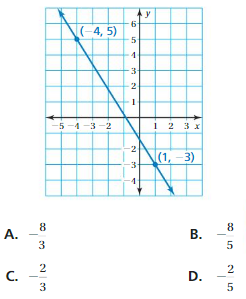
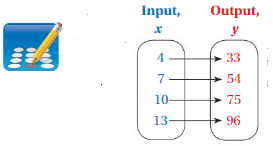
Answer:
The total number of miles it flies = 56 miles

Explanation:
given that city 1 at (0, 0)
city 2 at (33, 56)
city 3 at (23, 32)
33 + 23
56

Question 10.
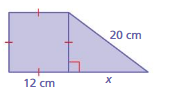
The national debt of Country A is $398,038,013,519. The national debt of Country B is $2,137,348,918. Approximately how many times greater is the debt of Country A than the debt of Country B?
A. 2 times greater
B. 20 times greater
C. 133 times greater
D. 200 times greater

Answer:
option B is correct.

Explanation:
country A = $398,038,013,519
country B = $2,137,348,918.

Question 11.
What is the solution of the system?
Big Ideas Math Solutions Grade 8 Chapter 9 Real Numbers and the Pythagorean Theorem cp 11
F.(2, 4)
G. (3, 0)
H.(4, 2)
I. (5, 0)

Answer:
option H is correct.

Explanation:
In the given graph
the line x-axis meets on 4 and y-axis meet on 2
(4, 2)

Question 12.
In the diagram, lines ℓ and m are parallel. Which angle has the same measure as ∠1?
Big Ideas Math Solutions Grade 8 Chapter 9 Real Numbers and the Pythagorean Theorem cp 12
A. ∠2
B. ∠5
C. ∠7
D. ∠8

Answer:
option D

Explanation:
given that l and m are parallel lines.
˂ 1 is equal to ˂8

Question 12.
Which graph represents the linear equation y = – 2x – 2?
Big Ideas Math Solutions Grade 8 Chapter 9 Real Numbers and the Pythagorean Theorem cp 13

Answer:
option F is correct.

Explanation:
graph F represents the linear equation.
y = -2x -2

Conclusion:

I wish the details mentioned in the above article regarding the Big Ideas Math Answers Grade 8 Chapter 9 Real Numbers and the Pythagorean Theorem is beneficial for high school students. If you have any queries feel free to post your doubts in the below comment section. Best of Luck!!!