Big Ideas Math Answers Grade 4 Chapter 10 Relate Fractions and Decimals

Big Ideas Math Answers Grade 4 Chapter 10 Relate Fractions and Decimals: If you are an avid student and curious about Maths then take the help of the Big Ideas Math Answers Grade 4 Chapter 10 Relate Fractions and Decimals. You can explore Questions from Practice Tests, Cumulative Practice, Chapter Test, Performance Tests, and seek the Homework Help required. Big Ideas Math Answers Grade 4 Chapter 10 Relate Fractions and Decimals provided will enhance the Overall Maths Skills.

Big Ideas Math Book 4th Grade Answer Key Chapter 10 Relate Fractions and Decimals

In order to help you guys, we have provided the solutions in pdf format. So Download Big Ideas Math Book 4th Grade Answer Key Chapter 10 Relate Fractions and Decimals pdf for free. Access the topicwise Grade 4 Big Ideas Math Answer Key available via quick links and use them as a reference whenever you have any queries.

Lesson: 1 Understand Tenths

Lesson: 2 Understand Hundredths

Lesson: 3 Fractions and Decimals

Lesson: 4 Compare Decimals

Lesson: 5 Add Decimal Fractions and Decimals

Lesson: 6 Fractions, Decimals and Money

Lesson: 7 Operations with Money

Performance Task

Lesson 10.1 Understand Tenths

Explore and Grow

How many dimes have a total value of one dollar? Draw a model.
Big Ideas Math Answers Grade 4 Chapter 10 Relate Fractions and Decimals 1

One dime is what fraction of one dollar? Write your answer in words and as a fraction.

Answer:
We know that,
1 dollar = 10 dimes
So,
The representation of one dime in the fraction of 1 dollar is: \(\frac{1}{10}\)
In terms of words, one Dime is equal to one-tenth of the Dollar

Explanation:
The given note is “Dollar note”
Big Ideas Math Answers Grade 4 Chapter 10 Relate Fractions and Decimals 1
We know that,
1 Dollar = 10 Dimes
So,
The representation of one Dime in the fraction of 1 dollar is: \(\frac{1}{10}\)

So,
The representation of a Dime in the model is:

From the above model,
We can say that one Dime is equal to one-tenth of one Dollar.

Structure
How is one whole related to one-tenth? How do you think you can write \(\frac{1}{10}\) in a place value chart?
Answer:
The representation of one-tenth in a place value chart is:

Explanation:
The one-tenth is the fraction value which is less than one whole. When we divide the one whole into ten parts,
then each divided part represents one-tenth of the 10 parts.
Hence,
The representation of \(\frac{1}{10}\) in the place-value chart is:

Think and Grow: Understand Tenths

A decimal is a number with one or more digits to the right of the decimal point. The first place to the right of the decimal point is the tenths place.
You can write tenths as fractions or decimals.
Big Ideas Math Answers Grade 4 Chapter 10 Relate Fractions and Decimals 2

Example
Write \(\frac{3}{10}\) as a decimal.
Shade the model. Use a place value chart.

Example
Write 2\(\frac{8}{10}\) as a decimal.
Shade the model. Use a place value chart.

Show and Grow

Write the fraction or mixed number as a decimal.

Question 1.
Big Ideas Math Answer Key Grade 4 Chapter 10 Relate Fractions and Decimals 5
Answer: The representation of \(\frac{5}{10}\) in the place-value chart is:

Explanation:
The given fraction is: \(\frac{5}{10}\)
The given model fro \(\frac{5}{10}\) is:
Big Ideas Math Answer Key Grade 4 Chapter 10 Relate Fractions and Decimals 5
The formula for converting fraction to a decimal is Decimal = Numerator ÷ Denominator
So,
The representation of \(\frac{5}{10}\) in the decimal form is: 0.5

Question 2.
Big Ideas Math Answer Key Grade 4 Chapter 10 Relate Fractions and Decimals 6

Answer: The representation of 1\(\frac{7}{10}\) in the place-value chart is:

Explanation:
The given mixed fraction is: 1\(\frac{7}{10}\)
So,
The improper fraction of 1\(\frac{7}{10}\) is: \(\frac{17}{10}\)
The given model for 1\(\frac{7}{10}\) is:
Big Ideas Math Answer Key Grade 4 Chapter 10 Relate Fractions and Decimals 6
Here,
In 1\(\frac{7}{10}\),
1 represents the one’s place and 7 represents the tenths place
The formula for converting fraction to a decimal is Decimal = Numerator ÷ Denominator
So,
The representation of 1\(\frac{7}{10}\) in the decimal form is: 1.7

Apply and Grow: Practice

Shade the model to represent the fraction or mixed number. Then write the fraction or mixed number as a decimal.

Question 3.
Big Ideas Math Answer Key Grade 4 Chapter 10 Relate Fractions and Decimals 7
Answer: The representation of  \(\frac{2}{10}\) in the place- value chart is:

Explanation:
The given fraction is: \(\frac{2}{10}\)
The model representing the \(\frac{2}{10}\) is:

The formula for converting fraction to a decimal is Decimal = Numerator ÷ Denominator
Hence,
The representation of \(\frac{2}{10}\) in the decimal form is: 0.2

Question 4.
Big Ideas Math Answer Key Grade 4 Chapter 10 Relate Fractions and Decimals 8
Answer: The representation of 1\(\frac{9}{10}\) in the place-value chart is:

Explanation:
The given mixed fraction is: 1\(\frac{9}{10}\)
So,
The improper fraction of 1\(\frac{9}{10}\) is: \(\frac{19}{10}\)
The model representiong 1\(\frac{9}{10}\) is:

The formula for converting fraction to a decimal is Decimal = Numerator ÷ Denominator
Hence,
The representation of 1\(\frac{9}{10}\) in the decimal form is: 1.9

Write the fraction or mixed number as a decimal.

Question 5.
Big Ideas Math Answer Key Grade 4 Chapter 10 Relate Fractions and Decimals 9
Answer: The representation of \(\frac{7}{10}\) in the place-value chart is:

Explanation:
The given fraction is: \(\frac{7}{10}\)
The model representing the \(\frac{7}{10}\) is:

The formula for converting fraction to a decimal is Decimal = Numerator ÷ Denominator
Hence,
The representation of \(\frac{7}{10}\) in the decimal form is: 0.7

Question 6.
Big Ideas Math Answer Key Grade 4 Chapter 10 Relate Fractions and Decimals 10
Answer: The representation of \(\frac{4}{10}\) in the place-value chart is:

Explanation:
The given fraction is: \(\frac{4}{10}\)
The model representing the \(\frac{4}{10}\) is:

The formula for converting fraction to a decimal is Decimal = Numerator ÷ Denominator
Hence,
The representation of \(\frac{4}{10}\) in the decimal form is: 0.4

Question 7.
Big Ideas Math Answer Key Grade 4 Chapter 10 Relate Fractions and Decimals 11
Answer: The representation of 5\(\frac{1}{10}\) in the place-value chart is:

Explanation:
The given mixed fraction is:5\(\frac{1}{10}\)
So,
The improper fraction of 5\(\frac{1}{10}\) is: \(\frac{51}{10}\)
In 5\(\frac{1}{10}\),
5 represents the ones position and 1 represents the tenths position.
The formula for converting fraction to a decimal is Decimal = Numerator ÷ Denominator
Hence,
The representation of 5\(\frac{1}{10}\) in the decimal form is: 5.1

Question 8.
Big Ideas Math Answer Key Grade 4 Chapter 10 Relate Fractions and Decimals 12
Answer: The representation of 24\(\frac{3}{10}\) in the place-value chart is:

Explanation:
The given mixed fraction is: 24\(\frac{3}{10}\)
So,
The improper fraction of 24\(\frac{3}{10}\) is: \(\frac{243}{10}\)
In 24\(\frac{3}{10}\),
2 represents the tens position
4 represents the one’s position
3 represents the tenths position
The formula for converting fraction to a decimal is Decimal = Numerator ÷ Denominator
Hence,
The representation of 24\(\frac{3}{10}\) in the decimal form is: 24.3

Write the number as a fraction or mixed number and as a decimal.

Question 9.
six tenths
Answer: The representation of six tenths in the fraction form is: \(\frac{6}{10}\)
The representation of \(\frac{6}{10}\) in the place-value chart is:

Explanation:
The given fraction is: \(\frac{6}{10}\)
In \(\frac{6}{10}\),
6 represents the tenth’s position
The formula for converting fraction to a decimal is Decimal = Numerator ÷ Denominator
Hence,
The representation of \(\frac{6}{10}\) in the Decimal form is: 0.6

Question 10.
eleven and five-tenths
Answer: The representation of eleven and five-tenths in the fraction form is: 11\(\frac{5}{10}\)
The representation of 11\(\frac{5}{10}\) in the place-value chart is:

Explanation:
The given mixed fraction is: 11\(\frac{5}{10}\)
So,
The improper fraction of 11\(\frac{5}{10}\) is: \(\frac{115}{10}\)
In 11\(\frac{5}{10}\),
1 represents Ten’s and 1 represents the one’s position
5 represents the tenth’s position
The formula for converting fraction to a decimal is Decimal = Numerator ÷ Denominator
Hence,
the representation of 11\(\frac{5}{10}\) in the decimal form is: 11.5

Question 11.
Newton passes 8 out of 10 obedience classes. What portion of the classes does Newton pass? Write your answer as a decimal.
Big Ideas Math Answer Key Grade 4 Chapter 10 Relate Fractions and Decimals 13
Answer: The portion of the classes does Newton pass is: 0.8

Explanation:
It is given that Newton passes 8 out of 10 obedience classes.
The representation of the portion of the classes that Newton passed in the fraction form = \(\frac{The number of classes that Newton passed} {The total number of classes}\) = \(\frac{8}{10}\)
So,
The representation of \(\frac{8}{10}\) in the place-value chart is:

In \(\frac{8}{10}\),
8 represents the Tenth’s position.
So, the representation of \(\frac{8}{10}\) in the decimal form is: 0.8
The formula for converting fraction to a decimal is Decimal = Numerator ÷ Denominator
Hence,
We can conclude that the representation of the portion of the classes that Newton passed in the decimal form is: 0.8

Question 12.
You move a game piece around a game board 3\(\frac{2}{10}\) times before you lose a turn. Write this number as a decimal.
Big Ideas Math Answer Key Grade 4 Chapter 10 Relate Fractions and Decimals 14.
Answer: The representation of 3\(\frac{2}{10}\) in the decimal form is: 3.2

Explanation:
It is given that you move a game piece around a game board 3\(\frac{2}{10}\) times before you lose a sum.
So,
The representation of 3\(\frac{2}{10}\) in the place-value chart is:

In 3\(\frac{2}{10}\),
3 represents one’s position
2 represents the tenth’s position
The formula for converting fraction to a decimal is Decimal = Numerator ÷ Denominator
Hence,
The representation of 3\(\frac{2}{10}\) in the decimal form is: 3.2

Question 13.
Writing
Do 0.5 and 5.0 have the same value? Explain.
Answer: 0.5 and 5.0 does not have the same value because the place-value of 5 is different in both 0.5 and 5.0

Explanation:
The given numbers are: 0.5 and 5.0
The position of 5 in 0.5 according to the place-value chart is:

The position of 5 in 5.0 according to the place-value chart is:

In 0.5, the position of 5 is: tenth’s position
In 5.0, the position of 5 is: One’s position
The formula for converting fraction to a decimal is Decimal = Numerator ÷ Denominator
Hence, from the above,
We can conclude that 0.5 and 5.0 do not have the same value.

Think and Grow: Modeling Real Life

Example
You have a collection of dinosaur figurines. What portion of the dinosaurs in your collection are carnivores? Write your answer as a decimal.
Big Ideas Math Answer Key Grade 4 Chapter 10 Relate Fractions and Decimals 15
Draw a model to represent the collection. Shade the same number of parts as there are carnivore dinosaurs in the collection.
Big Ideas Math Answer Key Grade 4 Chapter 10 Relate Fractions and Decimals 15.1
Write the decimal shown by the model.
Answer:
From the above table, 3 of the dinosaurs in the collection are carnivores.
The total number of dinosaurs in the collection is: 10
So,
The representation of carnivores in the collection of dinosaurs is: \(\frac{3}{10}\)

Explanation:
The given table is:
Big Ideas Math Answer Key Grade 4 Chapter 10 Relate Fractions and Decimals 15
From the above table,
The total number of dinosaurs are: 10
The number of carnivores in the total number of dinosaurs is: 3
So,
The representation of carnivores in the total number of dinosaurs in the fraction form is: \(\frac{3}{10}\)
Now,
The representation of \(\frac{3}{10}\) in the place-value chart is:

In \(\frac{3}{10}\),
3 represents tenth’s position.
The formula for converting a fraction to a decimal is Decimal = Numerator ÷ Denominator
Hence,
The representation of carnivores from the total number of dinosaurs in the decimal form is: 0.3

Show and Grow

Question 14.
Use the table above. What portion of the dinosaurs in your collection are herbivores? Write your answer as a decimal.
Big Ideas Math Answer Key Grade 4 Chapter 10 Relate Fractions and Decimals 16
Answer: The portion of dinosaurs in your collection that are herbivores is: 0.5

Explanation:
The given table is:
Big Ideas Math Answer Key Grade 4 Chapter 10 Relate Fractions and Decimals 15
From the above table,
The total number of dinosaurs are: 10
The number of herbivores from the collection of dinosaurs is: 5
So,
The representation of the number of herbivores from the total dinosaurs in the fraction form is: \(\frac{5}{10}\)
Now,
The representation of \(\frac{3}{10}\) in the place-value chart is:

In \(\frac{3}{10}\),
3 represents the tenth’s position
The formula for converting fraction to a decimal is Decimal = Numerator ÷ Denominator
Hence,
The representation of the herbivores from the total number of dinosaurs in the decimal form is: 0.5

Question 15.
DIG DEEPER!
You have 10 apps on your tablet. Six of the apps are games. What portion of the apps on your tablet are not games? Write your answer as a decimal.
Answer: The portion of the apps on your tablet that is not games in the fraction form is: \(\frac{4}{10}\)

Explanation:
It is given that there are 10 apps on your tablet out of which 6 of the apps are games.
So,
The total number of apps on your tablet are: 10
The number of apps that are games on your tablet is: 6
So,
The number of apps that are not games on your tablet is: 4
So,
The representation of the apps that are not games out of the total apps in the fraction form is: \(\frac{4}{10}\)
So,
The representation of \(\frac{4}{10}\) in the place-value chart is:

In \(\frac{4}{10}\),
4 represents the tenth’s position
The formula for converting fraction to a decimal is Decimal = Numerator ÷ Denominator
Hence,
The portion of the apps that are not games out of the total number of apps in the decimal form is: 0.4

Question 16.
DIG DEEPER!
You make 3 pans of lasagna for a party. You cut each pan of lasagna into10 equal pieces. The guests eat 22 pieces. Write the fraction and decimal that represent how many pans of lasagna the guests eat.
Answer: The representation of the pans of lasagna the guests eat in the fraction form is: \(\frac{22}{30}\)

Explanation:
It is given that there are 3 pans of lasagna for a party and each pan of lasagna cut into 10 equal parts.
So,
The total number of pieces of Lasagna = The total number of pans × The number of parts that each Lasagna is cut
= 3 × 10 = 30 pieces
It is also given that the guests eat 22 pieces out of 30 pieces.
So,
The representation of the number of pieces that the guests eat is: \(\frac{22}{30}\)
The representation of \(\frac{22}{30}\) in the place-value chart is:

In \(\frac{22}{30}\),
22 represents the ten’s and one’s position
30 represents the tenth’s position
The formula for converting fraction to a decimal is Decimal = Numerator ÷ Denominator
Hence,
The representation of the number of pieces out of the total number of pieces in the decimal form is: 22.30

Understand Tenths Homework & Practice 10.1

Question 1
Write \(\frac{6}{10}\) as a decimal.
Big Ideas Math Answer Key Grade 4 Chapter 10 Relate Fractions and Decimals 17
Answer: The representation of \(\frac{6}{10}\) in the decimal form is: 0.6

Explanation:
The given fraction is: \(\frac{6}{10}\)
The given model for \(\frac{6}{10}\) is:
Big Ideas Math Answer Key Grade 4 Chapter 10 Relate Fractions and Decimals 17
The representation of \(\frac{6}{10}\) in the place-value chart is:

In \(\frac{6}{10}\),
6 represents the tenth’s position
The formula for converting fraction to a decimal is Decimal = Numerator ÷ Denominator
Hence,
The representation of \(\frac{6}{10}\) in the decimal form is: 0.6

Question 2.
Shade the model to represent 1\(\frac{8}{10}\). Then write the mixed number as a decimal.
Big Ideas Math Answer Key Grade 4 Chapter 10 Relate Fractions and Decimals 18

Write the fraction or mixed number as a decimal.
Answer: The representation of 1\(\frac{8}{10}\) in the decimal form is: 1.8

Explanation:
The given mixed fraction is: 1\(\frac{8}{10}\)
So,
The improper fraction of 1\(\frac{8}{10}\) is: \(\frac{18}{10}\)
The model given for 1\(\frac{8}{10}\) is:

So,
The representation of 1\(\frac{8}{10}\) in the place-value chart is:

In 1\(\frac{8}{10}\),
1 represents the one’s position
8 represents the tenth’s position
The formula for converting fraction to a decimal is Decimal = Numerator ÷ Denominator
Hence,
Th representation of 1\(\frac{8}{10}\) in the decimal form is: 1.8

Question 3.
\(\frac{1}{10}\)
Answer: The representation of \(\frac{1}{10}\) in the decimal form is: 0.1

Explanation:
The given fraction is: \(\frac{1}{10}\)
Now,
The representation of \(\frac{1}{10}\) in the place-value chart is:

In \(\frac{1}{10}\),
1 represents the tenth’s position
The formula for converting fraction to a decimal is Decimal = Numerator ÷ Denominator
Hence,
The representation of \(\frac{1}{10}\) in the decimal form is: 0.1

Question 4.
\(\frac{5}{10}\)
Answer: The representation of \(\frac{5}{10}\) in the decimal form is: 0.5

Explanation:
The given fraction is: \(\frac{5}{10}\)
Now,
The representation of \(\frac{5}{10}\) in the place-value chart is:

In \(\frac{5}{10}\),
5 represents the tenth’s position
The formula for converting fraction to a decimal is Decimal = Numerator ÷ Denominator
Hence,
The representation of \(\frac{5}{10}\) in the decimal form is: 0.5

Question 5.
\(\frac{2}{10}\)
Answer: The representation of \(\frac{2}{10}\) in the decimal form is: 0.2

Explanation:
The given fraction is: \(\frac{2}{10}\)
Now,
The representation of \(\frac{2}{10}\) in the place-value chart is:

In \(\frac{2}{10}\),
2 represents the tenth’s position
The formula for converting fraction to a decimal is Decimal = Numerator ÷ Denominator
Hence,
The representation of \(\frac{2}{10}\) in the decimal form is: 0.2

Question 6.
\(\frac{8}{10}\)
Answer: The representation of \(\frac{8}{10}\) in the decimal form is: 0.8

Explanation:
The given fraction is: \(\frac{8}{10}\)
Now,
The representation of \(\frac{8}{10}\) in the place-value chart is:

In \(\frac{8}{10}\),
8 represents the tenth’s position
The formula for converting fraction to a decimal is Decimal = Numerator ÷ Denominator
Hence,
The representation of \(\frac{8}{10}\) in the decimal form is: 0.8

Question 7.
4\(\frac{3}{10}\)
Answer: The representation of 4\(\frac{3}{10}\) in the decimal form is: 4.3

Explanation:
The given mixed fraction is: 4\(\frac{3}{10}\)
So,
The improper fraction of 4\(\frac{3}{10}\) is: \(\frac{43}{10}\)
Now,
The representation of 4\(\frac{3}{10}\) in the place-value chart is:

In 4\(\frac{3}{10}\),
4 represents the one’s position
3 represents the tenth’s position
The formula for converting fraction to a decimal is Decimal = Numerator ÷ Denominator
Hence,
The representation of 4\(\frac{3}{10}\) in the decimal form is: 4.3

Question 8.
1\(\frac{4}{10}\)
Answer: The representation of 1\(\frac{4}{10}\) in the decimal form is: 1.4

Explanation:
The given mixed fraction is: 1\(\frac{4}{10}\)
So,
The improper fraction of 1\(\frac{4}{10}\) is: \(\frac{14}{10}\)
Now,
The representation of 1\(\frac{4}{10}\) in the place-value chart is:

In 1\(\frac{4}{10}\),
1 represents the one’s position
4 represents the tenth’s position
The formula for converting fraction to a decimal is Decimal = Numerator ÷ Denominator
Hence,
The representation of 1\(\frac{4}{10}\) in the decimal form is: 1.4

Question 9.
31\(\frac{7}{10}\)
Answer: The representation of 31\(\frac{7}{10}\) in the decimal form is: 31.7

Explanation:
The given mixed fraction is: 31\(\frac{7}{10}\)
So,
The improper fraction of 31\(\frac{7}{10}\) is: \(\frac{317}{10}\)
Now,
The representation of 31\(\frac{7}{10}\) in the place-value chart is:

In 31\(\frac{7}{10}\),
3 represents the ten’s position
1 represents the one’s position
7 represents the tenth’s position
The formula for converting fraction to a decimal is Decimal = Numerator ÷ Denominator
Hence,
The representation of 31\(\frac{7}{10}\) in the decimal form is: 31.7

Question 10.
40\(\frac{6}{10}\)
Answer: The representation of 40\(\frac{6}{10}\) in the decimal form is: 40.6

Explanation:
The given mixed fraction is: 40\(\frac{6}{10}\)
So,
The improper fraction of 40\(\frac{6}{10}\) is: \(\frac{406}{10}\)
Now,
The representation of 40\(\frac{6}{10}\) in the place-value chart is:

In 40\(\frac{6}{10}\),
4 represents the ten’s position
0 represents the one’s position
6 represents the tenth’s position
The formula for converting fraction to a decimal is Decimal = Numerator ÷ Denominator
Hence,
The representation of 40\(\frac{6}{10}\) in the decimal form is: 40.6

Write the number as a fraction or mixed number and as a decimal.

Question 11.
three tenths
Answer: The representation of the three-tenths in the decimal form is: 0.3

Explanation:
The given fraction in the word form is: Three-tenths
The representation of the three-tenths in the fraction form is: \(\frac{3}{10}\)
So,
The representation of \(\frac{3}{10}\) in the place-value chart is:

In \(\frac{3}{10}\),
3 represents the tenth’s place
Hence,
The representation of \(\frac{3}{10}\) in the decimal form is: 0.3

Question 12.
fourteen and nine-tenths
Answer: The representation of fourteen and nine-tenths in the decimal form is: 14.9

Explanation:
The given mixed fraction in Word form is: fourteen and nine-tenths
The representation of fourteen and nine-tenths in the fraction form is: 14\(\frac{9}{10}\)
So,
The improper fraction of 14\(\frac{9}{10}\) is: \(\frac{149}{10}\)
So,
The representation of 14\(\frac{9}{10}\) in the place-value chart is:

In 14\(\frac{9}{10}\),
1 represents the ten’s place
4 represents the one’s place
9 represents the tenth’s place
Hence,
The representation of 14\(\frac{9}{10}\) in the decimal form is: 14.9

Question 13.
You knock down 5 out of 10 bowling pins. What portion of the bowling pins do you knockdown? Write your answer as a decimal.
Answer: The portion the bowling pins did you knockdown is: \(\frac{5}{10}\) = 0.6

Explanation:
It is given that you knock down 5 bowling pins out of 10 bowling pins.
So,
The representation of the portion of bowling pins you knock down is: \(\frac{5}{10}\)
so,
The representation of \(\frac{5}{10}\) in the place-value chart is:

In \(\frac{5}{10}\),
5 represents the tenth’s position
Hence,
The representation of the portion of the bowling pins that you knockdown in the decimal form is: \(\frac{5}{10}\) = 0.5

Question 14.
You drive a go-kart around a track 8\(\frac{7}{10}\) times before you spin out. Write this number as a decimal.
Big Ideas Math Answer Key Grade 4 Chapter 10 Relate Fractions and Decimals 19

Answer:  The representation of 8\(\frac{7}{10}\) in the decimal form is: 8.7

Explanation:
It is given that you drive a go-kart around a track 8\(\frac{7}{10}\) before you spin out.
So,
The given mixed fraction is: 8\(\frac{7}{10}\)
So,
The improper fraction of 8\(\frac{7}{10}\) is: \(\frac{87}{10}\)
So,
The representation of 8\(\frac{7}{10}\) in the place-value chart is:

In 8\(\frac{7}{10}\),
8 represents the one’s position
7 represents the tenth’s position
Hence,
The representation of 8\(\frac{7}{10}\) in the decimal form is: 8.7

Question 15.
DIG DEEPER!
Which number-cards are represented by the model?
Big Ideas Math Answer Key Grade 4 Chapter 10 Relate Fractions and Decimals 20

Use the table.
Answer: The number- cards represented by the model are: 1\(\frac{3}{10}\) and 1.3

Explanation:
The given model is:
Big Ideas Math Answer Key Grade 4 Chapter 10 Relate Fractions and Decimals 20
In the given model, the tables are represented by:
A) 1\(\frac{3}{10}\) B) 13 C) 0.13 D) 1.3
In the given model,
Consider the fully colored model as one whole unit.
So,
The total number of colored units is: 10
Now, in another model,
The number of colored parts is: 3
The number of total parts is: 10
So,
The portion of the colored part from the total number of parts is: \(\frac{3}{10}\)
So, by combining the 2 models,
The total number of colored parts = 1 + \(\frac{3}{10}\)
= 1 + 0.3
= 1.3
So,
The representation of the total number of colored parts in the mixed fraction form is: 1\(\frac{3}{10}\)
The representation of the total number of colored parts in the decimal form is: 1.3

Question 16.
Modeling Real Life
A photographer frames her photographs from a safari trip. What portion of the framed photographs are of mammals? Write your answer as a decimal.
Big Ideas Math Answer Key Grade 4 Chapter 10 Relate Fractions and Decimals 21
Big Ideas Math Answer Key Grade 4 Chapter 10 Relate Fractions and Decimals 21.1

Answer: The portion of the framed photographs that are of mammals in the decimal form is: 0.6

Explanation:
It is given that a photographer frames photos from a safari trip and the framed photos are all categorized according to the table given below:
Big Ideas Math Answer Key Grade 4 Chapter 10 Relate Fractions and Decimals 21
So,
From the table,
The total number of framed photographs are: 10
The number of framed photographs that are mammals is: 6
So,
The portion of the mammals from the total number of framed photographs in the fraction form is: \(\frac{6}{10}\)
The representation of the \(\frac{6}{10}\) in the place-value chart is:

In \(\frac{6}{10}\),
6 represents the tenth’s position
Hence,
The portion of the mammals from the  framed photographs in the decimal form is:  0.6

Question 17.
DIG DEEPER!
What portion of the framed not photographs are of mammals? Write your answer as a decimal.
Answer: THe portion of the photographs that are not mammals in the decimal form is: 0.4

Explanation:
The table for all the framed photographs is given below:
Big Ideas Math Answer Key Grade 4 Chapter 10 Relate Fractions and Decimals 21
From the table,
The total number of framed photographs are: 10
The number of framed photographs that are not mammals is: 4
So,
The portion of the photographs that are not mammals in the fraction form is: \(\frac{4}{10}\)
The representation of \(\frac{4}{10}\) in the place-value chart is:

In \(\frac{4}{10}\),
4 represents the tenth’s position
Hence,
The number of framed photographs that are not mammals in the decimal form is: 0.4

Review & Refresh

Find the product.

Question 18.
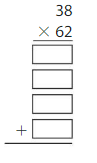
Big Ideas Math Answer Key Grade 4 Chapter 10 Relate Fractions and Decimals 22
Answer: 47 × 6 = 282

Explanation:
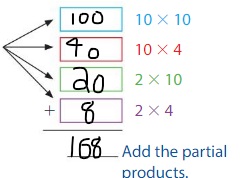
By using the partial products method,
47 × 6 = ( 40 + 7 ) × 6
= ( 40 × 6 ) + ( 7 × 6 )
= 240 + 42
= 282
Hence, 47 × 6 = 282

Question 19.
Big Ideas Math Answer Key Grade 4 Chapter 10 Relate Fractions and Decimals 23
Answer: 961 × 3 = 2,883

Explanation:
By using the partial products method,
961 × 3 = ( 900 + 60 + 1 ) × 3
= ( 900 × 3 ) + ( 60 × 3 ) + ( 1 × 3 )
= 2,700 + 180 + 3
= 2,883
Hence, 961 × 3 = 2,883

Question 20.
Big Ideas Math Answer Key Grade 4 Chapter 10 Relate Fractions and Decimals 24
Answer: 2,405 × 8 = 19,240

Explanation:
By using the partial products method,
2,405 × 8 = ( 2,400 + 5 ) × 8
= ( 2,400 × 8 ) + ( 5 × 8 )
= 19,200 + 40
= 19,240
Hence, 2,405 × 8 = 19,240

Lesson 10.2 Understand Hundredths

Explore and Grow

How many pennies have a total value of one dollar? Draw a model.
Big Ideas Math Answer Key Grade 4 Chapter 10 Relate Fractions and Decimals 25

One penny is what fraction of one dollar? Write your answer in words and as a fraction.

Answer: The representation of one penny into the dollar in the fraction form is: 0.01

Explanation:
The given note is:
Big Ideas Math Answer Key Grade 4 Chapter 10 Relate Fractions and Decimals 25
We know that,
1 Dollar = 100 pennies
So,
The representation of  1 penny into the dollar is: \(\frac{1}{100}\) dollars

Hence, one dollar is equal to 100 pennies and 1 penny is equal to 0.01 dollars

Structure
How is one-tenth related to one hundredth? How do you think you can write \(\frac{1}{100}\) in a place value chart?

Answer: The one-tenth is related to the one-hundredth as: \(\frac{1}{10}\)

Explanation:
We know that,
one-hundredth = \(\frac{1}{10}\) × \(\frac{1}{10}\)
Now,
The representation of \(\frac{1}{100}\) in the place-value chart is:

In \(\frac{1}{100}\),
1 represents the hundredth’s position

Think and Grow: Understand Hundredths

In decimal, the second place to the right of the decimal point is the hundredths place. You can write hundredths as fractions or decimals. A fraction with a denominator of 10 or 100 is called a decimal fraction.
Big Ideas Math Answer Key Grade 4 Chapter 10 Relate Fractions and Decimals 26

Show and Grow

Write the fraction or mixed number as a decimal.

Question 1.
Big Ideas Math Answer Key Grade 4 Chapter 10 Relate Fractions and Decimals 29
Answer: The representation of \(\frac{45}{100}\) in the decimal form is: 0.45

Explanation:
The given fraction is: \(\frac{45}{100}\)
The model given for \(\frac{45}{100}\) is:
Big Ideas Math Answer Key Grade 4 Chapter 10 Relate Fractions and Decimals 29

So,
The representation of \(\frac{45}{100}\) in the place-value chart is:

In \(\frac{45}{100}\),
5 represents the hundredth’s position
4 represents the tenth’s position
The formula for converting fraction to a decimal is Decimal = Numerator ÷ Denominator
Hence,
The representation of \(\frac{45}{100}\) in the decimal form is: 0.45

Question 2.
Big Ideas Math Answer Key Grade 4 Chapter 10 Relate Fractions and Decimals 30
Answer: The representation of 1\(\frac{90}{100}\) in the decimal form is: 1.90

Explanation:
The given fraction is: 1\(\frac{90}{100}\)
The model given for 1\(\frac{90}{100}\) is:
Big Ideas Math Answer Key Grade 4 Chapter 10 Relate Fractions and Decimals 30

So,
The representation of 1\(\frac{90}{100}\) in the place-value chart is:

In 1\(\frac{90}{100}\),
1 represents the one’s position
0 represents the hundredth’s position
9 represents the tenth’s position
The formula for converting fraction to a decimal is Decimal = Numerator ÷ Denominator
Hence,
The representation of 1\(\frac{90}{100}\) in the decimal form is: 1.90

Apply and Grow: Practice

Shade the model to represent the fraction or mixed number. Then write the fraction or mixed number as a decimal.

Question 3.
Big Ideas Math Answer Key Grade 4 Chapter 10 Relate Fractions and Decimals 31
Answer: The representation of \(\frac{98}{100}\) in the decimal form is: 0.98

Explanation:
The given fraction is: \(\frac{98}{100}\)
The model given for \(\frac{98}{100}\) is:
Big Ideas Math Answer Key Grade 4 Chapter 10 Relate Fractions and Decimals 31

So,
The representation of \(\frac{98}{100}\) in the place-value chart is:

In \(\frac{98}{100}\),
8 represents the hundredth’s position
9 represents the tenth’s position
The formula for converting fraction to a decimal is Decimal = Numerator ÷ Denominator
Hence,
The representation of \(\frac{98}{100}\) in the decimal form is: 0.98

Question 4.
Big Ideas Math Answer Key Grade 4 Chapter 10 Relate Fractions and Decimals 32
Answer:

The representation of 1\(\frac{34}{100}\) in the decimal form is: 1.34

Explanation:
The given mixed fraction is: 1\(\frac{34}{100}\)
So,
The improper fraction of 1\(\frac{34}{100}\) is: \(\frac{134}{100}\)
The model given for 1\(\frac{34}{100}\) is:
Big Ideas Math Answer Key Grade 4 Chapter 10 Relate Fractions and Decimals 32

So,
The representation of 1\(\frac{34}{100}\) in the place-value chart is:

In 1\(\frac{34}{100}\),
1 represents the one’s position
4 represents the hundredth’s position
3 represents the tenth’s position
The formula for converting fraction to a decimal is Decimal = Numerator ÷ Denominator
Hence,
The representation of 1\(\frac{34}{100}\) in the decimal form is: 1.34

Write the fraction or mixed number as a decimal.

Question 5.
\(\frac{42}{100}\)
Answer: The representation of \(\frac{42}{100}\) in the form of decimal number is: 0.42

Explanation:
The given fraction is: \(\frac{42}{100}\)
Now,
The representation of \(\frac{42}{100}\) in the place-value chart is:

In \(\frac{42}{100}\),
2 represents the hundredth position
4 represents the tenth position
Hence,
The representation of \(\frac{42}{100}\) in the decimal form is: 0.42

Question 6.
\(\frac{7}{100}\)
Answer: The representation of \(\frac{7}{100}\) in the form of decimal number is: 0.07

Explanation:
The given fraction is: \(\frac{7}{100}\)
Now,
The representation of \(\frac{7}{100}\) in the place-value chart is:

In \(\frac{7}{100}\),
7 represents the hundredth position
0 represents the tenth position
Hence,
The representation of \(\frac{7}{100}\) in the decimal form is: 0.07

Question 7.
4\(\frac{56}{100}\)
Answer: The representation of 4\(\frac{56}{100}\) in the form of a decimal number is: 4.56

Explanation:
The given mixed fraction is: 4\(\frac{56}{100}\)
So,
The improper fraction of 4\(\frac{56}{100}\) is: \(\frac{456}{100}\)
Now,
The representation of 4\(\frac{56}{100}\) in the place-value chart is:

In 4\(\frac{56}{100}\),
4 represents the one’s position
6 represents the hundredth position
5 represents the tenth position
Hence,
The representation of 4\(\frac{56}{100}\) in the decimal form is: 4.56

Question 8.
23\(\frac{9}{100}\)
Answer: The representation of 23\(\frac{9}{100}\) in the form of a decimal number is: 23.09

Explanation:
The given mixed fraction is: 23\(\frac{9}{100}\)
So,
The improper fraction of 23\(\frac{9}{100}\) is: \(\frac{2,309}{100}\)
Now,
The representation of 23\(\frac{9}{100}\) in the place-value chart is:

In 23\(\frac{9}{100}\),
2 represents the ten’s position
3 represents the one’s position
9 represents the hundredth position
0 represents the tenth position
Hence,
The representation of 23\(\frac{9}{100}\) in the decimal form is: 23.09

Write the fraction or mixed number as a decimal.

Question 9.
sixty-one hundredths
Answer:
The representation of sixty-one hundredths in the fraction form is: \(\frac{61}{100}\)
The representation of sixty-one hundredths in the decimal form is: 0.61

Explanation:
The given word form is: Sixty-one hundredths
So,
The representation of sixty-one hundredths in the fraction form is: \(\frac{61}{100}\)
Now,
The representation of \(\frac{61}{100}\) in the place-value chart is:

In \(\frac{61}{100}\),
1 represents the hundredth’s position
6 represents the tenth’s position
Hence,
The representation of \(\frac{61}{100}\) in the decimal form is: 0.61

Question 10.
twelve and eighty-three hundredths
Answer:
The representation of twelve and eighty-three hundredths in the fraction form is: 12\(\frac{83}{100}\)
The representation of twelve and eighty-three hundredths in the decimal form is: 12.83

Explanation:
The given word form is: twelve and eighty-three hundredths
So,
The representation of twelve and eighty-three hundredths in the fraction form is: 12\(\frac{83}{100}\)
Now,
The representation of 12\(\frac{83}{100}\) in the place-value chart is:

In 12\(\frac{83}{100}\),
1 represents the ten’s position
2 represents the one’s position
3 represents the hundredth’s position
8 represents the tenth’s position
Hence,
The representation of 12\(\frac{83}{100}\) in the decimal form is: 12.83

Question 11.
A shelter finds homes for 100 dogs. Five of the dogs are Doberman pinschers. What portion of the dogs are Doberman pinschers? Write your answer as a decimal.
Big Ideas Math Answer Key Grade 4 Chapter 10 Relate Fractions and Decimals 33
Answer: The portion of the dogs that are Doberman pinschers in the fraction form is: 0.05

Explanation:
It is given that a shelter finds homes for 100 dogs and out of these 100 dogs, 5 dogs are Doberman pinschers
So,
The portion of the dogs that are Doberman pinschers = \(\frac{The number of dogs that are Doberman pinschers}{The total number of dogs}\)
= \(\frac{5}{100}\)
So,
The representation of \(\frac{5}{100}\) in the place-value chart is:

In \(\frac{5}{100}\),
0 represents the tenth’s position
5 represents the hundredth’s position
Hence,
The portion of the dogs that are Doberman pinschers in the decimal form is: 0.05

Question 12.
An athlete runs 3\(\frac{50}{100}\) lengths of a football field. Write this number as a decimal.
Big Ideas Math Answer Key Grade 4 Chapter 10 Relate Fractions and Decimals 33.1
Answer: The representation of 3\(\frac{50}{100}\) in the decimal form is: 3.5

Explanation:
It is given that an athlete runs 3\(\frac{50}{100}\) lengths of a football field.
So,
The representation of 3\(\frac{50}{100}\) in the place-value chart is:

Now,
In 3\(\frac{50}{100}\),
3 represents the one’s place
0 represents the hundredth’s place
5 represents the tenth’s position
Now,
The given mixed fraction is: 3\(\frac{50}{100}\)
So,
The improper fraction of 3\(\frac{50}{100}\) is: \(\frac{350}{100}\)
So,
The representation of 3\(\frac{50}{100}\) in the decimal form is: 3.50

Question 13.
Number Sense
Which number of cards show three-hundredths?
Big Ideas Math Answer Key Grade 4 Chapter 10 Relate Fractions and Decimals 34
Answer: From the given cards, \(\frac{3}{100}\) and 0.03 shows the form of three-hundredths

Explanation:
The given number of cards is:
Big Ideas Math Answer Key Grade 4 Chapter 10 Relate Fractions and Decimals 34

The given fractions and decimal numbers in the given table are:
A) \(\frac{3}{100}\) B) \(\frac{3}{10}\) C) 300 D) 0.3 E) 0.03
We can observe that
From three-hundredths, we can say that,
The total number of cards are: 100
The portion of cards from 100 cards is: 3
So,
The representation of three-hundredths in the fraction form is: \(\frac{3}{100}\)
Now,
The representation of \(\frac{3}{100}\) in the place-value chart is:

In \(\frac{3}{100}\),
0 represents the tenth’s position
3 represents the hundredth’s position
So,
The representation of \(\frac{3}{100}\) in the decimal form is: 0.03
hence, from the given table,
We can conclude that the number of cards that represent the three-hundredths is: \(\frac{3}{100}\) and 0.03

Think and Grow: Modeling Real Life

Example
You use 51 toothpicks to make a bridge. What portion of the container of toothpicks do you use to make the bridge? Write your answer as a decimal.
Draw a model to represent the container of toothpicks. Shade the same number of parts as the number of toothpicks you use to make the bridge. Write the decimal shown by the model
Big Ideas Math Answer Key Grade 4 Chapter 10 Relate Fractions and Decimals 35
Answer:
It is given that you are using 51 toothpicks to make a bridge.
So,
The total number of chopsticks are: 100
The number of chopsticks that are using to make a bridge is: 51
So,
The representation of the portion of the chopsticks that are used to make chopsticks = \(\frac{51}{100}\)
So, from \(\frac{3}{100}\),
We can say that you use 51 of the container of toothpicks to make the bridge.

Show and Grow

Question 14.
A book fair has 100 books. 60 of the books are chapter books. What portion of the books in the book fair are chapter books? Write your answer as a decimal.
Answer: The portion of the chapter books out of the total number of books in the decimal form is: 0.60

Explanation:
It is given that a book fair has 100 books and out of these 100 books, 60 books are chapter books.
So,
The portion of the chapter books out of the total number of books in the fraction form is: \(\frac{60}{100}\)
Now,
The representation of \(\frac{60}{100}\) in the place-value chart is:

From \(\frac{60}{100}\), we can say that
0 represents the hundredth’s position-
6 represents the tenth’s position
So,
The representation of \(\frac{60}{100}\) in the decimal form is: 0.60
Hence, from the above,
We can conclude that the portion of the books that are the chapter books in the decimal form is: 0.60

Question 15.
The model represents the members of a marching band. What portion of the marching band plays a brass instrument? percussion instrument? Write your answers as decimals.
Big Ideas Math Answer Key Grade 4 Chapter 10 Relate Fractions and Decimals 36
Answer: The portion of the marching band that plays a brass instrument is: 0.47

Explanation:
It is given that the below model represents the members of a marching band.
The given model is:
Big Ideas Math Answer Key Grade 4 Chapter 10 Relate Fractions and Decimals 36
In the given model, there are 3 categories of marching brand
In the given model, each box represents 1 unit.
So,
From the model,
The number of the marching band that plays a brass instrument is: 47
The number of the marching band that plays a woodwind instrument is: 36
The number of the marching band that plays a percussion instrument is: 17
The total number of instruments are: 100
So,
The portion of the marching band that plays a band instrument from the total number of instruments in the fraction form is: \(\frac{47}{100}\)
Hence, from the above,
The portion of the marching band that plays a band instrument from the total number of instruments i the decimal form is: 0.47

Question 16.
DIG DEEPER!
What portion of Earth’s surface is covered by water? Write your answer as a decimal.
Big Ideas Math Answer Key Grade 4 Chapter 10 Relate Fractions and Decimals 37
Answer: The portion of Earth’s surface that is covered by water in the fraction form is: 0.71

Explanation:
It is given that about \(\frac{71}{100}\) of earth’s surface is covered by water.
So,
The representation of \(\frac{71}{100}\) in the place-value chart is:

From \(\frac{71}{100}\), we can say that
1 represents the hundredth’s position
7 represents the tenth’s position
Hence,
The portion of water on the Earth’s surface represented in decimal form is: 0.71

Understand Hundredths Homework & Practice 10.2

Write the fraction or mixed number as a decimal.

Question 1.
Write \(\frac{83}{100}\) as a decimal.
Big Ideas Math Answer Key Grade 4 Chapter 10 Relate Fractions and Decimals 38
Answer: The representation of \(\frac{83}{100}\) in the decimal form is: 0.98

Explanation:
The given fraction is: \(\frac{83}{100}\)
The model given for \(\frac{83}{100}\) is:
Big Ideas Math Answer Key Grade 4 Chapter 10 Relate Fractions and Decimals 38

So,
The representation of \(\frac{83}{100}\) in the place-value chart is:

In \(\frac{83}{100}\),
3 represents the hundredth’s position
8 represents the tenth’s position
The formula for converting fraction to a decimal is Decimal = Numerator ÷ Denominator
Hence,
The representation of \(\frac{83}{100}\) in the decimal form is: 0.83

Question 2.
Shade the model to represent 1\(\frac{65}{100}\). Then write the mixed number as a decimal.
Big Ideas Math Answer Key Grade 4 Chapter 10 Relate Fractions and Decimals 39
Answer: The representation of \(\frac{65}{100}\) in the form of a decimal number is: 1.65

Explanation:
The given mixed fraction is: 1\(\frac{65}{100}\)
So,
The improper fraction of 1\(\frac{65}{100}\) is: \(\frac{165}{100}\)
Now,
The representation of 1\(\frac{65}{100}\) in the place-value chart is:

In 1\(\frac{65}{100}\),
1 represents the one’s position
5 represents the hundredth position
6 represents the tenth position
Hence,
The representation of 1\(\frac{65}{100}\) in the decimal form is: 1.65

Question 3.
\(\frac{12}{100}\)
Answer: The representation of \(\frac{12}{100}\) in the decimal form is: 0.12

Explanation:
The given fraction is: \(\frac{12}{100}\)
So,
The representation of \(\frac{12}{100}\) in the place-value chart is:

In \(\frac{12}{100}\),
2 represents the hundredth’s position
1 represents the tenth’s position
The formula for converting fraction to a decimal is Decimal = Numerator ÷ Denominator
Hence,
The representation of \(\frac{12}{100}\) in the decimal form is: 0.12

Question 4.
\(\frac{24}{100}\)
Answer: The representation of \(\frac{24}{100}\) in the decimal form is: 0.24

Explanation:
The given fraction is: \(\frac{24}{100}\)
So,
The representation of \(\frac{24}{100}\) in the place-value chart is:

In \(\frac{24}{100}\),
4 represents the hundredth’s position
2 represents the tenth’s position
The formula for converting fraction to a decimal is Decimal = Numerator ÷ Denominator
Hence,
The representation of \(\frac{24}{100}\) in the decimal form is: 0.24

Question 5.
\(\frac{2}{100}\)
Answer: The representation of \(\frac{2}{100}\) in the decimal form is: 0.02

Explanation:
The given fraction is: \(\frac{2}{100}\)
So,
The representation of \(\frac{2}{100}\) in the place-value chart is:

In \(\frac{2}{100}\),
2 represents the hundredth’s position
0 represents the tenth’s position
The formula for converting fraction to a decimal is Decimal = Numerator ÷ Denominator
Hence,
The representation of \(\frac{2}{100}\) in the decimal form is: 0.02

Question 6.
\(\frac{8}{100}\)
Answer: The representation of \(\frac{8}{100}\) in the decimal form is: 0.08

Explanation:
The given fraction is: \(\frac{8}{100}\)
So,
The representation of \(\frac{8}{100}\) in the place-value chart is:

In \(\frac{8}{100}\),
8 represents the hundredth’s position
0 represents the tenth’s position
The formula for converting fraction to a decimal is Decimal = Numerator ÷ Denominator
Hence,
The representation of \(\frac{8}{100}\) in the decimal form is: 0.08

Question 7.
2\(\frac{59}{100}\)
Answer: The representation of 2\(\frac{59}{100}\) in the form of a decimal number is: 2.59

Explanation:
The given mixed fraction is: 2\(\frac{59}{100}\)
So,
The improper fraction of 2\(\frac{59}{100}\) is: \(\frac{259}{100}\)
Now,
The representation of 2\(\frac{59}{100}\) in the place-value chart is:

In 2\(\frac{59}{100}\),
2 represents the one’s position
9 represents the hundredth position
5 represents the tenth position
Hence,
The representation of 2\(\frac{59}{100}\) in the decimal form is: 2.59

Question 8.
48\(\frac{31}{100}\)
Answer: The representation of 48\(\frac{31}{100}\) in the form of a decimal number is: 48.31

Explanation:
The given mixed fraction is: 48\(\frac{31}{100}\)
So,
The improper fraction of 48\(\frac{31}{100}\) is: \(\frac{4,831}{100}\)
Now,
The representation of 48\(\frac{31}{100}\) in the place-value chart is:

In 48\(\frac{31}{100}\),
4 represents ten’s position
8 represents the one’s position
1 represents the hundredth position
3 represents the tenth position
Hence,
The representation of 48\(\frac{31}{100}\) in the decimal form is: 48.31

Question 9.
6\(\frac{7}{100}\)
Answer: The representation of 6\(\frac{7}{100}\) in the form of a decimal number is: 6.07

Explanation:
The given mixed fraction is: 6\(\frac{7}{100}\)
So,
The improper fraction of 6\(\frac{7}{100}\) is: \(\frac{607}{100}\)
Now,
The representation of 6\(\frac{7}{100}\) in the place-value chart is:

In 6\(\frac{7}{100}\),
6 represents the one’s position
7 represents the hundredth position
0 represents the tenth position
Hence,
The representation of 6\(\frac{7}{100}\) in the decimal form is: 6.07

Question 10.
31\(\frac{6}{100}\)
Answer: The representation of 31\(\frac{6}{100}\) in the form of a decimal number is: 31.06

Explanation:
The given mixed fraction is: 31\(\frac{6}{100}\)
So,
The improper fraction of 31\(\frac{6}{100}\) is: \(\frac{3,106}{100}\)
Now,
The representation of 31\(\frac{6}{100}\) in the place-value chart is:

In 31\(\frac{6}{100}\),
3 represents the ten’s position
1 represents the one’s position
6 represents the hundredth position
0 represents the tenth position
Hence,
The representation of 31\(\frac{6}{100}\) in the decimal form is: 31.06

Write the number as a fraction or mixed number and as a decimal.

Question 11.
seventy-four hundredths
Answer:
The representation of seventy-four hundredths in the fraction form is: \(\frac{74}{100}\)
The representation of seventy-four hundredths in the decimal form is: 0.74

Explanation:
The given word form is: Seventy-four hundredths
So,
The representation of seventy-four hundredths in the fraction form is: \(\frac{74}{100}\)
Now,
The representation of \(\frac{74}{100}\) in the place-value chart is:

In \(\frac{74}{100}\),
4 represents the hundredth’s position
7 represents the tenth’s position
Hence,
The representation of \(\frac{74}{100}\) in the decimal form is: 0.74

Question 12.
sixteen and thirty-one hundredths
Answer:
The representation of sixteen and thirty-one hundredths in the fraction form is: 16\(\frac{31}{100}\)
The representation of sixteen and thirty-one hundredths in the decimal form is: 16.31

Explanation:
The given word form is: sixteen and thirty-one hundredths
So,
The representation of sixteen and thirty-one hundredths in the fraction form is: 16\(\frac{31}{100}\)
Now,
The representation of 16\(\frac{31}{100}\) in the place-value chart is:

In 16\(\frac{31}{100}\),
1 represents the ten’s position
6 represents the one’s position
1 represents the hundredth’s position
3 represents the tenth’s position
Hence,
The representation of 16\(\frac{31}{100}\) in the decimal form is: 16.31

Write the value of the underlined digit.

Question 13.
5.84
Answer: The value of 8 in 5.84 is: 0.8

Explanation:
The given number is: 5.84
The representation of 5.84 in the place-value chart is:

In 5.83, from the place-value chart,
We can say that the value of 8 in 5.83 is: 0.8

Question 14.
21.03
Answer: The value of 2 in 21.03 is: 20

Explanation:
The given number is: 21.03
The representation of 21.03 in the place-value chart is:

From the above place-value chart,
We can say that the value of 2 in 21.03 is: 20

Question 15.
67.32
Answer: The value of 2 in 67.32 is: 0.02

Explanation:
The given number is: 67.32
The representation of 67.32 in the place-value chart is:

From the above place-value chart,
We can say that the value of 2 in 67.32 is: 0.02

Question 16.
506.19
Answer: The value of 5 in 506.19 is: 500

Explanation:
The given number is: 506.19
The representation of 506.19 in the place-value chart is:

From the above place-value chart,
We can say that the value of 5 in 506.19 is: 500

Question 17.
A clown has 100 balloons. She uses 56 of the balloons to make animals. What portion of the balloons does she use? Write your answer as a decimal.
Big Ideas Math Answer Key Grade 4 Chapter 10 Relate Fractions and Decimals 39.1
Answer: The portion of the balloons she used to make animals in the decimal form is: 0.56

Explanation:
It is given that a clown has 100 balloons and she uses 56 of the balloons to make animals.
So,
The total number of balloons are: 100
The number of ballons that are used to make animals is: 56
So,
The portion of the balloons that are used to make animals is:\(\frac{56}{100}\)
So,
The representation of \(\frac{56}{100}\) in the place-value chart is:

Hence,
We can conclude that the portion of the balloons that are used to make animals in the decimal form is: 0.56

Question 18.
You fill a beaker 4\(\frac{35}{100}\) times for an experiment. Write this number as a decimal.
Big Ideas Math Answer Key Grade 4 Chapter 10 Relate Fractions and Decimals 40
Answer: The representation of 4\(\frac{35}{100}\) in the form of a decimal number is: 4.35

Explanation:
The given mixed fraction is: 4\(\frac{35}{100}\)
So,
The improper fraction of 4\(\frac{35}{100}\) is: \(\frac{435}{100}\)
Now,
The representation of 4\(\frac{35}{100}\) in the place-value chart is:

In 4\(\frac{35}{100}\),
4 represents the one’s position
5 represents the hundredth position
3 represents the tenth position
Hence,
The representation of 4\(\frac{35}{100}\) in the decimal form is: 4.35

Question 19.
YOU BE THE TEACHER
Descartes writes 2\(\frac{40}{100}\) as 2.04. Is he correct? Explain.
Answer:
The representation of 2\(\frac{40}{100}\) in the form of a decimal number is: 2.40
So, Descartes is wrong.

Explanation:
The given mixed fraction is: 2\(\frac{40}{100}\)
So,
The improper fraction of 2\(\frac{40}{100}\) is: \(\frac{240}{100}\)
Now,
The representation of 2\(\frac{40}{100}\) in the place-value chart is:

In 2\(\frac{40}{100}\),
2 represents the one’s position
0 represents the hundredth position
4 represents the tenth position
So,
The representation of 2\(\frac{40}{100}\) in the decimal form is: 2.40
But, according to Descartes,
The representation of 2\(\frac{40}{100}\) in the decimal form is: 2.04
Hence, from the above,
We can conclude that Descartes is not correct.

Question 20.
DIG DEEPER!
Shade each model to show 0.6 and 0.60. What do you notice?
Big Ideas Math Answer Key Grade 4 Chapter 10 Relate Fractions and Decimals 41
Answer: From the values of 0.6 and 0.60, we can notice that the value of 6 in both numbers are the same.

Explanation:
The given numbers are: 0.6 and 0.60
The given models of 0.6 and 0.60 are:
Big Ideas Math Answer Key Grade 4 Chapter 10 Relate Fractions and Decimals 41
Now,
The shaded models of 0.6 and 0.60 will be:

Now,
The representation of 0.6 in the place-value chart is:

The representation of 0.60 in the place-value chart is:

Hence,
From the above 2 place-value charts,
We can conclude that 0.6 and 0.60 are the same as the value of 6 in 0.6 and 0.60 is the same.

Question 21.
Modeling Real Life
You work on the puzzle shown. You connect 78 of the puzzle pieces. What portion of the puzzle have you completed? Write your answer as a decimal.
Big Ideas Math Answer Key Grade 4 Chapter 10 Relate Fractions and Decimals 42
Answer: The portion of the puzzles you have completed in the decimal form is: 0.78

Explanation:
It is given that you are working on a 100-box puzzle and you connected 78 of the puzzle pieces.
So,
The total number of puzzles are: 100
The number of puzzles that are connected is: 78
So,
The portion of the puzzles that are connected in the fraction form is: \(\frac{78}{100}\)
Now,
The representation of \(\frac{78}{100}\) in the place-value chart is:

Hence, from the above,
We can conclude that the portion of the puzzles that are connected in the decimal form is: 0.78

Review & Refresh

Divide. Then check your answer.

Question 22.
Big Ideas Math Answer Key Grade 4 Chapter 10 Relate Fractions and Decimals 43
Answer: 1,308 ÷ 5 = 261 R 3

Explanation:
By using the partial quotients method,
1,308 ÷ 5 = ( 1,000 + 300 + 5 ) ÷ 5
= ( 1,000 ÷ 5 ) + ( 300 ÷ 5 ) + ( 5 ÷ 5 )
= 200 + 60 + 1
= 261 R 3
Hence, 1,308 ÷ 5 = 261 R 3

Question 23.
Big Ideas Math Answer Key Grade 4 Chapter 10 Relate Fractions and Decimals 44
Answer: 67 ÷ 4 = 16 R 3

Explanation:
By using the partial quotients method,
67 ÷ 4 = ( 56 + 8 ) ÷ 4
= ( 56 ÷ 4 ) + ( 8 ÷ 4 )
= 14 + 2
= 16 R 3
Henec, 67 ÷ 4 = 1 R 3

Question 24.
Big Ideas Math Answer Key Grade 4 Chapter 10 Relate Fractions and Decimals 45
Answer: 725 ÷ 2 = 362 R 1

Explanation:
By using the partial quotients method,
725 ÷ 2 = ( 720 + 4 ) ÷ 2
= ( 720 ÷ 2 ) + ( 4 ÷ 2 )
= 360 + 2
= 362 R 1
Hence,
75 ÷ 2 = 362 R 1

Lesson 10.3 Fractions and Decimals

Explore and Grow

Plot each fraction or decimal on a number line.

Reasoning
What do you notice about the locations of the points? What can you conclude about the numbers?

Answer: From the above plots, we can see that the number of lines between any two numbers is the same whether the given number is in fraction form or in the decimal form
So, from the above plots, we can conclude that the location of the numbers and the gap between the two numbers is the same.

Think and Grow: Fractions and Decimals

Example
Write \(\frac{6}{10}\) as hundredths in fraction form and decimal form.
Fraction form: Shade the model to help write \(\frac{6}{10}\) as an equivalent fraction with a denominator of 100.

Two or more decimals that have the same value are equivalent decimals.
Example
Write 0.40 as tenths in decimal form and fraction form.

Show and Grow

Question 1.
Write \(\frac{9}{10}\) as hundredths in fraction form and decimal form.
Answer:
The representation of \(\frac{9}{10}\) as hundredths in the fraction form is: \(\frac{90}{100}\)
The representation of \(\frac{90}{100}\) in the decimal form is: 0.90

Explanation:
The given fraction is: \(\frac{9}{10}\)
So, to write \(\frac{9}{10}\) as hundredths, multiply the fraction and numerator of \(\frac{9}{10}\) with 10.
So,
Firstly the numerators 9 and 10 are multiplied and then the denominators 10 and 10 are multiplied
We know that,
Decimal = Numerator ÷ Denominator
So,
The representation of \(\frac{90}{100}\) in the place-value chart is:

Hence,
The representation of \(\frac{9}{10}\) as hundredths in the fraction form is: \(\frac{90}{100}\)
The representation of \(\frac{90}{100}\) in the decimal form is: 0.90

Question 2.
Write 0.20 as tenths in decimal form and fraction form.
Answer:
The representation of 0.20 as tenths in the fraction form is: \(\frac{2}{10}\)
The representation of \(\frac{2}{10}\) in the decimal form is: 0.2

Explanation:
The given fraction is: \(\frac{20}{100}\)
So, to write \(\frac{20}{100}\) as tenths, divide the fraction and numerator of \(\frac{20}{100}\) with 10.
So,
Firstly the numerators 20 and 10 are divided and then the denominators 100 and 10 are divided
So,
\(\frac{20}{100}=\frac{20 \div 10}{100 \div 10}=\frac{2}{10}\)
We know that,
Decimal = Numerator ÷ Denominator
So,
The representation of \(\frac{2}{10}\) in the place-value chart is:

Hence,
The representation of \(\frac{20}{100}\) as tenths in the fraction form is: \(\frac{2}{10}\)
The representation of \(\frac{2}{10}\) in the decimal form is: 0.2

Apply and Grow: Practice

Write the number as tenths in fraction form and decimal form.

Question 3.
\(\frac{80}{100}\)
Answer:
The representation of \(\frac{80}{100}\) as tenths in the fraction form is: \(\frac{8}{10}\)
The representation of \(\frac{8}{10}\) in the decimal form is: 0.8

Explanation:
The given fraction is: \(\frac{80}{100}\)
So, to write \(\frac{80}{100}\) as tenths, divide the fraction and numerator of \(\frac{80}{100}\) with 10.
So,
Firstly the numerators 80 and 10 are divided and then the denominators 100 and 10 are divided
So,
\(\frac{80}{100}=\frac{80 \div 10}{100 \div 10}=\frac{8}{10}\)
We know that,
Decimal = Numerator ÷ Denominator
So,
The representation of \(\frac{80}{100}\) in the place-value chart is:

Hence,
The representation of \(\frac{80}{100}\) as tenths in the fraction form is: \(\frac{8}{10}\)
The representation of \(\frac{8}{10}\) in the decimal form is: 0.8

Question 4.
\(\frac{50}{100}\)
Answer:
The representation of \(\frac{50}{100}\) as tenths in the fraction form is: \(\frac{5}{10}\)
The representation of \(\frac{5}{10}\) in the decimal form is: 0.5

Explanation:
The given fraction is: \(\frac{50}{100}\)
So, to write \(\frac{50}{100}\) as tenths, divide the fraction and numerator of \(\frac{50}{100}\) with 10.
So,
Firstly the numerators 50 and 10 are divided and then the denominators 100 and 10 are divided
So,
\(\frac{50}{100}=\frac{50 \div 10}{100 \div 10}=\frac{5}{10}\)
We know that,
Decimal = Numerator ÷ Denominator
So,
The representation of \(\frac{50}{100}\) in the place-value chart is:

Hence,
The representation of \(\frac{50}{100}\) as tenths in the fraction form is: \(\frac{5}{10}\)
The representation of \(\frac{5}{10}\) in the decimal form is: 0.5

Question 5.
0.30
Answer:
The representation of 0.30 as tenths in the fraction form is: \(\frac{3}{10}\)
The representation of \(\frac{3}{10}\) in the decimal form is: 0.3

Explanation:
The given decimal number is: 0.30
So,
The representation of 0.30 in the fraction form is: \(\frac{30}{100}\)
So, to write \(\frac{30}{100}\) as tenths, divide the fraction and numerator of \(\frac{30}{100}\) with 10.
So,
Firstly the numerators 30 and 10 are divided and then the denominators 100 and 10 are divided
So,
\(\frac{30}{100}=\frac{30 \div 10}{100 \div 10}=\frac{3}{10}\)
We know that,
Decimal = Numerator ÷ Denominator
So,
The representation of \(\frac{3}{10}\) in the place-value chart is:

Hence,
The representation of \(\frac{30}{100}\) as tenths in the fraction form is: \(\frac{3}{10}\)
The representation of \(\frac{3}{10}\) in the decimal form is: 0.3

Write the number as hundredths in fraction form and decimal form.

Question 6.
\(\frac{2}{10}\)
Answer:
The representation of \(\frac{2}{10}\) as hundredths in the fraction form is: \(\frac{20}{100}\)
The representation of \(\frac{20}{100}\) in the decimal form is: 0.20

Explanation:
The given fraction is: \(\frac{2}{10}\)
So, to write \(\frac{2}{10}\) as hundredths, multiply the fraction and numerator of \(\frac{2}{10}\) with 10.
So,
Firstly the numerators 2 and 10 are multiplied and then the denominators 10 and 10 are multiplied
We know that,
Decimal = Numerator ÷ Denominator
So,
The representation of \(\frac{20}{100}\) in the place-value chart is:

Hence,
The representation of \(\frac{2}{10}\) as hundredths in the fraction form is: \(\frac{20}{100}\)
The representation of \(\frac{20}{100}\) in the decimal form is: 0.20

Question 7.
0.7
Answer:
The representation of 0.7 as hundredths in the fraction form is: \(\frac{70}{100}\)
The representation of \(\frac{70}{100}\) in the decimal form is: 0.70

Explanation:
The given decimal number is: 0.7
So,
The representation of 0.7 in the fraction form is: \(\frac{7}{10}\)
So, to write \(\frac{7}{10}\) as hundredths, multiply the fraction and numerator of \(\frac{7}{10}\) with 10.
So,
Firstly the numerators 7 and 10 are multiplied and then the denominators 10 and 10 are multiplied
We know that,
Decimal = Numerator ÷ Denominator
So,
The representation of \(\frac{70}{100}\) in the place-value chart is:

Hence,
The representation of \(\frac{7}{10}\) as hundredths in the fraction form is: \(\frac{70}{100}\)
The representation of \(\frac{70}{100}\) in the decimal form is: 0.70

Question 8.
2\(\frac{1}{10}\)
Answer:
The representation of 2\(\frac{1}{10}\) as hundredths in the fraction form is: 2\(\frac{10}{100}\)
The representation of 2\(\frac{10}{100}\) in the decimal form is: 2.10

Explanation:
The given mixed fraction is: 2\(\frac{1}{10}\)
So,
To write 2\(\frac{1}{10}\) as hundredths, multiply the fraction and numerator of 2\(\frac{1}{10}\) with 10.
So,
Firstly the numerators 1 and 10 are multiplied and then the denominators 10 and 10 are multiplied
We know that,
Decimal = Numerator ÷ Denominator
So,
The representation of 2\(\frac{10}{100}\) in the place-value chart is:

Hence,
The representation of 2\(\frac{1}{10}\) as hundredths in the fraction form is: 2\(\frac{10}{100}\)
The representation of 2\(\frac{10}{100}\) in the decimal form is: 2.10

Write the number represented by the point as hundredths in fraction form and decimal form.

Answer:
From the above number line,
‘A’ is: 0.4
‘B’ is: 0.9
‘C’ is: 1.5

Question 9.
A
Answer:
From the above number line, ‘A’ is: 0.4
The representation of 0.4 as hundredths in the fraction form is: \(\frac{40}{100}\)
The representation of \(\frac{40}{100}\) in the decimal form is: 0.40

Explanation:
The given decimal number is: 0.4
So,
The representation of 0.4 in the fraction form is: \(\frac{4}{10}\)
So,
To write \(\frac{4}{10}\) as hundredths, multiply the fraction and numerator of \(\frac{4}{10}\) with 10.
So,
Firstly the numerators 4 and 10 are multiplied and then the denominators 10 and 10 are multiplied
We know that,
Decimal = Numerator ÷ Denominator
So,
The representation of \(\frac{40}{100}\) in the place-value chart is:

Hence,
The representation of \(\frac{4}{10}\) as hundredths in the fraction form is: \(\frac{40}{100}\)
The representation of \(\frac{40}{100}\) in the decimal form is: 0.40

Question 10.
B
Answer:
From the above number line, ‘B’ is: 0.9
The representation of 0.9 as hundredths in the fraction form is: \(\frac{90}{100}\)
The representation of \(\frac{90}{100}\) in the decimal form is: 0.90

Explanation:
The given decimal number is: 0.9
So,
The representation of 0.9 in the fraction form is: \(\frac{9}{10}\)
So,
To write \(\frac{9}{10}\) as hundredths, multiply the fraction and numerator of \(\frac{9}{10}\) with 10.
So,
Firstly the numerators 9 and 10 are multiplied and then the denominators 10 and 10 are multiplied
We know that,
Decimal = Numerator ÷ Denominator
So,
The representation of \(\frac{90}{100}\) in the place-value chart is:

Hence,
The representation of \(\frac{9}{10}\) as hundredths in the fraction form is: \(\frac{90}{100}\)
The representation of \(\frac{90}{100}\) in the decimal form is: 0.90

Question 11.
C
Answer:
From the above number line, ‘C’ is: 1.5
The representation of 1.5 as hundredths in the fraction form is: \(\frac{150}{100}\)
The representation of \(\frac{150}{100}\) in the decimal form is: 1.50

Explanation:
The given decimal number is: 1.5
So,
The representation of 1.5 in the fraction form is: \(\frac{15}{10}\)
So,
To write \(\frac{15}{10}\) as hundredths, multiply the fraction and numerator of \(\frac{15}{10}\) with 10.
So,
Firstly the numerators 15 and 10 are multiplied and then the denominators 10 and 10 are multiplied
We know that,
Decimal = Numerator ÷ Denominator
So,
The representation of \(\frac{150}{100}\) in the place-value chart is:

Hence,
The representation of \(\frac{15}{10}\) as hundredths in the fraction form is: \(\frac{150}{100}\)
The representation of \(\frac{150}{100}\) in the decimal form is: 1.50

Question 12.
DIG DEEPER!
Complete the table. Think: Can all of the numbers in the table be written as hundredths?

Answer: Yes, all the numbers in the table can be written as hundredths.

Explanation:
A) The given mixed fraction is: 23\(\frac{7}{10}\)
So,
The representation of 23\(\frac{7}{10}\) in the fraction form is: \(\frac{237}{10}\)
So,
To write 23\(\frac{7}{10}\) as hundredths, multiply the fraction and numerator of 23\(\frac{7}{10}\) with 10.
So,
Firstly the numerators 7 and 10 are multiplied and then the denominators 10 and 10 are multiplied
We know that,
Decimal = Numerator ÷ Denominator
So,
The representation of 23\(\frac{70}{100}\) in the place-value chart is:

Hence,
The representation of 23\(\frac{7}{10}\) as hundredths in the fraction form is: 23\(\frac{70}{100}\)
The representation of 23\(\frac{70}{100}\) in the decimal form is: 23.70

B) The given mixed fraction is: 18\(\frac{2}{10}\)
So,
The representation of 18\(\frac{2}{10}\) in the fraction form is: \(\frac{182}{10}\)
So,
To write 18\(\frac{2}{10}\) as hundredths, multiply the fraction and numerator of 18\(\frac{2}{10}\) with 10.
So,
Firstly the numerators 2 and 10 are multiplied and then the denominators 10 and 10 are multiplied
We know that,
Decimal = Numerator ÷ Denominator
So,
The representation of 18\(\frac{20}{100}\) in the place-value chart is:

Hence,
The representation of 18\(\frac{2}{10}\) as hundredths in the fraction form is: 18\(\frac{20}{100}\)
The representation of 18\(\frac{20}{100}\) in the decimal form is: 18.20
Hence, in the same way, C) and D) Expressions can also be written as hundredths and in the decimal form

Think and Grow: Modeling Real Life

Example
You use 100 tiles to make a mosaic. 80 of them are square tiles. Your friend uses 10 tiles to make a mosaic. Six of them are square tiles. Do the mosaics have the same fraction of square tiles?
Big Ideas Math Answer Key Grade 4 Chapter 10 Relate Fractions and Decimals 53

Determine whether the fractions are equivalent.
Write your friend’s fraction as hundredths in fraction form. Then compare.

Hence,
The mosaics don’t have the same fraction of square tiles.

Show and Grow

Question 13.
You use 10 beads to make a bracelet. Seven of them are purple. Your friend uses 100 beads to make a bracelet. 70 of them are purple. Do the bracelets have the same fraction of purple beads?
Big Ideas Math Answer Key Grade 4 Chapter 10 Relate Fractions and Decimals 56
Answer: Yes, the bracelets have the same fraction of purple beads.

Explanation:
It is given that you use 10 beads to make a bracelet and out of 10 beads, seven of them are purple.
So,
The portion of the bracelet that is purple is: \(\frac{7}{10}\)
So,
The given fraction is: \(\frac{7}{10}\)
So,
To write \(\frac{7}{10}\) as hundredths, multiply the fraction and numerator of \(\frac{7}{10}\) with 10.
So,
Firstly the numerators 7 and 10 are multiplied and then the denominators 10 and 10 are multiplied
We know that,
Decimal = Numerator ÷ Denominator
So,
The representation of \(\frac{70}{100}\) in the place-value chart is:

Hence,
The representation of \(\frac{7}{10}\) as hundredths in the fraction form is: \(\frac{70}{100}\)
It is also given that your friend uses 100 beads to make a bracelet and out of 100, 70 beads are purple.
So,
The portion of purple beads from the total number of beads is: \(\frac{70}{100}\)
Hence, from the above,
We can conclude that the bracelet has the same fraction of purple beads
Question 14.
DIG DEEPER!
The model represents the types of trees on a tree farm. What portion of the tree farm is blue spruce? Fraser fir? white pine? Write your answers as decimals in tenths.
Big Ideas Math Answer Key Grade 4 Chapter 10 Relate Fractions and Decimals 57
Answer:
The portion of the tree farm that is blue spruce is: 0.4
The portion of the tree farm that is Fraser fir is: 0.4
The portion of the tree farm that is White pine is: 0.2

Explanation:
It is given that the below model represents the types of trees on a tree farm.
The given model is:
Big Ideas Math Answer Key Grade 4 Chapter 10 Relate Fractions and Decimals 57
In the given model, there are 3 categories of trees
In the given model, each box represents 1 unit.
So,
From the model,
The number of trees of blue spruce is: 40
The number of trees of Frazer fir is: 40
The number of trees of White pine is: 20
The total number of trees in a tree farm is: 100
So,
The portion of the tree farm that is blue spruce from the total number of instruments in the fraction form is: \(\frac{40}{100}\)
The portion of the tree farm that is Frazer fir from the total number of instruments in the fraction form is: \(\frac{40}{100}\)
The portion of the tree farm that is White pine from the total number of instruments in the fraction form is: \(\frac{20}{100}\)
Now, for the Blue spruce,
So,
To write \(\frac{40}{100}\) as tenths, divide the fraction and numerator of \(\frac{40}{100}\) with 10.
So,
Firstly the numerators 40 and 10 are divided and then the denominators 100 and 10 are divided
So,
\(\frac{40}{100}=\frac{40 \div 10}{100 \div 10}=\frac{4}{10}\)
We know that,
Decimal = Numerator ÷ Denominator
So,
The representation of \(\frac{4}{10}\) in the place-value chart is:

Hence,
The representation of \(\frac{4}{10}\) as tenths in the decimal form is: 0.4
Now, for the Frazer fir,
So,
To write \(\frac{40}{100}\) as tenths, divide the fraction and numerator of \(\frac{40}{100}\) with 10.
So,
Firstly the numerators 40 and 10 are divided and then the denominators 100 and 10 are divided
So,
\(\frac{40}{100}=\frac{40 \div 10}{100 \div 10}=\frac{4}{10}\)
We know that,
Decimal = Numerator ÷ Denominator
So,
The representation of \(\frac{4}{10}\) in the place-value chart is:

Hence,
The representation of \(\frac{4}{10}\) as tenths in the decimal form is: 0.4
Now, for the White pine,
So,
To write \(\frac{20}{100}\) as tenths, divide the fraction and numerator of \(\frac{20}{100}\) with 10.
So,
Firstly the numerators 20 and 10 are divided and then the denominators 100 and 10 are divided
So,
\(\frac{20}{100}=\frac{20 \div 10}{100 \div 10}=\frac{4}{10}\)
We know that,
Decimal = Numerator ÷ Denominator
So,
The representation of \(\frac{2}{10}\) in the place-value chart is:

Hence,
The representation of \(\frac{2}{10}\) as tenths in the decimal form is: 0.2
Hence, from the above,
We can conclude that
The portion of the tree farm that is blue spruce is: 0.4
The portion of the tree farm that is Fraser fir is: 0.4
The portion of the tree farm that is White pine is: 0.2

Fractions and Decimals Homework & Practice 10.3

Write the number as tenths in fraction form and decimal form.

Question 1.
\(\frac{40}{100}\)
Answer:
The representation of \(\frac{40}{100}\) as tenths in the fraction form is: \(\frac{4}{10}\)
The representation of \(\frac{4}{10}\) in the decimal form is: 0.4

Explanation:
The given fraction is: \(\frac{40}{100}\)
So, to write \(\frac{40}{100}\) as tenths, divide the fraction and numerator of \(\frac{40}{100}\) with 10.
So,
Firstly the numerators 40 and 10 are divided and then the denominators 100 and 10 are divided
So,
\(\frac{40}{100}=\frac{40 \div 10}{100 \div 10}=\frac{5}{10}\)
We know that,
Decimal = Numerator ÷ Denominator
So,
The representation of \(\frac{4}{10}\) in the place-value chart is:

Hence,
The representation of \(\frac{40}{100}\) as tenths in the fraction form is: \(\frac{4}{10}\)
The representation of \(\frac{4}{10}\) in the decimal form is: 0.4

Question 2.
\(\frac{70}{100}\)
Answer:
The representation of \(\frac{70}{100}\) as tenths in the fraction form is: \(\frac{7}{10}\)
The representation of \(\frac{7}{10}\) in the decimal form is: 0.7

Explanation:
The given fraction is: \(\frac{70}{100}\)
So, to write \(\frac{70}{100}\) as tenths, divide the fraction and numerator of \(\frac{70}{100}\) with 10.
So,
Firstly the numerators 70 and 10 are divided and then the denominators 100 and 10 are divided
So,
\(\frac{70}{100}=\frac{70 \div 10}{100 \div 10}=\frac{7}{10}\)
We know that,
Decimal = Numerator ÷ Denominator
So,
The representation of \(\frac{7}{10}\) in the place-value chart is:

Hence,
The representation of \(\frac{70}{100}\) as tenths in the fraction form is: \(\frac{7}{10}\)
The representation of \(\frac{7}{10}\) in the decimal form is: 0.7

Question 3.
0.20
Answer:
The representation of 2.20 as tenths in the fraction form is: \(\frac{2}{10}\)
The representation of \(\frac{2}{10}\) in the decimal form is: 0.2

Explanation:
The given decimal number is: 0.20
So,
the representation of 0.20 in the fraction orm is: \(\frac{20}{100}\)
So, to write \(\frac{20}{100}\) as tenths, divide the fraction and numerator of \(\frac{20}{100}\) with 10.
So,
Firstly the numerators 20 and 10 are divided and then the denominators 100 and 10 are divided
So,
\(\frac{20}{100}=\frac{20 \div 10}{100 \div 10}=\frac{2}{10}\)
We know that,
Decimal = Numerator ÷ Denominator
So,
The representation of \(\frac{2}{10}\) in the place-value chart is:

Hence,
The representation of \(\frac{20}{100}\) as tenths in the fraction form is: \(\frac{2}{10}\)
The representation of \(\frac{2}{10}\) in the decimal form is: 0.2

Write the number as hundredths in fraction form and decimal form

Question 4.
\(\frac{8}{10}\)
Answer:
The representation of \(\frac{8}{10}\) as hundredths in the fraction form is: \(\frac{80}{100}\)
The representation of \(\frac{80}{100}\) in the decimal form is: 0.80

Explanation:
The given fraction is: \(\frac{8}{10}\)
So, to write \(\frac{8}{10}\) as hundredths, multiply the fraction and numerator of \(\frac{8}{10}\) with 10.
So,
Firstly the numerators 8 and 10 are multiplied and then the denominators 10 and 10 are multiplied
We know that,
Decimal = Numerator ÷ Denominator
So,
The representation of \(\frac{80}{100}\) in the place-value chart is:

Hence,
The representation of \(\frac{8}{10}\) as hundredths in the fraction form is: \(\frac{80}{100}\)
The representation of \(\frac{80}{100}\) in the decimal form is: 0.80

Question 5.
0.5
Answer:
The representation of 0.5 as hundredths in the fraction form is: \(\frac{50}{100}\)
The representation of \(\frac{50}{100}\) in the decimal form is: 0.50

Explanation:
The given decimal number is: 0.5
So,
The representation of 0.5 in the fraction form is: \(\frac{5}{10}\)
So, to write \(\frac{5}{10}\) as hundredths, multiply the fraction and numerator of \(\frac{5}{10}\) with 10.
So,
Firstly the numerators 5 and 10 are multiplied and then the denominators 10 and 10 are multiplied
We know that,
Decimal = Numerator ÷ Denominator
So,
The representation of \(\frac{50}{100}\) in the place-value chart is:

Hence,
The representation of \(\frac{5}{10}\) as hundredths in the fraction form is: \(\frac{50}{100}\)
The representation of \(\frac{50}{100}\) in the decimal form is: 0.50

Question 6.
9\(\frac{6}{10}\)
Answer:
The representation of 9\(\frac{6}{10}\) as hundredths in the fraction form is: 9\(\frac{60}{100}\)
The representation of 9\(\frac{60}{100}\) in the decimal form is: 9.60

Explanation:
The given mixed fraction is: 9\(\frac{6}{10}\)
So,
To write 9\(\frac{6}{10}\) as hundredths, multiply the fraction and numerator of 9\(\frac{6}{10}\) with 10.
So,
Firstly the numerators 6 and 10 are multiplied and then the denominators 10 and 10 are multiplied
We know that,
Decimal = Numerator ÷ Denominator
So,
The representation of 9\(\frac{60}{100}\) in the place-value chart is:

Hence,
The representation of 9\(\frac{6}{10}\) as hundredths in the fraction form is: 9\(\frac{60}{100}\)
The representation of 9\(\frac{60}{100}\) in the decimal form is: 9.60

Write the number represented by the point as hundredths in fraction form and decimal form.

Answer:
From the above number line,
‘A’ value is: 0.3
‘B’ value is: 0.6
‘c’ value is: 1.8

Question 7.
A
Answer:
From the above number line, ‘A’ is: 0.3
The representation of 0.3 as hundredths in the fraction form is: \(\frac{30}{100}\)
The representation of \(\frac{30}{100}\) in the decimal form is: 0.30

Explanation:
The given decimal number is: 0.3
So,
The representation of 0.3 in the fraction form is: \(\frac{3}{10}\)
So,
To write \(\frac{3}{10}\) as hundredths, multiply the fraction and numerator of \(\frac{3}{10}\) with 10.
So,
Firstly the numerators 3 and 10 are multiplied and then the denominators 10 and 10 are multiplied
We know that,
Decimal = Numerator ÷ Denominator
So,
The representation of \(\frac{30}{100}\) in the place-value chart is:

Hence,
The representation of \(\frac{3}{10}\) as hundredths in the fraction form is: \(\frac{30}{100}\)
The representation of \(\frac{30}{100}\) in the decimal form is: 0.30

Question 8.
B
Answer:
From the above number line, ‘A’ is: 0.6
The representation of 0.6 as hundredths in the fraction form is: \(\frac{60}{100}\)
The representation of \(\frac{60}{100}\) in the decimal form is: 0.60

Explanation:
The given decimal number is: 0.6
So,
The representation of 0.6 in the fraction form is: \(\frac{6}{10}\)
So,
To write \(\frac{6}{10}\) as hundredths, multiply the fraction and numerator of \(\frac{6}{10}\) with 10.
So,
Firstly the numerators 6 and 10 are multiplied and then the denominators 10 and 10 are multiplied
We know that,
Decimal = Numerator ÷ Denominator
So,
The representation of \(\frac{60}{100}\) in the place-value chart is:

Hence,
The representation of \(\frac{6}{10}\) as hundredths in the fraction form is: \(\frac{60}{100}\)
The representation of \(\frac{60}{100}\) in the decimal form is: 0.60

Question 9.
C
Answer:
From the above number line, ‘A’ is: 1.8
The representation of 1.8 as hundredths in the fraction form is: 1\(\frac{80}{100}\)
The representation of 1\(\frac{80}{100}\) in the decimal form is: 1.80

Explanation:
The given decimal number is: 1.8
So,
The representation of 1.8 in the fraction form is: 1\(\frac{8}{10}\)
So,
To write 1\(\frac{8}{10}\) as hundredths, multiply the fraction and numerator of 1\(\frac{8}{10}\) with 10.
So,
Firstly the numerators 8 and 10 are multiplied and then the denominators 10 and 10 are multiplied
We know that,
Decimal = Numerator ÷ Denominator
So,
The representation of 1\(\frac{80}{100}\) in the place-value chart is:

Hence,
The representation of 1\(\frac{8}{10}\) as hundredths in the fraction form is: 1\(\frac{80}{100}\)
The representation of 1\(\frac{80}{100}\) in the decimal form is: 1.80

Question 10.
Precision
Which of the following show forty-one and nine-tenths?
Big Ideas Math Answer Key Grade 4 Chapter 10 Relate Fractions and Decimals 59
Answer:
Let the given Expressions be named as:
A) 41.9 B) 41.09  C) 40 + 1 + \(\frac{9}{10}\)  D) 40 + 1 + 9  E) 41\(\frac{90}{10}\) F) 40 + 1 + 0.9
Hence,
The representation of forty-one and nine-tenths is shown by: B), C) and F)

Explanation:
Big Ideas Math Answer Key Grade 4 Chapter 10 Relate Fractions and Decimals 59
Let the given Expressions be named as:
A) 41.9 B) 41.09  C) 40 + 1 + \(\frac{9}{10}\)  D) 40 + 1 + 9  E) 41\(\frac{90}{10}\) F) 40 + 1 + 0.9
Now,
The given word form is: Forty-one and nine-tenths
The representation of forty-one and nine-tenths in the fraction form is: 41\(\frac{9}{10}\)
So,
The expanded form of 41\(\frac{9}{10}\) is: 40 + 1 + \(\frac{9}{10}\)
The expanded form of 41\(\frac{9}{10}\) in the decimal form is: 40 + 1 + 0.9
The standard form of 41\(\frac{9}{10}\) is: 41.09
Hence, from the above,
We can conclude that Expressions B), C), and F) representing 41\(\frac{9}{10}\)

Question 11.
Which One Doesn’t Belong? Which one does not belong with the other three?
Big Ideas Math Answer Key Grade 4 Chapter 10 Relate Fractions and Decimals 60
Answer:
Let the Expressions be named as:
A) 0.70  B) \(\frac{7}{10}\)  C) 0.07  D) \(\frac{70}{100}\)
Hence, from above,
Expression C) does not belong to the other three.

Explanation:
Let the Expressions be named as:
A) 0.70  B) \(\frac{7}{10}\)  C) 0.07  D) \(\frac{70}{100}\)
Now,
The representation of \(\frac{7}{10}\) as hundredths in the fraction form is: \(\frac{70}{100}\)
The representation of \(\frac{70}{100}\) in the decimal form is: 0.70
So,
To write \(\frac{7}{10}\) as hundredths, multiply the fraction and numerator of \(\frac{7}{10}\) with 10.
So,
Firstly the numerators 7 and 10 are multiplied and then the denominators 10 and 10 are multiplied
We know that,
Decimal = Numerator ÷ Denominator
So,
The representation of \(\frac{70}{100}\) in the place-value chart is:

Hence, from the above,
We can conclude that Expression C) does not belong to the other three.

Question 12.
YOU BE THE TEACHER
Is Newton correct? Explain.
Big Ideas Math Answer Key Grade 4 Chapter 10 Relate Fractions and Decimals 61
Answer: Yes, Newton is correct

Explanation:
The given numbers are: 80 and 0.8
When we compare 80 and 0.8,
We can say that 0.8 is the number that we can obtain when we divide 80 with 100
So,
We can observe that 80 is the whole number and 0.8 is the decimal number
We know that,
The whole number is always greater than the decimal number.
Hence, from the above,
We can conclude that 80 is greater than 0.8 as 80 is greater than 8 according to Newton

Question 13.
Number Sense
Write two equivalent fractions and two equivalent decimals represented by the model.
Big Ideas Math Answer Key Grade 4 Chapter 10 Relate Fractions and Decimals 62
Answer:
The equivalent fractions of \(\frac{6}{10}\) are: \(\frac{60}{100}\) and \(\frac{6}{10}\)
The equivalent decimals represented by \(\frac{6}{10}\) are: 0.6 and 0.60

Explanation:
The given model is:
Big Ideas Math Answer Key Grade 4 Chapter 10 Relate Fractions and Decimals 62
From the above model,
The total number of parts are: 10
The number of colored parts is: 6
Hence,
The portion of the colored part out of the total number of parts is: \(\frac{6}{10}\)
Now,
The given fraction is: \(\frac{6}{10}\)
So, to write \(\frac{6}{10}\) as hundredths, multiply the fraction and numerator of \(\frac{6}{10}\) with 10.
So,
Firstly the numerators 6 and 10 are multiplied and then the denominators 10 and 10 are multiplied
We know that,
Decimal = Numerator ÷ Denominator
So,
The representation of \(\frac{60}{100}\) in the place-value chart is:

The representation of \(\frac{6}{10}\) in the place-value chart is:

Hence,
The equivalent fractions of the given model is: \(\frac{60}{100}\) and \(\frac{6}{10}\)
The equivalent decimal numbers of \(\frac{6}{10}\) are: 0.6 and 0.60

Question 14.

Modeling Real Life
Does each player get a base hit on the same fraction of pitches? Explain.
Big Ideas Math Answer Key Grade 4 Chapter 10 Relate Fractions and Decimals 63
Answer: Yes, each player gets a base hit on the same fraction of pitches.

Explanation:
It is given that there are 2 types of players. They are: Major League player and Youth League player
It is also given that the Major League player gets a base hit on 30 out of 100 pitches and youth League player gets a base hit on 3 out of 10 pitches
So, for comparison, convert the youth League player’s base hit into hundredths.
Now,
The representation of the youth League plyer’s base hit is: \(\frac{3}{10}\)
So,
To write \(\frac{3}{10}\) as hundredths, multiply the fraction and numerator of \(\frac{3}{10}\) with 10.
So,
Firstly the numerators 3 and 10 are multiplied and then the denominators 10 and 10 are multiplied
We know that,
Decimal = Numerator ÷ Denominator
So,
The representation of \(\frac{30}{100}\) in the place-value chart is:

Hence, from the above,
we can conclude that each player gets a base hit on the same fraction of pitches.

Review & Refresh

Find the equivalent fraction

Question 15.
Big Ideas Math Answer Key Grade 4 Chapter 10 Relate Fractions and Decimals 64
Answer: The equivalent fraction of \(\frac{4}{6}\) is: \(\frac{2}{3}\)

Explanation:
The given fraction is \(\frac{4}{6}\)
From the above fraction, the numerator and denominator are: 4 and 6
4 and 6 are the multiples of 2.  ( Since the  the numerator and the denominator are the even numbers )
So,
We have to divide the \(\frac{4}{6}\) with 2
So,
\(\frac{4}{6}=\frac{4 \div 2}{6 \div 2}=\frac{2}{3}\)
Hence,
The equivalent fraction of \(\frac{4}{6}\) is: \(\frac{2}{3}\)

Question 16.
Big Ideas Math Answer Key Grade 4 Chapter 10 Relate Fractions and Decimals 65
Answer: The equivalent fraction of \(\frac{25}{100}\) is: \(\frac{5}{20}\)

Explanation:
The given fraction is \(\frac{25}{100}\)
From the above fraction, the numerator and denominator are: 25 and 100
25 and 100 are the multiples of 5.  ( Since the  the numerator and the denominator are the multiples of 5 )
So,
We have to divide the \(\frac{25}{100}\) with 5
So,
\(\frac{25}{100}=\frac{25 \div 5}{100 \div 5}=\frac{5}{20}\)
Hence,
The equivalent fraction of \(\frac{25}{100}\) is: \(\frac{5}{20}\)

Question 17.
Big Ideas Math Answer Key Grade 4 Chapter 10 Relate Fractions and Decimals 66
Answer: The equivalent fraction of \(\frac{14}{8}\) is: \(\frac{7}{4}\)

Explanation:
The given fraction is \(\frac{14}{8}\)
From the above fraction, the numerator and denominator are: 14 and 8
14 and 8 are the multiples of 2.  ( Since the  the numerator and the denominator are the even numbers )
So,
We have to divide the \(\frac{14}{8}\) with 2
So,
\(\frac{14}{8}=\frac{14 \div 2}{8 \div 2}=\frac{7}{4}\)
Hence,
The equivalent fraction of \(\frac{14}{8}\) is: \(\frac{7}{4}\)

Lesson 10.4 Compare Decimals

Use models to compare the decimals.


Answer:

By using the models, we can compare the number of boxes for the comparison of the decimal numbers.
Each box represents 1 unit out of 100 total units.
So,
The denominator will be the same i.e., the total number of boxes will be the same.
So, we have to compare only numerators i.e., the number of colored boxes so that we can compare the decimal numbers

Reasoning
How did you use your models to determine which decimal is greater?

Answer: For the comparison of the decimals, equate either the numerator or the denominator so that we can compare the numerators.
If we compare the numerators, then we have to make the denominators equal
If we compare the denominators, then we have to make the numerators equal
Hence, in this way, we can compare the decimal numbers.

Think and Grow: Compare Decimals

Example
Compare 0.7 and 0.07.
Answer: 0.7 is greater than 0.07

Explanation:
The given decimal numbers are: 0.7 and 0.07
The representation of 0.7 in the fraction form is: \(\frac{7}{10}\)
The representation of 0.07 in the fraction form is: \(\frac{7}{100}\)
So,
for comparison, we have to make the denominators equal.
So,
Multiply \(\frac{7}{10}\) with 10
So for \(\frac{7}{10}\),
The numerator is 7 and denominator is 10
So,
The numerator 7 is multiplied by 10 and the denominator is also multiplied by 10 to make the denominators equal.
So,
The representation of \(\frac{7}{10}\) in the hundredth’s form is: \(\frac{70}{100}\)
Hence, from the above,
We can conclude that 0.7 is greater than 0.07 by comparing their fraction forms.

Example
Use a place value chart. Start at the left. Compare the digits in each place until the digits differ.
The digits in the one’s place are the same. Compare the tenths.

So, 0.7 > 0.07

Example
Compare 0.25 and 0.3.

Use a number line. 0.25 is 25 hundredths. 0.3 and 0.30 are equivalent decimals. So, 0.3 is equivalent to 30 hundredths.

Show and Grow

Compare.

Question 1.
Big Ideas Math Answers 4th Grade Chapter 10 Relate Fractions and Decimals 73
Answer: 0.46 is less than 0.44

Explanation:
The given decimal numbers are: 0.46 and 0.44
The representation of 0.46 and 0.44 in the place-value chart is:

So,
From the above place-value chart,
we can observe that one’s and tenth’s positions are the same.
So,
Compare the hundredth’s position 6 and 4
So, 6 hundredths > 4 hundredths
Hence, from the above,
We can conclude that 0.46 is greater than 0.44

Question 2.
Big Ideas Math Answers 4th Grade Chapter 10 Relate Fractions and Decimals 74
Answer: 0.05 is less than 0.2

Explanation:
The given decimal numbers are 0.05 and 0.2
The representation of 0.05 in the fraction form is: \(\frac{5}{100}\)
The representation of 0.2 in the fraction form is: \(\frac{2}{10}\)
So, for comparison, change \(\frac{2}{10}\) in to hundredths
So, for the change of \(\frac{2}{10}\) in to hundredths, multiply \(\frac{2}{10}\) with 10
So,
The numerator 2 is multiplied by 10 and the denominator 10 is multiplied with 10
Hence,
The representation of 0.2 in hundredth’s form is: \(\frac{20}{100}\)
So, for comparison,
The given number line is:

So, from the above number line,
0.05 is to the left of 0.20
Hence, from the above,
We can conclude that 0.05 is less than 0.20

Apply and Grow: Practice

Use the number line to compare.

Question 3.
Big Ideas Math Answers 4th Grade Chapter 10 Relate Fractions and Decimals 76
Answer: 0.85 is less than 0.96

Explanation:
The given decimal numbers are: 0.85 and 0.96
The given number line is:

From the above number line, 0.85 is to the left of 0.90
Hence, from the above,
We can conclude that 0.85 is less than 0.90

Question 4.
Big Ideas Math Answers 4th Grade Chapter 10 Relate Fractions and Decimals 77
Answer: 0.25 is less than 0.52

Explanation:
The given decimal numbers are: 0.25 and 0.52
The given number line is:

From the above number line,
0.25 is to the left of 0.52
Hence, from the above,
We can conclude that 0.25 is less than 0.52

Explanation:

Question 5.
Big Ideas Math Answers 4th Grade Chapter 10 Relate Fractions and Decimals 78
Answer: 0.11 is greater than 0.09

Explanation:
The given decimal numbers are: 0.11 and 0.09
The given number line is:

From the above line, we can observe that,
0.11 is to the right of 0.09
Hence, from the above,
we can conclude that 0.11 is greater than 0.09

Question 6.
Big Ideas Math Answers 4th Grade Chapter 10 Relate Fractions and Decimals 79
Answer: 0.72 is greater than 0.59

Explanation:
The given decimal numbers are: 0.72 and 0.59
The given number line is:

From the above number line, we can observe that,
0.72 is to the right of 0.59
Hence, from the above,
We can conclude that 0.72 is greater than 0.59

Question 7.
Big Ideas Math Answer Key Grade 4 Chapter 10 Relate Fractions and Decimals 80
Answer: 0.04 is less than 0.40

Explanation:
The given decimal numbers are: 0.04 and 0.40
The given number line is:

From the above number line, we can observe that
0.04 is to the left of 0.40
Hence, from the above,
we can conclude that 0.04 is less than 0.40

Question 8.
Big Ideas Math Answer Key Grade 4 Chapter 10 Relate Fractions and Decimals 81
Answer: 0.90 is equal to 0.9

Explanation:
The given decimal numbers are: 0.90 and 0.9
Change the 0.9 into hundredths by multiplying 0.9 with 10.
Now,
The representation of 0.9 in the fraction form is: \(\frac{9}{10}\)
So,
When we multiply \(\frac{9}{10}\) with 10, we can get
The representation of \(\frac{9}{10}\) in hundredth’s in the fraction form is: \(\frac{90}{100}\)
Now,
the given number line is:

We get the numer \(\frac{90}{100}\) by convrting the \(\frac{9}{10}\) and the given number is also \(\frac{90}{100}\)
Hence, from the above,
we can conclude that 0.90 is equal to 0.9

Question 9.
Big Ideas Math Answer Key Grade 4 Chapter 10 Relate Fractions and Decimals 82
Answer: 0.3 is greater than 0.03

Explanation:
The given decimal numbers are: 0.3 and 0.03
The representation of 0.3 in the fraction form is: \(\frac{3}{10}\)
The representation of 0.03 in the fraction form is: \(\frac{3}{100}\)
So, for the conversion of \(\frac{3}{10}\) into hundredth’s, we have to multiply \(\frac{3}{10}\) with 10
So,
The representation of \(\frac{3}{10}\) as hundredth’s in the fraction form is: \(\frac{30}{100}\)
The given number line is:

From the above number line, we can observe that
0.03 is to the left of 0.30
Hence, from the above,
We can observe that 0.03 is less than 0.30

Compare

Question 10.
Big Ideas Math Answer Key Grade 4 Chapter 10 Relate Fractions and Decimals 83
Answer: 5.29 is greater than 5.24

Explanation:
The given decimal numbers are: 5.29 and 5.24
The representation of 5.29 and 5.24 in the place-value chart is:

From the above place-value chart, we can observe that one’s and the tenth’s positions are the same.
So,
We have to compare the hundredth’s position of the two decimal numbers.
So, 9 hundredths > 4 hundredths
Hence, from the above,
we can conclude that 5.29 is greater than 5.24

Question 11.
Big Ideas Math Answer Key Grade 4 Chapter 10 Relate Fractions and Decimals 84
Answer: 25.94 is greater than 25.9

Explanation:
The given decimal numbers are: 25.94 and 25.9
The representation of 25.94 and 25.9 in the place-value chart is:

From the above place-value chart, we can observe that ten’s, one’s, and tenth’s positions are the same.
So, we have to compare the hundredth’s position.
So,
4 hundredths > 0 hundredths
Hence, from the above,
we can conclude that 25.94 is greater than 25.9

Open-Ended
Complete the statement to make it true.

Question 12.
Big Ideas Math Answer Key Grade 4 Chapter 10 Relate Fractions and Decimals 85
Answer:
Let the missing numbers be 3 and 2
So,
0.31 > 0.21

Explanation:
Let the decimal numbers be: 0.31 and 0.21
The representation of 0.31 and 0.21 in the place-value chart is:

From the above place-value chart,
We can observe that one’s and hundredth’s positions are the same.
So, we have to compare the tenth’s position of the two decimal numbers
So,
3 tenths > 2 tenths
Hence, from the above,
We can conclude that 0.31 is greater than 0.21

Question 13.
Big Ideas Math Answer Key Grade 4 Chapter 10 Relate Fractions and Decimals 86
Answer:
Le the missing number be 10
So,
12.10 = 12.10

Explanation:
Let the missing decimal numbers be: 12.10 and 12.10
The representation of 12.10 and 12.10 in the place-value chart is:

From the above place-value chart, we can observe that all the positions are the same.
Hence, from the above,
We can conclude that 12.10 is equal to 12.10

Question 14.
9.43 < ____
Answer:
Let the missing number be: 9.53
So,
9.43 < 9.53

Explanation:
Let the 2 decimal numbers be: 9.43 and 9.53
The representation of 9.43 and 9.53 in the place-value chart is:

From the above place-value chart, we can observe that one’s position and hundredths position is the same.
So, we can either compare the tenths position.
So,
When we compare the tenths position, 4 tenths < 5 tenths
Hence, from the above
We can conclude that 9.43 is less than 9.53

Question 15.
Precision
Write the number that is halfway between 3.6 and 3.7. Explain how you found your answer.
Answer: The number that is halfway between 3.6 and 3.7 is 3.65

Explanation:
The given decimal numbers are: 3.6 and 3.7
We know that,
The middle number between two numbers = (The given first number + The given second number) ÷ 2
So,
The number that is halfway between 3.6 and 3.7 = (3.6 + 3.7) ÷ 2
= 7.3 ÷ 2
= 3.65
Hence, from the above,
we can conclude that the number that is halfway between 3.6 and 3.7 is: 3.65

DIG DEEPER!
Write whether the statement is true or false. If false, explain why

Question 16.
Big Ideas Math Answer Key Grade 4 Chapter 10 Relate Fractions and Decimals 87
Answer: \(\frac{1}{10}\) is greater than 0.07

Explanation:
The given numbers are: \(\frac{1}{10}\) and 0.07
The representation of 0.07 in the fraction form is: \(\frac{7}{100}\)
So, for comparison, we have to convert \(\frac{1}{10}\) into hundredths form by multiplying \(\frac{1}{10}\) with 10.
So,
The representation of \(\frac{1}{10}\) as hundredths in the fraction form is: \(\frac{10}{100}\)
The representation of 0.07 in the fraction form is: \(\frac{7}{100}\)
Hence, from the above,
we can conclude that \(\frac{1}{10}\) is greater than 0.07

Question 17.
Big Ideas Math Answer Key Grade 4 Chapter 10 Relate Fractions and Decimals 88
Answer: 0.6 is greater than 0.36

Explanation:
The given numbers are: 0.6 and \(\frac{36}{100}\)
The representation of 0.6 in the fraction form is: \(\frac{6}{10}\)
So, for comparison, we have to convert \(\frac{6}{10}\) into hundredths form by multiplying \(\frac{6}{10}\) with 10.
So,
The representation of \(\frac{6}{10}\) as hundredths in the fraction form is: \(\frac{60}{100}\)
The representation of 0.36 in the fraction form is: \(\frac{36}{100}\)
Hence, from the above,
we can conclude that 0.6 is greater than \(\frac{36}{100}\)

Think and Grow: Modeling Real Life

Example
Newton and Descartes make paper airplanes. Newton’s paper Whose airplane flies 3.01 meters. Descartes’s paper airplane flies 3.10 meters. Whose paper airplane flies farther?
Big Ideas Math Answer Key Grade 4 Chapter 10 Relate Fractions and Decimals 89
Use a place value chart. Compare the digits in each place until the digits differ.

Compare Newton’s distance to Descartes’s distance.
So,
Descartes’s paper airplane flies farther.

Show and Grow

Question 18.
Compare the thickness of a nickel and a quarter. Which coin is thinner?
Big Ideas Math Answers Grade 4 Chapter 10 Relate Fractions and Decimals 91
Answer: When we compare the thickness of nickel and quarter by observing the table, we can say that the Quarter is thinner.

Explanation:
The given table is:
Big Ideas Math Answers Grade 4 Chapter 10 Relate Fractions and Decimals 91
From the given table,
The thickness of the Nickel is: 1.95mm
The thickness of the Quarter is: 1.75mm
Now,
The representation of the thicknesses of the Nickel and the Quarter in the place-value chart is:

From the above place-value chart, we can observe that
7 tenths < 9 tenths
Hence, from the above,
We can conclude that the Quarter is thinner.

Question 19.
You, your cousin, and your friend run a 100-meter race. Who finishes first? second? third?
Big Ideas Math Answers Grade 4 Chapter 10 Relate Fractions and Decimals 92
Answer:
The one who finishes first is: You
The one who finishes second is: Friend
The one who finishes third is: Cousin

Explanation:
The given timings are:
The timing of yours is: 16.40 seconds
The timing of your friend is: 16.48 seconds
The timing of your cousin is: 16.58 seconds
Now, the representation of all the timings in the place-value chart is:


Hence, from the above,
We can conclude that:
The one who finishes first is: You
The one who finishes second is: Friend
The one who finishes third is: Cousin

Question 20.
DIG DEEPER!
Your water bottle is 0.25 full. Your friend’s water bottle is 0.5 full. You have more water than your friend. Explain how this is possible.
Answer: This is not possible.

Explanation:
It is given that your water bottle is 0.25 full and your friend’s water bottle is 0.5 full.
So, we have to compare 0.25 and 0.5
The representation of 0.5 in the fraction form is: \(\frac{5}{10}\)
The representation of 0.25 in the fraction form is: \(\frac{25}{100}\)
So, for comparison, we have to convert \(\frac{5}{10}\) as hundredths by multiplying \(\frac{5}{10} \) with 10.
So,
The representation of \(\frac{5}{10}\) as hundredths in the fraction form is: \(\frac{50}{100}\)
Hence, from the above,
we can conclude that your friend’s water bottle has more water than you.

Compare Decimals Homework & Practice 10.4

Compare

Question 1.
Big Ideas Math Answers Grade 4 Chapter 10 Relate Fractions and Decimals 93
Answer: 0.58 is greater than 0.52

Explanation:
The given decimal numbers are: 0.58 and 0.52
The representation of 0.58 and 0.52 in the place-value chart is:

From the above table, we can observe that one’s and tenth’s positions are the same.
So, we have to compare the hundredth’s position
So,
8 hundredths > 2 hundredths
Hence, from the above,
we can conclude that 0.58 is greater than 0.52

Question 2.
Big Ideas Math Answers Grade 4 Chapter 10 Relate Fractions and Decimals 94
Answer: 0.25 is greater than 0.05

Explanation:
The given decimal numbers are: 0.25 and 0.05
The given number line is:

From the above number line,
We can observe that 0.05 is to the left of 0.25
hence, from the above,
We can conclude that 0.25 is greater than 0.05

Use the number line to compare.

Question 3.
Big Ideas Math Answers Grade 4 Chapter 10 Relate Fractions and Decimals 96
Answer: 0.76 is greater than 0.59

Explanation:
The given decimal numbers are: 0.76 and 0.59
The given number line is:

From the above number line,
We can observe that 0.76 is to the right of 0.59
Hence, from the above,
we can conclude that 0.76 is greater than 0.59

Question 4.
Big Ideas Math Answers Grade 4 Chapter 10 Relate Fractions and Decimals 97
Answer: 0.21 is less than 0.23

Explanation:
the given decimal numbers are: 0.21 and 0.23
The given number line is:

From the above number line,
We can observe that 0.21 is to the left of 0.23
Hence, from the above,
we can conclude that 0.21 is less than 0.23

Question 5.
Big Ideas Math Answers Grade 4 Chapter 10 Relate Fractions and Decimals 98
Answer: 0.7 is greater than 0.07

Explanation:
The given decimal numbers are: 0.7 and 0.07
The representation of 0.7 in the fracton form is: \(\frac{7}{10}\)
So,
The \(\frac{7}{10}\) should be converted into hundredths by multiplying \(\frac{7}{10}\) with 10.
So,
The representation of \(\frac{7}{10}\) as hundredths in the fraction form is: \(\frac{70}{100}\)
Now,
The given number line is:

From the above number line,
We can observe that 0.7 is to the left of 0.07
Hence, from the above,
We can conclude that 0.7 is greater than 0.07

Question 6.
Big Ideas Math Answers Grade 4 Chapter 10 Relate Fractions and Decimals 99
Answer: 0.05 is less than 0.08

Explanation:
The given decimal numbers are: 0.05 and 0.08
The given number line is:

From the above number line,
We can observe that 0.05 is to the left of 0.08
Hence, from the above,
We can conclude that 0.05 is less than 0.08

Question 7.
Big Ideas Math Answers Grade 4 Chapter 10 Relate Fractions and Decimals 100
Answer: 0.10 is equal to 0.1

Explanation:
The given decimal numbers are: 0.10 and 0.1
Now,
The representation of 0.1 in the fraction form is: \(\frac{1}{10}\)
The representation of 0.10 in the fraction form is: \(\frac{1}{100}\)
Now, to make the denominators equal, multiply \(\frac{1}{10}\) by 2.
So,
The representation of \(\frac{1}{10}\) as hundredths, in the fraction form is: \(\frac{1}{100}\)
Now,
The given number line is:

Hence, from the above,
We can conclude that 0.10 is equal to 0.1

Question 8.
Big Ideas Math Answers Grade 4 Chapter 10 Relate Fractions and Decimals 101
Answer: 0.05 is less than 0.50

Explanation:
The given decimal numbers are: 0.05 and 0.50
The given number line is:

From the above number line,
We can observe that 0.05 is to the left of 0.50.
Hence, from the above,
we can conclude that 0.05 is less than 0.50

Question 9.
Big Ideas Math Answers Grade 4 Chapter 10 Relate Fractions and Decimals 102
Answer: 0.13 is less than 0.19

Explanation:
The given decimal numbers are: 0.13 and 0.19
The given number line is:


From the above number line,
We can observe that 0.13 is to the left of 0.10
Hence, from the above,
We can conclude that 0.13 is less than 0.19

Compare

Question 10.
Big Ideas Math Answers Grade 4 Chapter 10 Relate Fractions and Decimals 103
Answer: 2.2 is greater than 2.02

Explanation:
The given decimal numbers are: 2.2 and 2.02
The representation of 2.2 and 2.02 in the place-value chart is:

From the above place-value chart,
We can observe that only one’s position is the same
So,
2 tenths > 0 tenths
Hence, from the above,
We can conclude that 2.2 is greater than 2.02

Question 11.
Big Ideas Math Answers Grade 4 Chapter 10 Relate Fractions and Decimals 104
Answer: 4.70 is equal to 4.7

Explanation:
The given decimal numbers are: 4.70 and 4.7
The representation of 4.70 in the fraction form is: 4\(\frac{70}{100}\)
The representation of 4.7 in the fraction form is: 4\(\frac{7}{10}\)
So, to compare, we have to make the denominators equal.
So, multiply 4\(\frac{7}{10}\) with 10
So,
The representation of 4\(\frac{7}{10}\) as hundredth’s in the fraction form is: 4\(\frac{70}{100}\)
Hence, from the above,
We can conclude that 4.70 is equal to 4.7

Question 12.
Big Ideas Math Answers Grade 4 Chapter 10 Relate Fractions and Decimals 105
Answer: 8.35 is less than 8.53

Explanation:
The given decimal numbers are: 8.35 and 8.53
The representation of 8.35 and 8.53 in the place-value chart is:

From the above place-value chart,
We can observe that only the tenth’s position can be compared.
So,
3 tenths < 5 tenths
Hence, from the above,
We can conclude that 8.35 is less than 8.53

Question 13.
Big Ideas Math Answers Grade 4 Chapter 10 Relate Fractions and Decimals 106
Answer: 35.01 is greater than 32.98

Explanation:
The given decimal numbers are: 35.01 and 32.98
The representation of 35.01 and 32.98 in the place-value chart is:

From the above place-value chart,
We can compare one’s position since it is the position with the highest value after the ten’s position.
So,
5 ones > 2 ones
Hence, from the above,
we can conclude that 35.01 is greater than 32.98

Question 14.
Big Ideas Math Answers Grade 4 Chapter 10 Relate Fractions and Decimals 107
Answer: 14.9 is less than 14.92

Explanation:
The given decimal numbers are: 14.9 and 14.92
The representation of 14.9 and 14.92 in the place-value chart is:

From the above place-value chart,
We can compare only the hundredth’s positions.
So,
0 hundredths< 2 hundredths
Hence, from the above,
We can conclude that 14.9 is less than 14.92

Question 15.
Precision
Explain how to compare 0.46 and 0.48.
Answer: 0.46 is less than 0.48

Explanation:
The given decimal numbers are: 0.46 and 0.48
The representation of 0.46 and 0.48 in the place-value chart is:

From the above place-value chart,
We can compare the hundredth’s position
So,
6 hundredths < 8 hundredths
Hence, from the above
We can conclude that 0.46 is less than 0.48

Question 16.
Open-Ended
What might Descartes’s number be?
Big Ideas Math Answers Grade 4 Chapter 10 Relate Fractions and Decimals 108
Answer: Descartes’s number might be: 0.61, 0.62, 0.63, 0.64, 0.65

Explanation:
Given that my number is greater than 0.6 and less than 0.7.
So,
The numbers might be: 0.61, 0.62, 0.63, 0.64, 0.65, 0.66, 0.67, 0.68, 0.69
It is also given that the greatest digit in the number is in the tenths place.
So,
The numbers might be: 0.61, 0.62, 0.63, 0.64, 0.65
Hence, from the above,
We can conclude that Descartes’s number might be: 0.61, 0.62, 0.63, 0.64, 0.65

Question 17.
Modeling Real Life
A traffic light is red for 23.4 seconds and green for 23.6 seconds. Does the traffic light stay red or green longer?
Answer: The traffic light stay green for a long time

Explanation:
It is given that a traffic light is red for 23.4 seconds and green for 23.6 seconds.
So, we have to compare 23.4 and 23.6 to see which light stay for a long time
Now,
The representation of 23.4 and 23.6 in the place-value chart is:

From the above place-value chart, we can observe that we can compare only the tenths position.
So,
4 tenths < 6 tenths
So,
23.4 is less than 23.6
Hence, from the above,
We can conclude that the green light stays for a long time

Question 18.
Modeling Real Life
Order the caterpillars from longest to shortest.
Big Ideas Math Answers Grade 4 Chapter 10 Relate Fractions and Decimals 109
Answer: Caterpillar B > Caterpillar A > Caterpillar C

Explanation:
The given table is:
Big Ideas Math Answers Grade 4 Chapter 10 Relate Fractions and Decimals 109
From the table,
The length of caterpillar A is: 3.5 cm
The length of caterpillar B is: 3.65 cm
The length of caterpillar C is: 3.45 cm
So,
When we compare the tenth’s position in all the lengths of the caterpillars,
We can observe that B > A > C
Hence, from the above,
We can conclude that caterpillar B > caterpillar A > caterpillar C

Review & Refresh

Round the number to the nearest hundred thousand

Question 19.
695,023
Answer: The nearest hundred thousand of 695,023 is: 700,000

Explanation:
The given number is: 695,023
We know that,
The value of a digit depends on the position of the digit
So,
The value of the nearest hundred thousand in 695,023 is: 700,000

Question 20.
246,947
Answer: The value of the nearest hundred thousand in 246,947 is: 200,000

Explanation:
The given number is: 246,947
We know that,
The value of a digit depends on the position of the digit
So,
The value of the nearest hundred thousand in 246,947 is: 200,000

Lesson 10.5 Add Decimal Fractions and Decimals

Explore and Grow

How can you use a number line to find the sum?
Big Ideas Math Answers Grade 4 Chapter 10 Relate Fractions and Decimals 110
0.25 + 0.7
Big Ideas Math Answers Grade 4 Chapter 10 Relate Fractions and Decimals 111
How can you use models to check your answers?

Answer:
The representation of the sum in the fraction form is:
\(\frac{7}{10}\) + \(\frac{25}{100}\) = \(\frac{95}{100}\)
The representation of the sum in the decimal form is:
0.25 + 0.7 = 0.95

Explanation:
The given fractions are: \(\frac{25}{100}\) and \(\frac{7}{10}\)
For addition, we have to make either denominators or the numerators equal.
so,
For making \(\frac{7}{10}\) as the hundredths, we have to multiply \(\frac{7}{10}\) by 10
So,
The representation of \(\frac{7}{10}\) as hundredths in the fraction form is: \(\frac{70}{100}\)
So,
\(\frac{70}{100}\) + \(\frac{25}{100}\)
= \(\frac{70 + 25}{100}\)
= \(\frac{95}{100}\)
The representation of \(\frac{95}{100}\) in the decimal form is: 0.95
Now,

Hence, from the above,
We can conclude that
\(\frac{70}{100}\) + \(\frac{25}{100}\) = \(\frac{95}{100}\)
The representation of \(\frac{95}{100}\) in the decimal form is: 0.95

Reasoning
How can you add two decimal fractions with a denominator of 10? How can you add two decimal fractions with denominators of 10 and 100?

Answer: We add the two fractions only if their numerator or denominators are equal
If there are fractions with different denominators, then we will make the denominators equal either by multiplying or by dividing the fractions and add the different fractions.

Think and Grow: Add Decimal Fractions and Decimals

You have learned how to add fractions with the same denominator. You can use equivalent fractions to add fractions that do not have the same denominator.
Big Ideas Math Answers Grade 4 Chapter 10 Relate Fractions and Decimals 112
Step 1: Use equivalent fractions to write the fractions with the same denominator
Think: Rewrite \(\frac{3}{10}\) with a denominator of 100.


Example
Find 0.75 + 0.2.
Step 1: Write 0.75 and 0.2 as fractions.Think: 0.75 is 75 hundredths. 0.2 is 2 tenths.

Step 2: Use equivalent fractions to write the fractions with the same denominator.

Step 3: Add the numerators.

Step 4: Write the sum as a decimal.

So, 0.75 + 0.2 = 0.95

Show and Grow

Find the sum.

Question 1.
Big Ideas Math Answers Grade 4 Chapter 10 Relate Fractions and Decimals 119
Answer:
The representation of the sum in the fraction form is:
\(\frac{1}{10}\) + \(\frac{36}{100}\) = \(\frac{46}{100}\)
The representation of \(\frac{46}{100}\) in the decimal for is: 0.46

Explanation:
The given fractions are: \(\frac{36}{100}\) and \(\frac{1}{10}\)
For addition, we have to make either denominators or the numerators equal.
so,
For making \(\frac{1}{10}\) as the hundredths, we have to multiply \(\frac{1}{10}\) by 10
So,
The representation of \(\frac{1}{10}\) as hundredths in the fraction form is: \(\frac{10}{100}\)
So,
\(\frac{10}{100}\) + \(\frac{36}{100}\)
= \(\frac{10 + 36}{100}\)
= \(\frac{46}{100}\)
The representation of \(\frac{46}{100}\) in the decimal form is: 0.46
Hence from the above,
We can conclude that
\(\frac{1}{10}\) + \(\frac{36}{100}\) = \(\frac{46}{100}\)
The representation of \(\frac{46}{100}\) in the decimal for is: 0.46

Question 2.
0.5 + 0.25 = ____
Answer:
The representation of the sum in the fraction form is:
\(\frac{5}{10}\) + \(\frac{25}{100}\) = \(\frac{75}{100}\)
The representation of 0.25 + 0.5 in the decimal form is: 0.75

Explanation:
The given decimal numbers are: 0.5 and 0.25
So, convert the two decimal numbers in to respective fractions.
So,
The given fractions are: \(\frac{25}{100}\) and \(\frac{5}{10}\)
For addition, we have to make either denominators or the numerators equal.
so,
For making \(\frac{5}{10}\) as the hundredths, we have to multiply \(\frac{5}{10}\) by 10
So,
The representation of \(\frac{5}{10}\) as hundredths in the fraction form is: \(\frac{50}{100}\)
So,
\(\frac{50}{100}\) + \(\frac{25}{100}\)
= \(\frac{50 + 25}{100}\)
= \(\frac{75}{100}\)
The representation of \(\frac{75}{100}\) in the decimal form is: 0.75
Hence from the above,
We can conclude that
\(\frac{5}{10}\) + \(\frac{25}{100}\) = \(\frac{75}{100}\)
The representation of \(\frac{75}{100}\) in the decimal for is: 0.75

Apply and Grow: Practice

Find the sum.

Question 3.
Big Ideas Math Answers Grade 4 Chapter 10 Relate Fractions and Decimals 120
Answer:
The representation of the sum in the fraction form is:
\(\frac{4}{10}\) + \(\frac{37}{100}\) = \(\frac{77}{100}\)
The representation of \(\frac{77}{100}\) in the decimal for is: 0.77

Explanation:
The given fractions are: \(\frac{37}{100}\) and \(\frac{4}{10}\)
For addition, we have to make either denominators or the numerators equal.
so,
For making \(\frac{4}{10}\) as the hundredths, we have to multiply \(\frac{4}{10}\) by 10
So,
The representation of \(\frac{4}{10}\) as hundredths in the fraction form is: \(\frac{40}{100}\)
So,
\(\frac{40}{100}\) + \(\frac{37}{100}\)
= \(\frac{40 + 37}{100}\)
= \(\frac{77}{100}\)
The representation of \(\frac{77}{100}\) in the decimal form is: 0.77
Hence from the above,
We can conclude that
\(\frac{4}{10}\) + \(\frac{37}{100}\) = \(\frac{77}{100}\)
The representation of \(\frac{77}{100}\) in the decimal for is: 0.77

Question 4.
Big Ideas Math Answers Grade 4 Chapter 10 Relate Fractions and Decimals 121
Answer:
The representation of the sum in the fraction form is:
\(\frac{2}{10}\) + \(\frac{23}{100}\) = \(\frac{43}{100}\)
The representation of \(\frac{43}{100}\) in the decimal for is: 0.43

Explanation:
The given fractions are: \(\frac{23}{100}\) and \(\frac{2}{10}\)
For addition, we have to make either denominators or the numerators equal.
so,
For making \(\frac{2}{10}\) as the hundredths, we have to multiply \(\frac{2}{10}\) by 10
So,
The representation of \(\frac{2}{10}\) as hundredths in the fraction form is: \(\frac{20}{100}\)
So,
\(\frac{20}{100}\) + \(\frac{23}{100}\)
= \(\frac{20 + 23}{100}\)
= \(\frac{43}{100}\)
The representation of \(\frac{43}{100}\) in the decimal form is: 0.43
Hence from the above,
We can conclude that
\(\frac{2}{10}\) + \(\frac{23}{100}\) = \(\frac{43}{100}\)
The representation of \(\frac{43}{100}\) in the decimal for is: 0.43

Question 5.
Big Ideas Math Answers Grade 4 Chapter 10 Relate Fractions and Decimals 122
Answer:
The representation of the sum in the fraction form is:
\(\frac{7}{10}\) + \(\frac{19}{100}\) = \(\frac{89}{100}\)
The representation of \(\frac{89}{100}\) in the decimal for is: 0.89

Explanation:
The given fractions are: \(\frac{19}{100}\) and \(\frac{7}{10}\)
For addition, we have to make either denominators or the numerators equal.
so,
For making \(\frac{7}{10}\) as the hundredths, we have to multiply \(\frac{7}{10}\) by 10
So,
The representation of \(\frac{7}{10}\) as hundredths in the fraction form is: \(\frac{70}{100}\)
So,
\(\frac{70}{100}\) + \(\frac{19}{100}\)
= \(\frac{70 + 19}{100}\)
= \(\frac{89}{100}\)
The representation of \(\frac{89}{100}\) in the decimal form is: 0.89
Hence from the above,
We can conclude that
\(\frac{7}{10}\) + \(\frac{19}{100}\) = \(\frac{89}{100}\)
The representation of \(\frac{89}{100}\) in the decimal for is: 0.89

Question 6.
0.35 + 0.1 = ____
Answer:
The representation of the sum in the fraction form is:
\(\frac{1}{10}\) + \(\frac{35}{100}\) = \(\frac{45}{100}\)
The representation of 0.35 + 0.1 in the decimal for is: 0.45

Explanation:
The given decimal numbers are: 0.1 and 0.35
So, convert the two decimal numbers in to respective fractions.
So,
The given fractions are: \(\frac{35}{100}\) and \(\frac{1}{10}\)
For addition, we have to make either denominators or the numerators equal.
so,
For making \(\frac{1}{10}\) as the hundredths, we have to multiply \(\frac{1}{10}\) by 10
So,
The representation of \(\frac{1}{10}\) as hundredths in the fraction form is: \(\frac{10}{100}\)
So,
\(\frac{10}{100}\) + \(\frac{35}{100}\)
= \(\frac{10 + 35}{100}\)
= \(\frac{45}{100}\)
The representation of \(\frac{45}{100}\) in the decimal form is: 0.45
Hence from the above,
We can conclude that
\(\frac{1}{10}\) + \(\frac{35}{100}\) = \(\frac{45}{100}\)
The representation of \(\frac{45}{100}\) in the decimal for is: 0.45

Question 7.
0.8 + 0.15 = ____
Answer:
The representation of the sum in the fraction form is:
\(\frac{8}{10}\) + \(\frac{15}{100}\) = \(\frac{95}{100}\)
The representation of 0.15 + 0.8 in the decimal for is: 0.95

Explanation:
The given decimal numbers are: 0.8 and 0.15
So, convert the two decimal numbers in to respective fractions.
So,
The given fractions are: \(\frac{15}{100}\) and \(\frac{8}{10}\)
For addition, we have to make either denominators or the numerators equal.
so,
For making \(\frac{8}{10}\) as the hundredths, we have to multiply \(\frac{8}{10}\) by 10
So,
The representation of \(\frac{8}{10}\) as hundredths in the fraction form is: \(\frac{80}{100}\)
So,
\(\frac{80}{100}\) + \(\frac{15}{100}\)
= \(\frac{80 + 15}{100}\)
= \(\frac{95}{100}\)
The representation of \(\frac{95}{100}\) in the decimal form is: 0.95
Hence from the above,
We can conclude that
\(\frac{8}{10}\) + \(\frac{15}{100}\) = \(\frac{95}{100}\)
The representation of \(\frac{95}{100}\) in the decimal for is: 0.95

Question 8.
0.50 + 0.4 = __
Answer:
The representation of the sum in the fraction form is:
\(\frac{4}{10}\) + \(\frac{50}{100}\) = \(\frac{90}{100}\)
The representation of 0.50 + 0.4 in the decimal for is: 0.90

Explanation:
The given decimal numbers are: 0.4 and 0.50
So, convert the two decimal numbers in to respective fractions.
So,
The given fractions are: \(\frac{50}{100}\) and \(\frac{4}{10}\)
For addition, we have to make either denominators or the numerators equal.
so,
For making \(\frac{4}{10}\) as the hundredths, we have to multiply \(\frac{4}{10}\) by 10
So,
The representation of \(\frac{4}{10}\) as hundredths in the fraction form is: \(\frac{40}{100}\)
So,
\(\frac{40}{100}\) + \(\frac{50}{100}\)
= \(\frac{50 + 40}{100}\)
= \(\frac{90}{100}\)
The representation of \(\frac{90}{100}\) in the decimal form is: 0.90
Hence from the above,
We can conclude that
\(\frac{4}{10}\) + \(\frac{50}{100}\) = \(\frac{90}{100}\)
The representation of \(\frac{90}{100}\) in the decimal for is: 0.90

Question 9.
Big Ideas Math Answers Grade 4 Chapter 10 Relate Fractions and Decimals 123
Answer:
The representation of the sum in the fraction form is:
\(\frac{48}{100}\) + \(\frac{16}{100}\) + \(\frac{2}{10}\) = \(\frac{84}{100}\)
The representation of \(\frac{84}{100}\) in the decimal for is: 0.84

Explanation:
The given fractions are: \(\frac{48}{100}\), \(\frac{16}{100}\) and \(\frac{2}{10}\)
For addition, we have to make either denominators or the numerators equal.
so,
For making \(\frac{2}{10}\) as the hundredths, we have to multiply \(\frac{2}{10}\) by 10
So,
The representation of \(\frac{2}{10}\) as hundredths in the fraction form is: \(\frac{20}{100}\)
So,
\(\frac{48}{100}\) + \(\frac{16}{100}\) + \(\frac{20}{100}\)
= \(\frac{48 + 16 + 20}{100}\)
= \(\frac{84}{100}\)
The representation of \(\frac{84}{100}\) in the decimal form is: 0.84
Hence from the above,
We can conclude that
\(\frac{2}{10}\) + \(\frac{48}{100}\) + \(\frac{16}{100}\) = \(\frac{84}{100}\)
The representation of \(\frac{84}{100}\) in the decimal for is: 0.84

Question 10.
0.3 + 0.25 + 0.1 = ___
Answer:
The representation of the sum in the fraction form is:
\(\frac{3}{10}\) + \(\frac{1}{10}\) + \(\frac{25}{100}\) = \(\frac{65}{100}\)
The representation of 0.25 + 0.1 + 0.3 in the decimal for is: 0.65

Explanation:
The given decimal numbers are: 0.3, 0.1 and 0.25
So, convert the three decimal numbers in to respective fractions.
So,
The given fractions are: \(\frac{25}{100}\) , \(\frac{3}{10}\) and \(\frac{1}{10}\)
For addition, we have to make either denominators or the numerators equal.
so,
For making \(\frac{1}{10}\) and \(\frac{3}{10}\) as the hundredths, we have to multiply \(\frac{5}{10}\) and \(\frac{3}{10}\) by 10
So,
The representation of \(\frac{1}{10}\) as hundredths in the fraction form is: \(\frac{10}{100}\)
The representation of \(\frac{3}{10}\) as hundredths in the fraction form is: \(\frac{30}{100}\)
So,
\(\frac{10}{100}\) + \(\frac{25}{100}\) + \(\frac{30}{100}\)
= \(\frac{10 + 25 + 30}{100}\)
= \(\frac{65}{100}\)
The representation of \(\frac{65}{100}\) in the decimal form is: 0.65
Hence from the above,
We can conclude that
\(\frac{1}{10}\) + \(\frac{25}{100}\) + \(\frac{3}{10}\) = \(\frac{65}{100}\)
The representation of \(\frac{65}{100}\) in the decimal for is: 0.65

Number Sense
Find the sum.

Question 11.
Big Ideas Math Answers Grade 4 Chapter 10 Relate Fractions and Decimals 124
Answer:
The representation of the sum in the fraction form is:
\(\frac{5}{10}\) + \(\frac{29}{100}\) = \(\frac{79}{100}\)
The representation of 0.5 + \(\frac{29}{100}\) in the decimal for is: 0.79

Explanation:
The given numbers are: 0.5 and \(\frac{29}{100}\)
So, convert the decimal number in to respective fractions.
So,
The given fractions are: \(\frac{5}{10}\) and \(\frac{29}{100}\)
For addition, we have to make either denominators or the numerators equal.
so,
For making \(\frac{5}{10}\) as the hundredths, we have to multiply \(\frac{5}{10}\) by 10
So,
The representation of \(\frac{5}{10}\) as hundredths in the fraction form is: \(\frac{50}{100}\)
So,
\(\frac{50}{100}\) + \(\frac{29}{100}\)
= \(\frac{50 + 29}{100}\)
= \(\frac{79}{100}\)
The representation of \(\frac{79}{100}\) in the decimal form is: 0.79
Hence from the above,
We can conclude that
\(\frac{5}{10}\) + \(\frac{29}{100}\) = \(\frac{79}{100}\)
The representation of \(\frac{79}{100}\) in the decimal for is: 0.79

Question 12.
Big Ideas Math Answers Grade 4 Chapter 10 Relate Fractions and Decimals 125
Answer:
The representation of the sum in the fraction form is:
\(\frac{8}{10}\) + \(\frac{75}{100}\) = \(\frac{155}{100}\)
The representation of 0.75 + \(\frac{8}{10}\) in the decimal for is: 1.55

Explanation:
The given numbers are: 0.75 and \(\frac{8}{10}\)
So, convert the decimal number in to respective fractions.
So,
The given fractions are: \(\frac{8}{10}\) and \(\frac{75}{100}\)
For addition, we have to make either denominators or the numerators equal.
so,
For making \(\frac{8}{10}\) as the hundredths, we have to multiply \(\frac{8}{10}\) by 10
So,
The representation of \(\frac{8}{10}\) as hundredths in the fraction form is: \(\frac{80}{100}\)
So,
\(\frac{80}{100}\) + \(\frac{75}{100}\)
= \(\frac{80 + 75}{100}\)
= \(\frac{155}{100}\)
The representation of \(\frac{155}{100}\) in the decimal form is: 1.55
Hence from the above,
We can conclude that
\(\frac{8}{10}\) + \(\frac{75}{100}\) = \(\frac{155}{100}\)
The representation of \(\frac{155}{100}\) in the decimal for is: 1.55

Question 13.
YOU BE THE TEACHER
Your friend says Newton and Descartes are both correct. Is your friend correct? Explain.
Big Ideas Math Answers Grade 4 Chapter 10 Relate Fractions and Decimals 126
Answer: Yes, your friend is correct.

Explanation:
The representation of the sum in the fraction form is:
\(\frac{5}{10}\) + \(\frac{5}{100}\) + \(\frac{55}{100}\) = \(\frac{110}{100}\)
The representation of 0.55 + 0.5 + 0.05 in the decimal for is: 1.10

Explanation:
The given decimal numbers are: 0.05, 0.5 and 0.55
So, convert the three decimal numbers in to respective fractions.
So,
The given fractions are: \(\frac{55}{100}\) , \(\frac{5}{10}\) and \(\frac{5}{100}\)
For addition, we have to make either denominators or the numerators equal.
so,
For making \(\frac{5}{10}\)  as the hundredths, we have to multiply \(\frac{5}{10}\) by 10
So,
The representation of \(\frac{5}{10}\) as hundredths in the fraction form is: \(\frac{50}{100}\)
So,
\(\frac{50}{100}\) + \(\frac{55}{100}\) + \(\frac{5}{100}\)
= \(\frac{50 + 55 + 5}{100}\)
= \(\frac{110}{100}\)
The representation of \(\frac{110}{100}\) in the decimal form is: 1.10
Hence from the above,
We can conclude that
\(\frac{5}{10}\) + \(\frac{55}{100}\) + \(\frac{5}{100}\) = \(\frac{110}{100}\)
The representation of \(\frac{110}{100}\) in the decimal for is: 1.10 or 1.1

Question 14.
DIG DEEPER!
Write and solve a decimal addition problem represented by the model. Write your answer as a decimal and as a mixed number.
Big Ideas Math Answers Grade 4 Chapter 10 Relate Fractions and Decimals 127
Answer:
From the above model,
The representation of the sum in the fraction form is:
\(\frac{6}{10}\) + \(\frac{47}{100}\) = \(\frac{107}{100}\) = 1\(\frac{7}{100}\)
The representation of \(\frac{107}{100}\) in the decimal for is: 1.07

Explanation:
The given model is:
Big Ideas Math Answers Grade 4 Chapter 10 Relate Fractions and Decimals 127
From the model,
The given fractions are: \(\frac{47}{100}\) and \(\frac{6}{10}\)
For addition, we have to make either denominators or the numerators equal.
so,
For making \(\frac{6}{10}\) as the hundredths, we have to multiply \(\frac{6}{10}\) by 10
So,
The representation of \(\frac{6}{10}\) as hundredths in the fraction form is: \(\frac{60}{100}\)
So,
\(\frac{60}{100}\) + \(\frac{47}{100}\)
= \(\frac{60 + 47}{100}\)
= \(\frac{107}{100}\)
The representation of \(\frac{107}{100}\) in the decimal form is: 1.07
Hence from the above,
We can conclude that
\(\frac{6}{10}\) + \(\frac{47}{100}\) = \(\frac{107}{100}\) = 1\(\frac{7}{100}\)
The representation of \(\frac{107}{100}\) in the decimal for is: 1.07

Think and Grow: Modeling Real Life

Example
You use \(\frac{8}{10}\) pound of clay to make a cup. You make a handle for the cup with \(\frac{15}{100}\) pound of clay and attach the handle to the cup. What fraction of a pound does your cup weigh in all?
Add the fractions.
Big Ideas Math Answers Grade 4 Chapter 10 Relate Fractions and Decimals 136

Use equivalent fractions to write the fractions with the same denominator.
Rewrite \(\frac{8}{10}\) with a denominator of 100.

Show and Grow

Question 15.
Each morning, you walk \(\frac{25}{100}\) mile to your friend’s house and then \(\frac{5}{10}\) mile to school. What fraction of a mile do you walk each morning?
Answer:
The fraction of a mile you walk each morning is:
\(\frac{25}{100}\) + \(\frac{5}{10}\) = \(\frac{75}{100}\)

Explanation:
It is given that each morning, you walk \(\frac{25}{100}\) mile to your friend’s house and then \(\frac{5}{10}\) mile to school.
So,
To find the portion of a mile you walk in the morning, you have to add the fractions.
So,
Now, first, we have to convert \(\frac{5}{10}\) as hundredths so that we can add both the fractions because denominators have to be equal for the addition.
So,
Multiply \(\frac{5}{10}\) with 10 to convert it as hundredths
So,
The representation of \(\frac{5}{10}\) as hundredths in the fraction form is: \(\frac{50}{100}\)
So,
\(\frac{25}{100}\) + \(\frac{50}{100}\)
= \(\frac{75}{100}\)
Hence, from the above,
We can conclude that the portion of a mile you walk in the morning is: \(\frac{75}{100}\)

Question 16.
You ride a zip line that is mile-long \(\frac{15}{100}\) mile long. You ride another zip line that is \(\frac{3}{10}\) mile long. Your friend rides a total of \(\frac{40}{100}\) mile on zip lines. Who rides farther on zip lines?
Big Ideas Math Answers Grade 4 Chapter 10 Relate Fractions and Decimals 138
Answer: Your friend rides farther on zip lines.

Explanation:
It is given that you ride a zip line that is mile-long \(\frac{15}{100}\) mile long. You ride another zip line that is \(\frac{3}{10}\) mile long and your friend rides a total of \(\frac{40}{100}\) mile on zip
lines.
So, the given three fractions are:
\(\frac{15}{100}\), \(\frac{3}{10}\) and \(\frac{40}{100}\)
So, for the comparison of the three fractions, we have to make the denominators equal.
So, we have to convert \(\frac{3}{10}\) as hundredths.
So,
We have to multiply \(\frac{3}{10}\) with 10
So,
The representation of \(\frac{3}{10}\) as hundredths in the fraction form is: \(\frac{30}{100}\)
Now,
As the denominators are equal, compare the numerators.
So, we have to compare 15, 30, and 40
By comparing, we can observe that 40 > 30 > 15
Hence, from the above,
We can conclude that your friend rides farther on zip lines than you.

Question 17.
DIG DEEPER!
You ship a package that weighs 0.8 pounds. Your package is 0.75 pounds lighter than your friend’s package. How much does your friend’s package weigh? Write your answer in decimal form.
Answer: The weight of your friend’s package is: 1.55 pounds

Explanation:
The two given decimal numbers are: 0.8 and 0.75
It is given that your package is 0.75 pounds lighter than your friend’s package.
So,
The weight of your friend’s package = 0.8 + 0.75
Now, first, convert the given decimal numbers into fractions.
So, The representation of 0.8 and 0.75 in the fraction forms is: \(\frac{8}{10}\) and \(\frac{75}{100}\)
Now, for addition, we have to make the denominators of the two fractions equal.
So,
We have to multiply \(\frac{3}{10}\) with 10, to make the denominator equal to 100
So,
The representation of \(\frac{3}{10}\) as hundredths in the fraction form is: \(\frac{30}{100}\)
So,
\(\frac{30}{100}\) + \(\frac{75}{100}\)
= \(\frac{105}{100}\)
The representation of \(\frac{105}{100}\) in the decimal form is: 1.05
Hence, from the above,
We can conclude that the weight of your friend’s package in the decimal form is: 1.05 pounds

Add Decimal Fractions and Decimals Homework & Practice 10.5

Find the sum.

Question 1.
Big Ideas Math Answers Grade 4 Chapter 10 Relate Fractions and Decimals 139
Answer:
The representation of the sum in the fraction form is:
\(\frac{4}{10}\) + \(\frac{32}{100}\) = \(\frac{72}{100}\)
The representation of \(\frac{72}{100}\) in the decimal for is: 0.72

Explanation:
The given fractions are: \(\frac{32}{100}\) and \(\frac{4}{10}\)
For addition, we have to make either denominators or the numerators equal.
so,
For making \(\frac{4}{10}\) as the hundredths, we have to multiply \(\frac{4}{10}\) by 10
So,
The representation of \(\frac{4}{10}\) as hundredths in the fraction form is: \(\frac{40}{100}\)
So,
\(\frac{40}{100}\) + \(\frac{32}{100}\)
= \(\frac{40 + 32}{100}\)
= \(\frac{72}{100}\)
The representation of \(\frac{72}{100}\) in the decimal form is: 0.72
Hence from the above,
We can conclude that
\(\frac{4}{10}\) + \(\frac{32}{100}\) = \(\frac{72}{100}\)
The representation of \(\frac{72}{100}\) in the decimal for is: 0.72

Question 2.
Big Ideas Math Answers Grade 4 Chapter 10 Relate Fractions and Decimals 140
Answer:
The representation of the sum in the fraction form is:
\(\frac{8}{10}\) + \(\frac{3}{100}\) = \(\frac{83}{100}\)
The representation of \(\frac{83}{100}\) in the decimal for is: 0.83

Explanation:
The given fractions are: \(\frac{3}{100}\) and \(\frac{8}{10}\)
For addition, we have to make either denominators or the numerators equal.
so,
For making \(\frac{8}{10}\) as the hundredths, we have to multiply \(\frac{8}{10}\) by 10
So,
The representation of \(\frac{8}{10}\) as hundredths in the fraction form is: \(\frac{80}{100}\)
So,
\(\frac{80}{100}\) + \(\frac{3}{100}\)
= \(\frac{80 + 3}{100}\)
= \(\frac{83}{100}\)
The representation of \(\frac{83}{100}\) in the decimal form is: 0.83
Hence from the above,
We can conclude that
\(\frac{8}{10}\) + \(\frac{3}{100}\) = \(\frac{83}{100}\)
The representation of \(\frac{83}{100}\) in the decimal for is: 0.83

Question 3.
Big Ideas Math Answers Grade 4 Chapter 10 Relate Fractions and Decimals 141
Answer:
The representation of the sum in the fraction form is:
\(\frac{2}{10}\) + \(\frac{15}{100}\) = \(\frac{35}{100}\)
The representation of \(\frac{35}{100}\) in the decimal for is: 0.35

Explanation:
The given fractions are: \(\frac{15}{100}\) and \(\frac{2}{10}\)
For addition, we have to make either denominators or the numerators equal.
so,
For making \(\frac{2}{10}\) as the hundredths, we have to multiply \(\frac{2}{10}\) by 10
So,
The representation of \(\frac{2}{10}\) as hundredths in the fraction form is: \(\frac{20}{100}\)
So,
\(\frac{20}{100}\) + \(\frac{15}{100}\)
= \(\frac{20 + 15}{100}\)
= \(\frac{35}{100}\)
The representation of \(\frac{35}{100}\) in the decimal form is: 0.35
Hence from the above,
We can conclude that
\(\frac{2}{10}\) + \(\frac{15}{100}\) = \(\frac{35}{100}\)
The representation of \(\frac{35}{100}\) in the decimal for is: 0.35

Question 4.
Big Ideas Math Answers Grade 4 Chapter 10 Relate Fractions and Decimals 142
Answer:
The representation of the sum in the fraction form is:
\(\frac{1}{10}\) + \(\frac{45}{100}\) = \(\frac{55}{100}\)
The representation of \(\frac{55}{100}\) in the decimal for is: 0.55

Explanation:
The given fractions are: \(\frac{45}{100}\) and \(\frac{1}{10}\)
For addition, we have to make either denominators or the numerators equal.
so,
For making \(\frac{1}{10}\) as the hundredths, we have to multiply \(\frac{1}{10}\) by 10
So,
The representation of \(\frac{1}{10}\) as hundredths in the fraction form is: \(\frac{10}{100}\)
So,
\(\frac{10}{100}\) + \(\frac{45}{100}\)
= \(\frac{10 + 45}{100}\)
= \(\frac{55}{100}\)
The representation of \(\frac{55}{100}\) in the decimal form is: 0.55
Hence from the above,
We can conclude that
\(\frac{1}{10}\) + \(\frac{45}{100}\) = \(\frac{55}{100}\)
The representation of \(\frac{55}{100}\) in the decimal for is: 0.55

Question 5.
Big Ideas Math Answers Grade 4 Chapter 10 Relate Fractions and Decimals 143
Answer:
The representation of the sum in the fraction form is:
\(\frac{7}{10}\) + \(\frac{22}{100}\) = \(\frac{92}{100}\)
The representation of \(\frac{92}{100}\) in the decimal for is: 0.92

Explanation:
The given fractions are: \(\frac{22}{100}\) and \(\frac{7}{10}\)
For addition, we have to make either denominators or the numerators equal.
so,
For making \(\frac{7}{10}\) as the hundredths, we have to multiply \(\frac{7}{10}\) by 10
So,
The representation of \(\frac{7}{10}\) as hundredths in the fraction form is: \(\frac{70}{100}\)
So,
\(\frac{70}{100}\) + \(\frac{22}{100}\)
= \(\frac{70 + 22}{100}\)
= \(\frac{92}{100}\)
The representation of \(\frac{92}{100}\) in the decimal form is: 0.92
Hence from the above,
We can conclude that
\(\frac{7}{10}\) + \(\frac{22}{100}\) = \(\frac{92}{100}\)
The representation of \(\frac{92}{100}\) in the decimal for is: 0.92

Question 6.
Big Ideas Math Answers Grade 4 Chapter 10 Relate Fractions and Decimals 144
Answer:
The representation of the sum in the fraction form is:
\(\frac{5}{10}\) + \(\frac{17}{100}\) = \(\frac{67}{100}\)
The representation of \(\frac{67}{100}\) in the decimal for is: 0.67

Explanation:
The given fractions are: \(\frac{17}{100}\) and \(\frac{5}{10}\)
For addition, we have to make either denominators or the numerators equal.
so,
For making \(\frac{5}{10}\) as the hundredths, we have to multiply \(\frac{5}{10}\) by 10
So,
The representation of \(\frac{5}{10}\) as hundredths in the fraction form is: \(\frac{50}{100}\)
So,
\(\frac{50}{100}\) + \(\frac{17}{100}\)
= \(\frac{50 + 17}{100}\)
= \(\frac{67}{100}\)
The representation of \(\frac{67}{100}\) in the decimal form is: 0.67
Hence from the above,
We can conclude that
\(\frac{5}{10}\) + \(\frac{17}{100}\) = \(\frac{67}{100}\)
The representation of \(\frac{67}{100}\) in the decimal for is: 0.67

Question 7.
0.6 + 0.25 = ___
Answer:
The representation of the sum in the fraction form is:
\(\frac{6}{10}\) + \(\frac{25}{100}\) = \(\frac{85}{100}\)
The representation of 0.25 + 0.6 in the decimal form is: 0.85

Explanation:
The given decimal numbers are: 0.6 and 0.25
So, convert the two decimal numbers in to respective fractions.
So,
The given fractions are: \(\frac{25}{100}\) and \(\frac{6}{10}\)
For addition, we have to make either denominators or the numerators equal.
so,
For making \(\frac{6}{10}\) as the hundredths, we have to multiply \(\frac{6}{10}\) by 10
So,
The representation of \(\frac{6}{10}\) as hundredths in the fraction form is: \(\frac{60}{100}\)
So,
\(\frac{60}{100}\) + \(\frac{25}{100}\)
= \(\frac{60 + 25}{100}\)
= \(\frac{85}{100}\)
The representation of \(\frac{85}{100}\) in the decimal form is: 0.85
Hence from the above,
We can conclude that
\(\frac{6}{10}\) + \(\frac{25}{100}\) = \(\frac{85}{100}\)
The representation of \(\frac{85}{100}\) in the decimal for is: 0.85

Question 8.
0.3 + 0.40 = ___
Answer:
The representation of the sum in the fraction form is:
\(\frac{3}{10}\) + \(\frac{40}{100}\) = \(\frac{70}{100}\)
The representation of 0.40 + 0.3 in the decimal form is: 0.70

Explanation:
The given decimal numbers are: 0.3 and 0.40
So, convert the two decimal numbers in to respective fractions.
So,
The given fractions are: \(\frac{40}{100}\) and \(\frac{3}{10}\)
For addition, we have to make either denominators or the numerators equal.
so,
For making \(\frac{3}{10}\) as the hundredths, we have to multiply \(\frac{3}{10}\) by 10
So,
The representation of \(\frac{3}{10}\) as hundredths in the fraction form is: \(\frac{30}{100}\)
So,
\(\frac{30}{100}\) + \(\frac{40}{100}\)
= \(\frac{30 + 40}{100}\)
= \(\frac{70}{100}\)
The representation of \(\frac{70}{100}\) in the decimal form is: 0.70
Hence from the above,
We can conclude that
\(\frac{3}{10}\) + \(\frac{40}{100}\) = \(\frac{70}{100}\)
The representation of \(\frac{70}{100}\) in the decimal for is: 0.70

Question 9.
0.05 + 0.9 = ___
Answer:
The representation of the sum in the fraction form is:
\(\frac{9}{10}\) + \(\frac{5}{100}\) = \(\frac{95}{100}\)
The representation of 0.05 + 0.9 in the decimal form is: 0.95

Explanation:
The given decimal numbers are: 0.05 and 0.9
So, convert the two decimal numbers in to respective fractions.
So,
The given fractions are: \(\frac{5}{100}\) and \(\frac{9}{10}\)
For addition, we have to make either denominators or the numerators equal.
so,
For making \(\frac{9}{10}\) as the hundredths, we have to multiply \(\frac{9}{10}\) by 10
So,
The representation of \(\frac{9}{10}\) as hundredths in the fraction form is: \(\frac{90}{100}\)
So,
\(\frac{5}{100}\) + \(\frac{90}{100}\)
= \(\frac{5 + 90}{100}\)
= \(\frac{95}{100}\)
The representation of \(\frac{95}{100}\) in the decimal form is: 0.95
Hence from the above,
We can conclude that
\(\frac{9}{10}\) + \(\frac{5}{100}\) = \(\frac{95}{100}\)
The representation of \(\frac{95}{100}\) in the decimal for is: 0.95

Find the sum.

Question 10.
Big Ideas Math Answers Grade 4 Chapter 10 Relate Fractions and Decimals 145
Answer:
The representation of the sum in the fraction form is:
\(\frac{41}{100}\) + \(\frac{22}{100}\) + \(\frac{3}{10}\) = \(\frac{93}{100}\)
The representation of \(\frac{93}{100}\) in the decimal for is: 0.93

Explanation:
The given fractions are: \(\frac{41}{100}\), \(\frac{22}{100}\) and \(\frac{3}{10}\)
For addition, we have to make either denominators or the numerators equal.
so,
For making \(\frac{3}{10}\) as the hundredths, we have to multiply \(\frac{3}{10}\) by 10
So,
The representation of \(\frac{3}{10}\) as hundredths in the fraction form is: \(\frac{30}{100}\)
So,
\(\frac{41}{100}\) + \(\frac{22}{100}\) + \(\frac{30}{100}\)
= \(\frac{41 + 22 + 30}{100}\)
= \(\frac{93}{100}\)
The representation of \(\frac{93}{100}\) in the decimal form is: 0.93
Hence from the above,
We can conclude that
\(\frac{3}{10}\) + \(\frac{41}{100}\) + \(\frac{22}{100}\) = \(\frac{93}{100}\)
The representation of \(\frac{93}{100}\) in the decimal for is: 0.93

Question 11.
0.8 + 0.25 + 0.75 = ___
Answer:
The representation of the sum in the fraction form is:
\(\frac{8}{10}\) + \(\frac{75}{100}\) + \(\frac{25}{100}\) = \(\frac{180}{100}\)
The representation of 0.25 + 0.75 + 0.8 in the decimal for is: 1.80

Explanation:
The given decimal numbers are: 0.8, 0.75 and 0.25
So, convert the three decimal numbers in to respective fractions.
So,
The given fractions are: \(\frac{25}{100}\) , \(\frac{8}{10}\) and \(\frac{75}{100}\)
For addition, we have to make either denominators or the numerators equal.
so,
For making \(\frac{8}{10}\)  as the hundredths, we have to multiply \(\frac{}{10}\) by 10
So,
The representation of \(\frac{8}{10}\) as hundredths in the fraction form is: \(\frac{80}{100}\)
So,
\(\frac{80}{100}\) + \(\frac{25}{100}\) + \(\frac{75}{100}\)
= \(\frac{80 + 25 + 75}{100}\)
= \(\frac{180}{100}\)
The representation of \(\frac{180}{100}\) in the decimal form is: 1.80
Hence from the above,
We can conclude that
\(\frac{8}{10}\) + \(\frac{25}{100}\) + \(\frac{75}{100}\) = \(\frac{180}{100}\)
The representation of \(\frac{180}{100}\) in the decimal for is: 1.80

Question 12.
Patterns
Describe and complete the pattern.

Answer:
The representation of the sum in the fraction form is:
\(\frac{1}{10}\) + \(\frac{9}{100}\) = \(\frac{19}{100}\)
The representation of \(\frac{19}{100}\) in the decimal for is: 0.19

The representation of the sum in the fraction form is:
\(\frac{2}{10}\) + \(\frac{18}{100}\) = \(\frac{38}{100}\)
The representation of \(\frac{38}{100}\) in the decimal for is: 0.38

The representation of the sum in the fraction form is:
\(\frac{3}{10}\) + \(\frac{27}{100}\) = \(\frac{57}{100}\)
The representation of \(\frac{114}{100}\) in the decimal for is: 0.57
Now,
Whwn we add all the three results, we will get
The last result’s representation in the fraction form is:
\(\frac{19}{100}\) + \(\frac{38}{100}\) + \(\frac{57}{100}\) = \(\frac{114}{100}\)
The last result’s representation in the decimal form is:
0.19 + 0.38 + 0.57 = 1.14

Question 13.
Which One Doesn’t Belong? Which expression does not belong with the other three?
Big Ideas Math Solutions Grade 4 Chapter 10 Relate Fractions and Decimals 147
Answer:
Let the Expressions be named as A, B, C, and D
The given expressions are:
Big Ideas Math Solutions Grade 4 Chapter 10 Relate Fractions and Decimals 147
From the above expressions, Expression D does not belong with the other three

Explanation:
Let the expressions be named  A, B, C, and D
So,
The expressions are:
Big Ideas Math Solutions Grade 4 Chapter 10 Relate Fractions and Decimals 147
So, from the above expressions,
We can observe that the Expression D does not belong with the other three

Question 14.
Modeling Real Life
In an aquarium, \(\frac{5}{10}\) of the fish are red and \(\frac{3}{100}\) of the fish are yellow. What fraction of the fish is more?
Answer: The fraction of the fish that is red is more in the aquarium

Explanation:
It is given that in the aquarium,
There are \(\frac{5}{10}\) of the fish are red and \(\frac{3}{100}\) of the fish are yellow.
So, for comparison, we have to equal the denominators
So,
\(\frac{5}{10}\) has to be multiplied by 10 to make the denominator of \(\frac{5}{10}\) as hundredths
So,
The representation of \(\frac{5}{10}\) as hundredths in the fraction form is: \(\frac{50}{100}\)
So, when we compare the fishes that are red and yellow,
We will get that
Red fishes > Yellow fishes
hence, from the above,
We can conclude that the red fishes are more than yellow fishes in the aquarium

Question 15.
DIG DEEPER!
Which gecko is longer? Explain.
Big Ideas Math Solutions Grade 4 Chapter 10 Relate Fractions and Decimals 148
Answer: Leopard Gecko is longer

Explanation:
It is given that
The total length of Leopard Gecko is: 0.05 + 0.06 = 0.11 m = \(\frac{11}{100}\)
The length of Adult Electric Blue Gecko is: \(\frac{7}{100}\)
So, from the above,
We can say that the numerators of both the fractions are equal.
So, when we compare,
We can see that leopard gecko is longer than adult Electric Blue Gecko
Hence, from the above,
We can conclude that the Leopard Gecko is longer than the Adult Electric Blue Gecko

Review & Refresh

Question 16.
38 ÷ 4
Answer: 38 ÷ 4 = 9 R 2

Explanation:
By using the partial quotients method,
38 ÷ 4 = ( 32 + 4 ) ÷ 4
= ( 32 ÷ 4 ) + ( 4 ÷ 4 )
= 8 + 1
= 9 R 2
Hence, 38 ÷ 4 = 9 R 2

Question 17.
641 ÷ 9
Answer: 641 ÷ 9 = 71 R 2

Explanation:
By using the partial quotients method,
641 ÷ 9 = ( 630 + 9 ) ÷ 9
= ( 630 ÷ 9 ) + ( 9 ÷ 9 (
= 70 + 1
= 71 R 2
Hence, 641 ÷ 9 = 71 R 2

Question 18.
52 ÷ 7
Answer: 52 ÷ 7 = 7 R 3

Explanation:
By using the partial quotients method,
52 ÷ 7 = (42 + 7 ) ÷ 7
= ( 42 ÷ 7 ) + ( 7 ÷ 7 )
= 6 + 1
= 7 R 3
Hence, 52 ÷ 7 = 7 R 3

Lesson 10.6 Fractions, Decimals and Money

Explore and Grow

Shade the model to show each money moment.

Answer: Here, we have taken the reference of 1 dollar and find out the amount by them that is equal to 1 dollar

Explanation:
We know that,
1 Quarter = 0.25 dollar
1 dime = 0.1 dollar
1 nickel = 0.05 dollar
1 penny = 0.01 dollar
Hence, the above values are marked in the above-given model.

Reasoning

How can you write each money amount as a fraction and a decimal in terms of dollars?

Answer:
The representation of the Quarter, in the dollar in the fraction form is: \(\frac{25}{100}\) dollar
The representation of the Quarter, in the dollar in the decimal form is: 0.25

The representation of the dime, in the dollar in the fraction form is: \(\frac{10}{100}\) dollar
The representation of the dime, in the dollar in the decimal form is: 0.10

The representation of the nickel, in the dollar in the fraction form is: \(\frac{5}{100}\) dollar
The representation of the nickel, in the dollar in the decimal form is: 0.05

The representation of the penny, in the dollar in the fraction form is: \(\frac{1}{100}\) dollar
The representation of the penny, in the dollar in the decimal form is: 0.01

Explanation:
We know that,
1 Quarter = 0.25 dollar
1 dime = 0.1 dollar
1 nickel = 0.05 dollar
1 penny = 0.01 dollar
So, all the money moments are represented in the terms of dollars.
So, the representation of all the money moments in terms of dollars in the fraction and the decimal forms is:
The representation of the Quarter, in the dollar in the fraction form is: \(\frac{25}{100}\) dollar
The representation of the Quarter, in the dollar in the decimal form is: 0.25

The representation of the dime, in the dollar in the fraction form is: \(\frac{10}{100}\) dollar
The representation of the dime, in the dollar in the decimal form is: 0.10

The representation of the nickel, in the dollar in the fraction form is: \(\frac{5}{100}\) dollar
The representation of the nickel, in the dollar in the decimal form is: 0.05

The representation of the penny, in the dollar in the fraction form is: \(\frac{1}{100}\) dollar
The representation of the penny, in the dollar in the decimal form is: 0.01

Think and Grow: Fractions, Decimals, and Money

You can use a dollar sign and a decimal point to write a money amount. Just as a decimal point separates ones from tenths and hundredths, it also separates whole dollars from cents.
Big Ideas Math Solutions Grade 4 Chapter 10 Relate Fractions and Decimals 150

Use the total money amount to complete the table.

Show and Grow

Find the total money amount. Then write the amount as a fraction or mixed number and as a decimal.

Question 1.
Big Ideas Math Solutions Grade 4 Chapter 10 Relate Fractions and Decimals 152
Answer: The total amount of money is: $0.66

Explanation:
We know that,
1 Quarter = $0.25
1 nickel = $0.05
1 penny = $0.01
The given money is: 2 Quarters, 3 nickels, and 1 penny
So,
The total amount of money = ( 2 × 0.25 ) + ( 3 × 0.05 ) + ( 1 × 0.01 )
= 0.50 + 0.15 + 0.01
= 0.06
Hence,
The total amount of money is: $0.06
The representation of $0.06 in the fraction form is: \(\frac{6}{100}\) dollar
The representation of $0.06 in the decimal form is: $0.06

Question 2.
Big Ideas Math Solutions Grade 4 Chapter 10 Relate Fractions and Decimals 153
Answer: The total amount of money is: $2.30

Explanation:
We know that,
1 Quarter = $0.25
1 nickel = $0.05
The given money is: 2 dollars, 1 Quarter, and 1 nickel
So,
The total amount of money = ( 2 × 1 ) + ( 1 × 0.25 ) + ( 1 × 0.05 )
= 2 + 0.25 + 0.05
= 2.30
Hence,
The total amount of money is: $2.30
The representation of $2.30 in the fraction form is: 2\(\frac{30}{100}\) dollar
The representation of $2.30 in the decimal form is: $2.30

Apply and Grow: Practice

Find the total money amount. Then write the amount as a fraction or mixed number and as a decimal.

Question 3.
Big Ideas Math Solutions Grade 4 Chapter 10 Relate Fractions and Decimals 154
Answer: The total amount of money is: $0.46

Explanation:
We know that,
1 Quarter = $0.25
1 nickel = $0.05
1 dime = $0.10
1 penny = $0.01
The given money is: 6 pennies, 1 Quarter, 1 dime, and 1 nickel
So,
The total amount of money = ( 6 × 0.01 ) + ( 1 × 0.25 ) + ( 1 × 0.05 ) + ( 1 × 0.10 )
= 0.06 + 0.25 + 0.05 + 0.10
= 0.46
Hence,
The total amount of money is: $0.46
The representation of $0.46 in the fraction form is: \(\frac{46}{100}\) dollar
The representation of $0.46 in the decimal form is: $0.46

Question 4.
Big Ideas Math Solutions Grade 4 Chapter 10 Relate Fractions and Decimals 155
Answer: The total amount of money is: $0.46

Explanation:
We know that,
1 Quarter = $0.25
1 nickel = $0.05
4 Quarters = 1 dollar
The given money is: 4 Quarters, 1 dollar, and 1 nickel
So,
The total amount of money = ( 1 × 1 ) + ( 4 × 0.25 ) + ( 1 × 0.05 )
= 1 + 1 + 0.05
= 2.05
Hence,
The total amount of money is: $2.05
The representation of $2.05 in the fraction form is: 2\(\frac{5}{100}\) dollar
The representation of $2.05 in the decimal form is: $2.05

Write the fraction or mixed number as a money amount and as a decimal.

Question 5.
\(\frac{53}{100}\)
Answer: The representation of \(\frac{53}{100}\) as the total amount of money is: $0.53

Explanation:
The given fraction is: \(\frac{53}{100}\)
The given fraction will be given as an amount in dollars.
So,
The total amount of money in the decimal form is: $0.53

Question 6.
\(\frac{4}{100}\)
Answer: The representation of \(\frac{4}{100}\) as the total amount of money is: $0.04

Explanation:
The given fraction is: \(\frac{4}{100}\)
The given fraction will be given as an amount in dollars.
So,
The total amount of money in the decimal form is: $0.04

Question 7.
\(\frac{100}{100}\)
Answer: The representation of \(\frac{100}{100}\) as the total amount of money is: $1

Explanation:
The given fraction is: \(\frac{100}{100}\)
The given fraction will be given as an amount in dollars.
So,
The total amount of money in the decimal form is: $1

Question 8.
1\(\frac{22}{100}\)
Answer: The representation of 1\(\frac{22}{100}\) as the total amount of money is: $1.22

Explanation:
The given fraction is: 1\(\frac{22}{100}\)
The given fraction will be given as an amount in dollars.
So,
The total amount of money in the decimal form is: $1.22

Question 9.
1\(\frac{18}{100}\)
Answer: The representation of 1\(\frac{18}{100}\) as the total amount of money is: $1.18

Explanation:
The given fraction is: 1\(\frac{18}{100}\)
The given fraction will be given as an amount in dollars.
So,
The total amount of money in the decimal form is: $1.18

Question 10.
1\(\frac{70}{100}\)
Answer: The representation of 1\(\frac{70}{100}\) as the total amount of money is: $1.70

Explanation:
The given fraction is: 1\(\frac{70}{100}\)
The given fraction will be given as an amount in dollars.
So,
The total amount of money in the decimal form is: $1.70

Question 11.
You find 1 dime, 3 nickels, and 2 pennies on the ground. How much money do you find? Write your answer in three different ways.
Answer: The total amount of money you find on the ground is: $0.27

Explanation:
The given amount that you find on the ground is: 1 dime, 3 nickels, and 2 pennies
We know that,
1 dime = 0.10 dollars
1 nickel = $0.05 dollars
1 penny = $0.01 dollars
So,
The total amount of money you find on the ground = ( 1 × 0.10 ) + ( 3 × 0.05 ) + (2 × 0.01 )
= 0.10 + 0.15 + 0.02
= 0.27
Hence from the above,
We can conclude that the three ways of representing the total amount of money is:
The total amount of money you find on the ground is: $0.27
The representation of the total amount of money in the fraction form is: \(\frac{27}{100}\) dollar
The representation of the total amount of money in the decimal form is: $0.27

Question 12.
YOU BE THE TEACHER
Your friend has three $1 bills and 2 pennies. Your friend writes, “I have $ 3.2.” Is your friend correct? Explain.
Answer: No, your friend is wrong

Explanation:
It is given that your friend has three $1 bills and 2 pennies.
So,
The given amount your friend has: 3 $1 bills and 2 pennies
We know that,
1 penny = 0.01 dollars
So,
The total amount of money your friend has = ( 3 × 1 ) + ( 2 × 0.01 )
= 3 + 0.02
= 3.02
Hence,
The total amount of money your friend has: $3.02 dollars or 3 dollars and 2 pennies
But, your friend has written $3.02 as $3.20 which means 3 dollars and 2 dimes
Hence, from the above,
We can conclude that your friend is wrong

Question 13.
DIG DEEPER!
You have \(\frac{1}{4}\) dollar in coins. Draw two possible groups of coins that you could have.
Answer: The possible group of coins that you could have for \(\frac{1}{4}\) is: Quarter

Explanation:
It is given that you have \(\frac{1}{4}\) dollar in coins.
But, we have al, the money moments in terms of 100.
So, to make the denominator of \(\frac{1}{4}\) 100, multiply \(\frac{1}{4}\) by 25
So,
The representation of \(\frac{1}{4}\) as hundredths in the fraction form is: \(\frac{25}{100}\)
We know that,
1 Quarter = $0.25
Hence, from the above,
We can conclude that the possible group of coins that you could have for \(\frac{1}{4}\) is: Quarter

Think and Grow: Modeling Real Life

Example
Newton has \(\frac{85}{100}\) dollar. Can he buy the spinning toy? Explain.
Big Ideas Math Solutions Grade 4 Chapter 10 Relate Fractions and Decimals 156
Write the fraction as a money amount.
\(\frac{85}{100}\) as a money amount is $0.85.
Compare the amount of money Newton has to the price of the toy.
Newton can’t buy the spinning toy.

Explanation:
It is given that Newton has \(\frac{85}{100}\) dollar
So,
The amount of money that Newton has in the decimal form is: $0.85
But, it is also given that
The cost of spinning toy is: \(\frac{99}{100}\) dollar
So, for comparison, we have to make either the numerators or the denominators equal.
Here, both the denominators are equal.
So, we can compare both the fractions directly.
So, by comparing, we get,
0.85 < 0.99
Hence,
We can conclude that Newton can’t buy the spinning toy.

Show and Grow

Question 14.
Descartes has \(\frac{76}{100}\) dollar. Can he buy the bouncy ball? Explain.
Big Ideas Math Solutions Grade 4 Chapter 10 Relate Fractions and Decimals 156.1
Answer: Yes, he can buy the bouncy ball

Explanation:
It is given that Descartes has \(\frac{76}{100}\) dollar
So,
The amount of money that Descartes has in the decimal form is: $0.76
But, it is also given that
The cost of bouncy ball is: \(\frac{50}{100}\) dollar
So, for comparison, we have to make either the numerators or the denominators equal.
Here, both the denominators are equal.
So, we can compare both the fractions directly.
So, by comparing, we get,
0.76 > 0.50
Hence,
We can conclude that Descartes can buy the bouncy ball.

Question 15.
You throw 3 dimes, 3 nickels, and 8 pennies into a fountain. Your friend throws 1 quarter, 4 nickels, and 5 pennies. Who throws a greater amount of money into the fountain?
Answer: You throw a greater amount of money into the fountain when compared to your friend.

Explanation:
It is given that you throw 3 dimes, 3 nickels, and 8 pennies and your friend throws 1 quarter, 4 nickels, and 5 pennies
So,
The amount that you have is: 3 dimes, 3 nickels, and 8 pennies
The amount that your friend has is: 1 quarter, 4 nickels, and 5 pennies
We know that,
1 quarter = $0.25
1 dime = $0.10
1 nickel = $0.05
1 penny = $0.01
So,
The total amount of money you have = ( 3 × 0.10 ) + ( 3 × 0.05 ) + ( 8 × 0.01 )
= 0.30 + 0.15 + 0.08
= $0.53
The total amount of money your friend has = ( 1 × 0.25 ) + ( 4 × 0.05 ) + ( 5 × 0.01 )
= 0.25 + 0.20 + 0.05
= $0.50
Now,
The representation of the amount of money you have in the fraction form is: \(\frac{53}{100}\) dollars
The representation of the amount of money your friend has in the fraction form is: \(\frac{50}{100}\) dollars
So, by comparing these two amounts,
We can conclude that you have a greater amount of money than your friend

Question 16.
DIG DEEPER!
Complete the table. Which piggy bank has the greatest amount of money? the least amount of money?

Answer:
The piggy bank which has the greatest amount of money is: B
the piggy bank which has the least amount of money is: C

Explanation:
The given table is:

From the given table,
The amount of money present in all the three piggy banks is: Quarters, Dimes, Nickels,  and pennies
We know that,
1 Quarter = $0.25
1 dime = $0.10
1 nickel = $0.05
1 penny = $0.01
So,
The total amount of money that all the three piggy banks have:
A: ( 3 × 0.25 ) + ( 1 × 0.10 ) + ( 4 × 0.05 ) + ( 2 × 0.01 ) = $1.07
B: ( 1 × 0.25 ) + ( 7 × 0.10 ) + ( 3 × 0.05 ) + ( 0 × 0.01 ) = $1.10
C: ( 2 × 0.25 ) + ( 0 × 0.10 ) + ( 8 × 0.05 ) + ( 11 × 0.01 ) = $1.01
Hence, from the above,
we can conclude that
The piggy bank that has the greatest amount of money is: B
The piggy bank that has the least amount of money is: C

Fractions, Decimals and Money Homework & Practice 10.6

Write the money amount as a fraction or mixed number and as a decimal.

Question 1.
$ 0.53
Answer: The representation of $0.53 as the total amount of money in the fraction form is: \(\frac{53}{100}\) dollar

Explanation:
The given amount of money in the decimal form is: $0.53
The given decimal form will be given as an amount in dollars.
So,
The total amount of money in the fraction form is: \(\frac{53}{100}\) dollars
The total amount of money in the decimal form is: $0.53

Question 2.
$ 0.40
Answer: The representation of $0.40 as the total amount of money in the fraction form is: \(\frac{40}{100}\) dollar

Explanation:
The given amount of money in the decimal form is: $0.40
The given decimal form will be given as an amount in dollars.
So,
The total amount of money in the fraction form is: \(\frac{40}{100}\) dollars
The total amount of money in the decimal form is: $0.40

Question 3.
$1.01
Answer: The representation of $1.01 as the total amount of money in the fraction form is: 1\(\frac{1}{100}\) dollar

Explanation:
The given amount of money in the decimal form is: $1.01
The given decimal form will be given as an amount in dollars.
So,
The total amount of money in the fraction form is: 1\(\frac{1}{100}\) dollars
The total amount of money in the decimal form is: $1.01

Find the total money amount. Then write the amount as a fraction or mixed number and as a decimal.

Question 4.
Big Ideas Math Solutions Grade 4 Chapter 10 Relate Fractions and Decimals 158
Answer: The total amount of money is: $0.65

Explanation:
We know that,
1 Quarter = $0.25
1 nickel = $0.05
1 dime = $0.10
The given money is: 1 Quarter, 2 dimes, and 4 nickel
So,
The total amount of money = ( 1 × 0.25 ) + ( 4 × 0.05 ) + ( 2 × 0.10 )
=  0.25 + 0.20 + 0.20
= 0.65
Hence,
The total amount of money is: $0.65
The representation of $0.65 in the fraction form is: \(\frac{65}{100}\) dollar
The representation of $0.65 in the decimal form is: $0.65

Question 5.
Big Ideas Math Solutions Grade 4 Chapter 10 Relate Fractions and Decimals 159
Answer: The total amount of money is: $2.13

Explanation:
We know that,
1 dime = $0.10
1 penny = $0.01
The given money is: 3 pennies, 1 dime, and 2 dollars
So,
The total amount of money = ( 3 × 0.01 ) + ( 2 × 1 ) + ( 1 × 0.10 )
= 0.03 + 2 + 0.10
= 2.13
Hence,
The total amount of money is: $2.13
The representation of $2.13 in the fraction form is: 2\(\frac{13}{100}\) dollar
The representation of $2.13 in the decimal form is: $2.13

Question 6.
Big Ideas Math Solutions Grade 4 Chapter 10 Relate Fractions and Decimals 160
Answer: The total amount of money is: $0.92

Explanation:
We know that,
1 Quarter = $0.25
1 dime = $0.10
1 penny = $0.01
The given money is: 2 pennies, 2 Quarters, 4 dimes
So,
The total amount of money = ( 2 × 0.01 ) + ( 2 × 0.25 ) + ( 4 × 0.10 )
= 0.02 +0.50 + 0.40
= 0.92
Hence,
The total amount of money is: $0.92
The representation of $0.92 in the fraction form is: \(\frac{92}{100}\) dollar
The representation of $0.92 in the decimal form is: $0.92

Question 7.
Big Ideas Math Solutions Grade 4 Chapter 10 Relate Fractions and Decimals 161
Answer: The total amount of money is: $3.15

Explanation:
We know that,
1 Quarter = $0.25
1 nickel = $0.05
1 dime = $0.10
The given money is: 4 Quarters, 2 dollars, 1 dime, and 1 nickel
So,
The total amount of money = ( 2 × 1 ) + ( 4 × 0.25 ) + ( 1 × 0.05 ) + ( 1 × 0.10 )
= 2 + 1 + 0.05 + 0.10
= 3.15
Hence,
The total amount of money is: $3.15
The representation of $3.15 in the fraction form is: 3\(\frac{15}{100}\) dollar
The representation of $3.15 in the decimal form is: $3.15

Write the fraction or mixed number as a money amount and as a decimal.

Question 8.
\(\frac{87}{100}\)
Answer: The representation of \(\frac{87}{100}\) as the total amount of money is: $0.87

Explanation:
The given fraction is: \(\frac{87}{100}\)
The given fraction will be given as an amount in dollars.
So,
The total amount of money in the decimal form is: $0.87

Question 9.
\(\frac{12}{100}\)
Answer: The representation of \(\frac{12}{100}\) as the total amount of money is: $0.12

Explanation:
The given fraction is: \(\frac{12}{100}\)
The given fraction will be given as an amount in dollars.
So,
The total amount of money in the decimal form is: $0.12

Question 10.
1\(\frac{9}{100}\)
Answer: The representation of 1\(\frac{9}{100}\) as the total amount of money is: $1.09

Explanation:
The given fraction is: 1\(\frac{9}{100}\)
The given fraction will be given as an amount in dollars.
So,
The total amount of money in the decimal form is: $1.09

Question 11.
You find 3 quarters, 2 nickels, and 1 penny in your backpack. How much money do you find? Write your answer in three different ways.
Answer: The amount of money you find is: $0.86

Explanation:
It is given that you find 3 quarters, 2 nickels, and 1 penny in your backpack
So,
The amount of money you have is: 3 quarters, 2 nickels, and 1 penny
We know that,
1 quarter = $0.25
1 nickel = $0.05
1 penny = $0.01
So,
The total amount of money you have = ( 3 × 0.25 ) + ( 2 × 0.05 ) + ( 1 × 0.01 )
= 0.75 + 0.10 + 0.01
= 0.86
Hence,
The total amount of money you have is: $0.86
The total amount of money you have in the fraction form is: \(\frac{86}{100}\)
The total amount of money you have in the decimal form is: $0.86

Question 12.
Which One Doesn’t Belong? Which one does not belong with the other three?
Big Ideas Math Solutions Grade 4 Chapter 10 Relate Fractions and Decimals 162
Answer:
Let the amounts be named A, B, C, and D
So, from the amounts,
we can say that A) does not belong to the other three.

Explanation:
Le the amounts named as A, B, C, and D
Now,
A) 3 pennies  B) \(\frac{3}{10}\)  C) 0.30 dollars  D) \(\frac{30}{100}\)
We know that,
1 penny = $0.01
So,
3 pennies = $0.03
Hence, from the above,
we can conclude that A) does not belong to the other three.

Question 13.
Reasoning
Would you rather have \(\frac{2}{10}\) of a dollar or 6 nickels? Explain.
Answer: You would rather have 6 nickels

Explanation:
The given fraction is: \(\frac{2}{10}\) of a dollar
So,
The representation of \(\frac{2}{10}\) as hundredths in the fraction form is: \(\frac{20}{100}\)
The representation of \(\frac{20}{100}\) in the decimal form is: 0.20
We know that,
1 nickel = $0.05
So,
6 nickels = 6 × 0.05 = $0.30
Now,
When we compare the given fraction and 6 nickels, w can observe that
6 nickels > \(\frac{2}{10}\) of a dollar
Hence, from the above,
we can conclude that you would have to rather have 6 nickels than \(\frac{2}{10}\) of a dollar

Question 14.
Modeling Real Life
Newton has \(\frac{46}{100}\) dollar. Can he buys the key chain ? Explain.
Big Ideas Math Solutions Grade 4 Chapter 10 Relate Fractions and Decimals 163
Answer: No, Newton can’t buy the key chain

Explanation:
It is given that Newton has \(\frac{46}{10}\) dollar
So,
The representation of \(\frac{46}{10}\) in the decimal form is: $0.46
It is also given that,
The cost of the key chain is: $0.49
Now,
When we compare the fractions, we have to equate either the numerators or the denominators.
Here, both the denominators are equal.
So,
When we compare, we will observe
0.46 < 0.49
Hence, from the above,
We can conclude that Newton can’t buy the key chain

Question 15.
DIG DEEPER!
Descartes has $1. Can he buy 2 key chains? Explain how you know without calculating.
Answer: Yes, Descartes can buy 2 key chains

Explanation:
From the above problem,
The cost of 1 key chain is: $0.49
It is given that Descartes has $1 and he wants to buy the 2 key chains
So,
The cost of 2 key chains = 0.49 + 0.49 = $0.98
But, Descartes has $1
So,
The money that Descartes left = 1 – 0.98 = 0.02
Hence, from the above,
We can conclude that Descartes can buy the 2 key chains

Review & Refresh

Add.

Question 16.
Big Ideas Math Answer Key Grade 4 Chapter 10 Relate Fractions and Decimals 164
Answer: \(\frac{24}{100}\) + \(\frac{35}{100}\) = \(\frac{59}{100}\)

Explanation:
The given fractions are: \(\frac{24}{100}\) and \(\frac{35}{100}\)
So, for the addition of the fractions, we have to equate either both the numerators or both the denominators.
Here, both the denominators are equal.
Hence,
\(\frac{24}{100}\) + \(\frac{35}{100}\) = \(\frac{59}{100}\)

Question 17.
Big Ideas Math Answer Key Grade 4 Chapter 10 Relate Fractions and Decimals 165
Answer: \(\frac{10}{8}\) + \(\frac{3}{8}\) = \(\frac{13}{8}\)

Explanation:
The given fractions are: \(\frac{10}{8}\) and \(\frac{3}{8}\)
So, for the addition of the fractions, we have to see whether the denominators are equal or the numerators are equal.
Here, both the denominators are equal.
Hence,
\(\frac{10}{8}\) + \(\frac{3}{8}\) = \(\frac{13}{8}\)

Question 18.
Big Ideas Math Answer Key Grade 4 Chapter 10 Relate Fractions and Decimals 166
Answer: \(\frac{1}{10}\) + \(\frac{3}{10}\) + \(\frac{6}{10}\) = \(\frac{10}{10}\)

Explanation:
The given fractions are: \(\frac{1}{10}\), \(\frac{3}{10}\) and \(\frac{6}{10}\)
So, in addition,
We have to equate either both the numerators or both the denominators.
Here,
The denominators of all the fractions are equal.
Hence,
\(\frac{1}{10}\) + \(\frac{3}{10}\) + \(\frac{6}{10}\) = \(\frac{10}{10}\)

Lesson 10.7 Operations with Money

Explore and Grow

Draw bills and coins to solve each problem. How much do all of the toys cost?
Big Ideas Math Answer Key Grade 4 Chapter 10 Relate Fractions and Decimals 167

  1. You pay for one of the toys with a $10 bill. What is your change?

Answer:
Let the toy be an Action figure.
Now,
It is given that the cost of an Action figure is: $5.50
It is also given that you pay for one of the toys with a $10 bill
So,
Your change = 10 – 5.50 = $4.50
Hence, from the above,
We can conclude that the change is: $4.50

2. You buy three of the same toys. How much do the toys cost in all?

Answer:
The given table is:
Big Ideas Math Answer Key Grade 4 Chapter 10 Relate Fractions and Decimals 167
From the given table,
The cost of an Action figure is: $5.50
The cost of a whistle is: $1.25
The cost of a Board game is: $3.75
So,
The cost of 3 Action figures = 3 × 5.50 = $16.50
The cost of 3 whistles = 3 × 1.25 = $3.75
The cost of 3 board games = 3 × 3.75 = $11.15

3. You and your friend put your money together to buy some of the toys. The cashier gives you a $4.50 change. You want to share the change equally. How much money does each of you get?

Answer: It is given that you and your friend put your money together to buy some of the toys. It is also given that the cashier gives you a $4.50 change.
So,
The amount that should be shared equally between you and your friend = 4.50 ÷ 2
= (4 ÷ 2 ) + ( 0.50 ÷ 2 )
= 2 + 0.25
= 2.25
Hence, from the above,
we can conclude that the amount that should be shared equally between you and your friend is: $2.25

Precision
Compare your work to your partner’s.

Think and Grow:
Newton has $1.35. Descartes has $1.25. How much money do they have altogether?
Big Ideas Math Answer Key Grade 4 Chapter 10 Relate Fractions and Decimals 168
Answer:
It is given that Newton has $1.35 and Descartes has $1.25.
So,
The total amount of money they have altogether = $1.35 + $1.25
= $2.60
Hence, from the above,
We can conclude that they have $2.60 altogether.

Example
Newton has $2.45. He spends $1.10. How much money does he have left?

He has $1.35 left.
Example
Three friends each have$0.60. How much money do they have in all?
Big Ideas Math Answer Key Grade 4 Chapter 10 Relate Fractions and Decimals 170
Answer: It is given that the three friends each have $0.60
So,
the total amount of money that the three friends have = 0.60 × 3 = $1.80
Hence, from the above,
We can conclude that they have $1.80 in all.
Example
You and a friend have a total of $ 1.48. You want to share the money equally. How much money should each of you get?
Big Ideas Math Answer Key Grade 4 Chapter 10 Relate Fractions and Decimals 171
Answer: It is given that you and a friend have a total of $1.48
It is also given that you want to share the money equally
So,
The amount of money that you and your friend share the money equally = 1.48 ÷ 2
= ( 1 ÷ 2 ) + ( 0.48 ÷ 2 )
= 0.5 + 0.24
= 0.74
Hence, from the above,
We can conclude that you each should get $0.74.

Show and Grow

Question 1.
You pay a total of $2.25 for 3 granola bars. How much money does each bar cost? Draw bills and coins to solve.
Answer: The amount of money does each bar cost is: $0.75

Explanation:
It is given that you pay a total of $2.25 for 3 granola bars
So,
The amount of money that each bar cost = The total cost of 3 granola bars ÷ 3
= 2.25 ÷ 3
= 0.75
Hence, from the above,
We can conclude that the amount of money does each ba cost is: $0.75

Apply and Grow: Practice

Question 2.
You buy 2 stamps. Each stamp costs $0.49. How much money do you spend in all?
Answer: The total amount of money you spend is: $0.98

Explanation:
It is given that you buy 2 stamps and each stamp costs $0.49
So,
The total amount of money you spent on buying stamps = The cost of each stamp × 2
= 0.49 × 2
= $0.98
Hence, from the above,
we can conclude that the amount of money you spent on buying the 2 stamps is: $0.98

Question 3.
Newton has $2.50. He spends $1.07 on a flying disk. How much money does Newton have left?
Answer: The amount of money does Newton have left is: $1.43

Explanation:
It is given that Newton has $2.50 and he spends $1.07 on a flying disk
So,
The amount of money does Newton have left = The amount of money that Newton has – The amount of money that Newton spent
= 2.50 – 107
= $1.43
Hence, from the above,
We can conclude that the amount of money does Newton have left is: $1.43

Question 4.
A tube of toothpaste costs $2.71 and a toothbrush costs $1.62. How much more money does the toothpaste cost more than the toothbrush?
Answer: The amount of money that the toothpaste cost more than the toothbrush is: $1.09

Explanation:
It is given that a tube of toothpaste costs $2.71 and a toothbrush costs $1.62.
So,
The amount of money that the toothpaste cost more than the toothbrush = The cost of toothpaste -The cost of the toothbrush
= 2.71 – 1.62
= $1.07
Hence, from the above,
We can conclude that the more money does the toothpaste cost more than the toothbrush is: $1.07

Question 5.
Two fingerboards cost a total of $7.20. Each fingerboard costs the same amount. How much does each fingerboard cost?
Big Ideas Math Answer Key Grade 4 Chapter 10 Relate Fractions and Decimals 172
Answer: Each fingerboard costs: 0.36

Explanation:
It is given that the two fingerboards cost a total of $7.20
It is also given that each fingerboard costs the same amount.
So,
The cost of each fingerboard = The cost of 2 fingerboards ÷ 2
= 7.20 ÷ 2
= ( 7 ÷ 2 ) + ( 0.2 ÷ 2 )
= 3.5 + 0.1
= 3.6
Hence, from the above,
We can conclude that the cost of each fingerboard is: $0.36

Question 6.
In Exercise 2, you pay for the stamps using a $1 bill. What is your change?
Answer:
From Exercise 2,
The total cost of buying 2 stamps is: $0.98
In this exercise, it is given that you pay for the stamps using a $1 bill.
So,
The change = 1 – 0.98
= 0.02
Hence, from the above,
We can conclude that The change after paying the $1 bill for paying the stamps is: $0.02

Question 7.
You have four $1 bills and 3 dimes. Do you have enough money to buy the tube of toothpaste and the toothbrush in Exercise 4? Explain.
Answer: No, you don’t have enough money to buy the tube of toothbrush and toothpaste which is explained in Exercise 4

Explanation:
From Exercise 4,
The total cost of money to buy the tube of toothpaste and the toothbrush = 2.71 + 1.62 = $4.33
It is given that you have 4 $1 bills and 3 dimes
We know that,
1 dime = $0.10
So,
The total amount of money you have = (4 × 1 ) + ( 3 × 0.10 )
= 4 + 0.30
= 4.30
Now,
We have to compare 4.33 and 4.30
So, by comparing the 2 values, we will observe
4.33 > 4.30
Hence, from the above,
We can conclude that you don’t have enough money to buy the toothpaste and the toothbrush

Question 8.
DIG DEEPER!
You have $1.10 less than Descartes. How much money do you, Newton, and Descartes have altogether?
Big Ideas Math Answer Key Grade 4 Chapter 10 Relate Fractions and Decimals 173
Answer:
It is given that you have $1.10 less than Descartes
From the above figure,
Newton has $1.50 and Descartes has $1.25 more than Newton
So,
The amount of money that Descartes has = The amount of money Newton has + 1.25
= 1.50 + 1.25
= $2.75
The amount of money you have = The amount of money Descartes has – 1.10
= 2.75 – 1.10
= $1.65
Hence, from the above,
We can conclude that
The amount of money you have is: $1.65
The amount of money Newton has is: $1.50
The amount of money Descartes has is: $2.75

Think and Grow: Modeling Real Life

Example
You buy a joke book that costs $3.50 and a book about science experiments that costs $4.25. You give the cashier $8. What is your change?
Think: What do you know? What do you need to find? How will you solve?
Big Ideas Math Answer Key Grade 4 Chapter 10 Relate Fractions and Decimals 174
Step 1: Draw bills and coins to show the money you give the cashier, $8.
Step 2: Subtract the cost of the joke book. Subtract $3.50 by taking away
3 $1 bills and 2 quarters.
The given model is:
Big Ideas Math Answer Key Grade 4 Chapter 10 Relate Fractions and Decimals 175
Step 3: Subtract the cost of the science experiment book.
Subtract $4.25 by taking away
4 $1 bills and 1 quarter.
Step 4: The remaining coin represents your change.
Your change is $1.75

Show and Grow

Question 9.
You buy a gel pen that costs $1.10 and a school shirt that costs $5.85. You give the cashier $7. What is your change?
Answer: The change is: $0.05

Explanation:
It is given that you buy a gel pen that costs $1.10 and a school shirt that costs $5.85.
So,
The total cost of the gel pen and the school skirt = 5.85 + 1.10 = $ 6.95
It is also given that you give the cashier $7
So,
the change = The money given to the cashier – The total cost of the gel pen and the school skirt
= 7 – 6.95
= 0.05
Hence, from the above,
We can conclude that the change is: $0.05

Question 10.
You have $2.50. Your friend has 2 times as much money as you. How much money do you and your friend have altogether?
Answer: The amount of money you and your friend have altogether is: $7.50

Explanation:
It is given that you have $2.50 and your friend has 2 times as much money as you.
So,
The amount of money your friend has = 2.50 × 2 = $5
So,
The amount of money you and your friend have altogether = The amount of money you have + The amount of money your friend has
= 5 + 2.5
= $7.5
Hence, from the above,
We can conclude that the amount of money you and your friend have altogether is: $7.50

Question 11.
DIG DEEPER!
You have $8.38. Your friend has $3.16. How much money can you give to your friend so that you each have the same amount?
Answer: The amount of money you can give to your friend so that you each have the same amount = $5.22

Explanation:
It is given that you have $8.38 and your friend has $3.16
So,
The amount of money you can give to your friend so that you each have the same amount = The amount of money you have – The amount of money your friend has
= 8.38 – 3.16
= $5.22
Hence, from the above,
We can conclude that the amount of money you can give to your friend so that you each have the same amount is: $5.22

Operations with Money Homework & Practice 10.7

Draw bills and coins to solve.

Question 1.
A sketch pad is $2.85 and a sketching pencil is $1.25. How much more money is the sketch pad than the sketching pencil?
Answer: The amount of money the sketch pad needs more than the sketching pencil is: $1.60

Explanation:
It is given that a sketch pad is $2.85 and a sketching pencil is $1.25.
So,
The cost of a sketch pad is: $2.85
The cost of a sketching pencil is: $1.25
So,
the amount of money more than the sketching pencil = The cost of sketch pad – The cost of the sketching pencil
= 2.85 – 1.25
= $1.60
Hence, from the above,
We can conclude that the amount of money needed more than the sketching pencil is: $.1.60

Question 2.
Descartes buys two toys for a total of $2.54. Each toy costs the same amount. How much does each toy cost?
Answer: The cost of each boy is: $1.27

Explanation:
It is given that Descartes buys 2 toys for a total of $2.54 and it is also given that each toy costs the same amount
So,
The cost of each toy = The total cost of the two toys ÷ 2
= 2.54 ÷ 2
= $1.27
Hence, from the above,
We can conclude that the cost of each toy is: $1.27

Question 3.
You buy 4 bags of the water balloons shown. How much money do you spend in all?
Big Ideas Math Answer Key Grade 4 Chapter 10 Relate Fractions and Decimals 177
Answer: The total cost of the 4 bags of balloons are: $4.80

Explanation:
It is given that you have 4 bags of balloons and it is also given that the cost of each bag of balloon is $1.20
So,
The total cost of the four bags of balloons = 4 × 1.20
= $4.80
hence, from the above,
We can conclude that the cost of the four bags of balloons is: $4.80

Question 4.
You have four $1 bills and 2 nickels. Do you have enough money to buy the sketch pad and the sketching pencil in Exercise 1? Explain.
Answer: No, we have enough money to buy the sketch pad and the sketching pencil

Explanation:
From Exercise 1,
The total cost of the sketch pen and the sketching pencil = 2.85 + 1.25
= $4.10
In this exercise, it is given that you have 4 $1 bills and 2 nickels.
We know that,
1 nickel = $0.05
So,
The total amount of money = ( 4 × 1 ) + ( 2 × 0.05 )
=  + 0.1
= $4.1
So,
The total amount from exercise 1 and the money you have are equal
Hence, from the above,
We can conclude that we have enough money to buy the sketch pen and the sketching pencil

Question 5.
Reasoning
You have 3 jars, with $2.32 in each jar. Do you have enough money to buy the model car? If not, how much more money do you need?
Big Ideas Math Answer Key Grade 4 Chapter 10 Relate Fractions and Decimals 178
Answer: You don’t have enough money to buy the model car
The amount of money that you needed more to buy the model car is: $0.53

Explanation:
It is given that you have 3 jars, with $2.32 in each jar
So,
The total amount of money n the three jars = 3 × 2.32 = $6.96
It is also given that
The cost of the model car is: $7.49
So,
The amount of money needed more to buy the model car = The cost of the model car – The total amount of money in the three jars
= 7.49 – 6.96
= $0.53
Hence, from the above,
We can conclude that we don’t have enough money to buy the model car
The amount of money needed more to buy the car is: $0.53

Question 6.
DIG DEEPER!
Descartes has 3 quarters, 1 dime, and 3 nickels. He wants to put the same amount of money into each of the two piggy banks. How can he do this with these coins?
Answer: The amount of money in each of the two piggy banks is: $0.5

Explanation:
It is given that Descartes has 3 quarters, 1 dime, and 3 nickels.
So,
The amount of money Descartes possess is: 3 quarters, 1 dime, and 3 nickels
We know that,
1 quarter = $0.25
1 dime = $0.10
1 nickel = $0.05
So,
The total amount of money Descartes possesses = ( 3 × 0.25 ) + ( 1 × 0.10 ) + ( 3 × 0.05 )
= 0.75 + 0.10 + 0.15
= $1.00
So,
The amount of money in each of the two piggy banks = 1 ÷ 2 = $0.5
Hence, from the above,
We can conclude that the amount of money in each of the two piggy banks is: $0.5

Question 7.
Modeling Real Life
You buy the key chains shown. You pay with a $5 bill. What is your change?
Big Ideas Math Answer Key Grade 4 Chapter 10 Relate Fractions and Decimals 179
Answer: The change is: $1.10

Explanation:
It is given that you have bought some key chains as shown in the below figure.

Big Ideas Math Answer Key Grade 4 Chapter 10 Relate Fractions and Decimals 179
From the above figure,
The cost of a basketball key chain is: $2.53
The cost of a football chain is: $2.37
So,
The total cost of the two key chains = 2.53 + 2.37
= $4.90
It is also given that you pay with a $5 bill
So,
The change = 5 – The total cost of the key chains
= 5 – 4.90
= $1.10
Hence, from the above,
We can conclude that the change obtained after buying the key chains is: $1.10

Question 8.
DIG DEEPER!
Your class collects pennies and nickels in separate jars. Your class collects $5.87 in pennies and $2.65 in nickels. You divide the total amount of money collected between two charities. How many pennies do you put in the nickel jar so that both jars have the same amount of money?
Answer:
The total amount of money divided between the 2 charities is: $4.26
The number of pennies you need to put in the nickel jar is: $3.22

Explanation:
It is given that your class collects pennies and nickels in separate jars. It is also given that your class collects $5.87 in pennies and $2.65 in nickels.
It is given that you divide the total amount of money collected between two charities.
So,
The total amount of money collected by the class = 5.87 + 2.65 = $8.52
Now,
The total amount of money divided between the 2 charities = 8.52 ÷ 2
= ( 8 ÷ 2 ) + ( 0.52 ÷ 2 )
= 4 + 0.26
= $ 4.26
Now,
The amount of money needed more to add pennies into the nickel jars = 5.87 – 2.65 = $3.22
Hence, from the above,
We can conclude that
The total amount of money divided between the 2 charities is: $4.26
The number of pennies you need to put in the nickel jar is: $3.22

Review & Refresh

Write the product as a multiple of a unit fraction. Then find the product.

Question 9.
Big Ideas Math Answer Key Grade 4 Chapter 10 Relate Fractions and Decimals 180
Answer: The product of 6 and \(\frac{7}{12}\) is: \(\frac{14}{4}\)

Explanation:
The given fractions are: \(\frac{6}{1}\) and \(\frac{7}{12}\)
For multiplication,
Multiply numerators and denominators separately.
So,
\(\frac{6}{1}\) × \(\frac{7}{12}\) = \(\frac{6 × 7 }{1 × 12}\)
= \(\frac{42}{12}\)
For the simplified form of \(\frac{42}{12}\), divide \(\frac{42}{12}\) by 3 as 42 and 12 are the multiples of 3
Hence,
\(\frac{7}{12}\) × \(\frac{6}{1}\) = \(\frac{42}{12}\) = \(\frac{14}{4}\)

Question 10.
Big Ideas Math Answer Key Grade 4 Chapter 10 Relate Fractions and Decimals 181
Answer: The product of 2 and \(\frac{5}{6}\) is: \(\frac{5}{3}\)

Explanation:
The given fractions are: \(\frac{2}{1}\) and \(\frac{5}{6}\)
For multiplication,
Multiply numerators and denominators separately.
So,
\(\frac{2}{1}\) × \(\frac{5}{6}\) = \(\frac{2 × 5 }{1 × 6}\)
= \(\frac{10}{6}\)
For the simplified form of \(\frac{10}{6}\), divide \(\frac{10}{6}\) by 2 as 10 and 6 are the multiples of 2
Hence,
\(\frac{5}{6}\) × \(\frac{2}{1}\) = \(\frac{10}{6}\) = \(\frac{5}{3}\)

Question 11.
Big Ideas Math Answer Key Grade 4 Chapter 10 Relate Fractions and Decimals 182
Answer: The product of 10 and \(\frac{3}{8}\) is: \(\frac{15}{4}\)

Explanation:
The given fractions are: \(\frac{10}{1}\) and \(\frac{3}{8}\)
For multiplication,
Multiply numerators and denominators separately.
So,
\(\frac{10}{1}\) × \(\frac{3}{8}\) = \(\frac{10 × 3 }{1 × 8}\)
= \(\frac{30}{8}\)
For the simplified form of \(\frac{30}{8}\), divide \(\frac{30}{8}\) by 2 as 30 and 8 are the multiples of 2
Hence,
\(\frac{5}{8}\) × \(\frac{10}{1}\) = \(\frac{30}{8}\) = \(\frac{15}{4}\)

Relate Fractions and Decimals Performance Task 10

You have a recipe to make one loaf of home made whole wheat bread. You want to make 8 loaves of bread.

1. You need between 6.5 cups and 7 cups of whole wheat flour for one loaf of bread.
a. So far, you measure 3\(\frac{1}{4}\) cups of flour for one loaf. What is the least amount of cups you need to add?
Big Ideas Math Answer Key Grade 4 Chapter 10 Relate Fractions and Decimals 183

Answer: The least amount of cups you need to add is: 3.25

Explanation:
It is given that you need between 6.5 and 7 cups of whole wheat flour for one loaf of bread.
It is given that you measured so far 3\(\frac{1}{4}\) cups of flour for one loaf
So,
The least number of cups you need to add to make one loaf of bread = 6.5 – 3\(\frac{1}{4}\)
The representation of 3\(\frac{1}{4}\) in the decimal form is: 3.25
So,
The least number of cups you need = 6.5 – 3.25 = 3.25 cups
Hence, from the above,
We can conclude that you need a minimum of 3.25 cups of wheat flour to make a loaf of bread

b. There are about 4 cups of flour in 1 pound. How many 5-pound bags of whole wheat flour should you buy to make all of the bread?
Big Ideas Math Answer Key Grade 4 Chapter 10 Relate Fractions and Decimals 184

Answer: You should buy about 20 cups of flour to make all the bread

Explanation:
It is given that we need about 4 cups of flour in 1 pound.
So,
The number of cups you need for five-pound bags = 4 × 5 = 20 cups
Hence, from the above,
We can conclude that we will need about 20 cups of flour to make all the bread

c. You use a $10 bill to buy enough bags of whole wheat flour for 8 loaves. What is your change?
Answer: Your change is: $4.8

Explanation:
It is given that you use a $10 bill to buy enough bags of whole wheat flour for 8 loaves.
So,
The total cost of wheat flour = 2.69 × 2 = $5.38
So,
Your change = 10 – 5.38 = $4.62
Hence, from the above,
We can conclude that the change is: $4.62

Question 2.
You need to add 2\(\frac{1}{4}\) cups of warm water for one loaf of bread. The temperature of the water should be about 110°F.
a. How many cups of water do you need for all of the bread?
Big Ideas Math Answer Key Grade 4 Chapter 10 Relate Fractions and Decimals 185

Answer: The number of cups of warm water you need for all the bread is: 18 cups

Explanation:
It is given that you need to add 2\(\frac{1}{4}\) cups of warm water for one loaf of bread.
But, it is given for the whole read, there are 8 loaves of bread.
So,
The total number of cups you need to make all the bread = 2\(\frac{1}{4}\) × 8
= 2.25 × 8
= 18 cups
Hence, from the above,
We can conclude that we will need 18 cups of warm water to make all the whole bread

b. You find the temperatures of 3 different samples of water. Which sample of water should you use? Explain.
Answer: We will use a C sample of water

Explanation:
The given temperatures are:
Big Ideas Math Answer Key Grade 4 Chapter 10 Relate Fractions and Decimals 185
From the above table,
The temperature of A is: 105.5
The temperature of B is: 114.4
The temperature of C is: 109.6
It is given that the temperature to make the bread is: 110
So,
We will choose sample C to make the bread.
Hence, from the above,
we can conclude that we will use C’s sample of water to make the bread

Relate Fractions and Decimals Activity

Decimal Boss

Directions:

  1. Divide the Decimal Boss Cards equally between both players.
  2. Each player flips a Decimal Boss Card.
  3. Players compare their numbers. The player with the greater number takes both cards.
  4. The player with the most cards at the end of the round wins!

Big Ideas Math Answer Key Grade 4 Chapter 10 Relate Fractions and Decimals 186

Relate Fractions and Decimals Chapter Practice 10

10.1 Understand Tenths

Write the fraction or mixed number as a decimal.

Question 1.
\(\frac{8}{10}\)
Answer: The representation of \(\frac{8}{10}\) in the decimal form is: 0.8

Explanation:
The given fraction is: \(\frac{8}{10}\)
Now,
The representation of \(\frac{8}{10}\) in the place-value chart is:

In \(\frac{8}{10}\),
8 represents the tenth’s position
The formula for converting fraction to a decimal is Decimal = Numerator ÷ Denominator
Hence,
The representation of \(\frac{8}{10}\) in the decimal form is: 0.8

Question 2.
\(\frac{3}{10}\)
Answer: The representation of \(\frac{3}{10}\) in the decimal form is: 0.3

Explanation:
The given fraction is: \(\frac{3}{10}\)
Now,
The representation of \(\frac{3}{10}\) in the place-value chart is:

In \(\frac{3}{10}\),
3 represents the tenth’s position
The formula for converting fraction to a decimal is Decimal = Numerator ÷ Denominator
Hence,
The representation of \(\frac{3}{10}\) in the decimal form is: 0.3

Question 3.
6\(\frac{7}{10}\)
Answer: The representation of 6\(\frac{7}{10}\) in the decimal form is: 6.7

Explanation:
The given fraction is: 6\(\frac{7}{10}\)
Now,
The representation of 6\(\frac{7}{10}\) in the place-value chart is:

In 6\(\frac{7}{10}\),
6 represents the one’s position
7 represents the tenth’s position
The formula for converting fraction to a decimal is Decimal = Numerator ÷ Denominator
Hence,
The representation of 6\(\frac{7}{10}\) in the decimal form is: 6.7

Question 4.
15\(\frac{4}{10}\)
Answer: The representation of 15\(\frac{4}{10}\) in the decimal form is: 15.4

Explanation:
The given fraction is: 15\(\frac{4}{10}\)
Now,
The representation of 15\(\frac{4}{10}\) in the place-value chart is:

In 15\(\frac{4}{10}\),
1 represents the ten’s position
5 represents the one’s position
4 represents the tenth’s position
The formula for converting fraction to a decimal is Decimal = Numerator ÷ Denominator
Hence,
The representation of 15\(\frac{4}{10}\) in the decimal form is: 15.4

Write the number as a fraction or mixed number and as a decimal.

Question 5.
two tenths
Answer:
The representation of two-tenths in the fraction form is: \(\frac{2}{10}\)
The representation of two-tenths in the decimal form is: 0.2

Explanation:
The given word form is: Two-tenths
So,
The representation of two-tenths in the fraction form is: \(\frac{2}{10}\)
Now,
The representation of \(\frac{2}{10}\) in the place-value chart is:

In \(\frac{2}{10}\),
2 represents the tenth’s position
Hence,
The representation of \(\frac{2}{10}\) in the decimal form is: 0.2

Question 6.
thirteen and six tenths
Answer:
The representation of thirteen and six-tenths in the fraction form is: 13\(\frac{6}{10}\)
The representation of thirteen and six-tenths in the decimal form is: 13.6

Explanation:
The given word form is: Thirteen and six-tenths
So,
The representation of thirteen and six-tenths in the fraction form is: 13\(\frac{6}{10}\)
Now,
The representation of 13\(\frac{6}{10}\) in the place-value chart is:

In 13\(\frac{6}{10}\),
1 represents the ten’s position
3 represents the one’s position
6 represents the tenth’s position
Hence,
The representation of 13\(\frac{6}{10}\) in the decimal form is: 13.6

Question 7.
Modeling Real Life
You bake 2 loaves of banana bread for a party. You cut each loaf into10 equal pieces. The guests eat 18 pieces. Write the fraction and decimal that represent how many loaves the guests eat in all.
Big Ideas Math Answer Key Grade 4 Chapter 10 Relate Fractions and Decimals 187
Answer:
The representation of the loaves that the guests eat in the fraction form is: \(\frac{18}{20}\)
The representation of the loaves that the guests eat in the decimal form is: 0.9

Explanation:
It is given that you bake 2 loaves of banana bread and you cut each banana bread into 10 pieces
So,
The total number of pieces is: 20 pieces
It is also given that the guests eat 18 pieces.
So,
The number of pieces eaten by guests is: 18
So,
The representation of the loaves that the guests eat in the fraction form is: \(\frac{18}{20}\)
The representation of the loaves that the guests eat in the decimal form is: 0.9

10.2 Understand Hundredths

Write the fraction or mixed number as a decimal.

Question 8.
\(\frac{10}{100}\)
Answer: The representation of \(\frac{10}{100}\) in the form of decimal number is: 0.10

Explanation:
The given fraction is: \(\frac{10}{100}\)
Now,
The representation of \(\frac{10}{100}\) in the place-value chart is:

In \(\frac{10}{100}\),
0 represents the hundredth position
1 represents the tenth position
Hence,
The representation of \(\frac{10}{100}\) in the decimal form is: 0.10

Question 9.
\(\frac{6}{100}\)
Answer: The representation of \(\frac{6}{100}\) in the form of decimal number is: 0.06

Explanation:
The given fraction is: \(\frac{6}{100}\)
Now,
The representation of \(\frac{6}{100}\) in the place-value chart is:

In \(\frac{6}{100}\),
6 represents the hundredth position
0 represents the tenth position
Hence,
The representation of \(\frac{6}{100}\) in the decimal form is: 0.06

Question 10.
8\(\frac{75}{100}\)
Answer: The representation of 8\(\frac{75}{100}\) in the form of a decimal number is: 8.75

Explanation:
The given fraction is: 8\(\frac{75}{100}\)
Now,
The representation of 8\(\frac{75}{100}\) in the place-value chart is:

In 8\(\frac{75}{100}\),
8 represents the one’s position
5 represents the hundredth position
7 represents the tenth position
Hence,
The representation of 8\(\frac{75}{100}\) in the decimal form is: 8.75

Question 11.
34\(\frac{2}{100}\)
Answer: The representation of 34\(\frac{2}{100}\) in the form of a decimal number is: 34.02

Explanation:
The given fraction is: 34\(\frac{2}{100}\)
Now,
The representation of 34\(\frac{2}{100}\) in the place-value chart is:

In 8\(\frac{75}{100}\),
3 represents the ten’s position
4 represents the one’s position
2 represents the hundredth position
0 represents the tenth position
Hence,
The representation of 34\(\frac{2}{100}\) in the decimal form is: 34.02

Write the number as a fraction or mixed number and as a decimal.

Question 12.
thirty-seven hundredths
Answer:
The representation of thirty-seven hundredths in the fraction form is: \(\frac{37}{100}\)
The representation of thirty-seven hundredths in the decimal form is: 0.37

Explanation:
The given word form is: Thirty-seven hundredths
So,
The representation of thirty-seven hundredths in the fraction form is: \(\frac{37}{100}\)
Now,
The representation of \(\frac{37}{100}\) in the place-value chart is:

In \(\frac{37}{100}\),
7 represents the hundredth’s position
3 represents the tenth’s position
Hence,
The representation of \(\frac{37}{100}\) in the decimal form is: 0.37

Question 13.
nineteen and forty-one hundredths
Answer:
The representation of nineteen and forty-seven hundredths in the fraction form is: 19\(\frac{47}{100}\)
The representation of nineteen and forty-seven hundredths in the decimal form is: 19.47

Explanation:
The given word form is: Nineteen and forty-seven hundredths
So,
The representation of nineteen and forty-seven hundredths in the fraction form is: 19\(\frac{47}{100}\)
Now,
The representation of 19\(\frac{47}{100}\) in the place-value chart is:

In 19\(\frac{47}{100}\),
1 represents the ten’s position
9 represents the one’s position
7 represents the hundredth’s position
4 represents the tenth’s position
Hence,
The representation of 19\(\frac{47}{100}\) in the decimal form is: 19.47

10.3 Fractions and Decimals

Write the number as tenths in fraction form and decimal form.

Question 14.
\(\frac{30}{100}\)
Answer:
The representation of \(\frac{30}{100}\) as tenths in the fraction form is: \(\frac{3}{10}\)
The representation of \(\frac{3}{10}\) in the decimal form is: 0.3

Explanation:
The given fraction is: \(\frac{30}{100}\)
So, to write \(\frac{30}{100}\) as tenths, divide the fraction and numerator of \(\frac{30}{100}\) with 10.
So,
Firstly the numerators 30 and 10 are divided and then the denominators 100 and 10 are divided
So,
\(\frac{30}{100}=\frac{30 \div 10}{100 \div 10}=\frac{8}{10}\)
We know that,
Decimal = Numerator ÷ Denominator
So,
The representation of \(\frac{30}{100}\) in the place-value chart is:

Hence,
The representation of \(\frac{30}{100}\) as tenths in the fraction form is: \(\frac{3}{10}\)
The representation of \(\frac{3}{10}\) in the decimal form is: 0.3

Question 15.
\(\frac{90}{100}\)
Answer:
The representation of \(\frac{90}{100}\) as tenths in the fraction form is: \(\frac{39{10}\)
The representation of \(\frac{39}{10}\) in the decimal form is: 0.9

Explanation:
The given fraction is: \(\frac{90}{100}\)
So, to write \(\frac{390}{100}\) as tenths, divide the fraction and numerator of \(\frac{90}{100}\) with 10.
So,
Firstly the numerators 90 and 10 are divided and then the denominators 100 and 10 are divided
So,
\(\frac{90}{100}=\frac{90 \div 10}{100 \div 10}=\frac{8}{10}\)
We know that,
Decimal = Numerator ÷ Denominator
So,
The representation of \(\frac{90}{100}\) in the place-value chart is:

Hence,
The representation of \(\frac{90}{100}\) as tenths in the fraction form is: \(\frac{9}{10}\)
The representation of \(\frac{9}{10}\) in the decimal form is: 0.9

Question 16.
0.50
Answer:
The representation of 0.50 as tenths in the fraction form is: \(\frac{5}{10}\)
The representation of \(\frac{5}{10}\) in the decimal form is: 0.5

Explanation:
The given decimal number is: 0.50
So,
The representation of 0.50 in the fraction form is: \(\frac{50}{100}\)
So, to write \(\frac{50}{100}\) as tenths,divide the fraction and numerator of \(\frac{50}{100}\) with 10.
So,
Firstly the numerators 50 and 10 are divided and then the denominators 100 and 10 are divided
We know that,
Decimal = Numerator ÷ Denominator
So,
The representation of \(\frac{5}{10}\) in the place-value chart is:

Hence,
The representation of \(\frac{50}{100}\) as tenths in the fraction form is: \(\frac{5}{10}\)
The representation of \(\frac{5}{10}\) in the decimal form is: 0.5

Write the number as hundredths in fraction form and decimal form.

Question 17.
\(\frac{7}{10}\)
Answer:
The representation of \(\frac{7}{10}\) as hundredths in the fraction form is: \(\frac{70}{100}\)
The representation of \(\frac{70}{100}\) in the decimal form is: 0.70

Explanation:
The given fraction is: \(\frac{7}{10}\)
So, to write \(\frac{7}{10}\) as hundredths, multiply the fraction and numerator of \(\frac{7}{10}\) with 10.
So,
Firstly the numerators 7 and 10 are multiplied and then the denominators 10 and 10 are multiplied
We know that,
Decimal = Numerator ÷ Denominator
So,
The representation of \(\frac{70}{100}\) in the place-value chart is:

Hence,
The representation of \(\frac{7}{10}\) as hundredths in the fraction form is: \(\frac{70}{100}\)
The representation of \(\frac{70}{100}\) in the decimal form is: 0.70

Question 18.
\(\frac{4}{10}\)
Answer:
The representation of \(\frac{4}{10}\) as hundredths in the fraction form is: \(\frac{40}{100}\)
The representation of \(\frac{40}{100}\) in the decimal form is: 0.40

Explanation:
The given fraction is: \(\frac{4}{10}\)
So, to write \(\frac{4}{10}\) as hundredths, multiply the fraction and numerator of \(\frac{4}{10}\) with 10.
So,
Firstly the numerators 4 and 10 are multiplied and then the denominators 10 and 10 are multiplied
We know that,
Decimal = Numerator ÷ Denominator
So,
The representation of \(\frac{40}{100}\) in the place-value chart is:

Hence,
The representation of \(\frac{4}{10}\) as hundredths in the fraction form is: \(\frac{40}{100}\)
The representation of \(\frac{40}{100}\) in the decimal form is: 0.40

Question 19.
0.6
Answer:
The representation of 0.6 as hundredths in the fraction form is: \(\frac{60}{100}\)
The representation of \(\frac{60}{100}\) in the decimal form is: 0.60

Explanation:
The given decimal number is: 0.6
So,
The representation of 0.6 in the fraction form is: \(\frac{6}{10}\)
So, to write \(\frac{6}{10}\) as hundredths,multiply the fraction and numerator of \(\frac{6}{10}\) with 10.
So,
Firstly the numerators 6 and 10 are multiplied and then the denominators 100 and 10 are multiplied
We know that,
Decimal = Numerator ÷ Denominator
So,
The representation of \(\frac{60}{100}\) in the place-value chart is:

Hence,
The representation of \(\frac{6}{10}\) as hundredths in the fraction form is: \(\frac{60}{100}\)
The representation of \(\frac{60}{100}\) in the decimal form is: 0.60

10.4 Compare Decimals

Compare

Question 20.
Big Ideas Math Answer Key Grade 4 Chapter 10 Relate Fractions and Decimals 188
Answer: 0.79 is greater than 0.72

Explanation:
The given decimal numbers are: 0.79 and 0.72
The representation of 0.79 and 0.72 in the place-value chart is:

So,
From the above place-value chart,
we can observe that one’s and tenth’s positions are the same.
So,
Compare the hundredth’s position 9 and 2
So, 9 hundredths > 2 hundredths
Hence, from the above,
We can conclude that 0.79 is greater than 0.72

Question 21.
Big Ideas Math Answer Key Grade 4 Chapter 10 Relate Fractions and Decimals 189
Answer: 9.16 is less than 9.56

Explanation:
The given decimal numbers are: 9.16 and 9.56
The representation of 9.16 and 9.56 in the place-value chart is:

So,
From the above place-value chart,
we can observe that one’s and hundredth’s positions are the same.
So,
Compare the tenth’s position 1 and 5
So, 1 hundredths < 5 hundredths
Hence, from the above,
We can conclude that 9.16 is less than 9.56

Question 22.
Big Ideas Math Answer Key Grade 4 Chapter 10 Relate Fractions and Decimals 190
Answer: 11.40 is equal to 11.4

Explanation:
The given decimal numbers are: 11.40 and 11.4
The representation of 11.40 and 11.4 in the place-value chart is:

So,
From the above place-value chart,
we can observe that one’s, tenth’s, and hundredth’s positions are the same.
So,
Compare the tenth’s position 4 and 4
So, 4 hundredths = 4 hundredths
Hence, from the above,
We can conclude that 11.40 is equal to 11.4

Open-Ended
Complete the statement to make it true.

Question 23.
Big Ideas Math Answer Key Grade 4 Chapter 10 Relate Fractions and Decimals 191
Answer: 0.19 is greater than 0.15

Explanation:
Let the missing number be 1
So,
The given decimal numbers are: 0.19 and 0.15
The representation of 0.19 and 0.15 in the place-value chart is:

So,
From the above place-value chart,
we can observe that one’s and tenth’s positions are the same.
So,
Compare the hundredth’s position 9 and 5
So, 9 hundredths > 5 hundredths
Hence, from the above,
We can conclude that 0.19 is less than 0.15

Question 24.
Big Ideas Math Answer Key Grade 4 Chapter 10 Relate Fractions and Decimals 192
Answer: 6.30 is equal to 6.3

Explanation:
Let the missing number be 0
So,
The given decimal numbers are: 6.30 and 6.3
The representation of 6.30 and 6.3 in the place-value chart is:

So,
From the above place-value chart,
we can observe that one’s, hundredth’s, and tenth’s positions are the same.
So,
Compare the hundredth’s position 0 and 0
So, 0 hundredths = 0 hundredths
Hence, from the above,
We can conclude that 6.30 is equal to 6.3

Question 25.
___ > 40.48
Answer: 40.58 is greater than 40.48

Explanation:
Let the missing number be 40.58
So,
The given decimal numbers are: 40.58 and 40.48
The representation of 40.58 and 40.48 in the place-value chart is:

So,
From the above place-value chart,
we can observe that one’s and hundredth’s positions are the same.
So,
Compare the tenth’s position 9 and 5
So, 5 tenths > 4 tenths
Hence, from the above,
We can conclude that 40.58 is greater than 40.48

Question 26.
Open-Ended
What might Newton’s number be?
Big Ideas Math Answer Key Grade 4 Chapter 10 Relate Fractions and Decimals 193
Answer: Newton’s number might be: 0.23, 0.24, 0.25, 0.26, 0.27, 0.28, 0.29

Explanation:
It is given that Newton’s number will be between 0.2 and 0.3
So,
Newton’s number might be: 0.21, 0.22, 0.23, 0.24, 0.25, 0.26, 0.27, 0.28, 0.29
It is also given that the highest digit will be in the hundredth’s place
Hence,
Newton’s number might be: 0.23, 0.24, 0.25, 0.26, 0.27, 0.28, 0.29

10.5 Add Decimal Fractions and Decimals

Find the sum.

Question 27.
Big Ideas Math Answer Key Grade 4 Chapter 10 Relate Fractions and Decimals 194
Answer:
The representation of the sum in the fraction form is:
\(\frac{6}{10}\) + \(\frac{14}{100}\) = \(\frac{74}{100}\)
The representation of \(\frac{74}{100}\) in the decimal for is: 0.74

Explanation:
The given fractions are: \(\frac{14}{100}\) and \(\frac{6}{10}\)
For addition, we have to make either denominators or the numerators equal.
so,
For making \(\frac{6}{10}\) as the hundredths, we have to multiply \(\frac{6}{10}\) by 10
So,
The representation of \(\frac{6}{10}\) as hundredths in the fraction form is: \(\frac{60}{100}\)
So,
\(\frac{60}{100}\) + \(\frac{14}{100}\)
= \(\frac{60 + 14}{100}\)
= \(\frac{74}{100}\)
The representation of \(\frac{74}{100}\) in the decimal form is: 0.74
Hence from the above,
We can conclude that
\(\frac{6}{10}\) + \(\frac{14}{100}\) = \(\frac{74}{100}\)
The representation of \(\frac{74}{100}\) in the decimal for is: 0.74

Question 28.
Big Ideas Math Answer Key Grade 4 Chapter 10 Relate Fractions and Decimals 195
Answer:
The representation of the sum in the fraction form is:
\(\frac{3}{10}\) + \(\frac{52}{100}\) = \(\frac{82}{100}\)
The representation of \(\frac{82}{100}\) in the decimal for is: 0.82

Explanation:
The given fractions are: \(\frac{52}{100}\) and \(\frac{3}{10}\)
For addition, we have to make either denominators or the numerators equal.
so,
For making \(\frac{3}{10}\) as the hundredths, we have to multiply \(\frac{3}{10}\) by 10
So,
The representation of \(\frac{3}{10}\) as hundredths in the fraction form is: \(\frac{30}{100}\)
So,
\(\frac{30}{100}\) + \(\frac{52}{100}\)
= \(\frac{30 + 52}{100}\)
= \(\frac{82}{100}\)
The representation of \(\frac{82}{100}\) in the decimal form is: 0.82
Hence from the above,
We can conclude that
\(\frac{3}{10}\) + \(\frac{52}{100}\) = \(\frac{82}{100}\)
The representation of \(\frac{82}{100}\) in the decimal for is: 0.82

Question 29.
0.12 + 0.6 = ___
Answer:
The representation of the sum in the fraction form is:
\(\frac{6}{10}\) + \(\frac{12}{100}\) = \(\frac{72}{100}\)
The representation of 012 + 0.6 in the decimal form is: 0.72

Explanation:
The given decimal numbers are: 0.6 and 0.12
So, convert the two decimal numbers in to respective fractions.
So,
The given fractions are: \(\frac{12}{100}\) and \(\frac{6}{10}\)
For addition, we have to make either denominators or the numerators equal.
so,
For making \(\frac{6}{10}\) as the hundredths, we have to multiply \(\frac{6}{10}\) by 10
So,
The representation of \(\frac{6}{10}\) as hundredths in the fraction form is: \(\frac{60}{100}\)
So,
\(\frac{60}{100}\) + \(\frac{12}{100}\)
= \(\frac{60 + 12}{100}\)
= \(\frac{72}{100}\)
The representation of \(\frac{72}{100}\) in the decimal form is: 0.72
Hence from the above,
We can conclude that
\(\frac{6}{10}\) + \(\frac{12}{100}\) = \(\frac{72}{100}\)
The representation of \(\frac{72}{100}\) in the decimal for is: 0.72

Question 30.
0.4 + 0.72 = ___
Answer:
The representation of the sum in the fraction form is:
\(\frac{4}{10}\) + \(\frac{72}{100}\) = \(\frac{112}{100}\)
The representation of 0.4 + 0.72 in the decimal form is: 1.12

Explanation:
The given decimal numbers are: 0.4 and 0.72
So, convert the two decimal numbers in to respective fractions.
So,
The given fractions are: \(\frac{72}{100}\) and \(\frac{4}{10}\)
For addition, we have to make either denominators or the numerators equal.
so,
For making \(\frac{4}{10}\) as the hundredths, we have to multiply \(\frac{4}{10}\) by 10
So,
The representation of \(\frac{4}{10}\) as hundredths in the fraction form is: \(\frac{40}{100}\)
So,
\(\frac{40}{100}\) + \(\frac{72}{100}\)
= \(\frac{72 + 40}{100}\)
= \(\frac{112}{100}\)
The representation of \(\frac{112}{100}\) in the decimal form is: 1.12
Hence from the above,
We can conclude that
\(\frac{4}{10}\) + \(\frac{72}{100}\) = \(\frac{112}{100}\)
The representation of \(\frac{112}{100}\) in the decimal for is: 1.12

Question 31.
Big Ideas Math Answer Key Grade 4 Chapter 10 Relate Fractions and Decimals 196
Answer:
The representation of the sum in the fraction form is:
\(\frac{23}{100}\) + \(\frac{36}{100}\) + \(\frac{2}{10}\) = \(\frac{79}{100}\)
The representation of \(\frac{79}{100}\) in the decimal for is: 0.79

Explanation:
The given fractions are: \(\frac{23}{100}\), \(\frac{36}{100}\) and \(\frac{2}{10}\)
For addition, we have to make either denominators or the numerators equal.
so,
For making \(\frac{2}{10}\) as the hundredths, we have to multiply \(\frac{2}{10}\) by 10
So,
The representation of \(\frac{2}{10}\) as hundredths in the fraction form is: \(\frac{20}{100}\)
So,
\(\frac{23}{100}\) + \(\frac{36}{100}\) + \(\frac{20}{100}\)
= \(\frac{23 + 36 + 20}{100}\)
= \(\frac{79}{100}\)
The representation of \(\frac{79}{100}\) in the decimal form is: 0.79
Hence from the above,
We can conclude that
\(\frac{2}{10}\) + \(\frac{23}{100}\) + \(\frac{36}{100}\) = \(\frac{79}{100}\)
The representation of \(\frac{79}{100}\) in the decimal for is: 0.79

Question 32.
0.18 + 0.2 + 0.07 = ___
Answer:
The representation of the sum in the fraction form is:
\(\frac{2}{10}\) + \(\frac{18}{100}\) + \(\frac{7}{100}\) = \(\frac{45}{100}\)
The representation of 0.18 + 0.2 + 0.07 in the decimal for is: 0.45

Explanation:
The given decimal numbers are: 0.18, 0.2 and 0.07
So, convert the three decimal numbers in to respective fractions.
So,
The given fractions are: \(\frac{18}{100}\) , \(\frac{2}{10}\) and \(\frac{7}{100}\)
For addition, we have to make either denominators or the numerators equal.
so,
For making \(\frac{2}{10}\)  as the hundredths, we have to multiply \(\frac{2}{10}\)  by 10
So,
The representation of \(\frac{2}{10}\) as hundredths in the fraction form is: \(\frac{20}{100}\)
So,
\(\frac{20}{100}\) + \(\frac{18}{100}\) + \(\frac{7}{100}\)
= \(\frac{20 + 18 + 7}{100}\)
= \(\frac{45}{100}\)
The representation of \(\frac{45}{100}\) in the decimal form is: 0.45
Hence from the above,
We can conclude that
\(\frac{2}{10}\) + \(\frac{18}{100}\) + \(\frac{7}{100}\) = \(\frac{45}{100}\)
The representation of \(\frac{45}{100}\) in the decimal for is: 0.45

Number Sense
Find the sum.

Question 33.
Big Ideas Math Answer Key Grade 4 Chapter 10 Relate Fractions and Decimals 197
Answer:
The representation of the sum in the fraction form is:
\(\frac{5}{10}\) + \(\frac{48}{100}\) = \(\frac{98}{100}\)
The representation of 0.5 + \(\frac{48}{100}\) in the decimal for is: 0.98

Explanation:
The given numbers are: 0.5 and \(\frac{48}{100}\)
So, convert the decimal number in to respective fractions.
So,
The given fractions are: \(\frac{5}{10}\) and \(\frac{48}{100}\)
For addition, we have to make either denominators or the numerators equal.
so,
For making \(\frac{5}{10}\) as the hundredths, we have to multiply \(\frac{5}{10}\) by 10
So,
The representation of \(\frac{5}{10}\) as hundredths in the fraction form is: \(\frac{50}{100}\)
So,
\(\frac{50}{100}\) + \(\frac{48}{100}\)
= \(\frac{50 + 48}{100}\)
= \(\frac{98}{100}\)
The representation of \(\frac{98}{100}\) in the decimal form is: 0.98
Hence from the above,
We can conclude that
\(\frac{5}{10}\) + \(\frac{48}{100}\) = \(\frac{98}{100}\)
The representation of \(\frac{98}{100}\) in the decimal for is: 0.98

Question 34.
Big Ideas Math Answer Key Grade 4 Chapter 10 Relate Fractions and Decimals 198
Answer:
The representation of the sum in the fraction form is:
\(\frac{9}{10}\) + \(\frac{25}{100}\) = \(\frac{115}{100}\)
The representation of 0.25 + \(\frac{9}{10}\) in the decimal for is: 1.15

Explanation:
The given numbers are: 0.25 and \(\frac{9}{10}\)
So, convert the decimal number in to respective fractions.
So,
The given fractions are: \(\frac{9}{10}\) and \(\frac{25}{100}\)
For addition, we have to make either denominators or the numerators equal.
so,
For making \(\frac{9}{10}\) as the hundredths, we have to multiply \(\frac{9}{10}\) by 10
So,
The representation of \(\frac{9}{10}\) as hundredths in the fraction form is: \(\frac{90}{100}\)
So,
\(\frac{90}{100}\) + \(\frac{25}{100}\)
= \(\frac{90 + 25}{100}\)
= \(\frac{115}{100}\)
The representation of \(\frac{115}{100}\) in the decimal form is: 1.15
Hence from the above,
We can conclude that
\(\frac{9}{10}\) + \(\frac{25}{100}\) = \(\frac{115}{100}\)
The representation of \(\frac{115}{100}\) in the decimal for is: 1.15

10.6 Fractions, Decimals, and Money

Find the total money amount. Then write the amount as a fraction or mixed number and as a decimal.

Question 35.
Big Ideas Math Answer Key Grade 4 Chapter 10 Relate Fractions and Decimals 199
Answer: The total amount of money is: $1.13

Explanation:
We know that,
1 Quarter = $0.25
1 nickel = $0.05
1 penny = $0.01
The given money is: 3 pennies, 4 Quarters, and 2 nickels
So,
The total amount of money =  ( 4 × 0.25 ) + ( 2 × 0.05 ) + ( 3 × 0.01 )
= 1 + 0.10 + 0.03
= 1.13
Hence,
The total amount of money is: $1.13
The representation of $1.13 in the fraction form is: 1\(\frac{13}{100}\) dollar
The representation of $1.13 in the decimal form is: 1.13

Question 36.
Big Ideas Math Answer Key Grade 4 Chapter 10 Relate Fractions and Decimals 200
Answer: The total amount of money is: $2.11

Explanation:
We know that,
1 Quarter = $0.25
1 nickel = $0.05
1 penny = $0.01
The given money is: 1 penny, 4 Quarters, 1 dollar, and 2 nickels
So,
The total amount of money = ( 1 × 1 ) + ( 4 × 0.25 ) + ( 2 × 0.05 ) + ( 1 × 0.01 )
= 1 + 1 + 0.1 + 0.01
= 2.11
Hence,
The total amount of money is: $2.11
The representation of $2.11 in the fraction form is: 2\(\frac{11}{100}\) dollar
The representation if $2.11 in the decimal form is: 2.11

Question 37.
Write \(\frac{18}{100}\) as a money amount and as a decimal.
Answer: The representation of \(\frac{18}{100}\) as the total amount of money is: $0.18

Explanation:
The given fraction is: \(\frac{18}{100}\)
The given fraction will be given as an amount in dollars.
So,
The total amount of money in the decimal form is: $0.18

Question 38.
Write $0.94 as a fraction and as a decimal.
Answer: The representation of 0.94 as the total amount of money is: $0.94

Explanation:
The given decimal number is: 0.94
So,
The representation of 0.94 in the fraction form is: \(\frac{94}{100}\)
The given fraction will be given as an amount in dollars.
So,
The total amount of money in the decimal form is: $0.94

10.7 Operations with Money

Draw bills and coins to solve.

Question 39.
Bananas cost $0.29 per pound. You buy 3 pounds of bananas. How much money do you spend in all?
Answer: The total amount of money you spent is: $0.87

Explanation:
It is given that bananas cost $0.29 per pound and you bought 3 pounds of bananas
So,
The cost of bananas per pound is: $0.29
So,
The cost of 3 pounds of bananas = 3 × 0.29 = $0.87
hence, from the above,
We can conclude that the total amount of money you spent is: $0.89

Question 40.
Descartes has $3.50. He spends $1.75 on a journal. How much money does Descartes have left?
Answer: The amount of money Descartes left is: $1.75

Explanation:
It is given that Descartes has $3.50 and he spent $1.75 on a journal
So,
The total amount of money Descartes has: $3.50
The amount of money Descartes spent is: $1.75
So,
The amount of money Descartes left = The total amount of money Descartes has – The amount of money Descartes spent
= 3.50 – 1.75
= $1.75
Hence, from the above,
We can conclude that the amount of money Descartes left is: $1.75

Question 41.
You buy the items shown at a book fair. How much money do you spend in all?
Big Ideas Math Answer Key Grade 4 Chapter 10 Relate Fractions and Decimals 201
Answer: The total amount of money you spent is: $7.49

Explanation:
The given figure is:
Big Ideas Math Answer Key Grade 4 Chapter 10 Relate Fractions and Decimals 201
From the given figure,
The cost of a book is: $6.99
The cost of the pen is: $0.50
Hence,
The total amount of money you spent = The cost of a book + The cost of a pen
= 6.99 + 0.50
= $7.49
Hence, from the above,
We can conclude that the amount of money you spent is: $7.49

Conclusion:

All detailed and step by step explanations are covered in the Big Ideas Math Answers Grade 4 Chapter 10 Relate Fractions and Decimals. The solutions are prepared by the highly experienced subject experts after the ample research. This will help you to score the highest marks in the exams. Keep in touch with us to get the solution key of all Big Ideas Math Grade 4 Chapters.

Big Ideas Math Answers Grade 4 Chapter 4 Multiply by Two-Digit Numbers

Get the best material to prepare for the exams here. The students of grade 4 can get the Big Ideas Math Answers Grade 4 Chapter 4 Multiply by Two-Digit Numbers on this page. As per your convenience, we have provided the Big Ideas Math Book 4th Grade Answer Key Chapter 4 Multiply by Two-Digit Numbers in the pdf format. So, Download Big Ideas Math Answers Grade 4 Chapter 4 Multiply by Two-Digit Numbers for free of cost from the below section.

Big Ideas Math Book 4th Grade Answer Key Chapter 4 Multiply by Two-Digit Numbers

Check out the topics covered in Big Ideas Math Answers Grade 4 Chapter 4 Multiply by Two-Digit Numbers from here. The Multiply by Two-Digit Numbers chapter includes Multiply by Tens, Estimate Products, Use Area Models to Multiply Two-Digit Numbers, Use the Distributive Property to Multiply Two-Digit Numbers, Practice Multiplication Strategies, and so on. You can get solutions for each and every question from our ccss math answers.

Lesson 1: Multiply by Tens

Lesson 2: Estimate Products

Lesson 3: Use Area Models to Multiply Two-Digit Numbers

Lesson 4: Use the Distributive Property to Multiply Two-Digit Numbers

Lesson 5: Use Partial Products to Multiply Two-Digit Numbers

Lesson 6: Multiply Two-Digit Numbers

Lesson 7: Practice Multiplication Strategies

Lesson 8: Problem Solving: Multiplication with Two-Digit Numbers

Performance Task

Lesson 4.1 Multiply by Tens

Explore and Grow
Model each product. Draw each model.
Big Ideas Math Answer Key Grade 4 Chapter 4 Multiply by Two-Digit Numbers 4.1 1
What pattern do you notice in the products?

Answer:
The Place- value method. From the above pattern, we can conclude that the result has different place-values of 6

Explanation:
The position of 3 is different in the given 4 multiplications.
So,
2 × 3 = 6
2 × 30 = 60
2 × 300 = 600
2 × 3000 = 6,000
From the above pattern, we can conclude that the result has different place-values of 6
Repeated Reasoning
How can the pattern above help you find 20 × 30?

Answer:
20 × 30 = 600

Explanation:
You can think of 20 as two tens and 30 as Three tens.
So,
20 × 30 = 2 × 1 ten × 3 × 1 ten = 2 tens × 2 × 3 = 6 × 2 tens = 600
Think and Grow: Multiply by Multiples of Tens
You can use place value and properties to multiply two-digit numbers by multiples of ten.
Example
Find 40 × 20.
One Way: Use place value.
40 × 20 = 40 × ____ tens
= ____ tens
= _____
So, 40 × 20 = _____.

Answer:
800

Explanation:
By using the Place-value method,
40 × 20 = 40 × 2 tens
= 80 tens
= 800
So, 40 × 20 = 800
Another Way: Use the Associative Property of Multiplication.
40 × 20 = 40 × (2 × 10) Rewrite 20 as 2 × 10.
= (40 × 2) × 10 Associative Property of Multiplication
= ____ × 10
= ____
So, 40 × 20 = _____.

Answer:
800

Explanation:
By using the Associative Property of Multiplication,
40 × 20 = 40 × (2 × 10)
= (40 × 2) × 10
= 80 × 10
= 800
Note: Associative Property of Multiplication
Take 3 numbers a, b, c.
By using Associative Property, we can write
a × (b × c) = (a × b) × c
Find 12 × 30.
One Way: Use place value
Big Ideas Math Answer Key Grade 4 Chapter 4 Multiply by Two-Digit Numbers 4.1 2
12 × 30 = 12 × _____ tens
= ____ tens
= _____
So, 12 × 30 = _____.

Answer:
360

Explanation:
Using the Place-value method,
12 × 30 = 12 × 3 tens
= 36 tens
= 360
So, 12 × 30 = 360
Another Way: Use the Associative Property of Multiplication
12 × 30 = 12 × (3 × 10) Rewrite 30 as 3 × 10.
= (12 × 3) × 10 Associative Property of Multiplication
= ____ × 10
= _____
So, 12 × 30 = ____.

Answer: 360

Explanation:
By using the Associative Property of Multiplication,
12 × 30 = 12 × (3 × 10)
= (12 × 3) × 10
= 36 × 10
= 360
Note: Associative Property of Multiplication
Take 3 numbers a, b, c.
By using Associative Property, we can write
a × (b × c) = (a × b) × c
Show and Grow
Find the product.

Question 1.
70 × 40 = _____

Answer:
2800

Explanation:
By using the Associative Property of Multiplication,
70 × 40 = 70 × (4 × 10)
= (70 × 4) × 10
= 280 × 10
= 2800
Note: Associative Property of Multiplication
Take 3 numbers a, b, c.
By using Associative Property, we can write
a × (b × c) = (a × b) × c

Question 2.
50 × 80 = ____

Answer:
4,000

Explanation:
By using the Associative Property of Multiplication,
50 × 80 = 50 × (8 × 10)
= (50 × 8) × 10
= 400 × 10
= 4000
Note: Associative Property of Multiplication
Take 3 numbers a, b, c.
By using Associative Property, we can write
a × (b × c) = (a × b) × c

Question 3.
24 × 90 = _____

Answer:
2160

Explanation:
By using the Associative Property of Multiplication,
24 × 90 = 24 × (9 × 10)
= (24 × 9) × 10
= (8 × 3 × 9) × 10
= 216 × 10
= 2160
Note: Associative Property of Multiplication
Take 3 numbers a, b, c.
By using Associative Property, we can write
a × (b × c) = (a × b) × c

Question 4.
45 × 60 = _____

Answer:
2700

Explanation:
By using the Associative Property of Multiplication,
45 × 60 = 45 × (6 × 10)
= (45 × 6) × 10
= (5 × 9 × 6) × 10
= 270 × 10
= 2700
Note: Associative Property of Multiplication
Take 3 numbers a, b, c.
By using Associative Property, we can write
a × (b × c) = (a × b) × c
Apply and Grow: Practice
Find the product.

Question 5.
90 × 10 = _____

Answer:
900

Explanation:
By using the place-value method,
90 × 10 = 10 × 9 tens
= 90 tens
= 900
So,
90 × 10 = 900

Question 6.
40 × 60 = ____

Answer:
2400
Explaination:
By using the place-value method,
40 × 60 = 40 × 6 tens
= 4 tens × 6 tens
= 24 × tens × tens
= 2400
So,
40 × 60 = 2400

Question 7.
20 × 70 = _____

Answer: 1400

Explanation:
By using the place-value method,
70 × 20 = 70 × 2 tens
= 7 tens × 2 tens
= 14 × tens × tens
= 1400
So,
70 × 20 = 1400

Question 8.
11 × 30 = ____

Answer: 330

Explanation:
By using the place-value method,
11 × 30 = 11 × 3 tens
= 33 tens
= 330
So,
11 × 30 = 330

Question 9.
12 × 40 = ____

Answer: 480

Explanation:
By using the place-value method,
12 × 40 = 12 × 4 tens
= 48 tens
= 480
So,
12 × 40 = 480

Question 10.
15 × 50 = _____

Answer: 750

Explanation:
By using the place-value method,
15 ×50 = 15 × 5 tens
= 75 tens
= 750
So,
15 × 50 = 750

Question 11.
30 × 13 = _____

Answer: 390

Explanation:
By using the place-value method,
13 × 30 = 13 × 3 tens
= 39 tens
= 390
So,
13 × 30 = 390

Question 12.
10 × 76 = _____

Answer: 760

Explanation:
By using the place-value method,
10 × 76 = 76 × 1 ten
= 76 tens
= 760
So,
76 × 10 = 760

Question 13.
40 × 25 = ____

Answer: 1,000

Explanation:
By using the place-value method,
25 × 40 = 25 × 4 tens
= 5 × 5× 4 tens
= 100 tens
= 1,000
So,
25 × 40 = 1,000
Find the missing factor.

Question 14.
50 × ____ = 1,500

Answer: 30
Explanation;
Let the missing number be X
So, 50 × X = 1,500
X = 1,500 / 50 = 30
Hence, the value of X is: 30

Question 15.
20 × ____ = 1,800

Answer: 90
Explanation;
Let the missing number be X
So, 20 × X = 1,800
X = 1,800 /20 = 90
Hence, the value of X is: 90

Question 16.
60 × ___ = 4,200

Answer: 70
Explanation;
Let the missing number be X
So, 60 × X = 4,200
X = 4,200 / 60 = 70
Hence, the value of X is: 70

Question 17.
____ × 80 = 6,400

Answer: 80
Explanation;
Let the missing number be X
So, X × 80 = 6,400
X = 6,400 / 80 = 80
Hence, the value of X is: 80

Question 18.
____ × 90 = 3,600

Answer: 40
Explanation;
Let the missing number be X
So, X × 90 = 3,600
X = 3,600 / 90 = 40
Hence, the value of X is: 40

Question 19.
____ × 70 = 3,500

Answer: 50
Explanation;
Let the missing number be X
So, X × 70 = 3,500
X = 3,500 / 70 = 50
Hence, the value of X is: 50
Compare.

Question 20.
Big Ideas Math Answer Key Grade 4 Chapter 4 Multiply by Two-Digit Numbers 4.1 3

Answer: 60 × 30 is equal to 1,800

Explanation:
60 × 30 = 1,800
Given numbers are: 1,800 and 1,800
By comparing 2 values, we can conclude that 1,800 is equal to 1,800

Question 21.
Big Ideas Math Answer Key Grade 4 Chapter 4 Multiply by Two-Digit Numbers 4.1 4

Answer: 480 is greater than 460

Explanation:
40 × 12 = 480
Given numbers are: 480 and 460
By comparing 2 values, we can conclude that480 is greater than 460

Question 22.
Big Ideas Math Answer Key Grade 4 Chapter 4 Multiply by Two-Digit Numbers 4.1 5

Answer: 2,250 is less than 2,340

Explanation:
25 × 90 = 2,250
Given numbers are 2,250 and 2,340
By comparing 2 values, we can conclude that 2,250 is less than 2,340

Question 23.
It takes 10 days to film 1 episode of a television show. How many days will it take to film a 20-episode season?
Big Ideas Math Answer Key Grade 4 Chapter 4 Multiply by Two-Digit Numbers 4.1 6

Answer: 200 days

Explanation:
Given that it takes 10 days to film 1 episode of a Television show.
So,
The number of days it will take to film a 20-episode season is: 20 × 10 = 200 days

Question 24.
Reasoning
What is Descartes’s number? Explain.
Big Ideas Math Answer Key Grade 4 Chapter 4 Multiply by Two-Digit Numbers 4.1 7

Answer:

Question 25.
YOU BE THE TEACHER
Newton says that the product of two multiples of ten will always have exactly two zeros. Is he correct? Explain.

Answer: He is correct

Explanation:
Let us suppose 2 numbers 10 and 20 which are the two multiples of 10.
Now,
10 × 20 = 200
According to Newton, the product of two multiples of ten will always have exactly two zeroes.
So, from the above multiplication, we can say that Newton is correct.
Think and Grow: Modeling Real Life

Example
Food drive volunteers collect 1,328 cans of food. The volunteers have50 boxes. Each box holds 20 cans. How many cans will fit in the boxes?
Big Ideas Math Answer Key Grade 4 Chapter 4 Multiply by Two-Digit Numbers 4.1 8
Multiply to find how many cans will fit in the boxes.
20 × 50 = 50 × (5 × 10)
Rewrite 50 as 5 × 10.
= (20 × 5) × 10 Associative Property of Multiplication
= 100 × 10
= 1,000
So, 1,000 cans fit in the boxes.
Subtract the number of cans that will fit in the boxes from the total number of cans collected.
Big Ideas Math Answer Key Grade 4 Chapter 4 Multiply by Two-Digit Numbers 4.1 9
The cans that can not fit in the boxes = 1,328 – 1,000 = 328
So,
328 cans will not fit in the boxes.
Show and Grow

Question 26
A library has 2,124 new books. The library has 40 empty shelves. Each shelf holds 35 books. How many not books
will fit on the empty shelves?

Answer: 724

Explanation:
Multiply to find how many books will hold on the shelves.
40 × 35 = 35 × (4 × 10)
Rewrite 40 as 5 × 10.
= (35 × 4) × 10 Associative Property of Multiplication
= 140 × 10
= 1,400
So, 1,400 cans fit in the boxes.
Subtract the number of books that will hold on the shelves from the total number of books collected.
The number of books that will not hold on the shelves = 2,124 – 1,400 = 724
So,
724 books will not hold on the shelves

Question 27.
An apartment building has 15 floors. Each floor is 10 feet tall. An office building has 30 floors. Each floor is 13 feet tall. How much taller is the office building than the apartment building?

Answer: 240 feet

Explanation:
Given that an apartment has 15 floors and in that, each floor is 10 feet tall.
So, the height of the apartment = 15 × 10 = 150 feet
Given that an office building has 30 floors and in that, each floor is 13 feet tall.
So, the height of the office building = 30 × 13 = 390 feet
Now, to calculate how much taller an office building than the apartment, we have to subtract both the heights of the apartment and the office building.
So,
The difference in height between the office building and the apartment = 390 feet – 150 feet = 240 feet.
From the above, we can conclude that the office building is 240 feet taller than the apartment.

Question 28.
You burn 35 calories each hour you spend reading and 50 calories each hour you spend playing board games. In 2
weeks, you spend14 hours reading and 28 hours playing board games. How many calories do you burn reading
and playing board games?

Answer:
The calories burned during reading in 2 weeks = 490 calories
The calories burned during playing board games = 1400 calories

Explanation:
Given that,
The calories burned during reading is: 35 calories each hour
The calories burned during playing board games is: 50 calories each hour
It is also given that In 2 weeks,
the time spend on reading and Playing Board Games are 14 hours and 28 hours
So, to calculate the calorie consumption in these 2 weeks, we have to multiply the number of hours and the number of calories.
So,
The calories burned during reading in 2 weeks = 490 calories
The calories burned during playing board games in 2 weeks = 1400 calories

Multiply by Tens Homework & Practice 4.1

Find the product.

Question 1.
30 × 10 = _____

Answer: 300

Explanation:
The product of multiply by tens can be done in 2 ways. They are:
A) The place-value method  B) The Associative Property of Multiplication
A) By using the place-value method:
30 × 10 = 10 × 3 tens
= 1 ten × 3 tens
= 3 × 1 ten × 1 ten
= 3 × 100
= 300
B) The Associative Property of Multiplication:
30 × 10 = 3 × (10 × 10)
= (3 × 10) × 10
= 30 × 10
= 300
Note: Associative Property of Multiplication
Take 3 numbers a, b, c.
By using Associative Property, we can write
a × (b × c) = (a × b) × c

Question 2.
20 × 90 = _____

Answer: 1800

Explanation:
The product of multiply by tens can be done in 2 ways. They are:
A) The place-value method  B) The Associative Property of Multiplication
A) By using the place-value method:
20 × 90 = 20 × 9 tens
= 2 tens × 9 tens
= 18 × 1 ten × 1 ten
= 18 × 100
= 1800
B) The Associative Property of Multiplication:
20 × 90 = 20 × (9 × 10)
= (20 × 9) × 10
=(5 × 4 × 9) × 10
= 180 × 10
= 1800
Note: Associative Property of Multiplication
Take 3 numbers a, b, c.
By using Associative Property, we can write
a × (b × c) = (a × b) × c

Question 3.
50 × 70 = _____

Answer: 3500

Explanation:
The product of multiply by tens can be done in 2 ways. They are:
A) The place-value method  B) The Associative Property of Multiplication
A) By using the place-value method:
50 × 70 = 50 × 7 tens
= 5 tens × 7 tens
= 35 × 1 ten × 1 ten
= 35 × 100
= 3500
B) The Associative Property of Multiplication:
50 × 70 = 50 × (7 × 10)
= (50 × 7) × 10
=(5 × 10 × 7) × 10
= 350 × 10
= 3500
Note: Associative Property of Multiplication
Take 3 numbers a, b, c.
By using Associative Property, we can write
a × (b × c) = (a × b) × c

Question 4.
40 × 13 = ______

Answer: 520

Explanation:
The product of multiply by tens can be done in 2 ways. They are:
A) The place-value method  B) The Associative Property of Multiplication
A) By using the place-value method:
40 × 13 = 13 × 4 tens
= 13 × 4 tens
= 52 × 1 ten
= 52 × 10
= 520
B) The Associative Property of Multiplication:
40 × 13 = 13 × (4 × 10)
= (13 × 4) × 10
=(13 ×2× 2) × 10
= 54 × 10
= 540
Note: Associative Property of Multiplication
Take 3 numbers a, b, c.
By using Associative Property, we can write
a × (b × c) = (a × b) × c

Question 5.
27 × 60 = _____

Answer: 1620

Explanation:
The product of multiply by tens can be done in 2 ways. They are:
A) The place-value method  B) The Associative Property of Multiplication
A) By using the place-value method:
27 × 60 = 27 × 6 tens
= 3 × 9 × 6 tens
= 162 × 1 ten
= 162 × 10
= 1620
B) The Associative Property of Multiplication:
27 × 60 = 27 × (6 × 10)
= (27 × 6) × 10
=(6 × 3 × 9) × 10
= 162 × 10
= 1620
Note: Associative Property of Multiplication
Take 3 numbers a, b, c.
By using Associative Property, we can write
a × (b × c) = (a × b) × c

Question 6.
80 × 56 = _____

Answer: 4480

Explanation:
The product of multiply by tens can be done in 2 ways. They are:
A) The place-value method  B) The Associative Property of Multiplication
A) By using the place-value method:
80 × 56 = 56 × 8 tens
= 7 × 8 × 8 tens
= 448 × 1 ten
= 448 × 10
= 4480
B) The Associative Property of Multiplication:
56 × 80 = 56 × (8 × 10)
= (56 × 8) × 10
=(8 × 7 × 8) × 10
= 448 × 10
= 4480
Note: Associative Property of Multiplication
Take 3 numbers a, b, c.
By using Associative Property, we can write
a × (b × c) = (a × b) × c
Find the missing factor.

Question 7.
70 × ____ = 2,100

Answer: 30

Explanation:
Let the missing number be X
So, 70 × X = 2,100
X = 2,100 / 70 = 30
Hence, the value of X is: 30

Question 8.
____ × 10 = 900

Answer: 90
Let the missing number be X
So, X × 10 = 900
X = 900 / 10 =90
Hence, the value of X is: 90

Question 9.
40 × ____ = 1,600

Answer: 40
Let the missing number be X
So, 40 × X = 1,600
X = 1,600 / 40 = 40
Hence, the value of X is: 40

Question 10.
____ × 20 = 1,600

Answer: 80
Let the missing number be X
So, X× 20 = 1,600
X = 1,600 / 20 = 80
Hence, the value of X is: 80

Question 11.
30 × ____ = 1,800

Answer: 60
Let the missing number be X
So, 30 × X = 1,800
X = 1,800 / 30 = 60
Hence, the value of X is: 60

Question 12.
____ × 50 = 3,000

Answer: 60
Let the missing number be X
So, X × 50 = 3,000
X = 3,000 / 50 = 60
Hence, the value of X is: 60
Compare.

Question 13.
Big Ideas Math Answer Key Grade 4 Chapter 4 Multiply by Two-Digit Numbers 4.1 10

Answer: 7,200 is less than 8,100

Explanation:
90 × 80 = 7,200
Given numbers are: 7,200 and 8,100
By comparing 2 values, we can conclude that 7,200 is less than 8,100

Question 14.
Big Ideas Math Answer Key Grade 4 Chapter 4 Multiply by Two-Digit Numbers 4.1 11

Answer: 1,200 is greater  than 1,020

Explanation:
60 ×17 = 1,020
Given numbers are: 1,200 and 1,020
By comparing 2 values, we can conclude that 1,200 is greater than 1,020

Question 15.
Big Ideas Math Answer Key Grade 4 Chapter 4 Multiply by Two-Digit Numbers 4.1 12

Answer: 2,380 is equal to 2,380

Explanation:
34 × 70 = 2,380
Given numbers are:2,380 and 2,380
By comparing the 2 values, we can conclude that 2,380 is equal to2,380

Question 16.
A shallow moonquake occurs 20 kilometers below the moon’s surface. A deep moonquake occurs 35 times deeper than a shallow moonquake. How many kilometers below the surface does the deep moonquake occur?
Big Ideas Math Answer Key Grade 4 Chapter 4 Multiply by Two-Digit Numbers 4.1 13

Answer: 15 kilometers

Explanation:
Given that a shallow moonquake occurred 20 kilometers below the moon’s surface and a deep moonquake occurs 35 meters deeper than a shallow moonquake.
Now, to calculate how much distance the deep moonquake occurred from the surface, we have to subtract the distance that a shallow moonquake occurred from the deep moonquake occurred.
Hence,
The distance below the surface the deep moonquake occurred = 30 – 25 = 15 kilometers

Question 17.
Structure
Write the multiplication equation represented by the number line.
Big Ideas Math Answer Key Grade 4 Chapter 4 Multiply by Two-Digit Numbers 4.1 14

Answer:

Question 18.
Writing
Explain how you can use 20 × 10 = 200 to find 20 × 12.

Answer: By using the Associative Property of Multiplication,
20 × 10 = 10 × (2 × 10)
= (10 × 2) × 10
= 20 × 10
= 200
By using the same method, we can also find the value of 20 × 12.
Now,
By using the Associative Property of Multiplication,
20 × 12 = 12 × (2 × 10)
= (12 × 2) × 10
= 24 × 10
= 240
Note: Associative Property of Multiplication
Take 3 numbers a, b, c.
By using Associative Property, we can write
a × (b × c) = (a × b) × c

Question 19.
DIG DEEPER!
The product of a number and twice that number is 800. What are the numbers?

Answer: 20, 40

Explanation:
Let the number be X
Given that,
X × 2X = 800
Take X as a common multiple.
Hence,
X × X ( 1 × 2) = 800
X × X × 2 = 800
X × X = 800/2 = 400
X × X = 20 × 20
From the above, we can conclude that the value of X is 20
Hence, the value of twice the X is  20 × 2 = 40
So,
The numbers that can give the product 800 are 20, 40

Question 20.
Modeling Real Life
There are 506 new plants in a greenhouse. A worker programs a robot to arrange the plants into14 rows with 30 plants in each row. How many plants will fit in the rows?

Answer: 420

Explanation:
Given that there are 506 new plants in a greenhouse and a robot can arrange the plants into 14 rows with 30 plants each.
So, to find how many plants will fit in the row, we have to multiply 14 and 30( Since the robot arranges the plants in rows)
Now, By using the Associative Property of Multiplication,
14 × 30 =  14 × (3 × 10)
= (14 × 3) × 10
= (2 × 7 × 3) × 10
= 42 × 10
= 420
From the above, we can conclude that 420 plants will fit in the row.

Question 21.
Modeling Real Life
The world’s largest pool is 13 meters longer than the total length of 20 Olympic pools. An Olympic pool is 50 meters long. How long is the world’s largest pool?

Answer: 1013 meters

Explanation: Given that an Olympic pool has a length of 50 meters. But, there are 20 Olympic pools.
So, to find the total length of the Olympic Pool, we have to multiply the number of pools and the length of each pool.
By using the Associative Property of Multiplication,
50 × 20 = 50 × (2 × 10)
= (50 × 2) × 10
= ( 5 × 10 × 2) × 10
= 100 × 10
= 1,000 meters
So, the total length of the 20 Olympic pools = 1,000 meters
The
Question also mentions that the world’s largest pool is 13 meters longer than the total length of 20 Olympic pools.
Hence,
The length of the World’s largest pool = 1,000 + 13 = 1,013 meters.
So, the length of the World’s largest pool is 1,013 meters
Review & Refresh
Find the value of the underlined digit.

Question 22.
52,618

Answer: The place-value of 8 in the given number is: 8

Explanation:
We can find the position of any given number by using the place- value method.
From this, we can conclude that the place-value of 8 is: 8

Question 23.
379,021

Answer: The place-value of 7 in the given number is: 70,000

Explanation:
We can find the position of any given number by using the place- value method.
From this, we can conclude that the place-value of 7 in the given number is: 70,000

Explanation:

Question 24.
203,557

Answer: The place-value of 2 in the given number is: 200,000

Explanation:
We can find the position of any given number by using the place- value method.
From this, we can conclude that the place-value of 2 in the given number is: 200,000

Question 25.
497,384

Answer: The place-value of 3 in the given number is: 300

Explanation:
We can find the position of any given number by using the place- value method.
From this, we can conclude that the place-value of 3 in the given number is: 300

Lesson 4.2 Estimate Products

Explore and Grow
Choose an expression to estimate each product. Write the expression. You may use an expression more than once.
Big Ideas Math Answers 4th Grade Chapter 4 Multiply by Two-Digit Numbers 4.2 1
Big Ideas Math Answers 4th Grade Chapter 4 Multiply by Two-Digit Numbers 4.2 2
Compare your answers with a partner. Did you choose the same expressions?

Answer:
Let your Expression be 20 ×25.
The given Partner Expressions are:
A) 21 × 24  B) 26 × 38  C) 23 × 17  D) 42 × 23
By Comparing your Expression and your Partner Expression,
A) 500 is less than 504.

Explanation:
Let your Expression be 20 ×25.
By using the Associative Property of Multiplication,
20 × 25 = 25 × ( 2 × 10)
= (25 × 2) × 10
= (5 × 5 × 2) × 10
= 50 × 10
= 500
The given Partner Expressions are:
A) 21 × 24  B) 26 × 38  C) 23 × 17  D) 42 × 23
We can calculate the partner Expressions by Simplifying the given Expressions.
A)
21 × 24 = 3 × 7 × 3 × 8
= 9 × 56
= 504
By comparing your Expression with your Partner Expression, 500 is less than 504.
B)
26 × 38 = 13  × 2 × 19 × 2
= 4× 247
= 988
By comparing your Expression with your Partner Expression, 500 is less than 988.
C)
23 × 17
=391
By comparing your Expression with your Partner Expression, 500 is greater than 391.
D)
42 × 23 = 7  ×  2 ×3 ×  23
= 966
By comparing your Expression with your Partner Expression, 500 is less than 966.
Construct Arguments
Which estimated product do you think will be closer to the product of 29 and 37? Explain your reasoning.
Big Ideas Math Answers 4th Grade Chapter 4 Multiply by Two-Digit Numbers 4.2 3

Answer: 1,000 will be closer to 1,073

Explanation:
Given Product is
29 × 37 = 1,073
Given Expressions are:
25 × 40 = 1,000
30 × 40 = 1,200
Compare the given Product and the Expressions.
By comparison, we can conclude that 1,073 is close to 1,000.
Think and Grow: Estimate Products
You can estimate products using rounding or compatible numbers. Compatible numbers are numbers that are easy to multiply and are close to the actual numbers.
Example
Use rounding to estimate 57 × 38.
Step 1: Round each factor to the nearest ten.
Big Ideas Math Answers 4th Grade Chapter 4 Multiply by Two-Digit Numbers 4.2 4
Step 2: Multiply.
60 × 40 = 60 × 4 tens
= 240 tens
= 2400
So, 57 × 38 is about 2400.
Example
Use compatible numbers to estimate 24 × 31.
Step 1: Choose compatible numbers.
Big Ideas Math Answers 4th Grade Chapter 4 Multiply by Two-Digit Numbers 4.2 5
Step 2: Multiply.
25 × 30 = 25 × 3 tens
= 75 tens
= 750
So, 24 × 31 is about 750.
Show and Grow
Use rounding to estimate the product.

Question 1.
27 × 50

Answer: 1500

Explanation:
Let 27 be Rounded to 30.
Now, we have to find the result of 30 × 50.
We can find the product of multiples of ten by using two methods. They are:
A) The place-value method  B) Associative Property of Multiplication
A) By using the Associative Property of Multiplication,
30 × 50 = 30 × (5 × 10)
= (30 × 5) × 10
= ( 3 × 10 × 5) × 10
= 150 × 10
= 1,500
B) By using the place-value method,
30 × 50 = 30 × 5 tens
= 3 tens × 5 tens
= 15 × 1 ten × 1ten
= 15 × 10 × 10
= 1500
So,
27 × 50 can be rounded to 1,500

Question 2.
42 × 14

Answer: 600

Explanation:
Let 42 be Rounded to 40
Let 14 be Rounded to 15
Now, we have to find the result of 40 × 15.
We can find the product of multiples of ten by using two methods. They are:
A) The place-value method  B) Associative Property of Multiplication
A) By using the Associative Property of Multiplication,
40 × 15 = 15 × (4 × 10)
= (15 × 4) × 10
= ( 3 × 4 × 5) × 10
= 60 × 10
= 600
B) By using the place-value method,
40 × 15 = 15 × 4 tens
= 60 tens
= 60 × 10
= 600
So,
42 × 16 can be rounded to 600

Question 3.
61 × 73

Answer: 4,200

Explanation:
Let 61 be Rounded to 60
Let 73 be Rounded to 70
Now, we have to find the result of 60 × 70.
We can find the product of multiples of ten by using two methods. They are:
A) The place-value method  B) Associative Property of Multiplication
A) By using the Associative Property of Multiplication,
60 × 70 = 60 × (7 × 10)
= (60 × 7) × 10
= ( 6 × 10 × 7) × 10
= 420 × 10
= 4,200
B) By using the place-value method,
60 × 70 = 60 × 7 tens
= 6 tens ×7 tens
= 42 × 1 ten × 1ten
= 42 × 10 × 10
= 4,200
So,
61 ×73 can be rounded to 4,200
Use compatible numbers to estimate the product.

Question 4.
19 × 26

Answer: 500

Explanation:
Let 19 be Rounded to 20
Let 26 be Rounded to 25
Now, we have to find the result of 20 × 25.
We can find the product of multiples of ten by using two methods. They are:
A) The place-value method  B) Associative Property of Multiplication
A) By using the Associative Property of Multiplication,
20 × 25 = 25 × (2 × 10)
= (25 × 2) × 10
= ( 5 × 5 ×2) × 10
= 50 × 10
= 500
B) By using the place-value method,
20 × 25 = 25 × 2 tens
= 50 tens
= 50 × 1 ten
= 50 × 10
= 500
So,
19 ×26 can be rounded to 500

Question 5.
23 × 78

Answer: 2,000

Explanation:
Let 23 be Rounded to 25
Let 78 be Rounded to 80
Now, we have to find the result of 25 × 80.
We can find the product of multiples of ten by using two methods. They are:
A) The place-value method  B) Associative Property of Multiplication
A) By using the Associative Property of Multiplication,
25 × 80 = 25 × (8 × 10)
= (25 × 8) × 10
= ( 5× 5 × 8) × 10
= 200 × 10
= 2,000
B) By using the place-value method,
25 × 80 = 25 × 8 tens
= 200 tens
= 200 × 10
= 2,000
So,
23 ×78 can be rounded to 2,000

Question 6.
74 × 20

Answer: 1,500

Explanation:
Let 74 be Rounded to 75
Now, we have to find the result of 75 × 20.
We can find the product of multiples of ten by using two methods. They are:
A) The place-value method  B) Associative Property of Multiplication
A) By using the Associative Property of Multiplication,
75 × 20 = 75 × (2 × 10)
= (75 × 2) × 10
= ( 5 × 5 × 3 × 2) × 10
= 150 × 10
= 1,500
B) By using the place-value method,
75× 20 = 75 ×2 tens
= 150 tens
= 150× 10
= 1,500
So,
74 ×20 can be rounded to 1,500
Apply and Grow: Practice
Estimate the product.

Question 7.
41 × 73

Answer:  2,800

Explanation:
Let 41 be Rounded to 40
Let 73 be Rounded to 70
Now, we have to find the result of 40 × 70.
We can find the product of multiples of ten by using two methods. They are:
A) The place-value method  B) Associative Property of Multiplication
A) By using the Associative Property of Multiplication,
40 × 70 = 40 × (7 × 10)
= (40 × 7) × 10
= ( 4 × 10 × 7) × 10
= 280 × 10
= 2,800
B) By using the place-value method,
40 × 70 = 40 × 7 tens
= 4 tens ×7 tens
= 28 × 1 ten × 1ten
= 28 × 10 × 10
= 2,800
So,
41 ×73 can be rounded to 2,800

Question 8.
52 × 84

Answer: 4,250

Explanation:
Let 52 be Rounded to 50
Let 84 be Rounded to 85
Now, we have to find the result of 50 × 85.
We can find the product of multiples of ten by using two methods. They are:
A) The place-value method  B) Associative Property of Multiplication
A) By using the Associative Property of Multiplication,
50 × 85 = 85 × (5× 10)
= (85 × 5) × 10
= ( 17× 5 × 5) × 10
= 425 × 10
= 4,250
B) By using the place-value method,
50 × 85 = 85 × 5 tens
= 425 tens
= 425 × 10
= 4,250
So,
52 ×84 can be rounded to 4,250

Question 9.
26 × 68

Answer: 1,750

Explanation:
Let 26 be Rounded to 25
Let 68 be Rounded to 70
Now, we have to find the result of 25 × 70.
We can find the product of multiples of ten by using two methods. They are:
A) The place-value method  B) Associative Property of Multiplication
A) By using the Associative Property of Multiplication,
25 × 70 = 25 × (7 × 10)
= (25 × 7) × 10
= ( 5 × 5 × 7) × 10
= 175 × 10
= 1,750
B) By using the place-value method,
25 × 70 = 25 × 7 tens
= 175  tens
= 175 × 10
= 1,750
So,
26 ×68 can be rounded to 1,750

Question 10.
38 × 17

Answer: 600

Explanation:
Let 38 be Rounded to 40
Let 17 be Rounded to 15
Now, we have to find the result of 40 × 15.
We can find the product of multiples of ten by using two methods. They are:
A) The place-value method  B) Associative Property of Multiplication
A) By using the Associative Property of Multiplication,
15 × 40 = 15 × (4× 10)
= (15 × 4) × 10
= ( 5 × 3 × 4) × 10
= 60 × 10
= 600
B) By using the place-value method,
15 × 40 = 15 × 4 tens
= 60  tens
= 60 × 10
= 600
So,
38 ×17 can be rounded to 600

Question 11.
75 × 24

Answer: 1,875

Explanation:
Let 24 be Rounded to 25
Now, we have to find the result of 25 × 75.
We can find the Product by using the simplification method.
25 × 75
= 5 × 5 × 25 × 3
= 5 × 5× 5 × 5 × 3
= 25 × 25 × 3
= 625 × 3
= 1,875
So,
38 × 17 can be Rounded to 1,875

Question 12.
93 × 53

Answer: 4,500

Explanation:
Let 93 be Rounded to 90
Let 53 be Rounded to 50
Now, we have to find the result of 90 × 50.
We can find the product of multiples of ten by using two methods. They are:
A) The place-value method  B) Associative Property of Multiplication
A) By using the Associative Property of Multiplication,
90 × 50 = 90 × (5 × 10)
= (90 × 5) × 10
= ( 5 × 2 × 9 × 5) × 10
= 450 × 10
= 4,500
B) By using the place-value method,
90 × 50 = 90 × 5 tens
= 9 tens × 5 tens
= 45 × 1 ten × 1 ten
= 45 × 10 × 10
= 4,500
So,
93 ×53 can be rounded to 4,500

Question 13.
44 × 78

Answer: 3,600

Explanation:
Let 44 be Rounded to 45
Let 78 be Rounded to 80
Now, we have to find the result of 45 × 80.
We can find the product of multiples of ten by using two methods. They are:
A) The place-value method  B) Associative Property of Multiplication
A) By using the Associative Property of Multiplication,
45 × 80 = 45 × (8 × 10)
= (45 × 8) × 10
= ( 5 × 2 × 9 × 4) × 10
= 360 × 10
= 3,600
B) By using the place-value method,
45 × 80 = 45 × 8 tens
= 5 × 9 × 8 tens
= 45 × 8 × 10
= 360 × 10
= 3,600
So,
44 ×78 can be rounded to 4,500

Question 14.
21 × 33

Answer: 600

Explanation:
Let 21 be Rounded to 20
Let 33 be Rounded to 30
Now, we have to find the result of 20 × 30.
We can find the product of multiples of ten by using two methods. They are:
A) The place-value method  B) Associative Property of Multiplication
A) By using the Associative Property of Multiplication,
20 × 30 = 20 × (3× 10)
= (20 × 3) × 10
= ( 5× 4 × 3) × 10
= 60 × 10
= 600
B) By using the place-value method,
20 × 30 = 30 × 2 tens
= 3 tens × 2 tens
= 6 × 10 × 10
= 600
So,
21 ×33 can be rounded to 600

Question 15.
45 × 45

Answer: 2,500

Explanation:
Let 45 be Rounded to 50
Now, we have to find the result of 50 × 50.
We can find the product of multiples of ten by using two methods. They are:
A) The place-value method  B) Associative Property of Multiplication
A) By using the Associative Property of Multiplication,
50 × 50 = 50 × (5× 10)
= (50 × 5) × 10
= ( 10× 5 × 5) × 10
= 250 × 10
= 2,500
B) By using the place-value method,
50 × 50 = 50 × 5 tens
= 250 tens
= 25 × 10 × 10
= 2,500
So,
45 ×45 can be rounded to 2,500
Open-Ended
Write two possible factors that can be estimated as shown.

Question 16.
2,400
Big Ideas Math Answers 4th Grade Chapter 4 Multiply by Two-Digit Numbers 4.2 6

Answer:

Explanation:
The given number is: 2,400
The Products of 24 are:
4 × 6 = 24
6 × 4 =24
From the above two products, we can conclude that the two possible numbers that can give the product 2,400 are: 40, 60

Question 17.
1,200
Big Ideas Math Answers 4th Grade Chapter 4 Multiply by Two-Digit Numbers 4.2 7

Answer:              

Explanation:

Explanation:
The given number is: 1,200
The Products of 12 are:
3 × 4 =12
4 × 3 =12
6 ×2 =12
2 ×6 =12
From the above two products, we can conclude that the two possible numbers that can give the product 2,400 are: 40, 30, and 20, 60

Question 18.
DIG DEEPER!
You use 50 × 30 to estimate 46 × 29. Will your estimate be greater than or less than the actual product? Explain.

Answer: We will Estimate the Product greater than the actual Product

Explanation:
Given Product is: 46 × 29

Explanation:
Let 46 be Rounded to 50
Let 29 be Rounded to 30
Now, we have to find the result of 50 × 30.
We can find the product of multiples of ten by using two methods. They are:
A) The place-value method  B) Associative Property of Multiplication
A) By using the Associative Property of Multiplication,
50 × 30 = 50 × (3 × 10)
= (50 × 3) × 10
= ( 5 × 10 × 3) × 10
= 150 × 10
= 1,500
B) By using the place-value method,
50 × 30 = 30 × 5 tens
= 150  tens
= 150× 10
= 1,500
So,
46 ×29 can be rounded to 1,500

Question 19.
YOU BE THE TEACHER
Your friend uses rounding to estimate 15 × 72. She gets a product of 700. Is your friend’s estimate correct?
Explain.

Answer: No

Explanation:
Your friend is going to estimate 15 × 72 and she gets a product 700.
So, According to her Product, the Possible rounded off numbers to get the product 700 are 10 and 70
So, your Friend’s estimate is not correct.
Now,
Let 72 be Rounded to 70
Now, we have to find the result of 15 × 70.
We can find the product of multiples of ten by using two methods. They are:
A) The place-value method  B) Associative Property of Multiplication
A) By using the Associative Property of Multiplication,
15 × 70 = 15 × (7 × 10)
= (15 × 7) × 10
= (3 × 5 × 7) × 10
= 105 × 10
= 1,050
B) By using the place-value method,
15 × 70 = 15 × 7 tens
= 105  tens
= 105 × 10
= 1,050
So,
15 ×72 can be rounded to 1,050
Think and Grow: Modeling Real Life
Example
About how much does 1 year of phone service cost?
Big Ideas Math Answers 4th Grade Chapter 4 Multiply by Two-Digit Numbers 4.2 8
Think: What do you know? What do you need to find? How will you solve it?
There are 12 months in 1 year, so multiply the price per month by 12.
12 × 24 = 288
Estimate the product.
Big Ideas Math Answers 4th Grade Chapter 4 Multiply by Two-Digit Numbers 4.2 9

Answer: 
Show and Grow
Question 20.
Use the table above. About how much does 1 year of Internet service cost? About how much does 1 year of cable television service cost?

Answer:
Internet Service cost: $540
Cable television service cost: $1068

Explanation:
In the given table,
The Internet cost and cable television service costs are given per month.
For 1 year, there are 12 months.
So,
The cost of Internet service for a year is: 12 × $45 = $ 540
The cost of cable television service for a year is: 12 × $89 = 1068

Question 21.
A giant panda eats 28 pounds of food each day. An orca eats 17 times as much food as the panda eats each day. About how much food does the orca eat each day?
Big Ideas Math Answers 4th Grade Chapter 4 Multiply by Two-Digit Numbers 4.2 10

Answer: 476 Pounds

Explanation:
Given that a giant panda eats 28 pounds of food each day and an Orca eats 17 times as much food as the panda eats each day.
So,
The amount of food eaten by an Orca = 17 × The amount of food eaten by panda
= 17 × 28 = 476 pounds

Estimate Products Homework & Practice 4.2

Use rounding to estimate the product.

Question 1.
42 × 13

Answer:  600

Explanation:
Let 42 be Rounded to 40
Let 13 be Rounded to 15
Now, we have to find the result of 40 × 15.
We can find the product of multiples of ten by using two methods. They are:
A) The place-value method  B) Associative Property of Multiplication
A) By using the Associative Property of Multiplication,
40 × 15 = 15 × (4 × 10)
= (15 × 4) × 10
= ( 3 × 4 × 5) × 10
= 60 × 10
= 600
B) By using the place-value method,
40 × 15 = 15 × 4 tens
= 60 tens
= 60 × 10
= 600
So,
42 × 13 can be rounded to 600

Question 2.
56 × 59

Answer: 3,300

Explanation:
Let 56 be Rounded to 55
Let 59 be Rounded to 60
Now, we have to find the result of 55 × 60.
We can find the product of multiples of ten by using two methods. They are:
A) The place-value method  B) Associative Property of Multiplication
A) By using the Associative Property of Multiplication,
55 × 60 = 55 × (6 × 10)
= (55 × 6) × 10
= ( 5 × 11 × 6) × 10
= 330 × 10
= 3,300
B) By using the place-value method,
55 × 60 = 55 × 6 tens
= 330 tens
= 330 × 10
= 3,300
So,
42 × 16 can be rounded to 600

Question 3.
19 × 91

Answer: 1,800

Explanation:
Let 19 be Rounded to 20
Let91 be Rounded to 90
Now, we have to find the result of 20 × 90.
We can find the product of multiples of ten by using two methods. They are:
A) The place-value method  B) Associative Property of Multiplication
A) By using the Associative Property of Multiplication,
20 × 90 = 20 × (9× 10)
= (20 × 9) × 10
= ( 5 × 4 × 9) × 10
= 180 × 10
= 1,800
B) By using the place-value method,
20 × 90 = 20 × 9 tens
= 2 tens × 9 tens
= 18 × 1 ten × 1 ten
=18 × 10 × 10
= 18 × 100
= 1,800
So,
19 × 91 can be rounded to 1,800
Use compatible numbers to estimate the product.

Question 4.
23 × 78

Answer: 2,000

Explanation:
Let 23 be Rounded to 25
Let 78 be Rounded to 80
Now, we have to find the result of 25 × 80.
We can find the product of multiples of ten by using two methods. They are:
A) The place-value method  B) Associative Property of Multiplication
A) By using the Associative Property of Multiplication,
25 × 80 = 25 × (8 × 10)
= (25 × 8) × 10
= ( 5 × 5 × 8) × 10
= 200 × 10
= 2,000
B) By using the place-value method,
25 × 80 = 25 × 8 tens
= 200 tens
= 200 × 10
= 2,000
So,
23 × 78 can be rounded to 2,000

Question 5.
67 × 45

Answer:3,150

Explanation:
Let 67 be Rounded to 70
Now, we have to find the result of 70 × 45.
We can find the product of multiples of ten by using two methods. They are:
A) The place-value method  B) Associative Property of Multiplication
A) By using the Associative Property of Multiplication,
45 × 70 = 45 × (7 × 10)
= (45 × 7) × 10
= ( 5 × 9 × 7) × 10
= 315 × 10
= 3,150
B) By using the place-value method,
45 × 70 = 45 × 7 tens
= 315 tens
= 315 × 10
= 3,150
So,
67 × 45 can be rounded to 3,150

Question 6.
19 × 24

Answer: 500
Explanation;
Let 19 be Rounded to 20
Let 24 be Rounded to 25
Now, we have to find the result of 25 × 20.
We can find the product of multiples of ten by using two methods. They are:
A) The place-value method  B) Associative Property of Multiplication
A) By using the Associative Property of Multiplication,
20 × 25 =25 × (2 × 10)
= (25 × 2) × 10
= ( 5 × 5 × 2) × 10
= 50 × 10
= 500
B) By using the place-value method,
25 × 20 = 25 × 2 tens
= 50 tens
= 50 × 10
= 500
So,
19 × 24 can be rounded to 500
Estimate the product.

Question 7.
84 × 78

Answer: 6,800

Explanation:
Let 84 be Rounded to 85
Let 78 be Rounded to 80
Now, we have to find the result of 85 × 80.
We can find the product of multiples of ten by using two methods. They are:
A) The place-value method  B) Associative Property of Multiplication
A) By using the Associative Property of Multiplication,
85 × 80 = 85 × (8 × 10)
= (85 × 8) × 10
= ( 5 × 17 × 8) × 10
= 680 × 10
= 6,800
B) By using the place-value method,
85 × 80 = 85 × 8 tens
= 680 tens
= 680 × 10
= 6,800
So,
84 × 78 can be rounded to 600

Question 8.
92 × 34

Answer: 3,150

Explanation:
Let 92 be Rounded to 90
Let 34 be Rounded to 35
Now, we have to find the result of 90 × 35.
We can find the product of multiples of ten by using two methods. They are:
A) The place-value method  B) Associative Property of Multiplication
A) By using the Associative Property of Multiplication,
90 × 35 = 35 × (9 × 10)
= (35 × 9) × 10
= ( 5 × 7 × 9) × 10
= 315 × 10
= 3,150
B) By using the place-value method,
90 × 35 = 35 × 9 tens
= 315 tens
= 315 × 10
= 3,150
So,
92 × 34 can be rounded to 3,150

Question 9.
57 × 81

Answer: 4,800

Explanation:
Let 57 be Rounded to 60
Let 81 be Rounded to 80
Now, we have to find the result of 80 × 60.
We can find the product of multiples of ten by using two methods. They are:
A) The place-value method  B) Associative Property of Multiplication
A) By using the Associative Property of Multiplication,
80 × 60 = 80 × (6 × 10)
= (80 × 6) × 10
= ( 8 × 10 × 6) × 10
= 480 × 10
= 4,800
B) By using the place-value method,
80 × 60 = 80 × 6 tens
= 480 tens
= 480 × 10
= 4,800
So,
57 × 81 can be rounded to 600
Open-Ended
Write two possible factors that could be estimated as shown.

Question 10.
6,400
Big Ideas Math Answers 4th Grade Chapter 4 Multiply by Two-Digit Numbers 4.2 11

Answer:    

Explanation:
The Products of 64 are:
8 × 8 = 64
16 × 4 =64
From the above two products, we can conclude that the two possible numbers that can give the product 6,400 are: 80,80 and. 160,40

Question 11.
1,600
Big Ideas Math Answers 4th Grade Chapter 4 Multiply by Two-Digit Numbers 4.2 12

Answer:

Explanation:
The Products of 16 are:
4 × 4 = 16
8 × 2 =16
From the above two products, we can conclude that the two possible numbers that can give the product 1,600 are: 40, 40 and, 80,20

Question 12.
Reasoning
Are both Newton’s and Descartes’s estimates reasonable? Explain.
Big Ideas Math Answers 4th Grade Chapter 4 Multiply by Two-Digit Numbers 4.2 13

Answer: Both Newton’s and Descartes’s estimates are reasonable

Explanation:
According to Newton,
The estimated values of 27 and 68 are 30 and 70
According to Descartes,
The estimated values of 27 and 68 are 25 and 70
According to Newton:
27 × 68 = 2,100
We can find the product of multiples of ten by using two methods. They are:
A) The place-value method  B) Associative Property of Multiplication
A) By using the Associative Property of Multiplication,
30 × 70 = 30 × (7 × 10)
= (30 × 7) × 10
= ( 3 × 10 × 7) × 10
= 210 × 10
= 2,100
B) By using the place-value method,
30× 70 = 30 ×7 tens
= 210 tens
= 210 × 10
= 2,100
So,
27 × 68 can be rounded to 2,100 ( According to Newton)
According to Descartes:
27 × 68 = 1,750
We can find the product of multiples of ten by using two methods. They are:
A) The place-value method  B) Associative Property of Multiplication
A) By using the Associative Property of Multiplication,
25 × 70 = 25 × (7 × 10)
= (25 × 7) × 10
= ( 5 × 5 × 7) × 10
= 175 × 10
= 1,750
B) By using the place-value method,
25× 70 = 25 ×7 tens
= 175 tens
= 175 × 10
= 1,750
So,
27 × 68 can be rounded to 1,750 ( According to Descartes)

Question 13.
DIG DEEPER!
You use 90 × 30 to estimate 92 × 34. Will your estimate be greater than or less than the actual product? Explain.

Answer: No
Your friend is going to estimate 92 × 34 and she gets a product  2,700.
So, your Friend’s estimate is not correct.
Now,
Let 34 be Rounded to 35
Let 92 be Rounded to 90
Now, we have to find the result of 35 × 90.
We can find the product of multiples of ten by using two methods. They are:
A) The place-value method  B) Associative Property of Multiplication
A) By using the Associative Property of Multiplication,
35 × 90 = 35 × (9 × 10)
= (35 × 9) × 10
= (9× 5 × 7) × 10
= 315 × 10
= 3,150
B) By using the place-value method,
35 × 90 = 35 × 9 tens
= 315  tens
= 315 × 10
= 3,150
So,
92 ×34 can be rounded to 3,150

Question 14.
Modeling Real Life
About how many hours of darkness does Barrow, Alaska have in December?
Big Ideas Math Answers 4th Grade Chapter 4 Multiply by Two-Digit Numbers 4.2 14

Answer: 744 hours

Explanation:
From the above table,
The days of darkness in Barrow, Alaska are 31 days.
We know that there are 24 hours in a day.
So,
The number of hours of darkness does Barrow, Alaska have in December = 31 × 24 = 744 hours
Review & Refresh

Question 15.
Round 253,490 to the nearest ten thousand.

Answer: 250,000
Explanation;
The position of a given number is dependent on the place-value of that number.
So,
When 253,490 rounded off to the nearest ten thousand, the result ts 250,000

Question 16.
Round 628,496 to the nearest hundred thousand.

Answer: 630,000
Explanation;
The position of a given number is dependent on the place-value of that number.
So,
When 628,496 rounded off to the nearest ten thousand, the result ts 630,000

Lesson 4.3 Use Area Models to Multiply Two-Digit Numbers

Explore and Grow
Draw an area model that represents 15 × 18. Then break apart your model into smaller rectangles.
Big Ideas Math Answers Grade 4 Chapter 4 Multiply by Two-Digit Numbers 4.3 1
What is the total area of your model? Explain how you found your answer.

Answer: The Total Area of your Model = 400

Explanation:

Count the number of boxes in both the vertical and horizontal directions.
Since all the sides of the figure look the same, take any 1 row in the vertical direction and horizontal direction and count the number of boxes in it.
After counting, you get
The number of boxes in a row present in the vertical direction is: 20
The number of boxes in a row present in the horizontal direction is: 20
So, we can find the total area of your model by multiplying the number of boxes in both the vertical and horizontal directions. ( Remember, there is no need to count all the boxes in both directions since the figure has an equal number of boxes on all sides)
So,
The total area of your model = 20 × 20 = 400
Reasoning
Compare with a partner. Do you get the same answer? Explain.

Answer: Yes

Explanation:
My Partner counted the number of boxes in the middle of the model in both vertical and horizontal directions.
He got,
The number of boxes in a row present in the vertical direction is: 20
The number of boxes in a row present in the horizontal direction is: 20
So,
The total area of my partner’s model = 20 × 20 = 400
So,
My partner and I got the same answer.
Think and Grow: Use Area Models to Multiply
Example
Use an area model and partial products to find 12 × 14.
Model the expression. Break apart 12 as 10 + 2 and 14 as 10 + 4.
Big Ideas Math Answers Grade 4 Chapter 4 Multiply by Two-Digit Numbers 4.3 2
Big Ideas Math Answers Grade 4 Chapter 4 Multiply by Two-Digit Numbers 4.3 3

Answer: 168

Explanation:
So, 12 × 14 = 168
Show and Grow
Use the area model to find the product.

Question 1.
17 × 15 = _____
Big Ideas Math Answers Grade 4 Chapter 4 Multiply by Two-Digit Numbers 4.3 4

Answer: 255

Explanation:
So, 17 × 15 = 255

Question 2.
34 × 22 = _____

Big Ideas Math Answers Grade 4 Chapter 4 Multiply by Two-Digit Numbers 4.3 5

Answer: 748

Explanation:
  So, 34 × 22 = 748
Apply and Grow: Practice
Use the area model to find the product.

Question 3.
13 × 19 = _____
Big Ideas Math Answers Grade 4 Chapter 4 Multiply by Two-Digit Numbers 4.3 6

Answer: 247

Explanation:
So, 13 × 19 = 247
Now,
100 + 90 + 30 + 27 = 247
So,
                 13 × 19 = 247

Question 4.
25 × 39 = ____
Big Ideas Math Answers Grade 4 Chapter 4 Multiply by Two-Digit Numbers 4.3 7

Answer: 975

Explanation:

Now,
600 + 150 + 180 + 45 = 975
So,
25 × 39 = 975
Draw an area model to find the product.

Question 5.
11 × 13 = ______
Big Ideas Math Answers Grade 4 Chapter 4 Multiply by Two-Digit Numbers 4.3 8

Answer:  143

Explanation:
By using the Partial Products method,
10 × 6 + 3 × 6 + 10 × 5 + 3 × 5
= 60 + 18 + 50 + 15 = 143
So,
11 × 13 = 143

Question 6.
23 × 26 = ______

Answer: 598

Explanation:

By using the Partial products method,
20 × 20 + 3 × 20 + 20 × 6 + 3 × 6
= 400 + 60 + 120 + 18 = 598
So,  23 × 26 = 598

Question 7.
27 × 45 = ______

Answer: 1,215

Explanation:

By using the partial products method,
20 × 20 + 7 × 20 + 20 × 25 + 7 ×25
= 400 + 140 +500 + 175 = 1,215
So, 27 × 45 = 1,215

Question 8. Perseid meteors travel 59 kilometers each second. How far does a perseid meteor travel in 15 seconds?
Big Ideas Math Answers Grade 4 Chapter 4 Multiply by Two-Digit Numbers 4.3 9

Answer: 885 kilometers

Explanation:
Given that the Perseid meteors travel 59 kilometers each second.
So,
The distance traveled by the Perseid meteors in 15 seconds = 59 × 15 = 885 kilometers
From the above,
We can conclude that the Perseid meteors travel 885 kilometers in 15 seconds.

Question 9.
DIG DEEPER!
Write the multiplication equation represented by the area model.
Big Ideas Math Answers Grade 4 Chapter 4 Multiply by Two-Digit Numbers 4.3 10

Answer:

Explanation:
Using the Partial Products Model,
40 × 30 + 40 × 2 + 3 × 30 + 3 × 2
= 1,200 + 80 + 90 + 6 = 1,376
So, the multiplication equation represented by area model = 43 × 32
Think and Grow: Modeling Real Life
Example
A wind farm has 8 rows of new wind turbines and 3 rows of old wind turbines. Each row has 16 turbines. How many turbines does the wind farm have?
Big Ideas Math Answers Grade 4 Chapter 4 Multiply by Two-Digit Numbers 4.3 11

Answer: Add the number of rows of new turbines to the number of rows of old turbines
8 + 3 =11
So,
There are11 rows of turbines.
Multiply the number of rows by the number in each row.

So, the wind farm has 176  turbines.
Show and Grow

Question 10.
You can type 19 words per minute. Your cousin can type 33 words per minute. How many more words can your cousin type in 15 minutes than you?

Answer: 210 words

Explanation:
Given that you can type 19 words per minute and your cousin can type 33 words per minute.
So,
The number of words you can type in 15 minutes = 19 × 15 = 285
The number of words your cousin can type in 15 minutes = 495
Hence,
The number of words you have to type more than your cousin in 15 minutes = 495 – 285 =  310 words

Question 11.
A store owner buys 24 packs of solar eclipse glasses. Each pack has 12 glasses. The store did not sell 18 of the glasses. How many of the glasses did the store sell?
Big Ideas Math Answers Grade 4 Chapter 4 Multiply by Two-Digit Numbers 4.3 13

Answer: 270 glasses

Explanation:
Given that a store Owner buys 24 packs of solar eclipse glasses and each pack has 12 glasses.
So,
the total number of glasses that a store owner buy = 24 × 12 = 288 glasses
But,
It is also given that the store owner did not sell 18 glasses.
Hence, the total number of glasses the store owner sold = 288 – 18 = 270 glasses

Use Area Models to Multiply Two-Digit Numbers Homework & Practice 4.3

Use the area model to find the product.

Question 1.
12 × 13 = ______
Big Ideas Math Answers Grade 4 Chapter 4 Multiply by Two-Digit Numbers 4.3 14

Answer: 156

Explanation:
By using the partial products method,
10 × 10 + 2 ×10 + 10 × 3 + 2 ×3
= 100 + 20 +30 + 6 = 156
So, 12 × 13 = 156

Question 2.
38 × 24 = _____
Big Ideas Math Answers Grade 4 Chapter 4 Multiply by Two-Digit Numbers 4.3 15

Answer: 912

Explanation:
By using the Partial products method,
30 × 20 + 8 × 20 + 30 × 4 + 8 × 4
= 600 + 160 + 120 + 32 = 912
So,  38 × 24 = 912
Use the area model to find the product.

Question 3.
19 × 18 = ____
Big Ideas Math Answers Grade 4 Chapter 4 Multiply by Two-Digit Numbers 4.3 16

Answer: 342

Explanation:

By using the partial products method,
10 × 10 +8 × 10 + 10 × 9 +9 ×8
= 100 + 80 +90 + 72 = 342
So, 19 × 18 = 342

Question 4.
23 × 25 = _____
Big Ideas Math Answers Grade 4 Chapter 4 Multiply by Two-Digit Numbers 4.3 17

Answer: 575

Explanation:
By using the partial products method,
20 × 20 +5 × 20 + 3 × 20 +3 ×5
= 400 + 100 +60 + 15 = 575
So, 23 × 25 = 575
Draw an area model to find the product.

Question 5.
26 × 31 = _____

Answer: 806

Explanation:

By using the partial products method,
20 × 30 +6× 30 + 1 × 20 +6 ×1
= 600 + 180 +20 + 6 = 806
So, 26 × 31 = 806

Question 6.
22 × 47 = ______

Answer: 1,034

Explanation:

By using the partial products method,
20 × 40 +2×40 + 7 × 20 +2 ×7
= 800 + 80 +140 + 14 = 1,034
So, 22 × 47 = 1,034

Question 7.
YOU BE THE TEACHER
Your friend finds 12 × 42. Is your friend correct? Explain.
Big Ideas Math Answers Grade 4 Chapter 4 Multiply by Two-Digit Numbers 4.3 18

Answer: Yes, your friend is correct.

Explanation:

By using the partial products method,
10 × 40 +2×10 + 2 × 40 +2 ×2
= 400 + 20 +80 + 4 = 504
So, 12 × 42 = 504

Question 8.
Writing
Explain how to use an area model and partial products to multiply two-digit numbers.

Answer:
Let the Partial Products are: a, b, c, d
By using the Partial Products method,
a × c + b × c + a × d + b × d
= ac + bc + ad + bd
So, by using the above method, we can find the product of 2- digit numbers.

Question 9.
Modeling Real Life
A mega-arcade has 9 rows of single-player games and 5 rows of multi-player games. Each row has 24 games. How many games does the arcade have?
Big Ideas Math Answers Grade 4 Chapter 4 Multiply by Two-Digit Numbers 4.3 19

Answer:  The arcade has 336 games

Explanation:
Given that a mega arcade has 9 rows of single-player games and 5 rows of multi-player games.
So,
Total number of rows present in the arcade = 9 + 5 = 14
It is also given that each row has 24 games.
So,
The total number of games present in the arcade = 14 × 24 = 336

By using the partial products method,
10 × 20 +4 × 20 + 10 × 4 + 4 ×4
= 200 + 80 +40 + 16 = 336
So, 14 × 24 = 336
Review & Refresh
Find the sum. Check whether your answer is reasonable.

Question 10.
Big Ideas Math Answers Grade 4 Chapter 4 Multiply by Two-Digit Numbers 4.3 20

Answer: 84,016

Explanation:
To find the sum, add the digits starting from the Right-most position. If there is “Carry”, then add that carry to the result of the next Position value.

Question 11.
Big Ideas Math Answers Grade 4 Chapter 4 Multiply by Two-Digit Numbers 4.3 21

Answer: 71,585

Explanation:
To find the sum, add the digits starting from the Right-most position. If there is “Carry”, then add that carry to the result of the next Position value. (As shown in the above figure)

Question 12.
Big Ideas Math Answers Grade 4 Chapter 4 Multiply by Two-Digit Numbers 4.3 22

Answer: 569,821

Explanation:

To find the sum, add the digits starting from the Right-most position. If there is “Carry”, then add that carry to the result of the next Position value. (As shown in the above figure)

Lesson 4.4 Use the Distributive Property to Multiply Two-Digit Numbers

Explore and Grow
Use as few base ten blocks as possible to create an area model for 13 × 24. Draw to show your model.
Big Ideas Math Solutions Grade 4 Chapter 4 Multiply by Two-Digit Numbers 4.4 1
Color your model to show four smaller rectangles. Label the partial products.

Answer:
By using the partial products method,
10 × 20 +3 × 20 + 4 × 3 + 10 ×4
= 200 + 60 +12 + 40 = 312
So, 13 × 24 = 312
Reasoning
How do you think the Distributive Property relates to your area model? Explain.

Answer:
Distributive Property of Multiplication:
Let there are 3 numbers a, b, c.
The Distributive property is given as:
a × (b  + c) = ( a ×  b) + ( a ×  c)
SO, by using the above property, we can conclude that the Distributive Property relates to your area model.
Think and Grow: Use the Distributive Property to Multiply
Example
Find 17 × 25.
One Way: Use an area model and partial products.


Show and Grow

Question 1.
Use the area model and the Distributive Property to find 32 × 19.
Big Ideas Math Solutions Grade 4 Chapter 4 Multiply by Two-Digit Numbers 4.4 3

Answer: 608

Explanation:
Using the Distributive Property, we can find the product of 32 × 19
32 × 19 = 32 × ( 10 + 9)
= ( 32 × 10 ) + ( 32 × 9)
= ( 30 + 2 ) × 10 + ( 30 + 2 ) × 9
= ( 30 × 10 ) + ( 2 × 10 ) + ( 30 × 9 ) + ( 2 × 9)
= 300 + 20 + 270 + 18
= 608
So, 32 × 19 = 608
Apply and Grow: Practice

Question 2.
Use the area model and the Distributive Property to find 34 × 26.
Big Ideas Math Solutions Grade 4 Chapter 4 Multiply by Two-Digit Numbers 4.4 4

Answer: 884

Explanation:
Using the Distributive Property, we can find the product of 34 × 26
34 × 26 = 34 × ( 20 + 6)
= ( 34 × 20 ) + ( 34 × 6)
= ( 30 + 4 ) × 20 + ( 30 + 4 ) × 6
= ( 30 × 20 ) + ( 4 × 20 ) + ( 30 × 6 ) + ( 4 × 6)
= 600 + 80 + 180 + 24
= 884
So, 34 × 26 = 884
Use the Distributive Property to find the product.

Question 3.
28 × 47 = 28 × (40 + 7)
= (28 × 40) + (28 × 7)
= (20 + 8) × 40  + (20 + 8) × 7
= (20 × 40) + (8 × 40) + (20 × 7) + (8 × 7)
= 800 + 320 + 140 + 56
=1,316
So, 28 × 47 = 1,316

Answer: 28 × 47 = 1,316

Question 4.
39 × 41 = _____

Answer:
39 × 41 = 39 × (40 + 1)
= (39 × 40) + (39 × 1)
= (30 + 9) × 40  + (30 + 9) × 1
= (30 × 40) + (9 × 40) + (30 × 1) + (9 ×1)
=1,200 + 360 + 30 + 9
=1,599
So, 39 × 41 = 1,599

Question 5.
74 × 12 = ______

Answer:
74 × 12 = 74 × (10 + 2)
= (74 × 10) + (74 × 2)
= (70 + 4) × 10  + (70 + 4) × 2
= (70 × 10) + (4 × 10) + (70 × 2) + (4 ×2)
=700 + 40 + 140 + 8
=888
So, 74 × 12 = 888

Question 6.
83 × 65 = _____

Answer:
83 × 65 = 83 × (60 + 5)
= (83 × 60) + (83 × 5)
= (80 + 3) × 60  + (80 + 3) ×5
= (80 × 60) + (3 × 60) + (80 × 5) + (3 ×5)
=4,800 + 180 + 400 + 15
=5,395
So, 83 × 65 = 5,395

Question 7.
Which One Doesn’t Belong?
Which expression does not belong with the other three?
Big Ideas Math Solutions Grade 4 Chapter 4 Multiply by Two-Digit Numbers 4.4 5

Answer:
Let the given Expressions be ordered as A), B), C) and D)
From the Order, we can say that Expression C) does not belong to the other three.

Explanation:
The given Expressions are:
A) ( 40 + 7) × 52
B) ( 40 + 7) × (50 + 2)
C) ( 40 × 7) × ( 50 × 2)
D) 47 × ( 50 + 2)
The given Expressions are written using the Distributive Property of Multiplication.
The Distributive property is given as:
a × (b  + c) = ( a ×  b) + ( a ×  c)
So, from the above Property, we can conclude that Expression C) does not belong to the other three.
Think and Grow: Modeling Real Life
Example
The dunk tank at a school fair needs 350 gallons of water. There are 27 students in a class. Each student pours13 gallons of water into the tank. Is there enough water in the dunk tank?
Big Ideas Math Solutions Grade 4 Chapter 4 Multiply by Two-Digit Numbers 4.4 6
Find how many gallons of water the students put in the dunk tank.

Given that there are 350 gallons at a school fair.
But, we got 351 gallons of water.
So, there is 1 gallon enough water in the dunk tank.
Show and Grow

Question 8.
An event coordinator orders 35 boxes of T-shirts to give away at a baseball game. There are 48 T-shirts in each box. If 2,134 fans attend the game, will each fan get a T-shirt?
Big Ideas Math Solutions Grade 4 Chapter 4 Multiply by Two-Digit Numbers 4.4 8

Answer: No, each fan will not get a T-shirt.

Explanation:
Given that an event coordinator orders 35 boxes of T-shirts to give away at a baseball game and there are 48 T-shirts in each box.
So, we will get the total number of T-shirts due to the Product of 35 × 48.
We will get the product by using the Distributive Property of Multiplication.
35 × 48 = 35 × (40 + 8)
= (35 × 40) + (35 × 8)
= (30 + 5) × 40  + (30 + 5) × 8
= (30 × 40) + (5 × 40) + (30 × 8) + (8 ×5)
=1,200 + 20 + 240 + 40
=1,680
So, 35× 48 = 1,680
Note:
The Distributive property is given as:
a × (b  + c) = ( a ×  b) + ( a ×  c)

Question 9.
A horse owner must provide 4,046 square meters of pasture for each horse. Is the pasture large enough for 2 horses? Explain.
Big Ideas Math Solutions Grade 4 Chapter 4 Multiply by Two-Digit Numbers 4.4 9

Answer: Yes, the pasture is large enough for 2 horses.

Explanation:
Given that a horse owner must provide 4,046 square meters for each horse.
But, it is also given that the area of pasture is 86 × 96 square meters.
We have to find the Product of 86 × 96 by using the Distributive Property of Multiplication..
86 × 96 = 86 × (90 + 6)
= (86 × 90) + (86 × 6)
= (80 + 6) × 90  + (80 + 6) × 6
= (80 × 90) + (6 × 90) + (80 × 6) + (6 ×6)
=7,200 + 540 + 480 + 36
=8,256
So, 86× 96 = 8,256
By comparing the area of the pasture of each horse and the Product, we can conclude that the pasture is large enough for the 2 horses.
Note:
The Distributive property is given as:
a × (b  + c) = ( a ×  b) + ( a ×  c)

Use the Distributive Property to Multiply Two-Digit Numbers Homework & Practice 4.4


Question 1.
Use the area model and the Distributive Property to find 45 × 21.
Big Ideas Math Solutions Grade 4 Chapter 4 Multiply by Two-Digit Numbers 4.4 10

Answer: 945

Explanation: By using the Distributive Property of Multiplication,
45 × 21 = 45 × (20 + 1)
= (45 × 20) + (45 × 1)
= (40 + 5) × 20  + (40 + 5) ×1
= (20 × 40) + (5 × 20) + (40 × 1) + (1 ×5)
=800 + 100 + 40 + 5
=945
So, 45× 21 = 945
Note:
The Distributive property is given as:
a × (b  + c) = ( a ×  b) + ( a ×  c)

Question 2.
Use the Distributive Property to find the product.
34 × 49 = 34 × (40 + 9)
= (34 × 40) + (34 × 9)
= (30 + 4) × 40 + (30 + 4) × 9
= (30 × 40) + (4 × 40) + (30 × 9) + (4 × 9)
= 1,200 +160 + 270 + 36
= 1,666
So, 34 × 49 =1,666

Question 3.
14 × 27 = ______

Answer: 378

Explanation: Using the Distributive Property of Multiplication,
14 × 27 = 14 × (20 + 7)
= (14 × 20) + (14 × 7)
= (10 + 4) × 20  + (10 + 4) × 7
= (10 × 20) + (4 × 20) + (10 × 7) + (4 ×7)
=200 + 80 + 70 + 28
=378
So, 14× 27 = 378
Note:
The Distributive property is given as:
a × (b  + c) = ( a ×  b) + ( a ×  c)

Question 4.
38 × 31 = ______

Answer: 1,178

Explanation: Using the Distributive Property of Multiplication,
38 × 31 = 38 × (30 + 1)
= (38 × 30) + (38 × 1)
= (30 + 8) × 30  + (30 + 8) ×1
= (30 × 30) + (8× 30) + (30 × 1) + (8 ×1)
=900 + 240 + 30 + 8
=1,178
So, 38× 31 = 1,178
Note:
The Distributive property is given as:
a × (b  + c) = ( a ×  b) + ( a ×  c)

Question 5.
58 × 26 = ______

Answer: 1,508

Explanation: Using the Distributive Property of Multiplication,
58 × 26 = 58 × (20 + 6)
= (58 × 20) + (58 × 6)
= (50 + 8) × 20  + (50 + 8) × 6
= (50 × 20) + (8 × 20) + (50 × 6) + (8 ×6)
=1,000 + 160 + 300 + 48
=1,508
So, 58× 26 = 1,508
Note:
The Distributive property is given as:
a × (b  + c) = ( a ×  b) + ( a ×  c)

Question 6.
56 × 32 = ______

Answer: 1,792

Explanation: Using the Distributive Property of Multiplication,
56 × 32 = 56 × (30 + 2)
= (56 × 30) + (56× 2)
= (50 + 6) × 30  + (50 + 6) × 2
= (30 × 50) + (6 × 30) + (50 × 2) + (6 ×2)
=1,500 + 180 + 100 + 12
=1,792
So, 56× 32 = 1,792
Note:
The Distributive property is given as:
a × (b  + c) = ( a ×  b) + ( a ×  c)

Question 7.
87 × 23 = ______

Answer: 2,001

Explanation: Using the Distributive Property of Multiplication,
87 × 23 = 87 × (20 + 3)
= (87 × 20) + (87 × 3)
= (80 + 7) × 20  + (80 + 7) × 3
= (80 × 20) + (7 × 20) + (3 × 80) + (7 ×3)
=1,600 + 140 + 240 + 21
=2,001
So, 87× 23 = 2,001
Note:
The Distributive property is given as:
a × (b  + c) = ( a ×  b) + ( a ×  c)

Question 8.
95 × 81 = ______

Answer: 7,695

Explanation: Using the Distributive Property of Multiplication,
95 × 81 = 95 × (80 + 1)
= (95 × 80) + (95 × 1)
= (90 + 5) × 80  + (90 + 5) × 1
= (90 × 80) + (5 × 80) + (90 × 1) + (1 ×5)
=7,200 + 400 + 90 + 5
=7,695
So, 95× 81 = 7,695
Note:
The Distributive property is given as:
a × (b  + c) = ( a ×  b) + ( a ×  c)

Question 9.
DIG DEEPER!
Find 42 × 78 by breaking apart 42 first.

Answer: 3,276

Explanation: Using the Distributive Property of Multiplication,
42 × 78 = 78 × (40 + 2)
= (78 × 40) + (78 × 2)
= (70 + 8) × 40  + (70 + 8) × 2
= (70 × 40) + (8 × 40) + (70 × 8) + (8 ×2)
=2,800 + 320 + 560 + 16
=3,276
So, 42× 78 = 3,276
Note:
The Distributive property is given as:
a × (b  + c) = ( a ×  b) + ( a ×  c)

Question 10.
Modeling Real Life
The Elephant Building is 335 feet high. A real Asian elephant is 12 feet tall. If 29 real elephants could stand on top of each other, would they reach the top of the building?
Big Ideas Math Solutions Grade 4 Chapter 4 Multiply by Two-Digit Numbers 4.4 11

Answer: The 29 real elephants would reach the top of the building even when they stand on top of each other.

Explanation:
Give that the Elephant Building is 335 feet high. It is also given that a real Asian Elephant is 12 feet tall and there are 29 real elephants.
So, we have to find the height of 29 real elephants. We can find it using the product of 29 × 12.
We find the product by using the Distributive Property of Multiplication.
29 × 12 = 12 × (20 + 9)
= (12 × 20) + (12 × 9)
= (10 + 2) × 20  + (10 + 2) × 9
= (10 × 20) + (2 × 20) + (10 × 9) + (2 ×9)
=200 + 40 + 90 + 18
=348
So, 29× 12 = 348
We get the result of the Product as 348 feet but given that the Elephant Building is 335 feet high.
From this, we can conclude that if 29 real elephants could stand on top of each other,  they would reach the top of the building
Note:
The Distributive property is given as:
a × (b  + c) = ( a ×  b) + ( a ×  c)
Review & Refresh
Find the difference. Then check your answer.

Question 11.
Big Ideas Math Solutions Grade 4 Chapter 4 Multiply by Two-Digit Numbers 4.4 12

Answer: 25,259

Explanation:

The difference between the multi-digit numbers can be found by the difference taken from the left-most digit. If the number we want to subtract is less than the number to be subtracted, then we will take the carry from the Previous digit and the Previous digit contains 1 less number.

Question 12.
Big Ideas Math Solutions Grade 4 Chapter 4 Multiply by Two-Digit Numbers 4.4 13

Answer: 53,162

Explanation:
The difference between the multi-digit numbers can be found by the difference taken from the left-most digit. If the number we want to subtract is less than the number to be subtracted, then we will take the carry from the Previous digit and the Previous digit contains 1 less number.

Question 13.
Big Ideas Math Solutions Grade 4 Chapter 4 Multiply by Two-Digit Numbers 4.4 14

Answer: 140,938

Explanation:
The difference between the multi-digit numbers can be found by the difference taken from the left-most digit. If the number we want to subtract is less than the number to be subtracted, then we will take the carry from the Previous digit and the Previous digit contains 1 less number.

Lesson 4.5 Use Partial Products to Multiply Two-Digit Numbers

Explore and Grow

How can you use the rectangles to find 24 × 53? Complete the equation.
Big Ideas Math Answer Key Grade 4 Chapter 4 Multiply by Two-Digit Numbers 4.5 1
24 × 53 = _____

Answer: 1,272

Explanation:
By using the partial products method,
24 × 53 = 50 × 20 +3 × 20 + 4 × 3 + 50 ×4
= 1,000 + 60 +12 + 200 = 1,272
So, 53 × 24 = 1,272
Reasoning
What does the area of each rectangle represent.

Answer:
Think and Grow: Use Partial Products to Multiply Two-DigitNumbers
Example
Use place value and partial products to find 27 × 48.
Estimate: 30 × 50 = 1,500

So, 27 × 48 =1296
Check: Because 1,296 is close to the estimate, 1,500, the answer is reasonable.
Show and Grow
Find the product. Check whether your answer is reasonable.

Question 1.
Estimate: ______
Big Ideas Math Answer Key Grade 4 Chapter 4 Multiply by Two-Digit Numbers 4.5 3

Answer:  585

Explanation:
Using the Partial Products method,
39 × 15 = ( 30 + 9) × ( 10 + 5)
= 30 × 10 + 9 × 10 + 30 × 5 + 9 × 5
= 300 + 90 + 150 + 45
= 585
Estimate:
Let 39 be Rounded to 40.
So, 40 × 15 = 600
As the Estimate and the actual answer are near, the answer is reasonable.

Question 2.
Estimate: ______
Big Ideas Math Answer Key Grade 4 Chapter 4 Multiply by Two-Digit Numbers 4.5 4

Answer: 5,166

Explanation:
Using the Partial Products method,
82 × 63 = ( 80 + 2) × ( 60 + 3)
= 80 × 60 + 2 × 60 + 80 × 3 + 2 × 3
= 4,800 + 120 + 240 + 6
= 5,166
Estimate:
Let 82 be Rounded to 80.
Let 63 be Rounded to 65.
So, 80 × 65 = 5,200
As the Estimate and the actual answer are near, the answer is reasonable.

Question 3.
Estimate: _______
Big Ideas Math Answer Key Grade 4 Chapter 4 Multiply by Two-Digit Numbers 4.5 5

Answer: 3,976

Explanation:
Using the Partial Products method,
56 × 71 = ( 50 + 6) × ( 70 + 1)
= 50 × 70 + 1 × 50 + 70 × 6 + 6 × 1
= 3,500 + 50 + 420 + 6
= 3,976
Estimate:
Let 56 be Rounded to 55.
Let 71 be Rounded to 70.
So, 55 × 70 = 3,850
As the Estimate and the actual answer are not  near, the answer is not  reasonable.
Apply and Grow: Practice
Find the product. Check whether your answer is reasonable.

Question 4.
Estimate: _____
Big Ideas Math Answer Key Grade 4 Chapter 4 Multiply by Two-Digit Numbers 4.5 6

Answer: 364

Explanation:
Using the Partial Products method,
14 × 26 = ( 10 + 4) × ( 20 + 6)
= 10 × 20 + 10 × 6 + 20 × 4 + 4 × 6
= 200 + 60 + 80 + 24
= 364
Estimate:
Let 26 be Rounded to 25.
Let 14 be Rounded to 15.
So, 25 × 15 = 375
As the Estimate and the actual answer are near, the answer is reasonable.

Question 5.
Estimate: _____
Big Ideas Math Answer Key Grade 4 Chapter 4 Multiply by Two-Digit Numbers 4.5 7

Answer: 1,767

Explanation:
Using the Partial Products method,
57 × 31 = ( 50 + 7) × ( 30 + 1)
= 50 × 30 + 1 × 50 + 30 × 7 + 7 ×1
= 1,500 + 50 + 210 + 7
= 1,767
Estimate:
Let 57 be Rounded to 55. (or) Let 57 be Rounded to 60.
Let 31 be Rounded to 30.
So, 30 × 55 = 1,650 (or) 30 × 60 = 1,800
As the Estimate and the actual answer are near, the answer is reasonable. ( Depending on the Estimate value).

Question 6.
Estimate: _______
Big Ideas Math Answer Key Grade 4 Chapter 4 Multiply by Two-Digit Numbers 4.5 8

Answer: 2,116

Explanation:
Using the Partial Products method,
23 × 92 = ( 20 +3) × ( 90 + 2)
= 20 × 90 + 2 × 20 + 90 × 3 + 3 ×2
= 1,800 + 40 + 270 + 6
= 2,116
Estimate:
Let 23 be Rounded to 25.
Let 92 be Rounded to 90.
So, 90 × 25 = 2,250 
As the Estimate and the actual answer are near, the answer is reasonable.

Question 7.
Estimate: ______
13 × 98 = ______

Answer: 1,274

Explanation:
Using the Partial Products method,
13 × 98 = ( 10 + 3) × ( 90 +8)
= 10 × 90 + 3 × 90 + 10 × 8 + 3 ×8
= 900 + 270 + 80 + 24
= 1,274
Estimate:
Let 13 be Rounded to 15.
Let 98 be Rounded to 100.
So, 15 × 100 = 1,500 
As the Estimate and the actual answer are not near, the answer is not  reasonable.

Question 8.
Estimate: ______
65 × 22 = ______

Answer: 1,430

Explanation:
Using the Partial Products method,
65 × 22 = ( 60 + 5) × ( 20 + 2)
= 60 × 20 + 60 × 2 + 20 × 5 + 5 ×2
= 1,200 + 120 + 100 + 10
= 1,430
Estimate:
Let 22 be Rounded to 20.
So, 20 × 65 = 1,300
As the Estimate and the actual answer are not  near, the answer is not reasonable.

Question 9.
Estimate: ______
72 × 81 = _____

Answer: 5,832

Explanation:
Using the Partial Products method,
72 × 81 = ( 70 + 2) × (80 + 1)
= 70 × 80 + 1 × 70 + 80 × 2 + 2 ×1
= 5,600 + 70 + 160 + 2
= 5,832
Estimate:
Let 72 be Rounded to 70.
Let 81 be Rounded to 80.
So, 70 × 80 = 5,600
As the Estimate and the actual answer are not near, the answer is not  reasonable.

Question 10.
A farmer has 58 cows. Each cow produces 29 liters of milk. How many liters of milk do the cows produce in all?
Big Ideas Math Answer Key Grade 4 Chapter 4 Multiply by Two-Digit Numbers 4.5 9

Answer: 1,682 liters

Explanation:
Given that a farmer has 58 cows and each cow gives 29 liters of milk.
So, to find the total quantity of milk, we have to find the Product of 58 × 29 by using the Partial Products method.
Now,
Using the Partial Products method,
58 × 29 = ( 50 + 8) × ( 20 + 9)
= 50 × 20 + 9 × 50 + 20 ×8 + 8 ×9
= 1,000 + 450 + 160 + 72
= 1,682
From the above value, we can conclude that the total quantity of milk produces is 1,682 liters.

Question 11.
Number Sense
How much greater is the product of 12 and 82 than the product of 11 and 82? Explain how you know without multiplying.

Answer: The product of 12 and 82 is greater than 82 than the product of 11 and 82.

Explanation:
The given Products are
A) product of 12 and 82  B) product of 11 and 82
From the above, we can see that both the products have “82” as a Common number. So, find the difference between the remaining 2 numbers and we find that difference as ‘1’.
From this, we can conclude that the product of 12 and 82 is greater than 82 than the product of 11 and 82.
To verify this, we can find the products using the Partial Products method.
Now,
12 × 82 = ( 10 + 2) × ( 80 +2)
= 10 × 80 + 10 × 2 + 80 × 2 + 2 ×2
= 800 + 20 + 160 + 4
= 984
11 × 82 = ( 10 + 1) × ( 80 + 2)
= 10 × 80 + 10 × 2 + 80 ×1 + 2 × 1
= 800 + 20 + 80 + 2
= 902
Now, 984 – 902 = 82
By multiplication also, we can conclude that the product of 12 and 82 is greater than 82 than the product of 11 and 82.

Question 12.
DIG DEEPER!
Write the multiplication equation shown by the partial products.
200 + 60 + 50 + 15

Answer:  13 × 25

Explanation:
By using the Partial Products method,
200 + 60 + 50 + 15
= 20 × 10 + 20 × 3 + 5 ×10 + 5 × 3
= ( 10 + 3) × 20 +( 10 + 3) × 5
= ( 10 + 3) × ( 20 + 5)
= 13 × 25
Think and Grow: Modeling Real Life
Example
How many hours does a koala sleep in 2 weeks?
Big Ideas Math Answer Key Grade 4 Chapter 4 Multiply by Two-Digit Numbers 4.5 10
Find how many hours a koala sleeps each day.

We know that,
1 week = 7 days
So,
2 weeks = 2 × 7 days = 14 days
Hence,
A koala sleeps 308 hours in 2 weeks.
Show and Grow

Question 13.
Use the table above. How many hours does a python sleep in 3 weeks?
Big Ideas Math Answer Key Grade 4 Chapter 4 Multiply by Two-Digit Numbers 4.5 12

Answer: 378 hours

Explanation:
From the above table, we can conclude that the python sleeps for 18 hours a day.
We know that,
1 week = 7 days
So,
3 weeks = 3 × 7 = 21 days
Hence, to find how many hours a python sleep in 3 weeks, we have to find the product of 18 × 21.
Using the Partial Products method,
18 × 21 = ( 10 + 8) × ( 20 +1)
= 10 × 20 + 10 × 1 + 20 × 8 + 8 ×1
= 200 + 10 + 160 + 8
= 378
Hence, from the above,
we can conclude that the python sleeps for 378 hours in 3 weeks.

Question 14.
You have 12 packets of pea seeds and23 packets of cucumber seeds. How many fewer pea seeds do you have than cucumber seeds?
Big Ideas Math Answer Key Grade 4 Chapter 4 Multiply by Two-Digit Numbers 4.5 13

Answer:  102 pea seeds are less than cucumber seeds

Explanation:
Given that there are 12 packets of pea seeds and 23 packets of cucumber seeds.
From the table,
The number of seeds in each packet of pea seeds = 12 × 6 = 72
The number of seeds in each packet of cucumber = 12 × 3 = 36 + 6 = 42
So,
The total number of seeds in pea = 72  × 12
The total number of seeds in cucumber = 42 × 23
By using the Partial Products method,
72 × 12 = ( 10 + 2) × ( 70 +2)
= 10 × 70 + 10 × 2 + 2 × 70 + 2 ×2
= 700 + 20 + 140 + 4
= 864
42 × 23 = ( 40 + 2) × ( 20 +3)
= 40 × 20 + 40 × 3 + 20 × 2 + 2 ×3
= 800 + 120 + 40 + 6
= 966
So,
The number of pea seeds less than the cucumber seeds = 966 – 864 = 102 seeds

Use Partial Products to Multiply Two-Digit Numbers Homework & Practice 4.5

Find the product. Check whether your answer is reasonable.

Question 1.
Estimate: _______
Big Ideas Math Answer Key Grade 4 Chapter 4 Multiply by Two-Digit Numbers 4.5 14

Answer: 442

Explanation:
Using the Partial Products method,
17 × 26 = ( 10 + 7) × ( 20 + 6)
= 10 × 20 + 10 × 6 + 20 × 7 + 7 × 6
= 200 + 140 + 60 + 24
= 424
Estimate:
Let 17 be Rounded to 15.
Let 26 be Rounded to 25.
So, 25 × 15 = 375
As the Estimate and the actual answer are not near, the answer is not reasonable.

Question 2.
Estimate: _____
Big Ideas Math Answer Key Grade 4 Chapter 4 Multiply by Two-Digit Numbers 4.5 15

Answer: 2,356

Explanation:
Using the Partial Products method,
38 × 62 = ( 30 + 8) × ( 60 + 2)
= 30 × 60 + 30 × 2 + 60 × 8 + 8 × 2
= 1,800 + 60 + 480 + 16
= 2,356
Estimate:
Let 38 be Rounded to 40.
Let 62 be Rounded to 60.
So, 40 × 60 = 2,400
As the Estimate and the actual answer are near, the answer is reasonable.

Question 3.
Estimate: ______
Big Ideas Math Answer Key Grade 4 Chapter 4 Multiply by Two-Digit Numbers 4.5 16

Answer: 3,913

Explanation:
Using the Partial Products method,
91 × 43 = ( 90 + 1) × ( 40 + 3)
= 90 × 40 + 90 × 3 + 40 × 1 + 3 × 1
= 3,600 + 270 + 40 + 3
= 3,913
Estimate:
Let 91 be Rounded to 90.
Let 43 be Rounded to 45.
So, 90 × 45 = 4,050
As the Estimate and the actual answer are not near, the answer is not reasonable.
Find the product. Check whether your answer is reasonable.

Question 4.
Estimate: _____
Big Ideas Math Answer Key Grade 4 Chapter 4 Multiply by Two-Digit Numbers 4.5 17

Answer: 3,774

Explanation:
Using the Partial Products method,
51 × 74 = ( 50 + 1) × ( 70 + 4)
= 50 × 70 + 50 × 4 + 70 × 1 + 4 × 1
= 3,500 + 200 + 70 + 4
= 3,774
Estimate:
Let 51 be Rounded to 50.
Let 74 be Rounded to 75.
So, 50 × 75 = 3,750
As the Estimate and the actual answer are near, the answer is reasonable.

Question 5.
Estimate: ______
Big Ideas Math Answer Key Grade 4 Chapter 4 Multiply by Two-Digit Numbers 4.5 18

Answer: 532

Explanation:
Using the Partial Products method,
28 × 19 = ( 20 + 8) × ( 10 + 9)
= 10 × 20 + 20 × 9 + 10 × 8 + 9 × 8
= 200 + 180 + 80 + 72
= 532
Estimate:
Let 28 be Rounded to 30.
Let 19 be Rounded to 20.
So, 30 × 15 = 600
As the Estimate and the actual answer are near, the answer is reasonable.

Question 6.
Estimate: ______
Big Ideas Math Answer Key Grade 4 Chapter 4 Multiply by Two-Digit Numbers 4.5 19

Answer: 1,575

Explanation:
Using the Partial Products method,
35 × 45 = ( 30 + 5) × ( 40 + 5)
= 30 × 40 + 30 × 5 + 40 × 5 + 5 × 5
= 1,200 + 150 + 200 + 25
= 1,575
There is no need for Estimate because they are already rounded numbers. So, the answer is reasonable.

Question 7.

Estimate: ______
82 × 63 = ______

Answer: 5,166

Explanation:
Using the Partial Products method,
82 × 63 = ( 80 + 2) × ( 60 + 3)
= 80 × 60 + 80 × 3 + 60 × 2 + 2 × 3
= 4,800 + 240 + 120 + 6
= 5,166
Estimate:
Let 82 be Rounded to 80.
Let 63 be Rounded to 65.
So, 80 × 65 = 5,200
As the Estimate and the actual answer are near, the answer is reasonable.

Question 8.
Estimate: ______
36 × 93 = ______

Answer: 3,348

Explanation:
Using the Partial Products method,
36 × 93 = ( 30 + 6) × ( 90 + 3)
= 30 × 90 + 30 × 3 + 90 × 6 + 3 × 6
= 2,700 + 90 + 540 + 18
= 3,348
Estimate:
Let 36 be Rounded to 35.
Let 93 be Rounded to 95.
So, 35 × 95 = 3,325
As the Estimate and the actual answer are near, the answer is reasonable.

Question 9.
Estimate: _______
57 × 22 = ______

Answer: 1,254

Explanation:
Using the Partial Products method,
57 × 22 = ( 50 + 7) × ( 20 + 2)
= 50 × 20 + 50 × 2 + 20 × 7 + 7 × 2
= 1,000 + 100 + 140 + 14
= 1,254
Estimate:
Let 57 be Rounded to 55.
Let 22 be Rounded to 20.
So, 55 × 20 = 1,100
As the Estimate and the actual answer are not near, the answer is not reasonable.

Question 10.
DIG DEEPER!
Find the missing digits. Then find the product.
Big Ideas Math Answer Key Grade 4 Chapter 4 Multiply by Two-Digit Numbers 4.5 20

Answer: The missing digits are 1, 1

Explanation:
Using the Partial Products method,
100 + 50 + 60 + 30
= 10 × 10 + 10 × 5 + 10 × 6 + 5 × 6
= 10( 10 + 5) + 6( 10 + 5)
= ( 10 + 5) × ( 10 + 6)
= 15 × 16
So,
From the above, we can conclude that the missing digits are: 1, 1

Question 11.
Modeling Real Life
If Newton meets his goal each month, how many liters of water will he drink in 1 year?
Big Ideas Math Answer Key Grade 4 Chapter 4 Multiply by Two-Digit Numbers 4.5 21

Answer: 396 liters of water
Explanation;
Given,
Each ♦ = 6 liters
From this,
Half ♦ = 3 liters
From the above table,
Monthly water Intake by Newton = 6 × 5 + 3 = 33 liters
So, The yearly intake by Newton can find out by the product of 33 × 12. ( Since a year has 12 months)
Using the Partial Products method,
33 × 12 = ( 30 + 3) × ( 10 + 2)
= 30 × 10 + 30 × 2 + 10 × 3 + 3 × 2
= 300 + 60 + 30 + 6
= 396 liters
From the above,
we can conclude that the yearly intake by Newton is: 396 liters

Question 12.
Modeling Real Life
Use the table in Exercise 11. If you and Descartes each meet your goal each month, how many more liters will you drink in 1 year than Descartes?
Big Ideas Math Answer Key Grade 4 Chapter 4 Multiply by Two-Digit Numbers 4.5 22

Answer: 468 liters
Explanation;
From the above table,
Given that,
The monthly intake of water by you = 6 × 7 + 3 = 45 liters
The monthly intake of water by Descartes = 6 liters
We know that 1 year consists of 12 months.
So,
The yearly intake of water by Descartes = 12 × 6 = 72 liters
The yearly intake of water by you = 45 × 12
We have to find 45 × 12 using the Partial Products method.
45 × 12 = ( 40 + 5) × ( 10 +2)
= 10 × 40 + 40 × 2 + 5 × 10 + 5 ×2
= 400 + 80 + 50 + 10
= 540 liters
Hence,
The amount of water you drink more than Descartes = 540 – 72 = 468 liters
Review & Refresh
Add or subtract. Then check your answer.

Question 13.
512,006 + 318,071 = ______

Answer: 830,077

Explanation:
To find the sum, add the digits starting from the Right-most position. If there is “Carry”, then add that carry to the result of the next Position value.

Question 14.
746,620 – 529,706 = ______

Answer: 216,914

Explanation:
The difference between the multi-digit numbers can be found by the difference taken from the left-most digit. If the number we want to subtract is less than the number to be subtracted, then we will take the carry from the Previous digit and the Previous digit contains 1 less number.

Lesson 4.6 Multiply Two-Digit Numbers

Explore and Grow

Use base ten blocks to model each product. Draw each model.
Big Ideas Math Answers 4th Grade Chapter 4 Multiply by Two-Digit Numbers 4.6 1

Answer:
Reasoning
How are the models related to the product 17 × 13?

Answer:
The above model shows the pattern of the Partial Products method.
According to the Partial Products method,
(10 +7) × (10 + 3 ) ( As in the above model)
= 17 × 13
Think and Grow: Multiply Two-Digit Numbers

Show and Grow
Find the product. Check whether your answer is reasonable.

Question 1.
Estimate: ______
Big Ideas Math Answers 4th Grade Chapter 4 Multiply by Two-Digit Numbers 4.6 3

Answer: 1,312

Explanation: Using the Partial Products method,
41 × 32 = ( 40 + 1) × ( 30 +2)
= 30 × 40 + 40 × 2 + 1 × 30 + 1 ×2
= 1,200 + 80 + 30 + 2
= 1,312
Estimate:
Let 41 be Rounded to 40.
Let 32 be Rounded to 30.
So, 40 × 30 = 1,200
As the Estimate and the actual answer are not near, the answer is not reasonable.

Question 2.
Estimate: _____
Big Ideas Math Answers 4th Grade Chapter 4 Multiply by Two-Digit Numbers 4.6 4

Answer: 2,392

Explanation: Using the Partial Products method,
52 × 46 = ( 50 + 2) × ( 40 +6)
= 50 × 40 + 50 × 6 +2 × 40 + 6 ×2
= 2,000 + 300 + 80 + 12
= 2,392
Estimate:
Let 52 be Rounded to 50.
Let 46 be Rounded to 45.
So, 45 × 50 = 2,250
As the Estimate and the actual answer are not near, the answer is not reasonable.

Question 3.
Estimate: ______
Big Ideas Math Answers 4th Grade Chapter 4 Multiply by Two-Digit Numbers 4.6 5

Answer: 2,730

Explanation: Using the Partial Products method,
78 × 35 = ( 70 + 8) × ( 30 +5)
= 30 × 70 + 70 × 5 + 8 × 30 + 8 ×5
= 2,100 + 350 + 240 + 40
= 2,730
Estimate:
Let 78 be Rounded to 80.
So, 35 × 80 = 2,800
As the Estimate and the actual answer are  near, the answer is reasonable.
Apply and Grow: Practice
Find the product. Check whether your answer is reasonable.

Question 4.
Estimate: _____
Big Ideas Math Answers 4th Grade Chapter 4 Multiply by Two-Digit Numbers 4.6 6

Answer: 516

Explanation: Using the Partial Products method,
12 × 43 = ( 10 + 2) × ( 40 +3)
= 10 × 40 + 10 × 3 + 2 × 40 + 3 ×2
= 400 + 30 + 80 + 6
= 516
Estimate:
Let 12 be Rounded to 10.
Let 43 be Rounded to 45.
So, 45 × 10 = 450
As the Estimate and the actual answer are near, the answer is  reasonable.

Question 5.
Estimate: ______
Big Ideas Math Answers 4th Grade Chapter 4 Multiply by Two-Digit Numbers 4.6 7

Answer: 1,992

Explanation: Using the Partial Products method,
83 × 24 = ( 80 + 3) × ( 20 +4)
= 80 × 20 + 80 × 4 + 3 × 20 + 3 ×4
= 1,600 + 320 + 60 + 12
= 1,992
Estimate:
Let 83 be Rounded to 85.
Let 24 be Rounded to 25.
So, 85 × 25 = 2,152
As the Estimate and the actual answer are not near, the answer is not reasonable.

Question 6.
Estimate: _____
Big Ideas Math Answers 4th Grade Chapter 4 Multiply by Two-Digit Numbers 4.6 8

Answer: 4,484

Explanation: Using the Partial Products method,
59 × 76 = ( 50 + 9) × ( 70 +6)
= 50 × 70 + 50 × 6 + 9 × 70 + 9 ×6
= 3,500 + 300 + 630 + 54
= 4,484
EStimate:
Let 59 be Rounded to 60.
Let 76 be Rounded to 75.
So, 60 × 75 = 4,500
As the Estimate and the actual answer are near, the answer is  reasonable.

Question 7.
Estimate: ______
22 × 41 = ______

Answer: 902

Explanation: Using the Partial Products method,
41 × 22 = ( 40 + 1) × ( 20 +2)
= 20 × 40 + 40 × 2 + 1 × 20 + 1 ×2
= 800 + 80 + 20 + 2
= 902
Estimate:
Let 41 be Rounded to 40.
Let 22 be Rounded to 20.
So, 40 × 20 = 800
As the Estimate and the actual answer are not near, the answer is not reasonable.

Question 8.
Estimate: _____
94 × 32 = ______

Answer: 3,008

Explanation: Using the Partial Products method,
94 × 32 = ( 90 + 4) × ( 30 +2)
= 30 × 90 + 90 × 2 + 4 × 30 + 4 ×2
= 2,700 + 180 + 120 + 8
= 3,008
Estimate:
Let 94 be Rounded to 95.
Let 32 be Rounded to 30.
So, 95 × 30 = 2,850
As the Estimate and the actual answer are not near, the answer is not reasonable.

Question 9.
Estimate: _____
63 × 54 = _____

Answer: 3,402

Explanation: Using the Partial Products method,
63 × 54 = ( 60 + 3) × ( 50 +4)
= 60 × 50 + 60 × 4 + 3 × 50 + 3 ×4
= 3,000 + 240 + 150 + 12
= 3,402
Estimate:
Let 63 be Rounded to 65.
Let 54 be Rounded to 55.
So, 55 × 65 = 3,575
As the Estimate and the actual answer are not near, the answer is not reasonable.

Question 10.
Newton eats 14 treats each week. Each treat has 33 calories. How many treat calories does Newton eat each week?
Big Ideas Math Answers 4th Grade Chapter 4 Multiply by Two-Digit Numbers 4.6 9

Answer: 462 treat calories

Explanation:
Given that Newton eats 14 treats each week and each treat has 33 calories.
So, to find the total number of treat calories, we have to find the product of 14 × 33 by using the Partial Products method.
14 × 33 = ( 10 + 4) × ( 30 +3)
= 10 × 30 + 10 × 3 + 30 × 4 + 3 ×4
= 300 + 30 + 120 + 12
= 462
From the above,
we can conclude that Newton eats 462 treat calories each week.

Question 11.
YOU BE THE TEACHER
Your friend finds 43 × 26. Is he correct? Explain.
Big Ideas Math Answers 4th Grade Chapter 4 Multiply by Two-Digit Numbers 4.6 10

Answer: Your friend is not correct.

Explanation:
First, we will find 43 × 26 by using the Partial Products method.
43 × 26 = ( 40 + 3) × ( 20 +6)
= 40 × 20 + 40 × 6 + 20 × 3 + 3 ×6
= 800 + 240 + 60 + 18
= 860 + 258
= 1,118
Fro the above, we can conclude that 258 must be placed instead of 248

Question 12.
Open-Ended
Use 4 cards to write 2 two-digit numbers that have a product that is close to, but not greater than, 1,200.
Big Ideas Math Answers 4th Grade Chapter 4 Multiply by Two-Digit Numbers 4.6 11
_______ × ______

Answer:
Think and Grow: Modeling Real Life
Example
There are 16 hours in 1 day on Neptune. There are 88 times as many hours in 1 day on Mercury as 1 day on Neptune. There are 5,832 hours in 1 day on Venus. Are there more hours in 1 day on Mercury or 1 day on Venus?
Big Ideas Math Answers 4th Grade Chapter 4 Multiply by Two-Digit Numbers 4.6 12
Multiply to find how many hours Compare if there are in 1 day on Mercury.
Using the Multiplication method,

So, there are 1,408 hours on Mercury in 1 day
It is also given that there are 5,832 hours on venus in 1 day.
So, to compare how many hours are more on Mercury when compared to venus = 5,832 – 1,408 = 4,424 hours.
So, there are more hours in 1 day on Venus.
Show and Grow

Question 13.
A ninja lantern-shark is 18 inches longer than a whale. A whale-shark is 16 times as long as the ninja lantern-shark. A hammerhead shark is 228 inches long. Is the whale shark ? or the hammerhead shark longer?
Big Ideas Math Answers 4th Grade Chapter 4 Multiply by Two-Digit Numbers 4.6 14

Answer: The whale-shark is longer when compared to the hammerhead shark.

Explanation:
Given that a ninja lantern-shark is 18 inches long and a whale shark is 16 times longer than the ninja lantern-shark
So, to find the total length of a whale shark, we have to find the product of 18 × 16 using the Partial Products method.
18 × 16 = ( 10 + 8) × ( 10 +6)
= 10 × 10 + 10 × 6 + 10 × 8 + 8 ×6
= 100 + 60 + 80 + 48
= 288 inches
It is also given that the hammerhead shark is 228 inches long.
From the above, we can conclude that the whale shark is longer than the hammerhead shark.

Question 14.
There are 24 science classrooms in a school district. Each classroom receives 3 hot plates. Each hot plate costs $56. How much do all of the hot plates cost?
Big Ideas Math Answers 4th Grade Chapter 4 Multiply by Two-Digit Numbers 4.6 15

Answer: $4,032

Explanation:
Given that there are 24 science classrooms in a school district and each classroom receives 3 hot plates.
So, the total number of hot plates received in a school district = 24 × 3 = 72 hot plates
It is also given that each hot plate costs $56.
So, to find the total cost of the hot plates we have to find the product of 56 × 72 using the Partial Products method.
56 × 72 = (50 + 6) × ( 70 +2)
= 50 × 70 + 50 × 2 + 70 × 6 + 2 ×6
= 3,500 + 100 + 420 + 12
= $4,032
From the above, we can conclude that the cost of all the hotplates in a school district is: $4,032

Question 15.
Fourteen adults and 68 students visit the art museum. What is the total cost of admission?
Big Ideas Math Answers 4th Grade Chapter 4 Multiply by Two-Digit Numbers 4.6 16

Answer: $1,656

Explanation:
From the above table,
we can see that
the admission price of an adult is: $26
the admission price of a student is: $19
It is also given that there are 14 adults and 68 students.
So,
the total admission cost of the adults is: 14 × 26
the total admission cost of the children is: 68 × 19
Using  the Partial Products method,
14 × 26 = (20 + 6) × ( 10 +4)
= 20 × 10 + 20 × 4 + 10 × 6 + 4 ×6
= 200 + 80 + 60 + 24
= $364
Using  the Partial Products method,
68 × 19 = (60 + 8) × ( 10 +9)
= 60 × 10 + 60 × 9 + 10 × 8 + 8 ×9
= 600 + 540 + 80 + 72
= $1,292
Hence,
The total cost of admission (Both adults and children) = 364 + 1,292 = $1,656

Multiply Two-Digit Numbers Homework & Practice 4.6

Find the product. Check whether your answer is reasonable.

Question 1.
Estimate: ______
Big Ideas Math Answers 4th Grade Chapter 4 Multiply by Two-Digit Numbers 4.6 17

Answer: 1,196

Explanation: Using the Partial Products method,
31 × 92 = ( 30 + 1) × ( 90 +2)
= 30 × 90 + 30 × 2 + 1 × 90 + 1 ×2
= 2,700 + 60 + 90 + 2
= 2,852
Estimate:
Let 31 be Rounded to 30.
Let 92 be Rounded to 90.
So, 30 × 90 = 2,700
As the Estimate and the actual answer are not near, the answer is not reasonable.

Question 2.
Estimate: ______
Big Ideas Math Answers 4th Grade Chapter 4 Multiply by Two-Digit Numbers 4.6 18

Answer: 3,456

Explanation: Using the Partial Products method,
48 × 72 = ( 40 + 8) × ( 70 +2)
= 70 × 40 + 40 × 2 + 8 × 70 + 8 ×2
= 2,800 + 80 + 560 + 16
= 3,456
Estimate:
Let 48 be Rounded to 50.
Let 72 be Rounded to 70.
So, 50 × 70 = 3,500
As the Estimate and the actual answer are near, the answer is  reasonable.

Question 3.
Estimate: _____
Big Ideas Math Answers 4th Grade Chapter 4 Multiply by Two-Digit Numbers 4.6 19

Answer: 1,290

Explanation: Using the Partial Products method,
15 × 86 = ( 10 + 5) × ( 80 +6)
= 10 × 80 + 10 × 6 + 5 × 80 + 5 × 6
= 800 + 60 + 400 + 30
= 1,290
Estimate:
Let 86 be Rounded to 85.
So, 85 × 15 = 1,275
As the Estimate and the actual answer are near, the answer is reasonable.

Question 4.
Estimate: ______
Big Ideas Math Answers 4th Grade Chapter 4 Multiply by Two-Digit Numbers 4.6 20

Answer: 4,374

Explanation: Using the Partial Products method,
81 × 54 = ( 80 + 1) × ( 50 +4)
= 80 × 50 + 80 × 4 + 1 × 50 + 1 × 4
= 4,000 + 320 + 50 + 4
= 4,374
Estimate:
Let 81 be Rounded to 80.
Let 54 be Rounded to 55.
So, 55 × 80 = 4,400
As the Estimate and the actual answer are near, the answer is reasonable.

Question 5.
Estimate: ______
Big Ideas Math Answers 4th Grade Chapter 4 Multiply by Two-Digit Numbers 4.6 21

Answer: 1,426

Explanation: Using the Partial Products method,
23 × 62 = ( 20 + 3) × ( 60 +2)
= 20 × 60 + 20 × 2 + 3 × 60 + 3 ×2
= 1,200 + 40 + 180 + 6
= 1,426
Estimate:
Let 23 be Rounded to 25.
Let 62 be Rounded to 60.
So, 25 × 60 = 1,500
As the Estimate and the actual answer are near, the answer is  reasonable.

Question 6.
Estimate: _____
Big Ideas Math Answers 4th Grade Chapter 4 Multiply by Two-Digit Numbers 4.6 22

Answer: 5,335

Explanation: Using the Partial Products method,
97 × 55 = ( 90 + 7) × ( 50 +5)
= 90 × 50 + 90 × 5 + 7 × 50 + 7 × 5
= 4,500 + 450 + 350 + 35
= 5,335
Estimate:
Let 97 be Rounded to 95.
So, 55 × 95 = 5,225
As the Estimate and the actual answer are near, the answer is  reasonable.
Find the product. Check whether your answer is reasonable.

Question 7.
Estimate: ______
51 × 62 = ______

Answer: 3,162

Explanation: Using the Partial Products method,
51 × 62 = ( 50 +1) × ( 60 +2)
= 60 × 50 + 50 × 2 + 1 × 60 + 1 × 2
= 3,000 + 100 + 60 + 2
= 3,162
Estimate:
Let 51 be Rounded to 50.
Let 62 be Rounded to 60.
So, 50 × 60 = 3,000
As the Estimate and the actual answer are near, the answer is  reasonable.

Question 8.
Estimate: ______
37 × 13 = ______

Answer: 481

Explanation: Using the Partial Products method,
37 × 13 = ( 10 +3) × ( 30 +7)
= 10 × 30 + 10 × 7 + 3 × 30 + 3 × 7
= 300 + 70 + 90 + 21
= 481
Estimate:
Let 37 be Rounded to 40.
Let 13 be Rounded to 15.
So, 40 × 15= 600
As the Estimate and the actual answer are not near, the answer is not reasonable.

Question 9.
Estimate: _______
49 × 78 = ______

Answer: 3,822

Explanation: Using the Partial Products method,
49 × 78 = ( 40 +9) × ( 70 +8)
= 40 × 70 + 40 × 8 + 9 × 70 + 9 × 8
= 2,800 + 320 + 630 + 72
= 3,822
Estimate:
Let 49 be Rounded to 50.
Let 78 be Rounded to 80.
So, 50 × 80 = 4,000
As the Estimate and the actual answer are near, the answer is  reasonable.

Question 10.
Newton plays 21 basketball games. He scores 12 points each game. How many points does he score in all?
Big Ideas Math Answers 4th Grade Chapter 4 Multiply by Two-Digit Numbers 4.6 23

Answer: He scored 252 points.

Explanation:
Given that Newton plays 21 basketball games and he scores 12 points each game.
So, to find the total number of points in all games, we have to find the product of 21 × 12
By using the Partial Products method,
21 × 12 = ( 20 +1) × ( 10 + 2)
= 20 × 10 + 20 × 2 + 1 × 10 + 1 × 2
= 200 + 40 + 10 + 2
= 252 points
Hence,
From the above, we can conclude that Newton had scored 252 points in 21 basketball games.

Question 11.
DIG DEEPER!
When you use regrouping to multiply two-digit numbers, why does the second partial product always end in 0?

Answer: Because we divide the partial Products in terms of 10 only.
Ex:
13 × 15 = ( 10 + 3) × (10 + 5)

Question 12.
Number Sense
Find the missing digits.
Big Ideas Math Answers 4th Grade Chapter 4 Multiply by Two-Digit Numbers 4.6 24

Answer: The missing numbers are: 6, 7, 0 and 1

Explanation:

By using the Partial Products method,
34 × 65 = ( 30 +4) × ( 60 + 5)
= 30 × 60 + 30 × 5 + 4 × 60 + 4 × 5
= 1,800 + 150 + 240 + 20
= 2,040 + 170
= 2,210
So,
From the above, we can conclude that the missing numbers are: 6, 7, 0 and 1

Question 13.
Modeling Real Life
A tiger dives 12 feet underwater. An otter dives 25 times deeper than the tiger. A walrus dives 262 feet underwater. Does the otter or walrus dive deeper?
Big Ideas Math Answers 4th Grade Chapter 4 Multiply by Two-Digit Numbers 4.6 25

Answer:  Otter drives deeper than the Walrus.

Explanation:
Given that a tiger dives 12 feet underwater and an otter dives 25 times deeper than the tiger.
So,
The total distance dived by otter = 25 × 12 feet
By using the Partial Products method,
25 × 12 = ( 20 +5) × ( 10 + 2)
= 20 × 10 + 20 × 2 + 5 × 10 + 2 × 5
= 200 + 40 + 50 + 10
= 300
It is also given that a walrus dives 262 feet underwater.
From the above,
we can conclude that the otter dives deeper than the walrus.
Review & Refresh

Question 14.
Complete the table.
Big Ideas Math Answers 4th Grade Chapter 4 Multiply by Two-Digit Numbers 4.6 26

Answer:
A) 6,835
Word Form: Six thousand, eight hundred thirty-five
Expanded Form: 6,000 + 800 + 30 + 5

Explanation:
Any number can be written in 3 forms. They are:
A) Standard Form B) Word Form C) Expanded Form
So, we can write the given form in the remaining 2 forms.
B) 70,000 + 4,000 + 100 + 2
Standard Form: 74,102
Word Form: Seventy-four thousand, One hundred two

Explanation:
Any number can be written in 3 forms. They are:
A) Standard Form B) Word Form C) Expanded Form
So, we can write the given form in the remaining 2 forms.
C) Five hundred one thousand, three hundred twenty-nine
Standard Form: 501,329
Expanded Form: 500,000 +0 + 1,000 + 100 + 0 + 2

Explanation:
Any number can be written in 3 forms. They are:
A) Standard Form B) Word Form C) Expanded Form
So, we can write the given form in the remaining 2 forms.

Lesson 4.7 Practice Multiplication Strategies

Explore and Grow
Choose any strategy to find 60 × 80.
Big Ideas Math Answers Grade 4 Chapter 4 Multiply by Two-Digit Numbers 4.7 1

Answer: The strategy to find 60 × 80 is: Associative Property of Multiplication

Explanation: By using the Associative Property of Multiplication,
60 ×80 =60 × (8 × 10)
= (60 × 8) × 10
= (6 × 10 × 8) × 10
= 480 × 10
= 4,800
Choose any strategy to find 72 × 13.

Answer: The strategy to find 72 × 13 is: Distributive Property

Explanation:
72 × 13 = 72 × ( 10 + 3)
= ( 72 × 10 ) + ( 72 ×3)
= ( 70 + 2 ) × 10 + ( 70 + 2 ) × 3
= ( 70 × 10 ) + ( 2 × 10 ) + ( 70 × 3 ) + ( 2 × 3)
= 700 + 20 + 210 + 6
= 936
So, 72 × 13 = 936
Reasoning
Explain why you chose your strategies. Compare your strategies to your partner’s strategies. How are they the same or different?

Answer:
Think and Grow: Practice Multiplication Strategies
Example
Find 62 × 40.
One Way: Use place value.
62 × 40 = 62 × 4 tens
=248 tens
= 248 × 10
= 2,480
So, 62 × 40 = 2,480.
Another Way: Use an area model and partial products.

So, 62 × 40 =2,480 .
Example
Find 56 × 83.
One Way: Use place value and partial products.

So, 56 × 83 = 4,648.
Another Way: Use regrouping
Multiply 56 by 3 ones. Then multiply 56 by 8 tens. Regroup if necessary.

So, 56 × 83 = 4,648.
Show and Grow
Find the product.

Question 1.
90 × 37 = _____

Answer: 3,330

Explanation: Using the Associative Property of Multiplication,
37 × 90 = 37 × (9 × 10)
= (37 × 9) × 10
= (3 × 3 × 37) × 10
= 333 × 10
= 3,330

Question 2.
78 × 21 = ______

Answer: 1,638

Explanation: Using the Distributive Property,
78 × 21 = 78 × ( 20 + 1)
= ( 78 × 20 ) + ( 78 × 1)
= ( 70 + 8 ) × 20 + ( 70 + 8 ) × 1
= ( 70 × 20 ) + ( 8 × 20 ) + ( 70 × 1 ) + ( 8 × 1)
= 1,400 + 160 + 70 + 8
= 1,638
So, 78 × 21 = 1,638

Question 3.
14 × 49 = _____

Answer: 686

Explanation: Using the Associative Property of Multiplication,
14 × 49 = 14 × ( 40 + 9)
= ( 14 × 40 ) + ( 14 × 9)
= ( 10 + 4 ) × 40 + ( 10 + 4 ) × 9
= ( 40 × 10 ) + ( 4 × 40 ) + ( 10 × 9 ) + ( 4 × 9)
= 400 + 160 + 90 + 36
= 686
So, 14 × 49 = 686
Apply and Grow: Practice
Find the product.

Question 4.
74 × 30 = _____

Answer: 2,220

Explanation: Using the Associative Property of Multiplication,
74 × 30 = 74 ( 3 × 10)
= ( 74 × 3) × 10
= 222 × 10
= 2,220
So, 74 × 30 = 2,220

Question 5.
51 × 86 = _____

Answer: 4,386

Explanation: Using the Distributive Property ,
51 × 86 = 51 × ( 80 + 6)
= ( 51 × 80 ) + ( 51 × 6)
= ( 50 + 1 ) × 80 + ( 50 + 1 ) × 6
= ( 50 × 80 ) + ( 1 × 80 ) + ( 50 × 6 ) + ( 1 × 6)
= 4,000 + 80 + 300 + 6
= 4,386
So, 51 × 86 = 4,386

Question 6.
40 × 29 = ______

Answer: 1,160

Explanation: Using the Associative Property of Multiplication,
40 × 29 = 29 × (4 × 10)
= (29 × 4) × 10
= (29× 2 × 2) × 10
= 116 × 10
= 1,160

Question 7.
92 × 80 = _____

Answer: 7,360

Explanation: Using the Associative Property of Multiplication,
92 × 80 = 92 × (8 × 10)
= (92 × 8) × 10
= (92 × 2 × 4) × 10
= 736 × 10
= 7,360

Question 8.
41 × 17 = ______

Answer: 697

Explanation: Using the Distributive Property,
41 × 17 = 41 × ( 10 + 7)
= ( 41 × 10 ) + ( 41 × 7)
= ( 40 + 1 ) × 10 + ( 40 + 1 ) × 7
= ( 40 × 10 ) + ( 1 × 10 ) + ( 40 × 7 ) + ( 1 × 7)
= 400 + 10 + 280 + 7
= 697
So, 41 × 17 = 697

Question 9.
60 × 53 = _____

Answer: 3,180

Explanation: By using the Associative Property of Multiplication,
60 × 53 = 53 × (6 × 10)
= (53 × 6) × 10
= (53× 3 × 2) × 10
= 318 × 10
= 3,180
Logic
Find the missing factor.

Question 10.
Big Ideas Math Answers Grade 4 Chapter 4 Multiply by Two-Digit Numbers 4.7 5

Answer: The missing number is: 41

Explanation:

In the given figure, the partial fractions are given.
The 1st partial fraction represents the multiplication with the unit digit and the 2nd partial fraction represents the multiplication with the tens digit.
The first partial fraction will come when 72 is multiplied with 1 and the 2nd partial fraction will come when 72 is multiplied with 4.
So, the missing number is: 41

Question 11.
Big Ideas Math Answers Grade 4 Chapter 4 Multiply by Two-Digit Numbers 4.7 6

Answer: The missing number is: 34

Explanation:

In the given figure, the partial fractions are given.
The 1st partial fraction represents the multiplication with the unit digit and the 2nd partial fraction represents the multiplication with the tens digit.
The first partial fraction will come when 65 is multiplied with 4 and the 2nd partial fraction will come when 65 is multiplied with 3.
So, the missing number is: 34

Question 12.
Big Ideas Math Answers Grade 4 Chapter 4 Multiply by Two-Digit Numbers 4.7 7

Answer: The missing number is: 87

Explanation:

In the given figure, the partial fractions are given.
The 1st partial fraction represents the multiplication with the unit digit and the 2nd partial fraction represents the multiplication with the tens digit.
The first partial fraction will come when 93 is multiplied with 7 and the 2nd partial fraction will come when 93 is multiplied with 8.
So, the missing number is: 87

Question 13.
Writing
Explain why you start multiplying with the one’s place when using regrouping to multiply.

Answer: When using ” Regrouping” to multiply, we start multiplying from the rightmost position i.e.., one’s position because the place value of that position is 1.

Question 14.
DIG DEEPER!
Find the missing digit so that both products are the same.
Big Ideas Math Answers Grade 4 Chapter 4 Multiply by Two-Digit Numbers 4.7 8

Answer: The missing digit so that both products are the same is: 3

Explanation:

The product of 26 × 15 is:
26 × 15 = 26 × ( 10 + 5)
= ( 26 × 10 ) + ( 26 × 5)
= ( 20 + 6 ) × 10 + ( 20 + 6 ) × 5
= ( 20 × 10 ) + ( 6 × 10 ) + ( 20 × 5 ) + ( 6 × 5)
= 200 + 60 + 100 + 30
= 390
So, 26 × 15 = 390
To get the same result in the next product, we have to find the missing number.
So, 390 / 30 = 13
Hence, the missing digit so that both products are the same is: 3
Think and Grow: Modeling Real Life
Example
A swinging ship ride runs 50 times each afternoon. The ship has 10 rows of benches with 4 seats in each bench. If the ship is full each time it runs, how many people will ride the swinging ship in 1 afternoon?
Big Ideas Math Answers Grade 4 Chapter 4 Multiply by Two-Digit Numbers 4.7 9
Multiply to find how many people will ride the swinging ship ride each time.
10 × 4 = 40
So,
40 people will ride the swinging ship ride each time.
Multiply to find how many people will ride the swinging ship in 1 afternoon.
40 × 50 = 40 × (5 × 10)  (Rewrite 50 as 5 × 10)
= (40 × 5) × 10 ( By using Associative Property of Multiplication)
= 200 × 10
= 2,000
Hence,
2,000 people will ride the swinging ship in 1 afternoon.
Show and Grow

Question 15.
A teacher orders 25 rock classification kits. Each kit has 4 rows with 9 rocks in each row. How many rocks are there in all?

Answer: 900 rocks

Explanation:
Given that a teacher orders 25 rock classification kits and each kit has 4 rows with 9 rocks in each row.
So,
The total number of rows present in 25 rock classification kits = 25 × 4 = 100 rows
We have to find the number of rocks in 100 rows by multiplying 100 × 9.
Now, 100 × 9 = 900 rocks.
From the above,
We can conclude that there are 900 total rocks.

Question 16.
A hotel has 12 floors with 34 rooms on each floor. 239 rooms are in use. How many rooms are not in use?

Answer: The total number of rooms that are not in use: 169

Explanation:
Given that a hotel has 12 floors with 34 rooms on each floor.
So, the total number of rooms in a hotel = 34 × 12
By using the Distributive method,
34 × 12 = 34 ( 10 + 2 )
= ( 34 × 10 ) + ( 34 × 2 )
= ( 30 + 4 ) × 10 + ( 30 + 4 ) × 2
= ( 30 × 10 ) + ( 4 × 10 ) + ( 30 × 2 ) + ( 4 × 2)
= 300 + 40 + 60 + 8
= 408
But, it is also given that 239 rooms are in use.
So, the number of rooms that are not in use = 408 – 239 = 169 rooms

Question 17.
A child ticket for a natural history museum costs $13. An adult ticket costs twice as much as a child ticket. How much does it cost for 21 children and 14 adults to go to the museum?
Big Ideas Math Answers Grade 4 Chapter 4 Multiply by Two-Digit Numbers 4.7 10

Answer: $637

Explanation:
Given that a child ticket for a natural history museum costs $13 and an adult ticket costs twice as much as a child ticket.
So, the cost of an adult ticket = 2 × $13 = $26
So, to find the total cost for 21 children and 14 adults in a museum, we have to find
21 × $13  and 14 × $26
Now,
21 × 13 = 21 ( 10 + 3 )
= ( 21 × 10 ) + ( 21 × 3 )
= ( 20 + 1 ) × 10 + ( 20 +1 ) × 3
= ( 20 × 10 ) + ( 1 × 10 ) + ( 20 × 3 ) + ( 1 × 3)
= 200 + 10 + 60 + 3
= 273
14 × 26 = 14 ( 20 + 6 )
= ( 14 × 20 ) + ( 14 × 6 )
= ( 10 + 4 ) × 20 + ( 10 +4 ) × 6
= ( 10 × 20 ) + ( 4 × 20 ) + ( 10 × 6 ) + ( 4 × 6)
= 200 + 80 + 60 + 24
= 364
Hence,
The total cost for children and adults in a museum = 273 + 364 = $637

Practice Multiplication Strategies Homework & Practice 4.7

Find the product.

Question 1.
16 × 13 = _____

Answer: 208

Explanation: By using the Distributive method,
16 × 13 = 16 ( 10 + 3 )
= ( 16 × 10 ) + ( 16 × 3 )
= ( 10 + 6 ) × 10 + ( 10 + 6 ) × 3
= ( 10 × 10 ) + ( 6 × 10 ) + ( 10 × 3 ) + ( 6 × 3)
= 100 + 30 + 60 + 18
= 208

Question 2.
29 × 50 = _____

Answer: 1,450

Explanation: By using the Associative Property of Multiplication,
29 × 50 = 29 × ( 5 × 10 )
= ( 29 × 5 ) × 10
= 145 × 10
= 1,450

Question 3.
78 × 45 = _____

Answer: 3,510

Explanation: By using the Distributive method,
78 × 45 = 78 ( 40 + 5 )
= ( 78 × 40 ) + ( 78 × 5 )
= ( 70 + 8 ) × 40 + ( 70 + 8 ) × 5
= ( 70 × 40 ) + ( 8 × 40 ) + ( 70 × 5 ) + ( 8 × 5)
= 2,800 + 320 + 350 + 40
= 3,510

Question 4.
30 × 71 = ______

Answer: 2,130

Explanation: By using the Associative Property of Multiplication,
30 × 71 = 71 × ( 3 × 10 )
= ( 71 × 3 ) × 10
= 213 × 10
= 2,130

Question 5.
62 × 14 = _____

Answer: 868

Explanation: By using the Distributive method,
62 × 14 = 62 ( 10 + 4 )
= ( 62 × 10 ) + ( 62 × 4 )
= ( 60 + 2 ) × 10 + ( 60 + 2 ) × 4
= ( 60 × 10 ) + ( 2 × 10 ) + ( 60 × 4 ) + ( 2 × 4)
= 600 + 20 + 240 + 8
= 868

Question 6.
80 × 90 = _____

Answer: 7,200

Explanation: By using the Associative Property of Multiplication,
80 × 90 = 80 × ( 9 × 10 )
= ( 80 × 9 ) × 10
= 720 × 10
= 7,200
Find the product.

Question 7.
70 × 18 = _____

Answer: 1,260

Explanation: By using the Associative Property of Multiplication,
70 × 18 = 18 × ( 7 × 10 )
= ( 18 × 7 ) × 10
= 126 × 10
= 1,260

Question 8.
32 × 59 = _____

Answer: 1,888

Explanation: By using the Distributive method,
32 × 59 = 59 ( 30 + 2 )
= ( 59 × 30 ) + ( 59 × 2 )
= (50 + 9 ) × 30 + ( 50 + 9 ) × 2
= ( 50 × 30 ) + ( 9 × 30 ) + ( 50 × 2 ) + ( 2 × 9)
= 1,500 + 270 + 100 + 18
= 1,888

Question 9.
67 × 20 = ____

Answer: 1,340

Explanation: By using the Associative Property of Multiplication,
67 × 20 = 67 × ( 2 × 10 )
= ( 67 × 2 ) × 10
= 134 × 10
= 1,340

Question 10.
51 × 84 = _____

Answer: 4,284

Explanation: By using the Distributive method,
51 × 84 = 51 ( 80 + 4 )
= ( 51 × 80 ) + ( 51 × 4 )
= (50 + 1 ) × 80 + ( 50 + 1 ) × 4
= ( 50 × 80 ) + ( 1 × 80 ) + ( 50 × 4 ) + ( 1 × 4)
= 4,000 + 80 + 200 + 4
= 4,284

Question 11.
40 × 40 = _____

Answer: 1,600

Explanation: By using the Associative Property of Multiplication,
40 × 40 = 40 × ( 4 × 10 )
= ( 40 × 4 ) × 10
= 160 × 10
= 1,600

Question 12.
23 × 97 = ______

Answer: 2,231

Explanation: By using the Distributive method,
23 × 97 = 97 ( 20 + 3 )
= ( 97 × 20 ) + ( 97 × 3 )
= (90 + 7 ) × 20 + ( 90 + 7 ) × 3
= ( 90 × 20 ) + ( 7 × 20 ) + ( 90 × 3 ) + ( 7 × 3)
= 1,800 + 140 + 270 + 21
= 2,231

Question 13.
Writing
Which strategy do you prefer to use when multiplying two-digit numbers? Explain.

Answer: The strategy you have to prepare when multiplying 2-digit numbers must depend on the numbers.
some strategies to multiply 2-digit numbers are:
A) The place-value method  B) The Associative Property of Multiplication  C) Distributive Property D) Partial Products method E) Regrouping method

Question 14.
Patterns
What number can you multiply the number of tires by to find the total weight? Use this pattern to complete the table.
Big Ideas Math Answers Grade 4 Chapter 4 Multiply by Two-Digit Numbers 4.7 11

Answer: The number you can multiply the number of tires by to find the total weight is: 20

Explanation:

From the above table,
to find the multiple of total weight, divide the number of tires by the total weight. ( Take any 2 values)
So, 80 /4 = 20 ( Multiple of total weight)
From the above,
We can conclude that the number you can multiply the number of tires by to find the total weight is: 20

Question 15.
Modeling Real Life
Each bag of popcorn makes 13 cups. A school has a movie day, and the principal brings 15 boxes of popcorn. Each box has 3 bags of popcorn. How many cups of popcorn does the principal bring?
Big Ideas Math Answers Grade 4 Chapter 4 Multiply by Two-Digit Numbers 4.7 12

Answer: 585 cups of popcorn

Explanation:
Given that each bag of popcorn makes 13 cups and the principal brings 15 boxes of popcorn. It is also given that each box has 3 bags of popcorn.
So, to find the total number of cups of popcorn the principal bring = 13 × 15 × 3
Now,
By using the Distributive method,
13 × 45 = 45 ( 10 + 3 )
= (45 × 10 ) + ( 45 × 3 )
= (40 +5 ) × 10 + ( 40 + 5 ) × 3
= ( 40 × 10 ) + ( 5 × 10 ) + ( 40 × 3 ) + ( 5 × 3)
= 400 + 50 + 120 + 15
= 585
From the above,
we can conclude that the number of cups the principal bring is: 585 cups of popcorn
Review & Refresh
Find the product.

Question 16.
8 × 200 = _____

Answer: 1,600

Explanation: By using the Associative Property of Multiplication,
8 × 200 = 8 × (20 × 10)
= (8 × 20) × 10
= (8× 5 × 4) × 10
= 160 × 10
= 1,600

Question 17.
7 × 300 = _____

Answer: 2,100

Explanation: By using the Associative Property of Multiplication,
7 × 300 = 7 × (30 × 10)
= (7 × 30) × 10
= (7× 5 × 6) × 10
= 210 × 10
= 2,100

Question 18.
6,000 × 5 = _____

Answer: 30,000

Explanation: By using the Associative Property of Multiplication,
5 × 6,000 = 5 × (600 × 10)
= (5 × 600) × 10
= (6× 5 × 100) × 10
= 300 × 10
= 3,000

Question 19.
9 × 90 = ____

Answer: 810

Explanation: By using the Associative Property of Multiplication,
9 × 90 = 9 × (9 × 10)
= (9 × 9) × 10
= 81 × 10
= 810

Question 20.
3,000 × 6 = _____

Answer: 18,000

Explanation: By using the Associative Property of Multiplication,
6 × 3,000 = 6 × (300 × 10)
= (6 × 300) × 10
= (6× 3 × 100) × 10
= 1800 × 10
= 18,000

Question 21.
5 × 500 = _____

Answer: 2,500

Explanation: By using the Associative Property of Multiplication,
5 × 500 = 5 × (50 × 10)
= (5 × 50) × 10
= (5× 5 × 10) × 10
= 250 × 10
= 2,500

Lesson 4.8 Problem Solving: Multiplication with Two-Digit Numbers

Explore & Grow
Explain, in your own words, what the problem below is asking. Then explain how you can use multiplication to solve the problem.
Big Ideas Math Solutions Grade 4 Chapter 4 Multiply by Two-Digit Numbers 4.8 1
A ferry can transport 64 cars each time it leaves a port. The ferry leaves a port 22 times in 1 day. How many cars can the ferry transport in 1 day?

Answer: 1,408 cars can ferry transport in 1 day

Explanation:
Given that a ferry can transport 64 cars each time it leaves a port and the ferry leaves a port 22 times in 1 day.
From this, the total number of cars that can ferry transport in 1 day is: 64 × 22
By using the Distributive method,
64 × 22 = 64 ( 20 + 2 )
= (64 × 20 ) + ( 64 × 2 )
= (60 + 4 ) × 20 + ( 60 + 4 ) × 2
= ( 60 × 20 ) + ( 4 × 20 ) + ( 60 × 2 ) + ( 4 × 2)
= 1,200 + 80 + 120 + 8
= 1,408
From the above,
we can conclude that the total number of cars that ferry transport in 1 day is 1,408 cars.
Construct Arguments
Make a plan to find how many cars the ferry can transport in 1 week.

Answer: 9,856 cars

Explanation:
From the above problem, we know that the total number of cars a ferry can transport in 1 day is: 1,408 cars
We know that,
1 week = 7 days
First, we have to find the total number of cars the ferry can transport in 1 day using the Product 64 × 22.
By using the Distributive method,
64 × 22 = 64 ( 20 + 2 )
= (64 × 20 ) + ( 64 × 2 )
= (60 + 4 ) × 20 + ( 60 + 4 ) × 2
= ( 60 × 20 ) + ( 4 × 20 ) + ( 60 × 2 ) + ( 4 × 2)
= 1,200 + 80 + 120 + 8
= 1,408
Now,
the total number of cars a ferry can transport in 1 week = 1,408 × 7 = 9,856 cars
Think and Grow: Problem Solving: Multiplication with Two-Digit Numbers
Example
A pet store receives a shipment of 8 boxes of dog treats. Each box is 2 feet high and has 18 bags of dog treats. How many ounces of dog treats does the pet store receive in the shipment?
Big Ideas Math Solutions Grade 4 Chapter 4 Multiply by Two-Digit Numbers 4.8 2
Understand the Problem
What do you know?
• The store receives 8 boxes.
• Each box is 2 feet high.
• Each box has 18 bags of dog treats.
• Each bag weighs 32 ounces.
What do you need to find?
• You need to find how many ounces of dog treats the pet store receives in the shipment.
Make a Plan
How will you solve it?
• Multiply 32 by 18 to find how many ounces of dog treats are in each box.
• Then multiply the product by 8 to find how many ounces of dog treats the pet store receives in the shipment.
• The height of each box is unnecessary information.
Solve
Big Ideas Math Solutions Grade 4 Chapter 4 Multiply by Two-Digit Numbers 4.8 3

Answer: 4,608 ounces

Explanation:
Given that the store receives 8 boxes and Each box has 18 bags of dog treats. It is also given that each bag weighs 32 ounces.
The number of ounces of dog treats the pet store receives in the shipment = 18 × 8 × 32
It is also given that each box is 2 feet high. But it is not necessary for the calculation of a total number of ounces.
First, we will find the weight of 1 box = 18 × 32
By using the Distributive method,
18 × 32 = 18 ( 30 + 2 )
= (18 × 30 ) + ( 18 × 2 )
= (10 + 8 ) × 30 + ( 10 + 8 ) × 2
= ( 10 ×30 ) + ( 8 × 30 ) + ( 10 × 2 ) + ( 8 × 2)
= 300 + 240 + 20 + 16
= 576
So,
The total weight of dog treats the pet store receives in the shipment = 576 × 8 = 4,608 ounces
Hence,
The pet store receives 4,608 ounces of dog treats.
Show and Grow

Question 1.
Show how to solve the problem above using one equation.

Answer: 18 × 32 × 8
Apply and Grow: Practice
Understand the problem. What do you know? What do you need to find? Explain.

Question 2.
Thirteen students create a petition for longer recess. They need 5,000 signatures in all. So far, each student has 99 signatures. How many more signatures do they need?

Answer: 3,713 signatures

Explanation:
Given that there are 13 students that create a petition for longer recess and they need 5,000 signatures in all.
It is also given that each student has 99 signatures.
So, the total number of signatures that 13 students have are: 13 × 99
By using the Distributive method,
13 × 99 = 13 ( 90 + 9 )
= (13 × 90 ) + ( 13 × 9 )
= (10 +3 ) × 90 + ( 10 + 3 ) × 9
= ( 90 × 10 ) + ( 3 × 90 ) + ( 10 × 9 ) + ( 9 × 3)
= 900 + 270 + 90 + 27
= 1,287
But, the students required 5000 signatures in total.
So,
The remainin number of signatures required by students = 5,000 – 1,287 = 3,713 signatures

Question 3.
An activity book has 35 pages and costs $7. Each page has 4 puzzles. You have completed all of the puzzles on 16 of the pages. How many puzzles do you have left to complete?

Answer: 76 puzzles

Explanation:
Given that an activity book has 35 pages and each page has 4 puzzles.
So,
The total number of puzzles = 35 × 4 = 140 puzzles
But, it is also given that the puzzles completed in all of the 16 pages and we know that each page has 4 puzzles.
So,
The number of puzzles in 16 pages = 16 × 4 = 64 puzzles
Now,
The remaining number of puzzles in the remaining pages = 140 – 64 = 76 puzzles
Understand the problem. Then make a plan. How will you solve it? Explain.

Question 4.
Twelve classes provide items for a time capsule. There are 23 students in each class. Each student puts 2 small items in the time capsule. How many items are in the time capsule?
Big Ideas Math Solutions Grade 4 Chapter 4 Multiply by Two-Digit Numbers 4.8 4

Answer: 552 items

Explanation:
Given that there are 12 classes that provide items for a time capsule and there are 23 students in each class and each student puts 2 small items in the time capsule.
First, we have to find the total number of students by the product 23 × 12
By using the Distributive method,
12 × 23 = 23( 10 + 2 )
= (23 × 10 ) + ( 23 × 2 )
= (20 +3 ) × 10 + ( 20 + 3 ) × 3
= ( 20 × 10 ) + ( 3 × 10 ) + ( 20 × 3 ) + ( 3 × 3)
= 200 + 30 + 60 + 9
= 296 students
Now,
The total number of small items put by the total number of students = 296 × 2 = 552 small items

Question 5.
A craftsman cuts letters and numbers from license plates to make signs. He has 15 Florida plates and 25 Georgia plates. Each plate has a total of 7 letters and numbers. How many letters and numbers does the craftsman cut in all?

Answer: 280 letters and numbers
Explanation;
Given that a craftsman has 15 Florida plates and 25 Georgia plates and each plate has a total of 7 letters and numbers.
Hence,
The total number of plates that a craftsman have = 25 + 15 = 40 plates
The total number of letters and numbers each plate has = 40 × 7 = 280 letters and numbers

Question 6.
DIG DEEPER!
In 1 month, the solar panel and the wind turbine can produce the kilowatt-hours of electricity shown. How much electricity can 28 solar panels and1 small wind turbine produce each month?
Big Ideas Math Solutions Grade 4 Chapter 4 Multiply by Two-Digit Numbers 4.8 5

Answer: 1,673 kilowatt-hours of electricity
Explanation;
Given that each solar panel produces 30 kilowatt-hours and a wind turbine produces 833 kilowatt-hours.
Now, the electricity produced by 28 solar panels = 28 × 30
By using the Associative Property of Multiplication,
28 × 30 = 28 × (3 × 10)
= (28 × 3) × 10
= (7× 4 × 3) × 10
= 84 × 10
= 840 kilowatt-hours
Hence,
The total electricity produced by 28 solar panels and 1 wind turbine = 840 + 833 = 1,673 kilowatt-hours

Think and Grow: Modeling Real Life
Example
An adult ticket for a zip line course costs $48.A child ticket costs $19 less than an adult ticket. In 1 day, 86 adults and 42 children ride the zipline. How much more money was earned from adult tickets than from child tickets?
Big Ideas Math Solutions Grade 4 Chapter 4 Multiply by Two-Digit Numbers 4.8 6
Think: What do you know? What do you need to find? How will you solve?
Step 1: How much money was earned from adult tickets?
$48 × 86 = ‘a’
‘a’ is an unknown product.

So,
a = 4,128
Step 2: How much money was earned from child tickets?
A child ticket costs $48 – $19 = $29.
$29 × 42 = c
c is the unknown product.

So,
c = 1,218
Step 3: Use m to represent how much more money was earned from adult tickets.

So, $ 2910 more was earned from adult tickets.
Show and Grow

Question 7.
A theater has 45 rows of 72 seats on the floor level and 22 rows of 36 seats in the balcony. How many seats are there in all?
How many more seats are on the floor level than on the balcony?

Answer: 4,032 seats
Explanation;
Given that a theater has 45 rows of 72 seats on the floor level and 22 rows of 36 seats in the balcony.
So,
The total number of seats on the floor level = 45 × 72
The total number of seats on the balcony = 22 × 36
By using the Distributive method,
72 × 45 = 45 ( 70 + 2 )
= (45 × 70 ) + ( 45 × 2 )
= (40 +5 ) × 70 + ( 40 + 5 ) × 2
= ( 40 × 70 ) + ( 5 × 70 ) + ( 40 × 2 ) + ( 5 × 2)
= 2,800 + 350 + 80 + 6
= 3,240
By using the Distributive method,
22 × 36 = 36 ( 20 + 2 )
= (36 × 20 ) + ( 36× 2 )
= (30 +6 ) × 20 + ( 30 + 6) × 2
= ( 30 × 20 ) + ( 6 × 20 ) + ( 30 × 2 ) + ( 6 × 2)
= 600 + 120 + 60 + 12
= 792
So,
The total number of seats ( Floor level and balcony) = 3,240 + 792 = 4,032 seats

Problem Solving: Multiplication with Two-Digit Numbers Homework & Practice 4.8

Understand the problem. Then make a plan. How will you solve it? Explain.

Question 1.
Seventy-two mushers compete in a sled-dog race. Each musher has 16 dogs. How many dogs compete in the race than mushers?
Big Ideas Math Solutions Grade 4 Chapter 4 Multiply by Two-Digit Numbers 4.8 10

Answer: 1,152 dogs

Explanation:
Given that there are 72 mushers compete in a sled-dog race and each musher has 16 dogs.
So,
The total number of dogs that compete in the race = 16 × 72
By using the Distributive method,
16 × 72 = 72 ( 10 + 6 )
= (72 × 10 ) + ( 72× 6 )
= (70 +2 ) × 10 + ( 70 + 2) × 6
= ( 70 × 10 ) + ( 2 × 10 ) + ( 70 × 6 ) + ( 6 × 2)
= 700 + 20 + 420 + 12
= 1,152
Hence,
The total number of dogs that compete in the race are: 1,152 dogs

Question 2.
A photographer buys 3 USB drives that each cost $5. She puts 16 folders on each drive. Each folder has 75 photographs. How many photographs does the photographer put on the USB drives in all?

Answer: 3,600 photographs
Explanation;
Given that a photographer has 3 USB drives and there are 16 folders and 75 photographers on each drive.
So,
The total number of photographs on all the USB drives = 16 × 3 × 75 = 48 × 75
By using the Distributive method,
48 × 75 = 75 (40 + 8 )
= (75 × 40 ) + ( 75 × 8 )
= (70 +5 ) × 40 + ( 70 + 5) × 8
= ( 70 × 40 ) + ( 5 × 40 ) + ( 70 × 8 ) + ( 5 × 8)
= 2,800 + 200 + 560 + 40
= 3,600 photographs
Hence,
The total number of photographs on all the USB drives are: 3,600 photographs

Question 3.
A teacher has 68 students take 25
Question test. The teacher checks the answers for 9 of the tests. How many answers does the teacher have left to check?

Answer: 1,475 answers

Explanation:
Given that a teacher has 68 students take 25
Question test.
So,
The total number of answers the teacher have to check = 68 × 25
By using the Distributive method,
68 × 25 = 68 ( 20 + 5 )
= (68 × 20 ) + ( 68× 5 )
= (60 +8 ) × 20 + ( 60 + 8) × 5
= ( 60 × 20 ) + ( 8 × 20 ) + ( 60 × 5 ) + ( 8 × 5)
= 1,200 + 160 + 300 + 40
= 1,700
It is also given that the teacher checked 9 papers only.
So.
The number of answers checked = 9 × 25 = 225
Hence,
The number of answers remained unchecked = 1,700 – 225 = 1,475 answers

Question 4.
Each day, a cyclist bikes uphill for 17 miles and downhill for 18 miles. She drinks 32 fluid ounces of water after each bike ride. How many miles does the cyclist bike in 2 weeks?

Answer: 490 miles
Explanation;
Given that a cyclist bikes uphill for 17 miles and downhill for 18 miles.
SO,
The total distance that cyclist bikes each day = 17 + 18 = 35 miles
We know that,
1 week = 7 days
S0, 2 weeks = 2 × 7  = 14 days.
So, the distance traveled by a cyclist in 2 weeks = 35 × 14
By using the Distributive method,
35 × 14 = 35 ( 10 + 4 )
= (35 × 10 ) + ( 35× 4 )
= (30 +5 ) × 10 + ( 30 + 5) × 4
= ( 30 × 10 ) + ( 5 × 10 ) + ( 30 × 4 ) + ( 5 × 4)
= 300 + 50 + 120 + 20
= 490 miles
Hence,
The distance traveled by a cyclist in 2 weeks is: 490 miles

Question 5.
Precision
Which expressions can be used to solve the problem?
Twelve friends play a game that has 308 cards. Each player receives 16 cards. How many cards are left?
(308 – 12) × 16
308 – (16 × 12)
308 – (12 × 16)
(308 – 16) – 12

Answer: Let the Expressions be named as A),  B), C) and D)
Either B) or C) can be used to solve the problem.

Explanation:
The given Expressions are;
A) (308 – 12) × 16
B) 308 – (16 × 12)
C) 308 – (12 × 16)
D) (308 – 16) – 12
It is given that there are 12 friends that have 16 cards each and there are 308 cards in total.
So,
The number of cards that have left = 308 – ( 16 × 12 ) (or) 308 – ( 12 × 16 )
Hence,
From the above,
we can conclude that either B) or C) can be used to solve the problem.

Question 6.
Modeling Real Life
A child ticket costs $14 less than an adult ticket. What is the total ticket cost for 18 adults and 37 children?
Big Ideas Math Solutions Grade 4 Chapter 4 Multiply by Two-Digit Numbers 4.8 11

Answer: The total ticket cost is: $2,617

Explanation:
The given cost of an Adult ticket = $57
It is also given that a child ticket costs $14 less than an adult ticket.
So,
The given cost of a child ticket = 57 – 14 = $43
Now,
The cost for 18 adults = 18 × 57
The cost for 37 children = 37 × 43
By using the Distributive method,
18 × 57 = 57 ( 10 + 8 )
= (57 × 10 ) + ( 57× 8 )
= (50 + 7 ) × 10 + ( 50 + 7) × 8
= ( 50 × 10 ) + ( 7 × 10 ) + ( 50 × 8 ) + ( 7 × 8)
= 500 + 70 + 400 + 56
= 1,026
By using the Distributive method,
37 × 43 = 37 ( 40 + 3 )
= (37 × 40 ) + ( 37× 3 )
= (30 +7 ) × 40 + ( 30 + 7) × 3
= ( 30 × 40 ) + ( 7 × 40 ) + ( 30 × 3 ) + ( 7 × 3)
= 1,200 + 280 + 90 + 21
= 1,591
Hence,
The total cost of tickets = 1,591 + 1,026 = $2,617

Question 7.
Modeling Real Life
An artist creates a pattern by alternating square and rectangular tiles. The pattern has 14 square tiles and 13 rectangular tiles. How long is the pattern?
Big Ideas Math Solutions Grade 4 Chapter 4 Multiply by Two-Digit Numbers 4.8 12

Answer: 1,680 cm

Explanation:
Given that an artist creates a pattern by alternating square and rectangular tiles and the pattern 14 square tiles and 13 rectangular tiles.
From the given fig.,
Area of Square = 8 × 8 = 64 square cm
Area of Rectangle = 8 × 14 = 112 square cm
So,
Area of 14 squares = 14 × 64
Area of 13 rectangles = 112 × 13
By using the Distributive method,
14 × 64 = 64 ( 10 + 4 )
= (64 × 10 ) + ( 64× 4 )
= (60 +4 ) × 10 + ( 60 + 4) × 4
= ( 60 × 10 ) + ( 4 × 10 ) + ( 60 × 4 ) + ( 4 × 4)
= 600 + 40 + 240 + 16
= 896
By using the Distributive method,
112 × 13 = 13 ( 100 + 12 )
= (13 × 100 ) + ( 13× 12 )
= (10 +3 ) × 100 + ( 10 + 3) × 12
= ( 10 × 100 ) + ( 3× 100 ) + ( 10 × 12 ) + ( 12 × 3)
= 1,000 + 300 + 120 + 36
= 1,456
Hence,
The total length of the Pattern = 896 + 1,456 = 2,352 square cm

Question 8.
Modeling Real Life
A cargo ship has go ship has 34 rows of crates. Each row has 16 stacks of crates. There are 5 crates in each stack. The ship workers unload 862 crates. How many crates are still on the ship?
Big Ideas Math Solutions Grade 4 Chapter 4 Multiply by Two-Digit Numbers 4.8 13

Answer: 1,858 crates are still on the ship.

Explanation:
Given that a cargo ship has a go ship has 34 rows of crates and each row has 16 stacks of crates. It is also given that there are 5 crates in each stack.
So,
The total number of crates = 34 × 16 × 5 = 34 × 80
By using the Associative Property of Multiplication,
34 × 80 = 34 × (8 × 10)
= (34 × 8) × 10
= (17× 2 × 8) × 10
= 272 × 10
= 2,720
It is also given that the ship workers unload 862 crates.
Hence,
The number of crates that the ship had = 2,720 – 862 = 1,858 crates
Review & Refresh
Estimate the product.

Question 1.
4 × 85

Answer: 340

Explanation:
By using the partial products method,
4 × 85 = ( 80 + 5 ) × ( 2 + 2 )
= ( 80 × 2 ) + (80 × 2 ) + ( 5 × 2 ) + ( 5 × 2 )
= 160 + 160 + 10 + 10
= 340

Question 2.
6 × 705

Answer: 4,230

Explanation:
By using the partial products method,
6 × 705 = ( 700 + 5 ) × ( 2 + 4 )
= ( 700 × 2 ) + (700 × 4 ) + ( 5 × 2 ) + ( 5 × 4 )
= 1,400 + 2,800 + 10 + 20
= 4,230

Question 3.
8 × 7,923

Answer: 63,384

Multiply by Two-Digit Numbers Performance Task

Wind turbines convert wind to energy. Most wind or turbines have 3 blades. The blades rotate slower or faster depending on the speed of the wind. More energy is generated when the blades spin faster.
Big Ideas Math Answer Key Grade 4 Chapter 4 Multiply by Two-Digit Numbers 1

Question 1.
A wind turbine rotates between 15 and 40 times in 1 minute.
a.What is the least number of times the turbine rotates in 1 hour?
b.What is the greatest number of times the turbine rotates in 1 hour?

Answer:
a) 900 times
b) 2,400 times

Explanation:
Given that a wind turbine rotates between 15 and 40 times in 1 minute.
We know that,
1 hour = 60 minutes
The wind turbine rotates minimum 15 times and maximum 40 times in a minute.
So,
The minimum number of times a wind turbine rotate in 1 hour = 15 × 60
The maximum number of times a wind turbine rotate in 1 hour = 40 × 60
Using the Associative Property of Multiplication,
15 × 60 = 15 ( 6 × 10)
= ( 15 × 6) × 10
= 90 × 10
= 900
Using the Associative Property of Multiplication,
40 × 60 = 40 ( 6 × 10)
= ( 40 × 6) × 10
= 240 × 10
= 2,400
Hence,
The minimum number of times a wind turbine rotate in 1 hour = 900 times
The maximum number of times a wind turbine rotate in 1 hour = 2,400 times

Question 2.
The tips of the turbine blades spin 5 times faster than the speed of the wind. The speed of the wind is 22 miles per hour. How fast do the blade tips spin?

Answer: 110 miles per hour
Explanation;
Given that the tips of the turbine blades spin 5 times faster than the speed of the wind. It is also given that the speed of the wind is 22 miles per hour.
So,
The speed of the blade tips = 22 × 5 = 110 miles per hour

Question 3.
A turbine farm has 7 large wind turbines. Each wind turbine can generate enough energy to power 1,485 houses. How many houses can the turbine farm power in all?

Answer: 10,395 houses

Explanation:
Given that a turbine farm has 7 large wind turbines and each wind turbine can generate enough energy to power 1,485 houses.
So,
The total number of houses that a turbine farm generates enough energy = 1,485 × 7 = 10,395 houses

Question 4.
Use the chart.
Big Ideas Math Answer Key Grade 4 Chapter 4 Multiply by Two-Digit Numbers 2
a. How many times more houses are powered when the length of each blade is doubled?
b. A wind turbine has blades that are each 60 meters long. How many houses can the wind turbine power?

Answer:
a) 2 times
b) 33,000 houses
Explanation;
a) The given original length of each blade is 15 meters and 30 meters. It is also given that some houses are powered.
Now,
It is also given that the length of each blade is doubled.
So, 15 meters becomes 30 meters and 30 meters becomes 60 meters.
From this, we have to observe that the change in length also changes the energy powered in a directly proportional way.
From this, we can conclude that
The number of times more houses are powered when the length of each blade is doubled is: 2 times
b) Given that the length f each wind turbine is 60 meters long.
So, the number of houses that can be powered up = 60 × 550
Using the Associative Property of Multiplication,
550 × 60 = 550 × ( 10 × 6)
= ( 550 × 6 ) × 10
= 3300 × 10
= 33,000
Hence,
The number of houses can the wind turbine power is: 33,000 houses

Multiply by Two-Digit Numbers Activity

Multiplication Boss
Directions:
1. Each player flips 4 Number Cards and uses them in any order to create a multiplication problem with two-digit factors.
2. Each player finds the product of the two factors.
3. Players compare products. The player with the greater product takes all 8 cards.
4. If the products are equal, each player flips 4 more cards and plays again. The player with the greater product takes all 16 cards.
5. The player with the most cards at the end of the round wins
Big Ideas Math Answer Key Grade 4 Chapter 4 Multiply by Two-Digit Numbers 3

Multiply by Two-Digit Numbers Chapter Practice

4.1 Multiply by Tens

Find the product.

Question 1.
50 × 20 = _____

Answer: 1,000

Explanation:
By using the Place-value method,
50 × 20 = 50 × 2 tens
= 5 tens × 2 tens
= 10 × 10 × 10
= 1,000
So, 50 × 20 = 1,000

Question 2.
30 × 60 = _____

Answer: 1,800

Explanation:
By using the Place-value method,
30 × 60 = 30 × 6 tens
= 3 tens × 6 tens
= 18 × 10 × 10
= 1,800
So, 30 × 60 = 1,800

Question 3.
80 × 10 = _____

Answer: 800

Explanation:
By using the Place-value method,
80 × 10 = 10 × 8 tens
= 1 ten × 8 tens
= 8 × 10 × 10
= 800
So, 80 × 10 = 800

Question 4.
40 × 70 = _____

Answer: 2,800

Explanation:
By using the Place-value method,
70 × 40 = 70 × 4 tens
= 7 tens × 4 tens
= 28 × 10 × 10
= 2,800
So, 70 × 40 = 2,800

Question 5.
60 × 50 = _____

Answer: 3,000

Explanation:
By using the Place-value method,
50 × 60 = 50 × 6 tens
= 5 tens × 6 tens
= 30 × 10 × 10
= 3,000
So, 50 × 60 = 3,000

Question 6.
90 × 90 = _____

Answer: 8,100

Explanation:
By using the Place-value method,
90 × 90 = 90 × 9 tens
= 9 tens × 9 tens
= 81 × 10 × 10
= 8,100
So, 90 × 90 = 8,100

Question 7.
70 × 11 = _____

Answer: 770

Explanation:
By using the Place-value method,
70 × 11 = 11 × 7 tens
= 77 tens
= 77 × 10
= 770
So, 70 × 11 = 770

Question 8.
18 × 30 = _____

Answer: 540

Explanation:
By using the Place-value method,
30 × 18 = 18 × 3 tens
= 54 tens
= 54 × 10
= 540
So, 30 × 18 = 540

Question 9.
20 × 75 = _____

Answer: 1,500

Explanation:
By using the Place-value method,
20 × 75 = 75 × 2 tens
= 150 tens
= 150 × 10
= 1,500
So, 20 × 75 = 1,500
Find the missing factor.

Question 10.
40 × ____ = 3,200

Answer: The missing number is: 80
Explanation;
Let the missing number be X
So, 40 × X = 3,200
X = 3,200 /40 = 80
Hence, the value of X is: 80

Question 11.
_____ × 20 = 1,200

Answer:
The missing number is: 60
Explanation;
Let the missing number be X
So, 20 × X = 1,200
X = 1,200 /20 = 60
Hence, the value of X is: 60

Question 12.
30 × ____ = 2,100

Answer:
The missing number is: 70
Explanation;
Let the missing number be X
So, 30 × X = 2,100
X = 2,100 /30 = 70
Hence, the value of X is: 70

4.2 Estimate Products

Estimate the product.

Question 13.
25 × 74

Answer: 1,850

Explanation:
Let 74 be rounded to 75
By using the Partial Fraction method,
25 × 75 = ( 20 + 5) × ( 70 + 5)
= ( 20 × 70) + ( 20 × 5) + ( 5 × 70) + ( 5 × 5)
= 1,400 + 100 + 350 + 25
= 1,875
So,
25 × 74 = 1,875

Question 14.
16 × 28

Answer: 448

Explanation:
Let 16 be rounded to 15
Let 28 be rounded to 30
By using the Partial Fraction method,
15 × 30 = ( 10 + 5) × ( 25 + 5)
= ( 10 × 25) + ( 10 × 5) + ( 5 × 25) + ( 5 × 5)
= 200 + 50 + 125 + 25
= 400
So,
16 × 28 = 400

Question 15.
42 × 81

Answer: 3,402

Explanation:
Let 42 be rounded to 40
Let 81 be rounded to 80
By using the tens method,
40 × 80 = 40 × 8 tens
= 4 tens × 8 tens
= 32 × 1 ten × 1 ten
= 32 × 10 × 10
= 3,200
So,
42 × 81 = 3,200
Open-Ended
Write two possible factors that can be estimated as shown.

Question 16.
8,100
Big Ideas Math Answer Key Grade 4 Chapter 4 Multiply by Two-Digit Numbers chp 16

Answer:

Explanation:
The Products of 81 are:
9 × 9 = 81
From the above two products, we can conclude that the two possible numbers that can give the product 6,400 are: 90,90

Question 17.
400
Big Ideas Math Answer Key Grade 4 Chapter 4 Multiply by Two-Digit Numbers chp 17

Answer:

Explanation:
The Products of 64 are:
2 × 2 = 4
4 × 1 =4
From the above two products, we can conclude that the two possible numbers that can give the product 400 are: 20,20 and. 10,40

4.3 Use Area Models to Multiply Two-Digit Numbers

Draw an area model to find the product.

Question 18.
13 × 19 = _____

Answer: 247

Explanation:
By using the Partial Products method,
13 × 19 = ( 10 + 3) × ( 10 + 9)
10 × 10 +  10× 9 + 10 × 3 + 3 × 9
= 100 + 90 + 30 + 27
= 247
So,
19 × 13 = 247

Question 19.
21 × 36 = _____

Answer: 756

Explanation:
By using the Partial Products method,
21 × 36 = ( 20 + 1) × ( 30 + 6)
= 20 × 30 +  20× 6 + 30 × 1 + 1 × 6
= 600 + 120 + 30 + 6
= 756
So,
21 × 36 = 756

Question 20.
YOU BE THE TEACHER
Your friend finds 28 × 24. Is your friend correct? Explain.
Big Ideas Math Answer Key Grade 4 Chapter 4 Multiply by Two-Digit Numbers chp 20

Answer: Your friend is not correct.
Explanation;

By using the partial Products method,
400 + 160 +80 + 32 = 672
From the above,
we can conclude that in place of 16, 160 must be placed.

4.4 Use Distributive Property to Multiply Two-Digit Numbers

Use Distributive Property to find a product.

Question 21.
27 × 34 = 27 × (30 + 4)
= (27 × 30) + (27 × 4)
= (20 + 7) × 30 + (20 + 7) × 4
= (20 ×30) + (7 × 30) + (20 ×4) + (7 × 4)
= 600 + 210 + 80 + 28
= 918
So, 27 × 34 = 918.

Question 22.
43 × 18 = _____

Answer: 774

Explanation: Using the Partial Products method,
43 × 18 = 43× (10 + 8)
= (43 × 10) + (43 × 8)
= (40 + 3) × 10 + (40 + 3) × 8
= (40 ×10) + (3 × 10) + (40 ×8) + (3 × 8)
= 400 + 30 + 320 + 24
= 774
So, 43 × 18 = 774

Question 23.
35 × 57 = _____

Answer: 1,995

Explanation: Using the Partial products method,
35 × 57 = 35 × (50 + 7)
= (35 × 50) + (35 × 7)
= (30 + 5) × 50 + (30 + 5) × 7
= (50 ×30) + (5 × 50) + (30 ×7) + (7 × 5)
= 1,500 + 250 + 210 + 35
= 1,995
So, 35 × 57 = 1,995

Question 24.
81 × 76 = _____

Answer: 6,156
81 × 76 = 81 × (70 + 6)
= (81 × 70) + (81 × 6)
= (80 + 1) × 70 + (80 + 1) × 6
= (80 ×70) + (70 × 1) + (80 ×6) + (1 × 6)
= 5,600 + 70 + 480 + 6
= 6,156
So, 81 × 76 = 6,156

4.5 Use Partial Products to Multiply Two-Digit Numbers

Find the product. Check whether your answer is reasonable.

Question 25.
Big Ideas Math Answer Key Grade 4 Chapter 4 Multiply by Two-Digit Numbers chp 25

Answer: 396

Explanation: Using the Partial Products method,
18 × 22 = 22 × (10 + 8)
= (22 × 10) + (22 × 8)
= (20 + 2) × 10 + (20 + 2) × 8
= (20 ×10) + (2 × 10) + (20 ×8) + (2 × 8)
= 200 + 20 + 160 + 16
= 396
So, 18 × 22 = 396

Question 26.
Big Ideas Math Answer Key Grade 4 Chapter 4 Multiply by Two-Digit Numbers chp 26

Answer: 3,358

Explanation: Using the Partial Products method,
73 × 46 = 73 × (40 + 6)
= (73 × 40) + (73 × 6)
= (70 + 3) × 40 + (70 + 3) × 6
= (70 ×40) + (3 × 40) + (70 ×6) + (3 × 6)
= 2,800 + 120 + 420 + 18
= 3,358
So, 73 × 46 = 3,358.

Question 27.
Big Ideas Math Answer Key Grade 4 Chapter 4 Multiply by Two-Digit Numbers chp 27

Answer: 3,276

Explanation: By using the Partial Products method,
39 × 84 = 39 × (80 + 4)
= (39 × 80) + (39 × 4)
= (30 + 9) × 80 + (30 + 9) × 4
= (80 ×30) + (9 × 80) + (30 ×4) + (9 × 4)
= 2,400 + 720 + 120 + 36
= 3,276
So, 39 × 84 = 3,276

Question 28.
57 × 19 = _____

Answer: 1,083

Explanation: By using the Partial Products method,
57 × 19 = 57 × (10 + 9)
= (57 × 10) + (57 × 9)
= (50 + 7) × 10 + (50 + 7) × 9
= (50 ×10) + (7 × 10) + (50 ×9) + (7 × 9)
= 500 + 70 + 450 + 63
= 1,083
So, 57 × 19 = 1,083

Question 29.
38 × 65 = _____

Answer: 2,470

Explanation: By using the Partial Products method,
38 × 65 = 65 × (30 + 8)
= (65 × 30) + (65 × 8)
= (60 + 5) × 30 + (60 + 5) × 8
= (60 ×30) + (5 × 30) + (60 ×8) + (5 × 8)
= 1,800 + 150 + 480 + 40
= 2,470
So, 38 × 65 = 2,470

Question 30.
94 × 26 = _____

Answer: 2,444

Explanation: By using the Partial Products method,
94 ×26 = 94 × (20 + 6)
= (94 × 20) + (94 × 6)
= (90 + 4) × 20 + (90 + 4) × 6
= (90 ×20) + (4 × 20) + (90 ×6) + (4 × 6)
= 1,800 + 80 + 540 + 24
= 2,444
So, 94 × 26 = 2,444
Reasoning
Find the missing digits. Then find the product.

Question 31.
Big Ideas Math Answer Key Grade 4 Chapter 4 Multiply by Two-Digit Numbers chp 31

Answer:

Question 32.
Big Ideas Math Answer Key Grade 4 Chapter 4 Multiply by Two-Digit Numbers chp 32

Answer:

4.6 Multiply Two-Digit Numbers

Find the product. Check whether your answer is reasonable.

Question 33.
Estimate: _____
Big Ideas Math Answer Key Grade 4 Chapter 4 Multiply by Two-Digit Numbers chp 33

Answer: 2,108

Explanation:
Using the Partial Products method,
34 × 62 = ( 60 + 2) × ( 30 + 4)
= 30 × 60 + 4 × 60 + 30 × 2 + 2 × 4
= 1,800 + 240 + 60 + 8
= 2,108
Estimate:
Let 62 be Rounded to 60.
Let 34 be Rounded to 35.
So, 60 × 35 = 2,100
As the Estimate and the actual answer are near, the answer is reasonable.

Question 34.
Estimate: ____
Big Ideas Math Answer Key Grade 4 Chapter 4 Multiply by Two-Digit Numbers chp 34

Answer: 7,917

Explanation:
Using the Partial Products method,
87 × 91 = ( 80 + 7) × ( 90 + 1)
= 80 × 90 + 7 × 90 + 80 × 1 + 7 × 1
= 7,200 + 630 + 80 + 7
= 7,917
Estimate:
Let 87 be Rounded to 85.
Let 91 be Rounded to 90.
So, 90 × 85 = 7,650
As the Estimate and the actual answer are not near, the answer is  not reasonable.

Question 35.
Estimate: _____
Big Ideas Math Answer Key Grade 4 Chapter 4 Multiply by Two-Digit Numbers chp 35

Answer: 3,285

Explanation:
Using the Partial Products method,
73 × 45 = ( 70 + 3) × ( 40 + 5)
= 70 × 40 + 3 × 40 + 70 × 5 + 5 × 3
= 2,800 + 120 + 350 + 15
= 3,285
Estimate:
Let 73 be Rounded to 75.
So, 45 × 75 = 3,375
As the Estimate and the actual answer are near, the answer is reasonable.

Question 36.
Estimate: ____
13 × 21 = ______

Answer: 273

Explanation:
Using the Partial Products method,
13 × 21 = ( 20 + 1) × ( 10 + 3)
= 20 × 10 + 20 × 3 + 10 × 1 + 1 × 3
= 200 + 60 + 10 + 3
= 273
Estimate:
Let 13 be Rounded to 15.
Let 21 be Rounded to 20.
So, 20 × 15 = 300
As the Estimate and the actual answer are near, the answer is reasonable.

Question 37.
Estimate: _____
42 × 53 = _____

Answer: 2,226

Explanation:
Using the Partial Products method,
42 × 53 = ( 40 + 2) × ( 50 + 3)
= 40 × 50 + 3 × 40 + 50 × 2 + 2 × 3
= 2,000 + 120 + 100 + 6
= 2,226
Estimate:
Let 42 be Rounded to 40.
Let 53 be Rounded to 55.
So, 40 × 55 = 2,200
As the Estimate and the actual answer are near, the answer is reasonable.

Question 38.
Estimate: _____
29 × 66 = _____

Answer: 1,914

Explanation:
Using the Partial Products method,
29 × 66 = ( 20 + 9) × ( 60 + 6)
= 20 × 60 + 9 × 60 + 20 × 6 + 9 × 6
= 1,200 + 540 + 120 + 54
= 1,914
Estimate:
Let 29 be Rounded to 30.
Let 66 be Rounded to 65.
So, 30 × 65 = 1,950
As the Estimate and the actual answer are near, the answer is reasonable.

4.7 Practice Multiplication Strategies

Find the product.

Question 39.
80 × 30 = _____

Answer: 2,400

Explanation: Using the Place-value method,
80 × 30 = 80 × 3 tens
= 240 tens
= 2,400
So, 80 × 30 = 2,400

Question 40.
26 × 51 = _____

Answer: 1,326

Explanation: Using the Partial Products method,
26 × 51 = ( 20 + 6) × ( 50 + 1)
= ( 20 × 50) + ( 20 × 1) + ( 6 × 50) + (6 × 1)
= 1,000 + 20 + 300 + 6
= 1,326

Question 41.
94 × 70 = _____

Answer: 6,580

Explanation: Using the Place-value method,
94 × 70 = 94 × 7 tens
= 658 tens
= 6,580
So, 94 × 70 = 6,580

Question 42.
15 × 67 = _____

Answer: 1,005

Explanation: Using the Partial Products method,
15 × 67 = ( 10 + 5) × ( 60 + 7)
= ( 10 × 60) + ( 10 × 7) + ( 5 × 60) + ( 5 × 7)
= 600 + 70 + 300 + 35
=1,005

Question 43.
40 × 38 = _____

Answer: 1,520

Explanation: Using the Place-value method,
38 × 40 = 38 × 4 tens
= 152 tens
= 1,520
So, 38 × 40 = 1,520

Question 44.
29 × 92 = _____

Answer: 2,668

Explanation: Using the partial products method,
29 × 92 = ( 20 + 9) × ( 90 + 2)
= ( 20 × 90 ) + ( 20 × 2) + ( 9 × 90) + ( 9 × 2)
= 1,800 + 40 + 810 + 18
= 2,668

Question 45.
Modeling Real Life
A Ferris wheel runs 40 times each day. It has 16 cars with 4 seats in each car. If the Ferris wheel is full each time it runs, how many people will ride it in 1 day?
Big Ideas Math Answer Key Grade 4 Chapter 4 Multiply by Two-Digit Numbers chp 45

Answer: 2,560 people will ride the Ferris wheel in 1 day

Explanation:
Given that a  Ferris wheel runs 40 times each day and it has 16 cars with 4 seats in each car.
So, the total number of people that can ride a Ferris wheel = 40 × 16 × 4 = 40 × 64
By using the place-value method,
64  × 40  = 64 × 4 tens
= 256 tens
= 2,560
From the above,
We can conclude that there are 2,560 people who will ride the Ferris wheel in 1 day
4.8 Problem Solving: Multiplication with Two-Digit Numbers

Question 46.
A music fan memorizes 59 songs for a concert. Her goal is to memorize all of the songs from 13 albums. There are 15 songs on each album. How many more songs does the music fan still need to memorize?
Big Ideas Math Answer Key Grade 4 Chapter 4 Multiply by Two-Digit Numbers chp 46

Answer: 136 songs

Explanation:
Given that a music fan has to memorize all of the songs from 13 albums and there are 15 songs on each album.
So, the total number of songs the music fan has to memorize = 13 × 15
By using the Partial Products method,
13 × 15 = ( 10 + 3) × ( 10 + 5)
= ( 10 × 10 ) + ( 10 × 5) + ( 3 × 10 ) + ( 3 × 5)
= 100 + 50 + 30 + 15
= 195
It is also given that the music fan memorized 59 songs for the Concert.
Hence,
The number of songs that has to memorize by the music fan = 195 – 59 = 136 songs

Question 47.
Find the area of the Jamaican flag.
Big Ideas Math Answer Key Grade 4 Chapter 4 Multiply by Two-Digit Numbers chp 47

Answer: 2,592 inches
Explanation;
The given Jamaican flag is in the shape of a rectangle.
We know that,
Area of the rectangle = length × breadth
So,
Area of the Jamaican flag = 36 × ( 36 + 36) = 36 × 72
Using the Partial Products method,
36 × 72 = ( 30 + 6) × ( 70 + 2)
= ( 30 × 70 ) + ( 30 × 2 ) + ( 6 × 70) + ( 6 × 2)
= 2,100 + 60 + 720 + 12
= 2,592 inches
From this,
We can conclude that the area of the Jamaican flag is: 2,592 inches

Final Words:

We believe that the details provided in Big Ideas Math Answers Grade 4 Chapter 4 Multiply by Two-Digit Numbers are beneficial for you to overcome the difficulties in this chapter. Share this pdf link with your friends to help them to score good marks in the exams. Stay with us to get the latest updates regarding the solutions with explanations of all the BIM Grade 3 chapters.

Big Ideas Math Answers Grade 4 Chapter 5 Divide Multi-Digit Numbers by One-Digit Numbers

Free pdf of Big Ideas Math Answers Grade 4 Chapter 5 Divide Multi-Digit Numbers by One-Digit Numbers is available on this page. So, the students of Grade 4 can Download Big Ideas Math Book 4th Grade Answer Key Chapter 5 Divide Multi-Digit Numbers by One-Digit Numbers from here. With the help of the Big Ideas Math Answers Grade 4 Chapter 5 Divide Multi-Digit Numbers by One-Digit Numbers, you can learn the fundaments of maths. This will help you to become master in maths.

Big Ideas Math Book 4th Grade Answer Key Chapter 5 Divide Multi-Digit Numbers by One-Digit Numbers

Fall in love maths by practicing the problems from Big Ideas Math Book 4th Grade Answer Key Chapter 5 Divide Multi-Digit Numbers by One-Digit Numbers. The solutions are given as per the latest edition. So, check out the solutions for all the problems with brief explanations by clicking on the below attached links.

Lesson: 1 Divide Tens, Hundreds, and Thousands

Lesson: 2 Estimate Quotients

Lesson: 3 Understand Division and Remainder

Lesson: 4 Use Partial Quotients

Lesson: 5 Use Partial Quotients with a Remainder

Lesson: 6 Divide Two-Digit Numbers by One-Digit Numbers

Lesson: 7 Divide Multi-Digit Numbers by One-Digit Numbers

Lesson: 8 Divide by One-Digit Numbers

Lesson: 9 Problem Solving: Division

Performance Task

Lesson 5.1 Divide Tens, Hundreds, and Thousands


Explore and Grow

Use a model to find each missing factor. Draw each model. Then write the related division equation.
Big Ideas Math Answer Key Grade 4 Chapter 5 Divide Multi-Digit Numbers by One-Digit Numbers 5.1 1

What pattern do you notice?

Answer: The pattern follows the multiplication of 4 with ones, tens, hundreds, and thousands.

Explanation:
Let the missing number be X.
Now,
The given Expressions are:

A) X × 2 = 8
So, X can be calculated by
X= 8 ÷ 2 = 4

B) X × 2 = 80
So, X can be calculated by
X= 80 ÷ 2 = 40

C) X × 2 = 800
So, X can be calculated by
X= 800 ÷ 2 = 400

D) X × 2 = 8,000
So, X can be calculated by
X= 8,000 ÷ 2 = 4,000
Hence, from the above,
We can conclude that the pattern follows the multiplication of 4 with ones, tens, hundreds, and thousands.

Repeated Reasoning

Explain how 12 ÷ 4 can help you find 1,200 ÷ 4

Answer: 1,200 ÷ 4 is 100 times the value of 12 ÷ 4.

Explanation:

The value of 12 ÷ 4 = 3
Now,
we know that 1,200 times is 100 times the value of 12. ( From the place-value Concept)
So,
1,200 ÷ 4 = 120 tens ÷ 4
=30 tens
= 300
Hence, from the values of 3 and 300,
We can conclude that the value of 300 is 100 times the value of 3.

Think and Grow: Divide Tens, Hundreds and Thousands

You can use place value and basic division facts to divide tens, hundreds, or thousands by one-digit numbers.
Big Ideas Math Answer Key Grade 4 Chapter 5 Divide Multi-Digit Numbers by One-Digit Numbers 5.1 2

Example
Find 270 ÷ 9
Think: 27 ÷ 9
270 ÷ 9 = 27 tens ÷ 9
= 3 tens
= 30
So, 270 ÷ 9 = 30

Big Ideas Math Answer Key Grade 4 Chapter 5 Divide Multi-Digit Numbers by One-Digit Numbers 5.1 3

Example
Find 5,600 ÷ 8.
Think: 56 ÷ 8
5,600 ÷ 8 = 56 hundreds ÷ 8
= 7 hundreds
= 700
So, 5,600 ÷ 8 = 700

Show and Grow

Question 1.
Find 2,400 ÷ 6.
Think: 24 ÷ 6 = 3
2,400 ÷ 6 = 24 hundreds ÷ 6
= 3 hundreds
=300
So, 2,400 ÷ 6 = 300.

Question 2.
Find each quotient.
49 ÷ 7 =_____
490 ÷ 7 = ______
4,900 ÷ 7 = ______

Answer: Let the Expressions be A), B) and C)
So,
The quotients of A), B) and C) are:
A) 7
B) 70
C) 700

Explanation:
Let the given Expressions be A), B) and C)
So, the given Expressions are:
A) 49 ÷ 7
B) 490 ÷ 7
C) 4,900 ÷ 7
So,
A) 49 ÷ 7 = 7

B) 490 ÷ 7 = 49 tens ÷ 7
= 7 tens
=70
So, 490 ÷ 7 = 70

C) 4,900 ÷ 7 =  49 hundreds ÷ 7
= 7 hundred
= 700
So, 4,900 ÷ 7 = 700

Note: The “Quotient” of an Expression is defined as a number that divides the Dividend and the quotient should be an Integer.

Apply and Grow: Practice

Find the quotient
Question 3.
50 ÷ 5 = _____

Answer: 10

Explanation:
The given Expression is:
50 ÷ 5 = 5 tens ÷ 5
= 1 ten
=10
So, 50 ÷ 5 = 10

Note: The “Quotient” of an Expression is defined as a number that divides the Dividend and the quotient should be an Integer.

Question 4.
360 ÷ 6 = _____

Answer: 60

Explanation:
The given Expression is:
360 ÷ 6 = 36 tens ÷ 6
= 6 tens
=60
So, 360 ÷ 6 = 60

Note: The “Quotient” of an Expression is defined as a number that divides the Dividend and the quotient should be an Integer.

Question 5.
7,200 ÷ 8 = ______

Answer: 900

Explanation:
The given Expression is:
7,200 ÷ 8 = 72 hundreds ÷ 8
= 9 hundred
=900
So, 7,200 ÷ 8 = 900

Note: The “Quotient” of an Expression is defined as a number that divides the Dividend and the quotient should be an Integer.

Question 6.
180 ÷ 2 = ______

Answer: 90

Explanation:
The given Expression is:
180 ÷ 2 = 18 tens ÷ 2
= 9 tens
=90
So, 180 ÷ 2 = 90

Note: The “Quotient” of an Expression is defined as a number that divides the Dividend and the quotient should be an Integer.

Question 7.
4,200 ÷ 7 = _____

Answer: 600

Explanation:
The given Expression is:
4,200 ÷ 7 = 42 hundreds ÷ 7
= 6 hundred
=600
So, 4,200 ÷ 7 = 600

Note: The “Quotient” of an Expression is defined as a number that divides the Dividend and the quotient should be an Integer.

Question 8.
20 ÷ 2 = ____

Answer: 10

Explanation:
The given Expression is:
20 ÷ 2 = 2 tens ÷ 2
= 1 ten
=10
So, 20 ÷ 2 = 10

Note: The “Quotient” of an Expression is defined as a number that divides the Dividend and the quotient should be an Integer.

Question 9.
2,000 ÷ 5 = _____

Answer: 400

Explanation:
The given Expression is:
2,000 ÷ 5 = 20 hundreds ÷ 5
= 4 hundred
=400
So, 2,000 ÷ 5 = 400

Note: The “Quotient” of an Expression is defined as a number that divides the Dividend and the quotient should be an Integer.

Question 10.
30 ÷ 3 = _____

Answer: 10

Explanation:
The given Expression is:
30 ÷ 3 = 3 tens ÷ 3
= 1 ten
=10
So, 30 ÷ 3 = 10

Note: The “Quotient” of an Expression is defined as a number that divides the Dividend and the quotient should be an Integer.

Question 11.
320 ÷ 4 = ______

Answer: 80

Explanation:
The given Expression is:
320 ÷ 4 = 32 tens ÷ 4
= 8 tens
=80
So, 320 ÷ 4 = 80

Note: The “Quotient” of an Expression is defined as a number that divides the Dividend and the quotient should be an Integer.

Question 12.
140 ÷ 2 = _____

Answer: 70

Explanation:
The given Expression is:
140 ÷ 2 = 14 tens ÷ 2
= 7 tens
=70
So, 140 ÷ 2 = 70

Note: The “Quotient” of an Expression is defined as a number that divides the Dividend and the quotient should be an Integer.

Question 13.
5,400 ÷ 9 = ____

Answer: 600

Explanation:
The given Expression is:
5,400 ÷ 9 = 54 hundreds ÷ 9
= 6 hundred
=600
So, 5,400 ÷ 9 = 600

Note: The “Quotient” of an Expression is defined as a number that divides the Dividend and the quotient should be an Integer.

Question 14.
180 ÷ 6 = _____

Answer: 30

Explanation:
The given Expression is:
180 ÷ 6 = 18 tens ÷ 6
= 3 tens
=30
So, 180 ÷ 6 = 30

Note: The “Quotient” of an Expression is defined as a number that divides the Dividend and the quotient should be an Integer.

DIG DEEPER!

Find the missing number.
Question 15.
70 ÷ ____ = 10

Answer: The missing number is: 7

Explanation:
Let the missing number be X.
The given Expression is:
70 ÷ X = 10
So, X can be calculated by
X= 70 ÷ 10 = 70

Question 16.
4,000 ÷ _____ = 800

Answer: The missing number is: 20

Explanation:
Let the missing number be X.
The given Expression is:
4,000 ÷ X = 800
So, X can be calculated by
X= 4,000 ÷ 800 = 20

Question 17.
160 ÷ _____ = 40

Answer: The missing number is: 4

Explanation:
Let the missing number be X.
The given Expression is:
160 ÷ X = 40
So, X can be calculated by
X= 160 ÷ 40 = 4

Question 18.
_____ ÷ 7 = 300

Answer: The missing number is: 2,100

Explanation:
Let the missing number be X.
The given Expression is:
X ÷ 7 = 300
So, X can be calculated by
X= 70 × 300 = 2,100

Question 19.
_____ ÷ 5 = 70

Answer: The missing number is: 350

Explanation:
Let the missing number be X.
The given Expression is:
X ÷ 5 = 70
So, X can be calculated by
X= 70 × 5 = 350

Question 20.
_____ ÷ 6 = 10

Answer: The missing number is: 60

Explanation:
Let the missing number be X.
The given Expression is:
X ÷ 6 = 10
So, X can be calculated by
X= 6 × 10 = 60

Compare
Question 21.
Big Ideas Math Answer Key Grade 4 Chapter 5 Divide Multi-Digit Numbers by One-Digit Numbers 5.1 4
Answer: 10 is equal to 10

Explanation:
Let the given Expressions be A) and B)
The given Expressions are:
A) 40 ÷ 4 = 4 tens ÷ 4
= 1 ten
= 10
B) 1 × 10 = 10
So, from the above,
We can conclude that 10 is equal to 10

Question 22.
Big Ideas Math Answer Key Grade 4 Chapter 5 Divide Multi-Digit Numbers by One-Digit Numbers 5.1 5

Answer: 20 is less than 200

Explanation:
Let the given Expressions be A) and B)
The given Expressions are:
A) 160 ÷ 8 = 16 tens ÷ 8
= 2 tens
= 20
B) 2 × 100 = 200
So, from the above,
We can conclude that 20 is less than 200

Question 23.
Big Ideas Math Answer Key Grade 4 Chapter 5 Divide Multi-Digit Numbers by One-Digit Numbers 5.1 6

Answer: 900 is greater than 90

Explanation:
Let the given Expressions be A) and B)
The given Expressions are:
A) 8,100 ÷ 9 = 81 hundreds ÷ 9
= 9 hundreds
= 900
B) 9 × 10 = 90
So, from the above,
We can conclude that 900 is equal to 90

Question 24.
There are 240 students visiting a fair. They are divided equally among 8 barns. How many students are in each barn?
Big Ideas Math Answer Key Grade 4 Chapter 5 Divide Multi-Digit Numbers by One-Digit Numbers 5.1 7
Answer: There are 30 students in each barn.

Explanation:
Given that there are 240 students visiting a fair and these students are divided equally among 8 barns.
So,
The number of students in each barn can be calculated by dividing the number of students by the number of barns.
Hence,
The number of students in each barn is:
240 ÷ 8 = 24 tens ÷ 8
= 3 tens
= 30
So, 240 ÷ 8 = 30 students

Question 25.

YOU BE THE TEACHER
Is Descartes correct? Explain.
Big Ideas Math Answer Key Grade 4 Chapter 5 Divide Multi-Digit Numbers by One-Digit Numbers 5.1 8

Answer: Descartes is not correct.

Explanation:
Given Expression is 2,500 ÷ 5
The value of 2,500 ÷ 5 is:
2,500 ÷ 5  = 25 hundreds ÷ 5
= 5 hundreds
= 500
So, 2,500 ÷ 5 = 500
But, According to Descartes,
2,500 ÷ 5 = 5,000
But, up on calculation, we get the result as 500.
So, Descartes is not correct.

Think and Grow: Modeling Real Life

Example
A lobster lays 5,400 eggs. It lays 9 times as many eggs as a seahorse. How many eggs does the seahorse lay?

Big Ideas Math Answer Key Grade 4 Chapter 5 Divide Multi-Digit Numbers by One-Digit Numbers 5.1 9.1
Draw a model.

Show and Grow

Question 26.
A coach has 350 career wins. He has 7 times as many careers wins as wins this season. How many wins does the coach have this season?

Big Ideas Math Answer Key Grade 4 Chapter 5 Divide Multi-Digit Numbers by One-Digit Numbers 5.1 10

Answer: 50 wins

Explanation:
Given that a coach has 350 career wins and he has 7 times as many careers wins as this season.
So,
The number of wins that the coach has in this season can be calculated by dividing the total career wins by the number of times the career wins of this season.
Hence,
The number of career wins in this season is:
350 ÷ 7 = 35 tens ÷ 7
= 5 tens
= 50
So, from the above,
We can conclude that the career wins of this season are: 50

Question 27.
There are 160 shareable bicycles in a city. There are 8 bicycle-sharing stations. Each station has the same number of bicycles. How many bicycles are at each station?

Answer: 20 bicycles are at each station.

Explanation:
Given that there are 160 shareable bicycles in a city and there are 8 bicycle-sharing stations.
It is also given that each station has the same number of bicycles.
So, the number of bicycles in each station are:
160 ÷ 8 = 16 tens ÷ 8
= 2 tens
= 20
So, 160 ÷ 8 = 20
Hence, from the above,
We can conclude that there are 20 bicycles at each station.

Question 28.
A charity has 637 adult volunteers and 563 teenage volunteers. All of the volunteers are divided, into 6 equal groups. How many volunteers are in each group?

Answer: There are 200 volunteers in each group.

Explanation;
Given that a charity has 637 adult volunteers and 563 teenage volunteers.
So,
The total number of Volunteers = Number of adult volunteers + Number of teenage volunteers
= 637 + 563
= 1,200 volunteers
It is also given that the volunteers are divided into 6 equal groups.
So, the number of volunteers in each group are 1,200 ÷ 6.
Now,
1,200 ÷ 6 = 12 hundreds ÷ 6
= 2 hundred
= 200
Hence, from the above,
We can conclude that there are 200 volunteers in each group.

Divide Tens, Hundreds and Thousands Homework & Practice 5.1

Question 1.
Find 150 ÷ 3.
Think: 15 ÷ 3 = 5
150 ÷ 3 = 15 tens ÷ 3
= 5 tens
= 50
So, 150 ÷ 3 = 50

Question 2.
Find 6,300 ÷ 7
Think: 63 ÷ 7 = 9
6,300 ÷ 7 = 63 hundreds ÷ 7
= 9  hundreds
= 900
So, 6300 ÷ 7 = 900

Find the quotient.

Question 3.
12 ÷ 2 = _____
120 ÷ 2 = ______
1,200 ÷ 2 = ______
Answer:
Let the Expressions be A), B) and C)
So,
The quotients of A), B) and C) are:
A) 6
B) 60
C) 600

Explanation:
Let the given Expressions be A), B) and C)
So, the given Expressions are:
A) 12 ÷ 2
B) 120 ÷ 2
C) 1,200 ÷ 2
So,
A) 12 ÷ 2 = 6

B) 120 ÷ 2 = 12 tens ÷ 2
= 6 tens
=60
So, 120 ÷ 2 = 60

C) 1,200 ÷ 2 =  12 hundreds ÷ 2
= 6 hundred
= 600
So, 1,200 ÷ 2 = 600

Note: The “Quotient” of an Expression is defined as a number that divides the Dividend and the quotient should be an Integer.

Question 4.
40 ÷ 8 = _____
400 ÷ 8 = ______
4,000 ÷ 8 = ______

Answer:
Let the Expressions be A), B) and C)
So,
The quotients of A), B) and C) are:
A) 5
B) 50
C) 500

Explanation:
Let the given Expressions be A), B) and C)
So, the given Expressions are:
A) 40 ÷ 8
B) 400 ÷ 8
C) 4,000 ÷ 8
So,
A) 40 ÷ 8 = 5

B) 400 ÷ 8 = 40 tens ÷ 8
= 5 tens
=50
So, 400 ÷ 8 = 50

C) 4,000 ÷ 8 =  40 hundreds ÷ 8
= 5 hundred
= 500
So, 4,000 ÷ 8 = 500

Note: The “Quotient” of an Expression is defined as a number that divides the Dividend and the quotient should be an Integer.

Find the quotient.
Question 5.
80 ÷ 8 = ______

Answer: 10

Explanation:
The given Expression is:
80 ÷ 8 = 8 tens ÷ 8
= 1 ten
=10
So, 80 ÷ 8 = 10

Note: The “Quotient” of an Expression is defined as a number that divides the Dividend and the quotient should be an Integer.

Question 6.
300 ÷ 6 = _____

Answer: 50

Explanation:
The given Expression is:
300 ÷ 6 = 30 tens ÷ 6
= 5 tens
=50
So, 300 ÷ 6 = 50

Note: The “Quotient” of an Expression is defined as a number that divides the Dividend and the quotient should be an Integer.

Question 7.
1,000 ÷ 5 = _____

Answer: 200

Explanation:
The given Expression is:
1,000 ÷ 5 = 10 hundreds ÷ 5
= 2 hundred
=200
So, 1,000 ÷ 5 = 200

Note: The “Quotient” of an Expression is defined as a number that divides the Dividend and the quotient should be an Integer.

Find the quotient.
Question 8.
40 ÷ 8 = ______

Answer: 5

Explanation:
The given Expression is:
40 ÷ 8 = 4 tens ÷ 8
=5
So, 40 ÷ 8 = 5

Note: The “Quotient” of an Expression is defined as a number that divides the Dividend and the quotient should be an Integer.

Question 9.
6,400 ÷ 8 = _____

Answer: 800

Explanation:
The given Expression is:
6,400 ÷ 8 = 64 hundred ÷ 8
= 8 hundred
=800
So, 6,400 ÷ 8 = 800

Note: The “Quotient” of an Expression is defined as a number that divides the Dividend and the quotient should be an Integer.

Question 10.
350 ÷ 5 = ______

Answer: 70

Explanation:
The given Expression is:
350 ÷ 5 = 35 tens ÷ 5
= 7 tens
=70
So, 350 ÷ 5 = 70

Note: The “Quotient” of an Expression is defined as a number that divides the Dividend and the quotient should be an Integer.

Question 11.
2,100 ÷ 7 = ____

Answer: 300

Explanation:
The given Expression is:
2,100 ÷ 7 = 21 hundreds ÷ 7
= 3 hundred
=300
So, 2,100 ÷ 7 = 300

Note: The “Quotient” of an Expression is defined as a number that divides the Dividend and the quotient should be an Integer.

Question 12.
240 ÷ 3 = ______

Answer: 80

Explanation:
The given Expression is:
240 ÷ 3 = 24 tens ÷ 3
= 8 tens
=80
So, 240 ÷ 3 = 80

Note: The “Quotient” of an Expression is defined as a number that divides the Dividend and the quotient should be an Integer.

Question 13.
90 ÷ 9 = _____

Answer: 10

Explanation:
The given Expression is:
90 ÷ 9 = 9 tens ÷ 9
= 1 ten
=10
So, 90 ÷ 9 = 10

Note: The “Quotient” of an Expression is defined as a number that divides the Dividend and the quotient should be an Integer.

DIG DEEPER!

Find the missing number.

Question 14.
50 ÷ ______ = 10

Answer: The missing number is:  5

Explanation:
Let the missing Expression be X.
The given Expression is:
50 ÷ X = 10
So, X can be calculated by
X= 160 ÷ 40 = 4

Question 15.
_____ ÷ 7 = 600

Answer: The missing number is: 4,200

Explanation:
Let the missing Expression be X.
The given Expression is:
X ÷ 7 = 600
So, X can be calculated by
X= 600 × 7 = 4,200

Question 16.
320 ÷ ______ = 40

Answer: The missing number is: 8

Explanation:
Let the missing number be X.
The given Expression is:
320 ÷ X = 40
So, X can be calculated by
X= 3200 ÷ 40 = 8

Compare
Question 17.
Big Ideas Math Answer Key Grade 4 Chapter 5 Divide Multi-Digit Numbers by One-Digit Numbers 5.1 11

Answer: 10 is equal to 10

Explanation:
Let the given Expressions be A) and B)
The given Expressions are:
A) 30 ÷ 3 = 3 tens ÷ 3
= 1 ten
= 10
B) 1 × 10 = 10
So, from the above,
We can conclude that 10 is equal to 10

Question 18.
Big Ideas Math Answer Key Grade 4 Chapter 5 Divide Multi-Digit Numbers by One-Digit Numbers 5.1 12
Answer: 70 is less than 700

Explanation:
Let the given Expressions be A) and B)
The given Expressions are:
A)560 ÷ 8 = 56 tens ÷ 8
= 7 tens
= 70
B) 9 × 100 = 700
So, from the above,
We can conclude that 70 is less than 700

Question 19.
Big Ideas Math Answer Key Grade 4 Chapter 5 Divide Multi-Digit Numbers by One-Digit Numbers 5.1 13
Answer: 700 is less than 7,000

Explanation:
Let the given Expressions be A) and B)
The given Expressions are:
A) 4,900 ÷ 7 = 49 hundreds ÷ 7
= 7 hundreds
= 700
B) 7 × 1,000 = 7,000
So, from the above,
We can conclude that 700 is equal to 7,000

Question 20.
A movie theater has 180 seats. The seats are divided into 9 equal rows. How many seats are in each row?

Answer: There are 20 seats in each row.

Explanation:
Given that a model theater has 180 seats and the seats are divided into 9 equal rows.
Now, to find the number of seats in each row, we have to divide the total number of seats by the number of rows.
So,
180 ÷ 9 = 18 tens ÷ 9
= 2 tens
= 20 seats
So, from the above,
We can conclude that the number of seats in each row is: 20 seats

Question 21.
Number Sense
What is Newton’s number?

Big Ideas Math Answer Key Grade 4 Chapter 5 Divide Multi-Digit Numbers by One-Digit Numbers 5.1 14

Answer:

Question 22.
Modeling Real Life
A gorilla understands 2,000 words. She understands 4 times as many words as a toddler. How many words does the toddler understand?
Big Ideas Math Answer Key Grade 4 Chapter 5 Divide Multi-Digit Numbers by One-Digit Numbers 5.1 15

Answer: The toddler understands 500 words.

Explanation:
Given that a gorilla understands 2,000 words.
It is also given that the gorilla understands 4 times as many words as a toddler.
So,
The words understand by a toddler = The words understand by a gorilla ÷ 4
So,
2,000 ÷ 4 = 20 hundreds ÷ 4
= 5 hundred
= 500
Hence, from the above,
We can conclude that the words understand by a toddler are: 500 words

Review & Refresh

Compare

Question 23.
Big Ideas Math Answer Key Grade 4 Chapter 5 Divide Multi-Digit Numbers by One-Digit Numbers 5.1 16
Answer: 1,834 is greater than 1,796

Explanation:
Given numbers are 1,834 and 1,796.
Hence, from these 2 numbers,
We can conclude that 1,834 is greater than 1,796

Question 24.
Big Ideas Math Answer Key Grade 4 Chapter 5 Divide Multi-Digit Numbers by One-Digit Numbers 5.1 17
Answer: 62,905 is greater than 62,081

Explanation:
Given numbers are 62,905 and 62,081.
Hence, from these 2 numbers,
We can conclude that 62,905 is greater than 62,081

Question 25.
Big Ideas Math Answer Key Grade 4 Chapter 5 Divide Multi-Digit Numbers by One-Digit Numbers 5.1 18
Answer: 9,142 is less than 9,146

Explanation:
Given numbers are 9,142 and 9,146
Hence, from these 2 numbers,
We can conclude that 9,142 is less than 9,146.

Question 26.
Big Ideas Math Answer Key Grade 4 Chapter 5 Divide Multi-Digit Numbers by One-Digit Numbers 5.1 19
Answer: 52,048 is less than 52,071

Explanation:
Given numbers are 52,048 and 52,071
Hence, from these 2 numbers,
We can conclude that 52,048 is less than 52,071

Question 27.
Big Ideas Math Answer Key Grade 4 Chapter 5 Divide Multi-Digit Numbers by One-Digit Numbers 5.1 20
Answer: 402,157 is equal to 402,157

Explanation:
Given numbers are 402,157 and 402,157
Hence, from these 2 numbers,
We can conclude that 402,157 is equal to 402,157

Question 28.
Big Ideas Math Answer Key Grade 4 Chapter 5 Divide Multi-Digit Numbers by One-Digit Numbers 5.1 21
Answer: 387,402 is less than 384,927

Explanation:
Given numbers are 387,402 and 384,927
Hence, from these 2 numbers,
We can conclude that 387,402 is less than 384,927

Lesson 5.2 Estimate Quotients

Explore and Grow

Explain how you can use the table to estimate 740 ÷ 8.

740 ÷ 8 is about ______.

Answer: 90

Explanation:
Let 740 be Estimated to 720.
So, now we have to find the value of 720 ÷ 8
Now,
720 ÷ 8 = 72 tens ÷ 8
= 9 tens
= 90
Hence, from the above,
We can conclude that 740 ÷ 8 is about 90.

Reasoning
Why did you choose your estimate? Compare your results with your partner.

Answer: We choose the Estimate to round off the Result because the quotient must be the Integer.

Think and Grow: Estimate Quotients

You can use division facts and compatible numbers to estimate a quotient.
Example
Estimate 154 ÷ 4.

Big Ideas Math Answers 4th Grade Chapter 5 Divide Multi-Digit Numbers by One-Digit Numbers 5.2 2

Look at the first two digits of the dividend and use basic division facts. and are close to the actual numbers.
Think: What number close to 154 is easily divided by 4?
Try 120. 12 ÷ 4 = 3, so 120 ÷ 4 =30.
Try 160. 16 ÷ 4 , = 4, so 160 ÷ 4 = 140.
Choose 160 because 154 is closer to 160.
So, 154 ÷ 4 is about 40.

When solving division problems, you can check whether an answer is reasonable by finding two numbers that a quotient is between.
Example
Find two numbers that the quotient 6,427 ÷ 7 is between.

Big Ideas Math Answers 4th Grade Chapter 5 Divide Multi-Digit Numbers by One-Digit Numbers 5.2 3
Think: What numbers close to 6,427 are easily divided by7?
Use 6,300. 63 ÷ 7 = 9, so 6,300 ÷ 7 = 900.
Use 7,000. 70 ÷ 7 = 10, so 7,000 ÷ 7 = 1,000 .
6,427 is between 6,300 and 7,000.
So, the quotient 6,427 ÷ 7 is between 900 and 1,000.

Show and Grow

Estimate the quotient.
Question 1.
61 ÷ 3
Answer: 20

Explanation;
Let 61 be rounded off to 60.
So, now we have to find 60 ÷ 3
Now,
60 ÷ 3 = 6 tens ÷ 3
= 2 tens
= 20
Hence, from the above,
We can conclude that 61 ÷ 3 can be rounded off to 20.

Question 2.
465 ÷ 9
Answer: 50

Explanation:
Let 465 be rounded off to 450.
So, now we have to find 450 ÷ 9
Now,
450 ÷ 9 = 45 tens ÷ 9
= 5 tens
= 50
Hence, from the above,
We can conclude that 465 ÷ 9 can be rounded off to 50..

Find two numbers that the quotient is between.
Question 3.
477 ÷ 8
Answer: The Quotient of 477 ÷ 8 is between 50 and 60.

Explanation:
Use 400. 40 ÷ 8 = 5, so 400 ÷ 8 = 50.
Use 480. 48 ÷ 8 = 6, so 480 ÷ 8 = 60 .
477 is between 400 and 480.
So, the quotient of 477 ÷ 8 is between 50 and 60.

Question 4.
5,194 ÷ 6
Answer: The Quotient of 5,194 ÷ 6 is between 800 and 900

Explanation:
Use 4,800. 48 ÷ 6 = 8, so 4,800 ÷ 6 = 800.
Use 5,400. 54 ÷ 6 = 9, so 5,400 ÷ 6 = 900 .
5,194 is between 4,800 and 5,400.
So, the quotient of 5,194 ÷ 6 is between 800 and 900

Apply and Grow: Practice

Estimate the quotient
Question 5.
29 ÷ 5
Answer: 6

Explanation;
Let 29 be rounded off to 30.
So, now we have to find 30 ÷ 5
Now,
30 ÷ 5 = 3 tens ÷ 5
= 6
Hence, from the above,
We can conclude that 29 ÷ 5 can be rounded off to 6.

Question 6.
571 ÷ 8
Answer: 70

Explanation;
Let 571 be rounded off to 560.
So, now we have to find 560 ÷ 8
Now,
560 ÷ 8 = 56 tens ÷ 8
= 7 tens
= 70
Hence, from the above,
We can conclude that 571 ÷ 8 can be rounded off to 70.

Question 7.
202 ÷ 6
Answer: 30

Explanation;
Let 202 be rounded off to 180.
So, now we have to find 180 ÷ 6
Now,
180 ÷ 6 = 18 tens ÷ 6
= 3 tens
= 30
Hence, from the above,
We can conclude that 202 ÷ 6 can be rounded off to 30.

Question 8.
3,384 ÷ 7
Answer: 500

Explanation;
Let 3,384 be rounded off to 3,500.
So, now we have to find 3,500 ÷ 7
Now,
3,500 ÷ 7 = 35 hundreds ÷ 7
= 5 hundred
= 500
Hence, from the above,
We can conclude that 3,384 ÷ 7 can be rounded off to 500.

Find two estimates that the quotient is between.
Question 9.
22 ÷ 3
Answer: The Quotient of 22 ÷ 3 is between 7 and 8.

Explanation:
Use 21. , so 21 ÷ 3 = 7.
Use 24.  so 24 ÷ 3 = 8 .
22 is between 21 and 24.
So, the quotient of 22 ÷ 3 is between 7 and 8.

Question 10.
165 ÷ 9
Answer: The Quotient of 165 ÷ 9 is between 10 and 20

Explanation:
Use 90. 9 ÷ 9 = 1, so 90 ÷ 9 = 10.
Use 180. 18 ÷ 9 = 2, so 180 ÷ 9 = 20 .
165 is between 90 and 180.
So, the quotient of 165 ÷ 9 is between 10 and 20

Question 11.
2,387 ÷ 5
Answer: The Quotient of 2,387 ÷ 5 is between 400 and 500.

Explanation:
Use 2,000. 20 ÷ 5 = 4, so 2,000 ÷ 5 = 400.
Use 2,500. 25 ÷ 5 = 5, so 2,500 ÷ 5 = 500 .
2,387 is between 2,000 and 2,500.
So, the quotient of 2,387 ÷ 5 is between 400 and 500.

Question 12.
3,813 ÷ 4
Answer: The Quotient of 3,813 ÷ 4 is between 900 and 1,000

Explanation:
Use 3,600. 36 ÷ 4 = 9, so 3,600 ÷ 4 = 900.
Use 4,000. 40 ÷ 4 = 10, so 4,000 ÷ 4 = 1,000 .
3,813 is between 3,600 and 4,000.
So, the quotient of 2,387 ÷ 5 is between 400 and 500.

DIG DEEPER!
Estimate to compare.
Question 13.
Big Ideas Math Answers 4th Grade Chapter 5 Divide Multi-Digit Numbers by One-Digit Numbers 5.2 4
Answer: 3 is greater than 2

Explanation;
Given Expressions are 26 ÷ 9 and 2
Let 26 be rounded to 27.
Now,
27 ÷ 9 = 3
Hence, from the above values,
We can conclude that 3 is greater than 2

Question 14.
Big Ideas Math Answers 4th Grade Chapter 5 Divide Multi-Digit Numbers by One-Digit Numbers 5.2 5
Answer: 50 is equal to 50.

Explanation;
Given Expressions are 142 ÷ 3 and 50
Let 142 be rounded to 150.
Now,
150 ÷ 3 = 15 tens ÷ 3
= 5 tens
= 50
Hence, from the above values,
We can conclude that 50 is equal to 50.

Question 15.
Big Ideas Math Answers 4th Grade Chapter 5 Divide Multi-Digit Numbers by One-Digit Numbers 5.2 6
Answer: 80 is less than 90

Explanation;
Given Expressions are 645 ÷ 8 and 816 ÷ 9
Let 645 be rounded to 640.
Now,
640 ÷ 8 = 64 tens ÷ 8
= 8 tens
= 80
Let 816 be rounded to 810.
Now,
810 ÷ 9 = 81 tens ÷ 9
= 9 tens
= 90
Hence, from the above results,
We can conclude that 80 is less than 90

Question 16.
Big Ideas Math Answers 4th Grade Chapter 5 Divide Multi-Digit Numbers by One-Digit Numbers 5.2 7
Answer: 200 is equal to 200

Explanation;
Given Expressions are 1,200 ÷ 6 and 800 ÷ 4
Now,
1,200 ÷ 6 = 12 hundreds ÷ 6
= 2 hundred
= 200
Now,
800 ÷ 4 = 80 tens ÷ 4
= 20 tens
= 200
Hence, from the above results,
We can conclude that 200 is equal to 200

Question 17.
A pizza shop owner has 2,532 coupons in pamphlets of 4 coupons each. He wants to determine whether he has enough pamphlets to give one to each of his first 600 customers. Can he use an estimate, or is an exact answer required? Explain.
Big Ideas Math Answers 4th Grade Chapter 5 Divide Multi-Digit Numbers by One-Digit Numbers 5.2 8

Answer: He has to use an Estimate.

Explanation:
Given that a pizza owner has 2,532 coupons in pamphlets of 4 coupons each and he wants to give one to each of his first 600 customers.
So, we have to first find the total number of coupons he has.
But, there are 2,532 coupons in pamphlets for 4 coupons each. The coupons are in such a way that we can cot divide all the coupons equally.
So, we have to find the estimate of 2,532
Let 2,532 be rounded to 2,400 ( Since the coupons are to be divided into 4 coupons each)
Hence,
2,400 ÷ 4 = 24 hundreds ÷ 4
= 6 hundred
= 600
From this,
We can conclude that the pizza owner has to use an Estimate.

YOU BE THE TEACHER
Your friend finds a quotient. Is his answer reasonable? Estimate to check.
Question 18.
Big Ideas Math Answers 4th Grade Chapter 5 Divide Multi-Digit Numbers by One-Digit Numbers 5.2 9
Answer: His answer is reasonable

Explanation:
Given Expression is 273 ÷ 3
Let 273 be rounded to 270
Now,
270 ÷ 3 = 27 tens ÷ 3
= 9 tens
= 90
Since there is not much difference between the Estimate quotient and the quotient of your friend, his answer is reasonable.

Question 19.
Big Ideas Math Answers 4th Grade Chapter 5 Divide Multi-Digit Numbers by One-Digit Numbers 5.2 10
Answer: His answer is not reasonable.

Explanation:
Given Expression is 4,290 ÷ 6
Let 4,290 be rounded to 4,200
Now,
4,200 ÷ 6 = 42 hundreds ÷ 6
= 7 hundred
= 700
Since the Estimate quotient and the quotient of your friend has large difference, the answer of your friend is not reasonable.

Think and Grow: Modeling Real Life

Example
Mount Nantai is 2,486 meters above sea level. It is about 8 times as many meters above sea level as the Taal Volcano. About how many meters above sea level is the Taal Volcano?

Big Ideas Math Answers 4th Grade Chapter 5 Divide Multi-Digit Numbers by One-Digit Numbers 5.2 11

Mount Nantai is about 8 times as many meters above sea level as the Taal Volcano, so estimate 2,486 ÷ 8.
Think: What number close to 2,486 is easily divided by 8?
Try 2,400. 24 ÷ 8 = 3, so 2,400 ÷ 8 = 300.
Try 3,200. 32 ÷ 8 = 4, so 3,200 ÷ 8 = 400.
Choose 2,400 because 2,486 is closer to 2,400.
So, the Taal Volcano is about 400 meters above sea level.

Show and Grow

Question 20.
There are about 3,785 milliliters in 1 gallon. There are 4 times as many milliliters in 1 gallon as there are in 1 quart. About how many milliliters are in 1 quart?
Answer: 900 milliliters

Explanation:
Given that there are about 3,785 milliliters in 1 gallon and there are 4 times as many milliliters in 1 gallon as there are in 1 quart.
So,
The number of milliliters in 1 gallon = the number of milliliters in 1 quant
So, we have to find 3,785 ÷ 4
Now,
Let 3,785 be rounded to 3,600
So,
3,600 ÷ 4 = 36 hundreds ÷ 4
= 9 hundred
= 900
Hence, from the above,
We can conclude that the number of milliliters in 1 quant is: 900 milliliters.

Question 21.
A teenager works at an amusement park for 3 months and earns $2,178. She earns the same amount each month. About how much money does she earn each month?

Answer: $700

Explanation:
Given that a teenager works at an amusement park for 3 months ad earns $2,178 and she earns the same amount each month.
So, the amount of money she earns each month = $2,178 ÷ 3
Now,
Let 2,178 be rounded to 2,100 (Since the amount of money is the same each month)
Now,
2,100 ÷ 3 = 21 hundreds ÷ 3
= 7 hundred
=700
Hence, from the above,
We can conclude that she earns $700 each month.

Question 22.
An animal shelter has a bin filled with 456 pounds of dog food. There are 4 large dogs at the shelter who each eat 2 pounds of dog food each day. For about how many days can the dogs eat from the bin of food?

Big Ideas Math Answers 4th Grade Chapter 5 Divide Multi-Digit Numbers by One-Digit Numbers 5.2 12

Answer: The dogs eat food from the bin of food for about 60 days.

Explanation:
Given that an animal shelter has a bin filled with 456 pounds of dog food.
It is also given that there are 4 large dogs at the shelter who each eat 2 pounds of dog food each day.
So,
The total amount of food dogs eat = 4 × 2 = 8 pounds
So,
The number of days the total amount of food the dogs eat = Total amount of food ÷ Total amount of food dogs eat per each day
= 456 ÷ 8
Let,
456 be rounded to 480
Now,
480 ÷ 8 = 48 tens ÷ 8
= 6 tens
= 60
Hence, from the above,
We can conclude that the dogs complete the total food in about 60 days.

Estimate Quotients Homework & Practice 5.2

Estimate the quotient.

Question 1.
33 ÷ 4.
Answer: 8

Explanation;
Let 33 be rounded off to 32.
So, now we have to find 32 ÷ 4
Now,
32 ÷ 4 = 8
Hence, from the above,
We can conclude that 33 ÷ 4 can be rounded off to 8.

Question 2.
527 ÷ 9
Answer: 60

Explanation;
Let 527 be rounded off to 540.
So, now we have to find 540 ÷ 9
Now,
540 ÷ 9 = 54 tens ÷ 9
= 6 tens
= 60
Hence, from the above,
We can conclude that 527 ÷ 9 can be rounded off to 60.

Find two estimates that the quotient is between.

Question 3.
308 ÷ 7
Answer: The Quotient of 308 ÷ 7 is between 40 and 50

Explanation:
Use 280. 28 ÷ 7 = 4, so 280 ÷ 7 = 40.
Use 350. 35 ÷ 7 = 5, so 350 ÷ 7 = 50 .
308 is between 280 and 350.
So, the quotient of 308÷ 7 is between 40 and 50.

Question 4.
3,421 ÷ 6
Answer: The Quotient of 3,421 ÷ 6 is between 500 and 600

Explanation:
Use 3,000. 30 ÷ 6 = 5, so 3,000 ÷ 6 = 500.
Use 3,600. 36 ÷ 6 = 6, so 3,600 ÷ 6 = 600 .
3,421 is between 3,000 and 3,600.
So, the quotient of 3,421 ÷ 6 is between 500 and 600.

DIG DEEPER!
Estimate to compare
Question 5.
Big Ideas Math Answers 4th Grade Chapter 5 Divide Multi-Digit Numbers by One-Digit Numbers 5.2 13
Answer: 30 is less than 40

Explanation;
Given Expressions are 97 ÷ 3 and 40
Let 97 be rounded to 90.
Now,
90 ÷ 3 = 30
Hence, from the above values,
We can conclude that 30 is greater than 40

Question 6.
Big Ideas Math Answers 4th Grade Chapter 5 Divide Multi-Digit Numbers by One-Digit Numbers 5.2 14
Answer: 80 is greater than 20

Explanation;
Given Expressions are 425 ÷ 5 and 182 ÷7
Let 425 be rounded to 400.
Now,
400 ÷ 5 = 40 tens ÷ 5
= 8 tens
= 80
Let 182 be rounded to 140.
Now,
140 ÷ 7 =14 tens ÷ 7
= 2 tens
= 20
Hence, from the above results,
We can conclude that 80 is greater than 20

Question 7.
Three friends want to share 261 tickets equally. They want to determine whether they can each have at least 87 tickets. Can they use an estimate, or is an exact answer required? Explain.
Big Ideas Math Answers 4th Grade Chapter 5 Divide Multi-Digit Numbers by One-Digit Numbers 5.2 15

Answer: The three friends don’t have to use an Estimate and they needed an exact answer.

Explanation:
Given that 3 friends want to share 261 tickets equally and they want to determine whether they each have at least 87 tickets.
By using Estimate:
Let 261 be rounded to 270.
So, 270 tickets have to be shared among 3 friends.
Now,
270 ÷ 3 = 27 tens ÷ 3
= 9 tens
= 90
So, each friend have 90 tickets.
Now,
The given actual value is 261 tickets.
So,
261 ÷ 3 = ( 240 + 21 ) ÷ 3 ( Divide 261 into multiples of 3 so that all the partitioned numbers can be divided exactly)
= ( 240 ÷ 3) + ( 21 ÷ 3)
= 80 + 7
= 87 tickets.
Hence, from the above,
We can conclude that the 3 friends required an exact number.

Question 8.
Reasoning
Explain how to find a better estimate for 462 ÷ 5 than the one shown.

Round 462 to 500. Estimate 500 ÷ 5. 500 ÷ 5 = 100, so 462 ÷ 5 is about 100.

Answer: The better estimate to find 462 ÷ 5 is to round off 462 to 450.

Explanation:
Given Expression is 462 ÷ 5
Let 462 be rounded to 450
So,
450 ÷ 5 = 45 tens ÷ 5
= 9 tens
= 90
Now,
Let 462 be rounded to 500.
So,
500 ÷ 5 = 5 hundreds ÷ 5
= 1 hundred
=100
But, 462 is near to 450 when compared to 450.
So,
We can conclude that
462 ÷ 5 = 90

Question 9.
Modeling Real Life
A machine that makes toy spinners is in operation for 8 hours each day. The machine makes 7,829 toy spinners in 1 day. About how many toy spinners does the machine make each hour?

Answer: About 1,000 toy spinners the machine make each hour.

Explanation:
Given that a machine that makes toy spinners is in operation for 8 hours each day and the machine makes 7,829 toy spinners in 1 day.
So, to find the number of toy spinners the machine make each hour, we have to find the value of 7,829 ÷ 8
Now,
Let 7,829 be rounded to 8,000
So, 8,000 ÷ 8 = 80 hundreds ÷ 8
= 10 hundred
=1,000
So, from the above
We can conclude that about 1,000 toy spinners the machine make each hour.

Question 10.
Modeling Real Life
A little penguin has 10,235 feathers. The penguin has about 3 times as many feathers as a blue jay. About how many feathers does the blue jay have?

Big Ideas Math Answers 4th Grade Chapter 5 Divide Multi-Digit Numbers by One-Digit Numbers 5.2 16
Answer: The blue jay have about 3,412 feathers.

Explanation;
Given that a penguin has 10,235 feathers and it has about 3 times as many feathers as a blue jay.
So,
The feathers of a blue jay = 10,235 ÷ 3
Now,
Let 10,235 be rounded to 10,236
So,
10,236 ÷ 3 = ( 9,000 + 1,236) ÷ 3
=( 9,000 ÷ 3 )+ ( 1,236 ÷ 3)
= 3,000 + 412
= 3,412 feathers
Hence, from the above,
We can conclude that there are about 3,412 feathers in a blue jay.

Review & Refresh

Write an equation for the comparison sentence.

Question 11.
15 is 9 more than 6.

Answer:

Question 12.
56 is 7 times as many as 8.

Answer: 7 ×8 = 56

Explanation:
Given that 56 is 7 times as many as 8
That means 8 + 8 + 8+ 8 + 8 +8 + 8 = 56
= 7 ×8 = 56

Lesson 5.3 Understand Division and Remainder

Explore and Grow

Use base ten blocks to determine whether 14 can be divided equally among 2, 3, 4, or 5 groups. Draw and describe your models.
Big Ideas Math Answers Grade 4 Chapter 5 Divide Multi-Digit Numbers by One-Digit Numbers 5.3 1
Big Ideas Math Answers Grade 4 Chapter 5 Divide Multi-Digit Numbers by One-Digit Numbers 5.3 2

Answer:

Structure
Explain why the units that are leftover cannot be put into a group.

Answer: The leftover units of the above group can not be put into a group because it is clearly mentioned that the blocks will have to be divided into equal parts.

Think and Grow: Find and Interpret Remainder

Sometimes you cannot divide a number evenly and there is an amount left over.
Big Ideas Math Answers Grade 4 Chapter 5 Divide Multi-Digit Numbers by One-Digit Numbers 5.3 3
The amount left over is called the remainder. Use an R to represent the remainder.


Show and Grow

Use a model to find the quotient and the remainder.

Question 1.
19 ÷ 6 = _____ R _____
Big Ideas Math Answers Grade 4 Chapter 5 Divide Multi-Digit Numbers by One-Digit Numbers 5.3 5

Answer: 6 R 1

Explanation:
Number of Units in each group = 6
Number of units leftover = 1
So,
19 ÷ 6 = 6 R 1
Where R is the Remainder (or) the number of units leftover

Question 2.
34 ÷ 5 = _____ R ______
Big Ideas Math Answers Grade 4 Chapter 5 Divide Multi-Digit Numbers by One-Digit Numbers 5.3 6
Answer: 6 R 4

Explanation:
Number of Units in each group = 6
Number of units leftover = 4
So,
34 ÷ 5 = 6 R 4
Where R is the Remainder (or) the number of units leftover

Question 3.
26 ÷ 3 = _____ R _____
Answer: 8 R 2

Explanation:
Divide 26 into 3 equal parts.
So, we will get
Number of Units in each group = 8
Number of units leftover = 2
Hence,
26 ÷ 3 = 8 R 2
Where R is the Remainder (or) the number of units leftover

Question 4.
20 ÷ 7 = ______ R _____
Answer: 14 R 6

Explanation:
Divide 20 into 7 equal parts.
So, we will get
Number of Units in each group = 2
Number of units leftover = 6
Hence,
20 ÷ 7 = 14 R 6
Where R is the Remainder (or) the number of units leftover

Apply and Grow: Practice

Use a model to find the quotient and the remainder.
Question 5.
13 ÷ 2 = _____ R _____
Answer: 6 R 1

Explanation:
Divide 13 into 2 equal parts.
So, we will get
Number of Units in each group = 6
Number of units leftover = 1
Hence,
13 ÷ 2 = 6 R 1
Where R is the Remainder (or) the number of units leftover

Question 6.
25 ÷ 9 = ____ R ____
Answer: 2 R 7

Explanation:
Divide 25 into 9 equal parts.
So, we will get
Number of Units in each group = 2
Number of units leftover = 7
Hence,
25 ÷ 9 = 2 R 7
Where R is the Remainder (or) the number of units leftover

Question 7.
28 ÷ 8 = _______ R _____
Answer: 3 R 4

Explanation:
Divide 28 into 8 equal parts.
So, we will get
Number of Units in each group = 3
Number of units leftover = 4
Hence,
28 ÷ 8 = 3 R 4
Where R is the Remainder (or) the number of units leftover

Question 8.
15 ÷ 4 = _____ R _____
Answer: 3 R 3

Explanation:
Divide 15 into 4 equal parts.
So, we will get
Number of Units in each group = 3
Number of units leftover = 3
Hence,
15 ÷ 4 = 3 R 3
Where R is the Remainder (or) the number of units leftover

Question 9.
29 ÷ 6 = _____ R ______
Answer: 4 R 5

Explanation:
Divide 29 into 6 equal parts.
So, we will get
Number of Units in each group = 4
Number of units leftover = 5
Hence,
29 ÷ 6 = 4 R 5
Where R is the Remainder (or) the number of units leftover

Question 10.
11 ÷ 5 = ______ R ______
Answer: 2 R 1

Explanation:
Divide 11 into 5 equal parts.
So, we will get
Number of Units in each group = 2
Number of units leftover = 1
Hence,
11 ÷ 5 = 2 R 1
Where R is the Remainder (or) the number of units leftover

Question 11.
Descartes has 23 cat treats to divide equally among 4 friends. How many treats does he give each friend? How many treats are left over?
Answer:
The number of treats he gives to each friend = 5
The number of treats leftover = 3

Explanation:
Given that Descartes has 23 cat treats to divide equally among 4 friends.
So,
We have to find 23 ÷ 4 to find the number of treats he gives to each friend and the number of treats leftover
Now,
Divide 23 into 4 equal parts.
So, we will get
Number of Units in each group = 5
Number of units leftover = 3
So,
23 ÷ 4 = 5 R 3
Where R is the Remainder (or) the number of units leftover
Hence, from the above,
We can conclude that,
The number of treats he gives to each friend = 5
The number of treats leftover = 3

Question 12.
You have 26 markers. How many groups of 3 markers can you make? How many markers are left over?
Answer:

The number of markers can you make = 8
The number of markers leftover = 2

Explanation:
Given that you have 26 markers and you have to make a group of 3 markers each.
So, we have to find 26 ÷ 3 so that we can find the number of markers that you make and the number of markers leftover.
Now,
Divide 26 into 3 equal parts.
So, we will get
Number of Units in each group = 8
Number of units leftover = 2
So,
26 ÷ 3 = 8 R 2
Where R is the Remainder (or) the number of units leftover
Hence, from the above,
We can conclude that,
The number of markers can you make = 8
The number of markers leftover = 2

Question 13.
Structure
Write a division equation represented by the model.
Big Ideas Math Answers Grade 4 Chapter 5 Divide Multi-Digit Numbers by One-Digit Numbers 5.3 7
Answer: 19 ÷ 3 = 5 R 4

Explanation:
Given model is
Big Ideas Math Answers Grade 4 Chapter 5 Divide Multi-Digit Numbers by One-Digit Numbers 5.3 7
So, from the above model, we can see that
The number of groups = 3
The number of units in each group = 5
The number of units leftover = 4
So, to find the total number of units,
Total number of units = (The number of groups × The number of units in each group ) + ( The number of units leftover)
= (5 × 3) + 4 = 15 + 4 = 19
Hence, from the above, the division equation represented by the model is:
19 ÷ 3 = 5 R 4

Question 14.
YOU BE THE TEACHER
Is Newton correct? Draw a model to support your answer.

Big Ideas Math Answers Grade 4 Chapter 5 Divide Multi-Digit Numbers by One-Digit Numbers 5.3 8

Answer: Yes, Newton is correct.

Explanation:
The given  division equation is:
30 ÷ 4
From the division equation, we can see that
The number of units in each group = 6
The number of units leftover = 6
So, we can write
30 ÷ 4 = 6 R 6
Newton has also given the same division equation as we got above.
Hence, Newton is correct.

Think and Grow: Modeling Real Life
Example
A water taxi transports passengers to an island. The taxi holds no more than 8 passengers at a time. There are 53 people in line to ride the water taxi.

Big Ideas Math Answers Grade 4 Chapter 5 Divide Multi-Digit Numbers by One-Digit Numbers 5.3 9
• How many trips to the island are full?
• How many trips to the island are needed?
• How many passengers are on the last trip?
Use a model to find 53 ÷ 8.
Big Ideas Math Answers Grade 4 Chapter 5 Divide Multi-Digit Numbers by One-Digit Numbers 5.3 10
The quotient is 6. The remainder is 5.
Interpret the quotient and the remainder.

How many trips to the island are full?
“6”  is the number of trips that have 8 passengers.
So, 6 trips to the island are full.

How many trips to the island are needed?
6 trips are full and 1 trip is not full.
So, 7 trips are needed.

How many passengers are on the last trip?
“5”  is the number of passengers that are on the last trip.
So, 5 passengers are on their last trip.

Show and Grow

Question 15.
Tours of a crayon factory have no more than 9 guests. There are 87 guests in line to tour the factory.
• How many tours are full?
• How many tours are needed?
• How many guests are on the last tour?
Big Ideas Math Answers Grade 4 Chapter 5 Divide Multi-Digit Numbers by One-Digit Numbers 5.3 11

Answer:
a) 9 Tours are full.
b) 10 Tours are needed.
c) 6 guests are on the last tour.

Explanation:
Given that there are 87 guests in line to tour a crayon factory It is also given that there are no more than 9 guests in the tours of a crayon factory.
We have to observe that to make all the guests full on all the trips without leftovers, we will need 10 trips. i.e.., 90 guests.
So, now we have to find the number of guests in each tour of a crayon factory by finding the quotient and remainder of 87 ÷ 9.
Now,
87 ÷ 9
From this, we can see
The number of guests in each tour that are full = 9
The number of guests leftover on the last trip = 6
Hence, from the above,
We can conclude that
a) 9 Tours are full.
b) 10 Tours are needed.
c) 6 guests are on the last tour.

Understand Division and Remainder Homework & Practice 5.3

Use a model to find the quotient and the remainder.
Question 1.
25 ÷ 7 = _____ R _____
Answer: 3 R 4

Explanation:
Divide 25 into 7 equal parts.
So, we will get
Number of Units in each group = 3
Number of units leftover = 4
Hence,
25 ÷ 7 = 3 R 4
Where R is the Remainder (or) the number of units leftover

Question 2.
19 ÷ 2 = ______ R ______
Answer: 9 R 1

Explanation:
Divide 19 into 2 equal parts.
So, we will get
Number of Units in each group = 9
Number of units leftover = 1
Hence,
19 ÷ 2 = 9 R 1
Where R is the Remainder (or) the number of units leftover

Question 3.
27 ÷ 6 = _____ R ______
Answer: 4 R 3

Explanation:
Divide 27 into 6 equal parts.
So, we will get
Number of Units in each group = 4
Number of units leftover = 3
Hence,
27 ÷ 6 = 4 R 3
Where R is the Remainder (or) the number of units leftover

Question 4.
26 ÷ 4 = ______ R ______
Answer: 6 R 2

Explanation:
Divide 26 into 4 equal parts.
So, we will get
Number of Units in each group = 6
Number of units leftover = 2
Hence,
26 ÷ 4 = 6 R 2
Where R is the Remainder (or) the number of units leftover

Use a model to find the quotient and the remainder.
Question 5.
29 ÷ 8 = _____ R _____
Answer: 3 R 5

Explanation:
Divide 29 into 8 equal parts.
So, we will get
Number of Units in each group = 3
Number of units leftover = 5
Hence,
29 ÷ 8 = 3 R 5
Where R is the Remainder (or) the number of units leftover

Question 6.
11 ÷ 2 = _____ R ______
Answer: 5 R 1

Explanation:
Divide 11 into 2 equal parts.
So, we will get
Number of Units in each group = 5
Number of units leftover = 1
Hence,
11 ÷ 2 = 5 R 1
Where R is the Remainder (or) the number of units leftover

Question 7.
DIG DEEPER!
A number divided by 4 has a remainder. What numbers might the remainder be? Explain.
Answer:

Question 8.
Modeling Real Life
Tours of a space center can have no more than 7 guests. There are 31 guests in line to tour the space center.
• How many tours are full?
• How many tours are needed?
• How many guests are on the last tour?
Answer:
a) 4 Tours are full.
b) 5 Tours are needed.
c) 3 guests are on the last tour.

Explanation:
Given that there are 31 guests in line to tour the space center. It is also given that there are no more than 7 guests in the tours of a space center.
We have to observe that to make all the guests full on all the trips without leftovers, we will need 5 trips. i.e.., 35 guests.
So, now we have to find the number of guests in each tour of a crayon factory by finding the quotient and remainder of 31 ÷ 7.
Now,
31 ÷ 7
From this, we can see
The number of guests in each tour that are full = 4
The number of guests leftover on the last trip = 3
Hence, from the above,
We can conclude that
a) 4 Tours are full.
b) 5 Tours are needed.
c) 3 guests are on the last tour.

Question 9.
Modeling Real Life
You need 3 googly eyes to make one monster puppet. You have 28 googly eyes. How many monster puppets can you make?
Big Ideas Math Answers Grade 4 Chapter 5 Divide Multi-Digit Numbers by One-Digit Numbers 5.3 12
Answer: You can make 9 monster puppets.

Explanation:
Given that you need 3  googly eyes to make 1 monster puppet.
It is also given that you have 28 googly eyes.
So, to find the number of monster puppets that you can make with the given googly eyes, we have to find the quotient and remainder of 28 ÷ 3.
The quotient of 28 ÷ 3.is the number of monster puppets that you can make with the help of given googly eyes.
Now,
28 ÷ 3
From this, we can find
The number of units in each group = 9
The number of units leftover = 1
Now, we have to observe that “The number of units in each group” is the “Quotient”
Hence, from the above,
We can conclude that You can make 9 monster puppets with 1 leftover.

Question 10.
Modeling Real Life
Forty-one students attend tryouts for a debate league. Each team can have 6 students. How many students will not be on a team?
Answer: 5 students will not be on a team

Explanation:
Given that 41 students attend tryouts for a debate league and each team can have 6 students.
So, to find the number of students that can not form a team, we have to find the quotient and remainder of 41 ÷6
Now,
41 ÷ 6
From this, we can observe that
The number of students in each team = 6
The number of students that can not form a team = 5
Hence, from the above,
We can conclude that 5 students will not be on a team.

Question 11.
Modeling Real Life
A book has 37 pages. You read 7 pages each day. How many days will it take you to finish the book?
Answer: About 5 days

Explanation:
Given that a book has 37 pages and you read 7 pages each day.
To find the number of days it will take to finish the book, we have to find the quotient of 37 ÷ 7.
Now,
37 ÷ 7
From this,
The number of groups that can be filled = 5
The number of groups that are leftover = 2
Hence, from the above,
We can conclude that the book will be finished in about 5 days.

Review & Refresh

Estimate the sum or difference.
Question 12.
50,917 – 23,846 = _____
Answer: 27,071

Question 13.
499,042 + 181,765 = ______
Answer: 680,807

5.4 Use Partial Quotients

Explore and Grow

Use the area models to find 3 × 12 and 36 ÷ 3.

Big Ideas Math Solutions Grade 4 Chapter 5 Divide Multi-Digit Numbers by One-Digit Numbers 5.4 1
Answer:

Reasoning
How does the Distributive Property relate to each of the area models? Explain.

Answer: The “Distributive Property for Partial Quotients” works in a similar way to ” The Distributive Property of Partial Products”

Explanation:
Take the above 2 Area models as examples.
In the 1st Area model, we have to find 3 × 12.
Now, by using the Distributive Property of Partial Products,
3 × 12 = 3 × (10 + 2)
= ( 3 ×10 ) + ( 3 × 2 )
= 30 + 6
= 36
Hence, 3 × 12 = 36
In the 2ndArea model, we have to find 36 ÷ 3
Now, by using the Distributive Property for Partial Quotients,
36 ÷ 3 = ( 30 + 6 ) ÷ 3
= ( 30 ÷ 3 ) + ( 6 ÷ 3 )
= 10 + 2
= 12
Hence, 36 ÷ 3 = 12

Note:  When the quotient has to divide into Partial quotients, the partial quotients has to be the multiples of the number that has to  divide the quotient.

Think and Grow: Use Partial Quotients to Divide

To divide using partial quotients, subtract a multiple of the divisor that is less than the dividend. Continue to subtract multiples until the remainder is less than the divisor. The factors that are multiplied by the divisor are called partial quotients. Their sum is the quotient.
Example
Use an area model and partial quotients to find 235 ÷ 5.

Show and Grow

Use an area model and partial quotients to divide.
Question 1.
60 ÷ 4 = _____
Big Ideas Math Solutions Grade 4 Chapter 5 Divide Multi-Digit Numbers by One-Digit Numbers 5.4 3

Answer:

Explanation:
By using the Distributive Property for Partial Quotients,
60 ÷ 4 = ( 40 + 20 ) ÷ 4
= ( 40 ÷ 4 ) + ( 20 ÷ 4 )
= 10 + 5
= 15
Hence, 60 ÷ 4 = 15

Question 2.
192 ÷ 3 = _____
Big Ideas Math Solutions Grade 4 Chapter 5 Divide Multi-Digit Numbers by One-Digit Numbers 5.4 4

Answer:

Explanation:
By using the Distributive Property for Partial Quotients,
192 ÷ 3 = ( 180 + 12 ) ÷ 3
= ( 180 ÷ 3 ) + ( 12 ÷ 3 )
= 60 + 4
= 64
Hence, 192 ÷ 3 = 64

Apply and Grow: Practice

Question 3.
Use an area model and partial quotients to find 264 ÷ 8.

Big Ideas Math Solutions Grade 4 Chapter 5 Divide Multi-Digit Numbers by One-Digit Numbers 5.4 5

Answer:

Explanation:
By using the Distributive Property for Partial Quotients,
264 ÷ 8 = ( 240 + 24 ) ÷ 8
= ( 240 ÷ 8 ) + ( 24 ÷ 8 )
= 30 + 3
= 33
Hence, 264 ÷ 8 = 33

Use partial quotients to divide
Question 4.
\(\sqrt [ 4 ]{ 96 } \)

Answer: 

Explanation:
By using the Distributive Property for Partial Quotients,
96 ÷ 4 = ( 80 + 16 ) ÷ 4
= ( 80 ÷ 4 ) + ( 16 ÷ 4 )
= 20 + 4
= 24
Hence, 96 ÷ 4 = 24

Question 5.
\(\sqrt [ 9 ]{ 405 } \)
Answer:

Explanation:
By using the Distributive Property for Partial Quotients,
405 ÷ 9 = ( 360 + 45 ) ÷ 9
= ( 360 ÷ 9 ) + ( 45 ÷ 9 )
= 40 + 5
= 45
Hence, 405 ÷ 9 = 45

Question 6.
\(\sqrt [ 6 ]{ 378 } \)
Answer:

Explanation:
By using the Distributive Property for Partial Quotients,
378 ÷ 6 = ( 360 + 18 ) ÷ 6
= ( 360 ÷ 6 ) + ( 18 ÷ 6 )
= 60 + 3
= 63
Hence, 378 ÷ 6 = 63

Question 7.
\(\sqrt [ 7 ]{ 84 } \)
Answer:

Explanation:
By using the Distributive Property for Partial Quotients,
84 ÷ 7 = ( 70 + 14 ) ÷ 7
= ( 70 ÷ 7 ) + ( 14 ÷ 7 )
= 10 +2
= 12
Hence, 84 ÷ 7 = 12

Question 8.
\(\sqrt [ 5 ]{ 735 } \)
Answer:

Explanation:
By using the Distributive Property for Partial Quotients,
735 ÷ 5 = ( 700 + 35 ) ÷ 5
= ( 700 ÷ 5 ) + ( 35 ÷ 5 )
= 140 + 7
= 147
Hence, 735 ÷ 5 = 147

Question 9.
Structure
Find the missing numbers.
Big Ideas Math Solutions Grade 4 Chapter 5 Divide Multi-Digit Numbers by One-Digit Numbers 5.4 6
Answer: The missing numbers are: 60, 20, and 3.

Explanation:

By using the Distributive Property for Partial Quotients,
332 ÷ 4 = ( 240 + 80 + 12 ) ÷ 4
= ( 240 ÷ 4 ) + ( 80 ÷ 4 ) + ( 12 ÷ 4 )
= 60 + 20 + 3
= 83
Hence, 332 ÷ 4 = 63

Think and Grow: Modeling Real Life

Example
There are 8 students on each tug-of-war team. How many tug-of-war teams are there?
Big Ideas Math Solutions Grade 4 Chapter 5 Divide Multi-Digit Numbers by One-Digit Numbers 5.4 7
Use an area model and partial quotients to find 128 ÷ 8.


Show and Grow

Use the table above.
Question 10.
There are 5 students on each relay race team. How many relay race teams are there?
Answer: 18 relay race teams

Explanation:
The given number of students in relay race = 90
Given that there are 5 students on each relay race team.
SO, to find the number of relay race teams, we have to find the value of 90 ÷ 5.

Hence, from the above,
We can conclude that there are 18 relay race teams.

Question 11.
DIG DEEPER!
There are 6 students on beach volleyball team. There are 4 fewer students on each water balloon toss team than each volleyball team. How many of each team are there?

Answer: There are 78 teams of water balloon toss team.

Explanation:
Given that,
The total number of students in the volleyball team = 96
The total number of students in the water balloon toss team = 156
It is also given that,
There are 6 students on each volleyball team and there are 4 fewer students on each water balloon toss team.
So,
The number of students on  water balloon toss team = 6 – 4 = 2 students.
Hence, to find the number of students on each water balloon toss team, we have to find the value of 156 ÷ 2 by using the Distributive Property of Partial quotients.
Using the Distributive Property of Partial quotients,
156 ÷ 2 = ( 140 + 16 ) ÷ 2
= ( 140 ÷ 2 ) + ( 16 ÷ 2 )
= 70 + 8
= 78
Hence, from the above,
We can conclude that there are 78 students on each water balloon toss team.

Question 12.
Twenty-seven students were absent on the day of sign-ups. They all decide to play kickball. There are 9 students on each kickball team. How many kickball teams are there?

Answer:  There are 3 kickball teams

Explanation:
Given that there are 27 students who were absent on the day of sign-ups and they all decide to play kickball. It is also given that there are 9 students on each kickball team.
So, to find the number of kickball teams, we have to find the value of 27 ÷ 9
Now, by using the Distributive Property of partial quotients,
27 ÷ 9 = ( 18 + 9 ) ÷ 9
= ( 18 ÷ 9 ) + ( 9 ÷ 9 )
= 2 + 1
= 3
Hence, from the above,
We can conclude that there are 3 kickball teams.

Use Partial Quotients Homework & Practice 5.4

Question 1.
Use an area model and partial quotients to find 345 ÷ 5.

Big Ideas Math Solutions Grade 4 Chapter 5 Divide Multi-Digit Numbers by One-Digit Numbers 5.4 9

Answer:

Explanation:
Using the Distributive Property of Partial quotients,
345 ÷ 5 = ( 300 + 45 ) ÷ 5
= ( 300 ÷ 5 ) + ( 45 ÷ 5 )
= 60 + 9
= 69
Hence, 345 ÷ 5 = 63

Use partial quotients to divide.
Question 2.
\(\sqrt [ 6 ]{ 90 } \)
Answer: 15

Explanation:
Using the Distributive Property of Partial quotients,
90 ÷ 6 = ( 60 + 30 ) ÷ 6
= ( 60 ÷ 6 ) + ( 30 ÷ 6 )
= 10 + 5
= 15
Hence, 90 ÷ 6 = 15

Question 3.
\(\sqrt [ 3 ]{ 48 } \)
Answer: 16

Explanation:
Using the Distributive Property of Partial quotients,
48 ÷ 3 = ( 18 + 30 ) ÷ 3
= ( 30 ÷ 3 ) + ( 18 ÷ 3 )
= 10 + 6
= 16
Hence, 48 ÷ 3 = 16

Question 4.
\(\sqrt [ 8 ]{ 200 } \)
Answer: 25

Explanation:
Using the Distributive Property of Partial quotients,
200 ÷ 8 = ( 160 + 40 ) ÷ 8
= ( 160 ÷ 8 ) + ( 40 ÷ 8 )
= 20 + 5
= 25
Hence, 200 ÷ 8 = 25

Use partial quotients to divide.
Question 5.
\(\sqrt [ 4 ]{ 56 } \)
Answer: 14

Explanation:
Using the Distributive Property of Partial quotients,
56 ÷ 4 = ( 40 + 16 ) ÷ 4
= ( 40 ÷ 4 ) + ( 16 ÷ 4 )
= 10 + 4
= 14
Hence, 56 ÷ 4 = 14

Question 6.
\(\sqrt [ 7 ]{ 511 } \)
Answer: 73

Explanation:
Using the Distributive Property of Partial quotients,
511 ÷ 7 = ( 490 + 21 ) ÷ 7
= ( 490 ÷ 7 ) + ( 21 ÷ 7 )
= 70 + 3
= 73
Hence, 511 ÷ 7 = 73

Question 7.
\(\sqrt [ 9 ]{ 423 } \)
Answer: 47

Explanation;
Using the Distributive Property of Partial quotients,
423 ÷ 9 = ( 360 + 63 ) ÷ 9
= ( 360 ÷ 9 ) + ( 63 ÷ 9 )
= 40 + 7
= 47
Hence, 423 ÷ 9 = 47

Question 8.
YOU BE THE TEACHER
Descartes finds 952 ÷ 8. Is he correct? Explain.

Big Ideas Math Solutions Grade 4 Chapter 5 Divide Multi-Digit Numbers by One-Digit Numbers 5.4 10

Answer: Descartes is correct.

Explanation:

By using the Distributive Property for Partial Quotients,
952 ÷ 8 = ( 800 + 80 + 72 ) ÷ 8
= ( 800 ÷ 8 ) + ( 80 ÷ 8 ) + ( 72 ÷ 8 )
= 100 + 10 + 9
= 119
Hence, 952 ÷ 8 = 119

Question 9.
Writing
Explain how you can solve a division problem in more than one-way using partial quotients.
Answer: We can solve partial quotients in more than one-way by dividing the partial quotients in more than 2 multiples.

Explanation:
Take an example of 952 ÷ 8.

From the above, we can see that the partial quotients are divided in to 3 quotients which are the multiples of 8.

Question 10.
Modeling Real Life
Each shelter animal gets 3 toys. How many shelter animals are there?

Big Ideas Math Solutions Grade 4 Chapter 5 Divide Multi-Digit Numbers by One-Digit Numbers 5.4 11

Answer: There are 56 shelter animals.

Explanation:
From the given table,
The number of toys donated = 168
It is also given that each shelter animal gets 3 toys.
So,
The number of shelter animals = The number of toys donated ÷ The number of toys that each shelter animal gets
= 168 ÷ 3
By using the Distributive property of quotients,
168 ÷ 3 = ( 150 + 18 ) ÷ 3
= ( 150 ÷ 3 ) + ( 18 ÷ 3 )
= 50 + 6
= 56
Hence, from the above,
We can conclude that there are 56 shelter animals.

Review & Refresh

Find the product.
Question 11.
40 × 70 = _____
Answer: 2,800

Explanation:
Using the Place-value method,
40 × 70 = 40 × 7 tens
= 4 tens × 7 tens
= 28 × 1 ten × 1 ten
= 28 × 10 × 10
= 2,800
Hence, 40 × 70 = 2,800

Question 12.
30 × 58 = ______
Answer: 1740

Explanation:
Using the Distributive Property of partial products,
30 × 58 = 30 × ( 50 + 8 )
= ( 30 × 50 ) + ( 30 × 8 )
= 1,500 + 240
= 1,740
Hence, 30 × 58 = 1,740

Question 13.
62 × 90 = ______
Answer: 5580

Explanation:
Using the place-value method,
62 × 90 = 62 × 9 tens
= 558 tens
= 558 × 10
= 5,580
Hence,62 × 90 = 5,580

Lesson 5.5 Use Partial Quotients with a Remainder

Explore and Grow

Use an area model to find 125 ÷ 5.

Big Ideas Math Answer Key Grade 4 Chapter 5 Divide Multi-Digit Numbers by One-Digit Numbers 5.5 1

Answer:

Explanation:
Using the Distributive Property of partial quotients,
125 ÷ 5 = ( 100 + 25 ) ÷ 5
= ( 100 ÷ 5 ) + ( 25 ÷ 5 )
= 20 + 5
= 25
Hence, 125 ÷ 5 = 25

Can you use an area model to find 128 ÷ 5? Explain your reasoning.
Big Ideas Math Answer Key Grade 4 Chapter 5 Divide Multi-Digit Numbers by One-Digit Numbers 5.5 2

Answer: We can’t use an area model to find 128 ÷ 5 because 128 can’t be divided by 5 as 128 leaves a remainder.

Explanation:
Given division Expression is 128 ÷ 5
From this Expression, we can say that 128 can’t be divided by 5
When 128 is divided by 5, it leaves a remainder of 3.
So,
128 ÷ 5
From this,
The number of units in each group = 25
The number of units that are leftover = 3
Hence,
128 ÷ 5 = 25 R 3

Construct Arguments
Explain to your partner how your model shows that 5 does not divide evenly into 128.

Answer:


Like the above arrangement, do the remaining 20 times.
Hence, we arranged 125 models in to a group and there are 3 models that are not fit in the group.
In this way, 128 will not be divided by 5 evenly.

Think and Grow: Practice

Example
Use partial quotients to find 2,918 ÷ 4.

So, 2,918 ÷ 4 = 2,916 R 2.

Show and Grow

Use partial quotients to divide.
Question 1.
82 ÷ 3 = _____
Big Ideas Math Answer Key Grade 4 Chapter 5 Divide Multi-Digit Numbers by One-Digit Numbers 5.5 5
Answer: 27 R 1

Explanation:

Using Distributive property of partial quotients,
82 ÷ 3 = ( 60 + 21 ) ÷ 3
= ( 60 ÷ 3 ) + ( 21 ÷ 3)
= 20 + 7
= 27 R 1
Hence, 82 ÷ 3 = 27 R 1

Question 2.
754 ÷ 9 = _____
Big Ideas Math Answer Key Grade 4 Chapter 5 Divide Multi-Digit Numbers by One-Digit Numbers 5.5 6
Answer: 83 R 7

Explanation:

Using Distributive property of partial quotients,
754 ÷ 9 = ( 720 + 27 ) ÷ 9
= ( 720 ÷ 9 ) + ( 27 ÷ 9 )
= 80 + 3
= 83 R 7
Hence, 754 ÷ 9 = 83 R 7

Question 3.
\(\sqrt [ 8 ]{ 460 } \)
Answer:  57 R 4

Explanation:
Using Distributive property of partial quotients,
460 ÷ 8 = ( 400 + 56 ) ÷ 8
= ( 400 ÷ 8 ) + ( 56 ÷ 8 )
= 50 + 7
= 57 R 4
Hence, 460 ÷ 8 = 57 R 4

Question 4.
\(\sqrt [ 5 ]{ 3,242 } \)
Answer: 648 R 2

Explanation:
Using Distributive property of partial quotients,
3,242 ÷ 5 = ( 3,000 + 200 + 40 ) ÷ 5
= ( 3,000 ÷ 5 ) + ( 200 ÷ 5 ) + ( 40 ÷ 5 )
= 600 + 40 + 8
= 648 R 2
Hence, 3,242 ÷ 5 = 648 R 2

Question 5.
\(\sqrt [ 6 ]{ 5,850 } \)
Answer: 975 R 0

Explanation:
Using Distributive property of partial quotients,
5,850 ÷ 6 = ( 5,400 + 420 + 30 ) ÷ 6
= ( 5,400 ÷ 6 ) + ( 420 ÷ 6 ) + ( 30 ÷ 6 )
= 900 + 70 + 5
Hence, 5,850 ÷ 6 = 975 R 0

Apply and Grow: Practice

Use partial quotients to divide.
Question 6.
\(\sqrt [ 5 ]{ 63 } \)
Answer: 12 R 3

Explanation:
Using Distributive property of partial quotients,
63 ÷ 5 = ( 50 + 10 ) ÷ 5
= ( 50 ÷ 5 ) + ( 10 ÷ 5 )
= 10 + 2
= 12 R 3
Hence, 63 ÷ 5 = 12 R 3

Question 7.
\(\sqrt [ 7 ]{ 401 } \)
Answer: 57 R 2

Explanation:
Using Distributive property of partial quotients,
401 ÷ 7 = ( 350 + 49 ) ÷ 7
= ( 350 ÷ 7 ) + ( 49 ÷ 7 )
= 50 + 7
= 57 R 2
Hence, 401 ÷ 7 = 57 R 2

Question 8.
\(\sqrt [ 4 ]{ 5,237 } \)
Answer: 1,309 R 1

Explanation:
Using Distributive property of partial quotients,
5,237 ÷ 4 = ( 5,200 + 36 ) ÷ 4
= ( 5,200 ÷ 4 ) + ( 36 ÷ 4 )
= 1,300 + 9
= 1,309 R 1
Hence, 5,237 ÷ 4 = 1,309 R 1

Question 9.
\(\sqrt [ 9 ]{ 256 } \)
Answer: 28 R 4

Explanation:
Using Distributive property of partial quotients,
256 ÷ 9 = ( 180 + 72 ) ÷ 9
= ( 180 ÷ 9 ) + ( 72 ÷ 9 )
= 20 + 8
= 28 R 4
Hence, 256 ÷ 9 = 28 R 4

Question 10.
\(\sqrt [ 8 ]{ 945 } \)
Answer: 118 R 1

Explanation:
Using Distributive property of partial quotients,
945 ÷ 8 = ( 880 + 64 ) ÷ 8
= ( 880 ÷ 8 ) + ( 64 ÷ 8 )
= 110 + 8
= 118 R 1
Hence, 945 ÷ 8 = 118 R 1

Question 11.
\(\sqrt [ 2 ]{ 7,043 } \)
Answer: 3521 R 1

Explanation:
Using Distributive property of partial quotients,
7,043 ÷ 2 = ( 7,000 + 42 ) ÷ 2
= ( 7,000 ÷ 2 ) + ( 42 ÷ 2 )
= 3,500 + 21
= 3,521 R 1
Hence, 7,043 ÷ 2 = 3,521 R 1

Question 12.
The third, fourth, and fifth grades make 146 science projects for a fair. Did each grade make the same number of projects? Explain.

Big Ideas Math Answer Key Grade 4 Chapter 5 Divide Multi-Digit Numbers by One-Digit Numbers 5.5 7

Answer:  No, each grade did not make the same number of projects.

Explanation:
It is given that the third, fourth, and fifth grades make 146 science projects for a fair.
From this,
The total number of grades = 3
Now, to find whether each grade makes the same number of projects or not, we can find out by knowing the value of 146 ÷ 3.
Now,
Using Distributive property of partial quotients,
146 ÷ 3 = ( 120 + 24 ) ÷ 3
= ( 120 ÷ 3 ) + ( 24 ÷ 3 )
= 40 + 8
= 48 R 2
Hence, 146 ÷ 3 = 48 R 2

Question 13.
Structure
Newton found 315 ÷ 6. Explain how the steps would be different if he had used 50 as the first partial quotient?
Big Ideas Math Answer Key Grade 4 Chapter 5 Divide Multi-Digit Numbers by One-Digit Numbers 5.5 8
Answer:

By changing the first partial quotient to 50, the number of partial quotients reduced to 2, and hence the calculation of the division becomes easy.

Think and Grow: Modeling Real Life

Example
There are 1,862 people attending a mud run. Each wave of runners can have8 people. How many waves of runners are needed?
Big Ideas Math Answer Key Grade 4 Chapter 5 Divide Multi-Digit Numbers by One-Digit Numbers 5.5 9
Use partial quotients to find 1,862 ÷ 8.

1,862 ÷ 8 = 232 R 6
Interpret the quotient and the remainder.
The quotient is 232. This means that 232 waves of runners will have 8 people.
The remainder is 6. This means that 1 wave of runners will have 6 people.
So, 1864  waves of runners are needed.

Show and Grow

Question 14.
A juice factory has 768 fluid ounces of juice for guests to sample. A worker pours the juice into 5-fluid ounce cups. How many cups does the worker fill?
Answer: The number of cups that the worker fill = 153 cups

Explanation:
Given that a juice factory has 78 fluid ounces of juice for guests to sample and a worker pours the juice into 5- fluid ounce cups.
To find the number of cups that the worker fill, we have to find the quotient of 768 ÷ 5
Now,
768 ÷ 5 = ( 700 + 60 + 5 ) ÷ 5
= ( 700 ÷ 5 ) + ( 60 ÷ 5 ) + ( 5 ÷ 5 )
= 140 + 12 + 1
= 153 R 3
Hence,
The number of cups that the worker fill = 153 cups

Question 15.
A toy company designs 214 collectible figures. The company releases 6 of the figures each month. How many months will it take the company to release all of the collectible figures? How many years will it take?
Big Ideas Math Answer Key Grade 4 Chapter 5 Divide Multi-Digit Numbers by One-Digit Numbers 5.5 11
Answer:
The number of months that the company released all the toys = About 35 years
The number of years that the company released all the toys = About 3 years

Explanation:
Given that a toy company designs 214 collectible figures and the company releases 6 of the figures each month.
Now,
The number of months that the company released all toys = 214 ÷ 6
Now,
214 ÷ 6 = ( 180 + 30 ) ÷ 6
= ( 180 ÷ 6 ) + ( 30 ÷ 6 )
= 30 + 5
= 35 R 4
We know that,
1 year = 12 months
It is given that 6 figures released each month.
So, for 1 year, 72 toys will be released.
Now,
The number of years that the company released all the toys = 214 ÷ 72
Now,
214 ÷ 72 = 2 R 70
Hence, from the above,
We can conclude that
The number of months that the company released all the toys = About 35 years
The number of years that the company released all the toys = About 3 years

Use Partial Quotients with a Remainder Homework & Practice 5.5

Use partial quotients to divide.
Question 1.
\(\sqrt [ 4 ]{ 67 } \)
Answer: 16 R 3

Explanation:
Using Distributive property of partial quotients,
67 ÷ 4 = ( 60 + 4 ) ÷ 4
= ( 60 ÷ 4 ) + ( 4 ÷ 4 )
= 15 + 1
= 16 R 3
Hence, 67 ÷ 4 = 16 R 3

Question 2.
\(\sqrt [ 2 ]{ 715 } \)
Answer: 357 R 1

Explanation:
Using Distributive property of partial quotients,
715 ÷ 2 = ( 700 + 14 ) ÷ 2
= ( 700 ÷ 2 ) + ( 14 ÷ 2 )
= 350 + 7
= 357 R 1
Hence, 715 ÷ 2 = 357 R 1

Question 3.
\(\sqrt [ 5 ]{ 1,308 } \)
Answer: 261 R 3

Explanation:
Using Distributive property of partial quotients,
1,308 ÷ 5 = ( 1,000 + 300 + 5 ) ÷ 5
= ( 1,000 ÷ 5 ) + ( 300 ÷ 5 ) + ( 5 ÷ 5 )
= 200 + 60 + 1
= 261 R 3
Hence, 1,308 ÷ 5 = 261 R 3

Question 4.
\(\sqrt [ 3 ]{ 516 } \)
Answer: 172 R 0

Explanation:
Using Distributive property of partial quotients,
516 ÷ 3 = ( 510 + 6 ) ÷ 3
= ( 510 ÷ 3 ) + ( 6 ÷ 3 )
= 170 + 2
= 172 R 0
Hence, 516 ÷ 3 = 172 R 0

Question 5.
\(\sqrt [ 9 ]{ 2,497 } \)
Answer: 277 R 4

Explanation:
Using Distributive property of partial quotients,
2,497 ÷ 9 = ( 1,800 + 630 + 36 + 27 )  ÷ 9
= ( 1,800 ÷ 9 ) + ( 630 ÷ 9 ) + ( 36 ÷ 9 ) + ( 27 ÷ 9 )
= 200 + 70 + 4 + 3
= 277 R 4
Hence, 2,497 ÷ 9 = 277 R 4

Question 6.
\(\sqrt [ 6 ]{ 831 } \)
Answer: 138 R 3

Explanation:
Using Distributive property of partial quotients,
831 ÷ 6 = ( 780 + 48 ) ÷ 6
= (780 ÷ 6 ) + ( 48 ÷ 6 )
= 130 + 8
= 138 R 3
Hence, 831 ÷ 6 = 138 R 3

Use partial quotients to divide.
Question 7.
\(\sqrt [ 9 ]{ 476 } \)
Answer: 52 R 8

Explanation:
Using Distributive property of partial quotients,
476 ÷ 9 = ( 450 + 18 ) ÷ 9
= ( 450 ÷ 9 ) + ( 18 ÷ 9 )
= 50 + 2
= 52 R 8
Hence, 476 ÷ 9 = 52 R 8

Question 8.
\(\sqrt [ 7 ]{ 2,254 } \)
Answer: 322 R 0

Explanation:
Using Distributive property of partial quotients,
2,254 ÷ 7 = ( 2,100 + 140 + 14 ) ÷ 7
= ( 2,100 ÷ 7 ) + ( 140 ÷ 7 ) + ( 14 ÷ 7 )
= 300 + 20 + 2
= 322 R 0
Hence, 2,254 ÷ 7 = 322 R 0

Question 9.
\(\sqrt [ 4 ]{ 3,018 } \)
Answer: 754 R 2

Explanation:
Using Distributive property of partial quotients,
3,018 ÷ 4 = ( 2,800 + 200 + 16 ) ÷ 4
= ( 2,800 ÷ 4 ) + ( 200 ÷ 4 ) + ( 16 ÷ 4 )
= 700 + 50 + 4
= 754 R 2
Hence, 3,018 ÷ 4 = 754 R 2

Question 10.
Reasoning
Show how to use the least number of partial quotients to find 3,526 ÷ 4

Answer:
By using the Distributive property of partial quotients,
3,526 ÷ 4 = ( 3,520 + 4) ÷ 4
= ( 3,520 ÷ 4 ) + ( 4 ÷ 4 )
= 880 + 1
= 881 R 2
Hence, 3,526 ÷ 4 = 881 R 2
Hence, from the above,
We can conclude that the least number of partial quotients are “2” in 3,526 ÷ 4

Question 11.
Modeling Real Life
A gardening center has 1,582 pots to fill. Each bag of soil can fill 4 pots. How many bags of soil are needed?
Big Ideas Math Answer Key Grade 4 Chapter 5 Divide Multi-Digit Numbers by One-Digit Numbers 5.5 12

Answer: The number of bags of soil needed = 395 R 2

Explanation:
Given that a gardening center has 1,582 pots to fill and each bag of soil can fill 4 pots.
So, the number of bags of soil needed = Number of pots ÷ Number of pots that each bag of soil fill
= 1,582 ÷ 4
By using the Distributive property of quotients,
1,582 ÷ 4 = ( 1,200 + 360 + 20 ) ÷ 4
= ( 1,200 ÷ 4 ) + ( 360 ÷ 4 ) + ( 20 ÷ 4 )
= 300 + 90 + 5
= 395 R 2
Hence, from the above,
We can conclude that the number of bags of soil needed are: 395 R 2

Question 12.
DIG DEEPER!
You have 178 photos. You put 3 photos on each page of an album. Your friend has 354 photos. She puts 6 photos on each page of an album. Who uses more pages? Explain.
Answer: The one who has 178 photos uses more pages.

Explanation:
Given that you 178 photos and you put 3 photos on each page of an album.
Hence, The number of pages used by you = The number of photos ÷ The number of photos on each page of an album
= 178 ÷ 3
By using the Distributive property of quotients,
178 ÷ 3 = ( 150 + 27 ) ÷ 3
= ( 150 ÷ 3 ) + ( 27 ÷ 3 )
= 50 + 9
= 59 R 1 pages
It is also given that your friend has 354 photos and she puts 6 photos on each page of an album.
Hence, The number of pages used by your friend = The number of photos ÷ The number of photos on each page of an album
= 354 ÷ 6
By using the Distributie property of quotients,
354 ÷ 6 = ( 300 + 48 + 6 ) ÷ 6
= ( 300 ÷ 6 ) + ( 48 ÷ 6 ) + ( 6 ÷ 6 )
= 50 + 8 + 1
= 59 pages
Hence, from the above,
we can conclude that you have more pages wh0 have 60 pages.

Review & Refresh

Question 13.
An Olympic swimmer wants to eat 10,000 calories each day. He eats 3,142 calories at breakfast and 3,269 calories at lunch. How many more calories must the swimmer eat to reach his goal?
Answer: The swimmer must eat 3,589 calories to reach his goal.

Explanation:
Given that an Olympic swimmer wants to eat 10,000 calories each day.
It is also given that he eats 3,142 calories at breakfast and 3,269 calories at lunch.
So,
The total calories he eat = 3,142 + 3,269 = 6,411 calories
Hence,
The number of calories he wants to eat more to reach his goal = Total number of calories – The number of calories he eats
= 10,000 – 6,411
= 3,589 calories
Hence, from the above,
We can conclude that the swimmer must eat 3,589 calories to reach his goal.

Lesson 5.6 Divide Two-Digit Numbers by One-Digit Numbers

Explore and Grow

Use a model to find each quotient. Draw each model.
Big Ideas Math Answers 4th Grade Chapter 5 Divide Multi-Digit Numbers by One-Digit Numbers 5.6 1
84 ÷ 4

85 ÷ 5
Answer:
84 ÷ 4 = 21
85 ÷ 5 = 17

Explanation:
Let the given Expressions be marked as A) and B)
So,
A) 84 ÷4  B) 85 ÷ 5
Now,
By using the Distributive property of partial quotients,
84 ÷ 4 = ( 80 + 4 ) ÷ 4
= ( 80 ÷ 4 ) + ( 4 ÷ 4 )
= 20 + 1
= 21
Hence, 84 ÷ 4 = 21
By using the Distributive property of partial quotients,
85 ÷ 5 = ( 80 + 5 0 ÷ 5
= ( 80 ÷ 5 ) + ( 5 ÷ 5 )
= 16 + 1
= 17
Hence, 85 ÷ 5 = 17

Construct Arguments
Explain to your partner how your methods for finding the quotients above are the same. Then explain how they are different.
Answer: Let you and your partner are finding the value of 70 ÷ 5.
You want to use the Partial quotients method and your partner wants to use the area model method.
Even though the methods of your’s and your partner are different, the answer will be the same.
Now,
By using the Distributive Property of partial quotients,
70 ÷ 5 = ( 65 + 5) ÷ 5
= ( 65 ÷ 5 ) + ( 5 ÷ 5 )
= 13 + 1
= 14
So, 70 ÷ 5 = 14
Now,
By using the Area Model,
70 ÷ 5
From this,
The number of units that are grouped together = 14
The number of units that are leftover = 0
So, 70 ÷ 5 = 14 R 0

Think and Grow: Use Regrouping to Divide

Show and Grow

Divide. Then check your answer.
Question 1.
Big Ideas Math Answers 4th Grade Chapter 5 Divide Multi-Digit Numbers by One-Digit Numbers 5.6 3
Answer: 96 ÷ 6 = 16

Explanation:

By using the partial quotients method,
96 ÷ 6 = ( 90 + 6 ) ÷ 6
= ( 90 ÷ 6 ) + ( 6 ÷ 6 )
= 15 + 1
= 16
Hence, 96 ÷ 6 = 16

Question 2.
Big Ideas Math Answers 4th Grade Chapter 5 Divide Multi-Digit Numbers by One-Digit Numbers 5.6 4
Answer: 88 ÷ 2 = 44

Explanation:

By using the partial quotients method,
88 ÷ 2 = ( 80 + 8 ) ÷ 2
= ( 80 ÷ 2 ) + ( 8 ÷ 2 )
= 40 + 4
= 44
So, 88 ÷ 2 = 44

Question 3.
Big Ideas Math Answers 4th Grade Chapter 5 Divide Multi-Digit Numbers by One-Digit Numbers 5.6 5
Answer: 74 ÷ 5 = 14 R 4

Explanation:

By using the partial quotients method,
74 ÷ 5 = ( 65 + 5 ) ÷ 5
= ( 65 ÷ 5 ) + ( 5 ÷ 5 )
= 13 + 1
= 14
So, 74 ÷ 5 = 14 R 4

Apply and Grow: Practice

Divide. Then check your answer.
Question 4.
\(\sqrt [ 5 ]{ 60 } \)
Answer: 60 ÷ 5 = 12

Explanation:
By using the partial quotients method,
60 ÷ 5 = ( 55 + 5 ) ÷ 5
= ( 55 ÷ 5 ) + ( 5 ÷ 5 )
= 11 + 1
= 12
Hence, 60 ÷ 5 = 12

Question 5.
\(\sqrt [ 6 ]{ 70 } \)
Answer: 70 ÷ 6 = 11 R 4

Explanation:
70 ÷ 6 = ( 60 + 6 ) ÷ 6
= ( 60 ÷ 6 ) + ( 6 ÷ 6 )
= 10 + 1
= 11
Hence, 70 ÷ 6 = 11 R 4

Question 6.
\(\sqrt [ 8 ]{ 90 } \)
Answer: 90 ÷ 8 = 11 R 2

Explanation:
By using the partial quotients method,
90 ÷ 8 = ( 80 + 8 ) ÷ 8
= ( 80 ÷ 8 ) + ( 8 ÷ 8 )
= 10 + 1
= 11
Hence, 90 ÷ 8 = 11 R 2

Question 7.
\(\sqrt [ 3 ]{ 93 } \)
Answer: 93 ÷ 3 = 31 R 0

Explanation:
By using the partial quotients method,
93 ÷ 3 = ( 90 + 3 ) ÷ 3
= ( 90 ÷ 3 ) + ( 3 ÷ 3 )
= 30 + 1
= 31
Hence, 93 ÷ 3 = 31 R 0

Question 8.
\(\sqrt [ 2 ]{ 45 } \)
Answer: 45 ÷ 2 = 22 R 1

Explanation:
By using the partila quotients method,
45 ÷ 2 = ( 40 + 4 ) ÷ 2
= ( 40 ÷ 2 ) + ( 4 ÷ 2 )
= 20 + 2
= 22
Hence, 45 ÷ 2 = 22 R 1

Question 9.
\(\sqrt [ 3 ]{ 64 } \)
Answer: 64 ÷ 3 = 21 R 1

Explanation:
By using the partial quotients method,
64 ÷ 3 = ( 60 + 3 ) ÷ 3
= ( 60 ÷ 3 ) + ( 3 ÷ 3 )
= 20 + 1
= 21
Hence, 64 ÷ 3 = 21 R 1

Question 10.
\(\sqrt [ 6 ]{ 42} \)
Answer: 42 ÷ 6 = 7

Explanation:
By using the partial quotients method,
42 ÷ 6 = ( 36 + 6 ) ÷ 6
= ( 36 ÷ 6 ) + ( 6 ÷ 6 )
= 6 + 1
= 7
Hence, 42 ÷ 6 = 7

Question 11.
\(\sqrt [ 8 ]{ 36 } \)
Answer: 36 ÷ 8 = 4 R 4

Explanantion:
By using the partial quotients method,
36 ÷ 8 = ( 24 + 8 ) ÷ 8
= ( 24 ÷ 8 ) + ( 8 ÷ 8 )
= 3 + 1
= 4 R 4
Hence, 36 ÷ 8 = 4 R 4

Question 12.
\(\sqrt [ 7 ]{ 50 } \)
Answer: 50 ÷ 7 = 7 R 1

Explanation:
By using the partial quotients method,
50 ÷ 7 = ( 42 + 7 ) ÷ 7
= ( 42 ÷ 7 ) + ( 7 ÷ 7 )
= 6 + 1
= 7
Hence, 50 ÷ 7 = 7 R 1

Question 13.
Writing
Explain how you can use estimation to check the reasonableness of your answer when dividing a two-digit number by a one-digit number.
Answer:  We can check the estimation to check the reasonableness of the answer when dividing a two-digit number by a one-digit number by 2 methods. They are:
A) The partial quotients method  B) Regrouping  C) Area model method

Question 14.
Structure
Find the missing numbers.
Big Ideas Math Answers 4th Grade Chapter 5 Divide Multi-Digit Numbers by One-Digit Numbers 5.6 6
Answer: The missing numbers are: 4, 2, 5, 2, and 2 ( The order of numbers is from top to bottom)

Explanation:

By using the partial quotients method,
72 ÷ 5 = ( 65 + 5 ) ÷ 5
= ( 65 ÷ 5 ) + ( 5 ÷ 5 )
= 13 + 1
= 14
Hence, 72 ÷ 5 = 14 R 2

Think and Grow: Modeling Real Life

Example
A house cat has 64 muscles in its ears. It has the same number of muscles in each ear. How many muscles does the house cat have in each ear?
Big Ideas Math Answers 4th Grade Chapter 5 Divide Multi-Digit Numbers by One-Digit Numbers 5.6 7
The house cat has 2 ears, so find 64 ÷ 2.
Think: 64 is 6 tens and 4 ones.
Divide the tens.

Show and Grow

Question 15.
You earn 5 cents for each plastic bottle you recycle. You recycle some bottles and earn 75 cents. How many bottles did you recycle?
Answer:  75 ÷ 5 = 15 bottles

Explanation:
Given,
The cost of each plastic bottle you recycle = 5 cents
The total money earned by recycling plastic bottles = 75 cents
So,
The number of plastic bottles = The total money earned by recycling plastic bottles ÷ The cost of each plastic bottle you recycle
=75 ÷ 5
Now,
By using the partial quotients method,
75 ÷ 5 = ( 70 + 5 ) ÷ 5
= ( 70 ÷ 5 ) + ( 5 ÷ 5 )
= 14 + 1
= 15
Hence, from the above,
We can conclude that there are 15 plastic bottles that are recycled.

Question 16.
DIG DEEPER!
A cross-country runner must run 80 miles in 1 week. He wants to run about the same number of miles each day. How many miles should he run each day? How can you interpret the remainder?
Answer: 80 ÷ 7 = 11 R 3

Explanation:

By using the partial quotients method,
80 ÷ 7 = ( 70 + 7 ) ÷ 7
= ( 70 ÷ 7 ) + ( 7 ÷ 7 )
= 10 + 1
= 11
Hence, 80 ÷ 7 = 11 R 3

Question 17.
Admission to a go-kart park costs a total of $78 for 3 adults and 3 children. The price is the same for all ages. What is the cost of admission for each person?
Big Ideas Math Answers 4th Grade Chapter 5 Divide Multi-Digit Numbers by One-Digit Numbers 5.6 9
Answer: 78 ÷ 6 = $13

Explanation:
Given that admission to a go-kart, park costs a total of $78 for 3 adults and 3 children and it is also given that the price is the same for all ages.
Hence, the price for children and adults are the same.
Hence, total number of people = 3 adults + 3 children = 6 people
To find the cost of admission for each person, we have to find the value of 78 ÷ 6
Now,
By using the partial products method,
78 ÷ 6 = ( 60 + 18 ) ÷ 6
= ( 60 ÷ 6 ) + ( 18 ÷ 6 )
= 10 + 3
= 13
Hence, from the above,
We can conclude that the cost of admission for each person is: $13.

Divide Two-Digit Numbers by One-Digit Numbers Homework & Practice 5.6

Divide. Then check your answer.
Question 1.
Big Ideas Math Answers 4th Grade Chapter 5 Divide Multi-Digit Numbers by One-Digit Numbers 5.6 10
Answer: 85 ÷ 5 = 17

Explanation:

By using the partial quotients method,
85 ÷ 5 = ( 80 + 5 ) ÷ 5
= ( 80 ÷ 5 ) + ( 5 ÷ 5 )
= 16 + 1
= 17
Hence, 85 ÷ 5 = 17

Question 2.
Big Ideas Math Answers 4th Grade Chapter 5 Divide Multi-Digit Numbers by One-Digit Numbers 5.6 11
Answer: 63 ÷ 3 = 21

Explanation:

By using the partial quotients method,
63 ÷ 3 = ( 60 + 3 ) ÷ 3
= ( 60 ÷ 3 ) + ( 3 ÷ 3 )
=20 + 1
= 21
Hence, 63 ÷ 3 = 21

Question 3.
Big Ideas Math Answers 4th Grade Chapter 5 Divide Multi-Digit Numbers by One-Digit Numbers 5.6 12
Answer: 94 ÷ 7 =13 R 3

Explanation:

By using the partial quotients method,
94 ÷7 = ( 84 + 7 ) ÷ 7
= ( 84 ÷ 7 ) + ( 7 ÷ 7 )
= 12 + 1
= 13 R 3
Hence, 94 ÷ 7 = 13 R 3

Divide. Then check your answer.
Question 4.
\(\sqrt [ 6 ]{ 74 } \)
Answer: 74 ÷ 6 = 12 R 2

Explanation:
By using the partial products method,
74 ÷ 6 = ( 60 + 12 ) ÷ 6
= ( 60 ÷ 6 ) + ( 12 ÷ 6 )
= 10 + 2
= 12 R 2
Hence, 74 ÷ 6 = 12 R 2

Question 5.
\(\sqrt [ 8 ]{ 92 } \)
Answer: 92 ÷ 8 = 11 R 4

Explanation:
By using the partial products method,
92 ÷ 8 = ( 80 + 8 ) ÷ 8
= ( 80 ÷ 8 ) + ( 8 ÷ 8 )
= 10 + 1
= 11 R 4
Hence, 92 ÷ 8 = 11 R 4

Question 6.
\(\sqrt [ 3 ]{ 50 } \)
Answer: 50 ÷ 3 = 16 R 2

Explanation:
By using the partial quotients method,
50 ÷ 3 = ( 42 + 6 ) ÷ 3
= ( 42 ÷ 3 ) + ( 6 ÷ 3 )
= 14 + 2
= 16 R 2
Hence, 50 ÷ 3 = 16 R 2

Question 7.
\(\sqrt [ 2 ]{ 83 } \)
Answer: 83 ÷ 2 = 41 R 1

Explanation:
By using the partial quotients method,
83 ÷ 2 = ( 80 + 2 ) ÷ 2
= ( 80 ÷ 2 ) + ( 2 ÷ 2 )
= 40 + 1
= 41 R 1
Hence, 83 ÷ 2 = 41 R 1

Question 8.
\(\sqrt [ 9 ]{ 72 } \)
Answer: 72 ÷ 9 = 8 R 0

Explanation:
By using the partial quotients method,
72 ÷ 9 = ( 63 + 9 ) ÷ 9
= ( 63 ÷ 9 ) + ( 9 ÷ 9 )
= 7 + 1
= 8 R 0
Hence, 72 ÷ 9 = 8 R 0

Question 9.
\(\sqrt [ 7 ]{ 65 } \)
Answer: 65 ÷ 7 = 9 R 2

Explanation:
By using the artial products method,
65 ÷ 7 = ( 56 + 7 ) ÷ 7
= ( 56 ÷ 7 ) + ( 7 ÷ 7 )
= 8 + 1
= 9 R 2
Hence, 65 ÷ 7 = 9 R 2

Question 10.
Which One Doesn’t Belong?
Which problem does not require regrouping not to solve?
Big Ideas Math Answers 4th Grade Chapter 5 Divide Multi-Digit Numbers by One-Digit Numbers 5.6 13
Answer: Let the given Expressions be named as A), B), C), and D)
Hence,
A) 36 ÷ 2
B) 55 ÷ 2
C) 47 ÷ 2
D) 92 ÷ 2
From the above Expressions, we can conclude that Expression A) does not require Regrouping to solve.

Explanation:
Let the given Expressions be named as A), B), C), and D)
Hence,
A) 36 ÷ 2
B) 55 ÷ 2
C) 47 ÷ 2
D) 92 ÷ 2
A) 36 ÷ 2 = ( 3 tens + 6 ones ) ÷ 2
= ( 3 tens ÷ 2 ) + ( 6 ones ÷ 2 )
= 15 + 3
= 18
Here, as there are no tens left to regroup, there is no need for Regrouping again.
B) 55 ÷ 2 = ( 5 tens + 5 ones ) ÷ 2
= ( 5 tens ÷ 2 ) + ( 5 ones ÷ 2 )
It can’t be solved further and there is need for us for further Regrouping.
Hence, the remaining two will also be the same.
Hence, from the above,
We can conclude that Expression A) does not require Regrouping.

Question 11.
Modeling Real Life
A team of 6 students finishes an obstacle course in 66 minutes. Each student spends the same number of minutes on the course. How many minutes is each student on the course?

Big Ideas Math Answers 4th Grade Chapter 5 Divide Multi-Digit Numbers by One-Digit Numbers 5.6 14

Answer: Each student takes 11 minutes to finish an obstacle course.

Explanation:
Given that a team of 6 students finishes an obstacle course in 66 minutes and it is also given that each student spends the same number of minutes on the course.
So,
The number of minutes each student takes on the course = The number of total minutes taken to complete an obstacle course ÷ The number of members on each team
= 66 ÷ 6
Now,
By using the partial quotients method,
66 ÷ 6 = ( 60 + 6 ) ÷ 6
= ( 60 ÷ 6 ) + ( 6 ÷ 6 )
= 10 + 1
= 11 minutes
Hence, from the above,
We can conclude that each student takes 11 minutes to finish an obstacle race.

Question 12.
DIG DEEPER!
You want to make 40 origami animals in 3 days. You want to make about the same number of animals each day. How many animals should you make each day? How can you interpret the remainder?

Big Ideas Math Answers 4th Grade Chapter 5 Divide Multi-Digit Numbers by One-Digit Numbers 5.6 15

Answer: You should make 13 animals each day.

Explanation:

Given that you want to make 40 origami animals in 3 days and you want to make about the same number of animals each day.
So,
The number of animals you want to make on each day = Total number of animals ÷ 3
= 40 ÷ 3
Now,
By using the partial quotients method,
40 ÷ 3 = ( 30 + 9 ) ÷ 3
= ( 30 ÷ 3 ) + ( 9 ÷ 3 )
= 10 + 3
= 13 R 1
Hence, from the above,
We can conclude that you have to make 13 animals each day with one remaining at last.

Review & Refresh

Estimate the product.
Question 13.
32 × 67
Answer:  32 × 67 = 2,144

Explanation:
By using the partial products method,
32 × 6 = ( 30 + 2 ) × ( 60 + 7 )
= ( 30 × 60 ) + ( 2 × 60 ) + ( 30 × 7 ) + ( 2 × 7 )
= 1,800 + 120 + 210 + 14
= 2,144
Hence, 32 × 67 = 2,144

Question 14.
24 × 51
Answer: 24 × 51 = 1,224

Explanation:
By using the partial products method,
24 × 51 = ( 20 + 4 ) × ( 50 + 1 )
= ( 20 × 50 ) + ( 20 × 1 ) + ( 4 × 50 ) + ( 4 × 1 )
= 1,000 + 20 + 200 + 4
= 1,244
Hence, 24 × 51 = 1,244

Question 15.
96 × 75
Answer: 96 × 75 = 7,200

Explanation:
By using the partial products method,
96 × 75 = ( 90 + 6 ) × ( 70 + 5 )
= ( 90 × 70 ) + ( 90 × 5 ) + ( 6 × 70 ) + ( 6 × 5 )
= 6,300 + 450 + 420 + 30
= 7,200
Hence, 96 × 75 = 7,200

Lesson 5.7 Divide Multi-Digit Numbers by One-Digit Numbers

Explore and Grow

Use a model to divide. Draw each model.
348 ÷ 3
Big Ideas Math Answers Grade 4 Chapter 5 Divide Multi-Digit Numbers by One-Digit Numbers 5.7 1
148 ÷ 3
Answer:
348 ÷ 3 = 116
148 ÷ 3 = 49 R 1

Explanation:

By using the partial quotients method,
348 ÷ 3 = ( 330+ 18 ) ÷ 3
= ( 330 ÷ 3 ) + ( 18 ÷ 3 )
= 110 + 6
= 116
Hence, 348 ÷ 3 = 116
148 ÷ 3 = ( 120 + 27 ) ÷ 3
= ( 120 ÷ 3 ) + ( 27 ÷ 3 )
= 40 + 9
= 49 R 1
Hence, 148 ÷ 3 = 49 R 1

Reasoning
Explain why the quotient of 148 ÷ 3 does not have a digit in the hundreds place.
Answer:
When 148 is divided by 3, the hundreds place in 148 won’t be divided by 3. This is the reason why the quotient of 148 ÷ 3 does not have the hundreds place.

Think and Grow: Practice

Example
Find 907 ÷ 5.
Estimate: 1,000 ÷ 5 = 200 R 0
Big Ideas Math Answers Grade 4 Chapter 5 Divide Multi-Digit Numbers by One-Digit Numbers 5.7 2
So, 907 ÷ 5 = 181 R 2.
Check: Because 181 R 2 is close to the estimate, the answer is reasonable.

Show and Grow

Divide. Then check your answer.
Question 1.
Big Ideas Math Answers Grade 4 Chapter 5 Divide Multi-Digit Numbers by One-Digit Numbers 5.7 3
Answer: 531 ÷ 4 = 132 R 3

Explanation:

By using the partial quotients method,
531 ÷ 4 = ( 480 +48 ) ÷ 4
= ( 480 ÷ 4 ) + ( 48 ÷ 4 )
= 120 + 12
= 132 R 3
Hence, 531 ÷ 4 = 132 R 3

Question 2.
Big Ideas Math Answers Grade 4 Chapter 5 Divide Multi-Digit Numbers by One-Digit Numbers 5.7 4
Answer: 7,180 ÷ 5 = 1,436

Explanation:

By using the partial quotients method,
7,180 ÷ 5 = ( 7,000 + 150 + 30 ) ÷ 5
= ( 7,000 ÷ 5 ) + ( 150 ÷ 5 ) + ( 30 ÷ 5 )
= 1,400 + 10 + 30 + 6
= 1,436
Hence, 7,180 ÷ 5 = 1,436

Question 3.
Big Ideas Math Answers Grade 4 Chapter 5 Divide Multi-Digit Numbers by One-Digit Numbers 5.7 5
Answer: 8,385 ÷ 7 = 1,197 R 6

Explanation:

By using the partial quotients method,
8,385 ÷ 7 = ( 7,700 + 630 + 49 ) ÷ 7
= ( 7,700 ÷ 7 ) + ( 630 ÷ 7 ) + ( 49 ÷ 7 )
= 1,100 + 90 + 7
=1,197 R 6
Hence, 8,385 ÷ 7 = 1,197 R 6

Apply and Grow: Practice

Divide. Then check your answer.
Question 4.
\(\sqrt [ 5 ]{ 6,381 } \)
Answer: 6,381 ÷ 5 = 1,276 R 1

Explanation:
By using the partial quotients method,
6,381 ÷ 5 = ( 6,000 + 350 + 30 ) ÷ 5
= ( 6,000 ÷ 5 ) + ( 350 ÷ 5 ) + ( 30 ÷ 5 )
=1,200 + 70 + 6
=1,276 R 1
Hence, 6,381 ÷ 5 = 1,276 R 1

Question 5.
\(\sqrt [ 3 ]{ 4,605 } \)
Answer: 4,605 ÷ 3 = 1,535 R 0

Explanation:
4,605 ÷ 3 = ( 4,500 + 105 ) ÷ 3
= ( 4,500 ÷ 3 ) + ( 105 ÷ 3 )
= 1,500 + 35
= 1,535 R 0
Hence, 4,605 ÷ 3 = 1,535 R 0

Question 6.
\(\sqrt [ 6 ]{ 820 } \)
Answer: 820 ÷ 6 = 136 R 4

Explanation:
By using the partial quotients method,
820 ÷ 6 = ( 720 + 90 + 6 ) ÷ 6
= ( 720 ÷ 6 ) + ( 90 ÷ 6 ) + ( 6 ÷ 6 )
= 120 + 15 + 1
= 136 R 4
Hence, 820 ÷ 6 = 136 R 4

Question 7.
\(\sqrt [ 6 ]{ 7,039 } \)
Answer: 7,039 ÷ 6 = 1,173 R 1

Explanation:
By using the partial quotients method,
7,039 ÷ 6 = ( 6,600 + 420 + 18 ) ÷ 6
= ( 6,600 ÷ 6 ) + ( 420 ÷ 6 ) + ( 18 ÷ 6 )
= 1,100 + 70 + 3
= 1,173 R 1
Hence,
7,039 ÷ 6 = 1,173 R 1

Question 8.
\(\sqrt [ 4 ]{ 855 } \)
Answer: 855 ÷ 4 = 213 R 3

Explanation:
By using the partial quotients method,
855 ÷ 4 = ( 800 + 52 ) ÷ 4
= ( 800 ÷ 4 ) + ( 52 ÷ 4 )
= 200 + 13
= 213 R 3
Hence, 855 ÷ 4 = 213 R 3

Question 9.
\(\sqrt [ 2 ]{ 367 } \)
Answer: 367 ÷ 2 = 183 R 1

Explanation:
By using the partial quotients method,
367 ÷ 2 = ( 360 + 6 ) ÷ 2
= ( 360 ÷ 2 ) + ( 6 ÷ 2 )
= 180 + 3
= 183 R 1
Hence, 367 ÷ 2 = 183 R 1

Question 10.
\(\sqrt [ 8 ]{ 9,692 } \)
Answer: 9,692 ÷ 8 = 1,211 R 4

Explanation:
By using the partial quotients method,
9,692 ÷ 8 = ( 9,600 + 88 ) ÷ 8
= ( 9,600 ÷ 8 ) + ( 88 ÷ 8 )
= 1,200 + 11
= 1,211 R 4
Hence, 9,692 ÷ 8 = 1,211 R 4

Question 11.
\(\sqrt [ 7 ]{ 8,345 } \)
Answer: 8,345 ÷ 7 = 1,192 R 1

Explanation:
By using the partial quotients method,
8,345 ÷ 7 = ( 7,700 +630 +14 ) ÷ 7
= ( 7,700 ÷ 7 ) + ( 630 ÷ 7 ) + ( 14 ÷ 7 )
= 1,100 + 90 + 2
=1,192 R 1
Hence, 8,345 ÷ 7 = 1,192 R 1

Question 12.
\(\sqrt [ 7 ]{ 971 } \)
Answer: 971 ÷ 7 = 138 R 5

Explanation:
By using the partial quotients method,
971 ÷ 7 = ( 910 + 56 ) ÷ 7
= ( 910 ÷ 7 ) + ( 56 ÷ 7 )
= 130 + 8
= 138 R 5
Hence, 971 ÷ 7 = 138 R 5

Question 13.
There are 8,274 people at an air show. The people are divided into equally 6 sections. How many people are in each section?

Big Ideas Math Answers Grade 4 Chapter 5 Divide Multi-Digit Numbers by One-Digit Numbers 5.7 6

Answer: There are 1,379 people in each section.

Explanation:
Given that there are 8,274 people at an air show and the people are divided equally into 6 sections.
So,
The number of people in each section = Total number of people ÷ Number of sections
= 8,274 ÷ 6
Now,
By using the partial quotients method,
8,274 ÷ 6 = ( 7,800 + 420 + 54 ) ÷ 6
= ( 7,800 ÷ 6 ) + ( 420 ÷ 6 ) + ( 54 ÷ 6 )
= 1,300 + 70 + 9
= 1,379
Hence, from the above,
We can conclude that there are 1,379 people in each section.

Question 14.
YOU BE THE TEACHER
Newton finds 120 ÷ 5. Is he correct? Explain.

Big Ideas Math Answers Grade 4 Chapter 5 Divide Multi-Digit Numbers by One-Digit Numbers 5.7 7

Answer: Newton is not correct.

Explanation:
According to Newton,
For 120 ÷ 5,
Quotient = 114 and Remainder = 0
But,
By using the partial quotients method,
120 ÷ 5 = ( 100 + 20 ) ÷ 5
= ( 100 ÷ 5 ) + ( 20 ÷ 5 )
= 20 + 4 )
= 24
Hence,
According to the partial quotients method,
For 120 ÷ 5,
Quotient = 24 and Remainder = 0
Hence, from the above,
We can conclude that Newton is not correct.

Think and Grow: Modeling Real Life

Example
There are 1,014 toy car tires at a factory. Each car needs 4 tires. How many toy cars can the factory workers make with the tires?
Each car needs 4 tires, so find 1,014 ÷ 4.
1 thousand cannot be shared among 4 groups without regrouping. So, regroup 1 thousand as 10 hundreds.

Interpret the quotient and the remainder.
The quotient is 253. The factory workers can make 253 toy cars.
The remainder is 2. There are 2 tires left over.

Show and Grow

Question 15.
A principal orders 750 tablets. The distributor can fit 8 tablets in each box. How many boxes are needed to ship all of the tablets?
Answer:
The number of boxes needed to ship all of the tablets= 93 boxes with 6 leftovers = 93 R 6

Explanation:
Given that a principal orders 750 tablets and the distributor can fit 8 tablets in each box.
So,
The number of boxes needed to ship all of the tablets = The number of tablets ordered ÷ The number of tablets that fits into each box
= 750 ÷ 8
Now,
By using the partial quotients method,
750 ÷ 8 = ( 720 + 24 ) ÷ 8
= ( 720 ÷ 8 ) + ( 24 ÷ 8 )
= 90 + 3
= 93 R 6
Hence, from the above,
We can conclude that
The number of boxes needed to ship all the tablets = 93 boxes with 6 leftovers

Question 16.
An athlete’s heart rate after a 5-mile run is 171 beats per minute, which is 3 times as fast as her resting heart rate. What is the athlete’s resting heart rate?
Big Ideas Math Answers Grade 4 Chapter 5 Divide Multi-Digit Numbers by One-Digit Numbers 5.7 9
Answer: The athlete’s resting heart rate is 57 beats per minute.

Explanation:
Given that an athlete’s heart rate after a 5-mile run is 171 beats per minute. It is also given that 171 beats per minute which are 3 times as fast as her resting heart rate.
So,
The athlete’s heart rating rate = Athlete’s heart rate after a 5-mile run ÷ 3
= 171 ÷ 3
Now,
By using the partial quotients method,
171 ÷ 3 = ( 150 + 21 ) ÷ 3
= ( 150 ÷ 3 ) + ( 21 ÷ 3 )
= 50 + 7
= 57 beats per minute.
Hence, from the above,
We can conclude that the athlete’s resting heart rate is 57 beats per minute.

Question 17.
A car costs $5,749. The taxes and fees for the car cost an additional $496. A customer uses a 5-year  interest-free loan to buy the car. How much money will the customer pay for the car each year?
Answer:  The customer will pay $1,249 for the car each year

Explanation:
Given that a car costs $5,749 and the taxes and fees for the car cost an additional $496.
So,
The total cost of the car = 5,749 + 496 = $6,245
It is also given that the customer uses a 5-year interest – free loan to buy the car.
So,
The money that the customer will pay each year = The total cost of the car ÷ 5
= 6,245 ÷ 5
Now,
By using the partial quotients method,
6,245 ÷ 5 = ( 6,000 +  200 + 45 ) ÷ 5
= ( 6,000 ÷ 5 ) + ( 200 ÷ 5 ) + ( 45 ÷ 5 )
= 1,200 +  40 + 9
= $1,249
Hence, from the above,
We can conclude that
The money that the customer pay each year = $1,249

Divide Multi-Digit Numbers by One-Digit Numbers Homework & Practice 5.7

Divide. Then check your answer.
Question 1.
Big Ideas Math Answers Grade 4 Chapter 5 Divide Multi-Digit Numbers by One-Digit Numbers 5.7 10
Answer: 473 ÷ 9 = 52 R 5

Explanation:

By using the partial quotients method,
473 ÷ 9 = ( 450 ÷ 9) + ( 18 ÷ 9)
= 50 + 2
= 52 R 5
Hence, 473 ÷ 9 = 52 R 5

Question 2.
Big Ideas Math Answers Grade 4 Chapter 5 Divide Multi-Digit Numbers by One-Digit Numbers 5.7 11
Answer: 3,904 ÷ 2 = 1,952

Explanation:

By using the partial quotients method,
3,904 ÷ 2 = ( 3,000 + 900 + 4 ) ÷ 2
= ( 3,000 ÷ 2 ) + ( 900 ÷ 2 ) + ( 4 ÷ 2 )
= 1,500 + 450 +2
= 1,902
Hence, 3,904 ÷ 2 = 1,902

Question 3.
Big Ideas Math Answers Grade 4 Chapter 5 Divide Multi-Digit Numbers by One-Digit Numbers 5.7 12
Answer: 2,531 ÷6 = 421 R 5

Explanation:

By using the partial quotients method,
2,531 ÷ 6 = ( 2,400 + 120 + 6 ) ÷ 6
= ( 2,400 ÷ 6 ) + ( 120 ÷ 6 ) + ( 6 ÷ 6 )
= 400 + 20 + 1
= 421 R 5
Hence, 2,531 ÷ 6 = 421 R 5

Question 4.
\(\sqrt [ 5 ]{ 8,271 } \)
Answer: 8,271 ÷ 5 = 1,654 R 1

Explanation:
By using the partial quotients method,
8,271 ÷ 5 = ( 8,000 + 250 + 20 ) ÷ 5
= ( 8,000 ÷ 5 ) + ( 250 ÷ 5 ) + (20 ÷ 5 )
= 1,600 + 50 + 4
= 1,654 R 1
Hence, 8,271 ÷ 5 = 1,654 R 1

Question 5.
\(\sqrt [ 7 ]{ 952 } \)
Answer: 952 ÷ 7 = 136

Explanation:
By using the partial quotients method,
952 ÷ 7 = ( 910 + 42 ) ÷ 7
= (910 ÷ 7 ) + ( 42 ÷ 7 )
= 130 + 6
= 136
Hence, 952 ÷ 7 = 136

Question 6.
\(\sqrt [ 8 ]{ 9,107 } \)
Answer: 9,107 ÷ 8 = 1,138 R 3

Explanation:
9,107 ÷ 8 = ( 8,800 + 240 + 56 +8 ) ÷ 8
= ( 8,800 ÷ 8 ) + ( 240 ÷ 8 ) + ( 56 ÷ 8 ) + ( 8 ÷ 8 )
= 1,100 + 30 + 7 + 1
= 1,138 R 3
Hence, 9,107 ÷ 8 = 1,138 R 3

Divide. Then check your answer.
Question 7.
\(\sqrt [ 3 ]{ 509 } \)
Answer: 509 ÷ 3 = 169 R 2

Explanation:
By using the partial quotients method,
509 ÷ 3 = ( 480 + 27 ) ÷ 3
= ( 480 ÷ 3 ) + ( 27 ÷ 3 )
= 160 + 9
= 169 R 2
Hence, 509 ÷ 3 = 169 R 2

Question 8.
\(\sqrt [ 4 ]{ 7,150 } \)
Answer: 7,150 ÷ 4 = 1,787 R 2

Explanation:
7,150 ÷ 4 = ( 6,800 + 320 + 28 ) ÷ 4
= ( 6,800 ÷ 4 ) + ( 320 ÷ 4 ) + ( 28 ÷ 4 )
= 1,700 + 80 + 7
= 1,787 R 2
Hence, 7,150 ÷ 4 = 1,787 R 2

Question 9.
\(\sqrt [ 2 ]{ 5,547 } \)
Answer: 5,547 ÷ 2 = 2,773 R 1

Explanation:
5,547 ÷ 2 = ( 5,000 + 500 +46 ) ÷ 2
= ( 5,000 ÷ 2 ) + ( 500 ÷ 2 ) + ( 46 ÷ 2 )
= 2,500 + 250 + 23
= 2,273 R 1
Hence, 5,547 ÷ 2 = 2,273 R 1

Question 10.
\(\sqrt [ 3 ]{ 756 } \)
Answer: 756 ÷ 3 = 252 R 0

Explanation:
756 ÷ 3 = ( 720 +36 ) ÷ 3
= ( 720 ÷ 3 ) + ( 36 ÷ 3 )
= 240 + 12
= 252
Hence, 756 ÷ 3 = 252 R 0

Question 11.
\(\sqrt [ 4 ]{ 6,871 } \)
Answer: 6,871 ÷ 4 = 1,717 R 3

Explanation:
6,871 ÷ 4 = ( 6,000 + 800 + 64 + 4 ) ÷ 4
= ( 6,000 ÷ 4 ) + ( 800 ÷ 4 ) + ( 64 ÷ 4 ) + ( 4 ÷ 4 )
= 1,500 + 200 + 16 +1
= 1,717 R 3
Hence, 6,871 ÷ 4 = 1,717 R 3

Question 12.
\(\sqrt [ 5 ]{ 108 } \)
Answer: 108 ÷ 5 = 21 R 3

Explanation:
108 ÷ 5 = ( 100 +5 ) ÷ 5
= ( 100 ÷ 5 ) + ( 5 ÷ 5 )
= 20 + 1
= 21 R 3
Hence, 108 ÷ 5 = 21 R 3

Question 13.
A deli sells 203 pretzel roll sandwiches. Each bag has 7 pretzel rolls. How many bags of pretzel rolls are used?
Big Ideas Math Answers Grade 4 Chapter 5 Divide Multi-Digit Numbers by One-Digit Numbers 5.7 13

Answer: The number of pretzel rolls is used = 29 rolls

Explanation:
Given that a deli sells 203 pretzel roll sandwiches and each bag has 7 pretzel rolls.
So,
The number of pretzel rolls used = Total number of pretzel roll sandwiches ÷ 7
= 203 ÷ 7
Now,
By using the partial quotients method,
203 ÷ 7 = ( 140 + 63 ) ÷ 7
= ( 140 ÷ 7 ) + ( 63 ÷ 7 )
= 20 + 9
= 29 bags
Hence, from the above,
We can conclude that there are 29 bags of pretzel rolls of sandwiches

Question 14.
DIG DEEPER!
Which expression does have a 4-digit quotient? Explain not how you know without solving.
6,197 ÷ 2
3, 261 ÷ 5
5,240 ÷ 4
9,045 ÷ 8
Answer:
Let the Expressions be named as A), B), C), and D)
So,
A) 6,197 ÷ 2
B) 3, 261 ÷ 5
C) 5,240 ÷ 4
D) 9,045 ÷ 8
From the above,
Expression C) does have a 4- digit quotient without leaving a remainder.

Explanation;
Let the Expressions be named as A), B), C), and D)
So,
A) 6,197 ÷ 2
B) 3, 261 ÷ 5
C) 5,240 ÷ 4
D) 9,045 ÷ 8
A) 6,197 ÷ 2
By using the partial quotients method,
6,197 ÷ 2 = ( 6,000 + 196 ) ÷ 2
= ( 6,000 + 196 ) ÷ 2
= 3,000 + 98
=3,098 R 1
Hence, 6,197 ÷ 2 = 3,098 R 1
B) 3,261 ÷ 5 = ( 3,000 + 250 + 10 ) ÷ 5
= ( 3,000 ÷ 5 ) + ( 250 ÷ 5 ) + ( 10 ÷ 5 )
= 600 + 50 + 2
= 652 R 1
Hence, 3,261 ÷ 5 = 652 R 1
C) 5,240 ÷ 4 = ( 5,200 + 40 ) ÷ 4
= ( 5,200 ÷ 4 ) + ( 40 ÷ 4 )
= 1,300 + 10
= 1,310 R 0
Hence, 5,240 ÷ 4 = 1,310
D) 9,045 ÷ 8 = ( 9,000 + 40 ) ÷ 8
= ( 9,000 ÷ 8 ) + ( 40 ÷ 8 )
= 1,125 + 5
= 1,130 R 5
Hence, from all the 4 Expressions,
We can conclude that the Expression C)  has 4-digit quotient having remainder 0

Question 15.
Modeling Real Life
There are 505 pieces of chalk donated for a community event. The chalk is bundled into groups of 7 pieces. How many bundles can be made?
Big Ideas Math Answers Grade 4 Chapter 5 Divide Multi-Digit Numbers by One-Digit Numbers 5.7 14

Answer: The number of bundles that can be made = 72 R 1

Explanation:
Given that there are 505 pieces of chalk donated for a community event and the chalk is bundled into groups of 7 pieces.
So,
The number of bundles that can be made = 505 ÷ 7
Now,
By using the partial quotients method,
505 ÷ 7 = ( 490 + 14 ) ÷ 7
= ( 490 ÷ 7 ) + ( 14 ÷ 7 )
= 70 + 2
= 72 R 1
Hence, from the above,
We can conclude that
The number of bundles that can be made = 72 bundles with 1 leftover

Review & Refresh

Find the product. Check whether your answer is reasonable.
Question 16.
Estimate: _____
61 × 3 = _____
Answer: 61 × 3 =183

Explanation:
By using theDistributive Property,
61 × 3 = ( 60 + 1 ) × 3
= ( 60 × 3 ) + ( 1 × 3 )
= 180 + 3
= 183
So, 61 × 3 = 183
Estimate:
Let 61 be rounded to 60.
So, by using the place-value method,
60 × 3 = 6 tens × 3
= 18 tens
= 18 × 10
= 180
So, 60 × 3 = 180
Hence, from the above,
We can conclude that the actual answer is near to the Estimate. So, the answer is reasonable.

Question 17.
Estimate: ______
54 × 9 = ______
Answer: 54 × 9 = 486

Explanation:
By using the Distributive Property,
54 × 9 = ( 50 + 4 ) × 9
= ( 50 × 9 ) + ( 4 × 9 )
= 450 + 36
= 486
So, 54 × 9 = 486
Estimate:
Let 54 be rounded to 55.
Let 9 be rounded to 10
So, by using the place-value method,
10 × 55 = 1 ten × 55
= 55 tens
= 55 × 10
= 550
So, 55 × 10 = 550
Hence, from the above,
We can conclude that the actual answer is not near to the Estimate. So, the answer is not reasonable.

Question 18.
Estimate: _______
82 × 7 = ______
Answer: 82 × 7 = 574

Explanation:
By using the Distributive Property,
82 × 7 = ( 80 + 2 ) × 7
= ( 80 × 7 ) + ( 2 × 7 )
= 560 + 14
= 574
So, 82 × 7 = 574
Estimate:
Let 82 be rounded to 80.
Let 7 be rounded to 5.
So, by using the place-value method,
80 × 5 = 8 tens × 5
= 40 tens
= 40 × 10
= 400
So, 80 × 5 = 400
Hence, from the above,
We can conclude that the actual answer is not near to the Estimate. So, the answer is not reasonable.

Lesson 5.8 Divide by One-Digit Numbers

Explore and Grow

Use a model to find each quotient. Draw each model.
312 ÷ 3
Big Ideas Math Solutions Grade 4 Chapter 5 Divide Multi-Digit Numbers by One-Digit Numbers 5.8 1
312 ÷ 4
Answer:
312 ÷ 3 = 104
312 ÷ 4 = 78

Explanation:
           
By using the partial quotients method,
312 ÷ 3 = ( 300 + 12 )÷ 3
= ( 300 ÷ 3 ) + ( 12 ÷ 3 )
= 100 + 4
= 104
Hence, 312 ÷ 3 = 104
By using the partial quotients method,
312 ÷ 4 = ( 280 + 20 + 12 ) ÷ 4
= ( 280 ÷ 4 ) + ( 20 ÷ 4 ) + ( 12 ÷ 4 )
= 70 + 5 + 3
= 78
Hence, 312 ÷ 4 = 78

Structure
Compare your models for each quotient. What is the same? What is different? What do you think this means when using regrouping to divide?
Answer: The Divisor for both the models is the same and the quotient is different for both Expressions.

Think and Grow: Divide by One-Digit Numbers

Example
Find 4,829 ÷ 8.
4 thousand cannot be shared among 8 groups without regrouping. So, regroup 4 thousands as 40 hundred and combine with 8 hundred.

Show and Grow

Divide. Then check your answer.
Question 1.
Big Ideas Math Solutions Grade 4 Chapter 5 Divide Multi-Digit Numbers by One-Digit Numbers 5.8 3
Answer: 756 ÷ 7 = 108

Explanation:

By using the partial quotients method,
756 ÷ 7 = ( 700 + 56 ) ÷ 7
= ( 700 ÷ 7 ) + ( 56 v 7 )
= 100 + 8
= 108
Hence, 756 ÷ 7 = 108

Question 2.
Big Ideas Math Solutions Grade 4 Chapter 5 Divide Multi-Digit Numbers by One-Digit Numbers 5.8 4
Answer: 364 ÷ 6 = 6 R 4

Explanation:

By using the partial quotients method,
364 ÷ 6 = ( 300 + 60 ) ÷ 6
= ( 300 ÷ 6 ) + ( 60 ÷ 6 )
= 50 + 10
= 60 R 4
Hence, 364 ÷ 6 = 60 R 4

Question 3.
Big Ideas Math Solutions Grade 4 Chapter 5 Divide Multi-Digit Numbers by One-Digit Numbers 5.8 5
Answer: 3,190 ÷ 3 = 1,063 R 1

Explanation:

By using the partial quotients method,
3,190 ÷ 3 = ( 3,000 + 180 + 9 ) ÷ 3
= ( 3,000 ÷ 3 ) + ( 180 ÷ 3 ) + ( 9 ÷ 3 )
= 1,000 + 60 + 3
= 1,063 R 1
Hence, 3,190 ÷ 3 = 1,063 R 1

Apply and Grow: Practice

Divide. Then check your answer.
Question 4.
\(\sqrt [ 2 ]{ 81 } \)
Answer: 81 ÷ 2 = 40 R 1

Explanation:
By using the partial quotients method,
81 ÷ 2 = ( 60 + 20 ) ÷ 2
= ( 60 ÷ 2 ) + ( 20 ÷ 2 )
= 30 + 10
= 40 R 1
Hence, 81 ÷ 2 = 40 R 1

Question 5.
\(\sqrt [ 4 ]{ 428 } \)
Answer: 428 ÷ 4 = 107

Explanation:
By using the partial quotients method,
428 ÷ 4 = ( 400 + 28 ) ÷ 4
= ( 400 ÷ 4 ) + ( 28 ÷ 4 )
= 100 + 7
= 107
Hence, 428 ÷ 4 = 107

Question 6.
\(\sqrt [ 6 ]{ 842 } \)
Answer: 842 ÷ 6 = 140 R 2

Explanation:
By using the partial quotients method,
842 ÷ 6 = ( 780 + 60 ) ÷ 6
= ( 780 ÷ 6 ) + ( 60 ÷ 6 )
= 130 + 10
= 140 R 2
Hence, 842 ÷ 6 = 140 R 2

Question 7.
\(\sqrt [ 3 ]{ 2,724 } \)
Answer: 2,724 ÷ 3 = 908

Explanation:
By using partial quotients method,
2,724 ÷ 3 = ( 2,700 + 24 ) ÷ 3
= ( 2,700 ÷ 3 ) + ( 24 ÷ 3 )
= 900 + 8
= 908
Hence, 2,724 ÷ 3 = 908

Question 8.
\(\sqrt [ 9 ]{ 635 } \)
Answer: 635 ÷ 9 = 70 R 5

Explanation:
By using partial products method,
635 ÷ 9 = ( 540 + 90 ) ÷ 9
= ( 540 ÷ 9 ) + ( 90 ÷ 9 )
= 60 + 10
= 70 R 5
Hence, 635 ÷ 9 = 70 R 5

Question 9.
\(\sqrt [ 6 ]{ 1,442 } \)
Answer: 1,442 ÷ 6 = 240 R 2

Explanation:
By using partial quotients method,
1,442 ÷ 6 = ( 1,200 +240 ) ÷ 6
= ( 1,200 ÷ 6 ) + ( 240 ÷ 6 )
= 200 +40
= 240 R 2
Hence, 1,442 ÷ 6 = 240 R 2

Question 10.
\(\sqrt [ 6 ]{ 303 } \)
Answer: 303 ÷ 6 = 50 R 3

Explanation:
By using partial quotients method,
303 ÷ 6 = ( 240 + 60 ) ÷ 6
= ( 240 ÷ 6 ) + ( 60 ÷ 6 )
= 40 + 10
= 50 R 3
Hence, 303 ÷ 6 = 50 R 3

Question 11.
\(\sqrt [ 5 ]{ 2,530 } \)
Answer: 2,530 ÷ 5 = 506

Explanation:
By using partial quotients method,
2,530 ÷ 5 = ( 2,500 + 30 ) ÷ 5
= ( 2,500 ÷ 5 ) + ( 30 ÷ 5 )
= 500 + 6
= 506
Hence, 2,530 ÷ 5 = 506

Question 12.
\(\sqrt [ 8 ]{ 7,209 } \)
Answer: 7,209 ÷ 8 = 900 R 9

Explanation:
By using partial quotients method,
7,209 ÷ 8 = ( 6,400 + 800 ) ÷ 8
= ( 6,400 ÷ 8 ) + ( 800 ÷ 8 )
= 800 + 100
= 900 R 9
Hence, 7,209 ÷ 8 = 900 R  9

Question 13.
The 5 developers of a phone app earn a profit of $4,535 this month. They divide the profit equally. How much money does each developer get?
Big Ideas Math Solutions Grade 4 Chapter 5 Divide Multi-Digit Numbers by One-Digit Numbers 5.8 6
Answer: Each developer gets the money of $907

Explanation:
Given that the 5 developers of a phone app earn a profit of $4,535 this month and it is also given that they divide the profit equally.
So,
The money each developer get = The total profit earned by 5 developers ÷ 5
= $4,535 ÷ 5
Now,
By using the partial quotients method,
4,535 ÷ 5 = ( 4,500 + 35 ) ÷ 5
= ( 4,500 ÷ 5 ) + ( 35 ÷ 5 )
= 900 + 7
= 907
Hence, from the above,
We can conclude that the money got by each developer is $907.

Question 14.
Newton finds 817 ÷ 4. Is he correct? Explain.
Big Ideas Math Solutions Grade 4 Chapter 5 Divide Multi-Digit Numbers by One-Digit Numbers 5.8 7
Answer: Newton is not correct.

Explanation;

By using the partial quotients method,
817 ÷ 4 = ( 800 + 16 ) ÷ 4
= ( 800 ÷ 4 ) + ( 16 ÷ 4 )
= 200 + 4
= 204 R 1
According to Newton,
817 ÷ 4 = 24 R 1
But according to the partial quotients method,
817 ÷ 4 = 204 R 1
Hence, from the above,
We can conclude that Newton is not correct.

Think and Grow: Modeling Real Life

Example
Seven players are placed on each basketball team. Remaining basketball players are added to the teams, so some of the teams have 8 players. How many basketball teams have 7 players? 8 players?
There are 1,839 players signed up for basketball, so find 1,839 ÷ 7.
1 thousand be shared cannot among 7 groups without regrouping. So, regroup 1 thousand as 10 hundreds and combine with 8 hundreds.

Interpret the quotient and the remainder.
The quotient is262. So, there are 262 basketball teams in all.
The remainder is 5. So, 5 basketball teams have 8 players.
Subtract to find how many teams have 7 players. 262 −5 = 257
So, 257 basketball teams have 7 players and 5 have 8 players.

Show and Grow

Use the table above.
Question 15.
Nine players are placed on each ball hockey team. Remaining players are added to the teams, so some of the teams have 10 players. How many ball hockey teams have9 players? 10 players?
Answer:
Given that there are 9 players on each ball hockey team.
So, the quotient represents the ball hockey teams who have 9 players and the remainder represents the ball hockey teams who have 10 players.
Now,
By using the partial quotients method,
952 ÷ 9 = ( 900 + 45 ) ÷ 9
= ( 900 ÷ 9 ) + ( 45 ÷ 9 )
= 100 + 5
= 105 R 7
The quotient is 105. So, there are 105 ball hockey teams in all.
The remainder is 7. So, 7 ball hockey teams have 10 players.
Subtract to find the number of teams has 9 players. 105 −7 = 98
So, 98 basketball teams have 9 players and 7 have 10 players.

Question 16.
Eighty-four players who signed up to play soccer decide not to play. Eight players are placed on each soccer team. How many soccer teams are there?
Answer: There are 299 soccer teams

Explanation:
Given that 84 players who signed up to play soccer decide not to play and it is also given that 8 players are placed on each soccer team.
It is also given that,
The total number of players who play soccer = 2,476 players
So,
The number of players who played soccer = 2,476 – 84 = 2,392 players
Now,
The number of soccer teams = 2,392 ÷ 8
Now,
By using the partial quotients method,
2,392 ÷ 8 = ( 1,600 + 720 + 72 ) ÷ 8
= ( 1,600  ÷ 8 ) + ( 720 ÷ 8 ) + ( 72 ÷ 8 )
= 200 + 90 + 9
= 299
Hence, from the above,
we can conclude that there are 299 soccer teams.

Divide by One-Digit Numbers Homework & Practice 5.8

Divide. Then check your answer.
Question 1.
Big Ideas Math Solutions Grade 4 Chapter 5 Divide Multi-Digit Numbers by One-Digit Numbers 5.8 9
Answer: 832 ÷ 8 = 104

Explanation:

By using the partial quotients method,
832 ÷ 8 = ( 800 + 32 ) ÷ 8
= ( 800 ÷ 8 ) + ( 32 ÷ 8 )
= 100 + 4
= 104
Hence, 832 ÷ 8 = 104

Question 2.
Big Ideas Math Solutions Grade 4 Chapter 5 Divide Multi-Digit Numbers by One-Digit Numbers 5.8 10
Answer: 215 ÷ 7 = 30 R 5

Explanation:

By using the partial quotients method,
215 ÷ 7 = ( 140 + 70 ) ÷7
( 140 ÷ 7 ) + ( 70 ÷ 7 )
= 20 + 10
= 30 R 5
Hence, 215 ÷7 = 30 R 5

Question 3.
Big Ideas Math Solutions Grade 4 Chapter 5 Divide Multi-Digit Numbers by One-Digit Numbers 5.8 11
Answer: 5,078 ÷ 5 = 1,015 R 3

Explanation:

By using the partial quotients method,
5,078 ÷ 5 = ( 5,000 + 75 ) ÷ 5
= ( 5,000 ÷5 ) + ( 75 ÷ 5 )
= 1,000 + 15
= 1,015 R 3
Hence, 5,078 ÷ 5 = 1,015 R 3

Question 4.
\(\sqrt [ 7 ]{ 94 } \)
Answer: 94 ÷ 7 = 13 R 3

Explanation:
By using the partial quotients method,
94 ÷ 7 = ( 84 + 7 ) ÷ 7
= ( 84 ÷ 7 ) + ( 7 ÷ 7 )
= 12 + 1
= 13 R 1
Hence, 94 ÷ 7 = 13 R 1

Question 5.
\(\sqrt [ 6 ]{ 731 } \)
Answer: 731 ÷ 6 = 121 R 5

Explanation:
By using the partial quotients method,
731 ÷ 6 = ( 720 + 6 ) ÷ 6
= ( 720 ÷ 6 ) + ( 6 ÷ 6 )
= 120 + 1
= 121 R 5
Hence, 731 ÷ 6 = 121 R 5

Question 6.
\(\sqrt [ 4 ]{ 6,514 } \)
Answer: 6,514 ÷ 4 = 1,628 R 2

Explanation:
By using the partial quotients method,
6,514 ÷ 4 = ( 6,000 + 480 + 32 ) ÷ 4
= ( 6,000 ÷ 4 ) + ( 480 ÷ 4 ) + ( 32 ÷ 4 )
= 1,500 + 120 + 8
= 1,628 R 2
Hence, 6,514 ÷ 4 = 1,628 R 2

Question 7.
\(\sqrt [ 3 ]{ 62 } \)
Answer: 62 ÷ 3 = 20 R 2
Explanation:
By using the partial quotients method,
62 ÷3 = ( 33 + 27 ) ÷ 3
= ( 33 ÷ 3 ) + ( 27 ÷ 3 )
= 11 + 9
= 20 R 2
Hence, 62 ÷ 3 = 20 R 2

Question 8.
\(\sqrt [ 5 ]{ 548 } \)
Answer: 548 ÷ 5 = 109 R 3

Explanation:
By using the partial quotients method,
548 ÷ 5 = ( 500 + 45 ) ÷ 5
= ( 500 ÷ 5 ) + ( 45 ÷ 5 )
= 100 + 9
= 109 R 3
Hence, 548 ÷ 5 = 109 R 3

Question 9.
\(\sqrt [ 2 ]{ 4,136 } \)
Answer: 4,136 ÷ 2 = 2,068

Explanation:
By using the partial quotients method,
4,136 ÷ 2 = ( 4,000 + 100 + 36 ) ÷ 2
= ( 4,000 ÷ 2 ) + ( 100 ÷ 2 ) + ( 36 ÷ 2 )
= 2,000 + 50 + 18
= 2,068
Hence, 4,136 ÷ 2 = 2,068

Divide. Then check your answer.
Question 10.
\(\sqrt [ 7 ]{ 214 } \)
Answer: 214 ÷ 7 = 30 R 4

Explanation:
By using the partial quotients method,
214 ÷ 7 = ( 140 + 70 ) ÷ 7
= ( 140 ÷ 7 ) + ( 70 ÷ 7 )
= 20 + 10
= 30 R 4
Hence, 214 ÷ 7 = 30 R 4

Question 11.
\(\sqrt [ 4 ]{ 321 } \)
Answer: 321 ÷ 4 = 80 R 1

Explanation:
By usng the partial quotients method,
321 ÷ 4 = ( 280 + 40 ) ÷ 4
= ( 280 ÷ 4 ) + ( 40 ÷ 4 )
= 70 + 10
= 80 R 1
Hence, 321 ÷ 4 = 80 R 1

Question 12.
\(\sqrt [ 6 ]{ 5,162 } \)
Answer: 5,162 ÷6 = 860 R 2

Explanation:
By using the partial quotients method,
5,162 ÷ 6 = ( 4,800 + 300 + 60 ) ÷ 6
= ( 4,800 ÷ 6 ) + ( 300 ÷ 6 ) + ( 60 ÷ 6 )
= 800 + 50 + 10
= 860 R 2
Hence, 5,162 ÷ 6 = 860 R 2

Question 13.
\(\sqrt [ 2 ]{ 7,301 } \)
Answer: 7,301 ÷ 2 = 3,650 R 1

Explanation:
By using the partial quotients method,
7,301 ÷ 2 = ( 7,000 + 300 ) ÷ 2
= ( 7,000 ÷ 2 ) + ( 300 ÷ 2 )
= 3,500 + 150
= 3,650 R 1
Hence, 7,301 ÷ 2 = 3,650 R 1

Question 14.
\(\sqrt [ 5 ]{ 603 } \)
Answer: 603 ÷ 5 = 120 R 3

Explanation:
By using the partial products method,
603 ÷ 5 = ( 550 + 50 ) ÷ 5
= ( 550 ÷ 5 ) + ( 50 ÷ 5 )
= 110 + 10
= 120 R 3
Hence, 603 ÷ 5 = 120 R 3

Question 15.
\(\sqrt [ 3 ]{ 6,082 } \)
Answer: 6,082 ÷ 3 = 2,027 R 1

Explanation:
By using the partial quotients method,
6,082 ÷ 3 = ( 6,000 + 81 ) ÷ 3
= ( 6,000 ÷ 3 ) + ( 81 ÷ 3 )
= 2,000 + 27
= 2,027 R 1
Hence, 6,082 ÷ 3 = 2,027 R 1

Question 16.
There are 450 pounds of grapes for a grape stomping contest. They are divided equally into 5 barrels. How many pounds of grapes are in each barrel?

Big Ideas Math Solutions Grade 4 Chapter 5 Divide Multi-Digit Numbers by One-Digit Numbers 5.8 12

Answer: There are 90 pounds of grapes in each barrel.

Explanation:
Given that there are 450 pounds of grapes for a grape stomping contest and they are divided equally into 5 barrels.
So,
The number of pounds of grapes in each barrel = Total number of pounds of groups ÷ 5
= 450 ÷ 5
Now,
By using the partial quotients method,
450 ÷ 5 = ( 400 + 50 ) ÷ 5
= ( 400 ÷ 5 ) + ( 50 ÷ 5 )
= 80 + 10
= 90 pounds
Hence, from the above,
We can conclude that there are 90 pounds of grapes in each barrel.

Question 17.
DIG DEEPER!
How could you change the dividend in Exercise 11 so that there would be no remainder? Explain.
Answer: The dividend given in Exercise 11 is 321 and leaves the remainder 1 when the dividend is divided by 4.
So, to make the dividend a number in such a way that it is divisible by 4 and leaves the remainder 0
By observing the given number 321, we can say that it is close to 320 which is divisible by 4 and leaves the remainder 0.
Hence, the number which we have to change so that the remainder will be 0 is: 320

Question 18.
Modeling Real Life
Five actresses are placed on each team. Remaining actresses are added to the teams, so some of the teams have 6 actresses. How many teams have 5 actresses? 6 actresses?

Big Ideas Math Solutions Grade 4 Chapter 5 Divide Multi-Digit Numbers by One-Digit Numbers 5.8 13

Answer:
The number of teams that have 5 actresses = 40
The number of teams that have 6 actresses = 2

Explanation:
Given that actresses are placed on each team and the remaining actresses are added to the teams.
So, from the table, we can see that
The total number of actresses = 202
Now, to find the number of teams that have 5 actresses, we have to find the value of 202 ÷ 5
The remainder of 202 ÷ 5 gives the number of teams that have 6 actresses
Now,
By using the partial quotients method,
202 ÷ 5 = ( 150 + 50 ) ÷ 5
= ( 150 ÷ 5 ) + ( 50 ÷ 5 )
= 30 + 10
= 40 R 2
Hence, from the above,
We can conclude that
The number of teams that have 5 actresses = 40 teams
The number of teams that have 6 actresses = 2 teams

Review & Refresh

Write the value of the underlined digit.
Question 19.
86,109
Answer: The place- value of 6 in 86,109 is: 6,000

Explanation:
We know that the position of a given digit in any number depends on the place-value of that number.
So,
The place-value of 6 in 86,109 is: 6,000

Question 20.
15,327
Answer: The place-value of 1 in 15,327 is: 10,000

Explanation:
We know that the position of a given digit in any number depends on the place-value of that number.
So,
The place-value of 1 in 15,327 is: 10,000

Question 21.
914,263
Answer: The place-value of 9 in  914,263 is: 900,000

Explanation:
We know that the position of a given digit in any number depends on the place-value of that number.
So,
The place-value of 9 in  914,263 is: 900,000

Question 22.
284,505
Answer: The place-value of 0 in 284,505 is: 0 ( Since 0 × 10 = 0 )

Explanation:
We know that the position of a given digit in any number depends on the place-value of that number.
So,
The place-value of 0 in 284,505 is: 0 ( Since 0 × 10 = 0 )

Lesson 5.9 Problem Solving: Division

Explore & Grow

Make a plan to solve the problem.
A fruit vendor has 352 green apples and 424 red apples. The vendor uses all of the apples to make fruit baskets. He puts 8 apples in each basket. How many fruit baskets does the vendor make?
Big Ideas Math Answer Key Grade 4 Chapter 5 Divide Multi-Digit Numbers by One-Digit Numbers 5.9 1

Answer: The fruit vendor makes 97 fruit baskets

Explanation:
Given that a fruit vendor has 352 green apples and 424 red apples.
So,
Total number of apples = Number of red apples + Number of green apples
= 352 + 424
= 776 apples.
It is also given that the vendor uses all of the apples to make fruit baskets and he puts 8 apples in each basket.
Hence,
The number of fruit baskets that the vendor makes = Total number of apples ÷ Number of apples the vendor puts in each basket
= 776 ÷ 8
Now,
By using the partial quotients method,
776 ÷ 8 = ( 720 + 56 ) ÷ 8
= ( 720 ÷ 8 ) + ( 56 ÷ 8 )
= 90 + 7
= 97 baskets
Hence, from the above,
We can conclude that there are 97 fruit baskets that the vendor made.

Make Sense of Problems
The vendor decides that each basket should have 8 of the same colored apples. Does this change your plan to solve the problem? Will this change the answer? Explain.
Answer: Yes, you have to change your plan to solve the problem but this way will not change the answer as we will get the same answer as above.

Explanation:
Given that the vendor decides that each basket should have 8 of the same colored apples.
So,
The number of fruit baskets that have red apples = 424 ÷ 8
Now,
By using the partial quotients method,
424 ÷ 8 = ( 400 + 24 ) ÷ 8
= ( 400 ÷ 8 ) + ( 24 ÷ 8 )
= 50 + 3
= 53 fruit baskets ( for every 8 red apples)
Now,
The number of fruit baskets that have green apples = 352 ÷ 8
Now,
By using the partial quotients method,
352 ÷ 8 = ( 320 + 32 ) ÷ 8
= ( 320 ÷ 8 ) + ( 32 ÷ 8 )
= 40 + 4
= 44 fruit baskets ( for every 8 green apples)
So,
Total number of fruit baskets that a vendor make = Number of fruit baskets that have red apples + Number of fruit baskets that have green apples
= 44 + 53 = 97 fruit baskets
Hence, from the above,
We can conclude that we change the plan of solving the problem but the answer remains the same.

Think and Grow: Problem Solving: Division

Example
The speed of sound in water is 1,484 meters per second. Sound travels 112 more than 4 times as many meters per second in water as it does in air. What is the speed of sound in air?
Big Ideas Math Answer Key Grade 4 Chapter 5 Divide Multi-Digit Numbers by One-Digit Numbers 5.9 2
Understand the Problem
What do you know?
• The speed of sound in water is sound 1,484 meters per second.
• Sound travels 112 more than 4 times as many meters per second in water as it does in air.

What do you need to find?
• You need to find the speed in the air.

Make a Plan
How will you solve it?
• Subtract 112 from 1,484 to find 4 times the speed of sound in the air.
• Then divide the difference by 4 to find the speed of sound in the air.

Solve

So,
The speed of sound in air is 343 meters per second.

Show and Grow
Question 1.
Explain how you can check whether your answer above is reasonable.
Answer:

Apply and Grow: Practice

Understand the problem. What do you know? What do you need to find? Explain.
Question 2.
A surf shop owner divides 635 stickers evenly among all of her surfboards. Each surfboard has 3 tiki stickers and 2 turtle stickers. How many surfboards does she have?
Answer: She has 127 surfboards

Explanation:
Given that a surf shop owner divides 635 stickers evenly among all of her surfboards and each surfboard has 3 tiki stickers and 2 turtle stickers.
So,
The total number of stickers on each surfboard = Number of tiki stickers + Number of turtle stickers
= 3 + 2
= 5 stickers
So,
Total number of surfboards = Total number of stickers ÷ The number of stickers on each surfboard
= 635 ÷ 5
By using the partial quotients method,
635 ÷ 5 = ( 600 + 35 ) ÷ 5
= ( 600 ÷ 5 ) + ( 35 ÷ 5 )
= 120 + 7
= 127 surfboards
Hence, from the above,
We can conclude that there are 127 surfboards.

Question 3.
There are 1,008 projects in a science fair. The projects are divided into equally 9 rooms. Each room has 8 equal rows of projects. How many projects are in each row?
Big Ideas Math Answer Key Grade 4 Chapter 5 Divide Multi-Digit Numbers by One-Digit Numbers 5.9 4
Answer: There are 14 projects in each row.

Explanation:
Given that there are 1,008 projects in a science fair and the projects are divided into equally 9 rooms. It is also given that each room has 8 equal rows of projects.
So,
Total number of rooms = 9 × 8 =72 rooms
Now,
Number of projects in each row = Total number of projects ÷ Total number of rooms
= 1,008 ÷ 72
Now,
By using the partial quotients method,
1,008 ÷ 72 = ( 720 + 288 )÷ 72
= ( 720 ÷ 72 ) + ( 288 ÷ 72 )
= 10 + 4
= 14 projects in each row
Hence, from the above,
We can conclude that there are 14 projects in each row.

Understand the problem. Then make a plan. How will you solve it? Explain.
Question 4.
Of 78 students who work on a mural, 22 students design it, and the rest of the students paint it. The painters are divided equally among 4 areas of the mural. How many painters are assigned to each area?
Answer: 14 painters are assigned to each area.

Explanation:
Given that there are 78 students who work on a mural and 22 students designed the mural and the remaining students painted it.
So,
The students who painted the mural = Total number of students – The students who designed the mural
= 78 – 22
= 56 students
It is also given that the painters are divided equally among 4 areas of the mural.
So,
The number of painters divided = The number of students who painted the mural ÷ 4
= 56 ÷ 4
Now,
By using the partial quotients method,
56 ÷ 4 = ( 40 + 16 ) ÷ 4
= ( 40 ÷ 4 ) + ( 16 ÷ 4 )
= 10 + 4
= 14 students
Hence, from the above,
we can conclude that there are 14 students are assigned to each area.

Question 5.
The Winter Olympics occur twice every 8 years. How many times will the Winter Olympics occur in 200 years?
Answer:  50 times

Explanation:
Given that the Winter Olympics occur twice every 8 years.
So, the Winter Olympics occur every 4 years. ( 8 ÷ 2 = 4 )
So,
The number of times Winter Olympics occur in 200 years = 200 ÷ 4
Now,
By using the partial quotients method,
200 ÷ 4 = ( 160 + 40 ) ÷ 4
= ( 160 ÷ 4 ) + ( 40 ÷ 4 )
= 40 + 10
= 50 times
Hence, from the above,
We can conclude that the Winter Olympics occur 50 times in 200 years.

Question 6.
A party planner wants to put 12 balloons at each of 15 tables. The balloons come in packages of 8. How many packages of balloons must the party planner buy?
Answer: The party planner buy 176 packages of balloons with 4 leftover balloons

Explanation:
Given that a part planner wants to put 12 balloons at each of 15 tables.
So,
Total number of balloons = 15 × 12
Now,
By using the partial products method,
12 × 15 = ( 10 + 2 ) × ( 10 + 5 )
= ( 10 × 10 ) + ( 10 × 5 ) + ( 2 × 10 ) + ( 2 × 5 )
= 100 + 50 + 20 +10
= 180 balloons
It is also given that the balloons come in packages of 8.
So,
The number of balloons that each package contain = Total number of balloons ÷ 8
= 180 ÷ 8
Now,
By using the partial quotients method,
180 ÷ 8 = ( 160 + 16 ) ÷ 8
= ( 160 ÷ 8 ) + ( 16 ÷ 8 )
= 20 + 2
= 22 R 4
Hence, from the above,
We can conclude that the number of balloons that each package contain is: 22 with 4 leftovers

Question 7.
An art teacher has 8 boxes of craft sticks. Each box has 235 sticks. The students use the sticks to make as many hexagons as possible. How many sticks are used?
Big Ideas Math Answer Key Grade 4 Chapter 5 Divide Multi-Digit Numbers by One-Digit Numbers 5.9 5

Answer: The number of sticks used is: 313 with 2 leftover

Explanation:
Given that an art teacher has 8 boxes of craft sticks and each box has 235 sticks.
So,
Total number of sticks = 235 × 8
Now,
By using the partial products method,
235 × 8 = ( 200 + 35 ) × 8
= ( 200 × 8 ) + ( 35 × 8 )
= 1,600 + 280
= 1,880 sticks
It is also given the sticks are used to make hexagons.
We know that,
The number of sides of Hexagon = 6
So,
The number of sticks used to make hexagons = 1,880 ÷ 6
Now,
By using the partial quotients method,
1,880 ÷ 6 = ( 1,800 + 60 + 18 ) ÷ 6
= ( 1,800 ÷ 6 ) + ( 60 ÷ 6 ) + ( 18 ÷ 6 )
= 300 + 10 + 3
= 313 R 2
Hence, from the above,
We can conclude that the number of sticks used for making hexagons is: 313 with 2 leftover

Think and Grow: Modeling Real Life

Example
A book enthusiast has $200 to buy an e-reader and e-books. He uses a $20 off coupon and buys the e-reader shown. Each e-book costs $6. How many e-books can the book enthusiast buy?
Think: What do you know? What do you need to find? How will you solve it?
Big Ideas Math Answer Key Grade 4 Chapter 5 Divide Multi-Digit Numbers by One-Digit Numbers 5.9 6
Step 1: How much money does the book enthusiast pay for the e-reader?
Subtract $20 from $119.

Step 2: Subtract to find how much money he has left to spend on e-books.
$200 – _____ = d
d is the unknown difference.

Step 3: Use to find the number of e-books the book enthusiast can buy.

So, the book enthusiast can buy 16 e-books.

Show and Grow

Question 8.
You run 17 laps around a track. Newton runs 5 times as many laps as you. Descartes runs 35 more laps than Newton. Eight laps around the track are equal to 1 mile. How many miles does Descartes run?
Big Ideas Math Answer Key Grade 4 Chapter 5 Divide Multi-Digit Numbers by One-Digit Numbers 5.9 10
Answer: Descartes runs 15 miles

Explanation:
Given that you run 17 laps around a track and Newton runs 5 times as many laps as you.
So,
The number of laps covered by Newton = 17 × 5 = 85 laps
It is also given that Descartes runs 35 more laps than Newton.
So,
The number of laps covered by Descartes = 35 + Number of laps covered by Newton
= 35 + 85
= 120 laps
Given that,
8 laps = 1 mile
So,
The number of miles covered by Descartes = The number of laps covered by Descartes ÷ 8
= 120 ÷ 8
Now,
By using the partial quotients method,
120 ÷ 8 = ( 80 + 40 ) ÷ 8
= ( 80 ÷ 8 ) + ( 40 ÷ 8 )
= 10 + 5
= 15 miles
Hence, from the above,
We can conclude that Descartes covers 15 miles.

Problem Solving: Division Homework & Practice 5.9

Understand the problem. Then make a plan. How will you solve it? Explain.
Question 1.
You borrow a 235-page book from the library. You read 190 pages. You have 3 days left until you have to return the book. You want to read the same number of pages each day to finish the book. How many pages should you read each day?

Answer:  The number of pages you should read each day is: 15 pages

Explanation:
Given that you borrow a 235-page book and you read 190 pages. It is also given that you have only 3 days left until you have to return the book.
So,
The number of remaining pages = 235 – 190 = 45 pages
So,
The number of pages you should read each day = 45 ÷ 3
Now,
By using the partial quotients method,
45 ÷ 3 = ( 30 + 15 ) ÷ 3
= ( 30 ÷ 3 ) + ( 15 ÷ 3 )
= 10 + 5
= 15
Hence, from the above,
We can conclude that the number of pages you should read each day is: 15 pages

Question 2.
There are 24 fourth-graders and 38 fifth graders traveling to a math competition. If 8 students can fit into each van, how many vans are needed?
Answer: The number of vans needed is: 7 R 6

Explanation:
Given that there are 24 fourth-graders and 38 fifth-graders traveling to a math competition.
So,
The total number of students who are traveling to a math competition = Number of fourth-graders + Number of fifth-graders
= 24 + 38
=  62 students
It is also given that 8 students can fit into each van.
So,
The number of vans needed = Total number of students ÷ Number of students fit into each van
= 62 ÷ 8
Now,
By using the partial quotients method,
62 ÷ 8 = ( 40 + 16 ) ÷ 8
= ( 40 ÷ 8 ) + ( 16 ÷ 8 )
= 5 + 2
= 7 vans with 6 students leftover
= 7 R 6
Hence, from the above,
We can conclude that the number of vans needed is: 7 vans with 6 students leftover

Question 3.
Your class has 3 bags of buttons to make riding horses for a relay race. Each bag has 54 buttons. What is the greatest number of horses your class can make?
Big Ideas Math Answer Key Grade 4 Chapter 5 Divide Multi-Digit Numbers by One-Digit Numbers 5.9 11
Answer: The greatest number of horses your class can make = 40 horses

Explanation:
Given that your class has 3 bags of buttons to make riding horses for a relay race and each bag contains 54 buttons
So,
The total number of buttons present = 54 × 3
Now,
By using the Distributive Property of multiplication,
54 × 3 = ( 50 + 4 ) × 3
( 50 × 3 ) + ( 4 × 3 )
= 150 + 12
= 162 buttons
It is also given that each horse needs 4 buttons.
So,
The greatest number of horses you can make = Total number of buttons ÷ 4
= 162 ÷ 4
NOw,
By using the partial quotients method,
162 ÷ 4 = ( 120 + 40 ) ÷ 4
= ( 120 ÷ 4 ) + ( 40 ÷ 4 )
= 30 + 10
= 40 horses with 2 buttons leftover
= 40 R 2
Hence, from the above,
We can conclude that the greatest number of horses you can make = 40 horses

Question 4.
Factory workers make 2,597 small, 2,597 medium, and 2,597 large plush toys. The workers pack the toys into boxes with 4 toys in each box. How many toys are left over?
Answer: The number of toys leftover are: 3 toys

Explanation:
Given that factory workers make 2,597 small, 2,597 medium, and 2,597 large plush toys.
So,
Total number of toys that factory workers can made = 2,597 + 2,597 + 2,597
= 7,791 toys
It is also given that the workers pack the toys into boxes with 4 toys in each box.
So,
The number of toys in each box = Total number of toys that the factory workers can make ÷ 4
= 7,791 ÷ 4
Now,
By using the partial quotients method,
7,791 ÷ 4 = ( 7,200 + 520 + 68 ) ÷ 4
= ( 7,200 ÷ 4 ) + ( 520 ÷ 4 ) + ( 68 ÷ 4 )
= 1,200 + 130 + 17
=1,347 R 3
Hence, from the above,
We can conclude that there are 3 leftovers after all the toys packed into  group of 4.

Question 5.
Writing
Write and solve a two-step word problem that can be solved using division.
Answer:

Question 6.
Modeling Real Life
You exercise for 300 minutes this week. Outside of jogging, you divide your exercising time equally among 3 other activities. How many minutes do you spend on each of your other 3 activities?
Big Ideas Math Answer Key Grade 4 Chapter 5 Divide Multi-Digit Numbers by One-Digit Numbers 5.9 12
Answer: You spend 100 minutes on each of your other 3 activities.

Explanation:
Given that you exercise for 300 minutes this week.
It is also given that outside of jogging, you divide your exercising time equally among 3 other activities.
So,
The number of minutes you spend on each of your 3 other activities = Total minutes of exercising ÷ Total number of activities outside jogging
= 300 ÷ 3
Now,
By using the partial quotients method,
300 ÷ 3 = ( 270 + 30 ) ÷ 3
= ( 270 ÷ 3 ) + ( 30 ÷ 3 )
= 90 + 10
= 100 minutes.
Hence, from the above,
we can conclude that you spent 100 minutes on each of the 3 other activities outside of jogging.

Question 7.
Modeling Real Life
Drones are used to help protect orangutans and their habitats. A drone takes a picture every 2 seconds. How many pictures does the drone take in 30 minutes?
Big Ideas Math Answer Key Grade 4 Chapter 5 Divide Multi-Digit Numbers by One-Digit Numbers 5.9 13

Answer: The drone makes 900 pictures in 30 minutes.

Explanation:
Given that the drones are used to help protect orangutans and their habitats
It is also given that a drone takes a picture every 2 seconds.
We know that,
1 minute = 60 seconds
So,
30 minutes = 30 × 60 seconds
Now,
By using the place-value method,
30 × 60 = 3 tens × 60
= 3 tens × 6 tens
= 18 × 10 × 10
= 1,800 seconds
So,
The number of pictures does the drone takes in 30 minutes = 1,800 ÷ 2
Now,
By using the partial quotients method,
1,800 ÷ 2 = ( 1,000 +800 ) ÷ 2
= ( 1,000 ÷ 2 ) + ( 800 ÷ 2 )
= 500 + 400
= 900 pictures
Hence, from the above,
we can conclude that the drone takes 900 pictures in 30 minutes.

Review & Refresh

Find the product. Check whether your answer is reasonable.
Question 8.
Estimate: _____
41 × 22 = _____
Answer: 41 × 22 = 902

Explanation:
By using the partial products method,
41 × 22 = ( 40 + 1 ) × ( 20 + 2 )
=( 40 × 20 ) + ( 1 × 20 ) + ( 40 × 2 ) + ( 1 × 2 )
= 800 + 20 + 80 + 2
= 902
So, 41 × 22 = 902
Estimate:
Let 41 be rounded to 40.
Let 22 be rounded to 20.
So, by using the place-value method,
40 × 20 = 4 tens × 20
= 80 tens
= 80 × 10
= 800
So, 40 × 20 = 400
Hence, from the above,
We can conclude that the actual answer is not near to the Estimate. So, the answer is not reasonable.

Question 9.
Estimate: ______
87 × 19 = ______

Answer: 87 × 19 = 1,653

Explanation:
By using the partial products method,
87 × 19 = ( 80 + 17 ) × ( 10 + 9 )
=( 80 × 10 ) + ( 80 × 9 ) + ( 17 × 10 ) + ( 17 × 9 )
= 800 + 720 + 170 + 153
= 1,653
So, 87 × 19 = 1,653
Estimate:
Let 87 be rounded to 85.
Let 19 be rounded to 20.
So, by using the place-value method,
85 × 20 = 2 tens × 85
= 170 tens
= 170 × 10
= 1,700
So, 85 × 20 = 1,700
Hence, from the above,
We can conclude that the actual answer is near to the Estimate. So, the answer is reasonable.

Question 10.
Estimate: _____
36 × 59 = ______
Answer: 36 × 59 = 2,124

Explanation:
By using the partial products method,
36 × 59 = ( 30 + 6 ) × ( 50 + 9 )
=( 30 × 50 ) + ( 30 × 9 ) + ( 6 × 50 ) + ( 6 × 9 )
= 1,500 + 270 + 300 + 54
= 2,124
So, 36 × 59 = 2,124
Estimate:
Let 36 be rounded to 35.
Let 59 be rounded to 60.
So, by using the place-value method,
35 × 60 = 6 tens × 35
= 210 tens
= 210 × 10
= 2,100
So, 35 × 60 = 2,100
Hence, from the above,
We can conclude that the actual answer is near to the Estimate. So, the answer is reasonable.

Divide Multi-Digit Numbers by One-Digit Numbers Performance Task

The students in fourth grade go on a field trip to a planetarium.
Question 1.
The teachers have $760 to buy all of the tickets for the teachers and students. They receive less than $6 in change.

a. Each ticket costs $6. How many tickets do the teachers buy?
b. Exactly how much money is left over?
Big Ideas Math Answers 4th Grade Chapter 5 Divide Multi-Digit Numbers by One-Digit Numbers 1
c. There are 6 groups on the field trip. Each group has 1 teacher. There is an equal number of students in each group. How many students are in each group?
d. Two groups can be in the planetarium for each show. The planetarium has 7 rows of seats with 8 seats in each row. How many seats are empty during each show?

Answer:
a) The teachers buy 126 tickets.
b) The money that is leftover: $4
c) The number of students in each group: 20
d) The number of seats empty during each show is: 0

Explanation:
Given that the teachers have $760 to buy all of the tickets for the teachers and students and they received less than $6 change.
a) Given that each ticket cost $6
So,
The number of tickets that the teachers can buy = 760 ÷ 6
Now,
By using the partial quotients method,
760 ÷ 6 = ( 600 + 120 + 36 ) ÷ 6
= ( 600 ÷ 6 ) + ( 120 ÷ 6 ) + ( 36 ÷ 6 )
= 100 + 20 + 6
= 126 tickets with 4 leftover as change=
= 126 R 4
b) From the above,
The money that is leftover = $4
c) Given that there are 6 groups on the field trip and each group has 1 teacher.
It is also given that there is an equal number of students in each group.
From the number of tickets, we can conclude that there are 126 students.
So,
The number of groups of students = 126 ÷ 6
Now,
By using the partial quotients method,
126 ÷ 6 = ( 60 + 60 ) ÷ 6
= ( 60 ÷ 6 ) + ( 60 ÷ 6 )
= 10 + 10
= 20 R 6
Hence, from the above,
we can conclude that there are 20 student groups.
d) Given that there are two groups in the planetarium for each show and the planetarium has 7 rows of seats with 8 seats in each row.
So,
The total number of seats = 7 × 8 = 56 seats
So,
The number of seats that are empty during each show = 56 ÷ 2 = 28
Hence, there are no empty seats left in each show.

Question 2.
The groups will be at the planetarium from 11:00 A.M. until 2:30 P.M. During that time they will rotate through 7 events: the planetarium show, 5 activities, and lunch. The planetarium show lasts 45 minutes. Each activity lasts 22 minutes. Students have 5 minutes between each event. How long does each group have to eat lunch?
Big Ideas Math Answers 4th Grade Chapter 5 Divide Multi-Digit Numbers by One-Digit Numbers 2

Answer: Each group has 10 minutes to eat lunch.

Explanation:
Given that,
The groups will be at the planetarium from 11:00 A.M. until 2:30 P.M.
The number of events = 7
The number of activities = 5
The time of planetarium show = 45 minutes
The time each activity lasts = 22 minutes
So,
The time at which 5 activities lasts = 22 × 5 = 110 minutes
The time for which students have time between each event = 5 minutes
Now,
The total time that the groups will be at the planetarium = From 11:00 A.M. until 2:30 P.M.
= 3 hours 30 minutes
= 210 minutes
The time taken by the groups for the activities and events = 45 + 110 =155 minutes
So,
The remaining time = 210 – 155 = 55 minutes
The time is taken by all the students between the events = 5 × 7 = 35 minutes
So, the remaining time = 55 – 35 = 20 minutes
Given that there are 2 groups in the above Exercise.
So, The time is taken for lunch by each group = 20 ÷ 2 = 10 minutes.
Hence, from the above,
we can conclude that there are 10 minutes for each group to eat lunch.

Question 3.
You learn that the distance around Mars is about twice the distance around the moon. The distance around Mars is 13,263 miles. To find the distance around the moon, do you think an estimate or an exact answer is needed? Explain.

Answer: We need an Estimate.

Explanation:
Given that the distance around Mars is about twice the distance around the moon and the distance around Mars is 13,263 miles.
So,
The distance of Moon = The distance around Mars ÷ 2
= 13,263 ÷ 2
If we find the value of 13,263 ÷ 2, we will get the answer with decimals.
So, we have to take an Estimate to calculate the distance around the Moon.
Estimate:
let 13,263 be rounded to 13,262
Now,
By using the partial quotients method,
13,262 ÷ 2 = ( 12,000 + 1,000 + 260 + 2 ) ÷ 2
= ( 12,000 ÷ 2 ) + ( 1,000 ÷ 2 ) + ( 260 ÷ 2 ) + ( 2 ÷ 2 )
= 6,000 + 500 + 130 +1
= 6,631 miles.
Hence, from the above,
We can conclude that the estimated distance around the Moon = 6,631 miles

Divide Multi-Digit Numbers by One-Digit Numbers Activity

Division Dots
Directions:
1. Players take turns connecting two dots, each using a different color.
2. On your turn, connect two dots, vertically or horizontally. If you close a square around a division problem, find and write the quotient and the remainder. If you do not close a square, your turn is over.
3. Continue playing until all division problems are solved.
4. The player with the most completed squares wins!
Big Ideas Math Answers 4th Grade Chapter 5 Divide Multi-Digit Numbers by One-Digit Numbers 3
Answer:

Divide Multi-Digit Numbers by One-Digit Numbers Chapter Practice

5.1 Divide Tens, Hundreds, and Thousands

Find the quotient.
Question 1.
90 ÷ 9 = _____
Answer: The quotient is: 10

Explanation:
The given Expression is:
90 ÷ 9 =9 tens ÷ 9
= 1 ten
=10
So, 90 ÷ 9 = 10

Note: The “Quotient” of an Expression is defined as a number that divides the Dividend and the quotient should be an Integer.

Question 2.
560 ÷ 7 = _____
Answer: The quotient is: 80

Explanation:
The given Expression is:
560 ÷ 7 = 56 tens ÷ 7
= 8 tens
=80
So, 560 ÷ 7 = 80

Note: The “Quotient” of an Expression is defined as a number that divides the Dividend and the quotient should be an Integer.

Question 3.
2,700 ÷ 9 = _____
Answer: The quotient is: 300

Explanation:
The given Expression is:
2,700 ÷ 9 = 27 hundreds ÷ 9
= 3 hundred
=300
So, 2,700 ÷ 9 = 300

Note: The “Quotient” of an Expression is defined as a number that divides the Dividend and the quotient should be an Integer.

Question 4.
240 ÷ 4 = ______
Answer: The quotient is: 60

Explanation:
The given Expression is:
240 ÷ 4 = 24 tens ÷ 4
= 6 tens
=60
So, 240 ÷ 4 = 60

Note: The “Quotient” of an Expression is defined as a number that divides the Dividend and the quotient should be an Integer.

Question 5.
4,500 ÷ 5 = _____
Answer: The quotient is: 900

Explanation:
The given Expression is:
4,500 ÷ 5 = 45 hundreds ÷ 5
= 9 hundred
=900
So, 4,500 ÷ 5 = 900

Note: The “Quotient” of an Expression is defined as a number that divides the Dividend and the quotient should be an Integer.

Question 6.
60 ÷ 6 = _____
Answer: The quotient is: 10

Explanation:
The given Expression is:
60 ÷ 6 = 6 tens ÷ 6
= 1 ten
=10
So, 60 ÷ 6 = 10

Note: The “Quotient” of an Expression is defined as a number that divides the Dividend and the quotient should be an Integer.

Question 7.
1,600 ÷ 8 = _____
Answer: The quotient is: 200

Explanation:
The given Expression is:
1,600 ÷ 8 = 16 hundreds ÷ 8
= 2 hundred
=200
So, 1,600 ÷ 8 = 200

Note: The “Quotient” of an Expression is defined as a number that divides the Dividend and the quotient should be an Integer.

Question 8.
30 ÷ 3 = ______
Answer: The quotient is: 10

Explanation:
The given Expression is:
30 ÷ 3 = 3 tens ÷ 3
= 1 ten
=10
So, 30 ÷ 3 = 10

Note: The “Quotient” of an Expression is defined as a number that divides the Dividend and the quotient should be an Integer.

Question 9.
540 ÷ 9 = _____
Answer: The quotient is: 60

Explanation:
The given Expression is:
540 ÷ 9 = 54 tens ÷ 9
= 6 tens
=60
So, 540 ÷ 9 = 60

Note: The “Quotient” of an Expression is defined as a number that divides the Dividend and the quotient should be an Integer.

Find the missing number.
Question 10.
720 ÷ _____ = 80
Answer: The missing number is: 9

Explanation:
Let the missing number be X.
The given Expression is:
720 ÷ X = 80
So, X can be calculated by
X= 720 ÷ 80 = 9

Question 11.
_____ ÷ 7 = 10
Answer: 70

Explanation:
Let the missing number be X.
The given Expression is:
X ÷ 7 = 10
So, X can be calculated by
X= 7 × 10 = 70

Question 12.
1,800 ÷ _____ = 600
Answer: The missing number is: 3

Explanation:
Let the missing number be X.
The given Expression is:
1,800 ÷ X = 600
So, X can be calculated by
X= 1,800 ÷ 600 = 3

5.2 Estimate Quotients

Question 13.
47 ÷ 7
Answer: The estimated quotient is: 7

Explanation;
Let 47 be rounded off to 49.
So, now we have to find 49 ÷ 7
Now,
49 ÷ 7 = ( 42 + 7 ) ÷ 7
= ( 42 ÷ 7 ) + ( 7 ÷ 7 )
= 6 + 1
= 7
Hence, from the above,
We can conclude that 47 ÷ 7 can be rounded off to 7.

Question 14.
593 ÷ 6
Answer: The estimated quotient is: 99

Explanation;
Let 593 be rounded off to 594.
So, now we have to find 594 ÷ 6
Now,
594 ÷ 6 = ( 540 + 54 ) ÷ 6
= ( 540 ÷ 6 ) + ( 54 ÷ 6 )
= 90 + 19
= 99
Hence, from the above,
We can conclude that 593 ÷ 6 can be rounded off to 99

Find two estimates that the quotient is between.
Question 15.
261 ÷ 8
Answer: The quotient of 261 ÷ 8 is between 30 and 40.

Explanation:
Use 240. 24 ÷ 8 = 3, so 240 ÷ 8 = 30.
Use 320. 32 ÷ 8 = 4, so 320 ÷ 8 = 40 .
261 is between 240 and 320.
So, the quotient of 261 ÷ 8 is between 30 and 40.

Question 16.
7,012 ÷ 9
Answer: The quotient of 7,012 ÷ 9 is between 700 and 800.

Explanation:
Use 6,300. 63 ÷ 9 = 7, so 6,300 ÷ 9 = 700.
Use 7,200. 72 ÷ 9 = 8, so 7,200 ÷ 9 = 800 .
7,012 is between 6,300 and 7,200.
So, the quotient of 7,012 ÷ 9 is between 700 and 800.

Question 17.
Reasoning
Explain how to find a better estimate for 2,589 ÷ 6 than the one shown.
Round 2,589 to 3,000. Estimate 3,000 ÷ 6.
3,000 ÷ 6 = 500, so 2,589 ÷ 6 is about 500.
Answer: The better Estimate to find 2,589 ÷ 6 is to round off 2,589 to 2,580

Explanation:
Given Expression is 2,589 ÷ 6
Let 2,589 be rounded to 3,000
So,
3,000 ÷ 6 = 300 tens ÷ 6
= 50 tens
= 500
Now,
Let 2,589 be rounded to 2,580.
So,
2,580 ÷ 6 = 258 tens ÷ 6
= 43 tens
=430
But, 2,589 is near to 2,580 when compared to 3,000.
So,
We can conclude that
2,580 ÷ 6 = 43

5.3 Understand Division and Remainder

Use a model to find the quotient and the remainder.
Question 18.
14 ÷ 4 = _____ R _____
Answer: 3 R 2

Explanation:
Divide 14 into 4 equal parts.
So, we will get
Number of Units in each group = 3
Number of units leftover = 2
Hence,
26 ÷ 3 = 3 R 2
Where R is the Remainder (or) the number of units leftover

Question 19.
28 ÷ 6 = _____ R ______
Answer: 4 R 4

Explanation:
Divide 28 into 6 equal parts.
So, we will get
Number of Units in each group = 4
Number of units leftover = 4
Hence,
28 ÷ 6 = 4 R 4
Where R is the Remainder (or) the number of units leftover

Question 20.
18 ÷ 7 = _____ R ______
Answer: 2 R 4

Explanation:
Divide 18 into 7 equal parts.
So, we will get
Number of Units in each group = 2
Number of units leftover = 4
Hence,
18 ÷ 7 = 2 R 4
Where R is the Remainder (or) the number of units leftover

Question 21.
23 ÷ 3 = _____ R _______
Answer: 7 R 2

Explanation:
Divide 23 into 3 equal parts.
So, we will get
Number of Units in each group = 7
Number of units leftover = 2
Hence,
23 ÷ 3 = 7 R 2
Where R is the Remainder (or) the number of units leftover

Question 22.
Modeling Real Life
Tours of a factory can have no more than 9 guests. There are 76 guests in line to tour the factory.
• How many tours are full?
• How many tours are needed?
• How many guests are on the last tour?
Big Ideas Math Answers 4th Grade Chapter 5 Divide Multi-Digit Numbers by One-Digit Numbers chp 22
Answer:

a) The number of tours that are full = 8 tours
b) The number of tours needed = 9 tours
c) The number of guests on the last tour = 4 guests

Explanation:
Given that there are 76 guests in line to tour a  factory It is also given that there are no more than 9 guests on the tours of a  factory.
We have to observe that to make all the guests full on all the trips without leftovers, we will need 9 trips. i.e.., 81 guests.
So, now we have to find the number of guests in each tour of a crayon factory by finding the quotient and remainder of 76 ÷ 9.
Now,
76 ÷ 9
From this, we can see
The number of guests in each tour that are full = 8
The number of guests leftover on the last trip = 4
Hence, from the above,
We can conclude that
a) 8 Tours are full.
b) 9 Tours are needed.
c) 4 guests are on the last tour.

5.4 Use Partial Quotients

Use partial quotients to divide.
Question 23.
\(\sqrt [ 8 ]{ 504 } \)
Answer: 504 ÷ 8 = 63

Explanation:
By using the partial quotients method,
504 ÷ 8 = ( 480 + 24 ) ÷ 8
( 480 ÷ 8 ) + ( 24 ÷ 8 )
= 60 + 3
= 63
Hence, 504 ÷ 8 = 63

Question 24.
\(\sqrt [ 4 ]{ 52 } \)
Answer: 52 ÷ 4 = 13

Explanation:
By using the partial quotients method,
52 ÷ 4 = ( 40 + 12 ) ÷ 4
= ( 40 ÷ 4 ) + ( 12 ÷ 4 )
= 10 + 3
= 13
Hence, 52 ÷ 4 = 13

Question 25.
\(\sqrt [ 7 ]{ 119 } \)
Answer: 119 ÷ 7 = 17

Explanation:
By using the partial quotients method,
119 ÷ 7 = ( 105 + 14 ) ÷ 7
= ( 105 ÷ 7 ) + ( 14 ÷ 7 )
= 15 + 2
= 17
Hence, 119 ÷ 7 = 17

5.5 Use Partial Quotients with an Remainder

Use partial quotients to divide.
Question 26.
\(\sqrt [ 5 ]{ 82 } \)
Answer: 82 ÷ 5 = 16 R 2

Explanation:
By using the partial quotients method,
82 ÷ 5 = ( 75 + 5 ) ÷ 5
= ( 75 ÷ 5 ) + ( 5 ÷ 5 )
= 15 + 1
= 16 R 2
Hence, 82 ÷ 5 = 16 R 2

Question 27.
\(\sqrt [ 8 ]{ 759 } \)
Answer: 759 ÷ 8 = 94 R 7

Explanation:
By using the partial quotients method,
759 ÷ 8 = ( 720 + 32 ) ÷ 8
= ( 720 ÷ 8 ) + ( 32 ÷ 8 )
= 90 + 4
= 94 R 7
Hence, 759 ÷ 8 = 94 R 7

Question 28.
\(\sqrt [ 3]{ 5,468 } \)
Answer: 5,468 ÷ 3 = 1,822 R 2

Explanation:
By using the partial quotients method,
5,468 ÷ 3 = ( 5,400 + 66 ) ÷ 3
= ( 5,400 ÷ 3 ) + ( 66 ÷ 3 )
= 1,800 + 22
= 1,822 R 2
Hence, 5,468 ÷ 3 = 1,822 R 2

5.6 Divide Two-Digit Numbers by One-Digit Numbers

Divide. Then check your answer.
Question 29.
\(\sqrt [ 3 ]{ 58 } \)
Answer: 58 ÷ 3 = 19 R 1

Explanation:
By using the partial quotients method,
58 ÷ 3 = ( 48 + 9 ) ÷ 3
= ( 48 ÷ 3 ) + ( 9 ÷ 3 )
= 16 + 3
= 19 R 1
Hence, 58 ÷ 3 = 19 R 1

Question 30.
\(\sqrt [ 4 ]{ 90 } \)
Answer: 90 ÷ 4 = 22 R 2

Explanation:
By using the partial quotients method,
90 ÷ 4 = ( 80 + 8 ) ÷ 4
= ( 80 ÷ 4 ) + ( 8 ÷ 4 )
= 20 + 2
= 22 R 2
Hence, 90 ÷ 4 = 22 R 2

Question 31.
\(\sqrt [ 2 ]{ 67 } \)
Answer: 67 ÷ 2 = 33 R 1

Explanation:
By using the partial quotients method,
67 ÷ 2 = ( 60 + 6 ) ÷ 2
= ( 60 ÷ 2 ) + ( 6 ÷ 2 )
= 30 + 3
= 33 R 1
Hence, 67 ÷ 2 = 33 R 1

5.7 Divide Multi-Digit Numbers by One-Digit Numbers

Divide. Then check your answer.
Question 32.
\(\sqrt [ 5 ]{ 865 } \)
Answer: 865 ÷ 5 = 173

Explanation:
By using the partial quotients method,
865 ÷ 5 = ( 800 + 65 )÷ 5
= ( 800 ÷ 5 ) + ( 65 ÷ 5 )
=  160 + 13
= 173
Hnece, 865 ÷ 5 = 173

Question 33.
\(\sqrt [ 2 ]{ 7,532 } \)
Answer: 7,532 ÷ 2 = 3,766

Explanation:
By using the partial quotients method,
7,532 ÷ 2 = ( 7,000 + 500 + 3 ) ÷ 2
= ( 7,000 ÷ 2 ) + ( 500 ÷ 2 )  + ( 32 ÷ 2 )
= 3,500 + 250 + 16
= 3,766
Hence, 7,532 ÷ 2 = 3,766

Question 34.
\(\sqrt [ 4 ]{ 507 } \)
Answer: 507 ÷ 4 = 126 R 3

Explanation:
By using the partial quotients method,
507 ÷ 4 = ( 480 + 24 ) ÷ 4
= ( 480 ÷ 4 ) + ( 24 ÷ 4 )
= 120 + 6
= 126 R 3
Hence, 507 ÷ 4 = 126 R 3

Question 35.
\(\sqrt [ 6 ]{ 9,127 } \)
Answer: 9,127 ÷ 6 = 1,521 R 1

Explanation:
By using the partial quotients method,
9,127 ÷ 6 = ( 9,000 + 126 ) ÷ 6
= ( 9,000 ÷ 6 ) + ( 126 ÷ 6 )
= 1,500 + 21
= 1,521 R 1

Question 36.
\(\sqrt [ 8 ]{ 253 } \)
Answer: 253 ÷ 8 = 31 R 5

Explanation:
By using the partial quotients method,
253 ÷ 8 = ( 240 + 8 ) ÷ 8
= ( 240 ÷ 8 ) + ( 8 v 8 )
= 30 + 1
= 31 R 5
Hence,253 ÷ 8 = 31 R 5

Question 37.
\(\sqrt [ 6 ]{ 429 } \)
Answer: 429 ÷ 6 = 71 R 3

Explanation:
By using the partial quotients,
429 ÷ 6 = ( 420 + 6 ) ÷ 6
= ( 420 ÷ 6 ) + ( 6 ÷ 6 )
= 70 + 1
= 71 R 3
Hence, 429 ÷ 6 = 71 R 3

5.8 Divide by One-Digit Numbers

Divide. Then check your answer.
Question 38.
\(\sqrt [ 3 ]{ 91 } \)
Answer: 91 ÷ 3 = 30 R 1

Explanation:
By using the partial quotients method,
91 ÷ 3 = ( 60 + 30 ) ÷ 3
= ( 60 ÷ 3 ) + ( 30 ÷ 3 )
= 20 + 10
= 30 R 1
Hence, 91 ÷ 3 = 30 R 1

Question 39.
\(\sqrt [ 7 ]{ 914 } \)
Answer: 914 ÷ 7 = 130 R 4

Explanation:
By using the partial quotients method,
914 ÷ 7 = ( 840 + 70 ) ÷ 7
= ( 840 ÷ 7 ) + ( 70 ÷ 7 )
= 120 + 10
= 130 R 4
Hence, 914 ÷ 7 = 130 R 4

Question 40.
\(\sqrt [ 2 ]{ 6,075 } \)
Answer: 6,075 ÷ 2 = 3,037 R 1

Explanation:
By using the partial quotients method,
6,075 ÷ 2 = ( 6,000 + 74 ) ÷ 2
= ( 6,000 ÷ 2 ) + ( 74 ÷ 2 )
= 3,000 + 37
= 3,037 R 1
Hence, 6,075 ÷ 2 = 3,037 R 1

5.9 Problem Solving: Division

Question 41.
A young snake sheds its skin every 2 weeks. How many times will the snake shed its skin in 3 years?
Big Ideas Math Answers 4th Grade Chapter 5 Divide Multi-Digit Numbers by One-Digit Numbers chp 41.1
Big Ideas Math Answers 4th Grade Chapter 5 Divide Multi-Digit Numbers by One-Digit Numbers chp 41.2
Answer: A young snake sheds its skin 78 times in 3 years.

Explanation:
Given that a young snake sheds its skin every 2 weeks
We know that,
1 year = 52 weeks
So,
3 years = 3 × 52 = 156 weeks
So,
The number of times the young snake sheds its skin in 3 years = 156 ÷ 2
Now,
By using the partial quotients method,
156 ÷ 2 = ( 100 + 56 ) ÷ 2
= ( 100 ÷ 2 ) + ( 56 ÷ 2 )
= 50 + 28
= 78 times
Hence, from the above,
We can conclude that the young snake will shed its skin 78 times in 3 years

Conclusion:

After your preparation please test your knowledge by solving the problems provided at the end of the chapter. You can also prepare the questions on your own and solve the problems if you learn the concepts in depth. Prepare well and secure highest marks in the exams. All the Best!!!

Big Ideas Math Answers Grade 4 Chapter 6 Factors, Multiples, and Patterns

Are you looking for a solution key for BIM 4th Grade Chapter 6? If yes, then get the detailed explanation for all the questions on Big Ideas Math Book 4th Grade Answer Key Chapter 6 Factors, Multiples, and Patterns. There are a lot of benefits by referring to the Big Ideas Math Answer Key Grade 4 Chapter 6 Factors, Multiples, and Patterns. The solutions are prepared as per the latest edition. So, check the topics and Download Big Ideas Math Answers Grade 4 Chapter 6 Factors, Multiples, and Patterns pdf for free of cost.

Big Ideas Math Book 4th Grade Answer Key Chapter 6 Factors, Multiples, and Patterns

It is very difficult for the parents to make their children complete homework in time. Refer to our Big Ideas Math Answers Grade 4 Chapter 6 Factors, Multiples, and Patterns and explain the methods to your children clearly. Improve your math skills by practicing the problems from Big Ideas Math Book 4th Grade Answer Key Chapter 6 Factors, Multiples, and Patterns. Make use of the links and kickstart your preparation.

Lesson: 1 Understand Factors

Lesson: 2 Factors and Divisibility

Lesson: 3 Relate Factors and Multiples

Lesson: 4 Identify Prime and Composite Numbers

Lesson: 5 Number Patterns

Lesson: 6 Shape Patterns

Performance Task

Lesson 6.1 Understand Factors

Explore and Grow

Draw two different rectangles that each have an area of 24 square units. Label their side lengths.
Big Ideas Math Answer Key Grade 4 Chapter 6 Factors, Multiples, and Patterns 6.1 1
Compare your rectangles to your partner’s rectangles. How are they the same? How are they different?

Answer:

Explanation:
My rectangle is 6 × 4 and my partner’s rectangle is 3 × 8
We know that,
Area of rectangle = l × b
Hence,
According to the above formula, the areas of rectangles are the same irrespective of different lengths and different breadths.

Structure
How is each side length related to 24?

Answer: 
We know that,
The factors of 24 = 4 × 6, 3 × 8, 1 × 24, 2 × 12
Remember that,
a × b = b × a
So,
4 × 6 = 6 × 4
This pattern will be applicable to all factor pairs
Hence, from the above,
We can conclude that each side length is related to 24 because of the factor pair.

Think and Grow: Find Factor Pairs

You can write whole numbers as products of two factors. The two factors are called a factor pair for the number
Big Ideas Math Answer Key Grade 4 Chapter 6 Factors, Multiples, and Patterns 6.1 2

Example
Find the factor pairs for 20.
Find the side lengths of as many different rectangles with an area of 20 square units as possible.

The side lengths of each rectangle are a factor pair.
So, the factor pairs for 20 are 12 and 1,  10 and 2,  and 5 and 4.

Show and Grow

Question 1.
Use the rectangles to find the factor pairs for 12.
Big Ideas Math Answer Key Grade 4 Chapter 6 Factors, Multiples, and Patterns 6.1 4
Answer: Factor pairs of 12 are: 12 and 1, 6 and 2, and 4 and 3

Explanation:

The factor pairs are nothing but the side lengths of a rectangle and the area of a rectangle gives the factor
Hence,
The factor pairs of 12 are: 12 and 1, 6 and 2, and 4 and 3

Question 2.
Draw rectangles to find the factor pairs for 16.
Big Ideas Math Answer Key Grade 4 Chapter 6 Factors, Multiples, and Patterns 6.1 5
Answer: The factor pairs of 16 are: 1 and 16, 2 and 8, 4 and  4

Explanation:

The factor pairs are nothing but the side lengths of a rectangle and the area of a rectangle gives the factor
Hence,
The factor pairs of 16 are: 1 and 16, 2 and 8, 4 and  4

Apply and Grow: Practice

Draw rectangles to find the factor pairs for the number.
Question 3.
14
Big Ideas Math Answer Key Grade 4 Chapter 6 Factors, Multiples, and Patterns 6.1 6

Answer: The factor pairs of 14 are: 1 and 14, 2 and 7

Explanation:

Factors are the numbers that divide the original number completely. Hence,
The factor pairs of 14 are: 1 and 14, 2 and 7

Question 4.
15
Big Ideas Math Answer Key Grade 4 Chapter 6 Factors, Multiples, and Patterns 6.1 7

Answer:  The factor pairs of 15 are: 1 and 15, 3 and 5

Explanation:

Factors are the numbers that divide the original number completely. Hence,
The factor pairs of 15 are: 1 and 15, 3 and 5

Question 5.
20
Big Ideas Math Answer Key Grade 4 Chapter 6 Factors, Multiples, and Patterns 6.1 8

Answer: The factor pairs of 20 are: 1 and 20, 2 and 10, 4 and 5

Explanation:

Factors are the numbers that divide the original number completely. Hence,
The factor pairs of 15 are: 1 and 15, 3 and 5

Question 6.
36
Big Ideas Math Answer Key Grade 4 Chapter 6 Factors, Multiples, and Patterns 6.1 9
Answer: The factor pairs of 36 are: 1 and 36, 2 and 18, 3 and 12, 4 and 9, 6 and 6

Explanation:

Factors are the numbers that divide the number completely.
Hence,
The factor pairs of 36 are: 1 and 36, 2 and 18, 3 and 12, 4 and 9, 6 and 6

Find the factor pairs for the number.
Question 7.
11
Answer: The factor pairs of 11 are: 1 and 11

Explanation:

Factors are the numbers that divide the original number completely.Hence,
The factor pairs of 15 are: 1 and 15, 3 and 5

Question 8.
9
Answer: The factor pairs of 9 are: 1 and 9, and 3 and 3

Explanation:

Factors are the numbers that divide the original number completely. Hence,
The factor pairs of 15 are: 1 and 15, 3 and 5

Question 9.
4

Answer: The factor pairs of 4 are: 1 and 4, 2 and 2

Explanation:
Factors are the numbers that divide the original number completely. Hence,
The factor pairs of 4 are:
1 × 4, 2 × 2 ( Since 4 ×1 and 1 × 4 are equal, we will take any 1 factor )

Question 10.
25
Answer:  The factor pairs of 25 are: 1 and 25, 5 and 5

Explanation:
Factors are the numbers that divide the original number completely. Hence,
The factor pairs of 25 are:
1 × 25, 5 × 5

Question 11.
10
Answer: The factor pairs of 10 are: 1 and 10, 2 and 5

Explanation:
Factors are the numbers that divide the original number completely. Hence,
The factor pairs of 10 are:
1 × 10, 5 × 5

Question 12.
40
Answer: The factor pairs of 40 are: 1 and 40, 2 and 20, 4 and 10, 5 and 8

Explanation:
Factors are the numbers that divide the original number completely. Hence,
The factor pairs of 40 are:
1 × 40, 2 × 20, 4 × 10 and 5 × 8

Question 13.
Writing
Use the word to explain one way that 2 and 6 are related.
Answer: The factor pair of 6 are: 1 and 6, 2 and 3

Explanation:
The one way 2 and  are related is the “Factor-pair method”
According to the factor-pair method,
The factors of 6 are:
1 × 6 and 2 × 3
Hence, from the above,
We can conclude that 2 and 6 are related due to the factor-pair method.

Think and Grow: Modeling Real Life

Example
You want to organize 30 pictures into a rectangular array on a wall. How many different arrays can you make?
Big Ideas Math Answer Key Grade 4 Chapter 6 Factors, Multiples, and Patterns 6.1 10
To find the number of arrays you can make, find the number of factor pairs for 30.
There are 3-factor pairs for 30.
You can use each factor pair to make 30 arrays.
So, there are 30 ×3 = 90 ways to organize the pictures in different arrays.

Show and Grow

Question 14.
A city mayor buys 27 solar panels. She wants to organize the panels into a rectangular array. How many different arrays can she make?

Answer: The different arrays she can make are: 1 × 27, 3 × 9, 9 × 3, and 27 × 1

Explanation:
Given that a city mayor buys 27 solar panels and she wants to organize the panels into a rectangular array.
The “Array” is nothing but the number of patterns ( Factor pairs)  that we can arrange the given things.
Hence,
The factors of 27 are: 1 and 27, 3 and 9, 9 and 3, and 27 and 1
Hence,
The different arrays she can make in arranging the solar panels are:
1 × 27, 3 × 9, 9 × 3, and 27 × 1

Question 15.
DIG DEEPER!
A store owner has 42 masks to hang in a rectangular array on a wall. The owner does not have room for more than 10 masks in each row or column. What are the possible numbers of masks the owner should hang in each row?
Big Ideas Math Answer Key Grade 4 Chapter 6 Factors, Multiples, and Patterns 6.1 11

Answer: The number of possible masks the owner should hang in each row is: 7 masks

Explanation:
Given that a store owner has 42 masks to hang in a rectangular array on a wall.
So now,
The number of arrays ( Factor pairs ) of 42 are:
1 × 42, 2 × 21, 3 × 14, 6 × 7, 7 × 6, 14 × 3, 21 × 2, and 41 × 1
It is also given that the owner does not have enough room for more than 10 masks in each row or column.
So, from the above factor pairs, we can say that the possible array of masks is: 6 × 7 and 7 × 6
Hence, from the above,
we can conclude that the maximum number of masks the owner can put either in rows or columns is: 7 masks

Question 16.
A teacher wants to set up a chair for each of the 48 students in chorus. He wants to set up the chairs in a rectangular array. He can fit no more than 20 rows and no more than 30 chairs in each row in the room. What are the possible numbers of rows that he could set up?

Answer:  The possible number of rows that he could set up are: 16 rows

Explanation:
Given that a teacher wants to set up a chai for each of the 48 students in the chorus and he wants to set up the chairs in a rectangular array.
Hence, the number of arrays ( factor pairs) of 48 are:
1 × 48, 2 × 24, 3 × 16, 4 × 12, 6 × 8, 8 × 6, 12 × 4, 16 × 3, 24 × 2, and 48 × 1
It is also given that he can fit no more than 20 rows and no more than 30 chairs in each row in the room.
Hence, from the above,
We can conclude that the possible number of rows that he could set up are: 16 rows

Understand Factors Homework & Practice 6.1

Question 1.
Use the rectangles to find the factor pairs for 8.
Big Ideas Math Answer Key Grade 4 Chapter 6 Factors, Multiples, and Patterns 6.1 12

Answer: The factors of 8 are: 1 and 8, 2 and 4

Explanation:

Factors are the numbers that divide the original number completely. Hence,
The factor pairs of 8 are: 1 × 8 and 2 × 4

Question 2.
Draw rectangles to find the factor pairs for 21.
Big Ideas Math Answer Key Grade 4 Chapter 6 Factors, Multiples, and Patterns 6.1 13

Answer: The factor pairs of 21 are: 1 × 21, 3 × 7

Explanation:

Factors are the numbers that divide the original number completely. Hence,
The factor pairs of 21 are: 1 × 21, 3 × 7

Question 3.
Draw rectangles to find the factor pairs for 28.
Big Ideas Math Answer Key Grade 4 Chapter 6 Factors, Multiples, and Patterns 6.1 14

Answer: The factor pairs of 28 are: 1 × 28, 2 × 14, 4 × 7

Explanation:


Factors are the numbers that divide the original number completely. Hence,
The factor pairs of 28 are: 1 × 28, 2 × 14, 4 × 7

Find the factor pairs for the number.
Question 4.
13
Answer: The factor pairs of 13 are: 1 × 13 and 13 × 1

Explanation:
Factors are the numbers that divide the original number completely. Hence,
The factor pairs of 13 are:
1 × 13 and 13 × 1

Question 5.
5
Answer: The factor pairs of 5 are: 1 × 5 and 5 × 1

Explanation:
Factors are the numbers that divide the original number completely.
Hence,
The factor pairs of 5 are:
1 × 5 and 5 × 1

Question 6.
35
Answer: The factor pairs of 35 are: 1 × 35, 5 × 7

Explanation:
Factors are the numbers that divide the original number completely.
Hence,
The factor pairs of 35 are:
1 × 35, 5 × 7

Question 7.
45
Answer: The factor pairs of 45 are: 1 × 45, 3 × 15, 5× 9

Explanation:
Factors are the numbers that divide the original number completely.
Hence,
The factor pairs of 45 are:
1 × 45, 3 × 15, 5× 9

Question 8.
18
Answer: The factor pairs of 18 are: 1 × 18, 2 × 9, 3 × 6

Explanation:
Factors are the numbers that divide the original number completely.
Hence,
The factor pairs of 18 are:
1 × 18, 2 × 9, 3 × 6

Question 9.
36
Answer: The factor pairs of 36 are: 1 × 36, 2 × 18, 3 × 12, 4 × 9, 6 × 6

Explanation:
Factors are the numbers that divide the original number completely.
Hence,
The factor pairs of 36 are:
1 × 36, 2 × 18, 3 × 12, 4 × 9, 6 × 6

Question 10.
YOU BE THE TEACHER
Descartes says there are 5-factor pairs for 16. Newton says there are 3-factor pairs for 16. Who is correct? Explain.
Big Ideas Math Answer Key Grade 4 Chapter 6 Factors, Multiples, and Patterns 6.1 15

Answer:  Newton is correct

Explanation:
We know that,
a × b = b × a
Hence,
The factor pairs of 16 are:
1 × 16, 2 × 8, 4 × 4, 8 × 2, 16 × 1
But according to the above,
We don’t have to consider the factor pairs 8 × 2 and 16 × 1
Hence,
There are only 3-factor pairs.
But, Descartes says that there are 5-factor pairs for 16 while Newton says it three.
Hence, from the above,
We can conclude that Newton is correct.

Question 11.
Modeling Real Life
A race volunteer has 50 cases of bottled water. He wants to arrange the cases into a rectangular array. How many different arrays can he make?
Big Ideas Math Answer Key Grade 4 Chapter 6 Factors, Multiples, and Patterns 6.1 16

Answer: The number of different arrays he can make is: 6 arrays

Explanation:
Given that a race volunteer has 50 cases of bottled water and he wants to arrange the cases into a rectangular array.
The array is nothing but the factor pairs.
Hence, the number of arrays of 50 he can make = 1 × 50, 2 × 25, 5 × 10, 10 × 5, 25 × 2, 50 × 1
Hence, from the above,
we can conclude that the number of different arrays to arrange the 50 cases of bottled water are:
a) 1 × 50 b)  2 × 25 c)  5 × 10 d)  10 × 5 e)  25 × 2 f)  50 × 1

Review & Refresh

Find the product.
Question 12.
2 × 14 = _____
Answer: 2 × 14 = 28

Explanation:
According to the Distributive Property of Multiplication,
2 × 14 = ( 10 + 4 ) × 2
= ( 2 × 10 ) + ( 2 × 4 )
= 20 + 8
= 28
Hence, 2 × 14 = 28

Question 13.
22 × 7 = ______
Answer: 22 × 7 = 154

Explanation:
According to the Distributive Property of Multiplication,
22 × 7 = ( 20 + 2 ) × 7
= ( 20 × 7 ) + ( 2 × 7 )
= 140 + 14
= 154
Hence, 22 × 7 = 154

Question 14.
9 × 27 = ______
Answer: 27 × 9 = 243

Explanation:
According to the Distributive Property of Multiplication,
27 × 9 = ( 20 + 7 ) × 9
= ( 20 × 9 ) + ( 7 × 9 )
= 180 + 63
= 243
Hence, 27 × 9 = 243

Lesson 6.2 Factors and Divisibility

Explore and Grow

List any 10 multiples of 3. What do you notice about the sum of the digits in each multiple?
Answer:
The 10 multiples of 3 are:
3, 6, 9, 12, 15, 18 ,21, 24, 27, and 30
From the sum of the digits in the above multiples,
0 + 3 =3
0 + 6 = 6
0 + 9 = 9
1 + 2 = 3
1 + 5 = 6
2 + 1 = 3
2 + 4= 6
2 + 7 = 9
3 + 0 = 3
Hence, from the above sums,
We can conclude that the sum of the digits in the 10 multiples are also the multiples of 3.

List any 10 multiples of 9. What do you notice about the sum of the digits in each multiple?
Answer:
The 10 multiples of 9 are:
9, 18, 27, 36, 45, 54, 63, 72, 81, and 90
From the sum of the digits in the above multiples,
0 + 9 = 9
1 + 8 = 9
2 + 7 = 9
3 + 6 = 9
4 + 5 = 9
5 + 4 = 9
6 + 3 = 9
7 + 2 = 9
8 + 1 = 9
9 + 0 = 9
Hence, from the above,
We can conclude that the sum of the digits in all the multiples of 9 is equal to 9 only.

Structure
How can you use your observations above to determine whether 3 and 9 are factors of a given number? Explain.
Answer: The factors of 9 are: 1,3, and 9

Explanation:
The factor pairs of 9 are:
1 × 9, 3 × 3 and 9 × 1
Hence, from the above,
We can conclude that 3 and 9 are the factors of 9.

Think and Grow: Find Factors and Factor Pairs

A number is divisible by another number when a quotient is a whole number and the remainder is 0.

Some numbers have divisibility rules that you can use to determine whether they are factors of other numbers.
Big Ideas Math Answers 4th Grade Chapter 6 Factors, Multiples, and Patterns 6.2 1
Example
Find the factor pairs for 48.
Use divisibility rules and division to find the factors of 48.

The factors of 48 are 1, 2, 3, 4, 6, 8, 12, 16, 24, and 48.
The factor pairs for 48 are 6.

Show and Grow

Find the factor pairs for the number.
Question 1.
30
Answer:
The factor pairs of 30 are:
1 × 30, 2 × 15, 3 × 10, 5 × 6, 6 × 5, 10 × 3, 15 × 2, 30 × 1

Explanation:
Factors are the numbers that divide the original number completely.
Hence,
The factor pairs of 30 are:
1 × 30, 2 × 15, 3 × 10, 5 × 6, 6 × 5, 10 × 3, 15 × 2, 30 × 1

Question 2.
54
Answer:
The factor pairs of 54 are:
1 × 54, 2 × 27, 3 × 18, 6 × 9, 9 × 6, 18 × 3, 27 × 2, 54 × 1

Explanation:
Factors are the numbers that divide the original number completely.
Hence,
The factor pairs of 54 are:
1 × 54, 2 × 27, 3 × 18, 6 × 9, 9 × 6, 18 × 3, 27 × 2, 54 × 1

Apply and Grow: Practice

Find the factor pairs for the number.
Question 3.
29
Answer:
The factor pairs of 29 are:
1 × 29 and 29 × 1

Explanation:
Factors are the numbers that divide the original numbers completely.
Hence,
The factor pairs of 29 are:
1 × 29 and 29 × 1

Question 4.
50
Answer:
The factor pairs of 50 are:
1 × 50, 2 × 25, 5 × 10, 10 × 5, 25 × 2, and 50 × 1

Explanation:
Factors are the numbers that divide the original numbers completely.
Hence,
The factor pairs of 50 are:
1 × 50, 2 × 25, 5 × 10, 10 × 5, 25 × 2, and 50 × 1

Question 5.
63
Answer:
The factor pairs of 63 are:
1 × 63, 3 × 21, 7 × 9, 9 × 7, 21 × 3 and 63 × 1

Explanation:
Factors are the numbers that divide the number originally.
Hence,
The factor pairs of 63 are:
1 × 63, 3 × 21, 7 × 9, 9 × 7, 21 × 3 and 63 × 1

Question 6.
33
Answer:
The factor pairs of 33 are:
1 × 33, 3 × 11, 11 × 3 and 33 × 1

Explanation:
Factors are the numbers that divide the number originally.
Hence,
The factor pairs of 33 are:
1 × 33, 3 × 11, 11 × 3 and 33 × 1

Question 7.
60
Answer:
The factor pairs of 60 are:
1 × 60, 2 × 30, 3 × 20, 4 × 15, 5 × 12, and 6 × 10

Explanation:
Factors are the numbers that divide the number originally.
Hence,
The factor pairs of 60 are:
1 × 60, 2 × 30, 3 × 20, 4 × 15, 5 × 12, and 6 × 10

Question 8.
64
Answer:
The factor pairs of 64 are:
1 × 64, 2 × 32, 4 × 16, and 8 ×8

Explanation:
Factors are the numbers that divide the number originally.
Hence,
The factor pairs of 64 are:
1 × 64, 2 × 32, 4 × 16, and 8 ×8

List the factors of the number.
Question 9.
39
Answer:
The factors of 39 are: 1, 3, 13, and 39

Explanation:
Factors are the numbers that divide the number originally.
Hence,
The factors of 39 are: 1, 3, 13, and 39

Question 10.
44
Answer:
The factors of 44 are: 1, 2, 4, 11, 22, and 44

Explanation:
Factors are the numbers that divide the number originally.
Hence,
The factors of 44 are: 1, 2, 4, 11, 22, and 44

Question 11.
72
Answer:
The factors of 72 are: 1, 2, 3,4, 6, 8, 9, 12, 18, 24, 36, and 72

Explanation:
Factors are the numbers that divide the number originally.
Hence,
The factors of 72 are: 1, 2, 3,4, 6, 8, 9, 12, 18, 24, 36, and 72

Question 12.
67
Answer:
The factors of 7 are: 1 and 67

Explanation:
Factors are the numbers that divide the number originally.
Hence,
The factors of 7 are: 1 and 67

Question 13.
42
Answer:
The factors of 42 are: 1, 2, 3, 6, 7, 14, 21, and 42

Explanation:
Factors are the numbers that divide the number originally.
Hence,
The factors of 42 are: 1, 2, 3, 6, 7, 14, 21, and 42

Question 14.
28
Answer:
The factors of 28 are:
1, 2, 4, 7, 14, and 28

Explanation:
Factors are the numbers that divide the number originally
Hence,
The factors of 28 are:
1, 2, 4, 7, 14, and 28

Question 15.
Reasoning
Can an odd number have an even factor? Explain.
Answer: No, an odd number doesn’t have an even factor

Explanation:
Let the number which we want to find the factors is: 15
The factors of 15 are:
1, 3, 5, and 15
Hence, from the above factors,
We can conclude that an odd number doesn’t have an even factor.
Note: The “Odd number” is the number that can’t be divisible by 2.

Question 16.
Writing
Use the diagram to explain why you do not have to check whether any numbers greater than 4 are factors of 12.
Big Ideas Math Answers 4th Grade Chapter 6 Factors, Multiples, and Patterns 6.2 3
Answer: We don’t have to check the numbers greater than 4 are the factors of 12 because the factors of 12 greater than 4 are repeating.

Explanation:
The given number is 12
The factors of 12 are:
1, 2, 3, 4, 6, and 12
Hence, from the above
We can conclude that we don’t have to check the numbers greater than 4 are the factors of 12.

Think and Grow: Modeling Real Life

Example
There are 4 classes going on a field trip. The classes will use 3 buses. Can the teachers have an equal number of students on each bus?
Big Ideas Math Answers 4th Grade Chapter 6 Factors, Multiples, and Patterns 6.2 4
Think: What do you know? What do you need to find? How will you solve it?
Step 1: Add to find how many students are going on the field trip.
24 + 23 + 25 + 20 = 92
92 students are going on the field trip.
Step 2: Is the total number of students divisible by the number of buses?
Find the sum of the digits of 92. 9 + 2 =11
The sum of the digits not divisible by 3.
The teachers don’t have an equal number of students on each bus.

Show and Grow

Question 17.
A teacher is making a 5-page test with 28 vocabulary problems and 7 reading problems. Can the teacher put an equal number of problems on each page?
Answer: Yes, the teacher can put an equal number of problems on each page

Explanation:
Given that a teacher is making a 5- page test.
It is also given that there are 28 vocabulary problems and 7 reading problems.
So,
Total number of problems = 28 + 7 = 35 problems
So,
The number of problems that each page contains = 35 ÷ 5
Now,
By using the Distributive Property of Multiplication,
35 ÷ 5 = ( 30 + 5 ) ÷ 5
= ( 30 ÷ 5 ) + ( 5 ÷ 5 )
= 6 + 1
= 7
Hence, from the above,
We can conclude that the teacher can put an equal number of problems on each page.

Question 18.
A relay race is 39 laps long. Each team member must bike the same number of laps. Could a team have 8, 6, or 3 members? Explain.
Answer: A team has 3 members.

Explanation:
Given that a relay race is 39 laps long and each member must bike the same number of laps.
Now,
The factors of 39 are: 1, 3, 13, and 39
The factors are the numbers that divide the number originally.
So, 39 can be divided by 3 only.
Hence, from the above,
We can conclude that each team has only 3 members.

Question 19.
DIG DEEPER!
You have 63 clay figures to display on 7 shelves. Not all of the shelves need to be used and each shelf can hold no more than 25 figures. Each shelf must have the same number of figures. What are all the ways you could arrange the figures?
Big Ideas Math Answers 4th Grade Chapter 6 Factors, Multiples, and Patterns 6.2 5
Answer: The number of ways you could arrange the figures is to find the number of factors of 63.
So,
The number of factors of 63 is: 1, 3, 7,9 21, and 63

Explanation:
Given that you have 63 clay figures to display on 7 shelves.
It is also given that each shelf holds no more than 25 figures.
Now,
The factors of  63 are: 1, 3, 7,9 21, and 63
The “Factors” are the ways to arrange the given clay figures.
So,
The number of ways to arrange the clay figures that do not hold more than 25 is: 3, 7, 9, and 21
Hence, from the above,
We can conclude that the number of ways to arrange the clay figures in each shelf that do not hold more than 25 figures is: 3, 7, 9, and 21 ways

Factors and Divisibility Homework & Practice 6.2

Find the factor pairs for the number.
Question 1.
24
Answer:
The factor pairs of 24 are:
1 × 24, 2 × 12, 3 × 8, 4 × 6, 6 × 4, 8 × 3, 12 × 2, and 24 × 1

Explanation:
Factors are the numbers that divide the number originally.
Hence,
The factor pairs of 24 are:
1 × 24, 2 × 12, 3 × 8, 4 × 6, 6 × 4, 8 × 3, 12 × 2, and 24 × 1

Question 2.
48
Answer:
The factor pairs of 48 are:
1 × 48, 2 × 24, 3 × 16, 4 × 12, 6 × 8

Explanation:
Factors are the numbers that divide the number originally.
Hence,
The factor pairs of 48 are:
1 × 48, 2 × 24, 3 × 16, 4 × 12, 6 × 8

Question 3.
31
Answer:
The factor pairs of 31 are:
1 × 31 and 31 × 1

Explanation:
Factors are the numbers that divide the number originally.
Hence,
The factor pairs of 31 are:
1 × 31 and 31 × 1

Question 4.
99
Answer:
The factor pairs of 99 are:
1 × 99, 3 × 33, 9 × 11

Explanation:
Factors are the numbers that divide the number originally.
Hence,
The factor pairs of 99 are:
1 × 99, 3 × 33, 9 × 11

Question 5.
45
Answer:
The factor pairs of 45 are:
1 × 45, 3 × 15, and 5 × 9

Explanation:
factors are the numbers that divide the number originally.
Hence,
The factor pairs of 45 are:
1 × 45, 3 × 15, and 5 × 9

Question 6.
26
Answer:
The factor pairs of 26 are:
1 × 26, 2 × 13

Explanation:
Factors are the numbers that divide the number originally.
Hence,
The factor pairs of 26 are:
1 × 26, 2 × 13

List the factors of the number.
Question 7.
25
Answer:
The factors of 25 are: 1, 5, and 25

Explanation:
Factors are the numbers that divide the numbers originally.
Hence,
The factors of 25 are: 1, 5, and 25

Question 8.
56
Answer:
The factors of 56 are: 1, 2, 4, 7, 8, 14, 28 and 56

Explanation:
Factors are the numbers that divide the number originally.
Hence,
The factors of 56 are: 1, 2, 4, 7, 8, 14, 28 and 56

Question 9.
75
Answer:
The factors of 75 are: 1, 3, 5, 15, 25, and 75

Explanation:
Factors are the numbers that divide the number originally.
Hence,
The factors of 75 are: 1, 3, 5, 15, 25, and 75

Question 10.
80
Answer:
The factors of 80 are: 1, 2, 4, 5, 8, 10, 16, 20,40 and 80

Explanation:
Factors are the numbers that divide the numbers originally.
Hence,
The factors of 80 are: 1, 2, 4, 5, 8, 10, 16, 20,40 and 80

Question 11.
93
Answer:
The factors of 93 are: 1, 3, 31 and 93

Explanation;
Factors are the numbers that divide the number originally.
Hence,
The factors of 93 are: 1, 3, 31 and 93

Question 12.
61
Answer:
The factors of 61 are: 1 and 61

Explanation:
Factors are the numbers that divide the number originally.
Hence,
The factors of 61 are: 1 and 61

Question 13.
Reasoning
Why does a number that has 9 as a factor also have 3 as a factor?
Answer: The number that has 9 as a factor also have 3 as a factor because 9 is a multiple of 3

Explanation:
Let the number that has 9 as a factor and that has also 3 as a factor be: 18
Now,
The factors of 18 are: 1, 2, 3, 6, 9, and 18
Hene, from the above,
We can conclude that the number that has 9 as a factor also have 3 as a factor.

Question 14.
DIG DEEPER!
The number below has 3 as a factor. What could the unknown digit be?
3 _____ 5.
Answer: The unknown digit could be: 1 or 4 or 7

Explanation:
Given that the number has 3 as a factor.
To have 3 as a factor, the sum of the digits in the given number should be a multiple of 3
Hence,
The unknown digit in 3____5 could be: 1 or 4 or 7

Question 15.
Number Sense
Which numbers have 5 as a factor?
Big Ideas Math Answers 4th Grade Chapter 6 Factors, Multiples, and Patterns 6.2 6
Answer: The numbers which have 5 as a factor are: 50, 25, 1,485 and 100

Explanation:
Given numbers are: 50, 34, 25, 1,485, 100 and 48
The numbers that have the factor of 5 must have the last digits 0 or 5
Hence,
The numbers that have 5 as a factor are: 50, 25, 1,485, and 100

Question 16.
Modeling Real Life
You and a partner are conducting a bottle flipping experiment. You have 3 bottles with different amounts of water in each. You need to flip each bottle 15 times. If you take turns, will you and your partner each get the same number of flips?
Answer: Yes, you and your partner will each get the same number of flips.

Explanation:
Given that you and your partner are conducting a bottle flipping experiment and you have 3 bottles with different amounts of water in each and you need to flip each bottle 15 times.
So,
The number of flips each will get = 15 ÷ 3
Now,
By using the Distributive Property of Multiplication,
15 ÷ 3 = ( 12 + 3 ) ÷ 3
= ( 12 ÷ 3 ) + ( 3 ÷ 3 )
= 4 + 1
= 5
Hence, from the above,
We can conclude that each bottle will flip 5 times.

Question 17.
Modeling Real Life
A florist has 55 flowers. She wants to put the same number of flowers in each vase without any leftover Should she put 2, 3, or 5 flowers in each vase? Explain.
Big Ideas Math Answers 4th Grade Chapter 6 Factors, Multiples, and Patterns 6.2 7
Answer: The florist put 5 flowers in each vase.

Explanation:
Given that a florist has 55 flowers and she wants to put the same number of flowers in each vase without any leftover.
The number 55 will be divided by to not have any leftover because the last digit is 5.
Hence,
The florist puts 5 flowers in each vase.

Review & Refresh

Compare.
Question 18.
Big Ideas Math Answers 4th Grade Chapter 6 Factors, Multiples, and Patterns 6.2 8
Answer: 7,914 is greater than 7,912

Explanation:
Given numbers are 7,914 and 7,912
Hence, from the above,
We can conclude that 7,914 is greater than 7,912

Question 19.
Big Ideas Math Answers 4th Grade Chapter 6 Factors, Multiples, and Patterns 6.2 9
Answer: 65,901 is less than 67,904

Explanation:
Given numbers are 65,901 and 67,904
Hence, from the above,
We can conclude that 65,901 is less than 67,904

Question 20.
Big Ideas Math Answers 4th Grade Chapter 6 Factors, Multiples, and Patterns 6.2 10
Answer: 839,275 is equal to 839,275

Explanation:
Given numbers are 839,275 and 839,275
Hence, from the above,
We can conclude that 839,275 is equal to 839,275

Lesson 6.3 Relate Factors and Multiples

Explore and Grow

List all factors of 24.
Answer:
The factors of 24 are: 1, 2, 3, 4, 6, 8, 12 and 24

Explanation:
Factors are the numbers that divide the numbers originally.
Hence,
The factors of 24 are: 1, 2, 3, 4, 6, 8, 12 and 24

List several multiples of each factor. What number appears in each list?
Answer:
The factors of 24 are: 1, 2, 3, 4, 6, 8, 12 and 24

Explanation:
The factors of 24 are: 1, 2, 3, 4, 6, 8, 12 and 24
Now,
There are no other multiples of 1
The multiples of 2 are: 1, 2
The multiples of 3 are: 1,3
The multiples of 4 are: 1, 2, 4
The multiples of 6 are: 1, 2, 3 and 6
The multiples of 8 are: 1, 2, 4 and 8
The multiples of 12 are: 1, 2, 3, 4, 6, and 12
The multiples of 24 are: 1, 2, 3, 4, 6, 8, 12 and 24
Hence, from the above,
We can conclude that 1 appears in each list

Number Sense
How are factors and multiples related?
Answer:
Factors are the numbers that can divide the numbers originally.
Multiples are the numbers that can be divided by another number a certain number of times without any remainder.

Think and Grow: Identify Multiples

A whole number is a multiple of each of its factors.
12 is a multiple of 1, 2, 3, 4, 6, and 12.
1 × 12 = 12
2 × 6 = 12
3 × 4 = 12
4 × 3 = 12
6 × 2 = 12
12 × 1 = 12

Example
Is 56 a multiple of 7?
Big Ideas Math Answers Grade 4 Chapter 6 Factors, Multiples, and Patterns 6.3 1
One Way:
List multiples of 7.
7, 14, 21, 28, 35, 42, 49, 56
So, 56  is a multiple of 7.
Another Way:
Use division to determine whether 7 is a factor of 56.
56 ÷ 7 = 8
7 is a factor of 56.
So, 56 is a multiple of 7.

Example
Is 9 a factor of 64?
One Way:
Use divisibility rules to determine whether 9 is a factor of 64.
9 is not a factor of 64 because 6 + 4 = 10 is not divisible by 9.
Another Way:
List the multiples of 9.
9, 18, 27, 36, 45, 54, 63, 72
64 is not a multiple of 9.
So, 9 is not a factor of 64.

Show and Grow

Question 1.
Is 23 a multiple of 3? Explain.
Answer: 23 is not a multiple of 3

Explanation:

Multiples are the numbers that can be divided by another number a certain number of times without any remainder.
The multiples of 3 are: 3, 6, 9, 12, 15, 18, 21, 24, 27 and 30
Hence, from the above,
We can conclude that 23 is not a multiple of 3.

Question 2.
Is 8 a factor of 56? Explain.
Answer: 8 is a factor of 56.

Explanation:
Factors are the numbers that divide the numbers originally.
Now,
The factors of 56 are: 1, 2, 4, 7, 8, 14, 28, and 56
Hence, from the above,
We can conclude that 8 is a factor of 56.

Apply and Grow: Practice

Question 3.
Is 65 a multiple of 5? Explain.
Answer: 65 is a multiple of 5

Explanation:
Multiples are the numbers that can be divided by another number a certain number of times without any remainder.
The multiples of 5 are: 5, 10, 15, 20, 25, 30, 35,40, 45, 50, 55, 60 and 65
Hence, fro the above,
We can conclude that 65 is a multiple of 5.

Question 4.
Is 14 a multiple of 4? Explain.
Answer: 14 is not a multiple of 4.

Explanation:
Multiples are the numbers that can be divided by another number a certain number of times without any remainder.
The multiples of 4 are: 4, 8, 12, 16, 20, 24, 28, 32, 36, and 40
Hence, from the above,
We can conclude that 14 is not a multiple of 4.

Question 5.
Is 23 a multiple of 2? Explain.
Answer: 23 is not a multiple of 2

Explanation:
Multiples are the numbers that can be divided by another number a certain number of times without any remainder.
The multiples of 2 are: 2, 4, 6, 8, 10, 1, 14, 16, 18, 20, 22, 24 and 26
Hence, from the above,
We can conclude that 23 is not a multiple of 2.

Question 6.
Is 6 a factor of 96? Explain.
Answer: 6 is a factor of 96

Explanation:
Factors are the numbers that divide the number originally.
The factors of 96 are: 1, 2, 3, 4, 6, 8, 12, 16, 28, 32, 48 and 96
Hence, from the above,
We can conclude that 6 is a factor of 96.

Question 7.
Is 3 a factor of 82? Explain.
Answer: 82 is not a factor of 3

Explanation:
Factors are the numbers that divide the number originally.
The given number is 82
The sum of digits of 82 = 8 + 2 = 11
The number is a multiple of 3 only then the sum of the digits of that number is a multiple of 3.
But the sum of digits of 82 is not a multiple of 3
Hence, from the above,
we can conclude that 3 is not a factor of 82

Question 8.
Is 9 a factor of 72? Explain.
Answer: 9 is a factor of 72

Explanation:
Factors are the numbers that divide the number originally.
The factors of 72 are: 1, 2, 3, 4, 6, 8, 9, 12, 18, 24, 36, and 72
Hence, from the above,
We can conclude that 9 is a factor of 72.

Tell whether 8 is a multiple or a factor of the number. Write multiple, factor or both.
Question 9.
4
Answer: 8 is a multiple of 4.

Explanation:
Multiples are the numbers that can be divided by another number a certain number of times without any remainder.
So,
The multiples of 4 are: 4, 8, 12, 16, and 20
Hence, from the above,
We can conclude that 8 is a multiple of 4

Question 10.
8
Answer: 8 is a multiple of 8

Explanation:
Multiples are the numbers that can be divided by another number a certain number of times without any remainder.
So,
The multiples of 8 are: 8, 16, 24, 32, 0, etc.
Hence, from the above,
We can conclude that 8 is a multiple of 8

Question 11.
32
Answer: 32 is a multiple of 8

Explanation:
Multiples are the numbers that can be divided by another number a certain number of times without any remainder.
So,
The multiples of 8 are: 8, 16, 24, 32, 40, 48 etc
Hence, from the above,
We can conclude that 32 is a multiple of 8

Question 12.
Writing
Use numbers 6 and 12 to explain how factors and multiples are related.
Answer:
The multiplication Expression using numbers 6 and 12 is:
6 × 2 = 12
From the multiplication Expression,
6 is a factor of 12
12 is a multiple of 6

Explanation:
The given numbers re 6 and 12
From the given numbers, the multiplication Expression is:
6 × 2 = 12
Hence, from the above multiplication Expression,
6 is a factor of 12
12 is a multiple of 6.

Question 13.
Complete the Venn diagram.
Big Ideas Math Answers Grade 4 Chapter 6 Factors, Multiples, and Patterns 6.3 2
Answer:

Explanation:
From the given Venn diagram,
The factors of 40 are: 1, 2, 4, 5, 8, 10, 20, and 40
The first 10 multiples of 5 are: 5, 10, 15, 20, 25, 30, 35, 40, 45, and 50
Hence, from the above,
The common numbers from both the factors of 4 and the multiples of 5 are:
5, 10, 20 and 40

Think and Grow: Modeling Real Life

Example
You need 96 balloons for a school dance. Balloons come in packs of 4, packs of 6, and packs of 9. Which packs could you buy so you have no leftover balloons?
Big Ideas Math Answers Grade 4 Chapter 6 Factors, Multiples, and Patterns 6.3 3
Use division to determine whether 96 is a multiple of 4.
4 √96 So, 4  is a factor of 96, and 96  is a multiple of 4.
Use the divisibility rules to check whether 96 is a multiple of 6.
96 is even and 9 + 6 = 15 divisible by 3. So, 6  is a factor of 96 and 96  is a multiple of 6.
Use the divisibility rules to check whether 96 is a multiple of 9.
9 + 6 = 15  is not  divisible by 9. So, 9  is not a factor of 96 and
96  is not a multiple of 9.
You could buy packs of 4 balloons or packs of 6 balloons.

Show and Grow

Question 14.
A teacher needs 88 batteries for science experiments. Batteries are sold in packs of 2, packs of 6, and packs of 8. Which packs could the teacher buy so she has no leftover batteries?
Big Ideas Math Answers Grade 4 Chapter 6 Factors, Multiples, and Patterns 6.3 4
Answer: The teacher should buy the packs of 2 and packs of 8 so that there will be no leftover batteries.

Explanation:
Given that a teacher needs 88 batteries for science experiments and that batteries are sold in packs of 2, 6, and 8.
So,
The factors of 88 are: 1, 2, 4, 8, 11, 22, 44, and 88
So, from the factors of 88, we see that there is no 6 as a factor of 88
So, from this, we can say that we can’t pack 88 batteries in packs of 6 but in the packs of 2 and 8 ( Since 2 and 8 both are the factors of 88 )
We know that,
Factors are the numbers that divide the number originally.
Hence, from the above,
We can conclude that the 88 batteries can be packed in packs of 2 or packs of 8.

Question 15.
DIG DEEPER!
Descartes buys 2 books for a total of $15. Each book costs a multiple of $3. How much could each book cost?
Big Ideas Math Answers Grade 4 Chapter 6 Factors, Multiples, and Patterns 6.3 5

Answer: The cost of each book that Descartes bought is: $15

Explanation:
Given that Descartes bought 3 books for a total of $15 and each book costs a multiple of $3
So,
The cost of each book = The total cost of 2 books ÷ Total number of books
= 15 ÷ 2
Now,
By using the Distributive Property of Multiplication,
15 ÷ 2 = ( 12 + 3 ) ÷ 2
( 12 ÷ 2 ) + ( 3 ÷ 2 )
= 6 + 1.5
= 7.5
Hence, from the above,
We can conclude that the cost of each book is: $7.5 and the cost of each book is also a multiple of $3

Question 16.
Newton buys some boxes of dog treats for $9 each. Descartes buys some bags of cat treats for $6 each. Newton and Descartes spend the same amount of money on treats. What is the least amount of money they could have spent?

Answer: The least amount of money that Newton and Descartes spent on dog treats = $18

Explanation:
Given that Newton buys some boxes of dog treats for $9 each and Descartes buys some bags of cat treats for $6 each.
It is also given that Newton and Descartes spend the same amount of money on treats
So, we have to find the least number that can be a multiple of both 6 and 9.
Now,
the multiples of 6 are: 6, 12, 18, 24, 30, 36, 42, 48, 54, and 60
The multiples of 9 are: 9, 18, 27, 36, 45, 54, 63, 72, 81, and 90
From the multiples of 6 and 9,
We can see that the least number that can be the multiple of both 6 and 9 is: 18
Hence, from the above,
We can conclude that the least amount of money that Newton and Descartes spent on dog treats is: $18

Relate Factors and Multiples Homework & Practice 6.3

Question 1.
Is 16 a multiple of 3? Explain.
Answer: 16 is not a multiple of 3

Explanation:
Multiples are the numbers that can be divided by another number a certain number of times without any remainder.
So,
The multiples of 16 are 3, 6,9, 12, 15, 18, etc.
Hence, from the above,
We can conclude that 16 is not a multiple of 3.

Question 2.
Is 21 a multiple of 7? Explain.
Answer: 21 is a multiple of 7

Explanation:
Multiples are the numbers that can be divided by another number a certain number of times without any remainder.
So,
The multiples of 7 are: 7, 14, 21, 28, 35, 42, 49, 56, 63, 70
Hence, from the above,
We can conclude that 21 is a multiple of 7

Question 3.
Is 46 a multiple of 2? Explain.
Answer: 46 is a multiple of 2

Explanation:
Multiples are the numbers that can be divided by another number a certain number of times without any remainder.
So,
For the multiple of 2, the last digit should be 2, 4, 6, 8, 0
So,
46 can be said as a multiple of 2
Hence, from the above,
We can conclude that 46 is a multiple of 2.

Question 4.
Is 5 a factor of 71? Explain.
Answer: 5 is not a factor of 71

Explanation:
Factors are the numbers that divide the number completely.
So,
The factors of 71 are: 1, 71
Hence, from the above,
We can conclude that 5 is not a factor of 71.

Question 5.
Is 8 a factor of 88? Explain.
Answer: 8 is a factor of 88

Explanation:
Factors are the numbers that divide the numbers completely
So,
The factors of 88 are: 1, 2, 4, 8, 11, 22, 44, 88
Hence, from the above factors,
We can conclude that 8 is a factor of 88

Question 6.
Is 4 a factor of 80? Explain.
Answer: 4 is a factor of 80

Explanation:
Factors are the numbers that divide the number completely.
So,
The factors of 80 are: 1, 2, 4, 5, 8, 10, 16, 20, 40, 80
Hence, from the above factors,
We can conclude that 4 is a factor of 80.

Tell whether 30 is a multiple or a factor of the number. Write multiple, factor, or both.
Question 7.
30
Answer: 30 is a multiple and factor of 30

Explanation:
Multiples are the numbers that can be divided by another number a certain number of times without any remainder.
Factors are the numbers that divide the number completely
So,
The multiples of 30 are: 30, 60, 90, 120, 150, 180, 210, 240, 270 and 300
The factors of 30 are: 1, 2, 3, 5, 6, 10, 15, 30
Hence,
From the above,
We can conclude that 30 is a multiple and factor of 30

Question 8.
90
Answer: 90 is a multiple of 30

Explanation:
Multiples are the numbers that can be divided by another number a certain number of times without any remainder.
So,
The multiples of 30 are: 30, 60, 90, 120, 150, 180, 210, 240, 270, 300
Hence, from the above multiples,
We can conclude that 90 is a multiple of 30

Question 9.
10
Answer: 10 is a factor of 30

Explanation:
Factors are the numbers that divide the number originally.
So,
The factors of 30 are: 1, 2, 3, 5, 6, 10, 15, 30
Hence, from the above factors,
We can conclude that 10 is a factor of 30

Tell whether 10 is a multiple or a factor of the number. Write multiple, factor, or both.
Question 10.
5
Answer: 5 is a factor of 10

Explanation:
Factors are the numbers that divide the number completely.
So,
The factors of 10 are: 1, 2, 5, 10
Hence, from the above factors,
We can conclude that 5 is a factor of 10

Question 11.
60
Answer: 60 is a multiple of 10

Explanation:
Multiples are the numbers that can be divided by another number a certain number of times without any remainder.
So,
The multiples of 10 are: 10, 20, 30, 40, 50, 60, 70, 80 , 90, 100
Hence, from the above multiples,
We can conclude that 60 is a multiple of 10

Question 12.
10
Answer: 10 is a multiple and factor of 10

Explanation:
Multiples are the numbers that can be divided by another number a certain number of times without any remainder.
Factors are the numbers that divide the number completely
So,
The number of factors of 10 is: 1, 2, 5, 10
The multiples of 10 are: 10, 20, 30, 40, 50, 60, 70, 80 , 90, 100
Hence, from the above,
We can conclude that 10 is a factor and a multiple of 10

Question 13.
DIG DEEPER!
Name two numbers that are each a multiple of both 3 and 4. What do you notice about the two multiples?
Answer: 12 is a multiple of both 3 and 4

Explanation:
We know that,
If the number is divisible by 3, then the sum of the digits of that given number must be divisible by 3
If the number is divisible by 4, then the last 2 digits of that given number must also be divisible by 4
Hence,
The number which is a multiple of both 3 and 4 is: 12
12 will satisfy both the conditions of the number divisible by 3 and 4
Hence, from the above,
We can conclude that 12 is a multiple of both 3 and 4

Question 14.
YOU BE THE TEACHER
Is Newton correct? Explain.
Big Ideas Math Answers Grade 4 Chapter 6 Factors, Multiples, and Patterns 6.3 6

Answer: Yes, Newton is correct

Explanation:
Given that,
According to Newton, all numbers that are multiples of 10 have 2 as a factor.
Now,
The multiples of 10 are: 10, 20, 30, 40, 50, 60, 70, 80, 90, 100
So,
Let a multiple of 10 be 20
So,
The factors of 20 are: 1, 2, 4, 5, 10, 20
Hence, from the above,
We can conclude that Newton’s statement is correct

Question 15.
Logic
A quotient is a multiple of 4. The dividend is a multiple of 8. The divisor is a factor of 6. Write one possible equation for the problem.

Answer:
The possible equation for the problem is:
24 ÷ 6 = 4

Explanation:
Given that a quotient is a multiple of 4.
It is also given that the dividend is a multiple of 8 and the divisor is a factor of 6.
So,
The possible Equation for the given problem is:
24 ÷ 6 = 4
Where,
24 is a dividend
6 is a divisor
4 is a quotient
Hence, from the above,
We can conclude that the possible  equation according to the given conditions is:
24 ÷ 6 = 4

Question 16.
Modeling Real Life
Your friend needs our friend needs t0 50 US state capitals. She wants to memorize the same number of capitals each day. Which numbers of capitals can she memorize each day: 2, 3, 4, or 5?

Answer: The number of capitals she can memorize each day in packs of 2 and 5

Explanation:
Given that your friend needs 50 US state capitals and she wants to memorize the same number of capitals each day.
It is also given that the number of capitals she had to memorize in the packs of 2, 3, 4, or 5
So,
If the number has to be divided by 5, the last digit of that given number should be 5 (or) 0
So,
The factors of 50 are: 1, 2, 5,  10, 25, 50
Hence, from the above,
We can conclude that 50 US capitals she had to memorize is in the packs of 2 or packs of 5

Question 17.
Modeling Real Life
Zookeepers plan an enrichment day for the animals every 7 days and bathe the elephants every 2 days. You want to go to the zoo when both events are happening. What other dates in May will this happen?
Big Ideas Math Answers Grade 4 Chapter 6 Factors, Multiples, and Patterns 6.3 7

Answer: The events of both Enrichment day and Elephant Day come in the month of May other than 14 May is:
21 May and 28 May

Explanation:
Given that Zookeepers plan an enrichment day for the animals every 7 days
It is also given that the Elephant bathing takes place every 2 days.
So, other than 14 May,
The other days that these two events will take place on May are: 21 May and 28 May with 7 days gap from 14 May
Hence, from the above,
We can conclude that  both the events are happening on 21 and 28 May

Review & Refresh

Estimate the sum or difference.
Question 18.
Big Ideas Math Answers Grade 4 Chapter 6 Factors, Multiples, and Patterns 6.3 8
Answer: 71,606 – 49,641 = 21,965

Question 19.
Big Ideas Math Answers Grade 4 Chapter 6 Factors, Multiples, and Patterns 6.3 9
Answer: 75,294 + 36,043 = 111,337

Question 20.
Big Ideas Math Answers Grade 4 Chapter 6 Factors, Multiples, and Patterns 6.3 10
Answer: 93,294 – 40,293 = 53,001

Lesson 6.4 Identify Prime and Composite Numbers

Explore and Grow

Draw as many different rectangles as possible that each has the given area. Label their side lengths.
Big Ideas Math Solutions Grade 4 Chapter 6 Factors, Multiples, and Patterns 6.4 1
Compare the numbers of factors of 32 and 13.

Answer:
The factors of 32 are: 1, 2, 4, 8, 16, 32
The factors of 13 are: 1, 13
On comparison of the factors of 32 and 13, we can say that 13 has less number of factors than 32

Reasoning
Can a whole number have fewer than two factors? exactly two factors? more than two factors?

Answer: Yes, a whole number has exactly 2 factors and more than 2 factors but not less than 2 factors.

Explanation:
A whole number will be divided into 2 types based on the number of factors. They are:
A) Composite numbers:
The numbers that have more than 2 factors are called “Composite numbers”
B) Prime numbers:
The numbers that have exactly 2 factors are called “Prime numbers”
There will no less than 2 factors for any number.

Think and Grow: Identify Prime and Composite Numbers
A prime number is a whole number greater than 1 with exactly two factors, 1 and itself. A composite number is a whole number greater than 1 with more than two factors.

Example
Tell whether 27 is a prime composite
Use divisibility rules.
Big Ideas Math Solutions Grade 4 Chapter 6 Factors, Multiples, and Patterns 6.4 2
• 27 is odd, so it is not divisible by 2 or any other even number.
• 2 + 7 = 9 is divisible by 3,
so 27 is divisible by 3.
27 has factors in addition to 1 and itself.
So, 27 is a Composite number.

Example
Tell whether 11 is a prime composite
Use divisibility rules.
• 11 is odd, so it is not divisible by 2 or any other even number.
• 1 + 1 = 2 is not divisible by 3 or 9,
so 11 is not divisible by 3 or 9.
• The ones digit is not 0 or 5,
so 11 is not divisible by 5.
11 has exactly two factors, 1 and itself.
So, 11 is a prime number.

Show and Grow

Tell whether the number is prime or composite. Explain.
Question 1.
7
Answer: 7 is a prime number

Explanation:
Prime number:
The numbers which have exactly 2 factors 1 and itself is called “Prime numbers”
Now,
The factors of 7 are: 1, 7
Hence, from the above,
We can conclude that 7 is a prime number

Question 2.
12
Answer: 12 is a Composite number

Explanation:
Composite numbers:
The numbers which have more than 2 factors are called “Composite numbers”
Now,
The factors of 12 are: 1, 2, 3, 4, 6, 12
Hence, from the above,
We can conclude that 12 is a Composite number

Question 3.
2
Answer: 2 is a prime number.

Explanation:
Prime number:
The numbers which have exactly 2 factors 1 and itself are called “Prime numbers”
Now,
The factors of 2 are: 1, 2
Hence, from the above,
We can conclude that 2 is a prime number

Question 4.
19
Answer: 19 is a prime number

Explanation:
Prime number:
The numbers which have exactly 2 factors 1 and itself are called “Prime numbers”
Now,
The factors of 19 are: 1, 19
Hence, from the above,
we can conclude that 19 is a prime number

Question5.
45
Answer: 45 is a Composite number

Explanation:
Composite numbers:
The numbers which have more than 2 factors are called “Composite numbers”
Now,
The factors of 45 are: 1, 3, 5, 9, 15, 45
Hence, from the above,
we can conclude that 45 is a Composite number

Question 6.
54
Answer 54 is a  Composite number

Explanation:
Composite numbers:
The numbers which have more than 2 factors are called “Composite numbers”
Now,
The factors of 54 are: 1, 2. 3. 6, 9, 18, 27, 54
Hence, from the above,
We can conclude that 54 is a Composite number

Apply and Grow: Practice

Tell whether the number is prime or composite. Explain.
Question 7.
35
Answer:35 is a Composite number

Explanation:
Composite numbers:
The numbers which have more than 2 factors are called “Composite numbers”
Now,
The factors of 35 are: 1, 5, 7, 35
Hence, from the above,
We can conclude that 35 is a Composite number

Question 8.
5
Answer: 5 is a prime number

Explanation:
Prime numbers:
The numbers which have exactly 2 factors 1 and itself are called “prime numbers”
Now,
The factors of 5 are: 1, 5
Hence, from the above,
we can conclude that 5 is a prime number

Question 9.
23
Answer: 23 is a prime number

Explanation:
Prime numbers:
The numbers which have exactly 2 factors 1 and itself are called ” Prime numbers”
Now,
The factors of 23 are: 1, 23
Hence, from the above,
We can conclude that 23 is a prime number

Question 10.
40
Answer: 40 is a Composite number

Explanation:
Composite numbers:
The numbers which have more than 2 factors are called “Composite numbers”
Now,
The factors of 40 are: 1, 2, 4, 5, 8, 10, 20, 40
Hence, from the above,
We can conclude that 40 is a Composite number

Question 11.
41
Answer: 41 is a prime number

Explanation:
Prime numbers:
The numbers which have exactly 2 factors 1 and itself are called “Prime numbers”
Now,
The factors of 41 are: 1, 41
Hence, from the above,
we can conclude that 41 is a prime number

Question 12.
81
Answer: 81 is a Composite number

Explanation:
Composite numbers:
The numbers which have more than 2 factors are called “Composite numbers”
Now,
The factors of 81 are: 1, 3, 9, 27, 81
hence, from the above,
we can conclude that 81 is a Composite number

Question 13.
Structure
To create a list of the prime numbers that are less than 100, do the following.
Big Ideas Math Solutions Grade 4 Chapter 6 Factors, Multiples, and Patterns 6.4 3

  • Place a square around 1. It is neither prime nor composite.
  • Circle 2 and cross out all other multiples of 2.
  • Circle 3 and cross out all other multiples of 3.
  • Circle 5 and cross out all other multiples of 5.
  • Circle the next number that is not crossed out. This number is prime. Cross out all other multiples of this number.
  • Continue until every number is either circled or crossed out.

What are the prime numbers that are less than 100? Explain why these numbers not were crossed out on the chart.
Answer:
The prime numbers below 100 are:
2, 3, 5, 7, 11, 13, 17, 19, 23, 29, 31, 37, 41, 43, 47, 53, 59, 61, 67, 73, 79, 83, 87, 89, 93, and 97

Think and Grow: Modeling Real Life

Example
A museum volunteer has 76 shark teeth to display. Can the volunteer arrange the teeth into a rectangular array with more than 1 row and more than 1 tooth in each row? Explain.
Big Ideas Math Solutions Grade 4 Chapter 6 Factors, Multiples, and Patterns 6.4 4
Use divisibility rules to determine whether 76 is prime or composite.
76 is even, so it is divisible by 2.
76 has factors in addition to 1 and itself.
So, 76 is the Composite number.
So,
The volunteer will arrange the teeth into a rectangular array with more than 1 row and more than 1 tooth in each row.
Show and Grow

Question 14.
A teacher has 29 students in class. Can the teacher separate the students into equal groups? Explain.
Answer: No, the teacher can’t separate the students into equal groups.

Explanation:
Given that a teacher has 29 students in the class
Now,
Let find whether 29 is Prime or Composite
Now,
Factors of 29 are: 1, 29
Hence, from the above factors,
We can conclude that 29 is a prime number
Hence,
The teacher can’t divide 29 students into equal groups.

Question 15.
A band instructor wants to have several ways to organize band members into rectangular arrays on the field for a performance.Should the instructor have 89 members or 99 members on the field? Explain.
Answer: The Instructor should have 99 members on the field so that he can arrange the band members into rectangular arrays.

Explanation:
Given that a band instructor wants to organize band members into rectangular arrays on the field for a performance.
It is also given that the instructor wants to arrange into an array of whether 89 members or 99 members
Now,
Factors of 89 are: 1, 89
Factors of 99 are: 1, 3, 9, 11, 33, 99
Hence, from the above,
Since the 99 members can be arranged into different arrays,
We can conclude that the instructor can arrange the participants into an array of 99 members.

Question 16.
DIG DEEPER!
A paramedic is arranging bandages into 4 bins. An equal number of bandages are in each bin. Did the paramedic arrange a prime number or a composite number of bandages? Explain.
Big Ideas Math Solutions Grade 4 Chapter 6 Factors, Multiples, and Patterns 6.4 5
Answer: The paramedic has to arrange a composite number of bandages.

Explanation:
Gien that a paramedic is arranging bandages into 4 bins.
It is also given that there is an equal number of bandages in each bin.
Now,
Given there are 4 bins and 4 is a Composite number
So, 4 can divide only a Composite number but not a prime number.
Prime numbers:
The numbers which have exactly only 2 factors 1 and itself are “Prime numbers”
Composite numbers:
The numbers which have more than 2 factors are “Composite numbers”
Hence, from the above,
We can conclude that the paramedic has to arrange a Composite number of bandages.

Identify Prime and Composite Numbers Homework & Practice 6.4

Tell whether the number is prime or composite. Explain.
Question 1.
3
Answer: 3 is a prime number

Explanation:
Prime numbers:
The numbers which have exactly 2 factors 1 and itself are “Prime numbers”
Now,
The factors of 3 are: 1, 3
Hence, from the above,
We can conclude that 3 is a prime number

Question 2.
27
Answer: 27 is a composite number

Explanation:
Composite numbers:
The numbers which have more than 2 factors are “Composite numbers”
Now,
The factors of 27 are: 1, 3, 9, 27
Hence, from the above,
We can conclude that 27 is a composite number

Question 3.
46
Answer: 46 is a composite number

Explanation:
Composite numbers:
The numbers which have more than 2 factors are “Composite numbers”
Now,
The factors of 46 are: 1, 2, 23, 46
Hence, from the above,
We can conclude that 46 is a composite number

Question 4.
17
Answer: 17 is a prime number

Explanation:
Prime numbers:
The numbers which have exactly 2 factors 1 and itself are “Prime numbers”
Now,
The factors of 17 are: 1, 17
Hence, from the above,
We can conclude that 17 is a prime number

Question 5.
53
Answer: 53 is a prime number

Explanation:
Prime numbers:
The numbers which have exactly 2 factors 1 and itself are “Composite numbers”
Now,
The factors of 53 are: 1, 53
Hence, from the above,
we can conclude that 53 is a prime number

Question 6.
63
Answer: 63 is a composite number

Explanation:
Composite numbers:
The numbers which have more than 2 factors are “Composite numbers”
Now,
The factors of 63 are: 1, 3, 7, 9, 21, 63
Hence, from the above,
We can conclude that 63 is a composite number

Question 7.
29
Answer: 29 is a prime number

Explanation:
Prime numbers:
The numbers which have exactly 2 factors 1 and itself are “Prime numbers”
Now,
The factors of 29 are: 1, 29
Hence, from the above,
We can conclude that 29 is a prime number

Question 8.
31
Answer: 31 is a prime number

Explanation:
Prime numbers:
The numbers which have exactly 2 factors 1 and itself are “Prime numbers”
Now,
The factors of 31 are: 1, 31
Hence, from the above,
We can conclude that 31 is a prime number

Question 9.
75
Answer: 75 is a composite number

Explanation:
Composite numbers:
The numbers which have more than 2 factors are “Composite numbers”
Now,
The factors of 75 are: 1, 3, 5, 15, 25, 75
Hence, from the above,
We can conclude that 75 is a composite number

Question 10.
DIG DEEPER!
Can a number be both prime and composite? Explain.
Answer: No, a number can’t be both prime and composite

Explanation:
Prime numbers:
The numbers which have exactly 2 factors 1 and itself are “Prime numbers”
Composite numbers:
The numbers which have more than 2 factors are “Composite numbers”
Hence, from the number of factors,
We can say a number can’t be both prime and composite at the same time

Question 11.
Logic
Your friend is thinking of a prime number between 60 and 80. The tens digit is one less than the ones digit. What is the number?
Answer: The number is 67

Explanation:
Prime numbers:
The numbers which have exactly 2 factors 1 and itself are “Prime numbers”
So,
The prime numbers between 60 and 80 are: 61, 67, 73, 79
It is also given that the tens digit is one less than the ones digit
So,
Tens position value – 1 = ones position value
Hence, from the above,
We can conclude that 67 is the number.

Number Sense
Write true or false for the statement. If false, provide an example to support your answer.
Question 12.
All odd numbers are prime. _______
Answer: False

Explanation:
Given that all odd numbers are prime.
Prime numbers:
The number of factors which have exactly 2 factors 1 and itself is “Prime numbers”
So, let take the off numbers from 1 to 10
The odd numbers from 1 to 10 are: 1, 3, 5, 7, 9
So, from 1 to 10,
The prime numbers are: 3, 5, 7
So, from the above
9 is an odd number but it is not prime.
Hence, from the above,
We can conclude that all odd numbers are not prime

Question 13.
All even numbers, except 2, are composite. _______
Answer: True

Explanation:
Given that all even numbers except 2 are composite numbers
Now,
The even numbers from 1 to 0 are: 2, 4, 6, 8
Composite numbers:
The numbers which have more than 2 factors are “Composite numbers”
So,
The composite numbers from 1 to 10 are: 4, 6, 8
Note: 2 is an even prime number
Hence, from the above,
WE can conclude that all even numbers except  are composite numbers
Question 14.
A composite number cannot have exactly three factors. _______
Answer: True

Explanation:
Given that a composite number has exactly 3 factors
Composite numbers:
The numbers which have more than 2 factors are “Composite numbers”
Let the number be 63
Now,
The factors of 63 are: 1, 3, 7, 9, 21, 63
Hence, from the above,
We can conclude that a composite number don’t have exactly 3 factors

Question 15.
Modeling Real Life
There are 43 students trying out for a basketball team. Can the coach separate the students into equal groups? Explain.
Big Ideas Math Solutions Grade 4 Chapter 6 Factors, Multiples, and Patterns 6.4 6
Answer: No, the coach can’t separate the students into equal groups

Explanation:
Prime numbers:
The numbers which have exactly 2 factors 1 and itself are “Prime numbers”
Now,
The factors of 43 are: 1, 43
Hence, from the above,
We can conclude that the coach can’t separate the students into equal groups since 43 is a prime number

Question 16.
Modeling Real Life
Which planet not does have a prime number of rings?
Big Ideas Math Solutions Grade 4 Chapter 6 Factors, Multiples, and Patterns 6.4 7
Answer: Saturn does not have a prime number of rings.

Explanation:
Given that,
1 full circle = 2 rings
So,
1 half circle = 1 ring
Big Ideas Math Solutions Grade 4 Chapter 6 Factors, Multiples, and Patterns 6.4 7
So, from the above table,
The number of rings of Jupiter is: 3
The number of rings of Saturn is: 9
The number of rings of Uranus is: 13
The number of rings of Neptune is: 5
Prime numbers:
The numbers which have exactly 2 factors 1 and itself are “Prime numbers”
Hence, from the above,
We can conclude that Saturn does not have a prime number of rings ( Because 9 is a composite number )

Review & Refresh

Use properties to find the product. Explain your reasoning
Question 17.
4 × 9 × 25
Answer: 4 × 9 × 25 = 900

Explanation:
Using the Distributive Property of multiplication,
4 × 9 × 25 = 4 × 9 × ( 20 + 5 )
= 36 × ( 20 + 5 )
= ( 36 × 20 ) + ( 36 × 5 )
= 720 + 180
= 900
Hence, 4 × 9 × 25 = 900

Question 18.
405 × 3
Answer: 403 × 3 = 1,215

Explanation:
Using the Distributive Property of Multiplication,
405 × 3 = ( 400 + 5 ) × 3
= ( 400 × 3 ) + ( 5 × 3 )
= 1,200 + 15
= 1,215
Hence, 405 × 3 = 1,215

Question 19.
698 × 7
Answer: 698 × 7 = 4,886

Explanation:
Using the Distributive Property of Multiplication,
698 × 7 = ( 600 + 90 + 8 ) × 7
= ( 600 × 7 ) + ( 90 × 7 ) + ( 8 × 7 )
= 4,200 + 630 + 56
= 4,886
Hence, 698 × 7 = 4,886

Lesson 6.5 Number Patterns

Explore and Grow

Shade every third square in the table.
Big Ideas Math Answer Key Grade 4 Chapter 6 Factors, Multiples, and Patterns 6.5 1
Write the shaded numbers. What patterns do you see?

What other patterns do you see in the table?

Answer:
The shaded numbers are:
3, 6, 9, 12, 15, 18, 21, 24, 27, 30, 33, 36, 39, 42, 45, 48, 51, 54, 57, 60
From the shaded numbers, we can see that each third square is a multiple of 3
The other patterns we can observe in the given table is:
a) If we first shaded the second square and then shaded each second square, then we get the multiples of 2
b) The same pattern will have to be applied for the fourth square
There will also be other patterns by shading 5th square, 6th square, etc.

Structure
Circle every fourth square in the table. Write the circled numbers. What patterns do you see?
Answer:
The circled numbers are:
4, 8, 12, 16, 20, 24, 28, 32, 36, 40, 44, 48, 52, 56, 60
From the circled numbers of every fourth square, we can see that every fourth square is a multiple of 4.

Think and Grow: Create Number Patterns

A rule tells how numbers or shapes in a pattern are related.
Example
Use the rule “Add 3.” to create a number pattern. The first number in the pattern is 3. Then describe another feature of the pattern.
Create a pattern.

So,
The numbers in the pattern are multiples of 3.
Big Ideas Math Answer Key Grade 4 Chapter 6 Factors, Multiples, and Patterns 6.5 3

Example
Use the rule “Multiply by 2.” to create a number pattern. The first number in the pattern is 10. Then describe another feature of the pattern.
Create a pattern.

So,
The one’s digit of each number in the pattern is 0.

Show and Grow

Write the first six numbers in the pattern. Then describe another feature of the pattern.
Question 1.
Rule: Add 5.
First number: 1
1, ____, _____, _____, _____, _____
Answer: The first 6 numbers are: 1, 6, 11, 16, 21 and 26

Explanation:
For the formation of the pattern,
The given rules are:
Rule 1 : Add 5
Rule 2: Add 5
Hence,
The given pattern is

Question 2.
Rule: Multiply by 3.
First number: 3
3, _____, _____, ____, _____, _____
Answer: The first 6 numbers are: 3, 9, 27, 81, 243, 729

Explanation:
For the formation of the pattern,
the given rules are:
Rule 1: Multiply by 3
Rule 2: First number: 3
Hence,
The given pattern is

Question 3.
Rule: Subtract 2.
First number: 20
Answer: The first 6 numbers are: 20, 18, 16, 14, 12, 10

Explanation:
For the formation of the pattern,
the given rules are:
Rule 1: Subtract 20
Rule 2: First number: 20
Hence,
The given pattern is:

Question 4.
Rule: Divide by 2.
First number: 256
Answer: The first 6 numbers are: 256, 128, 64, 32, 16, 8

Explanation:
For the formation of the pattern,
the given rules are:
Rule 1: Divide by 2
Rule 2: First number: 256
Hence,
The given pattern is:

Apply and Grow: Practice

Write the first six numbers in the pattern. Then describe another feature of the pattern.
Question 5.
Rule: Add 11.
First number: 11
Answer: The first 6 numbers are: 11, 22, 33, 44, 55, 66

Explanation:
For the formation of the pattern,
the given rules are:
Rule: Add 11
First number: 11
Hence,
The given pattern is:

Question 6.
Rule: Multiply by 4.
First number: 4
Answer: The first 6 numbers are: 4, 16, 64, 256, 1024, 4096

Explanation:
For the formation of the pattern,
the given rules are:
Rule 1: Multiply by 4
First number: 4
Hence,
The given pattern is

Question 7.
Rule: Subtract 3.
First number: 21
Answer: The first 6 numbers are: 21, 18, 15, 12, 9, 6

Explanation:
For the formation of the pattern,
the given rules are:
Rule: Subtract 3
First number: 21
Hence,
The given pattern is:

Question 8.
Rule: Divide by 3.
First number: 729
Answer: The first 6 numbers are: 729, 243, 81, 27, 9, 3

Explanation:
For the formation of the pattern,
the given rules are:
Rule 1: Divide by 3
First number: 729
Hence,
The given pattern is

Question 9.
Rule: Add 9.
First number: 8
Answer: The first  numbers are: 8, 17, 26, 35, 44, 53

Explanation:
For the formation of the pattern,
the given rules are:
Rule 1: Add 9
First number: 8
Hence,
The given pattern is:

Question 10.
Rule: Multiply by 5.
First number: 5
Answer: The first 6 numbers are: 5, 25, 125, 625, 3125, 15,625

Explanation:
For the formation of the pattern,
the given rules are:
Rule 1: Multiply by 5
First number: 5
Hence,
The given pattern is:

Open-Ended
Use the rule to generate a pattern of four numbers.
Question 11.
Rule: Multiply by 2.
Answer:
Let the first number be 2.
Hence,
The pattern of four numbers is: 2, 4, 8, 16

Explanation:
For the formation of the pattern,
the given rules are:
Rule: Multiply by 2
Let the first number be: 2
Hence,
The obtained pattern will be:

Question 12.
Rule: Subtract 9.
Answer:
Let the first number be 36
Hence,
The pattern of four numbers is: 36, 27, 18, 9

Explanation:
For the formation of the pattern,
the given rules are:
Rule: Subtract 9
Let the first number be 36
Hence,
The obtained pattern will be:

Question 13.
Rule: Divide by 4.
Answer:
Let the first number be 16
Hence,
The pattern of 4 numbers are: 16, 12, 8, 4

Explanation:
For the formation of the pattern,
the given rules are:
Rule: Divide by 4
Let the first number be 16
Hence,
The obtained pattern will be:

Question 14.
Rule: Add 7.
Answer:
Let the first number be 7
Hence,
The pattern of the four numbers are: 7, 14, 21, 28

Explanation:
For the formation of the pattern,
the given rules are:
Rule: Add 7
Let the first number be 7
Hence,
The obtained pattern will be:

Question 15.
Patterns
Write a rule for the pattern below. Then write a different pattern that follows the same rule.
3, 6, 12, 24, 48
Answer:  The rule for the given pattern is: Multiply by 2

Explanation:
Given numbers are: 3, 6, 12, 24, 48
So, from the given numbers,
We can say that the given pattern follows the “Multiply by 2” rule

Question 16.
Reasoning
What is the missing number in the pattern? Explain.
39, 37, 35, _____, 31, 29
Answer: The missing number in the pattern is: 33

Explanation:
The given numbers are: 39, 37, 35, 31, 29
From the given pattern,
the numbers that are following the rule is “Subtract by 2”
Hence, from the above,
The missing number will be: 35 – 2 = 33

Think and Grow: Modeling Real Life

Example
A presidential election is held every 4 years. There was a presidential election in 2016. How many presidential elections will occur between 2017 and 2030?
Big Ideas Math Answer Key Grade 4 Chapter 6 Factors, Multiples, and Patterns 6.5 5
The rule is to add 4 years to each presidential election year. Start with 2016. Then count the years in the pattern that is between 2017 and 2030.

So,
3 presidential elections will occur between 2017 and 2030.

Show and Grow

Question 17.
The pattern of animals on a Chinese calendar repeats every 12 years. The year 2000 was the year of the dragon. How many times will the year of the dragon occur between 2001 and 2100?
Big Ideas Math Answer Key Grade 4 Chapter 6 Factors, Multiples, and Patterns 6.5 7
Answer: The number of times the dragon will appear between 2001 and 2100 is: 8

Explanation:
Given that the pattern of animals on a Chinese calendar repeats every 12 years
It is also given that the year 2000 was the year of the dragon
Now, between the year 2001 and 2100, there are 99 years
So,
The number of times the dragon will appear = The difference between the years 2001 and 2100 ÷ The number of years the pattern will change
= 99 ÷ 12
Now,
99 ÷ 12 = 8 R 3
Hence, from the above,
We can conclude that the dragon will appear 8 times between the years 2001 and 2021

Question 18.
A robotics team raised $25 the first month of school. Each month of school, the team wants to raise 2 times as much money as the month before. How much money should they raise in the fifth month of school?
Answer: The money should they raise in the fifth month of school is: $400

Explanation:
Given that a robotics team raised $25 for the first month of the school and each month of the school, the team wants to raise 2 times as much money as the month before.
Hence,
The rule followed here is: Multiply by 2
The given first number is: $25
Hence,
The pattern we will obtain is:

Hence, from the above,
We can conclude that the money they should raise in the fifth month is: $400

Question 19.
DIG DEEPER!
You start with 128 pictures on your tablet. You take 6 pictures and delete 3 pictures each day. How many pictures do you have on your tablet after 6 days?
Answer: The pictures you have on your tablet after 6 days is: 110 pictures

Explanation:
Given that you have 128 pictures on your tablet and you take 6 pictures and delete 3 pictures each day.
So,
The number of pictures you have each day = 6 – 3 = 3 pictures
So,
The total number of pictures in 6 days = 6 × 3 = 18 pictures
So,
The total number of pictures you have in 6 days = Total number of pictures – Total number f pictures in 6 days
= 128 – 18
= 110 pictures
Hence, from the above,
We can conclude that there are 110 pictures you have in 6 days.

Number Patterns Numbers Homework & Practice 6.5

Write the first six numbers in the pattern. Then describe another feature of the pattern.
Question 1.
Rule: Subtract 8.
First number: 88
88, ____, ____, ____, _____, _____
Answer:
The first 6 numbers in the given pattern are: 88, 80, 72, 64, 56, 48

Explanation:
For the formation of the pattern,
the given rules are:
Rule: Subtract 8
First number: 88
Hence,
The pattern we will obtain is:

Question 2.
Rule: Multiply by 10.
First number: 2
2, _____, _____, _____, ____, ____
Answer:
The first 6 numbers of the given pattern are: 2, 20, 200, 2,000, 20,000, 200,000

Explanation:
For the formation of the pattern,
the given rules are:
Rule: Multiply by 10
First number: 2
Hence,
The pattern we will obtain is:

Question 3.
Rule: Add 9.
First number: 17
Answer:
The first 6 numbers for the given pattern is: 17, 26, 35, 44, 53, 62

Explanation:
For the formation,
the given rules are:
Rule: Add 9
First number: 17
Hence,
The pattern we will obtain is:

Question 4.
Rule: Divide by 2.
First number: 1,600
Answer:
The first 6 numbers of the given pattern are: 1,600, 800, 400, 200, 100, 50

Explanation:
For the formation of the pattern,
the given rules are:
Rule: Divide by 2
First number: 1,600
Hence,
The pattern we will obtain is:

Open-Ended Use the rule to generate a pattern of four numbers.
Question 5.
Rule: Divide by 5.
Answer:
Let the first number be: 625
Hence,
The  four numbers of the given pattern will be: 625, 125, 25, 5

Explanation:
For the formation of the pattern,
the given rules are:
Rule: Divide by 5
Let the first number be: 625
Hence,
The pattern we will obtain is:

Question 6.
Rule: Add 8.
Answer:
Let the first number be 8
Hence,
The four numbers of the given pattern are: 8, 16, 24, 32

Explanation:
For the formation of the pattern,
the given rules are:
Rule: Add 8
Let the first number be 8
Hence,
The pattern we will obtain will be:

Question 7.
Rule: Multiply by 9.
Answer:
Let the first number be 9
Hence,
The four numbers of the pattern will be: 9, 81, 729, 6551

Explanation:
For the formation of the pattern,
the given rules are:
Rule: Multiply 9
Let the first number be 9
Hence,
The pattern we obtain will be:

Question 8.
Rule: Subtract 3.
Answer:
Let the first number be 27
Hence,
The four numbers of the given pattern will be: 27, 24, 21, 18

Explanation:
For the formation of the pattern,
the given rules are:
Rule: Subtract 3
Let the first number be 27
Hence,
The pattern we obtain will be:

Question 9.
Structure
List the first ten multiples of 9. What patterns do you notice with the digits in the one’s place? in the tens place?
Does this pattern continue beyond the tenth number in the pattern?
Answer: The first 10 multiples of 9 are: 9, 18, 27, 36, 45, 54, 63, 72, 81, 90

Explanation:
The first 10 multiples of 9 are: 9, 18, 27, 36, 45, 54, 63, 72, 81, 90
So,
from the above 10 multiples of 9,
The pattern we can observe in the one’s place is: Decreasing of numbers from 9 to 0 i.e., 9, 8, 7, ………..0
The pattern we can observe in the ten’s place is: Increasing of numbers from 0 to 9 i.e., 0, 1, 2 …………..9
The above 2 patterns will continue beyond the first 10 multiples of 9
Hence, from the above,
We can conclude that the patterns we observed are:
The pattern we can observe in the one’s place is: Decreasing of numbers from 9 to 0 i.e., 9, 8, 7, ………..0
The pattern we can observe in the ten’s place is: Increasing of numbers from 0 to 9 i.e., 0, 1, 2 …………..9

Question 10.
Modeling Real Life
It takes the moon about 28 days to orbit Earth. How many times will the moon orbit Earth in 1 year?
Big Ideas Math Answer Key Grade 4 Chapter 6 Factors, Multiples, and Patterns 6.5 8
Answer: The moon will orbit the earth 10,220 times in 1 year

Explanation:
Given that it takes the moon about 28 days to orbit the earth.
We know that,
1 year = 365 days
So,
The number of times the moon will orbit around the earth in 1 year = 365 × 28
Now,
By using the partial products method,
365 × 28  = ( 300 + 65 ) ×  ( 20 + 8 )
= ( 300 ×  20 ) + ( 300 ×  8 ) + ( 65 ×  20 ) + ( 65 ×  8 )
= 6,000 + 2,400 + 1,300 + 520
= 10,220 times
Hence, from the above,
We can conclude that the moon will orbit around the Earth 10,220 times

Question 11.
DIG DEEPER!
In each level of a video game, you can earn up to 10 points and lose up to 3 points. Your friend earns 9 points in the first level. If he earns and loses the maximum number of points at each level, how many total points will he have after level 6?
Answer: The total points your friend will have is: 44 points

Explanation:
Given that in each level of a video game, you can earn up to 10 points and lose up to 3 points
So,
The maximum number of points you can get = 10 – 3 = 7 points
It is also given that your friend earns 9 points in the first level
So,
The number of points he will have at level 6 = The number of points he has at the first level + 5 × ( The maximum number of points he can get )
= 9 + ( 5 ×  7 )
= 9 + 35
= 44 points
Hence, from the above,
We can conclude that he will have 44 points at the sixth level.

Review & Refresh

Find the product.
Question 12.
14 × 23 = _____
Answer: 14 ×  23 = 322

Explanation:
By using the partial products method,
14 ×  23 = ( 10 + 4 ) × ( 20 + 3 )
= ( 10 ×  20 ) + ( 10 ×  3 ) + ( 4 ×  20 ) + ( 4 ×  3 )
= 200 + 30 + 80 + 12
= 322
Hnece, 14 × 23 = 322

Question 13.
48 × 60 = _____
Answer: 48 × 60 = 2,880

Explanation:
By using the Distributive Property of Multiplication,
48 ×  60 = ( 40 + 8 ) × 60
= ( 40 ×  60 ) + ( 8 ×  60 )
= 2,400 + 480
= 2,880
Hence, 48 × 60 = 2,880

Question 14.
55 × 31 = _____
Answer: 55 ×  31 = 1,705

Explanation:
By using the partial products method,
55 × 31 = ( 50 + 5 ) ×  ( 30 + 1 )
= ( 50 ×  30 ) + ( 50 ×  1 ) + ( 5 ×  30 ) + ( 5 ×  1 )
= 1,500 + 50 + 150 + 5
= 1,705
Hence, 55 ×  31 = 1,705

Lesson 6.6 Shape Patterns

Explore and Grow

Create a rule using 3 different shapes. Draw the first six shapes in the pattern.

What is the next shape in the pattern?

What is the 9th shape in the pattern? Explain.

What is the 99th shape? 1,000th shape? Explain?

Answer: 
From the above 3 shapes,
The rule we can create is: Add 1
So,
We can say the above pattern will repeat after every 3 shapes.
So,
The 9th shape will be: Pentagon
The 99th shape will be: 99 / 3  =  33 R 0
So, The 99th shape will be: Pentagon
The 100th shape will be: Triangle (Because the remainder will be 1 i.e., the shapes will completely repeat 99 times and for the 100th time, it will start from 1st shape)

Structure
You want to show the first 40 shapes in the pattern above. Without modeling, how many of each shape do you think you will need?
Answer:
The number of times each shape will appear in the first 40 shapes is:
Triangle: 14 times
Square: 13 times
Pentagon: 13 times

Explanation:
In the above pattern, the shapes are: Triangle, Square, Pentagon
The rule we obtained by using these 3 shapes is: Add 1
So,
The pattern for the first 40 shapes will be: 40 ÷ 3
Now,
By using the Distributive Property of Division,
40 ÷ 3 = ( 36 + 3 ) ÷ 3
= ( 36 ÷ 3 ) + ( 3 ÷ 3 )
= 12 + 1
= 13 R 1
Hence, the 3 shapes will appear 39 times
So,
The number of times each shape will appear = 13 times
Hence, from the above,
We can conclude that the number of times the shape will appear is:
Triangle: 14 times ( 13 + 1. This 1 is because 40th time, the triangle will repeat again )
Square: 13 times
Pentagon: 13 times

Think and Grow: Create Shape Patterns

Example
Create a shape pattern by repeating the rule “triangle, hexagon, square, rhombus.”What is the 42nd shape in the pattern?
Create a pattern.
Big Ideas Math Answers 4th Grade Chapter 6 Factors, Multiples, and Patterns 6.6 1
42 ÷ 4 is 10 R2, so when the pattern repeats 10 times, the 40th shape is a rhombus So, the 41st shape is a Triangle and the 42nd shape is a hexagon.
Big Ideas Math Answers 4th Grade Chapter 6 Factors, Multiples, and Patterns 6.6 2
Big Ideas Math Answers 4th Grade Chapter 6 Factors, Multiples, and Patterns 6.6 3
Figure 1 has 1 column of 4 dots, so it has 1 × 4 = 4 dots.
Figure 2 has 2 columns of 4 dots, so it has 2 × 4 = 8 dots.
Figure 3 has 3 columns of 4 dots, so it has 3 × 4 = 12 dots.
So,
The 25th figure has 1 column of 4 dots, ( Because the 3 figures will be repeated 24 times and the first figure will appear again 25th time)
So, it has 1 × 4 =4 dots.

Show and Grow

Question 1.
Extend the pattern of shapes by repeating the rule “square, trapezoid, triangle, hexagon, triangle.”What is the 108th shape in the pattern?
Big Ideas Math Answers 4th Grade Chapter 6 Factors, Multiples, and Patterns 6.6 4
Answer: The 108th shape in the pattern will be: Triangle

Explanation:
The given pattern is: Square, trapezoid, triangle, hexagon, triangle
So, there is a total of 5 shapes.
So,
for this, when we divide any number by the total number of patterns, the value of the quotient will be a total repetition of the patterns and the remainder will be the counting of the pattern from the 1st figure.
So,
108 ÷ 5 = ( 100 + 5 ) ÷ 5
= ( 100 ÷ 5 ) + ( 5 ÷ 5 )
= 20 + 1
= 21 R 3
Hence, from the above,
We can conclude that the 108th shape will be the triangle.

Question 2.
Describe the dot pattern. How many dots are in the 76th figure?
Big Ideas Math Answers 4th Grade Chapter 6 Factors, Multiples, and Patterns 6.6 5
Answer: The number of dots in the 76th figure is: 3 dots

Explanation:
Big Ideas Math Answers 4th Grade Chapter 6 Factors, Multiples, and Patterns 6.6 5
From the above pattern,
In figure 1, the number of dots = 1 × 3 = 3 dots
In figure 2, the number of dots = 2 × 3 =  dots
In figure 3, the number of dots = 3 × 3 = 9 dots
So,
The total number of patterns is: 3
So,
for this, when we divide any number by the total number of patterns, the value of the quotient will be a total repetition of the patterns and the remainder will be the counting of the pattern from the 1st figure.
So,
By using the partial quotients method,
76 ÷ 3 = ( 66 +9 ) ÷ 3
= ( 66 ÷ 3 ) + ( 9 ÷ 3 )
= 22 + 3
= 25 R 1
Hence, from the above,
We can conclude that there are 3 dots in the 76th figure.

Apply and Grow: Practice
Question 3.
Extend the pattern of shapes by repeating the rule “oval, triangle.”What is the 55th shape?
Big Ideas Math Answers 4th Grade Chapter 6 Factors, Multiples, and Patterns 6.6 6
Answer: The 55th shape is: Oval

Explanation:
The given pattern of shapes is: Oval, Triangle
So,
The total number of patterns is: 2
So,
for this, when we divide any number by the total number of patterns, the value of the quotient will be a total repetition of the patterns and the remainder will be the counting of the pattern from the 1st figure.
So,
By using the partial quotients method,
55 ÷ 2 = ( 50 + 4 ) ÷ 2
= ( 50 ÷ 2 ) + ( 4 ÷ 2 )
= 25 + 2
= 27 R 1
Hence, from the above,
We can conclude that the 55th shape is: Oval

Question 4.
Extend the pattern of symbols by repeating the rule “add, subtract, multiply, divide.”What is the 103rd symbol?
Big Ideas Math Answers 4th Grade Chapter 6 Factors, Multiples, and Patterns 6.6 7
Answer: The 103rd symbol is: Multiply

Explanation:
The given patterns are: Add, Subtract, Multiply, Divide
So,
The total number of patterns is: 4
So,
for this, when we divide any number by the total number of patterns, the value of the quotient will be a total repetition of the patterns and the remainder will be the counting of the pattern from the 1st figure.
So,
By using the partial quotients method,
103 ÷ 4 = ( 80 + 20 ) ÷ 4
= ( 80 ÷ 4 ) + ( 20 ÷ 4 )
= 20 + 5
= 25 R 3
Hence, from the above,
We can conclude that the 103rd shape is: Multiply

Question 5.
Describe the pattern. How many squares are in the 24th figure?
Big Ideas Math Answers 4th Grade Chapter 6 Factors, Multiples, and Patterns 6.6 8
Answer: The number of squares in the 24th figure is: 4 squares

Explanation:
Big Ideas Math Answers 4th Grade Chapter 6 Factors, Multiples, and Patterns 6.6 8
In figure 1, the number of squares is: 2
In figure 2, the number of squares is: 3
In figure 3, the number of squares is: 4
So,
Total number of figures = 3
So,
for this, when we divide any number by the total number of patterns, the value of the quotient will be a total repetition of the patterns and the remainder will be the counting of the pattern from the 1st figure.
So,
By using the partial quotients method,
24 ÷ 3 = ( 21 + 3 ) ÷ 3
= ( 21 ÷ 3 ) + ( 3 ÷ 3 )
= 7 + 1
= 8 R 0
Hence, from the above,
We can conclude that  in the 24th figure, the number of squares is: 4

Question 6.
Describe the pattern of the small triangles. How many small triangles are in the 10th figure?
Big Ideas Math Answers 4th Grade Chapter 6 Factors, Multiples, and Patterns 6.6 9
Answer: The small triangles in the 10th figure is: 1

Explanation:
Big Ideas Math Answers 4th Grade Chapter 6 Factors, Multiples, and Patterns 6.6 9
From the given figure,
In fig 1, the number of triangles is: 1
In fig 2, the number of triangles is: 2
In fig 3, the number of triangles is: 4
So,
Total number of figures = 3
So,
for this, when we divide any number by the total number of patterns, the value of the quotient will be a total repetition of the patterns and the remainder will be the counting of the pattern from the 1st figure.
So,
By using the partial quotients method,
10 ÷ 3 = ( 3 + 6 ) ÷ 9
= ( 3 ÷ 3 ) + ( 6 ÷ 3 )
= 1 + 2
= 3 R 1
Hence, from the above,
We can conclude that the 10th figure has 1 triangle

Question 7.
Structure
Make a shape pattern that uses twice as many squares as triangles.
Answer:

Question 8.
Number Sense
Which shape patterns have a heart as the 12th shape?
Big Ideas Math Answers 4th Grade Chapter 6 Factors, Multiples, and Patterns 6.6 10
Answer:
Let the patterns be named as A), B), C) and D)
So,
The shape patterns that have a heart as the 12th shape is: A), B) and D)

Explanation:
Big Ideas Math Answers 4th Grade Chapter 6 Factors, Multiples, and Patterns 6.6 10
Let the patterns be named as A), B), C) and D)
A) In pattern A,
The total number of figures = 2
So,
for this, when we divide any number by the total number of patterns, the value of the quotient will be a total repetition of the patterns and the remainder will be the counting of the pattern from the 1st figure.
So,
12 ÷ 2 = 6
Hence, A) will have a heart as the 12th shape
B) In pattern B,
The total number of figures = 4
So,
for this, when we divide any number by the total number of patterns, the value of the quotient will be a total repetition of the patterns and the remainder will be the counting of the pattern from the 1st figure.
So,
12 ÷ 4 = 3
Hence, B) will have a heart as the 12th shape
C) In pattern C,
The total number of figures = 2
So,
for this, when we divide any number by the total number of patterns, the value of the quotient will be a total repetition of the patterns and the remainder will be the counting of the pattern from the 1st figure.
So,
12 ÷ 2 = 6
But, the 12th shape in C) will be a circle
D) In pattern D,
The total number of figures = 3
So,
for this, when we divide any number by the total number of patterns, the value of the quotient will be a total repetition of the patterns and the remainder will be the counting of the pattern from the 1st figure.
So,
12 ÷ 3 = 4
Hence, C) will have a heart as the 12th shape

Think and Grow: Modeling Real Life

Example
You make a necklace with a cube, hexagon, and star beads. You string the beads in a pattern. You use the rule “cube, star, cube, hexagon.”It takes 64 beads to complete the necklace. How many times do you repeat the pattern?
Big Ideas Math Answers 4th Grade Chapter 6 Factors, Multiples, and Patterns 6.6 11
Divide the number of beads it takes to complete the necklace by the number of beads in the rule. There are 4 beads in the rule.
So,
4√64 = 64 ÷ 4
By using the Distributive Property of division,
64 ÷ 4 = ( 60 + 4 ) ÷ 4
= ( 60 ÷ 4 ) + ( 4 ÷ 4 )
= 15 + 1
= 16
Hence,
You repeat the pattern 16 times

Show and Grow

Question 9.
The path on a board game uses the rule “red, green, pink, yellow, blue.”There are 55 spaces on the game board. How many times does the pattern repeat?
Big Ideas Math Answers 4th Grade Chapter 6 Factors, Multiples, and Patterns 6.6 12
Answer: The number of times the pattern will repeat is: 11 times

Explanation:
Given that the path on a board game uses the rule ” red, green, pink, yellow, blue ”
It is also given that there are 55 spaces on the game board
So,
for this, when we divide any number by the total number of patterns, the value of the quotient will be a total repetition of the patterns and the remainder will be the counting of the pattern from the 1st figure.
So,
By using the Distributive Property of division,
55 ÷ 5 = ( 50 + 5 ) ÷ 5
= ( 50 ÷ 5 ) + ( 5 ÷ 5 )
= 10 + 1
= 11
Hence, from the above,
We can conclude that the number of times the patterns repeat is: 11 times

Question 10.
You make a walkway in a garden using different-shaped stepping stones. You use the rule “square, circle, square, hexagon.”You use 24 square stepping stones. How many circle and hexagon stepping stones do you use altogether? How many stones do you use in all?
Answer:
The Total number of stones used are: 24
The number of  circle and hexagon stepping stones use are: 12

Explanation:
Given that there is a walkway in a garden using different-shaped stepping stones.
The rule used here is: Square, circle, square, hexagon
It is also given that there are 24 stepping stones you used
So,
for this, when we divide any number by the total number of patterns, the value of the quotient will be a total repetition of the patterns and the remainder will be the counting of the pattern from the 1st figure.
So,
By using the Distributive Property of division,
24 ÷ 4 = ( 20 + 4 ) ÷ 4
= ( 20 ÷ 4 ) + ( 4 ÷ 4 )
= 5 + 1
= 6
So,
The number of stones used each time is: 6 times
So,
The number of  circle and hexagon stepping stones used altogether is: 6 + 6 = 12
Hence, from the above,
We can conclude that circle and hexagon stepping stones you used altogether is: 12

Question 11.
DIG DEEPER!
You make a rectangular picture frame using square tiles. The picture frame is 12 tiles long and 8 tiles wide. You arrange the tiles in a pattern. You use the rule “red, orange, yellow.” How many of each color tile do you use?
Answer: The number of each color tiles do you use is: 32

Explanation:
Given that you make a rectangular picture frame using square tiles and it is also given that the picture frame is 12 tiles long and 8 tiles wide.
So,
The area of a rectangular picture frame = 12 × 8 = 96 square- meters
The rule used is: red, orange, yellow
So,
The total number of colors is: 3
So,
The number of each color tile you used = Area of rectangular picture frame ÷ Total number of colors
= 96 ÷ 3
Now,
By using the Distributive Property of division,
96 ÷ 3 = ( 90 + 6 ) ÷ 3
= ( 90 ÷ 3 ) + ( 6 ÷ 3 )
= 30 + 2
= 32
Hence, from the above,
we can conclude that each number of color tile used is: 32

Shape Patterns Numbers Homework & Practice 6.6

Question 1.
Extend the pattern of shapes by repeating the rule “up, right, down, left.”What is the 48th shape in the pattern?
Big Ideas Math Answers 4th Grade Chapter 6 Factors, Multiples, and Patterns 6.6 13
Answer: The 48th shape in the pattern is: Left

Explanation:
Given pattern is:
Big Ideas Math Answers 4th Grade Chapter 6 Factors, Multiples, and Patterns 6.6 13
The rule for the given pattern is: up, right, down, left
So,
The total number of patterns is: 4
So,
for this, when we divide any number by the total number of patterns, the value of the quotient will be a total repetition of the patterns and the remainder will be the counting of the pattern from the 1st figure.
So,
By using the partial quotients method,
48 ÷ 4 = ( 40 + 8 ) ÷ 4
= ( 40 ÷ 4 ) + ( 8 ÷ 4 )
= 10 + 2
= 12 R 0
Hence, from the above
We can conclude that the 48th figure in the given pattern is: Left

Question 2.
Extend the pattern of shapes by repeating the rule “small circle, medium circle, large circle.”What is the 86th shape in the pattern?
Big Ideas Math Answers 4th Grade Chapter 6 Factors, Multiples, and Patterns 6.6 14
Answer: The 86th shape in the pattern is: Medium circle

Explanation:
Given pattern is:
Big Ideas Math Answers 4th Grade Chapter 6 Factors, Multiples, and Patterns 6.6 14
The rule for the pattern is: Small circle, Medium circle, large circle
So,
The total number of patterns = 3
So,
for this, when we divide any number by the total number of patterns, the value of the quotient will be a total repetition of the patterns and the remainder will be the counting of the pattern from the 1st figure.
So,
By using the partial quotients method,
86 ÷ 3 = ( 75 + 9 ) ÷ 3
= ( 75 ÷ 3 ) + ( 9 ÷ 3 )
= 25 + 3
= 28 R 2
Hence, from the above,
We can conclude that the 86th shape in the pattern is: Medium circle

Question 3.
Describe the dot pattern. How many dots are in the 113th figure?
Big Ideas Math Answers 4th Grade Chapter 6 Factors, Multiples, and Patterns 6.6 15
Answer: The number of dots in the 113th figure is: 4 dots

Explanation:
Given pattern is:
Big Ideas Math Answers 4th Grade Chapter 6 Factors, Multiples, and Patterns 6.6 15
So,
In fig 1, the number of dots = 2
In fig 2, the number of dots = 4
In fig 3, the number of dots = 6
So,
The total number of figures = 3
So,
for this, when we divide any number by the total number of patterns, the value of the quotient will be a total repetition of the patterns and the remainder will be the counting of the pattern from the 1st figure.
So,
By using the partial quotients method,
113 ÷ 3 = ( 99 + 12 ) ÷ 3
= ( 99 ÷ 3 ) + ( 12 ÷ 3 )
= 33 + 4
= 37 R 2
Hence, from the above,
we can conclude that the number of dots in the 113th figure is: 4 dots

Question 4.
YOU BE THE TEACHER
You and your friend each create a shape pattern with 100 shapes. Your friend says both patterns will have the same number of circles. Is your friend correct? Explain.
Big Ideas Math Answers 4th Grade Chapter 6 Factors, Multiples, and Patterns 6.6 16
Answer: Yes, both patterns will have the same number of circles.

Explanation:
Given patterns are:
Big Ideas Math Answers 4th Grade Chapter 6 Factors, Multiples, and Patterns 6.6 16
The pattern of the friend is: Star, circle
The pattern of you si: Heart, circle, pentagon, circle
It is also given that,
The total number of figures = 100
So,
The total number of figures for your friend = 2
The total number of figures for you = 4
So,
for this, when we divide any number by the total number of patterns, the value of the quotient will be a total repetition of the patterns and the remainder will be the counting of the pattern from the 1st figure.
So
For your friend,
By using the partial quotients method,
100 ÷ 2 = ( 50 + 50 ) ÷ 2
= ( 50 ÷ 2 ) + ( 50 ÷ 2 )
= 25 + 25
= 50
Hence,
The number of circles = 50
The number of stars = 50
For you,
By using the partial quotients method,
100 ÷ 4 = ( 80 + 20 ) ÷ 4
= ( 80 ÷ 4 ) + ( 20 ÷ 4 )
= 20 + 5
= 25
Hence,
The number of circles altogether = 25 + 25 = 50
Hence, from the above,
We can conclude that there are equal number of circles in both the patterns

Question 5.
Structure
Draw the missing figure in the pattern. Explain the pattern.
Big Ideas Math Answers 4th Grade Chapter 6 Factors, Multiples, and Patterns 6.6 17
Answer:

Question 6.
Reasoning
Newton uses the rule “bone, bone, paw print” to make a shape pattern. He wants the pattern to repeat 8 times. How many bones will be in Newton’s pattern?
Big Ideas Math Answers 4th Grade Chapter 6 Factors, Multiples, and Patterns 6.6 18
Answer: The number of bones in Newton’s pattern is: 16

Explanation:
Given pattern is:
Big Ideas Math Answers 4th Grade Chapter 6 Factors, Multiples, and Patterns 6.6 18
The rule followed in the pattern is: Bone, Bone, pawprint
So,
The total number of figures in the given pattern = 3
So,
for this, when we divide any number by the total number of patterns, the value of the quotient will be a total repetition of the patterns and the remainder will be the counting of the pattern from the 1st figure.
So,
It is also given that the pattern repeated 8 times.
So,
The total number of figures when the pattern repeated 8 times = 8 × 3 = 24 figures
So,
By using the partial quotients method,
24 ÷ 3 = ( 21 + 3 ) ÷ 3
= ( 21 ÷ 3 ) + ( 3 ÷ 3 )
= 7 + 1
= 8
So,
The number of each figure in a pattern = 8
From the pattern, we can say there are 2 bones
So,
The total number of bones when the pattern repeated 8 times = 2 × 8 = 16
Hence, from the above,
We can conclude that there are 16 bones in the pattern when the pattern repeated 8 times

Question 7.
Modeling Real Life
The black keys on a piano follow the pattern “two black keys, three black keys.” There are 36 black keys on a standard piano. How many times does this entire pattern repeat?
Answer: The entire pattern repeat 12 times

Explanation:
Given that the black keys on a pattern follow the pattern
The given pattern is: two black keys, three black keys
So,
The total number of patterns = 2
It is also given that there are 36 black keys on a standard piano.
So,
The total number of black keys on a piano = 36
So,
for this, when we divide any number by the total number of patterns, the value of the quotient will be a total repetition of the patterns and the remainder will be the counting of the pattern from the 1st figure.
So,
By using the partial quotients method,
36 ÷ 2 = ( 30 + 6 ) ÷ 2
= ( 30 ÷ 2 ) + ( 6 ÷ 2 )
= 15 + 3
= 18
Hence, from the above,
We can conclude that the entire pattern will repeat 18 times.

Review & Refresh

Find the quotient.
Question 8.
30 ÷ 5 = _____
Answer: 30 ÷ 5 = 6

Explanation:
By using the partial products method,
30 ÷ 5 = ( 25 + 5 ) ÷ 5
= ( 25 ÷ 5 ) + ( 5 ÷ 5 )
= 5 + 1
= 6
Hence, 30 ÷ 5 = 6

Question 9.
360 ÷ 9 = ______
Answer: 360 ÷ 9 = 40

Explanation:
By using the partial quotients method,
360 ÷ 9 = ( 270 + 90 ) ÷ 9
= ( 270 ÷ 9 ) + ( 90 ÷ 9 )
= 30 + 10
= 40
Hence, 360 ÷ 9 = 40

Question 10.
6,400 ÷ 8 = _____
Answer: 6,400 ÷ 8 = 800

Explanation:
By using the place -value method,
6,400 ÷ 8 = 64 hundreds ÷ 8
= 8 hundred
= 8 × 100
= 800
Hence, 6,400 ÷ 8 = 800

Question 11.
140 ÷ 2 = _____
Answer: 140 ÷ 2 = 70

Explanation:
By using the place-value method,
140 ÷ 2 = 14 tens ÷ 2
= 7 tens
= 7 × 10
= 70
Hence, 140 ÷ 2 = 70

Question 12.
4,200 ÷ 7 = _____
Answer: 4,200 ÷ 7 = 600

Explanation:
By using the place-value method,
4,200 ÷ 7 = 42 hundreds ÷ 7
= 6 hundred
= 6 × 100
= 600
Hence, 4,200 ÷ 7 = 600

Question 13.
40 ÷ 2 = _____
Answer: 40 ÷ 2 = 20

Explanation:
By using the place-value method,
40 ÷ 2 = 4 tens ÷ 2
= 2 tens
= 2 × 10
= 20
Hence, 40 ÷ 2 = 20

Factors, Multiples, and Patterns Performance Task

You play basketball in a youth basketball program.
Big Ideas Math Answers Grade 4 Chapter 6 Factors, Multiples, and Patterns 1
Question 1.
There are 72 players in the program. Each team needs an equal number of players and must have at least 5 players. What are two different ways the teams can be made?
Answer: The different ways the teams can be made and to have at least 5 members are: 8 × 9 and 9 × 8

Explanation:
Given that there are 72 players in the program and each team needs an equal number of players.
It is also given that each team must have at least 5 players.
Now,
To find the different ways the teams can be made, we have to find the factors of 72
Now,
The factors of 72 are: 1, 2, 3, 4, 6, 8, 9, 12, 18, 24, 36, 72
Now, to make an equal number of players and to have at least 5 players,
The different ways the teams can be made is: 8 × 9, 9 × 8
Hence, from the above,
We can conclude that the 2 different ways the teams can be made are: 8 × 9 and 9 × 8

Question 2.
The width of a basketball court is 42 feet and the length is 74 feet. You run around the perimeter of the court 4 times to warm up. How many feet do you run?
Big Ideas Math Answers Grade 4 Chapter 6 Factors, Multiples, and Patterns 2
Answer: The number of feet you run is: 464 feet

Explanation:
Given that the width of a basketball court is 42 feet high and the length is 74 feet
So,
The perimeter of the basketball court = 42 + 74 = 116 feet
It is also given that you run around the perimeter of the basketball court 4 times to warm up.
So,
The number of feet you run to warm up = The perimeter of the basketball court × 4
= 116 × 4
Now,
By using the partial products method,
116 × 4 = ( 100 + 16 ) × 4
= ( 100 × 4 ) + ( 16 × 4 )
= 400 + 64
= 464 feet
Hence, from the above,
We can conclude that you will run up 464 feet to warm up your body.

Question 3.
You and your friend are on the same team. You played your first game last week.
a. Your team scored 4 more points than the other team. The total number of points scored by both teams was 58. How many points did your team score?
b. You and your friend scored the same number of points. You made 2-point shots and your friend made 3-point shots. What could be the greatest number of points you and your friend each scored?
Answer:

Question 4.
Your team uses the pattern below to decide which jersey color to wear to each game. Which color jersey will your team wear on the 20th game?
Big Ideas Math Answers Grade 4 Chapter 6 Factors, Multiples, and Patterns 3
Answer: The color of jersey your team will wear on the 20th game is: Game 4

Explanation:
Given that your team uses the following pattern:
Big Ideas Math Answers Grade 4 Chapter 6 Factors, Multiples, and Patterns 3
From the above pattern,
The total number of shirts is: 4
So,
for this, when we divide any number by the total number of patterns, the value of the quotient will be a total repetition of the patterns and the remainder will be the counting of the pattern from the 1st figure.
So,
By using the partial quotients method,
20 ÷ 4 = 5 R 0
Hence, from the above,
We can conclude that the color of the shirt your team will wear on the 20th game is: Game 4

Factors, Multiples, and Patterns Activity

Multiple Lineup
Directions:
1. Players take turns rolling a die.
2. On your turn, place a counter on a multiple of the number of your roll. If there is not a multiple of the number of your roll, you lose your turn.
3. The first player to create a line of 5 in a row, horizontally, vertically, or diagonally, wins!
Big Ideas Math Answers Grade 4 Chapter 6 Factors, Multiples, and Patterns 4
Answer:

Factors, Multiples, and Patterns Chapter Practice

6.1 Understand Factors

Question 1.
Use the rectangles to find the factor pairs for 6.
Big Ideas Math Answers Grade 4 Chapter 6 Factors, Multiples, and Patterns chp 1
Answer: The factor pairs of 6 are: 1 and 6, 2 and 3

Explanation:

The factor pairs are nothing but the side lengths of a rectangle and the area of a rectangle gives the factor
Hence,
The factor pairs of 6 are: 1 and 6, 2 and 3

Question 2.
Draw rectangles to find the factor pairs for 12.
Big Ideas Math Answers Grade 4 Chapter 6 Factors, Multiples, and Patterns chp 2
Answer: The factor pairs of 12 are: 1 and 12, 2 and 6, 3 and 4

Explanation:

The factor pairs are nothing but the side lengths of a rectangle and the area of a rectangle gives the factor
Hence,
The factor pairs of 12 are: 1 and 12, 2 and 6, 3 and 4

Find the factor pairs for the number.
Question 3.
17
Answer: The factor pairs of 17 are: 1 and 17

Explanation:
Factors are the numbers that divide the original completely.
Hence,
The factor pairs of 17 are: 1 × 17

Question 4.
10
Answer: The factor pairs of 10 are: 1 and 10, 2 and 5

Explanation:
Factors are the numbers that divide the original number completely.
Hence,
The factor pairs of 10 are: 1 × 10, 2 × 5

Question 5.
21
Answer: The factor pairs of 21 are: 1 and 21, 3 and 7

Explanation:
Factors are the numbers that divide the original number completely.
Hence,
The factor pairs of 21 are: 1 × 21, 3 × 7

Question 6.
20
Answer: The factor pairs of 20 are: 1 and 20, 2 and 10, 4 and 5

Explanation:
Factors are the numbers that divide the original number completely.
Hence,
The factor pairs of 20 are: 1 × 20, 2 × 10, 5 × 4

Question 7.
36
Answer: The factor pairs of 36 are: 1 and 36, 2 and 18, 3 and 12, 4 and 9, 6 and 6

Explanation:
Factors are the numbers that divide the original number completely.
Hence,
The factor pairs of 36 are: 1 × 36, 2 × 18, 3 × 12, 4 × 9, 6 × 6

Question 8.
50
Answer: The factor pairs of 50 are: 1 and 50, 2 and 25, 5 and 10

Explanation:
factors are the numbers that divide the original number completely.
Hence,
The factor pairs of 50 are: 1 × 50, 2 × 25, 5 × 10

6.2 Factors and Divisibility

Find the factor pairs for the number.
Question 9.
16
Answer: The factor pairs of 16 are: 1 and 16, 2 and 8, 4 and 4

Explanation:
Factors are the numbers that divide the original number completely.
Hence,
The factor pairs of 16 are: 1 × 16, 2 × 8, 4 × 4

Question 10.
24
Answer: The factor pairs of 24 are: 1 and 24, 2 and 12, 3 and 8, 4 and 6

Explanation:
factors are the numbers that divide the original number completely.
Hence,
The factor pairs of 24 are: 1 × 24, 2 × 12, 3 × 8, 4 × 6

Question 11.
56
Answer: The factor pairs of 56 are: 1 and 56, 2 and 28, 4 and 14, 7 and 8

Explanation:
Factors are the numbers that divide the original number completely.
Hence,
The factor pairs of 56 are: 1 × 56, 2 × 28, 4 × 14, 7 × 8

List the factors of the number.
Question 12.
25
Answer: The factors of 25 are: 1, 5, 25

Explanation:
Factors are the numbers that divide the original number completely.
Hence,
The factors of 25 are: 1, 5, 25

Question 13.
60
Answer: The factors of 60 are: 1, 2, 3, 4, 5, 6, 10, 12, 15, 20, 30, 60

Explanation:
Factors are the numbers that divide the original number completely.
Hence,
The factors of 60 are: 1, 2, 3, 4, 5, 6, 10, 12, 15, 20, 30, 60

Question 14.
72
Answer: The factors of 72 are: 1, 2, 3, 4, 6, 8, 9, 12, 18, 24, 36, 72

Explanation:
Factors are the numbers that divide the original number completely.
Hence,
The factors of 72 are: 1, 2, 3, 4, 6, 8, 9, 12, 18, 24, 36, 72

Question 15.
Number Sense
Which numbers have 3 as a factor?
Big Ideas Math Answers Grade 4 Chapter 6 Factors, Multiples, and Patterns chp 15
Answer: The numbers which have 3 as a factor are: 21, 36, 48, 93

Explanation:
Given numbers are: 56, 21, 3, 48, 93, 71
For the given number to have 3 as a factor, the sum of the digits of the given number must be a multiple of 3
So,
The sum of digits of:
56: 5 + 6 = 11: 1 + 1 = 2
21: 2 + 1 = 3
36: 3 + 6 = 9
48: 4 + 8 = 12: 1 + 2 = 3
93: 9 + 3 = 12: 1 + 2 = 3
71: 7 + 1 = 8
Hence, from the above,
we can conclude that the numbers which have 3 as a factor are: 21, 36, 48, 93

6.3 Relate Factors and Multiples

Question 16.
Is 54 a multiple of 3? Explain.
Answer: 54 is a multiple of 3

Explanation:
Multiples are the numbers that can be divided by another number a certain number of times without any remainder.
The multiples of 3 are: 3, 6, 9, 12, 15, 18, 21, 24, 27, 30, 33
To be a multiple of 3, the sum of the digits of the given number should also be a multiple of 3.
So,
54: 5 + 4 = 9 ( Divisible by 3 )
Hence, from the above,
we can conclude that 54 is a multiple of 3

Question 17.
Is 45 a multiple of 7? Explain.
Answer: 45 is not a multiple of 7

Explanation:
Multiples are the numbers that can be divided by another number a certain number of times without any remainder.
The multiples of 7 are: 7, 14, 21, 28, 35, 42, 49, 56, 63, 70
Hence, from the above,
we can conclude that 45 is not a multiple of 7

Question 18.
Is 2 a factor of 97? Explain.
Answer: 2 is not a factor of 97

Explanation:
Factors are the numbers that divide the original number completely.
The factors of 97 are: 1, 97
Hence, from the above,
We can conclude that 2 is not a factor of 97

Question 19.
Is 5 a factor of 60? Explain.
Answer: 5 is a factor of 60

Explanation:
Factors are the numbers that divide the original number completely.
The factors of 60 are: 1, 2, 3, 4, 5, 6, 10, 12, 15, 20, 30, 60
Hence, from the above,
We can conclude that 5 is a factor of 60

Tell whether 20 is a multiple or a factor of the number. Write multiple, factor, or both.
Question 20.
60
Answer: 20 is a factor of 60

Explanation:
Factors are the numbers that divide the original number completely.
The factors of 60 are: 1, 2, 3, 4, 5, 6, 10, 12, 15, 20, 30, 60
Hence, from the above,
We can conclude that 20 is a factor of 60

Question 21.
4
Answer: 20 is a multiple of 4

Explanation:
Multiples are the numbers that can be divided by another number a certain number of times without any remainder.
The multiples of 4 are: 4, 8, 12, 16, 20, 24, 28, 32, 36, 40
Hence, from the above,
We can conclude that 20 is a multiple of 4

Question 22.
20
Answer: 20 is a multiple and factor of 20

Explanation:
Multiples are the numbers that can be divided by another number a certain number of times without any remainder.
Factors are the numbers that divide the original number completely
Now,
Factors of 20 are: 1, 2, 4, 5, 10, 20
Multiples of 20 are: 20, 40, 60, 80, 100
Hence, from the above,
we can conclude that 20 is a multiple and factor of 20

Question 23.
Number Sense
Name two numbers that are each a multiple of both 5 and 2. What do you notice about the two multiples?
Answer: The 2 numbers that are each a multiple of both 5 and 2 are: 10 and 20

Explanation;
Multiples of 2 are: 2, 4, 6, 8, 10, 12, 14, 16, 18, 20
Multiples of 5 are: 5, 10, 15, 20, 25, 30, 35, 40, 45, 50
So,
From the multiples of both 2 and 5,
The numbers which have common multiples of both 5 and 2 are: 10, 20
The multiples of 2 have the one’s digit as 2 or 4 or 6 or 8 or 0
The multiples of 5 have the one’s digit as 5 or 0

Question 24.
Logic
A quotient is a multiple of 5. The dividend is a multiple of 4. The divisor is a factor of 8. Write one possible equation for the problem.
Answer: The possible equation is:
80 ÷ 8 = 10

Explanation:
Given that,
Quotient: Multiple of 5
Dividend: Multiple of 4
Divisor: Factor of 8
Hence, from the above,
we can conclude that the possible equation for the problem is:
80 ÷ 8 = 10

6.4 Identify Prime and Composite Numbers

Tell whether the number is prime or composite. Explain.
Question 25.
5
Answer: 5 is a prime number

Explanation;
Prime numbers:
The numbers which have exactly 2 factors 1 and itself are “Prime numbers”
Now,
The factors of 5 are: 1, 5
Hence, from the above,
We can conclude that 5 is a prime number

Question 26.
25
Answer: 25 is a composite number

Explanation:
Composite numbers:
The numbers which have more than 2 factors are “Composite numbers”
Now,
The factors of 25 are: 1, 5, 25
Hence, from the above,
We can conclude that 25 is a composite number

Question 27.
51
Answer: 51 is a composite number

Explanation:
Composite numbers:
The numbers which have more than 2 factors are “Composite numbers”
Now,
The factors of 51 are: 1, 3, 17, 51
Hence, from the above,
We can conclude that 51 is a composite number

Question 28.
21
Answer: 21 is a composite number

Explanation:
Composite numbers:
The numbers which have more than 2 factors are “Composite numbers”
Now,
The factors of 21 are: 1, 3, 7, 21
Hence, from the above,
We can conclude that 21 is a composite number

Question 29.
50
Answer: 50 is a composite number

Explanation:
Composite numbers:
The numbers which have more than 2 factors are “Composite numbers”
Now,
The factors of 50 are: 1, 2, 5, 10, 25, 50
Hence, from the above,
We can conclude that 50 is a composite number

Question 30.
83
Answer: 83 is a prime number

Explanation:
Prime numbers:
The numbers which have exactly 2 factors 1 and itself are “Prime numbers”
Now,
The factors of 83 are: 1, 83
Hence, from the above,
We can conclude that 83 is a prime number

Question 31.
Modeling Real Life
A prime number of students have which type of fingerprint?
Big Ideas Math Answers Grade 4 Chapter 6 Factors, Multiples, and Patterns chp 31

Answer: A prime number of students have Whorl fingerprint

Explanation:
Big Ideas Math Answers Grade 4 Chapter 6 Factors, Multiples, and Patterns chp 31
From the given figure,
Each half-circle = 1 student
The number of fingerprints of loop-type fingerprint: 9
The number of fingerprints of Arch-type fingerprint: 12
The number of fingerprints on Whorl-type fingerprint: 7
Hence, from the above,
We can conclude that the prime number of students has Whorl-type fingerprint

6.5 Number Patterns

Write the first six numbers in the pattern. Then describe another feature of the pattern.
Question 32.
Rule: Subtract 11.
First number: 99
99, ___, _____, _____, _____, _____
Answer:
The first 6 numbers in the given pattern are: 99, 88, 77, 66, 55, 44

Explanation:
For the formation of the pattern,
the given rules are:
Rule: Subtract 11
First number: 99
Hence,
The pattern we will obtain is:

Question 33.
Rule: Multiply by 5.
First number: 10
10, _____, _____, ____, _____, _____
Answer:
The first 6 numbers of the given pattern is: 10, 50, 250, 1,250, 6,250, 31,250

Explanation:
For the formation of the pattern,
the given rules are:
Rule: Multiply by 5
First number: 10
Hence,
The pattern we will obtain is:

Question 34.
Rule: Add 8.
First number: 15
Answer:
The first 6 numbers of the given pattern are: 15, 23, 31, 39, 47, 55

Explanation:
For the formation of the pattern,
the rules are:
Rule: Add 8
First number: 15
Hence,
The pattern we will obtain is:

Question 35.
Rule: Divide by 4.
First number: 4,096
Answer:
The first 6 numbers in the given pattern is: 4,096, 1,024, 256, 64, 16, 4

Explanation:
For the formation of the pattern,
the given rules are:
Rule: Divide by  4
First number: 4,096
Hence,
The pattern we will obtain is:

Open-Ended
Use the rule to generate a pattern of four numbers.
Question 36.
Rule: Divide by 2.
Answer:
Let the first number be 16
Hence,
The first 4 numbers of the given pattern are: 16, 8, 4, 2

Explanation:
For the formation of the pattern,
the given rules are:
Rule: Divide by 2
Let the first number be 16
Hence,
The pattern we will obtain is:

Question 37.
Rule: Add 3.
Answer:
Let the first number be 3
Hence,
The first four numbers of the given pattern are: 3, 6, 9, 12

Explanation:
For the formation of the pattern,
the given rules are:
Rule: Add 3
Let the first number be 3
Hence,
The pattern we will obtain is:

Question 38.
Rule: Multiply by10.
Answer:
Let the first number be 10
Hence,
The first  4 numbers of the given pattern are: 10, 100, 1,000, 10,000

Explanation:
For the formation of the pattern,
the given rules are:
Rule: Multiply by 10
Let the first number be 10
Hence,
The pattern we will obtain is:

Question 39.
Rule: Subtract 6.
Answer:
Let the first number be 36
Hence,
The first 4 numbers of the given pattern are: 36, 30, 24, 18

Explanation:
For the formation of the pattern,
the given rules are:
Rule: Subtract 6
Let the first number be 36
Hence,
The pattern we will obtain is:

6.6 Shape Patterns

Question 40.
Extend the pattern of shapes by repeating the rule “trapezoid, circle.” What is the 57th shape in the pattern?
Big Ideas Math Answers Grade 4 Chapter 6 Factors, Multiples, and Patterns chp 40
Answer: The 57th shape in the pattern is: Trapezoid

Explanation:
Given pattern is:
Big Ideas Math Answers Grade 4 Chapter 6 Factors, Multiples, and Patterns chp 40
The rule given for the pattern is: trapezoid, circle
So,
The total number of figures in the given pattern is: 2
So,
for this, when we divide any number by the total number of patterns, the value of the quotient will be a total repetition of the patterns and the remainder will be the counting of the pattern from the 1st figure.
So,
By using the partial quotient method,
57 ÷ 2 = ( 40 + 16 ) ÷ 2
= ( 40 ÷ 2 ) + ( 16 ÷ 2 )
= 20 + 8
= 28 R 1
Hence, from the above,
we can conclude that the 57th shape in the pattern is: Trapezoid

Question 41.
Extend the pattern of shapes by repeating the rule “top left, top right, bottom right, bottom left.” What is the 102nd shape in the pattern?
Big Ideas Math Answers Grade 4 Chapter 6 Factors, Multiples, and Patterns chp 41
Answer: The 102nd shape in the pattern is: Bottom left

Explanation:
The given pattern is:
Big Ideas Math Answers Grade 4 Chapter 6 Factors, Multiples, and Patterns chp 41
The rule given for the pattern is: top left, top right, bottom right, bottom left
So,
The total number of figures in the given pattern is: 4
So,
for this, when we divide any number by the total number of patterns, the value of the quotient will be a total repetition of the patterns and the remainder will be the counting of the pattern from the 1st figure.
So,
By using the partial quotients method,
102 ÷ 3 = ( 99 + 3 ) ÷ 3
= ( 99 ÷ 3 ) + ( 3 ÷ 3 )
= 33 + 1
= 34 R 0
Hence, from the above,
We can conclude that the 102nd shape in the pattern is: Bottom left

Question 42.
Describe the pattern. How many squares are in the 61st figure?
Big Ideas Math Answers Grade 4 Chapter 6 Factors, Multiples, and Patterns chp 42
Answer: The number of squares in the 61st figure is: 3

Explanation:
The given pattern is:
Big Ideas Math Answers Grade 4 Chapter 6 Factors, Multiples, and Patterns chp 42
In figure 1, the total number of squares = 3
In figure 2, the total number of squares = 6
In figure 3, the total number of squares = 9
So,
The total number of figures = 3
So,
for this, when we divide any number by the total number of patterns, the value of the quotient will be a total repetition of the patterns and the remainder will be the counting of the pattern from the 1st figure.
So,
By using the partial quotients method,
61 ÷ 3 = ( 57 + 3 ) ÷ 3
= ( 57 ÷ 3 ) + ( 3 ÷ 3 )
= 19 + 1
= 20 R 1
Hence, from the above,
We can conclude that the number of squares in the  61st figure in the pattern is: 4

Question 43.
Structure
Draw the missing figure in the pattern. Explain the pattern.
Big Ideas Math Answers Grade 4 Chapter 6 Factors, Multiples, and Patterns chp 43
Answer: The missing figure has: 7 squares

Explanation:
The given pattern is:
Big Ideas Math Answers Grade 4 Chapter 6 Factors, Multiples, and Patterns chp 43
The rule-following in the given pattern is: Add 2
The first number: 1
According to the rule,
The number of squares in the pattern will be like 1, 3, 5, 7, 9

Conclusion:

We hope the details mentioned in the Big Ideas Math Answers Grade 4 Chapter 6 Factors, Multiples, and Patterns are helpful for you to finish your homework in time. Learn the concepts in depth so that you can solve any kind of problem easily. If you have any queries you can post your comments in the below section.

Big Ideas Math Answers Grade 4 Chapter 7 Understand Fraction Equivalence and Comparison

Big Ideas Math Answers Grade 4 Chapter 7 Understand Fraction Equivalence and Comparison: It is mandatory for the students to learn the concepts in-depth if you want to become master in maths. Math is the scoring and easiest subject among all. Come fall in love with math by practicing the problems from our Big Ideas Math Answers Grade 4 Chapter 7 Understand Fraction Equivalence and Comparison. You can prove yourself in exams by practicing the problems from Bigideas Math Answer Key 4th Grade Chapter 7 Understand Fraction Equivalence and Comparison. So we suggest the students of Grade 4 to Download Big Ideas Math Solution Key Grade 4 Chapter 7 Understand Fraction Equivalence and Comparison pdf.

Big Ideas Math Book 4th Grade Answer Key Chapter 7 Understand Fraction Equivalence and Comparison

Pupils can easily observe the improvement and growth in math learning by practicing with the Big Ideas Math Answers Grade 4 Chapter 7 Understand Fraction Equivalence and Comparison. The best guide for math practice is Big Ideas Math Book 4th Grade Solution Key Chapter 7 Understand Fraction Equivalence and Comparison. Solve all the problems and learn the easy methods of math practice. Learn simple to solve the problems in Grade 4 Chapter 7 Understand Fraction Equivalence and Comparison. Access the links given below and start your preparation.

Lesson: 1 Model Equivalent Fractions

Lesson: 2 Generate Equivalent Fractions by Multiplying

Lesson: 3 Generate Equivalent Fractions by Dividing

Lesson: 4 Compare Fractions Using Benchmarks

Lesson: 5 Compare Fractions

Performance Task

Lesson 7.1 Model Equivalent Fractions

Explore and Grow

Use the model to write fractions that are the same size as \(\frac{1}{2}\).
Big Ideas Math Answer Key Grade 4 Chapter 7 Understand Fraction Equivalence and Comparison 7.1 1

Answer: Using the model, the fractions that have the same size as \(\frac{1}{2}\) are:
\(\frac{2}{4}\), \(\frac{3}{6}\), \(\frac{4}{8}\), \(\frac{6}{12}\)

Explanation:
Given model is:
Big Ideas Math Answer Key Grade 4 Chapter 7 Understand Fraction Equivalence and Comparison 7.1 1
In the above table, the whole 1 is divided in to different fractions like \(\frac{1}{2}\),
\(\frac{1}{3}\), \(\frac{1}{4}\), \(\frac{1}{5}\), \(\frac{1}{6}\),
\(\frac{1}{8}\), \(\frac{1}{10}\), and \(\frac{1}{12}\)
So,
From this table, the fractions that give us the same size as of \(\frac{1}{2}\) are:
\(\frac{2}{4}\), \(\frac{3}{6}\), \(\frac{4}{8}\), \(\frac{6}{12}\)

Hence, from the above,
We can conclude that the fractions that are having the same size as \(\frac{1}{2}\) are:
\(\frac{2}{4}\), \(\frac{3}{6}\), \(\frac{4}{8}\), \(\frac{6}{12}\)

Reasoning
Can you write a fraction with a denominator of 12 that is to the same size as \(\frac{2}{3}\) ? Explain.

Answer: The fraction with the denominator 12 that is to the same size as \(\frac{2}{3}\) is:
\(\frac{8}{12}\)

Explanation:
The given model is:
Big Ideas Math Answer Key Grade 4 Chapter 7 Understand Fraction Equivalence and Comparison 7.1 1
From the above table, the fractions having denominator 12 have only 1 row.
But, we want the same value of \(\frac{2}{3}\) by having the denominator 12
So, from the table,
When we add all \(\frac{1}{12}\), we will get the value \(\frac{8}{12}\)
So,
The value of \(\frac{2}{3}\) is equal to the \(\frac{8}{12}\)
Hence, from the above,
We can conclude that the fraction with denominator 12 that is having the same size as \(\frac{2}{3}\) is:
\(\frac{8}{12}\)

Think and Grow: Model Equivalent Fractions

Two or more numbers that have the same value are. Two or equivalent more fractions that name the same part of a whole are equivalent. Equivalent fractions name the same point on a number line. fractions.
Example
Use models to find equivalent fractions for \(\frac{2}{3}\) .
Big Ideas Math Answer Key Grade 4 Chapter 7 Understand Fraction Equivalence and Comparison 7.1 2
One Way:
Draw models that show the same whole divided into different numbers of parts.

Show and Grow

Use the model to find an equivalent fraction for \(\frac{2}{5}\) .
Answer:
Big Ideas Math Answer Key Grade 4 Chapter 7 Understand Fraction Equivalence and Comparison 7.1 4
Answer: The equivalent fraction for \(\frac{2}{5}\) is: \(\frac{4}{10}\)

Explanation:
The given model is:
Big Ideas Math Answer Key Grade 4 Chapter 7 Understand Fraction Equivalence and Comparison 7.1 4
From the above model, we can say the fraction is: \(\frac{2}{5}\)
Now, the model for the equivalent fraction of \(\frac{2}{5}\) is:

From the above model, we can say that the fraction is: \(\frac{4}{10}\)
Hence, from the above,
We can conclude that the equivalent of \(\frac{2}{5}\) is: \(\frac{4}{10}\)

Question 2.
Use the number line to find an1equivalent fraction for \(\frac{1}{6}\) .
Answer:
Big Ideas Math Answer Key Grade 4 Chapter 7 Understand Fraction Equivalence and Comparison 7.1 5.1
The equivalent fraction for \(\frac{1}{6}\) is: \(\frac{2}{12}\)

Explanation:
The given number line is:
Big Ideas Math Answer Key Grade 4 Chapter 7 Understand Fraction Equivalence and Comparison 7.1 5.1
From the given line, we can say that every 2 lines represent \(\frac{1}{6}\) multiple.
So,
Each line of the given number line represents \(\frac{1}{12}\) multiple
So,
The number line with \(\frac{1}{12}\) will be like:

So, from the above number line,
We can say that the equivalent fraction of \(\frac{1}{6}\) is: \(\frac{1}{12}\)

Hence, from the above,
We can conclude that the equivalent fraction of \(\frac{1}{6}\) is: \(\frac{1}{12}\)

Apply and Grow: Practice

Use the model to find an equivalent fraction.
Question 3.
Big Ideas Math Answer Key Grade 4 Chapter 7 Understand Fraction Equivalence and Comparison 7.1 5
Answer: The equivalent fraction of \(\frac{3}{6}\) is: \(\frac{1}{2}\)

Explanation:
The given model is:
Big Ideas Math Answer Key Grade 4 Chapter 7 Understand Fraction Equivalence and Comparison 7.1 5
From the above model, we can say that the fraction is: \(\frac{3}{6}\)
So,
The model for the equivalent fraction is:

From the above, we can see that the model represents \(\frac{1}{2}\)
Note: \(\frac{3}{6}\) is equal to \(\frac{1}{2}\) because when we divide \(\frac{3}{6}\) with 3, then we can get the answer.
Hence, from the above,
We can conclude that \(\frac{3}{6}\) = \(\frac{1}{2}\)

Question 4.
Big Ideas Math Answer Key Grade 4 Chapter 7 Understand Fraction Equivalence and Comparison 7.1 6
Answer: The  equivalent fraction of \(\frac{1}{5}\) is: \(\frac{2}{10}\)

Explanation:
The given model is:
Big Ideas Math Answer Key Grade 4 Chapter 7 Understand Fraction Equivalence and Comparison 7.1 6
From the above model, we can say that the fraction is: \(\frac{1}{5}\)
So,
The model for the equivalent fraction is:

So,
The equivalent fraction from the above model is: \(\frac{2}{10}\)
So,
When \(\frac{2}{10}\) is divided by 2, we will get the equivalent fraction
Hence, from the above,
We can say that \(\frac{1}{5}\) = \(\frac{2}{10}\)

Question 5.
Big Ideas Math Answer Key Grade 4 Chapter 7 Understand Fraction Equivalence and Comparison 7.1 7
Answer: The equivalent fraction of \(\frac{4}{5}\) is: \(\frac{8}{10}\)

Explanation:
The given model is:
Big Ideas Math Answer Key Grade 4 Chapter 7 Understand Fraction Equivalence and Comparison 7.1 7
From the above model, we can say the fraction is \(\frac{4}{5}\)
So,
The model for the equivalent fraction is:

From the above model, we can say that the equivalent fraction is: \(\frac{8}{10}\)
So,
When \(\frac{8}{10}\) is divided by 2, we will get the equivalent fraction.
Hence, from the above,
We can conclude that \(\frac{4}{5}\) = \(\frac{8}{10}\)

Question 6.
Big Ideas Math Answer Key Grade 4 Chapter 7 Understand Fraction Equivalence and Comparison 7.1 8
Answer: The equivalent fraction of \(\frac{1}{2}\) is: \(\frac{5}{10}\)

Explanation:
The given model is:
Big Ideas Math Answer Key Grade 4 Chapter 7 Understand Fraction Equivalence and Comparison 7.1 8
From the above model, we can say that the fraction is: \(\frac{1}{2}\)
So,
The model for the equivalent fraction is:

So, the model that represents the equivalent fraction is: \(\frac{5}{10}\)
So,
When \(\frac{5}{10}\) is divided by 5, we will get the equivalent fraction
Hence, from the above,
We can conclude that \(\frac{1}{2}\) = \(\frac{5}{10}\)

Use a number line to find an equivalent fraction.
Question 7.
Big Ideas Math Answer Key Grade 4 Chapter 7 Understand Fraction Equivalence and Comparison 7.1 9
Answer: The equivalent fraction of \(\frac{3}{4}\) is: \(\frac{6}{8}\)

Explanation:
The given number line is:
Big Ideas Math Answer Key Grade 4 Chapter 7 Understand Fraction Equivalence and Comparison 7.1 9
From the above-given number line,
Every 2 lines represent the value.i.e., \(\frac{1}{4}\)
So,
The value of each line represents \(\frac{1}{8}\)
So,
The model for the equivalent fraction is:

So,
From the equivalent number line,
We can say that \(\frac{3}{4}\) is equivalent to \(\frac{6}{8}\)
Hence, from the above,
We can conclude that \(\frac{3}{4}\) = \(\frac{6}{8}\)

Question 8.
Big Ideas Math Answer Key Grade 4 Chapter 7 Understand Fraction Equivalence and Comparison 7.1 10
Answer: The equivalent fraction of \(\frac{1}{3}\) is: \(\frac{3}{9}\)

Explanation:
The given number line is:
Big Ideas Math Answer Key Grade 4 Chapter 7 Understand Fraction Equivalence and Comparison 7.1 10
From the above number line,
The given fraction is: \(\frac{1}{3}\)
From the above number line,
Every 2 lines represent a value.
So,
if we divide the lines into 3 lines between the values, then we will get each line value with the denominator 9
So,
The number line for the equivalent fraction is:

So, from the above number line,
We can say that the equivalent fraction of \(\frac{1}{3}\) is: \(\frac{3}{9}\)
Hence, from the above,
We can conclude that \(\frac{1}{3}\) = \(\frac{3}{9}\)

Question 9.
Open-Ended
Write two equivalent fractions to describe the portion of the eggs that are white
Big Ideas Math Answer Key Grade 4 Chapter 7 Understand Fraction Equivalence and Comparison 7.1 11
Answer:
The two equivalent fractions to describe the portion of eggs that are white are:
\(\frac{6}{12}\) and \(\frac{1}{2}\)

Explanation:
The given model is:
Big Ideas Math Answer Key Grade 4 Chapter 7 Understand Fraction Equivalence and Comparison 7.1 11
From the above model,
We can say that,
The number of colored eggs is: 6
The number of white eggs is: 6
So,
The total number of eggs are: 12
So,
The fraction form for the white eggs is = \(\frac{Number of white eggs}{Total number of eggs}\)
= \(\frac{6}{12}\)
Equivalent form for the white eggs:
Consider the colored eggs as 1 group and the white eggs as 1 group
So,
The number of White eggs is: 1
The number of colored eggs is: 1
So,
The total number of eggs are: 2
So,
The fraction that the eggs are white = \(\frac{Number of white eggs}{Total number of eggs}\)
= \(\frac{1}{2}\)
Hence, from the above,
We can say that
The two equivalent fractions to describe the portion of eggs that are white are:
\(\frac{6}{12}\) and \(\frac{1}{2}\)

Question 10.
YOU BE THE TEACHER
Your friend says the models show equivalent fractions. Is your friend correct? Explain.
Big Ideas Math Answer Key Grade 4 Chapter 7 Understand Fraction Equivalence and Comparison 7.1 12
Answer: Yes, your friend is correct

Explanation:
Given models are:
Big Ideas Math Answer Key Grade 4 Chapter 7 Understand Fraction Equivalence and Comparison 7.1 12
Let the two models be named as 1st model and 2nd model.
So,
From the 1st model,
The total number of parts are: 4
The colored part is: 1
So,
The fraction form is: \(\frac{The colored part}{The total number of parts}\) = \(\frac{1}{4}\)
Now,
From the 2nd model,
The total number of parts are: 4
The colored part is: 1
So,
The fraction form is: \(\frac{The colored part}{The total number of parts}\) = \(\frac{1}{4}\)
Hence, from the above,
We can conclude that the 2 fractions are equal and so, your friend is correct.

Think and Grow: Modeling Real Life

Example
You and your friend make braided paper bookmarks. Yours is \(\frac{2}{3}\) foot long. Your friend’s is \(\frac{7}{12}\) foot long. Are the bookmarks the same length?
Big Ideas Math Answer Key Grade 4 Chapter 7 Understand Fraction Equivalence and Comparison 7.1 13
Determine whether the fractions are equivalent. Plot the fractions on the same number line. Then compare.
Big Ideas Math Answer Key Grade 4 Chapter 7 Understand Fraction Equivalence and Comparison 7.1 14
From the above number line,
we can observe that \(\frac{2}{3}\) is after the \(\frac{7}{12}\)
So,
\(\frac{2}{3}\) is greater than \(\frac{7}{12}\)
So,
The bookmarks do not have the same length.

Show and Grow

Question 11.
The lasagna pans are the same size. Are the amounts of lasagna left in the pans equal?
Big Ideas Math Answer Key Grade 4 Chapter 7 Understand Fraction Equivalence and Comparison 7.1 15
Answer: No, the amount of lasagna left in the pans are not equal

Explanation:
Given lasagna pans are:
Big Ideas Math Answer Key Grade 4 Chapter 7 Understand Fraction Equivalence and Comparison 7.1 15
Let the two lasagna pans be named as 1st model and 2nd model
From the first model,
The total number of parts are: 12
The number of parts that are occupied is: 4
The number of parts that are left is: 8
From the 2nd model,
The total number of parts are: 6
The number of parts that are occupied is: 2
The number of parts that are left is: 4
Hence, from the above,
We can conclude that the amount of lasagna left in the pans is not equal.

Question 12.
DIG DEEPER!
You run 3 laps around an outdoor track, where 4 laps are equal to 1 mile. Your friend runs 6 laps around the indoor track shown. Do you and your friend run the same distance? Explain.
Big Ideas Math Answer Key Grade 4 Chapter 7 Understand Fraction Equivalence and Comparison 7.1 16
Answer: Yes, you and your friend run the same distance.

Explanation:
Given that you run 3 laps around the outdoor track whereas for you, 4 laps is equal to 1 mile.
So,
The total distance covered by you = \(\frac{The number of laps that you run}{The number of laps that is equal to 1 mile}\)= \(\frac{3}{4}\)
It is also given that your friend runs 6 laps around the indoor track whereas, for your friend, 8 laps is equal to 1 mile.
So,
The total distance covered by your friend = \(\frac{The number of laps that your friend run}{The number of laps that is equal to 1 mile}\) = \(\frac{6}{8}\)
When \(\frac{3}{4}\) is multiplied and divide by 2 , we get \(\frac{6}{8}\)
So,
\(\frac{3}{4}\) = \(\frac{6}{8}\)
Hence, from the above,
We can conclude that you and your friend runs the same distance

Model Equivalent Fractions Homework & Practice 7.1

Use the model to find an equivalent fraction.
Question 1.
Big Ideas Math Answer Key Grade 4 Chapter 7 Understand Fraction Equivalence and Comparison 7.1 17
Answer: The equivalent fraction of \(\frac{3}{5}\) is: \(\frac{6}{10}\)

Explanation:
The given model is:
Big Ideas Math Answer Key Grade 4 Chapter 7 Understand Fraction Equivalence and Comparison 7.1 17
From the above model,
We can say that the fraction is: \(\frac{3}{5}\)
So,
The model for the Equivalent fraction is:

From the above model, we can say that the equivalent fraction is: \(\frac{6}{10}\)
So,
When we divide \(\frac{6}{10}\) by 2, we will get the equivalent value.
Hence, from the above,
We can conclude that \(\frac{3}{5}\) = \(\frac{6}{10}\)

Question 2.
Big Ideas Math Answer Key Grade 4 Chapter 7 Understand Fraction Equivalence and Comparison 7.1 18
Answer: The equivalent fraction of \(\frac{1}{4}\) is: \(\frac{2}{8}\)

Explanation:
The given model is:
Big Ideas Math Answer Key Grade 4 Chapter 7 Understand Fraction Equivalence and Comparison 7.1 18
From the above model, we can say that the fraction is: \(\frac{1}{4}\)
So,
The model for the equivalent fraction is:

From the above model,
So, we can say that the equivalent fraction is: \(\frac{2}{8}\)
So,
When \(\frac{1}{4}\) is multiplied and divided by 2, we can get the equivalent value.
Hence, from the above,
We can conclude that \(\frac{1}{4}\) = \(\frac{2}{8}\)

Use a number line to find an equivalent fraction.
Question 3.
Big Ideas Math Answer Key Grade 4 Chapter 7 Understand Fraction Equivalence and Comparison 7.1 19
Answer: The equivalent fraction of \(\frac{4}{6}\) is: \(\frac{8}{12}\)

Explanation:
The given Number line is:
Big Ideas Math Answer Key Grade 4 Chapter 7 Understand Fraction Equivalence and Comparison 7.1 19
From the given number line,
we can see that every 2 lines represent a value.i.e., \(\frac{4}{6}\)
So, when there will be 2 lines between 2 values, then each line will become \(\frac{1}{12}\)
So,
The model for the equivalent fraction is:

So, from the equivalent number line,
We can say that \(\frac{4}{6}\) is equal to \(\frac{8}{12}\)
Hence, from the above,
We can conclude that \(\frac{4}{6}\) = \(\frac{8}{12}\)

Question 4.
Big Ideas Math Answer Key Grade 4 Chapter 7 Understand Fraction Equivalence and Comparison 7.1 20
Answer: The equivalent fraction of \(\frac{2}{3}\) is: \(\frac{4}{6}\)

Explanation:
The given number line is:
Big Ideas Math Answer Key Grade 4 Chapter 7 Understand Fraction Equivalence and Comparison 7.1 20
From the above number line,
we can say that 2 lines represent a value. i.e., \(\frac{2}{3}\)
So,
The value of each line when divided into 2 parts represent: \(\frac{1}{6}\)
So,
The equivalent number line is:

So, from the above equivalent number line,
We can see that \(\frac{2}{3}\) is equal to \(\frac{4}{6}\)
Hence, from the above,
We can conclude that \(\frac{2}{3}\) = \(\frac{4}{6}\)

Find the equivalent fraction.
Question 5.
Big Ideas Math Answer Key Grade 4 Chapter 7 Understand Fraction Equivalence and Comparison 7.1 21
Answer: The equivalent fraction of \(\frac{1}{6}\) is: \(\frac{2}{12}\)

Explanation:
When we multiply and divide \(\frac{1}{6}\) with 2, we will get the equivalent value of \(\frac{1}{6}\)
So,

Hence, from the above,
We can conclude that \(\frac{1}{6}\) = \(\frac{2}{12}\)

Question 6.
Big Ideas Math Answer Key Grade 4 Chapter 7 Understand Fraction Equivalence and Comparison 7.1 22
Answer: The equivalent fraction of \(\frac{2}{5}\) is: \(\frac{4}{10}\)

Explanation:
When we multiply and divide \(\frac{2}{5}\) with 2, we will get the equivalent value of \(\frac{2}{5}\)
So,

Hence, from the above,
We can conclude that \(\frac{2}{5}\) = \(\frac{4}{10}\)

Question 7.
Big Ideas Math Answer Key Grade 4 Chapter 7 Understand Fraction Equivalence and Comparison 7.1 23
Answer: The equivalent fraction of \(\frac{1}{4}\) is: \(\frac{2}{8}\)

Explanation:
When we multiply and divide \(\frac{1}{4}\) with 2, we will get the equivalent value of \(\frac{1}{4}\)
So,

Hence, from the above,
We can conclude that \(\frac{1}{4}\) = \(\frac{2}{8}\)

Question 8.
Big Ideas Math Answer Key Grade 4 Chapter 7 Understand Fraction Equivalence and Comparison 7.1 24
Answer: The equivalent fraction of \(\frac{9}{12}\) is: \(\frac{3}{4}\)

Explanation:
When we divide the \(\frac{9}{12}\) by 3, we will get the equivalent value of \(\frac{9}{12}\)
So,

Hence, from the above,
We can conclude that \(\frac{9}{12}\) = \(\frac{3}{4}\)

Question 9.
Which One Doesn’tBelong?
Which model does not belong with the other three? Explain
Big Ideas Math Answer Key Grade 4 Chapter 7 Understand Fraction Equivalence and Comparison 7.1 25
Answer:
Let the given figures be named as A), B), C) and D)
So,
from the fraction values, figure C) does not belong with the other three because the values of the denominators of A), B), D) are all the multiples of 3

Explanation:
There are 4 given figures.
Let it be named as A), B), C) and D)
Big Ideas Math Answer Key Grade 4 Chapter 7 Understand Fraction Equivalence and Comparison 7.1 25
From A),
The total number of parts are: 3
The colored part is: 1
So,
The fraction form is: \(\frac{The colored part}{The total number of parts}\) = \(\frac{1}{3}\)
From B),
The total number of parts are: 6
The colored part is: 3
So,
The fraction form is: \(\frac{The colored part}{The total number of parts}\) = \(\frac{3}{6}\)
From C),
The total number of parts are: 5
The colored part is: 2
So,
The fraction form is: \(\frac{The colored part}{The total number of parts}\) = \(\frac{2}{5}\)
From D),
The total number of parts are: 12
The colored part is: 4
So,
The fraction form is: \(\frac{The colored part}{The total number of parts}\) = \(\frac{4}{12}\)
Hence, from all the figures,
We can conclude that figure C) does not belong with the other three because the values of the denominators of A), B), D) are all the multiples of 3

Question 10.
Modeling Real Life
Your crayon is \(\frac{1}{6}\) foot long. Your friend’s crayon is \(\frac{3}{12}\) foot long. Are the crayons the same length?
Big Ideas Math Answer Key Grade 4 Chapter 7 Understand Fraction Equivalence and Comparison 7.1 26
Answer: No, the crayons are not of the same length because your crayon is shorter than the crayon of your friend.

Explanation:
Given that,
The length of your crayon is: \(\frac{1}{6}\) foot
The length of your friend’s crayon is: \(\frac{3}{12}\) foot
So,
When we compare \(\frac{1}{6}\) foot and \(\frac{3}{12}\) foot,
Now,
Multiply and divide \(\frac{1}{6}\) with 2, we will get \(\frac{2}{12}\) foot
So,
we can sayt that \(\frac{1}{6}\) foot is less than \(\frac{3}{12}\) foot
Hence, from the above,
We can conclude that the length of the crayons are not equal.

Review & Refresh

Find the product
Question 11.
5 × 437 = _______
Answer: 5 × 437 = 2,185

Explanation:
By using the partial products method,
5 × 437 = 5 × ( 400 + 30 + 7 )
= ( 5 × 400 ) + ( 5 × 30 ) + ( 5 × 7 )
= 2,000 + 150 + 35
= 2,185
Hence, 5 × 437 = 2,185

Question 12.
6,982 × 9 = _______
Answer: 6,982 × 9 = 62,838

Explanation:
By using the partial products method,
6,982 × 9 = ( 6,000 + 900 + 80 + 2 ) × 9
= ( 6,000 × 9 ) + ( 900 × 9 ) + ( 80 × 9 ) + ( 2 × 9 )
= 54,000 + 8,100 + 720 + 18
= 62,838
Hence, 6,982 × 9 = 62,838

Question 13.
8 × 708 = _______
Answer: 8 × 708 = 5,664

Explanation:
By using the partial products method,
8 × 708 = 8 × ( 700 + 8 )
= ( 8 × 700 ) + ( 8 × 8 )
= 5,600 + 64
= 5,664
Hence, 8 × 708 = 5,664

Lesson 7.2 Generate Equivalent Fractions by Multiplying

Explore and Grow

Shade the second model in each pair to show an equivalent fraction.Then write the fraction.

Describe the relationship between each pair of numerators and each pair of denominators.
Answer: From the three models, we can say that the equivalent fractions of the three models obtained by multiplying and dividing \(\frac{1}{2}\) with 2, 3 and 4
Hence,
In the first model,
\(\frac{1}{2}\) = \(\frac{2}{4}\)
In the second model,
\(\frac{1}{2}\) = \(\frac{3}{6}\)
In the third model,
\(\frac{1}{2}\) = \(\frac{4}{8}\)

Structure
How can you use multiplication to write equivalent fractions? Explain. Then use your method to find another fraction that is equivalent to \(\frac{1}{2}\).
Answer: The equivalent fraction of \(\frac{1}{2}\) is: \(\frac{3}{6}\)
So,
\(\frac{1}{2}\) = \(\frac{3}{6}\)

Explanation:
We can multiply the given fraction by another fraction that have the same numerator and denominator to write equivalent fractions.
For example,
To write the equivalent fractions of \(\frac{1}{2}\), we can multiply so many fractions with the same numerator and denominator like \(\frac{2}{2}\), \(\frac{3}{3}\) etc.
Hence,
The equivalent fraction of \(\frac{1}{2}\) is: \(\frac{3}{6}\) or \(\frac{2}{4}\) or \(\frac{4}{8}\) or \(\frac{5}{10}\)

Think and Grow: Multiply to find Equivalent Fractions

You can find an equivalent fraction by multiplying the numerator and the denominator by the same number.
Big Ideas Math Answers 4th Grade Chapter 7 Understand Fraction Equivalence and Comparison 7.2 2
Example
Find an equivalent fraction for \(\frac{3}{5}\).

Show and Grow

Find an equivalent fraction.
Question 1.
Big Ideas Math Answers 4th Grade Chapter 7 Understand Fraction Equivalence and Comparison 7.2 4
Answer: The equivalent fraction of \(\frac{5}{6}\) is: \(\frac{10}{12}\)

Explanation:
When we multiply the fraction with the fraction having the same number as the numerator as the denominator, we will get the equivalent fraction.
So,
\(\frac{5}{6}\) is multiplied with \(\frac{2}{2}\)
Hence,

Question 2.
Big Ideas Math Answers 4th Grade Chapter 7 Understand Fraction Equivalence and Comparison 7.2 5
Answer: The equivalent fraction of \(\frac{8}{5}\) is: \(\frac{16}{10}\)

Explanation:
When we multiply the fraction with the fraction having the same number as the numerator as the denominator, we will get the equivalent fraction.
So,
\(\frac{8}{5}\) is multiplied with \(\frac{2}{2}\)
Hence,

Find the equivalent fraction.
Question 3.
Big Ideas Math Answers 4th Grade Chapter 7 Understand Fraction Equivalence and Comparison 7.2 6
Answer: The equivalent fraction of \(\frac{1}{2}\) is: \(\frac{4}{8}\)

Explanation:
The given model is:
Big Ideas Math Answers 4th Grade Chapter 7 Understand Fraction Equivalence and Comparison 7.2 6
The two models are the original model and its equivalent model.
So,
According to the models,
\(\frac{1}{2}\) = \(\frac{4}{8}\)
When we multiply the fraction with the fraction having the same number as the numerator as the denominator, we will get the equivalent fraction.
So according to the Equivalet model,
\(\frac{1}{2}\) is multiplied with \(\frac{4}{4}\)
Hence,

Question 4.
Big Ideas Math Answers 4th Grade Chapter 7 Understand Fraction Equivalence and Comparison 7.2 7
Answer: The equivalent fraction is: \(\frac{2}{3}\) is: \(\frac{4}{6}\)

Explanation:
The given model is:
Big Ideas Math Answers 4th Grade Chapter 7 Understand Fraction Equivalence and Comparison 7.2 7
The two models are the original model and the equivalent model.
So,
According to the models,
\(\frac{2}{3}\) = \(\frac{4}{6}\)
When we multiply the fraction with the fraction having the same number as the numerator as the denominator, we will get the equivalent fraction.
So according to the Equivalent model,
\(\frac{1}{2}\) is multiplied with \(\frac{2}{2}\)
Hence,

Apply and Grow: Practice

Find the equivalent fraction.
Question 5.
Big Ideas Math Answers 4th Grade Chapter 7 Understand Fraction Equivalence and Comparison 7.2 8
Answer: The equivalent model of \(\frac{3}{4}\) is: \(\frac{6}{8}\)

Explanation:
The given model is:
Big Ideas Math Answers 4th Grade Chapter 7 Understand Fraction Equivalence and Comparison 7.2 8
The two models are the original model and the equivalent model.
So,
According to the models,
\(\frac{3}{4}\) = \(\frac{6}{8}\)
When we multiply the fraction with the fraction having the same number as the numerator as the denominator, we will get the equivalent fraction.
So according to the Equivalent model,
\(\frac{3}{4}\) is multiplied with \(\frac{2}{2}\)
Hence,

Question 6.
Big Ideas Math Answers 4th Grade Chapter 7 Understand Fraction Equivalence and Comparison 7.2 9
Answer: The equivalent fraction of \(\frac{1}{3}\) is: \(\frac{4}{12}\)

Explanation:
The given model is:
Big Ideas Math Answers 4th Grade Chapter 7 Understand Fraction Equivalence and Comparison 7.2 9
The two models are the original model and the equivalent model.
So,
According to the models,
\(\frac{1}{3}\) = \(\frac{4}{12}\)
When we multiply the fraction with the fraction having the same number as the numerator as the denominator, we will get the equivalent fraction.
So according to the Equivalent model,
\(\frac{1}{3}\) is multiplied with \(\frac{4}{4}\)
Hence,

Question 7.
Big Ideas Math Answers 4th Grade Chapter 7 Understand Fraction Equivalence and Comparison 7.2 10
Answer: The equivalent fraction of \(\frac{9}{6}\) is: \(\frac{18}{12}\)

Explanation:
When we multiply the fraction with the fraction having the same number as the numerator as the denominator, we will get the equivalent fraction.
So,
\(\frac{9}{6}\) is multiplied with \(\frac{2}{2}\)
Hence,

Question 8.
Big Ideas Math Answers 4th Grade Chapter 7 Understand Fraction Equivalence and Comparison 7.2 11
Answer: The equivalent fraction of \(\frac{7}{5}\) is: \(\frac{140}{100}\)

Explanation:
When we multiply the fraction with the fraction having the same number as the numerator as the denominator, we will get the equivalent fraction.
So,
\(\frac{7}{5}\) is multiplied with \(\frac{20}{20}\)
Hence,

Find an equivalent fraction.
Question 9.
\(\frac{7}{6}\)
Answer: The equivalent fraction of \(\frac{7}{6}\) is: \(\frac{14}{12}\)

Explanation:
When we multiply the fraction with the fraction having the same number as the numerator as the denominator, we will get the equivalent fraction.
So,
\(\frac{7}{6}\) is multiplied with \(\frac{2}{2}\)
Hence,
\(\frac{7}{6}\) = \(\frac{14}{12}\)

Question 10.
\(\frac{10}{10}\)
Answer: The equivalent fraction of \(\frac{10}{10}\) is: \(\frac{20}{20}\)

Explanation:
When we multiply the fraction with the fraction having the same number as the numerator as the denominator, we will get the equivalent fraction.
So,
\(\frac{10}{10}\) is multiplied with \(\frac{2}{2}\)
Hence,
\(\frac{10}{10}\) = \(\frac{20}{20}\)

Question 11.
\(\frac{2}{4}\)
Answer: The equivalent fraction of \(\frac{2}{4}\) is: \(\frac{4}{8}\)

Explanation:
When we multiply the fraction with the fraction having the same number as the numerator as the denominator, we will get the equivalent fraction.
So,
\(\frac{2}{4}\) is multiplied with \(\frac{2}{2}\)
Hence,
\(\frac{2}{4}\) = \(\frac{4}{8}\)

Find two equivalent fractions.
Question 12.
\(\frac{5}{5}\)
Answer:
The two equivalent fractions of \(\frac{5}{5}\) are: \(\frac{10}{10}\) and \(\frac{15}{15}\)

Explanation:
When we multiply the fraction with the fraction having the same number as the numerator as the denominator, we will get the equivalent fraction.
So,
\(\frac{5}{5}\) is multiplied with \(\frac{2}{2}\) and \(\frac{3}{3}\)
Hence,
\(\frac{5}{5}\) = \(\frac{10}{10}\) and \(\frac{15}{15}\)

Question 13.
\(\frac{4}{3}\)
Answer:
The two equivalent fractions of \(\frac{4}{3}\) are: \(\frac{8}{6}\) and \(\frac{12}{9}\)

Explanation:
When we multiply the fraction with the fraction having the same number as the numerator as the denominator, we will get the equivalent fraction.
So,
\(\frac{4}{3}\) is multiplied with \(\frac{2}{2}\) and \(\frac{3}{3}\)
Hence,
\(\frac{4}{3}\) = \(\frac{8}{6}\) and \(\frac{12}{9}\)

Question 14.
\(\frac{1}{10}\)
Answer:
The two equivalent fractions of \(\frac{1}{10}\) are: \(\frac{2}{20}\) and \(\frac{3}{30}\)

Explanation:
When we multiply the fraction with the fraction having the same number as the numerator as the denominator, we will get the equivalent fraction.
So,
\(\frac{1}{10}\) is multiplied with \(\frac{2}{2}\) and \(\frac{3}{3}\)
Hence,
\(\frac{1}{10}\) = \(\frac{2}{20}\) and \(\frac{3}{30}\)

Question 15.
Writing
Explain how \(\frac{1}{4}\) and \(\frac{2}{8}\) are equivalent using multiplication. Use models to support your answer.
Answer: The equivalent fraction of \(\frac{1}{4}\) is: \(\frac{2}{8}\)

Explanation:
For the \(\frac{1}{4}\) and \(\frac{2}{8}\), the models are:

The two models are the original model and the equivalent model.
So,
According to the original model,
The total number of parts are: 4
The colored part is: 1
According to the Equivalent model,
The total number of parts are: 8
The colored part is: 2
Now,
When we multiply the fraction with the fraction having the same number as the numerator as the denominator, we will get the equivalent fraction.
So,
When we multiply \(\frac{1}{4}\) with \(\frac{2}{2}\), we will get the \(\frac{2}{8}\) which is the equivalent value of \(\frac{1}{4}\)
Hence,
The equivalent value of \(\frac{1}{4}\) is: \(\frac{2}{8}\)

DIG DEEPER!
Write true or false for the statement. If false, explain why.
Question 16.
Big Ideas Math Answers 4th Grade Chapter 7 Understand Fraction Equivalence and Comparison 7.2 12
Answer: \(\frac{4}{2}\) = \(\frac{24}{12}\)

Explanation:
Given fractions are: \(\frac{4}{2}\) and \(\frac{24}{12}\)
When we multiply the fraction with the fraction having the same number as the numerator as the denominator, we will get the equivalent fraction.
So,
When \(\frac{4}{2}\) is multiplied with \(\frac{6}{6}\), we will get  \(\frac{24}{12}\) which is the equivalent value of \(\frac{4}{2}\)
Hence,
\(\frac{4}{2}\) = \(\frac{24}{12}\)

Question 17.
Big Ideas Math Answers 4th Grade Chapter 7 Understand Fraction Equivalence and Comparison 7.2 13
Answer: \(\frac{3}{5}\) is not equal to \(\frac{6}{100}\)

Explanation:
Given fractions are: \(\frac{3}{5}\) and \(\frac{6}{100}\)
When we multiply the fraction with the fraction having the same number as the numerator as the denominator, we will get the equivalent fraction.
So,
When \(\frac{3}{5}\) is multiplied with \(\frac{2}{2}\), we will get  \(\frac{6}{10}\) which is not the equivalent value of \(\frac{3}{5}\)
Hence,
\(\frac{3}{5}\) is not equal to \(\frac{6}{100}\)

Think and Grow: Modeling Real Life

Example
A recipe calls for \(\frac{3}{4}\) cup of oats. You only have a \(\frac{1}{8}\) cup measuring cup. What fraction of a cup of oats, in eighths,do you need? Use multiplication to write an equivalent fraction for \(\frac{3}{4}\) in eighths.
Big Ideas Math Answers 4th Grade Chapter 7 Understand Fraction Equivalence and Comparison 7.2 14

Show and Grow

Question 18.
You need \(\frac{1}{2}\) cup of water for a science experiment. You only have a \(\frac{1}{4}\) cup measuring cup. What fraction of a cup of water, in fourths, do you need?
Answer: You need \(\frac{2}{4}\), in fourths, of a cup of water

Explanation:
Given that you need \(\frac{1}{2}\) cup of water for a science experiment and you only have a \(\frac{1}{4}\) cup measuring cup.
So, in terms of \(\frac{1}{4}\), \(\frac{1}{2}\) can be written as:
\(\frac{1}{2}\) = \(\frac{1 × 2}{2 × 2}\)
= \(\frac{2}{4}\)
Hence, from the above,
We can conclude that we need \(\frac{2}{4}\) fraction of a cup of water, in fourths

Question 19.
A pedestrian needs to walk \(\frac{4}{5}\) mile to meet her goal. The path is marked at every tenth of a mile. What fraction of a mile, in tenths, should she walk?
Answer: She should walk \(\frac{8}{10}\), in tenths of a mile

Explanation:
Given that a pedestrian needs to walk \(\frac{4}{5}\) mile to meet her goal.
It is also given that the path is marked at every tenth of a mile.
So, in terms of \(\frac{1}{10}\), \(\frac{4}{5}\) can be written as:
\(\frac{4}{5}\) = \(\frac{4 × 2}{5 × 2}\)
= \(\frac{8}{10}\)
Hence, from the above,
We can conclude that she should walk \(\frac{8}{10}\), in tenths of a mile

Question 20.
DIG DEEPER!
You put together \(\frac{7}{10}\) of a puzzle. The puzzle has pieces. What fraction of the puzzle, in hundredths, is not put together? Explain.
Big Ideas Math Answers 4th Grade Chapter 7 Understand Fraction Equivalence and Comparison 7.2 16
Answer: The fraction of the puzzle not put together, in hundredths is: \(\frac{30}{100}\)

Explanation:
Given that you put together \(\frac{7}{10}\) of a puzzle.
So, from this, the part of the puzzle that is not put together is: \(\frac{3}{10}\)
We have to find the fraction of the puzzle that is not put together, in hundredths
So, in terms of \(\frac{1}{100}\), \(\frac{3}{10}\) can be written as:
\(\frac{3}{10}\) = \(\frac{3 × 10}{10 × 10}\)
= \(\frac{30}{100}\)
Hence, from the above,
We can conclude that the fraction of the puzzle not put together, in hundredths is: \(\frac{30}{100}\)

Question 21.
You have \(\frac{3}{5}\) of a dollar in coins. What fraction of a dollar, in hundredths, do you have? Write one possible combination of coins that you have.
Big Ideas Math Answers 4th Grade Chapter 7 Understand Fraction Equivalence and Comparison 7.2 17
Answer: The fraction of a dollar in hundredths is: \(\frac{60}{100}\)

Explanation:
Given that you have \(\frac{3}{5}\) of a dollar in coins.
So, in terms of \(\frac{1}{100}\), \(\frac{3}{5}\) can be written as:
\(\frac{3}{5}\) = \(\frac{3 × 20}{5 × 20}\)
= \(\frac{60}{100}\)
Hence, from the above,
We can conclude that the fraction of a dollar in hundredths is: \(\frac{60}{100}\)

Generate Equivalent Fractions by Multiplying Homework & Practice 7.2

Find an equivalent fraction.
Question 1.
Big Ideas Math Answers 4th Grade Chapter 7 Understand Fraction Equivalence and Comparison 7.2 18
Answer: The equivalent fraction of \(\frac{1}{5}\) is: \(\frac{2}{10}\)

Explanation:
When we multiply the fraction with the fraction having the same number as the numerator as the denominator, we will get the equivalent fraction.
So,
\(\frac{1}{5}\) is multiplied with \(\frac{2}{2}\)
Hence,

Question 2.
Big Ideas Math Answers 4th Grade Chapter 7 Understand Fraction Equivalence and Comparison 7.2 19
Answer: The equivalent fraction of \(\frac{11}{6}\) is: \(\frac{22}{12}\)

Explanation:
When we multiply the fraction with the fraction having the same number as the numerator as the denominator, we will get the equivalent fraction.
So,
\(\frac{11}{6}\) is multiplied with \(\frac{2}{2}\)
Hence,

Find an equivalent fraction.
Question 3.
Big Ideas Math Answers 4th Grade Chapter 7 Understand Fraction Equivalence and Comparison 7.2 20
Answer: The equivalent fraction of \(\frac{4}{6}\) is: \(\frac{8}{12}\)

Explanation:
The given model is:
Big Ideas Math Answers 4th Grade Chapter 7 Understand Fraction Equivalence and Comparison 7.2 20
The two models are the original model and its equivalent model.
So,
According to the models,
\(\frac{4}{6}\) = \(\frac{8}{12}\)
When we multiply the fraction with the fraction having the same number as the numerator as the denominator, we will get the equivalent fraction.
So according to the Equivalent model,
\(\frac{4}{6}\) is multiplied with \(\frac{2}{2}\)
Hence,

Question 4.
Big Ideas Math Answers 4th Grade Chapter 7 Understand Fraction Equivalence and Comparison 7.2 21
Answer: The equivalent fraction of \(\frac{2}{5}\) is: \(\frac{4}{10}\)

Explanation:
The given model is:
Big Ideas Math Answers 4th Grade Chapter 7 Understand Fraction Equivalence and Comparison 7.2 21
The two models are the original model and its equivalent model.
So,
According to the models,
\(\frac{2}{5}\) = \(\frac{4}{10}\)
When we multiply the fraction with the fraction having the same number as the numerator as the denominator, we will get the equivalent fraction.
So according to the Equivalent model,
\(\frac{2}{5}\) is multiplied with \(\frac{2}{2}\)
Hence,

Question 5.
Big Ideas Math Answers 4th Grade Chapter 7 Understand Fraction Equivalence and Comparison 7.2 22
Answer: The equivalent fraction of \(\frac{3}{3}\) is: \(\frac{6}{6}\)

Explanation:
When we multiply the fraction with the fraction having the same number as the numerator as the denominator, we will get the equivalent fraction.
So,
\(\frac{3}{3}\) is multiplied with \(\frac{2}{2}\)
Hence,

Question 6.
Big Ideas Math Answers 4th Grade Chapter 7 Understand Fraction Equivalence and Comparison 7.2 23
Answer: The equivalent fraction of \(\frac{7}{10}\) is: \(\frac{70}{100}\)

Explanation:
Explanation:
When we multiply the fraction with the fraction having the same number as the numerator as the denominator, we will get the equivalent fraction.
So,
\(\frac{7}{10}\) is multiplied with \(\frac{10}{10}\)
Hence,

Find an equivalent fraction.
Question 7.
\(\frac{5}{3}\)
Answer: The equivalent value of \(\frac{5}{3}\) is: \(\frac{10}{6}\)

Explanation:
When we multiply the fraction with the fraction having the same number as the numerator as the denominator, we will get the equivalent fraction.
So,
\(\frac{5}{3}\) is multiplied with \(\frac{2}{2}\)
Hence,
\(\frac{5}{3}\) = \(\frac{10}{6}\)

Question 8.
\(\frac{4}{4}\)
Answer: The equivalent value of \(\frac{4}{4}\) is: \(\frac{8}{8}\)

Explanation:
When we multiply the fraction with the fraction having the same number as the numerator as the denominator, we will get the equivalent fraction.
So,
\(\frac{4}{4}\) is multiplied with \(\frac{2}{2}\)
Hence,
\(\frac{4}{4}\) = \(\frac{8}{8}\)

Question 9.
\(\frac{5}{10}\)
Answer: The equivalent value of \(\frac{5}{10}\) is: \(\frac{10}{20}\)

Explanation:
When we multiply the fraction with the fraction having the same number as the numerator as the denominator, we will get the equivalent fraction.
So,
\(\frac{5}{10}\) is multiplied with \(\frac{2}{2}\)
Hence,
\(\frac{5}{10}\) = \(\frac{10}{20}\)

Find two equivalent fractions.
Question 10.
\(\frac{3}{2}\)
Answer:
The two equivalent fractions of \(\frac{3}{2}\) are: \(\frac{6}{4}\) and \(\frac{9}{6}\)

Explanation:
When we multiply the fraction with the fraction having the same number as the numerator as the denominator, we will get the equivalent fraction.
So,
\(\frac{3}{2}\) is multiplied with \(\frac{2}{2}\) and \(\frac{3}{3}\)
Hence,
\(\frac{3}{2}\) = \(\frac{6}{4}\) and \(\frac{9}{6}\)

Question 11.
\(\frac{4}{10}\)
Answer:
The two equivalent fractions of \(\frac{4}{10}\) are: \(\frac{8}{20}\) and \(\frac{12}{30}\)

Explanation:
When we multiply the fraction with the fraction having the same number as the numerator as the denominator, we will get the equivalent fraction.
So,
\(\frac{4}{10}\) is multiplied with \(\frac{2}{2}\) and \(\frac{3}{3}\)
Hence,
\(\frac{4}{10}\) = \(\frac{8}{20}\) and \(\frac{12}{30}\)

Question 12.
\(\frac{10}{5}\)
Answer:
The two equivalent fractions of \(\frac{10}{5}\) are: \(\frac{20}{10}\) and \(\frac{30}{15}\)

Explanation:
When we multiply the fraction with the fraction having the same number as the numerator as the denominator, we will get the equivalent fraction.
So,
\(\frac{10}{5}\) is multiplied with \(\frac{2}{2}\) and \(\frac{3}{3}\)
Hence,
\(\frac{10}{5}\) = \(\frac{20}{10}\) and \(\frac{30}{15}\)

Question 13.
DIG DEEPER!
What is Descartes’s fraction?
Big Ideas Math Answers 4th Grade Chapter 7 Understand Fraction Equivalence and Comparison 7.2 24
Answer:

Question 14.
YOU BE THE TEACHER
Your friend says she can write a fraction equivalent to \(\frac{3}{4}\) that has a denominator of 10 and 4 and a whole number in the numerator. Is your friend correct? Explain.
Answer: Your friend is not correct

Explanation:
Given that your friend says she can write a fraction equivalent to \(\frac{3}{4}\) that has a denominator of 10 and 4 and a whole number in the numerator.
When we multiply the fraction with the fraction having the same number as the numerator as the denominator, we will get the equivalent fraction.
So,
\(\frac{3}{4}\) will be multiplied with \(\frac{10}{25}\) to get the value of 10 in the denominator
\(\frac{3}{4}\) will be multiplied \(\frac{1}{1}\) to get the value of 4 in the denomintor.
So,
\(\frac{3}{4}\) = \(\frac{30}{100}\) But it is said this fraction has to ahve the denominator of 10 but we get the denominator of 100
Hence, from the above,
we can conclude that your friend is not correct

Question 15.
Modeling Real Life
A recipe calls for 1 teaspoon of cinnamon. You only have a \(\frac{1}{2}\) teaspoon measuring spoon. What fraction of a teaspoon of cinnamon, in halves, do you need?
Big Ideas Math Answers 4th Grade Chapter 7 Understand Fraction Equivalence and Comparison 7.2 25
Answer: You need \(\frac{1}{2}\) of a fraction of teaspoon, in halves

Explanation:
Given that a recipe calls for 1 teaspoon of cinnamon and you only have a \(\frac{1}{2}\) teaspoon measuring spoon.
So,
In terms of \(\frac{1}{2}\), we can write \(\frac{1}{2}\) as:
\(\frac{1}{2}\) = \(\frac{1× 1}{2 × 1}\)
Hence, from the above,
We can conclude that you need \(\frac{1}{2}\) of a fraction of teaspoon, in halves

Question 16.
A couple lives in Florida for \(\frac{1}{3}\) of the year. Each year has 12 months. What fraction of a year,  in twelfths, does the couple live in Florida?
Answer: The couple lives in Florida for \(\frac{4}{12}\) of a year, in twelfths.

Explanation:
Given that a couple lives in Florida for \(\frac{1}{3}\) of the year.
It is also given that each year has 12 months
So,
In terms of \(\frac{1}{12}\), we can write \(\frac{1}{3}\) as:
\(\frac{1}{3}\) = \(\frac{1× 4}{3 × 4}\)
Hence, from the above,
We can conclude that the couple lives in Florida for \(\frac{4}{12}\) of a year, in twelfths.

Review & Refresh

Divide. Then check your answer.
Question 17.
7√891
Answer: 891 ÷ 7 =127 R 2

Explanation:
By using the partial quotients method,
891 ÷ 7 = ( 840 + 49 ) ÷ 7
= ( 840 ÷ 7 ) + ( 49 ÷ 7 )
= 120 + 7
= 127 R 2
Hence, 891 ÷ 7 = 127 R 2

Question 18.
3√2,395
Answer: 2,395 ÷ 3 =798 R 1

Explanation:
By using the partial quotients method,
2,395 ÷ 3 = ( 2,100 + 180 + 39 + 72 + 3 ) ÷ 3
= ( 2,100 ÷ 3 ) + ( 180 ÷ 3 ) + ( 39 ÷ 3 ) + ( 72 ÷ 3 ) + ( 3 ÷ 3 )
=700 + 60 + 13 + 24 + 1
= 798 R 1
Hence, 2,395 ÷ 3 = 798 R 1

Question 19.
6√627
Answer: 627 ÷ 6 = 104 R 3

Explanation:
By using the partial quotients method,
627 ÷ 6 = ( 600 + 24 ) ÷ 6
= ( 600 ÷ 6 ) + ( 24 ÷ 6 )
= 100 + 4
= 104 R 3
Hence, 627 ÷ 6 = 104 R 3

Lesson 7.3 Generate Equivalent Fractions by Dividing

Explore and Grow

Shade the second model in each pair to show an equivalent fraction.Then write the fraction.

Describe the relationship between each pair of numerators and each pair of denominators.
Answer: The division of the fractions depends on the divisibility rules.
So,
When the numerator and denominator are even numbers, then they can only be divided by even numbers.
When the numerator and denominator are the multiples of 3, then they can only be divided by 3.
So, like these, we will divide the numerator and the denominator

Structure
How can you use division to write equivalent fractions? Explain and then use your method to find a fraction that is equivalent to \(\frac{6}{10}\).
Answer: The equivalent fraction of \(\frac{6}{10}\) is: \(\frac{3}{5}\)

Explanation:
The division of the fractions depends on the divisibility rules of the numbers.
Now,
Divisibility rule of 2: If the one’s digit ends with 0, 2, 4, 6, 8, then that number is divisible by 2
So,
\(\frac{6}{10}\) has the numbers 6 and 10 which has the one’s digit of 6 and 0.
So,
We can divide the \(\frac{6}{10}\) by 2
So,
We will get ,
\(\frac{6}{10}=\frac{6 \div 2}{10 \div 2}=\frac{3}{5}\)
Hence, from the above,
We can conclude that from the above method, the equivalent of \(\frac{6}{10}\) is: \(\frac{3}{5}\)

Think and Grow: Divide to Find Equivalent Fractions

A factor that is shared bytwo or more given numbers is a common factor. You can find an equivalent fraction by dividing the numerator and the denominator by a common factor.
\(\frac{2}{4}=\frac{2 \div 2}{4 \div 2}=\frac{1}{2}\)
Example
Find an equivalent fraction for \(\frac{8}{12}\) .
Find the common factors of 8 and 12.

Show and Grow

Find an equivalent fraction.
Question 1.
Big Ideas Math Answers Grade 4 Chapter 7 Understand Fraction Equivalence and Comparison 7.3 3
Answer: The equivalent fraction of \(\frac{3}{6}\) is: \(\frac{1}{2}\)

Explanation:
The given fraction is \(\frac{3}{6}\)
From the above fraction, the numerator and denominator are: 3 and 6
3 and 6 are the multiples of 3.
So,
We have to divide the \(\frac{3}{6}\) with 3
So,
\(\frac{3}{6}=\frac{3 \div 3}{6 \div 3}=\frac{1}{2}\)
Hence,

Question 2.
Big Ideas Math Answers Grade 4 Chapter 7 Understand Fraction Equivalence and Comparison 7.3 4
Answer: The equivalent fraction of \(\frac{20}{8}\) is: \(\frac{10}{4}\)

Explanation:
The given fraction is \(\frac{20}{8}\)
From the above fraction, the numerator and denominator are: 20 and 8
20 and 8 are the multiples of 2.( SInce the one’s digit are 0 and 8)
So,
We have to divide the \(\frac{20}{8}\) with 2
So,
\(\frac{20}{8}=\frac{20 \div 2}{8 \div 2}=\frac{10}{4}\)
Hence,

Find the equivalent fraction.
Question 3.
Big Ideas Math Answers Grade 4 Chapter 7 Understand Fraction Equivalence and Comparison 7.3 5
Answer: The equivalent fraction of \(\frac{4}{10}\) is: \(\frac{2}{5}\)

Explanation:
The given fraction is \(\frac{4}{10}\)
From the above fraction, the numerator and denominator are: 4 and 10
4 and 10 are the multiples of 2.( SInce the one’s digit are 0 and 4)
So,
We have to divide the \(\frac{4}{10}\) with 2
So,
\(\frac{4}{10}=\frac{4 \div 2}{10 \div 2}=\frac{2}{5}\)
Hence,

Question 4.
Big Ideas Math Answers Grade 4 Chapter 7 Understand Fraction Equivalence and Comparison 7.3 6
Answer: The equivalent fraction of \(\frac{90}{100} is: [latex]\frac{9}{10}

Explanation:
The given fraction is [latex]\frac{90}{100}\)
From the above fraction, the numerator and denominator are: 90 and 100
90 and 100 are the multiples of 10.
So,
We have to divide the \(\frac{90}{100}\) with 10
So,
\(\frac{90}{100}=\frac{90 \div 10}{100 \div 10}=\frac{9}{10}\)
Hence,

Question 5.
Big Ideas Math Answers Grade 4 Chapter 7 Understand Fraction Equivalence and Comparison 7.3 7
Answer: The equivalent fraction of \(\frac{14}{4}\) is: \(\frac{7}{2}\)

Explanation:
The given fraction is \(\frac{14}{4}\)
From the above fraction, the numerator and denominator are: 14 and 4
14 and 4 are the multiples of 2. ( Since, the one’s digit is 4 )
So,
We have to divide the \(\frac{14}{4}\) with 2
So,
\(\frac{14}{4}=\frac{14 \div 2}{4 \div 2}=\frac{7}{2}\)
Hence,

Apply any Grow: Practice

Find the equivalent fraction.
Question 6.
Big Ideas Math Answers Grade 4 Chapter 7 Understand Fraction Equivalence and Comparison 7.3 8
Answer: The equivalent fraction of \(\frac{2}{6}\) is: \(\frac{1}{3}\)

Explanation:
The given fraction is \(\frac{2}{6}\)
From the above fraction, the numerator and denominator are: 2 and 6
2 and 6 are the multiples of 2. ( Since, the one’s digit is 2 and 6 )
So,
We have to divide the \(\frac{2}{6}\) with 2
So,
\(\frac{2}{6}=\frac{2 \div 2}{6 \div 2}=\frac{1}{3}\)
Hence,

Question 7.
Big Ideas Math Answers Grade 4 Chapter 7 Understand Fraction Equivalence and Comparison 7.3 9
Answer: The equivalent fraction of \(\frac{16}{12}\) is: \(\frac{4}{3}\)

Explanation:
The given fraction is \(\frac{16}{12}\)
From the above fraction, the numerator and denominator are: 16 and 12
16 and 12 are the multiples of 4.
So,
We have to divide the \(\frac{16}{12}\) with 4
So,
\(\frac{16}{12}=\frac{16 \div 4}{12 \div 4}=\frac{4}{3}\)
Hence,

Question 8.
Big Ideas Math Answers Grade 4 Chapter 7 Understand Fraction Equivalence and Comparison 7.3 10
Answer: The equivalent fraction of \(\frac{80}{100}\) is: \(\frac{8}{10}\)

Explanation:
The given fraction is \(\frac{80}{100}\)
From the above fraction, the numerator and denominator are: 80 and 100
80 and 100 are the multiples of 10.
So,
We have to divide the \(\frac{80}{100}\) with 10
So,
\(\frac{80}{100}=\frac{80 \div 10}{100 \div 10}=\frac{8}{10}\)
Hence,

Question 9.
Big Ideas Math Answers Grade 4 Chapter 7 Understand Fraction Equivalence and Comparison 7.3 11
Answer: The equivalent fraction of \(\frac{8}{8}\) is: \(\frac{1}{1}\)

Explanation:
The given fraction is \(\frac{8}{8}\)
From the above fraction, the numerator and denominator are: 8 and 8
8 and 8 are the multiples of 8.
So,
We have to divide the \(\frac{8}{8}\) with 8
So,
\(\frac{8}{8}=\frac{8 \div 8}{8 \div 8}=\frac{1}{1}\)
Hence,

Question 10.
Big Ideas Math Answers Grade 4 Chapter 7 Understand Fraction Equivalence and Comparison 7.3 12
Answer: The equivalent fraction of \(\frac{2}{4}\) is: \(\frac{1}{2}\)

Explanation:
The given fraction is \(\frac{2}{4}\)
From the above fraction, the numerator and denominator are: 2 and 4
2 and 4 are the multiples of 2.
So,
We have to divide the \(\frac{2}{4}\) with 2
So,
\(\frac{2}{4}=\frac{2 \div 2}{4 \div 2}=\frac{1}{2}\)
Hence,

Question 11.
Big Ideas Math Answers Grade 4 Chapter 7 Understand Fraction Equivalence and Comparison 7.3 13
Answer: The equivalent fraction of \(\frac{30}{6}\) is: \(\frac{10}{2}\)

Explanation:
The given fraction is \(\frac{30}{6}\)
From the above fraction, the numerator and denominator are: 30 and 6
30 and 6 are the multiples of 3.  ( Since the sum of the digits of the numerator and the denominator are the multiples of 3 )
So,
We have to divide the \(\frac{30}{6}\) with 3
So,
\(\frac{30}{6}=\frac{30 \div 3}{6 \div 3}=\frac{10}{2}\)
Hence,

Find an equivalent fraction for the point on the number line.
Question 12.
Big Ideas Math Answers Grade 4 Chapter 7 Understand Fraction Equivalence and Comparison 7.3 14
Answer: The equivalent fraction of \(\frac{6}{8}\) is: \(\frac{3}{4}\)

Explanation:
The Given number line is:
Big Ideas Math Answers Grade 4 Chapter 7 Understand Fraction Equivalence and Comparison 7.3 14
In the given line, the point on the marked line is at \(\frac{6}{8}\)
So,
The numerator and denominator of \(\frac{6}{8}\) are: 6 and 8 which are the multiples of 2
So,
\(\frac{6}{8}\) is divided by 2
So,
\(\frac{6}{8}=\frac{6 \div 2}{8 \div 2}=\frac{3}{4}\)
Hence,
The equivalent fraction of \(\frac{6}{8}\) is: \(\frac{3}{4}\)

Question 13.
Big Ideas Math Answers Grade 4 Chapter 7 Understand Fraction Equivalence and Comparison 7.3 15
Answer: The equivalent fraction of \(\frac{4}{12}\) is: \(\frac{1}{3}\)

Explanation:
The given number line is:
Big Ideas Math Answers Grade 4 Chapter 7 Understand Fraction Equivalence and Comparison 7.3 15
In the given line, the point on the marked line is at \(\frac{4}{12}\)
So,
The numerator and denominator of \(\frac{4}{12}\) are: 4 and 12 which are the multiples of 2
So,
\(\frac{4}{12}\) is divided by 2
So,
\(\frac{4}{12}=\frac{4 \div 2}{12 \div 2}=\frac{2}{6}\)
Hence,
The equivalent fraction of \(\frac{4}{12}\) is: \(\frac{2}{6}\)

Find an equivalent fraction.
Question 14.
\(\frac{3}{12}\)
Answer: The equivalent fraction of \(\frac{3}{12}\) is: \(\frac{1}{4}\)

Explanation:
The given fraction is \(\frac{3}{12}\)
From the above fraction, the numerator and denominator are: 3 and 12
3 and 12 are the multiples of 3.  ( Since the sum of the digits of the numerator and the denominator are the multiples of 3 )
So,
We have to divide the \(\frac{3}{12}\) with 3
So,
\(\frac{3}{12}=\frac{3 \div 3}{12 \div 3}=\frac{1}{4}\)
Hence,
The equivalent fraction of \(\frac{3}{12}\) is: \(\frac{1}{4}\)

Question 15.
\(\frac{18}{6}\)
Answer: The equivalent fraction of \(\frac{18}{6}\) is: \(\frac{6}{2}\)

Explanation:
The given fraction is \(\frac{18}{6}\)
From the above fraction, the numerator and denominator are: 18 and 6
18 and 6 are the multiples of 3.  ( Since the sum of the digits of the numerator and the denominator are the multiples of 3 )
So,
We have to divide the \(\frac{18}{6}\) with 3
So,
\(\frac{18}{6}=\frac{18 \div 3}{6 \div 3}=\frac{6}{2}\)
Hence,
The equivalent fraction of \(\frac{18}{6}\) is: \(\frac{3}{1}\)

Find two equivalent fractions.
Question 16.
\(\frac{20}{10}\)
Answer: The two equivalent fractions of \(\frac{20}{10}\) is: \(\frac{2}{1}\) and \(\frac{10}{5}\)

Explanation:
The given fraction is \(\frac{20}{10}\)
From the above fraction, the numerator and denominator are: 20 and 10
20 and 10 are the multiples of 10 and 2
So,
We have to divide the \(\frac{20}{10}\) with 10 and 2
So,
\(\frac{20}{10}=\frac{20 \div 10}{10 \div 10}=\frac{2}{1}\)
\(\frac{20}{10}=\frac{20 \div 2}{10 \div 2}=\frac{10}{5}\)
Hence,
The two equivalent fractions of \(\frac{20}{10}\) is: \(\frac{2}{1}\) and \(\frac{10}{5}\)

Question 17.
\(\frac{75}{100}\)
Answer: The two equivalent fractions of \(\frac{75}{100}\) is: \(\frac{15}{20}\) and \(\frac{3}{4}\)

Explanation:
The given fraction is \(\frac{75}{100}\)
From the above fraction, the numerator and denominator are: 75 and 100
75 and 100 are the multiples of 5 and 25 ( Since the one’s digit is 5 and 0 ).
So,
We have to divide the \(\frac{75}{100}\) with 5 and 25
So,
\(\frac{75}{100}=\frac{75 \div 5}{100 \div 5}=\frac{15}{20}\)
\(\frac{75}{100}=\frac{75 \div 25}{100 \div 25}=\frac{3}{4}\)
Hence,
The two equivalent fractions of \(\frac{75}{100}\) is: \(\frac{15}{20}\) and \(\frac{3}{4}\)

Question 18.
Reasoning
Your friend begins to divide the numerator and denominator of \(\frac{12}{6}\) by 4 and then gets stuck. Explain why your friend gets stuck.
Answer: The numerator and denominator of \(\frac{12}{6}\) is 12 and 6
when we find out the sum of the digits of the numerator and denominator, we find out that they are the multiples of 3.
So, we have to divide the \(\frac{12}{6}\) by 3 instead of 4
So, your friend get struck

Explanation:
The given fraction is: \(\frac{12}{6}\)
From the above fraction, the numerator and the denominator are: 12 and 6
When we find the sum of the digits of the numerator and the denominator, we can find out that the sum of the digits is the multiples of 3.
So,
We have to divide \(\frac{12}{6}\) by 3 instead of 4
Hence, from the above,
We can conclude that your friend is struck

Question 19.
DIG DEEPER!
Can you write an equivalent fraction with a lesser numerator and denominator when the numerator and denominator of a fraction are both odd numbers? Explain.
Answer:
Let the fraction with both the numerator and denominator odd numbers is: \(\frac{15}{9}\)
So,
The equivalent fraction of \(\frac{15}{9}\) is: \(\frac{5}{3}\)

Explanation:
Given that you have to write an equivalent fraction with a lesser numerator and denominator when the numerator and denominator of a fraction are both odd numbers.
Now,
Let the fraction with numerator and denominator odd numbers are: \(\frac{15}{9}\)
From the above fraction, the numerator and denominator are: 15 and 9
15 and 9 are the multiples of 3 ( Since the sum of the digits is a multiple of 3 ).
So,
We have to divide the \(\frac{15}{9}\) with 3
So,
\(\frac{15}{9}=\frac{15 \div 3}{9 \div 3}=\frac{5}{3}\)
Hence,
The equivalent fraction of \(\frac{15}{9}\) is: \(\frac{5}{3}\)

Think and Grow: Modeling Real Life

Example
The Lechtal High Trail is a 100-kilometer hiking trail in Austria. A hiker has completed 70 kilometers of the trail. What fraction of the trail, in tenths, has the hiker completed?
Big Ideas Math Answers Grade 4 Chapter 7 Understand Fraction Equivalence and Comparison 7.3 16
Use the distances to write the fraction of the trail the hiker has completed.

Show and Grow

Question 20.
A puzzle cube has 54 stickers. Nine of the stickers are orange. A cube has 6 faces. What fraction of the stickers, in sixths, are orange?
Big Ideas Math Answers Grade 4 Chapter 7 Understand Fraction Equivalence and Comparison 7.3 18
Answer: The fraction of the stickers, in sixths, that are orange is: \(\frac{1}{6}\)

Explanation:
Given that a puzzle has 54 stickers and each cube has 6 faces.
It is also given that 9 of the stickers are orange.
So,
The fraction of the stickers that are in orange = The number of stickers that are in orange ÷ The total number of stickers
= 9 ÷ 54
=\(\frac{1}{6}\)
Hence, from the above,
We can conclude that the fraction of the stickers, in sixths, that are orange are: \(\frac{1}{6}\)

Question 21.
There are 28 students in a class. Seven of the students pack their lunch. What fraction of the students, in fourths, pack their lunch?
Answer: The fraction of the students, in fourths that pack their lunch, is: \(\frac{1}{4}\)

Explanation:
It is given that there are 28 students in a class and 7 of the students pack their lunch.
So,
The fraction of students, in fourths, that pack their lunch = The number of students that pack their lunch ÷ The total number of students
= 7 ÷ 28
= \(\frac{1}{4}\)
Hence, from the above,
We can conclude that the fraction of students, in fourths that pack their lunch, are: \(\frac{1}{4}\)

Question 22.
DIG DEEPER!
There are 45 apps on a tablet. Nine of the apps are games. What fraction of the apps, in fifths, are not games? Explain.
Answer: The fraction of the apps, in fifths that are not games, is: \(\frac{4}{5}\)

Explanation:
Given that there are 45 apps on a tablet and nine of the apps are games.
So,
The fraction, in fifths that are games = The number of apps that are games ÷ The total number of games
= 9 ÷ 45
= \(\frac{1}{5}\)
Now,
The fraction of the apps, in fifths that are not games = 1- ( \(\frac{1}{5}\) )
= ( 5 – 1 ) ÷ 5
= \(\frac{4}{5}\)
Hence, from the above,
We can conclude that the fraction of apps, in fifths that are not games, is: \(\frac{4}{5}\)

Generate Equivalent Fractions by Dividing Homework & Practice 7.3

Find an equivalent fraction.
Question 1.
Big Ideas Math Answers Grade 4 Chapter 7 Understand Fraction Equivalence and Comparison 7.3 19
Answer: The equivalent fraction of \(\frac{8}{10}\) is: \(\frac{4}{5}\)

Explanation:
The given fraction is \(\frac{8}{10}\)
From the above fraction, the numerator and denominator are: 8 and 10
8 and 10 are the multiples of 2. ( Since, the one’s digit is 8 and 0 )
So,
We have to divide the \(\frac{8}{10}\) with 2
So,
\(\frac{8}{10}=\frac{8 \div 2}{10 \div 2}=\frac{4}{5}\)
Hence,

Question 2.
Big Ideas Math Answers Grade 4 Chapter 7 Understand Fraction Equivalence and Comparison 7.3 20
Answer: The equivalent fraction of \(\frac{24}{6}\) is: \(\frac{8}{2}\)

Explanation:
The given fraction is \(\frac{24}{6}\)
From the above fraction, the numerator and denominator are: 24 and 6
24 and 6 are the multiples of 3. ( Since, the sum of the digits is the multiples of 3 )
So,
We have to divide the \(\frac{24}{6}\) with 3
So,
\(\frac{24}{6}=\frac{24 \div 3}{6 \div 3}=\frac{8}{2}\)
Hence,

Find the equivalent fraction.
Question 3.
Big Ideas Math Answers Grade 4 Chapter 7 Understand Fraction Equivalence and Comparison 7.3 21
Answer: The equivalent fraction of \(\frac{4}{6}\) is: \(\frac{2}{3}\)

Explanation:
The given fraction is \(\frac{4}{6}\)
From the above fraction, the numerator and denominator are: 4 and 6
4 and 6 are the multiples of 2. ( Since, the one’s digits are 4 and 6 )
So,
We have to divide the \(\frac{4}{6}\) with 2
So,
\(\frac{4}{6}=\frac{4 \div 2}{6 \div 2}=\frac{2}{3}\)
Hence,

Question 4.
Big Ideas Math Answers Grade 4 Chapter 7 Understand Fraction Equivalence and Comparison 7.3 22
Answer: The equivalent fraction of \(\frac{25}{100}\) is: \(\frac{5}{20}\)

Explanation:
The given fraction is \(\frac{25}{100}\)
From the above fraction, the numerator and denominator are: 25 and 100
25 and 100 are the multiples of 5. ( Since, the one’s digits are 5 and 0 )
So,
We have to divide the \(\frac{25}{100}\) with 5
So,
\(\frac{25}{100}=\frac{25 \div 5}{100 \div 5}=\frac{5}{20}\)
Hence,

Find an equivalent fraction for the point on the number line.
Question 5.
Big Ideas Math Answers Grade 4 Chapter 7 Understand Fraction Equivalence and Comparison 7.3 23
Answer: The equivalent fraction of \(\frac{9}{12}\) is: \(\frac{3}{4}\)

Explanation:
The Given number line is:
Big Ideas Math Answers Grade 4 Chapter 7 Understand Fraction Equivalence and Comparison 7.3 23
In the given line, the point on the marked line is at \(\frac{9}{12}\)
So,
The numerator and denominator of \(\frac{9}{12}\) are: 9 and 12 which are the multiples of 3
So,
\(\frac{9}{12}\) is divided by 3
So,
\(\frac{9}{12}=\frac{9 \div 3}{12 \div 3}=\frac{3}{4}\)
Hence,
The equivalent fraction of \(\frac{9}{12}\) is: \(\frac{3}{4}\)

Question 6.
Big Ideas Math Answers Grade 4 Chapter 7 Understand Fraction Equivalence and Comparison 7.3 24
Answer: The equivalent fraction of \(\frac{6}{10}\) is: \(\frac{3}{5}\)

Explanation:
The Given number line is:
Big Ideas Math Answers Grade 4 Chapter 7 Understand Fraction Equivalence and Comparison 7.3 24
In the given line, the point on the marked line is at \(\frac{6}{10}\)
So,
The numerator and denominator of \(\frac{6}{10}\) are: 6 and 10 which are the multiples of 2
So,
\(\frac{6}{10}\) is divided by 2
So,
\(\frac{6}{10}=\frac{6 \div 2}{10 \div 2}=\frac{3}{5}\)
Hence,
The equivalent fraction of \(\frac{6}{10}\) is: \(\frac{3}{5}\)

Find an equivalent fraction.
Question 7.
\(\frac{3}{6}\)
Answer: The equivalent fraction of \(\frac{3}{6}\) is: \(\frac{1}{2}\)

Explanation:
The given fraction is \(\frac{3}{6}\)
From the above fraction, the numerator and denominator are: 3 and 6
3 and 6 are the multiples of 3.  ( Since the  the numerator and the denominator are the multiples of 3 )
So,
We have to divide the \(\frac{3}{6}\) with 3
So,
\(\frac{3}{6}=\frac{3 \div 3}{6 \div 3}=\frac{1}{2}\)
Hence,
The equivalent fraction of \(\frac{3}{6}\) is: \(\frac{1}{2}\)

Question 8.
\(\frac{8}{4}\)
Answer: The equivalent fraction of \(\frac{8}{4}\) is: \(\frac{4}{2}\)

Explanation:
The given fraction is \(\frac{8}{4}\)
From the above fraction, the numerator and denominator are: 8 and 4
8 and 4 are the multiples of 2.  ( Since the one’s digit is 8 and 4 )
So,
We have to divide the \(\frac{8}{4}\) with 2
So,
\(\frac{8}{4}=\frac{8 \div 2}{4 \div 2}=\frac{4}{2}\)
Hence,
The equivalent fraction of \(\frac{8}{4}\) is: \(\frac{4}{2}\)

Question 9.
\(\frac{15}{5}\)
Answer: The equivalent fraction of \(\frac{15}{5}\) is: \(\frac{3}{1}\)

Explanation:
The given fraction is \(\frac{15}{5}\)
From the above fraction, the numerator and denominator are: 15 and 5
15 and 5 are the multiples of 5.  ( Since the last digits are 5 )
So,
We have to divide the \(\frac{15}{5}\) with 5
So,
\(\frac{15}{5}=\frac{15 \div 5}{5 \div 5}=\frac{3}{1}\)
Hence,
The equivalent fraction of \(\frac{15}{5}\) is: \(\frac{3}{1}\)

Find two equivalent fractions.
Question 10.
\(\frac{4}{100}\)
Answer: The two equivalent fractions of \(\frac{4}{100}\) is: \(\frac{1}{25}\) and \(\frac{2}{50}\)

Explanation:
The given fraction is \(\frac{4}{100}\)
From the above fraction, the numerator and denominator are: 4 and 100
4 and 100 are the multiples of 2 and 4
So,
We have to divide the \(\frac{4}{100}\) with 4 and 2
So,
\(\frac{4}{100}=\frac{4 \div 2}{100 \div 2}=\frac{2}{50}\)
\(\frac{4}{100}=\frac{4 \div 4}{100 \div 4}=\frac{1}{25}\)
Hence,
The two equivalent fractions of \(\frac{4}{100}\) is: \(\frac{2}{50}\) and \(\frac{1}{25}\)

Question 11.
\(\frac{6}{6}\)
Answer: The two equivalent fractions of \(\frac{6}{6}\) is: \(\frac{1}{1}\) and \(\frac{2}{2}\)

Explanation:
The given fraction is \(\frac{6}{6}\)
From the above fraction, the numerator and denominator are: 6 and 6
6 and 6 are the multiples of 3 and 6
So,
We have to divide the \(\frac{6}{6}\) with 6 and 2
So,
\(\frac{6}{6}=\frac{6 \div 2}{6 \div 2}=\frac{3}{3}\)
\(\frac{6}{6}=\frac{6 \div 6}{6 \div 6}=\frac{1}{1}\)
Hence,
The two equivalent fractions of \(\frac{6}{6}\) is: \(\frac{1}{1}\) and \(\frac{3}{3}\)

Question 12.
\(\frac{24}{8}\)
Answer: The two equivalent fractions of \(\frac{24}{8}\) is: \(\frac{6}{2}\) and \(\frac{12}{4}\)

Explanation:
The given fraction is \(\frac{24}{8}\)
From the above fraction, the numerator and denominator are: 24 and 8
24 and 8 are the multiples of 4 and 2
So,
We have to divide the \(\frac{24}{8}\) with 4 and 2
So,
\(\frac{24}{8}=\frac{24 \div 4}{8 \div 4}=\frac{6}{2}\)
\(\frac{24}{8}=\frac{24 \div 2}{2 \div 2}=\frac{12}{4}\)
Hence,
The two equivalent fractions of \(\frac{24}{8}\) is: \(\frac{6}{2}\) and \(\frac{12}{4}\)

Question 13.
Writing
Explain how to find an equivalent fraction using division.
Answer:
Let the fraction be \(\frac{a}{b}\)
Let the equivalent fraction of \(\frac{a}{b}\) is: \(\frac{x}{y}\)
Let the number that divides \(\frac{a}{b}\) be p.
So,
Now, by using division,
\(\frac{a}{b}=\frac{a \div p}{b \div p}=\frac{x}{y}\)
Hence, like the above,
We can find th eequivalent fraction by using division.

Question 14.
Patterns
Describe and complete the pattern.
Big Ideas Math Answers Grade 4 Chapter 7 Understand Fraction Equivalence and Comparison 7.3 25
Answer: The remaining pattern is: \(\frac{8}{200}\) and \(\frac{4}{100}\)

Explanation:
The given pattern is:
Big Ideas Math Answers Grade 4 Chapter 7 Understand Fraction Equivalence and Comparison 7.3 25
From the above pattern, we can say that the given pattern is divided by 2.
Now,
\(\frac{64}{1,600}=\frac{64 \div 2}{1,600 \div 2}=\frac{32}{800}\)
So, like the above,
The remaining two patterns will be:
\(\frac{16}{400}=\frac{16 \div 2}{400 \div 2}=\frac{8}{200}\)
\(\frac{8}{200}=\frac{8 \div 2}{200 \div 2}=\frac{4}{100}\)
Hence, from the above,
We can conclude the pattern will be:

Question 15.
Modeling Real Life
A book shows100 hieroglyphic symbols. You have learned the meanings of 30 of them. What fraction of the symbols’ meanings, in tenths, have you learned?
Big Ideas Math Answers Grade 4 Chapter 7 Understand Fraction Equivalence and Comparison 7.3 26
Answer: The fraction of the symbols’ meaning, in tenths you have learned, is: \(\frac{3}{10}\)

Explanation:
Given that a book shows 100 hieroglyphic symbols
It is also given that you have learned the meanings of 30 of them.
So,
The fraction of the symbols’ meaning, in tenths, you have read = The number of meanings of the symbols’ you have learned ÷ The total number of symbols
= 30 ÷ 100
= \(\frac{3}{10}\)
Hence, from the above,
We can conclude that the fraction of the symbols’ meaning, in tenths, you have learned is: \(\frac{3}{10}\)

Question 16.
DIG DEEPER!
There are 54 players in a beach volleyball club. Nine of the players cannot attend a game night. The coach needs to make even teams with the players that are there. What fraction of the players, in sixths, are at the game night?
Big Ideas Math Answers Grade 4 Chapter 7 Understand Fraction Equivalence and Comparison 7.3 27
Answer: The fraction of the players, in sixths, are at the game night is: \(\frac{5}{6}\)

Explanation:
Given that there are 54 players in a beach volleyball club.
It is also given that nine of the players can not attend a game night and also the coach needs to make even teams with the players that are there.
So,
The fraction of the players, in sixths, that are not in the game night = \(\frac{The number of players that are not in the game night}{The total number of players}\)
= \(\frac{9}{54}\)
So,
we have to divide \(\frac{9}{54}\) with 9 ( Since 9 and 54 are the multiples of 9 )
So,
\(\frac{9}{54}=\frac{9 \div 9}{54 \div 9}=\frac{1}{6}\)
So,
The fraction of players, in sixths, that attended a game night = 1 – \(\frac{1}{6}\)
= \(\frac{5}{6}\)
Hence, from the above,
We can conclude that the fraction of the players, in sixths, that attended a game night is: \(\frac{5}{6}\)

Review & Refresh

Find the product. Check whether your answer is reasonable.
Question 17.
71 × 63 = _______
Answer: 71 × 63 = 4,473

Explanation:
Let 71 be rounded to 70
Let 63 be rounded to 65
So,
By using the place-value method,
70 × 65 = 7 tens × 65
= 455 tens
= 4,550
Hence, from the above 2 values 4,473 and 4,550,
We can conclude that the answer is not reasonable.

Question 18.
24 × 98 = _______
Answer: 24 × 98 = 2,352

Explanation:
Let 24 be rounded to 25
Let 98 be rounded to 100
So,
By using the place-value method,
25 × 100 = 10 tens × 25
= 250 tens
= 2,500
Hence, from the above 2 values 2,352 and 2,500,
We can conclude that the answer is not reasonable

Question 19.
85 × 27 = _______
Answer: 85 × 27 = 2,295

Explanation:
Let 27 be rounded to 25
So,
By using the partial products method,
85 × 25 = ( 80 + 5 ) × ( 20 + 5 )
= ( 80 × 20 ) + ( 80 × 5 ) + ( 5 × 20 ) + ( 5 × 5 )
= 1,600 + 400 + 100 + 25
= 2,125
Hence, from the above 2 values 2,295 and 2,125,
We can conclude that the answer is not reasonable

Lesson 7.4 Compare Fractions Using Benchmarks

Explore and Grow

Big Ideas Math Solutions Grade 4 Chapter 7 Understand Fraction Equivalence and Comparison 7.4 1
Answer: 

By using the above models,
5 is greater than half of the value of 8 i.e., 4
So,
We can conclude that \(\frac{5}{8}\) is greater than \(\frac{2}{5}\)

Structure
How does the numerator of a fraction compare tothe11denominator when the fraction is less than \(\frac{1}{2}\)? greater than \(\frac{1}{2}\) ? equal to \(\frac{1}{2}\)? Explain.
Answer:

Think and Grow: Compare Fractions Using Benchmarks

A benchmark is a commonly used number that you can use to compare other numbers. You can use the benchmarks \(\frac{1}{2}\) and 1 to help you compare fractions.
Big Ideas Math Solutions Grade 4 Chapter 7 Understand Fraction Equivalence and Comparison 7.4 2
Example
Use fraction strips to compare \(\frac{7}{10}\) and \(\frac{3}{8}\).

Show and Grow

Compare. Use a model to help
Question 1.
Big Ideas Math Solutions Grade 4 Chapter 7 Understand Fraction Equivalence and Comparison 7.4 4
Answer: \(\frac{5}{12}\) is less than \(\frac{3}{5}\)

Explanation:

From the above model,
5 is less than half of the value of 12 i.e., 6
So,
We can conclude that \(\frac{5}{12}\) is less than \(\frac{3}{5}\)

Question 2.
Big Ideas Math Solutions Grade 4 Chapter 7 Understand Fraction Equivalence and Comparison 7.4 5
Answer: \(\frac{3}{4}\) is equal to \(\frac{6}{8}\) which is the equivalent fraction of \(\frac{3}{4}\)

Explanation:

From the above model,
When we simplify \(\frac{6}{8}\) i.e., divide it by 2, we will get \(\frac{3}{4}\)
So,
We can conclude that \(\frac{3}{4}\) is equal to \(\frac{6}{8}\)

Question 3.
Big Ideas Math Solutions Grade 4 Chapter 7 Understand Fraction Equivalence and Comparison 7.4 6
Answer: \(\frac{6}{5}\) is greater than \(\frac{9}{10}\)

Explanation:

From the above model,
6 is greater than half of the value of 5.
So,
We can conclude that \(\frac{6}{5}\) is greater than \(\frac{9}{10}\)

Apply and Grow: Practice

Compare. Use a model to help
Question 4.
Big Ideas Math Solutions Grade 4 Chapter 7 Understand Fraction Equivalence and Comparison 7.4 7
Answer: \(\frac{4}{12}\) is less than \(\frac{7}{10}\)

Explanation:
Given fractions are: \(\frac{4}{12}\) and \(\frac{7}{10}\)
Now,
From \(\frac{4}{12}\),
we can see that 4 is less than half of the value of 12 ie., 6
Hence,
We can conclude that \(\frac{4}{12}\) is less than \(\frac{7}{10}\)

Question 5.
Big Ideas Math Solutions Grade 4 Chapter 7 Understand Fraction Equivalence and Comparison 7.4 8
Answer: \(\frac{1}{2}\) is equal to \(\frac{3}{6}\) which is the equivalent fraction of \(\frac{3}{6}\)

Explanation:
Given fractions are: \(\frac{1}{2}\) and \(\frac{3}{6}\)
Now,
When we simplify \(\frac{3}{6}\), by divideing with 3, we will get \(\frac{1}{2}\)
So,
We can conclude that \(\frac{1}{2}\) isequal to \(\frac{3}{6}\) which is the equivalent fraction of
\(\frac{3}{6}\)

Question 6.
Big Ideas Math Solutions Grade 4 Chapter 7 Understand Fraction Equivalence and Comparison 7.4 9
Answer: \(\frac{2}{10}\) is less than \(\frac{5}{6}\)

Explanation:
Given fractions are: \(\frac{2}{10}\) and \(\frac{5}{6}\)
Now,
From  \(\frac{2}{10}\),
We can see that 2 is less than half of the value of 10 i.e., 5
So,
We can conclude that \(\frac{2}{10}\) is less than \(\frac{5}{6}\)

Question 7.
Big Ideas Math Solutions Grade 4 Chapter 7 Understand Fraction Equivalence and Comparison 7.4 10
Answer: \(\frac{5}{5}\) is equal to \(\frac{12}{12}\)

Explanation:
Given fractions are: \(\frac{5}{5}\) and \(\frac{12}{12}\)
Now,
From \(\frac{5}{5}\),
We can see that the numerator and denominator are equal, so we will get the same result in both the numerator and the denominator
So,
We can conclude that \(\frac{5}{5}\) is equal to \(\frac{12}{12}\)

Question 8.
Big Ideas Math Solutions Grade 4 Chapter 7 Understand Fraction Equivalence and Comparison 7.4 11
Answer: \(\frac{4}{2}\) is greater than \(\frac{7}{10}\)

Explanation:
Given fractions are: \(\frac{4}{2}\) and \(\frac{7}{10}\)
Now,
From \(\frac{4}{2}\),
We can see that 4 is greater than half of the value of 2.
So,
We can conclude that \(\frac{4}{2}\) is greater than \(\frac{7}{10}\)

Question 9.
Big Ideas Math Solutions Grade 4 Chapter 7 Understand Fraction Equivalence and Comparison 7.4 12
Answer: \(\frac{4}{6}\) is greater than \(\frac{1}{3}\)

Explanation:
Given fractions are: \(\frac{4}{6}\) and \(\frac{1}{3}\)
When we simplify \(\frac{4}{6}\), we will get \(\frac{2}{3}\)
Now,
From \(\frac{2}{3}\),
We can see that 2 is greater than half of the value of 3.
So,
We can conclude that \(\frac{4}{6}\) is greater than \(\frac{1}{3}\)

Question 10.
Big Ideas Math Solutions Grade 4 Chapter 7 Understand Fraction Equivalence and Comparison 7.4 13
Answer: \(\frac{5}{4}\) is greater than \(\frac{3}{8}\)

Explanation:
Given fractions are: \(\frac{5}{4}\) and \(\frac{3}{8}\)
Now,
From \(\frac{5}{4}\),
We can say that 5 is greater than half of the value of 4 i.e., 2
So,
We can conclude that \(\frac{5}{4}\) is greater than \(\frac{3}{8}\)

Question 11.
Big Ideas Math Solutions Grade 4 Chapter 7 Understand Fraction Equivalence and Comparison 7.4 14
Answer: \(\frac{6}{12}\) is less than \(\frac{4}{5}\)

Explanation:
Given fractions are: \(\frac{6}{12}\) and \(\frac{4}{5}\)
When we simplify \(\frac{6}{12}\), we will get \(\frac{1}{2}\)
Now,
From \(\frac{4}{5}\),
We can say that 4 is greater than half of the value of 5
So,
We can conclude that \(\frac{6}{12}\) is less than \(\frac{4}{5}\)

Question 12.
Big Ideas Math Solutions Grade 4 Chapter 7 Understand Fraction Equivalence and Comparison 7.4 15
Answer: \(\frac{3}{2}\) is greater than \(\frac{80}{100}\)

Explanation:
The given fractions are: \(\frac{3}{2}\) and \(\frac{80}{100}\)
When we simplify \(\frac{80}{100}\) by dividing with 20, we will get \(\frac{4}{5}\)
Now,
From \(\frac{3}{2}\),
We can say that 3 is greater than half of the value of 2 i.e., 1
So,
We can conclude that \(\frac{3}{2}\) is greater than \(\frac{80}{100}\)

Question 13.
A black bear hibernates for \(\frac{7}{12}\) of 1 year. A bat hibernates for \(\frac{1}{4}\) of 1 year. Which animal hibernates longer? How do you know?
Big Ideas Math Solutions Grade 4 Chapter 7 Understand Fraction Equivalence and Comparison 7.4 16

Answer: The black bear hibernates for a longer time than the bat

Explanation:
It is given that a black bear hibernates for \(\frac{7}{12}\) of 1 year and a bat hibernates for \(\frac{1}{4}\) of 1 year.
So,
The time that a black bear hibernates is: \(\frac{7}{12}\) of 1 year
The time that a bat hibernates is: \(\frac{1}{4}\) of 1 year
So,
To make the total time 1 year, we have to multiply  \(\frac{1}{4}\) with \(\frac{3}{3}\)
So,
\(\frac{1}{4}\) = \(\frac{3}{12}\)
Hence,
When we compare \(\frac{7}{12}\) and \(\frac{3}{12}\),
We can conclude that a black bear hibernates for a long time.

Question 14.
Writing
Explain how you can tell whether a fraction is greater than, less than, or equal to1, just by looking at the numerator and the denominator
Answer: We will compare the numerator with half of the value of the denominator. In this way, we will determine the relationship between the fractions.
Now,
Let the 2 fractions be \(\frac{a}{b}\) and \(\frac{x}{y}\)
So,
Compare the first fraction’s a and b
When a > ( b / 2 ), \(\frac{a}{b}\) > \(\frac{x}{y}\)
When a < ( b / 2 ), \(\frac{a}{b}\) < \(\frac{x}{y}\)
When a = ( b / 2 ), \(\frac{a}{b}\) = \(\frac{x}{y}\)
Hence, from the above,
We can conclude that we can compare the two fractions just by looking at the numerator and the denominator

Question 15.
DIG DEEPER.!
You and your friend pack lunch. You eat \(\frac{2}{6}\) of your lunch. Your friend eats \(\frac{3}{4}\) of his lunch. Can you tell who ate more? Explain.
Answer: Your friend ate more lunch than you

Explanation:
Given that you and your friend pack lunch.
It is also given that you eat \(\frac{2}{6}\) of your lunch and your friend eats \(\frac{3}{4}\) of his lunch.
So,
The amount of lunch you ate = \(\frac{2}{6}\)
By simplifying \(\frac{2}{6}\) i.e., dividing by 2, we will get \(\frac{1}{3}\)
So,
The amount of lunch you ate = \(\frac{1}{3}\)
Now,
The amount of lunch your friend ate = \(\frac{3}{4}\)
So, when we compare \(\frac{1}{3}\) and \(\frac{3}{4}\),
Now,
From \(\frac{1}{3}\),
1 is less than half of the value of the 3
From \(\frac{3}{4}\),
3 is greater than half of the value of 4
Hence, from the above,
We can conclude that your friend ate more than you

Think and Grow: Modeling Real Life

Example
You have \(\frac{3}{5}\) of a bottle of blue paint and \(\frac{7}{8}\) of a bottle of yellow paint. Do you have enough of each paint color to make the recipe? Explain.
Big Ideas Math Solutions Grade 4 Chapter 7 Understand Fraction Equivalence and Comparison 7.4 17
Compare each fraction of a paint bottle to the benchmark \(\frac{1}{2}\).

So,
You have enough of each paint color to make the recipe.

Show and Grow

Question 16.
You have \(\frac{3}{8}\) tablespoon of baking soda, \(\frac{2}{3}\) tablespoon of contact lens solution, and \(\frac{5}{3}\) cups of glue. Do you have enough of each ingredient to make the recipe? Explain.
Big Ideas Math Solutions Grade 4 Chapter 7 Understand Fraction Equivalence and Comparison 7.4 19

Answer: You have enough ingredients of contact lens solution and glue.

Explanation:
It is given that you have \(\frac{3}{8}\) tablespoon of baking soda, \(\frac{2}{3}\) tablespoon of contact lens solution, and \(\frac{5}{3}\) cups of glue.
But it is given that
Big Ideas Math Solutions Grade 4 Chapter 7 Understand Fraction Equivalence and Comparison 7.4 19
So, when we compare the two values,
For the tablespoon of baking soda,
\(\frac{3}{8}\) is less than \(\frac{3}{4}\)
For the tablespoon of contact lens solution,
\(\frac{2}{3}\) is less than \(\frac{3}{2}\)
For the tablespoon of glue,
\(\frac{5}{3}\) is greater than \(\frac{6}{8}\)
Hence, from the above,
We can conclude that you have enough ingredients to make the recipe.

Question 17.
DIG DEEPER!
You and your friend are making posters for a science fair. The posters are the same size. Your poster has 8 equal parts and you are halfway done. Your friend’s poster has 12 equal parts. Your friend has completed \(\frac{9}{12}\) of her poster. Who has a greater amount of posters left to complete?

Answer: You have a greater amount of posters left to complete

Explanation:
Given that you and your friend are making posters for a science fair and the posters are the same size.
Given that,
Your poster has 8 equal parts and you are halfway done.
So,
The representation of your work is: \(\frac{4}{8}\)
The simple form of \(\frac{4}{8}\) is: \(\frac{1}{2}\)
Now,
It is also given that your friend’s poster has 12 equal parts and you have completed \(\frac{9}{12}\) of her poster.
So,
The representation of your friend’s work is: \(\frac{9}{12}\)
The simplified form of \(\frac{9}{12}\) is: \(\frac{3}{4}\)
So,
The amount of work left by you is: \(\frac{1}{2}\)
The amount of work left by your friend is: \(\frac{1}{4}\)
Hence, from the above,
We can conclude that you have a greater amount of posters left to complete.

Compare Fractions Using Benchmarks Homework & Practice 7.4

Compare. Use a model to help.
Question 1.
Big Ideas Math Solutions Grade 4 Chapter 7 Understand Fraction Equivalence and Comparison 7.4 20
Answer: \(\frac{8}{12}\) is less than \(\frac{1}{4}\)

Explanation:
The given fractions are: \(\frac{8}{12}\) and \(\frac{8}{6}\)
Now,
The simple form of \(\frac{8}{12}\) is: \(\frac{2}{3}\)
The simple form of \(\frac{8}{6}\) is: \(\frac{4}{3}\)
So,
When we compare \(\frac{2}{3}\) and \(\frac{4}{3}\),
We can say that \(\frac{2}{3}\) is less than \(\frac{4}{3}\)

Question 2.
Big Ideas Math Solutions Grade 4 Chapter 7 Understand Fraction Equivalence and Comparison 7.4 21
Answer: \(\frac{9}{10}\) is greater than \(\frac{1}{3}\)

Explanation:
The given fractions are: \(\frac{9}{10}\) and \(\frac{1}{3}\)
For \(\frac{9}{10}\) and \(\frac{1}{3}\)
When we compare 9 with half of the value of 10 i.e., 5, and when we compare 1 with half of the value of 3,
We will conclude that \(\frac{9}{10}\) is greater than \(\frac{1}{3}\)

Question 3.
Big Ideas Math Solutions Grade 4 Chapter 7 Understand Fraction Equivalence and Comparison 7.4 22
Answer: \(\frac{5}{2}\) is greater than \(\frac{7}{8}\)

Explanation:
The given fractions are: \(\frac{5}{2}\) and \(\frac{7}{8}\)
For \(\frac{5}{2}\) and \(\frac{7}{8}\)
When we compare 5 with half of the value of 2 i.e., 1, and when we compare 7 with half of the value of 8,
We will conclude that \(\frac{5}{2}\) is greater than \(\frac{7}{8}\)

Question 4.
Big Ideas Math Solutions Grade 4 Chapter 7 Understand Fraction Equivalence and Comparison 7.4 23
Answer: \(\frac{1}{4}\) is less than \(\frac{7}{12}\)

Explanation:
The given fractions are: \(\frac{1}{4}\) and \(\frac{7}{12}\)
For \(\frac{1}{4}\) and \(\frac{7}{12}\)
When we compare 1 with half of the value of 4 i.e., 2, and when we compare 7 with half of the value of 6,
We will conclude that \(\frac{1}{4}\) is less than \(\frac{7}{1}\)

Question 5.
Big Ideas Math Solutions Grade 4 Chapter 7 Understand Fraction Equivalence and Comparison 7.4 24
Answer: \(\frac{2}{2}\) is less than \(\frac{10}{8}\)

Explanation:
The given fractions are: \(\frac{2}{2}\) and \(\frac{10}{8}\)
For \(\frac{2}{2}\) and \(\frac{10}{8}\)
When we compare 2 with the value of 2, and when we compare 10 with half of the value of 8,
We will conclude that \(\frac{2}{2}\) is less than \(\frac{10}{8}\)

Question 6.
Big Ideas Math Solutions Grade 4 Chapter 7 Understand Fraction Equivalence and Comparison 7.4 25
Answer: \(\frac{60}{100}\) is equal to \(\frac{3}{5}\)

Explanation:
The given two fractions are: \(\frac{60}{100}\) and \(\frac{3}{5}\)
When we simplify (i.e., divide by 20) \(\frac{60}{100}\), we will get \(\frac{3}{5}\)
So,
When we compare the two fractions,
We will conclude that \(\frac{60}{100}\) is equal to \(\frac{3}{5}\)

Question 7.
Big Ideas Math Solutions Grade 4 Chapter 7 Understand Fraction Equivalence and Comparison 7.4 26
Answer: \(\frac{4}{12}\) is equal to \(\frac{2}{6}\)

Explanation:
The two given fractions are: \(\frac{4}{12}\) and \(\frac{2}{6}\)
When \(\frac{4}{12}\) is divided by 4, we will get \(\frac{1}{3}\)
When \(\frac{2}{6}\) is divided by 2, we will get \(\frac{1}{3}\)
So, when we compare the two fractions,
We will conclude that the two fractions are equal.

Question 8.
Big Ideas Math Solutions Grade 4 Chapter 7 Understand Fraction Equivalence and Comparison 7.4 27
Answer: \(\frac{4}{6}\) is greater than \(\frac{5}{100}\)

Explanation:
The given two fractions are: \(\frac{4}{6}\) and \(\frac{5}{100}\)
When \(\frac{4}{6}\) is divided by 2, we will get \(\frac{2}{3}\)
When \(\frac{5}{100}\) is divided by 5, we will get \(\frac{1}{20}\)
So,
When we compare 2 with half of the value of 3,
We will conclude that \(\frac{4}{6}\) is greater than \(\frac{5}{100}\)

Question 9.
Big Ideas Math Solutions Grade 4 Chapter 7 Understand Fraction Equivalence and Comparison 7.4 28
Answer: \(\frac{8}{10}\) is less than \(\frac{9}{1}\)

Explanation:
The given two fractions are: \(\frac{8}{10}\) and \(\frac{9}{1}\)
When we cross multiply the two fractions, i.e., 8 × 1 and 9 × 10,
We will get the values of 8 and 90,
So, from the above,
We will conclude that \(\frac{8}{10}\) is less than \(\frac{9}{1}\)

Question 10.
In a litter of kittens, \(\frac{3}{4}\) are white, and \(\frac{2}{8}\) are gray. Are there more white or more gray kittens?
Big Ideas Math Solutions Grade 4 Chapter 7 Understand Fraction Equivalence and Comparison 7.4 29
Answer: There are more white kittens than grey kittens

Explanation:
Given that,
The number of white kittens are: \(\frac{3}{4}\)
The number of gray kittens are: \(\frac{2}{8}\)
Simplify \(\frac{2}{8}\) by dividing it with 2
So,
\(\frac{2}{8}\) = \(\frac{1}{4}\)
So,
The number of white kittens are: \(\frac{1}{4}\)
The number of gray kittens are: \(\frac{3}{4}\)
So,
When we compare the number of white and gray kittens,
We will conclude that white kittens are more than gray kittens

Open-Ended
Complete the statement.
Question 11.
Big Ideas Math Solutions Grade 4 Chapter 7 Understand Fraction Equivalence and Comparison 7.4 30
Answer: The missing fraction is: \(\frac{1}{3}\)

Explanation:
The given fraction is: \(\frac{5}{6}\)
Let the missing fraction be: \(\frac{1}{3}\)
So,
When we compare the 2 fractions by cross multiplying the two fractions,
We will conclude that

Question 12.
Big Ideas Math Solutions Grade 4 Chapter 7 Understand Fraction Equivalence and Comparison 7.4 31
Answer: The missing fraction is:\(\frac{5}{8}\)

Explanation:
The given fraction is: \(\frac{7}{8}\)
Let the missing fraction be: \(\frac{5}{8}\)
So,
When we compare the two fractions by cross multiplying the two fractions,
We will conclude that

Question 13.
Big Ideas Math Solutions Grade 4 Chapter 7 Understand Fraction Equivalence and Comparison 7.4 32
Answer: The missing fraction is:  \(\frac{2}{5}\)

Explanation:
The given fraction is: \(\frac{12}{5}\)
Let the missing fraction be: \(\frac{2}{5}\)
So,
When we compare the two fractions by cross multiplication,
We will conclude that

Question 14.
Number Sense
Which statements are true
Big Ideas Math Solutions Grade 4 Chapter 7 Understand Fraction Equivalence and Comparison 7.4 33

Answer:
Let the given statements be named as A), B), ) and D)
So,
From these four statements, A), B) statements are true

Explanation:
Let the four statements be named as: A), B), C) and D)
Now, the given statements are:
Big Ideas Math Solutions Grade 4 Chapter 7 Understand Fraction Equivalence and Comparison 7.4 33
Cross multiply each statement
So,
From A), we will get 48 >15
From B), we will get 100 >48
From C), we will get 12 < 9
From D), we will get 8 < 8
Hence, from the above,
We can conclude that A) and B) statements are true

Question 15.
Modeling Real Life
You have \(\frac{1}{3}\) cup of oranges and \(\frac{5}{4}\) cups of strawberries. Do you have enough of each ingredient to make the smoothie? Explain.
Big Ideas Math Solutions Grade 4 Chapter 7 Understand Fraction Equivalence and Comparison 7.4 34

Answer: We have only enough strawberries ingredient

Explanation:
The given recipe is:
Big Ideas Math Solutions Grade 4 Chapter 7 Understand Fraction Equivalence and Comparison 7.4 34
It is also given that you have \(\frac{1}{3}\) cup of oranges and \(\frac{5}{4}\) cups of strawberries.
But, from the recipe,

It is given that \(\frac{3}{2}\) cup of oranges and \(\frac{7}{8}\) cups of strawberries.
So,
When we compare \(\frac{1}{3}\) and \(\frac{3}{2}\) cup of oranges, we can say that we have less amount of oranges to make the recipe.
When we compare \(\frac{5}{4}\) and \(\frac{7}{8}\) cups of strawberries, we can say that we have enough amount of strawberries to make the recipe.
Hence, from the above,
We can conclude that we have only enough strawberry ingredients to make the recipe.

Question 16.
DIG DEEPER!
Newton and Descartes are picking apples at a farm. Newton’s bag of 4apples weighs \(\frac{4}{5}\) pound. Descartes’s bag weighs \(\frac{3}{2}\) pounds. How much money will Newton and Descartes each pay for their bag of apples?
Big Ideas Math Solutions Grade 4 Chapter 7 Understand Fraction Equivalence and Comparison 7.4 35
Answer: The amount of money will Newton and Descartes each pay for their bag of apples is: $301

Explanation:
It is given that Newton and Descartes are picking apples at a farm.
It is also given that Newton’s bag of 4 apples weighs \(\frac{4}{5}\) pound.
Big Ideas Math Solutions Grade 4 Chapter 7 Understand Fraction Equivalence and Comparison 7.4 35
So,
\(\frac{4}{5}\) is in between \(\frac{1}{2}\) pound and 1 pound
So,
As per the figure, the pice of Newton’s bag is: $75
So,
The amount paid by Newton = 4 × 75 = $300
It is also given that Descartes’s bag weighs \(\frac{3}{2}\) pounds.
So,
\(\frac{3}{2}\) is greater than 1 pound
So,
The amount paid by Descartes is: $1
Hence, from the above,
The amount paid by Newton and Descartes = 300 + 1 = $301

Review & Refresh

Find the factor pairs for the number.
Question 17.
12
Answer: The factor pairs of 12 are: 1 and 12, 2 and 6, 3 and 4

Explanation:
Factors are the numbers that divide the original number completely.
Hence,
The factor pairs of 12 are: 1 × 12, 2 × 6, 3 × 4

Question 18.
50
Answer: The factor pairs of 50 are: 1 and 50, 2 and 25, 5 and 10

Explanation:
Factors are the numbers that divide the original number completely.
Hence,
The factor pairs of 50 are: 1 × 50, 2 × 25, 5 × 10

Question 19.
17
Answer: The factor pairs of 17 are: 1 and 17, 17 and 1

Explanation:
Factors are the numbers that divide the original number completely.
hence,
The factor pairs of 17 are: 1 × 17, 17 × 1

Lesson 7.5 Compare Fractions

Explore and Grow

Shade each pair of models to compare \(\frac{1}{3}\) and \(\frac{5}{12}\). Explain how each pair of models helps you compare the fractions differently.
Big Ideas Math Answer Key Grade 4 Chapter 7 Understand Fraction Equivalence and Comparison 7.5 1
Answer:

From the first pattern,
The first fraction is:
\(\frac{1}{3}\) = \(\frac{4}{12}\)
The second fraction is: \(\frac{5}{12}\)
By comparing the two fractions’ numerators,
We can conclude that \(\frac{4}{12}\) is less than \(\frac{5}{12}\)
From the second pattern,
The first fraction is:
\(\frac{1}{3}\) = \(\frac{5}{15}\)
The second fraction is: \(\frac{5}{12}\)
By comparing the two fractions’ denominators,
We can conclude that \(\frac{5}{15}\) is greater than \(\frac{5}{12}\)

Reasoning
How can you use equivalent fractions to compare fractions with different numerators and different denominators?
Answer:
We can use the equivalent fractions to compare the different numerators and different denominators by making either both the fractions’ numerators or both the fractions’ denominators.

Think and Grow: Compare Fractions

Example
Compare \(\frac{3}{5}\) and \(\frac{9}{10}\).
One Way:
Use a like denominator. Find an equivalent fraction for \(\frac{3}{5}\) that has a denominator of 10.
Multiply the numerator and the denominator of \(\frac{3}{5}\) by 2

Another Way:
Use a like numerator. Find an equivalent fraction for \(\frac{3}{5}\) that has a numerator of 10.
Multiply the numerator and the denominator of \(\frac{3}{5}\) by 3

Show and Grow

Compare. Use a model to help.
Question 1.
Big Ideas Math Answer Key Grade 4 Chapter 7 Understand Fraction Equivalence and Comparison 7.5 4
Answer: \(\frac{7}{8}\) is greater than \(\frac{3}{4}\)

Explanation:
The given fractions are: \(\frac{7}{8}\) and \(\frac{3}{4}\)
So,
Let make the denominator of the two fractions equal so that we can compare the numerators
To make the denominators equal, multiply the second fraction with 2
So,
\(\frac{3}{4}\) = \(\frac{6}{8}\)
So, when we compare the 2 fractions,
We can conclude that \(\frac{7}{8}\) is greater than \(\frac{3}{4}\)

Question 2.
Big Ideas Math Answer Key Grade 4 Chapter 7 Understand Fraction Equivalence and Comparison 7.5 5
Answer: \(\frac{4}{6}\) is equal to \(\frac{2}{3}\)

Explanation:
The given fractions are: \(\frac{4}{6}\) and \(\frac{2}{3}\)
So,
Let make the denominator of the two fractions equal so that we can compare the numerators
To make the denominators equal, multiply the second fraction with 2
So,
\(\frac{2}{3}\) = \(\frac{4}{6}\)
So, when we compare the 2 fractions,
We can conclude that \(\frac{4}{6}\) is equal to \(\frac{2}{3}\)

Question 3.
Big Ideas Math Answer Key Grade 4 Chapter 7 Understand Fraction Equivalence and Comparison 7.5 6
Answer: \(\frac{4}{3}\) is greater than \(\frac{5}{4}\)

Explanation:
The given fractions are: \(\frac{4}{3}\) and \(\frac{5}{4}\)
So,
Let make the denominator of the two fractions equal so that we can compare the numerators
To make the denominators equal, multiply the first fraction with 4 and the second fraction with 3
So,
\(\frac{4}{3}\) = \(\frac{16}{12}\)
\(\frac{5}{4}\) = \(\frac{15}{12}\)
So, when we compare the 2 fractions,
We can conclude that \(\frac{4}{3}\) is greater than \(\frac{5}{4}\)

Apply and Grow: Practice

Compare. Use a model to help
Question 4.
Big Ideas Math Answer Key Grade 4 Chapter 7 Understand Fraction Equivalence and Comparison 7.5 7
Answer: \(\frac{56}{12}\) is greater than \(\frac{1}{3}\)

Explanation:
The given fractions are: \(\frac{6}{12}\) and \(\frac{1}{3}\)
So,
Let make the denominator of the two fractions equal so that we can compare the numerators
To make the denominators equal, multiply the second fraction with 4
So,
\(\frac{1}{3}\) = \(\frac{4}{12}\)
So, when we compare the 2 fractions,
We can conclude that \(\frac{6}{12}\) is greater than \(\frac{1}{3}\)

Question 5.
Big Ideas Math Answer Key Grade 4 Chapter 7 Understand Fraction Equivalence and Comparison 7.5 8
Answer: \(\frac{8}{10}\) is equal to \(\frac{4}{5}\)

Explanation:
The given fractions are: \(\frac{8}{10}\) and \(\frac{4}{5}\)
So,
Let make the denominator of the two fractions equal so that we can compare the numerstors
To make the denominators equal, multiply the second fraction with 2
So,
\(\frac{4}{5}\) = \(\frac{8}{10}\)
So, when we compare the 2 fractions,
We can conclude that \(\frac{8}{10}\) is equal to \(\frac{4}{5}\)

Question 6.
Big Ideas Math Answer Key Grade 4 Chapter 7 Understand Fraction Equivalence and Comparison 7.5 9
Answer: \(\frac{3}{10}\) is greater than \(\frac{1}{4}\)

Explanation:
The given two fractions are: \(\frac{3}{10}\) and \(\frac{1}{4}\)
So,
Let make the denominators equal so that we can compare the numerators
So,
To make the denominators equal, multiply the first fraction with 4 and the second fraction with 10
So,
\(\frac{3}{10}\) = \(\frac{12}{40}\)
\(\frac{1}{4}\) = \(\frac{10}{40}\)
So, when we compare the 2 fractions,
We can conclude that \(\frac{3}{10}\) is greater than \(\frac{1}{4}\)

Question 7.
Big Ideas Math Answer Key Grade 4 Chapter 7 Understand Fraction Equivalence and Comparison 7.5 10
Answer: \(\frac{3}{8}\) is less than \(\frac{2}{5}\)

Explanation:
The given two fractions are: \(\frac{3}{8}\) and \(\frac{2}{5}\)
So,
Let make the denominators equal so that we can compare the numerators
So,
To make the denominators equal, multiply the first fraction with 5 and the second fraction with 8
So,
\(\frac{3}{8}\) = \(\frac{15}{40}\)
\(\frac{2}{5}\) = \(\frac{16}{40}\)
So, when we compare the 2 fractions,
We can conclude that \(\frac{3}{8}\) is less than \(\frac{2}{5}\)

Question 8.
Big Ideas Math Answer Key Grade 4 Chapter 7 Understand Fraction Equivalence and Comparison 7.5 11
Answer: \(\frac{9}{6}\) is equal to \(\frac{15}{10}\)

Explanation:
The given two fractions are: \(\frac{9}{6}\) and \(\frac{15}{10}\)
So,
Let make the denominators equal so that we can compare the numerators
So,
To make the denominators equal, multiply the first fraction with 10 and the second fraction with 6
So,
\(\frac{9}{6}\) = \(\frac{90}{60}\)
\(\frac{15}{10}\) = \(\frac{90}{60}\)
So, when we compare the 2 fractions,
We can conclude that \(\frac{9}{6}\) is equal to \(\frac{15}{10}\)

Question 9.
Big Ideas Math Answer Key Grade 4 Chapter 7 Understand Fraction Equivalence and Comparison 7.5 12
Answer: \(\frac{7}{10}\) is less than \(\frac{9}{12}\)

Explanation:
The given two fractions are: \(\frac{7}{10}\) and \(\frac{9}{12}\)
So,
Let make the denominators equal so that we can compare the numerators
So,
To make the denominators equal, multiply the first fraction with 12 and the second fraction with 10
So,
\(\frac{7}{10}\) = \(\frac{84}{120}\)
\(\frac{9}{12}\) = \(\frac{90}{120}\)
So, when we compare the 2 fractions,
We can conclude that \(\frac{7}{10}\) is less than \(\frac{9}{12}\)

Question 10.
Writing
Explain why writing fractions with like denominators or like numerators is helpful when comparing them.
Answer: If we write the fractions with the like numerators and like denominators, then the comparison will be easy when we do the cross multiplication of the fractions.

Explanation:
\(\frac{1}{2}\) is less than \(\frac{3}{4}\)
So, to make the like denominators, multiply the first fraction with 2
So, \(\frac{1}{2}\) = \(\frac{2}{4}\)
Since the denominators are equal, compare the numerstors and we will get the conclusion \(\frac{1}{2}\) is less than \(\frac{3}{4}\)

Question 11.
DIG DEEPER!
Use the fractions and symbols to make two true statements.
Big Ideas Math Answer Key Grade 4 Chapter 7 Understand Fraction Equivalence and Comparison 7.5 13
Answer:
The two statements are:
\(\frac{9}{12}\) < \(\frac{5}{6}\)
\(\frac{7}{8}\) > \(\frac{2}{3}\)

Explanation:
Given pattern is:
Big Ideas Math Answer Key Grade 4 Chapter 7 Understand Fraction Equivalence and Comparison 7.5 13
Given fractions from the above are:
\(\frac{9}{12}\), \(\frac{5}{6}\), \(\frac{7}{8}\) and \(\frac{2}{3}\)
Now, first take the 2 fractions for comparison.
The 2 fractions are: \(\frac{9}{12}\), \(\frac{5}{6}\)
So, to make the denominators of these 2 fractions equal, multiply the second fraction with 2
So,
\(\frac{5}{6}\) = \(\frac{10}{12}\)
Hence,
The first statement is:
\(\frac{9}{12}\) < \(\frac{5}{6}\)
Now, take the remaining 2 fractions.
The remaining 2 fractions are: \(\frac{7}{8}\) and \(\frac{2}{3}\)
So, to make the denominators of these 2 fractions equal, multiply the first fraction with 3 and the second fraction with 8
So,
\(\frac{7}{8}\) = \(\frac{21}{24}\)
\(\frac{2}{3}\) \(\frac{16}{24}\)
Hence,
The second statement is:
\(\frac{7}{8}\) > \(\frac{2}{3}\)

Think and Grow: Modeling Real Life

Example
You try to use a \(\frac{13}{16}\)-inch socket to tighten a bolt, but it is too big. Should you try a \(\frac{3}{4}\) -inch socket or a \(\frac{7}{8}\)-inch socket next?
Big Ideas Math Answer Key Grade 4 Chapter 7 Understand Fraction Equivalence and Comparison 7.5 14
Write each fraction using a like denominator.
Because 4 and 8 are both factors of 16, use 16 as the denominator.

Show and Grow

Question 12.
You drill a hole using a \(\frac{5}{16}\) -inch drill bit. The hole is too small. Which drill bit should you use to enlarge the hole?
Big Ideas Math Answer Key Grade 4 Chapter 7 Understand Fraction Equivalence and Comparison 7.5 16
Answer: You should use \(\frac{3}{8}\)– inch drill bit to enlarge the hole.

Explanation:
It is given that you drill a hole using a \(\frac{5}{16}\) and by using this, the hole is too small.
To enlarge a drill bit, it is also given 2 types of drill bits. They are:
A) \(\frac{3}{8}\) B) \(\frac{1}{4}\)
Now, to find the type of drill bit which is used to enlarge the hole, compare \(\frac{5}{16}\) with the given 2 drill bits
Now,
A) \(\frac{3}{8}\) and \(\frac{5}{16}\)
So, to make the denominators equal, \(\frac{3}{8}\) with 2.
So,
\(\frac{3}{8}\)= \(\frac{6}{16}\)
Hence,
\(\frac{6}{16}\) > \(\frac{5}{16}\)
Now,
B) \(\frac{5}{16}\) and \(\frac{1}{4}\)
So, to make the denominators equal, multiply \(\frac{1}{4}\) with 4
So,
\(\frac{1}{4}\) = \(\frac{4}{16}\)
Hence,
\(\frac{5}{16}\) < \(\frac{4}{16}\)
Hence, from the above two,
We can conclude that we can use \(\frac{3}{8}\) – inch bit drill to enlarge a hole which is made by \(\frac{5}{16}\) – inch bit drill

Question 13.
DIG DEEPER!
Order the animals from lightest to heaviest.
Big Ideas Math Answer Key Grade 4 Chapter 7 Understand Fraction Equivalence and Comparison 7.5 17
Answer: The order of animals from the lightest to heaviest is: Elk < Grizzly Bear < Mouse

Explanation:
The given table is:
Big Ideas Math Answer Key Grade 4 Chapter 7 Understand Fraction Equivalence and Comparison 7.5 17
So,
The weights of the animals from the above table are:
Mouse: \(\frac{4}{5}\)
Elk: \(\frac{1}{3}\)
Grizzly bear: \(\frac{3}{8}\)
To find the weights of all the 3 animals, we have to make the denominators of the three equal.
So, to make the denominators equal, multiply the three fractions by 120.
So, we will get
The weight of Mouse is:
\(\frac{4}{5}\) = \(\frac{96}{120}\)
The weight of Elk is:
\(\frac{1}{3}\) = \(\frac{40}{120}\)
The weight of Grizzly bear is:
\(\frac{3}{8}\) = \(\frac{45}{120}\)
Hence, from the above,
We can say that the order of the weights of the animals from the lightest to heaviest is: Elk < Grizzly Bear < Mouse

Compare Fractions Homework & Practice 7.5

Compare. Use model to help.
Question 1.
Big Ideas Math Answer Key Grade 4 Chapter 7 Understand Fraction Equivalence and Comparison 7.5 18
Answer: \(\frac{3}{10}\) is greater than \(\frac{1}{5}\)

Explanation:
The given two fractions are: \(\frac{3}{10}\) and \(\frac{1}{5}\)
So,
Let make the denominators equal so that we can compare the numerators
So,
To make the denominators equal, multiply the second fraction with 2
So,
\(\frac{1}{5}\) = \(\frac{2}{10}\)
So, when we compare the 2 fractions,
We can conclude that \(\frac{3}{10}\) is greater than \(\frac{1}{5}\)

Question 2.
Big Ideas Math Answer Key Grade 4 Chapter 7 Understand Fraction Equivalence and Comparison 7.5 19
Answer: \(\frac{4}{5}\) is greater than \(\frac{2}{3}\)

Explanation:
The given two fractions are: \(\frac{4}{5}\) and \(\frac{2}{3}\)
So,
Let make the denominators equal so that we can compare the numerators
So,
To make the denominators equal, multiply the first fraction with 3 and the second fraction with 5
So,
\(\frac{4}{5}\) = \(\frac{12}{15}\)
\(\frac{2}{3}\) = \(\frac{10}{15}\)
So, when we compare the 2 fractions,
We can conclude that \(\frac{4}{5}\) is greater than \(\frac{2}{3}\)

Question 3.
Big Ideas Math Answer Key Grade 4 Chapter 7 Understand Fraction Equivalence and Comparison 7.5 20
Answer: \(\frac{5}{8}\) is less than \(\frac{2}{1}\)

Explanation:
The given two fractions are: \(\frac{5}{8}\) and \(\frac{2}{1}\)
So,
Let make the denominators equal so that we can compare the numerators
So,
To make the denominators equal, multiply the second fraction with 8
So,
\(\frac{2}{1}\) = \(\frac{16}{8}\)
So, when we compare the 2 fractions,
We can conclude that \(\frac{5}{8}\) is less than \(\frac{2}{1}\)

Compare. Use a model to help.
Question 4.
Big Ideas Math Answer Key Grade 4 Chapter 7 Understand Fraction Equivalence and Comparison 7.5 21
Answer: \(\frac{9}{10}\) is less than \(\frac{97}{100}\)

Explanation:
The given two fractions are: \(\frac{9}{10}\) and \(\frac{97}{100}\)
So,
Let make the denominators equal so that we can compare the numerators
So,
To make the denominators equal, multiply the first fraction with 10
So,
\(\frac{9}{10}\) = \(\frac{90}{100}\)
So, when we compare the 2 fractions,
We can conclude that \(\frac{9}{10}\) is less than \(\frac{97}{100}\)

Question 5.
Big Ideas Math Answer Key Grade 4 Chapter 7 Understand Fraction Equivalence and Comparison 7.5 22
Answer: \(\frac{3}{8}\) is greater than \(\frac{2}{6}\)

Explanation:
The given two fractions are: \(\frac{3}{8}\) and \(\frac{2}{6}\)
So,
Let make the denominators equal so that we can compare the numerators
So,
To make the denominators equal, multiply the first fraction with 3 and the second fraction with 4
So,
\(\frac{3}{8}\) = \(\frac{9}{24}\)
\(\frac{2}{6}\) = \(\frac{8}{24}\)
So, when we compare the 2 fractions,
We can conclude that \(\frac{3}{8}\) is greater than \(\frac{2}{6}\)

Question 6.
Big Ideas Math Answer Key Grade 4 Chapter 7 Understand Fraction Equivalence and Comparison 7.5 23
Answer: \(\frac{1}{3}\) is equal to \(\frac{4}{12}\)

Explanation:
The given two fractions are: \(\frac{1}{3}\) and \(\frac{4}{12}\)
So,
Let make the denominators equal so that we can compare the numerators
So,
To make the denominators equal, multiply the first fraction with 4
So,
\(\frac{1}{3}\) = \(\frac{4}{12}\)
So, when we compare the 2 fractions,
We can conclude that \(\frac{1}{3}\) is equal to \(\frac{4}{12}\)

Question 7.
Big Ideas Math Answer Key Grade 4 Chapter 7 Understand Fraction Equivalence and Comparison 7.5 24
Answer: \(\frac{7}{2}\) is greater than \(\frac{6}{5}\)

Explanation:
The given two fractions are: \(\frac{7}{2}\) and \(\frac{6}{5}\)
So,
Let make the denominators equal so that we can compare the numerators
So,
To make the denominators equal, multiply the first fraction with 5 and the second fraction with 2
So,
\(\frac{7}{2}\) = \(\frac{35}{10}\)
\(\frac{6}{5}\) = \(\frac{12}{10}\)
So, when we compare the 2 fractions,
We can conclude that \(\frac{7}{2}\) is less than \(\frac{6}{5}\)

Question 8.
Big Ideas Math Answer Key Grade 4 Chapter 7 Understand Fraction Equivalence and Comparison 7.5 25
Answer: \(\frac{1}{10}\) is less than \(\frac{2}{12}\)

Explanation:
The given two fractions are: \(\frac{1}{10}\) and \(\frac{2}{12}\)
So,
Let make the denominators equal so that we can compare the numerators
So,
To make the denominators equal, multiply the first fraction with 12 and the second fraction with 10
So,
\(\frac{1}{10}\) = \(\frac{12}{120}\)
\(\frac{2}{12}\) = \(\frac{20}{120}\)
So, when we compare the 2 fractions,
We can conclude that \(\frac{1}{10}\) is less than \(\frac{2}{12}\)

Question 9.
Big Ideas Math Answer Key Grade 4 Chapter 7 Understand Fraction Equivalence and Comparison 7.5 26
Answer: \(\frac{3}{4}\) is greater than \(\frac{4}{6}\)

Explanation:
The given two fractions are: \(\frac{3}{4}\) and \(\frac{4}{6}\)
So,
Let make the denominators equal so that we can compare the numerators
So,
To make the denominators equal, multiply the first fraction with 3 and the second fraction with 2
So,
\(\frac{3}{4}\) = \(\frac{9}{12}\)
\(\frac{4}{6}\) = \(\frac{8}{12}\)
So, when we compare the 2 fractions,
We can conclude that \(\frac{3}{4}\) is greater than \(\frac{4}{6}\)

Question 10.
Structure
Compare \(\frac{3}{8}\) and \(\frac{1}{4}\) two different ways.

Answer: \(\frac{3}{8}\) is greater than \(\frac{1}{4}\)

Explanation:
The given two fractions are: \(\frac{3}{8}\) and \(\frac{1}{4}\)
First way of Comparison:
Let make the denominators equal so that we can compare the numerators
So,
To make the denominators equal, multiply the second fraction with 2
So,
\(\frac{1}{4}\) = \(\frac{2}{8}\)
So, when we compare the 2 fractions,
We can conclude that \(\frac{3}{8}\) is greater than \(\frac{1}{4}\)
Second Way of Comparison:
The given two fractions are: \(\frac{3}{8}\) and \(\frac{1}{4}\)
So,
Let make the numerators equal so that we can compare the denominators
So,
To make the numerators equal, multiply the second fraction with 3
So,
\(\frac{1}{4}\) = \(\frac{3}{4}\)
So, when we compare the 2 fractions,
We can conclude that \(\frac{3}{8}\) is greater than \(\frac{1}{4}\)

Question 11.
Modeling Real Life
A sailor is making a ship in a bottle. The last thing he needs to do is seal the bottle with a cork stopper. He tries a \(\frac{3}{4}\) -inch cork stopper, but it is too small. Should he try a \(\frac{1}{2}\)-inch cork stopper or a \(\frac{4}{5}\)-inch cork stopper next? Explain.
Big Ideas Math Answer Key Grade 4 Chapter 7 Understand Fraction Equivalence and Comparison 7.5 27
Answer: He had to use \(\frac{4}{5}\) -inch cork stopper

Explanation:
It is given that a sailor is making a ship in a bottle and he needs to seal the bottle after making the ship.
It is also given that he tried a \(\frac{3}{4}\) -inch cork stopper which is small
So, to make the big cork stopper so that it can close the bottle, there are 2 choices given.
The two choices are:
A) \(\frac{1}{2}\) B) \(\frac{4}{5}\)
Now,
Compare \(\frac{1}{2}\) with \(\frac{3}{4}\)
Now,
Let make the denominators equal so that we can compare the numerators
So,
To make the denominators equal, multiply the second fraction with 2
So,
\(\frac{1}{2}\) = \(\frac{2}{4}\)
So, when we compare the 2 fractions,
We can conclude that \(\frac{1}{2}\) is less than \(\frac{3}{4}\)
Now,
Compare \(\frac{4}{5}\) with \(\frac{3}{4}\)
Now,
Let make the denominators equal so that we can compare the numerators
So,
To make the denominators equal, multiply the  first fraction with 4 and the second fraction with 5
So,
\(\frac{4}{5}\) = \(\frac{16}{20}\)
\(\frac{3}{4}\) = \(\frac{15}{20}\)
So, when we compare the 2 fractions,
We can conclude that \(\frac{4}{5}\) is greater than \(\frac{3}{4}\)
Hence, from the above 2 comparisons,
We can conclude that we can use \(\frac{4}{5}\) – inch cork stopper.

Question 12.
DIG DEEPER!
Order the lengths of hair donated from greatest to least.
Big Ideas Math Answer Key Grade 4 Chapter 7 Understand Fraction Equivalence and Comparison 7.5 28

Answer: The order of lengths of hair donated from the greatest to the least is: C > B > A

Explanation:
The given table is:
Big Ideas Math Answer Key Grade 4 Chapter 7 Understand Fraction Equivalence and Comparison 7.5 28
From the above table,
The length of the hair donated by student A is: \(\frac{3}{4}\)
The length of the hair donated by student B is: \(\frac{11}{12}\)
The length of the hair donated by student C is: \(\frac{5}{6}\)
Now,
Let make the denominators equal so that we can compare the numerators
So,
To make the denominators equal, multiply the first fraction with 3, the second fraction with 1 and the third fraction with 2
So,
\(\frac{3}{4}\) = \(\frac{9}{12}\)
\(\frac{5}{6}\) = \(\frac{10}{12}\)
\(\frac{11}{12}\) = \(\frac{11}{12}\)
So, when we compare the 3 fractions,
We can conclude that the order of the lengths of hair donated from highest to least is: C > B > A

Review & Refresh

Question 13.
Extend the pattern of shapes by repeating the rule “triangle, pentagon, octagon.”What is the 48th shape in the pattern?
Big Ideas Math Answer Key Grade 4 Chapter 7 Understand Fraction Equivalence and Comparison 7.5 29
Answer: The 48th shape in the given pattern is: Octagon

Explanation:
The given pattern is:
Big Ideas Math Answer Key Grade 4 Chapter 7 Understand Fraction Equivalence and Comparison 7.5 29
From the above pattern,
The given rule is: Triangle, pentagon, octagon
So,
The total number of figures in the given pattern = 3
So,
The 48th figure in the given pattern = 48 ÷ 3
Now,
By using the partial quotients method,
48 ÷ 3 = ( 30 + 18 ) ÷ 3
= ( 30 ÷ 3 ) + ( 18 ÷ 3 )
= 10 + 6
= 16 R 0
Hence, from the above,
We can conclude that the 48th figure in the given pattern is: Octagon

Understand Fraction Equivalence and Comparison Performance Task

Question 1.
a. Your art teacher wants you to complete the design below. Half of the squares are colored black. Complete the table. Then use the table to finish the design.

b.Which two colors cover the same portion of the design? Explain.

Answer: Green and Blue colors cover the same portion of the design
Explanation:
The teacher has given a board that has a total of 100 squares and according to the table, we have to complete the design of the squares.
The table is:

Hence, from the above table,
We can conclude that Blue and Yellow colors cover the same portion of the design.

Question 2.
Your teacher displays 30 designs in a rectangular array on the wall. Show two different ways your teacher can arrange the designs.

Answer: The  different ways that your teacher can arrange the designs are: 1 × 30, 2 × 15, 3 × 5, 5 × 3, 15 × 2, 30 × 1

Explanation:
It is given that your teacher displays 30 designs in a rectangular array on the wall.
So, we can arrange the 30 designs in different ways by using the factor pairs of 30
Now,
The factor pairs of 30 are: 1 × 30, 2 × 15, 3 × 5, 5 × 3, 15 × 2, 30 × 1
Hence, from the above,
We can conclude that the different ways to arrange the 30 designs in a rectangular array is: 1 × 30, 2 × 15, 3 × 5, 5 × 3, 15 × 2, 30 × 1

Understand Fraction Equivalence and Comparison Activity

Fraction Boss
Directions:
1. Divide the Fraction Boss Cards equally between both players.
2. Each player flips a Fraction Boss Card.
3. Players compare their fractions. The player with the greater fraction takes both cards.
4. If the fractions are equal, each player flips another card. Players compare their fractions. The player with the greater fraction takes all four cards.
5. The player with the most cards at the end of the round wins!
Big Ideas Math Answers 4th Grade Chapter 7 Understand Fraction Equivalence and Comparison 2

Understand Fraction Equivalence and Comparison Chapter Practice

7.1 Model Equivalent Fractions

Question 1.
Use the model to find an equivalent fraction for \(\frac{3}{4}\).
Big Ideas Math Answers 4th Grade Chapter 7 Understand Fraction Equivalence and Comparison chp 1
Answer: The equivalent fraction of \(\frac{3}{4}\) is: \(\frac{6}{8}\)

Explanation:
The given model is:
Big Ideas Math Answers 4th Grade Chapter 7 Understand Fraction Equivalence and Comparison chp 1
From the above model,
We can say that the fraction is: \(\frac{3}{4}\)
So,
The model for the Equivalent fraction is:

From the above model, we can say that the equivalent fraction is: \(\frac{6}{8}\)
So,
When we divide \(\frac{6}{8}\) by 2, we will get the equivalent value.
Hence, from the above,
We can conclude that \(\frac{3}{4}\) = \(\frac{6}{8}\)

Question 2.
Use the number line to find an equivalent fraction for \(\frac{2}{5}\).
Big Ideas Math Answers 4th Grade Chapter 7 Understand Fraction Equivalence and Comparison chp 2
Answer: The equivalent fraction of \(\frac{2}{5}\) is: \(\frac{4}{10}\)

Explanation:
The given number line is:
Big Ideas Math Answers 4th Grade Chapter 7 Understand Fraction Equivalence and Comparison chp 2
From the above number line,
we can say that 2 lines represent a value. i.e., \(\frac{2}{5}\)
So,
The value of each line when divided into 2 parts represent: \(\frac{1}{10}\)
So,
The equivalent number line is:

So, from the above equivalent number line,
We can see that \(\frac{2}{5}\) is equal to \(\frac{4}{10}\)
Hence, from the above,
We can conclude that \(\frac{2}{5}\) = \(\frac{4}{10}\)

Question 3.
Open-Ended
Write two equivalent fractions to describe the portion of the apples that are red.
Big Ideas Math Answers 4th Grade Chapter 7 Understand Fraction Equivalence and Comparison chp 3
Answer:
The two equivalent fractions to describe the portion of apples that are red is:
\(\frac{4}{8}\) and \(\frac{1}{2}\)

Explanation:
The given model is:
Big Ideas Math Answers 4th Grade Chapter 7 Understand Fraction Equivalence and Comparison chp 3
From the above model,
We can say that,
The number of colored apples is: 4
The number of red apples is: 4
So,
The total number of apples are: 8
So,
The fraction form for the red apples is = \(\frac{Number of red apples}{Total number of apples}\)
= \(\frac{4}{8}\)
Equivalent form for the red apples:
Consider the colored apples as 1 group and the red apples as 1 group
So,
The number of red apples is: 1
The number of colored apples is: 1
So,
The total number of apples are: 2
So,
The fraction that the apples are red = \(\frac{Number of red apples}{Total number of apples}\)
= \(\frac{1}{2}\)
Hence, from the above,
We can say that
The two equivalent fractions to describe the portion of apples that are red are:
\(\frac{4}{8}\) and \(\frac{1}{2}\)

7.2 Generate Equivalent Fractions by Multiplying

Find the equivalent fraction.
Question 4.
Big Ideas Math Answers 4th Grade Chapter 7 Understand Fraction Equivalence and Comparison chp 4
Answer: The equivalent fraction of \(\frac{3}{4}\) is: \(\frac{9}{12}\)

Explanation:
The given fraction is \(\frac{3}{4}\)
From the above fraction, the numerator and denominator are: 3 and 4
It is given that the denominator value is 12.
So, to make the value 12 from 4, we have to multiply the fraction with 3
So,
\(\frac{3}{4} is multiplied with [latex]\frac{3}{3}.
Hence,

Question 5.
Big Ideas Math Answers 4th Grade Chapter 7 Understand Fraction Equivalence and Comparison chp 5
Answer: The equivalent fraction of [latex]\frac{1}{2}\) is: \(\frac{5}{10}\)

Explanation:
The given fraction is \(\frac{1}{2}\)
From the above fraction, the numerator and denominator are: 1 and 2
It is given that the numerator value is 5.
So, to make the value 5 from 1, we have to multiply the fraction with 5
So,
\(\frac{1}{2} is multiplied with [latex]\frac{5}{5}.
Hence,

Question 6.
Big Ideas Math Answers 4th Grade Chapter 7 Understand Fraction Equivalence and Comparison chp 6
Answer: The equivalent fraction of [latex]\frac{8}{5}\) is: \(\frac{160}{100}\)

Explanation:
The given fraction is \(\frac{8}{5}\)
From the above fraction, the numerator and denominator are: 8 and 5
It is given that the denominator value is 100.
So, to make the value 100 from 5, we have to multiply the fraction with 20
So,
\(\frac{8}{5} is multiplied with [latex]\frac{20}{20}.
Hence,

Find an equivalent fraction.
Question 7.
[latex]\frac{1}{6}\)
Answer: The equivalent fraction of \(\frac{1}{6}\) is: \(\frac{2}{12}\)

Explanation:
When we multiply the fraction with the fraction having the same number as the numerator as the denominator, we will get the equivalent fraction.
So,
\(\frac{1}{6}\) is multiplied with \(\frac{2}{2}\)
Hence,
\(\frac{1}{6}\) = \(\frac{2}{12}\)

Question 8.
\(\frac{5}{5}\)
Answer: The equivalent fraction of \(\frac{5}{5}\) is: \(\frac{10}{10}\)

Explanation:
When we multiply the fraction with the fraction having the same number as the numerator as the denominator, we will get the equivalent fraction.
So,
\(\frac{5}{5}\) is multiplied with \(\frac{2}{2}\)
Hence,
\(\frac{5}{5}\) = \(\frac{10}{10}\)

Question 9.
\(\frac{1}{4}\)
Answer: The equivalent fraction of \(\frac{1}{4}\) is: \(\frac{2}{8}\)

Explanation:
When we multiply the fraction with the fraction having the same number as the numerator as the denominator, we will get the equivalent fraction.
So,
\(\frac{1}{4}\) is multiplied with \(\frac{2}{2}\)
Hence,
\(\frac{1}{4}\) = \(\frac{2}{8}\)

Find two equivalent fractions.
Question 10.
\(\frac{3}{2}\)
Answer:
The two equivalent fractions of \(\frac{3}{2}\) is: \(\frac{6}{4}\) and \(\frac{9}{6}\)

Explanation:
When we multiply the fraction with the fraction having the same number as the numerator as the denominator, we will get the equivalent fraction.
So,
\(\frac{3}{2}\) is multiplied with \(\frac{2}{2}\) and \(\frac{3}{3}\)
Hence,
\(\frac{3}{2}\) = \(\frac{6}{4}\) and \(\frac{9}{6}\)

Question 11.
\(\frac{1}{3}\)
Answer:
The two equivalent fractions of \(\frac{1}{3}\) is: \(\frac{2}{6}\) and \(\frac{3}{9}\)

Explanation:
When we multiply the fraction with the fraction having the same number as the numerator as the denominator, we will get the equivalent fraction.
So,
\(\frac{1}{3}\) is multiplied with \(\frac{2}{2}\) and \(\frac{3}{3}\)
Hence,
\(\frac{1}{3}\) = \(\frac{2}{6}\) and \(\frac{3}{9}\)

Question 12.
\(\frac{4}{5}\)
Answer:
The two equivalent fractions of \(\frac{4}{5}\) is: \(\frac{8}{10}\) and \(\frac{12}{15}\)

Explanation:
When we multiply the fraction with the fraction having the same number as the numerator as the denominator, we will get the equivalent fraction.
So,
\(\frac{4}{5}\) is multiplied with \(\frac{2}{2}\) and \(\frac{3}{3}\)
Hence,
\(\frac{4}{5}\) = \(\frac{8}{10}\) and \(\frac{12}{15}\)

7.3 Generate Equivalent Fractions by Dividing

Find the equivalent fraction.
Question 13.
Big Ideas Math Answers 4th Grade Chapter 7 Understand Fraction Equivalence and Comparison chp 13
Answer: The equivalent fraction of \(\frac{3}{12}\) is: \(\frac{1}{4}\)

Explanation:
The given fraction is: \(\frac{3}{12}\)
From the above fraction, the numerator and denominator are: 3 and 12
3 and 12 are the multiples of 3.
So,
\(\frac{3}{12}=\frac{3 \div 3}{12 \div 3}=\frac{1}{4}\)
Hence,

Question 14.
Big Ideas Math Answers 4th Grade Chapter 7 Understand Fraction Equivalence and Comparison chp 14
Answer: The equivalent fraction of \(\frac{18}{100}\) is: \(\frac{9}{50}\)

Explanation:
The given fraction is: \(\frac{18}{100}\)
From the above fraction, the numerator and denominator are: 18 and 100
18 and 100 are the multiples of 2.
So,
\(\frac{18}{100}=\frac{18 \div 2}{100 \div 2}=\frac{9}{50}\)
Hence,

Question 15.
Big Ideas Math Answers 4th Grade Chapter 7 Understand Fraction Equivalence and Comparison chp 15
Answer: The equivalent fraction of \(\frac{20}{10}\) is: \(\frac{4}{2}\)

Explanation:
The given fraction is: \(\frac{20}{10}\)
From the above fraction, the numerator and denominator are: 20 and 10
20 and 10 are the multiples of 5. ( 20 and 10 are also multiples of 2 and 10 but in the denominator, 2i s given which can only be obtained by divideing 10 with 5 )
So,
\(\frac{20}{10}=\frac{20 \div 5}{10 \div 5}=\frac{4}{2}\)
Hence,

Find an equivalent fraction.
Question 16.
\(\frac{4}{6}\)
Answer: The equivalent fraction of \(\frac{4}{6}\) is: \(\frac{2}{3}\)

Explanation:
The given fraction is: \(\frac{4}{6}\)
From the above fraction, the numerator and denominator are: 4 and 6
4 and 6 are the multiples of 2. ( 4 and 6 are multiples of 2 )
So,
\(\frac{4}{6}=\frac{4 \div 2}{6 \div 2}=\frac{2}{3}\)
Hence,
The equivalent fraction of \(\frac{4}{6}\) is: \(\frac{2}{3}\)

Question 17.
\(\frac{16}{4}\)
Answer: The equivalent fraction of \(\frac{16}{4}\) is: \(\frac{8}{2}\)

Explanation:
The given fraction is: \(\frac{16}{4}\)
From the above fraction, the numerator and denominator are: 16 and 4
16 and 4 are the multiples of 2.
So,
\(\frac{16}{4}=\frac{16 \div 2}{4 \div 2}=\frac{8}{2}\)
Hence,
The equivalent fraction of \(\frac{16}{4}\) is: \(\frac{8}{2}\)

Question 18.
\(\frac{20}{8}\)
Answer: The equivalent fraction of \(\frac{20}{8}\) is: \(\frac{10}{4}\)

Explanation:
The given fraction is: \(\frac{20}{8}\)
From the above fraction, the numerator and denominator are: 20 and 8
20 and 8 are the multiples of 2.
So,
\(\frac{20}{8}=\frac{20 \div 2}{8 \div 2}=\frac{10}{4}\)
Hence,
The equivalent fraction of \(\frac{20}{8}\) is: \(\frac{10}{4}\)

Find two equivalent fractions.
Question 19.
\(\frac{80}{100}\)
Answer: The two equivalent fractions of \(\frac{80}{100}\) is: \(\frac{4}{5}\) and \(\frac{20}{25}\)

Explanation:
The given fraction is: \(\frac{80}{100}\)
From the above fraction, the numerator and denominator are: 80 and 100
80 and 100 are the multiples of 20 and 4
So,
We have to divide \(\frac{80}{100}\) with 20and 4
So,
\(\frac{80}{100}=\frac{80 \div 20}{100 \div 20}=\frac{4}{5}\)
\(\frac{80}{100}=\frac{80 \div 4}{100 \div 4}=\frac{20}{25}\)
Hence,
The two equivalent fractions of \(\frac{80}{100}\) is: \(\frac{4}{5}\) and \(\frac{20}{25}\)

Question 20.
\(\frac{6}{12}\)
Answer: The two equivalent fractions of \(\frac{6}{12}\) is: \(\frac{2}{4}\) and \(\frac{1}{2}\)

Explanation:
The given fraction is: \(\frac{6}{12}\)
From the above fraction, the numerator and denominator are: 6 and 12
6 and 12 are the multiples of 3 and 6
So,
We have to divide \(\frac{6}{12}\) with 3 and 6
So,
\(\frac{6}{12}=\frac{6 \div 3}{12 \div 3}=\frac{2}{4}\)
\(\frac{6}{12}=\frac{6 \div 6}{12 \div 6}=\frac{1}{2}\)
Hence,
The two equivalent fractions of \(\frac{6}{12}\) is: \(\frac{2}{4}\) and \(\frac{1}{2}\)

Question 21.
\(\frac{40}{4}\)
Answer: The two equivalent fractions of \(\frac{40}{4}\) is: \(\frac{20}{2}\) and \(\frac{10}{1}\)

Explanation:
The given fraction is: \(\frac{40}{4}\)
From the above fraction, the numerator and denominator are: 40 and 4
40 and 4 are the multiples of 2 and 4
So,
We have to divide \(\frac{40}{4}\) with 2 and 4
So,
\(\frac{40}{4}=\frac{40 \div 2}{4 \div 2}=\frac{20}{2}\)
\(\frac{40}{4}=\frac{40 \div 4}{4 \div 4}=\frac{10}{1}\)
Hence,
The two equivalent fractions of \(\frac{40}{4}\) is: \(\frac{20}{2}\) and \(\frac{10}{1}\)

Question 22.
Modeling Real Life
You have 90$. What fraction of a dollar, in tenths, do you have?
Answer: The fraction of a dollar, in tenths, is: \(\frac{1}{10}\)

Explanation:
It is given that you have 90$
So,
The fraction of a dollar, in tenths that pack their lunch = The number of dollars ÷ The total number of dollars
= 90 ÷ 100
= \(\frac{9}{10}\)
Hence, from the above,
We can conclude that the number of dollars, in tenths, is: \(\frac{9}{10}\)

7.4 Compare Fractions Using Benchmarks

Compare. Use a model to help.
Question 23.
Big Ideas Math Answers 4th Grade Chapter 7 Understand Fraction Equivalence and Comparison chp 23
Answer: \(\frac{7}{8}\) is greater than \(\frac{2}{5}\)

Explanation:
The given fractions are: \(\frac{7}{8}\) and \(\frac{2}{5}\)
For the two fractions, the models are:

So,
Let make the denominators equal so that we can compare the numerators
So,
To make the denominators equal, multiply the first fraction with 5 and the second fraction with 8
So,
\(\frac{7}{8}\) = \(\frac{35}{40}\)
\(\frac{2}{5}\) = \(\frac{16}{40}\)
So, when we compare the 2 fractions,
We can conclude that \(\frac{7}{8}\) is greater than \(\frac{2}{5}\)

Question 24.
Big Ideas Math Answers 4th Grade Chapter 7 Understand Fraction Equivalence and Comparison chp 24
Answer: \(\frac{6}{10}\) is less than \(\frac{4}{3}\)

Explanation:
The given fractions are: \(\frac{6}{10}\) and \(\frac{4}{3}\)
For the two fractions, the models are:

So,
Let make the denominators equal so that we can compare the numerators
So,
To make the denominators equal, multiply the first fraction with 3 and the second fraction with 10
So,
\(\frac{6}{10}\) = \(\frac{18}{30}\)
\(\frac{4}{3}\) = \(\frac{40}{30}\)
So, when we compare the 2 fractions,
We can conclude that \(\frac{6}{10}\) is less than \(\frac{4}{3}\)

Question 25.
Big Ideas Math Answers 4th Grade Chapter 7 Understand Fraction Equivalence and Comparison chp 25
Answer: \(\frac{1}{6}\) is equal to \(\frac{2}{12}\)

Explanation:
The given fractions are: \(\frac{1}{6}\) and \(\frac{2}{12}\)
For the two fractions, the models are:

So,
Let make the denominators equal so that we can compare the numerators
So,
To make the denominators equal, multiply the first fraction with 2
So,
\(\frac{1}{6}\) = \(\frac{2}{12}\)
So, when we compare the 2 fractions,
We can conclude that \(\frac{1}{6}\) is equal to \(\frac{2}{12}\)

7.5 Compare Fractions

Compare. Use a model to help.
Question 26.
Big Ideas Math Answers 4th Grade Chapter 7 Understand Fraction Equivalence and Comparison chp 26
Answer: \(\frac{1}{4}\) is equal to \(\frac{3}{12}\)

Explanation:
The given two fractions are: \(\frac{1}{4}\) and \(\frac{3}{12}\)
So,
Let make the denominators equal so that we can compare the numerators
So,
To make the denominators equal, multiply the first fraction with 3
So,
\(\frac{1}{4}\) = \(\frac{3}{12}\)
So, when we compare the 2 fractions,
We can conclude that \(\frac{1}{4}\) is equal to \(\frac{3}{12}\)

Question 27.
Big Ideas Math Answers 4th Grade Chapter 7 Understand Fraction Equivalence and Comparison chp 27
Answer: \(\frac{2}{3}\) is greater than \(\frac{6}{10}\)

Explanation:
The given two fractions are: \(\frac{2}{3}\) and \(\frac{6}{10}\)
So,
Let make the denominators equal so that we can compare the numerators
So,
To make the denominators equal, multiply the first fraction with 10 and the second fraction with 3
So,
\(\frac{2}{3}\) = \(\frac{20}{30}\)
\(\frac{6}{10}\) = \(\frac{18}{30}\)
So, when we compare the 2 fractions,
We can conclude that \(\frac{2}{3}\) is greater than \(\frac{6}{10}\)

Question 28.
Big Ideas Math Answers 4th Grade Chapter 7 Understand Fraction Equivalence and Comparison chp 28
Answer: \(\frac{7}{8}\) is greater than \(\frac{5}{6}\)

Explanation:
The given two fractions are: \(\frac{7}{8}\) and \(\frac{5}{6}\)
So,
Let make the denominators equal so that we can compare the numerators
So,
To make the denominators equal, multiply the first fraction with 6 and the second fraction with 8
So,
\(\frac{7}{8}\) = \(\frac{42}{48}\)
\(\frac{5}{6}\) = \(\frac{40}{48}\)
So, when we compare the 2 fractions,
We can conclude that \(\frac{7}{8}\) is greater than \(\frac{5}{6}\)

Understand Fraction Equivalence and Comparison of Cumulative Practice

Question 1.
Which number is a common factor of 12, 16, and 40?
A. 5
B. 8
C. 3
D. 4
Answer: D) 4

Explanation:
Given numbers are: 12, 16 and 40
The factors are the numbers that divide the original number completely.
So,
The factors of 12 are: 1, 2, 3, 4, 6, 12
The factors of 16 are: 1, 2, 4, 8, 16
The factors of 40 are: 1, 2, 4, 5, 8, 10, 20, 40
So,
The common factors of 12, 16, and 20 are: 1, 2, 4

Question 2.
Which statements describe the difference between 77,986 and 21,403?
Big Ideas Math Answers Grade 4 Chapter 7 Understand Fraction Equivalence and Comparison cp 2

Answer: The given numbers are: 77,986 and 21,403
So,
The difference between 77,986 and 21,403 is: 56,583
The below statements describe the difference between 77,986 and 21,403

Question 3.
Which product is between 5,050 and 5,100?
A. 652 × 8
B. 566 × 9
C. 1,023 × 5
D. 1,257 × 4

Answer: B) 566 × 9

Explanation:
Let the given product Expressions be named as  A), B), C) and D)
So,
The given products are:
A) 652 × 8   B) 566 × 9  C) 1,023 × 5  D) 1,257 × 4
Now,
By using the partial products method,
A. 652 × 8 = 5,216
B. 566 × 9 = 5,094
C. 1,023 × 5 = 5,115
D. 1,257 × 4 = 5,028
So,
From the above values,
The product that is between 5,050 and 5,100 is: 566 × 9

Question 4.
Use the advertisement to answer the question.
Big Ideas Math Answers Grade 4 Chapter 7 Understand Fraction Equivalence and Comparison cp 4
What is the greatest number of miles that the car could have been driven?
A. 84,699
B. 84,750
C. 84,749
D. 84,650
Answer: The greatest number of miles that the car should have been driven is: 84,699 miles

Explanation:
Given that the car should have been driven approximate 84,700 miles ( rounded to the nearest 100 )
The given options are: A) 84,699 B) 84,750 C) 84,749 D) 84,650
The greatest number that is close to 84,700 is: 84, 699
Hence, from the above,
We can conclude that the greatest number of miles that the car should have been driven is: 84,699 miles

Question 5.
Which multiplication expressions could be represented by the area model?

Answer: The multiplication Expression represented by the area model is: 84 × 34

Explanation:
The given area model is:

So, from the area model,
The factor pairs of 2,400 are: 80 × 30, 60 × 40
The factor pairs of 120 are: 4 × 30, 6 × 20
From the above two factors, we can say that
The area model can be formed from 80, 4 and 30
Hence,
The product for the given area model is: 84 × 34

Question 6.
Your neighbor buys yogurt in packages of 4. If your neighbor only buys complete packages, how many yogurts could he have bought?
Big Ideas Math Answers Grade 4 Chapter 7 Understand Fraction Equivalence and Comparison cp 6
A. 2
B. 20
C. 34
D. 18
Answer: The complete packages of yogurts that he could have brought is: 20

Explanation:
It is given that your neighbor bought yogurt in packages of 4
So, for complete packages, the number of packages that he takes should not have any extra yogurt i.e., remainder yogurt when packing completely in the packs of 4.
So,
From the above options,
We have only 20 yogurts that can be packed completely in packs of 4.

Question 7.
Which fraction makes the statement true?
Big Ideas Math Answers Grade 4 Chapter 7 Understand Fraction Equivalence and Comparison cp 7
Answer: \(\frac{1}{4}\) makes the statement true.

Explanation:
Given fraction is: \(\frac{6}{8}\)
So,
We have to compare \(\frac{6}{8}\) with the given options to satisfy the relation the option < \(\frac{6}{8}\)
Now,
A) The two fractions are:  \(\frac{1}{4}\) and \(\frac{6}{8}\)
So, to make the denominators equal, multiply the first fraction with 2
So,
\(\frac{1}{4}\) = \(\frac{2}{8}\)
Hence,
\(\frac{1}{4}\) < \(\frac{6}{8}\)

Question 8.
Which division equation is represented by the counters?
Big Ideas Math Answers Grade 4 Chapter 7 Understand Fraction Equivalence and Comparison cp 8
Answer: D) 26 ÷ 6 = 4 R 2

Explanation:
Given counters are:

From the above model,
The total number of counters are: 6
The number of parts that each counter has: 4
The number of parts that has leftover is: 2
So,
The total number of parts in 6 counters = 4 + 4 + 4 + 4 + 4 + 4 = 24
The total number of parts = The number of parts in 6 counters + The number of parts leftover = 24 + 2 = 26
Hence, from the above, the division Expression can be represented as:
26 ÷ 6 = 4 R 2

Question 9.
Which statements are true?
Big Ideas Math Answers Grade 4 Chapter 7 Understand Fraction Equivalence and Comparison cp 9
Answer: The below statements are true:

Prime numbers:
The numbers that have exactly 2 factors 1 and itself are ” Prime numbers”
Composite numbers:
The numbers that have more than 2 factors are “Composite numbers”

Question 10.
What is the quotient of 3,258 and 3?
Big Ideas Math Answers Grade 4 Chapter 7 Understand Fraction Equivalence and Comparison cp 10
Answer: The quotient of 3,258 and 3 is: 1,086

Explanation:
By using the partial quotients method,
3,258 ÷ 3 = ( 3,000 + 240 + 18 ) ÷ 3
= ( 3,000 ÷ 3 ) + ( 240 ÷ 3 ) + ( 18 ÷ 3 )
= 1,000 + 80 + 6
= 1,086
Hence, from the above,
The quotient of 3,258 and 3 is: 1,086

Question 11.
Which model shows an equivalent fraction for the fraction shown by the model below?
Big Ideas Math Answers Grade 4 Chapter 7 Understand Fraction Equivalence and Comparison cp 11
Answer: The equivalent fraction for the given model in shown in Option C)

Explanation:
From the given model,
The fraction is:\(\frac{3}{6}\)
From\(\frac{3}{6}\),
The number of colored parts is: 3
The total number of parts are: 6
So,
As 3 and 6 are the multiples of 3, divide \(\frac{3}{6}\) with 3
So, we get
\(\frac{3}{6}\) = \(\frac{1}{2}\)
So,
The equivalent fraction of \(\frac{3}{6}\) is \(\frac{1}{2}\) which is shown in the model of Option C)

Question 12.
What is the product of 68 and 45?
A. 8,420
B. 3,060
C. 612
D. 27,360
Answer: 68 × 45 = 3,060

Explanation:
By using the partial products method,
68 × 45 = ( 60 + 8 ) × ( 40 + 5 )
= ( 60 × 40 ) + ( 8 × 5 ) + ( 60 × 5 ) + ( 8 × 40 )
= 2,400 + 40 + 300 + 320
= 3,060
Hence,
68 × 45 = 3,060 which is Option B)

Question 13.
Which pattern uses the same rule as the pattern below?
2, 10, 18, 26, 34, 42
A. 15, 23, 31, 39, 47, 55
B. 5, 25, 125, 625, 3, 125, 15, 625,
C. 70, 62, 54, 46, 38, 30
D. 25, 34, 43, 52, 61, 70
Answer: Option A) follows the same pattern as the given pattern

Explanation:
Given pattern is: 2, 10, 18, 26, 34, 42
From the above pattern,
The rule is: Add 8
So,
By checking the options,
We can conclude that option A) satisfies the same rule as in the given pattern

Question 14.
Which statements are true?
Big Ideas Math Answers Grade 4 Chapter 7 Understand Fraction Equivalence and Comparison cp 12
Answer: The statements that are true are:

Explanation:
Compare the given fractions by making either both the denominators or the numerators equal.

Question 15.
Part A At a summer camp, 67 students are in a line to rent kayaks. Each kayak can hold 4 people. How many kayaks will be full?
Think
Solve
Explain
Big Ideas Math Answers Grade 4 Chapter 7 Understand Fraction Equivalence and Comparison cp 15
Part B How many kayaks will be used?
Part C How many students will be in the last kayak? Explain.

Answer:
Part A: 16 kayaks will be full
Part B: 17 kayaks will be used
Part C: 3 students will be in the last kayak

Explanation:
Given that there are 67 students standing in a line to rent a kayak and each kayak holds 4 people.
So,
The number of kayaks is: 67 ÷ 4
Now,
67 ÷ 4 = ( 60 + 4 ) ÷ 4
= ( 60 ÷ 4 ) + ( 4 ÷ 4 )
= 15 + 1
= 16 R 3
Hence, from the above
The number of kayaks that are full is: 16
The number of kayaks that will be used is: 17
The number of students that will be in the last kayak is: 3

Question 16.
How many zeros will the product of 80 and 50 have?
A. 1
B. 2
C. 3
D. 4
Answer: The product of 80 and 50 will have 3 zeroes

Explanation:
By using the place-value method,
80 × 50 = 8 tens × 50
= 400 tens
= 4,000
Hence,
The number of zeroes in 80 × 50 is: 3

Question 17.
There are 57 electronic books checked out of a library. There are 8 times as many printed books checked out as electronic books. How many total books are checked out of the library?
A. 513
B. 4,113
C. 122
D. 456
Answer: A) The total number of books that are checked out of the library: 513

Explanation:
It is given that there are 57 electronic books checked out of a library.
It is also given that there are 8 times as many printed books checked out as electronic books
So,
The total number of printed books = 57 × 8 = 456
Hence,
The total number of books = The number of electronic books + The number of printed books
= 57 + 456
= 513 books

Question 18.
Which number is equal to 100,000 + 5,000 + 80 + 4?
A. 1,584
B. 105084
C. 15,084
D. 105,840
Answer: B) 1,05,084

Explanation:
The given Expanded form is: 100,000 + 0 + 5,000 + 0 + 80 + 4
Hence,
The standard form is: 105,084

Understand Fraction Equivalence and Comparison STEAM Performance Task

Question 1.
Sea level is the average level of the oceans on Earth. The global sea level is rising about \(\frac{1}{8}\) inch each year.
a. If this pattern continues, how much will the sea level rise in 80 years?
b. You read from another source that the sea level is1rising about \(\frac{1}{2}\) inch every 4 years. Did your source use the same fact as above? Explain.
Big Ideas Math Answers Grade 4 Chapter 7 Understand Fraction Equivalence and Comparison spt 1
c. In 10 years, will the sea level rise more or less than an inch? Explain.
Big Ideas Math Answers Grade 4 Chapter 7 Understand Fraction Equivalence and Comparison spt 2
d. How many years will it take the sea level to rise about 1 foot?
e. Use the Internet or some other resource to learn about rising sea levels. Write one interesting fact that you learn.
Answer:
a) The amount of sea-level rise in 80 years is: 10 inches
b) Yes, your source does not use the same fact as above
c) In 10 years, the sea level will be an inch.
d) The amount of years that the sea-level will rise to about 1 foot is: 96 years
e) The sea-level will be more in the coastal areas

Explanation:
It is given that the global sea-level is rising about \(\frac{1}{8}\)  inch every year
So,
The amount of sea-level that will rise in 80 years = 80 × \(\frac{1}{8}\) = 10 inches
It is also given that another Internet source given that the sea-level is rising about \(\frac{1}{4}\) inches every 4 years
So,
The amount of sea-level that will rise every year = \(\frac{1}{4}\) × \(\frac{1}{4}\) = \(\frac{1}{16}\)
So,
Your source does not use the same source as above
We know that,
1 inch = 12 foot
But from above,
We can see that the amount of sea-level that will rise in 80 years in only 10 inch
So,
The amount os sea-level will be less than an inch in 10 year
The number of years that will take for the sea-level that will rise about 1 foot = 96 years

Question 2.
The gravitational pull of the moon affects the high and low tides of the oceans on Earth. Cities along the coasts use tide tables each day. Use the tide table to answer the questions.
Big Ideas Math Answers Grade 4 Chapter 7 Understand Fraction Equivalence and Comparison spt 3
a. When swimming, why is it important to understand tide tables?
Answer: When swimming, the tide tables is important because we can’t swim when there will be high tides. Otherwise, there is a chance, that we will be suffocated by water and die

b. What are the common factors of the water heights?
Answer: The common factors of water heights are: 1, 2, 4
c. Make a picture graph of the water heights.
Big Ideas Math Answers Grade 4 Chapter 7 Understand Fraction Equivalence and Comparison spt 4
d. What pattern do you notice about the water heights? Explain.
Answer: All water heights are the multiples of 4

Conclusion:
Free PDF of Big Ideas Math Answers Grade 4 Chapter 7 Understand Fraction Equivalence and Comparison is available here. Learn the easy tricks and tips to solve Grade 4 questions. Practice Books and questions are provided along with the explanations. Refer to Big Ideas Math Answers Grade 4 Chapter 7 Understand Fraction Equivalence and Comparison and score marks in the exams.

Big Ideas Math Answers Grade 4 Chapter 2 Add and Subtract Multi-Digit Numbers

Are you searching for the Grade 4 Chapter 2 Add and Subtract Multi-Digit Numbers Answer Key on various sites? If your answer is yes. Then you are on the right page. This is the best study material for Grade 4 students. The solutions for Big Ideas Math Answers Grade 4 Chapter 2 Add and Subtract Multi-Digit Numbers are prepared by the concerned subject experts. So refer to Big Ideas Math Answers Grade 4 Chapter 2 Add and Subtract Multi-Digit Numbers and practice the problems and try to finish your homework within time.

Big Ideas Math Book 4th Grade Answer Key Chapter 2 Add and Subtract Multi-Digit Numbers

Access Detailed Solutions to all the problems and learn how to solve related problems when you encounter them during your exams. Seek Homework Help needed by accessing the Big Ideas Math Answers Grade 4 Chapter 2 Add and Subtract Multi-Digit Numbers. Cross Check the Solutions from our Big Ideas Math Answers Grade 4 Chapter 2 Add and Subtract Multi-Digit Numbers and understand the areas you are facing difficulty. Hit the links and Download Big Ideas Math Answers Grade 4 Chapter 2 Add and Subtract Multi-Digit Numbers pdf for free.

Lesson: 1 Estimate Sum and Differences

Lesson 2.1 Estimate Sum and Differences
Estimate Sum and Differences Homework & Practice 2.1

Lesson: 2 Add Multi-Digit Numbers

Lesson 2.2 Add Multi-Digit Numbers
Add Multi-Digit Numbers Homework & Practice 2.2

Lesson: 3 Subtract Multi-Digit Numbers

Lesson 2.3 Subtract Multi-Digit Numbers
Subtract Multi-Digit Numbers Homework & Practice 2.3

Lesson: 4 Use Strategies to Add and Subtract

Lesson 2.4 Use Strategies to Add and Subtract
Use Strategies to Add and Subtract Homework & Practice 2.4

Lesson: 5 Problem Solving: Addition and Subtraction

Lesson 2.5 Problem Solving: Addition and Subtraction
Problem Solving: Addition and Subtraction Homework & Practice 2.5

Performance Task

Add and Subtract Multi-Digit Numbers Performance Task
Add and Subtract Multi-Digit Numbers Activity
Add and Subtract Multi-Digit Numbers Chapter Practice

Lesson 2.1 Estimate Sum and Differences

Explore and Grow
Estimate to find each sum by rounding to the nearest thousand, hundred, or ten. Explain why you chose to round to that place value.
A football team had 917 spectators at their first game and 872 at their second game. About how many spectators did the team have at both games?

Answer: The answer is 1789.

Explanation:
Number of spectators in First game: 917
Number of spectators in First game: 872
To get the number of spectators in both the games, we have to add the number of spectators in first game and second game.
That means, 917 + 872 = 1789.
A company budgets $1,800 for a company picnic. They spend $917 on the location and $872 on food. Did they stay within their budget?

Answer: Yes, they can stay within their budget.

Explanation:
Total budget: $1,800
Spend for location: $917
Spend for food: $872
Total spend = spend for location + spend for food.
That means, total spend = $917 + $872 = $1789.
Balance budget = Total budget – Total spend
That means, Balance budget: $1800 – $1789 = $11
As, the total spend for the company picnic is lesser than the company budget, they can stay within the budget.
Reasoning
Explain why you may choose to round to different place values in different situations.

Answer: “Round to” are the approximate values we give that are the nearest possible values to the exact values. Sometimes, we may be sufficient with the estimate or nearest values. We may not require the exact values. In such situations, we can go ahead with the round to values. For example, you organized a lunch at your home. The caterer asks you for the number of guests for whom the lunch has to be served. You cannot give him the exact number of guests. You give him the round of value of the number of guests attend based on your past experience and present situation. In such cases, round to is very helpful.
Think and Grow: Estimate Sum and Differences
An estimate is a number that is close to an exact number. You can use rounding to estimate sums and differences.
Example
Estimate 8,675 + 3,214.
One Way: Round each addend to the nearest hundred. Then find the sum.

So, 8,675 + 3,214 is about rounding the two numbers to the nearest hundreds. 8,700 is the nearest hundreds value for 8,675. 3200 is the nearest hundreds value for 3214.
Then, we will add 8,700 and 3,200.
8,700 + 3,200 = 11, 900
Another Way: Round each addend to the nearest thousand. Then find the sum.

So, 8,675 + 3,214 is about rounding the two numbers to the nearest thousands. 9,000 is the nearest thousands value for 8,675. 3,000 is the nearest thousands value for 3214.
Then, we will add 9,000 and 3,000.
9,000 + 3,000 = 12, 000
.
Example
Estimate 827,615 – 54,3006.
One Way: Round each addend to the nearest thousand. Then find the difference.

So, 827,615 – 54,306 is about rounding the two numbers to the nearest thousands. 8,28,000 is the nearest thousands value for 8,27,615. 54,000 is the nearest thousands value for 54,306.
Then, we will subtract 54,000 from 8,28,000.
8,28,000 – 54,000 = 7,74,000.
Another Way: Round each addend to the nearest ten thousand. Then find the difference.

So, 827,615 – 54,306 is about rounding the two numbers to the nearest ten thousands. 8,30,000 is the nearest thousands value for 8,27,615. 50,000 is the nearest thousands value for 54,306.
Then, we will subtract 50,000 from 8,30,000.
8,28,000 – 54,000 = 7,80,000.
Show and Grow
Estimate the sum or difference.

Question 1.
Big Ideas Math Answer Key Grade 4 Chapter 2 Add and Subtract Multi-Digit Numbers 2.1 5

Answer: We will here round of the values to the nearest hundreds. 63,900 is the nearest hundred for 63,851. For, 19,375 the nearest hundred value is 19,400.

Now we will add 63,900 to 19,400.
63,900 + 19,400 = 83,300.

Question 2.
Big Ideas Math Answer Key Grade 4 Chapter 2 Add and Subtract Multi-Digit Numbers 2.1 6

Answer: We will here round of the values to the nearest hundreds. 4,900 is the nearest hundred for 4,874. For, 2,530 the nearest hundred value is 2,500.

Now we will subtract 2,500 from 4,900.
4,900 – 2,500 = 2,400.
Apply and Grow: Practice
Estimate the sum or difference.

Question 3.
Big Ideas Math Answer Key Grade 4 Chapter 2 Add and Subtract Multi-Digit Numbers 2.1 7

Answer:
We here round the values to the nearest hundreds value.
For 27,369 the nearest hundreds value is 27,400. For 14,608 the nearest hundred value is 14,600.

27,400 + 14,600 = 42,000.
So, the estimate of the sum of 27,369 and 14,608 by rounding to the nearest hundreds value is 42,000.

Question 4.
Big Ideas Math Answer Key Grade 4 Chapter 2 Add and Subtract Multi-Digit Numbers 2.1 8

Answer:
We here round the values to the nearest hundreds value.
For 53,744 the nearest hundreds value is 53,700. For 41,086 the nearest hundred value is 41,100.

53,700 – 41,100 = 12,600.
So, the estimate of the difference of 53,744 and 41,086 by rounding to the nearest hundreds value is 12,600.

Question 5.
Big Ideas Math Answer Key Grade 4 Chapter 2 Add and Subtract Multi-Digit Numbers 2.1 9

Answer:
We here round the values to the nearest thousands value.
For 68,451 the nearest thousands value is 68,000. For 40,695 the nearest thousands value is 41,000.
68,000 – 41,000 = 27,000.
So, the estimate of the difference of 68,451 and 40,695 by rounding to the nearest thousands value is 27,000.

Question 6.
Big Ideas Math Answer Key Grade 4 Chapter 2 Add and Subtract Multi-Digit Numbers 2.1 10

Answer:
We here round the values to the nearest thousands value.
For 34,685 the nearest thousands value is 35,000. For 27,043 the nearest thousands value is 27,000.
35,000 + 27,000 = 62,000.
So, the estimate of the sum of 34,685 and 27,043 by rounding to the nearest thousands value is 62,000.

Question 7.
Big Ideas Math Answer Key Grade 4 Chapter 2 Add and Subtract Multi-Digit Numbers 2.1 11

Answer:
We here round the values to the nearest ten thousands value.
For 908,465 the nearest ten thousands value is 910,000. For 653,629 the nearest ten thousands value is 650,000.
910,000 – 650,000 = 260,000.
So, the estimate of the difference of 908,465 and 653,299 by rounding to the nearest ten thousands value is 260,000.

Question 8.
Big Ideas Math Answer Key Grade 4 Chapter 2 Add and Subtract Multi-Digit Numbers 2.1 12

Answer:
We here round the values to the nearest ten thousands value.
For 478,633 the nearest ten thousands value is 480,000. For 200,081 the nearest ten thousands value is 200,000.
480,000 + 200,000 = 680,000.
So, the estimate of the sum of 478,633 and 200,081 by rounding to the nearest ten thousands value is 680,000.

Question 9.
Big Ideas Math Answer Key Grade 4 Chapter 2 Add and Subtract Multi-Digit Numbers 2.1 13

Answer:
We here round the values to the nearest thousands value.
For 395,408 the nearest thousands value is 395,000. For 102,677 the nearest thousands value is 103,000.
395,000 – 103,000 = 292,000.
So, the estimate of the difference of 395,408 and 102,677 by rounding to the nearest thousands value is 292,000.
Question 10.
Big Ideas Math Answer Key Grade 4 Chapter 2 Add and Subtract Multi-Digit Numbers 2.1 14

Answer:
For 563,427 the nearest ten thousands value is 560,000. For 178,023 the nearest ten thousands value is 180,000.
560,000 + 180,000 = 740,000.
So, the estimate of the sum of 563,427 and 178,023 by rounding to the nearest ten thousands value is 740,000.

Question 11.
888,056 – 423,985 = _______

Answer:
We here round the values to the nearest ten thousands value.
For 888,056 the nearest ten thousands value is 890,000. For 423,985 the nearest ten thousands value is 420,000.
890,000 – 420,000 = 472,000.
So, the estimate of the difference of 888,056 and 423,985 by rounding to the nearest ten thousands value is 470,000.
Question 12.
713,642 + 49,018 = ______

Answer:
We here round the values to the nearest thousands value.
For 713,642 the nearest thousands value is 714,000. For 49,018 the nearest thousands value is 49,000.
714,000 + 49,000 = 763,000.
So, the estimate of the sum of 713,642 and 49,018 by rounding to the nearest thousands value is 763,000.

Question 13.
DIG DEEPER!
Is 20,549 + 9,562 greater than or less than 30,000? Explain how you know without finding the exact sum.

Answer:
We will solve this using round to estimates.
For 20,549 the nearest hundreds value is 20,500. For 9,562 the nearby smaller hundreds value is 9,500.
20,500 + 9,500 = 30,000.
The estimate sum is 30,000. We still have the values of 49 and 62 in both the values. So, the value of the sum of 20,549 and 9,562 is greater than 30,000.

Question 14.
Writing
Describe a real-life situation in which estimation would not be appropriate to use.

Answer:
Think and Grow: Modeling Real Life
Example
About how many more pounds does the whale shark weigh than the orca?
Big Ideas Math Answer Key Grade 4 Chapter 2 Add and Subtract Multi-Digit Numbers 2.1 15
Round the weight of each animal to the nearest thousand because you do not need a precise answer.
Orca: 8,000 Whale shark: 40,000.
Subtract the estimated weight of the orca from the estimated weight of the whale shark.

The whale shark weighs about 32,000 more pounds than the orca.
Show and Grow

Question 15.
About how many more votes did Candidate A receive than Candidate B?
Big Ideas Math Answer Key Grade 4 Chapter 2 Add and Subtract Multi-Digit Numbers 2.1 17

Answer:
Round the number of votes to the nearest thousands value.
Candidate A: 250,000. Candidate B: 85,000

Candidate A scored about 165,000 votes more than Candidate B.

Question 16.
Mount Saint Helens is a volcano that is 8,363 feet tall. Mount Fuji is a volcano that is 4,025 feet taller than Mount Saint Helens. About howtall is Mount Fuji?
Big Ideas Math Answer Key Grade 4 Chapter 2 Add and Subtract Multi-Digit Numbers 2.1 18

Answer:
Round the heights of the volcanoes to the nearest hundreds value.
Mount Saint Helens: 8,400. Mount Fuji: 4,000.

So, Mount Helens is about 4,400 feet taller than Mount Fuji.

Question 17.
An educational video has 6,129 fewer views than a gaming video. The educational video has 483,056 views. About how many views does the gaming video have?

Answer:
Here, it is given that the educational video has 6,129 fewer views than the gaming video.
That means, Gaming Video views – 6,129 = Educational video views.
Or Gaming video views = Educational video views + 6,129.
Given educational video views = 483,056
Therefore, Gaming video views = 483,056 + 6,129 = 489,185.
So, the number of gaming video views = 489,185.

Estimate Sum and Differences Homework & Practice 2.1

Estimate the sum or difference.

Question 1.
Big Ideas Math Answer Key Grade 4 Chapter 2 Add and Subtract Multi-Digit Numbers 2.1 19

Answer:
Round the values to the nearest hundreds values.
For 7,910 the nearest hundreds value is 7,900. For 1,358, the nearest hundreds value is 1,400.

7,900 + 1,400 = 9,300.

Question 2.
Big Ideas Math Answer Key Grade 4 Chapter 2 Add and Subtract Multi-Digit Numbers 2.1 20

Answer:
Round the values to the nearest hundreds values.
For 5,608 the nearest hundreds value is 5,600. For 3,217, the nearest hundreds value is 3,200.


5,600 – 3,200 = 2,400

Question 3.
Big Ideas Math Answer Key Grade 4 Chapter 2 Add and Subtract Multi-Digit Numbers 2.1 21

Answer:
Round the values to the nearest thousands values.
For 73,406 the nearest thousands value is 73,000. For 45,699 the nearest thousands value is 46,000.

73,000 – 46,000 = 27,000

Question 4.
Big Ideas Math Answer Key Grade 4 Chapter 2 Add and Subtract Multi-Digit Numbers 2.1 22

Answer:
Round the values to the nearest thousands values.
For 82,908 the nearest thousands value is 83,000. For 28,643 the nearest thousands value is 29,000.

83,000 + 29,000 = 1,12,000

Question 5.
Big Ideas Math Answer Key Grade 4 Chapter 2 Add and Subtract Multi-Digit Numbers 2.1 23

Answer:
Round the values to the nearest thousands values.
For 96,420 the nearest thousands value is 96,000. For 63,877 the nearest thousands value is 64,000.

96,000 – 64,000 = 32,000

Question 6.
Big Ideas Math Answer Key Grade 4 Chapter 2 Add and Subtract Multi-Digit Numbers 2.1 24

Answer:
Round the values to the nearest ten thousands values.
For 517,605 the nearest ten thousands value is 520,000. For 359,421 the nearest ten thousands value is 360,000.

520,000 + 360,000 = 880,000

Question 7.
Big Ideas Math Answer Key Grade 4 Chapter 2 Add and Subtract Multi-Digit Numbers 2.1 25

Answer:
Round the values to the nearest ten thousands values.
For 688,203 the nearest ten thousands value is 690,000. For 444,387 the nearest ten thousands value is 440,000.

690,000 – 440,000 = 250,000

Question 8.
Big Ideas Math Answer Key Grade 4 Chapter 2 Add and Subtract Multi-Digit Numbers 2.1 26

Answer:
Round the values to the nearest ten thousands values.
For 261,586 the nearest ten thousands value is 260,000. For 116,934 the nearest ten thousands value is 120,000.

260,000 + 120,000 = 380,000
Estimate the sum or difference.

Question 9.
864,733 – 399,608 = ______

Answer:
Round the values to the nearest ten thousands values.
864,733: 860,000
399,608: 400,000
860,000 – 400,000 = 460,000

Question 10.
134,034 + 26,987 = ______

Answer:
Round the values to the nearest thousands values.
134,034: 134,000
26,987: 27,000
134,000 + 27,000 = 161,000

Question 11.
Number Sense
Descartes estimates a difference by rounding each number to the nearest ten thousand. His estimate is 620,000. Which problems could he have estimated?
Big Ideas Math Answer Key Grade 4 Chapter 2 Add and Subtract Multi-Digit Numbers 2.1 27

Answer:
Round off all the given values to their nearest ten thousand value.
690,000 – 70,000 = 620,000
890,000 – 270,000 = 620,000
680,000 – 50,000 = 630,000
700,000 – 80,000 = 620,000.
So, Descartes could have estimated problems 1,2 and 4 and all the three give the estimated difference of 620,000.

Question 12.
Reasoning
When might you estimate the difference of 603,476 and 335,291 to the nearest hundred? to the nearest hundred thousand?

Answer:
When the precision of the difference value should be in hundreds, then round the values to hundred and calculate the difference.
603,476: 603,500 & 335,291: 335,300
603,500 – 335,300 = 268,200.
When the precision of the difference value should be in thousands, then round the values to thousands and calculate the difference.
603,476: 603,000 & 335,291: 335,000
603,000 – 335,000 = 268,000

Question 13.
Modeling Real Life
A storm causes causes 23,890 homes to be without power on the east side of a city and 18,370 homes to be without power on the west side. About how many homes altogether are without power?
Big Ideas Math Answer Key Grade 4 Chapter 2 Add and Subtract Multi-Digit Numbers 2.1 28

Answer:
Homes without power on east side: 23,890
Homes without power on west side: 18,370
Round the values to the nearest thousands value.
So, homes without power on east side = 24,000 and homes without power on west side = 18,000.
Total homes without power = 24,000 + 18,000 = 42,000
Therefore, total estimate of homes without power due to storm are 42,000.

Question 14.
Modeling Real Life
You walk 5,682 steps. Your teacher walks 4,219 steps more than you. About how many steps does your teacher walk?
Big Ideas Math Answer Key Grade 4 Chapter 2 Add and Subtract Multi-Digit Numbers 2.1 29

Answer:
Round the number of steps to the nearest hundreds value.
Number of steps I walked, 5,682 rounding it to the nearest hundreds value = 5,700
Number of steps teacher walked additional more than me, 4,219 rounding it to the nearest hundreds value = 4,200
Total number of steps teacher walked = Number of steps I walked + additional number of steps teacher walked.
Therefore total number of steps teacher walked = 5,700 + 4,200 = 9,900.
Review & Refresh
Find the product.

Question 15.
3 × 3 × 2 = ______

Answer:
Break the multiplication into steps as follows:
(3 X 3) x 2
= 9 x 2
=18

Question 16.
2 × 4 × 7 = ______

Answer:
Break the multiplication into steps as follows:
2 X (4 X 7)
= 2 X 28
= 56

Question 17.
3 × 3 × 5 = ______

Answer:
Break the multiplication into steps as follows:
(3 X 3) X 5
= 9 X 5
= 45.

Question 18.
6 × 2 × 3 = ______

Answer:
Break the multiplication into steps as follows:
6 X (2 X 3)
=6 X 6
= 36.

Question 19.
4 × 9 × 2 = ______

Answer:
Break the multiplication into steps as follows:
4 X (9 X 2)
= 4 X 18
= 72

Question 20.
4 × 10 × 2 = ______

Answer:
Break the multiplication into steps as follows:
4 X (10 X 2)
= 4 X 20
= 80.

Lesson 2.2 Add Multi-Digit Numbers

Explore and Grow
Which addition problem shows a correct way to find 38 +7? Why?
Big Ideas Math Answers 4th Grade Chapter 2 Add and Subtract Multi-Digit Numbers 2.2 1

Answer:
The second option shows the correct way.
Explanation: As per place value rule, 7 is the units position value. A units digit always should be added to the units digit of the other number. In the first option, 7 is under 3, which is actually in tens digit position. The second option displays it correctly pointing 7 under the units digit value, 8.
Which addition problem shows a correct way to find 403 + 1,248? Why?
Big Ideas Math Answers 4th Grade Chapter 2 Add and Subtract Multi-Digit Numbers 2.2 2

Answer:
The first option shows the correct way.
Explanation: As per place value rule, a units digit always should be added to the units digit of the other number. Similarly, tens digit value to the other number’s tens digit value and the hundreds digit value. First option maintains the rule correctly pointing 8 under 3, both which are units values. Similarly, 4 under 0 and 2 under 8. The second option started the sum from the left, which means, adding thousands digit value of 1,248 to the hundreds digit value of 403.
Reasoning
Why do you need to use place value when adding? Explain.

Answer:
While adding, we use place value i.e., we go from right hand side to the left hand side. In other words, we add the digits as per the place value. The digit of every number holds the place value. That means, a digit in tens place has the value of multiple of ten. Similarly, a digit in hundreds place has the value of multiple of hundred.
For example, In the number 23, 2 digit holds the value of multiple of ten. That means, 2 X 10.
To continue the parity of the sum, we follow the place value rule by adding digits as per the place values.
Think and Grow: Add Multi-Digit Numbers
Example
Add: 307,478 + 95,061.
Estimate: 307,000 + 95,000 = _______
Use place value to line up the addends.
Big Ideas Math Answers 4th Grade Chapter 2 Add and Subtract Multi-Digit Numbers 2.2 3
Add the ones, then the tens, and then the hundreds. Regroup if necessary.
Big Ideas Math Answers 4th Grade Chapter 2 Add and Subtract Multi-Digit Numbers 2.2 4
Add the thousands, then the ten thousands, and then the hundred thousands. Regroup if necessary.
Big Ideas Math Answers 4th Grade Chapter 2 Add and Subtract Multi-Digit Numbers 2.2 5
Show and Grow
Find the sum. Check whether your answer is reasonable.

Question 1.
Estimate: _______
Big Ideas Math Answers 4th Grade Chapter 2 Add and Subtract Multi-Digit Numbers 2.2 6

Answer:
Estimate: Round the values to the nearest hundreds.
17,700 + 53,000 = 70,700.
Add the tens, then hundreds, thousands and then the ten thousands. Regroup if necessary.

Check: Because 70,714 is close to the estimate, 70,700, the answer is reasonable.

Question 2.
Estimate: ______
Big Ideas Math Answers 4th Grade Chapter 2 Add and Subtract Multi-Digit Numbers 2.2 7

Answer:
Round the values to the nearest hundreds.
297,900 + 6,100 = 304,000
Add the ones, tens, then hundreds and thousands. Regroup if necessary.

Check: Because 303,982 is close to the estimate, 304,000, the answer is reasonable.
Apply and Grow: Practice
Find the sum. Check whether your answer is reasonable.

Question 3.
Estimate: ______
Big Ideas Math Answers 4th Grade Chapter 2 Add and Subtract Multi-Digit Numbers 2.2 8

Answer:
Round the values to the nearest hundreds.
Estimate: 6,400 + 3,300 = 9,700
Add the ones, tens, then hundreds and thousands. Regroup if necessary.

Check: Because 9,719 is close to the estimate, 9,700, the answer is reasonable.

Question 4.
Estimate: ______
Big Ideas Math Answers 4th Grade Chapter 2 Add and Subtract Multi-Digit Numbers 2.2 9

Answer:
Round the values to the nearest hundreds.
Estimate: 61,100 + 8,800 = 69,900
Add the ones, tens, then hundreds, then thousands and ten thousands. Regroup if necessary.

Check: Because 69,861 is close to the estimate, 69,900, the answer is reasonable.

Question 5.
Estimate: ______
Big Ideas Math Answers 4th Grade Chapter 2 Add and Subtract Multi-Digit Numbers 2.2 10

Answer:
Round the values to the nearest hundreds.
Estimate: 82,200 + 4,700 = 86,900
Add the ones, tens, then hundreds, then thousands and ten thousands. Regroup if necessary.

Check: Because 86,935 is close to the estimate, 86,900, the answer is reasonable.

Question 6.
Estimate: ______
Big Ideas Math Answers 4th Grade Chapter 2 Add and Subtract Multi-Digit Numbers 2.2 11

Answer:
Round the values to the nearest hundreds.
Estimate: 46,800 + 38,500 = 85,300
Add the ones, tens, then hundreds, then thousands and ten thousands. Regroup if necessary.

Check: Because 85,308 is close to the estimate, 85,300, the answer is reasonable.

Question 7.
Estimate: ______
Big Ideas Math Answers 4th Grade Chapter 2 Add and Subtract Multi-Digit Numbers 2.2 12

Answer:
Round the values to the nearest hundreds.
Estimate: 686,400 + 75,300 = 761,700
Add the ones, tens, then hundreds, then thousands and ten thousands. Regroup if necessary.

Check: Because 761,739 is close to the estimate, 761,700, the answer is reasonable.

Question 8.
Estimate: ______
Big Ideas Math Answers 4th Grade Chapter 2 Add and Subtract Multi-Digit Numbers 2.2 13

Answer:
Round the values to the nearest thousands.
Estimate: 594,000 + 308,000 = 902,000
Add the ones, tens, then hundreds, then thousands, ten thousands and then hundred thousands. Regroup if necessary.

Check: Because 902,240 is close to the estimate, 902,000, the answer is reasonable.

Question 9.
Estimate: ______
246,890 + 13,579 = ______

Answer:
Round the values to the nearest thousands.
Estimate: 247,000 + 14,000 = 261,000
Add the ones, tens, then hundreds, then thousands and then ten thousands. Regroup if necessary.

Check: Because 260,469 is close to the estimate, 261,000, the answer is reasonable.

Question 10.
Estimate: ______
822,450 + 8,651 = _______

Answer:
Round the values to the nearest thousands.
Estimate: 822,000 + 9,000 = 831,000
Add the ones, tens, then hundreds, then thousands and then ten thousands. Regroup if necessary.

Check: Because 831,101 is close to the estimate, 831,000, the answer is reasonable.

Question 11.
A video receives 10,678 views the first day. It receives 25,932 views the second day. How many views does the video receive in two days?
Big Ideas Math Answers 4th Grade Chapter 2 Add and Subtract Multi-Digit Numbers 2.2 14

Answer:
Number of views on first day = 10,678
Number of views on second day = 25,932.
Total number of views = number of views on first day + number of views on second day.
Total number of views = 10,678 + 25,932

Therefore, total number of views = 36,610 views.

Question 12.
YOU BE THE TEACHER
Is Newton correct? Explain.
Big Ideas Math Answers 4th Grade Chapter 2 Add and Subtract Multi-Digit Numbers 2.2 15

Answer:
No, Newton is not correct.
Explanation: Newton is doing the sum without following the place values. He is adding the units place digit of the second number to the hundreds value of the first number. Similarly, he is also adding tens, hundreds and thousands place value digits of the first number to the thousands, ten thousands and hundred thousands place value digits of the first number respectively.
The correct method is as follows:

Question 13.
DIG DEEPER!
Find the missing digits.
Big Ideas Math Answers 4th Grade Chapter 2 Add and Subtract Multi-Digit Numbers 2.2 16

Answer:
The digit missing in the first number is 5.
The digit missing in the second number is 4.
Explanation: Add the tens value digits 7 and 9. 7+9 = 16. Regroup 1 onto the hundreds place numbers.
1+ missing digit + 1 = 7. Therefore, the missing digit in first number becomes 5, as 1+5+1=7.
In the thousands place, 9+missing digit gives the value of 3 in the sum. the highest possible sum of 9 with a missing digit is 9+9=18. To get 3 in the units place of the sum, 9 has to be added with 4 because 9+4 gives a value of 13. Therefore the missing digit of second number is 4.
Think and Grow: Modeling Real Life
Example
A family is traveling in a car from Seattle to Atlanta. They travel 1,099 miles the first two days and 1,082 miles the next two days. Has the family arrived in Atlanta?
Big Ideas Math Answers 4th Grade Chapter 2 Add and Subtract Multi-Digit Numbers 2.2 17
Add the distances traveled.
Big Ideas Math Answers 4th Grade Chapter 2 Add and Subtract Multi-Digit Numbers 2.2 18
Compare the distance traveled to the distance from Seattle to Atlanta.
The family ______ arrived in Atlanta.
Show and Grow

Question 14.
One World Trade Center has 2,226 steps. A visitor enters the building and climbs 1,387 steps, takes a break, and climbs839 more steps. Did the visitor reach the top of the building?
Big Ideas Math Answers 4th Grade Chapter 2 Add and Subtract Multi-Digit Numbers 2.2 19

Answer:
Add the total number of steps:

Number of steps climbed: 2,226 and the number of steps of the world trade center, 2,226 are equal.
Therefore, the visitor has reached the top of the World Trade Center.

Question 15.
There were 51,787 more people who rode the city buses on Saturday than on Sunday. On Sunday, 174,057 people rode the buses. How many people rode the buses on Saturday?

Answer:
Given: People rode on city bus on Saturday = 51,787 + People rode on city bus on Sunday.
Therefore, People rode on city bus on Saturday = 51,787 + 174,057

Therefore, People rode on city bus on Saturday = 225,844.

Question 16.
The deepest part of the Atlantic Ocean is 8,577 feet shallower than the deepest part of the Pacific Ocean. The deepest part of the Atlantic Ocean is 27,493 feet deep. How deep is the deepest part of the Pacific Ocean?

Answer:
Given: Depth of Atlantic Ocean = Depth of Pacific Ocean – 8,577.
So, Depth of Atlantic Ocean = 27,493 – 8,577

Therefore, depth of Atlantic ocean = 18,916 feet.

Add Multi-Digit Numbers Homework & Practice 2.2

Find the sum. Check whether your answer is reasonable

Question 1.
Estimate: ______
Big Ideas Math Answers 4th Grade Chapter 2 Add and Subtract Multi-Digit Numbers 2.2 20

Answer:
Round the values to the nearest hundreds.
Estimate: 8,500 + 4,700 = 13,200
Add the ones, tens, then hundreds and then thousands. Regroup if necessary.

Check: Because 13,141 is close to the estimate, 13,200, the answer is reasonable.

Question 2.
Estimate: ______
Big Ideas Math Answers 4th Grade Chapter 2 Add and Subtract Multi-Digit Numbers 2.2 21

Answer:
Round the values to the nearest hundreds.
Estimate: 75,400 + 8,600 = 84,000
Add the ones, tens, then hundreds and then thousands. Regroup if necessary.

Check: Because 84,016 is close to the estimate, 86,000, the answer is reasonable.

Question 3.
Estimate: ______
Big Ideas Math Answers 4th Grade Chapter 2 Add and Subtract Multi-Digit Numbers 2.2 22

Answer:
Round the values to the nearest thousands.
Estimate: 90,000 + 20,000 = 110,000
Add the ones, tens, then hundreds and then thousands. Regroup if necessary.

Check: Because 110,340 is close to the estimate, 110,000, the answer is reasonable.

Question 4.
Estimate: ______
Big Ideas Math Answers 4th Grade Chapter 2 Add and Subtract Multi-Digit Numbers 2.2 23

Answer:
Round the values to the nearest thousands.
Estimate: 48,000 + 24,000 = 72,000
Add the ones, tens, then hundreds and then thousands. Regroup if necessary.

Check: Because 71,585 is close to the estimate, 72,000, the answer is reasonable.

Question 5.
Estimate: ______
Big Ideas Math Answers 4th Grade Chapter 2 Add and Subtract Multi-Digit Numbers 2.2 24

Answer:
Round the values to the nearest thousands.
Estimate: 505,000 + 65,000 = 570,000
Add the ones, tens, then hundreds and then thousands. Regroup if necessary.

Check: Because 569,821 is close to the estimate, 570,000, the answer is reasonable.

Question 6.
Estimate: ______
Big Ideas Math Answers 4th Grade Chapter 2 Add and Subtract Multi-Digit Numbers 2.2 25

Answer:
Round the values to the nearest thousands.
Estimate: 505,000 + 65,000 = 570,000
Add the ones, tens, then hundreds and then thousands. Regroup if necessary.

Check: Because 569,821 is close to the estimate, 570,000, the answer is reasonable.
Find the sum. Check whether your answer is reasonable.

Question 7.
Estimate: ______
547,795 + 9,418 = ______

Answer:
Round the values to the nearest thousands.
Estimate: 548,000 + 9,000 = 557,000
Add the ones, tens, then hundreds and then thousands. Regroup if necessary.

Check: Because 557,213 is close to the estimate, 557,000, the answer is reasonable.

Question 8.
Estimate: ______
401,269 + 58,135 = ______

Answer:
Round the values to the nearest thousands.
Estimate: 401,000 + 58,000 = 459,000
Add the ones, tens, then hundreds and then thousands. Regroup if necessary.

Check: Because 459,404 is close to the estimate, 459,000, the answer is reasonable.

Question 9.
Number Sense
Find and explain the error. What is the correct sum?
Big Ideas Math Answers 4th Grade Chapter 2 Add and Subtract Multi-Digit Numbers 2.2 26

Answer:
Round the values to the nearest thousands.
Estimate: 175,000 + 29,000 = 204,000
Add the ones, tens, then hundreds and then thousands. Regroup if necessary.

Check: Because 459,404 is close to the estimate, 459,000, the answer is reasonable.

Question 10.
Writing
Write a word problem that can be solved by finding the sum of 75,629 and 23,548.

Answer:
A purchases a house worth $23,548 more than the house purchased by B. House purchased by B is worth $75,629. Find the worth of the house purchased by A.
Worth of house purchased by A = Worth of house purchased by B + $23,548
Worth of house purchased by A = $75,629 + $23,548
Therefore, worth of house purchased by A = $ 99,177.

Question 11.
Modeling Real Life
Two chefs need to make 2,500 food samples for the opening day of their restaurant. Chef A makes 1,346 samples. Chef B makes 1,084 samples. Did the chefs make enough samples?
Big Ideas Math Answers 4th Grade Chapter 2 Add and Subtract Multi-Digit Numbers 2.2 27

Answer:
Food samples made by Chef A = 1,346.
Food samples made by Chef B = 1,084.
Total food samples made = Food samples made by Chef A + Chef B.
So, total food samples made = 1,346+1,084 = 2,430.
Total food samples required = 2,500.
The total food samples made are lesser than the required number of food samples. So, the chefs A & B didn’t make enough food samples.

Question 12.
Modeling Real Life
House A costs $24,450 less than House B. How much does House B cost?
Big Ideas Math Answers 4th Grade Chapter 2 Add and Subtract Multi-Digit Numbers 2.2 28

Answer:
Given, Cost of House A = Cost of House B – $24,450.
So, Cost of House B = Cost of House A + $24,450.
Therefore, Cost of House B = $175,500 + $ 24,450 = $ 199,950.
Review & Refresh
Find the quotient.

Question 13.
6 ÷ 2 = ______

Answer:

Therefore, the quotient is 3.

Question 14.
24 ÷ 4 = ______

Answer:

Quotient = 6.

Question 15.
32 ÷ 8 = ______

Answer:

Quotient = 4.

Question 16.
14 ÷ 7 = ______

Answer:

Quotient = 2.

Question 17.
Big Ideas Math Answers 4th Grade Chapter 2 Add and Subtract Multi-Digit Numbers 2.2 29

Answer:

Quotient = 1

Question 18.
Big Ideas Math Answers 4th Grade Chapter 2 Add and Subtract Multi-Digit Numbers 2.2 30

Answer:

Quotient = 7.

Question 19.
Big Ideas Math Answers 4th Grade Chapter 2 Add and Subtract Multi-Digit Numbers 2.2 31

Answer:

Quotient = 10

Question 20.
Big Ideas Math Answers 4th Grade Chapter 2 Add and Subtract Multi-Digit Numbers 2.2 32

Answer:

Quotient = 9.

Lesson 2.3 Subtract Multi-Digit Numbers

Explore and Grow
Which subtraction problem shows a correct way to find 94 – 8? Why?
Big Ideas Math Answers Grade 4 Chapter 2 Add and Subtract Multi-Digit Numbers 2.3 1

Answer:
First one shows the correct way to find the subtraction because it follows the place value rule by subtracting the units digit value of second number from the units digit value of the first number.
Which subtraction problem shows a correct way to find 3,710 – 251? Why?
Big Ideas Math Answers Grade 4 Chapter 2 Add and Subtract Multi-Digit Numbers 2.3 2

Answer:
Second one shows the correct way to find the subtraction because it follows the place value rule by subtracting the units, tens and hundreds digit values of second number from the units, tens and hundreds digit values of the first number respectively.
Reasoning
Why do you need to use place value when subtracting? Explain.

Answer:
While subtracting, we use place value rule i.e., we go from right hand side to the left hand side. In other words, we add the digits as per the place value. The digit of every number holds the place value. That means, a digit in tens place has the value of multiple of ten. Similarly, a digit in hundreds place has the value of multiple of hundred.
For example, In the number 23, 2 digit holds the value of multiple of ten. That means, 2 X 10.
To continue the parity of the sum, we follow the place value rule by subtracting digits as per the place values.
Think and Grow: Subtract Multi-Digit Numbers
Big Ideas Math Answers Grade 4 Chapter 2 Add and Subtract Multi-Digit Numbers 2.3 3
Show and Grow
Find the difference. Then check your answer.

Question 1.
Big Ideas Math Answers Grade 4 Chapter 2 Add and Subtract Multi-Digit Numbers 2.3 4

Answer: 2073

Check: Use addition to check your answer. 

Question 2.
Big Ideas Math Answers Grade 4 Chapter 2 Add and Subtract Multi-Digit Numbers 2.3 5

Answer: 9,821

Check: Use addition to check your answer.

Question 3.
Big Ideas Math Answers Grade 4 Chapter 2 Add and Subtract Multi-Digit Numbers 2.3 6

Answer: 452,107

Check: Use addition to check the solution.

Question 4.
Big Ideas Math Answers Grade 4 Chapter 2 Add and Subtract Multi-Digit Numbers 2.3 7

Answer: 183099

Check: Use addition to check the solution.
Apply and Grow: Practice
Find the difference. Then check your answer.

Question 5.
Big Ideas Math Answers Grade 4 Chapter 2 Add and Subtract Multi-Digit Numbers 2.3 8

Answer: 90,960

Check: Use addition to check the solution.

Question 6.
Big Ideas Math Answers Grade 4 Chapter 2 Add and Subtract Multi-Digit Numbers 2.3 9

Answer: 33,479

Check: Use addition to check the solution.

Question 7.
Big Ideas Math Answers Grade 4 Chapter 2 Add and Subtract Multi-Digit Numbers 2.3 10

Answer: 53,122

Check: Use addition to check the solution.

Question 8.
Big Ideas Math Answers Grade 4 Chapter 2 Add and Subtract Multi-Digit Numbers 2.3 11

Answer: 25,528.

Check: Use addition to check the solution.

Question 9.
Big Ideas Math Answers Grade 4 Chapter 2 Add and Subtract Multi-Digit Numbers 2.3 12

Answer: 338,681

Check: Use addition to check the solution.

Question 10.
Big Ideas Math Answers Grade 4 Chapter 2 Add and Subtract Multi-Digit Numbers 2.3 13

Answer: 293,189

Check: Use addition to check the solution.

Question 11.
281,660 – 44,521 = ______

Answer: 237,139

Check: Use addition to check the solution.

Question 12.
798,400 – 5,603 = ______

Answer: 792,379.

Check: Use addition to check the solution.

Question 13.
103,219 people attended a championship football game last year. 71,088 people attend the game this year. How many more people attended the game last year than this year?
Big Ideas Math Answers Grade 4 Chapter 2 Add and Subtract Multi-Digit Numbers 2.3 14

Answer: 32,131
People attended last year = 103,219
People attended this year = 71,088
People attended more last year than this year = People attended last year – People attended this year
People attended more last year than this year = 103,219 – 71,088

Therefore, People attended more last year than this year = 32,131.

Question 14.
Number Sense
Find and explain the error. What is the correct difference?
Big Ideas Math Answers Grade 4 Chapter 2 Add and Subtract Multi-Digit Numbers 2.3 15

Answer: The error in the solution is the regrouping is not applied correctly. The correct regrouping process is as follows:

Therefore, the correct difference = 363,505

Question 15.
Number Sense
Which statements describe the difference of 32,064 and 14,950?
The difference is about 17,000.
The difference is less than 17,000.
The difference is greater than 17,000.
The difference is 17,000.

Answer: The first and third statements describe the difference.
Explanation: Find the difference of 32,064 and 14,950 by rounding them to the nearest hundreds values and then to the nearest thousands values.
               
When you round the values to the nearest hundreds values, the statement 3 is satisfied. While rounding the values to the nearest thousands values, statement 1 is satisfied.
Think and Grow: Modeling Real Life
Example
The shoreline of Lake Michigan is 1,090 miles shorter than the shoreline of Lake Superior. How long is the shoreline of Lake Michigan?
Big Ideas Math Answers Grade 4 Chapter 2 Add and Subtract Multi-Digit Numbers 2.3 16
Subtract 1,090 from the length of the shoreline of Lake Superior.
Big Ideas Math Answers Grade 4 Chapter 2 Add and Subtract Multi-Digit Numbers 2.3 17
The shoreline of Lake Michigan is 1640 miles long.
Show and Grow

Question 16.
The new car is $15,760 less than the new truck. How much does the new car cost?
Big Ideas Math Answers Grade 4 Chapter 2 Add and Subtract Multi-Digit Numbers 2.3 18

Answer: $ 16,755
Explanation:
Cost of truck = $ 32,535.
Cost of car = Cost of truck – $ 15,760
Therefore Cost of car = $ 32,535 – $ 15,760

Therefore, Cost of car = $ 16,775.

Question 17.
Last year, an amusement park had 770,495 more guests than a water park. The attendance at the amusement park was 875,562 guests. What was the attendance at the water park?

Answer: 105,067
Number of guests in at Amusement park = 875,562
Number of guests at water park = number of guests at amusement park – 770,495 guests.
Number of guests at water park = 875,562 – 770,495

Therefore, the number of guests at water park = 105,067.

Question 18.
How many fewer miles did the pilot fly in Years 1 and 2 combined than in Year 3?
Big Ideas Math Answers Grade 4 Chapter 2 Add and Subtract Multi-Digit Numbers 2.3 19

Answer: 5,406
Number of miles the pilot fly in years 1 and 2 combined = number of miles fly in year 1 + number of miles fly in year 2.
So, total number of miles fly in years 1 and 2 = 5,396 + 10,821 = 16,217.
Fewer miles pilot flew in years 1 and 2 combined than year 3 = Number of miles flew in year 3  Number of miles pilot flew in years 1 & 2 combined.

Therefore, the pilot flew a combined of 5,406 miles fewer in years 1 and 2 compared to year 3.

Subtract Multi-Digit Numbers Homework & Practice 2.3

Find the difference. Then check your answer.

Question 1.
Big Ideas Math Answers Grade 4 Chapter 2 Add and Subtract Multi-Digit Numbers 2.3 21

Answer: 2,374
Explanation:

Question 2.
Big Ideas Math Answers Grade 4 Chapter 2 Add and Subtract Multi-Digit Numbers 2.3 22

Answer: 25259.
Explanation:

Question 3.
Big Ideas Math Answers Grade 4 Chapter 2 Add and Subtract Multi-Digit Numbers 2.3 23

Answer: 21,284
Explanation:

Question 4.
Big Ideas Math Answers Grade 4 Chapter 2 Add and Subtract Multi-Digit Numbers 2.3 24

Answer: 13,162
Explanation:

Question 5.
Big Ideas Math Answers Grade 4 Chapter 2 Add and Subtract Multi-Digit Numbers 2.3 25

Answer: 140,938
Explanation:

Question 6.
Big Ideas Math Answers Grade 4 Chapter 2 Add and Subtract Multi-Digit Numbers 2.3 26

Answer: 292,694
Explanation:

Find the difference. Then check your answer.

Question 7.
319,120 – 278,188 = _______

Answer: 40,932
Explanation:

Check: Add 278,188 to 40,932 to verify.

Question 8.
312,396 – 23,891 = ______

Answer: 288,505
Explanation:

Check: Add 23,891 to 288,505 to verify.

Question 9.
Writing
Write and solve a subtraction word problem using the numbers 34,508 and 8,529.

Answer:
The bike racing 8,529 more curators than the Formula 1 racing. The attendance at the bike racing park was 34,508 guests. What was the attendance at the Formula 1 racing?
Attendance at Bike racing = 34,508.
Attendance at Formula 1 racing = Attendance at Bike racing – 8,529.
So, Attendance at Formula 1 racing = 34,508 – 8,529

Therefore, attendance at Formula 1 racing = 25,979.
Use the time line to answer the questions.
Big Ideas Math Answers Grade 4 Chapter 2 Add and Subtract Multi-Digit Numbers 2.3 27

Question 10.
Modeling Real Life
How many years after the first cell phone was invented was the smartphone invented?

Answer: 29 years.
Year of first cell phone invented = 1973.
Year of first smart phone invented = 2002.
Number of years after smart phone invented = 2002 – 1973

Therefore, the years after smart phone invented from first cell phone is 29 years.

Question 11.
Modeling Real Life
How many years passed from the invention of the first telephone to the release of the iPhone?
Big Ideas Math Answers Grade 4 Chapter 2 Add and Subtract Multi-Digit Numbers 2.3 28

Answer: 131 years.
Explanation:
Year when first telephone invented = 1876.
Year of the launch of first iPhone = 2007.
Years passed from invention of first telephone to the invention of first iPhone = Launch year of iPhone – invention year of first telephone.
So, years passed = 2007 – 1876

Therefore, years passed after the invention of first telephone to the launch of first iPhone are 131 years.
Review & Refresh
Find the area of the shape.

Question 12.
Big Ideas Math Answers Grade 4 Chapter 2 Add and Subtract Multi-Digit Numbers 2.3 29

Answer: 15 square meter.
Explanation:
Given, one block = 1 square meter.
Total number of blocks highlighted = 15.
Therefore, total area = 15 square meters.

Question 13.
Big Ideas Math Answers Grade 4 Chapter 2 Add and Subtract Multi-Digit Numbers 2.3 30

Answer: 11 square inch
Explanation:
Given, one block = 1 square inch.
Total number of blocks highlighted = 11.
Therefore, total area = 11 square inch.

Lesson 2.4 Use Strategies to Add and Subtract

Explore and Grow
Choose any strategy to find 8,005 + 1,350.
Big Ideas Math Solutions Grade 4 Chapter 2 Add and Subtract Multi-Digit Numbers 2.4 1
For the given numbers, 8,005 and 1,350 the normal addition can be done using grouping using the place value rule. There is no need for the regrouping as well. However, we here will use the partial sums strategy to find the sum.
8000 + 005 = 8005
1000 + 350 = 1350
9000 + 355 = 9355
Choose any strategy to find 54,000 – 10,996.

Answer: 64996
For the given numbers, 54,000 and 10,996 we have to apply compensation strategy.
Add 4 to 10,996 to round it to the nearest thousands value.
10,996 + 4 = 11,000.
54,000 – 11,000 = 43,000.
Now subtract 4 from the result.
43,4000 – 4 = 42,996.
Therefore,54,000 – 10,996 = 42,996.
Reasoning
Explain why you chose your strategies. Compare your strategies to your partner’s strategies. How are they the same or different?

Answer:
Think and Grow: Use Strategies to Add or Subtract
Big Ideas Math Solutions Grade 4 Chapter 2 Add and Subtract Multi-Digit Numbers 2.4 2
Show and Grow
Find the sum or difference. Then check your answer.

Question 1.
Big Ideas Math Solutions Grade 4 Chapter 2 Add and Subtract Multi-Digit Numbers 2.4 3

Answer: 22,719.
We will use partial sums to add.

Therefore, 10,500 + 12,219 = 22,7199.

Question 2.
Big Ideas Math Solutions Grade 4 Chapter 2 Add and Subtract Multi-Digit Numbers 2.4 4

Answer:
We will use compensation strategy to find the difference.
7,008 – 8 = 7,000.
9,318 – 7,000 = 2,318.
2,318 – 8 = 2,310.
Therefore, 9,318 – 7,008 = 2,310.
Apply and Grow: Practice
Find the sum or difference. Then check your answer.

Question 3.
Big Ideas Math Solutions Grade 4 Chapter 2 Add and Subtract Multi-Digit Numbers 2.4 5

Answer:  16,457.
We here use regrouping strategy to solve this.

Question 4.
Big Ideas Math Solutions Grade 4 Chapter 2 Add and Subtract Multi-Digit Numbers 2.4 6

Answer: 36,081
Subtract the given numbers using regrouping model.

Therefore, the difference of 44,561 and 8480is 36,081

Question 5.
Big Ideas Math Solutions Grade 4 Chapter 2 Add and Subtract Multi-Digit Numbers 2.4 7

Answer: 11,063
Use compensation strategy to solve this:
Add 40 to 91,803.
91,803 + 40 = 91,843
91,843 – 80,740 = 11,103.
Now subtract 60 from the result.
11,103 – 40 = 11,063.

Question 6.
Big Ideas Math Solutions Grade 4 Chapter 2 Add and Subtract Multi-Digit Numbers 2.4 8

Answer: 100,973
Use regrouping to add the numbers.

Question 7.
Big Ideas Math Solutions Grade 4 Chapter 2 Add and Subtract Multi-Digit Numbers 2.4 9

Answer: 281,712
Use partial sum method to calculate this.

Question 8.
Big Ideas Math Solutions Grade 4 Chapter 2 Add and Subtract Multi-Digit Numbers 2.4 10

Answer: 822,594
Use regrouping method to find the difference:

Question 9.
780,649 – 13,754 = ______

Answer: 766,895
Use regrouping method:

Question 10.
417,890 + 90,284 = ______

Answer:  508,172
Use regrouping method to sum.

Question 11.
614,008 + 283,192 = ______

Answer: 897,200
Use regrouping method to find the sum.

Question 12.
801,640 – 206,427 = ______

Answer: 595,213
Use regrouping:

Question 13.
Structure
Write an equation shown by the number line.
Big Ideas Math Solutions Grade 4 Chapter 2 Add and Subtract Multi-Digit Numbers 2.4 11

Answer:
23,977 + 1000 = 24,977 + 20 = 24,997 + 3 = 25,000.
Think and Grow: Modeling Real Life
Example
Inner Core Earth’s mantle is 1,802 miles thick. Earth’s outer core is 1,367 miles thick. How many miles thinner is Earth’s outer core than its mantle?
Big Ideas Math Solutions Grade 4 Chapter 2 Add and Subtract Multi-Digit Numbers 2.4 12
Subtract the thickness of the outer core from the thickness of the mantle. Use compensation to subtract.
Big Ideas Math Solutions Grade 4 Chapter 2 Add and Subtract Multi-Digit Numbers 2.4 13
Earth’s outer core is 435 miles thinner than its mantle.
Show and Grow

Question 14.
Your friend’s heart beats 144,000 times in one day. Your heart beats 115,200 times in one day. How many fewer times does your heart beat than your friend’s?
Big Ideas Math Solutions Grade 4 Chapter 2 Add and Subtract Multi-Digit Numbers 2.4 14

Answer: 28,800
Number of times heart beats of my friend = 144,000
Number of times heart beats of me = 115,200
The fewer times my heart beats than my friend = 144,000 – 115,200

Question 15.
You, your friend, and your cousin are playing a video game. You score 2,118 more points than your friend. Your friend scores 1,503 fewer points than your cousin. What is each player’s score? Who wins?PlayerScoreYou?Friend6,010Cousin?
Big Ideas Math Solutions Grade 4 Chapter 2 Add and Subtract Multi-Digit Numbers 2.4 15

Answer:
Given, friend’s score = 6,010.
My score = My friend’s score + 2,118 = 6,010 + 2,118 = 8,128.
My cousin’s score = My friend’s score – 1,503 = 6,010 – 1,503 = 4,507.

Question 16.
Students at a school want tore cycle a total of 50,000 cans and bottles. So far, the students recycled 40,118 cans and 9,863 bottles. Did the students reach their goal? If not, how many more cans and bottles need recycled?
Big Ideas Math Solutions Grade 4 Chapter 2 Add and Subtract Multi-Digit Numbers 2.4 16

Answer: No, the students fell short by 19.
Number of cans recycled = 40,118.
Number of bottles recycled = 9,863
Total recycled = 40,118 + 9,863 = 49,981.
Students planned number for recycling = 50,000.
Shortage = 50,000 – 49,981 = 19.
The students fell short by 19 cans or bottles to recycle.

Use Strategies to Add and Subtract Homework & Practice 2.4

Find the sum or difference. Then check your answer.

Question 1.
Big Ideas Math Solutions Grade 4 Chapter 2 Add and Subtract Multi-Digit Numbers 2.4 17

Answer: 13,754
Use regrouping method to add the numbers.

Question 2.
Big Ideas Math Solutions Grade 4 Chapter 2 Add and Subtract Multi-Digit Numbers 2.4 18

Answer: 3,030
Use compensation method to subtract.
Subtract 30 from the first number to make it’s hundreds tens and units digits same those of the second number..
7,683 – 30 = 7,653.
Now subtract the second number from the result.
7,653 – 4,683 = 3,000
Now add 30 which was subtracted in the beginning to the result again to compensate.
3,000 + 20 = 3,030.

Question 3.
Big Ideas Math Solutions Grade 4 Chapter 2 Add and Subtract Multi-Digit Numbers 2.4 19

Answer: 25,801
Use compensation method to add the numbers.
We, here can see both the numbers are near to their nearest hundreds. The first number is 12 greater than its nearest hundreds value and the second is 11 lesser than its nearest hundreds value.
Subtract 11 from the first number and add 11 to the second number. Adding and subtracting compensates the net value.
18,212 – 11 = 18,201.
7,589 + 11 = 7,600.
Now add both the results.
18,201 + 7,600 = 25,801.

Question 4.
Big Ideas Math Solutions Grade 4 Chapter 2 Add and Subtract Multi-Digit Numbers 2.4 20

Answer: 7,625
Use compensation method to do the subtraction.
Subtract 25 from the first number to make the tens and units digits same those of the second number.
9,800 – 25 = 9,775.
Now subtract the second number from the result.
9,775 – 2,175 = 7,600.
Now add 25 to the result which was subtracted initially to compensate.
7,600 + 25 = 7,625.

Question 5.
Big Ideas Math Solutions Grade 4 Chapter 2 Add and Subtract Multi-Digit Numbers 2.4 21

Answer: 8,515
Use regrouping to subtract.

Question 6.
Big Ideas Math Solutions Grade 4 Chapter 2 Add and Subtract Multi-Digit Numbers 2.4 22

Answer: 161,935
Use regrouping to sum.

Question 7.
814,327 – 32,475 = ______

Answer: 781,852.
Use regrouping method to subtract.

Question 8.
294,801 + 46,030 = ______

Answer:
Use regrouping to sum.

Question 9.
512,006 + 318,071 = ______

Answer: 830,085.
Use compensation method.
Subtract 6 from the first number.
512,006 – 6 = 512,000.
Add the second number to the result.
512,000 + 318,071 = 830,071.
Now add 6  again to the result to compensate.
830,071 + 6 = 830,085.

Question 10.
746,620 – 529,706 = _______

Answer: 216,914
Use grouping to subtract.

Question 11.
YOU BE THE TEACHER
Your friend uses compensation to add. Is your friend correct? Explain.
Big Ideas Math Solutions Grade 4 Chapter 2 Add and Subtract Multi-Digit Numbers 2.4 23

Answer: No, the addition is incorrect.
Explanation:
In step 1, 17 was subtracted to round it to the nearest hundreds. To compensate the subtraction, 17 should be added to the result in the final step. But, 17 was subtracted instead.
Correct answer = 75,220 + 17 = 75,237.

Question 12.
Writing
Which strategy would you use to subtract 9,618 from 58,007? Explain.

Answer: 48,389
We here use regrouping strategy.

Question 13.
Modeling Real Life
There are about 500,000 detectable earthquakes each year. About 99,500 of the detectable earthquakes are felt. How many earthquakes are detectable, but are not felt each year?
Big Ideas Math Solutions Grade 4 Chapter 2 Add and Subtract Multi-Digit Numbers 2.4 24

Answer:
Given, number of detectable earthquakes = 500,000.
Number of detectable earthquakes that are felt = 99,500.
Number of earthquakes that cannot be felt = 500,000 – 99,500 = 405,000.

Question 14.
DIG DEEPER!
A committee wants to purchase a playground for $52,499. They put a donation of $8,025 towards the purchase of the playground. Then they make 2 payments of $4,275. How much money does the committee have left to pay for the playground?

Answer:
Cost of playground = $52,499.
Donation towards purchase = $8,025.
Next payments made = $4,275.
Amount left to pay = Total cost pf playground – donation – payment.
So, amount left = $52,499 – $8,025 – $4,275 = ($52,499 – $8,025) – $4,275
= $44,474 – $4,275 = $40,199.
So, the money left to pay by the committee to purchase the playground is $40,199
Review & Refresh
Write an equation to solve. Use a letter to represent the unknown number. Check whether your answer is reasonable.

Question 15.
There are 4 boxes. Each box has 6 granola bars. Your soccer team eats 18 granola bars. How many granola bars are left?

Answer: 6.
Let the total number of granola bars = X.
Given X = 4 Boxes of 6 granola bars each.
So, X = 6 * 4 = 24.
Number of Granola bars ate by Soccer team = 18.
Number of granola bars left = total granola bars – granola bars ate = 24 – 18 = 6.
Therefore, number of granola bars left = 6.

Question 16.
Newton has 35 blocks. Descartes has 28 blocks. Newton divides his blocks into7 equal groups and gives Descartes one group. How many blocks does Descartes have now?

Answer: 33.
Total blocks Newton has = 35.
Dividing 35 into 7 equal groups = 35/7.
So, number of blocks in each group = 35/7 = 5.
Number of blocks with Descartes = 28.
Number of blocks with Descartes after Newton giving one group of blocks = 28 + 5 = 33.

Lesson 2.5 Problem Solving: Addition and Subtraction

Explore and Grow
Use addition or subtraction to make a conclusion about the table.
Big Ideas Math Answer Key Grade 4 Chapter 2 Add and Subtract Multi-Digit Numbers 2.5 1

Answer:
We use addition and also subtraction.
Let’s solve this problem. How much is the combined area of Arizona and California is bigger than the combined area of Nevada and Utah.
Combined area (1) of Arizona and California = 113,594 + 155,779 = 269,373.
Combined area (2) of Nevada and Utah = 109,781 + 82,170 = 191,951.
Difference in combined areas = Combined area 1 – Combined area 2 = 269,373 – 191,951.

Therefore, the combined area of Arizona and California is 77,422 square miles bigger than the combined area of Nevada and Utah.
Think and Grow: Problem Solving: Addition and Subtraction
Example
You have3,914 songs in your music library. You download 1,326 more songs. Then you delete 587 songs. How many songs do you have now?
Understand the Problem
What do you know?
• You have 3,914 songs.
• You download 1,326 more
• You delete 587 songs.
What do you need to find?
• You need to find how many songs you have now.
Make a Plan
How will you solve?
• Add 3,914 and 1,326 to find how many songs you have after downloading some songs.
• Then subtract 587 from the sum to find how many songs you have now.
Solve
Big Ideas Math Answer Key Grade 4 Chapter 2 Add and Subtract Multi-Digit Numbers 2.5 2
k = 4,240
n = k – 587 = 5,240 – 587 = 3,653
You have 4,653 songs now.
Show and Grow

Question 1.
Explain how you can check whether your answer above is reasonable.

Answer:
You can check the answer by doing the subtraction first and the addition later.
First, subtract 587 songs that were deleted.
Therefore, 3,914 – 587 = 3,327.
Now add the downloaded songs, 1,326 to the result.
So, 3,327 + 1,326 = 4,653.
Apply and Grow: Practice
Understand the problem. What do you know? What do you need to find? Explain.

Question 2.
There are about 12,762 known ant species. There are about 10,997 known grasshopper species. The total number of known ant, grasshopper, and spider species is 67,437. How many known spider species are there?
Big Ideas Math Answer Key Grade 4 Chapter 2 Add and Subtract Multi-Digit Numbers 2.5 3

Answer: 43,678.
Given, number of ant species: 12,762.
Number of grasshopper species: 10,997.
Total number of ant, grasshopper and spider species: 67,437.
So, Number of (ant species + grasshopper species + spider species) = 67,437.
That means, 12,762 + 10,997 + number of spider species = 67,437.
Now, initially add the number of ant and grasshopper species using compensation strategy.
Add 3 to the number of grasshopper species: 10,997 + 3 = 11,000.
Now add the result to the number of ant species: 12,762 + 11,000 = 23,762.
Now subtract 3 to compensate: 23,762 – 3 = 23,759.
So, Number of spider species = 67,437 – 23,759.
Do the subtraction using regrouping.

Therefore, the known number of spider species = 43,678.

Question 3.
A quarterback threw for 66,111 yards between 2001 and 2016. His all-time high was 5,476 yards in 1 year. In his second highest year, he threw for 5,208 yards. How many passing yards did he throw in the remaining years?

Answer: 55,427
Total number of yards = 66,111 yards.
His first and second all-time high were 5,476 yards and 5,208 yards respectively.
Total yards in first and second year all-time high = 5,476 + 5,208 = 10,684.
The number of yards he threw in the remaining years = 66,111 – 10684
Find the difference using regrouping.

Therefore, number of yards he threw in the remaining years = 55,427 yards
Understand the problem. Then make a plan. How will you solve? Explain.

Question 4.
There are 86,400 seconds in 1 day. On most days, a student spends 28,800 seconds sleeping and 28,500 seconds in school. How many seconds are students not awake, but in school?

Answer:
Given, Number of seconds student sleeps = 28,800.
Number of seconds student spends at school = 28,500.
The
Question asked was the number of seconds the student spend not awake (sleeping), but in school.
In the given data, it’s not mentioned that the student spends time sleeping at school separately. So, with the given information, we cannot calculate the number of seconds student was not awake, but at school.

Question 5.
A pair of rhinoceroses weigh 14,860 pounds together. The female weighs 7,206 pounds. How much more does the male weigh than the female?
Big Ideas Math Answer Key Grade 4 Chapter 2 Add and Subtract Multi-Digit Numbers 2.5 4

Answer: 258 pounds.
Given,
Weight of female rhino =7,206 pounds.
Weight of the rhino pair = 14,860.
Weight of male rhino = 14,860 – 7,206
Solve this using compensation strategy.
Add 6 to the first number = 14,860 + 6 = 14,866.
Now subtract the second number from the result.
That means, 14,866 – 7,206 = 7,460.
Now, subtract 6 from the result to compensate = 7,460 – 6 = 7,454.
So, weight of male rhino = 7,464.
Weight of male rhino more than female rhino = male rhino weight – female rhino weight. = 7,464 – 7,206 = 258 pounds.

Question 6.
Earth is 24,873 miles around. If a person’s blood vessels were laid out in a line, they would be able to circle Earth two times, plus 10,254 more miles. How many miles long are a person’s blood vessels when laid out in a line?

Answer: 60,000 miles.
Given circumference of earth = 24,873 miles.
So, length of person’s blood vessels = 2 times the earth’s circumference + 10,254 miles.
That means, length of person’s blood vessels = (2 X 24,873) + 10,254 = 49,746 + 10,254.
Add the two numbers using grouping technique.

Therefore,, the length of human blood vessels = 60,000 miles.

Question 7.
Alaska has 22,041 more miles of shoreline than Florida and California combined. Alaska has 33,904 miles of shoreline. Florida has 8,436 miles of shoreline. How many miles of shoreline does California have?

Answer: 3,427 miles
Give, Shoreline of Alaska = 33,904.
Shoreline of Florida = 8,436 miles.
Shore lines of Florida + California = Shoreline of Alaska – 22,041 miles.
That means, 8,436 miles + Shoreline of California = 33,904 miles – 22,041 miles.
Subtract the right hand side using regrouping.

So, Shoreline of California + 8436 miles = 11,863 miles.
That means, Shoreline of California = 11,863 miles – 8436 miles

Therefore, shoreline of California = 3,427 miles.
Think and Grow: Modeling Real Life
Example
The attendance on the second day of a music festival is 10,013 fewer people than on the third day.How many total people attend the three-day music festival?
Big Ideas Math Answer Key Grade 4 Chapter 2 Add and Subtract Multi-Digit Numbers 2.5 5
Think: What do you know? What do you need to find? How will you solve?3?
Big Ideas Math Answer Key Grade 4 Chapter 2 Add and Subtract Multi-Digit Numbers 2.5 6
_______ total people attend the music festival.
Show and Grow

Question 8.
A construction company uses 3,239 more bricks to construct Building 1 than Building 2. How many bricks does the company use to construct all three buildings?
Big Ideas Math Answer Key Grade 4 Chapter 2 Add and Subtract Multi-Digit Numbers 2.5 7

Answer:
Given,
Number of bricks used for Building 1 = 11,415.
Number of bricks used for Building 3 = 16,352.
Number of bricks used for building 2 = Number of bricks used for Building 1 – 3,239.
So, Number of bricks used for Building 2 = 11,415 – 3,239.
Use regrouping to subtract.

So, number of bricks used for constructing Building 2 = 8,176.
So, bricks used to construct all three buildings = Bricks used for (Building 1 + Building 2 + Building 3)
So, total bricks used in construction = 11,415 + 8,176 + 16,352.
Use grouping to add the three numbers.

Therefore, the number of bricks used to construct all the three buildings = 35,943.

Problem Solving: Addition and Subtraction Homework & Practice 2.5

Understand the problem. Then make a plan. How will you solve? Explain.

Question 1.
A cargo plane weighs 400,000 pounds. After a load of cargo is removed, the plane weighs 336,985 pounds. Then a 12,395-pound load is removed. How many pounds of cargo are removed in all?

Answer: 75,410
Given,
Weight of plane with cargo = 400,000 pounds.
Weight of plane after removing first load of cargo = 336,985.
So, Weight of first cargo load = 400,000 – 336,985.
Use Count on to strategy to find the difference.

So, the difference is 60,000 + 3,000 + 15 = 63,015.
So, the weight of the first cargo = 63,015.
Given, weight of the second cargo = 12,395.
Total weight of the cargo = 63,015 + 12,395

So, the total weight of the cargo unloaded = 75,410 pounds.

Question 2.
A ski resort uses 5,200 gallons of water per minute to make snow. A family uses 361 gallons of water each day. How many more gallons of water does the ski resort use to make snow in 2 minutes than a family uses in 1 day?

Answer: 10,039 Gallons
Given,
Water required to make snow for 1 minute = 5,200 gallons.
Water required for household usage per day = 361 gallons.
Water required for ski resort to prepare snow per two minutes = 2 X 5,200 = 10,400 gallons.
The more water required than the water consumed by the household one day usage = 10,400 – 361.
Subtract using compensation.
Add 39 to the second number.
361 + 39 = 400.
Now subtract the result from the second number.
10,400 – 400 = 10,000.
Now, add 39 to the result to compensate.
10,000 + 39 = 10,039.
So, the additional water used for ski resort to make snow for 2 minutes than the water used by household per one day is 10,039 gallons.

Question 3.
In July, a website receives 379,162 fewer orders than in May and June combined. The website receives 542,369 orders in May and 453,708 orders in June. How many orders does the website receive in July?

Answer: 542,369
Given,
Orders received in May = 542,369.
Orders received in June = 453,708.
Total orders in May and June = 542,369 + 453,708.

So, orders received in July = 996,077 – 379,162.
Subtract using regrouping.

So, the number of orders received in the month of July = 542,369.

Question 4.
Writing
Write and solve a two-step word problem that can be solved using addition or subtraction.

Answer:
A father wants to buy a laptop to his son worth $3,495. He makes 2 payments of $1,500. How much money does the he have left to pay for the laptop?
Cost of laptop = $3,495.
Number of payments of $1,500 done = 2.
That means $1,500 X 2 = 3,000
Money left to pay by the father for the laptop = Cost of laptop – Amount paid
= $3,495 – $3,000.
$3,495 – $3,000 = $495.
So, money left to buy laptop = $495

Question 5.
Modeling Real Life
World War I lasted from 1914 to1918. World War II lasted from 1939 to 1945. How much longer did World War II last than World War I?

Answer: 2 years
Duration of World war 1 = 1918 – 1914 = 4 years.
Duration of World war 2 = 1945 – 1939 = 6 years.
The longer did World war 2 last = Duration of World war 2 – Duration of World war 1 = 6 years – 4 years
Therefore, World war 2 lasted 2 years longer than World war 1.

Question 6.
Modeling Real Life
Twenty people each donate $9 to a charity. Sixty people each donate $8. The charity organizer wants to raise a total of $1,500. How much more money does the organizer need to raise?

Answer:
Twenty people each donate $9 to a charity = 20 X $9 = $180
Sixty people each donate $8 = 60 X $8 = $480.
Total fund collected = $180 + $480 = $660
The charity organizer wants to raise a total of $1,500.
So, money left by the charity organizer to collect = $1500 – $660 = $740.

Question 7.
DIG DEEPER!
The blackpoll warbler migrates 2,376 miles, stops, and then flies another 3,289 miles to reach its destination. The arctic tern migrates 11,013 miles, stops, and then flies another 10,997 miles to reach its destination. How much farther is the arctic tern’s migration than the blackpoll warbler’s migration?
Big Ideas Math Answer Key Grade 4 Chapter 2 Add and Subtract Multi-Digit Numbers 2.5 8

Answer: 16,345 miles
Total migration of Blackpoll Warbler = 2,376 + 3,289
Total migration of arctic tern = 11,013 + 10,997
Total migration of Blackpoll:      Total migration of arctic tern: 
Farther the arctic tern’s migration than the blackpoll warbler’s migration = 22,010 – 5,665.
Use grouping to subtract.

So, farther the arctic tern’s migration than the blackpoll warbler’s migration is 16,345 miles.
Review & Refresh
Write the time. Write another way to say the time.

Question 8.
Big Ideas Math Answer Key Grade 4 Chapter 2 Add and Subtract Multi-Digit Numbers 2.5 9

Answer: 5 hours 56 minutes (05:56)
Other way: 4 minutes to 6’O Clock.

Question 9.
Big Ideas Math Answer Key Grade 4 Chapter 2 Add and Subtract Multi-Digit Numbers 2.5 10

Answer: 3 hours 43 minutes (03:43)
Other way: 17 minutes to 4’O Clock.

Question 10.
Big Ideas Math Answer Key Grade 4 Chapter 2 Add and Subtract Multi-Digit Numbers 2.5 11

Answer: 12 hours 37 minutes (12:37)

Add and Subtract Multi-Digit Numbers Performance Task

Question 1.
The time line shows the population of Austin, Texas from 1995 to 2015.
Big Ideas Math Answers 4th Grade Chapter 2 Add and Subtract Multi-Digit Numbers 1
Big Ideas Math Answers 4th Grade Chapter 2 Add and Subtract Multi-Digit Numbers 3
a. Which place would you round to when estimating population? Explain.
b. Estimate Austin’s population each year on the time line.
c. Use your estimates to complete the bar graph.
d. Between the years 1995 and 2015, did Austin’s population increase, decrease, or stay the same? Explain.
e. During which five-year period did the population increase the most? Explain.
f. About how many more people lived in Austin in the year 2015 than in the year 1995?
g. Do you think the population will be more than 1,000,000 in the year 2020? Explain.

Answer:
a) Round the values to the nearest ten thousands because the values are in lakhs.
b)
c)

d) Between the years, 1995 and 2015, Austin’s population was increased. The population was constantly increasing as per the given table and the chart.
e) During the five year period between 1995 and 2000, the population increased more. The graph was more steeper than the other time lines. That indicates more population growth during that period.
f) Population in 2015 = 930,052
Population in 1995 = 555,092.
Round the values to the nearest ten thousands values.

So, the population increase between 1995 and 2015 was estimated to be 370,000.
g) Yes, the population grown more than 100,000 in 5 years time except between 2000 and 2005. So, if that is the case, the population will be more than 1,000,000 by 2020.

Add and Subtract Multi-Digit Numbers Activity

Race to the Moon
Directions:
1. Players take turns.
2. On your turn, flip a Race for the Moon Card and find the sum or difference.
3. Move your piece to the next number on the board that is highlighted in your answer.
Big Ideas Math Answers 4th Grade Chapter 2 Add and Subtract Multi-Digit Numbers 4

Add and Subtract Multi-Digit Numbers Chapter Practice

2.1 Estimate Sum and Differences
Estimate the sum or difference.

Question 1.
Big Ideas Math Answers Grade 4 Chapter 2 Add and Subtract Multi-Digit Numbers chp 1

Answer: 6,600
Round the numbers to the nearest hundreds values.

Question 2.
Big Ideas Math Answers Grade 4 Chapter 2 Add and Subtract Multi-Digit Numbers chp 2

Answer: 72,000
Round the numbers to their nearest thousands

Question 3.
Big Ideas Math Answers Grade 4 Chapter 2 Add and Subtract Multi-Digit Numbers chp 3

Answer: 34,000.
Round the numbers to the nearest thousand values.

Question 4.
742,086 – 486,629 = ______

Answer: 250,000
Round the numbers to the nearest ten thousands value.

Question 5.
216,987 + 72,429 = ______

Answer: 289,000

2.2 Add Multi-Digit Numbers
Find the sum. Check whether your answer is reasonable.

Question 6.
Estimate: ______
Big Ideas Math Answers Grade 4 Chapter 2 Add and Subtract Multi-Digit Numbers chp 6

Answer: 53,300
Round the numbers to their nearest hundreds value:

Check: Use grouping to find the exact Sum:

As, 53,276 is nearest to the estimate value 53,300, the estimate is correct.

Question 7.
Estimate: ______
Big Ideas Math Answers Grade 4 Chapter 2 Add and Subtract Multi-Digit Numbers chp 7

Answer: 80,000
Round the numbers to the nearest thousands value:

Check: Use grouping to find the exact Sum:

As, 79,960 is nearest to the estimate value 80,000, the estimate is correct.

Question 8.
Estimate: ______
Big Ideas Math Answers Grade 4 Chapter 2 Add and Subtract Multi-Digit Numbers chp 8

Answer: 610,000
Round the numbers to the nearest ten thousands values.

Check: Use grouping to find the exact Sum:

As, 609,334 is nearest to the estimate value 610,000, the estimate is correct.

Question 9.
Logic
Find the missing digits
Big Ideas Math Answers Grade 4 Chapter 2 Add and Subtract Multi-Digit Numbers chp 9

Answer:

In this given problem, look at the units place. The result is 1 and as the units digit of the first number is 6, then the should be nothing else but 11. So, 11 – 6 = 5. So, the missing units digit of the second number is 5. The tens position also gets satisfied with the result being 11 as the regrouping gives the tens digit of the result 11 again.
If that’s the case, the regrouping again takes another addition of 1 to the hundreds place. It gives the result as follows:
1 + __ + 9 = Units digit of 5.
1+9 = 10. So, the 1 has to go for the thousands place as per regrouping. So, 0 + __ = 5.
So, the hundreds place of the first number is 5.

In this given problem, look at the tens place. The result is 2 and as the tens digit of the second number is 8, There is also a carrying of 1 from the units place to add in the sum.
So, 1 + __ + 8 = 12 (before regrouping of tens place). So, the missing units digit of the first number is 3. The hundreds position also gets satisfied with the result being 12 as the regrouping gives the hundreds digit of the result 15.
The regrouping again takes another addition of 1 to the ten thousands place. It gives the result as follows:
1 + 6 + __ = Units digit of 5. It clearly shows that there will be another regrouping.
7 + __ = 15.
7 + 8 = 15.
So, the ten thousands place of the second number is 8.
2.3 Subtract Multi-Digit Numbers
Find the difference. Then check your answer.

Question 10.
Big Ideas Math Answers Grade 4 Chapter 2 Add and Subtract Multi-Digit Numbers chp 10

Answer: 4757.
Use grouping to subtract.

Question 11.
Big Ideas Math Answers Grade 4 Chapter 2 Add and Subtract Multi-Digit Numbers chp 11

Answer: 2,289.
Use compensation method.
Add 11 to the first number.
32,700 + 11 = 32,711
Now subtract the second number from result.
So, 32,711 – 30,411 = 2,300.
Now subtract 11 from the result to compensate.
2,300 – 11 = 2,289.

Question 12.
Big Ideas Math Answers Grade 4 Chapter 2 Add and Subtract Multi-Digit Numbers chp 12

Answer: 75,575
Use grouping to subtract.

Question 13.
973,287 – 8,345 = ______

Answer: 964,942
Use grouping to subtract.

Question 14.
762,179 – 21,280 = ______

Answer: 740,899
Use grouping to subtract.

2.4 Use Strategies to Add or Subtract
Find the sum or difference. Then check your answer.

Question 15.
Big Ideas Math Answers Grade 4 Chapter 2 Add and Subtract Multi-Digit Numbers chp 15

Answer: 7,205
Use compensation method.
Subtract 5 from the first number.
13,500 – 5 = 13,495.
Now subtract second number from the result.
13,495 – 6,295 = 7,200.
Now add 5 to the result to compensate.
7,200 + 5 = 7,205.

Question 16.
Big Ideas Math Answers Grade 4 Chapter 2 Add and Subtract Multi-Digit Numbers chp 16

Answer: 825,528.
Use regrouping.

Check: Add the result to the second number to check.

Question 17.
Big Ideas Math Answers Grade 4 Chapter 2 Add and Subtract Multi-Digit Numbers chp 17

Answer: 911,527.
Use regrouping to solve this.

2.5 Problem Solving: Addition and Subtraction

Question 18.
Modeling Real Life
A library has 12,850 books. There are 1,932 poetry books, 5,047 nonfiction books, and 2,891 graphic novels. The rest are fiction. How many fiction books does the library have?

Answer:
Number of books in the library = 12,850.
Given, Number of (poetry books + notification books + graphic novels + fiction books) = Total books.
So, 1,932 + 5,047 + 2,891 + fiction books = 12,850.

So, 9,870 + Fiction books = 12,850.
So, Fiction books = 12,850 – 9,870.
Use compensation to do this subtraction.
Add 20 to the first number.
12,850 + 20 = 12,870.
12,870 – 9,870 = 3,000.
Now subtract 20 from the result to compensate.
3,000 – 20 = 2,980.
Therefore, the number of fiction books in the library are 2,980.

Question 19.
Modeling Real Life
A technology teacher wants to buy a 3-D printer for $3,495. He makes 3 payments of $999. How much money does the teacher have left to pay for the 3-D printer?

Answer: $498.
Cost of 3-D printer = $3,495.
Number of payments of $999 done = 3.
That means $999 + $999 + $999.
Use compensation technique to add the three numbers.
Add $1 to each payment of $999.
$999 + $1 = $1,000.
So, the addition has to be done for $1,000 + $1,000 + $1,000 = $3,000.
Now, subtract $3 from the result to compensate.
$3,000 – $3 = $2,997.
Money left to pay by the technology teacher for the 3-D printer = Cost of 3-D printer – Amount paid
= $3,495 – $2,997.
Use compensation method to do the subtraction. Add $3 to the second number.
$2,997 + $3 = $3,000.
Now subtract the result from the first number.
$3,495 – $3,000 = $495.
Add $3 to compensate.
$495 + $3 = $498.
So, the money left to pay by the technology teacher for the 3-D printer = $498.

Conclusion:

Come and fall in love with Maths by utilizing the Big Ideas Math Answers Grade 4 Chapter 2 Add and Subtract Multi-Digit Numbers. Make use of the Big Ideas Math Answers Grade 4 Chapter 2 Add and Subtract Multi-Digit Numbers as a reference for all your queries. Keep in touch with our site to avail updates on Class Specific Big Ideas Math Book 4th Grade Answer Key Chapter 2 Add and Subtract Multi-Digit Numbers at your fingertips.

Big Ideas Math Answers Grade 4 Chapter 1 Place Value Concepts

Big Ideas Math Answers Grade 4 Chapter 1 Place Value Concepts: The Big Ideas is the best guide in mathematics for the students who are pursuing 4th standard. You can enhance your math skills with the help of Big Ideas Math Book 4th Grade Answer Key Chapter 1 Place Value Concepts. We have prepared the solutions for all the questions in an easy and simple manner. So, we suggest you download the Big Ideas Math Answers Grade 4 Chapter 1 Place Value Concepts pdf. So that you can prepare in an offline mode.

Big Ideas Math Book 4th Grade Answer Key Chapter 1 Place Value Concepts

The topics covered in Chapter 1 Place Value Concepts are Understand Place Value, Read and Write Multi-Digit Numbers, Compare Multi-Digit Numbers, etc. So go through the topics and practice the problems. Conceptional understanding is very important in mathematics. Keeping that in mind we have provided the BIM Grade 4 Answer Key Chapter 1 Place Value Concepts with step by step explanation for all the questions.

Lesson 1: Understand Place Value

Lesson 2: Read and Write Multi-Digit Numbers

Lesson 3: Compare Multi-Digit Numbers

Lesson 4: Round Multi-Digit Numbers

Performance Task

Lesson 1.1 Understand Place Value

Explore and Grow

Model the number. Draw to show your model. Then write the value of each digit.
Big Ideas Math Answer Key Grade 4 Chapter 1 Place Value Concepts 1.1 1
Explanation: Every Digit in a number has a place value according to the position of a Digit. We define the place value of a digit by considering the Rightmost digit’s position as “1’s place.” After 1’s place, 10’s place, 100’s place, and so on.

Answer (i):
As per the Explanation,
The Position Value of ‘1’ is: 1000
The position value of ‘2’ is: 200
The position value of ‘7’ is: 70
The position value of ‘5’ is: 5

Answer (ii): As per Explanation,
The position value of ‘3’ is: 3000
The position value of ‘3’ is: 300
The position value of ‘3’ is: 30
The position value of ‘3’ is: 3

Repeated Reasoning
Compare the value of the tens digit to the value of the ones digit. Then do the same with the hundreds and tens digits, and the thousands and hundred’s digits. What do you notice?

Answer:  When we compare the ten’s digit to the value of one’s digit, we can notice that we got the 10’s digit by multiplying ’10’ to the 1’s digit. For comparison of 100’s and 1000’s digit also, we will get 100’s digit is “10 Times” of the 1000’s digit.

Think and Grow: Understand Place Value

A place value chart shows the value of each digit in a number.

The value of each place is 10 times the value of the place to the right.

The place value chart shows how the place values are grouped.

Each group is called a period. In a number, periods are separated by commas.

Big Ideas Math Answer Key Grade 4 Chapter 1 Place Value Concepts 1.1 2

Example
Big Ideas Math Answer Key Grade 4 Chapter 1 Place Value Concepts 1.1 3

• The number, in standard form, is _______.

Answer: 2,75,449

Explanation: The Position of each digit is defined in a number according to place value and we can count “place-value” up to “lakhs ” starting from “1’s place” from the Rightmost position and count from thereon.

• The value of the digit 7 is 7 ten thousand or ______.

Answer: 70,000

Explanation: The Position of each digit is defined in a number according to place value and we can count “place-value” up to “lakhs ” starting from “1’s place” from the Rightmost position and count from thereon.

• The value of the digit 4 in the hundreds place is ______.

Answer: 400

Explanation: The Position of each digit is defined in a number according to place value and we can count “place-value” up to “lakhs ” starting from “1’s place” from the Rightmost position and count from thereon.

• The value of the digit 4 in the tens place is ______.

Answer: 40

Explanation: The Position of each digit is defined in a number according to place value and we can count “place-value” up to “lakhs ” starting from “1’s place” from the Rightmost position and count from thereon.

• The value of the digit 4 in the hundreds place is ______ times the value of the digit 4 in the tens place.

Answer: 10 Times

Explanation: We know the value of ‘4’ in 100’s place: 400

We know the value of ‘4’ in 10’s place: 40

So, we can get ‘400’ when we multiply ’40’ with its place value ’10’.

Show and Grow

Write the value of the underlined digit.

Question 1.

93,517

Answer: The place value of ‘5’ in ‘93,517’ is:  500

Explanation: The position of each digit in a number is defined and it is the value based on the position of the digit. So, the place value of ‘5’ in ‘93,517’ is:  500

Question 2.

685,726

Answer: The place value of ‘8’ in ‘6,85,26’ is :  80,000

Explanation: The position of each digit in a number is defined and it is the value based on the position of the digit. So, the  place value of ‘8’ in ‘6,85,26’ is :  80,000

Question 3.

359,842

Answer: The place value of ‘9’ in ‘359,842’ is:  9000

Explanation: The position of each digit in a number is defined and it is the value based on the position of the digit. So, the place value of ‘9’ in ‘359,842’ is:  9000

Question 4.

483,701

Answer: The place value of ‘4’ in ‘483,701’ is :  400,000

Explanation: The position of each digit in a number is defined and it is the value based on the position of the digit. So, the place value of ‘4’ in ‘483,701’ is :  400,000

Compare the values of the underlined digits.

Question 5.

20 and 200

Answer: The value of ‘2’ in ‘200’ is 10 times the value of ‘2’ in ’20’.

Explanation: The position value of 2 in 200: 200

The position value of 2 in 20: 20

As we notice, the value of 2 in 20 is “10 Times” of the value of 2 in 200.

Question 6.

1,000 and 100

Answer: The value of ‘1’ in ‘100’ is 10 times the value of ‘1’ in ‘1000’.

Explanation: The position value of 1 in 1000: 1000

The position value of 1 in 100: 100

As we notice, the value of 1 in 100 is “10 Times” of the value of 1 in 1000.

Apply and Grow: Practice

Write the value of the underlined digit.

Question 7.

45,802

Answer: The place value of ‘2’ in ‘45,802’ is :  2

Explanation: The position of each digit in a number is defined and it is the value based on the position of the digit. So, the place value of ‘2’ in ‘45,802’ is :  2

Question 8.

97,361

Answer: The place value of ‘7’ in ‘97,361’ is :  7000

Explanation: The position of each digit in a number is defined and it is the value based on the position of the digit. So, the place value of ‘7’ in ‘97,361’ is:  7000

Question 9.

168,392

Answer: The place value of ‘9’ in ‘168,392’ is:  90

Explanation: The position of each digit in a number is defined and it is the value based on the position of the digit. So, the place value of ‘9’ in ‘168,392’ is:  90

Question 10.

807,516

Answer: The place value of ‘8’ in ‘807,516’ is :  800,000

Explanation: The position of each digit in a number is defined and it is the value based on the position of the digit. So, the place value of ‘8’ in ‘807,516’ is :  800,000

Question 11.

400,532

Answer: The place value of ‘5’ in ‘400,532’ is :  500

Explanation: The position of each digit in a number is defined and it is the value based on the position of the digit. So, the place value of ‘5’ in ‘400,532’ is:  500

Question 12.

749,263

Answer: The place value of ‘4’ in ‘749,263’ is :  40,000

Explanation: The position of each digit in a number is defined and it is the value based on the position of the digit. So, the place value of ‘4’ in ‘749,263’ is :  40,000

Question 13.

619,457

Answer: The place value of ‘6’ in ‘619,457’ is :  600,000

Explanation: The position of each digit in a number is defined and it is the value based on the position of the digit. So, the place value of ‘6’ in ‘619,457’ is :  600,000

Question 14.

301,882

Answer: The place value of ‘1’ in ‘301,882’ is :  1,000

Explanation: The position of each digit in a number is defined and it is the value based on the position of the digit. So, the place value of ‘1’ in ‘301,882’ is :  1,000

Compare the values of the underlined digits.

Question 15.

4 and 47

Answer: The value of 4 in 47 is 10 times the value of 4 in 4.

Explanation: The position value of 4 in 47 is: 40

The position value of 4 in 4: 4

As we notice, the value of 4 in 47 is “10 Times” of the value of 4 in 4.

Question 16.

35,649 and 23,799

Answer: The value of 3 in 35,649 is 10 times the value of 3 in 23,799.

Explanation: The position value of 3 in 35,649 is: 30,000

The position value of 3 in 23,799: 3,000

As we notice, the value of 3 in 35,649 is 10 times the value of 3 in 23,799.

Question 17.

Your friend is 9 years old. Your neighbor is 90 years old. Your neighbor is how many times as old as your friend?

Answer: Given that your friend is 9 years old and your neighbor is 90 years old. From these two, we can conclude that the neighbor is 10 times the age of your friend.

Question 18.

YOU BE THE TEACHER

Is Newton correct? Explain.
Big Ideas Math Answer Key Grade 4 Chapter 1 Place Value Concepts 1.1 4

Answer:

Question 19.

Writing

Explain the relationship between the place values when the same two digits are next to each other in a multi-digit number.

Answer: We know that the place value of a Digit is dependent on the Position of the Digit in a given number. Hence, even those are the same numbers or different numbers placed next to each other, the preceding digit is 10 times the value of the former number.

Think and Grow: Modeling Real Life

Example

What is the value of the digit 3 in the distance around Saturn? in the distance around Jupiter? How do these values relate to each other?
Big Ideas Math Answer Key Grade 4 Chapter 1 Place Value Concepts 1.1 5

Write each number in a place value chart.

Big Ideas Math Answer Key Grade 4 Chapter 1 Place Value Concepts 1.1 6

Compare the values of the digit 3 in each number.

Answer: The value of ‘3’ in Jupiter: 30,000

The value of ‘3’ in Saturn: 300,000

So, we can say that the value of ‘3’ in Saturn is 10 times the value of 3 in Saturn.

Saturn: The value of the digit 3 is ______.

Answer: 300,000

Explanation: As we can see, the value of 3 in Saturn is: 300,000

Jupiter: The value of the digit 3 is ______.

Answer: 30,000

Explanation: As we can see, the value of 3 in Jupiter is: 30,000

The value of the digit 3 in the distance around Saturn is ______ times the value of the digit 3 in the distance around Jupiter.

Answer: 10 times

Explanation: The value of ‘3’ in Jupiter: 30,000

The value of ‘3’ in Saturn: 300,000

So, we can say that the value of ‘3’ in Saturn is 10 times the value of 3 in Saturn.

Show and Grow

Use the table above.

Question 20.

The distance around which planet has an 8 in the thousands place?

Answer: Venus

Explanation: From the Table above, we see that the distance around Venus has ‘8’ in 1000’s place.

Question 21.

Compare the value of the 8s in the distance around Saturn.

Answer: The value of 1st 8 in Saturn: 800

The value of 2nd 8 in Saturn: 80

Explanation: From the above values, we can say that the value of 1st 8 is 10 times the value of 2nd 8 in Saturn.

Question 22.

What is the value of the digit 4 in the distance around Earth? in the distance around Neptune? How do these values relate to each other?

Answer: The value of 4 on Earth is 10 times the value of 4 in Neptune.

Explanation: The value of 4 on Earth is: 40,000

The value of 4 in Neptune is: 4,000

By comparing these two values, we can conclude that the value of 4 on Earth is 10 times the value of  4 in Neptune.

Question 23.
Compare the values of the first digits in the distances around Earth and Jupiter. Explain how you can use the values to compare the sizes of these two planets.

Answer:
The value of the 1st digit in Jupiter is 10 times the value of the 1st digit on Earth.

Explanation:
The value of 4 on Earth is: 40,000
The value of 4 in Jupiter is: 400,000
From these 2 values, we can conclude that the value of the 1st digit in Jupiter is 10 times the value of the 1st digit on Earth.

Understand Place Value Homework & Practice 1.1

Write the value of the underlined digit.

Question 1.

79,043

Answer: The place value of 4 in 79,043 is: 40

Explanation: The position of each digit in a number is defined and it is the value based on the position of the digit. So, the place value of 4 in 79,043 is: 40

Question 2.

52,618

Answer: The place value of 8 in 52,618 is: 8

Explanation: The position of each digit in a number is defined and it is the value based on the position of the digit. So, the place value of 8 in 52,618 is: 8

Question 3.

379,021

Answer: The place value of 9 in 379,021 is: 9000

Explanation: The position of each digit in a number is defined and it is the value based on the position of the digit. So, the place value of 9 in 379,021 is: 9000

Question 4.

958,641

Answer: The place value of 6 in 958,641 is: 600

Explanation: The position of each digit in a number is defined and it is the value based on the position of the digit. So, the place value of 6 in 958,641 is: 600

Question 5.

203,557

Answer: The place value of 2 in 203,557 is: 200,000

Explanation: The position of each digit in a number is defined and it is the value based on the position of the digit. So, the place value of 2 in 203,557 is: 200,000

Question 6.

145,860

Answer: The place value of 5 in 145,860 is: 5,000

Explanation: The position of each digit in a number is defined and it is the value based on the position of the digit. So, the place value of 5 in 145,860 is: 5,000

Question 7.

497,384

Answer: The place value of 3 in 497,384 is: 300

Explanation: The position of each digit in a number is defined and it is the value based on the position of the digit. So, the place value of 3 in 497,384 is: 300

Question 8.

612,739

Answer: The place value of 1 in 612,739 is: 10,000

Explanation: The position of each digit in a number is defined and it is the value based on the position of the digit. So, the place value of 1 in 612,739 is: 10,000

Compare the values of the underlined digits.

Question 9.

603 and 6,425

Answer: The value of 6 in 6,425 is 10 times the value of 6 in 603

Explanation: The value of 6 in 603 is: 600

The value of 6 in 6,425 is: 6,000

From these values, we can conclude that the value of 6 in 6,425 is 10 times the value of 6 in 603

Question 10.

930,157 and 89,216

Answer: The value of 9 in 930,157  is 100 times the value of 9 in 89,216

Explanation: The value of 9 in 930,157 is: 900,000

The value of 9 in 89,216 is: 9,000

From these values, we can conclude that the value of 9 in 930,157  is 100 times the value of 9 in 89,216.

Question 11.

A car can travel 50 miles per hour. A tsunami can travel 500 miles per hour. The tsunami is how many times faster than the car?

Answer: The Tsunami is 10 times faster than the car.

Explanation: Given that,

A car can travel 50 miles per hour

A tsunami can travel 500 miles per hour.

From these 2 values, we can conclude that the tsunami is 10 times faster than the car.

Question 12.

Number Sense

In the number 93,825, is the value in the ten thousand’s place 10 times the value in the thousands place? Explain.

Answer: Yes, the value in the ten thousand’s place is 10 times the value in the thousands place.

Explanation: The given number is 93,825.

But, we know how big is the number, the value in the ten thousand’s place is always 10 times the value in the thousands place.

Question 13.

Reasoning

Write the greatest number possible using each number card once. Then write the least six-digit number possible.

Big Ideas Math Answer Key Grade 4 Chapter 1 Place Value Concepts 1.1 7

Answer: The Greatest 6-digit  number is: 986531

The least 6-digit number is: 135689

Explanation: Given digits are : 6 , 1 , 3 , 8 , 9 , 5

By using each digit only once,

The Greatest 6-digit  number is: 986531

The least 6-digit number is: 135689

Question 14.

Modeling Real Life

Use the table.

Big Ideas Math Answer Key Grade 4 Chapter 1 Place Value Concepts 1.1 8

Question 14.

The height of which mountain has a 3 in the thousands place?

Big Ideas Math Answer Key Grade 4 Chapter 1 Place Value Concepts 1.1 9

Answer: Mount Kinabalu

Explanation: From the given table, we can conclude that Mount Kinabalu has ‘3’ in the thousands place.

Question 15.

What is the value of the digit 5 in the height ht of K2? in the height of Mount Everest? How do these values relate to each other?

Answer: The value of the 5 in the height of K2 is: 50

The value of the 5 in the height of Mount. Everest is: 5

Hence,

The value of 5 in K2 is 10 times the value of 5 in Mount. Everest

Explanation: From the given table, we can conclude that

The value of the 5 in the height of K2 is: 50

The value of the 5 in the height of Mount. Everest is: 5

Hence,

The value of 5 in K2 is 10 times the value of 5 in Mount. Everest

Question 16.

The tallest mountain in the world is shown in the table. Which mountain is it?

Answer: Mount. Everest

Explanation: From the given table, the Tallest Mountain in the World is: Mount. Everest

Review & Refresh

Question 17.

Use the graph to answer the questions.

How many seconds did the Peach Street traffic light stay red?

How many more seconds did the Valley Road traffic light stays red than the Elm Street traffic light?


Big Ideas Math Answer Key Grade 4 Chapter 1 Place Value Concepts 1.1 10

Answer: The time which the Peach Street traffic light stays red is: 55 seconds

The time which the Valley road traffic light stays red than the Elm Street traffic light is: 15 seconds

Explanation: Let us  consider, Half circle= 5 seconds

From the given graph,

The time which the Peach Street traffic light stays red is: 55 seconds

The time which the valley road traffic light stays red is: 35 seconds

The time which the Elm Street traffic light stays red is: 20 seconds

So,

The time which the Valley road traffic light stays red than the Elm Street traffic light is 15 seconds.

Lesson 1.2 Read and Write Multi-Digit Numbers

Explore and Grow

Model each number. Draw to show your models. Then write each number a different way.

2,186

Answer: Word Form: Two Thousand, One hundred eighty-six

Expanded Form: 2,000 + 100 + 80 + 6

Explanation: We can write the given number in 3 forms. They are:

A) Standard Form  B) Word Form  C) Expanded Form

Now, the Given number is 2,186 which is in Standard Form. So, we have to write the given number in the remaining 2 forms.

Five thousand, two hundred thirteen

Answer:

Standard Form: 5,213

Explanation:

We can write the given number in 3 forms. They are:

A) Standard Form  B) Word Form  C) Expanded Form

Now, the Given number is 5,213 which is in Standard Form. So, we have to write the given number in the remaining 2 forms.

Expanded Form:

Answer: 5,000 + 200 + 10 + 3

Explanation: We can write the given number in 3 forms. They are:

A) Standard Form  B) Word Form  C) Expanded Form

Now, the Given number is Five thousand, two hundred thirteen which is in word Form. So, we have to write the given number in the remaining 2 forms.

3,000 + 600 + 90 + 4

Answer: Standard Form: 3,694

Explanation: Now, the Given number is 3,000 + 600 + 90 + 4 which is in Expanded Form. So, we have to write the given number in the remaining 2 forms.

Word Form:

Answer: Three thousand, Six hundred ninety- four

Explanation: We can write the given number in 3 forms. They are:

A) Standard Form  B) Word Form  C) Expanded Form

Now, the Given number is 3,000 + 600 + 90 + 4  which is in Expanded Form. So, we have to write the given number in the remaining 2 forms.

Structure

Model a different four-digit number. Write the number in many different ways as possible. Compare your work to your partner’s.

Answer: Consider a 4- digit number ” 9,836″

So, we can write “9,836” in:

Standard Form: 9,836

Word Form: Nine thousand, Eight hundred thirty-six

Expanded Form: 9,000 + 800 + 30 + 6

Explanation: We can write the given number in 3 forms. They are:

A) Standard Form  B) Word Form  C) Expanded Form

Now, the given number which is 9,836 is in Standard Form. So, we have to write the given number in the remaining 2 forms.

Think and Grow: Read and Write Multi-Digit Numbers

Example

Write the number in standard form, word form, and expanded form.

Big Ideas Math Answer Key Grade 5 Chapter 10 Divide Fractions 8

Standard form:

Answer: 427, 561

Explanation: We can write the given number in 3 forms. They are:

A) Standard Form  B) Word Form  C) Expanded Form

Now, the given number which is 427,561 is in Standard Form. So, we have to write the given number in the remaining 2 forms.

Word form:

Answer: Four hundred Twenty-seven thousand, five hundred sixty-one

Explanation:

We can write the given number in 3 forms. They are:

A) Standard Form  B) Word Form  C) Expanded Form

Now, the given number which is 427,561 is in Standard Form. So, we have to write the given number in the remaining 2 forms.

Expanded form: _____ + _______ + ______ + ______ + ______ + ______

Answer: 400,000 + 20,000 + 7,000 + 500 + 60 + 1

Explanation:

We can write the given number in 3 forms. They are:

A) Standard Form  B) Word Form  C) Expanded Form

Now, the given number which is 427,561 is in Standard Form. So, we have to write the given number in the remaining 2 forms.

Example

Use the place value chart to write the number below in standard form and expanded form.

Big Ideas Math Answers 4th Grade Chapter 1 Place Value Concepts 1.2 2
Standard form:

Word form: fifty-four thousand, two

Expanded form: ____ + ______ + ______

Answer: Standard Form: 54,002

Expanded Form: 50,000 + 4,000 + 0 + 0 +2

Explanation:

We can write the given number in 3 forms. They are:

A) Standard Form  B) Word Form  C) Expanded Form

Now, the given number which is fifty-four thousand, two is in Word Form. So, we have to write the given number in the remaining 2 forms.

Show and Grow

Write the number in two other forms.

Question 1. 1

Standard form:

Answer: 38,650

Explanation:

We can write the given number in 3 forms. They are:

A) Standard Form  B) Word Form  C) Expanded Form

Now, the given number which is 38,650 is in Standard Form. So, we have to write the given number in the remaining 2 forms.

Word form:

Answer: Thirty-eight thousand, six hundred and fifty

Explanation:

We can write the given number in 3 forms. They are:

A) Standard Form  B) Word Form  C) Expanded Form

Now, the given number which is 38,650 is in Standard Form. So, we have to write the given number in the remaining 2 forms.

Expanded form:
Answer: 30,000 + 8,000 + 600 + 50 + 0

Explanation:

We can write the given number in 3 forms. They are:

A) Standard Form  B) Word Form  C) Expanded Form

Now, the given number which is 38,650 is in Standard Form. So, we have to write the given number in the remaining 2 forms.

Question 2.

Standard form:

Answer: 105,098

Explanation:

We can write the given number in 3 forms. They are:

A) Standard Form  B) Word Form  C) Expanded Form

Now, the given number which is 105,098 is in Standard Form. So, we have to write the given number in the remaining 2 forms.

Word form: one hundred five thousand, ninety-eight

Explanation:

We can write the given number in 3 forms. They are:

A) Standard Form  B) Word Form  C) Expanded Form

Now, the given number which is 105,098 is in Standard Form. So, we have to write the given number in the remaining 2 forms.

Expanded form:

Answer: 100,000 + 0 + 5,000 + 0 + 90 + 8

Explanation:

We can write the given number in 3 forms. They are:

A) Standard Form  B) Word Form  C) Expanded Form

Now, the given number which is 105,098 is in Standard Form. So, we have to write the given number in the remaining 2 forms.

Apply and Grow: Practice

Write the number in two other forms.

Question 3.

Standard form:

Answer: 642,050

Explanation:

We can write the given number in 3 forms. They are:

A) Standard Form  B) Word Form  C) Expanded Form

Now, the given number which is 642,050 is in Standard Form. So, we have to write the given number in the remaining 2 forms.

Word form:

Answer: Six hundred forty- two thousand and fifty

Explanation:

We can write the given number in 3 forms. They are:

A) Standard Form  B) Word Form  C) Expanded Form

Now, the given number which is 642,050 is in Standard Form. So, we have to write the given number in the remaining 2 forms.

Expanded form:

Answer: 600,000 + 40,000 + 2,000 + 50

Explanation:

We can write the given number in 3 forms. They are:

A) Standard Form  B) Word Form  C) Expanded Form

Now, the given number which is 642,050 is in Standard Form. So, we have to write the given number in the remaining 2 forms.

Question 4.

Standard form:  134,078

Word form:

Answer: One hundred thirty-four thousand and seventy-eight

Explanation:

We can write the given number in 3 forms. They are:

A) Standard Form  B) Word Form  C) Expanded Form

Now, the given number which is 134,078 is in Standard Form. So, we have to write the given number in the remaining 2 forms.

Expanded form:

Answer:100,000 + 30,000 + 4,000 + 0 + 70 + 8

Explanation:

We can write the given number in 3 forms. They are:

A) Standard Form  B) Word Form  C) Expanded Form

Now, the given number which is 134,078 is in Standard Form. So, we have to write the given number in the remaining 2 forms.

Question 5.

Complete the table.

Big Ideas Math Answers 4th Grade Chapter 1 Place Value Concepts 1.2 3

Answer:

A) Given Word Form is: three thousand, four hundred ninety-seven

Standard Form: 3,497

Expanded Form: 3,000 + 400 + 90 + 7

Explanation:

We can write the given number in 3 forms. They are:

A) Standard Form  B) Word Form  C) Expanded Form

Now, the given number which is three thousand, four hundred ninety-seven is in Word Form. So, we have to write the given number in the remaining 2 forms.

B) Given Expanded Form is: 50,000 + 2,000 + 400 + 80

Standard Form: 52,480

Word Form: Fifty-two thousand four hundred eighty

Explanation:

We can write the given number in 3 forms. They are:

A) Standard Form  B) Word Form  C) Expanded Form

Now, the given number which is 50,000 + 2,000 + 400 + 80 is in Expanded Form. So, we have to write the given number in the remaining 2 forms.

C) Given Standard Form is:  610,010

Word Form: Six hundred ten thousand, ten

Expanded Form: 600,000 + 10,000 + 0 + 10 + 0

Explanation:

We can write the given number in 3 forms. They are:

A) Standard Form  B) Word Form  C) Expanded Form

Now, the given number which is 610,010 is in Standard Form. So, we have to write the given number in the remaining 2 forms.

Question 6.

YOU BE THE TEACHER

The fangtooth fish lives about 6,500 feet underwater. Newton reads this number as “six thousand five hundred.”Descartes reads the number as “sixty-five hundred.”Did they both read the number correctly? Explain.

Big Ideas Math Answers 4th Grade Chapter 1 Place Value Concepts 1.2 4

Answer: Yes

Explanation:

The given number is “6,500”. Newton read it as “Six thousand five hundred” and Descartes read it as “Sixty-five hundred” because “One thousand is equal to 100 hundred”.

Question 7.

Which One Doesn’tBelong?

Which one not does belong with the other three?

eight hundred sixteen thousand, nine

800,000 + 10,000 + 6,000 + 900

816,009

Big Ideas Math Answers 4th Grade Chapter 1 Place Value Concepts 1.2 5

Answer: The “Expanded Form” does not belong among the given three.

Explanation:

We can write any number in 3 Forms. They are;

A) Standard Form  B) Word Form  C) Expanded Form

Now, the given “period Table” can read as “816,009” and ‘9’ has the place-value of 1 but in the Expanded Form, ‘9’ has a place-value of 100.

Think and Grow: Modeling Real Life

Example

Morse code is a code in which numbers and letters are represented by a series of dots and dashes. Use the table to write the number in standard form, word form, and expanded form.

Big Ideas Math Answers 4th Grade Chapter 1 Place Value Concepts 1.2 6

Big Ideas Math Answers 4th Grade Chapter 1 Place Value Concepts 1.2 7
Standard form:

Word form:

Expanded form:

Show and Grow

Question 8.

Use the table above to write the number in standard form, word form, and expanded form.

Big Ideas Math Answers 4th Grade Chapter 1 Place Value Concepts 1.2 8
Answer:

Question 9.

Use the number 20,000 + 9,000 + 400 + 50 to complete the check.

Big Ideas Math Answers 4th Grade Chapter 1 Place Value Concepts 1.2 9

Answer:

Standard Form: 29,450

Word Form: Twenty-nine thousand four hundred fifty

Explanation:

We can write any number in 3 Forms. They are;

A) Standard Form  B) Word Form  C) Expanded Form

Now, the given number is 20,000 + 9,000 + 400 + 50 which is in Expanded Form. So, we have to write the given number in the remaining 2 forms.

Read and Write Multi-Digit Numbers Homework & Practice 1.2

Write the number in two other forms.

Question 1.

Standard form:

Word form:

Expanded form: 500,000 + 40,000 + 3,000 + 200 + 90 + 8

Answer: Standard Form: 543,298

Word Form: Five hundred forty-three thousand, two hundred Ninety-eight

Explanation:

We can write any number in 3 Forms. They are;

A) Standard Form  B) Word Form  C) Expanded Form

Now, the given number is 500,000 + 40,000 + 3,000 + 200 + 90 + 8  which is in Expanded Form. So, we have to write the given number in the remaining 2 forms.

Question 2.

Standard form:

Word form: forty-eight thousand, six hundred three

Expanded form:

Answer: Standard Form: 48,603

Expanded Form: 40,000 + 8,000 + 600 + 0 + 3

Explanation:

We can write any number in 3 Forms. They are;

A) Standard Form  B) Word Form  C) Expanded Form

Now, the given number is forty-eight thousand, six hundred three which is in Word Form. So, we have to write the given number in the remaining 2 forms.

Question 3.

Complete the table.

Big Ideas Math Answers 4th Grade Chapter 1 Place Value Concepts 1.2 10

Answer:

A) 9,629

Word Form: Nine thousand, six hundred and twenty-nine

Expanded Form: 9,000 + 600 + 20 + 9

Explanation:

We can write any number in 3 Forms. They are;

A) Standard Form  B) Word Form  C) Expanded Form

Now, the given number is 9,629 which is in Standard Form. So, we have to write the given number in the remaining 2 forms.

B) 30,000 + 7,000 + 800 + 2

Standard Form: 37,802

Word Form: Thirty-seven thousand, Eight hundred two

Explanation:

We can write any number in 3 Forms. They are;

A) Standard Form  B) Word Form  C) Expanded Form

Now, the given number is 30,000 + 7,000 + 800 + 2 which is in Expanded Form. So, we have to write the given number in the remaining 2 forms.

C) four hundred sixteen thousand, eighty-seven

Standard Form: 416,087

Expanded Form: 400,000 + 16,000 + 0 + 80 + 7

Explanation:

We can write any number in 3 Forms. They are;

A) Standard Form  B) Word Form  C) Expanded Form

Now, the given number is four hundred sixteen thousand, eighty-seven which is in Word Form. So, we have to write the given number in the remaining 2 forms.

Question 4.

Reasoning

Your teacher asks the class to write forty-two thousand, ninety-three in standard form. Which student wrote the correct number? What mistake did the other student make?

Big Ideas Math Answers 4th Grade Chapter 1 Place Value Concepts 1.2 11

Answer: Student B

Explanation: The teacher asked Student A and B to write “forty-two thousand, ninety-three” in Standard form. That means ‘9’ must be in the tens place. But, Student A put the ‘9’ in the hundreds place whereas Student B put the ‘9’ in the tens place.

Question 5.

Logic

The number has two periods. The thousands period is written as six hundred eight thousand in word form. The one period is written as 600 + 80 in expanded form. What is the number?

Answer: 608,680

Explanation: Given that the number has 2 periods. They are 1) The thousands period   2) The hundreds period

The given Thousands period is: Six hundred eight thousand ( Word Form)

The given Hundreds period is: 600 + 80 ( Expanded Form)

On combining the 2 periods, we get the number “608,680” in the Standard Form.

Question 6.

Modeling Real Life

Use the table to write the number in standard form, word form, and expanded form.

Big Ideas Math Answers 4th Grade Chapter 1 Place Value Concepts 1.2 12

Big Ideas Math Answers 4th Grade Chapter 1 Place Value Concepts 1.2 13

Answer:

Question 7.

Modeling Real Life

Use the number 3,000 + 70 + 1 to complete the check.

Big Ideas Math Answers 4th Grade Chapter 1 Place Value Concepts 1.2 14

Answer: Standard Form: 3,071

Word Form: Three thousand, Seventy-one

Explanation:

We can write any number in 3 Forms. They are;

A) Standard Form  B) Word Form  C) Expanded Form

Now, the given number is 3,000 + 70 + 1 which is in Expanded Form. So, we have to write the given number in the remaining 2 forms.

Review & Refresh

Compare

Question 8.

Big Ideas Math Answers 4th Grade Chapter 1 Place Value Concepts 1.2 15

Answer: \(\frac{1}{6} \) is less than \(\frac{2}{6} \)

Explanation:

\(\frac{1}{6} \) = 0.1666

\(\frac{2}{6} \) = 0.333

Hence, \(\frac{1}{6} \) is less than \(\frac{2}{6} \)

Question 9.

Big Ideas Math Answers 4th Grade Chapter 1 Place Value Concepts 1.2 16

Answer: \(\frac{2}{2} \) is greater than \(\frac{2}{3} \)

Explanation:

\(\frac{2}{2} \) = 1

\(\frac{2}{3} \) = 0.666

Hence, \(\frac{2}{2} \) is greater than \(\frac{2}{3} \)

Question 10.

Big Ideas Math Answers 4th Grade Chapter 1 Place Value Concepts 1.2 17

Answer: \(\frac{1}{2} \) is less than \(\frac{3}{4} \)

Explanation:

\(\frac{1}{2} \) = 0.5

\(\frac{3}{4} \) = 0.75

Hence, \(\frac{1}{2} \) is less than \(\frac{3}{4} \)

Question 11.

Big Ideas Math Answers 4th Grade Chapter 1 Place Value Concepts 1.2 18

Answer: \(\frac{1}{4} \) is equal to \(\frac{2}{8} \)

Explanation:

\(\frac{1}{4} \) = 0.25

\(\frac{2}{8} \) = 0.25

Hence, \(\frac{1}{4} \) is equal to \(\frac{2}{8} \)

Lesson 1.3 Compare Multi-Digit Numbers

Explore and Grow

Goal: Make the greatest number possible.

Draw a Number Card. Choose a place value for the digit. Write the digit in the place value chart. Continue until the place value chart is complete.

Big Ideas Math Answers Grade 4 Chapter 1 Place Value Concepts 1.3 1

Compare your number with your partner’s. Whose number is greater?

Answer: Let me consider my number as “A” and my partner number as “B”

Let,

A = 999999 and B = 999998

From  the 2 numbers, we can conclude that

A > B

Construct Arguments

Explain your strategy to your partner. Compare your strategies.

Answer:

Think and Grow: Compare Multi-Digit Numbers

Example

Compare 8,465 and 8,439.

Use a place value chart.

Big Ideas Math Answers Grade 4 Chapter 1 Place Value Concepts 1.3 2

Start at the left. Compare the digits in each place until the digits differ.

Big Ideas Math Answers Grade 4 Chapter 1 Place Value Concepts 1.3 3

Answer:

Step 1: 8 thousand = 8 thousand

Step 2: 4 hundred = 4 hundred

Step 3: 6 tens > 3 tens

So,

8,465 > 8,439

Explanation:

The given 2 numbers are 8,465 and 8,439

By comparing the 2 numbers, we can conclude that

8,465 > 8,439

Show and Grow

Write which place to use when comparing the numbers.
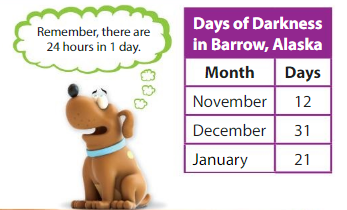
Question 1.

2,423

2,324

Answer: 2,423 is greater than 2,324

Explanation:

The given 2 numbers are 2,423 and 2,324

From these 2 numbers, we can conclude that 2,423 is greater than 2,324.

Question 2.

9,631

9,637

Answer: 9,631 is less than 9,637

Explanation:

The given 2 numbers are 9,631 and 9,637.

From these 2 numbers, we can conclude that 9,631 is less than 9,637

Question 3.

15,728

16,728

Answer: 15,728 is less than 16,728

Explanation:

The given 2 numbers are 15,728 and16,728.

From these 2 numbers, we can conclude that 15,728 is less than 16,728

Compare

Question 4.

Big Ideas Math Answers Grade 4 Chapter 1 Place Value Concepts 1.3 4

Answer: 5,049 is less than 5,082

Explanation:

The given 2 numbers are 5,049 and 5,082.

From these 2 numbers, we can conclude that5,049 is less than 5,082

Question 5.

Big Ideas Math Answers Grade 4 Chapter 1 Place Value Concepts 1.3 5

Answer: 735,283 is equal to 735,283

Explanation:

The given 2 numbers are 735,283 and 735,283.

From these 2 numbers, we can conclude that 735,283 is equal to 735,283

Question 6.

Big Ideas Math Answers Grade 4 Chapter 1 Place Value Concepts 1.3 6

Answer: 43,694 is greater than 3,694

Explanation:

The given 2 numbers are 43,694 and 3,694.

From these 2 numbers, we can conclude that 43,694 is greater than 3,694

Question 7.

Big Ideas Math Answers Grade 4 Chapter 1 Place Value Concepts 1.3 7

Answer: 88,195 is greater than 78,195

Explanation:

The given 2 numbers are88,195 and 78,195.

From these 2 numbers, we can conclude that 88,195 is greater than 78,195

Question 8.

Big Ideas Math Answers Grade 4 Chapter 1 Place Value Concepts 1.3 8

Answer: 6,480 is less than 6,508

Explanation:

The given 2 numbers are 6,480 and 6,508.

From these 2 numbers, we can conclude that 6,480 is less than 6,508

Question 9.

Big Ideas Math Answers Grade 4 Chapter 1 Place Value Concepts 1.3 9

Answer: 321,817 is greater than 312,827

Explanation:

The given 2 numbers are 321,817 and 312,827.

From these 2 numbers, we can conclude that 321,817 is greater than 312,827

Apply and Grow: Practice

Compare.

Question 10.

Big Ideas Math Answers Grade 4 Chapter 1 Place Value Concepts 1.3 10
Answer: 6,052 is less than 6,520

Explanation:

The given 2 numbers are 6,052 and 6,520.

From these 2 numbers, we can conclude that 6,052 is less than 6,520

Question 11.

Big Ideas Math Answers Grade 4 Chapter 1 Place Value Concepts 1.3 11
Answer: 891,634 is greater than 871,634

Explanation:

The given 2 numbers are 891,634 and 871,634

From these 2 numbers, we can conclude that 891,634 is greater than 871,634

Question 12.

Big Ideas Math Answers Grade 4 Chapter 1 Place Value Concepts 1.3 12

Answer: 28,251 is greater than 26,660

Explanation:

The given 2 numbers are28,251 and 26,660

From these 2 numbers, we can conclude that 28,251 is greater than 26,660

Question 13.

Big Ideas Math Answers Grade 4 Chapter 1 Place Value Concepts 1.3 13
Answer: 324,581 is greater than 32,458

Explanation:

The given 2 numbers are 324,581 and 32,458

From these 2 numbers, we can conclude that 324,581 is greater than 32,458

Question 14.

Big Ideas Math Answers Grade 4 Chapter 1 Place Value Concepts 1.3 14
Answer: 230,611 is greater than 230,610

Explanation:

The given 2 numbers are 230,611 and 230,610

From these 2 numbers, we can conclude that 230,611 is greater than 230,610

Question 15.

Big Ideas Math Answers Grade 4 Chapter 1 Place Value Concepts 1.3 15
Answer: 909,900 is greater than 909,009

Explanation:

The given 2 numbers are 909,900 and 909,009

From these 2 numbers, we can conclude that 909,900 is greater than 909,009

Question 16.

Big Ideas Math Answers Grade 4 Chapter 1 Place Value Concepts 1.3 16
Answer: 7,134 is less than 7,634

Explanation:

The given Expanded Form is: 7,000 + 100 + 30 + 4 = 7,134

The given 2 numbers are 7,134 and 7,634

From these 2 numbers, we can conclude that 7,134 is less than 7,634

Question 17.

Big Ideas Math Answers Grade 4 Chapter 1 Place Value Concepts 1.3 17
Answer: 100,003 is greater than 10,003

Explanation:

The given Word Form is: ten thousand, three = 10,003

The given 2 numbers are 100,003 and 10,003

From these 2 numbers, we can conclude that 100,003 is greater than 10,003

Question 18.

Big Ideas Math Answers Grade 4 Chapter 1 Place Value Concepts 1.3 18
Answer: 16,409 is less than 16,490

Explanation:

The given word Form is: Sixteen thousand, four hundred nine = 16,409

The given 2 numbers are 16,409 and16,490

From these 2 numbers, we can conclude that 16,409 is less than 16,490

Question 19.

Big Ideas Math Answers Grade 4 Chapter 1 Place Value Concepts 1.3 19
Answer: 461,329 is equal to 461,329

Explanation:

The given Expanded Form is: 400,000 + 60,000 + 1,000 + 300 + 20 + 9 =461,329

The given 2 numbers are 461,329 and 461,329

From these 2 numbers, we can conclude that 461,329 is equal to 461,329

Question 20.

Two brands of televisions cost $1,598 and $1,998. Which is the lesser price?

Big Ideas Math Answers Grade 4 Chapter 1 Place Value Concepts 1.3 20

Answer: The lesser price is: $1,598

Explanation:

The given costs of two brands of Television are $1,598 and $1,998

From the two costs of Television, we can conclude that the lesser price is: $1,598

Question 21.

DIG DEEPER!

Your friend says she can tell which sum is greater without adding the numbers. How can she tell?
34,593 + 6,781

34,593 + 6,609

Answer: 6,781 is greater tha 6,609

Explanation:

The given sums are:

34,593 + 6,781

34,593 + 6,609

From these two sums, we can see that 6,781 is greater tha 6,609

Question 22.

Number Sense

Write all of the digits that make the number greater than 23,489 and less than 26,472.

2?,650

Answer: 3 and 4

Explanation:

The given numbers are: 23,489 and 26,472

The digits that make the number greater than 23,489 and less than 26,472 are: 3 and 4

Question 23.

YOU BE THE TEACHER

Your friend says 38,675 is less than 9,100 because 3 is less than 9. Is your friend correct? Explain.

Answer: No

Explanation:

The given numbers are 38,675 and 9,100

In 38,675, the highest place-value is: 30,000

In 9,100, the highest place-value is: 9,000

From these, we can conclude that 38,675 is greater than 9,100

Think and Grow: Modeling Real Life

Example

Which playground costs the least?

Write each number in a place value chart.

Big Ideas Math Answers Grade 4 Chapter 1 Place Value Concepts 1.3 21

Big Ideas Math Answers Grade 4 Chapter 1 Place Value Concepts 1.3 22

Answer:

The playground which costs the least is: Green

Explanation: From the given table, we can conclude that “Green” has the least cost which is $35,872

Order the numbers from least to greatest.
_______, ______, _______

Answer: Green, Yellow, Blue

Explanation:

Compare the costs of 3 playgrounds

Green: $35,872    Yellow: $36,827  Blue: $36,927

From these costs, we can conclude that the order is: Green, Yellow, Blue

The ______ playground costs the least.

Answer: Green

Explanation:

Compare the costs of 3 playgrounds

Green: $35,872    Yellow: $36,827  Blue: $36,927

From these costs, we can conclude that the “Green Playground” has the least cost.

Show and Grow

Question 24.

Who received the highest score? Did anyone beat the high score?

Big Ideas Math Answers Grade 4 Chapter 1 Place Value Concepts 1.3 23

Big Ideas Math Answers Grade 4 Chapter 1 Place Value Concepts 1.3 24

Answer: You

Explanation:

The given high score is: 252,980

The score of You is: 254,020

From the given scores, we can conclude that “You” scored the highest score than the given high score.

Question 25.

Name two cities that have a greater population than St. Louis. Name two cities that do not have a greater population than Oakland.
Big Ideas Math Answers Grade 4 Chapter 1 Place Value Concepts 1.3 25

Answer:

The two cities that have a greater population than St. Louis: Tulsa, OK; Cleveland, OH; Oakland, CA

The two cities that do not have a greater population than Oakland: St. Louis, MO; Anchorage, AK

Compare Multi-Digit Numbers Homework & Practice 1.3

Write which place to use when comparing the numbers

Question 1.

396,241

386,201

Answer: Ten thousand’s  place

Explanation: The given numbers are: 396,241 and 386,201

When we want to compare the numbers directly, compare Ten thousand’s place to get the answer.

Question 2.

50,718

50,798

Answer: Tens place

Explanation: The given numbers are: 50,718 and 50,798

When we want to compare the numbers directly, compare Tens place to get the answer.

Question 3.

159,624

459,623

Answer: Hundred thousand place

Explanation: The given numbers are: 159,624 and 459,623

When we want to compare the numbers directly, compare a Hundred thousand place to get the answer.

Compare

Question 4.

Big Ideas Math Answers Grade 4 Chapter 1 Place Value Concepts 1.3 26

Answer: 7,902 is less than 7,912

Explanation:

The given 2 numbers are 7,902 and 7,912

From these 2 numbers, we can conclude that 7,902 is less than 7,912

Question 5.

Big Ideas Math Answers Grade 4 Chapter 1 Place Value Concepts 1.3 27
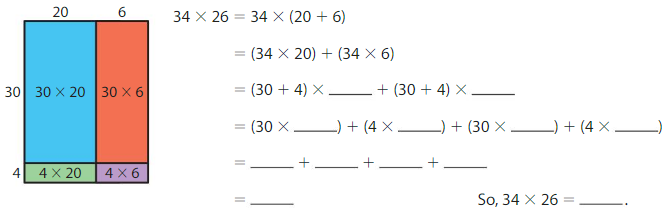
Answer: 63,871 is less than 63,902

Explanation:

The given 2 numbers are63,871 and 63,902

From these 2 numbers, we can conclude that 63,871 is less than 63,902

Question 6.

Big Ideas Math Answers Grade 4 Chapter 1 Place Value Concepts 1.3 28

Answer: 839,304 is greater than 829,001

Explanation:

The given 2 numbers are 839,304 and 829,001

From these 2 numbers, we can conclude that 839,304 is greater than 829,001

Question 7.

Big Ideas Math Answers Grade 4 Chapter 1 Place Value Concepts 1.3 29

Answer: 48,931 is greater than 48,930

Explanation:

The given 2 numbers are 48,931 and 48,930

From these 2 numbers, we can conclude that 48,931 is greater than 48,930

Question 8.

Big Ideas Math Answers Grade 4 Chapter 1 Place Value Concepts 1.3 30

Answer: 5,739 is equal to 5,739

Explanation:

The given 2 numbers are 5,739 and 5,739

From these 2 numbers, we can conclude that5,739 is equal to 5,739

Question 9.

Big Ideas Math Answers Grade 4 Chapter 1 Place Value Concepts 1.3 31

Answer: 10,000 is less than 100,000

Explanation:

The given 2 numbers are 10,000 and 100,000

From these 2 numbers, we can conclude that 10,000 is less than 100,000

Compare

Question 10.

Big Ideas Math Answers Grade 4 Chapter 1 Place Value Concepts 1.3 32

Answer: 16,420 is greater than 16,402

Explanation:

The given Expanded Form is: 10,000 + 6,000 + 400 + 2 = 16,402

The given 2 numbers are 16,420 and 16,402

From these 2 numbers, we can conclude that 16,420 is greater than 16,402

Question 11.

Big Ideas Math Answers Grade 4 Chapter 1 Place Value Concepts 1.3 33

Answer: 14.000 is less than 114,000

Explanation:

The given Word Form is fourteen thousand = 14,000

The given 2 numbers are 14.000 and 114,000

From these 2 numbers, we can conclude that 14.000 is less than 114,000

Question 12.

Big Ideas Math Answers Grade 4 Chapter 1 Place Value Concepts 1.3 34

Answer: 800,095 is less than 800,695

Explanation:

The given Word Form is eight hundred thousand, ninety-five = 800,095

The given 2 numbers are 800,095 and 800,695

From these 2 numbers, we can conclude that 800,095 is less than 800,695

Question 13.

Big Ideas Math Answers Grade 4 Chapter 1 Place Value Concepts 1.3 35

Answer: 509,733 is equal to 509,733

Explanation:

The given Expanded Form is 500,000 + 9,000 + 700 + 30 + 3 = 509,733

The given 2 numbers are 509,733 and509,733

From these 2 numbers, we can conclude that 509,733 is equal to 509,733

Question 14.

Two different laptops cost $1,050 and$1,150. Which is the lesser price?

Big Ideas Math Answers Grade 4 Chapter 1 Place Value Concepts 1.3 36

Answer: $1,050 is the lesser price.

Explanation:

The cost of two different Laptops are: $1,050 and $1,150

When compare $1,050 and $1,150, we can conclude that $1,050 is the lesser price.

Question 15.

DIG DEEPER!

If the leftmost digits of two multi-digit numbers are 6and 9, can you tell which number is greater? Explain.

Answer: 9 is a greater number

Explanation:

The given leftmost digits of two numbers are 6 and 9.

When we compare 6 and 9, we can conclude that 9 is the greater number.

Question 16.

Writing

Explain why you start comparing digits on the left when comparing multi-digit numbers.

Answer: When we compare multi-digit numbers, we start comparing digits on the leftmost side because those numbers’ positions have the highest place-value.

Question 17.

Modeling Real Life

Use the table to answer the questions.

Name two museums that had a yearly attendance greater than Children’sMuseum of Denver. Name two museums

that had a yearly attendance less than Discovery Place.

Big Ideas Math Answers Grade 4 Chapter 1 Place Value Concepts 1.3 37
Answer:

The museums that had a yearly attendance greater than the Children’s Museum of Denver are:

A) Boston Children’s Museum  B) Children’s Museum of Houston  C) Discovery palace  D) Exploratorium

The museums that had a yearly attendance less than Discovery Place are:

A) Boston Children’s Museum  B) Children’s Museum of Denver  C) Please Touch Museum

Review & Refresh

Round.

Question 18.

654

Nearest ten: _____

Nearest hundred: _____

Answer: 50, 600

Explanation:

The given number is: 654

When we round off the tens place, the nearest ten is: 50

When we round off the hundreds place, the nearest hundred is: 600

Question 19.

709

Nearest ten: _____

Nearest hundred: ______

Answer: 0, 700

Explanation:

The given number is: 709

When we round off the tens place, the nearest ten is: 0 ( Since the tens place is 0)

When we round off the hundreds place, the nearest hundred is: 700

Question 20.

25

Nearest ten: _____

Nearest hundred: _______

Answer: 20, 0

Explanation:

The given number is: 25

When we round off the tens place, the nearest ten is: 20

When we round off the hundreds place, the nearest hundred is: 0 ( Since the hundreds place is 0)

Lesson 1.4 Round Multi-Digit Numbers

Explore and Grow

Write five numbers that round to 250 when rounded to the nearest ten.

Big Ideas Math Solutions Grade 4 Chapter 1 Place Value Concepts 1.4 1

Answer: 210, 220, 230, 240, 250

Explanation:

The five numbers that round to 250 when rounded to the nearest ten are: 210, 220, 230, 240, 250


Write five numbers that round to 500 when rounded to the nearest hundred.

Big Ideas Math Solutions Grade 4 Chapter 1 Place Value Concepts 1.4 2

Answer: 100, 200, 300, 400, 500

Explanation:

The five numbers that round to 500 when rounded to the nearest hundred are: 100, 200, 300, 400, 500

Repeated Reasoning

Explain your strategy. Then explain how you could use the strategy to round a four-digit number to the nearest thousand.

Answer:

Think and Grow: Round Multi-Digit Numbers

To round a number, find the multiple of 10, 100, 1,000, and so on, that is closest to the number. You can use a number line or place value to round numbers.

Example

Use a number line to round 4,276 to the nearest thousand.
Big Ideas Math Solutions Grade 4 Chapter 1 Place Value Concepts 1.4 3

4,276 is closer to 4,000 than it is to 5,000.

So, 4,276 rounded to the nearest thousand is _______.

Answer: 4,000

Explanation: The number 4276 can be round off to 4,000 when rounded to the nearest thousand.

Example

Use place value to round 385,617 to the nearest ten thousand.

Big Ideas Math Solutions Grade 4 Chapter 1 Place Value Concepts 1.4 4

So, 385,617 rounded to the nearest thousand is _______.

Answer: 390,000

Explanation:

The number 385,617 can be round off to 390,000 when rounded to the nearest thousand. ( Since the thousands position is greater than 5)

Show and Grow

Round the number to the place of the underlined digit.

Question 1.

6,912

Answer: 7000

Explanation:

The number 6,912 can be round off to 7,000 when rounded to the nearest thousand. ( Since the thousands position is greater than 5)

Question 2.

43,215

Answer: 43,000

Explanation:

The number 43,215 can be round off to 43,000 when rounded to the nearest thousand. ( Since the thousands position is less than 5)

Question 3.

25,883

Answer: 25,000

Explanation:

The number 25,883 can be round off to 25000 when rounded to the nearest thousand. ( Since the thousands position is less than 5)

Question 4.

148,796

Answer: 140,000

Explanation:

The number 148,796 can be round off to 140000 when rounded to the nearest thousand. ( Since the thousands position is less than 5)

Question 5.

Round 5,379 to the nearest thousand.

Answer: 5,000

Explanation:

The number 5,379 can be round off to 5,000 when rounded to the nearest thousand. ( Since the thousands position is equal to 5)

Question 6.

Round 70,628 to the nearest ten thousand.

Answer: 70,000

Explanation:

The number 70,628 can be round off to 70,000 when rounded to the nearest ten thousand.

Question 7.

Round 362,113 to the nearest hundred thousand.

Answer:360,000

Explanation:

The number 362,113 can be round off to 360000 when rounded to the nearest hundred thousand.

Question 8.

Round 982,638 to the nearest thousand.

Answer:980,000

Explanation:

The number 982,638 can be round off to 980,000 when rounded to the nearest thousand. ( Since the thousands position is less than 5)

Apply and Grow: Practice

Round the number to the place of the underlined digit.

Question 9.

3,641

Answer: 3,700

Explanation:

The number 3,641 can be round off to 3700 when rounded to the nearest hundred. ( Since the hundreds position is greater than 5)

Question 10.

17,139

Answer: 18,000

Explanation:

The number 17,139can be round off to 18000 when rounded to the nearest thousand. ( Since the thousands position is greater than 5)

Question 11.

426,384

Answer: 426,300

Explanation:

The number 426,384 can be round off to 426300 when rounded to the nearest hundred ( Since the hundreds position is greater than 5)

Question 12.

542,930

Answer: 542,000

Explanation:

The number 542,930 can be round off to 542,000 when rounded to the nearest thousand. ( Since the thousands position is greater than 5)

Round the number to the nearest thousand.

Question 13.

9,426

Answer: 9,000

Explanation:

The number 9,426 can be round off to 9000 when rounded to the nearest thousand.

Question 14.

57,496

Answer: 58,000

Explanation:

The number 57,496 can be round off to 58000 when rounded to the nearest thousand. ( Since the thousands position is greater than 5)

Question 15.

360,491

Answer: 360,000

Explanation:

The number 360,491 can be round off to 360000 when rounded to the nearest thousand.

Question 16.

824,137

Answer: 824,000

Explanation:

The number 824,137 can be round off to 824,000 when rounded to the nearest thousand. ( Since the thousands position is less than 5)

Round the number to the nearest hundred thousand.

Question 17.

226,568

Answer: 200,000

Explanation:

The number 226,568 can be round off to 200,000 when rounded to the nearest hundred thousand. ( Since the hundred thousand position is less than 5)

Question 18.

457,724

Answer: 400,000

Explanation:

The number 457,724 can be round off to 400,000 when rounded to the nearest hundred thousand. ( Since the hundred thousand  position is less than 5)

Question 19.

108,665

Answer: 100,000

Explanation:

The number 108,665 can be round off to 100,000 when rounded to the nearest hundred thousand. ( Since the hundred thousand  position is less than 5)

Question 20.

75,291

Answer:

Question 21.

Number Sense

Write a five-digit number that has the digits 6, 0, 4, 2, and 8 and rounds to 70,000 when rounded to the nearest ten thousand.

Answer: 68,420

Explanation:

The given 5-digits are: 6, 0, 4, 2 and 8

The 5-git number which can be formed by using the given 5 digits are 68,420 and 68,420 can be round off to 70,000 when rounded to the nearest ten thousand.

Question 22.

Number Sense

When finding the United States census, should you round or find an exact answer? Explain.

Answer:

Question 23.

Open-Ended

A lightning strike can reach a temperature of about 54,000 degrees Fahrenheit. Write four possible temperatures for a lightning strike.

Answer:

Think and Grow: Modeling Real Life

Example

When the results are rounded to the nearest ten thousand, which token received about 160,000 votes?

Big Ideas Math Solutions Grade 4 Chapter 1 Place Value Concepts 1.4 5

Answer:

When the results are rounded to the nearest ten thousand, the tokens which received 1,60,000 votes are:

A) Race Car  B) Rubber Duck

Round each number to the nearest ten thousand.

Big Ideas Math Solutions Grade 4 Chapter 1 Place Value Concepts 1.4 6

Answer:

A) 134,704 : 130,000  B) 154,165 : 150,000  C) 207,954 : 208,000  D) 212,476 : 212,000

E) 167,582 : 170,000  F) 146,661 : 150,000  G) 165,083 : 170,000 H) 160,485 : 160,000

So, the _______ received about 160,000 votes.

Answer:

A) Race Car  B) Rubber Duck

Show and Grow

Use the table above.

Question 24.

When the results are rounded to the nearest ten thousand, which tokens received about 150,000 votes?

Answer:

A) Cat  B)  Penguin

Explanation:

From the above table, we can conclude that Cat and the Penguin have 160,000 votes when rounded to the nearest ten thousand.

Question 25.

When the results are rounded to the nearest hundred thousand, which tokens received about 100,000 votes?

Answer:

A) Cat  B) Penguin

Explanation:

From the above table, we can conclude that Cat and the Penguin have 160,000 votes when rounded to the nearest hundred thousand

Question 26.

DIG DEEPER!

To which place should you round each number of votes so that you can order the numbers from greatest to least? Explain.

Answer:

Question 27.
A car battery should be replaced when the odometer shows about 50,000 miles. None of the cars below have had a battery replacement. Which cars might need a new battery?
Big Ideas Math Solutions Grade 4 Chapter 1 Place Value Concepts 1.4 7
Answer: ODO

Explanation:

From the given Fig.,

we can conclude that ODO which has above 50,000 miles needs a battery replacement.

Round Multi-Digit Numbers Homework & Practice 1.4


Round the number to the place of the underlined digit.

Question 1.

6,251

Answer: 6,250

Explanation:

The given number is 6,251 and the underlined digit is 5.

Since the underlined digit is equal to 5, we can conclude that the given number can round off to 6,250

Question 2.

8,962

Answer: 9,000

Explanation:

The given number is 8,962 and the underlined digit is 8.

Since the underlined digit is greater than 5, we can conclude that the given number can round off to 9,000

Question 3.

3,951

Answer: 3,950

Explanation:

The given number is 3,951 and the underlined digit is 9.

we can conclude that the given number can round off to 3,950

Question 4.

79,064

Answer: 80,000

Explanation:

The given number is 79,064 and the underlined digit is 9.

Since the underlined digit is greater than 5, we can conclude that the given number can round off to 80,000

Question 5.

43,976

Answer: 43,000

Explanation:

The given number is 43,976 and the underlined digit is 3.

Since the underlined digit is greater than 5, we can conclude that the given number can round off to 43,000

Question 6.

24,680

Answer: 24,000

Explanation:

The given number is 24,680 and the underlined digit is 2.

Since the underlined digit is less than 5, we can conclude that the given number can round off to 24,000

Question 7.

726,174

Answer: 800,000

Explanation:

The given number is 726,174 and the underlined digit is 7.

Since the underlined digit is greater than 5, we can conclude that the given number can round off to 800,000

Question 8.

138,691

Answer: 140,000

Explanation:

The given number is 138,691 and the underlined digit is 8.

Since the underlined digit is greater than  5, we can conclude that the given number can round off to 140,000

Round the number to the nearest thousand.

Question 9.

5,517

Answer: 5,000

Explanation:

The given number is 5,517. Since the thousands position is equal to 5, we can round it off to 5,000

Question 10.

70,628

Answer: 70,000

Explanation:

The given number is 70,628. Since the thousands position is less than 5, we can round it off to 70,000

Round the number to the nearest ten thousand.

Question 11.

114,782

Answer: 110,000

Explanation:

The given number is 114,782. Since the ten thousand’s  position is less than 5, we can round it off to 110,000

Question 12.

253,490

Answer: 250,000

Explanation:

The given number is 253,490. Since the ten  thousand’s position is equal to 5, we can round it off to 250,000

Round the number to the nearest hundred thousand.

Question 13.

628,496

Answer: 700,000

Explanation:

The given number is 628,496. Since the hundred  thousand’s position is greater than 5, we can round it off to 700,000

Question 14.

90,312

Answer: 90,312

Explanation:

The given number is 90,312. There is no hundred thousand’s position in the given number. So, there is no effect on the given number.

Question 15.

Structure

Round * to the nearest thousand and to the nearest ten thousand.

Big Ideas Math Solutions Grade 4 Chapter 1 Place Value Concepts 1.4 8

Nearest thousand: ______

Nearest ten thousand: ______

Answer: Nearest Thousand: 8000

Nearest ten thousand: 10,000

Explanation:

In the given fig., the * sign is present after 7,500.

From this, we can conclude that

Nearest Thousand: 8000

Nearest ten thousand: 10,000

Question 16.

Number Sense

Which numbers round to 300,000 when rounded to the nearest hundred thousand?

Big Ideas Math Solutions Grade 4 Chapter 1 Place Value Concepts 1.4 9

Answer: 302,586

Explanation:

From the given fig., when we observe the positions of hundred’s  and ten thousand’s positions, it is clear that “302,586” can round off to 300,000

Question 17.

Number Sense

When discussing the price of a laptop, should you round to the nearest thousand or the nearest ten? Explain.

Answer: When you are discussing the price of a laptop, you should round off to the nearest thousand instead of the nearest ten.

Example: Suppose you want to buy a laptop that costs $152,236. When the dealer told you the price of a laptop, you will ask to round off the price of the laptop so that it will be easier for you to buy that laptop.

Question 18.

YOU BE THE TEACHER

Your friend says 5,953 rounds to 5,053 when rounded to the nearest hundred. Is your friend correct? Explain.

Answer: Wrong

Explanation:

The given number is 5,953. When rounded off to the nearest hundred, the given number becomes 6,000 since the hundreds position is greater than 5.

Question 19.

Modeling Real Life

A glassblower is using a furnace to melt glass. When the furnace reaches about 2,000 degrees Fahrenheit, when

rounded to the nearest hundred, she can put the glass in. At which temperatures could she put the glass into the

furnace?

Big Ideas Math Solutions Grade 4 Chapter 1 Place Value Concepts 1.4 10

Big Ideas Math Solutions Grade 4 Chapter 1 Place Value Concepts 1.4 11
Answer: 1925

Explanation:

Given that the furnace reached 2000 degrees Fahrenheit when rounded off to the nearest hundred.

So, the given options are: A) 2005   B) 1899  C) 1925  D) 275  E) 1002

From the given options, it is clear that 1925 degrees can round off to 2000 degrees.

Note: The option 2005 degrees can’t become the answer because when rounding off to the nearest number, the number should be less than the desired number.

Review & Refresh

Find the perimeter of the polygon.

Question 20.

Big Ideas Math Solutions Grade 4 Chapter 1 Place Value Concepts 1.4 12

Perimeter: _____

Answer: 23 in.

Explanation:

The “Perimeter” is defined as the total length of the geometrical figure covered on all sides.

So, the perimeter of the Polygon can be calculated as :

10 in. + 4 in. + 6 in. + 3 in. = 23 in.

Question 21.

Big Ideas Math Solutions Grade 4 Chapter 1 Place Value Concepts 1.4 13

Perimeter: _____

Answer: 26 m

Explanation:

The “Perimeter” is defined as the total length of the geometrical figure covered on all sides.

In a Parallelogram, the parallel sides are equal.

So, the length of all the sides of a parallelogram is: 8 m, 8 m, 5 m, 5 m

So,

The perimeter of the parallelogram can be calculated as:

8 m + 8 m + 5 m + 5 m = 26 m

Question 22

Big Ideas Math Solutions Grade 4 Chapter 1 Place Value Concepts 1.4 14

Perimeter: ______

Answer: 28 ft

Explanation:

The “Perimeter” is defined as the total length of the geometrical figure covered on all sides.

In a Square, the length of all the sides is equal. So, even in the fig., the length of 1 side is given, we can take it as the length of each of the remaining sides.

So, the perimeter of the square can be calculated as:

7 ft + 7 ft + 7ft + 7 ft = 28 ft.

Place Value Concepts Performance Task

You hike from Point A through Point F along the orange path shown on the map.

Big Ideas Math Answer Key Grade 4 Chapter 1 Place Value Concepts 1

Question 1.

What is the distance in elevation between each contour line?

Answer: 100 ft.

Explanation:

When we observe the Contour lines from 2000 ft. to 3000 ft., we can conclude that each Contour line can represent 100 ft.

Question 2.

As you walk from A to C, are you walking uphill or downhill? Explain.

Answer: Downhill

Explanation: When we observe the orange path in the given Contour lines, we can conclude that from A to C, you are going downhill.

Question 3.

Which letter represents the highest point? Estimate the height.

Answer: C

Explanation:

If we observe the Orange path, then we can see that Point C represents the highest point.

Question 4.

A water station has an elevation of 2,763 feet. Which letter represents the location of the water station?

Answer: Point B

Explanation:

From the Orange path, we can see that between 2,500 ft and 3,000 ft., Point is present which can represent the location of the water Station that has an elevation of 2,763 feet.

Question 5.

You take a break when you are at two thousand eighty feet. At which letter do you take a break?

Answer: Point A

Explanation:

Point A is present after 2,000 ft which is the nearest to 2,080 ft. So, Point A takes a break here.

Question 6.

About how much higher do you think Point C is than Point D? Explain.

Answer:

Place Value Concepts Activity

Place Value Plug-In

Directions:

1.Players take turns.

2.On your turn, roll six dice.Arrange the dice into a six-digit number that matches one of the descriptions.

3.Write your number on the lines.

4. The first player to complete all of the numbers wins!

Big Ideas Math Answer Key Grade 4 Chapter 1 Place Value Concepts 2

Place Value Concepts Chapter Practice

1.1 Understand Place Value

Write the value of the underlined digit.

Question 1.

26,490

Answer: 90

Explanation;

The position of each digit in a number is defined and it is the value based on the position of the digit. So, the place value of ‘9’ in 26,490’ is:  90

Question 2.

57,811

Answer: 50,000

Explanation:

The position of each digit in a number is defined and it is the value based on the position of the digit. So, the place value of ‘5’ in ‘57,811’ is:  50,000

Question 3.

308,974

Answer: 8,000

Explanation:

The position of each digit in a number is defined and it is the value based on the position of the digit. So, the place value of ‘8’ in ‘308,974’ is: 8,000

Question 4.

748,612

Answer: 700,000

Explanation:

The position of each digit in a number is defined and it is the value based on the position of the digit. So, the place value of ‘7’ in ‘748,612’ is: 700,000

Compare the values of the underlined digits

Question 5.

94 and 982

Answer: The value of  9 in 982 is 10 times the value of 9 in 94

Explanation:

The value of 9 in 982 is: 900

The value of 9 in 94 is: 90

From these values, we can conclude that the value of  9 in 982 is 10 times the value of 9 in 94

Question 6.

817,953 and 84, 006

Answer: The value of 8 in 817,953 is 10 times the value of 8 in 84,006

Explanation:

The value of 8 in 817,953 is:800,000

The value of 8 in 84,006 is:80,000

From these values, we can conclude that the value of 8 in 817,953 is 10 times the value of 8 in 84,006

1.2 Read and Write Multi-Digit Numbers

Question 7.

Complete the table.

Big Ideas Math Answer Key Grade 4 Chapter 1 Place Value Concepts chp 7

Answer:

A)50,000 + 600 + 90 + 1

Word Form: Fifty thousand, Six hundred Ninety-one

Standard Form: 50,691

Explanation:

We can write any number in 3 Forms. They are;

A) Standard Form  B) Word Form  C) Expanded Form

Now, the given number is 50,000 + 600 + 90 + 1 which is in Expanded Form. So, we have to write the given number in the remaining 2 forms.

B) Seven hundred two thousand, five hundred

Standard Form:702,500

Expanded Form: 700,000 + 0 + 2,000 + 500 + 0 + 0

Explanation:

We can write any number in 3 Forms. They are;

A) Standard Form  B) Word Form  C) Expanded Form

Now, the given number is Seven hundred two thousand, five hundred which is in Word Form. So, we have to write the given number in the remaining 2 forms.

C) 993,004

Word Form: Nine hundred Ninety-three thousand, four

Expanded Form: 900,000 + 90,000 + 3,000 + 0 + 0 +4

Explanation:

We can write any number in 3 Forms. They are;

A) Standard Form  B) Word Form  C) Expanded Form

Now, the given number is 993,004 which is in Standard Form. So, we have to write the given number in the remaining 2 forms.

Question 8.

Modeling Real Life

Use the number 10,000 + 4,000 + 300 + 90 + 9 to complete the check.

Big Ideas Math Answer Key Grade 4 Chapter 1 Place Value Concepts chp 8

Answer:

Word Form: Fourteen thousand, Three hundred Ninety-nine

Standard Form: 14,399

Explanation:

We can write any number in 3 Forms. They are;

A) Standard Form  B) Word Form  C) Expanded Form

Now, the given number is10,000 + 4,000 + 300 + 90 + 9 which is in Expanded Form. So, we have to write the given number in the remaining 2 forms.

1.3 Compare Multi-Digit Numbers

Write which place to use when comparing the numbers.

Question 9.

46,027

46,029

Answer: 46,027 is less than 46,029

Explanation:

The given 2 numbers are 46,027 and 46,029.

From these 2 numbers, we can conclude that 46,027 is less than 46,029

Question 10.

548,003

545,003

Answer: 548,003 is greater than 545,003

Explanation:

The given 2 numbers are 548,003 and 545,003.

From these 2 numbers, we can conclude that 548,003 is greater than 545,003

Question 11.

619,925

630,982

Answer: 619,925 is less than 630,982

Explanation:

The given 2 numbers are 619,925 and 630,982.

From these 2 numbers, we can conclude that 619,925 is less than 630,982

Compare.

Question 12.

Big Ideas Math Answer Key Grade 4 Chapter 1 Place Value Concepts chp 12

Answer: 4,021 is less than 4,210

Explanation:

The given 2 numbers are 4,021 and 4,210.

From these 2 numbers, we can conclude that 4,021 is less than 4,210

Question 13.

Big Ideas Math Answer Key Grade 4 Chapter 1 Place Value Concepts chp 13

Answer: 78,614 is equal to 78,614

Explanation:

The given 2 numbers are 78,614 and 78,614.

From these 2 numbers, we can conclude that 78,614 is equal to 78,614

Question 14.

Big Ideas Math Answer Key Grade 4 Chapter 1 Place Value Concepts chp 14

Answer: 816,532 is greater than 816,332

Explanation:

The given 2 numbers are 816,532 and 816,332.

From these 2 numbers, we can conclude that 816,532 is greater than 816,332

Question 15.

Big Ideas Math Answer Key Grade 4 Chapter 1 Place Value Concepts chp 15

Answer: 55,002 is less than 65,002

Explanation:

The given 2 numbers are 55,002 and 65,002.

From these 2 numbers, we can conclude that 55,002 is less than 65,002

Question 16.

Big Ideas Math Answer Key Grade 4 Chapter 1 Place Value Concepts chp 16

Answer: 3,276 is greater than 3,275

Explanation:

The given 2 numbers are 3,276 and 3,275.

From these 2 numbers, we can conclude that 3,276 is greater than 3,275

Question 17.

Big Ideas Math Answer Key Grade 4 Chapter 1 Place Value Concepts chp 17

Answer: 45,713 is less than 457,130

Explanation:

The given 2 numbers are45,713 and 457,130.

From these 2 numbers, we can conclude that 45,713 is less than 457,130

Question 18.

Big Ideas Math Answer Key Grade 4 Chapter 1 Place Value Concepts chp 18

Answer: 569,021 is greater than 56,902

Explanation:

The given Expanded Form is: 50,000 + 6,000 + 900 + 2 =56,902

The given 2 numbers are569,021 and 56,902.

From these 2 numbers, we can conclude that 569,021 is greater than 56,902

Question 19.

Big Ideas Math Answer Key Grade 4 Chapter 1 Place Value Concepts chp 19

Answer: 37,000 is less than 307,000

Explanation:

The given Word Form is: Thirty – seven thousand = 37,000

The given 2 numbers are 37,000 and 307,000.

From these 2 numbers, we can conclude that37,000 is less than 307,000

Question 20.

Two different hot tubs cost $4,179 and $4,139. Which is the lesser price?

Answer: The lesser price is $4,139

Explanation:

The costs of two different hot tubs are: $4,179 and $4,139

On comparing the costs of two different hot tubs, we can conclude that the lesser price is $4,139

Question 21.

Number Sense

Write all of the digits that make the number greater than 47,068 and less than 47,468.?

47,?68

Answer: 1, 2, 3

Explanation:

The digits that make the number greater than 47,068 and less than 47,468 are: 1, 2, 3

1.4 Round Multi-Digit Numbers

Round the number to the place of the underlined digit.

Question 22.

8,614

Answer: 8,610

Explanation:

The number 8,614 can be round off to 8,610 when rounded to the nearest ten. ( Since the tens position is less than 5)

Question 23.

2,725

Answer: 2,000

Explanation:

The number 2,725 can be round off to 2,000 when rounded to the nearest thousand. ( Since the thousands position is less than 5)

Question 24.

27,602

Answer: 27,700

Explanation:

The number 27,602 can be round off to 27,700 when rounded to the nearest hundred. ( Since the hundreds position is greater than 5)

Question 25.

906,154

Answer: 906,100

Explanation:

The number 906,154 can be round off to 906,100 when rounded to the nearest hundred. ( Since the hundreds position is less than 5)

Round the number to the nearest thousand.

Question 26.

1,358

Answer: 1,000

Explanation:

The number 1,358 can be round off to 1,000  when rounded to the nearest thousand. ( Since the thousands position is less than 5)

Question 27.

57,094

Answer: 58,000

Explanation:

The number 57,094 can be round off to 58,000 when rounded to the nearest thousand. ( Since the thousands position is greater than 5)

Round the number to the nearest ten thousand.

Question 28.

431,849

Answer: 431,000

Explanation:

The number 431,849 can be round off to 431,000  when rounded to the nearest ten thousand. ( Since the ten thousand’s  position is less than 5)

Question 29.

60,995

Answer: 70,000

Explanation:

The number 60,995 can be round off to 70,000 when rounded to the nearest ten thousand. ( Since the ten thousand’s position is greater than 5)

Final Words:

We wish the information provided in the Big Ideas Math Answers Grade 4 Chapter 1 Place Value Concepts is helpful for you. Make use of the above links and start your preparation. Keep in touch with us to get the updates regarding all the chapters of Big Ideas Math Answers Grade 4.